Physicists follow (ultra)cold front to foundations of science In graduate school Lincoln Carr worked at the European Organization for Nuclear Research (CERN), where he studied ultra-hot quark-gluon plasmas in an effort to re-create conditions from the first microsecond of the universe. Today Carr, an associate professor in Mines’ Department of Physics, is at the opposite end of the temperature scale — working with ultracold quantum gases that could hold the key to developing new quantum materials. Aided by the supercomputer dubbed “Ra” at Mines, the Carr Theoretical Physics Group works in three main fields: quantum many-body theory, nonlinear dynamics and artificial materials. Research in each area aims to bring about technological advances and contribute to the underlying knowledge base. “A standing question in physics is how to transition from quantum things like electrons, which are best described by probability waves, to classical things like chunks of rock or water or people, which are best described by definite statements like, ‘I am here, at this time, not moving,’” said Carr. “We know how to do this for one or a few particles, but are not really sure about the limits of quantum mechanics and the transition to the classical for many particles.” Understanding is growing rapidly as new developments occur. Just last year, there was a development in ultracold physics where ultracold atoms were assembled into ultracold molecules. It’s an area Carr’s group is quite
order of tens of nanoseconds), but the Mines research team observed methane hydrate nucleation by extending simulations two orders of magnitude longer than previous studies to achieve simulations of microseconds. While more research is necessary to obtain a complete picture, these simulations represent a substantial step toward understanding hydrate nucleation. These simulations reveal an intricate microscopic mechanism for hydrate formation, a phenomenon described by Princeton University Professor Pablo Debenedetti as a “molecular ballet” in an accompanying commentary in the same Science issue. This molecular ballet involves the cooperation of water and methane to form a nearly symmetrical structure followed by rearrangement to allow formation of more methane-trapping water cages. This kind of information could allow companies to engineer physical and chemical processes to prevent (in oil and gas flow assurance or during energy recovery) or promote (in gas storage) gas hydrate nucleation. “Scientific problems like this demonstrate how high-performance
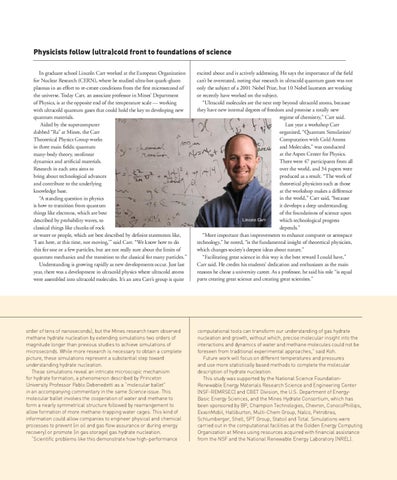
excited about and is actively addressing. He says the importance of the field can’t be overstated, noting that research in ultracold quantum gases was not only the subject of a 2001 Nobel Prize, but 10 Nobel laureates are working or recently have worked on the subject. “Ultracold molecules are the next step beyond ultracold atoms, because they have new internal degrees of freedom and promise a totally new regime of chemistry,” Carr said. Last year a workshop Carr organized, “Quantum Simulation/ Computation with Cold Atoms and Molecules,” was conducted at the Aspen Center for Physics. There were 47 participants from all over the world, and 34 papers were produced as a result. “The work of theoretical physicists such as those at the workshop makes a difference in the world,” Carr said, “because it develops a deep understanding of the foundations of science upon Lincoln Carr which technological progress depends.” “More important than improvements to enhance computer or aerospace technology,” he noted, “is the fundamental insight of theoretical physicists, which changes society’s deepest ideas about nature.” “Facilitating great science in this way is the best reward I could have,” Carr said. He credits his students’ dedication and enthusiasm as the main reasons he chose a university career. As a professor, he said his role “is equal parts creating great science and creating great scientists.”
computational tools can transform our understanding of gas hydrate nucleation and growth, without which, precise molecular insight into the interactions and dynamics of water and methane molecules could not be foreseen from traditional experimental approaches,” said Koh. Future work will focus on different temperatures and pressures and use more statistically based methods to complete the molecular description of hydrate nucleation. This study was supported by the National Science FoundationRenewable Energy Materials Research Science and Engineering Center (NSF-REMRSEC) and CBET Division, the U.S. Department of EnergyBasic Energy Sciences, and the Mines Hydrate Consortium, which has been sponsored by BP, Champion Technologies, Chevron, ConocoPhillips, ExxonMobil, Halliburton, Multi-Chem Group, Nalco, Petrobras, Schlumberger, Shell, SPT Group, Statoil and Total. Simulations were carried out in the computational facilities at the Golden Energy Computing Organization at Mines using resources acquired with financial assistance from the NSF and the National Renewable Energy Laboratory (NREL). Energy
and the
Earth
13