Retiring Faculty
Dale DeLetis Milton Academy Faculty, 1972–2001
F
or 29 years, Dale DeLetis has been greeting each of his new classes on the first day of school with a simple but immaculately enunciated and memorable ritual statement. “Good morning, everyone. My name is Mr. DeLetis. Capital D, little e, capital L, little e-t-i-s. That is your first spelling lesson.” Through nearly three decades Performing English classes, Oral Interpretation students, girls in Class VI English, fourth graders, Modern World Drama pupils, debaters, speechies and any others who may have been lucky enough, have been introduced to Dale’s unique combination of passion and clarity with those simple words. With them Dale has modeled confidence, respect, attention to detail, a light heart and straightforward engagement through the spoken word. For a long time now, most of Dale’s students have come to his first class knowing they would hear those words. They have waited for the moment with poorly disguised delight in their eyes and giggled or smiled and cast sidelong glances of recognition when it came. They recognize Dale’s ritual for what it has become – a rite of identification, one of those things about our School which does not change, which can be counted on through the years, which persists for a simple reason – because it works. In fact, Dale’s ritual has worked for so long that it has become a minor tradition of the institution, a part of the shared experience, which we all know and value as Milton Academy. Institutional memory is a very important concept to Dale. At crucial moments of redefinition and change during the past decade he has, time and again, helped us to put Milton’s continuing growth and dynamism into historical context. In fact, Mr. DeLetis can describe for you in personal
building the team. She was closely followed by Debbie Simon; soon Milton was a regional and then a national power in speech.
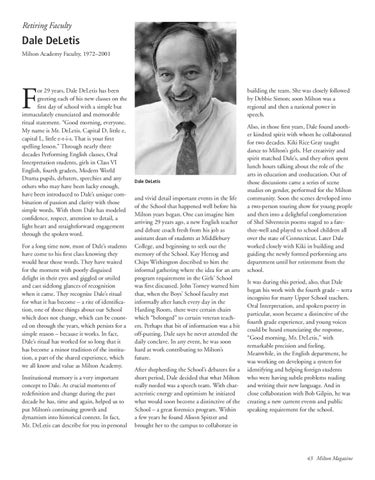
Dale DeLetis
and vivid detail important events in the life of the School that happened well before his Milton years began. One can imagine him arriving 29 years ago, a new English teacher and debate coach fresh from his job as assistant dean of students at Middlebury College, and beginning to seek out the memory of the School. Kay Herzog and Chips Withington described to him the informal gathering where the idea for an arts program requirement in the Girls’ School was first discussed. John Torney warned him that, when the Boys’ School faculty met informally after lunch every day in the Harding Room, there were certain chairs which “belonged” to certain veteran teachers. Perhaps that bit of information was a bit off-putting. Dale says he never attended the daily conclave. In any event, he was soon hard at work contributing to Milton’s future. After shepherding the School’s debaters for a short period, Dale decided that what Milton really needed was a speech team. With characteristic energy and optimism he initiated what would soon become a distinctive of the School – a great forensics program. Within a few years he found Alison Spitzer and brought her to the campus to collaborate in
Also, in those first years, Dale found another kindred spirit with whom he collaborated for two decades. Kiki Rice Gray taught dance to Milton’s girls. Her creativity and spirit matched Dale’s, and they often spent lunch hours talking about the role of the arts in education and coeducation. Out of those discussions came a series of scene studies on gender, performed for the Milton community. Soon the scenes developed into a two-person touring show for young people and then into a delightful conglomeration of Shel Silverstein poems staged to a farethee-well and played to school children all over the state of Connecticut. Later Dale worked closely with Kiki in building and guiding the newly formed performing arts department until her retirement from the school. It was during this period, also, that Dale began his work with the fourth grade – terra incognito for many Upper School teachers. Oral Interpretation, and spoken poetry in particular, soon became a distinctive of the fourth grade experience, and young voices could be heard enunciating the response, “Good morning, Mr. DeLetis,” with remarkable precision and feeling. Meanwhile, in the English department, he was working on developing a system for identifying and helping foreign students who were having subtle problems reading and writing their new language. And in close collaboration with Bob Gilpin, he was creating a new current events and public speaking requirement for the school.
43 Milton Magazine