“If you listen, the other person might listen to you, rather than both of you talking and yelling over one another,” says Sachiyo. “If you listen, you might solve the problem more quickly.” She then has students discuss what good and bad listening looks like and how you know when someone is not listening to you. They move on to finding a fair solution—a topic they spend time on during each open circle. By focusing on each child’s need during a disagreement, they can work toward finding a compromise. For example: If one student wants to read during recess and another wants to build with blocks, the reader wants silence and the block builder
wants to make noise. In the end, the students come up with the solution of splitting recess into reading time and block time. “It may take a while to get there, but walking through the steps of compromising helps the students realize that problems have more than one solution,” says Sachiyo. “It takes patience and listening to each other to figure out how both needs can be met.” Sachiyo concludes the open circle by reminding students that “conflict resolution does not mean one of us has to be right. Both perspectives are valid. Everyone has feelings, and sometimes no one is right or wrong—that is just how they feel.”
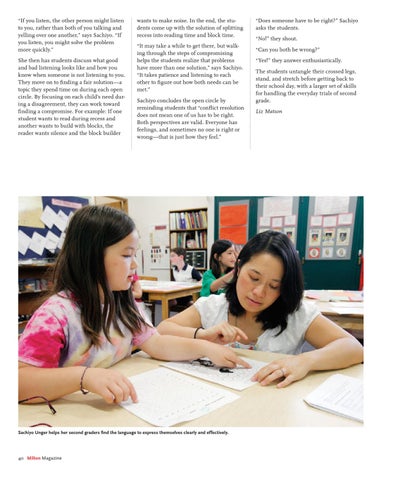
Sachiyo Unger helps her second graders find the language to express themselves clearly and effectively.
40 Milton Magazine
“Does someone have to be right?” Sachiyo asks the students. “No!” they shout. “Can you both be wrong?” “Yes!” they answer enthusiastically. The students untangle their crossed legs, stand, and stretch before getting back to their school day, with a larger set of skills for handling the everyday trials of second grade. Liz Matson