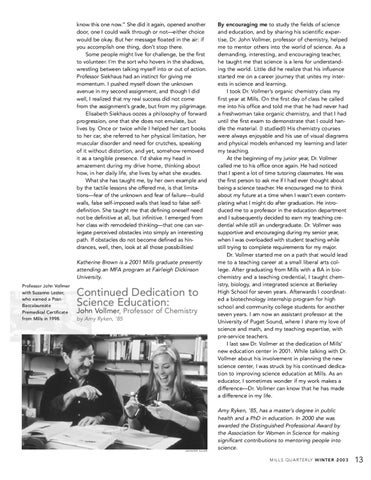
know this one now.” She did it again, opened another door, one I could walk through or not—either choice would be okay. But her message floated in the air: if you accomplish one thing, don’t stop there. Some people might live for challenge, be the first to volunteer. I’m the sort who hovers in the shadows, wrestling between talking myself into or out of action. Professor Siekhaus had an instinct for giving me momentum. I pushed myself down the unknown avenue in my second assignment, and though I did well, I realized that my real success did not come from the assignment’s grade, but from my pilgrimage. Elisabeth Siekhaus oozes a philosophy of forward progression, one that she does not emulate, but lives by. Once or twice while I helped her cart books to her car, she referred to her physical limitation, her muscular disorder and need for crutches, speaking of it without distortion, and yet, somehow removed it as a tangible presence. I’d shake my head in amazement during my drive home, thinking about how, in her daily life, she lives by what she exudes. What she has taught me, by her own example and by the tactile lessons she offered me, is that limitations—fear of the unknown and fear of failure—build walls, false self-imposed walls that lead to false selfdefinition. She taught me that defining oneself need not be definitive at all, but infinitive. I emerged from her class with remodeled thinking—that one can variegate perceived obstacles into simply an interesting path. If obstacles do not become defined as hindrances, well, then, look at all those possibilities! Katherine Brown is a 2001 Mills graduate presently attending an MFA program at Fairleigh Dickinson University. Professor John Vollmer with Suzanne Lester, who earned a PostBaccalaureate Premedical Certificate from Mills in 1998.
Continued Dedication to Science Education: John Vollmer, Professor of Chemistry by Amy Ryken, ’85
JENNIFER SAUER
By encouraging me to study the fields of science and education, and by sharing his scientific expertise, Dr. John Vollmer, professor of chemistry, helped me to mentor others into the world of science. As a demanding, interesting, and encouraging teacher, he taught me that science is a lens for understanding the world. Little did he realize that his influence started me on a career journey that unites my interests in science and learning. I took Dr. Vollmer’s organic chemistry class my first year at Mills. On the first day of class he called me into his office and told me that he had never had a freshwoman take organic chemistry, and that I had until the first exam to demonstrate that I could handle the material. (I studied!) His chemistry courses were always enjoyable and his use of visual diagrams and physical models enhanced my learning and later my teaching. At the beginning of my junior year, Dr. Vollmer called me to his office once again. He had noticed that I spent a lot of time tutoring classmates. He was the first person to ask me if I had ever thought about being a science teacher. He encouraged me to think about my future at a time when I wasn’t even contemplating what I might do after graduation. He introduced me to a professor in the education department and I subsequently decided to earn my teaching credential while still an undergraduate. Dr. Vollmer was supportive and encouraging during my senior year, when I was overloaded with student teaching while still trying to complete requirements for my major. Dr. Vollmer started me on a path that would lead me to a teaching career at a small liberal arts college. After graduating from Mills with a BA in biochemistry and a teaching credential, I taught chemistry, biology, and integrated science at Berkeley High School for seven years. Afterwards I coordinated a biotechnology internship program for high school and community college students for another seven years. I am now an assistant professor at the University of Puget Sound, where I share my love of science and math, and my teaching expertise, with pre-service teachers. I last saw Dr. Vollmer at the dedication of Mills’ new education center in 2001. While talking with Dr. Vollmer about his involvement in planning the new science center, I was struck by his continued dedication to improving science education at Mills. As an educator, I sometimes wonder if my work makes a difference—Dr. Vollmer can know that he has made a difference in my life. Amy Ryken, ’85, has a master’s degree in public health and a PhD in education. In 2000 she was awarded the Distinguished Professional Award by the Association for Women in Science for making significant contributions to mentoring people into science. M I L L S Q U A R T E R LY W I N T E R 2 0 0 3
13