Historic Bridgetown Street, High Street. Opposite the church was an open market, with its name borrowed from the famous London market, the Shambles. It was here that in the late eighteenth century, the slaves of Bridgetown and outlying country districts were given formal permission by the House of Assembly to sell any of their produce, such as ginger, aloes, vegetables or herbs from their allotments or gardens. The monies earned from these sales, even though mostly small sums, still gave the enslaved a sense of autonomy and independence that was highly valued.
The wealthier classes move across town
Photo: Henry Walter Parkinson with the kind permission of the Parkinson family
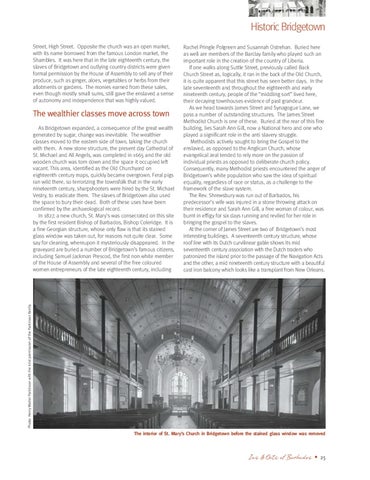
As Bridgetown expanded, a consequence of the great wealth generated by sugar, change was inevitable. The wealthier classes moved to the eastern side of town, taking the church with them. A new stone structure, the present day Cathedral of St. Michael and All Angels, was completed in 1665 and the old wooden church was torn down and the space it occupied left vacant. This area, identified as the Old Churchyard on eighteenth century maps, quickly became overgrown. Feral pigs ran wild there, so terrorizing the townsfolk that in the early nineteenth century, sharpshooters were hired by the St. Michael Vestry, to eradicate them. The slaves of Bridgetown also used the space to bury their dead. Both of these uses have been confirmed by the archaeological record. In 1827, a new church, St. Mary’s was consecrated on this site by the first resident Bishop of Barbados, Bishop Coleridge. It is a fine Georgian structure, whose only flaw is that its stained glass window was taken out, for reasons not quite clear. Some say for cleaning, whereupon it mysteriously disappeared. In the graveyard are buried a number of Bridgetown’s famous citizens, including Samuel Jackman Prescod, the first non white member of the House of Assembly and several of the free coloured women entrepreneurs of the late eighteenth century, including
Rachel Pringle Polgreen and Susannah Ostrehan. Buried here as well are members of the Barclay family who played such an important role in the creation of the country of Liberia. If one walks along Suttle Street, previously called Back Church Street as, logically, it ran in the back of the Old Church, it is quite apparent that this street has seen better days. In the late seventeenth and throughout the eighteenth and early nineteenth century, people of the “middling sort” lived here, their decaying townhouses evidence of past grandeur. As we head towards James Street and Synagogue Lane, we pass a number of outstanding structures. The James Street Methodist Church is one of these. Buried at the rear of this fine building, lies Sarah Ann Gill, now a National hero and one who played a significant role in the anti slavery struggle. Methodists actively sought to bring the Gospel to the enslaved, as opposed to the Anglican Church, whose evangelical zeal tended to rely more on the passion of individual priests as opposed to deliberate church policy. Consequently, many Methodist priests encountered the anger of Bridgetown’s white population who saw the idea of spiritual equality, regardless of race or status, as a challenge to the framework of the slave system. The Rev. Shrewsbury was run out of Barbados, his predecessor’s wife was injured in a stone throwing attack on their residence and Sarah Ann Gill, a free woman of colour, was burnt in effigy for six days running and reviled for her role in bringing the gospel to the slaves. At the corner of James Street are two of Bridgetown’s most interesting buildings. A seventeenth century structure, whose roof line with its Dutch curvilinear gable shows its mid seventeenth century association with the Dutch traders who patronized the island prior to the passage of the Navigation Acts and the other, a mid nineteenth century structure with a beautiful cast iron balcony which looks like a transplant from New Orleans.
The interior of St. Mary’s Church in Bridgetown before the stained glass window was removed
Ins & Outs of Barbados
• 25