www.flagshipnews.com | The Flagship | Section 1 | Thursday, August 4, 2022 7
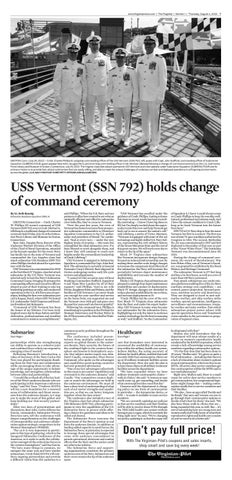
GROTON, Conn. (July 29, 2022) – Cmdr. Charles Phillips III, outgoing commanding officer of the USS Vermont (SSN 792), left, poses with Capt. John Stafford, commanding officer of Submarine Squadron (SUBRON) FOUR, guest speaker Rear Adm. Douglas Perry and incoming commanding officer Cmdr. Michael Lilleberg following a change-of-command ceremony at the U.S. Submarine Force Library and Museum in Groton, Connecticut, July 29, 2022. The Virginia-class fast attack submarine USS Vermont and crew operate under Submarine Squadron (SUBRON) FOUR and its primary mission is to provide fast-attack submarines that are ready, willing, and able to meet the unique challenges of undersea combat and deployed operations in unforgiving environments across the globe. (U.S. NAVY PHOTO BY CHIEF PETTY OFFICER JOSHUA KARSTEN)
USS Vermont (SSN 792) holds change of command ceremony By Lt. Seth Koenig
Submarine Readiness Squadron (SRS) 32
GROTON, Connecticut — Cmdr. Charles W. Phillips III turned command of USS Vermont (SSN 792) over to Cmdr. Michael A. Lilleberg in a traditional change of command ceremony held Friday, July 29, at the Submarine Force Library and Museum in Groton, Connecticut. Rear Adm. Douglas Perry, director of the Undersea Warfare Division of the Office of the Chief of Naval Operations, attended as the keynote speaker for the event. Perry has family ties to the state of Vermont and commanded the Los Angeles-class fast attack submarine USS Pasadena (SSN 752) when Phillips checked aboard for a previous tour with the boat. USS Vermont was commissioned in 2020 as the first Block IV Virginia-class fast attack submarine in the U.S. Navy. Vermont was selected early to host the Navy’s Submarine Command Course, bringing 30 prospective commanding officers and executive officers aboard as part of their training to take top leadership positions on subs, and conducted operations in the U.S. 4th Fleet area of operations, holding the first-ever submarine port call in Itaguai, Brazil, where SSN 792 hosted U.S. Ambassador Todd Chapman and Brazilian President Jair Bolsonaro. “Command of USS Vermont has been the honor of my lifetime. I’ve been truly inspired every day by these Sailors and their dedication, professionalism and steadfast commitment to mission accomplishment,”
Submarine from Page 1
partnerships while also strengthening our ability to operate as a cohesive joint and combined force which can respond to emerging crises if needed.” Following Houston’s introduction, a video of Secretary of the Navy Carlos Del Toro was played for participants thanking them for their time and collaboration while encouraging them to take advantage of the unique opportunity to bolster knowledge and strengthen relationships between allies and partnerships. “I would like to thank all of the key leaders of the West’s undersea domain who are participating in this important conference today,” said Del Toro. “I believe SCOTA will lay a new foundation for a renewed sense of collaboration and threat awareness from the undersea domain, so I urge you to make the most of this gather and keep building our vital security partnerships.” After two days of presentations and discussions, Rear Adm. Carlos Alfonso Saz Garcia, commander, Submarine Forces, Peruvian navy, left the conference with deeper comprehension on the challenges of interoperability and undersea collaboration against strategic competitors in the Western Hemisphere (WHEM). “For us it is very important to participate in this type of gathering, which is the inaugural Submarine Conference of the Americas, as it seeks to unify the collaboration amongst all the submarine forces in the western hemisphere,” said Saz Garcia. “We have many things in common, we navigate the same seas and have similar submarines. I truly think SCOTA will reinforce ongoing partnerships and provide a different vision from the undersea to a
said Phillips. “When the U.S. Navy and our partners or allies have wanted to see what an optimally efficient and effective submarine crew looks like, they’ve come to Vermont. “Over the past few years, the crew of Vermont has hosted everyone from prospective submarine commanders to Destroyer Squadron Commodores to the U.S. ambassador and president of Brazil,” he continued. “And at every turn — under the very highest levels of scrutiny — this team has exemplified the ideal submarine crew. I’ve been blessed to work alongside them, and I know they will continue to reach new heights under the extraordinary leadership of Cmdr. Lilleberg.” USS Vermont is assigned to Submarine Squadron 4, commanded by Capt. John Stafford. The submarine is currently at General Dynamics Corp.’s Electric Boat shipyard in Groton undergoing routine early life cycle reviews and adjustments. “I cannot let this occasion pass without thanking Commodore Stafford, Squadron 4 and Team New London for all of their support,” said Phillips. “And to my wife Devon, daughters Eden and Paloma, and the families of USS Vermont: I can never thank you enough for your sacrifice and service on the home front, you supported me and the Vermont crew with grit and grace over the past few years and I am forever grateful.” Following his command tour, Phillips is transitioning to a position in the Division for Strategic Deterrence and Nuclear Policy in the J5 Directorate of the Joint Staff in Washington, D.C.
“USS Vermont has excelled under the guidance of Cmdr. Phillips. Getting to know this team in recent weeks has been incredibly motivating — I know I have big shoes to fill, but I’m deeply excited about the opportunity to join this crew and help Vermont get back out to sea to answer the nation’s call,” said Lilleberg, a native of Victor, Montana. “Vermont is equipped with state-of-the-art technology and highly skilled U.S. Navy Sailors, representing the rich military history of the Green Mountain State and the rest of this great country. We will work every day to return to the tip of the spear.” Block IV Virginia-class submarines like Vermont incorporate design changes focused on reduced total ownership cost. By making these smaller-scale design changes to increase the component-level lifecycle of the submarine, the Navy will increase the periodicity between depot maintenance availabilities and increase the number of deployments. Blocks I-III Virginia-class submarines are planned to undergo four depot maintenance availabilities and conduct 14 deployments. Block IV design changes are intended to reduce planned availabilities by one to three, and increase deployments to 15. “Cmdr. Phillips led the crew of the very first Block IV Virginia-class submarine into the fleet, and under his expert leadership, USS Vermont in many ways became our ambassador for the submarine force, highlighting not only the latest in undersea warfare technology, but the best in manning as well,” said Stafford. “As the Commodore
of Squadron 4, I knew I could always count on Cmdr. Phillips to keep his warship welltrained, professional and mission ready. And I have the utmost confident in Cmdr. Lilleberg as he leads Vermont into the future from here.” SSN 792 is U.S. Navy ship to bear the name Vermont, but first in a century. The first was one of nine 74-gun warships authorized by Congress in 1816. The second, Battleship No. 20, was commissioned in 1907 and first deployed in December of that year as part of the “Great White Fleet.” The battleship Vermont was decommissioned June 30, 1920. During the change of command ceremony, the sword of Revolutionary War hero Ethan Allen, one of Vermont’s founders, was granted for exhibition by the Naval History and Heritage Command. The submarine Vermont is 377 feet long and has a 34-foot beam, as well as a crew of more than 130 Navy personnel. Fast-attack submarines are multi-mission platforms enabling five of the six Navy maritime strategy core capabilities — sea control, power projection, forward presence, maritime security and deterrence. They are designed to excel in anti-submarine warfare, anti-ship warfare, strike warfare, special operations, intelligence, surveillance and reconnaissance, irregular warfare and mine warfare. Fast-attack submarines project power ashore with special operations forces and Tomahawk cruise missiles in the prevention or preparation of regional crises.
common security problem throughout the Americas.” The conference included presentations from multiple subject matter experts on global threats in the undersea theatre, Navy security, the future of the combined fight in the western hemisphere and lessons in hemispheric security. One subject matter expert was Adm. Daryl Caudle, commander, Fleet Forces Command, who spoke on the advantages and capabilities participating countries had over potential adversaries. “One of our key advantages collectively in this room is our navies’ capabilities and overmatch in the undersea domain,” said Caudle. “Our competitors cannot duplicate or match the advantages we hold in the undersea environment. We must all have a deep level of understanding of what each of our navies’ strengths and capabilities are, so that we can better integrate together when the time arises.” The conference also included a tour of the Virginia-class fast-attack submarine USS Montana (SSN 794), allowing participants to view the capabilities of the U.S. Submarine Force in person while offering a chance for questions and ideas to be asked and shared. The Submarine Force executes the Department of the Navy’s mission in and from the undersea domain. In addition to lending added capacity to naval forces, the Submarine Force, in particular, is expected to leverage those special advantages that come with undersea concealment to permit operational, deterrent and combat effects that the Navy and the nation could not otherwise achieve. The Submarine Force and supporting organizations constitute the primary undersea arm of the Navy. Submarines and their crews remain the tip of the undersea spear.
Healthcare
be eliminated with that.” Mullen also told lawmakers that the department will soon release results of a survey on women’s reproductive health conducted by the RAND Corporation, which reveals a lack of knowledge among service members regarding contraceptive options. “It’s the first time that has been done in 30 years,” Mullen said. “It’s given us quite a bit of information ... includ[ing that there’s] a lack of education about women’s options around contraceptives, which are free in our MTFs. All active-duty service members get free contraceptives within the MTFs and in our retail pharmacies.” Right now, Mullen said, there is a small copay for active-duty service members to get contraceptives, but congressional legislation might change that — making contraception totally free to service members and their families. “We also ... have an app called ‘Decide and Be Ready’ that men and women can use to go through their contraceptive options to decide what’s best for them,” she said. “We also have those walk-in clinics that are ... being expanded this year, as well. But ... it’s sort of astonishing how our young men and women really don’t fully know of what their reproductive rights and health care consists of, and we need to do a better job.”
from Page 1
care that lawmakers were interested in concerned the availability of contraception within the military health care system. Seileen Mullen, the acting secretary of defense for health affairs, testified that until recently DOD had contraceptive clinics set up at 18 military treatment facilities across the department. Now, she said, the plan is to have those clinics at all military treatment facilities across the department. “We have expanded where we have military treatment contraceptive clinics — walk-in clinics,” she said. “A woman or man could come up, get counseling, and decide what contraceptives they need that day.” Cisneros said the department is changing policy on one form of contraception in particular — the intrauterine device, or IUD — to make it available to more service members. “We are currently updating our policies so that service members and their families will be able to receive those IUDs through the TRICARE health care system without having to pay a copay, which is currently the thing right now,” he said. “We’re changing our policy, updating it, so that the copay will
Don’t pay full price! With The Virginian-Pilot’s coupons and sales inserts, shop smart and save big every week!