2010 Installation Guide and Directory 2010 Fort Eustis Installation Guide and Telephone Directory
Fort Eustis
table of contents Welcome.............................................................................2 Reporting In.....................................................................3 Curfew...................................................................................3 Registration of Firearms........................................................3 Vehicle Registration..............................................................3 Virginia Motor Law...............................................................3 Welcome Center....................................................................4 History of Fort Eustis...............................................5 Schools and Training................................................6 Felker Army Airfield.............................................................6 NCO Academy......................................................................6 U.S. Army Aviation Logistics School...................................6 1st Battalion, 222nd Aviation Regiment................................7 Maritime & Intermodal Training Department, U.S.Army Transportation School (Forward).....................7 Command and Tenants...............................................9 7th Sustainment Brigade.......................................................9 6th Transportation Battalion (Truck)...................................10 10th Transportation Battalion (Terminal)............................11 11th Transportation Battalion (Terminal)............................11 24th Transportation Battalion (Terminal)............................12 53rd Transportation Battalion (Movement Control)...........13 7th Special Troops Battalion...............................................13 8th Transportation Brigade..................................................13 71st Transportation Battalion..............................................14 597th Transportation Terminal Group, SDDC....................15 U.S. Army Training Support Center....................................15 Aviation Applied Technology Directorate...........................16 Joint Deployment Training Center......................................16 McDonald Army Health Center..........................................16 Military Surface Deployment & Distribution Command.......17 Services.............................................................................18 Army Career and Alumni Program.....................................18 Army Community Service..................................................18 Army Emergency Relief......................................................18 Cable, Internet, Phone & Wireless Service.........................18 Chapel Activities.................................................................18 Child,Youth & School Services...........................................19 Customer Management Services.........................................21 Commissary.........................................................................22 Dental Services....................................................................22 Network Enterprise Center (Directorate of Information Management)...............................................22 Employment........................................................................23 Equal Opportunity/Equal Employment Opportunity..........23 Finance Office.....................................................................24 Financial Institutions...........................................................24 Fire & Emergency Services.................................................24 Housing...............................................................................24 Human Resources Directorate.............................................25 Inspector General................................................................26
Lodging...............................................................................26 Military Police.....................................................................26 Post Exchange.....................................................................26 Post Office...........................................................................27 Public Affairs Office............................................................28 Recycling Operations..........................................................28 Red Cross............................................................................28 Staff Judge Advocate...........................................................28 Transportation.....................................................................29 Vehicle Inspection...............................................................29 Veterinary Service...............................................................29 Video Teleconference Center..............................................29 Clubs and Leisure.......................................................30 Fort Eustis Club...................................................................30 Spouses’ Club of Fort Eustis...............................................30 Fort Eustis Historical & Archeological Association (FEHAA).....................................................30 Aquatic Center.....................................................................30 Auto Crafts Shop.................................................................30 Bowling Center....................................................................31 Car Wash.............................................................................31 DFMWR Community Recreation Center............................31 Fit to Win Program..............................................................32 Golf Course.........................................................................32 Leisure Travel Service.........................................................32 Library.................................................................................33 Outdoor Pools......................................................................33 Outdoor Recreation Center..................................................33 Sports...................................................................................33 United Service Organizations..............................................34 Communities...................................................................35 At Fort Eustis & Surrounding Areas...................................35 U.S. Army Transportation Museum....................................35 Hampton Roads...................................................................35 Historic Triangle..................................................................36
U.S. Army Transportation Center Brig.Gen. Brian R. Layer, Commander Ms. Karla L. Gonzalez, Public Affairs Officer Ms. Monica Miller Rodgers, Command Information Officer
MILITARY NEWSPAPERS OF VIRGINIA
© 2006 Military Newspapers of Virginia 143 Granby Street, Norfolk, VA 23510 (757) 222-3990
Published by Military Newspapers of Virginia, a private firm in no way connected with the U.S. Army, under exclusive written contract with Fort Eustis and Fort Story. This installation Guide is an authorized publication for members of the U.S. military services. Contents of this publication are not necessarily the view of, or endorsed by, the U.S. Government, the Department of Defense, or the Department of the Army. The appearance of advertising in this publication does not constitute endorsement by the Department of Defense or the Department of the Army or Military Newspapers of Virginia of the products or the services advertised. Everything advertised in this publication shall be made available for purchase, use or patronage without regard to race, color, religion, sex, national origin, age, marital status, physical handicap, political affiliation or any other nonmerit factor of the purchaser, user or patron. Editorial content is edited, prepared and provided by the Public Affairs Office of Fort Eustis.
Fort Eustis Installation Guide & Directory •
WELCOME TO FORT EUSTIS Welcome to the Hampton Roads area of Virginia where the military and local history have been entwined since the Revolutionary War. Fort Eustis is home to the U.S. Army Transportation Center and School, U.S. Army Aviation Logistics School, 8th Transportation Brigade, Joint Strategic Deployment Center and 7th Sustainment Brigade. Here, officers and enlisted Soldiers receive education and on-the-job training in transportation, aviation maintenance, logistics, and deployment doctrine and research. In the spring of 2005, the Base Realignment and Closure committee recommended major realignments, which will change the organizations and management of Fort Eustis. Major changes include the relocation of the Transportation School to Fort Lee, the relocation of Headquarters, U.S. Army Training and Doctrine Command from Fort Monroe to Fort Eustis, and the deactivation of the 8th Transportation Brigade. Also as part of BRAC 2005, Joint Basing began in 2010 when nearby Langley Air Force Base in Hampton assumed operational control of Fort Eustis under the 633d Air Base Wing. Department of Army civilian employees are becoming Department of Air Force civilian employees, but Soldiers are remaining Soldiers and Airmen are remaining Airmen. For a complete list of impending realignment actions, please visit our Web page at www.eustis.army.mil. The changes to Fort Eustis will not change the world-class support provided to organizations, servicemembers, families and our retiree community. Fort Eustis is virtually a city in itself, complete with a shopping mall, bank, credit union, post office, chapels, Commissary and many other facilities. With a wealth of recreational opportunities and some of the richest history in the nation, whatever your interests, you can find them here. The surrounding area offers hundreds of attractions. From the “historic triangle” of Yorktown, Williamsburg and Jamestown to the dozens of amusement parks and museums – Hampton Roads has something for everyone. Hampton Roads is rich with military history, and we’re a proud part of the history and future of Hampton Roads as we play a vital role in the national military strategy. We hope your stay here will be enjoyable and your tour of duty professionally challenging and satisfying.
Arial View of Fort Eustis
James River
Fort Eustis Installation Guide & Directory •
reporting in Fort Eustis is pleased to make your transition into our community as easy as possible. The following pages highlight the information you need to know about reporting in at Fort Eustis, from where to go when you arrive to post curfew and directions on registering your car. The Fort Eustis Welcome Center is located at the main gate and is a useful first stop in gathering information about vehicle registration and visitor’s information, including maps, directions and additional information about your new home at Fort Eustis. CURFEW Curfew at Fort Eustis applies to all unmarried civilians and family members under 18 years of age. Curfew hours for children under age 16 are 9 p.m. to 6 a.m. Eastern Standard Time and 10 p.m. to 6 a.m. during daylightsaving time. During these hours, parents or responsible adults must accompany all children traveling outside their homes on the installations. Curfew for children attending commandsponsored chapel or Youth Services functions begins 30 minutes after the completion of the function, but not later than 11 p.m., Sunday through Thursday, and midnight, Friday and Saturday. Curfew prohibits children under 17 years of age from being on any street, roadway, alley, avenue, park or any other public place on Fort Eustis between midnight and 5 a.m., Monday through Friday; 1 to 5 a.m., Saturday and Sunday. Exceptions to this policy are: • When a minor is accompanied by a parent, guardian or other adult in charge of the care, custody or control of the minor. • When a minor is on an errand or in an emergency situation. • When a minor is engaged in lawful employment and is in transit either directly to the place of employment or directly from the place of employment to his or her legal residence.
Weapons are registered through the Fort Eustis Welcome Center, 2 Washington Blvd., Monday through Friday, 8 a.m. to 4 p.m., except holidays. After hours and on weekends, weapons may be registered at the Provost Marshal Office, Building 648, Washington Boulevard. For more information, call 878-1878.
VEHICLE REGISTRATION All privately-owned vehicles must be registered on Fort Eustis. Required documents include a military or civilian identification; valid driver’s license with motorcycle endorsement, if applicable; valid vehicle registration; proof of insurance; and proof of valid safety inspection if required by the state. Vehicles are registered through the Fort Eustis Welcome Center, 2 Washington Blvd., Monday through Friday, 8 a.m. to 4 p.m., except holidays. After hours and on weekends, vehicles may be registered at the Provost Marshal Office located at Building 648, Washington Blvd. For more information, call 878-1878.
VIRGINIA MOTOR LAW If you are an active-duty member of the Armed Forces stationed in Virginia, you, your spouse and dependent children may drive with a valid driver’s license issued by your home state or country. You are not required to obtain a Virginia driver’s license; however, if you choose to apply, you will need documents to prove: • Identity (two documents) • Virginia residency • Legal presence • Social security number, if you have been issued one Virginia law also has an unsafe driving demerit system in which points are counted against individuals for traffic violations. Under this system, the commonwealth of Virginia’s
REGISTRATION OF FIREARMS All privately-owned weapons on Fort Eustis must be registered within three days of arrival with the Provost Marshal Office at Building 2 in the Main Gate area.
The Welcome Center
Fort Eustis Installation Guide & Directory •
Department of Motor Vehicles Commissioner’s Office will issue advisory letters to individuals telling them whether their licenses are suspended or revoked, if they are to attend drivers’ improvement classes, or are to be placed on probation. These actions are in accordance with Virginia State Codes 46.2-492, Uniform Demerit Point System and 46.2-495, Advisory Letters, upon accumulation of eight points on the UDPS in a 12-month time span or 12 points in a 24-month time period.
WELCOME CENTER The Fort Eustis Welcome Center is located in Building 2 at the main gate. Its services include: in/out processing, vehicle registration, vehicle pass issuance, firearms registration, and welcome information (maps, directions and points of interest). The Fort Eustis Welcome Center, 2 Washington Blvd., is open Monday through Friday, 8 a.m. to 4 p.m., except holidays. For more information, call 878-1878.
IF YOU ARE DUTY HOURS Permanent Party (HQ Officers - Bldg 662, Rm 100 USATC&S; 8th Bde, Enlisted - Bldg 662, Rm 100 USAALS, 7th Trans. Bde, USAG)
AFTER DUTY HOURS Officers - Bldg 210, Lobby Enlisted - Bldg 210, Lobby Phone: 878-5050 *All Soldiers must report to In and Out Processing in Bldg 662, Rm 100 the first following duty day.
STUDENTS Transportation Students (Includes USAR and NG) 8th Transportation Brigade Aviation Students (Includes USAR and NG) 1-222d Avn Rgt / USAALS Allied International Students
Officers - Bldg 705, Co. G, Rm 212 Enlisted - Bldg 705, ESAB, Rm 40a
Officers - Bldg 705, Rm 7 Enlisted - Bldg 705, Rm 7
Officers - Bldg 814, Co. H Enlisted - Bldg 1011
Officers - Bldg 814, Co. H Enlisted - Bldg 2717 SDNCO
Officers - 2715F, IMSO, Rm F-1 Enlisted - 2715F, IMSO, Rm F-1
(Call in advance during duty hours at 757-878-6440 or DSN 927-6440 for pickup arrangements; otherwise report to Bldg 1700. After duty hours, call 240-9706.
Permanent Party MEDDAC
Officers - Bldg 516 Enlisted - Bldg 516
Officers - Bldg 576 Enlisted - Bldg 576
DENTAC
Officers - Bldg 1563 Enlisted - Bldg 1563
Officers - Bldg 576 Enlisted - Bldg 576
Army Training Support Center SDDC Operations Center Aviation Applied Technology Directorate
Officers - Bldg 2114, Rm 1436 Enlisted - Bldg 2114, Rm 1436
Officers - Bldg 1700, VOQ GSI Enlisted - Bldg 1700, VOQ GSI GSI General Smalls Inn **All Soldiers must report to Bldg 2114, Rm 1436 the following duty day
Active Component Bldg 661, 878-7569 Reserve Component Bldg 661, 878-8652
Bldg 661, Must use outside phone: 878-8141
Officers - Bldg 401, Rm 114 Enlisted - Bldg 401, Rm 114
Officers - Bldg 2110 VOQ Enlisted - Bldg 817, HQ Co
US Air Force US Marine Corps, Navy, and Coast Guard
Officers - Bldg 705, Rm 203 Enlisted - Bldg 705, Rm 203
Officers - Bldg 2110, VOQ Enlisted - Bldg 2110 E5 & below are to report to Bldg 1567
Officers - Bldg 705, Rm 203 Enlisted - Bldg 705, Rm 203
Officers - Bldg 2110, VOQ Enlisted - Bldg 2110
USAR, NG
Officers - Bldg 1733 Enlisted - Bldg 1733
Officers - Bldg 2110, VOQ Enlisted - Bldg 2110
Fort Eustis Installation Guide & Directory •
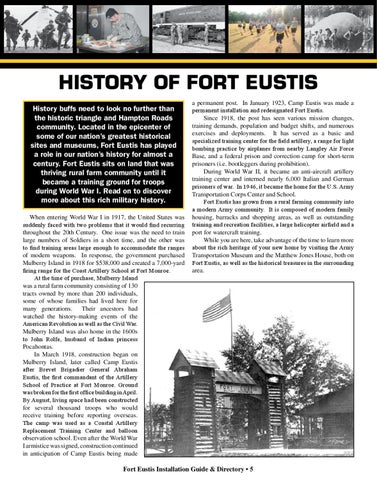
history of fort eustis History buffs need to look no further than the historic triangle and Hampton Roads community. Located in the epicenter of some of our nation’s greatest historical sites and museums, Fort Eustis has played a role in our nation’s history for almost a century. Fort Eustis sits on land that was thriving rural farm community until it became a training ground for troops during World War I. Read on to discover more about this rich military history. When entering World War I in 1917, the United States was suddenly faced with two problems that it would find recurring throughout the 20th Century. One issue was the need to train large numbers of Soldiers in a short time, and the other was to find training areas large enough to accommodate the ranges of modern weapons. In response, the government purchased Mulberry Island in 1918 for $538,000 and created a 7,000-yard firing range for the Coast Artillery School at Fort Monroe. At the time of purchase, Mulberry Island was a rural farm community consisting of 130 tracts owned by more than 200 individuals, some of whose families had lived here for many generations. Their ancestors had watched the history-making events of the American Revolution as well as the Civil War. Mulberry Island was also home in the 1600s to John Rolfe, husband of Indian princess Pocahontas. In March 1918, construction began on Mulberry Island, later called Camp Eustis after Brevet Brigadier General Abraham Eustis, the first commandant of the Artillery School of Practice at Fort Monroe. Ground was broken for the first office building in April. By August, living space had been constructed for several thousand troops who would receive training before reporting overseas. The camp was used as a Coastal Artillery Replacement Training Center and balloon observation school. Even after the World War I armistice was signed, construction continued in anticipation of Camp Eustis being made
a permanent post. In January 1923, Camp Eustis was made a permanent installation and redesignated Fort Eustis. Since 1918, the post has seen various mission changes, training demands, population and budget shifts, and numerous exercises and deployments. It has served as a basic and specialized training center for the field artillery, a range for light bombing practice by airplanes from nearby Langley Air Force Base, and a federal prison and correction camp for short-term prisoners (i.e. bootleggers during prohibition). During World War II, it became an anti-aircraft artillery training center and interned nearly 6,000 Italian and German prisoners of war. In 1946, it became the home for the U.S. Army Transportation Corps Center and School. Fort Eustis has grown from a rural farming community into a modern Army community. It is composed of modern family housing, barracks and shopping areas, as well as outstanding training and recreation facilities, a large helicopter airfield and a port for watercraft training. While you are here, take advantage of the time to learn more about the rich heritage of your new home by visiting the Army Transportation Museum and the Matthew Jones House, both on Fort Eustis, as well as the historical treasures in the surrounding area.
Fort Eustis Installation Guide & Directory •
schools & training Fort Eustis houses a number of training facilities that take advantage of its unique location along the James River. With the ability to train Army Soldiers on a variety of terrain, from land to sea and sand to woodland, Fort Eustis is unique in its ability to train Soldiers in a variety of different transportation capacities. This multidimensional ability and beautiful location help make Fort Eustis one of the best and most equipped military installations in the country.
NCO ACADEMY The U.S. Army Transportation Center Noncommissioned Officer Academy was organized Jan. 1, 1987 by direction of the Training and Doctrine Command and the U.S. Army Transportation and Aviation Logistics Schools. The USATCFE NCO Academy is located at 650 Monroe Ave.
FELKER ARMY AIRFIELD Felker Army Airfield, located on historic Mulberry Island at 2408 Condon Rd., is the Army’s first military heliport, designed in 1949 and dedicated in 1954 with Igor Sikorsky in attendance. Felker is an all-weather, full-service airfield, hosting six tenant organizations and providing a major site for Navy and Marine Corps helicopter training operations. As a member of Joint Base Langley-Eustis, the airfield is subordinate to the 1st Fighter Wing located at Langley Air Force Base. Tenants include: Training and Doctrine Command Flight Detachment, Aviation Applied Technology Directorate Flight Facility, 5th Battalion of the 159th Aviation Regiment, U.S. Army Aviation Logistics School, U.S. Air Force Detachment 1, 18th Weather Squadron, and Westwind Technologies Aviation Repair Facility.
Felker Army Airfield
NCO Academy The Eustis Noncommissioned Officers Academy is a joint partnership between the Transportation and Aviation Corp Regiments. The Academy’s mission is to produce noncommissioned officers grounded in a leadership framework promoting Army values and the warrior ethos; confidently and competently leading Soldiers in combat; and successfully performing their doctrinal war fighting roles in full spectrum operations within the contemporary operational environment. The commandant is a command sergeant major who works directly under the supervision of the Center commanding general and the Regimental command sergeant major. The Academy is fully accredited by the Training and Doctrine Command. Fort Eustis offers excellent training, maneuver and range areas to support all facets of training needed to conduct 26 noncommissioned officer education system courses. Its unique port facility, beachheads, wooded training sites and excellent roadway systems provide optimal opportunities for shared and multifunctional transportation training, such as Joint LogisticsOver-The-Shore exercises. The airfield and technical aviation lab and bay facilities provide a one-of-a-kind atmosphere needed to produce quality aviation logistics maintenance NCOs.
U.S. ARMY AVIATION LOGISTICS SCHOOL The U.S. Army Aviation Logistics School was established at
Fort Eustis Installation Guide & Directory •
Fort Eustis when the Aviation Branch was established in 1983. USAALS has been a tenant activity at Fort Eustis since Oct. 1, 1988. The U.S. Army Aviation Warfighting Center commander at Fort Rucker, Ala., is commandant of USAALS. The school provides a key link in the chain of Army Aviation combat support systems. It is devoted exclusively to the support of the Army Aviation war fighting mission through development of training for enlisted and officer personnel. USAALS provides helicopter maintenance training of U.S. Air Force and U.S. Foreign Military Sales customers either through integrated or co-located training. The school’s primary objective is to prepare a corps of highly specialized helicopter mechanics and logisticians for deployment to Army Aviation units worldwide. This objective is accomplished through ongoing programs in aviation maintenance management, training, evaluation, and the study of future materiel and support concepts geared to the latest aviation technology. Advanced learning environment, computer-aidedinstruction and state-of-the-art electronic training devices enhance the school’s programs. In its role as the Army-wide center for aviation logistics training and development, the school meets the dynamic challenge of keeping pace with tomorrow’s sophisticated and demanding needs in aviation logistics support. The school is accredited as a Training Institute of Excellence by Headquarters, Training and Doctrine Command, by the Commission on Occupational Education and the American Council on Education.
1ST BATTALION, 222ND AVIATION REGIMENT The 1st Battalion, 222nd Aviation Regiment conducts Advanced Individual Training and Soldierization by focusing on Army values, physical conditioning, warrior tasks and battle drills, and the warrior ethos at Fort Eustis in order to provide Soldiers to the field that can immediately contribute to the combat readiness of their gaining unit. The battalion consists of a Headquarters and Headquarters Detachment plus six Advanced Individual Training companies. HHD consists of the Battalion headquarters and Battalion staff elements. HHD is responsible for providing all administrative, logistics and plans, operations, and training support to the Battalion. There are five Initial Entry Training Companies in the Battalion that provided AIT training to Soldiers arriving from Basic Combat Training. These companies include; Alpha Company, Bravo Company, Charlie Company, Delta Company and Foxtrot Company. The IET Companies’ mission is to conduct Advanced Individual Training and Soldierization by focusing on Army values, physical conditioning, warrior tasks and battle drills, and the warrior ethos at Fort Eustis in order to provide Soldiers to the field that can immediately contribute to the combat readiness of
their gaining unit. Soldiers assigned to A Company train in one of the three following military occupations specialties: AH-64 (Apache) Attack Helicopter Repairer (15R), AH-64A Armament/Electrical Repairer (15X), and AH-64D Armament/Electrical Repairer (15Y). Soldiers assigned to B Company train in one of the three following MOSs: OH-58D (Kiowa Warrior) Helicopter Repairer (15S), OH-58D Armament/Electrical/Avionics System Repairer (15J), and Avionics Mechanic (15N). Soldiers assigned to C Company train in one MOS: UH-60 Utility (Black Hawk) Helicopter Repairer (15T). Soldiers assigned to D Company train in one of the four Aviation Allied Shops MOSs: Aircraft Powerplant Repairer (15B), Aircraft Powertrain Repairer (15D), Aircraft Electrician (15F), and Aircraft Structural Repairer (15G). Soldiers assigned to F Company train in one MOS: CH47 Cargo (Chinook) Helicopter Repairer (15U). H Company is the Battalion’s only MOS-transition company. As such, its mission is to continuously provide command and control for MOS/ASI training while focusing on Army values, warrior tasks and battle drills, and the warrior ethos at Fort Eustis to provide Soldiers to the field that can immediately contribute to the combat readiness of their gaining unit. Soldiers assigned to H Company attend AIT in one of 12 Aviation MOSs: Aircraft Powerplant Repairer (15B), Aircraft Powertrain Repairer (15D), Aircraft Electrician (15F), Aircraft Structural Repairer (15G), OH-58D Armament/Electrical/Avionics System Repairer (15J), Avionics Mechanic (15N), AH-64 Attack Helicopter Repairer (15R), OH-58D Helicopter Repairer (15S), UH-60 Blackhawk Helicopter Repairer (15T), CH-47 Chinook Helicopter Repairer (15U), AH-64A Armament/Electrical Repairer (15X), and AH64D Armament/Electrical Repairer (15Y).
MARITIME & INTERMODAL TRAINING DEPARTMENT, U.S. ARMY TRANSPORTATION SCHOOL (FORWARD) The Maritime & Intermodal Training Department, U.S. Army Transportation School (Forward) provides initial and advanced maritime, rail and terminal operations training to selected Transportation Corps military and civilian personnel of the U.S. armed forces, Department of Defense and foreign governments. The MITD develops and presents programs of resident, academic and online instruction to develop its leaders, support training in units, establishes applicable standards, and builds future Army transportation capability, incorporating advanced technology and state-of-the-art equipment into its curriculum. With the relocation of the Transportation School to Fort Lee, the Maritime & Intermodal Training Department remains at Fort Eustis as the forward element, providing vital training to current and future watercraft operators, engineers,
Fort Eustis Installation Guide & Directory •
cargo handlers, and rail operators and repairers. The chief future training remain relevant in today’s contemporary and of MITD serves as the forward element commander. Other operational environment through advanced and multifaceted organizations located on Fort Eustis as part of the forward training aimed at improving current and future concepts, element but not part of MITD are elements from the Training doctrine and materials. and Doctrine Command Capability Manager- Transportation, The MITD training campus is located at Bldg. 461, Kerr Road, Marine Qualification Office, Watercraft Safety, and Reserve adjacent to 3rd Port. Additional classrooms, training areas and Affairs. facilities are located at Bldg. 839 and the Rail Training Facility, The MITD is comprised of four training divisions and one Bldg. 2750. All courses taught at the maritime campus are support office that encompass every aspect of maritime, rail accredited by the American Council on Education. Additional and terminal operations. The Maritime Operations Division information regarding courses offered at the MITD may be provides training to initial and advanced watercraft operators found on the Transportation School’s home page at http://www. and warrant officers in basic seamanship and vessel operations transchool.eustis.army.mil. that includes all phases of navigation and piloting. The Maritime Engineering Maritime & Intermodal Training Department Division provides specialized instruction via state-of-the-art training laboratories and simulators to initial and advanced marine engineers and warrant officers as well as instruction for rail Soldiers that includes locomotive operations and repair. Marine engineers receive extensive training on electrical, hydraulics, welding, refrigeration, diesel engine operations and repair, and engine room procedures. The Maritime Simulations Division integrates classroom instruction with advanced simulations-based training on radar, small craft, high speed, full mission vessel bridge, and weapons simulators, providing realistic interactive training to operate a wide variety of Army watercraft and selected Navy, Coast Guard and commercial vessels. The Cargo Handling Division also integrates classroom instruction with advanced simulationsbased training using computerized crane and cargo handling simulators to provide realistic training on multiple types of cargo handling equipment. Students then apply the knowledge gained from simulation to the actual equipment loading and moving cargo on all types of vessels, vehicles and railcars. The Training Management Office provides essential administrative training support to all training divisions assigned to MITD. The training at MITD is constantly evolving as it adapts to the challenges of unpredictable areas of operation. MITD is dedicated to ensuring that current and
Fort Eustis Installation Guide & Directory •
commands & Tenants The command and tenants of Fort Eustis play a significant role in the Army warfighting machine. Fort Eustis Soldiers in units across post are trained and mobilized to support the Army mission and complete key missions in Overseas Contingency Operations. 7th Sustainment Brigade Soldiers are some of the most deployed in the military and perform a pivotal function in the current war effort. Other commands and tenants include the Army Training Support Center, Aviation Applied Technology Directorate, Joint Deployment Training Center and McDonald Army Health Center. 7TH SUSTAINMENT BRIGADE The 7th Sustainment Brigade is one of the most deployed units in the Army and has served honorably around the world in time of conflict since its activation in 1942. The Forces Command unit comprises approximately 4,000 Soldiers. The headquarters and six battalions – the Special Troops Battalion, the 6th Transportation Battalion, the 10th Transportation Battalion, the 24th Transportation Battalion and the 53rd Movement Control Battalion – are stationed at Fort Eustis. The 11th Transportation Battalion is stationed at Joint Expeditionary Base Little Creek-Fort Story (East) in Virginia Beach. The subordinate detachments and components that constitute the six battalions of the brigade are diverse in capability and equipment, including key enablers, such as logistics support vessels, landing craft, tugs, trucks, cargo transfer companies, movement control teams, divers and water purification units. The mission of the 7th Sustainment Brigade is to conduct worldwide multi-modal transportation operations to receive, stage, onward move and sustain forces for combat operations. 7th Sustainment Brigade has a unique range of capabilities, enabling strategic, operational and tactical level missions to be completed. Soldiers operate air and sea ports of debarkation by providing watercraft support, motor transport, terminal service, cargo transfer and cargo documentation in order to rapidly support force projection and provide sustainment to the armed forces throughout a theater of operations. Oct. 16, 2006, 7th Transportation Group became 7th
Sustainment Brigade. This increased the size of the headquarters from less than 100 to more than 380 Soldiers and incorporated a deployable command post, a Special Troops Battalion and a Signal Company. In addition, the Brigade has a Theater Opening Element (382nd TOE) and Theater Gateway (52nd TG) capability, and took command of the 53rd Movement Control Battalion. During World War II, the 7th Group, as it was then known, commanded ports in both the United Kingdom and Japan. During the Korean War, the 7th Group was designated as the 7th Medium Port and was responsible for all port operations in Pusan, Korea, in support of United Nations forces. During the Vietnam Conflict, the 7th Transportation Command (Terminal) was reactivated at Fort Eustis. The command provided a highly effective training base for the deployment of all watercraft and terminal service units deployed to the Republic of Vietnam. During the Grenada evacuation operation, elements of the group deployed on two separate occasions to discharge and load cargo by sea and air. The command was called upon again during Operation Just Cause in Panama, where deployed units provided airfield and control group support in functional services.
7th Sustainment Brigade In 1990 and 1991, the 7th Group was instrumental in the success of operations Desert Shield, Desert Storm and Desert Farewell. Within days of the Iraqi invasion of Kuwait, elements of the group began pouring into the Saudi Arabian desert. Opening the first seaports and airfields, the command grew to 9,200 Soldiers and 750 foreign national civilians who helped accomplish the most stunning and overwhelming deployment, sustainment, tactical movement and redeployment in U.S. military history. Little more than a year after the return from Saudi Arabia, the group deployed more than 1,100 Soldiers in support of Operation Restore Hope in December 1992. The last rotation of Soldiers departed the Port of Mogadishu, Somalia, in April 1994, after the United Nations assumed command of the humanitarian
Fort Eustis Installation Guide & Directory •
operation. Four months later, 7th Group supported another humanitarian mission in Mombassa, Kenya, providing relief support to Rwanda during Operation Support Hope. In September 1994, at the onset of Operation Uphold Democracy, 7th Group deployed more than 1,500 Soldiers to Haiti. During October 1994, 7th Group deployed more than 580 Soldiers to Southwest Asia in support Operation Vigilant Warrior. Soldiers from the 7th Group deployed to Hungary and Bosnia in December 1995 to support the NATO Implementation Force. Additionally, group officers augmented U.S. and NATO staff in Heidelberg, Germany; Naples, Italy; Budapest, Hungary; and Sarajevo, Bosnia-Herzegovina. January through April 1996, 7th Group Soldiers spearheaded the retrograde of forces from Haiti. Soldiers from the 7th Group have also provided humanitarian relief for Hurricane Bonnie victims in Puerto Rico in 1998 and for Hurricane Mitch victims in Central America in 1999. In the 21st century, the 7th Transportation Group continued to maintain the finest traditions of its illustrious past. In 2003 and 2004, the 7th Group deployed in support of Operation Iraqi Freedom, operating seaports and providing watercraft capabilities, line haul and cargo transfer across Kuwait and Iraq. In 2010, the Brigade participated in Operation Unified Response, helping Haiti after a devastating earthquake destroyed most of the country. Now armed with a new name and increasing strength to carry out the mission, 7th Sustainment Brigade is once again deploying in support of Operation Iraqi Freedom and Operation Enduring Freedom, and will continue to provide the transportation and support that keeps the Army moving. The 7th Sustainment Brigade’s continuing contribution to worldwide military missions has been immense. The 7th Brigade retains the ability to deploy on a moment’s notice, any of its units or equipment, to support U.S. forces or interests anywhere in the world.
6th TRANSPORTATION BATTALION (TRUCK) The 6th Transportation Battalion (Truck) provides command and control of units engaged in strategic deployment, motor transport, cargo transfer, direct and general marine maintenance, and Army dive operations. The unit is a subordinate element of the 7th Sustainment Brigade and is unique because it includes transportation, maintenance, marine terminal, quartermaster and diving assets. In 2003, the 6th Transportation Battalion deployed in support of Operation Iraqi Freedom and Coalition Joint LogisticsOver-The-Shore in Honduras. In 2004, the 6th Transportation Battalion deployed for its first of two times in support of
6th Transportation Battalion
Operation Iraqi Freedom. The second deployment to OIF began in 2008. In both instances, the Headquarters Company of the Battalion provided heavy transportation support to the Central Command area of responsibility. The Headquarters and Headquarters Detachment provides unit administrative and logistical support for the battalion staff sections. The 89th Transportation Company is the only truck company in the brigade. Their mission is to provide worldwide motortransport service in support of combat and non-combat forces during peace, war, and support and sustainment operations using M915 tractors and M872 trailers. The 558th Transportation Company is the only active-duty direct and general support Marine Maintenance Company in the Army, thereby providing support to the roughly 70 watercraft assigned to the 7th Sustainment Brigade. The unit also runs the Supply Support Activity for the 7th Sustainment Brigade. The 74th, 86th, 511th, 544th and 569th Engineer Dive Detachments are capable of conducting Army dive operations to include salvage, ships husbandry, port clearance and rehabilitation, underwater construction, beach/river survey and reconnaissance, obstruction marking, and removal, recovery and demolition.
Fort Eustis Installation Guide & Directory • 10
The 98th Transportation Detachment (Automated Cargo Documentation) provides documentation during upload, discharge and staging of personnel, equipment and supplies at air, rail, truck and water terminals. The 359th Transportation Company provides inter-modal transportation support worldwide in support of combat and noncombat forces during peace, war, and support and sustainment operations. The unit utilizes material handling equipment to include RT 240 KALMAR Container Handlers, 10K Atlas Forklifts, and RT-270 4K Forklifts. The 611th Transportation Company provides seaport operations support for combat and non-combat forces worldwide. The unit specializes in lift on/lift off and roll on/ roll off operations, as well as establishing and maintaining marshalling yards and distribution centers. Like the 359th, this unit operates similar equipment such as the KALMAR.
10TH TRANSPORTATION BATTALION (TERMINAL) The 10th Transportation Battalion (Terminal) provides command, control and technical supervision of theater terminal operations for units performing marine terminal at fixed ports or during Logistics Over-The-Shore operations. Soldiers of the 10th Transportation Battalion have deployed to the European Theater in support of World War II, Korea, Vietnam, Southwest Asia, Somalia, Haiti and to Central America for disaster relief. Most recently, the battalion deployed to Turkey, Kuwait and Iraq to support the Overseas Contingency Operations. Elements of the battalion remain deployed in support of Operation Iraqi Freedom and U.S. Army South taskings. The battalion stands ready to deploy and provide terminal operations at a moment’s notice anywhere in the world. The Headquarters and Headquarters Company provides unit administrative and logistical support for the battalion staff sections. The 73rd Transportation Company (Floating Craft) performs floating and harbor craft operations during intra-theater lift, water terminal, waterborne, tactical and joint amphibious, riverine or LOTS operations. The 97th Transportation Company (Heavy Boat) provides and operates landing craft for the transportation of personnel, containers and outsized cargo in offshore discharge operations and lighterage service. The 149th Transportation Company (Seaport Operations) performs seaport terminal service operations to discharge and load containerized/non-containerized cargo and wheeled/tracked vehicles in fixed seaports. The 155th Transportation Company (Inland Cargo Transfer) discharges, loads and transships cargo at air, rail or truck terminals.
The 358th Transportation Detachment (Automated Cargo Documentation) provides cargo documentation for break bulk or containerized cargo loaded or discharged from up to four ships in fixed port operations or two ships in a LOTS operation. The 393rd Transportation Detachment (Harbormaster Operations) provides operational control for vessel and harbormaster operations and related functions within a water terminal operation area, fixed port or LOTS, on a 24-hour basis. The 1099th Transportation Detachment (Logistics Support Vessel) transports vehicles, containers and general cargo to remote underdeveloped areas along coastlines and inland waterways. The detachment supports unit deployments, relocations, port-to-port operations and assists in discharging and backloading ships in roll-on/roll-off or LOTS operations. It also provides cargo transportation along coastal main supply routes.
11TH TRANSPORTATION BATTALION (TERMINAL) The 11th Transportation Battalion (Terminal) is one of six battalions under the 7th Sustainment Brigade, and the only subordinate element within the Brigade at Joint Expeditionary Base Little Creek-Fort Story (East). The Brigade headquarters and its remaining five battalions are all located at Fort Eustis. The 11th Transportation Battalion is a versatile organization that can meet a wide variety of transportation mission requirements demanded by today’s force-projection Army. The battalion conducts multi-modal transportation terminal operations to receive, stage and execute onward movement of cargo to sustain forces for combat operations. In 2009, nearly half of the forces within the 11th Transportation Battalion deployed in support of Operation Iraqi Freedom. The Headquarters and Headquarters Company provides command and control to the battalion’s subordinate elements in the performance of cargo transfer operations at sea, air, truck and rail terminals, as well overseeing the execution of local- and line-haul truck operations. The 119th Inland Cargo Transfer Company performs cargo transfer operations at air, truck, rail and inland waterway terminals. In addition, the unit conducts local-haul truck operations and cargo documentation services in and around its transportation terminal nodes. The 159th Seaport Operations Company performs shipboard terminal service operations to discharge and load containerized and palletized cargo, as well as both wheeled and tracked vehicles in either fixed seaports or Logistics Over-The-Shore sites. The 241st Seaport Operations Company performs shipboard terminal service operations to discharge and load containerized and palletized cargo, as well as both wheeled and tracked
Fort Eustis Installation Guide & Directory • 11
vehicles in either fixed seaports or Logistics Over-The-Shore sites. The 276th Automated Cargo Documentation Detachment performs cargo documentation services in a terminal operations environment. Trained to conduct 24-hour continuous operations in support of theater asset visibility, the ACDD is capable of managing cargo throughput of containerized and break-bulk cargo being loaded or discharged from up to four ships in a fixed port operation or two ships in a Logistics Over-The-Shore operation. The 368th Seaport Operations Company performs shipboard terminal service operations to discharge and load containerized and palletized cargo, as well as both wheeled and tracked vehicles in either fixed seaports or Logistics-Over-The-Shore sites. The 396th Harbormaster Operations Detachment provides 24-hour harbormaster operational control for Army vessels conducting intra-theater inland waterway, joint amphibious, riverine and LOTS operations.
24TH TRANSPORTATION BATTALION (TERMINAL) The 24th Transportation Battalion (Terminal) has the mission to command and control units performing air, sea, rail and highway terminal, and multi-modal transportation operations. Soldiers in the 24th Transportation Battalion, known for worldwide service, have deployed to support terminal service and ship-to-shore missions in Honduras, Columbia, Korea, Saudi Arabia, Egypt, Panama, Cuba, Haiti, Kuwait and Somalia. Most recently, Soldiers of the 24th Battalion have supported worldwide contingency operations in Germany, Kuwait, Iraq, Puerto Rico, Alaska and Egypt. For the past few years, elements of the 24th Transportation Battalion have deployed in support of Operation Iraqi Freedom and Operation Enduring Freedom. The “Leader Battalion” has the flexibility to tailor the numbers and types of mission requirements around the world. The battalion also performs missions at ports and depots throughout the United States in support of contingency operations. “Service is Our Product” is the motto of the 24th Transportation Battalion. The Headquarters and Headquarters Detachment provides command and control for all battalion-level terminal operations. Soldiers assigned to the 169th Seaport Operations Company provide upload, discharge and trans-shipment of break bulk, roll-on/roll-off and containerized cargo, as well as heavy lift capability in fixed or unimproved ports or Logistics-Over-TheShore environments in direct support of the battalion’s terminal service mission. The 331st Transportation Company is the only modular floating causeway company in the Army. This unit provides the
7th Sustainment Brigade ability to set up a temporary beach site floating causeway pier, a rapid discharge sealift interface between roll-on/roll-off ships and lighterage, and direct ship-to-shore movement of cargo using causeway ferries. The 335th Transportation Detachment (Logistics Support Vessel-1) provides logistical support in sustained operations and provides water transport and cargo services throughout any theater of operations. Soldiers also provide inter- and intratheater support as directed by higher headquarters. The 492nd Transportation Harbormaster Operations Detachment provides operational command, control, coordination and liaison for vessel and harbormaster operations within a terminal area, fixed port or LOTS environment. The 567th Transportation Company (Inland Cargo Transfer Company) is responsible for discharge, load and trans-ship of cargo at air, rail or truck terminals, Theater Distribution Centers, and Central Receiving & Shipping Points. Soldiers also conduct Arrival and Departure Airfield Control Group A/DACG operations. The 1098th Transportation Detachment (Medium Boat) provides and operates about 10 LCM-8 landing craft vessels for the movement of personnel, cargo and equipment in inland waterways and marine terminals, as well as augments other Army and Naval vessels during joint operations. The unit also has the capability to conduct Army waterborne tactical operations and joint amphibious operations. The 491st Automated Cargo Documentation Detachment performs cargo documentation functions throughout the reception, staging and onward movement process, feeding information that allows the maneuver commander to track his equipment as he builds combat power. The ACDs operating the Worldwide Port System and combining the use of RF Tags and hand-held scanners are responsible for recording the discharge and throughput of vehicles and supplies as they arrive in the theater of operations, thereby providing asset visibility at the “operational level;” a vital link in what should be a seamless, worldwide Total Asset Visibility capability.
Fort Eustis Installation Guide & Directory • 12
The 469th Transportation Detachment (Joint High Speed Vessel) is currently being realigned to provide worldwide Army watercraft logistics support to combatant commanders.
53rd TRANSPORTATION BATTALION (Movement Control) The 53rd Transportation Battalion’s (Movement Control) mission is to provide movement control services to a theater of operations. It commands, controls and supervises multiple movement control teams that operate at key transportation and distribution nodes such as seaports, aerial ports, rail and inland terminals, as well as regulating main supply routes. The battalion also provides in-transit and asset visibility of sustainment and surface deployment and redeployment of units within the theater of operation. The Battalion’s motto is “Siegesrader,” which means “Victory Wheels.” The Battalion received its motto many years ago as a truck battalion during its service and participation in World War II. The 53rd Transportation Battalion (Movement Control) coordinates with other movement control agencies, host nations, transportation mode operators and units, and assists in the planning and executing plans for reception, staging, onward movement and retrograde of personnel, equipment and sustainment. This includes actions associated with marshaling staging areas; monitors, manages and executes the theater’s movement and port clearance programs; monitors the use of trailers, containers and flat racks and coordinates their return to the theater transportation system; applies and meets the theater commanders’ movement priorities; and balances transportation assets with requirements according to directed priorities. The 53rd Transportation Battalion (Movement Control) more recently returned to the U.S. in April 2009 from Bagram Airfield, Afghanistan, in support of Operation Enduring Freedom. Previous to this assignment, the Battalion was in Kuwait supporting Operation Iraqi Freedom. As a Department of Defense non-discretionary move, the Army restationed the battalion from Fort McPherson, Ga., to Fort Eustis, Va., in May 2007 and assigned it to the 7th Sustainment Brigade.
7th SPECIAL TROOPS BATTALION The 7th Special Troops Battalion provides battalionlevel command and control of Soldiers assigned to 7th Sustainment Brigade Headquarters as well as FORSCOM units administratively assigned to the 7th Sust. Bde. The 7th STB was activated in October 2006 as part of the transformation of the 7th Transportation Group to the 7th Sust. Bde. Under the new structure, the 7th STB is the only subordinate battalion organic to the 7th Sust. Bde. and is designed as a multifunctional battalion. It has two organic companies within its structure: the Headquarters and Headquarters Company and
the 7th Signal Company. It also has the additional companies and detachments needed for a theater opening mission: the 510th Human Resources Company, the 382nd Theater Opening Element, and the 52nd Theater Gateway Element. These elements together give the 7th STB a unique capability not found in other sustainment brigades. The Headquarters and Headquarters Company transformed in October 2006 as well, almost doubling in size. HHC’s mission is to provide company-level command and control for Soldiers assigned to the brigade and battalion headquarters. Further, the Headquarters Company contains a medical section and a maintenance section capable of providing internal support. The 7th Signal Company was activated in October 2006, and brings state-of-the-art Joint Node Networking satellite communications capability to the brigade headquarters. Its mission is to provide communications between the brigade headquarters, a higher Expeditionary Sustainment Command or Theater Sustainment Command, and the 7th Sust. Bde.’s customers: multiple brigade combat teams. The 510th Human Resources Company is a FORSCOM asset, but receives administrative support from the 7th STB and the 7th Sust. Bde. The 510th contains small teams that control personnel movement. The teams are of two types: R5 teams (Rest, Recuperation, Return to Duty, Reception and Replacement Teams) and CLT (Casualty Liaison Teams). The mission of the 510th Human Resources Company is to support theater operations by tracking personnel flow in and out of theater nodes. The 382nd Theater Opening Element is a FORSCOM asset but receives administrative support from the 7th STB and the 7th Sust. Bde. The 382nd TOE deploys to provide theaterlevel logistics planning as combat forces develop and open a theater of operations. In a mature theater, the 382nd deploys to augment a sustainment brigade, which is responsible for theater transportation missions. The 52nd Theater Gateway Element is a FORSCOM asset but receives administrative support from the 7th STB and the 7th Sust. Bde. The 52nd TGE deploys to support theater operations by tracking personnel entering and leaving the theater of operations. The actions of the 52nd TGE cause combat pay and benefits to start and stop and starts the all important ‘boots on ground’ time for individual Soldiers.
8th Transportation Brigade The 8th Transportation Brigade consists of the 71st Transportation Battalion and provides administrative control over several satellite commands including the Noncommissioned Officers Academy, U.S. Army School of Music, Mid-Atlantic District Veterinary Command and Army personnel assigned to the Naval Ophthalmic Support and Training Activity totaling
Fort Eustis Installation Guide & Directory • 13
approximately 1,500 personnel. The Brigade also provides command, control and administration for students, permanentparty Soldiers and faculty assigned or attached to the U.S. Army Transportation Center & School. In addition to this core mission, units in the 8th Transportation Brigade conduct law enforcement operations on Fort Eustis and provide transportation support to Soldiers in training. The primary mission of the 8th Transportation Brigade is training focused on Army values, the warrior ethos and discipline. Training conducted develops Soldiers and leaders immediately capable of making contributions to their units and enables supported organizations to execute their assigned missions in a productive, realistic and challenging environment. The Brigade conducts Soldierization training with emphasis on warrior tasks and battle drills designed to prepare Soldiers to excel in the contemporary operational environment.
8th Transportation Brigade Soldiers assigned to 8th Transportation Brigade deploy in support of Operations Iraqi Freedom and Enduring Freedom, conducting vital multifunctional logistic and law enforcement operations – WITHOUT PARALLEL In 2010, the 8th Transportation Brigade deactivates. The 71st Transportation Battalion deactivates, but it will reactivate at Fort Lee. Golf Company will deactivate while Echo Company remains at Fort Eustis to support the waterborne training. The 221st Military Police Detachment will remain at Fort Eustis, while 2nd Faculty and Staff will fall under the Transportation School. The 508th Transportation School will also move to Fort Lee.
71st TRANSPORTATION BATTALION The 71st Transportation Battalion continuously executes command and control, administrative, and operational and logistic support in order to sustain law and order, training, and direct support operations on Fort Eustis; provides direct support
training for the Transportation Center and School and Aviation Logistics School. It provides tactical and Soldierization training focused on Army values, warrior tasks and drills, and the warrior ethos in order to maximize the successful graduation of Soldiers and leaders who are able to meet Army standards. E Company continuously conducts training, administrative and logistical support, and command and control to assigned and attached personnel of nine different military occupation specialties at Fort Eustis, Yorktown Naval Weapons Station and Portsmouth Naval Hospital. The company is responsible for training Soldiers for the following military occupation specialties: (88H) cargo handling specialist, (88K) watercraft operator, (88L) watercraft engineer, (88N) traffic management coordinator, (88P) railway equipment repairer, (88T) railway section repair, (88U) railway operation crewmember, and (68H) optical laboratory specialist. The company focuses on Army values, continuing the Soldierization process, enforcing high standards of training and discipline, which encourage teamwork to ensure Soldiers are mentally and physically fit, technically competent and can operate in tactical environments. G Company is responsible for all officers and warrant officers (both active and Reserve component) attending their branch basic and advanced courses, those Soldiers attending the functional courses offered by the U.S. Army Transportation School and Transportation Military Occupational Specialty – Transfer Soldiers training. The unit focuses on teamwork and the Army values in order to provide field commanders professional leaders prepared to execute their assigned missions 2nd Staff & Faculty Company is responsible for all attached or assigned personnel in the U.S. Army Transportation School and the 8th Transportation Brigade. On order, the company will activate and operate two emergency evacuation centers. 508th Transportation Company provides direct transportation and logistical support to the U.S. Army Transportation School, Noncommissioned Officer Academy and the U.S Army Aviation Logistic School. It provides Soldiers and vehicle assets for the general support to the U.S. Army Transportation Center and the Virginia Peninsula Region. 221st Military Police Detachment, upon order, deploys teams in support of Training and Doctrine Command directed law and order missions, as well as provides training, command and control, military working dogs, and administrative and logistical support at Fort Eustis to enable the provost marshal to conduct assigned missions. In 2010, the 71st Transportation Battalion deactivates, but it will reactivate at Fort Lee. Golf Company will deactivate while Echo Company remains at Fort Eustis to support the waterborne training. The 221st Military Police Detachment will remain at Fort Eustis, while 2nd Faculty and Staff will fall under the Transportation School. The 508th Transportation School will also move to Fort Lee.
Fort Eustis Installation Guide & Directory • 14
597th Transportation BRIGADE, SDDC As a subordinate command of the Military Surface Deployment and Distribution Command, the 597th Transportation Brigade commands, directs and manages the common-user ocean port terminals in Northern Command and Southern Command areas of responsibilities. The Brigade is responsible for conducting common-user ocean terminal services and seaport management in support of U.S. forces deploying or redeploying through the 18 continental United States designated strategic ports. The 597th Trans. Bde. provides equipment preparation, documentation and movement data support to deploying units, installations and installation transportation officers as requested. The brigade is also responsible for performing distribution surface management and services for movements originating in the continental United States with both domestic and international destinations. In addition, the brigade conducts port operations and distribution services throughout South America, Central America and the Caribbean region. The 597th TSB also provides command and control to four subordinate battalions: the 832nd Transportation Battalion located at Jacksonville, Fla.; the 833rd Trans. Bn. located at Seattle; the 841st Trans. Bn. located at Charleston, S.C.; and the 842nd Trans. Bn. located at Beaumont, Texas. Lastly, the brigade provides command and control for U.S. Transportation Command’s Joint Task Force-Port Opening Detachments: the 688th, the 689th, and the 690th Rapid Port Opening Elements. The 597th Trans. Bde. Headquarters is located at Building 661, Sheppard Place, Fort Eustis.
U.S. ARMY TRAINING SUPPORT CENTER The U.S. Army Training Support Command, a directorate of the Combined Arms Center, Training, at Fort Leavenworth, Kan., is a major contributor to the execution of Army training and education support. The mission of ATSC is to deliver integrated products, services, and infrastructure to enable education and full-spectrum training and education for Soldiers and civilians, Army-wide. ATSC works closely with Headquarters Department of the Army, HQ U.S. Army Training and Doctrine Command, 33 TRADOC centers and schools, and installations worldwide to provide the Army training and education community with a wide variety of education and training support capabilities. ATSC consists of a command group and seven subordinate divisions and TRADOC Capability Managers including: Education Support Division; TRADOC Capability Managers for The Army Distributed Learning Program, Army Training Information Systems, and Live Training; Systems Training Integration and Devices Division; Training Products Division; and Training Support Analysis and Integration Division. A Future Technology Office, Operations Division, Logistics Division and
597th Transportation Terminal Group a Resource Management Division support ATSC’s missions and enable the outward-focused divisions. Through its dedicated workforce of more than 350 military, civilian and contractor personnel, ATSC provides the following: Serves as the Department of the Army lead and TCM-Live for capability developments and user activities associated with the Range and Training Land Program, Integrated Training Area Management, Standards in Training Ammunition Commission, Tactical Engagement Systems, Combat Training Center and Opposing Forces Modernization Programs. Serves as the DA lead and TCM-dL, providing management and oversight of the design, development and fielding of individual training and education support distance learning products and services. Reviews all training development documents in support of the capability development process, and provides fielded training devices inventory and life-cycle management. Serves as the DA lead for Graphic Training Aids, DA Multimedia Visual Information Production and Distribution Program, and the TRADOC print manager for the Army Doctrine and Training Literature Program. Also serves as the TRADOC representative in the DoD Visual Information Steering Committee and the Executive Steering Committee of the Armed Forces Visual Information Board, and serves as the HQ TRADOC Audiovisual Information Production Officer. Provides life-cycle management, training support and assistance for the development, replication and distribution of training products. Serves as the DA lead and TCM-ATIS, providing an integrated, interoperable training and education information management capability that supports Soldiers and leaders and complies with applicable DoD and Army policies. Provides Training Support Enterprise integration to develop and maintain the Training Support System Master Plan and support a Web-based Training Support Information Management System. Through cost benefit analysis, recommends crossprogram priorities and supports CAC in defining and integrating
Fort Eustis Installation Guide & Directory • 15
training support requirements to HQDA and into the program objective memorandum building process. For more information on ATSC programs, products and services that provide training support to the individual Soldier, units and TRADOC schools, visit the ATSC Web site at http:// www.atsc.army.mil.
AVIATION APPLIED TECHNOLOGY DIRECTORATE The Aviation Applied Technology Directorate is a tenant activity located at Fort Eustis. The AATD is one of three aviation directorates within the Aviation and Missile Research, Development, and Engineering Center, Redstone Arsenal, Ala. Operational control of AATD is thru the Army Material Command’s Research, Development and Engineering Command located at Aberdeen Proving Ground Md. Future conflicts will continue to put a strain on Army aviation with demands for increased reliability, increased range and payload to support sea-basing and battle space expansion, increased reliance for sustainment of ground forces, demand for responsiveness (speed), increased station time and endurance, increased survivability, and reduced dependence on fuel. Today’s platforms are continually challenged to meet the needs of the ground commander, and there is a need to mature technologies for insertion into the current fleet as well as develop technologies to help set the conditions for the transition to future platforms. AATD is pursuing programs that develop and demonstrate the technologies for Army Aviation. Three technical divisions (Systems Integration, Platform Technology and Power Systems), Rapid Prototyping Division, Contracting Division, Office of the Counsel and Administrative Division, make up the Directorate’s team of more than 225 civil service and contractor personnel. Approximately two-thirds of these are engineers and experimental test pilots who are directly associated with research activities. The Directorate is organized to handle a large, varied and continuous workload while maintaining a wide degree of flexibility to assure the ability to meet unprogrammed projects Facilities include a headquarters building near Third Port, laboratories, warehouses, a research support area, and a hangar at Felker Army Airfield. All facilities are used for the preparation and maintenance of aircraft, related hardware and experimental equipment in support of the Directorate’s mission.
JOINT DEPLOYMENT TRAINING CENTER The Joint Deployment Training Center is the Department of Defense’s Center of Excellence for the education and training of the Joint Deployment Process and Joint Command and Control systems such as the Joint Operation Planning and Execution System and Joint Common Operational Picture.
Initially established in November 1997 at Fort Eustis, the JDTC is an element of the Directorate of Joint Training, United States Joint Forces Command. The JDTC staff consists of uniformed members from three of the five services, Army, Navy and Air Force, as well as civilian contractors, the majority having previously served in uniform. With more than 40 major deployments in the past 18 years, covering the spectrum of conflict from humanitarian assistance to the current Overseas Contingency Operations, joint deployments and the Soldiers, Sailors, Marines, Airmen and Coast Guardsmen who deploy have never been more important. Deploying joint forces with the right people and equipment and at the right time around the globe is a crucial part of our military’s ability to fight and win. JDTC’s mission is to develop and provide standardized joint deployment and Joint Command and Control systems curriculum, education, training and operational support to the Department of Defense. JDTC accomplishes its mission through in-resident training, mobile training teams and distributed learning, enhancing the effective and efficient use of the Defense Transportation System and Joint Command and Control by the unified commands, services and other government agencies during contingencies. JDTC provides flexible, customer-oriented training to more than 2,200 students annually. Information about JDTC is available on the Internet at www.jdtc.jfcom.mil.
MCDONALD ARMY HEALTH CENTER McDonald Army Health Center, Building 576 Jefferson Avenue, was built in 1964. The health center is fully accredited by the Joint Commission on Accreditation of Health Care Organizations. The outpatient wing was added in 1976. The health center conducts numerous same-day or ambulatory surgeries. Specialty services include internal medicine, surgery, dermatology, orthopedics, podiatry, women’s health, optometry, ophthalmology, gastroenterology, disease management, ears/ nose/throat, sleep study services, social work services, psychiatry, psychology, mental health counseling, nutrition care, physical therapy, and community health nursing services. In response to the challenge of maintaining medical combat readiness, Department of Defense delivers health care under the TRICARE program while providing the best health care for all eligible personnel. TRICARE offers three health care options: TRICARE Prime, TRICARE Extra or TRICARE Standard. MCAHC is a TRICARE Prime enrollment site that serves approximately 29,000 beneficiaries enrolled in the program. As part of the TRICARE program, the Department of Defense has entered into agreements with private contractors to supplement services that are either limited or not available through the military treatment facility. In the Tidewater area, Health Net Federal Services is the TRICARE contractor assisting with the delivery of healthcare.
Fort Eustis Installation Guide & Directory • 16
For customer convenience, a TRICARE Service Center is located at MCAHC. The TSC hours of operation are 7:30 a.m. to 4:30 p.m., Monday through Friday. The TSC is available to assist patients with questions regarding TRICARE, as well as enrollment. Craven Army Health Clinic, located at Fort Monroe, is a subordinate clinic of MCAHC. Craven also serves as a TRICARE Prime enrollment site for TRICARE Prime enrollees. The Joint Expeditionary Base Little Creek-Fort Story (East) Troop Medical Clinic is also a subordinate facility of MCAHC. This clinic enrolls all active-duty Soldiers at JEBLCFS (East).
The Military Surface Deployment and Distribution Command The Military Surface Deployment and Distribution Command links the Joint Deployment and Distribution Enterprise with the Army’s Materiel Enterprise as the Army component of U.S. Transportation Command and a Major Subordinate Command to Army Materiel Command. SDDC serves as the Department of Defense’s global surface transportation expert by planning, booking, shipping and tracking cargo; conducting port operations; and managing personal property moves for warfighters and other federal employees, including their families. SDDC Headquarters, Fort Eustis, is located in Building 661, the Del Mar Building, named for an early Army transportation leader, Maj. Gen. Henry R. Del Mar. The 2005 Base Realignment and Closure legislation has directed the relocation of SDDC HQ from Fort Eustis to Scott Air Force Base, Ill. This move, scheduled for completion in 2010, co-locates SDDC with the U.S. Transportation Command. With more than 4,600 military and civilian personnel, SDDC supports USTRANSCOM’s Defense Transportation System and other combatant commands by providing transportation and distribution solutions, operating all common-user seaports worldwide and by procuring more than $1.8 billion annually in commercial truck, rail, barge and ocean transportation services. SDDC’s success is achieved by leveraging the capability of the commercial transportation industry and military assets to create an efficient flow of materials. In 2009, SDDC was instrumental in the import and export of approximately 12.4 million square feet of unit cargo in support of combat operations. Of that, SDDC shipped more than 7.7 million square feet of cargo to the U.S. Central Command’s Area of Responsibility via 134 vessels, including more than 90 percent of all ammunition through SDDC’s Military Ocean Terminals at Sunny Point, N.C., and Concord, Calif. SDDC is supported by the United States Army Reserve Deployment Support Command headquartered in Birmingham, Ala. The one-star command consolidates all Army Reserve surface mobility units under a single command with operational
control of 53 Surface Deployment and Army Reserve Distribution Command units in October 2008. The DSC’s mission is to provide command, control and technical supervision of all SDDC aligned Army Reserve units performing terminal, rail, and deployment/ distribution support missions and functions. S D D C ’ s Transportation Engineering Agency has the responsibility to improve the global deployability and sustainment of U.S. armed forces by providing the Department of Defense with transportation engineering, policy guidance, research and analytical expertise to support the National Military Strategy. Headquartered at Scott Air Force Base, Ill., the agency is the premier DoD deployment engineering and analysis center, SDDC-TEA employs stateof-the-art computational and analytical tools as well as the most advanced information system technologies to satisfy the warfighter’s total force projection needs. SDDC’s Personal Property Section is responsible for moving and storing an average of about 500,000 household goods shipments per year at a cost of more than $2.2 billion for DoD. The newest units to join SDDC in 2009 are the Rapid Port Opening Elements. Three RPOEs are assigned to the 597th Transportation Terminal Group, Fort Eustis, and are integral parts of the expeditionary capability developed by USTRANSCOM’s Joint Task Force – Port Opening. They ensure cargo moving through air and sea ports are tracked and organized at a forward node for eventual distribution to in-mature theaters of operation. Visit SDDC at: www.sddc.army.mil/public/home www.twitter.com/hqsddc www.flickr.com/translog www.youtube.com/sddcvideos
Fort Eustis Installation Guide & Directory • 17
services Fort Eustis supports active-duty, retired military personnel, and the entire garrison community with a variety of services. Health and wellness are a focus of community services, and the following pages outline the dozens of services available including Army Community Service, chapel activities, and Commissary and Post Exchange services. ARMY CAREER AND ALUMNI PROGRAM The Army Career and Alumni Program provides pre-separation counseling and a wide range of transition and job search information and referral services for Soldiers, veterans, retirees, Department of the Army civilians and family members both online and at ACAP Centers. If you are an Active Component or Reserve Component Soldier with 180+ days of continuous active duty service and within one year of separation or two years of retirement, you can use ACAP services. Eligibility requirements are explained at http://www.acap.army.mil and include Soldiers pending MEB, chapter or REFRAD actions. Your AKO logon lets you access the ACAP XXI automated system inside the ACAP Center, or ACAP Express from your home or office, and receive ACAP Services. ACAP XXI is the Army’s automated system used to register with ACAP and complete pre-separation counseling; schedule Transition Assistance Program, Veterans Benefits and Disabled TAP workshops and other events; receive help writing resumes and cover letters; practice job interviews; and conduct career research. To schedule services, workshops or event attendance, go online to the secure Web site at https://www.acapexpress. army.mil or call the ACAP Center, 878-4955. Army personnel in Hampton Roads may call the ACAP Center, 878-4955 or visit at 601 Hines Circle, Room 140. The Veterans Administration gives separation and retirement physicals for personnel who will submit disability claims. This process begins at 180 days prior to separation. Call ACAP for information on the VA Disability Workshops, which is the first step in initiating the VA disability application. ACAP – Lifetime Readiness for Soldiers.
ARMY COMMUNITY SERVICE Army Community Service Center, 601 Hines Circle, 8783638, provides education and training to support Soldiers and
family resilience and reduce the stresses of military life. Services include Community Information and Referral, MobilizationDeployment, Relocation Readiness, Financial Readiness, Army Emergency Relief, Exceptional Family Member Program, Family Services/Outreach, and Spouse Employment services. ACS-Family Advocacy Program is located in Bldg. 1501, 8780807/04 and includes New Parent Support home visits, play groups, parenting education, and family violence awareness training. To report suspected child or domestic abuse, call the Military Police, 878-4555. Report sexual assault to Sexual Assault Response Coordinator, 268-6897 (24/7 cell). FAP Victim Advocates are available around the clock at 817-6149 (cell)—ask about confidential restricted reporting option. All newly assigned Fort Eustis personnel should make ACS one of their first stops for obtaining a welcome packet and orientation to the post and Hampton Roads area. Newly arriving Soldiers may also borrow essential household items from the ACS Lending Closet until their household goods arrive. The ACS Web page is www.eustis.army.mil/acs. Also visit Plan My Move at www.militaryhomefront.dod.mil .
ARMY EMERGENCY RELIEF Army Emergency Relief is located in the Soldier and Family Assistance Center section of Army Community Service, Building 601, Hines Circle. AER provides emergency financial assistance to Soldiers, retirees and their families. AER provides no-interest loans or grants in accordance with guidelines established by AER Headquarters. Hours of operation are 7:30 a.m. to 4 p.m. Monday through Friday, closed weekends and federal holidays. For emergencies after duty hours, holidays and weekends, please call the American Red Cross toll-free number at 1-877-272-7337. For more information, call 878-3638 ext 259.
CABLE, INTERNET, PHONE and WIRELESS SERVICE COX is the local provider of digital cable, high speed internet, digital phone and wireless services. The Cox Solutions Store is located off post in the Kiln Creek Shopping Center. The address is 209 Village Ave., Suite: GH, York County, VA 23608. This location is open from 9 a.m. to 8 p.m. Monday through Saturday and noon to 6 p.m. Sunday. Local service and information is available 24 hours a day seven days a week at 224-1111 or on line at www.cox.com/hr.
CHAPEL ACTIVITIES Regimental Memorial Chapel of the Transportation Corps, Building 923, Lee Boulevard, is the hub for religious activities.
Fort Eustis Installation Guide & Directory • 18
Regimental Memorial Chapel, worship services are conducted and religious education opportunities abound for children, youth and adults. Protestant Women of the Chapel, Sunday School,
sacramental preparation, choirs, and weekday Bible studies are just some of the programs offered at the Regimental Memorial Chapel. To contact the Chapel Office, call 878-1316/1317. To contact the Religious Education Offices, call 878-1450/1455. Regimental Memorial Chapel Annex, 1005 Monroe Avenue, offers a Contemporary Worship Service called Chapel Next and Bible studies. Fellowship House also meets in the Annex and serves as a “home away from home” for all Soldiers in Advanced Individual Training, regardless of faith preference. Fellowship House meets on Friday and Saturday evenings at 7 p.m. To contact the Fellowship House, call 878-3061. The Family Life Chaplain conducts classes on all aspects of family life at the Family Life Center, Building 215, Calhoun Street. Classes include parenting skills, marriage enhancement and pre-marriage counseling. The Family Life Chaplain also Chapel Activities provides marriage and family therapy. To contact the Family Life Center, call 878Catholic Services 5808. Masses Fort Eustis Unit Ministry Teams offer Regimental Memorial Chapel a comprehensive program of religious Mass................................................................................................................. 9:30 a.m., Sun Mass.............................................................................................. 11:45 a.m., Mon, Wed, Fri education, worship services, Soldier and Religious Education Classes for children and youth meet on Sundays from September to . family counseling, and troop ministry. May, 10:45 a.m.-12 noon. Sacramental Preparation, Sundays, 10:45 a.m.-12 noon. Catholic Youth Group, second and fourth Sundays, as 4-6 p.m. Field services are conducted to support training operations. Chaplain counseling and assistance are available during normal Protestant Services Regimental Memorial Chapel Annex duty hours at the various chaplain offices. Contemporary Service (Chapel Next).................................................................. 9 a.m., Sun After-duty assistance can be obtained by Adult Bible Study................................................................................................ 7 p.m., Wed calling the post staff duty at 878-5050. LDS Services:
Church Service (RMC Annex)................................................................. 11:00 a.m., Sun Family Home (RMC Annex)........................................................................12 noon Tues Family Home Evening (RMC Annex)...........................................................7 p.m., Tues
Regimental Memorial Chapel Sunday Bible Study (all ages)........................................................................ 9:30 a.m., Sun Collective Christian Worship Service................................................................. 11 a.m., Sun Protestant Women of the Chapel (PWOC).................................................... 9:00 a.m., Tues Adult Bible Study..........................................................................................11:30 a.m. Tues Adult Bible Study................................................................................................7 p.m., Tues PWOC Bible Study .......................................................................... 7 p.m., 2nd & 4th Wed Chancel Choir.............................................................................................. 7 p.m., Thursday Protestant Youth of the Chapel............................................................................. 2 p.m., Sun Men’s Prayer Breakfast, 2nd Saturday of the month............................................. 7 a.m., Sat Handbell Choir.............................................................................................6:30 p.m., Thurs *Call the Chapel for updates or check the Fort Eustis Chaplains Web Page at www.eustis.army.mil and click on Fort Eustis Chaplaincy or e-mail to Eustischapel@conuc.army.mil
Jewish Services For information on Jewish Services please call Adath Jeshurun Synagogue, 12646 Nettles Dr., Newport News, VA 23606, (757) 930-0820.
Islamic Services For information about Islamic Services please call the Islamic Center of Hampton Roads, 22 Tidemill Ln., Hampton, VA 23666, (757) 838-4756.
CHILD, YOUTH & SCHOOL SERVICES Fort Eustis has a comprehensive Department of Defense Child, Youth & School Services Program consisting of a Child Development Center, Family Child Care Homes, School Age Services, Middle School & Teen, Youth Sports & Fitness, School Liaison Services, Instructional, and Parent and Outreach Services.
SCHOOL LIAISON SERVICES The School Liaison Officer provides information about area schools, schoolpost partnerships, transportation, school registration and out-processing procedures, homeschooling, postsecondary opportunities, and other issues. The School Liaison connects garrisons and local schools to identify and resolve issues impacting military students in transition
Fort Eustis Installation Guide & Directory • 19
and deployment. Information about area public and private schools may be found at www.militaryk12link.com. To contact the School Liaison Officer, please call 878-5882.
PARENT AND OUTREACH SERVICES Children using any of the CYSS programs must first be registered in the Central Registration System. The number for the CYSS Central Registration Office is 878-4025. To register, the parent or guardian must bring the child’s current immunization record, current medical physical or wellbaby check (due within 30 days after registration), names and phone numbers of three local emergency contacts, most recent LES or pay statement for both parents, a copy of the child’s birth certificate, and the sponsor’s Social Security number. Single or dual-military parents will also need a copy of their Family Care Plan. There is no charge for annual registration. The Central Registration Office can provide parents with the list of family child care providers. The office also maintains a resource and referral list for off-post centers, child care providers, teenage baby sitters, and the waiting lists for all CYSS programs. Units or organizations may request onsite child care services through this office. Contact the director at 878-4025.
CHILD DEVELOPMENT CENTER The Child Development Center, 926 Madison Ave., provides full-time care for children 6 weeks through kindergarten age. Hours of operation for full-day care are 5:30 a.m. to 6 p.m., Monday through Friday. Fees are based on total family income. Hourly care is available for children 6 weeks through 5 years, from 8:30 a.m. to 3:30 p.m., Monday through Friday. Reservations are required. Evening care is available on Tuesdays and Thursdays from 6:15 to 8:15 p.m. with reservations made in advance. Saturday care is available 9 a.m. to 3 p.m. Care is free for deployed families with orders on file at Central Registration. Reservations must be made by noon on the Friday before care is needed for Saturdays. The center also offers two part-day programs. Part Day Preschool for 3 to 5 year olds is offered Monday through Friday from 9 a.m. to noon. In addition, a Pre-Kindergarten Strong Beginnings Program is offered Monday through Friday from 8:30 to 11:30 a.m. Children in this program must be birthday eligible to attend public kindergarten the following fall. Before- and after-school care is available for children enrolled in specific schools in the Newport News kindergarten and First Step Programs.
FAMILY CHILD CARE Family Child Care providers are independent contractors that provide full-day, part-day, hourly, extended, long-term, before/after school, and special-needs care when available in
Child, Youth and School Services their home business. These providers set their own hours and fees for their business. FCC providers will provide your child with a safe, happy and healthy environment for progressing in all developmental areas. Before starting their in-home business, each provider is screened closely, to include: a family interview; background checks; a week-long training; and our fire, health and safety proponents will inspect their homes. After care begins, these FCC providers will continue to be inspected, observed and monitored according to AR 608-10 and as needed to keep the FCC program up to the highest quality care for your children. Residents of privatized quarters are not authorized to provide regular childcare in their quarters unless they are certified FCC providers. If you or anyone you know is providing child care 10 hours a week or more on a regular basis, please contact the FCC office for more information so that we can enroll you in becoming an FCC certified provider. For more information on the FCC program or becoming certified, please call 878-5584. For more information on obtaining child care in an FCC home, please contact Central Registration at 878-4025. We currently have providers on and off Fort Eustis. We look forward to assisting you in your child care needs.
SCHOOL AGE SERVICES The School Age Program is located in Building 925, Madison Avenue. SAS provides before- and after-school care for grades first through fifth, full day care on school holidays/teacher work days, and a summer camp during summer break. Hourly care is also available by reservation. Hours of operation are 5:30 to 9 a.m. on weekdays, 3 to 6 p.m. weekdays except Wednesday, and 12:30 to 6 p.m. Wednesday. School Age Services offers open recreation Saturdays from 9 a.m. to 3 p.m. at Building 1102, Pershing Avenue. Summer camp hours are 5:30 a.m. to 6 p.m. weekdays. Children must be registered to attend all programs; fees are based on total family income. For additional information, contact Central Registration at 878-4025.
Fort Eustis Installation Guide & Directory • 20
HOME SCHOOL GROUP The Fort Eustis DoD civilians and active-duty home school families meet every Thursday from 10 a.m. to noon. at the Youth Services Building, 1102 Pershing Ave. The group does not meet on federal holidays or when the public schools are closed. Children must be registered with Child, Youth and School Services in order to participate, and parents are required to remain in the building with their children. Families will have access to the gym, the computer lab and various other planned activities. For more information, contact 878-5882/2662.
YOUTH SERVICES MIDDLE SCHOOL, TEEN AND SPORTS PROGRAMS Fort Eustis offers a comprehensive system of youthserving activities. The programs are designed to support the developmental needs of the children in the community. Youth Services programs are designed and intended primarily for family members of active-duty, Reserve and retired military and DoD, APF and NAF employees and their family members. Sports and Fitness Programs are offered for boys and girls, ages 3 through 18 years, in baseball, soccer, basketball, football, golf, bowling, camping, motor skill developmental courses, and fitness classes. Call 878-3724 for more information about activities currently being offered. Volunteer coaches are always needed for these programs. The Middle School/Teen Program is offered daily during the school year from 2 to 6 p.m., Monday through Thursday, 2 to10 p.m. Friday, and 4 to10 p.m. Saturday. The program is designed to provide leisure and recreation, sports and fitness, life skills, and mentoring and support. The Middle School/Teen Program holds a summer camp program as well. The Middle School and Teen Program is affiliated with the Boys and Girls Clubs of America and 4-H. In addition to specific activity fees, annual registration is required for non-military and DOD sponsors. For additional information, call 878-4448.
INSTRUCTIONAL PROGRAMS At Fort Eustis Child, Youth and School Services, we offer a variety of instructional programs encompassing the four services areas: School of Art, School of Life Skills, School of Sports and School of Academic Skills. The name SKIESUnlimited depicts the benefits youth will gain from participating in the four schools of instructional programs, i.e. Knowledge, Inspiration, Exploration and Skills. For youth participating in our instructional programs, the sky is the limit. The Unlimited highlights the endless opportunities for participants in regards to classes offered, special events and new program ideas. At Fort Eustis SKIESUnlimited we offer classes in gymnastics,
dance, tae kwon do, sign language, self defense, violin, piano, drums, guitar and teenage babysitting, . Classes are offered Monday through Saturday between 9 a.m. to 8 p.m., and all of our instructors are skilled in their field and love teaching youth of all ages. At our program, participants develop a positive selfimage, leadership skills, character, and have opportunities to explore personal interests. Please contact Central Registration at 878-4025 or SKIESUnlimited at 878-4448 for a list of current classes being offered.
CUSTOMER MANAGEMENT SERVICES Customer Management Services embodies a philosophy and actions to create a customer-centric organization. It captures and represents the “Voice of the Customer” and identifies, vets and resolves customer issues. The ultimate outcome is enabling and improving the well-being of the Army’s people through improved performance, readiness, retention, recruiting and work-life balance. The command needs a method to track, understand and gauge the true determinant of how well services are provided on the installation. Customer Management Services provides customer feedback to maximize efficiency and effectiveness of installation delivered services. Interactive Customer Evaluation is your direct link to management. Our promise is to address every ICE submission within three business days when a response is requested. Community FIRST is a structured process for obtaining, vetting, prioritizing and resolving installation level issues that cannot be addressed through the ICE system. The Community FIRST quarterly issue resolution process allows you to submit and receive responses to issues affecting the well-being of our Army family. Through the Community FIRST program, Fort Eustis customers are able to participate in a number of focus groups held throughout the year. Issues that cannot be resolved at the installation level are forwarded through the Army Family Action Plan program. Community FIRST utilizes focus group sessions to seek issues among specific constituent groups. From active-duty Soldiers, DoD civilians to veterans and retirees, every person that works, lives or plays on the installation will be represented in a focus group session. Call your local Customer Service Officer to find out how and when you can participate. The Customer Service Assessment is an annual Web-based, diagnostic tool process that provides direct feedback to the garrison leadership from those constituents that use products and services at the installation. The assessment enables the garrison commander to obtain critical customer service feedback on service-provider strengths and areas requiring improvement. The Constituent and Corporate Assessment are open during a specific time in the fall each year. Contact your local Customer Service Officer to find out when it will be available.
Fort Eustis Installation Guide & Directory • 21
COMMISSARY The Defense Commissary Agency’s Fort Eustis Commissary, located at 1382 Lee Blvd., supports military readiness and retention by proudly providing a cornerstone non-pay benefit. This benefit enhances quality of life through the resale of brandname goods at the lowest possible cost to military members, retirees and their families. The Commissary features 15 full service registers and four express self-service registers. It is open six days a week (closed Mondays). It serves an average of nearly 55,000 customers monthly. Shoppers buy products at cost, without profit or sales tax, and save at least 30 percent on their grocery bills. More than 20,000 different items are available, with specialty departments including a full-service deli, bakery, hot foods and seafood department. An extensive fresh produce department and meat department top off the store’s services. Complimentary coffee is available from 9 to 11 a.m. daily at the Commissary entrance. Stop by for cold sandwiches, fresh made Sushi, fruit, drinks and other lunch items at the handy Grab ‘N Go quick meal section. A cashier and register are there for your convenience from 11 a.m. to 1:30 p.m. The Commissary has a special-order program for all departments. For example, the deli/bakery offers specialoccasion cakes and party trays featuring items such as sub sandwiches, pastries, cookies, fruits and veggies. Disabled patrons may shop 30 minutes before normal opening times, Tuesday through Saturday, and motorized carts are available. The Commissary accepts food stamps, WIC checks, coupons and most major credit and debit cards. Anyone may purchase Commissary gift vouchers at the Commissary, but only authorized patrons can use them. Personal checks are accepted in amounts up to $25 over the total purchase. A 5 percent surcharge is added to each purchase, used for the construction of new stores and renovation of existing facilities. For more information, call 878-5966, ext. 221, or visit the Web
Commissary
site at http://www.commissaries.com —just click on “Locations” then the alphabetical listing. For comments or suggestions, an in-store patron communications program is reviewed daily for customer feedback.
DENTAL SERVICES The Fort Eustis Dental Activity has two of its five clinics along with the Headquarters Building located on Fort Eustis – Dental Activity Headquarters, 577 Sternberg Ave., Tignor Dental Clinic, 669 Monroe Ave., and McDonald Army Health Center Dental Clinic, 576 Jefferson Ave. located on the first floor inside the health center. The other clinics are located at Fort Monroe, Joint Expeditionary Base Little Creek-Fort Story (East), and the Fort Lee Dental Clinic Command at Fort Lee. The primary mission of the DENTAC is the dental readiness of active-duty Soldiers. Family members are required to enroll in the Family Member Dental Insurance Plan. Retirees can enroll in the TRICARE Retiree Dental Program. Emergencies are seen during duty hours on a priority basis at each of the clinics. Emergency care after normal duty hours is provided at the MCAHC Dental Clinic. After hours patients must first report to the Acute Minor Injury Clinic at the health center. To reach the DENTAC HQs call 314-7980; Tignor Dental Clinic call 878-3434; MCAHC Dental Clinic call 314-7925; Fort Monroe Dental Clinic call 314-8060; JEBLCFS (East) Dental Clinic call 422-7077; and Fort Lee Dental Clinic Command call (804) 734-9607/9608.
NETWORK ENTERPRISE CENTER (Directorate of Information Management) The Network Enterprise Center’s (formally the Directorate of Information Management), 667 Monroe Ave., mission is to provide the Army the installation capabilities and services to support expeditionary operations in a time of persistent conflict and to provide a quality of life for Soldiers and families commensurate with their service. The NEC provides integrated sustaining base information services and products in the information mission area to Forts Eustis and all tenant organizations. They are responsible for the operation and maintenance of the copper and fiber-optic infrastructure, operation of the network operations center, video teleconferencing center, as well as Internet access, email services, secure facsimile, and information technology and copier procurements. For network/computer repairs/e-mail problems, contact the NEC Service Desk at 878-4071 (during duty hours) and the Staff Duty Officer at 878-5897/5050 (after duty hours). For more information, visit the NEC Web site at www.eustis. army.mil/doim.
Fort Eustis Installation Guide & Directory • 22
EMPLOYMENT CIVILIAN PERSONNEL ADVISORY CENTER The Fort Eustis Civilian Personnel Advisory Center, 670 Lee Blvd., provides a full spectrum of human resources management services for appropriated fund and non-appropriated fund employees. In addition, job information services are provided to prospective employees and the general public. The lobby is open Monday through Friday from 8 a.m. to 4 p.m. excluding federal holidays. Current Fort Eustis vacancy announcements, frequently used forms and general information are available in the lobby. Internet access is also available in the lobby to assist individuals in their search for federal employment and other federal employee benefits. The CPAC Web site at www.eustis.army.mil/cpac provides job information, vacancy announcements, a link to the Army Civilian Resume Builder and other important employment information. Prospective NAF employment opportunities include regular and flexible appointments in activities such as the Child Development Center, golf course, Outdoor Recreation, Youth Services, marketing, information, tour and recreation office, bowling center, auto crafts shop, aquatic center and the consolidated club systems. Applications for NAF vacancies may be dropped in the drop box located in the lobby. Information on NAF job opportunities is also available on the Directorate of Family, Morale, Welfare and Recreation Web page at www.eustismwr.com Current Fort Eustis employees may arrange an appointment by contacting their servicing human resources specialist. An online directory of telephone numbers is available on the CPAC Web site. DoD civilians transferring with their military spouse should call 878-1368 to set up an appointment for registration in the spouse preference program. The Defense Finance and Accounting Service customer service representative is co-located with the CPAC to answer questions relating to pay. Telephone numbers and e-mail addresses of all customer service representatives servicing Fort Eustis employees are available in the online CSR directory in the “Pay” section of www.eustis.army.mil/cpac. For more information, call 878-2125 (AF personnel) or 8782107 (NAF personnel) or visit the Web site at www.eustis.army. mil/cpac.
OTHER EMPLOYMENT OUTLETS The Army and Air Force Exchange Service Administrative and Employment Office, 1527 Lee Blvd., is adjacent to the Commissary and is open Monday through Friday, 7:30 a.m. to 4 p.m. Applications for employment are to be submitted online at www.aafes.com. For more information, call 887-2742/2743. The 1st Advantage Federal Credit Union, 1317 Patton Ave., accepts resumes for employment. All other branch offices accept
them as well. For more information, call 877-2444. Northrop Grumman Technical Services, Inc., 1410 Washington Ave, accepts applications from 7:30 a.m. to 4 p.m., Monday through Friday. For more information, call 878-2891. Griffin Services Inc., Building 1425, accepts applications from 7:30 a.m. to 4 p.m., Monday through Friday. For more information, call 878-4285.
VIRGINIA EMPLOYMENT COMMISSION The Virginia Employment Commission maintains an office in the Army Community Service building, 601 Hines Cir., Rm. 142, for employment information and opportunities for activeduty military, retired military and their family members. To register, users must have a valid military identification card. Employment registration is open from 8:30 to 9:30 a.m., Monday through Friday. Job search may be done on computer or quick files from 9:30 a.m. to 4 p.m. The commission helps employers find workers by referring qualified applicants, maintaining lists of openings for employment, and offering access to information on possible vacancies to thousands of applicants at no fee to employers or job seekers. Employment counseling and referral to training programs are available as well as employability training to prepare applicants in finding and keeping jobs. The commission also provides resume and interviewing techniques. The VEC also offers typing tests upon appointment. For more information, call 878-0906.
EQUAL OPPORTUNITY/ EQUAL EMPLOYMENT OPPORTUNITY The Equal Opportunity (Military) & Equal Employment Opportunity (Civilian) Office, located at 2733 Madison Ave., seeks to ensure equal opportunity in all aspects of employment for Army employees and applicants for employment, and equal opportunity for military members at Fort Eustis. Affirmative employment and special emphasis programs promote equal employment opportunity for minorities, women and persons with disabilities. The office processes complaints of discrimination based on race, color, religion, sex, age, national origin, mental/physical disability, and reprisal. Army civilian employees are encouraged to give their supervisory chain the opportunity to address their concerns before filing an informal complaint; however, it is not required. A civilian, former employee or applicant for employment that believes he/she has been discriminated against has 45-calendar days to contact the EEO Office from the date an alleged discriminatory act, practice, or personnel action occurred. Office hours are 8 a.m. to 4 p.m., Monday through Friday. Appointments are encouraged to ensure prompt service.
Fort Eustis Installation Guide & Directory • 23
For more information, call 878-3727/5325. Military members seeking information about Equal Opportunity and the military’s EO complaints processing procedures may also contact 878-3727 ext. 260 or 878-0022 and may seek assistance from their command’s EO Advisor.
FINANCE OFFICE The Defense Military Pay Office, 662 Sheppard Pl., is a support activity at Fort Eustis. The DMPO is a subordinate office of the Defense Finance & Accounting Service, Indianapolis Center. The DMPO mission is to provide full military pay service, permanent change of station travel service, and limited disbursing service to Soldiers stationed at Fort Eustis, Joint Expeditionary Base Little Creek - Fort Story (East) and Fort Monroe. The DMPO also provides service to the Wounded Warrior service members in the Hampton Roads area. Satellite finance liaison offices are located at JEBLCFS (East) and Fort Monroe. Customer service hours for the Fort Eustis office are 7:30 a.m. to 4 p.m., Monday through Friday. For more information, call 878-2526.
FINANCIAL INSTITUTIONS BANK OF AMERICA Bank of America, 1327 Patton and Walker streets, is a private financial institution providing banking services to the area’s civilian and military community. For individual customers and businesses, Bank of America provides a myriad of financial services such as mortgage loans, personal loans, checking and savings accounts, free online banking with bill pay, certificates of deposit, and individual retirement accounts and investments. Four automated teller machines are located on post – two at the banking center, one at the Post Exchange and one at the hospital. The bank is open from 9 a.m. to 5 p.m., Monday through Friday; and 9 a.m. to noon, Saturday. For more information, call 887-7840.
1ST ADVANTAGE FEDERAL CREDIT UNION The 1st Advantage Federal Credit Union, 1317 Patton Ave., has been committed to providing financial services to members for more than 50 years. The credit union offers a wide range of products and services designed to meet all of your financial needs. Anyone who lives, works, worships or attends school on the Virginia Peninsula, or has a family member who does, is eligible to join. Services include savings, checking with free bill pay when you sign up for eStatements, free 24-hour Internet banking, and access to more than 85 fee-free ATMs across the Peninsula. We
also offer VISA Check Cards and Credit Cards, a variety of loans and mortgage products with competitive rates, as well as debt management and alternative financial planning. The credit union has two ATMs at the Lee Boulevard office – one walk-up machine and one drive-up machine – and one ATM located inside the Transportation School, Building 705. The credit union is open Monday through Friday, 9 a.m. to 5 p.m. and military paydays, 8 a.m. to 5 p.m. For information on all the products and services available with 1st Advantage, access the Web site at www.1stadvantage. org, or call toll-free at 1-800-359-7650, locally at 875-CASH, 890-AUTO or 877-2444.
FIRE AND EMERGENCY SERVICES The Fort Eustis Fire and Emergency Services Division, 648 Washington Blvd., is open weekdays from 7 a.m. to 4 p.m. for administrative support. The Fire Station is open 24 hours a day, 365 days a year. All fire, police and medical emergencies are handled by dialing 911. For non-emergency assistance, call 878-1008. Those interested in fire safety information for the home or workplace may contact the Fire Prevention Office at 878-4281 ext. 325. Fort Eustis Fire & Emergency Services also participates in the Child Safety Seat Program. To have your child safety seat inspected or for more information about the program, please contact the EMS Office at 878-4281 ext. 328. Fire & Emergency Services
HOUSING All Soldiers with qualifying dependents can apply for on-post housing through Balfour Beatty Communities, located at 126 Madison Avenue. The post has more than 850 homes. The waiting time for these homes varies, depending on the Soldier’s rank and number of bedrooms required. To improve the quality of family housing for Soldiers, onpost housing has been privatized through the Army Residential Communities Initiative program. The RCI program at Fort Eustis is
Fort Eustis Installation Guide & Directory • 24
a partnership between Balfour Beatty Communities and the Army. Soldiers living on post will be required to sign a resident responsibility agreement (lease) with Balfour Beatty Communities and allot their Basic Allowance for Housing as rent. Currently, the Soldier’s BAH pays the housing rent, lawn maintenance and housing maintenance. Monthly community events are also provided to residents for no cost. To learn more about on-post housing, visit the Fort Eustis Balfour Beatty Communities Web site at www.fteustishomes. com or call 369-8335. All Soldiers needing off-post housing should process through the RCI, Housing Services Office, Building 1501, or call 8782977 before making any arrangements to reside off post.
HUMAN RESOURCES DIRECTORATE The directorate provides a myriad of military personnel services, manages the Army Career & Alumni Program, the Army Substance Abuse Program, and the Army Continuing Education Services for Soldiers and family members, government civilians, retirees and their family members, and contractors assigned to the U.S. Army Transportation Center and School.
PERSONNEL SERVICES The Military Personnel Branch, 601 Hines Circle, serves all Soldiers and family members, government civilians, retirees and their family members, and contractors assigned to the U.S. Army Transportation Center and School. We additionally provide Personnel Service Support to Fort Eustis tenant units and the Fort Monroe, Joint Expeditionary Base Little Creek-Fort Story (East), and Joint Forces Command communities. The center provides the full range of military personnel support and services including pre and post retirement services, issuance of Military Identification and Common Access Cards, official passports, and separations processing. The Survivor Outreach Services Casualty Assistance Center is fully operational. CAC, in partnership with the SOS Army Community Service support coordinator and financial counselor, seeks to enhance direct Army support to the primary and secondary next of kin, as well as other Soldier-designated beneficiaries of any benefits and entitlements of Soldiers who die while on an active duty status. Primary and secondary next of kin are defined as spouse, children, parents, persons in loco parentis, siblings, and designated beneficiaries. SOS will also allow the Army to better identify the needs of others touched by the loss of a Soldier, and through partnerships with non-governmental organizations, guide those impacted by a loss to additional services in the civilian community. The CAC is also available to assist the next of kin of active duty Soldiers very seriously or seriously injured and surviving next of kin of retirees. The hours of operation are 7:30 a.m. to 4:30 p.m. weekdays,
with on-call personnel after published hours of operation. For more information on any of the services provided, please call 878-2204 or 878-4898.
ARMY SUBSTANCE ABUSE PROGRAM The mission of the Army Substance Abuse Program, located at 2794 Harrison Loop, is to increase combat readiness of the Fort Eustis military communities through awareness, training, drug testing, evaluation and identification of persons who have alcohol and/or other drug-related problems and rehabilitate persons once identified. Services offered to units and organizations include Unit Prevention Leaders Course, Alcohol and Drug Abuse Prevention Training, Employee Assistance Program, Army Drug Testing Program, Risk Reduction Program, clinical evaluations, referral to other service agencies and classes on substance abuse, stress management, and healthy living skills. For information, call 878-2924/4985. Rehabilitation services for active-duty Soldiers only, located at 515 Sternberg Ave., are available to individuals and groups on an outpatient or inpatient basis. Psychological tests are available. For rehabilitation information, call 314-7558/7532. The Employee Assistance Program service, 2794 Harrison Loop, offers counseling and referral to civilian employees, retirees and their families for personal problems of all kinds. Services include alcohol and drug counseling, as well as family, budget, adolescent, stress, and marriage and depression counseling and referral. Call 878-4985/1487 for appointments.
EDUCATION CENTER The Army Education Center, Building 1500, is on the corner of Lee Boulevard and Madison Avenue. Office hours are Monday through Wednesday and Friday, 8 a.m. to 5 p.m. and Thursday, 1 to 5 p.m. Thursday morning is reserved for Sergeants Time and the office is closed. Professional counselors are available to help military personnel and adult family members plan strategies to achieve educational and vocational goals. The center offers tests to determine academic achievement, identify vocational interests, and establish new military and civilian levels. Military Personnel and family members may prepare for high school equivalency (GED) tests with study materials available at the Army Learning Center. Although military members may take the actual GED tests at no charge, family members must take the tests at local off-post schools. The Basic Skills Program helps permanentparty Soldiers develop educational competencies in reading, English grammar and mathematics needed to raise GT scores. Colleges and universities provide on- and off-post programs for Soldiers, family members and government employees who want to take certificate, undergraduate and graduate-level classes.
Fort Eustis Installation Guide & Directory • 25
Army Tuition Assistance, available to active-duty Soldiers, will pay 100 percent of tuition cost not to exceed $250 per semester hour and $4,500 per year. Delivery of Army continuing education services is changing with greater reliance on interactive Web-based services. Now, Soldiers must register for classes and request tuition assistance entirely online through the GoArmyEd portal. www.goarmyed.com. For more information, call the center at 878-2083.
INSPECTOR GENERAL The Office of the Inspector General is located in Building 2783 on Harrison Loop. Office hours on Fort Eustis are from 7:30 a.m. to 4:30 p.m. Monday through Wednesday and Friday, 1 to 4:30 p.m. Thursdays. The Office of the IG serves military personnel, civilians and retirees of Fort Eustis, Joint Expeditionary Base Little CreekFort Story (East), the U.S. Army School of Music and their family members. The IG inquires into and reports on matters affecting morale, mission performance, discipline and efficiency directly to the commanding general. The IG provides assistance, conducts inspections, performs investigations and sponsors specific training sessions. Anyone may submit a complaint, allegation or request for assistance to the IG. Clients are urged to use their chain of command prior to visiting the IG office; however, it is not required. The Fort Eustis IG office can be reached at 878-4844/5702 during and after duty hours.
LODGING Fort Eustis Army Lodging houses temporary-duty personnel, permanent-change-of-station families and official visitors. Fort Eustis lodging is located at 1700 Madison Ave., and has 360 rooms and six distinguished visitor’s quarters. Those who are traveling in an unofficial status are lodged on a space-available basis without a guaranteed reservation. Reservations can be made by calling 878-5807/2337. All personnel should report to The General Smalls Inn, 1700 Madison Ave., for registration. Check-in time is 4 p.m. and check-out time is 11 a.m. daily.
MILITARY POLICE The Provost Marshal operates the Military Police Station on Fort Eustis. To report a crime, traffic accident, request assistance, register a weapon, or report lost or found property at Fort Eustis, call 8784555 or report to the MP station located at 648 Washington Blvd. To contact the MP operations, call 878-1451. For investigations, call 878-5515. The administrative section in Building 648 is open for customer service, Monday through Friday, 8 to 10 a.m. except holidays. The administrative sections can be contacted at 878-4551.
POST EXCHANGE The Main Post Exchange shopping center, 1386 Washington Ave., is a one-stop shopping complex. The complex features a concession mall, main exchange, military clothing sales store and food court. The food court includes Taco Bell, Charley’s Grilled Subs, Anthony’s Pizza and Robin Hood Sandwiches. The Main PX telephone number is 887-0293. The food court phone number is 887-2748. The shopping center is open 9 a.m. to 8 p.m., Monday through Saturday; and 10 a.m. to 6 p.m., Sunday. The military clothing sales store is open from 9 a.m. to 6 p.m., Monday through Saturday; and 10 a.m. to 5 p.m., Sunday. The telephone number is 887-8205.
THE CONCESSIONS ARE OPEN AS FOLLOWS: • GNC – 9 a.m. to 6 p.m., Monday through Saturday; and 10 a.m. to 4 p.m., Sunday. • Barber Shop – 8 a.m. to 7:30 p.m., Monday through Friday; 9 a.m. to 6 p.m. Saturday; and 10 a.m. to 5 p.m., Sunday. • Beauty Shop – 9 a.m. to 6 p.m., Monday through Saturday; and 10 a.m. to 5 p.m., Sunday. • Sunland Optical – 9 a.m. to 7 p.m., Monday through Friday; and 10 a.m. to 6 p.m., Saturday; and 10 a.m. to 4 p.m., Sunday. • Flower Shop – 9 a.m. to 7 p.m., Monday through Saturday; and 10 a.m. to 5 p.m., Sunday. • Specialty Shop – 9 a.m. to 7:30 p.m., Monday through Saturday; and 10 a.m. to 5 p.m., Sunday. • Alterations – 9 a.m. to 7 p.m., Monday through Saturday; and 10 a.m. to 5 p.m., Sunday. • Gifts & More – 9 a.m. to 6 p.m., Monday through Saturday; and 10 a.m. to 5 p.m., Sunday. • Game Stop – 9 a.m. to 7 p.m., Monday through Saturday; and 10 a.m. to 5 p.m., Sunday
THE FOOD COURT HOURS ARE: General Smalls Inn
• Taco Bell – 11 a.m. to 7 p.m., Monday through Saturday; and 11 a.m. to 6 p.m., Sunday. • Anthony’s – 11 a.m. to 7 p.m., Monday through Saturday;
Fort Eustis Installation Guide & Directory • 26
and 11 a.m. to 6 p.m., Sunday. • Robin Hood – 11 a.m. to 3 p.m., Monday through Friday; and 11 a.m. to 4 p.m., Saturday & Sunday. • Charley’s – 11a.m. to 7 p.m., Monday through Saturday; and 11 a.m. to 6 p.m., Sunday.
ADMINISTRATIVE OFFICE The AAFES Administrative and Employment Office, Building 1527 (next to the Commissary), is open 7:30 a.m. to 4 p.m., Monday through Friday. The AAFES general manager can be reached at 887-2740/2741. Employment applications are also accepted online at www.aafes.com.
AAFES CAR CARE CENTER
8 p.m. Friday; and closed on Sunday. The restaurant seats 66, employs 11 people and has the added convenience of a drivethru window. The telephone number is 888-0275.
OPTICAL CARE, CAR RENTAL, STARBUCKS Optical Care is adjacent to the Commissary in Building 1527. This facility includes convenient drive-up parking, a sitting area for Starbucks, and the AAFES Administrative and Employment Office. Starbucks is open 6a.m. to 6 p.m. Monday through Friday; and 7 a.m. to 5 p.m., Saturday and Sunday. Hertz Car Rental is open from 7:30 a.m. to 6 p.m., Monday through Friday; 8 a.m. to noon, Saturday; closed Sundays. For more information, call 820-0651 The Optical Care is open from 9a.m. to 6p.m., Monday through Friday; 9a.m. to 4p.m., Saturday; closed Sundays. For more information, call 887-3627.
The Car Care Center is located at the corner of Washington Boulevard and Jackson Avenue, Building 1380. It features gasoline and tire service, oil changes and batteries. For service appointments call 887-0392. The retail shop is open 7 a.m. to 6 p.m., Monday through Friday; 9 a.m. to 5 p.m., Saturday and closed Sunday. Service bay appointments are available Tuesday and Thursday, 8 a.m. to 4 p.m. Walk-in service is available Monday through Friday from 7 a.m. to 6 p.m.; 7 a.m. to 5 p.m., Saturday. Walk-in service is on a first come, first serve basis. Gas pumps are available 24 hours a day with use of the Military Star Card or other major credit cards.
Jacobs Theater, located in Building 647, has a traditional movie theater snack bar with popcorn, drinks and candy. It is open Friday and Saturday from 6 p.m. to midnight. For a recording of current movies and times, please call 878-2744.
BARRACKS PHONES
OTHER BARBER SHOPS
Barracks phones are located in Building 824. Barracks Phones are open 9 a.m. to 1 p.m., Monday through Friday; and closed Saturday and Sunday. The phone number is 888-0235.
Building 705 – 7 a.m. to 3 p.m., Monday through Friday; and closed Saturday and Sunday. The telephone number is 878-5013.
TROOP STORE The Fort Eustis Troop Store is located on the first floor of Building 705 in the U.S. Army Transportation School. It is open Monday through Friday from 7:30 a.m. until 3 p.m. and is closed all holidays and training holidays. For more information, call 887-0884.
BURGER KING Burger King is located on 13th Street across from the Commissary. The restaurant seats 104 people and employs 31 people. It is open from 6 a.m. to 9 p.m., Monday through Friday; 7 a.m. to 9 p.m. Saturday and Sunday. The telephone number is 887-1602.
CHURCH’S CHICKEN Church’s is located in Building 671. It is open from 11 a.m. to 7 p.m. Monday through Thursday and Saturday; 11 a.m. to
JACOBS THEATER
LAUNDROMAT Laundromat is located in Building 1377 and is open 24 hours a day, 7 days a week. The telephone number is 888-9812.
SHOPPETTE/CLASS SIX The Shoppette/Class Six, Building 1383, is located between the Post Exchange and Commissary. The facility has a full selection of food, beverages, magazines and video rentals. It is open 24 hours a day, 7 days a week. For more information, call 887-0882.
POST OFFICE The Fort Eustis branch of the U.S. Postal Service, 1321 Lee Blvd., is located across the street from Burger King. Mail is delivered to residents of on-post housing and Lee Hall. Outgoing mail pickup is 12:45 p.m. and 3 p.m. Outgoing mail for the day should be in the post office no later than 3 p.m. The facility provides all postal services, including express mail and post office box rentals. Hours of operation are 9:30 a.m. to 4:30 p.m., Monday through Friday; and 9 a.m. to 1 p.m., Saturday. The lobby is open 24 hours daily, and a stamp vending machine is provided. For more information, call 1-800-ASK-USPS (1-800-2758777).
Fort Eustis Installation Guide & Directory • 27
PUBLIC AFFAIRS OFFICE
RECYCLING OPERATIONS
The Public Affairs Office, 213 Calhoun St., conducts the post command information, public information and community relations programs. The chief command D 3HQLQVXO information medium is The Peninsula Warrior, a weekly civilian enterprise newspaper with a circulation of 25,000. !TLA (URRIC NTIC The Peninsula Warrior 3EASO ANE N BEG is published 50 weeks INS per year Fridays and is delivered to staffs, organizations, housing areas and various distribution points on and off post. Others mediums in command information include Command Channel 46, the electronic front gate sign and the Fort Eustis Web site at www.eustis.army. mil. Command Channel 46 (on-post cable station 46) allows viewers to learn about upcoming events on post and in the local community, as does the electronic front gate sign. The Fort Eustis Web site was revamped in 2008 to allow users to easily access information. The Public Affairs Office prepares news releases for use by local, regional and national media as part of its public information program. As official spokesperson for the command, the PAO handles all queries by news media and similar organizations. All queries concerning official activities at Fort Eustis must be referred to the PAO. The PAO also conducts the Army Hometown News Release Program. The PAO conducts the community relations program and serves as the communications advisor to the command and tenant activities that do not have public affairs staffs. The PAO is also the only Fort Eustis agency authorized to commit Army assets to support community activities. Community support includes honor guards, marching units, vehicle and equipment static displays, and Soldiers for community events and recruiting activities. All requests for community support must be referred to the PAO. As part of the community relations program, the PAO maintains a speaker’s bureau program that provides community groups with speakers on various topics. The PAO is open from 8 a.m. to 5 p.m., Monday through Friday. For more information, call 878-4920. The PAO may be reached at any time by calling the staff duty officer at 878-5050 and asking to be placed in contact with the PAO duty officer.
Recycling Operations are located with the Solid Waste Recycle and Pollution Prevention Center at 1209 Taylor Ave. The center pays individuals for aluminum cans. The SWRPPC will accept a number of different types of recyclable materials. The SWRPPC cannot accept household chemicals, household trash or other household items for disposal. Family housing residences should check with Balfour Beatty Communities for specific procedures to be used. The center is open from 7 a.m. to 3:30 p.m., Monday through Friday and is closed on federal holidays and weekends. More information about recycling and other environmental programs can be obtained by visiting the Environmental Division Web site http:// dpw-web.eustis.army.mil/enrd/index.htm. The Web site also has a copy of TCFE Regulation 200-6, Environmental Management. Additional information is also available by calling 878-4232.
U :DUULR * / ) . 4
-AY 6OL .O
%
4 ) 3 % 9 % 5 3 , ! . ' , s
%USTIS " ! 3 T "ASE ,ANGLEY RSONNEL AT *OIN E I N T E RE S T O F P E 0UBLISHED IN TH
,'3 #.#)(
W W W P E N I N S U L A
W A R R I O R C O M
*",% ,/'/
ILLUS 'RAPHIC DESIGNER TRATES JOINT BASING ˆ 0AGE
(URRICA CHECKL NE PREPARED IST IN FORMAT NESS ION 0A
4( 434
GE
IN PRE 3OLDIERS TAKE PART SCHOOL CAREER DAY ˆ 0AGE
$LU )RUFH 1HZV
3-),%
N KEEPS ,ANGLEY D $ENTAL 3QUADRO ˆ 0AGE
SMILING
RED CROSS The American Red Cross, 601 Lee Blvd., Room 120, coordinates a rapid communication network with Red Cross chapters throughout the United States, the Red Cross Emergency Services centers and Red Cross offices on military installations worldwide. Emergencies affecting family members are verified to support emergency leave and financial assistance when necessary. The Red Cross also works with military aid societies to provide financial assistance to active-duty service members, retirees and their families. Disaster assistance and assistance with family and personal problems, counseling, information, and referral are also available. The Red Cross offers certification classes in CPR, first aid, babysitting and disaster services. Numerous Red Cross volunteer opportunities are available year-round for adults and during the summer months for teenagers. Red Cross blood drives are held monthly. To contact the Red Cross for an emergency, call toll free, 1877-272-7337 or 1-757-838-7320. For non-emergencies call 878-3339and leave a message if there is no one in the office.
STAFF JUDGE ADVOCATE The Office of the Staff Judge Advocate, located at 2732 Madison Ave., provides a variety of client services to eligible military personnel, family members and retirees. The Fort Eustis Legal Assistance Office offers advice and assistance on personal legal matters including wills, trusts, living wills/appointments of health care agents, promissory notes, leases, real estate, financial issues, Service Members Civil Relief Act, Uniformed Services Employment Reemployment Rights Act, federal and state taxes, sales contracts, family law, and military administrative legal matters. Notarizations and Powers of Attorney are provided on a
Fort Eustis Installation Guide & Directory • 28
walk-in basis from 8 to 11:30 a.m. and 1 to 4 p.m., Monday through Wednesday and Friday; and from 1 to 4 p.m., Thursday. Legal advice on all other issues can be obtained by scheduling an appointment at 878-3031 ext. 222, or by visiting the Legal Assistance Office during walk-in hours on Tuesday and Thursday from 1 to 4 p.m. Clients seeking assistance during walk-in hours will be assisted on a first come, first serve basis. The Tax Assistance Center, 2733 Madison Ave., is open from Jan. 25 until April 15. Tax assistance can be obtained by scheduling an appointment Monday through Wednesday and Friday or on a walk-in basis from 8 a.m. to 8 p.m. Thursdays. Call 878-2343 for information or to make an appointment. The Fort Eustis Claims Office will process post-delivery Notice (including Pink Forms - DD Form 1840-R) for households goods claims on a walk-in basis. . Failure to file your post-delivery Notice within 70 days of household goods delivery likely will cause a reduction or denial of your claim. Claims may be filed on a walk-in basis, but appointments at 8783536 ext. 224 are recommended for complex claims. Claims services are available Monday, Tuesday, Wednesday and Friday from 8 a.m. to 4 p.m., except for lunch between 11:30 a.m. and 1 p.m. Thursday office hours are between 1 and 4 p.m. Call in advance regarding training holidays. The Fort Monroe Claims Office is located in the post headquarters building (phone 788-2157). Links to local claims offices of other military branches are available on the Web athttp://www.eustis.army.mil/SJA/claims.htm. Downloadable claims forms and further guidance are available from the linked Web site of the U.S. Army Claims Service. The Fort Eustis Trial Defense Office, 2733 Madison Ave., provides confidential legal advice to Soldiers undergoing criminal investigations or facing court martial, Article 15s or administrative separation actions. Soldiers who believe they may be suspected of crimes should call 878-2064 for information. Article 15 and administrative separation counseling is provided twice weekly. Call 878-2064 for specific dates and times.
TRANSPORTATION The Personal Property Processing Office provides assistance for complete shipment of personal property and travel arrangements for military and family members and Department of Defense civilians. Operating hours are 7:30 a.m. to 4:30 p.m., Monday through Friday. For more information, call 878-4664 for shipment of personal property or 878-3263 for travel assistance. The Commercial Travel Office provides official travel arrangements by commercial carriers for military and family members and DoD civilians. Operating hours are 7:30 a.m. to 4:30 p.m., Monday through Friday. For more information, call 878-5577/4176.
VEHICLE INSPECTION The State Inspection Station, 668 Jackson Ave., is located next to the Auto Crafts Shop and across from the car wash. State inspections are performed during the hours of 7:30 a.m. to 4:30 p.m., Monday through Friday. Facility staff is also available for automotive repair. For more information, call 878-2480.
VETERINARY SERVICE The Fort Eustis Veterinary Branch provides outpatient services for pets of active-duty and retired military personnel and their families at the Fort Eustis and Langley Air Force Base Veterinary Services Veterinary Treatment Facilities. The Fort Eustis VTF, 580 Jefferson Ave., operates clinics for immunizations, parasite control, and diagnosis and treatment of diseases that pose a potential threat to the health of the command and its animal population. The clinic does not provide surgical, extensive medical or emergency care. Routine services are available for pets of all personnel authorized medical care. Pets living on post must be registered within 10 days of arrival at the Fort Eustis VTF. Owners must provide proof of a current rabies vaccination. Animal care services are by appointment only. Sales of overthe-counter products are available Monday through Friday, 8 a.m. to 4 p.m. To contact the clinic, call 878-5824.
VIDEO TELECONFERENCE CENTER The Video Teleconference Center, 667 Monroe Ave., is available to Department of Defense customers for scheduled conferences. The studio can seat up to 31 participants and offers all the advantages of a face-to-face meeting. The center has the capability of point-to-point (two sites, secure or non-secure) or multipoint (up to 25 sites, secure or non-secure) teleconferencing. The center can link with more than 400 different VTC sites within the Army, Navy, Air Force and other branches of service, to include commercial activities. Overseas VTC connections can be made to selected areas. These facilities have normal operating hours of 7:30 a.m. to 4:30 p.m., Monday through Friday. All conferences must be scheduled in advance. For more information or to schedule a video teleconference, call 878-2030 or 878-5247.
Fort Eustis Installation Guide & Directory • 29
clubs & leisure Take advantage of the many opportunities to get involved or just relax and enjoy some of the leisure activities on post. There are a number of different venues to help the whole family relax and have fun, from the Aquatic Center to the Auto Crafts Shop, Bowling Center or Golf Course. A number of sports programs are also available. FORT EUSTIS CLUB The Fort Eustis Club is located at 2123 Pershing Ave. The club offers a lunch buffet Tuesday thru Friday 11:30 a.m. to 1:30 p.m. The club has one large ballroom and two banquet rooms. Management and staff will assist you with all your catering needs to include weddings, military receptions, family reunions, etc. The Wheelhouse Lounge offers entertainment Wednesday, Friday and Saturday and a snack bar specializing in chicken wings. The club is open to all military personnel, active duty and retired, and Department of Defense civilians. The club hosts a variety of annual events to include Mardi Gras, Easter Brunch, Mothers Day Brunch and Oktoberfest. For more information on the services the club offers and the operating hours, call 878-5700 or 888-0724.
Spouses’ Club of Fort Eustis The Spouses’ Club of Fort Eustis is an organization that provides support, resources and information to the Fort Eustis community. The SCFE also operates the Consignment Shop, which assists in making the money to give back to the installation. The Club also holds an annual gala fundraiser, open to the community and baskets of donations and other items are auctioned off. The money raised contributes to scholarships for family members, and welfare funds are disbursed to community organizations that provide services and support to service members and their families. Membership is open to spouses of active-duty personnel and spouses of civilians who are stationed at or live in the Fort Eustis area. For more information, e-mail spousesclubofforteustis@ yahoo.com, write to the club at P.O. Box 4711, Fort Eustis, VA 23604, or stop by the Consignment Shop Tuesdays and Wednesdays from 10 a.m. to 2 p.m.
FORT EUSTIS HISTORICAL AND ARCHEOLOGICAL ASSOCIATION The Fort Eustis Historical and Archeological Association, founded in 1965, endeavors to uncover the rich history of Fort Eustis, formerly known as Mulberry Island. Matthew Jones House The association has erected historical markers throughout the installation as well as placing tombstones in 18th and 19th century graveyards. The association also has genealogical information relating to the local families who occupied the island in its early history. The association operates the Matthew Jones House, a restored 17th or 18th Century house located on Fort Eustis. The house’s exterior can be viewed at any time of the year. Interior tours are available for individuals or tour groups at anytime by appointment. Membership is open to anyone. The association holds monthly luncheon meetings at the Fort Eustis Club with noted guest speakers. Meetings are also open to anyone who has an interest in the island’s history. For information call (757) 6454200 and leave a message.
FORT EUSTIS AQUATIC CENTER The Fort Eustis Aquatic Center is located in Building 641, Tyler Avenue and houses two large pools, a snack bar and multipurpose rooms. The center is open year round. The Competitive Pool (lap pool) is 25 yards with a depth range of 6.5 to 9 feet. It features a moveable platform floor that allows for depth changes in four lanes of the pool. The balcony seats 250 spectators. The main feature of the Adventure Pool (water park) is the 30-foothigh, 146-foot-long triple loop slide. The Adventure Pool has a beach front entrance with a maximum depth of 3.5 feet. A mini lazy river and whirlpool are also available for your enjoyment. For additional information, call 878-1090.
AUTO CRAFTS SHOP The Auto Crafts Shop, 660 Jackson Ave., has 22 inner-service bays and a welding shop. The shop handles anything from minor tune-ups, automotive maintenance and repair, to engine and transmission replacement. The facility also offers a Mechanic-
Fort Eustis Installation Guide & Directory • 30
for-Hire program at a very reasonable rate. Available services include welding facilities, lube racks, engine analyzer service, computer scan service, fuel injection and intake cleaning, tire changing, AC service, wheel balancing, wheel alignment, and an auto storage compound. Skilled mechanics perform all types of repairs, from oil changes and wheel balancing to engine and transmission replacements. The shop requires shop qualification card DA 3031-I, which can be obtained during operating hours. The shop is open Wednesday through Sunday. The shop is closed Monday, Tuesday and holidays. For more information, call 878-5440.
Auto Crafts Shop at 660 Jackson Ave. The car wash is open 24 hours every day and provides plenty of soap and time to keep vehicles looking good. For more information, call 878-5440.
DFMWR COMMUNITY RECREATION CENTER The Fort Eustis Community Recreation Center is a multiactivity facility offering the latest in combined recreational and Soldier services. The facility houses a Ticket and Travel Office, Recreation Area, Custom Framing Shop, T-shirt Shop, Engraving Shop, and the CZee CyberZone Computer Center. Within the recreation area are four 9-foot professional pool tables, a TV lounge, movie room with DVD movies to be checked out for inhouse viewing, snack bar, ping pong, air hockey, darts, foosball, board games, and Play Station 3, Xbox 360, Wii and Play Station 2 video game systems for use. Call 878-2067 or 878-3717 for additional information.
FORT EUSTIS CUSTOM FRAMING SHOP
Auto Crafts Shop
BOWLING CENTER The Fort Eustis Bowling Center is located at 675 Dickman St. The Bowling Center offers 24 lanes equipped with state-ofthe-art automatic computer scoring, bumper bowling and 42-inch television. The center operates year-round and supports intramurals bowling, day and evening leagues as well as open play. The center is available for Bowlopolis Children’s parties, promotion celebrations, hail and farewells, or many other special events. Every Friday and Saturday night, bowlers along with nonbowlers can enjoy Extreme Glow Bowling and bowling where you get to choose the music. Bowling specials are offered year round. We offer rental lockers for bowling equipment storage, a large variety of house balls, and rental shoes. Video games and a pool table are available for added enjoyment. The Pin Fall Lounge offers a full service bar with a digital juke box able to play more than 200,000 song choices and four widescreen televisions for the sport fans to track their favorite teams. The Strike Zone offers a wide variety of fun foods from Cajun Philly Cheese Steak to pizza or traditional sandwiches for eat-in or take-out. For more information, call 878-5482.
The Fort Eustis “Creative Framing” Custom Frame Shop offers picture framing, mat cutting, glass replacement, poster mounting, canvas and needlework stretching, and framing supplies. The Framing Shop has hundreds of frame mouldings and mats to choose from. Need broken glass replaced, old faded mats recut, scratched and damaged frames replaced? Come in for a free estimate. Call 878-3285 for additional information.
FORT EUSTIS ENGRAVING SHOP The Engraving Shop custom makes plaques and awards to customer specifications and offers laser or rotary engraving services on badges, nameplates, trophies, and many other gift and award items. A large variety of awards and gift presentation items are available either in stock or through our special order catalogs ranging from ships wheels, acrylic awards, plaques,
CAR WASH A five-bay, coin-operated car wash facility with four vacuum cleaners and coin vending machines is located adjacent to the
Fort Eustis Installation Guide & Directory • 31
T-Shirt Shop
desk and door plates, pen sets, and much more. Call 878-5031 for additional information.
FORT EUSTIS T-SHIRT SHOP The Fort Eustis T-Shirt Shop is your one stop location for custom-designed, screen-printed and embroidered apparel. Printables ranging from T-shirts, sweats, golf shirts, caps and guidons all to promote unit espirit-de-corps, family reunions, church picnics or organizational days. Much more all at competitive prices. Call 878-5684 for additional information.
FORT EUSTIS BETTER OPPORTUNITIES FOR SINGLE SOLDIERS The BOSS Program provides quality of life alternatives for single and unaccompanied Soldiers by allowing for opportunities to participate in leisure programs and contribute to their community. The Fort Eustis BOSS Committee coordinates, plans and implements leisure trips, programs and community events for themselves and their peers based on the wants and needs of the Soldiers on Fort Eustis. If interested in the BOSS Program, contact the Fort Eustis Recreation Center director at 878-2067 or the BOSS Office at Building 833, 878-1046.
FIT TO WIN PROGRAM The Fit to Win Program is a Fort Eustis Quality of Life Enhancement program. The program targets all authorized beneficiaries within the Fort Eustis community. Active- duty Soldiers have priority, followed by dependents, retired military and Department of Defense civilians. Fit to Win is also part of the Fort Eustis’ Health Promotion Program and works closely with Community Health Nursing and the Nutrition Care Division at McDonald Army Health Center. Program services include: • MICROFIT fitness assessments – using American College of Sports Medicine protocols • Wellness profiles and health surveys • Fitness equipment orientations • Run/Walk/Swim for Your Life programs – patrons earn rewards for participation time and accumulated mileage • Wellness Incentive Program – patrons earn rewards for participating in various fitness and wellness activities • Personal training and fitness counseling – administered by certified professionals • Follow Me to Fitness – command-sponsored formal fitness training program for government service civilians in accordance with Army Regulation 600-63 • “Fit Quest” quarterly newsletter • Numerous fitness handouts and brochures
The Fit to Win Office is located at Anderson Field House (balcony). For more information, call 878-2238 or visit www. eustismwr.com.
GOLF COURSE The Pines Golf Course is a 27-hole layout located on beautiful Fort Eustis. In addition to a great layout, carved out of a forest of mature pine trees, every golfer will enjoy breathtaking views of the Warwick River, which is home to many species of wildlife. The beauty of having 27 holes is we always have room for you. Call and make a tee time via our automated system or just walk up and play our extra Pines Golf Course nine holes. If practice is what you are looking for, The Pines boasts the largest all-grass driving range in the region. Along with a driving range that is more than 400 yards long, we have a chipping green, a practice bunker and a putting green. Whether you want to play, practice, or come out and take a private golf lesson from one of our Class A PGA golf professionals, The Pines is the place for you. A new 13,000-plus-square-foot-club house features both men’s and women’s locker rooms with full-size lockers, a Reggie’s Quick Casual Restaurant, a covered porch with views of the golf course as well as a new golf shop that carries a fantastic line of name- brand golf equipment, golf shoes, golf apparel and miscellaneous accessories. Catalogs are available for those desiring to special order equipment from almost any manufacturer. Club repair is available, along with handicap services, locker rental, club rental, pull cart rental and golf carts. Arrangements for lessons with one of our two Class A PGA golf professionals is available through the pro shop. Tee times are recommended seven days a week. We also offer catering on and off site. Call the golf shop for information on anything related to The Pines at 878-2252 or visit us on the Web at http://www. eustismwr.com/eustismwr.phtml?pageid=2.
LEISURE TRAVEL SERVICE The Information Ticket & Travel Office offers discount tickets to amusement parks, entertainment venues and tourist attractions nationwide. Discount cruise, hotels and vacation packages can also be booked. Brochures on local sites and attractions throughout Virginia and neighboring states are available at the
Fort Eustis Installation Guide & Directory • 32
ticket office located in Bldg 671. A Family Shuttle offers Soldiers and family members free transportation around the post. It operates Wednesday thru Sunday from 10 a.m. to 7 p.m. For more information and ticket prices, vacation packages and shuttle service, contact the ITT Office at 878-3694.
LIBRARY Groninger Library, 1313 Washington Blvd., adjacent to the Post Exchange parking lot, is open Sunday through Saturday and closed on federal holidays. The library offers a variety of print and non-print materials for research, pleasure and checkout. The main collection consists of more than 71,000 books, more than 60 magazines and newspapers, more than 300 books-on-tape, cassettes and CDs, 500 plus videos, 10 plus Playaways, and 800 plus DVDs. Registered patrons may check out books for 21 days and videos and DVDs for two days. Other facility offerings include 11 computers with free Internet capabilities, wireless Internet connection, five laptop Internet plug-ins, Microsoft Office Package for public use, a genealogy collection, Consumer Buying Guides, back issues of magazines, and a special collection of reference materials that are provided by Embry Riddle Aeronautical University. The library also offers a Summer Reading Program (June to August) and an Outreach Reading Program for children ages 0 to 17 years. Current best sellers and various reading lists are available. A separate children’s collection of fiction, nonfiction and reference are housed in the Children’s Room. Story Hour is held every Thursday from 10 to 10:30 a.m. The library provides a photocopier, typewriter and fax machine for public use. For more information, call 878-5017.
OUTDOOR POOLS From Memorial Day to Labor Day, two outdoor pools are open at Fort Eustis. One is a concrete pool located behind the Fort Eustis Club and the other is a sand pool sited near the Club, on the corner of Pershing and Wilson avenues. The Sand Pool is approximately 300 feet long by 100 feet wide and is 4 feet at its deepest point. This sandy bottom, beach front entry pool provides a day at the beach without the jelly fish and rip currents. The Sand Pool offers two water slides, swings, barbecue grills, a volleyball court and snack bar. The Club Pool is a concrete in-ground pool 25 meters long by 19 meters wide that runs from 3 feet to 11 feet in depth. It has a diving board, slide and locker rooms with shower facilities. Come and sit poolside and enjoy the wooded scenery and view down to the Warwick River where eagles and ospreys have been seen. For information about hours of operation, admission prices
and purchasing punch card pool passes, stop by the Aquatic Center, Building 641, at Tyler and Washington avenues, or call 878-1090.
OUTDOOR RECREATION CENTER The Outdoor Recreation Center is located at 828 Kells Dr., behind the 7th Sustainment Brigade Headquarters. The Brookwood Farms Bar-B-Que Restaurant features a wraparound deck overlooking Eustis Lake and has a dining area that offers lunch and dinner Monday through Friday 11 a.m. to 4 p.m. A full service bar is available upon request with pool tables and free Wi-Fi. The restaurant can also accommodate small functions to include unit luncheons, change of commands, private parties and weddings. Outdoor Recreation rents a wide variety of recreational equipment to include RVs, pop-up campers, 18- foot boats, canoes, paddle boats, grills and much more. Our five rustic log cabins are located on Lake Eustis and can accommodate up to eight people; all cabins come fully equipped. Our RV Travel Campground offers nine sites and includes water, electric and sewer. We have five travel trailers on campsites including water, electric and sewer. The trailers can sleep up to six people and are fully equipped. The Outdoor Recreation operates a Family mini park to include go carts, miniature golf and batting cages. The mini park is available for birthday parties or other group functions by calling 878-2610. For hours of operation, call 878-5883. We offer garden plots, RV storage, hunter and boating safety classes, and an archery range. A boarding stable is also available through Outdoor Recreation, some come with paddocks. Our large picnic areas on post may be reserved for parties; all pavilions and picnic areas must be reserved in advance. For all rentals and prices, call our main rental office at 8782610/2565, Monday through Friday from 8 a.m. to 5 p.m., Saturday 8 a.m. to 4 p.m. and Sunday 10 a.m. to 2 p.m. (Sunday hours are seasonal).
SPORTS ALL-ARMY, ARMED FORCES AND INTERNATIONAL MILITARY SPORTS Fort Eustis has been the host site for All Army trials and Armed Forces championships in Men’s and Women’s Soccer, Tennis, Golf and Triathlon. In addition, Fort Eustis has hosted International Military (North American Regional) Men’s Soccer Championships and was the host to the World Military Counseil International Du Sport Militaire Women’s Soccer Championships in 2004. CISM is the second largest amateur sports organization in the world, with the first being the International Olympic Committee,
Fort Eustis Installation Guide & Directory • 33
founded after World War II with more than 144 member nations. For information about eligibility for All-Army, Armed Forces or CISM Sports, call 878-2097 or see us on the Web at www. eustismwr.com under Sports Facilities and Sports Activities.
FACILITIES Anderson Field House, 643 Dickman St., houses a 25-meter long indoor pool; racquetball, handball and basketball courts; volleyball; weightlifting area (free weights, Cybex and Hoist selectorized circuit machines); and an aerobic fitness area featuring treadmills, bikes, steppers, climbers, flexibility trainers, fitness testing and more. For more information, call 878-2328. McClellan Fitness Center, 673 Monroe Ave., is a 25,000square foot facility that includes a cardiovascular area featuring treadmills, elliptical cross trainers, recumbent and upright stationary bicycles,and step mills. It has an exercise area that features a full complement of hammer strength plate-loaded equipment and free weights. The exercise classroom is the site for free aerobics, Pilates and yoga classes for up to 25 participants. The gym has an area for spectators, basketball and volleyball. For more information, call 878-5556 or find us on the Web at www.eustismwr.com Outdoor facilities include a soccer/football stadium with a 400-meter track and field, softball fields, basketball courts, tennis courts and a soccer field. For more information and field reservations, call 878-0013.
self-defense classes, and sponsored runs (Fort Eustis 10K and Mulberry Island Half Marathon/5K). For more information, call 878-6075 or 878-2238.
INTRAMURAL SPORTS The Fort Eustis Intramural Sports Program consists of flag football, basketball, volleyball and softball. For more information, call 878-4380.
UNITED SERVICE ORGANIZATIONS The United Service Organizations, or USO, is located in Building 833 on Monroe Avenue. The operating hours are from 9 a.m. to 8 p.m., Monday -Friday ,Saturday noon to 6 p.m. and Sundays noon to 6 p.m.. Holiday hours will be posted. The USO has much to offer newcomers and old timers alike, including computers, Wi-Fi, printers, copy and fax services, a large-screen television, movies, books, refreshments, games, information about local attractions and activities, bus schedules and other valuable information about Fort Eustis and surrounding communities. The USO holds and participates in special events, holiday activities and direct support to Soldiers and families. Ongoing activities are held at the USO Center and on and off post. The USO Outreach Program, in cooperation with the United Way and military support agencies, provides emergency lodging, transportation, information and referral to those in need. The organization offers deployment and return services to America’s men and women in uniform. Other offices are located at the Newport News/Williamsburg International Airport, Wallops Island, Huntington Hall Navy Barracks, the AMC terminal and MPMS Norfolk Naval Station, Norfolk International Airport and Joint Expeditionary Base Little Creek-Fort Story (West), Langley Flight Line Canteen and Fort Monroe. The USO is a civilian, nonprofit agency and a member of the United Way and Combined Federal Campaign. For more information, call 878-2415 or 289-5913.
INDIVIDUAL PROGRAMS Individual sports programs include all sports activities such as Run, Swim and Walk for Your Life, exercise incentive program, personnel training, civilian fitness, pregnant Soldier PT, equipment orientation, aerobic, Pilates, yoga, Learn-toSwim classes and firefighter fitness. Some popular special events include softball, racquetball, Warrior Appreciation Day sporting events, group exercise classes,
Fort Eustis Installation Guide & Directory • 34
USO
communities The Fort Eustis community has access to one of the hottest vacation spots in the nation, offering a variety of recreational opportunities for the entire family. The Hampton Roads community consists of nine cities and two counties. It is home to the Busch Gardens and Water Country theme parks, the historic sites of the Jamestown Settlement and Yorktown Battlefields, as well as Colonial Williamsburg. Virginia Beach is just a short drive away and offers a long, sunny boardwalk and mile of beaches. If you can’t find something to do in the Hampton Roads area, you’re just not trying! AT FORT EUSTIS AND SURROUNDING AREAS
exhibits will cover Bosnia and Kosovo. The building also contains a research library and auditorium. A major expansion to the main building opened to the public in 2004 and memorializes Col. Joe O. Bellino, commander of the 8th Transportation Group in Vietnam who implemented the gun trucks and the hardened convoy concept. Extensive outside displays feature fixed- and rotary-wing aircraft, tugboats and landing craft, trucks and materiel handling vehicles, steam locomotives and rail cars, and a few experimental vehicles. The museum and aviation pavilion, as well as the new Bellino gallery, were built with private funds raised by the Army Transportation Museum Foundation. The foundation operates a gift shop in the museum that offers various transportation-related items, souvenirs and gifts. The museum is open to the public Tuesday through Sunday, 9 a.m. to 4:30 p.m.; closed Mondays and federal holidays. It is handicapped accessible. Admission is free. For more information, call 878-1115 or visit the museum Web site at www.transchool.eustis.army.mil/Museum/Museum.
Fort Eustis and the surrounding areas provide an abundance of tourist attractions to suite every interest. The combination of historical sites, museums and amusement parks provide entertainment for both young and old. Visit the DFMWR Community Recreation Center, 671 Lee Blvd., or the Groninger Library, 1313 Washington Blvd., for brochures on attractions in the area and take advantage of the opportunities that abound around your new home in Southeastern Virginia, known as Hampton Roads.
U.S. ARMY TRANSPORTATION MUSEUM The U.S. Army Transportation Museum complex occupies six acres near the front gate of Fort Eustis. It is the only museum in the United States devoted entirely to the history of U.S. Army Transportation. Opened in 1976, the museum was memorialized in 1986 as Besson Hall, in honor of Gen. Frank S. Besson Jr., the first Transportation officer to reach four-star general rank. The main building houses exhibits from colonial days to the present. Films, videos, dioramas and models demonstrate Army transportation’s contribution to the growth of our nation. Exhibits include the Vietnam-era gun truck, “Eve of Destruction,” the first standard two-and-a-half-ton truck of World War I, a World War II Jeep converted for rail use as a small locomotive, and a full-size diorama of the 7th Transportation Group in Operation Desert Storm. Current exhibits also include operations in Grenada, Panama, Somalia, Haiti, Afghanistan and Iraq. Additional
U.S. Army Transportation Museum
HAMPTON ROADS Hampton Roads is a showcase of history from many eras. Take a boat ride over the historic waters of the Chesapeake Bay where the Civil War ironclads – the Monitor and the Merrimac – battled near Fort Monroe. Sail the seven seas at the Mariner’s Museum in Newport News and see the world’s largest collection of ship models, maps, cannons and nautical instruments. Or visit the present and future at the Virginia Air and Space Center and the Hampton Roads History Center in Hampton, whose theme, “From the Sea to the Stars,” describes the region’s
Fort Eustis Installation Guide & Directory • 35
abundant history and rich aerospace legacy. From the stately World War I Victory Arch to the Virginia Living Museum, Newport News expands its multifaceted personality to include Newport News Park, with more than 200 campsites, biking and hiking trails, nature walks, golf courses, and fishing facilities. The War Memorial Museum of Virginia houses exhibits and memorabilia from every war, from pre-Revolutionary times to this century’s Southeast Asia conflicts. Across the Chesapeake Bay is the Naval Station Norfolk, the world’s largest naval installation. Norfolk’s Nauticus is a national maritime museum that provides hands-on displays, theaters and exhibits about maritime technology, weather and world oceans. Norfolk is the home of the Douglas MacArthur Memorial, a tribute to America’s most decorated military officer. At St. Paul’s Church visitors may see a British cannonball still embedded in its walls. The city’s Garden by the Sea is the home of an array of colorful foliage and the April Azalea Festival that attracts princesses from all of the NATO nations. Virginia’s Golden Coast is an outdoor world of fun and excitement. You’ll find swimming, boating, surfing, fishing and plenty of sunshine for bathing at Ocean View and Buckroe Beach on the Chesapeake Bay or at Virginia Beach and Assateague on the Atlantic Ocean. Assateague is perhaps best known for the annual “Pony Penning” event, when cowboys herd the island’s wild horses to nearby Chincoteague Island on the last Wednesday of July. After their swim across the channel, most of the foals are sold at auction while the remaining horses are herded back to Assateague the next day. Mariner’s Museum
The peacefulness of Virginia’s First Landing State Park in Virginia Beach offers moss-covered trees and an abundance of wildlife and camping facilities. The Chesapeake Bay BridgeTunnel, with its 17.6 miles over and under the bay, connects
Yorktown Days Hampton Roads and the Eastern Shore. The bridge-tunnel is one of the seven engineering wonders of the world. With all these attractions and wonders, and many more, your time in the Hampton Roads area is sure to be full of new experiences and opportunities.
HISTORIC TRIANGLE The Historic Triangle of Jamestown, Williamsburg and Yorktown boasts a multitude of timeless adventures. Jamestown is America’s birthplace; Williamsburg is where patriots plotted the course of history; and Yorktown is where America won independence from Britain. Jamestown is a step back in time to the 1607 scene of the first permanent English settlement in the New World. Full-scale reproductions of the Susan Constant, the Godspeed and the Discovery still bob gently on the James River. The Jamestown Settlement offers recreations of the James Fort with its guardhouse, church, storehouse and homes, and galleries trace the development of the British Empire and our fledgling new nation. Williamsburg is an 18th-century experience that reaches its height in the bustling shops where costumed silversmiths, coopers, boot makers, printers and bakers demonstrate their 200year-old crafts. Eighteenth-century life has been authentically recreated along the Duke of Gloucester Street, from its taverns, shops and homes to the market square green where village militia train with guns and cannons. Yorktown was established by Virginia’s colonial government in 1691 to regulate trade and to collect taxes for Great Britain on both imports and exports. Yorktown is the site of the last major battle of the American Revolution. The Yorktown Visitors Center provides the backdrop for battlefield tours over such hallowed ground as the Grand French Battery, a testament of foreign assistance to our fight for independence.
Fort Eustis Installation Guide & Directory • 36
fort eustis legend bldg # map Coord phone
k
ree
sc
fe kif
s
eu
st
is
la
r
ke
ive
Behavioral Health Services...................515..............25......... B6.......314-7558 Community Health Nurse.....................2792............41......... E5.......878-4755 McDonald Army Health Center.............576..............42......... C6.......314-7500 Satellite Pharmacy...............................1386............43......... C5.......878-2539 Sick Call (3rd Floor, Primary Care).......576..............42......... C6.......314-7887 Social Services/Family Advocacy..........515..............25......... B6.......314-7910 Housing Operations – Balfour Beatty Military Hsg Maint Office...1405............44......... E4.......396-8344 Balfour Beatty Military Hsg Community Management Office.............................126..............45......... B6.......396-8350 Balfour Beatty Military Hsg Project Office 126..............45......... B6.......396-3596 Residential Community Office (RCO).........1501............46......... D6......878-5650 Antwerp Village Area...........................2900............47......... F5 South Village (West)............................1100............48......... E7 Inchon Village Area ............................300..............49......... B6 LeHavre Village Area...........................1900............50......... E6 Marseilles Village Area.........................2500............51......... F6 North Village.......................................100..............52......... B7 North Village East................................300..............53......... C6 Newport Village Area...........................2700............54......... E5 St. Nazare Village Area........................2100............55......... F6 ID Card Section........................................... 601..............4........... C5.......878-0948 In/Out Processing ......................................601..............4........... C5.......878-6721 Inspector General’s Office............................2783............56......... E5.......878-4844 Laundromat................................................1377............57......... C5.......888-9812 Laundry (Pick-Up Point)..............................1608............58......... D3......878-2270 Library........................................................1313............59......... C5.......878-5017 McClellan Physical Fitness Center..................673..............60......... C4.......878-5556 MG John H. Stanford Elementary School......929..............61......... C6.......888-3200 Military Clothing Sales Store........................1386............43......... C5.......878-3169 Military Police Station (Desk Sergeant)........648..............38......... C5.......878-4555 Movie Theater (Jacob Theater).....................647..............62......... C4.......887-2748 Museum (U.S. Army Transportation).............300..............63......... B6.......878-1109 Newport News Pistol Range..........................3914............64......... F2.......888-3377 Noncommissioned Officers Academy.............650..............65......... C4.......878-4440 Package Store (Class VI)..............................1383............66......... C5.......887-0882 Personnel Service Center.............................601..............4........... C5.......878-5493 Post Exchange Administrative Office...........................1527............67......... D6......887-2740 Barber Shop........................................1386............43......... C5.......887-1975 Dry Cleaners........................................1527............67......... D6......887-1149 Florist..................................................1386............43......... C5.......887-0574 Main Post Exchange.............................1386............43......... C5.......887-0293 Optical Shop........................................1527............67......... D6......847-3045 Personnel............................................1527............67......... D6......887-2742 Starbucks............................................1527............67......... D6......396-6088 Post Headquarters (HQ U.S. Army Transportation Center & Fort Eustis) Garrison Commander’s Office...........210..............68......... B5.......878-2908 Post Office...................................................1321............69......... C5.......887-2418 Post Locator............................................................................................878-1212 POV State Inspection Station........................668..............70......... C4.......878-2480 Public Affairs Office.....................................213..............71......... B5.......878-4920 Outdoor Recreation Center - .......................828..............72......... C5.......878-2610 Equipment Checkout Brookwood Farms BBQ.....................828..............72......... C5.......878-2259 Recreation (FMWR) Mini-Park (Go-Kart, Putt-Putt, Batting Cage)....................................866..............73......... B4.......878-5883 Recycling Center..........................................1209............74......... C3.......878-2692
sR
7th Sustainment Brigade.............................825..............1........... B3.......878-2472 8th Transportation Brigade..........................1012............2........... D4......878-5501 Airfield (Felker Army Airfield)......................2408............3........... F2.......878-3588 American Red Cross.....................................601..............4........... C5.......878-3339 Aquatic Center . ..........................................641..............5........... C5.......878-1090 Army Career & Alumni Program..................601..............4........... C5.......878-4955 Army Community Services ..........................601..............4........... C5.......878-3638 Army Education Center................................1500............6........... D6......878-2083 Army Substance Abuse Program...................2794............7........... E5.......878-4985 Army Training Support Center......................2112............8........... E6.......878-5708 Auto Skill Centers........................................660..............9........... C4.......878-5440 Aviation Applied Technology Directorate.......401..............10......... B2.......878-2208 Aviation Logistics School Headquarters.........2717............11......... E5.......878-6847 Bank of America.........................................1327............12......... C5.......887-7840 Billeting Office.............................................1700............13......... D6......878-5807 Bowling Center............................................675..............14......... C5.......878-5482 Boy Scouts..................................................2738............15......... D5 Burger King.................................................1328............16......... C5.......887-1602 Carlson Wagonlit Travel...............................601..............4........... C5.......878-5577 Chapels Chapel Offices......................................923..............17......... D6......878-1304 Regimental Chapel...............................923..............17......... D6......878-1316 8th Brigade Chapel..............................1005............18......... D4......878-3061 Child Development Center............................926..............19......... D6......878-3294 Church’s Chicken..........................................671..............20......... C5.......888-0275 Civilian Personnel Advisory Center...............670..............21......... B5.......878-3402 Civilian Counseling Services.........................2794............7........... E5.......878-4985 Clubs Fort Eustis Community Club..................2123............22......... F7.......878-5700 Spouses Club of Ft Eustis......................215..............23......... B5 Commissary................................................1382............24......... D5......878-2073 Community Counseling Center......................515..............25......... B6.......314-7534 Community Recreation Center (MWR)...........671..............20......... C5.......878-2067 Cyber Zone..........................................671..............20......... C5.......878-3694 Frame Shop.........................................671..............20......... C5.......878-3285 T-Shirt Shop.........................................671..............20......... C5.......878-5684 Engraving Shop...................................671..............20......... C5.......878-5031 Leisure Travel and Tickets.....................671..............20......... C5.......878-3629 Contracting Northern Region Contracting Ctr (Eustis)....................2746..... 26.................. E5 878-2808 Northern Region Contracting Center.......2798............27......... E5.......878-3166 Credit Union (1st Advantage).......................1317............28......... C5.......877-2444 Criminal Investigation Division (CID) 12th MP Detachment...........................1499............29......... E5.......878-4811 Dental Clinic (Tignor Dental Clinic)...............669..............30......... C4.......878-5709 Defense Military Pay Office.........................662..............31......... C4.......878-2526 Deployment Training Facility........................839..............32......... B3.......878-2039 Dining Facility (Resolute).............................695..............33......... C4.......878-1917 Directorate of Information Management......667..............34......... C4.......878-2700 Document Automation and Production..........655..............35......... C5.......878-3389 Engineers (Directorate of Public Works).......1407............36......... E4.......878-3642 Advanced Federal Services.....................1425............37......... E4.......878-6369 Family Life Center.......................................215..............23......... D6......878-5808 Fire Station.................................................648..............38......... C5.......878-1008 Girl Scouts...................................................2738............15......... D5 Golf Course (The Pines)...............................3518............39......... F2.......878-2965 Reggie’s Restaurant.............................3518............39......... F2 Gymnasium (Anderson Field House).............643..............40......... C5.......878-2097 Health Care Facilities -
faculty
me
bldg # map Coord phone
Ja
faculty
fort eustis legend faculty
bldg # map Coord phone
Sand Pool........................................................................75....................878-3828 Service Station (Gas, Automotive Needs)......1380............76......... C5.......887-0392 Shoppette....................................................1383............66......... C5.......887-0882 Stables –Riding Area...................................2010............77......... E1.......878-2835 Staff Judge Advocate Office.........................2732............78......... E5.......878-2205 Test, Measurement & Diagnostic Equipment (TMDE) Support Center................................1424............79......... E3.......878-4253 Consignment Shop/Craft Center...................671..............20......... C5.......878-0190 General Small Inn........................................1700............13......... D6......878-2337 Transportation Office...................................601..............4........... C5.......878-3200 Transportation School..................................705..............80......... C5.......878-5501 Travel Camp (Cabins, Campsites)..................828..............72......... C3.......878-2610 United Service Organization (USO)...............833..............81......... C5.......878-2415
faculty
bldg # map Coord phone
U.S. Air Force 360th Training Squadron Detachment...804..............82......... B3.......878-2031 U.S. Army Reserve – Reserve Center....................................1034............83......... D4......878-4117 Aviation Support Facility.......................2448............84......... F2 U.S. Coast Guard Port Security Unit 305.........................2747............85......... E4.......878-5922 U.S. Dept of Transportation James River Reserve Fleet....................2606............86......... F1.......887-3233 Veterinary Service.......................................580..............87......... C6.......878-5824 Visitor Center /Welcome Center....................2..................88......... A6 Youth Services Center..................................1102............89......... D6......878-4448
Fold Out Map of fort Eustis
Hampton Roads Art & Concert Venues
AQUATIC CENTER RECREATION CENTER THE FORT EUSTIS CLUB OUTDOOR RECREATION MINI PARK- GO KARTS & MORE BOWLING CENTER CHILD DEVELOPMENT SERVICES GOLF COURSE GYM & FITNESS CENTERS YOUTH ACTIVITIES 733D FORCE SUPPORT DIVISION WWW.EUSTISMWR.COM
CALL 757-847-9236
WE PROuDLy SuPPORt OuR MILItARy!
14750 Warwick Blvd. • Newport News, VA 23608
50% OFF
The firsT 2 monThs wiTh a new lease See Store for Details
See Store for Details
Days Inn
Warwick Blvd. Denbigh Blvd.
all packing and sTorage supplies
Happy
(Boxes Beechmont
20% OFF
nTelos Wireless Pavilion 901 Crawford Street Portsmouth, VA 23704 www.pavilionconcerts.com
Little Theatre of Norfolk 801 Claremont Ave. Norfolk, VA 23507 www.ltnonline.org
Ferguson Center for the Arts 1 University Place Newport News, VA 23606 http://fergusoncenter.cnu.edu/
The NorVa 317 Monticello Ave. Norfolk, VA 23510 www.thenorva.com
Generic Theatre 912 W. 21st Street Norfolk, VA 23517 www.generictheater.org
Sandler Center for the Performing Arts 201 Market St. Virginia Beach, VA 23462 www.sandlercenter.org
Verizon Wireless Virginia Beach Amphitheater 3550 Cellar Door Way Virginia Beach, VA 23456 www.livenation.com/venue/ getVenue/venueID/1948
Roper Performing Arts Center 340 Granby Street Norfolk, VA 23510 www.tcc.edu/roper
Suffolk Center for Cultural Arts 110 W. Finney Ave. Suffolk, VA 23434 www.suffolkcenter.org
we OFFer: • Electronic Gate Access • Storage Insurance Available • Online Rental & Payments • Month to Month Leases • Packing and Storage Supplies • Commercial & Residential • Fenced and Lighted • Major Credit Cards Accepted • Professional and Friendly Services • Daily Access 6am – 9pm • Outside Vehicle Parking Available
The American Theatre 125 East Mellan St. Hampton, VA 23663 www.theamericantheatre.com
Email: warwick@happyboxes.com • Website: www.happyboxes.com Fort Eustis Pull-Out Map
M1
Ted Constant Convocation Center 4320 Hampton Blvd. Norfolk, VA 23529 www.constantcenter.com
Hampton Coliseum 1000 Coliseum Drive Hampton, VA 23666 www.hampton.gov/coliseum
Emergency numbers: Dial 911 for police, fire, and rescue emergencies. PMO - 757-878-4555 • Fort Eustis Fire and Emergency - 757-878-4281/ext. 322 Fort Eustis Ready Army Coordinator - 757-878-6813 Newport News Disaster Information Line - 757-269-2910 Newport News Emergency Preparedness Information - 757-269-2900 ~ Newport News Alert AM Radio Channel - 1700 AM ~
Hospitals In Hampton Roads Peninsula McDonald Army Health Center 576 Jefferson Ave. Fort Eustis, VA 23604 (757) 878-5700 Acute Minor Illness Clinic (757) 314-7500 Riverside Regional Medical Center 500 J. Clyde Morris Blvd. Newport News, VA 23601 (757) 594-2000 Emergency/Trauma Center (757) 594-2050
Mary Immaculate Hospital 2 Bernardine Dr. Newport News, VA 23602 (757) 886-6000 Emergency Center (757) 886-6271 Sentara CarePlex Hospital 300 Coliseum Dr. Hampton, VA 23666 (757) 736-1000 Emergency Department (757) 736-2010
Sentara Williamsburg Regional Medical Center 100 Sentara Cir. Williamsburg, VA 23188 (757) 984-6000
South Side Fort Story Health Clinic 649 New Guinea Rd. Fort Story, VA 23459 (757) 422-7802 Naval Medical Center 620 John Paul Jones Cir. Portsmouth, VA 23708 (757) 953-5000 Emergency Room (757) 953-1320 Children’s Hospital of The King’s Daughters 601 Childrens Ln. Norfolk, VA 23507 (757) 668-7000 Emergency Center (757) 668-7188 Bon Secours DePaul Medical Center 150 Kingsley Ln. Norfolk, VA 23505 (757) 889-5000 Emergency Room (757) 889-5111 Bon Secours Maryview Medical Center 3636 High St. Portsmouth, VA 23707 (757) 398-2200 Emergency Room (757) 398-2427
Bon Secours Health Center at Harbour View 5818 Harbour View Blvd. Suffolk, VA 23435 (757) 673-5800 Emergency Room (757) 673-6064 Sentara Norfolk General Hospital 600 Gresham Dr. Norfolk, VA 23507 (757) 388-3000 Emergency Department (757) 388-3551 Sentara Liegh Hospital 830 Kempsville Rd. Norfolk, VA 23502 (757) 261-6000 Emergency Department (757) 261-6800 Sentara Princess Anne 200 Glenn Mitchell Dr. Virginia Beach, VA 23456 (757) 507-0000 Emergency Department (757) 507-0010
Sentara Virginia Beach General Hospital 1060 First Colonial Rd. Virginia Beach, VA 23454 (757) 395-8000 Emergency Department (757) 395-8890 Sentara Bayside Hospital 800 Independence Blvd. Virginia Beach, VA 23455 (757) 363-6100 Emergency Department (757) 363-6137 Sentara Obici Hospital 2800 Godwin Blvd. Suffolk, VA 23434 (757) 934-4000 Emergency Department (757) 934-4800 Chesapeake General Hospital 736 Battlefield Blvd. Chesapeake, VA 23320 (757) 312-8121 Emergency Department (757) 312-6128
Official Telephone Directory Fort Eustis & Fort Story Department of the Army U.S. Army Transportation Center 2010 Area Code 757 Fort Eustis Direct Dial Operator Assistance
Commercial 878-XXXX 878-5215
DSN 826-XXXX 826-1110
Fort Story Direct Dial Operator Assistance
Commercial 422-7XXX 422-7305
DSN 438-7XXX 438-7305
Emergency Telephone Numbers Fort Eustis Military Police Fire Ambulance Staff Duty Officer
From Military Phone 911 911 911 878-5897/5050
From Civilian Phone 911 911 911 878-5897/5050
Fort Story Military Police Fire Ambulance Staff Duty Officer
911 911 911 422-7211
911 911 911 422-7211
ATTENTION! DO NOT PROCESS, STORE, OR TRANSMIT CLASSIFIED INFORMATION ON NON-SECURE TELECOMMUNICATIONS SYSTEMS. OFFICIAL DOD TELECOMMUNICATIONS SYSTEMS—INCLUDING TELEPHONES, FACSIMILE MACHINES, COMPUTER NETWORKS, AND MODEMS—ARE SUBJECT TO MONITORING FOR TELECOMMUNICATIONS SECURITY PURPOSES AT ALL TIMES. USE OF OFFICIAL DOD TELECOMMUNICATIONS SYSTEMS CONSTITUTES CONSENT TO TELECOMMUNICATIONS SECURITY MONITORING.
Fort Eustis Installation Guide & Directory • 37
ORGANIZATION
Bldg
Phone
fort eustis SERVICES/TENANTS –A– 641
878-1090/1091
ARMY CAREER AND ALUMNI PROGRAM Appointments & Information 601 ACAP Transition Services Manager 601
878-4955 878-2881
Aquatic Center
ARMY COMMUNITY SERVICE ACS Officer Admin AER Army Family Team Building Exceptional Family Member Program Family Advocacy Installation Volunteer Coordinator
601 878-3638/ext. 243 601 878-3638/ext. 235/221 601 878-3638/ext. 259 601 878-3638/ext. 240 601 878-3638/ext. 265 1501 878-0808 601 878-3638/ext. 233
ARMY TMDE SUPPORT CENTER Chief Calibration Assistant Technician
1424 1424 1424
ARMY TRAINING SUPPORT CENTER Office of the Commander Commander 2114 Deputy Commander 2114 SGM 2114 HQ Detachment Commander 2797 ATSC Operations Office Operations Officer 2114 Taskings 2114 Security 2114 Records Management 2114 Military PAC 2114 Logistics Office 3310 Resource Management Director 2114 Management 2114 Program and Budget 2114 Training Support Analysis and Integration Director 2112 Plans and Admin 2112 Training Support 2112 Integration 2112 Analysis 2112 Training Support Delivery Director 3308 Development 3308 Delivery 3308 Education and Training Support Director 2795 Courseware Standards & Certification 2795 Courseware Management 3306 Staff and Faculty Development 2789 Systems Training and Devices Director 2112
878-4242/4109 878-4253/4109 878-4109/5670
878-5569/X-4045 878-5569/X-4049 878-5569/X-4046 878-3090/X-7037 878-2880 878-5569/X-4048 878-5569/X-4059 878-5569/X-4056 878-5569/X-4055 878-2051 878-5023/X-4085 878-5023/X-4088 878-5023/X-4084 878-2446/X-2032 878-2446/X-2047 878-2446/X-2001 878-2446/X-2026 878-2446/X-2037 878-7001/X-6501 878-7001/X-6528 878-7001/X-6585 878-4516 878-5066 878-2442 878-5332 878-2910/X-2057
ORGANIZATION
Bldg
Army Modernization 2112 Devices 2112 TRADOC Capability Manager – Live Director 2797 Sustainable Range Program 2787 Live Training Support 2785 Standards in Training Commission 2787 Requirements and Integration 2785 Training Support Assistance and Production Director 2114 Customer Assistance 3306 Replication and Distribution 3306 Video Multimedia 2114 Graphics and Exhibits 2114 Future Technology Office 2114 ARMY AND AIR FORCE EXCHANGE SERVICES (ALSO SEE POST EXCHANGE) General Manager 1527 Office Assistant 1527 Human Resources 1527 Service/Vending Manager 1527 Concessions Alterations 1386 Barber Shop 1386 Barber Shop 705 Barracks Phone Center 824 Beauty Shop 1386 Car Rental 1527 Flower Shop 1386 General Nutrition Center 1386 Gift Shop 1386 Launderette 1377 1386 Optical Shop GameStop 1386 Optometry Care 1527 Food Burger King 1328 Food Court 1386 Anthony's Pizza Robin Hood Taco Bell Charley's Jacobs Theater 647 Recording 647 Starbucks 1527 Church’s Chicken 671A Retail Troop Store 705 Dan Daniels Distribution Center Shoppette Main Store 1386 Military Clothing Sales Store 1386 Service Station 1380 Shoppette/Class 6 1383
Phone 878-2910/X-2094 878-2910/X-2065 878-5572/X-239 878-2320/X-7148 878-3090/X-7076 878-2084/X-7170 878-3090/X-7040 878-4611/X-4004 878-3666/X-5573 878-4668/X-2568 878-4611/X-4010 878-4611/X-4009 878-5569/X-4041
887-2740/ext. 0 887-2741/ext. 0 887-2742/ext. 2 887-3488/ext 3 887-9446 887-1975 887-5013 888-0235 887-0292 820-0651 887-0574 887-8309 887-1050 888-9812 847-3045 243-2572 887-3627 887-1602 887-2748
878-3436 878-2744 369-6088 888-0275 887-0884 887-5602 887-0293 887-8205 887-0392/887-2601 887-0882
ARMY TRANSPORTATION MUSEUM FOUNDATION 878-1180 President 300A Vice President and Office Manager
Fort Eustis Installation Guide & Directory • 38
ORGANIZATION
Bldg
Phone
AUTO CRAFTS SHOP
660
878-5440
AVIATION APPLIED TECHNOLOGY DIRECTORATE, US ARMY AVIATION AND MISSILE COMMAND Commander 401 Deputy Commander 401 First Sergeant 401 Associate Director for Technology 401 Office of Counsel 401 Public Affairs Office 401 Administrative Directorate Chief 401 Equipment 401 Logistics 401 Program/Budget 401 Security 401 AMCOM Director, Special Programs 401 Contracting Division, Chief 401 Locator (0645-1630, Duty Days) 401 Platform Technology Division, Chief 401 Power Systems Division, Chief 401 Rapid Prototype Division 401 Aviation Support 2402 Engineering Des & Analysis, Chief 403 Experimental Fabrication, Chief 3507 Prototyping and Integration, Chief 2402 Test & Instrumentation, Chief 409 Systems Integration Division, Chief 401
878-1114/2208 878-2413/3507 878-5040 878-2122 878-5831/2844 878-4105 878-2072 878-0082 878-3272 878-2508 878-3002 878-2000 878-4828 878-3002 878-5526/3025 878-2164/5875 878-3475/6229 878-5001 878-3621 878-5070 878-5076 878-5913 878-2103/2349
AVIATION SUPPORT FACILITY (SEE ALSO 244TH AVN BDE) 2448 878-0613/ext 222 Facility Supervisor Aviation Life Support 2448 878-0613/ext 236 Fax 2448 878-4961 Flight Dispatch 2448 878-0613/ext 226 Flight Standards 2448 878-0613/ext 223/232 Maintenance Supervisor 2448 878-0613/ext 250/251 Maintenance Office 2448 878-0613/ext 240/241 Quality Control 2448 878-0613/ ext 237/238/239 Production Control 2448 878-0613/ext 256 Technical Supply 2448 878-0613/ext 245/246
–B– BALFOUR BEATTY COMMUNITIES Community Manager Assistant Community Manager Resident Coordinator Maintenance/Work Orders
126 126 126 1405
369-8347 369-8340 369-8335 369-8344
BARBER SHOPS Barber Shop Barber Shop
1386 705
887-1975 878-5013
BEAUTY SHOP
1386
887-0292
BANKS (See Financial Institutions)
ORGANIZATION
Bldg
Phone
BETTER OPPORTUNITIES FOR SINGLE SOLDIERS
833
878-1046
675
878-5482
601
878-1118/2689
923 923 923 923 923 923
878-1303 878-1316/1317 878-1304 878-1316/1317 878-1316/1317 878-1316/1317
923 923 923 923 215
878-1316/1317 878-1450 878-1455 878-1445 878-5808
820
878-0361/ext 249
BILLETING (See Lodging) BOWLING CENTER
–C– CASUALTY AFFAIRS Casualty Assistance Center CHAPLAIN’S OFFICE Chaplain Chaplain Assistant Administrative Assistant Plans, Ops, and Mob Chaplain Resource Manager Catholic Chaplain Regimental Memorial Chapel NCOIC Chaplain Assistant Director Religious Education (Catholic) Director Religious Education (Protestant) Fax Family Life Chaplain Unit Chaplains 7th Sustainment Brigade Chaplain 7th Sustainment Brigade Chaplain Assistant 6th Transportation Battalion 10th Transportation Battalion 11th Transportation Battalion Chaplain 24th Transportation Battalion Chaplain 7th Special Troops Battalion Chaplain US Army Transportation Chaplain 8th Transportation Brigade Chaplain Fax 1/222d Aviation Regiment Chaplain 71st Transportation Battalion Chaplain Regimental Memorial Chapel Annex 53rd Transportation Battalion Chaplain 597th Terminal Transportation Group Chaplain 93rd Signal Brigade Chaplain CHILD SERVICES CYSS Administrative Office Central Registration School Liaison Officer Child Development Center School Age Services Youth Center Family Child Care Youth Sports & Fitness SKIES Program Home School Group HIRED! Student Internship Program
Fort Eustis Installation Guide & Directory • 39
820 878-0361/exts 252/254 827 878-5179 820 878-0361/ext 251 600 422-7665/exts 2/3 861 878-2505/ext 230 820 878-0361/ext 254 705 878-6006 664 878-2115/3061/3619 664 878-7075 1010 878-3612 664 878-3612 1005 878-4930 815 878-0363/exts 257/255 661 662 925 1501 1102 926 925 1102 925 1607 1102 1102 1102
878-7811 878-6554 878-1149 878-4025 878-5882 878-4000 878-5339 878-4448/2662 878-5584 878-3274 878-4448 878-5882 878-4448
ORGANIZATION
Bldg
Phone
CIVILIAN LOGISTICS CAREER MANAGEMENT OFFICE Director 705 878-6395 Central Referral Program 705 878-6191/6395 Intern Program 705 878-6130/6912/6401 Professional Development Program 705 878-6107/6395 CIVILIAN PERSONNEL ADVISORY CENTER Director Civilian Pay/Customer Service Job Information NAF Job Information NAF Labor Relations
670 670 670 670 670
CLOTHING SALES
1386
887-8205
2123
878-5700
CLUBS Fort Eustis Club COAST GUARD USCG Port Security Unit 305
2747/2744
COMMANDING GENERAL Commanding General Executive Assistant Aide-de-Camp Center Command Sergeant Major Administrative Assistant Chief of Staff Administrative Assistant Executive Officer Administrative Supervisor Chief Executive Services Protocol Coordinator
878-5646 878-4484 878-2125 878-2107 878-1366
878-5922/6117
210 878-4801 210 878-4801 210 878-4801 210 878-2398/4173 210 878-2398/4173 210 878-4803 210 878-4803/4804 210 878-4802 210 878-4805 210 878-6023 210 878-6033
COMMISSARY (DEFENSE COMMISSARY AGENCY) 1382 878-5966/ext 223/283 Store Director Store Administrator 1382 878-5966/ext 224/275 Store Manager 1382 878-5966/ext 222/282 Bakery 1382 878-5966/ext 277 Customer Service 1382 878-5966/ext 237/238 Deli 1382 878-5966/ext 278 Grocery Manager 1382 878-5966/ext 232/236 Produce Manager 1382 878-5966/ext 235 Meat Department Manager 1382 878-5966/ext 234 Seafood 1382 878-5966/ext 271 Secretary 1382 878-5966/ext 221 601
CONGRESSIONALS
878-2204
CORPS OF ENGINEERS, FORT EUSTIS RESIDENT OFFICE 1558 878-1382/1376 Fort Eustis Resident Engineer TRADOC HQ Resident Engineer 1560 369-8375
–D– DEFENSE MILITARY PAY OFFICE Director Administration
662 662
878-3311 878-3547
ORGANIZATION
Bldg
Phone
Systems Internal Control Customer Service PCS Travel / DITY Reserves Retirement Separation Disbursing Division Processing Division Review Division Lead Defense Travel Administrator (LDTA)
662 662 662 662 662 662 662 662 662 662
878-5613 878-3807 878-5201/2526 878-2616 878-5994 878-4022 878-5202 878-5994 878-5937/5610/5705 878-5961/2185
662
878-3829
577 577 82 82 649 649
314-7980 314-7988 314-8060/8061 314-8060/8061 422-7067/7077/7641 422-7067/7077/7641
576 576 669 669
314-7925/7926 314-7925/7926 878-3434 878-3434
DENTAL ACTIVITIES Commander Senior, Dental NCO Fort Monroe Dental Clinic Appointments Fort Story Dental Clinic Appointments McDonald Army Community Hospital Dental Clinic Appointments Tignor Dental Clinic Appointments
DIRECTORATE OF FAMILY, MORALE, WELFARE AND RECREATION Director 210 878-3102/3606 Admin 210 878-3606/3102 Aquatic Center 641 878-1090 Army Community Service ACS Officer 601 878-3638/ext. 243 Admin 601 878-3638/ext. 235 AER 601 878-3638/ext. 259 Army Family Team Building 601 878-3638/ext. 233 Exceptional Family Member Program 601 878-3638/ext. 265 Family Advocacy 1501 878-0807 Installation Volunteer Coordinator 601 878-3638/ext. 233 Soldier Family Assistance Center 601 878-6900 Lodging (General Smalls Inn) General Smalls Inn Manager 1700 878-1379/5708 Administration 1700 878-1379 878-5807/2337 Reservations 1700 Financial Management 210 878-5804 Private Organizations 210 878-3010 Unit Funds/Support 210 878-5819 Auto Craft Shop 660 878-5440 BOSS 833 878-1046 Bowling Center 675 878-5482 Brookwood Farms 828 878-2259 Community Recreation Center 671 878-2067/ext 229 Engraving Shop 671 878-5031/ext 224 Frame Shop 671 878-3285 T-Shirt Shop 671 878-5684 Equipment Rental 828 878-2610 Fit-to-Win Coordinator 643 878-2238 Go Kart Track 866 878-5883 Gymnasium
Fort Eustis Installation Guide & Directory • 40
ORGANIZATION
Bldg
Phone
Anderson Field House McClellan Fitness Center Inspection Station ITR/ITT Library, Groninger Mini Park Outdoor Recreation Sports (Intramural) Stables Child, Youth and School Services Child Development Center Family Child Care Registration and Outreach Administration (Youth Services) School Age Services Middle School & Teen Youth Services Sports Fort Eustis Club Golf Course (The Pines) Marketing and Commercial Sponsorship NAF/Supply/Equipment Rental NAF Laundry
643 673 668 671 1313 866 828 673 2012 925 926 925 1102 925 1102 1102 2123 3518 1607 1607 671
878-2097 878-5556 878-2480 878-3694 878-5017 878-5883 878-2090 878-4380 878-2835 878-1149 878-3294/4000 878-5584 878-4025 878-1149 878-5339 878-2662 878-3724 878-5700 878-2552/2965 878-4430/2602 878-1718 878-1781
DIRECTORATE OF HUMAN RESOURCES (Director of Support Operations) Casualty Assistance Center Mortuary Affairs Coordinator
662 601 601
FORT EUSTIS EDUCATION CENTER Director of Education Deputy Director Education Technician Systems Administrator Front Desk Counselor Counseling Support Specialist Counseling Support Specialist C, TSO Army LC/BSEP ERAU FIT Resident Administrator FIT Secretary St Leo University Troy University Fax
1500 1500 1500 1500 1500 1500 1500 1500 1500 1500 1500 1500 1500 1500 1500 1500
JEBLCFS (East) Army Education Center Education Services Office 591 Army LC/BSEP 591 Fax 591 733d MISSION SUPPORT GROUP FORCE SUPPORT DIVISION MILITARY PERSONNEL BRANCH Chief, Military Personnel Branch Contracting Representative Admin/Congressional General Dynamics
662 662 662
878-2204 878-1118/2689/2165 878-1118/2689/2165 878-2083/ext 222 878-2083/ext 227 878-2083/ext 223 878-2083/ext 253 878-2083/ext 221 878-2083/ext 226 878-2083/ext 250 878-2083/ext 249 878-2083/ext 228 878-2083/ext 229 878-2083/ext 230 878-2083/ext 233 878-2083/ext 235 878-2083/ext 237 878-2083/ext 246 878-3524 422-7151 422-7151 422-7957
878-2204/4898 878-2180 878/2204/2180
ORGANIZATION
Bldg
Phone
Program Manager Admin Services Personnel Services Branch Manager Personnel Automation Officer Management Enlisted Promotions Enlisted Records ID Cards/DEERS In/Out Processing Military Awards Personnel Strength Branch Manager Enlisted Reassignments Officer Reassignments Student Processing Passports Transition/Retirement Services Branch Manager/RSO Mobilization/Demobilization Separations Retirements
601 601 601 601 601 601 601 601 601 601 601 601 601 601 601
878-4204 878-5473 878-2953 878-5815/2095/3017 878-2108/4431 878-3883/3124 878-3124/3883 878-2564/0948 878-3124/4431 878-3124/4431 878-5392 878-5930/5470 878-2926 878-3734/5618 878-0925
601 601 601 601
878-3648 878-6947/6948 878-5884/2227 878-3220/2227
601 601
878-4955 878-2881
ARMY CAREER AND ALUMNI PROGRAM ACAP Center Manage Transition Services Manager 633d ABW CONSOLIDATED JOINT STAFF ALCOHOL SUBSTANCE ABUSE PROGRAM Alcohol & Drug Control Officer Prevention Coordinator Employee Assistance Program Coordinator Drug Testing Coordinator Drug Testing Coordinator Risk Reduction Program Coordinator DIRECTORATE OF LOGISTICS Director Fax Secretary Logistics Plans & Operations Chief Secretary Contract Management CORs Operations/Plans Mobilization Supply & Services Div Chief Installation Property Book Installation Supply Advisor Supply QAE Installation Food Advisor Food Services QAE Food Services/AFMIS Transportation Division Installation Transportation Officer Commercial Travel Office
Fort Eustis Installation Guide & Directory • 41
2794 2794
878-4985/2924 878-2924
2794 2794 2794 2794
878-2924/4985 878-2924/4985 878-4965 878-2924
1413 1413 1413
878-5874 878-0331 878-5874
1413 1413 1413 1413 1413 1413 1413 1413 1413 1413 1413 1413 1413 1413 1204
878-0326 878-2006 878-2823 878-2464/6136 878-0328 878-2743 878-0332 878-6663 878-6663 878-3505 878-6665 878-2851/3803 878-2468 878-5586 887-8289
ORGANIZATION
Bldg
Phone
Unit Movements Transportation Specialists Maintenance Division Maintenance Chief Maintenance QAEs Maintenance Specialist Maint (SAMS)
1413 1413
878-4212/4200 878-2764/3894
1413 1413 1413 1413
878-0333 878-3425 / 2832 878-2743 878-6135
DIRECTORATE OF PLANS, TRAINING, MOBILIZATION & SECURITY Director 210 878-2200 210 878-4968 STE (Secure Voice) Fax 210 878-5942 Program Analyst 210 878-4409 NCOIC 210 878-2174 2174th GSU Forward Mobilization/Training Integration Ofc. 210 878-1153/5607 2174th GSU Forward Fax 210 878-3428 Aviation Division Airfield Manager 2408 878-2138 Secretary 2408 878-4483 Fax 2408 878-4143 Aviation Safety Officer 2408 878-5865 Chief, Operations Branch 2408 878-3398 Chief, Air Traffic Control 2416 878-3530/2058 Flight Records Section 2408 878-5828 Flight Dispatch Section 2408 878-2139/2233/2584 Harbormaster Chief 405 878-3498 Harbormaster 405 878-4688/4687/4689 Plans and Exercise Division Chief 210 878-4462 Fax 210 878-6926 Plans Branch Plans Officer 210 878-6085 Readiness Branch Readiness (USR) Specialist 210 878-6086 Force Integration Branch Force Integration/Structure 210 878-6801 Antiterrorism/Force Protection (AT/FP) Branch Force Protection Officer 210 878-6925 Antiterrorism Officer 210 878-6924 CBRNE Branch CBRNE Officer 210 878-5578 Intelligence Branch Intelligence Officer 210 878-3795 STE (Secure Voice) 210 878-5082 Intel, CBRNE, AT/FP Fax 210 878-6926 Operations Division Operations Division Chief 233 878-6880 Operations Deputy 233 878-3847 Installation Operations Center 233 878-3847/3856/5050 Operations Specialist 233 878-5050/5897 IOC Fax 233 878-3513/2833 STE (Secure Voice) 233 878-4008 STE (Secure Fax) 233 878-2515 Post SDO/SDNCO (after duty) 210 878-5050 Training Division Range Operations/Training Officer 3942 878-5484
ORGANIZATION
Bldg
Phone
3942 878-3739 Fax Ammunition Manager 3942 878-2517/ext 230 Training Support Specialist 3942 878-3097/ext 235 ATRRS Manager 2432 878-2055/ext 233 Simulation Branch Visual Simulation Specialist 2432 878-5743/ext 232 Vissering Landship Training Facility 415 878-2925 Modisett Training Facility 650 878-1913 EST 2000 Facility 1037 878-0699/2144 Range Operations Branch Range Officer 2432 878-0295 Training Land Manager 2432 878-2804/ext 221 LRAM Coordinator 2432 878-3114/ext 227 GIS Coordinator 2432 878-3114/ext 224 Range Safety Officer 2432 878-3834/ext 225 Range Operations Sp 2432 878-3834/ext 228 RFMSS Scheduling 2432 878-4412/ext 226/234 Reserve Component Support Branch Chief 2110 878-5505/2013/ext 223 Operations 2110 878-5505/ext 221/224 IMA Coordinator 2110 878-5308/ext 228 Fax 2110 878-3307 Logistics 2110 878-2155/ext 223/226 Logistics Fax 2110 878-5073 Reserve Component Operations (Fort Story) Operations Specialist 845 422-7465/7708 Operations Assistant 845 422-7465/7707 Fax 845 422-7387 Security Division Chief 210 878-5230 Fax 210 878-2809 Information Security Program Mgr 210 878-5014 Industrial Security Program Mgr 210 878-5324 Personnel Security Program Mgr 210 878-3382 Security Specialist (Personnel) 210 878-5009 Security Specialist (Personnel) 210 878-5318 Security Specialist (Personnel) 210 878-5315 Security Specialist (Personnel) 210 878-5313 STE (Secure Voice) 210 878-5624 DIRECTORATE OF PUBLIC WORKS Director Deputy Director Fax Secretary Business Management Division Chief Automation Customer Services GIS Master Planner Programs Real Property Training/Personnel Management Engineer Services Division Chief Secretary COR
Fort Eustis Installation Guide & Directory • 42
1407 1407 1407 1407
878-3642 878-3642 878-4030 878-3642
1407 1407 1407 1407 1407 1407 1407 1407
878-3509/ext 232 878-3509/ext 223 878-3509/ext 252 878-3190/ext 284 878-3509/ext 285 878-3509/ext 237 878-3509/ext 304 878-3509/ext 262
1407 1407 1407
878-3190/ext 268 878-3190/ext 269 878-3190/ext 277
ORGANIZATION
Bldg
Phone
Mech Eng 1407 878-3190 ext 236 Fax 407 878-1774 Environmental and Natural Resources Division Chief 1407 878-4123/ext 302 Compliance 1407 878-4123/ext 300 Conservation 1407 878-4152 Pollution Prevention 1407 878-4123/ext 299 Restoration 1407 878-4123/ext 303 Fax 1407 878-4589 Operations and Maintenance Division Chief 1407 878-2489/ext 228 COR for Contractor, AFSC 1407 878-2489/ext 274 Contract Rep Asst 1407 878-2489/ext 240 Energy Engineer 1407 878-2498/ext 236 Contract Perf Eval (Custodial) 1407 878-3190/ext 265 Estimating 1407 878-2498/ext 253/257 HELP (after hours) 1407 878-4357 Service Order Desk 1407 878-5225/4357 Contract Perf Eval (Refuse) 1407 878-4232 Recycling Center 1209 878-4232 Fax 1209 878-0732 Fire and Emergency Services Division Chief 648 878-4281/ext 322 Secretary 648 878-4281/ext 325 Assistant Chiefs Operations 648 878-4281/ext 324 Comm & Tech Services 648 878-4281/ext 321 Disaster Preparedness & EMS Coordinator 648 878-4281/ext 328 Fire Training Coordinator 648 878-4281/ext 326 Fire Prevention & Public Educ 648 878-3131/ext 330 Fire Station #1 648 878-3395 Fire Station #2 (FAAF) 2401 878-5727 Fire Inspector 648 878-3131/ext 250 Dispatch (Non-emergency) 648 878-1008 Residential Communities Office Chief 1501 878-5650/ext 222 Engineer Technician 1501 878-5650/ext 226 RCI Liaison 1501 878-2977
DIRECTORATE OF RESOURCE MANAGEMENT Director 210 Secretary 210 Management Accounting Office 210 Management Office 210 Manpower Office 210 Program-Budget Office 210
878-2324/3800 878-3800/2324 878-1553/3905 878-2766/3908 878-2847/6044 878-4047/0329
DOCUMENT AUTOMATION & PRODUCTION SERVICE In House Production 655 878-2024/ext 234 Procurement Specialist 655 878-3389/ext 227 ENGRAVING SHOP ENLISTED MANAGEMENT Enlisted Promotions
–E– 671
878-5031/ext 224
601
878-3883/3124
ORGANIZATION
Bldg
Phone
Enlisted Reassignments Enlisted Records
601 601
878-5930/5470 878-3124/3883
ENTERPRISE MULTIMEDIA CENTER Chief Training & Audiovisual Officer Audiovisual Library Customer Service Desk Devices Media Production Property Book Officer TV Producer/Director
2715C 2715C 2715C 2715C 2715C 2715C 2715C 2715C
878-3761 878-4831 878-4831 878-4831 878-4831 878-4831 878-4831 878-4831
EQUAL EMPLOYMENT OPPORTUNITY OFFICE EEO Manager 2733 878-3727/5325/ext 260 EEO Specialist 2733 878-3727/5325/ext 254 EEO Specialist, AEP Manager/ Complaints Manager 2733 878-3727/5325/ext 258 EEO Specialist, SEP Manager/ Disability Manager 2733 878-3727/5325/ext 257 Fax 878-3701 EQUAL OPPORTUNITY OFFICE Senior EO Advisor 2733 878-0022 EO Advisor 2733 878-0021 EO Assistance Line 2733 878-EOSH (3674) EQUIPMENT CONCENTRATION SITE 93 (G) ECS Manager 2506 Management Assistant 2505 Toll Free 2505 Fax 2505 Maintenance Branch Supervisors 2505 Communications 2505 Inspectors 2505 Mechanics 2505 Production Control 2505 Supply Techs 2505 Tool & Parts 2505 Small Arms Repair 2505 Work Leaders 2505 Storage Branch Supervisor 2506 Fax 2506 Inspector 2504 2506 Records Clerk Warehouse 2506 Branch Maintenance Activity Watercraft 93 Maintenance 998 Fax
878-2694 878-4077/ext 224 1-800-598-8123 878-3640 878-4077/ext 231 878-4077/ext 232 878-4077/ext 237 878-4077/ext 230 878-4077/ext 225 878-4077/ext 235 878-4077/ext 234 878-4077/ext 229 878-4077/ext 233 878-2070 878-5468 878-3555 878-3955 878-1647 962-4305/ext 2102 962-4324
828
878-2610
FINANCIAL INSTITUTIONS Bank of America 1st Advantage Federal Credit Union
1327 1317
887-7840 877-2444
FIRE AND EMERGENCY SERVICES Chief
648
EQUIPMENT RENTAL
–F–
Fort Eustis Installation Guide & Directory • 43
878-4281/ext 322
ORGANIZATION
Bldg
Assistant Chiefs 648 Operations 648 Comm & Tech Services 648 Disaster Preparedness & EMS Coordinator 648 Fire Training Coordinator 648 Fire Prevention & Public Education 648 Fire Station #1 648 Fire Station #2 (FAAF) 2401 Inspector 648 Non-emergency/dispatch 648 Fire Extinguisher Maintenance 2401 Residential Communities Office Chief 1501 1501 Engineer Technician FIT-TO-WIN 643 FLOWER SHOP FOOD Bonici Bros. Pizza Bowling Center Burger King Fort Eustis Club Jacobs Theater PX Food Court Shoppette/Class 6 Brookwood Farms FRAME SHOP
Phone 878/4281/ext 324 878-4281/ext 324 878-4281/ext 321 878-4281/ext 328 878-4281/ext 326 878-4281/ext 330 878-3395 878-5727 878-4281/ext 250 878-1008 878-5727 878-5650 878-5650 878-2238
1386
887-0574
2123 675 1328 2123 647 1386 1383 828
878-2742 878-5482 887-1602 878-5700 878-3436 887-2748 887-0882 878-2259
671
878-3285
–G– GARRISON COMMANDER Garrison Commander Deputy Garrison Commander Assistant Garrison CSM GENERAL NUTRITION CENTER
210 210 210 210 1386
GO-KART TRACK
866
GOLF COURSE (THE PINES) Golf Shop/Administration Fax Reggie’s Snack Bar Bar
3518 3518 3518
GYMNASIUMS Anderson Field House McClellan Fitness Center
643 673
878-2908 878-2908 878-2908 878-3558 887-8309 878-5883 878-2252/2965 878-4896 878-5331 878-3616 878-2328 878-5556
–H– HELP (AFTER HOURS) DPW Operation & Maintenace Help Desk 1407
878-4357/5225
ORGANIZATION
Bldg
Phone
HOSPITAL 576 Information (See also McDonald Army Health Center)
314-7500 1-800-304-9863
HOUSING DIVISION (See Balfour Beatty Communities and/or Residential Communities Office)
–I– ID CARDS
601
878-2564/0948
IN/OUT PROCESSING
601
878-3124/4431
INSPECTION STATION Fax
668 668
878-2480 878-6250
INSPECTOR GENERAL Inspector General Deputy Inspector General Chief, Inspections Branch Fax NCOIC Secretary
2783 2783 2783 2783 2783 2783
878-4844 878-5702/2308 878-5702/2308 878-4308 878-5702/2308 878-5702/2308
INTERNAL REVIEW AND AUDIT COMPLIANCE OFFICE Chief 705 878-2493 Auditors 705 878-3162/2494 Fax 705 878-3199 INTERNATIONAL MILITARY STUDENT OFFICE International Military Student Officer 2715F 671
ITR/ITT
878-6440 878-3694
–J– JAMES RIVER RESERVE FLEET (DEPARTMENT OF TRANSPORTATION) Fleet Program Manager 2606 Fleet Administrative Officer 2606 Tugmaster Supervisor 2606 High Voltage Electrical Supervisor 2606 Safety & Occ Health Specialist 2606 Supervisory Quality Assurance Specialist 2612 Fleet Technical Support Specialist 2612 JOINT DEPLOYMENT TRAINING CENTER Director Administrative Assistant Deputy Director Ops Officer, Technical Point of Contact Chief, Future Operations Chief, Joint Training and Tracking Branch Chief, Technical, Security and Support Branch
Fort Eustis Installation Guide & Directory • 44
887-3233/ext 11 887-3233/ext 16 887-3233/ext 17 887-3233/ext 18 887-3233/ext 13 887-3233/ext 32 887-3233/ext 25
849 849 849 849 705
878-0984/ext 247 878-0984/ext 221 878-0984/ext 225 878-0984/ext 226 878-1295
849
878-0984/ext 237
705
878-1852
ORGANIZATION
Bldg
Phone
849 705 849 849
878-0984/ext 227 878-1977 878-0984/ext 222 878-0984/ext 234
JST Task Lead SRA Operations Chief Office Manager Systems Administration
ORGANIZATION
Bldg
Phone
MILITARY AWARDS
601
878-3124/4431
866
878-5883
MILITARY POLICE (See Provost Marshall Office)
–K–
MINI PARK
–L–
MISSION AND INSTALLATION CONTRACTING COMMAND CENTER – FORT EUSTIS 2746 878-2800/ext 2254 Director Deputy Director 2746 878-2800/ext 2243 Administrative Support Assistant 2746 878-2800/ext 2258 Fax 2746 878-2712 Small and Disadvantaged Business Specialists 2746 878-5124/ext 2262 2746 878-4122/ext 223 Fax 2746 878-2712 Contracts Division Supervisor 2798 878-3166/ext 3269 Fax 2798 878-5567 Contract Management Division Supervisor 2798 878-3166/ext 3246 Fax 2798 878-4455 Vessels Branch Supervisor 2739 878-1306/ext 227 Fax 2739 878-2178 Acquisition Support Division Supervisor 2798 878-3166/ext 3236 FOIA Coordinator 2798 878-3166/ext 3384 Unsolicited Proposal Coordinator 2798 878-3166/ext 3291 PRWeb/Acquiline Help Desk 2798 878-3166/ext 3222 Fax 878-4624 2746 878-5809/ext 2249 Credit Card APC (Pri) Credit Card APC (Alt) 2746 878-2800/ext 2248 Fax 2746 878-2712 Installation Support Division Supervisor 2746 878-2800/ext 2222 Fax 2746 878-5126 Legal Division Supervisor 2746 878-5123/ext 2256 Fax 2746 878-2712 MISSION ENHANCED LITTLE BIRD PROGRAM OFFICE MELB PM 401 878-3299/ext 226 Fax 878-4046
LEGAL SERVICES (SEE ALSO STAFF JUDGE ADVOCATE) Legal Services 2732 878-2205 LIBRARY (GRONINGER) 1313 878-5017 LODGING (GENERAL SMALLS INN) Inn manager Administration Reservations LOGISTICS (See also Directorate of Logistics)
1700 1700 1700
878-1379/5784 878-1379/5784 878-5807/2337
1413
878-5874
839
878-5759
576 576 576 576
314-7500/ 1-800-304-9863 314-7501 314-7501 314-7525
576 576 577
314-7525 314-7525 314-7980
–M– MARINE CORPS REPRESENTATIVE MCDONALD ARMY HEALTH CENTER, MEDICAL DEPARTMENT ACTIVITY Main Number (Information) Commander Deputy Commander for Administration Deputy Commander for Clinical Services Deputy Commander for Nursing & Patient Support Services Health Center SGM Dental Headquarters Information Management Help Desk (USAMITC Help Desk) Marketing/Public Affairs Pathology/Lab Patient Representative Prescription Refills PTM&S Social Work Services TRICARE Customer Service Center Warrior Transition Unit (CQ)
576 576 576 878-6834 576 576 2128
MID-ATLANTIC DISTRICT VETERINARY COMMAND Commander, MADVAC 2792 First Sergeant 2792 Secretary 2792 Human Resource Assistant 2788 Fax 2792 Food Hygiene QA&S 2792 Operations NCO 2788 Veterinary Treatment Facility Animals 580
1-800-872-6482 314-7844 314-7580 314-7855 314-7797/7842 314-7910 1-877-874-2273 878-1579 878-0051 878-1102 878-3207 878-2282 878-3650 878-2711 878-5517/5062 878-5824
MORTUARY AFFAIRS Funeral Honors Support
601 601
878-1118/2689/2165 878-1118/2689/2165
MUSEUM Fax
300
878-1115 878-5656
667 667
878-2700 878-2700
–N– NETWORK ENTERPRISE CENTER Director Admin Asst Operations Division
Fort Eustis Installation Guide & Directory • 45
ORGANIZATION
Bldg
Phone
ORGANIZATION
Bldg
Phone
Chief IT Service Desk IAM COMSEC Video Teleconference Center Business Office Division Chief Acquisitions Plans & Project Management
667 667 667 667 667
878-5247 878-4071 878-2393 878-5908 878-2030
PERSONNEL AUTOMATION BRANCH Personnel Automation Branch Personnel Strength/Operations
601 601
878-5815/2095/3017 878-5392
POST EXCHANGE
1386
887-0293
667 667 667
878-4954 878-0301 878-4954
POST OFFICE USPS
1321
887-1590 1-800-275-8777
NONCOMMISIONED OFFICER ACADEMY Commandant Admin Office Admin NCOIC Deputy Commandant Secretary Supply Project Warrior Training Specialist Training NCOIC Examinations Office ANCOC Branch Chief ANCOC SGL Area BNCOC Branch Chief BNCOC SGL Area
650 650 650 650 650 650 650 650 650 650 650 650 650 650
878-4679 878-0068 878-4620 878-4958 878-4440 878-4010 878-3419 878-2102/4569 878-5152 878-5207 878-5592 878-6575/5063 878-4080 878-3197/5645
NRCC (See Mission and Installation Contracting Command Center - Fort Eustis)
–O– OFFICE OF THE CHIEF OF TRANSPORTATION Director 705 Writer/Editor 705 Sergeant Major 705 Command Historian 705 Maritime Qualification Division Chief 705 Army Sea Pay Coordinator 705 Marine Qualification Technician 705 Personnel Systems Division Proponency Officer 705 Warrant Officer Proponency 705 Enlisted Proponency 705 Regimental Plans and Operations Division Regimental S-3 705 Regimental S-3 NCO 705 OFFICER MANAGEMENT 601
878-6260 878-6062/6055 878-3672 878-2856 878-4622 878-4623 878-4621 878-6264 878-1326 878-5277/6381 878-6103/6080 878-6056 878-2108/4431
PRESCRIPTION REFILLS PROVOST MARSHAL OFFICE Provost Marshal Deputy Provost Marshal Provost Sergeant Physical Security Administrative Branch Supervisor AWOL/Civil Liaison Fort Eustis Military Police Station Desk Sergeant Operations Sergeant Traffic Section Investigation Section Welcome Center Gate Operations PUBLIC AFFAIRS OFFICE (PAO) Public Affairs Officer Editor/The Peninsula Warrior Fax
RANGE CONTROL Range Operations Scheduling/RFMSS Range Safety Range Officer Land Management ITAM/GIS Range Maintenance
648 648
878-4552 878-4551
648 648 648 648 2 2
878-4555 878-1451 878-4575 878-5515 878-1878/1881 878-6773
213 213 213
878-4920 878-4920 878-4928
2432 878-4412/ext 228 2432 878-4412/ ext 226/234 2432 878-4412/ext 225 2432 878-0295/4412/ ext 222/223 2432 878-4412/ext 221 2432 878-4412/ext 224 3904 878-4712
REASSIGNMENTS Enlisted Officer
601 601
878-5930/5470 878-2926
601
878-3339 1-877-272-7337 838-7320
705
878-6846
847-3045
OUTDOOR RECREATION
828
878-2090
RED CROSS Red Cross (Duty Hours 0800-1600) Emergency After Duty Hours Hampton Roads Red Cross Chapter
878-0925
RESERVE AFFAIRS Chief, Reserve Affairs Reserve Component Liaison Office
601
878-3013 878-3750 878-4553 878-3763
–R–
1386
PASSPORTS
648 648 648 648
–Q–
OPTICAL SHOP
–P–
878-6834
Fort Eustis Installation Guide & Directory • 46
ORGANIZATION
Bldg
Phone
USAR Liaison NCOIC ARNG Liaison NCOIC Total Force Integration Office Chief, USAR Chief, ARNG Marine Training & Standards Officer
662 662
878-5706 878-1043
705 705 705
878-6668 878-5360 878-5146
RESERVE CORPS LIAISON
662
878-2162
RESIDENTIAL COMMUNITIES OFFICE
1501
878-5650
–S– SAFETY OFFICE, TRANSPORTATION BRANCH Installation Safety Manager 2794 878-3741 x221 Secretary/Safety Technician 2794 878-3740/3741 x222 BASOPS Safety Specialist 2794 878-3995 x223, x226, x227 Fax 2794 878-0404 Report A Safety Hazard 24-hour line 2794 878-7475 8th Trans Bde/Wheeled Vehicle Specialist 705 878-6782 Marine Safety Specialist 705 878-1327 T-School/Rail Safety Specialist 705 878-6619 7th Sust Bde. Safety Specialist 825 878-2760 SERVICE ORDERS
1407
878-5225/4357
SOLID WASTE RECYCLING POLLUTION PREVENTION CENTER 1209 878-4232 Solid Waste Center SPORTS OFFICE
673
878-4380
STABLES
2012
878-2835
STAFF JUDGE ADVOCATE Staff Judge Advocate Deputy SJA Secretary Fax Legal Administrator Chief Paralegal NCO Admin Law Claims Claims Fax Legal Assistance Military Justice USA Trial Defense Service TDS Fax
2732 2732 2732 2732 2732 2732 2732 2732 2732 2732 2732 2733 2733
878-2205 878-5407 878-5288/ext 244 878-5289 878-5288/ext 239 878-5288/ext 240 878-5286/ext 258 878-3536/ext 224 878-3442 878-3031/ext 222 878-5287/ext 252 878-2064 878-2732
SURFACE DEPLOYMENT AND DISTRIBUTION COMMAND OPERATIONS CENTER 661 878-8000 Deputy Commanding General Aide-de-Camp 661 878-8007 Exec Officer 661 878-8104 Secretary 661 878-8009 Fax 661 878-8005 Command Operations Center (24/7) 661 878-8141 Customer Service Hotline 1-800-526-1465 Headquarters & Headquarters Detach 661 878-8226 Deputy Chief of Staff, G2 661 878-8323
ORGANIZATION
Bldg
Deputy Chief of Staff, G3 661 Deputy Chief of Staff for G4, Forward 661 Facility Manager 661 Supply 661 Mail Room 661 Deputy Chief of Staff for Information Management Field Support Division 661 Help Desk 661 Deputy Chief of Staff, G7 Director 661 Deputy Director 661 Strategic Business Office, G9 661 Staff Judge Advocate SAFB Public Affairs SAFB
Phone 878-8192 878-7583 878-8699 878-7583 878-7407 878-8870 878-8324 878-8723 878-8752 878-8641 618-220-5052 618-220-5704
– T – TANK-AUTOMOTIVE & ARMAMENTS COMMAND, WATERCRAFT INSPECTION BRANCH Chief 2796 878-4477 Ship Repair Maintenance Program Manager 2796 878-4378 Marine Maintenance Program Asst(s) 2796 878-2750/3906 Marine Surveyors 2796 878-3578/4482/1457 TECHNOLOGY APPLICATIONS PROGRAM OFFICE 401 Project Manager Deputy PM 401 Fax Admin Support Spec 401 Secretary 401 APM ASE 401 PM MH-47 404 PM MH-60 404 PM, Mission Equipment 401 APM Sensors 401 Business Management Division 401 Fax Logistics Division Chief 401 Fax Systems Engineering Division 404 Fax Technology Applications Contracting Office Chief 401 Fax 401 Procurement Clerk Mission Enhanced Little Bird Program Office MELB PM 401 Fax THE PENINSUAL WARRIOR NEWSPAPER Peninsula Warrior newspaper 213 (See also Public Affairs Office)
878-3299/ext 224 878-3299/ext 237 878-3937 878-3299/ext 262 878-3299/ext 221 878-3299/ext 235 878-0730/ext 232 878-0730/ext 222 878-3299/ext 248 878-3299/ext 363 878-3299/ext 253 878-3937 878-3299/ext 251 878-3937 878-0703/ext 229 878-0727 878-5223/ext 350 878-4199 878-5223/ext 360 878-3299/ext 226 878-4046 878-4920
TRADOC CAPABILITY MANAGER - WATERCRAFT TCM OIC 705 878-9990/5552/ ext 222 Assistant TCM 705 878-5552/ext 260 Fleet Managers 705 878-5552
Fort Eustis Installation Guide & Directory • 47
ORGANIZATION
Bldg
Phone
Transition Managers TWVRMO Combat Developer TCM Fax TWVRMO Conference Phone TCM Conference Phone TRANSITION SERVICES MANAGER
ext 233/257/225 705 878-5552 ext 258/228 705 878-4751/5552/ ext 226 705 878-2658 705 878-6407 705 878-4355 601
878-3648
TRANSPORTATION AND HOUSEHOLD GOODS NorthGruman Tranportation Office 601 Travel Office Carlson Travel Office
878-4664 878-0967 878-5577
TRANSPORTATION SCHOOL Assistant Commandant 705 Deputy Assistant Commandant 705 Secretary 705 SGM 705 Quality Assurance 705 Secretary 705 Safety 705 Staff & Faculty Development Division Chief 705 Secretary 705 Deployment & Deployment Systems Department Chief 705 Secretary 705 Course Manager–88N & Deployment 705 Strategic Deployment Division 1028 Transportation Coordinator Div 705 Defense Trans System Division 705 Inter-modal Operations Department Chief 705 OES Course Mgr 705 Secretary 705 Chief, TBOLC 705 School Chaplain 705 Mil Driver Standardization 705 Chief, Rail 2750 Marine Terminal Department Chief 461 NCOIC 461 Secretary 461 Marine Engineer Division 461 Marine Operations Division 461 Marine Simulations Division 839 Chief, 88H Divison 839 Training Operations Division Chief 705 NCOIC 705 Directorate of Support Director 705 Secretary 705 Chief, ARSAD 705 Chief, FCAS 705 Chief, LIBRARY 705
878-0401 878-2988 878-0400 878-2474 878-6761 878-6783 878-6619 878-6164 878-6175 878-1037 878-2039 878-6111 878-3942 878-2176 878-3719 878-6928 878-6005 878-6927 878-6287 878-6006 878-6557 878-2740 878-4100 878-2753 878-2998 878-6307 878-6224 878-1069 878-6411 878-6829 878-6787 878-6304/2311 878-6304/2311 878-6621 878-6614 878-5563
ORGANIZATION
Bldg
Phone
Futures & Standards Transportation Museum Chief President, Museum Foundation Gift Shop
705
878-5491
300 300 300
878-1115 878-1180 878-1115
833
878-2415
–U– UNITED SERVICE ORGANIZATION U.S. ARMY AVIATION LOGISTICS SCHOOL Commander Commander, USAR Deputy to the Commander Command Sergeant Major Secretary Legal Assistant EO Advisor Reenlistment Staff Duty NCO Staff Duty (Cell) IMO STAMIS Administrator Safety Manager Quality Assurance Office Instr Sys Analyst Trng Dev NCO Title XI NCO Training Resource & Support Division Chief Budget Analyst Budget Analyst Budget Analyst Budget Analyst Personnel Coord Asst Program Analyst Program Analyst Support Services Office Chief NCOIC Training Operations and Support Division Chief Trng Spec (DAHT) Trng Spec (DATT) Trng Spec (DAST) Force Protection Trng Req Asst A&P Prog External Operations Academic Records Int'l Military Student Office Training Support Branch Department of Attack Helicopter Training Director Deputy Director Operations NCO SGM Secretary
Fort Eustis Installation Guide & Directory • 48
2717 2717 2717 2717 2717 2717 2717 2717 2717 2717 2717 2715E 2717 2717 2717 2717
878-6850/ext 3323 878-6609 878-6805/ext 3324 878-6809/ext 3325 878-6850/ext 3322 878-6850/ext 3330 878-6849/ext 3375 878-6650/ext 2225 878-6609/ext 3327 879-5856 878-6372/ext 2291 878-2734/ext 2267 878-6265 878-6283/ext 2282 878-6283/ext 2283 878-6176/ext 2273 878-6608/ext 2276
2717 2717 2717 2717 2717 2717 2717 2717
878-6706/ext 3333 878-6713/ext 3338 878-6718/ext 3335 878-6715/ext 3339 878-6715/ext 3332 878-6427/ext 3340 878-6428/ext 3337 878-6427/ext 3336
2717 2717
878-6848/ext 3342 878-2734/ext 3377
2717 2717 2717 2717 2717 2717 2717 2717 2717 2715F 3301
878-1289 878-1289/ext 3348 878-6475/ext 3355 878-6605/ext 3358 878-6605/ext 3358 878-6729/ext 3349 878-6605/ext 3354 878-6372/ext 2251 878-6605/ext 3359 878-0062 878-0300
2715C 2715C 2715C 2715C 2715C
878-4564 878-1640 878-4375 878-0313 878-4564
ORGANIZATION Advanced Attack Armament Division Chief Operations NCO Trng Spec Advanced Attack Helicopter Division Chief Operations NCO Trng Specialist Aircraft Armament Division Chief Operations NCO Trng Specialist Department of Aviation Systems Training Director Deputy Director SGM Secretary Advanced Aviation Logistics Division Chief BNCOC Cargo Helicopter Division Chief Branch Chief Trng Specialist Course Management Office NCOIC Utility Helicopter Division Chief Branch Chief Trng Spec Department of Aviation Trades Training Director Deputy Director SGM Operations NCO Secretary Course Management Office NCOIC Electrical & Electronics Division Chief Branch Chief Trng Spec Propulsion & Powertrain Division Chief Branch Chief Trng Spec Structures & Pneudraulics Division Chief Branch Chief Trng Spec Latin American Training Division Chief Warrant Officer Training Division Chief Master Instructor Department of Training Plans & Evaluation Director Deputy Director
Bldg
Phone
2418 2418 2418
878-1602 878-1633 878-1600
2411B 2411B 2411B
878-5326 878-3721 878-1642
2716E 2716E 2715A
878-1031 878-4404 878-4404
2731 2731 2731 2731
878-4370/ext 244 878-4370/ext 222 878-4370/ext 242 878-4370/ext 221
2730 2730
878-5330 878-2727
2716A 2716A 2716A
878-3001 878-1714 878-1712
2731
878-4370/ext 224
2716C 2716C 2716C
878-5459 878-4788 878-5497
2715F 2715F 2715F 2715F 2715F
878-5039 878-6294 878-3556 878-4829 878-4582
2715F
878-4625
2716G 2716G 2716G
878-1123 878-2827 878-2696
2715K 2715K 2715K
878-3620 878-1684 878-2192
2715I 2715I 2715I
878-3695 878-3283 878-5812
2715F
878-5065
2716K 2716K
878-4497 878-4732
2717 2717
878-6627/ext 2223 878-6664/ext 2224
ORGANIZATION
Bldg
Phone
Secretary New Systems Training Division Chief Training Division (TD) Chief Advanced Learning Development Division Chief
2717
878-6601/ext 2221
2717
878-4932/ext 2232
2717
878-6176/ext 2288
2717
878-2734/ext 3357
–V– VEHICLE REGISTRATION
2 878-1878/1879/1880/1881
VETERINARY TREATMENT FACILITY
2792
878-3207
–W– 2 878-1878/1879/1880/1881
WELCOME CENTER
–X– –Y – YOUTH SERVICES Administration (Youth Center) Youth Sports & Fitness Central Registration Family Child Care Youth Center School Age Services Middle School & Teen School Liaison Services
925 1607 1501 925 1102 925 1102 1102
878-1149 878-3274 878-4025 878-5584 878-4448 878-5339 878-2662 878-5882
–Z– NUMERICAL LISTINGS/MILITARY UNITS 7th SUSTAINMENT BRIGADE Commander Deputy Commanding Officer Command Sergeant Major Adjutant Engineer Family Readiness Coordinator Legal Movements Training OPS Reenlistment S-1 S-2 S-3 S-4 Safety 7th Special Troops Battalion Commander CSM HHC, 7th STB
Fort Eustis Installation Guide & Directory • 49
820 878-5112/ext 222 820 878-5112/ext 233 820 878-5112/ext 224 820 878-5112/ext 253 820 878-5112/ext 312 820 878-0361/ext 262 820 878-0361/ext 263 820 878-0363 820 878-5112/ext 330 820 878-5112/ext 285, 286 820 878-0361/ext 260 820 878-5112/ext 259 820 878-1392 820 878-5112/ext 225 820 878-5112/ext 301 820 878-0363/ext 256
819 819 819 855A
878-0362/ext 247 878-0361/ext 247
ORGANIZATION
Bldg
Commander First Sergeant 164th Movement Control Team Commander First Sergeant 382nd Transportation Company Commander First Sergeant 510th Human Resources Company Commander First Sergeant
855A 878-0362/ext 224 855A 878-2022 819 819 878-0395/ext 237/238 819 878-0395/ext 249 820 820 878-0363/ext 221 820 878-0363/ext 221 820 820 878-0362/ext 232 820 878-0362/ext 227
6th Transportation Battalion Commander Executive Officer CSM S-1 S-2 S-3 S-4 HHD, 6th Trans. Bn. First Sergeant Diving Detachment Commander First Sergeant 89th Transportation Company First Sergeant 359th Transportation Company Commander First Sergeant 558th Transportation Company Commander First Sergeant 611th Transportation Company Commander First Sergeant 10th Transportation Battalion Commander Executive Officer CSM S-1 S-2 S-3 S-4 HHD, 10th Trans. Bn. Commander First Sergeant 73rd Transportation Company Commander First Sergeant 97th Transportation Company Commander First Sergeant 149th Transportation Company Commander First Sergeant 155th Transportation Company
827 827 827 827 827 827 827 818 818 858A 858A 858A 857 857 858A 858A 858A 856A 856A 856A 857 857 857 826 826 826 826 826 826 826 826 820 820
Phone
878-2628 878-2628 878-2628 878-5222 878-3770 878-1676 878-5641 878-0365/ext 245 878-5604 878-3500 878-2309/1993 878-3591 878-3137/1895 878-4737 878-4211/3996 878-7063 878-0050 878-5005/ext 246 878-5005/ext 245 878-5005/ext 251 878-5005/ext 222 878-5005/ext 231 878-5005/ext 231 878-5005/ext 237 878-4925 878-4925
856B 856B
878-1344 878-1349
815 815 854A 854A 854A
878-2500 878-4261 878-6179 878-6179
ORGANIZATION
Bldg
Commander First Sergeant 358th Transportation Detachment Commander First Sergeant 393rd Transportation Detachment Commander First Sergeant 689th Transportation Company Commander First Sergeant 11th Transportation Battalion Commander Executive Officer CSM S-3 HHD, 11th Trans. Bn. Commander First Sergeant 119th ICTC Commander First Sergeant 159th Transportation Company Commander First Sergeant 241st Transportation Company Commander First Sergeant 276th Transportation Company Commander First Sergeant 368th ICTC Commander First Sergeant 396th THOD Commander First Sergeant
815 815
878-3992 878-4137
815 815 444 444 815 815 815
878-0395/ext. 254 878-0395/ ext. 262 444 878-3520 878-3520
24th Transportation Battalion (Terminal) Commander Executive Officer CSM S-1 S-2 S-3 S-4 HHD, 24th Trans. Bn. Commander First Sergeant 169th Transportation Detachment Commander First Sergeant 331st Transportation Company Commander First Sergeant 335th LSV-1 Commander
Fort Eustis Installation Guide & Directory • 50
811 811 811 811 811 861W 861W 861W 861E 861E 861E 862W 862W 862W 860W 860W 860W 861E 861E 861E 862E 862E 862E 704 704 704 861 861 861 861 861 861 861 861 810 810 810 820 820 820 859A 859A 859A BOAT BOAT
Phone
878-4137 878-4137 422-7381 422-7381 422-7381 422-7340 422-7207 422-7204 422-7480 422-7190 422-7249 422-7491 422-7933 422-7900 422-7772 422-7122 422-7120 422-7256 422-7757 422-7757 878-3177/ext 225 878-3177/ ext 224 878-3177/ext 223 878-3177/ext 227 878-3177/ext 238 878-3177/ext 242 878-3177/ext 262 878-4500 878-4272 878-0362/ext 263 878-0362/ext 259 878-3784 878-3784 358-5657
ORGANIZATION
Bldg
820 820 820 444 444 444 804 804 804 815 815 815 810 810 810
491st ACDD Commander First Sergeant 492nd Transportation Company Commander First Sergeant 567th Transportation Company Commander First Sergeant 688th RPOE Commander First Sergeant 1098th Transportation Company Commander First Sergeant
53rd Movement Control Battalion Commander CSM 408th Movement Control Team First Sergeant
815 815 815 815 815
8TH TRANSPORTATION BRIGADE Commander Brigade CSM Brigade Executive Officer Brigade Secretary Fax Adjutant S-1 NCOIC S-1 In-Processing IET S-1 Personnel Actions S-1 Awards S-1 Civilian Pers. Actions S-1 Evaluations S-1 Mailroom S-1 Fax S-2/3 OIC S-2/3 SGM S-2/3 OPS OIC S-2/3 Operations NCOIC S-2/3 Operations Assistant S-2/3 Training Tech S-2/3 Training Technician S-2 NCOIC S-2 Security Manager S-3 Admin S-3 Fax S-4 OIC S-4 NCOIC S-4 Budget Officer S-4 Assistant NCOIC S-4 PBO S-4 Fax S-6 Comm S-6 Comm Special Staff Chaplain Equal Opportunity
1012 1012 1012 1012 1012 1012 1012 1012 1012 1012 1012 1012 1012 1012 1012 1012 1012 1012 1012 1012 1012 1012 1012 1012 1012 1012 1012 1012 1012 1002 1004
Phone
ORGANIZATION
Bldg
Phone
878-5304 878-5304
Reenlistment Safety Staff Duty Officer
1012 1012 1012
878-5501/ext 236 878-5501/ext 237 878-6059/878-5501/ ext 249
878-9471 878-9470 878-3451 878-4247 878-0395/ext 239 878-0395/ext 241 878-2310 878-3793 878-0393/ext 262 878-0393/ext 263 878-0395/ext 224 878-5501/ext 254 878-5501/ext 256 878-5501/ext 253 878-5501/ext 254 878-1912 878-5501/ext 228 878-5501/ext 235 878-5501/ext 232 878-5501/ext 234 878-5501/ext 234 878-5501/ext 231 878-5501/ext 234 878-5501/ext 234 878-0402 878-5501/ext 247 878-5501/ext 246 878-5501/ext 244 878-5501/ext 240 878-5501/ext 245 989-5501/ext 237 878-5501/ext 245 878-5501/ext 251 878-5501/ext 252 878-5501/ext 239 878-6906 878-5501/ext 227 878-5501/ext 226 878-5501/ext 222 878-5501/ext 224 878-5501/ext 238 878-0170 878-5501/ext 225 878-5501/ext 258 878-2115/3061 878-1257/5993
1-222ND AVIATION REGIMENT Commander CSM Executive Officer Secretary Battalion HQ Fax Battalion Reenlistment S-1 S-1 Fax S-2/6 S- 3/HHD CDR S-3 NCOIC DET 1SG S-4 NCOIC Armors Company A Commander First Sergeant XO Operations Supply Fax Company B Commander First Sergeant XO Operations Supply Fax Company C Commander First Sergeant XO Operations/FAX Supply Company D Commander First Sergeant XO Operations Supply Fax Company F Commander 1SG XO Operations Supply CQ Company H Commander First Sergeant XO Operations Supply CQ
Fort Eustis Installation Guide & Directory • 51
878-2724/2867 1010 1010 878-3407/2867 1010 878-2867/2724 1010 878-2867/2724 1010 878-3320 1010 878-5338 1011 878-4405/ext 247 1011 878-3491 1011 878-4405/ext 233 1011 878-4405/ext 222 1011 878-4405/ext 223/225 1010 878-0035 1010 878-0044 1002 1002 1002 1002 1002
878-2353 878-2618 878-1771 878-5338 878-2459 878-5396
1004 1004 1004 1004 1004
878-2721 878-2496 878-0312 878-0311 878-3363 878-6329
1003 1003 1003 1003 1003
878-2289 878-2911 878-3462 878-2527 878-7076
1001 1001 1001 1001 1001 1001
878-6357 878-6343 878-6349 878-6394 878-6394 878-6389
663 663 663 663 663 663
878-5833 878-5816 878-5775 878-2651 878-0726 878-2757
814 814 814 814 814 814
878-2592 878-5512 878-1025 878-1023 878-0053 878-1025
ORGANIZATION 71st TRANSPORTATION BATTALION Commander CSM Chaplain Executive Officer Secretary S-1 S-2 S-3 S-4 Company E Commander Executive Officer First Sergeant Operations Drill Sergeant Office Supply Company G Commander Executive Officer First Sergeant Operations Supply TAC Office 2nd Staff and Faculty Company Commander First Sergeant Classroom Support Operations Training Supply 202nd Military Police Company Commander First Sergeant Operations 221st Military Police Detachment Commander First Sergeant Operations 508th Transportation Company Commander Executive Officer First Sergeant Operations Maintenance Officer Supply 82ND AFSB LOGISTICS SUPPORT TEAM Chief Logistics Management Specialist Management Services Specialist Logistic Assistance Representatives AMCOM LAR (s) TACOM LAR (s) TACOM LAR-Ft. Lee After duty hours Fleet Maintenance Expansion Chief, FMX
Bldg
Phone
1013 1013 1013 1013 1013 1013 1013 1013 1013
878-5498 878-2245 878-3061 878-5498 878-5498 878-1256 878-4031 878-2997 878-3187
663 663 663 663 663 663
878-1509 878-1535 878-1513 878-1507 878-1501 878-1519
705 705 705 705 705 705
878-1112 878-6481 878-6483 878-6675 878-6675 878-2933/1112
705 705 705 705 705 705
878-5160 878-4142 878-6337 878-4306 878-4302 878-4904
859 859 859
878-3784 878-5494 878-4790
860 860 860
878-2406 878-2151 878-2811
2743 2743 2743 2743 2743 2743
878-4198 878-0572 878-2251 878-3521 878-0570 878-4146
1601 1601 1601
878-1330 878-1333 878-2206
1601 1601 1601
878-1334/5004/1335 878-4344/2807 804-313-0042 878-2206
1605
878-2541
ORGANIZATION
Bldg
Phone
FMX Prgm Analyst 1605 Left Behind Equipment-Honeywell Technology Solutions Assistant Program Manager 1605 Admin Assistant 1605 Equipment Specialist 1605 12TH MILITARY POLICE DETACHMENT (CID) Special Agent-in-Charge 1499 First Sergeant 1499 Drug Support 1499 Duty Agent 1499 Duty Agent (MP Desk After Duty Hours) Fax Tip Hotline 18th WEATHER SQUADRON, DETACHMENT 1 US AIR FORCE Commander 2408 Flight NCOIC 2408 Airfield Services NCOIC 2408 Operations NCO 2408 Duty Forecaster 2408 Weather Station Fax 2408
878-2040 878-7064 878-3564 878-3512
878-4811/ext 224 878-4811/ext 225 878-4811/ext 231 878-4811/ext 221 878-4555 878-0058 878-4811/ext 222
878-1496 878-3446 878-3343 878-2606 878-5300 878-2817
244th AVIATION BRIGADE, AVIATION SUPPORT FACILITY Facility Supervisor 2448 878-0613/ext 222 Aviation Life Support 2448 878-0613/ext 235 Fax 2448 878-4961 Flight Dispatch 2448 878-0613/ext 270 Flight Standards 2448 878-0613/ext 223/232 Maintenance Superintendent 2448 878-0613/ext 250 Quality Control 2448 878-0613/ ext 237/238/239 Production Control 2448 878-0613/ext 256 Technical Supply 2448 878-0613/ext 245/246 360th TRAINING SQUADRON, DETACHMENT 1, KN US AIR FORCE Detachment Commander 804 Administration 804 Charge of Quarters 804 Military Training Flt Chief 804 Course Supervisor 804 Fax 804 First Sergeant 804 597TH TRANSPORTATION TERMINAL GROUP Commander 661 Deputy Commander 661 Sergeant Major 661 Secretary 661 Safety Officer 661 S-1 661 S-2 661 S-3 661 S-4 661 S-6 661 Fax Number 661
Fort Eustis Installation Guide & Directory • 52
878-2031/ext 27 878-2031/ext 21 878-2031/ext 26 878-2031/ext 23 878-2031/ext 22 878-2044 878-2031/ext 24 878-8067 878-8239 878-8140 878-7435 878-7543 878-8200 878-8288 878-8334 878-6116 878-7408 878-7505
Fort Eustis
YELLOW PAGES
BUYER’S GUIDE OF GOODS AND SERVICES The appearance of advertising in this publication does not constitute endorsement by the department of Defense, the Department of the Army, the Department of the Navy, the Department of the Air Force, the U.S. Marine Corps or Military Newspapers of Virginia (Program Services, Inc.) of the products or services advertised. Everything advertised in this publication will be made available for purchase, use or patronage without regard to race, color, religion, sex, national origin, age, marital status, physical handicap, political affiliation or any other nonmerit factor of the purchaser, user or patron. If a violation or rejection of this equal opportunity policy by an advertiser is confirmed, the publisher shall refuse to print advertising from that source until the violation is corrected.
Fort Eustis Installation Guide & Directory • 53
Automotive – Rental Enterprise Rent-A-Car Service Fort Eustis.......................................... 757-872-9536 Visit us online at www.enterprise.com/usgov
Warwick Memorial United Methodist Church 38 Hoopes Rd. Newport News................................................ 757-877-2270
Automotive – Repair Trinity Car Care 15650 Warwick Blvd. Newport News................................................ 757-820-3760 See our ad on this page
42).)49 #!2 #!2%
Bikes Back Alley Bikes 5317 George Washington Memorial Highway Grafton............................................................ 757-872-4653
&OREIGN $OMESTIC s 6! 3TATE )NSPECTION 3TATION
9/52 #/-0,%4% !54/-/4)6% 3%26)#% #%.4%2
7ARWICK "LVD s .EWPORT .EWS 6! 4RAFlC ,IGHTS %AST OF &T %USTIS
Chiropractors Rebound Chiropractic & Accupuncture 11790 Jefferson Ave., #205 Newport News................................................ 757-873-8701 www.ReboundChiropractic.com
We Support Our Troops
Churches Full Gospel Kingdom Church 3114 Washington Ave. Newport News................................................ 757-244-4919 See our ad on this page
New Beech Grove Baptist Church “A Church On Fire...�
Maranatha Baptist Church 221 Hampton Highway Yorktown......................................................... 757-867-8394 See our ad on this page New Beech Grove Baptist Church 326 Tabbs Lane Newport News.................................................757-877-4114 See our ad on this page
Full Gospel Kingdom Church 3114 Washington Avenue, Newport News,VA (757) 244-4919 • Website: www.FGKC.com
Keeping It Real: Real Solutions for Real People Christian Education for the Entire Family Dynamic Praise and Worship • Powerful Preaching and Teaching Leadership Development • Marriage/Singles/Family Enrichment Children/Youth Ministries/Str8 Up Youth • Kingdom Bible Institute
Sunday Morning Worship 8:30 a.m. Hampton Roads Convention Center • 1610 Coliseum Drive, Hampton, VA
867-8394 www.maranathabaptistchurch.com
What we offer... • Life Changing Teaching and Preaching • Inspiring, Encouraging Worship and Praise • Sincere Smiles from Friendly People • Nursery Each Sunday • Children’s Church Each 1st, 3rd & 4th Sunday • Ministries for All Ages and Interests • Two Worship Services 8:00 am & 11:00 am • Relevant Bible Study and Worship Wednesdays – Noon and 7:00pm • Quality Child Care Center Ministry (Including Infancy)
326 Tabbs Lane Newport News, VA 23602
(757) 877-4114
Bishop Felton & Lady Sylvia Hawkins Invite you to join them at the Kingdom
Pastor Dale Coffey 221 Hampton Highway Yorktown, VA 23693
• Become a Part of a Loving Christian Family • Experience the Presence of the Lord • Take the Next Step to a Victorious Life
www.nbgbc.org Our Ministries
• Sunday School 9:45AM • Sunday Worship Services 10:50AM & 6:00PM • Wednesday Service 7:30PM • Wednesday Maranatha Kids’ Clubs & Proteens Meeting 7:00PM
• Faith Promise Missions Program • Youth Ministry • Seedline Ministry • Children’s Ministry
For We Preach Not Ourselves But Christ Jesus The Lord
Fort Eustis Installation Guide & Directory • 54
Dentists Avent & Huie Pediatric Dentistry 12725 McManus Blvd., Suite 1-A Newport News................................................ 757-874-0660 See our ad on this page
Dentist – Orthodontist Loretta Rubenstein, DDS 12725 McManus Blvd., Suite 1-B Newport News................................................ 757-874-0990 See our ad on this page
Benjamin T. Watson Family Dentistry 729 Thimble Shoals Blvd., Bldg. 7E Newport News................................................ 757-873-3322 See our ad on this page
Hospitals Poplar Springs Hospital 1-866-546-2229 www.poplarsprings.com
Tidewater Family Dentistry 559 Denbigh Blvd. Newport News................................................ 757-877-6787
Hotels Comfort Suites Airport 12570 Jefferson Ave. Newport News................................................ 757-947-1333 See our ad on this page
"ENJAMIN 4 7ATSON $$3 -!'$ '%.%2!, $%.4)3429
&OR !PPOINTMENTS #ALL
-),)4!29 ).352!.#% 02/6)$%2 6ISIT OUR 7EBSITE FOR $IRECTIONS 3ERVICES !VAILABLE
WWW DR WATSON COM
4HIMBLE 3HOALS "LVD "UILDING % s .EWPORT .EWS 6!
MITCHELL A. AVENT, D.D.S. MARK A. HUIE, D.D.S.
Dentistry for Children 12725 McManus Blvd., Suite 1A • Newport News, VA 23602 (Across from Mary Immaculate Hospital) (757) 874-0660 • Fax: (757) 874-0698 www.oceansofsmiles.org
EconoLodge 15237 Warwick Blvd. Newport News................................................ 757-874-9244 See our ad on this page Fort Eustis Inn 16924 Warwick Blvd. Newport News................................................ 757-887-9122 See our ad on this page The Mulberry Inn 16890 Warwick Blvd. Newport News................................................ 757-887-3000 See our ad on the back page • 24 Deluxe Efficiencies • all Rooms Renovated • Microwave, Refrigerators • Singles/Kings/Doubles • Guest Laundry • Direct Dial Phones • Color Cable TV 25 in. Remote • Handicap & Non-Smoking Rooms available • Military and Commercial Rates • aaa approved • Senior Discount • TDY & PCS Special Packages available • Queen Jacuzzi Rooms
Loretta Rubenstein, DDS 757-874-0990 Specialist in Child & Adult Orthodontics www.OceansOfSmiles.org office@OceansOfSmiles.org
12725 McManus Blvd., Bldg. 1B Newport News, VA 23602
(757) 874-9244
15237 Warwick Blvd. • Newport News, VA 23608
Fort Eustis inn Across From The Base Only 10 Minutes From Busch Gardens
• High Speed Wireless Internet • TDY and PCS Special Packages Available! • Microwaves • Refrigerators Fully • Efficiencies - Rooms Remodeled • Cable - HBO • Commercial - Weekly www.forteustisinn.com • Military Rates
(757) 887-9122 16923 Warwick Blvd, Newport News • Rt. 60 East of Williamsburg
www.newportnewscs.com
Fort Eustis Installation Guide & Directory • 55
Point Plaza Suites and Conference Hotel 950 J. Clyde Morris Blvd. Newport News................................................ 757-599-4460 See our ad on the back page Rodeway Inn & Suites 15910 Warwick Blvd. Newport News................................................ 757-888-6667 Towneplace suites by marriott 200 Cybernetics Way Yorktown......................................................... 757-874-8884 See our ad on this page Insurance State Farm Insurance – Irene Sisson 12876 Jefferson Ave. Newport News................................................ 757-874-5400 See our ad on this page
Coliseum Square 2040 Coliseum Dr., #33 Hampton.......................................................... 757-827-6530 2720 N. Mall Dr., Suite 148 Virginia Beach................................................. 757-431-1111 Kemp River Shopping Center 1255 Fordham Dr., Suite 114 Virginia Beach................................................ 757-523-0161 Janaf Shopping Center, Suite 10 5900 E. Virginia Beach Blvd. Virginia Beach................................................ 757-466-4140
TownePlace Suites by Marriott Newport News/Yorktown
lending omni financial Need Money for Something Important, Let Omni Help Newport News.................................. 757-888-OMNI (6664) See our ad on the front of the Fort Eustis map MWR Services MWR 655 Williamson Loop Fort Eustis....................................................... 757-878-4430 See our ad on the front of the Fort Eustis map
• • • •
200 Cybernetics Way • Yorktown, VA 23693
757-874-8884
Obstetrics/Gynecology Center for Women’s Health 12706 McManus Blvd. Newport News................................................ 757-874-2229 101 Eaton St., Ste. 300 Hampton.......................................................... 757-874-2229 See our ad on this page Optometrists National Optometry Patrick Henry Mall 12300 Jefferson Ave., #417 Newport News................................................ 757-249-4330
Timothy A. O’Connell, m.d. Douglas Thom, m.d. • Ealena Callender, m.d. Cheri L. Coyle, m.d. • Kathleen Richardson, c.o.g.n.p. 12706 McManus Blvd. Newport News, VA 23602 (757) 874-2229 Fax: (757) 874-7525
Fully equipped kitchens Priced below per diem Pet friendly Free continental breakfast
101 Eaton St., Ste. 300 Hampton, VA 23669 (757) 874-2229 Fax: (757) 851-9195
www.centerforwomen.com Fort Eustis Installation Guide & Directory • 56
www.towneplacesuitesnewportnews.com Email: tps.phfts.gm@marriott.com
Greenbrier Mall 1401 Greenbrier Parkway South Chesapeake..................................................... 757-523-2000 4300 Portsmouth Blvd., #180 Chesapeake..................................................... 757-465-5555 4655-201 Monticello Ave. Monticello Marketplace Williamsburg................................................... 757-259-6823
-).54% "%$3 56 &2%% -YSTIC 4AN
s /PEN $AYS ! 7EEK s 7ALK )NS !CTIVE $UTY !PPOINTMENTS -ILITARY s %MPLOYEE ARE $ISCOUNT 3MART 4AN #ERTIl ED
3TONEY #REEK ,ANE .EWPORT .EWS 6!
7ARWICK "LVD 3UITE 5 .EWPORT .EWS 6!
6ILLAGE !VE 3UITE % 9ORKTOWN 6!
-ONTICELLO !VE 3UITE " 7ILLIAMSBURG 6!
s WWW "ODY3OL4ANNING COM s
Storage Happy Boxes Self Storage 14750 Warwick Blvd. Newport News................................................ 757-872-9121 See our ad on the front of the Fort Eustis map Tanning Salon Body and Sol Tanning 209 Village Ave............................................... 757-234-4765 12715 Warwick Blvd...................................... 757-534-9259 4920-8 Monticello Ave................................... 757-220-1224 621 Stoney Creek Lane #6............................. 757-234-0518 See our ad on this page Taxi Cabs Yellow Cab of Newport News Service Fort Eustis and all of Newport News Service to all Airport........................................ 757-855-1111 Thrift Stores Goodwill Industries 757-248-9405 www.goodwillhr.org See our ad on this page Tourism Newport News Visitors Center 12560 Jefferson Ave. Newport News................................................ 757-886-7777 See our ad on this page
Fort Eustis Installation Guide & Directory • 57
OUR NEIGHBORS U.S. Air force langley air force base Hampton................................................764-9990 U.S. Army fort monroe Hampton................................................788-2111
U.S. navy dam neck Norfolk..................................................444-0000 little creek amphibious base Virginia Beach......................................444-0000 naval security group nw Chesapeake...........................................444-0000
U.S. coast guard reserve training center Yorktown...............................................898-3500
norfolk naval base Norfolk..................................................444-0000
U.S. navy cheatham annex fleet industrial supply center Williamsburg.........................................887-4000
portsmouth naval hospital Portsmouth............................................953-5000
oceana naval air station Virginia Beach......................................444-0000
Yorktown naval weapons station Yorktown...............................................887-4000
Fort Eustis Installation Guide & Directory • 58
NOTES/important numbers
Fort Eustis Installation Guide & Directory • 59
NOTES/important numbers
Fort Eustis Installation Guide & Directory • 60
“Excellent instruction;
�
real world application. - Joe T.
!DOBEš 3OFTWARE
REGISTER
TODAY!
Mention this ad to receive a
25%
DISCOUNT on your next 3 classes!
0HOTOSHOPÂŽ )N$ESIGNÂŽ )LLUSTRATORÂŽ
$REAMWEAVERÂŽ &LASHÂŽ &IREWORKSÂŽ
-ICROSOFTš /Fl CE 7ORD Ž !CCESS Ž %XCELŽ
0OWERPOINTÂŽ 0UBLISHERÂŽ
!LSO !VAILABLE 6IDEO %DITING (4-, 3ECURITY 7EB $ESIGN FROM ! :
EXPIRES JULY 31, 2011
An Adobe & Microsoft Authorized Training Center 6)3)4 53 !4
WWW NORTHSTARTRAINING COM OR CALL TO REGISTER ./24( "!44,%&)%,$ "/5,%6!2$ s #(%3!0%!+%
Welcome Military and Your Families
• • • • • • •
Closest Hotel to Fort Eustis Complimentary Deluxe Continental Breakfast Bar Free Wireless Internet Microwave & Refrigerator in all Rooms Guest Laundry Facilities Outdoor Pool Basketball Area
All Rooms Include: • • • • • •
Complimentary High Speed and Wireless Internet Cable TV Coffee Maker Iron/Ironing Board Free Local Calls Hair Dryer
For Reservations Call:
(757) 887-3000 or 800-223-0404
www.MulberryInnVa.com www.VisitFortEustis.com
A Beck Company Hotel
16890 Warwick Blvd., Newport News at Ft. Eustis Blvd., From I-64 Exit 250-A
Per Diem Rates with Twice the Space. “Suite” Deal. Executive One-Bedroom Suites for Business and Leisure Guests • Spacious suites with living room, fully equipped kitchen separate bedroom and full bath • Two phone lines with complimentary broadband Internet, voice mail and a computer workstation • VCR, coffee maker, iron and ironing board, hair dryer and safe • Bedrooms with one king or two double beds • Separate TVs in living room and bedroom
Point Plaza Amenities • Refrigerator and Microwave in all guest rooms • Complimentary High-speed Internet • One-Bedroom Suite w/full kitchen, living room and bedroom • Free local calls • Guest laundry facilities • Largest indoor heated pool in Newport News • Restaurant on-site
at City Center
Reservations: 757-599-4460 or 1-800-841-1112
A Beck Company Hotel
950 J. Clyde Morris Blvd., Newport News Adjacent to City Center at Oyster Point. Take Exit 258-B from I-64. *Subject to room availability. Per diem guarantees on suites must stay 7 nights or longer. FEMA Approved.
www.PointPlazaSuites.com www.VisitFortEustis.com
Better Service.That’s the Point.