h e a lt h y
living
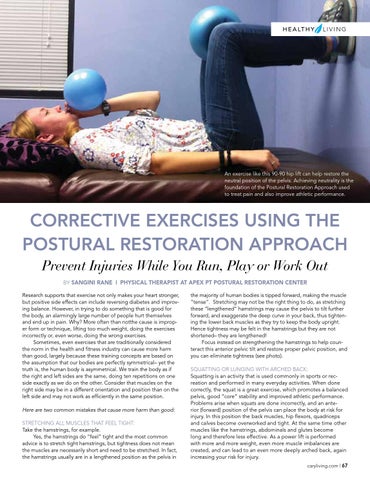
An exercise like this 90-90 hip lift can help restore the neutral position of the pelvis. Achieving neutrality is the foundation of the Postural Restoration Approach used to treat pain and also improve athletic performance.
Corrective Exercises Using the Postural Restoration Approach Prevent Injuries While You Run, Play or Work Out by Sangini Rane | Physical Therapist at Apex PT Postural Restoration Center Research supports that exercise not only makes your heart stronger, but positive side effects can include reversing diabetes and improving balance. However, in trying to do something that is good for the body, an alarmingly large number of people hurt themselves and end up in pain. Why? More often than notthe cause is improper form or technique, lifting too much weight, doing the exercises incorrectly or, even worse, doing the wrong exercises. Sometimes, even exercises that are traditionally considered the norm in the health and fitness industry can cause more harm than good, largely because these training concepts are based on the assumption that our bodies are perfectly symmetrical– yet the truth is, the human body is asymmetrical. We train the body as if the right and left sides are the same, doing ten repetitions on one side exactly as we do on the other. Consider that muscles on the right side may be in a different orientation and position than on the left side and may not work as efficiently in the same position. Here are two common mistakes that cause more harm than good: STRETCHING ALL MUSCLES THAT FEEL TIGHT: Take the hamstrings, for example. Yes, the hamstrings do “feel” tight and the most common advice is to stretch tight hamstrings, but tightness does not mean the muscles are necessarily short and need to be stretched. In fact, the hamstrings usually are in a lengthened position as the pelvis in
the majority of human bodies is tipped forward, making the muscle “tense”. Stretching may not be the right thing to do, as stretching these “lengthened” hamstrings may cause the pelvis to tilt further forward, and exaggerate the deep curve in your back, thus tightening the lower back muscles as they try to keep the body upright. Hence tightness may be felt in the hamstrings but they are not shortened– they are lengthened! Focus instead on strengthening the hamstrings to help counteract this anterior pelvic tilt and restore proper pelvic position, and you can eliminate tightness (see photo). SQUATTING OR LUNGING WITH ARCHED BACK: Squatting is an activity that is used commonly in sports or recreation and performed in many everyday activities. When done correctly, the squat is a great exercise, which promotes a balanced pelvis, good “core” stability and improved athletic performance. Problems arise when squats are done incorrectly, and an anterior (forward) position of the pelvis can place the body at risk for injury. In this position the back muscles, hip flexors, quadriceps and calves become overworked and tight. At the same time other muscles like the hamstrings, abdominals and glutes become long and therefore less effective. As a power lift is performed with more and more weight, even more muscle imbalances are created, and can lead to an even more deeply arched back, again increasing your risk for injury. caryliving.com | 67