COMMUNITY Powered by Real Times Media
SECTION B
michiganchronicle.com
March 9-15, 2016
Remembering
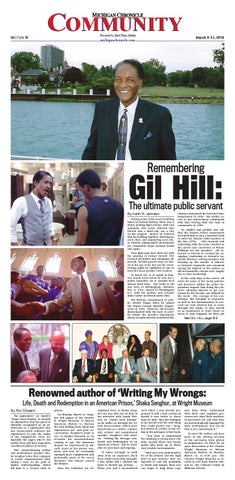
Gil Hill: The ultimate public servant
By Keith R. Johnson
During some of the most troubling times in Detroit history, there was a shiny, guiding light of hope, faith and optimism who never believed that Detroit was a dead city, nor a city on life support. Rather he believed that by working together, believing in each other, and supporting each other, Detroit, taking small, incremental yet consistent steps forward would rise again. That light may have died out with the passing of former Detroit City Council president and champion for Detroit, Gil Hill passed away on Feb. 29 at the age of 84, but not the resurrecting spirit he exhibited as one of Detroit’s most prolific civic leaders. To know Gil, or to speak to him, one would never know he was not a native Detroiter, for it seemed he’d always been here. The truth is Gil was born in Birmingham, Alabama Nov. 6, 1931, moved to Washington D.C. with his mother, and actually didn’t arrive in Detroit until 1953. His lifelong commitment to public service began when he joined the Wayne County Sheriff's Department in 1953. However, Gil became disenchanted with the lack of activity within the sheriff's department which actually directly benefitted the
citizens and joined the Detroit Police Department in 1959. His stellar career in law enforcement culminated with him retiring with the rank of commander in 1989. So skilled and prolific was Gil, that the Atlanta Police Department recruited him to join a national team to solve the Atlanta child murders of the late 1970s Gil’s tenacity and leadership with the team resulted in the arrest and conviction of Wayne Williams for the murders. Gil returned to Detroit to resume his exemplary leadership in Detroit’s homicide division, solving murders and keeping up the morale of officers as Detroit’s homicide rate remained among the highest in the nation, as did its homicide closure rate, largely due to Gil’s leadership. In the early days of his career, Gil never let some of the racist policies and practices within the police department impede him doing his job, never allowing himself to get consumed by the racism, nor defined by the racist. The courage of his convictions, his strength of character, as well as his determination to succeed not only allowed him to move through the ranks, it also served as an inspiration to other black officers to stay engaged, do their job
See GIL HILL page B-2
Renowned author of ‘Writing My Wrongs:
Life, Death and Redemption in an American Prison,’ Shaka Senghor, at Wright Museum By Roz Edward
prison.
An appearance on Oprah’s “Super Soul Sunday” is usually an affirmation that the guest is officially recognized as an intellectual or a spiritualist who has transcended ordinary life experiences to join the ranks of the enlightened. They are typically the sages who’ve led stellar lives and have long been considered pillars of society.
On Monday, March 14, Senghor will appear at the Charles H. Wright Museum of African American History to discuss the best-selling book about his experiences pre- and post- incarceration. Senghor’s book is one of familial intensity as he recounts his unconventional coming of age, the immense despair he experienced in the early years of his prison sentence and how he eventually emerged more enlightened and profoundly aware of the social dynamics that almost caused his demise.
But, award-winning author and motivational speaker Shaka Senghor joins that company of social commentators after taking a turn on the path to higher understanding, which led him to a 19-year stint in
Hear the turbulent yet tri-
umphant story of Shaka Senghor one day after the air date of his interview with Oprah Winfrey on “Super Soul Sunday” as he walks us through his 19year incarceration, which positioned him as a writer, community activist and inspirational speaker. Senghor’s new memoir, “Writing My Wrongs: Life, Death and Redemption in an American Prison” will be available for purchase and signing.
each other, I was already programed to kill. I had convinced myself it was better to shoot than be shot, that the handgun in my pocket was the only thing that could protect me,” Senghor writes in a letter to his victim in the prologue of his book. “You have to understand the thinking of young inner city kids, mostly black and brown males who grow up in these very volatile environments.
“It takes strength to walk away from an argument. Back then, I didn’t have that strength. I was afraid and I allowed my fears to dictate my actions. … When you and I encountered
“And once you understand a lot of the abuses and the high level of gun violence they are exposed to and the proximity to death and danger, then you can begin to help them cope
and help them understand what their own cognitive processes are, what their emotional processes are and how they are psychologically damaged by their environment. You can fix that if you understand it.” To meet the author and hear more of his riveting account of his ascension from prison to prominence, be there for an open discussion at the Charles Wright Museum of African American History on Monday, March 14, at 6:30 p.m. The Charles Wright Museum is located at 315 East Warren Avenue in the Cultural Center in Midtown Detroit.