Peipsimaa
Omedu
A small village, facing Lake Peipsi, with it’s back to big forests
Rafting logs on Lake Peipsi
In 1924 Karl Robert Keerberg wrote his graduation paper at the Department of Forestry of Tartu University titled “Rafting timber in the Northern Peipsi catchment area”. He describes the work of raftsmen in the rivers Omedu, Alajõgi, Avijõgi, Rannapungerja, etc. “When you come to the river, the first thing is to roll logs into water, it is piecework, 1-2 marks per log depending upon the distance. Going down the river, the workers follow the logs and push more of them into the river.” At the mouth of the river logs are tied into rafts. The row of rafts of 650 m3 was pulled by a tugboat across Lake Peipsi to Tartu. The forests near Kodavere were a good source of firewood and logs for Tartu. The timber of worse quality which was smaller than logs was cut into firewood and transported to Tartu by barges. At Omedu a part of logs remained in the factory of wooden cardboard and boards which in 1923 employed 200 people.
8
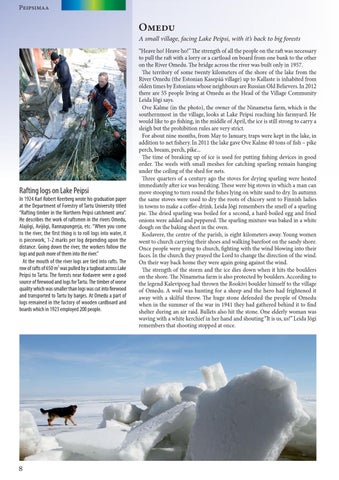
“Heave ho! Heave ho!” The strength of all the people on the raft was necessary to pull the raft with a lorry or a cartload on board from one bank to the other on the River Omedu. The bridge across the river was built only in 1957. The territory of some twenty kilometers of the shore of the lake from the River Omedu (the Estonian Kasepää village) up to Kallaste is inhabited from olden times by Estonians whose neighbours are Russian Old Believers. In 2012 there are 55 people living at Omedu as the Head of the Village Community Leida Jõgi says. Ove Kalme (in the photo), the owner of the Ninametsa farm, which is the southernmost in the village, looks at Lake Peipsi reaching his farmyard. He would like to go fishing, in the middle of April, the ice is still strong to carry a sleigh but the prohibition rules are very strict. For about nine months, from May to January, traps were kept in the lake, in addition to net fishery. In 2011 the lake gave Ove Kalme 40 tons of fish – pike perch, bream, perch, pike... The time of breaking up of ice is used for putting fishing devices in good order. The weels with small meshes for catching sparling remain hanging under the ceiling of the shed for nets. Three quarters of a century ago the stoves for drying sparling were heated immediately after ice was breaking. These were big stoves in which a man can move stooping to turn round the fishes lying on white sand to dry. In autumn the same stoves were used to dry the roots of chicory sent to Finnish ladies in towns to make a coffee-drink. Leida Jõgi remembers the smell of a sparling pie. The dried sparling was boiled for a second, a hard-boiled egg and fried onions were added and peppered. The sparling mixture was baked in a white dough on the baking sheet in the oven. Kodavere, the centre of the parish, is eight kilometers away. Young women went to church carrying their shoes and walking barefoot on the sandy shore. Once people were going to church, fighting with the wind blowing into their faces. In the church they prayed the Lord to change the direction of the wind. On their way back home they were again going against the wind. The strength of the storm and the ice dies down when it hits the boulders on the shore. The Ninametsa farm is also protected by boulders. According to the legend Kalevipoeg had thrown the Rookivi boulder himself to the village of Omedu. A wolf was hunting for a sheep and the hero had frightened it away with a skilful throw. The huge stone defended the people of Omedu when in the summer of the war in 1941 they had gathered behind it to find shelter during an air raid. Bullets also hit the stone. One elderly woman was waving with a white kerchief in her hand and shouting “It is us, us!” Leida Jõgi remembers that shooting stopped at once.