6
THE UNION
FEATURES
DECEMBER 2012
Wreaths promote life skills BY KIMBERLY VO
When you think about Christmas, you may think about the trees, holiday lights, and perhaps even wreaths. The MHS Wreath Company, an annual mock company headed by Special Education Teacher Jeff Waugh, operated throughout the month of November online and on campus. The MHS Wreath Company did more than sell an assortment of decorations, as its purpose is to teach functional life skills to special-needs students by allowing them to actively take a role in the selling and delivering of the decorations. The MHS Wreath Company provided a variety of different items for purchase this year. Among wreaths, there were also swags, centerpieces, New England decorations, and garlands for sale. This year, the company also provided shipping services for the purchases, according to Waugh. “[The MHS Wreath Company] is a mock company for special education students, and it is to teach them about money and responsibility and how to work together,” Waugh said. “It is a whole big educational tool that I use for teaching special ed.” The students have to go around and sell the decorations. Many of
the autistic and special-needs kids in the class who have difficulty talking to strangers have a defined goal they must achieve. They have to walk up and talk to somebody, explaining what they are doing and why they are doing it, according to Waugh. “They collect money, they have to count it, they have to give change,” Waugh said. “Then it becomes a bigger process for them once we get the wreaths. Then they have to assemble them and then they have to distribute them, and it’s a very people-oriented thing—it’s a big project.” Waugh plans on using the funds they raised through the wreath company to purchase iPads for his classroom. Last year, the funds were used to take the students on three different field trips, but field trips for this year have not been decided yet. The MHS Wreath Company is where students sell wreaths to teachers, according to Special Education Student Kevin Tran. Tran’s job is to sell and deliver wreaths by “reading the labels and going to classrooms.” “[The wreath company is] to learn about money, responsibility, and teamwork,” Tran said. “[The wreath company] is an undertaking [of ] students by students.”
Banh performs lion dancing, strives to revitalize tradition BY VIVIAN DINH
Moving to the beat of drums, cymbals, and gongs, hidden performers dance by mimicking a lion’s movement. But have you ever wondered just who those performers are under the lion costumes? Unbeknownst to many students, Senior Sonny Banh happens be one of those performers. Lion dancing is a form of traditional dance that is used as an act of celebration or congratulations, according to Banh. Chinese and Vietnamese lions have a mirror on their foreheads to repel devils and demons, Banh said. “At some Asian weddings or grand openings, you’d see some lion dancing,” Banh said. “But usually you’d see lion dancing around Lunar New Year.” Banh started lion dancing about six months ago and made his lion dance debut in August, at a parade in the state of Washington. Since then, he has performed at two local events. “I lion-danced at an event for our one year anniversary for the organization in September,” Banh said. “The next one was at a Veteran’s Day parade in San Jose.” Initially, Banh didn’t have a particular interest in lion dancing, but upon the insistence of his friends who lion-danced, he tried it out. Realizing how fun lion dancing is, Banh continued to practice and perform. “I was at my friend’s party and
they’re mostly lion dancers. Their headmaster saw that I was a big person and wanted to recruit me to be one of their tails,” Banh said. “I thought lion dancing wasn’t that fun, but it actually was so I continued to do it.” Lion dancing may appear easy, but that’s because a lot of time is spent perfecting each stunt. According to Banh, he and his friends practice routines often to ensure they’re on beat with the drums and other instruments. “If we’re freestyling, then we don’t have to prepare for anything,” Banh said. “But, if we’re setting up a routine, like a bench routine, it takes a few months to prepare.” Banh now does ceremonial lion dancing with a team called Buu Kim Tu (Golden Temple) based in San Jose. Buu Kim Tu originated from a temple located in Southern Vietnam in 1960, Banh said. “Basically, the organization started a few years back,” Banh said. “A former lion dancer named Sunny Nguyen wanted to revitalize the culture of lion dancing in San Jose, so he started it. It wasn’t official until last year.” Buu Kim Tu was founded on ideas like respect and appreciation for Vietnamese and Chinese culture, Banh said. Its mission is to keep a history and culture alive. “Nowadays, you don’t see that many people doing lion dance. You only see it at Vietnamese or Chinese New Years,” Banh said. “The main reason I want to do it is to revitalize the culture of lion dancing.”
C������� �� T����� R�������
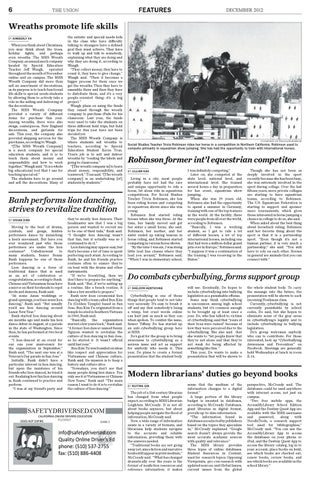
Social Studies Teacher Tricia Robinson rides her horse in a competition in Northern California. Robinson used to compete primarily in equestrian show jumping. She has had the opportunity to train with international horses.
Robinson former int’l equestrian competitor BY LILLIAN KAO
Living in a city, most people probably have not had the rare and unique opportunity to ride a horse, let alone ride in equestrian competitions. For Social Studies Teacher Tricia Robinson, she has been riding horses and competing in equestrian shows since she was young. Robinson first started riding horses when she was three. At the time, her family moved and got her sister a small horse, she said. Robinson, her mother, and her sister ended up taking lessons in horse riding, and Robinson started competing in various horse shows. “By the time I was six, I was doing little lead line classes where they lead you around,” Robinson said. “When I was in elementary school,
I was definitely competing.” Later on, she competed at the state level, national level, and international level. She trained several hours a day in preparation for her event, equestrian show jumping. When she was 19 years old, Robinson also had the opportunity to spend a summer in Germany, training with one of the top trainers in the world. At the facility, there were people from all over the world, according to Robinson. “Basically, I was a working student, so I got to ride a lot of different horses, a lot of top international horses, including one that had won a million dollar grand prix over in Europe,” Robinson said. “I suppose it was a continuation of the training I was receiving in the States.”
Though she has not been as deeply involved in the sport recently because she has been busy, she was extremely involved in the sport during college. Over the last fifteen years, more private colleges are starting to have equestrian teams, according to Robinson. The U.S. Equestrian Federation is starting to support and sponsor more tournaments, which gives those interested in horse jumping a chance in college to do so, she said. When asked about the best thing about horseback riding, Robinson said her favorite thing about the sport is that it is a partnership sport. “Even though it’s not a human partner, it is very much a partnership,” she said. “You still have to rely on each other. Horses in general are animals that you can connect with.”
Do combats cyberbullying, forms support group BY SHELDON HENTSCHKE
Cyberbullying is one of those things that people tend to not take very seriously. It’s easy to brush it off and say that somebody’s being a wimp, but cruel words online can hurt just as much as they can when spoken. To combat the issue, Senior Tiffany Do has started up an anti-cyberbullying group here at MHS. Do’s goal for the group is to bring awareness to cyberbullying as a serious issue and act as support for anybody who needs it. This year, Do plans to create a formal presentation that the student body
will see. Eventually, Do hopes to include cyberbullying into bullying legislation as a punishable offense. Some may think cyberbullying is uncommon among high school students, but it’s common enough to be brought up at least once a year. Do, who has talked to victims of cyberbullying, said that “years of their lives were ruined” because of how they were perceived due to the cyberbullying. She also said that she wants to “let people know that they’re not alone and that they’re not weak for being affected by something like this .” This year, Do wants to make a presentation that will be shown to
the whole student body. To carry the message into the future, the presentation will be shown to each incoming Freshman class. Currently, cyberbullying is not currently punishable by school codes, Do said, but she hopes to eliminate some of the gray areas in cyberbullying’s legality and to include cyberbullying in bullying legislation. Do’s group welcomes anybody who can to contribute. For those interested, look up “Cyberbullying Awareness and Prevention” on Facebook. Meetings are generally held Wednesdays at lunch in room E-14.
Modern librarians’ duties go beyond books BY RUITING QIN
The job of a 21st century librarian has changed from what people expect, according to MHS Librarian LeighAnn McCready. It is not all about books anymore, but about helping people navigate the flood of information, McCready said. Now, a wide range of information exists in a variety of formats, and librarians help students navigate to the accurate and reliable information, providing them with the answers needed. “Traditional books are not going away yet, since fiction and narrative books still appear in print medium,” McCready said. “What has changed dramatically over the years is the format of nonfiction resources and reference information; it makes
sense that the medium of the information changes to a digital format.” A large portion of the library budget is invested in databases, according to McCready. Databases, giant libraries in digital format, provide up-to-date information. “The information found in databases are selected by publishers based on the topics they specialize in,” McCready explained. “Google search doesn’t always provide the most accurate academic sources with quality and relevance.” The MHS library provides three types of online databases: Student Resources in Context, used for research topics; Opposing Viewpoints, pro-con research with updated sources; and Global Issues, current issues from the global
perspective, McCready said. The databases could be used anywhere with internet access, not just on campus. “Two free mobile apps, the AccessMyLibrary School Edition App and the Destiny Quest App are available with the MHS username and password, along with NoodleTools, a research support tool used for bibliographies,” McCready said. “You can use the AccessMyLibrary App to access the databases on your phone or iPad, and the Destiny Quest App to access the library catalog, log in to your account, place books on hold, see which books are checked out, renew books, review books, and see which books are available in the school library.”