Mexico’s 2018 was marked by significant uncertainty and wariness among investors. On his third presidential campaign, Andrés Manuel López Obrador ran on an anticorruption and socially-focused platform. He promised to cancel iconic projects and industry advances, including NAIM and the Energy Reform, which generated concern in the national and international business communities. Following a historic landslide win, López Obrador generated hope for change and opened the door for investment in sectors that past administrations did not consider a priority. Still, uncertainty lingers and fulfilling campaign promises while maintaining macroeconomic stability will be a tough balancing act, particularly since most promises involve more public spending while reducing tax income. However, the federal administration has vowed to not incur further debt or lead the country into an economic crisis.
Despite changes, the Mexican economy remains business as usual. The agricultural, tourism, manufacturing and banking sectors, among others, have gained momentum to become world-class competitors. The renegotiation of the country’s multiple free-trade agreements, including USMCA, TPP11 and a revamped partnership with the EU, have the potential to fuel economic growth while adding a pinch of stability to a weary market. Although the global economy might decelerate, Mexico has an opportunity to reinvent itself alongside the new government administration. The challenge ahead is to implement the right strategies from a public and private sector standpoint to complete Mexico’s transformation and turn it into a true powerhouse of the 21st century.
In its second edition, Mexico Business Review 2019 provides insight into the opportunities and challenges that the country faces in the coming years. Through interviews with the leading stakeholders in the public and private sectors, Mexico Business Review shines a light on the national economy and the views of the business community regarding the country’s road toward technology transformation, commercial diversification and regulatory changes.
The publisher has made all reasonable efforts to provide accurate information, and the information contained in this publication is derived from sources believed to be true and accurate. However, the information in this publication should not be considered to be complete or definitive, and may contain inaccuracies or typographical errors. The publisher accepts no responsibility regarding the accuracy of information and use of such information is at your own risk. The publisher will not be liable to any party for any direct, indirect, special or other consequential damages arising out of any use of information in this publication. The publisher provides no representations or warranties, express or implied, including any implied warranties of fitness for a particular purpose, merchantability or otherwise in relation to any information provided by the publisher in this publication.
ISBN: 978-1-7328256-3-5
Loteria Nacional Draw
NATIONAL CHAMPIONS
1Mexico’s entrepreneurial tradition has given birth to some of the most important companies and influential businesspeople in the world who not only employ a significant number of people but are also key for the country’s GDP growth. These National Champions are economic giants that have played a key role in positioning Mexico as a synonym of quality, attracting a continual stream of investment to the country. Mexico must now translate the success of these Mexican leaders working at national and international companies to broaden the middle class while at the same time increasing the quality of life of the general population.
The first chapter of Mexico Business Review showcases success stories of leading national and international companies led by renowned Mexican businesspeople.
The arrival of a new presidential administration opens the door to positive changes and this chapter highlights the strategies that companies are implementing to capitalize on opportunities in the local and international markets.
CHAPTER 1: NATIONAL CHAMPIONS
8 THE YEAR IN REVIEW: Uncertainty, Tepid Optimism Mark AMLO-Private Sector Partnership
11 SEXENNIAL PLAN: Cooperation Key to Country’s Success
12 ROUNDTABLE: What Should AMLO Focus on to Boost Development?
14 VIEW FROM THE TOP: Graciela Márquez, Minister of Economy
16 VIEW FROM THE TOP: Juan Pablo Castañón, CCE
18 VIEW FROM THE TOP: Gilberto García, Ministry of Economy
19 VIEW FROM THE TOP: Román Meyer, Minister of Agrarian, Territorial and Urban Development
20 VIEW FROM THE TOP: Andrés Conesa, Aeroméxico
22 VIEW FROM THE TOP: Mario Vela, GNP Seguros
24 VIEW FROM THE TOP: Fernando Alanís, Industrias Peñoles
25 VIEW FROM THE TOP: Octavio Alvídrez, Fresnillo
26 VIEW FROM THE TOP: Mayra González, Nissan Mexicana
27 VIEW FROM THE TOP: Luis Barrios, Hoteles City Express
28 VIEW FROM THE TOP: Tomás Bermúdez, IDB
29 VIEW FROM THE TOP: José-Oriol Bosch, BMV Group
31 VIEW FROM THE TOP: Ernesto Prieto, LOTENAL and Pronósticos para la Asistencia Pública
32 VIEW FROM THE TOP: Raúl Beyruti, GINgroup
33 INSIGHT: Carlos Lukac, Gayosso
34 VIEW FROM THE TOP: María Fernanda Garza, ICC Mexico
35 VIEW FROM THE TOP: Armando Ortega, CANCHAM
36 COMPANY SPOTLIGHT: GINgroup: a Leader in Integral Talent Management
UNCERTAINTY, TEPID OPTIMISM MARK AMLO-PRIVATE SECTOR PARTNERSHIP
Stable macroeconomic variables, a significant demographic bonus and a wide network of free-trade agreements have maintained Mexico as a favored investment destination. A new president and new public policies will undoubtedly impact the Mexican economy. Precisely how is the great unknown
For most of its modern history, Mexico has been among the steadiest countries in the Latin American region. Since its last economic crisis in 1994, the country has become a model of economic stability and since 2000, smooth political transitions have become the rule. Despite changes in the governing party, the country’s economic ideology remained more or less the same. However, the election of President Andrés Manuel López Obrador, who ran on an electoral platform of anticorruption and reversing iconic projects such as NAIM and Enrique Peña Nieto’s structural reforms, generated uncertainty among investors and business leaders. For most of his electoral campaign, the private sector did not see eye to eye with President López Obrador but after his win on July 1, 2018, with 53.2 percent of the vote, both agreed to move forward and work together toward the country’s development.
“The 2018 presidential elections illustrated the country’s strong desire for political change,” says Raúl MartínezOstos, Chairman of the Board and Director General of Grupo Financiero Barclays México. “Policy continuity has been a hallmark of past presidential changes, particularly in the economic and financial spheres. This is no longer the case.”
As part of the promised change, President López Obrador has built a strategy that at its center plans to battle corruption and favor economic growth and austerity, all with a social focus.
A few days after his victory, AMLO declared to the media that the country was bound to experience 4 percent annual GDP growth during his administration. He suggested that the country’s 2 percent average growth during Enrique Peña Nieto’s administration created poverty, insecurity, violence and migration. For the past eight years, the country has averaged 2.98 percent yearly growth, which is in line with the global average. According to data from the World Bank, between 2010 and 2017, global GDP grew an average 2.96 percent.
AMLO’s forecasts were challenged by analysts from the private and public sector. According to Banxico’s February 2019 Survey of Economic Growth Expectations from Private Sector Specialists, the country’s GDP is expected to grow 1.8 percent in 2019 and 1.91 percent in 2020. The starkest contrast between the government’s estimates and private-sector forecasts came from Bank of America, which lowered its growth expectations from 2 percent to 1 percent. Yet, President López Obrador vowed that during his first year in office, the country would experience a 2 percent increase in GDP.
Economic growth never comes easy, however, especially in the first year of a new administration. In 2006, when Felipe Calderón won the presidential elections, the country experienced 4.5 percent GDP growth. However, during Calderón’s first year in power, the country underwent an economic deceleration and grew 2.3 percent. The same happened in 2012 when Enrique Peña Nieto won the presidency. In 2012, the country’s economy expanded 3.6 percent, while in 2013 the economy’s expansion equaled 1.4 percent. Martínez-Ostos says this is completely normal. “We are aware that in terms of economic growth, the first year of López Obrador’s administration will be difficult and the country will experience deceleration. This will be the result of 2018’s uncertainty and changes in how the country operates. However, this is just part of the adjustment.”
Government transitions also generate a significant dose of uncertainty among investors and the period between the Peña Nieto and AMLO administrations was no different. Despite promises from the incoming government that contracts would be respected and macroeconomic stability would be preserved at all costs, markets and investors remained wary. Nevertheless, the presentation of the economic package for AMLO’s first year in office convinced markets that even if the government enforced different policies, macroeconomic stability would be maintained. “We have to understand that there is and there will be uncertainty, so we must find a way to work with it and clarify as much as possible. The government’s economic program, at least in its first year, is going in the right direction, which has had a calming effect. The landscape will gradually clear. The federal administration is thoroughly reviewing the state of the country,” says Martínez-Ostos.
Maintaining fiscal discipline has been key for the country in past years and has been the backbone of Mexico’s macroeconomic stability. “We need to gauge the price paid for Mexico’s economic stability. We need to evaluate all elements that are a consequence of the financial crises that Mexico suffered in the 1980s and 1990s. The first thing that must be done is to preserve the country’s macroeconomic stability and its capacity to absorb external shocks,” says Guillermo Ortiz, Partner and Board Member of BTG Pactual and former Minister of Finance during Ernesto Zedillo’s administration. The fall in oil prices is an example. The country was able to absorb this development from a fiscal point of view thanks
to the exchange rate. “Mexico has become a more resilient economy and we must properly recognize the elements that have fostered this resilience,” says Ortiz.
AMLO’s promise to bolster the population’s quality of life and purchasing power also led him to increase by decree minimum salaries when he became president. Nationwide, the minimum salary increased by 16 percent and in the northern border, salaries increased 100 percent. Although the discussion surrounding minimum wage in the country is long overdue, experts agree that an increase by decree was not the answer. “Salaries must increase based on collective negotiations and this must respond to a productivity element,” says Oscar de la Vega, Managing Partner at De la Vega & Martínez Rojas. Moreover, an increase by decree can have significant negative consequences in productivity costs and the country’s inflation rate. “Given the conditions established in collective contracts, an increase in minimum wages represents an increase in the entire payroll of these companies, generating a significant cost issue,” says de la Vega.
Above all the promises the government made, the fight against corruption has taken a central role in AMLO’s articulation of his political administration. The implementation of the National Anticorruption System has been a pending issue since the Peña Nieto administration, which is why the entire business community has closed ranks to ask President López Obrador for a speedy implementation. “Corruption costs us at least 1 percent of the country’s GDP. However, there are studies that put this cost between 1 and 10 percent of the national GDP,” says Juan Pablo Castañón, former President of the Mexican Business Council (CCE). “As this was a key topic for President López Obrador, we would like to see the rapid implementation of the National Anticorruption System and specific measures from the federal government to address this situation.”
OVERSPENDING AND CORRUPTION
AMLO’s campaign and the first months of his term in office have been marked by a fight against corruption and the
implementation of austerity measures that will have longlasting effects. AMLO terminated ProMéxico, the government agency created in 2007 to oversee the country’s international promotion as an investment destination. Although the decision was heavily criticized by the private sector, AMLO split ProMéxico’s functions between the Ministry of Economy and the Ministry of Foreign Affairs. “Economic promotion is important to the federal government and the Ministry of Economy. This will not change now that ProMéxico no longer exists. Our goal is to take the best practices developed by that organization and others and apply them to continue stimulating economic development,” says Gilberto García, the newly appointed Director General of Direct Foreign Investment at the Ministry of Economy.
According to García, the FDI strategy of past years was not as successful as it could have been. “FDI has remained stagnant for the past few years, with a few peaks caused by acquisitions of local companies, such as Banamex or Grupo Modelo,” he says. “Mexico captured about 1.8 percent of the global FDI in 2007 and in 2018 the country captured 1.3 percent. There is a myth that previous activities to attract FDI led to continuous growth of investment in the country but the data proves otherwise.” García says that the current administration will enforce a different strategy. “In previous years, there was only a vague definition of the strategic areas and products that should be a priority in investment and trade promotion, which led to poor use of resources and results. Now the parameters will be very clear. We will use data mining to accurately determine Mexico’s strategic products and sectors and to identify how we can better intervene to promote growth. We will analyze each region to evaluate their capability to produce added value products, which will in turn generate better jobs with better salaries for our population. Our strategy will also take into account an analysis of the global supply chains in which Mexico participates.”
ProMéxico was not the only promotion agency that disappeared. The Mexican Tourism Promotion Board (CPTM)
suffered the same fate and elicited a significant number of complaints from the private sector. However, AMLO has stated that the money used for the promotion of the country will instead be destined for the construction of one of his administration’s flagship projects: the Tren Maya, or Mayan Train. Still, the private sector argues that tourism promotion should not be taken lightly and that the country cannot do without it. “We have been working for almost 25 years to position Mexico as a tourism destination and it often takes times to see the tangible result of these promotional efforts, sometimes years. If the new administration wants to build the Mayan Train, the tourism sector will welcome it but the government will need to find new budgetary sources to pay for it, rather than use the money used by CPTM for promotional purposes,” says Erika García, CEO of Vacacionante and Vacations with a Cause Foundation.
Although the federal administration has argued that the Mayan Train itself will be a promotional tool and visitor magnet, compensating for the lack of tourism promotion, representatives of the private sector argue that CPTM's disappearance also terminates a successful cooperation model between the public and private sectors. “CPTM’s promotional mechanism has been internationally recognized and even replicated. CPTM does not work alone and decides how and where to spend the money jointly with the trusts that have been set up by different destinations,” says García.
UNDOING PEÑA NIETO’S LEGACY
Most of AMLO’s efforts during the transition period and his first months in office targeted Peña Nieto’s accomplishments. NAIM’s cancellation was among his most controversial decisions and sent the markets and international investors scrambling. “Actions such as the decision to cancel NAIM, which is politically motivated and not justified by technical reasons, generate distress that not only impacts macroeconomic indicators such as interest rates but also generate a loss in competitiveness,” says Castañón.
Most analysts agree that the popular consultation carried out to cancel NAIM was not optimal but they also agree that the country will survive the project’s cancellation. “It is important to remember that an investment project, regardless of how important it is for the country, should not define Mexico’s risk,” says Raymundo E. Enríquez, National Managing Partner of Baker McKenzie. “The airport consultation was not optimally conducted and as a consequence, it generated a great deal of doubt. But in the end, Mexico is more than just one project and I think the new government will comply with all its obligations and will honor all the contracts that were awarded. We need to put matters in the right perspective.” Despite the backlash the cancellation generated among business leaders, AMLO’s administration has decided to move forward with the construction of the Santa Lucía Airport. The government
assured the general population this was the better option to improve Mexico’s infrastructure and air connectivity, yet technical, environmental and affordability studies are still due.
Similar to NAIM, canceling or changing the Energy Reform has been a constant in AMLO’s agenda that has also generated doubt among investors. Still, many believe the government must be allowed to review the contracts and AMLO has assured on several occasions that during his first three years in power, the constitution will not be altered. “Regarding the Energy Reform, the administration is analyzing the conditions under which contracts were signed. It wants to maintain good practices and correct those elements that could be done better. This is not a seamless process but we also need to give the administration the benefit of the doubt. Clearly, some investors are nervous, which is understandable as this is unprecedented,” says Martínez-Ostos.
US, MEXICO AND CANADA
One of the last tasks Peña Nieto’s administration undertook was the renegotiation of NAFTA. Though slandered by US President Donald Trump, María Fernanda Garza, Chair of ICC Mexico, says the treaty remains an example of a successful free-trade agreement. “NAFTA is a perfect example of a positive commercial agreement. Moreover, it anticipated the moment we are living right now, in which countries are coming together in blocs to compete effectively, such as the European Union bloc. North America is already an integrated region; production chains are so articulated that even without the treaty, it would have been impossible to disentangle the economic relationship between Mexico, Canada and the US.”
After over a year of negotiations, North American mandataries announced they had achieved a successful renegotiation and presented the USMCA treaty. The agreement gave relief to national and international investors, although for Mexico it was more of a wake-up call. “It is undeniable that Mexico’s interaction with the world will have to change. The renegotiation of NAFTA, now known as USMCA, was a wake-up call for Mexico and for everyone in the private sector to diversify contacts and to lessen our focus on the US. That is the main challenge: to diversify our market and our sources of investment,” says Enríquez. Despite critics, both the former and current federal administrations believe that USMCA offers competitive advantages for the Mexican industry, particularly for the automotive sector, which was severely attacked by President Trump. “The changes agreed in rules of origin will boost a greater degree of integration for this industry in North America. An increase in the regionalcontent value (VCR) from 62.5 percent to 75 percent in light vehicles reinforces and consolidates production chains further and promotes greater use of inputs sourced in North America, providing greater opportunities for Mexican suppliers,” says Graciela Márquez, Minister of Economy.
“We need investment to grow between 2 and 4 percent, to double growth during the administration … We need to grow with well-being. We need both feet. If we are missing one, then we are crippled. We need to look for balance”
“Carlos (Salazar, President of CCE) says we should make a commitment to attract investment so we can grow at 4 percent. Deal. He also says to make a commitment to end poverty during this administration. Deal. How do I know he will agree with me? I have a single proposal for Carlos and for all: let’s make a commitment to end corruption”
February
27, 2019
COOPERATION KEY TO COUNTRY’S SUCCESS
To ensure growth, there needs to be commitment between the public and private sectors to invest in the country’s economic activities. However, this cannot be guaranteed unless there is trust and mutual reassurance that rule of law will be respected and that businesses will work toward inclusive growth
During Carlos Salazar Lomelín’s swearing in as the new President of CCE, President López Obrador acknowledged the role that the private sector plays in generating growth, employment and eliminating corruption. In return, Salazar Lomelín asked the president to become obsessed with investment to boost GDP growth to levels of at least 4 percent and promised him the support of the business community. “We do not look for any privilege. Have trust in this sector,” he said to López Obrador.
The president’s relationship with the private sector has long been in the spotlight and on many occasions has been rife with tension. However, to ensure economic growth, a permanent collaboration is needed between all players. The government is in charge of establishing a stable regulatory framework that incentivizes investment, while the private sector has the money to generate investment and economic activity.
Over the past few years, the private sector has also become an active participant in the development of public policies. An example is the publication of the México Mejor Futuro (Mexico, a Better Future) document during the 2018 presidential elections. The document identified five pillars in which the government and the private initiative needed to work together to boost the country’s development. The pillars call for legality and justice, prosperity and innovation, equal opportunities, efficient and transparent governments and sustainability and preservation of natural resources.
Cooperation between public and private players is not limited to more investment to increase productive activity. Juan Pablo Castañón, the former President of CCE, acknowledged the need to coordinate efforts between the public and private sectors to foster an environment less prone to violence. “One of the best antidotes to violence is to generate well-paid jobs. By generating better products with more added value, workers will become more specialized, will have more training and we will be able to pay better salaries. With better and innovative products, we can compete in the world and generate greater economic development.”
WHAT SHOULD AMLO FOCUS ON TO BOOST DEVELOPMENT?
JUAN PABLO CASTAÑÓN Former President of CCE
JOSÉ-ORIOL BOSCH CEO of BMV Group
GUILLERMO ORTIZ Partner and Board Member of BTG Pactual
RAYMUNDO E. ENRÍQUEZ National Managing Partner of Baker McKenzie
The arrival of President López Obrador created uncertainty among investors but also provided new opportunities for industries to evolve and contribute to Mexico’s growth. Business leaders across all sectors are willing to work hand in hand with the new government and have also shared a series of recommendations and opinions regarding the public policies the federal government should favor, the priorities it should focus on and the elements needed to boost growth.
It is very important to solve problems related to security and rule of law. The National Anticorruption System needs to start working and we need to have an Anticorruption Prosecutor. This would also allow us to reduce the country cost. Corruption costs us at least 1 percent of the country’s GDP. However, there are studies that put the cost of corruption between 1 and 10 percent of the GDP. As this is a key topic for President López Obrador, we would like to see the rapid functioning of the National Anticorruption System and specific measures from the federal government to address this issue.
The most important thing is to spur Mexico’s growth, which has been relatively limited. Rather than growing 2.5 percent, the country should grow at least 5 percent. There were some encouraging changes in the Peña Nieto administration with the structural reforms, but with the start of this new government cycle, economic growth will depend on the investment attracted to the country.
Public policies for the healthy development of the financial system are obvious. We need to continue promoting financial inclusion, which is a topic that has received emphasis in recent years, and to find ways for the informal economy to have more formal financing mechanisms. The informal economy continues to be a burden on the country’s growth and development. It is less productive and does not have access to formal financing. This implies that its financing schemes are expensive and shortterm, generating a vicious cycle of low productivity.
We need to innovate. The government needs to use new tools available to make its processes more productive and efficient. It will be a challenge for the new government to reduce the federal workforce and to make due will less as a result. However, this will lead to increased efficiency and transparency to eliminate the possibility of corruption. If the government can make these changes while providing certainty to investors regarding timelines and results, we will be able to generate much of the investment we need.
Education is key to the digital transformation. Most children in Mexico still receive a traditional education and it is necessary to make technological tools available to them from a very young age. Programming skills will be extremely useful to children, not just because they are in demand but because they teach a flexible way of thinking. Deloitte supports an organization that implements several programming courses for girls and we also have a scholarship program for university students in Queretaro. Developing stronger educational programs will help the country cultivate the capabilities it needs to be more competitive.
It is important to continue investing in research and development and we need to develop professional talent with expertise in agriculture. With research, it is always important for people to be prepared and ready to continue supporting the development of agriculture. We need to continue favoring export markets that pay well for our products and that help farmers earn money. For the southern part of the country, it is important to develop a production platform. It is equally important to develop storage infrastructure, build highways and to develop cold chains to facilitate exports for producers. We need a public-private policy that favors the development of the small and medium-sized producer.
The new administration must maintain Mexico’s free-trade agreements, since free trade is necessary for the country to achieve long-term competitiveness and greater economic development. The government has to maintain infrastructure investment in the country because South American countries like Ecuador and Colombia are becoming more competitive. Security and rule of law must also play a key role in Mexico’s development because there are some states in the country that are almost nonexistent for doing business. The government needs to balance and strengthen rule of law throughout the country if it wants the country to develop equitably.
We need to have an administration focused on attracting a greater amount of foreign investment, which we think is the mechanism that will help us become more productive. Things like increasing minimum wages could be feasible if we have more investment. We also need an environment that makes it easier to do business. Sometimes it is very hard to obtain business permits and every state in the country functions differently, which complicates the process of doing business.
There are many priorities and not enough budget, so choosing one is not easy. One question that impacts the tourism industry is whether the money that is used for promotion will be used for other purposes. If the new administration wants to build the Mayan Train, the tourism sector will welcome it but the government will need to find new budgetary sources to pay for it, rather than use the money that is used by the CPTM for promotional purposes.
LUIS TEJADO President and CEO of Bluedrop Agroforestry
LUIS MEZA Managing Partner at Deloitte Consulting Group, México
LISSETTE MONTEFUSCO
Vice President of Strategic Planning at CMR
ERIKA GARCÍA CEO of Vacacionante and Vacations with a Cause Foundation
JAVIER VALDÉS
Director General of Syngenta Latin America North
STRATEGY FOR INCLUSIVE WEALTH GENERATION
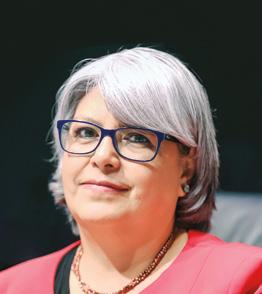
GRACIELA MÁRQUEZ Minister of Economy
Q: What will be the Ministry of Economy’s guiding principles during the current federal administration?
A: The Ministry of Economy is responsible for generating wealth and increasing the well-being of all Mexicans, both of which are also the main objectives of President López Obrador’s administration.
Mexico is about to close the second decade of the 21 st century with a trajectory of low growth rates and enormous regional, sectorial and social disparities. Over the past 12 years, the country has averaged annual growth of 2.1 percent, of which 69 percent originates from foreign companies, while national businesses contributed 31 percent. Mexico still must take advantage of its close relationship with the global economy and at the same time strengthen its productive force. In other words, the virtuous combination between the global economy and the domestic market will help the country find the path to sustained, sustainable and inclusive growth for the coming years.
Over the past 12 years, the country has averaged annual growth of 2.1 percent, of which 69 percent originates from foreign companies
Our objective is not only to reactivate growth at high and sustained rates but to do so with a focus on solving existing inequalities. This means generating wealth without leaving behind any social sector, production field or region of the country. We have set three main pillars that will guide our policies: innovation, diversification and inclusion. These pillars are not mutually exclusive; they complement each other. We are in the middle of the fourth industrial revolution, which is changing the way we understand production of goods and services. The challenge is to adopt these technologies inclusively to benefit the entire population.
Innovation is key for our economic policy. We are convinced that only by adapting to and adopting new technologies will we be able to produce new goods and services based on an efficient, competitive and productive supply chain that integrates national added value. The Ministry of Economy will support innovation through programs such as Programa para el Desarrollo de la Industria del Software y la Innovación (PROSOFT) and Programa para la Productividad y Competitividad Industrial (PPCI). We are confident that innovation will help us close inequality gaps created in the past decades.
The second pillar — diversification — is essential to promote exports of goods and services of all productive fields in the country, integrating those sectors and regions that have been left out of global market participation. Investment in logistics, easier paperwork and the provision of market information will be the springboards that help national producers participate actively in international trade.
The US is already our main commercial partner but we still have opportunities to increase the presence of Mexican products in some states north of the border. The same can be said about Canada. An increase in commercial integration and productivity in the North American region will generate significant growth for the Mexican economy. Capitalizing on other areas will also complement our trading activities. There are routes for commercial diversification thanks to the recent ratification of the Comprehensive and Progressive Agreement for TransPacific Partnership (CPTPP), which will link the Mexican economy with one of the most important economic engines of the world, and the finished negotiations for a new treaty with the EU.
The third pillar that we will boost is inclusion, which means promoting collaboration of marginalized regions and population segments in high-productivity activities.
The combination of these strategic pillars will allow us to contribute to the country’s growth and to the consolidation of our strengths according to our industrial calling and
cultural identity. We will articulate a real industrial policy through the conjunction of the national industry, society and the government, which will increase the well-being of the national population. The greater challenge is to close the gap between regions and between segments of the population.
Q: What opportunities will the implementation of USMCA bring to Mexican automotive suppliers and automakers with operations in the country?
A: The first highlight from USMCA for the automotive industry is that Mexico's preferential access to the US market remains untouched. The changes agreed in rules of origin will boost a greater degree of integration for this industry in North America. An increase in the regional content value (VCR) from 62.5 percent to 75 percent in light vehicles further reinforces and consolidates production chains and promotes greater use of inputs sourced in North America, providing greater opportunities for Mexican suppliers.
Operational costs for automotive manufacturing in Mexico are competitive and offer advantages over most countries in Southeast Asia. At the same time, VCR requirements are an additional incentive for companies to set up shop in Mexico. Although complying with stricter VCR standards will be challenging, the auto parts industry has developed significant capabilities. Furthermore, Mexico offers greater competitive advantages when compared to the other USMCA members. This treaty, in particular regarding the conditions established for the automotive industry, reflects US efforts to relocate manufacturing production to US territory, as well as the need for a strategic manufacturing partner in the region. Mexico has the opportunity to strengthen European and Asian production chains, creating more incentives for more companies to establish operations in North America.
It is important to highlight that the labor component included in USMCA’s rules of origin has several compensation alternatives through investments in R&D activities that will favor the profile of the automotive companies established in Mexico.
Q: Why is it important for the Mining Undersecretariat to be part of the Ministry of Economy rather than the Ministry of Energy?
A: Mining policy should be part of an integral industrial policy that fosters national competitivity through complete production chains. Mining is a key link in several important production chains that favor the country’s economic development, by acting as a supplier in industries like metallurgy, metal-mechanic and steel. It would be impossible to competitively improve these industries
without including effective promotion and regulation of the mining industry.
Q: What is the ministry’s strategy to promote Mexico’s competitiveness as a mining jurisdiction and what incentives will be offered to possible investors?
A: First, we must ensure that all investments have a social endorsement, which comes from full acceptance of all communities involved in the mining activity. When hosting communities welcome mining activities, it generates a virtuous cycle that contributes to prosperity and pacification.
We will also work on a reform to the Mining Law that modernizes current regulations and introduces the figure of a mining grid to ease cadastral administration of lots to avoid splices and litigation. In addition, the Geological Mexican Survey will be reoriented to concentrate the localization of deposits that can be exploited in a profitable manner so they can be offered to the international investment community with certified data and basic metallurgical information.
Innovation, diversification
and inclusion will be the three main pillars favored by the Ministry of
Economy for economic growth
Q: What changes are needed to promote investment, competitivity and improve the performance of the mining sector in the country?
A: Most importantly, we must incorporate referendums to the regulatory process. This is needed, first, because it is contemplated in international agreements signed by the country, such as Agreement 169 of the International Labor Organization. Second, because these consultations open the door for more satisfactory binding processes between local communities and project developers. With this, our goal for communities is to grow the labor force with competitive wages, as suppliers and as full beneficiaries of mining activities.
Graciela Márquez was professor and researcher at Colegio de México. She majored in economics at UNAM, has a Master’s in economics from the same institution and a Ph.D. from Harvard University. She is the first woman to lead the Ministry of Economy
BUSINESS COMMUNITY STRIVES TO CREATE A FAIRER, MORE COMPETITIVE MEXICO
JUAN PABLO CASTAÑÓN Former President of CCE
Q: What role does CCE play in Mexico’s economic and social development?
A: We have a variety of organizations that represent businesses in different areas of the economy, either generally or in more specific industries. CCE was created to address the need to share a transversal agenda between all business organizations. Although each organization looks for solutions to specific problems that impact their sector, CCE voices concerns related to structural problems. CCE is the umbrella organization for most of the country’s business entities.
Our transversal agenda includes issues related to economic and financial public policy, which entails decisions that directly impact the economy. As representatives of the country’s business organizations, we have direct interaction with both the legislative and executive branches of government, promoting and analyzing initiatives that we believe can help solve the country’s most pressing issues.
At the same time, we have to help and even generate pressure on the authorities to solve security issues.
Another pillar for development is the creation of public policies that generate competitiveness. Topics such as deregulation and the combination of efforts between development and commercial banks are key to improving the country’s standing. We also need a public policy that facilitates communication between SMEs and the scientific community so they can work together and generate products that have greater added value.
70%
Employment in Mexico generated by SMEs
We are interested in the creation of public policies that help to better organize the market, that allow for free competition and that at the same time facilitate the generation of new businesses.
Q: How does CCE comply with its mandate to help develop public policies intended for economic growth and competitiveness?
A: Two years ago, we created a document for the candidates participating in the electoral process, whether running for president, the legislative branch or governorships. This document, México Mejor Futuro (Mexico, a Better Future), identified five pillars in which both the government and the private sector need to work. The first pillar is rule of law and security and the private sector's participation is crucial for this. We need to work against corruption, promote integrity and business ethics within companies and initiate codes of conduct regarding corporate governance that can also permeate SMEs, thus creating a culture of greater compliance in the country.
Efficiency and transparency of governments are also fundamental issues. We want all governments, not only at the federal level but locally as well, to commit to the digitalization of their processes, which would allow for governmental accountability and comparisons between states. Any efficient government must ensure all economic variables are managed with responsibility to allow for economic growth.
Businesses and society need to always be vigilant and hold whoever governs the country accountable to avoid mistakes in economic policy that could generate inflation and increase debt. A breakdown of the country’s macroeconomic indicators would eliminate the stability businesses need to develop. That is why we insist so much on Banxico’s independence, on responsible debt management from the Ministry of Public Credit and on the constant improvement in the management of PEMEX’s debt indicators, which in the end are related to management of the national debt. Actions such as the cancellation of NAIM, which are politically motivated and not justified by technical reasons, generate distress that not only impacts macroeconomic indicators, such as interest rates, but also generate a loss in competitiveness.
Sustainability is a priority as well. We cannot achieve definite development without it being sustainable.
However, sustainability is not only about protecting the environment but also about creating companies that are profitable and successful over time, generating the best possible compliance practices. Businesses and their collaborators must also be involved in solving the needs of their communities.
Q: How does the Mexican business community work alongside the government to foster the creation of an environment less prone to violence?
A: We need to demand more information from the authorities and coordinate our efforts to monitor specific intervention plans in different regions of the country. We also need to generate best practices in terms of prevention with our workers. One of the best antidotes to violence is to generate well-paid jobs. By generating better products, with more added value, workers will become more specialized, have more training and we will be able to pay better salaries. With better and innovative products, we can compete in the world and generate greater economic development.
Training and prevention are fundamental contributions we can make from our field to generate a better environment to fight violence. We also need to be firm when participating in the efforts made by the federal government and insist that the models that work the best are those of coordination and cooperation.
Q: What policies are necessary for the sustainable development of Mexico’s business community?
A: It is important to solve the problem of security and rule of law. The National Anti-corruption System needs to start working and we need to have an Anti-corruption Prosecutor. This would also allow us to reduce the country’s costs.
Corruption costs us at least 1 percent of GDP, although some studies put the cost of corruption between 1 and 10 percent of GDP. As this was a key topic for President López Obrador, we would like to see the rapid functioning of the National Anti-corruption System and specific measures from the federal government to address this situation.
Second, the only way to generate opportunities for those who have no opportunities is through employment. Around 70 percent of employment in Mexico is generated by SMEs. This means that the country needs an industrial policy focused on supporting the creation of SMEs and fostering an environment that facilitates their growth while committing to employment generation. In this regard, the country has a challenge in terms of deregulation for businesses. We estimate that excessive regulation costs us around 2 percent of GDP.
We also need to acquire, develop, import and implement new technologies to generate products with greater added value. Mexico has already taken a step in this regard by not competing on the world stage with commodities, meaning not competing with agricultural products. When you compete with commodities, you have to reduce costs because end prices do not depend on you but on international markets. But if we start competing with added value products and new technologies, with Mexican design and talent involved, we will generate more and faster growth.
Mexico needs to use the tools at its disposal, including its free trade agreements with 42 countries. However, to use the world more, we require public policy that enables Mexican products to go into the world. This means better infrastructure and logistics systems so inputs can enter and products can exit the country more easily, which would make Mexico more attractive and more economical than other countries.
México Mejor
Futuro
identifies rule of law, security, business ethics and public policies as priorities for the public and private sector
Mexico's mission, through the government, is to create an environment that fosters this exchange so there is more investment and employment. But the business community needs to do the rest. Today, we could sell agricultural products at a price four or five times higher in the Middle East than in the US. However, we cannot access those markets that easily because we do not have the production and logistics viability to get our products there economically.
The business community, including SMEs and big companies, need to be united in terms of communication with government institutions in charge of making public policies. Sometimes, communication between the two sectors is difficult but if we do not work together, development will be halted. The only way to generate employment and economic growth for people and their families is by working together.
The Mexican Business Coordinating Council (CCE) is the organization that represents the Mexican business community. Its goal is to boost democracy, social responsibility, equal opportunities and a free market economy
INCLUSION, DIVERSIFICATION, INNOVATION: PILLARS FOR FDI ATTRACTION
GILBERTO GARCÍA Director General of Direct Foreign Investment at the Ministry of Economy
Q: What is the main appeal of Mexico as an investment destination?
A: Mexico has a dynamic and attractive economy for investment with slow but steady growth. Our industry is increasingly linked to global value chains through productive companies that grow at an accelerated pace and generate innovative products and services. Another element attracting FDI to Mexico is the federal government’s initiative to eliminate corruption, which will allow for fair competition among all investors. Mexico is increasingly perceived internationally as a solid investment destination but the country needs a one-stop solution to serve as a gateway for foreign companies looking to set up business in Mexico.
Q: What is the administration’s strategy to continue promoting the country after the termination of ProMéxico?
A: Economic promotion is important to the federal government and the Ministry of Economy. This will not change now that ProMéxico no longer exists. Our goal is to take the best practices developed by that organization and others and apply them to continue stimulating economic development. The new economic promotion strategy will come under the jurisdiction of the Global Economic Intelligence Unit directed by Sergio Silva, in coordination with state and municipal governments and the Ministry of Foreign Relations (SRE). The objective is to replace ProMéxico’s 46 offices with 150 points of contact across the world focused on foreign commerce. We are also coordinating with state governments and economic development units to properly channel economic support from the federal government to companies that need it.
Q: What elements of Peña Nieto's trade promotion policy will be kept in place and what will be changed?
A: We will use data mining to accurately determine Mexico’s strategic products and sectors and to identify how to best
The Direct Foreign Investment Direction is part of the new Global Economic Intelligence Unit of the Ministry of Economy. It oversees the design of Mexico’s economic promotion strategy in collaboration with the Ministry of Foreign Affairs
promote growth. We will analyze each region to evaluate their ability to produce added value products, which will in turn generate better jobs with better salaries for our population. Our strategy will also take into account an analysis of the global supply chains in which Mexico participates.
The Ministry of Economy follows three pillars: inclusion, diversification and innovation. Inclusion refers not just to companies that can enter global supply chains but also companies that can support the economic development of the communities where they are located. Our inclusion strategy also targets exports from more regions in Mexico, as most exports originate in just 11 or 12 metropolitan areas. In terms of diversification, our goal is to grow the number of companies that export their products. At this point, 90 percent of all exports are done by big companies and we want SMEs to increase their participation. Moreover, five or six products represent 40 percent of Mexico’s exports, which are mainly destined for the US. We need a diversified export chain in terms of products and destinations as this will allow us to minimize risk. Regarding innovation, our goal is to be more competitive in areas with higher added value, which will also permit the generation of better work conditions in Mexico.
Q: What is your message for potential investors that have put their projects on hold until they get a clear perspective of the administration’s policies?
A: The country is an investment destination with dozens of trade agreements that include first-rate protection schemes. Some infrastructure projects have been canceled but these decisions were taken after a revision of priorities and contracts. The goal of this government is to reduce inequality in Mexico in a responsible way by avoiding an increase in taxes or debt. The government is also developing more social programs and investing in infrastructure projects that will increase public spending and increase the country’s connectivity and competitiveness, especially in the south. These policies will lead to a healthy business environment. Mexico will continue to be open for business as it is implementing all the necessary structural changes that will lead to growth and will continue respecting the property rights of all investors.
MASTER ORGANIZATIONAL PLAN PUTS PEOPLE FRONT AND CENTER
ROMÁN MEYER Minister of Agrarian, Territorial and Urban Development
Q: What are SEDATU’s main objectives as a recently established ministry?
A: SEDATU has numerous obligations, which include being a bridge between other ministries, such as SCT, the Welfare Ministry and SADER. We are also in charge of the National Housing Plan and, thanks to a change in legislation, SEDATU is responsible for defining public policies regarding housing, which was previously the purview of the National Housing Commission (CONAVI). We are working closely with FOVISSSTE, INFONAVIT and BANOBRAS to define the best strategies for the housing sector and our goal is to create a policy that understands housing as more than just an economic indicator. The economic element is central and important but we also need to focus on reducing the existing lag in social housing. We need to start considering the housing model, its characteristics and what happens with houses a few years after they are constructed. The endgame is to support the segment of the population without access to the social housing system and housing financing mechanisms like INFONAVIT.
Another of our responsibilities is the regularization of urban territory and the national agrarian registry and policy, which refers to land ownership. We are also looking to encourage a generational change in ejidos and to incorporating women into the decision-making process in agrarian centers. Finally, we will work for and contribute to the generation of a more robust and structured life in agrarian centers.
Q: What alliances has SEDATU established with international organizations?
A: We are working with several UN institutions and we have a collaboration agreement with FAO. The idea is for them to help us evaluate the national agrarian policy. However, this is not our only approach with international organizations. Mexico has agreed a set of international obligations and we have the responsibility to see them through. Examples of this are the UN’s Sustainable Development Goals and the implementation of the 2030 Sustainable Development agenda.
Q: What is SEDATU’s role in the reconstruction efforts following the September 2017 earthquake?
A: Regarding the National Reconstruction Plan, we are working alongside the Ministry of Land-use Planning, which focuses mostly on the middle part of Mexico. We are confident that state authorities will complete the reconstruction projects effectively. We are supporting other states, Morelos being our priority, but also Oaxaca, Puebla, State of Mexico, Tlaxcala and others where there is a lag in reconstruction of housing, health and educational infrastructure, along with cultural and INBA-protected landmarks.
There are three topics in which we want to focus regarding the reconstruction program. The first is finishing on time and ensuring the requisite quality. We expect to do most of the work during 2019. We also want to finish equipping health and education centers. We want to also start the reconstruction of cultural patrimony, such as churches. However, we understand this is a more artisanal procedure that requires the use of special construction techniques, which means the process could take three to four years to complete.
Q: What do you want to achieve by the end of the current administration?
A: We need to find mechanisms to provide decent, welllocated and culturally adapted housing. Building a house in Oaxaca is different than in Chihuahua. Materials, climate and the house layout, to name a few, are all different and it is the government’s obligation to generate guidelines that establish these differences so social housing can adapt its standards.
We also expect to grow our urban development program. This is a very specific initiative for areas within cities where there are significant lags and that have considerable development opportunities. Today, we are supporting 10 border cities plus five more with a tourism calling. We expect to end 2023 with 100 cities affiliated to the program.
Román Meyer is the Minister of Agrarian, Territorial and Urban Development (SEDATU). He has worked on projects focused on urban and economic development with an emphasis on equality. Among his projects are Centro Cultural El Rosario
MEXICO’S FLAGSHIP CARRIER CHAMPIONS ECONOMIC DEVELOPMENT
ANDRÉS CONESA
Director
General
of Aeroméxico
Q: How has the airline industry evolved since you took the reins of Mexico’s flagship airline?
A: The entire aviation industry, including Aeroméxico, was destroying capital back in 2005 because airlines did not focus on additional or long-term capital investments. The industry has since become an attractive sector for investment. Looking at variables such as the size of the industry, the average age of the fleet and the strength of human capital, it is evident that the industry is much stronger now than 13 years ago. For us, Delta Air Lines’ investment in Aeroméxico highlights the evolution the industry has undergone since then.
Q: What are the main concerns that influence Aeroméxico’s general strategy?
A: Aeroméxico concentrates on hedging its risk based on the three variables that impact our financial performance the most: exchange rates, jet fuel prices and real economic activity. Our sources of foreign revenue are similar to our foreign expenses, which eliminates the need to go to financial markets and bet against exchange rates. Regarding fuel, we rely on the oil derivatives market, hedging half of our jet fuel consumption.
The worst mistake in this industry is overcapacity, which is why we have staggered leasing contracts to adjust for contingencies. We own between 35 and 40 percent of our aircraft and lease the rest. If something goes wrong, we downsize by not renewing aircraft leasing contracts. On the other hand, if things go well, we just agree to new leases.
Q: What is Aeroméxico’s strategy to improve passenger experience?
A: Our goal is to offer the best experience every time, which is key long-term sustainability. The bulk of our expenses is oriented to buying new aircraft along with technological investments, which are divided among all of Aeroméxico’s projects to empower our passengers. Our digital ecosystem, including our webpage, app and airport kiosks, is designed to provide all our customers with greater control of their travel experience.
Q: What areas of passenger experience are the top priorities for Aeroméxico?
A: When asked about customer experience, people think about the Boeing 787 Dreamliner and onboard experience. However, the worst thing that can happen to a passenger is a flight cancellation. We are refocusing our efforts to deliver the most reliable service. For example, in October 2017, we set a record for the industry and our airline with only three flight cancellations, which was a great achievement since we operate between 650 and 700 daily flights.
Q: How sensitive are Aeroméxico’s operations to natural phenomena and how does that impact passenger experience?
A: A narrow-body usually flies four or five daily trips for any airline, so if a plane is delayed for any reason throughout the day (including weather delays), the remaining operations involving that plane will most likely be delayed. Passengers may see clear skies at night and think they are being deceived by the airline when told that fog or a similar phenomenon set the flight back. But if an aircraft is delayed for three hours in the morning, this delay will have a domino effect for the rest of the day.
Q: How is the growing competition pushing Aeroméxico to reinvent itself?
A: Aviation is one of the most competitive industries and Mexico’s airline market is largely divided in three similar parts. Aeroméxico also competes with some of the best airlines in the international market, including British Airways, Lufthansa, Iberia, Air France-KLM, American Airlines, Avianca, United Airlines, Japan Airlines and ANA. Having strong competitors in and out of Mexico is what drives Aeroméxico to reinvent itself.
Q: What challenges does a saturated AICM pose to Aeroméxico and how does the airline address them?
A: The main problem at AICM is not the airport terminals but the available number of slots. More than 20 companies are flying through AICM, which suggests that lack of space is not the problem. Aeroméxico can
increase its seat offering by 30 percent in the next five years without changing its current number of slots and aircraft. Additionally, our fleet strategy gives us flexibility, since we only operate three types of aircraft, which reduces operating costs, and are increasing our fleet size at AICM. Aeroméxico Connect flies an all-Embraer fleet and Aeroméxico sticks to Boeing 737 and 787 aircraft.
Q: Some governments are highly proactive with their flag carriers. How does Aeroméxico interact with the government?
A: Airlines are important for economic development because when international companies ponder where to invest, one of the first concerns is connectivity. It is necessary to have a hub-and-spoke model to connect a city, since it is impossible to do only point to point. Aeroméxico made its case with Mexico’s anti-trust authorities regarding our number of slots at AICM, as the authorities believed we have too many. However, compared to other flagship carriers that usually have 80 percent of the slots in their hub airports, Aeroméxico holds only 43 percent. Taking away and limiting the number of slots makes it impossible to implement a hub-and-spoke model, which harms the ability of airlines to connect the country.
Q: What should the new administration do to support the growth of the airline industry and its national carriers?
A: The Mexican airline industry has consolidated through several bankruptcies. In the last 10 years, 10 airlines went bankrupt. This should not be the case. The authorities should change their approach to consolidation so economic cycles happen in an orderly fashion rather than as disruptive processes that bankrupt companies.
First, the government must be disciplined in its macro policies and focus on providing security, education and health using fiscal discipline while maintaining an independent central bank that fights inflation. Because of the spike in oil prices, we saw a rise in inflation followed by the depreciation of the peso. Also, the aviation industry needs better infrastructure and the industry’s regulatory framework should be strengthened.
Q: What is Aeroméxico’s strategy to compete against low-cost Mexican carriers?
A: A flight seat is not a commodity. People cannot expect to pay the same price for a flight seat in the Mexico City-Monterrey route on Aeroméxico compared to other carriers, when we offer 25 daily flights for that route, the chance to earn miles and both business-class and economy seats.
It is impossible to be a low-cost carrier, a charter, a cargo airline and a full-service airline at the same time.
Each company must focus on the area in which it excels. However, we also offer tailor-made products for pricesensitive passengers. For instance, we deploy our alleconomy-cabin planes as a way to offer more competitive rates and compete in that segment.
Q: How have Delta Air Lines and Aeroméxico benefited from their joint venture?
A: Both airlines can learn from each other. Delta Air Lines is among the best-run airlines in the world and we can learn greatly from it, especially regarding its resilience in the face of market restrictions, remaining profitable and improving its network. Also, Delta Air Lines’ approach to joint partnerships with other airlines, such as Aeroméxico, places great importance on its collaborators. On the other hand, we can share best practices with Delta Air Lines regarding our fleet plan execution and our e-commerce strategy, which can help us build synergies.
We are certain that together we can build stronger and more sustainable airlines to better compete in the international arena, specifically against subsidized airlines.
Aeroméxico has a 30 percent share of the Mexican market versus its two strongest local competitors, which have 26 and 23 percent
Q: What milestones does the airline expect to reach in the short term?
A: Aeroméxico is prepared for the short term but the airline’s strategic decisions must focus on the medium and long term. We need to consolidate the joint venture with Delta Air Lines and find new opportunities with it. We need to strengthen our service in the cities we already serve.
While Aeroméxico has daily flights to Madrid and Tokyo, we need to increase the number of flights on the Shanghai-Seoul route. We will also optimize our fleet strategy. The company is moving from eight types of cabin to three and we are retiring the last 777s left in our fleet and introducing the new Boeing 737 MAX, of which we received the first in March 2018.
Aeroméxico is Mexico’s flagship carrier and one of the four founding members of SkyTeam. It is the largest local airline and has codeshare agreements with Delta Air Lines, British Airways, Lufthansa, Air France-KLM and American Airlines, among others
PUBLIC-PRIVATE SCHEMES FOR BETTER SERVICE PROVISION
MARIO VELA Director General of GNP Seguros
Q: What is GNP Seguros doing to raise awareness about the importance of insurance products?
A: Mexico has one of the world’s lowest penetration rates in terms of insurance; it is time for authorities to increase the use of tax incentives to make some coverage mandatory and to encourage people to get insurance. This can create a virtuous cycle so the government and people do not have to absorb all the expenses. The process should start with education: people need to know that being insured can create a situation of mutual benefit for the client, the government and the insurance sector. GNP Seguros actively participates in raising awareness so Mexicans are taken care of with the products available in our portfolio. One of our most successful stories happened three years ago, when we created an organ donation campaign focused on accident prevention and the benefits of being insured. We emphasized the importance of taking precautions at the wheel and also pushed for people to subscribe to the official list of organ donors.
Q: How do GNP Seguros’ website and apps address growing consumer demand for digital services?
A: Most companies are adapting to Industry 4.0 and GNP Seguros is no exception. Technology is integral to our customer service and for the quality of the product we offer. Our Conecta Móvil app gives the user full control of our services. Our app also provides a GNP card so the client can visit a hospital without major complications and with all the necessary clinical information. Our digital system is connected to more than 20 hospitals, which allows us to share medical information. GNP Seguros’ technology connects the patient, the hospital and the company in the best way possible to improve processes and results.
Q: How is technology boosting GNP Seguros’ performance?
A: We are betting heavily on digitalization to increase sales and to improve our services and claims management. We use an AI-based chatbot to sell our new low-cost insurance line. This chatbot focuses on guiding clients to acquire accessible health policies that cost around MX$1,000 (US$52) a year. For our car insurance customers, it is easier to contact the insurer and receive
information in real time about the location of the adjuster and the waiting time. We guarantee quality and efficiency in our customer service.
GNP Seguros is also working on another app for reporting minor crashes. If a client hits an object or someone damages their car, our app allows the user to take a picture to estimate the cost of repair and deductible coverage, in addition to offering recommendations for mechanical workshops. Everything is done instantly and in real time. Technology also serves to provide greater security for the insurance sector against possible fraud. Through AI, GNP Seguros can detect anomalies and patterns to limit unnecessary expenses and thus keep our premiums low and accessible.
Q: How can insurance companies complement social security and contribute as a financial mechanism for health management?
A: Coverage varies from one health institution to another so we believe the government can approach the insurance sector to achieve better access. Seguro Popular and other institutions do not cover all medical conditions so the private sector can complement their work. GNP Seguros believes that working under a complementary scheme will provide the patient with a much better service. This initiative can be complemented even further if there is standardization of quality, services, protocols and other indicators to administer the health system. We have to start thinking about the health system as a unitary entity.
Q: What trans-sexennial proposals would GNP Seguros suggest to improve the health system and the participation of the insurance sector in Mexico?
A: In the private sector, it is necessary to implement and maintain quality indicators similar to those of the public sector. The government could start by creating a single quality base for all hospitals so that the population has better access to healthcare. Another opportunity is to incorporate standardizing management tools (GRDs) to create a system of risk adjustments based on the consumption of patient resources at Mexican hospitals. The
government also could rely on other public-private schemes to reorganize the way health is provided in Mexico. One option could be to expand insurance coverage to increase access. A person affiliated with IMSS or Seguro Popular through an insurance expansion could increase his coverage and have access to private hospitals, which would help balance the burden on health institutions and democratize access to healthcare.
Q: One problem insurance companies face is the lack of assertive verification of services provided by hospitals. How can communication between parties be improved?
A: For GNP Seguros and other insurers to simplify the reimbursement process, it is necessary for health service providers to submit more detailed information. GNP Seguros facilitates communication with hospitals through a technology platform that tracks more than 750,000 procedures a year in a faster and more personalized way. The insurance sector requires hospitals to provide a descriptive diagnosis. As a result, it is easier for us to make the payment for hospital services and maintain a low premium for the patient. If insurance companies include unverified payments then the premium increases, affecting the client, hospitals and access to medical care in general.
Q: What is GNP Seguros’ participation in the Mexican light-vehicle market? How many light vehicles are covered by GNP insurance?
A: In Mexico, there are 113 insurance companies. Our penetration in the automotive industry is 12 percent. We differentiate ourselves from the rest through the quality of our services and in the innovative alternatives we offer our clients. We are looking for new ways to increase our leadership in the market by focusing on cars with one or more years of use to strengthen our participation. Only 28 percent of Mexico’s population has car insurance and only 18 states make civil liability mandatory. It is necessary to push for a national insurance regulation that makes civil liability mandatory.
Q: How is GNP Seguros bolstering its penetration of auto insurance in the Mexican market?
A: Our company has the highest insurance penetration in the country. We are focusing on providing insurance to the lower segments of society to increase the country’s health coverage. In the automotive sector, we launched three new products: Smart Drive, Smart Follow and Smart Trip. Smart Drive is an app that encourages drivers to develop preventive driving habits because the better you drive, the lower your car insurance premium will be. Smart Follow is an app that helps transport service providers ensure that their drivers exhibit proper driving behavior throughout a trip to ensure the safety of goods and
workers. Smart Trip is a car insurance proposal based on the kilometers driven. The app creates a premium that covers exactly what you need.
Q: What are GNP Seguros’ expansion goals in the Mexican automotive and health sectors? How does the company plan to increase its market share?
A: GNP Seguros offers unique coverage and top-quality service. Mexico is one of only two countries that offer coverage for meteorological and earthquake risks. To achieve this, we signed an alliance with Sompo Canopius, a global insurer and reinsurer. Also, we partnered with Beazley, a British world leader in cyber risks and created Cyber SafeGNP to cover different-sized companies that need to protect their information and help them to have a contingency strategy in case of a cyberattack. This is how our strong diversification helps us to consolidate as a leader and grow our position in the sector.
Our goal is to innovate by diversifying our services and to increase our penetration in the market with strong exposure through social media. We are the industry’s most active company when it comes to online presence. We have around six daily publications to share information about prevention, our portfolio of products, insurance tips and other relevant topics.
GNP Seguros is the largest multiline insurance company in the Mexican market. It has more than 116 years of experience in inter-sectoral insurance and is part of Grupo Bal, which brings together leading companies in a variety of industries
SERENITY IN THE FACE OF CHANGE
FERNANDO ALANÍS CEO of Industrias Peñoles
Q: How optimistic is Industrias Peñoles regarding industry growth, considering the volatility of the sector?
A: There are many people within the mining industry who speculate but few who actually understand what is happening. Precious metals are highly volatile and companies cannot alter their plans every time there is an unexpected change. Successful companies need to have a long-term vision and not let themselves get carried away by the ups and downs of the price cycle. We need to focus on the few things we can control such as reducing costs, increasing productivity and being highly efficient; everything else will fall into place.
Our company is over 100 years old and is used to constant change and turbulence. We even had to overcome the Mexican revolution. Peñoles finds that volatility is a normal part of the industry. The landscape may always be in flux but the country’s mineral deposits will always remain, as will demand for this material. We are strong believers in having a long-term vision and making sure everything is congruent with our goals. With a clear vision and consistency in commitments, great things can be achieved. From the beginning, we knew that we wanted to be an international leader in the industry and this vision is reflected in everything we do.
There are four main factors that differentiate us from the rest: the quality of our products, our processes, the excellence of our team and the ethical manner in which we manage our business. To achieve excellence, an operator must not only demand it from its collaborators but also incorporate processes that uphold this benchmark from recruitment to training and development. This applies to everything. It sounds simple but congruency is not easy to put into practice.
Q: How would you describe the key factors behind Industrias Peñoles’ success?
Industrias Peñoles is a 100 percent-owned subsidiary of Grupo BAL. The group is the largest gold and lead producer in Latin America and through its subsidiary Fresnillo, it is the largest silver producer in the world
A: There are four key principles that companies should always invest in no matter the price cycle to assure success: security, technology, training and maintenance. These elements are sacred to us and even in times of dire budget restrictions, we do not cut costs in these divisions. We understand the importance of having trained people who know how to use technology safely. There is no other way to do business.
We are investing in developing our main training facility in Velardeña where we will have state-of-the-art technology and simulators. We use cabins to educate our operators for several weeks and have them simulate a variety of situations that are likely to occur in everyday operations. The training center will certify operators through governmental programs that teach them how to properly handle machines and carry out maintenance. This training helps keep our mines safe and productive. It is part of the secret recipe behind our high levels of production, reduced costs and employee retention.
Q: What does the country need to become a more competitive mining jurisdiction?
A: To experience a boost in the industry, Mexico truly needs clearer public policies. The automotive industry is a good example of this. Many years ago, someone saw the potential Mexico had in the automotive industry and decided to establish a series of public policies to incentivize the development of this sector. The country now plays an important role in the automotive sector thanks to the vision this person established. The mining industry in Mexico needs a similar set of actions to take full advantage of the potential of the mining sector.
To see more projects in the country, we need less jurisdictional volatility to incentivize investment because mining law plays a crucial role in competitivity. The results of the Frasier Institute Report are a clear example of this.
In 2011, Mexico’s mining sector experienced US$15 billion in investment, a record high, while in 2017 it dropped to US$3 billion thanks to the changes in the law. Considering that the industry requires a long-term investment, public policies should also have a long-term vision.
INDUSTRY DOWNTURN COULD LEAD TO TALENT GAP
OCTAVIO ALVÍDREZ CEO of Fresnillo
Q: What is the single greatest obstacle that Fresnillo will have to overcome in the coming years?
A: We used to consider our growth objectives to be the biggest challenge that we faced but now that we are about to meet our IPO goals of doubling production in 10 years, we consider the lack of human talent to be a greater obstacle. We have a large portfolio of projects but we consider the most precious asset in our company to be our talent. The downcycle in the mining industry caused many people to stop working in the industry and now there are many gaps to fill in medium to high-level positions.
Q: How will the new anti-bribery and corruption legislation impact the mining industry?
A: This is a very positive initiative not only for the mining industry but for the entire country. We are listed on the LSE and since day one we have had to comply with the UK Bribery and Corruption Act. It is very strict but with our company’s values and profile we have not had compliance problems and we have seen and we know the benefits of following these types of norms. As a company with an already-strict governance structure we comply with this new initiative in Mexico. The sector is responding positively to the legislation.
Q: What does the company want to see in Guerrero before advancing projects in this state?
A: Security can be an issue in certain isolated areas within the country and even though we have an interesting project in Guerrero we have not been able to deploy exploration in the area due to these issues. We have tried a couple of times to start exploring it but unfortunately, we have experienced safety problems and have removed our people from the area. Thanks to our large project portfolio we can pause our efforts in this area and direct them toward less challenging regions. We hope that the area will be at a more stable stage in the future. The growing presence of the mining industry has the possibility of changing the reality of the state as it will bring economic growth and quality jobs.
Q: Why did the company decide to list on the LSE over more traditional mining markets such as the TSX?
A: Before deciding to list on the LSE, we thoroughly reviewed the markets in London, New York and Toronto. Due to the size of the listing we reduced our options to New York and London. And then we saw that mining had greater weight in London than in New York. Due to the listing being primary and a secondary, the tax implications also had a weight on the decision. As a Mexican company with more than a century in mining, it was very important that despite the fact that Fresnillo would be incorporated as a UK company, we would be able to pay all taxes of the listing and then those required in Mexico. This was a strong priority that brought us to the LSE. We have been studying the possibility of a dual listing in another market but since only 25 percent of our capital is in the UK market, further dividing this percentage would only put more pressure on the liquidity of our shares. For this reason, we are not considering it at the moment.
Q: What would you like the new administration to prioritize when it comes to the mining industry?
A: The new administration needs to understand the importance of the mining industry in Mexico and its ability to compete globally with other jurisdictions. Larger companies have the privilege of being able to choose or buy projects in different countries and they prioritize investments in regions that have the best investment platform in terms of permitting processes, taxes, infrastructure, mining law, clear and defined mining development policies and human talent. It is crucial that the new mining authorities prioritize strengthening the areas in which we lack competitiveness. We need to make exploration 100 percent deductible. We need an efficient and clear permitting process, clear rules and processes for indigenous consultation when and if applicable, access to land policies and guidelines and a reduction in security issues to lower the cost of operations in Mexico.
Fresnillo is the world’s largest silver producer and Mexico’s largest gold producer. It is listed on the London Stock Exchange and has seven operating mines across Mexico. In 2017, it produced 58.7 million ounces of silver
LEAVING COMFORT ZONE TO BE MORE INNOVATIVE, EMOTIVE
MAYRA GONZÁLEZ President and Managing Director of Nissan Mexicana
Q: What main factors have allowed Nissan and other Japanese companies to gain a strong foothold in Mexico?
A: Japanese companies have found Mexico to be a strategic partner and a second home. Though Japanese by origin, Nissan is a Mexican competitor with over 53 years in the market. Quality is another factor that has given Nissan an additional advantage over competitors.
Nissan vehicles are synonymous of quality, durability and reliability and that has been one of our main differentiators to establish ourselves as sales leader in the country for nine consecutive years. That being said, we are now expanding this mindset by giving innovation and emotion much bigger roles in our corporate image and products. We are present in most market segments and each of our vehicles, from March to Kicks to GT-R, offers its own version of technology, innovation and emotion along with quality and reliability.
Q: What is the “wow” factor that will ensure the brand’s continued growth?
A: Our strategy of innovation and emotion has been a continuous process that started with the launch of GT-R and Nissan Motorsports (NISMO). We have also made advances beyond our high-performance segment, including the development of the hybrid version of X-Trail launched in 2017 and the second generation of our fullelectric LEAF model launched in the end of summer 2018. We are renewing our entire lineup and we also have new releases. Murano, for example, was officially launched on June 18, 2018. This model will crown and complement our SUV lineup, which is the sector with the most dynamic development in the country.
Q: What are Nissan’s strategies to maintain its leadership in the market after a slight decrease in market share?
Nissan Motor Corporation is part of the Renault-NissanMitsubishi Alliance. Nissan Mexicana has been the topselling brand in Mexico for nine straight years. It has four manufacturing plants in the country
A: The market is reaching a stabilization period and the challenge for Nissan was greater after halting production of Tsuru, which was a representative model and sales leader for the brand in Mexico for over 30 years. Tsuru gave much to Nissan and to Mexico and we ended its production after 2.4 million units sold. We also announced Tiida’s exit from the market, so it was no surprise to see a decrease in market share. This was a necessary step to take the company to the next level and to implement the concept of Nissan Intelligent Mobility, our vision toward a zero-emissions and zero-accidents future. Tsuru fulfilled its purpose and now we are betting on new models such as GT-R, Murano and X-Trail in its hybrid version, as well as special editions such as Kicks Dark Light, a commemorative edition that reflects our sponsorship with the Star Wars franchise.
Q: What are your expectations for the development of the domestic market?
A: The domestic market grew to almost twice its size since 2009. Since then, the industry grew nonstop and is naturally reaching its peak. This is not a crisis, only an adjustment, and competition will only make us stronger as a country. The industry will continue adjusting until it reaches its optimal point although the government should keep offering incentives to strengthen the market further. From our side, we are fully committed to working with the government to make the country the automotive powerhouse it should be. The industry might not grow in the short term, especially considering the challenges related to an election year, but it can maintain its current levels.
Q: How are you facing the competition of new arrivals from Korea and China?
A: The arrival of more competitors has forced us to improve our technology and deliver more quickly on our promise of innovation and emotion. New brands will arrive with new products and they will naturally grow until they reach their stabilization point. Nissan has more than 53 years in the market; we have watched every brand arrive and we understand that we must work to retain our position in the market.
EXPANSION BEYOND BUSINESS DESTINATIONS
LUIS BARRIOS Chairman and CEO of Hoteles City Express
Q: Hoteles City Express is generally associated with business tourism. What opportunities do you see in other niches?
A: Hoteles City Express targets all types of tourism at the same time. It started with a focus on business travel because we saw an opportunity in this niche. When we founded the company in early 2000, we bet on NAFTA, believing the treaty would generate industrial and commercial activity that would have an impact on different regions of the country. We were not wrong. The treaty generated investment and employment and became a significant currency generator, which meant an increase in employment, better wages, more consumption and, therefore, social improvements.
We expected economic growth in different regions, particularly in all the commercial, business and investment routes that would be impacted by NAFTA. However, due to the natural evolution of markets, these routes also generated greater demand in different niches such as pleasure, business, religious, group and medical tourism. None of these niches provide economic viability per se; what makes them profitable is their combination. In this sense, Hoteles City Express is immersed in all these areas but despite our diversification, the business niche remains our main segment.
Q: One of the main features of Hoteles City Express is its ability to build hotels quickly. How do you mitigate associated risks?
A: Hoteles City Express owes its current position to its people. In addition, we have defined a precise strategy focused on a specific segment of the Mexican market. We analyze destinations and their expected growth. If we conclude the city is bound to experience economic expansion, then having a City hotel in that city becomes a must.
This vision has allowed us to maintain our growth rate, thanks also in part to the fact that we pay attention to the necessities, which means having a very robust and focused team with experience and many capabilities. The second element that allowed this growth was to have a team of investors that embraced the project. Another contributor to our success is the market opportunity for a product like Hoteles City Express.
Q: How has Hoteles City Express attracted the support of institutional investors for the development of its hotels?
A: Fortunately, Hoteles City Express’ growth has never been hindered by lack of capital. We have been able to convince investors thanks to the viability of the project and the expected economic returns. Investors have a very clear formula: risk and return; the greater the risk, the greater the economic return.
In the beginning, the only thing investors had was trust in us and in our project. When Hoteles City Express became a public company, we had been operating for 11 years with proven results, so the market trusted us and decided to invest. Before that, between 2002 and 2009, we held four capital-raising rounds.
Q: Where does Hoteles City Express plan to focus its growth strategy in the coming years, in addition to the previous focus on business routes?
A: More than the routes themselves, we focused on the opportunities these locations offered. Today, we have hotels in 30 states and in 70 cities. We are in three cities in Colombia and are present in Costa Rica. We will continue expanding where we see growth potential, either in the cities we are already in or in those where we do not have presence.
We need to be aware of where investment will catalyze regional growth. For instance, the newly named strategic economic zones are a good starting point for the future. The hotel sector is part of the development of the national infrastructure. You cannot make a Nissan plant in Aguascalientes without having hotels in the region. For these types of projects to be successful you need hotel rooms, as well as highways and airports. It is infrastructure. We will be where we detect an increase in growth and investment.
Hoteles City Express is a Mexican hotel chain focused on business tourism. It is Mexico’s second-largest hotel chain. With a hotel opening almost every six weeks on average, it is also one of the fastest-growing hotel chains in the country
SOCIAL PROGRAMS BRIDGE MEXICO’S TWO REALITIES
TOMÁS BERMÚDEZ
Country Representative of IDB
Q: The Update to the Institutional Strategy (UIS) 2016-2019 targets a reduction in inequality in Latin America and the Caribbean. What results have you seen in Mexico?
A: One of the bank’s objectives is to improve competitiveness and close inequality gaps. In Mexico, some institutions work relatively well compared to others in the region. The country has a significant commercial relationship with the US and while this has led to economic growth, it has been slow and uneven. The result is the creation of two Mexican realities, one with OECD development levels and one that significantly lags.
We are working on social protection and social programs and I think those implemented in the country have been successful. We need to start thinking about how we can link these social programs to the manufacturing sector. For instance, in its 20 years, the Prospera social program has helped people overcome poverty.
Q: What specific programs is IDB implementing in Mexico that are having a positive macroeconomic and microeconomic impact?
A: We are working on a project with CONAFE, which is part of the Ministry of Public Education. This project involves providing educational services in the most marginalized areas of the country. In these places, CONAFE has developed schools especially for teachers who are trained as educators, even though they might not have a teaching degree. The project also includes the implementation of virtual libraries in those locations to provide kids with access to more content. This has been a very successful model that we are trying to replicate in other countries.
We are also working alongside the Bill & Melinda Gates Foundation to improve prenatal and postnatal care in Chiapas, including the distribution of medications through a digital platform. All our programs have a national scope
InterAmerican Development Bank (IDB) is an international financing organization. It provides technical and financial support for countries in Latin America to reduce poverty and inequality
but we are focusing mostly on the south of the country because we believe the region requires special intervention. If lagging areas are left untouched, the social gap in the country will widen and impact its competitiveness and economic growth. This approach is a kind of Marshall Plan for the southern part of Mexico. The country needs to work on several areas, including public services, the government’s ability to respond to its citizens, infrastructure and the creation and connectivity of value chains.
Q: What is the bank’s approach in gender equality, climate change and rule of law?
A: Gender equality is a sensitive issue in Mexico because when you analyze inclusion of women in the Mexican manufacturing sector, you realize it is among the lowest rates in Latin America. In Mexico, only 5 percent of board members are women. This issue is a business opportunity since there are many studies that suggest that broader diversity results in increased productivity. In this regard, the quotas system that has been implemented in the public sector has been highly effective. I think the private sector has the will to change things but it moves too cautiously. This is an area in which Mexico lags when compared to other Latin American countries.
Rule of law is another complicated issue. The 2018 presidential elections were defined by the population’s perception about rule of law and corruption. Mexico has good legislation in this regard. The problem lies in the enforcement of those laws. IDB has helped with everything related to the creation of the National Anti-Corruption System and we also can help in the creation of the country’s Public Prosecutor’s office. A potential solution to the corruption problem is to attack it using technology. I think there is much to do in terms of AI and data sharing between governmental agencies.
Regarding climate change, Mexico is on the front lines in Latin America. During Felipe Calderón’s administration a great deal was done in this area. Given that the objectives set were fairly ambitious, Mexico’s capabilities to comply with them are what worries me. Even so, when you compare Mexico with the rest of the region, the country’s contribution to the fight against climate change has been significant.
ENABLING ACCESS TO CAPITAL AND DEBT MARKETS
JOSÉ-ORIOL BOSCH CEO of BMV Group
Q: How has BMV Group protected itself against external shocks?
A: Companies listed on the BMV are so diversified in terms of sectors, sizes and business segments that the impact of geopolitical uncertainty has been much less intense in Mexico. I think Mexico, just like Canada and the US, needs to see the renegotiation of NAFTA and the subsequent signing of USMCA as an opportunity to turn to other markets. Mexico does not only have North America as a potential market; it has a great number of free-trade agreements with other countries, even though the majority of trade is focused on the North American region.
Q: How can the International Quotation System (SIC) help to position international companies in Mexico?
A: SIC caters to foreign companies that operate in Mexico. There are over 1,500 foreign securities listed on SIC from different countries and sectors. Of these, approximately half are stocks and half are ETFs. In terms of mining, companies from the US, Canada, the UK and from Latin America are listed on this index. This means any investor in Mexico can buy these shares. Rather than listings, they can be seen more as a registry of international companies that allows Mexican investors to buy shares.
SIC represents more than a third of the total volume of the BMV, with the local exchange representing the remaining two-thirds. There is a great deal of interest because a Mexican investor can buy shares in an international company, pay in pesos and sell in pesos, while maintaining a fiscal advantage compared to buying the shares in Canada directly.
Q: What should the secondary regulation of the Fintech Act include so innovation in the sector is not compromised?
A: The goal of the Fintech regulation is to add value. It needs to define market value and how it will develop and grow. Fintech sounds very nice but obtaining the financing for it is not so simple. We have been talking with those companies because they want to obtain funding to grow through the BMV. We are having this same conversation with various sectors that do not have access to financing or that have trouble finding it.
Q: How can BMV Group help to bridge Mexico’s infrastructure gap?
A: BMV Group has already helped, considering there are many infrastructure companies listed on the exchange. We also have companies accessing financing through debt and these are the most traditional instruments in the market. In 2009, CKDs were created and since then around 100 issues have raised close to MX$170 billion (US$8.85 billion). Of this, infrastructure represents about 30 percent.
Fibras were first raised in real estate in 2011 and their numbers continue growing. We are looking at new Fibras and we are about to raise a Fibra in the education sector, which will be the first of its kind. Also, Fibra Es were created in 2015 and the first infrastructure Fibra E was raised by Pinfra in 2016. Since then, we have had various infrastructure Fibra Es, the latest being that of GACM, as well as a first Fibra E on the energy side issued by CFE. We have a range of products for the industry to choose from and in 2017 we created the first Special Purpose Acquisition Corporation (SPAC), which is very common in other markets.
Q: Why has there been such a lack of demand for CerPIs compared to other products?
A: In comparison to Fibras, which were a new asset class, CerPI is a product similar to CKDs but with some different management rules, including the role played by the administrator. We had the first CerPI issued in real estate and I think now we will start to see much more demand for the product. There are already various CerPIs that will be launched in the coming months. It is always difficult to be the first but now that the first CerPI has been successful, the door has been opened and we will see more demand. It was the same story with Fibras – the first real estate Fibra was raised by FUNO in 2011 and it was extremely complex but it was more easily understood after the first issuance.
BMV Group offers services for the operation and post-trading of stocks and derivatives in Mexico. It operates a stock exchange, derivative products, an OTC securities and derivatives brokerage, a securities clearing house and a derivatives clearing house
HEALTHY FINANCES PROVIDE MORE SUPPORT FOR MEXICANS
ERNESTO PRIETO
Director General of LOTENAL and Pronósticos para la Asistencia Pública
Q: What strategies will you put in place to position and strengthen the Lotería Nacional brand?
A: Lotería Nacional will turn 250 in 2020 and since its creation, it has supported the public and economic life of the country. Throughout this time, Lotería Nacional has only halted its operations for brief moments, during the War of Independence and during the Mexican Revolution. Lotería Nacional has provided support for different causes, such as the building of hospices, the construction of a train between Mexico and Toluca during Benito Juárez’s administration, the construction of Reforma Avenue and San Andrés Hospital, which later became Hospital Siglo XXI.
Unfortunately, today, Lotería Nacional has a deficit of MX$540 million (US$28.4 million). Our goal is to reverse this deficit through austerity, transparency, efficiency and sales. Lotería Nacional’s main objective is to contribute to public assistance. However, the only way to do this is to increase our sales and boost our resources. Our first objective is to reverse Lotería Nacional’s current financial situation and to do that we will merge Lotería Nacional and our betting arm, Pronósticos para la Asistencia Pública. We are just waiting for an answer from the entities involved, such as the Ministry of Finance, the Ministry of Public Service, the Attorney General’s Office and the Juridical Advisor of the Presidency to start this unification process. Unlike Lotería Nacional, Pronósticos does not have a deficit and in fact, provides the federal treasury with over MX$500 million (US$26.3 million).
Another objective is to increase our points of sale. We have 83 points of sale in the country, with 50 of those in the Mexico City metropolitan area, plus three virtual outlets. Lotería Nacional’s clients are older people, around 45-50 years of age on average. This means we have a significant opportunity to attract younger customers. We want to use social media to better and more efficiently promote Lotería Nacional and attract a younger demographic.
Q: How will Lotería Nacional work toward the digitalization of its offering and services?
A: We want to modify the contests. In fact, in 2019, we want to increase our electronic ticket series. Lotería Nacional holds four
draws per week and each has three sets of tickets or series. Every series except one is done on paper with the exception, called “Cachito Electrónico,” performed electronically. The idea is to have at least three electronic series per week by 2020. Going digital will help us engage millennial clients who are accustomed to mobility and digitalization.
Q: How is Lotería Nacional planning to position itself to compete against international lotteries?
A: We want to promote Lotería Nacional in the US. The project has been presented and we expect to start working alongside the Ministry of Foreign Affairs to promote the draws of both Lotería Nacional and Pronósticos among Mexicans living in the US. This is another reason we need to implement a digital component and even develop a Lotería Nacional app. The market of Mexicans living in the US represents an interesting opportunity for us and we believe that providing them with the chance to buy Lotería Nacional tickets will help them feel closer to their country.
Q: What are Lotería Nacional’s goals in terms of income and participants?
A: Each draw has between 2.4 million and 3.6 million tickets, so we sell hundreds of millions of tickets per year. We are confident we can reduce Lotería Nacional’s deficit by MX$400 million (US$21 million), at least. The situation at Pronósticos is different. We expect to register 7 percent growth in 2019, especially since we have had sales above this target for the first two months of the year. Eventually, we will replicate this at Lotería Nacional. We want to leave a Lotería Nacional that is financially healthy, with its credibility intact. The Lotería Nacional is among the few public institutions recognized by the majority of the population. People identify the Lotería Nacional with its public assistance work, the niños gritones (kids announcing the results) and as a chance for them to turn around their lives.
Lotería Nacional para la Asistencia Pública (LOTENAL) is a decentralized public organization in charge of organizing draws with cash prices. Its purpose is to collect financial resources to support the federal government’s public assistance goals
FLEXIBLE HUMAN RESOURCES FOR A FLEXIBLE WORK MARKET
RAÚL BEYRUTI Founder and President of GINgroup
Q: GINgroup integrates several companies with different services. How do your various offerings complement each other?
A: GINgroup is focused on human capital management. However, we have seen the need to make our collaborators happy; if we achieve this, the client will be happy. To that end, we created a company called GINxti. This unit is in charge of imbuing our collaborators with greater added value.
Similarly, the other GINgroup divisions were created to address the particular needs that we have detected in the market. For instance, when we realized that we needed our collaborators to speak English, we decided to create a company that focuses on English lessons. It is the market itself that generates the demand; we create the companies to provide the solution.
Q: Of GINgroup’s entire portfolio, where do you find your largest opportunity areas?
A: Growth will come from human capital. We have experienced 25 percent growth rates for the past five years in this sector. We are considered the No. 1 company in Latin America in terms of human capital and we were also named the best employer in the country.
If we continue growing 25 percent in terms of human capital, this will naturally have a positive effect on the group as a whole and will help us generate new businesses. We opened an office in Houston, Texas, and another one in Colombia in April 2018. We have also tackled the Peruvian market through Sportway. By the end of 2018, we had established our presence in Canada and Chile.
Q: How does GINgroup adapt to different countries to provide the same service and level of benefits?
GINgroup is a Mexican company that specializes in human capital management and acquisition. The company also has offices in Dominican Republic, Colombia and Panama and includes GINxti, GINflex, Sportsclinic, Sportway and Centro Medico GIN
A: The first thing we look for is that our suppliers in Mexico have the capability to supply us in other countries. For instance, Zurich and Mapfre are available in Colombia, so we are trying to replicate our agreements with these companies there. The idea is to start from what we already have in Mexico and to open new partnerships for things that do not exist in Mexico but that do in other countries. However, everything has to have the same characteristics and follow the same process.
Q: What are the main skills that the Mexican talent system demands?
A: We are immersed in a process of change. What works today will be obsolete tomorrow, so most of our clients are looking for people who can speak English perfectly, who have finished a professional degree, have experience and the desire to improve and who are reliable. There are many necessary characteristics but for me, the most important are resourcefulness, knowledge and experience.
Q: What needs has GINgroup identified in healthcare and how does the company address them?
A: GINgroup specializes in the acquisition and management of human capital, which is why we offer our collaborators the best possible medical scheme. The group has two types of collaborators: 10,000 internal employees working within GINgroup’s operations and 160,000 external collaborators, whom we manage. To provide care to our employees, GINgroup has signed several agreements with insurance companies, including Mapfre and Zurich, and all GINgroup collaborators are granted a policy for minor medical expenses that covers their spouse and children.
We also have our own hospital network and agreements with other hospitals, so our collaborators have treatment options. All our hospitals are located in Mexico City’s metropolitan area but we are associated with individual doctors and we are building a hospital in Tijuana to grow our offering in the rest of the country. We also have regional agreements with local hospitals.
INNOVATION DISRUPTS FUNERAL INDUSTRY
CARLOS LUKAC Director General of Gayosso
Innovating is never easy but in a conservative sector dominated by family-owned companies, it is even harder, says Carlos Lukac, Director General of Gayosso, the largest full-service funeral industry provider in Mexico. Nonetheless, companies, even in the funeral business, must follow this path to maintain their leadership. “Familyowned companies tend to be traditionalists by nature, which makes the funerary industry extremely traditional, conservative and closed.”
Gayosso was a family-owned business for 135 years before it was acquired in 2008 by private-equity fund Advent International. This spurred a transformation process that merged a traditional industry with institutional stakeholders. “The result was a radical transformation of our operations,” says Lukac. “We believe that very much like what happened with drugstores or cinemas, the funerary industry is on its way to consolidation, with no more than three large institutional players dominating the industry.”
Although Gayosso remains the sector’s only institutionalized player, it is determined to use its leadership position to continue growing. The company emphasizes three pillars: a clear value proposition, exceptional service and constant service innovation. Lukac says Gayosso has become a onestop shop for funerary services, solving clients’ current and future funerary needs and working according to a culture focused on exceeding client expectations, which generates loyalty and allows the company to set premium prices for its services. “Four years ago, we started implementing a customer satisfaction survey and clients gave us an average 75/100 grade,” he says. “We made changes to our service philosophy and today, all our branches average a 90/100 grade.”
Innovation, Lukac adds, is what keeps Gayosso at the forefront of the industry. The company is investing heavily in technology to modernize its processes and has acquired trade-marked Aquamation equipment to provide an alternative to traditional cremation. “The Aquamation process is an example of what innovation looks like in this industry,” he says. “It is more ecological than traditional
cremation processes and because of rising gas prices, it is bound to be more economical in the future.”
There is still a long way to go before the company can provide this service nationwide. Lukac says Gayosso has had to work with the authorities to obtain the permits required to introduce this service. However, the company already has its first machine in Tijuana, the second will be in Monterrey and a third will be in Mexico City, according to Lukac’s expectations. “Aquamation is our latest innovation offering. However, we need to always be thinking about how to continue innovating and offering new products and services in the coming years,” says Lukac. “In this industry, innovation is a key service differentiator and a growth driver.”
The company has also transformed the way it markets its products and solutions. In addition to its traditional sales force of around 1,900 telemarketers and 3,100 people in the field, the company is about to launch an e-commerce platform for the online commercialization of pre-need funeral services. “We believe that the future of our business lies in offering pre-need funeral services rather than in selling atneed funeral services,” Lukac says.
He has good reason for optimism: the at-need funeral services business is worth approximately MX$8 billion (US$415 million) while 10 years ago its value was MX$6 billion (US$310 million), according to Lukac. The pre-need funeral services market is valued at MX$5 billion (US$260 million) compared to only MX$500 million (US$26 million) a decade ago. “While there is growth in both businesses, pre-need packages that bundle up funeral services with final resting place are clearly bound to experience the largest growth in the future,” he says.
Migrating Gayosso’s business to pre-need also requires a higher level of institutionalization, as clients want assurance that the company will deliver its services years or decades in the future. As such Gayosso’s pre-need, according to Lukac, “is a mixture of the hospitality industry and an insurance product. Innovation and stability blended in one single offering.”
FREE TRADE GENERATES COMPETITIVE BLOCS
MARÍA FERNANDA GARZA Chair of ICC Mexico
Q: What are the chamber’s priorities in Mexico?
A: ICC Mexico follows ICC’s international agenda, which is developed based on global needs. However, we have specific priorities in each country that are set up by local experts that analyze the country’s reality and generate a work plan with objectives for the year. For Mexico, we have established five key issues that need to be implemented to increase the country’s competitiveness: grow work productivity, promote economic digitalization, internationalize SMEs, increase R&D investment and keep up the fight against corruption while improving rule of law.
Q: How does ICC help Mexico foster international trade?
A: Our goal is to improve Mexico’s business environment, which is why we are constantly generating recommendations for different sectors. At first, we focused on generating rules for international trade, such as the International Commerce Terms (INCOTERMS) and the regulation for letters of credit, as well as many recommendations regarding best practices for different areas, such as the fight against corruption. In fact, in the 1970s, we were the first international organization to point out the need to have strong corporate governance. ICC also publishes compendiums of good practices related to corporate ethics, business integrity, the digital economy, marketing and publicity, economic competition and intellectual property, among others. We provide these guidelines and the needed training for free so companies can implement them.
Another ICC goal is to reconcile the public and private sectors. For instance, regarding economic digitalization, many governments have a problem understanding how everything should be managed and there is a great debate between governments, businesses and users on how to design regulations. We take an active mediation role to help governments set the correct regulation rather than over-regulate and possibly sabotage the market’s potential.
The International Chamber of Commerce (ICC) was founded in 1919 and established in Mexico in 1945. Its mandate is to create rules that foster free trade and investment between countries
Q: The EU and China have pledged to reform the WTO. What should these reforms include to adapt to the reality of this century?
A: We are convinced about the need to modernize the WTO. ICC has a global agenda for international trade and we think the WTO continues to be fairly relevant in the modern trade ecosystem. We are against voices that call for its disappearance.
We recognize that we have not been that efficient and effective in communicating what the WTO really does to improve the lives of billions all over the world. Groups against free trade do not understand that the WTO is responsible for setting clear rules for every country, regardless of its size, which allows smaller countries to fairly compete with larger economies. However, the WTO’s internal mechanisms have been very slow and have failed to adapt to current economic conditions. The ICC needs better external communication and needs to be more agile and quicker in accordance with the times we are living. We have advanced in many areas, such as trade facilitation, but there are still many countries that have inefficient processes that prevent trade agility.
Despite the necessary changes, we also fully support the existence of panels for dispute settlement or antidumping panels at the WTO. The role of this organization is extremely important, especially now, given the geopolitical changes resulting from the 2008-2009 financial crisis and the subsequent social crisis. We believe these generated the social unrest that has led to a less open and more protectionist world.
Q: What opportunities do you see for Mexico to achieve real and effective trade diversification?
A: Mexico has an international calling; it is among the world’s most open economies. With free-trade agreements with 46 countries, Mexico can reach many markets. However, around 80 percent of our exports are destined to the US. Due to our location, it was logical for Mexico to send all its products to the US but this led us into a comfort zone. The treaties we had with the rest of the world suggest we are an open
country that favors trade but the truth is that we never had strategies nor implemented clear actions to diversify our exports to other markets. Today, we have a significant opportunity with the TPP11 that will allow us to reach 500 million consumers in countries where we do not have active commerce. It represents an important opportunity for the agricultural, pharmaceutical and electronics sectors.
Regardless of what President Trump says, NAFTA is a perfect example of a positive commercial agreement. Moreover, it anticipated the moment we are living right now, in which countries are coming together in blocs to compete effectively, such as the European Union bloc. North America is already an integrated region; production chains in the region are so articulated that even without the treaty, it would have been impossible to disentangle the economic relationship between Mexico, Canada and the US. Asia is another bloc that is developing strongly, so we need to continue looking for ways to grow as a region.
Q: How does ICC Mexico collaborate with the Mexican government?
A: We provide recommendations based on the experience we have had in different countries. We have already delivered documents to President López Obrador’s
administration outlining how international trade, investment and globalization can contribute to inclusive growth and how the UN’s sustainable development objectives go hand in hand with his agenda. We are convinced that we can achieve sustainable growth with the participation of the private sector and that an open economy will allow us to generate better opportunities for all Mexicans.
Q: What are ICC’s expectations in terms of free trade for the coming years?
A: We will see moderate growth while the commercial tension between China and the US lingers. Interest rates are increasing, which will restrict access to finance for developing countries that had been growing at a moderate rate and commodity-focused exporting countries will be impacted as a result.
Reforms must also continue to make Mexico a more efficient economy. We cannot allow another 20 years to go by to have a new series of reforms like those that were implemented in Enrique Peña Nieto’s administration. These do not need to be sweeping reforms. Simple regulatory changes will suffice but they must be constant so we can continue being efficient and not lose our place in the world economy.
DIRECT CONNECTIVITY NEEDED TO FOSTER BILATERAL TIES
ARMANDO ORTEGA President of CANCHAM
Q: Much of the existing commercial relationship between Mexico and Canada happens through the US. How can both countries strengthen their direct ties?
A: Both countries are aware of the need to find direct connectivity to foster bilateral trade and investment, avoiding the US as a springboard. Recently, Canadian and Mexican airlines, including West Jet, Volaris, Interjet, and Aeroméxico, have increased the number of direct flights to and from various cities to help boost the services industry. The biggest challenge for trade in goods is maritime connection, which is where the East Coast can trigger the first results. The connection between Halifax to Altamira and Veracruz is one to watch. However, geography matters and the US will always remain the ham in the bilateral sandwich.
Q: In which areas of the Mexican economy do Canadian companies have the largest participation?
A: Canadian investments have flowed mostly to the mining sector, as measured by the number of companies devoted to this activity. Manufacturing in general, and auto parts in particular, are leaders in employment and exports. Pharmaceutical, financial services and a big rainbow of other services illustrate the vibrant bilateral trade and investment between the countries.
The Canadian Chamber of Commerce in Mexico (CANCHAM) was created in 1982 to represent Canadian businesses in Mexico and promote trade and investment between both countries. To date, the Chamber represents over 300 companies
GINGROUP: A LEADER IN INTEGRAL TALENT MANAGEMENT
Human resources management, whether focused on a blue or white-collar workforce, is not easy. Companies need a certain level of specialization to handle delicate management tasks like recruitment and personnel planning that directly impact business performance. GINgroup is positioned as a leading player in integral management of human talent in Mexico.
GINgroup is a 100 percent Mexican company with over 38 years of experience and more than 2,500 specialists in a variety of human resources areas. The company has more than 4,500 clients in the Mexican market and holds pole position in the human resources management segment. In 2018, GINgroup registered sales totaling MX$31 billion (US$1.64 billion), which represents a 26 percent increase compared to 2017. Overall, GINgroup contributes to the employment of more than 180,000 people nationwide. The company’s specialization areas include payroll processing and management adapted to every position profile, recruitment processes for special positions in different geographic locations, planning and personnel and payroll management focused on accounting, fiscal, legal and administrative matters. The company is also an active promotor of employment formality and is responsible for the management of thousands of employees enrolled with IMSS and INFONAVIT.
By adapting its services and solutions to a company’s specific profile, GINgroup is an ally that helps improve labor conditions, maintain an effective positioning and promote growth. GINgroup also develops strategies that generate significant savings, while complying with the clients’ procedures and quality standards. The company has several certifications that vouch for its quality and capabilities: Socially Responsible Company (ESR), Great Place To Work (GPTW), Inclusive Company and Family Responsible Company (EFR), among others. In addition, GINgroup has an agreement with CONACYT that allows the company to access fully updated information on the Mexican labor market and the number of talent-related companies in the country.
In Mexico, GINgroup has 11 operational centers, 80 offices and more than 50 subsidiaries. However, its reach is international. In addition to Mexico, GINgroup has operations in the Dominican Republic, Panama, Colombia, Spain, Canada, Peru and the US. It is evaluating opening offices in Paraguay, Chile, Costa Rica, Honduras and Italy.
Ángel de la Independencia, Reforma, Mexico City
FINANCE & BANKING
2The banking sector has become a growth engine for Mexico over the past 20 years, especially after the arrival of international banks to the country. Despite its success, the sector still faces a significant number of challenges, mostly related to the country’s banking reach, which barely touches 50 percent of the population – too low compared to other countries in the region.
Financial & Banking focuses on how the sector is working to adapt to the country’s reality and its efforts to include more people in the formal banking segment. Digitalization will play a key role, providing people who do not have access to banking infrastructure with the opportunity to access a bank account through a smartphone, for example. Innovation is a recurrent topic among interviewees, as the banking sector has invested significant resources and partnered with the fintech industry in an effort to generate more financial inclusion.
The Mexican banking and financial segments are stronger than ever but a new era is dawning. Social inclusion is long overdue and putting both segments under the spotlight, while digitalization remains the brave new world brought by young and innovative players
National economic development depends heavily on a country’s financial capabilities and the evolution of a strong and healthy banking and financial ecosystem. For several years, banking and financial entities in Mexico have enjoyed significant growth rates that have boosted the performance of many economic sectors. According to INEGI, in 4Q18, the financial services and insurance sector in Mexico surged 9 percent higher compared to the yearearlier period, accounting for MX$924 billion (US$48.1 billion) for that quarter which was roughly 5 percent of the country’s total GDP. Significantly, up to that point, the segment had registered almost eight years of consecutive quarterly growth.
According to tCNBV, by January 2019, the country had 50 multiple banking institutions with a total value at MX$9.4 trillion (US$490 billion), up from the MX$8.96 trillion (US$480 billion) represented by the Mexican banking system in January 2018. The total portfolio value of these companies was MX$5.19 trillion (US$270 billion) in January 2019, a MX$440 billion (US$22.9 billion) increase compared to the same month in 2018.
“Financial inclusion in Mexico will come through technology and not from the traditional banking model”
Francesc Noguera, Director General of Banco Sabadell México
Given Mexico’s history and past economic crises, capitalization has been a crucial issue for authorities and banks themselves. Mexican regulations establish that banking institutions must have a minimum Capitalization Index (ICAP) of 8 percent. However, Basel III, an international regulatory framework for banks, establishes a minimum ICAP of 10.5 percent. The Mexican Banking System passes with flying colors, delivering a 15.9 percent ICAP by 4Q18. According to HR Ratings, the strength of the Mexican banking system is such that 35.4 percent of the banks in the country had AAA credit scores
by the end of 2018. Gustavo Méndez, Advisory Partner and Financial Services Leader at Deloitte, says this reflects one of the greatest strengths of the Mexican banking system. “The Mexican financial system is solid and capitalized,” he says. “The 2014 Financial Reform ensured the solidity and liquidity of banks, resulting in the robust system that we have today.”
FINANCIAL INCLUSION
While the sector is strong, there are glaring gaps that require attention, with financial inclusion among the top priorities. “The base of the social pyramid has been long underserved, un-banked and credit invisible for the financial sector,” says Julio Carranza, Director General of BanCoppel. According to the 2018 National Report on Financial Inclusion, between 2012 and 2016 there was a 3.8 percent increase in the number of deposit accounts in the country, which is an average of 12,277 accounts per every 10,000 adults. However, the IMF’s Financial Access Survey (FAS) still puts Mexico below its Latin American peers, such as Peru, Colombia, Argentina and Chile, in terms of deposit accounts.
Méndez adds that the lack of access to financial services is heavily rooted in the country’s economic informality and employment seasonality. “Banks are focused on the formal sectors and can lend money based on this,” he says. “People in the informal sector do not have access to credit since they do not have proof of payment and the bank does not know how much they earn.”
However, the blame is not entirely on the financial system. “In Mexico, there is a reluctance to use banks and regulated financial entities. For this reason, using brands that are wellknown but that are not necessarily tied to the financial system, such as Coppel and Elektra, has worked well to lure more people into the banking system,” says Gerardo Márquez, Founder of Evolve Fintech. Companies like BanCoppel and Banco Azteca have implemented this approach to grown their clientele. “BanCoppel is the second-largest issuer of debit cards in Mexico and the third issuer of credit cards. The bank opens on average 600,000 new accounts every month,” says Carranza.
DIGITALIZATION: ONE BIG STEP FORWARD
Although bank digitalization is the natural response to technological advances, in Mexico it also can be a powerful
ally in the sector’s move toward financial inclusion. “Financial inclusion in Mexico will come through technology and not from the traditional banking model,” says Francesc Noguera, Director General of Banco Sabadell México. The incorporation of payments made through smartphones, in particular, will open a window of opportunity to bring more people into the financial system. “Having a significant number of payments made through smartphones … forces people to have a bank account, which then can help to increase credit and to expand services to a larger segment of the population,” Noguera adds.
The government and Banxico are pushing toward the implementation of the CoDi (Digital Payment) platform, which will allow users and businesses to make transactions using QR codes. Antonio Junco, Executive Vice President of Government Relations for Latin America and the Caribbean at Mastercard, points out that the implementation of QR technology can bolster the number of businesses that can accept digital payments and at the same time reduce infrastructure costs. Méndez adds that the use of cellphones as a bank account and payment method could help to eliminate friction in payment systems and to understand the behavior of the informal sector.
But it may be the past that hinders the future, despite the significant strides that banking institutions are making to implement a digital strategy. “Systems inherent to traditional banking players are the biggest challenge when trying to digitalize operations. These do not allow them to move at the speed that the market demands,” says Márquez. The fintech industry is not similarly restrained, which is why it has gained relevance in the past couple of years. “Big banks have operating systems with platforms that were created many years ago and changing them would cost a lot of money,” says Méndez. Rather than go it alone, many banks have chosen to work in collaboration with fintech businesses, going so far as to integrate them into their processes. “Fintech can help in the innovation and in the evaluation of creditors or borrowers in a nontraditional way,” says Méndez.
PROGRAMMING A BOOST
In January 2019, President López Obrador presented his administration’s program to boost the financial sector. The plan is centered around eight pillars whose goal is to bolster the banking and stock markets to “boost more dynamic, inclusive and fair economic growth.” The plan, which will be carried out between Banxico and the SHCP, contemplates the creation of a payment platform using mobile devices, easing the process to obtain a loan associated with payroll and providing flexibility for financial intermediaries and Afores, among other elements. Raúl Martínez-Ostos, Chairman of the Board and Director General of Grupo Financiero Barclays México, says the governmental plan encompasses several
areas of the financial sector that need to be addressed. “Programa de Impulso al Sector Financiero covers topics like technology and digitalization,” he says. “At the same time, the initiative tackles the problem of organized crime that affects the financial sector as much as any other.”
The initiative may not be the only measure needed to boost the sector and alleviate its problems but it is certainly a good place to start, says Martínez-Ostos. “One initiative may not radically change the country’s financial landscape but is an important step that authorities are taking along with the private sector to pave the road toward greater economic dynamism.”
AMLO’S 8 PILLARS FOR THE FINANCE SECTOR
• New payment platform for mobile devices
• Payroll loans from any bank
• Regulation for repurchase and securities lending transactions
• Incentives for companies to list on the stock market while removing discriminatory factors that hinder investors
• Flexibility for financial intermediaries in their repurchase and securities lending operations
• Flexibility for Afores’ investments
• Allowing young people between 15 and 17 years of age to open a bank account
• Focus on national development banks to benefit 15 million new clients in rural areas, vulnerable municipalities and semi-urban areas
BMV, Reforma, Mexico City
Torre Bancomer, Reforma, Mexico City
“I think we can address calls for the reduction of banking commissions, not with laws and not with regulations. Banks need to regulate banks”
“If there are many banks, there is competition and banks will have to offer better conditions to clients. This will allow banking commissions to be reduced” March 22, 2019
COMPETITION, TECHNOLOGY TO REDUCE BANKING COMMISSIONS
New financial solutions based on technology could potentially allow for the reduction of banking commissions. Although this would impact bank revenues directly, President López Obrador’s expectation is that this will help to lure more people into the formal banking and financial sector
In November 2018, one month before President López Obrador took office, legislators from the Morena party presented a proposal to regulate and ultimately eliminate banking commissions. The proposal garnered much attention and landed a significant blow to the stocks of most major banks in the country. Banorte, Inbursa, Santander, BanBajío and BBVA Bancomer accumulated a MX$103 billion (US$5.4 billion) loss in just one day after the initiative was made public.
Although many argued that the initiative had no place in a market economy, it opened the door to constructive dialogue between banking institutions and financial authorities to accommodate a reduction of commissions. CNBV presented a study detailing the percentage of banks’ revenue that comes from commissions and CONDUSEF reported that in 2017, the Mexican banking sector earned MX$108 billion (US$5.7 billion) from commissions, which represents 30 percent of the total income of the banking sector.
As part of the dialogue spurred by the Morena initiative, at the 82th Banking Convention in March 2019, President López Obrador assured the banking sector that the country’s executive power would not promote any regulatory change to reduce or eliminate banking commissions. Moreover, the president offered his support to reduce commissions through competition and innovation, rather than through legislation. However, López Obrador did ask banks to work on improving financial inclusion and encouraged them to reduce commissions applied on remittances. “Next year, I want to recognize the banking institutions that take the initiative and implement a plan to charge less in remittances,” he said.
The Mexican Banking Association (ABM) has stated that technology is part of the answer to reduce commissions. “Technology will lead to a reduction of costs but banks cannot agree on how much they should reduce commissions. That goes against the economic competition law,” said Marcos Martínez, former President of ABM.
A CREDIT PRODUCT FOR THE BASE OF THE PYRAMID
JULIO CARRANZA Director General of BanCoppel
Q: What elements allowed BanCoppel to succeed in penetrating the base of the social pyramid?
A: BanCoppel is the sole bank that offers clients a credit card even if they are unable to fully prove their income. This does not mean that BanCoppel is irresponsible when lending money. In fact, the bank invests heavily in technology, systems, software and educational strategies so its clients can avoid nonpayment.
We adapted our products to our customers’ needs. For example, our credit card has a longer expiration date than those offered by other banks. We lend money to carpenters, plumbers, taxi drivers, housewives, teachers, small businesses owners or other people who would normally be excluded from mainstream banking, leaving them without options because they are unable to prove their income. The base of the social pyramid has been neglected too long. BanCoppel decided to pay attention and serve this social segment, creating a uniquely innovative and efficient business model that has attracted more than 30 million clients, issued over 4.5 million credit cards and granted almost 700,000 personal loans.
BanCoppel is the second-largest issuer of debit cards in Mexico and the third issuer of credit cards. The bank has more than 16 percent market share in remittance flows, which ranks BanCoppel as the second-biggest remittance payer in Mexico. Over 50 percent of the customers who open a bank account with BanCoppel do not have another account with other banks and 40 percent of those who get a loan from us lack a credit score. Approximately 54 percent of BanCoppel clients are women and the bank opens 600,000 new accounts every month. We have over 1,100 offices located in more than 400 cities in Mexico. Cities with over 100,000 inhabitants have a Coppel store and a BanCoppel office. Although the bank’s offices are located inside the stores, their operations are independent.
BanCoppel is a banking institution and part of Grupo Coppel. It focuses on providing banking services to the base of the social pyramid. BanCoppel obtained its registry as a banking institution from the CNBV in 2007
Q: How does BanCoppel adjust its business model to meet the needs and interests of its clients?
A: We are a regulated financial entity and strictly comply with legal and operational regulations. These are designed to protect our customers’ money, investments and savings. In addition to complying with all regulations, we created a model that allows us to determine if we can lend money to a person or not.
When we welcome a first-time customer, we digitize their fingerprints as a personal identification. This technology eases the management of our clients’ needs because, frequently, they do not carry official identification. Also, we personally visit our clients at their homes to verify three facts: that the client is who he claims to be, that the client lives where he says he lives and that he is employed where he says he works. Although these visits represent higher operating costs, they are helpful tools to provide us with a clear vision of our credit portfolio.
Q: How does BanCoppel integrate technological solutions to its offering?
A: A few years ago, our competitors were financial institutions like Banco Azteca, FAMSA, Compartamos, pawn shops or SOFOMES. Today, the competitive boundaries have expanded due to technology, which is why we have made substantial investments in technology. For example, more than 95 percent of the phones sold in Mexico are smartphones and, although not everyone who buys a smartphone can afford internet packages, there are many open Wi-Fi networks that give people access to a free internet connection.
When it comes to high-tech solutions, it is important to remember that we meet the needs of different generations. Millennials do not want to go to a bank and wait their turn; they want everything to be quick and simple. But we also have customers who prefer to visit a bank. Although millennials are the customers of the future and we understand that they prefer to use the internet, we believe that our offices will not disappear. It is possible that in years to come technology and digitalization of services will lead customers to visit banks less frequently but they will continue to do so.
INCREASING FINANCIAL INCLUSION THROUGH TECHNOLOGY
FRANCESC NOGUERA
Director General of Banco Sabadell México
Q: How would you describe Banco Sabadell’s trajectory in Mexico and what opportunities the country offers?
A: We have been in Mexico for 27 years, so we have deep knowledge of the country. For 14 years, we were stockholders in Banco del Bajío, which means that before we made the decision to start operating as a bank, we already had significant experience in the country. In 2012, we sold our participation in Banco del Bajío and we started working on our own banking project.
Mexico offers many opportunities for banks. The economy is solid but the local banking sector is relatively small compared to other countries in the region, such as Brazil or Chile. A historical reason behind this is that in the 1980s the banks were state-owned and were not active, while in the 1990s the banks were privatized and then declared bankrupt. It was not until the early 2000s when banks emerged again. This means that there is an inertial lag that is very obvious in the number of people that still do not have access to banking services.
When the economic crisis of 2008 hit Spain, Banco Sabadell took the opportunity to buy new banks. This generated even more appetite to diversify our operations internationally. At that time, three countries were identified as priorities for Banco Sabadell: UK, Spain and Mexico. In the UK, we chose to buy a bank but in Mexico we decided to start from scratch. We now have two vehicles, a bank and a SOFOM, and the results have been quite positive. The SOFOM started four years ago and focuses on corporate credit and project finance and the bank started operating two years ago. The SOFOM is twice the size of the bank. However, if we merged operations, Banco Sabadell would be the 11th or 12th-largest bank in the country, out of 53. Our portfolio of corporate credit is the 10th-largest in the country and totals US$2.63 billion.
Q: You have chosen to make Mexico your test-market for a 100 percent digital offer. Why Mexico?
A: The world is changing and so is Mexico. What is conventional or traditional will fall into disuse in a few years, so when you start from zero you can innovate. Meanwhile, if you have operations in a country like Spain, capacity for
innovation is very limited. In Mexico, we have the luxury of being challengers. Having a relevant banking infrastructure takes decades and a huge amount of investment. Technology helps us to avoid this barrier.
Not having bank offices has not slowed our growth. To achieve our goals, we have chosen to create an app and not a website. We believe that websites are something from the past since at the end of the day people use their phones for their everyday activities, not their computers. The first premise was that there would be no physical bank offices and the next decision was to develop only an app, not a website. We launched it with an initial proposition of a basic account and gradually added more products. In five months, we attracted 5,000 clients in Mexico City.
Q: What are the challenges of implementing this digital offering while trying to reach new segments of the population?
A: Today, over 90 percent of Mexicans have a smartphone and many people are choosing post-paid schemes rather than the traditional pre-paid plans. Having a significant number of payments made through smartphones helps solve the problem of financial inclusion because it forces people to have a bank account, which then can help to increase credit and to expand services to a larger segment of the population.
I believe that financial inclusion in Mexico will come through technology and not from the traditional bank offices model. Some people find the latter model insecure because of the problem of crime in the country. Others are frustrated by it because they do not find it helpful. In Mexico, there is a significant level of dissatisfaction with the current banking model. It is true that Banco Sabadell is targeting a more urban public, with a younger demographic, but it does not discriminate. It is open to anyone who wants to use it.
Banco Sabadell is a Spanish bank with 11 million clients. It is present in more than 20 countries. In Mexico, it opened its first representative office in 1991 and in 2014 started operating as a SOFOM
CORDIALITY: AN ENTREPENEUR-ORIENTED BANKING STRATEGY
ERNESTO LÓPEZ CLARIOND Chairman of the Board at Banco Bancrea
Q: What makes Banco Bancrea a “cordial bank” and how does that make a difference for clients?
A: A year and a half before opening Banco Bancrea, we already knew that we wanted to be a different kind of bank. Having an entrepreneurial perspective, we developed Bancrea based on the idea of being a cordial and open banking institution that would deliver financing support to entrepreneurs. After five years of operations, our portfolio totals MX$11 billion (US$552 million) and we know that the most important part of our
Banco Bancrea is a Mexican bank that provides financial services, including deposits, financing, investments and insurance, to SMEs, larger companies and individuals. The bank’s main offices are located in Monterrey
business is the people we work with. In all cases, we consider the feasibility of the project to be financed based on the proposal and the person, instead of using rigid parameters.
Q: What is the profile of the entrepreneurs with whom Bancrea collaborates?
A: Bancrea’s goal is to explore innovative and different ideas. Our team of experts is responsible for evaluating the proposal; if it makes sense for us, we support it. Our parameters are personalized, opening the door to the best and most sustainable ideas. Bancrea’s loans average MX$15 million (US$737,000) but we work with a wide variety of company sizes and profiles. Companies come for a value offer that includes greater speed, time and personalized attention. Our services and solutions are focused on the client.
INNOVATIVE MODEL REDUCES ROI PERIOD
JUAN CARLOS MINERO Chief Investment Officer of BWC
Q: How does BWC ensure better market opportunities for clients to capitalize returns in a constantly changing financial market?
A: New trends are focused more on decision-makers and capital rotation. In this context, BWC specializes in the management of investment funds and active funds. Our added value is that we are disruptive agents of the traditional financial ecosystem; we adapt to other strategies to support our clients in a volatile environment to generate a higher
Black Wallstreet Capital (BWC) is an independent investment adviser with a global asset management strategy. The company offers investment services, portfolio management and financial advice to companies and individuals
return on investment. BWC’s actions in risk management are based on a financial and innovative framework that reduces the time needed to see a return on investment.
Q: How does BWC provide added value to its customers, considering they all have different objectives?
A: BWC has a different organizational structure and service provision because we focus on employing highly qualified financial analysists instead of developing a large promotional sales force. This scheme means that 97 percent of our clients have come to us on their own. Our clients are seen as partners because we share with them a discretionary fund composed of our clients, employees and partners. We offer an opportunity for different customer profiles to participate with the financial capital that best suits their needs. | VIEW FROM THE TOP
MEDIUM-SIZED COMPANIES: NEGLECTED MARKET WITH GREAT POTENTIAL
ALFREDO
ALFARO Managing Partner at Northgate Mexico
Q: What opportunities did you see in the Mexican market to establish here?
A: Northgate Capital started operating in Mexico in 2012. We became interested in the country after pension funds, through Afores, were approved to invest in private equity with capability to execute public issuances through CKDs on the Mexican Stock Exchange. Given Northgate Capital’s international experience, the company decided to offer its fund management expertise and developed a local team to render these services.
The central element of our investment strategy in Mexico is growth focused on medium-sized companies, which also allows us to differentiate from other funds pursuing larger investments. We are a generalist fund and we are focused on investments that range between MX$300 million (US$15.5 million) and MX$800 million (US$41.3 million), which is the amount that has proven to generate impact on the expansion plans of medium-size companies. In 2012, we launched our fist equity CKD and in 2015, we launched our fist Mezzanine debt CKD, giving Mexican companies two financing options: equity and debt. In December 2017, we launched our second equity CKD. We have put around MX$12 billion (US$620 million) into the Mexican market.
Q: What risks do medium-sized companies face when trying to expand their operations?
A: One fundamental challenge is available capital and financing options. The reality in Mexico is that medium-sized companies have access to financing alternatives or loans that are very limited because banks tend to be more conservative toward SMEs, providing more moderate financial support. Consequently, to accelerate growth, these companies need capital investment and that is where funds can participate.
Once companies decide to request investment from private funds, the next challenge lies in making the company’s information available to the fund. In exchange for shared risk, companies must undergo institutionalization processes that involve making decisions based on analytical information processes and generating information in a disciplined, comprehensive and efficient manner.
Q: What risks has Northgate identified that could hinder investment in Mexico?
A: SMEs are a resource for the development of any economy. The country will need to boost commercial activities and resources so that entrepreneurial activity can prosper. This goes beyond the arrival of a government that can centralize some of the most important economic activities, like the energy sector. We do not believe that these conditions hamper the development of the SME sector. Uncertainty goes beyond the dynamism of the internal market. Having conditions where macroeconomic variables such as exchange and interest rates are affected, with an internal market that is not growing, could harm internal consumption. That is where we see a little more risk: that the conditions for economic growth might decay.
What can be improved is the use of technology, especially as it relates to the needs of medium-sized companies. One of the most important factors we take into consideration in our decision-making process is our analysis of how the use of technology can have a greater impact on two central company areas: expansion and productivity.
Q: Which sectors are most interesting for Northgate Capital in terms of investment allocation?
A: In the entertainment sector, we partnered with Grupo Diniz, which operates ¡Recórcholis! and is launching an amusement park named ¡Kataplum! in 2018 at a Mexico City mall. We are also invested in a company called Elara that operates in the telecommunications sector. Through ABC Leasing we participate in financial leasing activities that target mediumsized companies. Another niche in which we are working is the hotel segment. We have invested in a company called Extended Suites that is focused on long-term business stays. Our latest investment is in the development of a chain of natural gas service stations for the Bajio region.
Northgate Capital is an international fund with presence in the UK, the US and Mexico. It has been operating in the latter since 2012 and focuses on medium-sized companies. At a global level, the company is focused on boosting technology companies
GENERATING A PLATFORM THAT CONTRIBUTES TO CERTAINTY
RAÚL MARTÍNEZ-OSTOS
Chairman of the Board and Director General of Grupo Financiero Barclays México
Q: How can Grupo Financiero Barclays México support clients in this market landscape?
A: We are and will continue to be an important player in the development of the Mexican debt market, with a strong position in the governmental bonds exchange. In the capital market, we continue looking for opportunities to attract more investment to the country and to the stock market. Our job is to generate a platform that contributes to providing certainty, acting as an intermediary and providing liquidity to the markets in which we operate. We are also focusing on the investment banking sector, since many projects in the second half of 2018 were delayed due to uncertainty.
Despite the uncertainty surrounding López Obrador’s administration, Barclays helped the government issue US$2 billion in government bonds in the main global debt markets at a very competitive rate. We were the first bank in the country to do this, which illustrates our commitment to Mexico and the support we can offer the government and Mexican companies throughout this presidential term. Although many criticized the bond rates, which were higher than those in 2018, this problem is not specific to Mexico. Risk rates for emerging markets, along with rates for US Treasury bills, have also increased.
Q: What are the main opportunities Grupo Financiero Barclays has identified to boost investor confidence?
A: So far, the markets have given López Obrador’s administration the benefit of the doubt, which helps when managing risk. Investors see the government wants to improve the country’s savings by creating conditions in which Afores can access new investment alternatives. We can also participate in this process by helping Afores find new investment niches that go beyond government bonds or stocks. Sectors like infrastructure, energy and agriculture offer attractive participation opportunities through CKDs and CERPIs.
In 2018, we made several successful transactions in CKDs and CERPIs and we feel that this year will not be any different. Institutional Mexican investors might be changing investment vehicles but they clearly continue to invest.
However, we can help generate these opportunities and channel resources toward them. We are contributing to the development of the country.
Q: How can certainty be assured when the new administration might change the country’s regulatory framework?
A: We have to understand that there is and there will be uncertainty, so we must find a way to work with it and clarify as much as possible. The government’s economic program, at least in its first year, is going in the right direction, which has had a calming effect. The landscape will gradually clear. The federal administration is thoroughly reviewing the state of the country. Regarding the Energy Reform, the administration is analyzing the conditions under which contracts were signed. It wants to maintain good practices and correct those elements that could be done better. This is not a seamless process but we also need to give the administration the benefit of the doubt here as well. Clearly, some investors are nervous, which is understandable as this process is unprecedented.
People think that changing government administrations is a smooth process but it is not. There needs to be a diagnosis and there is a learning curve, not only for the government but also for us. The private and public sectors need to be in constant communication to understand how they can help each other and better coordinate policymaking.
Q: What are the main challenges in Mexico’s financial future?
A: The 2018 presidential elections illustrated the country’s strong desire for political change. López Obrador represented that change and our task as financial institutions is to adapt to this new reality. Policy continuity has been a hallmark of past presidential changes, particularly in the economic and financial spheres. This is no longer the case.
The new administration has experience in different areas and is conducting business in its own way. While there is continuity in certain areas, the general environment is one of uncertainty. There are many elements still to be defined but the new government presented a responsible budget, developed an economic program with a focus on public finances and reiterated the importance of Banxico’s autonomy.
López Obrador’s administration is looking for ways to work alongside the financial sector to create the conditions for financial inclusion, while helping the stock market grow and incentivizing savings among the population.
Q: How will the new program to boost the financial sector impact the country’s development?
A: From the banking side, there is no denying that Mexico has low banking penetration, which opens the door to informality and expensive financing mechanisms. Programa de Impulso al Sector Financiero covers topics like technology and digitalization to address this issue. At the same time, the initiative tackles the problem of organized crime that affects the financial sector as much as any other. By reducing the use of cash, we can diminish problems related to money laundering and its impact on the country’s economy.
On the government’s side, the administration is looking for financial schemes to reinforce capital markets. One reason very few Mexican companies are listed on the stock market is the amount of taxes they must pay when issuing a public offering. Reducing these taxes is an initiative that has been talked about for many years and the new government is reopening the discussion. We expect this will provide an opportunity for Mexican companies to carefully review how to reach new markets. One initiative may not radically change the country’s financial landscape but it is an important step that authorities are taking along with the private sector to pave the road toward greater economic dynamism.
Q: Among the sectors that could attract investment from Afores, which offer the best opportunities?
A: The agricultural sector is highly attractive, which is why we are trying to create a second CKD especially for this sector. Several agribusiness niches are very profitable but it is a fragmented sector in which there is no institutional capital that can provide scalability for Mexican producers to compete against large global companies. Our goal is to find a way to provide that scalability.
The technology sector also offers significant opportunities. Although the most attractive projects are companies like Uber or Amazon, most of the economic activity in this sector comes from smaller companies that fill in the gaps of the technology ecosystem. I believe there is space for global and local institutional capital to work with these companies.
Q: What are Barclays' expectations for 2019 and 2020?
A: We will work to consolidate our position as an international investment bank. We are committed to Mexico for the long term. We want to continue providing liquidity to public debt and capital markets and to work hand in hand with the Mexican authorities. Grupo Financiero Barclays México is aware that in terms of economic growth, the first year of López Obrador’s administration will be difficult and the country will experience deceleration. This will be the result of 2018’s uncertainty and changes in how the country operates. However, this is just part of the adjustment. We must continue supporting different economic activities so the country does not stagnate.
Grupo Financiero Barclays México is a subsidiary of Barclays PLC. Its investment banking arm provides financial advisory, capital raising, financing and risk management to corporations, governments and financial institutions
BMV Group, Mexico City
LATIN AMERICAN EXPERTISE TO MANAGE MEXICAN INVESTMENTS
GUILLERMO ORTIZ Partner and Board Member of BTG Pactual
Q: BTG Pactual is Latin America’s largest investment bank. After three years, what is the bank’s position in Mexico?
A: BTG Pactual’s largest operations are in Brazil but we also have operations in Argentina and Peru, with two investment units in Colombia and Chile. In the latter two, BTG bought the most important local investment banks, so we are very active in these two countries. In Mexico, we built the operations from the ground up. We have a brokerage house and an investment fund operator and we do M&As and provide consultancy for IPOs, among others. In Mexico, we have a relatively compact operation but we have participated in a significant number of IPOs in the past two and a half years.
Q: What have been the largest challenges BTG Pactual has had to overcome in Mexico?
A: In Mexico, we compete with many investment banks that have been operating here for years. Our direct competition includes international banks like Morgan Stanley, Goldman Sachs and Barclays and Mexican institutions. It is not an easy task but I think that we have done significant work. We are making an effort to increase our brand awareness. Our distribution capacity in Latin America is a competitive advantage we can offer our clients, together with our analytical capacity. We have analysts based in Brazil, New York and London, among others, who are specialists in different industries and who give us a significant capacity to understand a variety of businesses and sectors.
Q: What are the challenges of developing a healthy investment ecosystem in Mexico?
A: The problem we have in Mexico is that there are few issuing entities. The Mexican Stock Exchange is very small compared with its Brazilian counterpart. In Brazil, there are more listed companies than in Mexico, which makes it a larger market with greater liquidity. In Mexico, there are many large and medium-sized companies that are not listed. One reason for
BTG Pactual is a Brazilian investment bank, asset manager and wealth manager, and the largest Latin American institution of this nature. It is present in Brazil, Chile, Peru, Colombia, Mexico, the US, UK and China
this is culture. Many companies do not become public due to the conditions that this operation implies, such as the need to implement corporate governance and to establish transparent practices. Some companies are not willing to follow this path, but those that have done so have discovered that the market is an important source of resources and funds.
The business community needs to be convinced that becoming a public company not only provides access to capital sources but also allows for involvement in practices like the creation of corporate governance and can also help solve inheritance problems that many family businesses face.
Q: Given the international economic and geopolitical outlook, which economic model should a country like Mexico favor to continue growing?
A: We need to gauge the price paid for Mexico’s economic stability and evaluate all the elements that are a consequence of the financial crises that Mexico suffered in the 1980s and 1990s. The first thing that must be done is to preserve the country’s macroeconomic stability and its capacity to absorb external shocks. The fall in oil prices is an example. The country was able to absorb this problem from a fiscal point of view thanks to the exchange rate. Mexico has become a more resilient economy and we must properly recognize the elements that have fostered this resilience.
We also need to focus on increasing the economy’s productivity and competitiveness. The structural reforms represented major milestones but there is still a long way to go. All this needs to be accompanied by respect for the rule of law and the country’s institutions. Mexico has been able to build institutions and similarly, the country will be able to increase its competitiveness and its resilience. A clear example is the autonomy of Mexico’s central bank. The fact that Banxico has been autonomous since 1994 facilitated the construction of several elements to ensure macroeconomic stability, such as the central bank’s prohibition against financing the government and its focus on preserving purchasing power.
NEEDS OF A NEWLY OPENED MARKET
OCTAVIO LIÉVANO
Country Head of Crédit Agricole CIB
Q: In which industry does Crédit Agricole CIB have the biggest portfolio share in Mexico?
A: In Mexico, the energy industry represents around half of our portfolio of activities, followed by the automotive sector and construction materials. The projects we get involved with are generally valued at US$1.5 billion or more. We manage direct loans, syndicated loans, hedging (derivatives), debt capital market transactions and M&A and financial advisory. We can also cover interest rate and exchange derivatives as well as deposits and other products related to investments. Crédit Agricole CIB has significant expertise in all areas of structured finance, ranking in the Top 5 in the world in areas such as project finance, reserve-based lending, shipping finance, aircraft finance and securitizations. We are also a pioneer and worldwide leader in sustainable finance and green bonds.
Q: What Crédit Agricole CIB service has been difficult to introduce to the Mexican market?
A: We are among the most experienced banks globally in reserve-based lending, which has not yet taken off in Mexico because the regulation has not been fully developed to support this activity. Through this service, new upstream oil and gas projects can be financed on a non-recourse basis through the sponsor. A loan is provided on the basis of the amount and value of the reserves of hydrocarbons of a given project. However, there are a few remaining issues to make this fully bankable in Mexico, like what to do if a block has to be reauctioned.
Q: How has the international industry reacted to the new framework for the Mexican electricity industry?
A: The Mexican electricity market is relatively new and has a limited history and track record. This causes final users of electricity, sponsors and banks to take a cautious approach to the spot market. That being said, we are seeing continued activity and efforts by all participants to advance the market and continue developing projects. Financial innovation will be key in this regard.
Some projects are being developed without a long-term contract for the entire energy production. The risk that arises when a power generation project does not have a secure long-
term buyer is called merchant risk; the greater the proportion of generation that is not secured by a long-term buyer, the greater the risk involved. The financing market in Mexico is still in its infancy in terms of handling merchant risk because of the electricity market’s lack of history but sponsors, offtakers and banks like Crédit Agricole CIB continue to innovate.
Q: How should factors like merchant risk be tackled in the Mexican market?
A: A select few financial institutions, such as Crédit Agricole CIB, have international experience in handling these types of issues and can use their international knowledge to support the development of the market in Mexico. Nevertheless, the risk from having no historical track record for prices remains, making it hard to create bankable projects. This, as in other countries like Chile, will continue to develop with time. We are already seeing and considering innovative structures to finance these types of projects.
Q: How have CFE and PEMEX evolved as the Energy Reform has unfolded?
A: The Energy Reform meant that CFE and PEMEX were given the mission of creating value as opposed to maximizing their production volumes or participating in certain projects that are strategic for Mexico’s development, regardless of the company’s expertise or profitability. As productive enterprises of the state, these companies could no longer take on those projects. This gave them the chance to focus on more profitable activities.
The new administration seems to want to revert part of this trend. This can be positive as some aspects of the Energy Reform may have been too stringent. However, the challenge going forward will be to wisely allocate PEMEX’s and CFE’s limited budget to pursue their activities, which means they will have to remain selective.
Crédit Agricole CIB is one of the world’s 10 largest financial institutions. It has been in Mexico since the 1970s and is focused on providing services for corporations and stateowned companies such as PEMEX and CFE
Q: PC Capital’s private equity fund prefers investing in education, financial services, consumer and sustainability industries. Why these in particular?
A: The firm believes that education, sustainability and consumer services are the pillars of Mexico’s future development and will require further financial backing to continue growing. In the last two years, consumption in Mexico has been increasing at an accelerated rate because the country’s middle class has also expanded. This sector is expected to continue making a significant contribution to Mexico’s economy over the next 10 years and PC Capital does not see any reason to believe otherwise. PC Capital’s focus for the short to midterm will be to continue supporting SMEs in the consumer sector and in the area of sustainability.
Q: What are PC Capital’s top success stories?
A: One of our success stories in the financial services industry is our investment in Te Creemos Holding, which has now become the largest private microfinance company in the country. The company employs over 4,000 people and has grown by more than 10 times in revenue and over 15 times in earnings in the last three years. In the consumer services sector, we also had great success with Grupo Filoa, a cafeteria management company that we exited this summer with an IRR of over 80 percent. Regarding sustainability, we have also had the benefit of experiencing tremendous growth derived from the preference of consumers for sustainable products. An example of that is our recent investment in Rancho Los Molinos, which is the most important seed distributor in Mexico with sales of more than 200 million seeds per year and presence in all major retail chains in the country.
Q: PC Capital has begun talks to raise a new fund of up to US$200 million. Where will this money be invested?
A: We want to keep supporting and strengthening SMEs and their contribution to the Mexican economy. Among the firm’s objectives is to continue investing in sectors that benefit Mexico, create wealth and encourage the country’s economic development. At the same time, PC Capital wants to help these SMEs grow. This new investment fund will be launched in 2019 and will invest between US$5 million and US$25 million per company.
Q: What internal and external elements could hinder investment in Mexico?
A: Support for private investment by the new government will be key for the country. It is necessary for the new government to support and continue to implement public policies that benefit all industries and the active participation of the private sector. The last administration did a good job in giving the private sector the opportunity to strengthen itself and even openly participate in industries where it was not possible before, like the energy sector. The government must also be inclusive and consider SMEs, since approximately half of Mexico’s GDP derives from these types of companies, which is also the focus of PC Capital’s investments.
Q: In 2018, PC Capital celebrated its 10th anniversary in the Mexican market. What have been the main guidelines for PC Capital’s track record over these last 10 years?
A: We are very happy to have reached 10 years of working for our investors in Mexico. PC Capital’s investments in the country have been very successful and our companies are all leaders in their respective industries. Our goal at PC Capital is to achieve strong financial returns for our investors but also to generate social impact in the community. These guidelines have cemented our investment criteria to help us create jobs, gender equality and take care of the environment at the same time that we achieve financial success. We are proud to say that through our portfolio, we now employ over 5,000 people, of which over 40 percent are women. We are generating economic wealth in every state and are present in over 3,500 retail outlets that reach both urban and rural communities. These provide sustainable products and financial services to all segments of the population.
LUZ ADRIANA RAMÍREZ Director General of Visa Mexico
Q: What is Visa’s main differentiating value compared to others in the market?
A: Visa is a company with unparalleled scale, innovation, security and brand recognition. We have a diverse portfolio in consumer payments products and when merchants accept Visa, they gain access to 3.2 billion Visa cardholders. We innovate to provide intuitive experiences by developing, in collaboration with multiple partners, consumer-centric products, solutions and services, so people can continue paying easily and securely.
Q: How much progress has Visa Mexico made in its goal to market Near Field Communications (NFC) terminals among clients?
A: Contactless technology can help ease the transition from cash to electronic payments. Visa has worked with the industry to quickly advance the deployment of products and enabling mobile points of sale. Visa has made great progress with several business partners to support the adoption of contactless technology, which is critical as it will pave the way for next-generation payment technologies, including mobile phones, wearables and other IoT devices.
Q: How does Visa collaborate with the industry and the government to improve financial inclusion?
A: Digital technologies are bringing people together. We have a responsibility to make sure everyone is included in the global digital marketplace. With over 60 percent of the adult population excluded from financial services in the country, paying with cards is limited to specific sectors of the socioeconomic pyramid. We collaborate with governments and with other industry players to promote financial inclusion following two central strategies. One is oriented to expanding access to products and solutions designed to meet customers’ needs. The other is to increase acceptance of digital payments, as only 10 businesses accept cards per 1,000 inhabitants in Mexico.
Collaboration is key in transforming the digital payment environment. In partnership with OXXO and Citibanamex,
it is possible to obtain a Saldazo debit card in just five minutes at any OXXO convenience store and there are already more than 8 million accounts. In addition, we are supporting the Mexican government’s social programs with our bank partners Banco Azteca and Banorte. As more and more players in the industry move toward digitalization, we need to make sure consumers are not left behind.
Q: Samsung Pay for Visa has been available in Mexico since January 2018. How has the service performed and what is next?
A: Samsung Pay has received a positive response. Visa cardholders with access to Samsung Pay have adopted a faster and convenient mobile payment method in Mexico. Besides the seamless experience, transactions are protected by multiple layers of security, including Visa Token Service. Consumers are more demanding and move quickly to participate in the world of digital transactions. We are supporting our clients to offer consumers a safe, simple and consistent purchasing experience, regardless of where they are and what device they are using.
Q: Visa and the Ministry of Tourism are collaborating to boost the growth of tourism in Mexico through digital transformation. What is Visa’s role in this project?
A: Tourism is a major engine for economic growth in Mexico and digital transformation is key to boost further development. When payment acceptance is improved in the country’s tourism destinations, consumption is facilitated and the experience is better for tourists. Our work with governments allows us to drive acceptance and promote the use of electronic payments in those destinations. Visa also has access to a large amount of information that we share with the government to strengthen tourism strategies.
Visa is a global payments technology company that connects consumers, businesses, financial institutions and governments in more than 200 countries and territories to fast, secure and reliable electronic payment systems
IN THE DIGITALIZATION DRIVER’S SEAT
JOSÉ MARÍA ZAS President and Director General of American Express in Latin America and the
Caribbean
The rise of the middle class in Mexico has inspired and challenged companies to provide better services while adapting to the digital era, says José María Zas, President and General Director of American Express in Latin America and the Caribbean, adding that one of the country’s biggest problems, the informal economy, is also an opportunity. “In Mexico, only 10 percent of all product and service consumption is paid by card. However, this weakness can become a financial opportunity; in other Latin American countries this figure is 30 percent,” says Zas.
“In Mexico, only 10 percent of all product and service consumption is paid by card”
To meet the financial demand of the Mexican market, American Express offers a diverse portfolio of products and services, such as personal credit cards, corporate cards, reward programs, travel services and a global network to complete the financial experience. “No one among our competition can replicate the services we provide on a financial level. Most competitors have a local reach, while our company has international connections,” says Zas. “The relationship with the client is based on world-class assistance. The company supports its clients wherever they go.”
The informal economy impacts the financial sector in different ways, according to Zas. First, fewer stores are willing to accept cards because there is not a great deal of demand for card-payment services. Second, a large percentage of the Mexican population does not have a bank account. Third, the percentage of purchases made with a card is low compared to other countries. “An increase in card users would go a long way to formalizing the national economy, improving equity in tax collection, improving security measures and boosting investment in sectors like health, education and transportation,” he suggests. This could also open opportunities for people to have a better financial
education and to understand how contributions to the Tax Administration Service (SAT) can improve benefits and contribute to economic growth.
The fintech industry can play an integral role in this process, Zas says. According to a 2018 report on the Regulatory Sandbox in LATAM and Caribbean for the Fintech Ecosystem and the Financial System by the InterAmerican Development Bank, the fintech industry has been growing rapidly in Latin America and it has become the ideal mechanism to improve financial inclusivity in the region. The report also states that there are around 700 platforms in the region that offer digital financial services and Mexico owns 25.6 percent of these.
Zas believes the digital transformation in Mexico is boosting communication between government, banking institutions and fintech developers to help improve inefficiencies in the financial sector. “The relationship between technology and financial services is constantly evolving. The greatest outcome is the ability to reinvent services and products to address the changing needs of the customer,” he says.
The challenges of the technological era are not overtly clear but this uncertainty opens opportunities for new products and services. Meanwhile, fintech companies will continue to position themselves in the financial market as catalysts for digital change and drivers of innovation in traditional industries. In March 2018, the Fintech Act was approved with 145 articles to regulate crowdfunding companies, virtual currencies and electronic payments, according to the report in the Act to Regulate Institutions of Financial Technology published in the Official Journal of the Federation.
American Express is expanding at great speed thanks to innovative products with new payment structures, such as the American Express Platinum credit card and the American Express Gold cards, Zas says. “The Mexican market and consumers in the financial sector are spurring demand for digitalized services. American Express’s renewed vision is to provide the best consumer experience every day, showcasing how the company has changed.”
CONTACTLESS, QR TECH DRIVING FINANCIAL GROWTH
ANTONIO JUNCO
Executive Vice President of Government Relations for
Latin America and the Caribbean at Mastercard
Q: What is Mastercard’s role in creating a digital future in Mexico?
A: Mastercard achieved significant progress in contactless payment technology in 2017, driven in part by cardholders who demanded this technology, which is now operational. Businesses are changing their infrastructure to ensure the best customer experience through contactless payments. In 2018, 30 percent of businesses accepted payments through contactless technology and we expect that by the end of 2019 more than 50 percent will do so. One of our main issues in Mexico is financial inclusion, which is why we are developing technology for the public transportation sector: to ensure that most of the population have access to innovation and to close the gap between financial institutions. We already have 1.4 million Mastercard Metro cards in the market that are equipped with contactless technology.
We believe the use of contactless technology will greatly benefit Mexico. Data shows that countries that adopt contactless technology increase the number of registered transactions by 27 percent. In Europe, more than 50 percent of transactions are contactless and in countries like Poland and Sweden, this percentage surpasses 80 percent. In Mexico, both issuers and merchants are adopting the technology and as a result, we expect to see strong progress in 2019.
Q: How does Mastercard guarantee security of transactions using its technology?
A: Security is one of the most important aspects of a financial transaction and it is a top priority for Mastercard. We have developed tools and solutions that guarantee security of transactions and that comply with all security protocols. That said, it is also important to balance this with agile solutions.
For instance, the security filters for the purchase of a MX$5 (US$0.3) metro token is different than for a transaction of MX$50,000 (US$2,600). To achieve this balance, we work with banks to ensure that cardholders always enjoy the highest security standards while maintaining the product’s flexibility. The public can be certain that contactless
payments are secure. One of the main reasons is that the card never leaves your hands.
Q: How ready is Mexico’s infrastructure to bolster the adoption of contactless payments?
A: The challenge we have found in Mexico is the cost of the digital payment infrastructure, which is a barrier for many SMEs seeking to integrate into the digital payment network. There have been several developments that allow the reduction of infrastructure costs, such as point of sale (POS) readers or QR technology. These technologies make it easy for small businesses that do not have a continuous sales volume or for independent professionals like doctors, dentists or architects, whose businesses do not depend on daily transactions, to enter the ecosystem of digital payments. This is where the next million POS readers will go. They will be placed with professionals, public transportation services and in non-urban areas where acceptance of cards needs to grow.
Q: What are the emerging opportunities to work with cryptocurrencies or blockchain technology?
A: There are many new and interesting technologies that have emerged, such as blockchain. We already have several applications based on blockchain and several patents for blockchain applications as this technology represents an interesting alternative in terms of payments and exchanges. Cryptocurrencies are not a strategic priority for the company but we believe that blockchain technology offers an interesting future.
There are also other interesting technologies that are making a difference, including QR. It is necessary to note that regardless of whether we use chips, contactless cards or QR codes, we have developed all the technology related to fraud and money laundering prevention needed to ensure that transactions are secure.
Mastercard is a global technology company focused on the payment industry. Its main business is the processing of payments between merchant banks and card-issuing banks or credit unions. Mastercard became a public company in 2006
HOW CAN REGULATIONS
BOOST TECHNOLOGY DEVELOPMENT IN FINANCING?
JOSÉ-ORIOL BOSCH CEO of BMV Group
GUSTAVO MÉNDEZ Advisory Partner and Financial Services Leader at Deloitte
DANIEL VOGEL CEO of Bitso
Although Mexican banks have long portrayed themselves as innovators, fintech companies spurred a race in the digital innovation arena and opened the door to new financial regulation aimed at leveling the playing field between traditional financial institutions and digitally-native players. However, new regulations can pose a problem for innovators and entrepreneurs by setting a too-rigid framework that may halt innovation by constraining new activities or setting up sky-high costs for new business ventures. The challenge that authorities and the financial ecosystem face is finding an adequate balance that protects consumers and encourages innovation.
Fintech can become a provider of technology to the sector, including to stock exchanges. The important thing is to first have a strong primary legislation, which was already published. I think this will allow fintech companies to grow in an orderly and uniform way, so no incident happens that may smear the name of the rest of the industry. The aim of the fintech regulation is to add value. Fintech sounds very nice but obtaining the financing for it is not so simple, so we have been talking with those companies that want to obtain funding to grow through the BMV. We are having the same conversation with various sectors which do not have access to financing or that find it difficult to find it. One such sector is Sofomes in Mexico. We have an agreement with ASOFOM and we have been able to help many Sofomes, small and large alike, to access funding through the BMV in the capital and debt markets.
All regulations and laws impose restrictions and limits, but these should exist for the right reason. For the Fintech Act, regulators scrutinized laws from around the world and tried to incorporate the best regulations and practices they saw in other countries. The authorities also created the idea of a sandbox that allows fintech companies that are not covered by the main regulation to operate in a controlled environment with a limited number of users. This provides the space for new ideas to be explored and to be evaluated by the regulator. Regulators are leaving open this sandbox environment so innovation can continue. I do not think the innovation experienced by the sector, nor its speed, will be limited. Moreover, the authority will provide the space for innovation. Companies will have somewhere to reach customers and improve accessibility to services and products.
The Fintech Act is positive because it promotes four fundamental pillars: consumer protection, minimum operation standards, certainty for companies and investors and financial inclusion. It is a very general law that promotes flexibility, which means that changing industry conditions will only imply changes in secondary regulation thus avoiding a legislative process. However, I believe there is a risk that the law will not be as permissive as it should be with smaller players, which could halt innovation in the country. Part of our proposal is that regulation should be proportional to the operational level of every company. When it comes to regulation, you have a clear trade off: the level of innovation you want to foster versus the level of risk you want these companies to take on.
When it comes to fintech, the ecosystem is diverse. To define secondary regulations, authorities have sat with different players and associations, which has been fairly positive. We would like to see an environment that fosters the creation of more fintech companies and that allows existing companies to do what they are already doing. Players should continue growing and filling the market niches that had been neglected by traditional financial institutions. The road toward regulation has been collaborative and we want it to generate growth in the sector and at the same time foster financial inclusion.
It is a good thing that we are being regulated. You have to do things right and you cannot have that many companies in limbo. However, it worries us that the law has several requirements that for entrepreneurs are hard to comply with. We expect the CNBV to fix this through the secondary legislation. It would be ideal to have a regulatory sandbox with very basic regulations for startups and once they have grown enough, to subject them to more regulation. This would be particularly beneficial for companies that have a strong risk component, such as crowdfunding or loans.
It is very important to pay attention to detail. One of the things that needs to be carefully considered is the amount of money that regulators will ask fintech companies to withhold in their financial statements. That amount will be determined by the CNBV and will depend on the size of the fintech company, its number of clients and operations. The risk involved here is that probably the minimum threshold required by regulators may be too high for startups. However, the Fintech Act has some good points. For instance, it will force fintech companies to strengthen their KYC processes and have all their clients’ funds divided, meaning the money belonging to each client must be clearly separated from the funds of other clients, identified and made susceptible to audit by a third party.
CNBV, Banxico, CONDUSEF and the Ministry of Finance and Public Credit are in charge of the secondary rules. With these rules, there are two important things to consider. Some must be applied regardless of whether we are banks, SOFIPOS or fintech companies, such as those related to the prevention of money laundering or rights of clients and users. However, the regulation also states that the complexity of the activity and the size of companies will determine the required regulation. It all depends on how the law is applied. If a company is very small, then it should not be asked to make regulatory reports as if it were a big company because the systemic risk is lower. This generates fewer operational costs.
Having an ideal law is very hard. However, what the Fintech Act should definitely have is absolute clarity, regardless if the sector is heavily regulated or not. One of the things that has impacted financial institutions the most is that there is a lot of room for interpretation. Compliance officers have different perspectives, there are different rules within banks and it depends greatly on who interprets the regulation. In the US, law interpretation also varies widely, which complicates relationships with financial entities outside Mexico. An ideal law would find a middle ground between being too strict and too permissive and would be absolutely clear with no room for interpretation.
FERNANDO GUTIÉRREZ CEO of STP
OMAR GALICIA Comercial Director de Mercado Libre
VICENTE FENOLL Director General of kubo.financiero
GERARDO MÁRQUEZ Founder of Evolve Fintech
HÉCTOR CÁRDENAS CEO of Conekta
DIGITAL CURRENCIES: A TOOL FOR FINANCIAL INCLUSION?
DANIEL VOGEL CEO of Bitso
Q: What is Bitso’s vision for Bitcoin and other cryptocurrencies as investment, payment and microtransaction tools?
A: The technology behind digital currencies must be understood as an enabler for many different things, not only as a technology that will impact microtransactions, remittances or as an investment tool. It is a technology that changes the concept of how money works and it opens the door to so many things, just like the internet did in the 1990s. In the same way the internet changed the way we access information, blockchain has the potential to change the way in which we perform transactions and in general, how we transmit value.
In 2017, we started to see digital currencies increase in value, which led many people to invest in them, leading to an even greater rise in value. Many people started buying digital currencies not because they thought it was more useful for transactions or because they had a greater affinity for virtual money but because they saw it as a new way to make money. Digital currencies can be alternative assets to store value. Nevertheless, at Bitso we believe that the underlying technology is much more than just a store of value. It is also a medium of exchange, a way to monetize networks and a tool for disintermediation, among others.
Q: What cultural changes have occurred as a result of the introduction of blockchain and digital currencies?
A: In Mexico, we have seen an interesting phenomenon: people have begun buying digital currencies as a means to incorporate themselves into the digital economy and in particular, to make either international payments or payments on the internet. Most of our clients continue to be young people, with an average age of 26 years. This segment includes young people who have no bank account or credit card. Similarly, these users dislike the idea of physically going to a bank or have been rejected by the traditional
Bitso, founded in 2014, is a Mexican online platform for the exchange of digital currencies like Ethereum and Bitcoin. It prioritizes security, transparency and best practices while focusing on innovative product development
financial system. This segment of the population views digital currencies as money created by their generation. Other buyers are those over 50 years old who suffered first-hand the country’s economic crisis and want their money to be in a decentralized network without a central entity.
Q: What are the challenges and opportunities in Mexico for the use of blockchain to promote financial inclusion?
A: The problem of financial inclusion has multiple dimensions. However, digital currencies and blockchain can be a breakthrough and we are already seeing several indications of this. This technology, however, is not a panacea and cannot solve everything but we are seeing many cases where digital currencies are helping people who are not included in the formal financial system in Mexico. Some examples include people who do not have a credit card or a bank account. If these people want to perform any transaction online, many are making transactions through bitcoin or ethereum. Financial inclusion does not need to be defined as having a bank account, it should be defined as having access to loans, insurance, a retirement investment fund and so on.
Bitso has more accounts than any brokerage house in the country. In remote places like Sierra Tarahumara, there were never fixed telephone lines because it was too expensive for companies to set them up. However, today, most people in the Sierra Tarahumara have a mobile phone or a smartphone. This situation provides the perfect opportunity to rethink financial services. We have customers located in places where there are no banks let alone brokerage houses. Because the distribution model is completely digital, we think about everything differently.
International companies are starting to provide different kinds of credit through blockchain and digital currencies. This means that if you are Mexican and you want to ask for a loan, your choice of offerings no longer originates only with Mexican banks or Mexican fintech companies but with almost any company in the world that wants to have exposure in Mexico. When competition stops being local and becomes global, that is good news for consumers.
ELECTRONIC PAYMENTS GAIN STRENGTH AS SECTOR EVOLVES
FERNANDO GUTIÉRREZ CEO of STP
Q: How is STP inserting itself into the fintech ecosystem in Mexico?
A: STP is an Interbank Electronic Payment System (SPEI) participant with 10 years in the large-value payments (LVP) system, performing electronic transfers on behalf of our clients to banks, brokerage houses and any other player connected to SPEI. Although we provide our services to any type of business, we are an important partner for the fintech industry thanks to our leadership in providing hitech and expertise solutions, including real-time connection (API-Fintech), advisory as independent consultants, multivariable technological integration with any platform, language and technology support and automatization of income and expenses of both investors and applicants of Collective Financing Institutions and Electronic Payment Fund Institutions in a 24/7 window.
STP allows fintech companies to identify Mexican tax ID numbers (RFC) and the beneficiaries’ name, which allows them to reinforce their KYC procedures through the technological authentication of the Electronic Proof of Payment (CEP).
Q: What advantages does STP’s electronic payments system offer over that of banks?
A: Banks set an upper limit for electronic transactions of MX$8,000 (US$437) after 5pm or on Saturdays, Sundays and bank holidays. The reason for this is that banks use their clients’ money to originate loans. Since we are not in that kind of business, our clients’ money is always available and ready to be disbursed 24/7 without any amount restriction and secured by financial guarantees established by SPEI rules.
The key competitive advantage offered by STP over traditional banks’ payment platforms is that we are integrated technologically into our clients’ systems (H2HERP) through algorithms and webservices that deliver encrypted messages on each transaction. This allows payments and collections to be made in real time from to STP to any bank account, debit card or mobile account in seconds.
Q: How is the Mexican electronic payments system evolving and how is this translating into benefits for users?
A: New services are appearing that we believe will transform the banking industry as a whole. Starting on April 30, 2018, banks are required to provide a CLABE account for each financial product their clients have. This is facilitating interbank payments and allowing clients to change or switch banks and perform SPEI payments 24/7 for all their accounts payable, loans, mortgages and leasing products. This will increase the amount of SPEI payments in the near future, which at the end of the day will change the way payments are understood. Also, Banxico has unveiled a functionality called “COBRO SPEI,” which is similar to the US banks’ ACH service, that all banks will be forced to add to their app so their clients can approve or reject automated charges from other participants. This will radically transform collection services.
Q: SPEI has been operating in the market for several years. What will it take for it to become a mass consumption service?
A: Although the number of people using the banking system still is not very high, electronic payments are growing rapidly. What we need now is for cell phones to become a payment tool. Banxico is working on new regulations that will allow this change. There is a reason for this: all transactions done via SPEI are transparent and can be traced. These can also help reduce the use of cash and payments via credit cards, reducing costs.
The rise in electronic payments can be seen in workers’ remittances. In 2017, almost 90 percent of remittances were made in cash and only 10 percent were done electronically to bank accounts but the trend is shifting. STP’s goal is to process electronic remittances to CLABE, debit card or mobile accounts.
STP is a Mexican fintech company that specializes in real-time electronic payments. It is conformed by a group of experts on fintech, economy and technology development for financial institutions
BUILDING NEXT-GENERATION FINANCIAL TOOLS
HÉCTOR CÁRDENAS CEO of Conekta
To enable economic digitalization in Mexico, the banking ecosystem must adapt to the needs of consumers. This goes beyond providing credit and debit cards and online banking, says Hector Cárdenas, CEO of Conekta, a fintech company that offers technological solutions to improve e-commerce in Latin America. Real digitalization means the creation of disruptive models that address real-life issues.
“Mexican society is ready to include technology solutions in everyday life. The only missing element are the tools to implement these solutions. We are a Mexican company that is building next-generation financial solutions through a disruptive model,” says Cárdenas. Conekta is a payment gateway company that is trying to change the way money is received or collected, while boosting online transactions. The path is not easy because for a disruptive model to be functional, companies need to find solutions that adjust to the problem instead of copying trends and solutions from other countries. “Countries in Southeast Asia have tried to solve payment problems and have moved from cash to smartphones. In Mexico, meanwhile, we are still trying to make everyone carry a credit or debit card because that is how it is done in the US,” says Cárdenas.
The government also plays a role and this can hinder fintech development when not all institutions are as involved as they should be. “In developed countries, there are three layers: government, banking and technology, which means that as a technology company, you only have to provide the technology component because banks have already done the job of providing a credit or debit card to the population,” says Cárdenas. “In Mexico, we tried to act as the technology layer but we realized that there was still a great deal to do in the other two layers, so we changed our approach.” Conekta took the leap and began developing payment solutions to counteract the country’s high level of fraud and chargeback.
According to Cárdenas, institutional players’ lack of progress in introducing digital processes does not mean that Mexican society is not ready for a digitalized economy. “Around 85 percent of the Mexican population has a smartphone, Mexico City is the second-most important city for Uber in the world
and Mexico is among the Top 5 countries for Spotify and Netflix.” Being ready, however, does not mean everyone needs a credit card, he adds. “Consumers are ready for digitalized services but they do not want a credit card because cash is useful to them.”
Instead of hitting a wall while trying to create a new reality, Conekta chose to generate the necessary tools to improve the conditions of the current reality. “We realized that we were never going to boost e-commerce in Mexico if we did not include the percentage of the population that is not part of the banking system,” says Cárdenas. This led to the creation of Oxxo Pay, a Conekta system through which users without credit or debit cards can engage in e-commerce activities by paying directly at Oxxo convenience stores. “Oxxo has become sort of a banking partner for those without a formal bank,” he says.
Oxxo Pay is the first step in solving payment problems in Mexico. “With Oxxo Pay we have developed a relationship with businesses. Now we have to take this product forward and change the payment system in the country.” The more confidence these platforms instill in users, the easier it will be to move toward a digitalized economy. “Platforms like Amazon provide confidence, which is one of the reasons for its success in Mexico,” says Cárdenas.
Even so, Cárdenas believes the Fintech Act will promote and provide users with the certainty needed to drive the digital transformation. “Many fintech companies have been consolidated and the government has understood the potential we have to generate change and disruption. This has also impacted traditional financial institutions, which are now beginning to innovate, generating a positive change in the financial ecosystem.”
For Cárdenas, there is no better country than Mexico to grow the fintech ecosystem. “We have a great economy and a large GDP but 61 percent of Mexican adults do not have access to a bank and 82 percent do not have credit cards. If we can create change, there will be a great opportunity for many entrepreneurs and companies to flourish,” he says.
E-COMMERCE GROWTH DEPENDS ON PAYMENT DIGITALIZATION
OMAR GALICIA Commercial Director of Mercado Libre
For e-commerce to work as it is meant to, one element is crucial. “Payments are the heart of e-commerce,” says Omar Galicia, Commercial Director of Mercado Libre. The company has developed several solutions to foster the burgeoning e-commerce ecosystem, including a fintech subsidiary named Mercado Pago. “We are giving our clients the capability to receive credit and debit card and convenience store payments within a single platform,” says Galicia. “We want companies to worry about attracting traffic to their websites and managing their product portfolio while we handle the payments.”
Companies of all sizes are embracing e-commerce to widen sales but many lack the necessary infrastructure or financial ties to go at it alone. “We realized that Mercado Libre was not the only player in the region that needed to tackle the payments issue and that there were many companies that wanted to participate in e-commerce but did not have the necessary connections with financial institutions or the engine to set up their own e-commerce ecosystem,” says Galicia.
Mercado Pago, which specializes in adapting to the payment methods available in each Latin American country and has 50 methods available for its 170 million clients, works to solve the specific needs of companies, regardless of their size. “We process payments from major players, such as Best Buy, Coppel Mexico and Samsung, but we also have very simple solutions for SMEs. An SME can send a WhatsApp or Facebook link and make a payment.” Galicia says Mercado Pago’s flexibility is about being part of the client’s evolution. “We want to help SMEs to evolve from very simple solutions. The idea is to provide support every step of the way.”
In addition to its online solution, companies can tap into Mercado Pago’s real-world offering called Point Blue, a device that allows card transactions in the physical world and immediately reflects them in Mercado Pago’s platform. “Point Blue is an omnichannel solution for businesses. It allows SMEs to have both the e-commerce solution and the physical-world solution all in one platform,” says Galicia.
In recent years, the number of companies that offer e-commerce payment solutions has increased but Galicia says
the Mexican market still offers many opportunities. “Around 60 percent of the population does not have access to financial instruments, which means that if we want e-commerce to continue growing, we have to include people that do not have these financial instruments.”
“We want companies to worry about attracting traffic to their websites and managing their product portfolio while we handle the payments”
Mercado Pago’s products allow users to make e-commerce transactions without a card. “We have set up alliances with convenience stores and banks, which helped us create a network of almost 26,000 physical points at which users can pay for their online purchases,” says Galicia. The company also offers a prepaid card developed with MasterCard that users can request online. “Almost 80 percent of the transactions that are made with this card are online transactions, which adds to the e-commerce ecosystem,” Galicia says.
In addition to payment solutions, finding ways to help SMEs boost their performance is another priority for the company, which is why it now offers credit solutions. “The goal of Mercado Crédito is to support SMEs by providing them with loans they can use for whatever they need. To approve the loan, we use an in-house scoring system that considers factors such as platform sales,” says Galicia.
Galicia says Mercado Pago, which has been operating since 2004, continues to report significant growth. “In 2017, Mercado Pago processed US$13.7 billion in Latin America, which makes it the most relevant fintech company in the region.” There is room for further gains, he adds. “In Mexico, there are around 5 million SMEs that need to perform transactions, which makes it a very interesting market for us.”
FINANCIAL PRODUCTS AS SOCIAL DEVELOPMENT TOOLS
VICENTE FENOLL Founder and CEO of kubo.financiero
The future of Mexico’s economy will be built on technology but the country must first overcome several challenges, says Vicente Fenoll, Founder and CEO of kubo.financiero.
Three particular issues require attention: the use of cash, internet access and the disparity between socioeconomic classes. Although companies like kubo.financiero cannot address each issue, they can play a role in the latter. “We want to provide services oriented to helping the base of the social pyramid to become part of the middle class. We create financial products that are social development tools,” Fenoll says.
“ Regulation must be understood as a competitive advantage and not a necessary evil”
Following the fintech wave, kubo.financiero started as a peer-to-peer lending platform that provided access to credit to micro-entrepreneurs from popular areas of Mexico City. However, the success of the platform has allowed the company to improve its offer. “ kubo. financiero now has clients from various socioeconomic levels and although we started in Mexico City, almost 40 percent of our clients now are from other states.”
Obtaining permission from CNBV to accept and manage savings accounts and deposits from clients allowed kubo. financiero to venture into a different range of products.
“We offered an innovative crowdfunding service and added other digital savings products. We understood that people needed an integral offering of products and services,” says Fenoll.
Unlike other fintech companies that compete head to head with banks, Fenoll says kubo.financiero’s offering allows it to position between banks and microfinancing institutions. “We cater to businesses that are growing but that are not big enough to obtain loans from banks.”
kubo.financiero’s average loan is MX$30,000 (US$1,550) compared with microfinancing institutions, which range from MX$7,000 (US$360) to MX$9,000 (US$470) on average per loan. “We are complementary institutions, although our interest rates are lower than those offered by microfinanciers,” he continues.
In 2018, Google selected the fintech enterprise to participate in its Launchpad Accelerator program, which helps startups grow their business model. Being part of the program has helped the company reshape its vision. “Google is helping us to change our methodology to what is called Objectives and Key Results (OKR). It is a business methodology that sometimes does not come naturally to businesses but we are working on it.” kubo.financiero’s participation in this program also provided insight on how to improve technical issues. “They told us how to improve our marketing strategies, what techniques and software to use to improve our machine-learning models and techniques for programing our websites.”
Fenoll trusts kubo.financiero and other emerging fintech companies are having an impact on the Mexican financial ecosystem. “Fintech companies have become part of the commercial banking segment and are beginning to permeate microfinancing institutions. The impact is already visible in a significant part of the financial sector.” He adds that there are three areas where fintech companies have made an important statement. “The first big change is that being a fintech company has become a key point on the agenda of several important players in the ecosystem. The second is related to volume, since we are attracting large volumes of clients who prefer one of our solutions to those of traditional banks. The third is that all this has resulted in the creation of the Fintech Act that is expected to boost the sector.”
The Fintech Act will force industry players to adapt, Fenoll says. “Regulation must be understood as a competitive advantage and not a necessary evil. Without a doubt, we will see new costs and platforms will have to cover those expenses adequately.”
PEER-TO-PEER LENDING PLATFORM FOR THE MIDDLE CLASS
JUAN CARLOS FLORES Co-founder and Director General at Doopla
Innovative deployment of technology can empower users, says Juan Carlos Flores, Co-Founder and Director General of Doopla, a Mexican peer-to-peer lending platform that took a different tack from its fintech peers by focusing on a segment often neglected by its competitors: the middle class. “Our value proposition focuses on reducing interest rates through the use of technology and the empowerment of the middle class.”
Unlike other fintech players that offer solutions geared toward financial inclusion, Doopla is the world’s first peer-topeer loan platform to offer an innovative payroll deduction solution. “According to data from the National Commission for the Protection and Defense of Users of Financial Services (CONDUSEF), those who ask for a MX$10,000 (US$510) loan from traditional financial institutions pay an average annual interest rate of 63 percent,” says Flores. “We do not think that is fair. Providing a loan to a payroll client should be even more economical, given that financial institutions do not accumulate collection expenses. Yet, interest rates remain extremely high.” Inequality is highlighted by the fact that savings accrue an annual average of only 3 percent in interest.
Building on the premise that loans to the middle class are extremely expensive, Flores says Doopla focused on reducing this cost asymmetry. “Our clients pay an annual 18 percent interest rate on their loans, while our investors receive a net annual return of 15 percent. Doopla only charges a 6 percent fee to successful applicants over the total amount funded.”
In addition to a lower cost, Flores says that other factors differentiate Doopla from its competitors, including banks or other peer-to-peer loan platforms. “One of the most important differentiators is user experience. Whenever you go to a bank to obtain a loan you need to go several times because there is always something missing.” Doopla’s platform is designed to avoid this, he says. “You just need to fill out an online application on our website and in 24 hours you will know whether the application is approved or not. The next step is to obtain funds from our investors. On average, a MX$20,000 (US$1,000) loan is resolved in less than five hours.”
Doopla’s payroll deduction scheme means the platform has an overdue rate close to 0 percent. But Flores estimates that this number will likely increase to 2 percent as the company grows its client portfolio. “Around 30 percent of the loans we have authorized are done through payroll deduction. Our goal is to increase this number to 50 percent by the end of 2018 and reach 80 percent in 2020,” he says. The company signs agreements directly with companies so their employees can access this benefit. “Most of the companies with which we have agreements are medium-sized businesses with about 500 employees. However, in 2017, PwC became a client. To finalize this agreement, we had to undergo a strict due diligence process but the deal generated trust in the market and we have been attracting more clients as a result.”
“Those who ask for a MX$10,000 loan from traditional financial institutions pay an average annual interest rate of 63 percent”
Flores says Doopla has been well-received. It has over 300,000 registered users, of which 90 percent are loan applicants and 10 percent are investors. However, he says around 70 percent of investors are recurrent. “The minimum required investment is MX$2,500 (US$129), but our average investment is MX$25,000 (US$1,290). Every month our investors receive a capital payment as well as interest on their investment.” The challenge Doopla now faces is attracting more investors but rather than focusing on individuals, Flores is trying to lure bigger investors. “The idea is that around 50 percent of Doopla’s investment will come from sophisticated investors, such as family businesses and investment funds.” He is confident that the platform’s successful results and the company’s transparent and strict underwriting processes for loan origination and corporate governance will help it convince these big investors of the platform’s potential.
BANKING SERVICES FOR NONTRADITIONAL BANKING COMPANIES
GERARDO MÁRQUEZ Founder of Evolve Fintech
Financial inclusion and providing access to banking services for as many people as possible, particularly for those at the base of the social pyramid, offer significant commercial opportunities, even to entities that are not related to traditional banking, says Gerardo Márquez, Founder of Evolve Fintech. “In Mexico, there is reluctance to use banks and regulated financial entities. As a result, using brands that are well-known but that are not necessarily tied to the financial system, such as Coppel and Elektra, has worked very well to lure more people into the banking system,” says Márquez, whose company specializes in generating customized banking and financial solutions for companies under the framework of a regulated financial entity.
Evolve Fintech hopes to take advantage of the market opportunity by providing “white label” banking services platforms for companies looking to expand their business to include financial services. “In many cases, in Mexico it is not profitable for banks to have offices in every city. But through digital banking solutions offered by companies with different commercial activities, communities can gain access to formal banking services.”
According to Márquez, approaching clients through wellknown and reliable companies facilitates commitment to financial products, which makes this the best way to offer unbanked end users new products and services. This process is part of a revolution that Márquez says will change the financial system in the coming years; a change that will originate with new digital players like Evolve instead of traditional financial and banking institutions. “The systems inherent to traditional banking companies pose the biggest challenge when trying to digitalize operations. Their core systems do not allow these institutions to move at the speed that the market demands.” In this regard, Márquez says that Evolve is the right player to spur the revolution. “Unlike traditional banking, we develop financial products to fit our client’s vision.”
Part of Márquez’s revolution comes from the development of the concept Banking-as-a-Service (BaaS), which allows a more flexible and complete implementation of digital banking
services. “The idea is to provide banking services that meet specific needs of population segments or companies like retailers, fintechs, social networks or money transmitters.” Evolve Fintech’s added value lies in the fact that it can generate customized solutions for its clients, leveraged against a regulated financial institution. But Márquez says this has not been easy. “The challenge of providing personalized solutions is to find the appropriate balance between the segment that you are catering to, profitability and the correct business model. Too much personalization without enough market complicates the business model.”
Providing the right solutions for the client is easier said than done. Márquez says the only way to do this is by conducting a thorough analysis of the information available. “A regulated financial entity has a great deal of information regarding its clients. In Mexico, this is not being analyzed or exploited correctly.” If banks used tools such as analytics, they could open a new business line that would allow even traditional banking institutions to offer more specific products that would generate greater customer loyalty.
Márquez does not see that transformation happening anytime soon. “In places like Europe, financial institutions changed their focus and now have business areas completely specialized in selling personalized products to each client, increasing the bank’s profitability per client.” In Mexico, this line of business is not as clear and does not happen as seamlessly as in other places. “There are still many people who do not have a bank account and banks are focused on luring these customers instead of analyzing their existing clientele.”
While the fintech sector has gained in relevance in recent years, Márquez says Evolve Fintech still faces several challenges, the most important of which is changing people’s perspectives of what a bank is. “Explaining our model is complicated,” he says. “Many people still picture a bank as a physical space and bankers as people in suits. Trying to convince potential customers to adopt our solution is not easy.” However, Evolve Fintech’s founder is confident. “One hundred percent digital banking in Mexico is groundbreaking; we just need to keep an open mind.”
FINANCING FOR EVERYONE
AUGUSTO ÁLVAREZ Co-director General of AlphaCredit
JOSE LUIS OROZCO Co-director General of AlphaCredit
Q: What is AlphaCredit’s business proposition for the Mexican market?
AA: We are a nonbanking financial entity specialized in two verticals: consumer lending, which includes our Crediamigo, TotalCredit and Vive brands, and loans to SMEs through our Alcanza Capital brand. Regarding consumer loans, these can be repaid via a payroll deduction or via a traditional collection through an electronic debit to your bank account. This particular product is offered to sectors that have been underserved in Mexico by traditional banks: government employees, pensioners, and the C and D socioeconomic rungs.
Our SME financing vertical has two products: leasing and factoring. We focus on the underserved SME market in Mexico where the biggest problem is the lack of access to short-term working capital financing. Our proposal addresses this with tailor-made solutions.
Q: How does AlphaCredit excel in serving the part of the population neglected by traditional banking?
JLO: AlphaCredit has a unique sales strategy. In addition to our wide distribution network across Mexico and Colombia, we deploy teams that use technology and vans as mobile offices to better reach our clients. We understand the characteristics of every town and their monetary needs. Our business model is among the reasons we have succeeded in this segment. Banks employ a pull model, which means that they bring people to their offices where managers sell all types of products to clients. They have this model because they need to distribute the fixed costs of having offices to all their clients through many products and they need to attract people through mass marketing.
Our business model is completely different. Unlike traditional banks, we want our salespeople on the streets. We want them to go to our clients’ workplaces, to healthcare clinics and offices located far away, to places where traditional banks think it is not profitable to have an office. Banks have a transactional business model but our business model is based exclusively on credit. Our business is based on offering the right product to our customers when they need it and with the highest customer service standards.
Q: How does the acquisition of Grupo Finmart strengthen your position and add value for your clients?
AA: Grupo Finmart was one of the industry’s founders. We combined its experience with our entrepreneurial culture. The acquisition helped us double the size of the company and expand our distribution footprint to serve a larger customer base, which is positive for creating economies of scale. In Mexico, we are present in all states through 180 offices and we also are present in Colombia’s most important cities.
Q: How does AlphaCredit's debut on international markets help it to consolidate its operations?
JLO: This was a great milestone for us since it was not only the largest opening transaction for a nonbank financial institution since Unifin’s but it was launched at a very attractive interest rate for our investors. It is a five-year bond that took into account much of what happened in Mexico, including the elections and other conjunctures. The bond structure strengthens our balance sheet and allows us to continue to grow and reach more customers.
Q: What are your top priorities going forward?
AA: We want to continue growing our consumer lending vertical both in Mexico and Colombia. Some estimates suggest that credit in general in Mexico accounts for 25 points of the national GDP. However, we believe that credit for consumption represents less than five points of those general 25 points, which means that there is still room for growth. We also want to double our efforts in leasing and factoring. The growth potential in these products is still very high as a result of the lack of credit available to SMEs. The business sector in Mexico has an impressive dichotomy. Large Mexican corporations are multinational companies that can access funding and financial markets in two weeks and place bonds easily. For them, financing is not a problem. If you are not one of these companies, obtaining financing is very difficult.
AlphaCredit is a Mexican nonbanking financial entity. It specializes in two verticals: consumer lending and financing for SMEs. It has 210 branches in Mexico, plus 25 more in Colombia
FINTECH CRUCIAL FOR BANKING REVOLUTION
GUSTAVO MÉNDEZ
Advisory Partner and Financial Services Leader
at Deloitte
Q: What is your assessment of the Mexican financial and banking systems?
A: The Mexican financial system is solid and capitalized. The 2014 Financial Reform ensured the solidity and liquidity of banks, resulting in the robust system we have today. After the reform, banks also focused on implementing practices to improve customer service, as well as preventive schemes against money laundering. Credit has been growing during the past 17 years but it is not enough and there are still many people who do not have access to financial services. However, the banking system’s profitability is above 15 percent in return on equity.
Q: How can financial institutions work to expand credit opportunities for companies?
A: It is not a matter of a lack of appetite from banks; it has to do with a macroeconomic environment in which there are no investment projects large enough for companies to apply for financing. It is not just a matter of offer, but of demand. In addition, the Mexican banking system concentrates about 80 percent of the loan portfolio in seven banks, of which five have foreign headquarters. More competition is required and the big opportunity for smaller banks is to leverage fintech.
Q: How will the development of the fintech sector and its relationship with traditional banks impact the Mexican banking and financial ecosystems?
A: Fintech can help in the evaluation of creditors or borrowers in a nontraditional way. Today, banks are focused on the formal sectors to make money-lending decisions. For this reason, people in the informal market do not have access to credit since they do not have proof of payment and the bank does not know how much they earn. The opportunity that fintech opens is to help banks understand
Deloitte is a conglomerate of independent firms that offer audit, tax, consulting, risk and financial advisory services. The company operates in over 150 countries and territories and is one of the Big Four consulting firms
the behavior, consumption patterns and other relevant data that could help to include this sector of the population in the financial system.
We see two types of fintech companies: those that will be integrated into banks and those that will become service providers for banks. Many banks are looking for fintech companies that can solve the problems banks face and are integrating them into their operations, either by buying shares or by absorbing them completely.
What could have a major impact on the financial system is the use of cellphones as a bank account and payment method, which has been successful in China. It helps to eliminate friction in payment systems and provides another source of information for understanding the informal market’s behavior and income.
Q: How prepared are Mexican banks to face this digital revolution?
A: Excluding new players like Banco Sabadell, which has declared itself a digital bank, all big banks have operating systems with platforms created many years ago and changing them would cost a lot of money. The advantage of new technologies is that they allow the creation of applications around the central core, emulating what a person can do with the system and enabling digitalization processes. So far, banks are exploring the integration of artificial intelligence, digitalization and fintech in an exploration mode but this is insufficient. To really become leaders, banks will need a holistic strategy and a pragmatic implementation with the customer as the center of focus.
Deloitte recently conducted a global study that shows bank branches will not disappear as they are a relevant sales point. The problem now is how to complement bank branches with a digital offering. Sales and customer interaction can become more digital and banks can better understand the behavior of customers to offer customized solutions. For customers, it is very important to trust the technology that they interact with.
UNIQUE STRATEGY PAYS OFF
EMILIO GUTIÉRREZ MATEOS
Founder and Managing Partner at Gutiérrez Mateos y Asociados
Q: How is Gutiérrez Mateos y Asociados different from other law firms?
A: Traditionally, law firms only specialize in one sector. However, we chose to specialize in the financial-businesscommercial branch, complementing it with civil and penal law. This gives us the knowledge and infrastructure to handle any civil or business-oriented case. Although we offer an unusual mix of specialization, we have found that it works in our favor. Clients have different needs and instead of having to find different lawyers that specialize in only one area, we offer a holistic approach to meet their business needs, which also results in savings related to representation costs. But the most important advantage we can offer is coordination of all legal actions taken, thus reducing the possibility of clients having to answer to any legal responsibilities that could be avoided.
Q: What are the key elements hindering Mexico’s position as an investment destination?
A: Mexico has always been regarded as a developing country full of uncertainty. Everything that happens in the business sector derives from certainty and trust between players. When trust is broken, those who own the money tend to hold their investments until there is more certainty about the situation. The clearest example of this is NAIM.
Gutiérrez Mateos y Asociados is a Mexican law firm that supports clients in the financial sector, such as Banco de México, FIRA, IPAB, Bancomext, Nafinsa and Fideicomiso Minero, in financialcommercial-business issues
FROM FINANCE TO PROVIDING ANTI-CORRUPTION GUIDANCE
JOSÉ ANTONIO CHÁVEZ
Managing Partner at Chávez Vargas Minutti Abogados
The main factor inhibiting the development of businesses in Mexico is corruption, says José Antonio Chávez, Managing Partner at Chávez Vargas Minutti Abogados. “Businesspeople are afraid of being forced to commit acts of corruption or being involved in corruption schemes. This is discouraging the development of more businesses.”
Chávez Vargas Minutti, a boutique Mexican law firm founded in 2010 and specialized in corporate finance, has been working to innovate legal services. The firm is starting to offer anti-corruption solutions through its subsidiary, CHM Compliance. The recent approval of the National Anticorruption System and the new government's goal of stamping out corruption make Chávez Vargas Minutti’s offer
all the more relevant for all businesses with operations in Mexico, Chavez says. “The National Anti-corruption System establishes, through seven pillars, clear practices for the private and public sectors that target the elimination of corruption.”
The problem, he adds, is that the new law remains vague in certain areas and leaves it to the authorities to decide whether businesses are complying or not. Chávez says the public is used to corruption scandals surrounding public entities but the private sector is no stranger to these practices. “CHM Compliance helps companies to develop codes of conduct and to enforce them,” he says. The code itself is not enough, however. Companies must find a way for these values to reach all their collaborators.
TECHNOLOGY & TELECOMS
With new technologies shaping economies and nurturing new businesses, the development of a strong telecommunications’ backbone has become a priority for the country. The Telecommunications Reform opened the door to competition in the sector and led to a price reduction of telecom services. The digital revolution and the transformation of traditional productive industries offers significant opportunities for Mexico, which has long depended on manufacturing activities. However, there is still a long way to go to achieve a comprehensive digital transformation.
In this chapter, industry leaders explain the best strategies to transform Mexico into a technology development hub, following a coherent and joint effort between all industry players to provide universal connectivity throughout the country. Without universal access, the country will struggle to implement Industry 4.0 practices and AI solutions. New technologies entering the industry, partnerships that foster innovation, and social and financial inclusion are showcased in the following interviews.
CHAPTER 3: TECHNOLOGY & TELECOMS
74 ANALYSIS: Connectivity Spurs New Businesses, Transformation
76 VIEW FROM THE TOP: Carlos Morales, Telefónica Movistar México
78 VIEW FROM THE TOP: Elie Hanna, Ericsson Mexico, America and the Caribbean
79 INSIGHT: Steve Logue, Virgin Mobile Mexico
80 VIEW FROM THE TOP: Kevin Cohen, ViaSat
81 VIEW FROM THE TOP: Luis Meza, Deloitte Consulting Group, México
82 VIEW FROM THE TOP: Maribel Dos Santos, Oracle Mexico
83 VIEW FROM THE TOP: Federico Casas-Alatriste, T-Systems México
84 INSIGHT: Juan Francisco Aguilar, Dell EMC Commercial Mexico
85 VIEW FROM THE TOP: Felipe Labbé, Global Hitss
86 VIEW FROM THE TOP: Juan Carlos Lovo, Grupo Tecno
87 VIEW FROM THE TOP: Marco Jiménez, Lenovo México
88 VIEW FROM THE TOP: Federico Ranero, Uber Mexico
89 INSIGHT: Germán Montoya, Rokk3r Labs
90 VIEW FROM THE TOP: Eduardo Farina, BlueMessaging
91 VIEW FROM THE TOP: Sergio Valencia, SRL Soluciones
92 VIEW FROM THE TOP: Elie Haibi, Hermes Systems
93 VIEW FROM THE TOP: José Funcia, Crater Solutions José Andrés González, Crater Solutions
CONNECTIVITY SPURS NEW BUSINESSES, TRANSFORMATION
There is little doubt that Mexico is eager to embrace transformative technology. Many businesses have done their homework and have transformed their operational models. But there is still a significant lack of technology disruption across the country
Transformation and evolution are key for business survival. Tools like Big Data, AI, machine learning and automation, combined with the mobile capabilities of smartphones and other devices, have broken paradigms regarding the way business is conducted. Today, business transformation means more than a change in processes or machinery. Felipe Labbé, CEO of Global Hitss, says the digital transformation is based on three cornerstones: user experience, efficiency and new business models. “New business models were generated thanks to new technologies that did not exist when many traditional businesses were created. For that reason, companies must understand new business models.”
The digital transformation is the convergence of two opposite approaches, adds Elie Haibi, Co-Founder and CEO of Hermes Systems: “One that originates at the business strategy and derives from operational, organizational or technological initiatives and another motivated by technology capabilities that enable new operational mechanisms and help to better execute a company’s business strategy and even inspire new strategic objectives.”
According to PwC, as a result of the implementation of AI, by 2030, global GDP could be 14 percent higher. In Mexico, the McKinsey Global Institute found that digitalization and the implementation of transformative tools could boost the country’s GDP between US$82 billion and US$144 billion per year by 2025. To deal with the transformation, creating a development strategy for AI is crucial, says Eduardo Farina, Director General of BlueMessaging. “AI will provide benefits like increased productivity but will also have a social impact that needs to be considered.”
There already is a coherent effort from the Mexican business community to transition to a digitally-driven business strategy, but Juan Francisco Aguilar, Vice President of Dell EMC Commercial Mexico, says many Mexican players are still not ready to undertake the challenge that such a transformation entails. According to Dell’s Index of Digital Transformation, six out of every 10 companies already perceive technological disruption in their business and six of every 10 companies do not know how their industries will work in the next three to five years. “Companies that
are digitally lagging face the possibility of disappearing in the next five years,” says Aguilar.
Despite the operational changes related to digitalization, Aguilar believes the main hurdle will come from the software processing and storage capabilities that companies will require. “The challenge of digital transformation is that new applications and the way companies interact with their clients require a new level of software development.” This is exemplified by the arrival of business models such as OTT (over-the-top) media services and ride-hailing apps that need to be available 24/7. “These applications must have short response times and understand consumption patterns to achieve a greater degree of interaction,” says Aguilar
Although some companies have been reluctant to incorporate new technologies and change the way they approach business, competition from the arrival of disruptive players has incentivized change, according to Labbé. “Digitalization has created to two types of companies: digital natives and digital migrants, the latter being large old companies that are migrating toward a digital model.” That being said, the real driver toward digital transformation will be neither companies nor the government but the end consumer. “Users who adopt new technologies do not return to old ones. For example, if you can order a taxi through your phone and automatically charge it to your credit card, you do not want to wait for a taxi and carry cash,” says Labbé.
CONNECTIVITY
For consumers to adopt new technologies, the country must first solve the key issue for a true digital transformation: connectivity. According to the Federal Institute of Telecommunications (IFT), telephone coverage and 3G mobile internet reach 88.4 percent of the population, while 4G reaches 84.1 percent of the population. However, President López Obrador argues that only 25 percent of the country’s territory is connected. Although IFT’s measurements reflect international standards, it is undeniable that several areas of the country still face connectivity issues. The institute states that a 1 percent gain in the digitalization index generates a productivity increase that translates to a 0.3 percent rise in the country’s
GDP. The federal administration’s goal is to bolster the existing telecom infrastructure to reduce the digital gap.
Although the previous federal administration focused mostly on the implementation of the Shared Network, the current government has chosen to implement a so-called Backbone Network in the country. Telecommunications of Mexico (Telecomm) says the implementation of the Backbone Network would allow concessionaries and marketers to access a high-capacity network to offer more telecom services to the general population.
Given the lack of public telecom infrastructure, the private sector has taken up the challenge to provide telecom services to remote locations through different business models. Carlos Morales, CEO of Telefónica Movistar México, says the company has decided to generate alliances to provide these services. “We have a project of rural franchises that allows us to make alliances with engineering and financing companies to provide coverage to small towns across the country. Our allies are in charge of building the infrastructure and we connect it to our core network. That small town becomes a franchise for the investor and a shared-revenue project with Telefónica Movistar México.”
Still, Morales believes the only way to convince the private sector to work alongside the government to provide connectivity is to tackle the problem of spectrum costs in the country. “For 2019, our estimates show the country’s three main players will pay around US$1 billion for use of the spectrum,” he says. “Spectrum costs could be lowered in line with international practices to incentivize investment. Similarly, the government could provide spectrum-related incentives to companies that invest in rural infrastructure.”
CHANGE IN MINDSET
Along with the implementation of new technologies, there is a need for stronger educational programs with a focus on technology to help the country become more competitive, says Luis Meza, Managing Partner at Deloitte Consulting Group. “Most children in Mexico still receive a traditional education and it is necessary to make technological tools available to them from a very young age. Programming skills will be extremely useful to children, not just because they are in demand but because they teach a flexible way of thinking.”
The private sector can play a key role in this process. Maribel Dos Santos, Managing Director of Oracle Mexico, says part of Oracle’s strategy to strengthen its role in the community is to establish collaborations with public academic institutions to lure young people into the technology environment. “Our goal is to help these students incorporate into the working environment or support them in the development of their own technology solutions.”
Generating technology-specialized talent obeys to an investment need. “Guadalajara is a growing technology hub supported by investment from big tech companies and academia ... It is important to ensure there is enough talent to support these operations and that the country is invested in generating more talent. If we do not create a large enough pool of talent, the country’s attractiveness as a technology destination will be threatened,” says BlueMessaging’s Farina. The change, adds Aguilar, must be extended to society as a whole: “In Mexico, we need to think not as a manufacturing country but as a country that develops software, applications and new technologies. We need to imagine Mexico as a technology development hub.”
Oracle data center
CHALLENGER PURSUES CONSTANT INNOVATION
CARLOS MORALES
CEO of Telefónica Movistar México
Q: How is the company strengthening its offering in Mexico?
A: Telefónica Movistar México entered the country through the acquisition of several carriers established in northern states. These companies had around 600,000 clients and today we have over 26 million users. Telefónica has also made significant investments in Mexico, including the acquisition of the initial carriers, the country’s spectrum, telecommunications infrastructure and stores.
Telefónica Movistar México has built its image as a company that defies the status quo by presenting the most innovative products to the market. In the past, carriers used to round up the time spent on a call and charge for those extra seconds. In 2012, Telefónica decided to end this practice and only charge for the seconds that our clients spent on the phone. In 2013, we were the first company to launch an unlimited-calls plan and in 2014, we were the first to let Mobile Virtual Operators (MVOs) use our network. In 2017, we launched a fixed wireless internet modem that connects to our mobile network. Our latest achievement was at the end of 2018 when we launched an unlimited-data plan. Our competitors have followed our example, which is good because end consumers benefit from a broad array of competitive services.
Q: How does Telefónica’s progress in Mexico differ from its experience in other countries?
A: Our experience in Mexico has been significantly different. In some of those markets, we bought the preponderant operator and started from a larger client base, while in Mexico we bought small carriers that allowed us to gradually grow our participation in the market as a challenger to the market leader.
Q: How has Telefónica Movistar México tackled the challenge of low profitability in Mexico and what does that mean for the company at a global level?
Telefónica Movistar México is a telecommunications company with significant presence in 16 countries and over 356 million users around the world. Telefónica has a strong presence in Spain, the rest of Europe and Latin America
A: Mexico is a country with extraordinary potential. It has over 120 million inhabitants in need of connectivity. However, we require changes in public policies so investments can enjoy higher returns. The Mexican market is basically dominated by three large companies and only one has an acceptable profitability. Our business is based on economies of scale, which means that 26 million clients are not sufficient to reach the profitability levels we require.
Profitability also reflects market conditions. In the past two years, telecom prices dropped 50 percent, while operational costs increased because of factors like inflation, volatile exchange rates and the constant investment we make in infrastructure. We also need to factor in spectrum costs in Mexico, which are among the most expensive in the world. The country has a model for spectrum payment unlike any other. We have to pay not only when we win a public tender but also every year through rights of use that are discretional and may vary on a yearly basis and increase with inflation.
Q: How has Telefónica adapted its business strategy to compete against other providers and boost profitability?
A: We have not stopped investing in our network despite the fall in prices. We have optimized our investments, directing resources to the most profitable and fastestgrowing geographies. Thanks to regulations, we have also signed roaming contracts for extended coverage with the preponderant player, so clients always have coverage even if Telefónica Movistar México does not have infrastructure in their region. In terms of data, traffic and use in Mexico are increasing exponentially. For the past three years, we have doubled the capacity of our network annually, evolving from 4G to a 4.5G network.
We also have developed projects through collaborative innovation. We have a project of rural franchises that allows us to make alliances with engineering and financing companies to provide coverage to small towns across the country. Our allies are in charge of building the infrastructure and we connect it to our core network. That small town becomes a franchise for the investor and shared-revenue project with Telefónica Movistar México.
Part of the company’s transformation is a result of diversifying our revenue streams. Five years ago, around 90 percent of our income came from our prepaid business. By the end of 2019, we expect prepaid services to account for around twothirds of our revenue. On the other hand, we have boosted our post-payment solutions to target higher socio-economic population segments and we already have 1.2 million clients in this segment.
We are also boosting our Full Connection home internet offering, which allows us to be more than just a mobile telecoms company. Within the corporate sector, over the past three years, we have developed four digital services focused on cybersecurity, IoT, cloud and Big Data. This was a natural path to take and already, these services are growing at an annual 30 percent rate. These strategies diversify our portfolio, reduce volatility and fuel profitability.
Q: What regulatory changes are needed to foster competition in the market and improve benefits for users?
A: Spectrum costs are among the main issues to tackle. In 2019, our estimates show the country’s three main players will pay around US$1 billion for use of the spectrum. Yet, this money will not go to the telecommunications sector. Public policies should ensure resources are destined to investment in connectivity. Spectrum costs could also be lowered in line with international practices to incentivize investment. Similarly, the government could provide spectrum-related incentives to companies that invest in rural infrastructure.
Even though the Telecom Reform opened the market to foreign investment, the government must still create a level playing field for competition. The reform, for instance, states that special promotions from the preponderant player must be replicable. However, this analysis is done after the company launches its offer, so other companies have to complain about it for the authorities to check whether it is replicable or not. Other countries force the preponderant player to disclose its future promotions beforehand, which helps to maintain fair competition for smaller players. This sometimes leads to complications, however, because smaller players can copy those strategies and implement them before the preponderant company has a chance to do so.
Q: What are Telefónica Movistar México’s goals for the next two years?
A: Profitability is essential for us. Therefore, our goals are to optimize our business model, to continue looking for partners and to be an example of what it is like to work with all kinds of alliances. Our short-term goal is to become a more relevant option for clients, while increasing our income in a more responsible and diversified way. We are looking to become an even more open, transparent and trustworthy company.
Telefónica Movistar's Tower, Santa Fe, Mexico City
5G DOOR TO PRODUCTIVITY, INNOVATION
ELIE HANNA President of Ericsson Mexico, America and the Caribbean
Q: What opportunities has Ericsson identified in the Mexican market?
A: Mexico is key for Ericsson; it is one of our Top 2 markets in Latin America, along with Brazil, and 2019 will be our 115th anniversary in the country. We are well-represented in Mexico through our global service center and our customer unit that allows our associates to work directly with employees. We also have a production facility and a warehouse in Guadalajara and we are acquiring the antennae and filter division of the German company Kathrein, which has a big production plant in Tlaxcala. This company is among the world’s leading providers of antenna technology, an area we identified as a gap in our portfolio, especially as we head toward 5G. Kathrein’s large facility will be incorporated into Ericsson’s structure and will strengthen our presence and capabilities.
Q: What strategies is the company favoring to strengthen Ericsson’s participation in the local market?
A: We are well-positioned in the country because we work with all mobile operators in Mexico. Ericsson has clients for its entire portfolio, from networks to digital services. Our strategy relies on our large local presence, our production facility and global center located in the country that facilitates deliveries of products and services.
Q: Given the fierce competition in the IT sector, what elements does Ericsson highlight as its differentiators?
A: The IT sector is huge and Ericsson cannot participate in all the inherent activities. We focus on the core of all networks: operations support systems/business support systems (OSS/BSS) and analytics and application services for those two areas. We are strong in digital services and are among the largest companies in terms of value.
Q: The provision of connectivity is long overdue in Mexico. How can the industry work toward a more connected country?
Ericsson is a multinational networking and telecommunications company founded in 1876 and headquartered in Sweden. Ericsson’s networks carry 40 percent of the world’s mobile traffic
A: There are many ways to increase connectivity. One reason connectivity fails to reach rural areas is that many operators do not see a potential return in working there due to the high fees they must pay the government. One solution would be for Ericsson to build the network for Mexico’s mobile operators and lease it back to them. Another strategy would be for the government to lower the spectrum fees in those areas, which would reduce entry barriers for investment. Ericsson’s mission is to connect everyone in whichever way we can.
Q: How is Ericsson collaborating in the implementation of the 5G network?
A: There are two ways to implement 5G: non-standalone and standalone. We will begin with the non-standalone, which is anchored on 4G networks. The standalone will come later when the ecosystem is ready for it. Our goal is to be leaders in both and we are already in talks with our clients in the Mexican market to start taking key steps toward 5G implementation. We will begin with test markets, followed by trials and all processes necessary to make the network ready for 5G.
Q: How will the implementation of the 5G network transform traditional business models in the country?
A: 5G will offer more than just higher connection speeds. It will also lower the cost per gigabyte significantly. This will allow industrywide connection, which will be a strong platform for innovation. Many industries want to improve their networks and enable more automation, even among traditional areas like farming. Others, like the automotive industry, are already working with us to develop and implement automation and 5G solutions.
Q: What are Ericsson’s growth expectations for the next two years?
A: Our goal is to grow faster than the global addressable market, which forecasts single-digit growth. In Mexico, we will continue to work with our customers and ensure that we are relevant and that we do add value to the industry. We have been in Mexico for 115 years and plan to remain here indefinitely. We transformed the telecoms industry from 1G to 4G and now we are heading toward 5G.
DIGITALIZING THE TELECOMS INDUSTRY
STEVE LOGUE
Former CEO of Virgin Mobile Mexico
The Telecommunications Reform approved by President Enrique Peña Nieto in 2013 changed the relationship between Mexicans and e-commerce, technology and the internet. It also forced Mexico to adopt international technological standards and allowed the development of many companies related to the industry, both Mexican and foreign, says Steve Logue, CEO of Virgin Mobile Mexico, who expects more innovation as a result.
“We are innovators in Latin America. We have created a sustainable and viable Mobile Virtual Network Operator (MVNO) in countries like Colombia and Chile and now we are trying to bring these innovations to Mexico,” says Logue. Virgin Mobile, an MVNO, was the first fully digitalized mobile phone operator to arrive in Mexico.
According to the E-commerce Study Mexico 2017 published by Internet Association, 51 percent of online shoppers are between 18 and 34 years old, 92 percent have a cell phone and 70 percent have used it to make a purchase online. For this reason, in countries with telecom operators as strong and large as those in Mexico, MVNOs must differentiate themselves to stand out among the competition. Logue says innovation is key. “Virgin Mobile competes in the Mexican market through innovation processes because it is the best way to satisfy the country’s emerging and digitalized market.”
In this context, Virgin Mobile Mexico has become a benchmark for other Mexican operators because it is the only company in the sector that has fully digitalized all its processes. The company is transforming telecommunications services by offering its customers different digital options through alliances with market leaders such as Amazon, Uber and Walmart. “In June 2017, the company’s digital sales represented only 1 percent; in March 2018, they represented 35 percent. We enjoyed a similar experience with our customer service, which today is 72 percent digitalized,” Logue says.
Digitalization also offers opportunities to capitalize on the use of Big Data, although there are issues. In particular, there is a large amount of unstructured data that is generated through different applications and devices, which
complicates its analysis. “Virgin Mobile is planning to use Big Data to do market analytics and to take advantage by participating with online networks in a more democratic way. This is one way to compensate for the differences between us and the large telecommunications operators,” says Logue.
Another challenge Virgin Mobile faces in Mexico is the low percentage of users that participate in e-commerce and the country’s limited financial inclusion. However, Logue is optimistic. “We sell more chips than any other supplier in the industry. We are becoming the telecom leaders in e-commerce because our business model adjusts better than traditional models.” According to a Federal Institute for Telecommunications (IFT) report titled The Public Consultation on the Cost Models to Determine Tariffs for the Services Provided, between June 2013 and September 2017, total access to broadband grew 37 percent. MVNOs also present a positive growth in their market share, with a total 1.4 million new subscriptions only in 2017, representing 1.2 percent of the total market and 18 percent more than in 2016, according to the IFT.
Despite the numbers, MVNOs like Virgin Mobile Mexico must contend with the country’s dominant operators from which they rent their networks, which eats up more than 50 percent of revenues. “In this context, there is the possibility that MVNOs cannot survive the market unless there are associations that work together with operators and regulatory authorities,” says Logue. According to Athens Information Technology, a private nonprofit organization that does research into innovative technologies, the most common conflict between MVNOs and host operators is access to the network.
Virgin Mobile Mexico expects a positive evolution in the way that telecommunications service providers compete in the market. In addition, the company believes fervently in the opportunities that exist in its market niche in Mexico and wants to continue leading the digitalization and innovation in the market. “The way to provide better services and digital products is for all players and telecommunications authorities to focus on improving services and not on protecting the market,” says Logue.
SATELLITE INTERNET PROVIDES ACCESS TO REMOTE LOCALES
KEVIN COHEN
General Manager, Community Wi-Fi, Americas of ViaSat
Q: What opportunities does the Mexican market offer to a global company like ViaSat?
A: Mexico has become a key market for ViaSat to expand its global telecommunications services as an internet provider. Although we have yet to become an ISP for final consumers in the country, it is in our plans. Mexico is a big and important market for ViaSat and we want to offer the same value we offer in the US, where we have around 600,000 subscribers and internet speeds between 12 and 100Mbps. Our main market in Mexico is people who do not have access to internet or who only have access to very low speeds.
We are letting the Mexican population know about us through interviews with Mexican media and inviting them to visit the communities that are benefiting from our Community Wi-Fi service. This service provides internet to communities with a population of up to 2,500 people. ViaSat has connected more than 100,000 people in Mexico in over 1,600 communities through this
ViaSat is a US-based communications company that provides equipment and services for military and commercial communications. It is a global company with more than 4,500 employees and 26 offices around the world
service. By the end of 2019, we would like to have more than 1 million Mexicans connected to our network and to continue developing more opportunities and services for the Mexican market.
Q: How does your Community Wi-Fi service work?
A: We link a computer in any of these small communities to the internet through a high-speed connection that uses a high-capacity satellite network. The operation involves a 30-inch satellite dish, about the same size as a satellite TV dish, and a ViaSat modem. Thanks to the low cost of infrastructure for satellite internet services, ViaSat can reach any location and perform a full installation in a couple of hours.
ViaSat also develops all the technology it offers, from the chip that contains the modem to the software it works with. The company constructs its own satellites in Arizona. The first, ViaSat-1, was launched in 2011 with a capacity of 140Gb/s, followed by ViaSat-2 in June 2017 with 260Gb/s and with coverage for Canada, the US, Mexico, Central America and the Caribbean. ViaSat-3 will be launched in 2020 with a capacity of 1Tb/s. Our business model is designed to address successfully and sustainably the community Wi-Fi niche.
ROADMAP FOR DIGITAL TRANSFORMATION
LUIS MEZA
Managing Partner at Deloitte Consulting Group, México
Q: How would you grade Mexico’s attractiveness for doing business after 2018’s political and trade changes?
A: While some might feel lingering uncertainty, we see a calm attitude in the sectors in which we participate. The signing of USMCA has particularly benefited our ability to provide professional technology services by letting professionals travel freely to Canada and the US. The US is restricting the use of foreign personnel. USMCA bypasses these restrictions and creates a new area of opportunity for Mexicans to offer technology services at competitive costs.
Q: How can companies prepare for a digital transformation?
A: Many companies believe that a digital transformation means switching from physical to e-sales. Decisionmakers need to understand how to integrate digitalization into their work culture and to use technology to monitor their entire operations. Today, it is impossible to imagine an organization not using technology to interact with employees, clients and suppliers. However, it is not enough for a company to adopt technology in only some of its processes; an entire digital transformation is necessary to build what we call a digital DNA.
Q: How can Deloitte support companies going through a digital transformation process?
A: To embrace the digital transformation we combined our usual consulting services with creative solutions. We are trying to help our clients identify the best areas of opportunity to generate value from the beginning of their operations. Companies often try to go through a digital transformation without a clear strategy in place and without a clear idea of the reasons why they are implementing these changes, which normally leads to confusion.
Successful digitalization must support the company’s core business while helping employees transmit a clear message to clients through digital platforms. We develop comprehensive strategies for clients, analyzing the technology they have and the results they want to acquire. This allows us to develop a roadmap that clearly states the initiatives to implement and the goals to achieve. We also help companies transform their culture by training their personnel to execute digital strategies.
Q: How is Mexico’s economic environment impacting digital transformation strategies?
A: Although some see the economic climate as an obstacle for investment, I believe it brings new business opportunities. For instance, there is discussion on whether Mexico will be able to maintain its position as a car manufacturer under new USMCA regulations. However, the sector can use this period to implement automation in its manufacturing plants and improve its practices in production, sales, exports and distribution. This is the time to adapt and become more competitive. Mexico can become a professional services powerhouse that sells these to the Americas and Europe.
Q: Which sectors could benefit from AMLO's transparency policies in terms of digital transformation?
A: This is a trend impacting all industries, even those that could be considered traditional. The mining sector, for example, is using digitalization to map mines and control ventilation, using motion sensors to control fans and reduce energy costs. In the agricultural sector we are working with a client that is now monitoring water distribution through the implementation of humidity sensors in the soil, allowing the company to save water and reduce operating costs.
Q: What are your recommendations to potentialize Mexico’s digital transformation?
A: Education is key to the digital transformation. Most children in Mexico still receive a traditional education and it is necessary to make technological tools available to them from a very young age. Programming skills will be extremely useful to children, not just because they are in demand but because they teach a flexible way of thinking. Deloitte supports an organization that implements several programming courses for girls and we also have a scholarship program for university students in Queretaro.
Deloitte is a conglomerate of independent firms that offer audit, tax, consulting, risk and financial advisory services. The company operates in over 150 countries and territories and is one of the Big Four consulting firms
EMBRACING THE CHALLENGE OF TRANSFORMING TO DIGITAL SERVICES
MARIBEL DOS SANTOS
Managing Director of Oracle Mexico
Q: How is Oracle’s business transformation impacting its relationship with existing and potential clients?
A: Oracle’s transformation process is moving from a product-development focus to a service-oriented strategy. In the past, Oracle sold its products physically but we are now the first company to have its entire product portfolio in the cloud. This transformation will provide Latin America, and Mexico in particular, with great benefits.
Mexico, which is our second-most important market in the region in terms of sales volume, has readily adopted new technologies like the cloud. Now, we want to contribute to the development of emerging technologies, such as IoT, blockchain and fintech. There used to be a misconception that Oracle only provided services for big companies. Most large players have already incorporated our solutions but we are seeing a significant number of medium-sized companies in the tourism, manufacturing, lodging and retail sectors adopting our services. These players will probably not move their entire operation to the cloud but they are adopting new technologies, which means they need a combination of CAPEX and OPEX that helps them grow and embrace innovation. Our transformation allows us to provide a service model where clients can adapt operational costs to their current growth, gradually incorporating new technology to be more competitive in the market. Today, we are much more flexible when supporting companies in reaching their objectives instead of being just a technology provider.
Q: How can Oracle support new businesses, such as fintech companies, to help them grow and improve their operations?
A: Oracle’s strategy is based on four fundamental pillars: our collaborators, customer satisfaction, technological innovation and community. Strengthening this last pillar is what will help us incorporate startups into the market.
Oracle is a multinational computer technology corporation headquartered in California. It specializes in developing and marketing database software and technology and cloud services. Oracle is present in 175 countries
We will launch an Innovation Lab before the end of 2019 where we will invite entrepreneurs working on new technology solutions like blockchain. The lab will have a strong educational focus. As a result, new companies will be able to get their technology to the market by the hand of experts. Our purpose is to transform the world, empowering people through innovation.
Q: How can Oracle participate in the government’s objective to seize technology opportunities and digital transformation?
A: Oracle is among the most important technology infrastructure providers to the government and we are in the process of presenting new solutions to help in different sectors. Given our special interest in education, we have focused our development in this sector and are working with institutions such as Colegio Nacional de Educación Profesional Técnica (CONALEP) and Colegio de Bachilleres. However, the impact Oracle has on Mexican society goes beyond our governmental collaborations. We also created Oracle Academy, a program that helps us provide educational content to 1.5 million students in Mexico through our platform. Our goal is to help these students incorporate into the working environment or to support them in the development of their own technology solutions.
Q: What can Mexico do to strengthen its position as a technology hub and foster the creation of more development centers like Oracle’s in Guadalajara?
A: Oracle’s development center in Guadalajara is in charge of all concentration and management tasks for Latin America. It also provides global services and develops new technologies like AI. This campus employs around 1,200 people but once finished, we expect that number to climb to 4,000. We intend to continue developing the Guadalajara center and in fact, the government and different ministries have shown interest in visiting the campus because of the important contribution it makes to the country in terms of employment, knowledge and technology development. Our goal is for Guadalajara to contribute not only to Mexico’s growth but to the entire Latin American region.
Q: What opportunities have you recognized in the Mexican market that can stimulate the growth of T-Systems?
A: Technology is transforming the global economy and Mexico is no exception. In the public and private sectors, T-Systems can help to create a more agile, efficient and inclusive society. Technology can help the government to save on resources that can then be directed to necessary social programs. It can help the private sector improve operational performance and further advance its digital transformation. T-systems breaks with traditional IT paradigms to offer customized solutions to both sectors.
The public and private sectors believe it is better to have their own IT technologies but this approach represents a large investment in maintenance and qualified labor. T-Systems delivers savings for its customers while increasing the functionality and efficiency of processes. Companies and institutions that hire us can be certain that T-Systems will provide an efficient solution and will work hand in hand with them to achieve their digital transformation goals.
Q: T-Systems offers a wide range of cloud-based management solutions. How does the company guarantee that its clients have the best solution for their needs?
A: The cloud is now at the top of every business IT agenda as the world faces a rapidly changing IT landscape. Companies increasingly require a cloud system that is specifically tailored to their needs and that can simultaneously run their native applications. Most of our clients, like SAT, belong to the premium segment and have shown interest in using hybrid cloud environments that have the ability to integrate public and private platforms. With T-Systems’ services, companies can handle a wide range of options, such as improving safeguards, adjusting cloud expenditures and relieving the pressure of using complex IT infrastructure. Each company can use the type of cloud that best suits its operations and budget in a cost-effective way, avoiding underutilization of the same technologies.
T-Systems’ solutions can be adapted to any business model and allow a client to move from a traditional model to a hybrid version. Thanks to their integration efforts and the
centralization of T-Systems solutions, our clients can organize their entire IT processes and synchronize their communication networks, while also centralizing their data management. This in turn allows them to focus on their core business.
Q: What benefits can T-Systems offer to clients?
A: Companies with their own IT infrastructure often do not have the experience, investment and specialization to deal with digital management problems. In the long term, this generates unplanned costs and makes the use of technologies more expensive. Therefore, outsourcing IT services can generate savings that are inaccessible to those that own their infrastructure. T-Systems’ business model is designed to ensure its clients pay only for the capacity they use. Additionally, the level of security is considerably higher than owning their IT infrastructure. Beyond these benefits, T-Systems is primarily useful in helping companies quickly become digital businesses that can easily and rapidly navigate a continuously changing IT environment. T-Systems believes the cloud represents the future of corporate IT but it can only be considered a benefit if a company is ready to employ it and migrate to a digital model.
Q: What are the company’s growth expectations for the short and long terms?
A: We are awaiting the ratification of USMCA. We hope to continue supporting the manufacturing sector and especially the automotive industry. On the other hand, in past years, T-Systems has been working with government institutions like SAT and we would like to continue this collaboration.
In the long term, the next opportunity for T-Systems will be the next great change that is coming to Mexico in terms of technology through blockchain, which will have a similar impact on democratization of technology as the internet had on communication.
T-Systems is a German multinational computer and consulting services company founded in October 2000. It is part of Deutsche Telekom and operates in 27 countries with 55,000 employees
WARY COMPANIES MUST EMBRACE DIGITALIZATION OR RISK EXTINCTION
JUAN FRANCISCO AGUILAR
Vice President of Dell EMC Commercial Mexico
In a constantly changing world, companies need technology that provides them with flexible processing and storage capabilities that can adjust to their future business needs, says Juan Francisco Aguilar, Vice President of Dell EMC Commercial in Mexico. “A few years ago, the conversation was focused on how to use the cloud, while themes such as machine learning, AI and virtual and augmented reality were anecdotal,” he says. “Today, we are seeing companies adopt technologies that four or five years ago were not even on their radar.”
Technology companies like Dell EMC will have to generate flexible and robust solutions to handle the processes and different technologies that will become necessary in the coming years. “The challenge of digital transformation is that new applications and the way companies interact with their clients require a new level of software development,” says Aguilar. The appearance of OTT media services, such as Netflix or Amazon Prime Video and ride-hailing apps, are examples of how the customer experience is changing. “These new business models must operate 24/7 and have a friendly interface. These applications must have short response times and understand the consumption patterns of their clients to achieve a greater degree of interaction.”
Aguilar says Dell EMC offers the software and hardware tools that companies need to interact with their clients and to process and store apps. “We complement our software and hardware offerings with a deep knowledge of computing users. Dell’s history is based on the profound understanding of its clients’ consumption history.” The company specializes in helping businesses achieve a digital transformation but Aguilar says that in general, Mexican companies are not ready to undertake the challenge that this transformation entails. According to Dell’s Index of Digital Transformation, six out of every 10 companies already perceive technological disruption in their businesses and six of every 10 companies do not know how their industries will work in the next three to five years. However, Aguilar says that what the index illustrates is that most businesses are now convinced that robotics, the cloud, IoT, AI and virtual and augmented reality are the
technologies generating the most disruption and that they are already being implemented.
Although companies are already implementing these technologies, they are not doing it fast enough. “Companies that are digitally lagging face the possibility of disappearing in the next five years.” Of the business leaders interviewed for the Dell Index of Digital Transformation, only 7 percent could be considered digital leaders, Aguilar says. “These are the leaders who have transformed their business and have made digital transformation a core in the functioning of their business.” When it comes to digital transformation, most business leaders are on the fence. Aguilar says that when companies realize the importance of digital transformation, it is often too late.
Among the limiting factors that constrain a company’s digital transformation are the lack of a leader with a digital vision, qualified personnel, the needed infrastructure to process and store information in a dynamic, agile and safe environment and the lack of public policies that allow the development of these technologies. “Digital transformation has to go well beyond smartphones and social networks. It entails the creation of innovation areas within companies that can help them become disruptive,” Aguilar says.
In particular, implementation of the appropriate public policies is vital for Mexico’s transformation, Aguilar says. “We need to think not as a manufacturing country but as a country that develops software, applications and new technologies. We need to imagine Mexico as a technology development hub.” He believes this transformation must go beyond businesses to include society as a whole. “We need to specifically encourage children to pursue technological careers and get them interested in software development.”
Aguilar believes Dell has a significant role to play in the digital transformation. “We have the largest portfolio of tools to advance the transformation of data, cybersecurity and the workforce. We see ourselves as one of the most important players for the country’s development.”
TOWARD A DIGITAL SOCIETY
FELIPE LABBÉ CEO of Global Hitss
Q: How can Global Hitss’ digital solutions and IT services help clients move toward digitalization?
A: Global Hitss has 30 years of experience and more than 8,000 employees in eight countries: the US, Brazil, Mexico, Colombia, Peru, Ecuador, Chile and Argentina. As part of América Móvil, the largest telecommunications group in Latin America, our goal is to develop a modern and inclusive society that can provide solutions to citizens through technology. We do this by providing our clients with a digital strategy that fits their business model and helping with its implementation.
By 2025, 70 percent of the economy will be controlled by millennials and members of the so-called Generation Z, a population group that consumes information very differently from previous generations. These changes are leading us to a collaborative and inclusive community, rather than to a closed and centralized one. Digitalization has created to two types of companies: digital natives and digital migrants, which are large old companies that are migrating toward a digital model. Global Hitss targets both types of companies; we want to bring our own solutions to digital natives and help migrants to evolve toward a digital society.
Q: Which sector has better understood how to transition to a digital ecosystem?
A: We are focusing on eight industries that are moving toward a digital ecosystem: banking and finance, retail, health, smart cities, Industry 4.0, education, logistics and transport and energy. We have recognized that the industries that most easily incorporate digitalization are those that deal directly with the final consumer, such as finance, retail and healthcare. Our goal is to help these companies approach the end consumer and put them at the center of the company’s operations.
Being part of America Móvil puts us in an excellent position to help clients undergo this digital transformation, so we see many opportunities in the market. Of our eight sectors, those which we expect to grow the most are financial, retail, healthcare, smart cities and education.
Q: What are the main challenges for companies transitioning toward a digital ecosystem?
A: The main challenge for an integral digital society is to reach digital maturity. There are a series of steps that countries must take before developing a digital society. The first is connectivity, followed by connected appliances, systems, solutions specifically designed for the needs of this society and sectorial integration, in that order. Each country is at a different stage and we are working on a case-by-case basis to introduce the necessary elements to develop this digital society.
Mexico is in excellent condition compared to other countries in Latin America to embrace digitalization. Once I was asked whether it should be the private sector or the government that leads this change and I answered that it should be the individual consumer. Mexico and Brazil are doing very well and are investing a great deal in digital transformation, as are Chile, Argentina and Colombia.
Q: A common concern of digital companies is reluctance of Mexican SMEs to incorporate technology. What is your view?
A: Many SMEs have been reluctant to incorporate new technologies but they are increasingly willing to change because they have realized that their competitors are companies with disruptive business models.
Digital transformation has three main axes: user experience, efficiency and new business models. If a company focuses only on the first two, it will not take the appropriate steps to develop the services required by its own clients. New business models were generated thanks to new technologies that did not exist when many traditional businesses were created. For that reason, these companies must understand these new business models.
Global Hitss is a digital solutions and IT services company with 30 years of experience and more than 8,000 collaborators in Latin America, the US and Europe. The company is a subsidiary of América Móvil
VISION IS KEY TO DRIVING DIGITAL TRANSFORMATION
JUAN CARLOS LOVO CEO of Grupo Tecno
Q: How does Grupo Tecno stand out among the market’s existing options?
A: Grupo Tecno has 35 years of experience and this is a key differentiator compared to other organizations. We have been working to establish highly effective longterm business relationships with both customers and suppliers. These relationships allow us to better advise our customers by providing customized technological solutions and taking advantage of a wide variety of stateof-the-art hardware and software, including the cloud and AI. The endgame is to offer businesses important financial and technical benefits through our key technical ecosystem, supported by our highly trained and skilled staff. Another area of expertise is cybersecurity, which has become a main concern and a high risk to organizations and individuals, particularly after an alarming increase in cyberattacks in the last year.
Our culture is another strength. As a company, we are highly committed to our values, our staff and our community. Therefore, our reputation in the marketplace is solid. Only time can forge a great organization, which startups lack.
Q: What kinds of companies are best at transitioning to a digital ecosystem?
A: Financial institutions, retailers and service providers are leading the adoption of new technologies to successfully serve changing consumer habits. The government also has been investing heavily in new technologies. It is interesting to highlight that when it comes to the cloud, the agreement amending the policies and regulations for the National Digital Strategy related to Information and Communication Technologies as well as the Administrative Manual for their General Application dated July 23, 2018, clearly state that data management should be based in Mexican territory
Grupo Tecno is a Mexican company with over 35 years of experience in the information and communications technology business. Its business partners include technology manufacturers, such as Oracle, DELL EMC, Riverbed and Microsoft
and ruled by Mexican laws, except when data management requirements exceed the capabilities available in Mexico.
Q: What specific opportunities do you see for the digital transformation of the Mexican public sector using Grupo Tecno’s solutions?
A: In general, the Mexican public sector is undergoing a digital transformation. Grupo Tecno can provide solutions such as Secure City and Electronic Citizen attention centers supported by AI. There is a need to create a unique individual medical history file in the health sector to consolidate health data in one single database hosted in the cloud and Grupo Tecno could become a strategic partner in developing and implementing this solution. Regarding cybersecurity, it is important to remember that certain strategic government offices are potential cyberattack targets and our expertise can help them mitigate this risk.
Q: What do you think about the evolution of the Mexican technology industry and the stance of Mexican businesses regarding digital transformation?
A: To address the evolution of technology it is important to understand that there are two key players involved: end users and companies. End users are the agents who are in daily contact with easily accessible technology, such as smartphones, tablets and other devices that enable them to benefit from the important technological investment and development big businesses such as financial institutions, retailers and government agencies are making to offer a wide variety of apps. The most important challenge is for companies to decide what technologies they will invest in and adapt to meet both their in-house needs and their customers’ expectations.
New technologies are available: the cloud, AI, cybersecurity solutions, Big Data, hyperconvergence and virtualization solutions. Mexico is a little behind countries like Brazil, Colombia and Chile in terms of new technologies adoption. Leading technology manufacturers are focusing on supporting Mexican businesses to speed up their technology adoption process.
SCALABILITY DEMOCRATIZES TECHNOLOGY, INNOVATION
MARCO JIMÉNEZ
Director General of Lenovo México
Q: What characteristics of the Mexican market have positioned it as a reference for Lenovo?
A: Mexico is among the 10 most important countries in Lenovo’s strategy. These 10 countries attract the majority of our investment in marketing, commercial efforts, product development and everything necessary to create and develop a market. We also have a production plant in Apodaca, Nuevo Leon, that supplies desktop and server equipment from our commercial line to the entire continent. We see Mexico as one of the strongest economies in Latin America, which provides us with the security to make decisions regarding investment.
Q: What added value can Lenovo offer to the industry?
A: Our commercial office in Mexico is divided into three large segments. First, the household and consumer segments, which we cover through retailers. It represents between 60 and 65 percent of our market. Second, the SMEs segment, through which we offer computer and data centers at attractive prices with financial solutions to reduce the technology gap. Third, the corporate and government segments, where we offer customized solutions regarding tablets, servers, PCs and storage systems. One of Lenovo’s competitive advantages in its global operations is that it has the largest hardware portfolio in the industry.
Q: How does Lenovo maintain a business model that makes technology available at affordable prices?
A: Our strategy is not to be a cheap brand but one that offers an interesting cost-benefit to the consumer. Our formula is innovation at an affordable price. We are looking for new technology launches, such as virtual reality devices, ultra-books and convertible PCs entering the market at very high prices. Through scalable models and volume, we can offer affordable prices, resulting in the democratization of technologies and innovation.
Q: What is the future of distribution in Mexico?
A: The large retail segment, in its different formats (specialized stores, department stores, furniture stores and supermarkets) has become stronger, especially in markets like Latin America. Lenovo reaches SMEs through 10,000 retailers in Mexico. In parallel, e-commerce is growing fast.
We have noticed that consumers feel more comfortable buying technology through our website.
Q: Which Mexican industrial sectors are interested in Lenovo’s solutions?
A: We have a great deal of experience in the public sector and we are greatly improving our presence in private industry. We are focused on growing in sectors like banking and finance, private and public education, retail and health. We also offer innovative business models, such as leasing and hardware as a service, because sometimes companies prefer to invest their CAPEX in their core business and use technology as a service.
Q: What type of solutions does Lenovo offer to the government?
A: The Mexican government has chosen a model that we consider a pioneer in the region: administrated service. Knowing the difficulties in resource management, the government hired an integral service provider that offers the installation, maintenance and support for every workplace. This model has led institutions to a more efficient expenditure and investment. Our business partners are integrating our hardware into that model.
Q: What are Lenovo’s goals for the near term?
A: First, we must continue growing at a double-digit pace annually. Build the brand is one of our priorities. We want to position Lenovo as a premium and innovative brand and continue to work with our business partners to expand in the private sector and education segments. In addition, we want to enter the emerging technology market and open new categories that help us grow AI and virtual and augmented reality. We also want to establish long-term relationships with our distributors, retailers and with our overall channel ecosystem. Last but not least, customer experience is a big focus area in our strategy.
Lenovo is a Chinese technology company specializing in the development and manufacture of computers, laptops, servers, smartphones and tablets. It is headquartered in Beijing and is among the world’s leading personal technology distributors
TECHNOLOGY KEY TO STAYING AHEAD OF THE CURVE
FEDERICO RANERO General Manager of Uber Mexico
Q: How are you taking advantage of data processing and machine-learning technologies to boost your service offering?
A: We have a new machine-learning model that uses data from the over 10 billion trips we have completed throughout the world to identify 40 scenarios that could lead to a risky ride-hailing situation. This refers to a scenario in which our users could be endangered but also one in which our terms and conditions are not being followed. We are now blocking more trips than ever before but we do this to prioritize security in our service.
We have also invested in a new verification algorithm for new users who only choose the cash-payment method. This has been a concern for many of our partner drivers but scanning the Facebook profiles of new users has allowed us to weed out fake applications. Regarding trips, we have developed several telematic applications to gather information from our drivers, which gives us intel on user satisfaction but also the driving habits of our partners. We keep close tabs on our partners’ performance so we can offer punctual advice or in more extreme cases, deactivate their account. In 2018, we deactivated 20,000 partner accounts either due to security concerns or because of driving practices that failed to live up to the standards we demand to maintain a quality service.
Q: What role does Uber want to play in the development of a sustainable mobility model in Mexico?
A: Uber was born out of the necessity for an alternative to public transportation and private-vehicle use but we never thought we would become part of the solution of a much wider mobility problem. Now that we are a key player in over 600 cities in 80 countries, we are aware of the problems that cities face in terms of mobility and how we
Uber Technologies is an American company based in San Francisco that provides transportation and mobility services in over 80 countries. In Mexico, the company has operations in 44 cities
can apply our technology to solve these and work toward sustainable urban planning.
Uber has become a key element in our users’ lives and thanks to that, we have contributed to improving the living conditions of the cities where we are present. We have noticed a significant decrease in incidents related to drunk driving because now, users know they can ask for an Uber at any time of day or night instead of having to use their car, which in many cases was the only option. Similarly, we have contributed to transporting more people in fewer cars, which is part of our corporate vision. Finally, the data we have generated after 10 billion trips has also led us to take a more active role in the planning and development of cities.
Mobility is a complicated challenge that demands collaboration from the public and private sectors and opening our data on general traffic flows to the public through tools such as Uber Movement can help cities ensure any investment made has the biggest return.
Q: After five years in Mexico, what is next for Uber and what role will the country play in the company’s strategy?
A: Over the past five years, we have invested over US$500 million in the country and yet we still see this as the beginning of our participation in the advancement of inclusive mobility and economic development. We are committed more than ever to Mexico and it is one of the most important countries for the company. Being in Mexico has helped us understand we cannot just export technology from one country to another and over the coming years we will introduce even more developments to improve the user experience with our platform.
Cars are to Uber what books are to Amazon, which means we must evolve from a platform to a marketplace where users can find services to transport themselves or goods, not even by car if necessary. We are already analyzing new services with bikes, scooters, cargo transport and even flying cars to make our offering as efficient as possible, either through our own developments or through alliances with third parties.
FIVE TRENDS ACCELERATING THE SPEED OF CHANGE
GERMÁN
MONTOYA Chief Strategy and Creative Officer at Rokk3r Labs
Technology is changing the way business is done and the winners will be those who understand the changes and create new value propositions. “We have seen around 20 technologies that are changing the world, ranging from robotics, to genetics and bots,” says Germán Montoya, Chief Strategy and Creative Officer at Rokk3r Labs.
Rokk3r Labs, a consulting company that helps businesses alter their traditional models through innovative solutions, has identified five trends or realities of the modern world that are accelerating the speed of change. The first is connectivity; according to Montoya, there are around 4 billion people connected to the internet, surfing the web at an average speed of 3G. It is expected that in five years the number of people connected will double and the average speed will climb to 10G, which will open new business opportunities. Augmented reality, the second trend according to Montoya, will also be possible thanks to computational power. “Computational power has become cheaper, so things that seemed possible only in theory will be implemented in practice, like AI.”
Sensors are also an important component of change. Montoya says that there are approximately 50 billion sensors in the world but that this number is bound to more than double in the next 10 years. “With over 100,000 sensors on each street block, you could sense everything, not only temperature but biometric data from people. It will allow us to have a clear visualization of what is happening in the environment.”
Montoya says that education is another component of change. He believes the internet has democratized what has been much more a monopoly for a long time. But the skills required in the future may not reflect current thinking. Creative skills, more than programing abilities, will be key, Montoya says. “For several years, people thought that studying a major related to programing or computer sciences would be the future but we will come to a point where computers themselves will be in charge of programing. The most important skill sets for the future will be creativity focused on problem
solving.” Finally, the concentration of private capital must be considered because it is driving the development of new technologies, such as autonomous vehicles and space travel.
Put all these factors together and the landscape takes on a different hue, says Montoya. “Convergence of all these technologies and their interaction is what is driving change in the world.” Convergence, he adds, allows for the transformation of traditional business models.
“There is a significant number of companies that have collected data from their customers but have not been able to use it adequately. Rather than creating new value propositions that fit their clients, the most they do is create loyalty programs that add little value for their customers or to their businesses,” says Montoya. “It is a matter of understanding the market better, of taking all the available information and correlating it in a different and more intelligent manner to obtain new correlations that shed light on new market schemes that could be applied.”
An example, says Montoya, is Uber, which he identifies as a business that has excelled in this regard and that has benefited from the trends identified by Rokk3r Labs. “Unlike other companies, Uber provided a solution to something that was already solved. It is not that there was no public transportation before Uber but it was completely centralized and controlled by local groups. Uber changed that.” Montoya says that “the ‘uberization’ of businesses is not the use of an app but taking a solution that already exists and offering a modern twist.”
Montoya is confident that innovation will soon take hold of the Mexican business community. “Change tends to start slowly but when you look at the growth curve, you will see that there is a moment when change accelerates and the curve becomes very steep. I think we are just in that moment that precedes an increase in the curve and very soon we will see the change in business strategies accelerating to meet the demands of the world. The future is already here.”
FINDING THE CHATBOT CONNECTION
EDUARDO FARINA Director General of BlueMessaging
Q: What opportunities does the current work environment create for BlueMessaging?
A: There are many opportunities in the Mexican market. Our solutions entail the creation of chatbots and machine-learning solutions, which makes us part of the AI transformation in the business world. Both in Mexico and the rest of the world, the trend is to boost the implementation of AI solutions. According to a McKinsey Global Institute analysis, by 2030, around 70 percent of all companies will have implemented at least one type of AI technology in their business processes. A report from PwC states that AI will add US$15.7 trillion to global GDP by 2030, while McKinsey Global Institute points out that Mexico’s GDP could grow by between US$82 billion and US$144 billion by 2025 thanks to digitalization.
It is important to set a country strategy for the development of an AI basis that fosters technological growth. We are among the Top 10 countries in the world, and the only one in Latin America, that have already started setting the basis for the definition of an AI country strategy. If we are strategic enough to define an AI ecosystem and the players that will participate in its development, then companies like ours, the government, academia and the industry will have clearly defined roles and the space to potentialize their efforts and generate positive growth. AI will provide benefits like increased productivity but it will also have a social impact that needs to be considered.
Q: How has the Mexican market received BlueMessaging’s offering?
A: We have been in the market for eight years and have seen a change in the way our products are presented and received. In the past, we had to convince companies to use our solutions but now, some of them are asking how to incorporate AI solutions into their processes. This is allowing for greater technology adoption.
BlueMessaging is a technology company founded in 2009 that connects organizations with people through different communication channels using AI-based innovation, machine learning algorithms and data analysis
Our first chatbot was created in 2011 and started operating in 2012. The technology was understood as an automated client assistant but it was still a foreign concept for many. Today, when you say the word chatbot people know what we are referring to. Prospective clients are now looking for automated solutions that will allow them to offer better services, in better time and in a more costefficient manner. The use of social media and different digital channels has potentialized the adoption of these solutions, since they already provide the infrastructure for this technology to work.
In late 2018, we partnered with Google to develop a new communication technology now in its beta phase. We are constantly looking for collaboration and synergies with big tech companies, such as Twitter, as well as with startups that create specific solutions for everyday problems.
Q: Which business sectors have been the most receptive to BlueMessaging’s offering?
A: The financial sector has been the most receptive. The fintech boom and all the changes it has generated broke the traditional banking model, so banks are looking for ways to reach the greatest number of customers at a lower cost. Retail is another sector that is showing more interest. Our implementations in the retail and entertainment sectors have been successful. We believe the healthcare sector also offers significant opportunities for the implementation of AI solutions.
Q: How can BlueMessaging solutions help companies understand clients better?
A: Our platforms use machine-learning algorithms and data analysis to help in decision-making and in definition of processes. Whenever a final user reaches one of our clients through one of our solutions, our chatbots can differentiate between transactional information requests, which is what we call public information, or more personalized requests that entail an authentication process from the final user, such as a credit card balance request. Applying Big Data analysis, brands can not only improve bot services but target more effective campaigns.
DIGITAL CLIENTS DEMAND DIGITAL SERVICES, COMMUNICATION
SERGIO VALENCIA Director General of SRL Soluciones
Q: How can SRL Soluciones improve its clients’ operations in terms of customer management?
A: The company first targeted the financial and telecoms sectors, where there is constant interaction with individual customers. Most companies in our line of work compete on price but we wanted to differentiate our services by providing the solutions that keep customers happy.
Our goal has always been to be the best distributor or best integrator of contact center solutions. We started distributing contact center software brands from market leaders like Genesys, Aspect, Cisco, Verint and ServiceNow. However, we understood that a box product cannot do everything a client wants, since they always need customization that goes beyond what the original product can offer. That is where our know-how and expertise come in: by customizing products for our clients. The idea is to transform their business without losing sight of the operations they want to maintain.
Q: According to SRL Soluciones, it is becoming the era of the customer. What should companies understand about this new era?
A: There are mature businesses and industries that have always done things the same way. Yet, clients are not comfortable with the same practices anymore. Digitalization has changed so much; people are using new channels of communication, while some companies still have a hard time understanding that communicating through social media is not only appropriate but the preferred way to reach the client.
Today, all our projects involve digital or technological transformations and we are helping companies more effectively reach clients through Facebook, Twitter and WhatsApp. Many startups offer to solve their clients’ communication needs but they only solve part of the problem by setting up an email or Facebook account for the company. Instead, we provide an omnichannel solution that can yield data for posterior analysis. We generate a roadmap to determine where the client wants to be in terms of customer relationship management, its current state in terms of company culture and technology and the steps needed to implement an integrated solution. Once in place,
companies have a consistent service in all communication channels, as well as knowledge on the context and previous interactions with the customer.
Q: How receptive have clients been to your offering?
A: The most receptive have been banks, insurers and telecom companies that must interact with customers through different channels. However, we have seen growing interest from players in the retail sector. Visiting a store was part of the customer experience in retail, which means digitalization has blocked part of the company’s role in dealing with the customer. For retailers, it is becoming increasingly important to transform and to have an efficient back-office process to properly serve customers.
Even though older technologies are being updated, such as the Interactive Voice Response (IVR) used by banks or telecom companies, people in Mexico still prefer to speak with a person rather than deal with the IVR. Companies had trouble grasping the importance of this change. As new technologies started to appear, we integrated them into the IVR to develop a more sophisticated system, which helped customers feel supported and reduced costs for companies.
Q: What differences have you found between contact centers in Mexico and around the world?
A: In Mexico, customers are open to adopting new technologies unlike in the US, where they tend to be more conservative. Here, companies also normally leave us the responsibility to create their communications solutions, while in the US and Europe they usually work alongside the manufacturer to design the solution they need. We are starting to see corporate positions focused on customer experience that previously did not exist. We are trying to show people in these positions how to analyze the customer experience from a technology standpoint.
SRL Soluciones is a Mexican technology company specialized in helping companies improve their customer service experience. It has strategic alliances and international certifications and has installed over 9,000 seats at contact centers in Mexico
GRADUAL CHANGES LEAD TO FULL DIGITAL TRANSFORMATION
ELIE HAIBI Co-founder and CEO of Hermes Systems
Q: How do you market your services among hesitant clients and what business opportunities have you detected?
A: A digital transformation (DT) impacts a company’s business strategy and its operational, organizational and technological initiatives. It is motivated by technology capabilities, such as AI, IoT, the cloud, mobility, blockchain and Big Data, that enable new operational mechanisms and help better execute a company’s business strategy.
Facing such a broad and complex DT program can lead to a long and costly sales cycles if combined with a hesitant market. That is why we came up with our micro-DT concept. While limiting the scope of the transformation to a specific part of the company, we focus on the capabilities brought by mobile technology. Almost everybody uses a smartphone and understands well its capabilities, from scanning a bar code to filling a digital form and keeping up with the geo-location of a vehicle. As a result, we deliver smaller but impactful projects and the customer is open to implement more changes, allowing us to progressively broaden the scope of the DT.
Q: How can the banking and financial system benefit from the DT solutions offered by Hermes Systems?
A: There is room for growth in financial services but that comes with challenges, such as the required infrastructure, operational performance, customer expectations and risk. Our advice for companies is to go digital, mind the culture of their organization and explore new business models. To achieve this, we have solutions intended to enable new strategic capabilities in three specific areas in the financial sector: customer attraction, collection and agency banking with services aggregation.
Filling a web or mobile application and receiving the credit approval in less than three minutes has a “wow” effect that is key for customer attraction. When the end-to-end credit
Hermes Systems is a Mexican company specialized in the digital transformation of businesses. It focuses on providing clients with agile transformation models enhanced by technological tools
origination process becomes digital, there are gains in quality, operational efficiency and cost of risk mitigation. Meanwhile, exploring new business models with agency banking allows the growth of financial services institutions’ operations without investing large amounts of money. Companies that want to reach the large underserved population in Mexico need to grow with speed and quality. Therefore, they must consider whether to open hundreds of new branches or partner with a retailer that has thousands of stores and equipping them with a mobile terminal enabled with basic, low-risk, customer service functions. The answer is a no-brainer.
Q: What opportunities does Hermes Systems offer to retail and e-commerce players and what strategies is it pursuing to position itself as the market’s best option?
A: Our focus in retail is on three axes: delivering a differentiated customer experience, building informed and engaged teams and optimizing store processes. The most successful customer-experience models follow practices from the hospitality industry. Hermes Systems can offer technological capabilities, such as customer identification through beacons or face recognition, social listening and sentiment analysis and personalized service based on data insights from all past interactions across all channels, to deliver a superior experience. But these elements are useless without a solid value proposition in customer experience, coupled with systematic mechanisms to make it consistent.
Regarding sales teams, connecting with customers who are often more informed than the employee requires coaching, teacher-led and online self-paced courses, gamification of education, closed customer feedback loops, the opportunity to constantly provide management with feedback on employee experience and aligning incentives with an omnichannel strategy to avoid sales cannibalization. Finally, optimizing store processes requires the implementation of strategies that include tracking merchandise from the warehouse to the shelf, performing accurate and rapid stock checks, instant product identification through scanning and monitoring the performance of individual items. Such initiatives are based on worldwide retail best practices and are carried out with the help of our technology partners: Apple and IBM.
BABY STEPS GO A LONG WAY IN DIGITALIZATION
JOSÉ FUNCIA Co-founder of Crater Solutions
JOSÉ ANDRÉS GONZÁLEZ Co-founder of Crater Solutions
Q: What are the main technological options offered by Crater Solutions to the Mexican business community?
JG: We provide technology solutions for businesses, which range from setting up a web page to more complex solutions such as implementing e-commerce or internal software for better company management. We have noticed that people and companies are not always aware of their technology needs. Besides offering technology services, we also help companies to adopt our solutions so they can improve their overall operations. This is the added value our clients receive when they hire our services.
Even though our main focus is technology, we work hard to provide the best possible customer service. All our clients have constant access not only to our team but to us. You not only need to know what you need but also what you want, which is why we offer our clients consulting services as well.
JF: We are a boutique company, since all our services are tailored. Many of our clients come to us to implement big technology solutions but we have found that sometimes their business capacities do not require that big a solution.
Q: What sector of the Mexican economy has been most receptive to your services?
JG: More than a particular industry or sector, we like to do analyses based on the type of company. Overall, though, the construction industry has been somewhat reluctant to implement technological solutions. In some cases, companies have taken too much time to adopt technology not because they did not want to implement it in their processes but because the solution they needed was not ready. In the end, however, it is the decision-maker who determines the level of readiness of the company itself and this is the person who has to break the barrier of fear related to technology adoption.
JF: This happens a lot in family businesses. In general, younger generations are more adventurous, have more confidence in technology and are able to introduce changes. If control remains with the parents or grandparents, then change becomes more complicated.
Q: How do you convince reluctant companies to implement technological changes?
JF: We conduct a detailed research of everything the company might need and then we talk to the person in charge of making the decisions. We convince them by showing them how their activities would improve. We try to work side by side with our clients so that we end up becoming their partners.
JG: Because we present information about how their business will be affected, the clients can directly see the benefit. We also try to facilitate the use of technology. Instead of offering them all the services they may need in one shot, we try to provide a step-by-step solution.
Q: How do you determine what solutions to offer clients?
JG: Not every company needs all our solutions. Some companies start with just a webpage and from there it all depends on the company’s needs. We also offer augmented and virtual reality solutions but these are usually destined for more specific clientele, like those in the construction industry.
JF: We determine the services we offer based on demand. If a client has any technology requirement, we will find a way to help them. If we cannot do it, we have strategic partners with expertise in areas where we do not and we connect our clients with them.
Q: What are the company’s growth strategies?
JG: We are pushing our virtual and augmented reality projects in the real-estate market. The construction sector has been rather slow in the implementation of technologies but we have seen that virtual reality can have a significant impact when it comes to customer service in real estate. We are also growing our team to widen our reach. By doing so, we can start expanding to other large cities such as Monterrey, Puebla and Guadalajara.
Crater Solutions is a Mexican technology company that specializes in the development of software and other technology solutions for businesses. The company also offers consultancy services to entrepreneurs
RETAIL
In a country with over 125 million inhabitants, the possibilities offered by the retail sector are on the rise. Whether it is personal goods, clothes, furniture or home repair equipment, the retail sector plays an important role in the country’s economy. Despite external turbulence that has impacted the economy, such as the drop in oil prices, the US dollar’s appreciation and the instability generated by USMCA’s negotiation, domestic consumption has remained one of Mexico’s main growth engines.
The Retail chapter shines a light on how this sector has evolved and the challenges it faces from a social, economic and technological standpoint. Consumer confidence has increased after President López Obrador’s election but the country’s retailers must still innovate not only in their offering but the way they present themselves to consumers to effectively compete with new platforms and their competitors. The challenge is to remain attractive in an increasingly digital world dominated by e-commerce companies.
CHAPTER 4: RETAIL
100 INFOGRAPHIC: Where Does the Money Go?
102 VIEW FROM THE TOP: Carlos Arroyo, Walmex
105 INSIGHT: César Medina, Mexico and LATAM
106 INSIGHT: John Lackner, H&M Mexico
107 INSIGHT: Eric Fortune, Decathlon Mexico
108 INSIGHT: Fernando Silva, Best Buy Mexico
109 VIEW FROM THE TOP: Patrick Devlyn, Grupo Devlyn
110 VIEW FROM THE TOP: Guillermo Martorell, Grupo RFP
111 VIEW FROM THE TOP: Macedonio Garza, Farmacias Benavides
112 VIEW FROM THE TOP: Ricardo Travassos, Coty México
113 VIEW FROM THE TOP: Felipe Sánchez, Assurant Mexico
114 VIEW FROM THE TOP: Michael Gines, Dacomsa
115 VIEW FROM THE TOP: Sergio Álvarez, Hankook Tire de México
USER EXPERIENCE BECOMING A DEFINING PRIORITY
It is a brave new world for retailers. Consumption is on the rise, but the shopping experience is evolving and retailers increasingly see a need to connect with customers through digitalization and e-commerce. These areas have developed in other parts of the world but are only starting to permeate the Mexican landscape
Few areas have felt the impact from digitalization as much as retail. New payment methods, online shopping and rapidly evolving consumer habits are creating a much more technology-driven market globally. Although the commerce revolution has been a death knell for traditional shopping outlets like malls, Mexico continues to buck that trend. But evolution requires adapting, and in that regard, Mexico is no different.
The new era for retailers, whether in Mexico or abroad, entails a transformation that emphasizes the shopping experience rather than the product. This is among the factors for the continued success of malls in Mexico and Latin America, says César Medina, CMO of Miniso Mexico and Latin America, who adds that the family and social components are key for retailers in the region. “In Latin America in general, we go to malls to socialize. Malls continue to be the place for family entertainment.”
While popularity of e-commerce has meant the demise of many malls and retailers in Europe and the US, John Lackner, Country Sales Manager of H&M Mexico, says retailers in the Mexican market will not face the same fate as long as they can effectively bond with consumers. “Global consumers want a company they can relate to and believe in.” This bond also entails celebrating local culture through stores. “To relate to the Mexican consumer, we have tried to celebrate the local culture and local flare.”
The focus on Mexican elements to create a bond with customers obeys to a change in patterns of consumption. “For a couple of years now, there has been a growing interest in locally made products. Before, everything that came from abroad was perfect. However, we have been seeing that more and more people appreciate Mexican products, due to a sense of pride for what this beautiful country has to offer,” says Ralph Simmons, CEO of Tane.
Even though malls and stores in the country have not experienced the same decline in visitors as those in other countries, Lackner says retailers must also play their part to maintain a healthy influx of visitors. This means generating spaces that put the customer first and have a product offering that addresses the needs of different customer groups. Medina adds that finding products for
the entire family helps users develop a common topic of communication and thus generates an emotional bond with the shopping experience.
THE E-COMMERCE CHALLENGE
Although e-commerce has been part of the everyday life of consumers for several years in the rest of the world, Mexican consumers have been late adopters for different reasons. According to the Mexican Association of Online Sales (AMVO), Mexicans that do not engage in online shopping cite fear of electronic fraud as the main cause for not buying online. Other reasons for not choosing e-commerce are fear of introducing bank account details, fear of buying the wrong product and the lack of understanding of how to buy online.
Despite these factors, online shopping in Mexico is growing. According to AMVO, in 2018, 38 percent of Mexican online shoppers made at least one online purchase per week. While 34 percent made at least one purchase per month. This represents an increase from the 7 and 29 percent rates of 2017, respectively. Given that trust is increasing among Mexican shoppers, retailers have no option but to set up an omnichannel strategy that allows them to participate in different consumption opportunities.
Carlos Arroyo, Senior Vice President and COO of Walmart de México y Centro América, says the most important asset for consumers is time, which is why e-commerce is becoming more popular in the country. While that may be, Lackner is certain that H&M’s e-commerce channel will not surpass the performance of the company’s physical stores anytime soon. This does not mean that retailers should not put stock in customer experience through digital mediums.
“Each customer has different expectations regarding their omnichannel experience,” says Lackner. “For us, it is important to have the same commercial message online and at our stores.”
Medina believes that even though e-commerce is here to stay and that it has revolutionized retail dynamics, it is not a panacea. “I believe e-commerce is overrated; rather than being the ultimate commercialization platform, it is just another one.” Simmons sees e-commerce as a tool to reach more consumers and to boost the number of customers
that visit the physical store. However, he says it will not be able to replace the experience of going to the store, given the luxury component of his brand. “We do not expect our e-commerce platform to become our No. 1 store but we are confident that it will perform well as part of the company’s omnichannel strategy.”
OPTIMISTIC CONSUMERS
Ultimately, it is the consumer who will dictate retail success and the data suggests that Mexicans are in an optimistic mood. The February 2019 National Confidence Index registered a 42.1 percent increase from the year-ago period, while posting a 5.9 percent rise on the month before. The National Consumption Index for February 2019 also posted a year-on-year gain of 52.4 percent in households’ openness to acquiring durable goods, such as furniture and home appliances.
INEGI’s data on private consumption analyzes the evolution of spending on goods and services. Private consumption is the most significant variable for analyzing aggregate demand. The National Confidence Index measures the perception of the current and expected economic situation
of households across the country and the favorability of the current environment for the purchase and acquisition of goods and services.
Other data also point to a positive landscape. According to the National Association of Department and Self-service Stores (ANTAD), retailing GDP is growing above the national GDP average. In 2018, the country’s GDP increased 2 percent, while wholesale trade GDP grew 2.4 percent and retail trade GDP rose 3.8 percent. ANTAD, which has 59,000 stores, including self-service, department and specialized stores, among its associates, reports that in 2018, overall trade activities accounted for 19.9 percent of the country’s GDP. Moreover, ANTAD’s total sales registered an 8.5 percent increase in that same year, totaling MX$1.8 billion (US$94 million), with department-store sales experiencing the largest growth at 10.5 percent.
Retail also has an important impact on job creation. Of the 23.5 million people in the formal economy, around 4.04 million work in retail. ANTAD estimates that the opening of a self-service store boosts job creation by 134 percent over a six-year period.
Tequila display, Casa Dragones
WHERE DOES THE MONEY GO?
Private consumption has been one of the most stable economic pillars. Despite changes in variables such as the exchange rate between the Mexican peso and the US dollar and inflation, consumption levels in the country have remained stable and continue supporting the positive
performance of the retail sector. Consumption provides an insight into consumer confidence and with the arrival of President AMLO, this indicator has soared. The sector is now waiting to see whether this increased confidence will translate to more sales that could boost the country’s internal market.
IMPORTANCE OF RETAIL IN THE MEXICAN ECONOMY
• In 2017, retail activities contributed to 19.8 percent of the GDP
• ANTAD (National Association of Selfservice and Department Stores) contribute to 3.7 percent of the GDP
55.24% Specialized 31.43% Self-service 13.33% Department
58,777
stores are registered with ANTAD
• Informal commerce is estimated to represent about 12.1 percent of the GDP
WHAT ARE WE BUYING? (MX$ million)
In 2018, 38 percent of buyers acquired a product or service online per week. On 2017, the rate was at 7 percent
CARLOS ARROYO Senior Vice President and COO of Walmart de México y Centroamérica (Walmex)
Q: How do Walmart’s operations in Mexico and Central America add to the company’s global strategy?
A: Walmart’s operations in Mexico are the second-largest globally after Walmart US. The first Sam’s Club opened in Mexico City in 1991 and from that point on, we were highly interested in expanding our operations in the country as we recognized significant opportunities. The company expanded significantly and in 2010, Walmart Mexico (Walmex) acquired operations in Central America. Walmex now has more than 2,400 stores in Mexico and an additional 821 in five countries in Central America: Honduras, Nicaragua, El Salvador, Guatemala and Costa Rica. We are highly committed to bringing our low-price offering to populations that may be too far away from major cities for customers to travel back and forth.
Walmart has over 2,400 stores in Mexico, plus 821 in Central America
At the end of 2014, Walmex set itself the mission to double its operations in Mexico in the next 10 years, which would require annual growth of 7 percent minimum. Our offices in Mexico have capitalized on the best practices that Walmart offices have implemented in the US, China and Japan. From 2014 to 2018, Walmex achieved a CAGR rate of 10 percent.
Q: How would you describe the evolution of private consumption trends in Mexico?
A: Consumer behavior is changing fast and close monitoring allows us to discover trends not just year after year but month after month. Fifteen years ago, our main priority was to offer our customers a broad range of products that allowed them to find everything they might need under a single roof and at the best price. Our communication with customers focused on supply, availability and price. Now, these three points have become much more sophisticated due to technology, creativity and innovation.
Our company’s mission has evolved. While before our goal was to be the most trusted retailer in Mexico, now the target is to be the most trusted omnichannel proposal for the Mexican and Central American consumer. We are fully aware that customers want to save not only money but time and to be able to acquire every product through different channels as easily as possible. This is a significant challenge as it requires us to develop many new capabilities to be a step ahead of our customers’ expectations.
Q: How are Walmex’s practices evolving to become a leader in the omnichannel sales business model?
A: Being an omnichannel retailer means much more than mixing physical stores and e-commerce. Our renovated model allows customers to order online and pick up at the store. It also enables them to use a kiosk to order a product that a particular store does not have in store, pay for it at the counter and receive it at home or pick it up at the same store. Our stores in Mexico are going through our omnichannel transformation, which is leading to daily growth in the number of customers we serve.
Customer needs change all the time but their most valued resource is time. If we want to optimize their time, we have to make the best use of our own. For instance, we are now implementing a system that provides store managers with the technological tools to perform all their duties at the front of the store, avoiding the need to visit the store’s warehouses. Previously, store managers were constantly going around the store to collect data for reports. Now, this process is done automatically through eight apps that they can install on their phone. This reduces downtime and allows us to provide better customer service. In 2018, we saved 7 million hours of unproductive time as we moved personnel from the back to the front of the store and allowed them to treat customers directly.
Q: What steps were necessary to turn Walmart into an omnichannel retailer?
A: This omnichannel proposal would not have been possible without an evolution in our internal operations. We have implemented much more than an e-commerce platform;
the whole company has evolved to surpass our customers’ expectations. The omnichannel approach used at our store in Toreo is now being replicated in other stores and we closed 2018 with over 113 Walmart Supercenter stores with a sales kiosk and 308 warehouse kiosks, which equated to opening 14 more stores. Our Mexican clientele has been extremely welcoming to this model as it saves time and allows customers to buy whenever they want and in whatever way they prefer. Our business is one of innovation, technology, productivity and creativity.
Walmex also manages Sam’s Club, Superama and Bodega Aurrera. At first, we thought Bodega Aurrera was not ready for our e-commerce platforms but we were wrong. The Mexican consumer is evolving at an accelerated pace and is increasingly looking for a sophisticated proposal for their retail needs. A self-service approach is no longer enough.
Q: How is Walmart’s investment in logistics supporting your omnichannel goal?
A: In 2016, we announced a US$1.3 billion investment in our logistics network in Mexico, given the opportunities to open many more stores in the country. This investment allows us to improve our operations and ensure availability of all products in all communities in Mexico. We have not stopped our investment in the country and we have invested an additional US$500 million since then. These distribution centers are essential to guarantee an excellent customer experience and provide them with fast delivery. We want to provide customers with a frictionless experience.
We are opening two more high-speed distribution centers in 2019 in Monterrey and Guadalajara that will cater to e-commerce customers. We are also developing three more distribution centers in Villahermosa, Merida and Chihuahua, which will support our physical stores and allow us to open more. Our goal is to become the best omnichannel provider, which requires investments in physical stores, e-commerce and in distribution centers.
Q: What best practices is Walmex taking from its international counterparts?
A: Mexico and Central America are not just importing best practices; they are also exporting them. I am proud of what the region exports to the world. For instance, Costa Rica has excellent technology and systems developers, which would benefit any operation in the world. Mexico is spearheading a transformation process for Walmart worldwide, which means our offices are constantly visited by representatives from around the world. Putting the customer at the center of all decisions helped us realize that marketing cannot be separated from sales or operations. For that reason, we are integrating all systems.
Walmart’s strategy rests on five strategic pillars. The first is traffic because the only way for a company to have sustainable growth is through traffic increase. The second is our omnichannel proposal, which puts us one step ahead of our customers’ expectations. The third is productivity; we must identify all activities that do not provide added value and update them to be closer to our customers at all times. The fourth is our people. We are strongly committed to our workforce; 240,000 families in Mexico and Central America depend on us as sources of employment. Our last pillar is agility. Due to the size of our stores, agility is essential to ensure that our operations are fast, efficient and effective.
Q: What are Walmex’s growth expectations for the retail sector and what growth opportunities has the company identified in Mexico?
A: We will continue with the mission we defined in 2014, which is to double our operations by 2024. This is a great moment to work at Walmex, as stores are growing thanks to the loyalty of our customers. Walmart has a bright future in Mexico and will continue investing in the country. In 2019, we will invest MX$20 billion (US$1.03 billion) in Mexico and Central America in existing stores, new stores, logistics, e-commerce, technology and upstreaming our “fresh” strategy to ensure we deliver quality produce.
Walmart is a multinational retailer and the largest company in the world by revenue, according to Forbes. The retailer is present in 27 countries and operates in Mexico and Central America under the name Walmex
Walmart pickup area
SMOOTH LOGISTICS ENSURE SUCCESS FOR ASIAN RETAILER
CÉSAR MEDINA
CMO of Miniso Mexico and LATAM
Any retailer with strong financial muscle can generate an aggressive strategy for physical expansion but the real challenge lies in generating the needed logistics to support the business operations of all the stores opened, says César Medina, CMO of Miniso Mexico and LATAM. “Miniso’s success as a retailer is partly based on its ability to sort out the logistics challenge that every company in this area faces.”
Miniso, a Japanese-Chinese retailer that has gained recognition for its quick expansion and its assortment of daily products at affordable prices, entered the Mexican market in December 2016. “In less than two years, we have opened 110 stores. In Mexico, we opened on average three stores per week during a particularly intense expansion cycle. In other countries, we open between one and two stores per month,” says Medina.
Although Miniso’s growth in the Mexican market set a milestone in terms of international expansion, Medina says that sorting out the logistics was the key to the company’s successful growth. “ Miniso’s logistics expansion is impressive. We reached a point where there was no logistics company in the country that could support on its own the number of operations we required.” To solve this problem, Miniso took logistics into its own hands. “When we started to accelerate our growth, the company began constructing its own factories and warehouses to reduce operational logistics costs.” Its first warehouse in Brazil was supposed to feed operations across the continent. However, growth in Mexico forced Miniso to open a warehouse in the country to support local operations.
“China centralized the logistics operation, creating its own distribution channels, and started shipping containers at the same speed that products were being manufactured. In Mexico, all the products that are sold arrive at a Mexican port and then are taken to our warehouse, from where they are then redistributed to stores across the country,” Medina says. Operations in Mexico have grown in such capacity that Miniso has had to change its warehouse on four occasions and is now in the process of opening a second storage facility in Cancun to stock stores in the south.
Although the logistics component is vital to ensure success, Medina says that other elements have contributed to Miniso’s positioning in the country. “From an economic perspective, Miniso’s business is based on selling products with a small profit margin but in large volumes.” From a creative point of view, the brand has created a strategy based on “smart consumption,” which entails selling highquality products at affordable prices. Highlighting the price variable has been part of Miniso’s international marketing strategy but Medina says that in Mexico, the company has chosen to focus on Miniso’s other qualities, leaving price as the last added value in the equation. “In Mexico, we decided to present a more aspirational Miniso, stressing the design and quality of our products. As a result, performance of Miniso’s boutiques are based on customer experience rather than on the advertising of prices.”
As part of the customer experience that Miniso creates, Medina says that stores are organized following ordered patterns of accommodation based on repetition, balance and sales psychology. “We have designed a concept of selfservice and accommodation that balances the store and gives users the sense that the store is not saturated, despite having over 2,500 Stock Keeping Units (SKUs) on display.”
In many parts of the world, e-commerce is leading a retailer transformation. Medina says the brand is not against transforming its business model but it will not abandon it for the sake of doing e-commerce. “I believe e-commerce is overrated; rather than being the ultimate commercialization platform, it is just another one.” Particularly in Latin America, Medina says conventional retail continues to maintain a social component rather than being a simple commercial operation. “In Latin America in general, we go to malls to socialize and for family entertainment.” Still, Medina says the brand and its stores are evolving toward more digital concepts. “We are changing to deliver more digital experiences in our stores that help consumers relate Miniso’s products to their everyday life.” He adds that Miniso will venture into e-commerce when it is ready. “We needed to figure out the details and logistics for the current business model before venturing into another.”
The rise of online shopping has caused a decline in traffic at brick-and-mortar stores in Europe and the US, but the Mexican market remains an enticing destination for global retailers that know how to bond with consumers, says John Lackner, Country Sales Manager of H&M Mexico. “Global consumers want a company they can relate to and believe in,” says Lackner. “To relate to the Mexican consumer, we have tried to celebrate the local culture and local flare, creating mutual respect between the country and H&M.”
H&M, the world’s second-largest retailer, entered Mexico in 2012. Since 2016, it has experienced significant growth, opening on average 10 stores per year. Although this might seem an aggressive expansion strategy, Lackner says it makes sense given the potential of the Mexican market.
“Growing too fast can cause strain in the organization but we believe our development in Mexico is sustainable,” he says. With 47 stores throughout the country and seven more planned for 2019, Lackner says the company’s expansion is rooted in the country’s improved commercial infrastructure. “We are working with all major developers to sustain our growth and to complement their portfolio,” he says. “We drive traffic to any shopping mall where we are present, which provides a mutual benefit to H&M and its lessors.”
Mexico has not experienced the same traffic drop at shopping malls as other regions, mainly because visiting these is still considered a family activity. As a result, the company has made it a priority to implement full concept stores with enough space to put the customer first. For H&M, this means having a fashion offering that addresses the needs of different customer groups depending on the store’s location.
H&M has also made a significant effort to blend into the Mexican culture by celebrating the country’s singularities.
“We want people to know that H&M celebrates the local culture and that our fashion is for everyone, which is why we launch campaigns using local models and people with different body types and genders,” says Lackner. H&M’s future flagship store on Masaryk Avenue in Mexico
City will boost the company’s relationship with Mexican culture by providing not only a fashion offering but also a space to showcase Mexican art. “The store will celebrate up-and-coming Mexican artists,” says Lackner. “H&M’s global campaign for 2020 will transform the way customers view our store. Instead of a cookie-cutter model, the idea is for the space to feel like a part of the neighborhood.”
Store openings and a rapid expansion might have driven H&M’s success in Mexico but the company is not blind to the reality of digitalization. To that end, it is launching an online store in 2019. Although this is an exciting venture, Lackner adds, H&M also understands that the online market in the country is smaller when compared to other international regions. Regardless, the company will maintain its focus on the customer, just as it does at its brick-and-mortar stores.
Online interaction between the brand and the customer might not appear to be as direct but Lackner says the company is taking significant steps to make the online shopping experience as seamless as possible. “Each client has different expectations regarding their omnichannel experience,” he says. “For us, it is important to have the same commercial message online and at our stores.” H&M is applying that same strategy in its marketing efforts, using both traditional and digital channels to reach the customer with a unified message. “We need billboards to communicate with some customers,” says Lackner. “We also understand that young people always have their phone at hand, so we have created a blend of marketing strategies for the country.”
Sustainability has also become a key element for H&M. The company has engaged in a number of initiatives that include the use of recycled fabrics and 100 percent organic cotton to minimize its environmental impact. “To be leaders in fashion we also need to be leaders in sustainability,” says Lackner. “We want to raise awareness regarding our sustainability initiatives and share them with our customers to truly be a better company.”
QUEST FOR GROWTH IN AN ASPIRATIONAL FIELD
ERIC FORTUNE CEO of Decathlon Mexico
The limited offering of equipment brands and their high price tags has made sports an aspirational activity for a big segment of the Mexican population. However, there is an opportunity to welcome more people into a healthier lifestyle, according to Eric Fortune, CEO of Decathlon in Mexico. “Just as H&M and Zara have worked toward democratizing fashion, we are democratizing sports and gradually expanding our client base and the population segments we target,” says Fortune. “We started targeting A, B and C+ segments but now we can even target C- clients.”
French designer, manufacturer and distributor of sports equipment Decathlon made its way to the Americas after conquering the European and Asian markets. The company arrived in Brazil over 15 years ago and eventually recognized the existing opportunity in other Latin American countries. In 2016, the company entered Mexico following a global strategy established by corporate CEO Michel Aballea to strengthen Decathlon’s international presence, consolidating the markets where the company already had operations and entering countries with potential for growth.
Decathlon rates a country’s attractiveness on the popularity of sports in the country, how developed its sports infrastructure is and how easy it is to do business. Mexico was among the company’s preferred destinations based on these standards and in 2014, the company began developing a strategy to tackle the market and add value to its sports scene. “We want to become an active participant in the population’s well-being and a promotor of good health, boosting sports practices and lobbying the government for the development of sports infrastructure and nutritional programs,” says Fortune.
The company opened its pilot store in Queretaro with fewer products than what it offers in Europe. “We opened with a reduced offer but it was a wise decision that helped us to adapt better to the market and to the needs of our users,” says Fortune. Based on the positive response from the Mexican public, Decathlon built a development strategy for the country’s main cities. The company wants to have 20 stores in Mexico by the end of 2020 to capitalize on the US$5 billion opportunity that Fortune expects the sports
market will generate over the next 10 years. Decathlon also decided to introduce its entire portfolio, including equipment for over 100 sports, an advantage over other international retailers, Fortune adds. “Mexicans practice all kinds of sports but sometimes the necessary equipment is not available in the country; as a result, users must look for other options in the US or Europe.”
Fortune also believes that Decathlon’s empowering business model gives it an upper hand in sports retail. Clients can test any product before buying it, which means they do not solely rely on the opinion of salespeople. However, the company made sure to include athletes in its sales force to create empathy and a relationship of trust with buyers. This also gives Decathlon a direct insight into what athletes think about its products. “Our collaborators have complete freedom to stop selling something if they are not pleased with its results and they can share that feedback with our product managers,” says Fortune. “Our main KPI is our users’ satisfaction, which is reflected in our service and warranty policies. We offer twoyear warranties for all our products and lifetime warranties for bicycle frames.”
To deliver on its promise of democratizing sports, Decathlon also made sure its distribution model allowed for prices to remain affordable. The company chose to build standalone stores rather than placing them in shopping malls to avoid passing on leasing costs to customers. “Real-estate prices in such facilities do not allow us to maintain an affordable approach and the available space generally does not allow us to comfortably display our offering in 100 sports,” says Fortune.
Having said that, the company does see these spaces as an opportunity to grow its operations, particularly in Mexico City, and even to contribute to their development. “Our stores themselves attract customers and do not need to ride on the popularity of other retailers or services,” says Fortune. “In the countries where we do have operations in shopping malls, our presence has helped to draw traffic to the mall and not vice versa, which is part of the added value we can offer as a company.”
TRADITION, INNOVATION MERGE AT CLIENT RELATIONSHIPS
FERNANDO SILVA President of Best Buy Mexico
Braving the e-commerce era is all about evolving alongside clients and technology, says Fernando Silva, President of Best Buy Mexico. After years of sustainable growth in the US and Canada, the multinational consumer electronics retailer is adapting its business model to the needs of the Mexican market.
“Mexico is our newest operation and the fastest growing for Best Buy. The country is a pillar for growth in the Best Buy 2020 strategy”
“We are opening distinct store formats in Mexico because the country is different than our other markets. We are one of the largest electronics retailers in the world and have a very big operation in Canada and the US,” says Silva. While Best Buy has more than 1,200 stores distributed in Mexico, Canada and the US and made US$42.15 billion in revenue in FY19, Silva says the multinational retailer is increasingly paying attention to the Latin American country. “Mexico is our newest operation and the fastest growing for Best Buy. The country is a pillar for growth in the Best Buy 2020 strategy.”
By the end of FY19, the company had 35 Best Buy and six Best Buy Express stores in Mexico, along with an e-commerce service. Before coming to Mexico, Best Buy’s business model required a representative handle all interactions clients had with the products. The company decided to change this model in Mexico, allowing customers to directly interact with all products, giving them access to unbiased information. Best Buy Mexico also went to great lengths to build trust among its client base and improve customer relations. “Services are a key differentiator and we do not work on commissions. Our sales representatives have a mission to be unbiased informers for our clients. We invest a great deal in the training of our associates so they can help clients make the best decisions for themselves.”
Silva credits these initiatives for making Best Buy the No. 1 and top-of-mind technology retailer in Mexico, even though it is the youngest electronics retailer in the country. The good relationship it has developed with its clients has allowed the company to grow. “Our best advocates are those who buy their electronics from us. Over 90 percent of our clients are returning customers and many of the new ones come through word of mouth. People trust their friends and family a lot more than they trust a brand.”
The country’s growing middle class and increasing access to Wi-Fi have also been key for the company’s growth, according to Silva, because customers are increasingly interested in owning electronics and in buying online and through their phones. Best Buy Mexico has bet on a service that mixes both digital and physical sales to address the needs of the Mexican market. “We do not think of the physical world and the digital world as different. To us, they are integrated. Merging the two has allowed us to be successful.”
While customers north of the border are increasingly shunning traditional retail for e-commerce, this is not the case in Mexico. “Mexicans like to go to malls for entertainment, especially families, so our stores need to be fun. We often see children pulling their parents into the store. We want to expand this experience to every segment of the market. People aspire to have a different shopping experience and we are providing that to the Mexican consumer.” The retailer wants to get even closer to its Mexican customers, which is the point of opening Best Buy Express stores, Silva says. These stores have an average area of 300m2 but offer the complete Best Buy experience: in-store and online purchasing, or in-store pickup after placing an order online.
“We offer a multichannel approach and we are the only ones in the market to offer pickup at stores 60 minutes after the sale is completed online.”
Best Buy sees a positive future in Mexico. “Best Buy will continue growing in Mexico and in 2019, we will open approximately eight more stores. We will also continue providing excellent services, enriching people’s lives through technology,” says Silva.
BETTER EYESIGHT CLEARS PATH TO PRODUCTIVITY
PATRICK DEVLYN Director General of Grupo Devlyn
Q: How do you expect operations to change now that the Devlyn family has repurchased the company?
A: The repurchase was the result of a cycle coming to an end with our partner investment fund. We merged with this fund to strengthen our position and serve the market more competitively. Our goal now is to consolidate the company with a medium and long-term vision focused on our brands: Devlyn Optics, Optimart, Clínicas, Vetro and Poyssa. We also want to strengthen ties with our business partners in department stores and with international brands like RayBan, Vogue, Carrera, Lacoste and Carolina Herrera.
Q: How is Devlyn approaching its goal of modernization?
A: Besides strengthening our business relationships, our strategy is focused on better customer service. However, the priority is not to open more stores but to improve how existing venues serve customers. What got us to where we are now will not keep us there because consumers are not the same as they were 15 years ago. Both the market and the consumer have evolved, creating new challenges. Grupo Devlyn must modernize its service by bringing clients closer to our opticians to provide quality ophthalmological exams, access to the best products and proper eye care. Grupo Devlyn will operate through an omnichannel communications system, allowing clients to contact our stores in the way that best suits them.
Q: According to the World Economic Forum, sight problems should be considered a public health matter because of their impact on productivity. What is Grupo Devlyn’s perspective?
A: In collaboration with the CCE and other partners like CANIFARMA, Funsalud and the Mexican Hospital Consortium, Grupo Devlyn can strengthen public policies geared toward prevention. Approximately 80 percent of all cases of treatable blindness globally can be resolved with a pair of glasses. Therefore, a public health issue becomes solvable through a pair of well-graduated and affordable glasses, creating a significant impact on various segments of society. With children or young people, better sight translates to improved school performance and greater engagement in education. Meanwhile, people already working can benefit
from greater productivity and fewer mistakes. The cost of frame or contact lenses is minimal when compared to the productivity and engagement benefits that people can get from them. Moreover, lenses can also contribute to reducing public problems such as road accidents.
Q: What recommendations would Grupo Devlyn make to the government to properly address eye health?
A: If the government, companies and the ophthalmological and optical sectors work together, there can be a favorable and almost immediate impact on society. At Grupo Devlyn, we believe eye health should be a priority in the national healthcare plan and we can and are willing to collaborate with the government to ensure spending on eye health results in a cost-efficient investment.
Q: What strategies is Grupo Devlyn implementing to compete against retail giants like Amazon?
A: Competition can come from different sectors, which means we must be aware of what companies like Amazon and Walmart are doing. Our first priority is to make sure we know our customers better than anyone else, while prioritizing quality and service through a personalized experience. Innovation is another key element in our differentiation strategy. We create new experiences for the client by employing innovative technologies and new distribution channels that make it easier for our customers to contact us.
Q: What role do you want Grupo Devlyn to play in the retail sector in Mexico?
A: Grupo Devlyn’s priority for 2019 is to better serve its customers and business partners in all segments where it participates. Secondly, we want to work more quickly in bringing together the elements and strategies that will exponentially improve our brand positioning and presence in the market.
Grupo Devlyn is the largest optical group in Mexico. The company specializes in optometric and ophthalmic solutions and wholesales optical products. It has over 1,000 optical stories in Latin America, plus six regional laboratories and 84 in-shop labs
TECHNOLOGY OFFERS MANY OPPORTUNITIES FOR PHARMACIES
GUILLERMO MARTORELL President of Grupo RFP
Q: What collaborations does Grupo RFP have in the Mexican health sector and how do this support the pharmaceutical industry’s development?
A: Our pharmacies work in two ways: the first is counter sales to the general public and the second is through institutional sales. Grupo RFP wants to be more efficient through digital development. Traditionally, medical prescriptions are very bureaucratic and have delayed processes. We want to simplify this communication between us and our customers through a digital platform that connects all players in the value chain. Grupo RFP believes that the inclusion of technological tools in its operations can be the key to strengthening areas such as pharmacovigilance, fraudrisk reduction, better traceability of medicines and easier communication with laboratories, distributors, and suppliers.
Grupo RFP has 600 pharmacies and 5,000 employees across northwestern Mexico
Q: What impact can the inclusion of technological tools have on both Grupo RFP and the final customer?
A: Technology offers many opportunities for the industries that adopt them. For pharmacies, technology means greater control over drugs and an improvement in pharmacovigilance. The operational benefits are only one element because there are other benefits for the patient and the pharmaceutical companies. Patients can improve treatment adherence with easier access to medicine. Technology also generates anonymous information that helps pharmaceutical companies create market intelligence strategies. Technology can offer opportunities that were not possible before. Grupo RFP wants to promote a relationship between technology and pharmaceutical products by
Grupo Regional de Farmacias Productivas (Grupo RFP) has more than 600 pharmacies and over 5,000 employees in cities such as Colima, Morelia, Guanajuato, Campeche, Veracruz, Puebla and Mexico City
connecting all the agents in the value chain. Our platform will include a communication space between the laboratory, the distributor, the point of sale, the hospitals and the medical network until the medicine reaches the patient. This symbolizes a very important advance for the group’s pharmacies because it opens a more competitive panorama.
Q: What are the advantages and drawbacks of using technologies for pharmacies?
A: One of the main limitations is the existing idea that physical stores could disappear because of technology. However, at Grupo RFP, we believe that technology can generate a positive change. This change will result in greater access to quality care at more accessible prices. The transformation of pharmacies democratizes access to health.
Q: How does the patient-centric model impact pharmacies?
A: Grupo RFP is in the process of changing its business model to deal more accurately with new consumers and the emerging needs of the market. The pharmacies that make up Grupo RFP are adopting a new approach that is compatible with the patient-centric model and are leaving behind the traditional approach of only selling medicine. The group wants to invest in the professionalization of pharmacy personnel to offer differentiated services such as nutrition and dermatology. We want to transform the way patients see pharmacies.
Q: In recent years, COFEPRIS has increased the rigor of pharmacovigilance. How can pharmacies be part of this initiative?
A: Digitalization can help improve drug control. The main problems with pharmacovigilance are medicine theft, the falsification of medicines and the theft of prescription drugs. Including technology in the pharmacovigilance process can increase the traceability of medicines. Through these mechanisms, pharmacies can guarantee the products that arrive to a patient’s hands are original, safe, accessible and quality medicines. Grupo RFP’s platform plans to use technology to validate prescriptions and medications and to analyze the traceability of the medications purchased by the group.
NORTHERN PHARMACY CHAIN EXPANDS THROUGH MEXICO
MACEDONIO GARZA Director General of Farmacias Benavides
Q: When Farmacias Benavides turned 100, it established the goal of launching 100 locations per year. What is the status of this plan?
A: We are on track. Our focus is on markets where we are already present but lack the necessary coverage, mainly in the central region of Mexico. After 100 years, our clients recognize our expertise in the sector. Over that time, we have cultivated our connection with our clients through the training our employees undergo. The most important factor for pharmacy is that its clients feel safe with the service provided by our employees. Pharmacy customers also value product availability and the industry invests heavily to maintain large inventories so prescriptions can be filled.
Q: How are you using technology to improve the efficiency of your distribution center, Centro de Eficiencia Logística?
A: Our Centro de Eficiencia Logística in Monterrey functions as a spearhead for our distribution strategy. This single center has sufficient capacity to address our expansion needs for the next few years. We are planning to install a new warehouse management system to improve our distribution capabilities and to plan for future demand. This system will also permit efficient distribution to future pharmacies. Our logistics chain has 12 cross-docking centers distributed throughout the country that allow us to reach places like Tijuana, Mexicali, Puerto Vallarta and Veracruz.
Farmacias Benavides has also invested in the consolidation of its drug distribution network through the implementation of processes that help predict demand. This allows us to guarantee the supply of the necessary products, especially during seasons of high demand.
Q: What role will online platforms play in Farmacias Benavides’ future?
A: Farmacias Benavides itself does not have an online sales platform but we do have a call center that clients can contact and from which they can receive products to their homes. We have a strong presence on social networks, including Facebook, where we have over 445,000 followers. We have over 9,000 followers on Twitter and 12,000 on Instagram. Furthermore, we have a platform that allows us to interact with
clients of our loyalty program Beneficio Inteligente (Smart Benefit). This platform allows us to interact with millions of clients and offer them several promotions based on their buying profile. Our parent, Walgreens Boots Alliance (WBA), fills one prescription from a mobile device every second. Beyond digital, Walgreens has a track record of innovation, trust and care along with deep roots in the community.
WBA has pioneered newsworthy healthcare innovations, mostly in the US but also elsewhere. For example, Boots in the UK has a service called “Medisure,” which provides patients who have complex therapy needs with pre-packed medicines delivered to their pharmacy or home. We have pioneered online pharmacy delivery services in Norway with “Farmaka” and in the Netherlands with “SPITS.” These services include pre-pack and unit dose dispensing. From a customer point of view, Farmacias Benavides uses a mix of digital platforms to interact with patients and customers and our website lets Loyalty Program members check their balance, transactions and discounts.
Q: How did the presence of doctors at the point of sale improve Farmacias Benavides market penetration?
A: Our pharmacy doctors are pillars of our business goal, which is to provide clients and patients integral solutions for their health and well-being. These doctors give patients the opportunity to acquire fast, trustworthy and easy-toaccess care. We have built a network of 620 doctor’s offices with more than 900 certified doctors who are prepared to treat any primary medical need. We offer general attention, weight and birth-control monitoring, blood pressure and glucose tests, injections and verification of health certificates and we keep an electronic record of all the patients we receive. The clinics provide only primary attention so if a patient needs a more specialized service they are channeled to the proper specialist.
Farmacias Benavides, with over 100 years of experience, is one of the largest pharmacy chains in Mexico. The company was acquired by Walgreens Boots Alliance in 2015 and has 1,218 points of sale in 24 states
SUCCESS LIES IN CELEBRATING DIVERSITY
RICARDO TRAVASSOS Director General of Coty México
Q: What role does Coty play in the beauty industry?
A: Coty is a world-leading beauty manufacturer of cosmetics, skincare, fragrances and hair coloring and styling brands. Two years ago, we completed a transformational merger with Procter & Gamble (P&G) Beauty, making Coty the third-largest beauty company in the world with approximately US$9 billion in revenue. The company now holds the No. 1 position globally in fragrances, the No. 2 position in professional hair products and is No. 3 in color cosmetics. The company has over 20,000 colleagues around the world and more than 77 brands sold in over 150 countries organized under three divisions: consumer beauty, professional beauty and luxury.
Q: What makes Coty a leading player in the segments where it participates?
A: In creating the new Coty, we had an amazing opportunity to redefine what beauty means to us and the impact we can have on society. We have chosen a bold and inspiring purpose to celebrate and liberate beauty diversity. We believe that the beauty of humanity lies in the individuality of people and that beauty is at its best when authentic.
The new Coty culture is based on five values: Own it and Drive It, Win for the Team, Live Beauty and Breath Beauty, Be Brave and Go Beyond and Think Like a Startup. Despite our size, we maintain the mentality of a startup. We have also developed a responsible growth strategy. We have partnered with Global Citizen, a disruptive NGO, to tackle the prejudice and discrimination that prevents people from being able to express their true selves. This program is called “We Stand for You” and focuses on those who face discrimination based on their gender, sexual orientation, disability or ethnicity.
Q: What is Mexico’s role in Coty’s consumer beauty business?
Coty is a multinational beauty company founded in 1904 by François Coty. With its subsidiaries, it develops, manufactures and distributes 77 brands of fragrances, cosmetics, skincare, nailcare and both professional and retail hair care products
A: Mexico is a key market for Coty given the size of its population, its growing economy, the strong consumption of beauty products and the country’s inherent growth potential. Our consumer beauty business has been growing at a fast pace quarter after quarter and gaining a bigger share in the most strategic segments. Thanks to the hair color, color cosmetics and body care divisions, we have secured our place as the third-largest beauty player globally and are well-positioned to continue our growth journey. In Mexico, we have a team of more than 700 colleagues and a strong and agile industrial footprint that helps us to adapt to local needs.
Q: How does Coty México add value to its partners across the value chain?
A: After the merger with P&G Beauty, we engaged in an incredibly complex transition, fully restructuring our strategic choices and plans, as well as our organization, supply, warehousing, logistics and IT to drive value and superior service to our customers. Our beauty portfolio includes leading brands such as Wella–Koleston, Covergirl, Adidas and Sally Hansen. Our added value goes from collecting consumer insights to developing disruptive innovation, from wide distribution to perfect in-store execution, from category vision and captaincies to tailormade category growth plans. We work hard to combine global expertise with local insights and demand to create strong business plans oriented to our final users. We are also investing heavily in consumer education both offline and online to foster the sustainable growth of our business units.
Q: What are the emerging beauty trends in Mexico?
A: Beauty industry consumers are no longer embracing an either-or approach. Users now seek convenience of purchase, repurchase and use, as well as personalized communication, products and services. They want variety of choice, playful experiences and purposeful brands that reflect social causes and they trust influencers and brands that are inspirational and authentic. Beauty routines have also changed to combine premium products with affordable options.
PROTECTING WHAT MATTERS MOST
FELIPE SÁNCHEZ President of Assurant Mexico
Q: How do Assurant Mexico’s operations add value to the company’s global activities?
A: Mexico plays a significant role in Assurant’s global business. The company has operations in 26 countries and in Latin America we operate in Mexico, Colombia, Peru, Chile, Argentina, Brazil and Puerto Rico. We serve the needs of around 300 million clients around the world, of which 30 million are in Latin America. Along with Brazil and Argentina, Mexico is among the most important countries in the region.
Assurant has been in the country for 12 years and during this time we have developed five business lines. The first is Global Automotive, an area that supplies the automotive industry. Our Extended Service Contracts (ESC) division serves the retail industry. The third business line is focused on mobile devices and offers theft or accidental damage insurance. One of our best-known products is the Switch Up program for Apple that, for a fee, allows users to change their smartphone whenever a new one comes out. Our fourth division is Assistance and Financial Products, which offers insurance for mortgages, car loans, unemployment and permanent disability. Our fifth business line is Property, which offers coverage for home damages resulting from natural disasters.
Q: What characteristics of the Mexican market have helped Assurant grow its business in the country?
A: In Mexico, there is not a great deal of awareness regarding the importance of protecting what we buy, either through an extended guarantee or an insurance policy. It is increasingly common to have car insurance but when it comes to other assets, there is no insurance culture that encourages people to purchase protection. This provides a huge growth opportunity for the company. Also, the percentage of people who protect their purchases is very small, which also represents a large area for growth.
Assurant also strives to turn its customer service into a competitive advantage. We have important relationships with large retailers like Liverpool, Palacio de Hierro, Costco and in the automotive sector with automakers, including Toyota, Nissan, General Motors and Volkswagen, all of which are companies that are very selective and have high-quality
standards. These companies are our clients and our strategic partners. An interesting feature of the service we offer is that even though we are a B2B business, we deal directly with the client. Assurant is not a well-known brand to the public because we sell through our clients’ brand, not our own.
Q: How is Assurant reinventing its traditional business to include new technologies in its operations?
A: We are always looking for new ways to offer and deliver our products. Assurant has invested around US$45 million in startups that we think could change the way we work. For example, we are investing in an application that will allow us to identify if a cell phone can be covered by insurance. This application targets the used cell phones market and can be used by any bank for its account holders. Users can create an account and then the application performs a calculation of the capabilities of the mobile phone, such as camera, microphone, speakers, screen, battery, software and Bluetooth. After completing the analysis, the app automatically sends a price proposal and if it is accepted it sends the contract automatically. This is just an example of our innovations, which focus on protecting what matters most to our customers.
Q: Assurant focuses on five business niches. Where do you see the greater potential for sustained growth?
A: In the case of Global Automotive and ESC, we have a significant leadership position. In the automotive market we work with 18 of the 31 brands that operate in Mexico, including the top four automotive brands previously mentioned, and in retail we also have a leadership position with clients like Home Depot and Sanborns. The clearest opportunity for growth is in our other three business lines, although there is always room for growth in every area due to the existing lack of awareness about the need to protect what we buy. The insurance industry in Mexico does not even reach 3 percent of national GDP, which means there is still much to do.
Assurant Mexico is part of Assurant Inc., a leader in specialized insurance products and services in North America and other international markets. The company is present in 26 countries and has over 300 million clients
A CHALLENGING POSITION FOR GROWTH
MICHAEL GINES
Managing Director of
Dacomsa
Q: What is Dacomsa’s strategy to cope with a growing and aging vehicle park?
A: The age of the vehicle park, far from being an obstacle, is an opportunity to grow our sales. The true challenge for the aftermarket is to cater to the demands of such a large and diverse vehicle park. In 1985, there were only 10 or 12 types of engines available in Mexico and now there are over 600 models and versions to service. We have had to adapt our inventories to increase the number of SKUs available while decreasing the stock of each component.
Q: What impact have the scrappage scheme and the import of used-vehicles from the US had on Dacomsa’s operations?
A: The scrappage scheme for heavy vehicles has certainly affected the development of the aftermarket because most of the units destroyed required constant replacement components. Used-vehicle imports have presented a much more complicated situation. These cars were imported normally after five years of use, which means they were right at the stage where they needed repairs and maintenance. However, many of these models were not available in the Mexican park, which meant there were no spare parts to meet demand. Now that imports have been limited, we have noticed that states near the border have regularized their vehicle parks with national models.
Q: What have been Dacomsa’s recent results in terms of sales and what are your growth projections for the end of the year?
A: 2017 was a very successful year for Dacomsa, particularly in the braking market. Our results were strong enough for us to push our development plans ahead by two years and we are opening a new manufacturing center in Celaya to increase our brake pad production volume. Our original plan was to start constructing this site in 2018 and begin
Dacomsa is a 100-percent Mexican company founded in 2003 as the aftermarket distribution division of Grupo Kuo. The company manages several brands including Fritec, Moresa, TREMEC and TF Victor
manufacturing in 2019 but thanks to our success we accelerated our process.
However, 2018 was so favorable mainly because of three factors: the presidential elections, the renegotiation of NAFTA and the six-month elimination of the vehicle verification program. Although we cannot quantify it precisely, we think the fact that people did not have to verify their cars had an impact on the purchase of spare components mainly for engines, which represents 55 percent of our total operation. Our performance in braking, which contributes 35 percent of our sales, and powertrain, which represents the remaining 10 percent, is still on track and growing, but our sales for engine parts remained flat in 2018 compared to 2017. That being said, our performance outside of Mexico has been successful and we are growing significantly. Our priority right now is to consolidate our operations outside the country, defend our position as market leaders and ramp up production at our new site in Celaya.
Q: How have customers changed their mindset in favor of high-quality albeit costlier spare parts?
A: Users understand that using quality parts like those offered by Dacomsa guarantees their vehicle will remain functional for 100,000km to 150,000km. That being said, purchasing power has decreased after the recent increase in gasoline prices, which has forced clients to go back to cheap, low-quality parts.
This is a worrisome situation and many distributors have faced problems regarding payment collection but there is only so much we can do in this situation. Our strategy to showcase our advantages has been to contact shops directly and understand how we can help them solve recurrent problems. We have several training programs for mechanics that take place at their shops but we have also implemented training via Facebook Live and YouTube to avoid affecting schedules. Automotive components are becoming increasingly complex and our role as a spare parts manufacturer is to help shops understand these changes.
KEY STRATEGIES FOR A GROWING SEGMENT
SERGIO ÁLVAREZ
Commercial Director of Hankook Tire de México
Q: How did your operations evolve in the north of the country after opening your distribution center in Monterrey?
A: We opened our first Hankook shop in Monterrey along with Grupo Raga and the goal is to open more by the end of this year in Chihuahua, Jalisco, Colima, San Luis Potosi, Yucatan, Queretaro and Mexico City. Although we already are the top brand in Chihuahua, we are just building our brand in Monterrey and San Luis Potosi. The north and south are two of our main priorities at the moment, considering that we now have an established presence in Jalisco, Guanajuato, Queretaro, Michoacan, Coahuila, Hidalgo, Puebla, Veracruz, the State of Mexico and Mexico City.
Q: How successful is your strategy to partner with supermarkets for aftermarket operations?
A: Our relationship with supermarkets has been critical in building our presence throughout the country. This is a much more price-driven market for commodity products but we have also positioned our tires, mainly the Laufenn brand. Our results have been positive and we expect our sales in supermarkets to grow approximately 15 percent by the end of 2018 compared to 2017.
Q: What strategies have you implemented to grow your presence in a price-driven market like Mexico?
A: Clients sometimes think tires are all black and round. That is not the case and we have worked on five key elements to show the end consumer the advantages that Hankook can offer. First, we pay close attention to the clients’ needs to then offer product innovation based on those requirements. South Korean culture is founded on innovation and we are introducing products to the Mexican market that can offer an added value in terms of safety, comfort, sustainability and performance. We have also implemented warranties for our products as part of our differentiation strategy.
Our third strategy is related to cost reduction, both in manufacturing and distribution operations, which is why we now have a total of three distribution centers located in Monterrey, Queretaro and Puebla. The latter is focused on the original equipment segment but the other two support the development of our aftermarket distribution network, which
is the fourth element in this growth strategy. For Hankook to be successful, we need distribution partners that believe in the brand and that know how to showcase its advantages when compared to commodity solutions. Finally, our people have been essential in building these relationships and incorporating new ideas into our organization.
Q: How has the clients’ mindset changed in favor of quality rather than price?
A: Clients have become much more active when deciding what tire fits their vehicle best. Normally, they go for the same model the car had when they purchased it but our distributors have also been clever in showing clients the benefits they can get from Hankook. Overall, clients are more curious and more informed about what type of tire they should use according to the season and the speed range in which they drive. As a result, quality, safety and performance are trumping price as a priority in the consumer’s mind. The fact that companies are also working to reduce production costs and developing more affordable brands within their lineup has also been key for users to be more attracted to quality products.
Q: How important is digitalization to Hankook’s strategy in the aftermarket?
A: Thanks to our growing presence in original equipment, our distribution network has steadily increased with our Hankook Masters stores. Our goal is to have 30 Hankook Masters stores by the end of the year. However, demand is greater and younger generations are now looking for us online. According to our latest statistics, Hankook is the best-selling tire brand online in Mexico, practically doubling the sales of our closest competitor. Today, between 30 and 32 percent of all tires sold digitally are Hankook, which equates to approximately 3 percent of our total sales. My personal goal is to grow our digital operations to 10-12 percent of our total sales by the end of 2019.
Hankook Tire is a South Korean tire manufacturer with corporate presence in 30 countries and manufacturing facilities in eight of those. The company has close to 22,000 employees globally and a production capacity of 104 million units as of 2017
Tiguan production, Puebla
MANUFACTURING & LOGISTICS
5Mexico has developed a strong manufacturing calling over the past five decades.
This particular area of expertise has enabled the country to successfully insert itself in the global manufacturing dynamic, fueled by globalization and free trade.
From the creation of a screw to the full assembly of vehicles, Mexico has become a world-class manufacturer for almost every product in the world.
Mexico’s standing as a manufacturing country relies heavily on its fortunate geographic positioning. Sharing a border with the US has prompted the development of shared manufacturing activities and the generation of professional logistics services that intrinsically connect Mexico with US industries. However, conditions are evolving. In this chapter, manufacturing and logistics companies explain how the implementation of AI solutions and Industry 4.0 are changing the face of the traditional manufacturing scheme and promise to boost Mexico’s position as a manufacturing powerhouse.
126 VIEW FROM THE TOP: Marcos Sulkin, Promologistics
127 INSIGHT: Ricardo Rochman, WePort
128 VIEW FROM THE TOP: Peter Kroll, everis Mexico
129 VIEW FROM THE TOP: Karl McDermott, Morpheus.Network
130 VIEW FROM THE TOP: Víctor Fuentes, Mitsubishi Electric Automation Mexico and Latin America
131 VIEW FROM THE TOP: Leonardo Romero, Helmut Fischer
132 VIEW FROM THE TOP: Luis Hernández, Caterpillar
133 VIEW FROM THE TOP: Jerzy Sasiada, WillScot Mexico
134 VIEW FROM THE TOP: Luis Antonio González, Concreto Polimérico Castor
135 VIEW FROM THE TOP: Carlos Sierra, Kuraray
136 VIEW FROM THE TOP: Jorge Plata, Argentum Textil
137 VIEW FROM THE TOP: Ricardo Ibarra, BIC LATAM
EXTERNAL, INTERNAL FACTORS PRESENT OPPORTUNITIES
With a booming industrial sector, Mexico is well on its way to becoming a manufacturing and logistics hub. However, internal and external factors threaten to cast a shadow over the sector’s development. Boosting investment in technology might help tip the scales for the local industry
Mexico has a robust industrial sector that capitalizes on a young, large and well-qualified workforce, numerous trade agreements and an ideal location that serves as an entry point to North and Latin America. The country also offers investors a stable political environment, inflation rates mostly contained to between 3 and 4 percent and a large local customer base, all benefits for local and foreign manufacturers operating in the country. Similarly, the manufacturing sector is vital for the country, as it represents 30 percent of national GDP, according to the latest data from the World Bank. Deloitte’s Global Manufacturing Competitiveness Index ranks Mexico eighth and projects the country will climb to seventh by 2020.
NAFTA was a key element in strengthening the country’s manufacturing muscle, as it facilitated imports and exports between Mexico and the US. According to INEGI, the manufacturing industry represents 88.2 percent of all exports. In 2018, Mexico exported a total of US$280 billion and this number is expected to increase by 5-7 percent in 2019, according to INDEX. As the US receives almost 80 percent of Mexico’s exports, companies on both sides of the border held their breath during the NAFTA renegotiation that eventually led to USMCA. While the updated treaty does not impact most manufacturing sectors, it will play a role in the automotive industries of both countries because it increases the required content manufactured in North America from 62.5 percent to 66 percent by 2020, followed by a gradual increase to 75 percent by 2023.
Headwinds for 2019 include the potential for local strikes, the ratification of USMCA and the ongoing trade war between the US and China, according to INDEX. But challenges often open opportunities. At a news conference on Dec. 8, 2018, Luis Aguirre, President of INDEX, called for the return of tax exemptions on temporary imports and for a removal of the eight-year time limit on the shelter program, which supports foreign companies starting operations in Mexico.
SERIOUS CONSIDERATIONS
In January 2019, President López Obrador announced a plan to stimulate the economy in the area close to the US border, which represented a total of 7.5 percent of the country’s GDP in 2018, according to Minister of Economy Graciela Márquez. López Obrador’s strategy would cut corporate and income taxes at the border from 30 percent to 20 percent. Moreover, it would double the existing minimum wage to a total of MX$176.2 (US$9.2) per day. The goal is to attract FDI and strengthen the region’s manufacturing capabilities.
Investment in technology is also key to fostering growth in the sector. The World Economic Forum, in its Future of Manufacturing report, credits globalization of the manufacturing ecosystem for driving prosperity for companies, countries and people, especially in emerging economies. PwC’s survey Industry 4.0: Building the Digital Enterprise states that surveyed companies expect the incorporation of IoT into their supply chains to lead to a 4.1 percent increase in efficiency and a 3.6 percent reduction in operational costs on average in the next five years.
Vice President of Investors Relations with Traxión
Q: What is Traxión’s strategy to grow in the transportation industry?
A: The two most important transportation segments we cover are cargo and logistics, on the one hand, and personnel and student transportation services, on the other. Traxión takes advantage of new business opportunities in these and other segments covered by our seven subsidiaries to continue growing in the Mexican market. In 2019, we plan to invest approximately MX$1.8 billion (US$94 million). This will help us expand our revenue by 20 percent and our EBITDA by 25 percent. Around 75 percent of our capital expenditure will go to the personnel and school transportation segment and the remaining 25 percent will focus on the renewal of our cargo and logistics fleet.
Q: What segments do you expect will experience the most significant growth?
A: We project great demand for student and personnel transportation services in industrialized areas such as northern Mexico, the Bajio region and the Mexico City metropolitan area. Traxión plans to increase its share in these markets and create new opportunities as industrial regions develop a taste for competitive transportation services. Our size enables us to make strong investments in the acquisition of new units and to close large contracts for large clients in this specific transportation format. In 1Q19, we invested MX$350 million (US$18.3 million) to purchase 100 Hyundai CNG bus units to meet specific client requirements.
In the cargo and logistics segment, we expect reasonable growth in demand in 2019. Traxión plans to adopt an asset-light business model to attack more logistics segments such as last-mile delivery, e-commerce and freight-forwarding. To grow our logistics umbrella service and offer a one-stop solution to clients, Traxión is strengthening the management, fleet and infrastructure of its Redpack subsidiary. By adopting an end-to-end, integrated logistics solution, clients will no longer need to hire four or five suppliers to cover different logistics needs.
Q: What factors could hamper Traxión’s growth in the transportation industry?
A: The transportation industry is a pillar of the Mexican economy as all consumption products are transported by truck at some point. This means transportation is deeply intertwined with Mexico’s domestic consumption, disposable income and the country’s growing middle class and demographic bonus.
Macroeconomic trends could pose the biggest challenges for growth. Although we cannot control exchange rates, interest rates or political risks, we need to have contingency strategies for each of these macroeconomic trends to mitigate risks and maintain continuous and profitable growth.
Q: How is Traxión reducing operating costs to counter the impact of rising diesel prices?
A: Grupo Traxión negotiates a wholesale price for diesel with fuel importers from the US that deliver diesel at the company’s yards and terminals. We also apply passthroughs of fuel price increases to our clients. Traxión also reduces operating costs by centralizing the noncore, back-office areas of its seven subsidiaries and concentrating regional operations of its companies in less facilities.
These efficiency strategies have yielded positive results. In 2018, Traxión added 71,210m2 of storage to its installed capacity and increased the efficiency and productivity of its cargo fleet. Despite having 1.7 percent fewer trucks than in 2017, our fleet covered 16.5 million kilometers more. In other words, Traxión covered 9.5 percent more kilometers with fewer trucks and increased its revenue per kilometer by 10 percent, while only increasing its costs per kilometer by 5.3 percent in 2018, which translates into more productivity, output and efficiency.
Traxión is the only transportation company listed on the Mexican Stock Exchange. The group has seven subsidiary companies that target various segments of the transportation and logistics market in Mexico
Q: How does ConaLog help its members improve their logistics processes?
A: ConaLog’s goal is to develop the competitiveness of Mexico’s logistics sector through the exchange of best practices developed by its many associates. ConaLog focuses on linking academic institutions, the logistics industry and the public sector by establishing impartial triple-helix strategies that benefit all players. For instance, the council is promoting a working plan based on an assessment of warehousing and logistics needs that was developed in association with the International Youth Foundation and a large logistics provider. This research impacted the academic plans at CONALEP, thus allowing 300 warehouse technicians to graduate with skills endorsed by the industry.
Q: How should logistics operators and their clients work together to maximize efficiencies?
A: Collaboration is the name of the game. This means mapping all players and their contribution to the value chain. For Mexico to play a significant role as a logistics hub, the country needs to develop its infrastructure, as well as lean and agile corporations that live up to the demands of the logistics market in terms of reaction speed and efficiency. Next comes technology. It is impossible to have a collaborative economic environment if there are no technical platforms that generate the visibility that the value chain requires. To maximize efficiency, it is necessary to be aware of what is going on everywhere at all times. Visibility is achieved when a supply chain in any sector can integrate all Industry 4.0 technologies to ensure total traceability. To that end, blockchain could be a great addition for its ability to decentralize and democratize data so all members of the chain can use it to meet their goals.
This level of integration is commonly found in the consumer goods sector, where many companies and brands have an active and direct communication with consumers. In the
The National Council of Logistics and Supply Chain Executives (ConaLog) is a nonprofit organization that aims to boost the integration, development and competitiveness of Mexico’s logistics sector through common best practices
case of the automotive industry, it is important for client demands to trickle down the supply chain so component suppliers can know what is behind changes in technical specifications. The automotive industry is at the forefront of supply chain integration given OEMs’ communication with Tier 1 and Tier 2 suppliers.
Q: What role does Big Data play in increasing the efficiency of the logistics chain?
A: Goods, information and monetary resources are the three elements flowing across the supply chain and we need tools that ensure visibility and connectivity to keep track of them. This includes everything from ERP and Customer Relationship Management (CRM) software to Warehouse and Transport Management Systems (WMS and TMS). We also need strategic tools that help companies design their supply chains and transform data into useful information. Technologies like IoT come in handy for the latter. All internal and external data from a company needs to work together efficiently and Big Data analytics, together with artificial intelligence, enable organizations to process information to ensure the needed visibility and make agile and efficient decisions.
The first step toward adopting these technologies is to have reliable data mining based on strong data governance. This means being able to identify the source that generated every piece of data and the owner of that source. It is also important that data is generated by technologies like master data management systems that do not depend on humans logging data. This ensures greater information consistency and a lower margin of error. Next, it is key to offer visibility to understand what happened in the logistics process and why it happened. Many companies that are adopting Industry 4.0 practices are already working on this step.
Adopting predictive models based on external data that can affect the process comes next. This leads to a stage of adaptation and learning where companies have already earned solid experience and can formulate scenarios to anticipate changes in the market to generate innovation and evolve their business. This optimizes processes and ensures the elimination of operational barriers.
RAIL FREIGHT COMPETITIVENESS OPENS OPPORTUNITIES
IKER DE LUISA
Director General of the Mexican Railroad Association (AMF)
As a largely exports-oriented economic sector, Mexico’s automotive industry needs all the logistics advantages it can muster to ship components and vehicles. Companies tend to prefer road or sea transportation but despite the challenges it faces, the country’s rail infrastructure remains a competitive alternative, especially for long-haul transportation, according to Iker de Luisa, Director General of the Mexican Railroad Association (AMF).
“Automotive is the third-most important sector for railway freight after grains and minerals and cement,” says de Luisa. Refineries, breweries and auto-assembly plants tend to set up shop close to railways because rail-based freight is a highly efficient way to frequently transport large volumes of goods over long distances. OEMs alone have consistently grown their exports year-on-year, surpassing the 3 millionvehicle mark in 2017, which makes rail an attractive solution to take these vehicles to the US. “The longer the distance, heavier the weight and larger the volume, the bigger the advantage rail can provide over road-based transportation,” says de Luisa.
Mexico started developing its rail infrastructure a century ago but involvement from the private sector in rail operations began in the mid-1990s. According to de Luisa, after railways were licensed, Mexico’s rail-based freight increased at an average compound annual growth rate of 4.1 percent through an investment of US$8.5 billion in railroads, trains and locomotives. In comparison, the country’s GDP grew at a 2.9 percent rate. “The fact that rail freight has increased 1.4 times more than Mexico’s GDP illustrates the good health of Mexico’s rail sector,” he says.
Celaya, Guanajuato, is an example of how freight cargo has grown as a consequence of the development of the automotive industry. The city is a key node thanks to railways operated by both KCSM and Ferromex that stem to the north, south, east and west. The city has an exchange yard and handles a significant volume of automotive, grain, steel and petrochemical freight generated locally. The region’s infrastructure keeps expanding; the Celaya rail beltway project, for example, is already 65 percent complete. This
project will require a total investment of US$123.1 million, according to AMF, and will improve safety and mobility in the city, while creating a direct access to the Honda plant and increasing efficiency in the region’s exports.
To counter security problems, AMF members are adopting new technologies to minimize and ensure quicker reaction times to incidents. Aside from collaborating closely with federal, state and city authorities, AMF is working alongside CONCAMIN on a legislative proposal that disincentivizes train robberies. “We seek to have the same status as air and sea transportation in terms of security,” says de Luisa.
Successful development of logistics infrastructure requires long-term planning for intermodal transportation, says de Luisa, and that includes rail infrastructure. “Having integral solutions where transportation means are connected with each other benefits the logistics chain and the end consumer,” he says. “Road-based transportation companies in the US no longer see trains as their competition but as an option to complement their service offering and Mexico could follow that example.” There is a significant intermodalservices offering along the Canada-US-Mexico corridor that if combined, could ensure JIT logistics are not broken. “Intermodal transportation offers new opportunities for the longest hauls to be completed by train and last-mile deliveries by truck,” adds de Luisa. “Such a transformation would enable all links of the logistics chain to grow, offer more services and provide users with better solutions.”
For intermodality to work, however, port capacity and the connectivity of Mexican ports and borders with roads and railways are issues that should be looked at. De Luisa also highlights less obvious challenges for Mexico’s logistics, including inspections, customs, working hours at ports and border controls. “Coordination between authorities and the private sector present at the borders or ports is just as important as the construction of new docks or other expansion projects,” he says. “New infrastructure is welcome but paying attention to synergies between government agencies and the private sector and the implementation of adequate public policies are also important.”
KAIZEN CULTURE KEY TO IMPROVING LOGISTIC PRACTICES
ARTUR BEZERRA President of ONE Mexico
Q: Ocean Network Express (ONE) resulted from the merger of three Japanese companies. What factors made this merger a reality?
A: In recent years, the container transportation segment has experienced difficulties in terms of demand and efficiency. For this reason, logistics companies NYK, MOL and K-Line decided to take advantage of their previous experience and merged to form ONE. In July 2017, the company arrived in Mexico with the goal of providing quality logistics and customer service, areas where Japanese companies are recognized worldwide.
Q: What is the scope of your operations in Mexico?
A: Our Mexico operations are equivalent to approximately 3 percent of our container operations worldwide. ONE’s participation in the global container transportation market represents about 7 percent, while our market share in Mexico is about 8 percent. Around 70 percent of our operations in Mexico are concentrated in Colima and we expect that in terms of container volume for Mexico, our operations will grow from 10 to 15 percent per year.
Q: How will the implementation of the ZEEs impact the development of ONE’s business?
A: We believe ZEEs represent one of the greatest growth opportunities for our segment. We are analyzing the possibility of enhancing our operations in the Gulf of Mexico to Europe. We hope the government strengthens other ports in the country, as well.
Q: What are the most popular destinations for Mexican exports?
A: Japan is our main destination for Mexican container exports. Our market share between Mexico and Japan is almost 12 percent, which is above our share in the world market and illustrates the strong trade relationship that exists between
Ocean Network Express (ONE) is a global Japanese transportation company. Its main area of operation is international container shipping. It was founded in 2017 as a joint venture between three Japanese companies
Japan and Mexico. Also, in Latin America we transport exports to countries such as Chile, Peru, Brazil and Argentina.
Q: Security issues have had a negative impact on logistics. How has this affected maritime freight transport?
A: Almost 60 percent of our operations in Mexico are related to intermodal transportation. Programs to protect our shipments, in which we invest considerably, are becoming more sophisticated thanks to the use of legal and insurance mechanisms that guarantee the security of our logistics.
Q: Jeremy Nixon, CEO of ONE, says the company needs to make sure innovation remains its focus. How are you accomplishing that?
A: As a logistics company, we try to continuously improve our hardware, our processes and our human talent. The entire ecosystem of our operations is backed by our Kaizen culture of continuous improvement, which helps us deliver innovation and provide greater satisfaction to our customers.
Worldwide, we have around 240 vessels operating. A large number of the vessels belong to ONE but we also work with chartered units. In Mexico, we have six services that operate from and to the country, so we collaborate with other associated operators to achieve better economies of scale. This allows us to reach more ports and commercial points more effectively. Within our portfolio, three of our six services are concentrated between Asia and Mexico for transporting cargo to and from the Pacific and South America. Also, one of our routes provides a niche trade service between Mexico, Los Angeles and Costa Rica, with the possibility of offering transshipment services to cargo coming from Asia. Our services in the Atlantic focus on Brazil, Argentina and Europe.
Q: What are ONE’s expectations for the coming years?
A: ONE has a positive view of the business opportunities in the country for the container segment. We seek organic growth in line with the economy and we believe Mexico’s strong domestic market can be part of this opportunity. Also, we would like to expand our services in the country once our brand is well-positioned and there is a commercial opportunity to explore.
MOVING CARGO AND OPPORTUNITIES THROUGH TECHNOLOGY
EDUARDO PORTER CEO of Agility Logistics México
In a globalized, changing and competitive economy, technology has become an opportunity catalyst. Logistics plays a fundamental role in guaranteeing optimal relations with customers and suppliers. When logistics meets technology, distribution channels and the supply chain evolve toward new ways of moving cargo, says Eduardo Porter, CEO of Agility Logistics México. “Agility sees itself as a technology company that moves cargo and goes beyond being a traditional logistics company. Globally, Agility Logistics places great emphasis on the simplification of logistics processes through technology,” says Porter. “We want to take advantage of the facilities of electronic invoicing to be more efficient, help the environment and facilitate the work of our employees by going paperless,” he adds.
The implementation of new information and communication technologies in the traditional logistics sector is essential to manage the information flow used in such operations. However, the main areas that continue to influence the performance of the value chain are, according to the WTO, customs procedures, private sector development, business facilities, attractiveness and infrastructure. “Mexico has the necessary infrastructure to develop in the logistics sector. However, improving the conditions related to land transport, tractors with double trailers and insecurity could boost the performance of both the economy and the logistics sector,” he says.
Agility Logistics’ global headquarters is responsible for identifying market trends and the commercial approach in the countries it operates. “Agility Logistics analyzes what are the most attractive markets for the company in Mexico, which is why our focus is on the automotive and construction sectors. However, our headquarters have identified opportunities for Agility Logistics to operate in the pharmaceutical and food industries. We are leaders in perishable logistics in other parts of the world. We think we can also be competitive in Mexico,” says Porter.
Each year, Agility Logistics provides around 415,000 tons of air freight and 740,000 TEU of ocean freight and manages
2.2 million m2 of warehousing and storage in over 100 countries. “In South America, we are leaders in logistics services for the export of salmon and berries by air cargo, in Europe we are leaders in perishable products, while in India we are focused on the transport of generics for the pharmaceutical industry,” says Porter. “Overall, we are leaders in different sectors all around the world and we also want to become leaders in Mexico.”
Agility’s global experience in e-logistics benefits the supply chain of international companies but also local companies nationwide. According to the Emerging Market Logistics Index 2018 published by Agility Logistics, the growth prospects for SMEs and large companies in emerging markets are positive for the coming years, which translates into growth opportunities for the logistics sector. The report also highlights that Mexico has three major challenges to overcome to achieve a greater development of its economy: structural reforms, the change of government as well as growth of e-commerce. Mexico is a country with great commercial appeal, both for companies that seek to export to other countries and for those in the country that want to operate internationally.
“Unlike other Latin American countries like Brazil, Mexico has many facilities to perform logistics services. Mexico has the best documentation process for imports and exports in the region and has very good infrastructure,” Porter adds. For emerging economies like Mexico, the WTO recommends focusing on providing the necessary investments in basic infrastructure and its maintenance, as well as developing a broad program to promote trade.
Agility’s efforts are focused on pooling the company’s experience in other countries to better develop its services in Mexico. Agility believes the essential factor to promote this development is human talent. “The secret to being a successful logistics company in multiple sectors is partly due to technology and experience but a large part is also due to the people who work to provide these services. It is essential for Agility to have well-trained professionals who are experts in the industries we work with to continue providing the best solutions for our customers,” says Porter.
TECHNOLOGY FOR BOUTIQUE LOGISTICS SERVICES
MARCOS SULKIN CEO of Promologistics
Q: How does Promologistics' focus on logistics and loyalty programs help you stand out in the market?
A: Promologistics has been in the market for 12 years but has almost 20 years of experience in logistic services. The company was founded to provide added value services to the entire supply chain and our initial goal was to cater to SMEs. However, over time we changed our mission and now focus on providing services to Triple-A companies.
We want to become a consulting partner for our clients and help them focus on their core business and invest in more strategic and commercial projects, which in turn helps them to create new business lines. For instance, we have developed two projects with Grupo Modelo. One is called Beerhouse, which centers on the distribution of craft beer. We manage the warehousing, picking and packaging processes and product delivery. We are also in charge of Grupo Modelo’s Amigos Modelo business, which distributes Grupo Modelo’s brand and promotional products. For this project, we are also oversee the picking and packaging and delivery processes.
In terms of loyalty programs, we manage everything related to the product offering with a portfolio of more than 5,000 options. We manage the creation of digital and printed catalogs, as well as the digital platform, product delivery and reverse logistics for each program. For example, we manage the loyalty programs for many banks in Mexico and create a personalized experience in product packaging for their products throughout the redemption process.
Q: How has Promologistics’ offering evolved in line with the market’s needs?
A: We have invested in technology and human resources to better provide ad-hoc solutions for our clients. We strongly believe that being close to our clients will help us gain the necessary understanding and knowledge to develop
Promologistics is a Mexican company that designs and executes customized logistics solutions for companies looking to solve their logistics needs over the medium and long terms, allowing them to focus on their core business and achieve their goals
personalized solutions. Over our 12 years of experience, we have recognized that spinning off some of our services into separate businesses would result in a more professional overall operation, which resulted in the development of our Next Cloud technology company. We also developed another business unit that helps companies grow through e-commerce and another focused on the creation and management of loyalty programs. We have developed six companies in total, including Promologistics.
Q: What is the added value of Promologistics’ reverse logistics service?
A: This is a service that usually nobody wants to provide because a common belief is that once the product has been shipped that is the end of the company’s service. Reverse logistics is very important but unfortunately many companies do not pay as much attention to this area. A quality reverse logistics service provides a significant opportunity to build client loyalty.
Our call center is staffed with 250 people who provide what we call our “last-mile” service and who are part of the reverse logistics offering. We verify that the product is delivered on time and to the right place. We are connected with all our couriers through different technologies; if the courier arrives to our client’s house and no one is there to receive the product, our system is notified. Many clients hire us exclusively for our reverse logistics services.
Q: What advantages does Promologistics offer over its competitors?
A: We have very few competitors because very few companies offer our 360° service. We have created a sophisticated network that has allowed us to become experts in specialized deliveries. Since we do not have the infrastructure of large carriers, we developed alliances with them so we can use their networks. Our service is boutique. We take advantage of the strength of carriers like Estafeta and, together with our technology and agility, we create new services and added value within the logistics world. Managing a last-mile service helps us identify any problem that might arise and to be proactive in solving it.
SPEEDING UP THE DIGITAL TRANSFORMATION
RICARDO ROCHMAN CEO and Founder of WePort
Mexican freight forwarders and customs brokers tend to operate offline, largely missing out on the benefits of the digital transformation taking place within the logistics segment, says Ricardo Rochman, CEO and Founder of WePort, a Mexican customs broker startup that seeks to revolutionize the way processes are carried out in the sector. “Customs brokers and the international logistics business continue to be primarily offline. Everything is done through email, Excel and Word documents that only generate a large amount of work,” says Rochman.
WePort hopes to disrupt the segment with its tracking solution. “Through our WeTrack tool, we unite all entities involved in the customs and logistics process. WeTrack controls operations, processes, events, KPIs, services and alerts, among many other things.” This tool has become WePort’s added value and has generated a great deal of interest from clients and competitors, Rochman adds.
WeTrack’s relevance becomes apparent when looking at the number of people and companies involved in a single operation, complicating communication between entities. “In each import and export operation there are at least seven companies involved, including the manufacturer, the transport company in the country of origin, the freight agent in the country of origin, the shipping company, the insurance entity, the freight agent in the country of destination and the customs broker.” WeTrack allows for unified control, according to Rochman. In addition, every WePort client has direct contact with its executive account representative. “Our clients can contact us 24/7 and we guarantee a response in minutes. We have operations all over the world so there is always someone in charge.”
Changing the sector mindset and asking clients to adopt innovative strategies has been among the company’s most difficult challenges. “We work in an industry with people of very different personalities. For the youngest, using our tool to track your load is quite easy but those who have been in the industry for a longer time are used to doing things in a certain way. Our challenge
is to convince them to use our WeTrack tool for their information needs,” says Rochman.
WePort must also stand out in a segment that is lightly regulated, leading to sometimes shady practices. “There is no regulation that provides a right legal figure or framework for freight forwarders in Mexico, which means that almost anyone can call themselves an international freight broker. This generates fears for customers and challenges for competitors,” explains Rochman.
Despite international trade being heavily affected by variables such as exchange rates and the unstable environment of international free trade agreements, Rochman says the industry has been growing intensively in Mexico both in imports and exports. Still, companies face constant logistics and geo-economics challenges. “They do not know how to send a product from Mexico to other countries using an effective logistics solution that pursues agility and cost reduction,” he says. “They tend to be unaware of commercialization requirements, regulations and needed certifications.”
Although Mexico enjoys several free trade agreements, Rochman points out that the country is not among the easiest when it comes to importing products. “There have been several complaints regarding the existing barriers for importing products to Mexico. The necessary documentation is impressive.” Rochman says these hurdles discourage many entrepreneurs and SMEs that aspire to venture into the Mexican market, adding that the authorities need to have greater flexibility. “Importers are aware that they must comply with nontariff restrictions but in Mexico, bureaucracy and waiting times delay import and commercialization processes, which can wear out a company.”
Although WePort has enjoyed almost double-digit annual growth, Rochman says the company can be heavily impacted by two elements: the evolution of the shipping business and the USMCA agreement. “As a company, we need to continue doing things the right way. This will help us take advantage of the opportunities and diversify our operations.”
GROW PRODUCTION, THEN BUILD DIGITAL FUTURE
PETER KROLL CEO of everis Mexico
Q: How much has everis’ position in Mexico’s industrial segment grown and how important is the automotive industry in your strategy for this market?
A: We have advanced considerably, focusing on what we call AUTOMAN, meaning automotive and discrete manufacturing. We have brought in a new vice president for this division and his focus is mostly on the automotive industry.
Most of the latest automotive projects and incoming plants are duplicates of operations in other parts of the world. BMW’s plant in San Luis Potosi, for example, is a copy of the OEM’s operation in Spartanburg, which means that all the best practices implemented there are now in Mexico. But this is just the first step. Next, these companies launch their operations with the goal of ramping up production. After that, they advance to the next stage in their strategy to become a digital operation with Industry 4.0 implementations.
As a controlled and isolated environment, Mexico offers a great opportunity for investors to test new concepts and develop new technologies that would be otherwise too complicated to install in already established plants in Germany or the US. Companies understand this and they are willing to take this step. However, their first priority is to develop production properly so they can then apply new ideas, such as Big Data, analytics, predictive manufacturing and augmented reality for the production floor. Eventually, Mexico will have an excellent opportunity to be at the forefront of the digital revolution and we are already working on some projects with companies in this sector.
Q: What role does everis want to play in the evolution of the technology implementation process in Mexico?
everis is a Spanish technology consulting and outsourcing company that is now part of the NTT DATA company. everis is present in 16 countries and participates in several industries, including automotive
A: everis has business and digital consulting experience but we also have developed as systems integrators and developers. Thanks to this duality, we can help clients to really understand what Industry 4.0 is and how it comprises a number of different concepts and technologies that need to come together for a holistic operation. Robotics and automation are definitely a part of the Industry 4.0 idea but it is also an integrated vision that includes manufacturing operations, the company’s back office, its supply chain and its clients.
At the same time, we can identify an area of opportunity within a company and start piloting a new development. We can use Big Data and analytics to understand patterns that allow us to predict when equipment will need maintenance. The information we analyze comes from the equipment itself or the product once it goes through quality control and that helps the system become a self-learning mechanism that reduces unscheduled downtime. We can also help workers increase their productivity using smart glasses and other wearables to introduce augmented reality and reduce errors related to customization in different vehicle units. We have even developed a software specifically oriented to maintenance called everis drizzle. This platform is based on a SAP Leonardo solution and uses IoT and Big Data capabilities to improve maintenance.
Q: How are you collaborating with OEMs, distributors and aftersales service providers to help them understand and embrace digitalization?
A: In the sales part of the automotive business, we are collaborating on the development of a digital user experience and aftersales service. There is a great deal to be done in Mexico in this segment, especially considering that globally dealership visits are decreasing from an average of 2.8 five years ago to 0.7 when clients look to buy a new car. In Mexico, there is still time before dealerships really transform the industry but we are moving closer to that. Processes are becoming much more digital and new tools such as virtual and augmented reality are creating a whole new experience for clients.
TRILLIONS IN SAVINGS HIDE BEHIND DISRUPTIVE TECHNOLOGY
KARL MCDERMOTT Global Head of Business Development at Morpheus.Network
Q: As a developer of a supply chain platform based on blockchain tech, how would you describe the disruptive nature of this technology?
A: Blockchain has the same transformative power the internet had in the early 1990s. Just like our lives changed thanks to the internet, processes will be revolutionized through automation and blockchain implementations. This technology offers a unique way of connecting and storing data, so people can trust it is not hackable and it can be used to connect businesses. It is important to note, however, that the idea of a universal registry of information for business is actually referred to as distributed ledger technology (DLT). Blockchain refers more to crypto science and dealing with investments, while DLT seeks to apply a similar methodology to improve corporate processes.
As an example, DHL is contracted to ship auto parts from Germany to Veracruz and then to Puebla, where the parts are integrated into a chassis that is finally sent to the US. IBM researchers found 40 different touchpoints where data had to be received and analyzed. Each of these points represents a cost-savings opportunity that adds up to a potential US$2 trillion to optimize the entire supply chain through blockchain.
Q: How would you rate Mexico’s position as a logistics hub?
A: From a global perspective, the way Mexico interacts in a global supply chain is not so different from what happens in other countries like Russia, Canada, the US or Argentina. The biggest area of opportunity to improve logistics processes in Mexico is to focus on activities where there is human intervention. Since there is a huge talent pool in the country, at times there are too many hands on the same bowl. Technology allows the improvement of processes, not by displacing people but by empowering them to create an added value.
We are working on automating cross-border processes. When USMCA is implemented, automotive companies will have to present a certificate of origin that states 75 percent of the car was built in North America. That process can
be automated to increase efficiency at border crossings. There are also release procedures with customs and border protection that can be digitalized to expedite movements. Our goal is to have all information gathered in a single platform and use an API to send it to border protection, thus avoiding having cars waiting at the border for the right documentation.
Q: What can Morpheus.Network offer to help solve the security issues plaguing the country?
A: Security is an issue that has to be tackled in most developed countries, both in terms of security of the product and protecting the value chain from dubious imports. Regarding physical security, companies must know the location of their shipments at all times and they must be aware of the last incidents that affected cargo and itineraries. Although GPS technology has been in the country for years, it can only show the trucks’ location but not what is happening with it when it stays in one place for two hours. By providing a richer dataset through more sensors and actuators, companies can manage their operations more precisely. Installing a panic button, for example, has helped clients register the truck’s last known location after a robbery to immediately alert the authorities and recover the merchandise before it was too late.
The second security issue plaguing the industry is related to activities in the black and grey markets. The higher the value of a product, the higher the risk of having to deal with forging activities. By using blockchain and a radio frequency ID tag (RFID), companies can track each component from the place it was manufactured to its current location. If suddenly there are several products with the same RFID or that lack information within the blockchain registry, retailers and even end consumers will know these are probably stolen or illegally-traded goods.
Morpheus.Network is a global developer of a full-service supply chain platform based on blockchain technology and an integrated cryptocurrency payment system. The company has partnerships with leading software developers and global carriers
TECHNOLOGY INTEGRATION DEMANDS QUALIFIED TALENT
VÍCTOR FUENTES
Director of Mitsubishi Electric Automation Mexico and Latin America
Q: What is your assessment of the adoption of Industry 4.0 practices in the Mexican automotive industry?
A: Industry 4.0 is a concept launched by the German government about a decade ago and adopted by German companies. IIoT referred to the same concept, only under a different name preferred in the US. For Mitsubishi Electric, our goal is to turn what we call e-F@ctory into a reality: an integration of systems and technologies that allows the industry to produce more with less, knowing how much processes cost and how to improve them. We believe the Mexican industry offers good conditions for technology adoption, whatever its name.
OEMs are already built around these concepts and the Mexican industry is working to embrace them, supported by the authorities. The state governments of Nuevo Leon and Aguascalientes emphasize the training of qualified engineers who can understand and work with these trends. Technology will make local companies more competitive but they must be willing to invest in it. It is necessary to be at the forefront of technological development to produce components.
Q: What challenges do high staff turnover rates present to automotive companies?
A: Staff turnover is a huge problem in the sector, especially in the Bajio region, where companies can lose up to 25 collaborators per week and must bear huge related costs. We need to shift the mindset from just needing labor to demanding qualified workers who can operate equipment differently. To that end, Mitsubishi Electric not only focuses on marketing automation technology but also on training the people who will use it.
Many processes can be automated within the industry but companies still think most of these should be managed
Mitsubishi Electric is a global company with over 40 years in Mexico. It develops and manufactures electric products and systems, including industrial robots, motion control systems, operator interfaces and computer numerical controls
through human labor. I am in favor of adopting more robots inasmuch as people are trained to program and operate these robots simultaneously. We need to provide Mexican engineering students with the tools they will use when they enter the labor market, which is why Mitsubishi Electric invests around US$200,000 annually to support academic institutions in Aguascalientes, Coahuila, Queretaro and Guanajuato, supplying them with the latest technology. We plan to do the same with either IPN or UNAM.
Q: How has Mitsubishi Electric’s strategy of reducing ownership costs through expense amortization over a project’s lifespan boosted adoption of automation?
A: Through this strategy, Mitsubishi Electric has maintained a technology standard among clients and helped companies migrate toward newer control equipment. Furthermore, it has secured our position among Japanese players and made it more difficult for our competitors to enter the market. When clients spend years without an equipment-related failure because of our solutions, they become interested in adopting our latest technologies and the more technology clients have installed at their plants, the lower ppm rates they will face and the greater processing speeds their programmable logic controllers (PLC) will achieve.
Q: How has political uncertainty derived from USMCA negotiations and the 2018 federal elections affected investment from Mitsubishi Electric’s clients in Mexico?
A: Many investments remain on stand-by but this situation has little to do with USMCA and the 2018 Mexican elections and more with a significant drop in car sales in the US. Consumers in that market are not purchasing as many new vehicles and trends in this market are changing. Older generations demanded large, eight-cylinder muscle cars several decades ago and this demand eventually shifted toward compact vehicles and later minivans. Hybrids are in demand now but they may go out of style in a few years as OEMs accelerate the development of EVs, which will have a great impact on the automotive industry as suppliers change and new manufacturing demands arise.
ADVANCED SOLUTIONS BOOST SEGMENT DIVERSIFICATION
LEONARDO ROMERO
Country Business Manager of Helmut Fischer
Q: What is Helmut Fischer’s strategy to automate measurement processes?
A: We are working to mount our metrology equipment directly on clients’ assembly operations. Helmut Fischer is in talks to automate some measuring processes at TRW’s and Lincoln Electric’s operations. We have also partnered with Autechnik, a Queretaro-based company that automates production lines. We provide the metrology technology and our partners automate the process using collaborative robots or measuring cells.
Helmut Fischer’s headquarters has worked to launch instruments that are friendlier to automation equipment and can be easily implemented. As an example, we want to replace wire-based probes with wireless sensors.
Q: How is Helmut Fischer changing its software to complement its equipment offering?
A: In terms of digitalization, Helmut Fischer develops new communication cards that make its metrology equipment compatible with data transmission protocols, such as Profibus or Profinet, that are integrated in ERP systems. This is a key step toward Big Data as our equipment can be escalated to decision-making systems. Helmut Fischer is also working to increase the flexibility of the software solutions of its measuring equipment to make sure that it can operate on several platforms.
Software solutions used to be largely centered on desktop applications but the growing adoption of smartphones has prompted Helmut Fischer to create apps to keep track of production. In Mexico, companies tend to prefer larger and more robust measuring equipment that are hard to misplace and can stand harsh conditions. As a result, the adoption of our app solutions has faced some resistance.
Q: How important are optic metrology technologies for Helmut Fischer’s Mexico operations?
A: In terms of optic metrology, Helmut Fischer has added pulsed-laser technology to its product portfolio. These products are still under development in Germany but
their penetration in the Mexican market will depend on the introduction of new paints that can be measured with this technology. Helmut Fischer has also advanced in other types of optic metrology, such as X-ray fluorescence, which has been well-received in segments like jewelry. We expect the jewelry segment to increase in importance in 2019.
Q: How is Helmut Fischer working to improve regulations covering measurement equipment?
A: Helmut Fischer collaborates with the Mexican Metrology Center (CENAM) to update official norms for the jewelry segment, such as NOM-033-SCFI-1994. This process will result in new opportunities for Helmut Fischer to increase its visibility and sales among companies that need to characterize alloys and measure the caratage of their jewelry. As prices for this equipment fall, more small jewelry shops will gain access to our technology. This will enable these family companies to certify their products and start exporting.
Q: What opportunities have prompted Helmut Fischer to diversify the sectors it supports?
A: In 2018, we started to consider supporting the oil and gas industry but it will still take a while for this to come to fruition. However, the development of new product lines, including corrosion prevention instruments, will help us increase our presence in new sectors.
While we have some projects with automotive companies, their success will depend largely on the trade environment resulting from USMCA and new regulations for the sale of vehicles. Whether it is X-ray fluorescence metrology equipment, micro-indentation instruments or anodizing technologies, we will diversify our operations and continue training our staff.
Helmut Fischer is a German metrology equipment manufacturer that specializes in measuring coating thickness, material analysis and micro-hardness testing. The company operates in several industrial sectors including automotive and aerospace
PRODUCTIVITY, EFFICIENCY AND SAFETY REDUCE OPERATIONAL COSTS
LUIS HERNÁNDEZ Country Manager of Caterpillar
Q: How does Caterpillar help the industry to increase its efficiency and become more cost-efficient?
A: Caterpillar is evolving alongside the industry. We are introducing a new platform for hydraulic excavators for the Mexican construction market. This new generation of excavators increases productivity by up to 40 percent, reduces maintenance costs by 15 percent and fuel consumption by 20 percent in comparison to our previous series of excavators. With this offering, Caterpillar aims to change the construction industry by increasing efficiency, productivity and operator safety to altogether reduce total operational costs.
Our mission is to provide solutions to our clients to build a better world. Caterpillar can offer these products thanks to the excellent support of our three dealers in Mexico: Madisa, Tracsa and Matco. These three privately-owned companies distribute our lines for mining, infrastructure and energy generation. Caterpillar subsidiary Solar Turbines directly distributes gas compression turbines for the oil and gas sector and Progress Rail supplies locomotive, railcar products and services to the railroad industry.
Q: What main changes has the industry faced during the past few years and how have they influenced Caterpillar’s strategy?
A: The construction industry in Mexico has significantly evolved due to the country’s changing economy. While there is still investment in new equipment, economic fluctuations in the sector led us to increase our service offering. The construction sector was very strong following the recession in 2009, a trend that continued until 2014 when the industry peaked. After that, global trends hit Mexico, leading the government to reduce spending on civil construction, which in turn caused a significant contraction in the infrastructure industry as clients stopped investing in
Caterpillar is the world’s leading manufacturer of construction and mining equipment, diesel and natural gas engines, industrial gas turbines and diesel-electric locomotives. It is a leader with the largest global presence in the industries it serves
new equipment. 2015 and 2016 were hard but the industry began to stabilize in 2017. These economic fluctuations led our clients to improve their cost structures, so they are increasingly preferring to lease the equipment instead of buying it. Moreover, clients have also become more interested in refurbished equipment.
Q: Considering these changes, how do you expect the infrastructure sector to perform during the coming five years?
A: President Andrés Manuel López Obrador’s policy proposals include interesting infrastructure projects. For that reason, we believe that the incoming presidential administration will bring great opportunities for us in the sector. Expectations change with every governmental transition but it is likely to include an increase in investment for the sector.
All governments in Mexico must invest in infrastructure, as this is essential for the country’s competitiveness. As a result, we expect the infrastructure market to continue developing. The only change we expect is for investment to be more concentrated in the south and southeast of the country, which was announced as part of the new government’s 25 main projects, of which many are infrastructure related. Furthermore, we expect an increase in PPPs. Overall, we are optimistic about the future.
Q: Caterpillar acts as an umbrella for other brands. Which of these provides the strongest added value in Mexico?
A: We have added many different brands to our portfolio, including some for the energy sector, such as the MaK brand for marine engines. Solar Turbines, MWM, Perkins, Progress Rail, SEM and Yellowmark are all in our portfolio. These are our strongest lines in Mexico but Caterpillar is by far our main brand. We continue to be leaders in the construction market thanks to design improvements that increase efficiency. Moreover, the Product Link system allows for all equipment to collect and send operational data on fuel usage, efficiency, productivity and maintenance to a server. Currently, we have around 14,000 assets connected, which allows us to determine what the market needs in terms of spare parts and where those are needed. This will allow us to better serve our clients.
TEMPORARY INFRASTRUCTURE SOLUTIONS OFFER ARRAY OF OPPORTUNITIES
JERZY SASIADA Director General and Managing Director of WillScot Mexico
Q: WillScot is a global leader in the mobile offices segment. How do your operations in Mexico add value to your global business?
A: Williams Scotsman, now WillScot, has been in Mexico for almost 13 years. We are a multinational company that constantly looks for growth opportunities and our operations in Mexico play an important role in this plan. The country is already ranked among those with the greatest growth potential, despite the uncertainty generated by the country’s new government and other internal and external circumstances, such as lower oil prices, Brexit and changes in the commercial relationship between the US and China that might impact Mexico’s economic development. We understand this is all part of a natural cycle and expect the situation to stabilize in 2019.
Q: Besides the oil and gas and energy sectors, where does WillScot see the biggest opportunity to develop its business?
A: We are growing our presence in the education sector, where we have found really good projects and our products have had a positive reception. Given the versatility and flexibility of our solutions, they can easily be adapted to meet the specific needs of the sector and its final users. A school cannot change its infrastructure in a short period of time but our products allow them to increase or reduce capacity on a yearly basis, depending on the number of students they have.
Renewable energy projects have also become a priority for the company. This industry is quickly developing in Mexico, particularly for solar plants and wind farms. Since these installations are in remote places, construction companies need to solve the problem of tool storage and housing services for the construction team. Our solutions are ideal to avoid losing time in transportation. We can create a small campus where people can live for a few months with zero impact on the environment.
Another area in which we could easily participate but which has not yet developed in Mexico is related to natural disaster response. Mexico is prepared to address the basic needs, such as medical attention or sleeping quarters, of those hit by these events. However, providing a medium-term
solution like provisional housing has not been explored. It has been a challenge to convince decision-makers of the benefits of doing so. Our solutions would be ideal because they are temporary and easy to install and dismantle. Although they do not provide the comfort of a permanent house, they are better than the current solution.
We can participate in many industries. In the health sector, the establishment of provisional points of care to reach more communities is a perfect example of how our product can be used. We are also working with banks to create spaces for provisional ATMs or public customer service points.
Q: How have client needs changed in recent years and how has WillScot adapted its portfolio accordingly?
A: Adaptability is a necessary strategy and we have created different systems to get closer to clients and identify their needs. As part of this, we launched our Ready to Work product line. Traditionally, companies like ours offered an empty box as a product but clients need ready-to-use facilities equipped with furniture. We started incorporating this offering a few years ago and it has become an integral part of our portfolio. We are providing turnkey solutions; if a client asks for a unit, we provide it in three days directly to the site where they need it and with the necessary equipment to start operations immediately.
We are also studying new products and new types of spaces to integrate into our offering. We are stepping beyond the traditional cubicle and although it remains our flagship product because it is what the market demands, we have also included modular units that can grow vertically or horizontally, depending on the space requirements. All our products can be transported should a client decide to move them to another location. Around 95 percent of the materials we use can be disassembled, transported and reassembled.
WillScot is an international company that specializes in providing temporary turnkey workspaces configured to client specifications. The company has operations in the US, Canada and Mexico and is North America’s leading provider of temporary workspaces
Q: Concreto Polimérico Castor specializes in products for construction, sewage, telephony and electricity. What distinguishes its offering?
A: What differentiates us is our service culture. We provide our clients with unique commercial conditions, such as offering a three-year warranty against any fracture in our products. No other company does this. We also make sure our products are resistant and durable. They are subjected to lab tests conducted by top Mexican and Central American companies specialized in this segment and certified by the Mexican Accreditation Entity (EMA).
We also are a Mexican company that uses Mexican technology. Our machines were built in Mexico in collaboration with experts from UNAM, which provided us with expertise in polymers. The university has also helped our company develop more resistant products. This is another differentiating factor, particularly as the industry undergoes a change from metal products to polymeric concrete products, given their resistance, durability and lower environmental impact.
We also are entering the fiberglass posts and luminaires business. Our goal is to replace wood and concrete posts with our fiberglass product. Among the advantages of this product are its 70-year durability and its light weight. The product’s flexibility also makes it an excellent solution for areas that experience high winds.
Q: What steps is the company taking to position itself as the best supplier of these products for the public sector?
A: We visit the different governmental institutions to demonstrate our solutions. Even though polymeric concrete has been in the Mexican market for over 20 years, it is still unknown in many engineering areas. Part of our approach has always been to show the product, its certifications and its benefits.
Concreto Polimérico Castor is a Mexican polymer concrete company with 25 years of experience in the market. Its product portfolio includes polymeric concrete sewer covers and it has ventured into the creation of glass fiber products such as posts
There is a great difference between our solutions and the products of our competitors. For instance, a ductile cast iron cover can cost around MX$5,000 and MX$6,000 (US$264US$317). The same product made of polymeric concrete costs around MX$1,500 (US$79) but it has the same durability and will not get stolen because it has no value in the black market.
Q: What opportunities does Concreto Polimérico Castor expect from the government’s planned infrastructure investment?
A: The change in federal administration has impacted our business. We were previously involved in several important projects, including the Toluca-Mexico City passenger train, the Mexico City-Queretaro train and NAIM. Regardless, we have presented our product to the new authorities and are positioned as an option for new projects to come.
One example is the proposed Mayan Train. It will be constructed on saline soil. We propose to do what they do in Canada and fabricate the railway ties with polymeric concrete, which does not require rods and neither expands nor contracts. Lighter posts also work better on saline or lacustrine roads. Transport of a half-ton concrete post like those we see in cities to remote areas requires a helicopter or specialized equipment for difficult terrain, which can be very expensive. Our 9m post weighs just 50kg and can be pulled or carried. They also can be set in any type of soil, even mud. We believe our products are the perfect choice for all these new projects.
Q: How does Concreto Polimérico Castor innovate in its solutions portfolio?
A: We are trying to achieve more durability and resistance with less material because the company is aware that plastic takes a long time to decompose. But we also want our products to last as long as possible in the function they were created for. Part of our new offering includes the development of transparent glass fiber posts, which incorporate LED lighting. This is an inexpensive solution that can help improve the urban image. Also, we want to construct wind turbine blades from glass fiber and position our glass fiber posts with CFE for use in transmission lines.
POSITIVE EXPECTATIONS FOR AUTOMOTIVE AND CONSTRUCTION SECTORS
CARLOS SIERRA Director General of Kuraray
Q: How has Kuraray’s entry to Mexico altered its game plan in the country and its relationship with distributors?
A: Kuraray is a Japanese company founded over 90 years ago. Originally, the company was focused entirely on Asia, but it is now a global business with a variety of products in the markets of specialty chemicals, fibers, faux leather and dental products, among many others. Most of the Latin American subsidiaries, including Mexico, opened in June of 2014 after the company completed the purchase of DuPont’s Glass Laminating Solutions and Vinyl businesses.
Having a subsidiary in Mexico offers interesting possibilities for Kuraray. When a company does not have a local subsidiary in the country, it has to depend on third-party distributors with goals that may not be completely aligned with that of the company. Our distributors’ main focus is profitability and the sale of different products that could act as competition. Part of our business strategy in Mexico has been to maintain our current relationships with our distributor network and analyze where they continue to add value to our operations. In the past, distributors helped us with import and storage but now we can do that through Kuraray Mexico.
Mexico offers attractive opportunities for a company like Kuraray. Geographically, it is next to our biggest client, which helps logistically. We have a skilled workforce and a network of free-trade agreements with several countries and regions.
Q: Where does Kuraray see the best opportunities to grow in the Mexican market?
A: We have identified the automotive and construction industries as our largest opportunities. Mexico is the world’s sixth-largest car manufacturer and the third-largest exporter. Manufacturing and exporting at such high levels is possible because the industry has organized productive chains intended as long-term investments.
Mexico will continue to solidify its role as an exporter. There are many countries capable of buying Mexican products, not only the US and Canada. We have to take advantage of the country’s free-trade agreements with other Latin American countries too.
Q: Does Kuraray have any plans to expand its Mexican subsidiary and establish manufacturing operations?
A: Although we do not have manufacturing facilities in Mexico, Kuraray is always looking for opportunities to grow. We have finalized the purchase of Calgon Carbon Corporation, an activated carbon company with a strong presence in North America. In 2015, Kuraray bought Plantic, which manufactures polymers derived from cornstarch, and in 2012 Kuraray bought MonoSol, a manufacturer of water-soluble film.
Q: How does Kuraray work to position its brand in the market and among its clients?
A: The company’s focus has always been on the client and in Mexico, our growth has been extraordinary. In 2017, Kuraray Mexico experienced the largest growth in Latin America. We have very successful products, such as SentryGlas, which experiences double-digit growth every year in the country. We are doing things right and we are growing. Mexico accounts for a small percentage of Kuraray Group’s sales. However, the country continues to grow its wide range of products. At the same time, we must standardize processes and unify our different business units with the Kuraray culture.
Q: As a chemicals company, what strategy is Kuraray following to reduce its environmental footprint?
A: To undertake companywide environmental conservation activities, Kuraray established the Environmental Conservation Working Team (WT) and Global Warming WT within the Corporate Social Responsibility Committee. These teams promote measures to counter global warming, manage chemical substance emissions and ensure the beneficial use of waste. Our goal to improve the environment and positively impact people’s lives with our technology. Kuraray has taken many steps to diminish the negative effects our industry may have on the environment and the communities where we live and work.
Kuraray is a world leader in specialty chemicals, polymers, fibers and textiles. In 2014, Kuraray acquired DuPont’s Glass Laminating Solutions and Vinyl businesses, which nearly doubled the company’s footprint in the Americas
TEXTILES FOR PROTECTION, PREVENTION
JORGE PLATA CEO of Argentum Textil
Q: Which industries does Argentum Textil target with its products?
A: Argentum Textil specializes in functional textiles. We participate in three markets: the electricity and energy sector, providing protection from electric arcs; the metalmechanics segment, particularly in the auto industry where our products protect against splatter from molten metal and the oil and gas industry where we provide protection from explosions. In metal-mechanics, for example, we provide anti-cuts made from the same material as bulletproof vests. We also supply products for automotive plants, where some processes are still manual and operators are exposed to a variety of dangers, such as high temperatures from welding. Our textiles are used for the sleeves that workers wear to prevent cuts and to protect their body against the welding heat.
Unfortunately, Mexico is lagging in terms of safety equipment; the existing regulation is wide open and allows business owners to provide their workers only the protection that they deem necessary. As a result, around 80 percent of our production goes to Europe.
Q: How does Argentum Textile tackle the operational challenges associated with producing differentiated products?
A: Producing differentiated products is complicated. You need to have the necessary technology, a flexible workforce and production processes that can be easily adapted. However, staying within a particular price range is the most difficult element. Since our production varies depending on what our clients require, we cannot employ a flat process that would allow us to set exact costs. Every product we design is different, so establishing fixed costs is somewhat complex. However, setting a higher price when offering differentiated products with added value is not a constraint since you are not fighting with a competitor over
50 cents. It is harder to make the required changes in the manufacturing process rapidly and effectively.
Q: What makes Argentum Textil’s business model different from its competitors?
A: The traditional business model we learned was based on price and time periods. The buyer pushed you to sell at deeper discounts and negotiations were, up to a point, hostile. However, when we started Argentum, we decided to do things differently and implemented a policy we call “Radical Transparency.” This policy ensures we are transparent with our suppliers regarding our costs and the profit margin we expect on each product. This might seem a disadvantage but in fact it has helped us to gain expertise. Suppliers sometimes advise us when they feel one of our processes is too expensive and offer their help to reduce costs. The implementation of this policy has created a relationship that the industry may not be used to but for us it has worked really well.
We also have a German certification called OEKO-TEX 100 Class 1, which specifies there are no hazardous substances in any of the textiles we use. This certification allows for traceability, starting with the fiber and ending with the finished product. All our suppliers must have this certification, which ensures that there are no substances that pose a danger when in immediate contact with the skin. Having this certification is also a differentiator for our company in the Mexican market because companies are not used to having certifications regarding fair trade or sustainability. Having these certifications is complicated and expensive but they help position your company differently.
Q: What are the challenges that Argentum Textil has faced as a Mexican company in a specialized market?
A: Most of our production is sent to Europe, although that does not mean that our products are not used in Mexico. Unfortunately, corruption continues to be an impediment to doing business in the country. The lack of regulation is another hindrance to our participation here. You cannot evaluate a product if you do not have a regulation to measure it against. The Energy Reform and the entrance of foreign companies will force a change in this condition.
Argentum Textil is a Mexican textiles company located in the state of Puebla. The company specializes in the production of functional and differentiated textile products intended to protect workers in manufacturing activities
R&D VITAL FOR DAILY PRODUCTS
RICARDO IBARRA Director General of BIC LATAM
Q: What is BIC’s role in Latin America and Mexico in particular?
A: BIC is a world and Latin American leader in stationery, lighters and shaving products and we are part of the daily life of millions of people. The main characteristic of our products is that they are of high quality and accessible. We need to be distributed in all stores, so consumers can find our products anywhere. Our strategy is always based on being close to the consumer. One of the main characteristics of the Latin American market is the existence of small traditional businesses that sell water, soft drinks, snacks and lighters. In Mexico, there are around 700,000 businesses of this kind, while in Brazil there are as many as 1 million. These businesses are important to us, since more than 80 percent of our lighter sales originates with these types of businesses. The same is true for small stationary stores that are still found in every neighborhood.
Q: How are your two plants in Mexico helping BIC bolster its position in the market and what quality control measures are in place?
A: 29.1 percent of all BIC factories are in Latin America. We have seven manufacturing facilities in the region, of which two are in Mexico, four in Brazil and one in Ecuador. Our plant in Cuautitlan, State of Mexico, specializes in stationary products and annually produces around 2 billion writing instruments, 20 percent of which are for domestic consumption and 80 percent for exporting to 27 countries. Our plant in Ramos Arizpe, Coahuila, produces 98 million razors per year. It is the fourth-largest plant in the world in terms of rake manufacturing.
Q: How relevant is R&D in a market where products might appear to be the same at first sight?
A: The most important element is to deliver high-quality products that meet consumer expectations. BIC’s business strategy for 2025 aims to promote sustainable innovation in BIC products, leveraging the circular economy. To achieve this, R&D plays a fundamental role. Behind each pen, there is an important R&D process that allows us to offer durable products of the highest quality. A BIC pen gives you more than 2 kilometers of writing and has
certain characteristics that makes it iconic. The hexagonal shape is intended to make transport more efficient, since it makes it easier to store pens, increasing the number of units per box. The cap of the pen has a small hole designed to prevent asphyxiation in case someone swallows it. Also, the enigmatic hole found on the side of all BIC pens serves to equalize atmospheric pressure inside and outside the pen. Without this feature, it would be impossible to correctly use the product inside an airplane or on top of a very tall building, for example.
When it comes to lighters, we manufacture the best product on the market. All our lighters comply with ISO 9994 quality and safety standards EN13869, ASTM F400 and US CPSC. By complying with these, we avoid possible accidents among our consumers. Regarding razors, BIC has always worked to offer consumers the best shaving solutions, introducing to the market a complete range of shavers that offer technological innovations at a fair price. We have very well-established products in the market but this does not mean that we do not develop new products. We will soon launch a new product called “Tattoo Marker,” which is a special marker for making temporary tattoos.
Q: What role does sustainability play in your operations?
A: One goal of BIC’s business strategy for 2025 is to reduce our environmental footprint and act firmly against climate change. We want to ensure that 80 percent of the energy used in our plants comes from renewable sources by 2025. All our factories have environmental management systems, certifications, measures to reduce water and energy consumption, reduction of greenhouse gas emissions, recycling and waste reuse policies. We also are targeting zero-carbon emissions in terms of transportation and we have reduced water consumption at our plants by 85 percent per ton of production.
BIC is a world leader in stationary, lighters and razors. With over 60 years in the global market, BIC employs more than 15,000 people worldwide and sells more than 11 billion products annually. The company is listed on the Paris Stock Exchange
AEROSPACE & AVIATION
Mexico aims to become a key player in the global aerospace supply chain thanks to its competitiveness as a manufacturing platform, free-trade agreements with 46 countries and a highly skilled workforce. The country is increasingly becoming a hub for aerospace investment and a magnet for companies interested in maintaining their competitiveness while lowering manufacturing costs. Mexico is now home to over 300 aerospace companies and the country has sets its sights high as it aims to enter the Top 10 of aerospace manufacturers by 2020.
Aerospace & Aviation showcases some of the biggest names in both sectors. From OEMs to suppliers, airlines and MROs, this chapter illustrates how local players are targeting the consolidation of the supply chain and attracting sufficient qualified human capital for Mexico to reach its ambitious sky and space goals.
CHAPTER 6: AEROSPACE & AVIATION
142 ANALYSIS: Clear Skies as Industry Continues High-flying Ways
143 VIEW FROM THE TOP: Luis Lizcano, FEMIA
144 VIEW FROM THE TOP: Carlos Robles, Bombardier Aerospace Mexico
146 VIEW FROM THE TOP: Jesús Navarro, Mexicana MRO Services
148 VIEW FROM THE TOP: Alejandro Rosas, Haskell
149 VIEW FROM THE TOP: Juan José Simón, SAE
150 VIEW FROM THE TOP: Juan Carlos Corral, Queretaro Aerocluster José Antonio Velázquez, Queretaro Aerocluster
151 VIEW FROM THE TOP: Rogelio Cisneros, Monterrey Aerocluster Claire Barnouin, Monterrey Aerocluster
152 VIEW FROM THE TOP: Rene Espinosa, Chihuahua Aerospace Cluster
156 VIEW FROM THE TOP: Eugenio Marín, TechBA Madrid-Montreal & TechBA Aerospace
157 INFOGRAPHIC: Soaring Aerospace Sector
158 INSIGHT: Roberto Corral, InnoCentro
159 VIEW FROM THE TOP: Kevin O’Shea, ACA
160 INSIGHT: Yousefh Pineda, Cramex Aerospace
161 VIEW FROM THE TOP: Beatriz Aguilar, Axon’ Interconex
162 VIEW FROM THE TOP: José Figueroa, Marposs México
163 VIEW FROM THE TOP: Gunther Barajas, Dassault Systèmes de México
164 INFOGRAPHIC: Solid Results for Commercial Aviation
166 VIEW FROM THE TOP: Miguel Cardona, Avianca
167 VIEW FROM THE TOP: Luis Alvarado, AeroUnion
168 MRO SPOTLIGHT: SAE: the Pleasure of Flying
CLEAR SKIES AS INDUSTRY CONTINUES HIGH-FLYING WAYS
Mexico’s aviation and aerospace industries reached new heights in 2018, with an increase in the value of aircraft component exports and record-breaking growth in passenger and cargo traffic. Both sectors will continue flying high thanks to growing demand for flight tickets and new aircraft but there are still challenges to overcome
Rising global demand for plane tickets continues to underpin new aircraft orders. Despite a slight decrease in orders in 2018, both Boeing and Airbus maintain a healthy backlog for the coming years and project positive demand for commercial aircraft through 2037.
“The world will need over 33,000 aircraft within the next 10 years and existing supply chains are unable to deal with this significant demand,” says Eduardo Marín, CEO of TechBA Madrid-Montreal and TechBA Aerospace. According to FEMIA, the Mexican aerospace industry achieved exports worth around US$8.5 billion in 2018, a figure that is expected to climb to US$12 billion by 2020. Luis Lizcano, Director General of the Federation, says Mexico is well on track to reach its goals and enter the Top 10 global aerospace suppliers by export value by the end of 2020. However, there are gaps to be filled and obstacles to overcome for Mexico to reach its true aerospace potential.
The Mexican aviation industry contributed 1.4 million jobs and US$37.1 billion to the country’s GDP in 2018
A study carried out by FEMIA and TechBA as part of FEMIA’s National Suppliers Development Program found several areas of opportunity for Mexican SMEs in composites and foundry components and a limited offering for highly specialized processes for the aerospace industry. Additionally, the lack of quality management certifications and other entry requirements for the aerospace industry are among the most important challenges Mexican SMEs must overcome. According to the study, it is necessary to establish strategies that strengthen SMEs in the areas of quality, financing and business culture within the aerospace industry.
MEXICO’S AVIATION THRUST
The Mexican aviation industry contributed US$37.1 billion to Mexico’s GDP and 1.4 million jobs in 2018, according to IATA. Data from DGAC shows that Mexico’s commercial aviation industry achieved solid growth rates of 7.6 percent and 12.8 percent in passenger and cargo traffic, respectively, in that same year. With 9.3 million people transported and 909,763
tons of cargo handled, 2018 was the seventh year of recordbreaking growth in passenger traffic and fifth in cargo traffic. The domestic passenger subsegment was the most dynamic for the country’s aviation industry with growth of 9.5 percent, followed by international passengers with 5.6 percent.
Together, Mexican airlines reached a solid 10.3 percent of aggregate growth in passenger traffic. Grupo Aeroméxico remains the most important player with market shares of 22.4 percent of the country’s total passenger traffic (21.8 million people) and 12.8 percent of all cargo transported (117,094 tons). Volaris held the second-largest share of total passengers transported with 17.5 percent (17 million passengers), followed by Interjet with 14.3 percent (13.9 million passengers). While these three airlines maintained their positions as the largest Mexican aviation players, Viva Aerobus beat them in terms of growth, posting a 22.4 percent gain compared to 2017’s passenger traffic figures.
IATA projects a solid performance for Mexico’s aviation sector over the next 20 years, particularly in the segments of domestic connectivity and diversification of direct international connections. However, the association points to Mexico’s strained airport infrastructure as the main challenge that could put the brakes on the country’s aviation growth. The Mexico City International Airport (AICM), the country’s most important airport terminal, was originally designed to support 32 million passengers; it reached a new level of saturation in 2018 when it catered to 47.7 million passengers and 581,675 tons of cargo. With a projected capacity to support traffic of 120 million passengers and 2 million tons of cargo per year when completed, NAIM was former President Enrique Peña Nieto’s bet to alleviate AICM’s saturation. But its cancelation by the López Obrador administration puts pressure on the long-term growth of the aviation sector.
Still, IATA maintains its growth projections for Mexican aviation. By 2037, Mexico could double its annual passenger traffic to 196 million people per year, create another 8 million aviation jobs and increase its aviation GDP to US$80 billion, as long as aviation-friendly policies are in place. But IATA also warns that the absence of NAIM will lead to a shortfall in capacity of 20 million passengers per year in 2035 that is yet to be covered and could lead to losses of US$20 billion out of the country’s GDP by 2035.
STABLE DEMAND WILL LEAD TO CONTINUOUS GROWTH
LUIS LIZCANO Director General of FEMIA
Q: How close is the country to reach Pro-Aéreo’s goal to rank among the Top 10 aerospace suppliers by 2020?
A: The industry has grown significantly in the last few years. Preliminary data indicates that the local aerospace industry registered over 13 percent growth in 2018, from about US$7.6 billion in component production in 2017 to US$8.6 billion. Few industries grow at a double-digit pace. For that reason, I am certain that Mexico will enter the Top 10 global aerospace suppliers by the end of 2020.
In the first Pro-Aéreo, we had calculated a much higher figure for employment, which was inadequate given that aerospace operations require a smaller workforce than other sectors. However, these individuals require much more training and specialization so their jobs have more responsibilities and higher pay. We are working with INEGI and the Ministry of Economy to create a detailed plan to measure how many jobs the aerospace sector creates. By 2020, we expect the sector to employ around 70,000 individuals, up from the 55,000 direct jobs we estimate the industry generated by 2018.
Q: How important is the aerospace industry to the development of the Mexican economy?
A: The country continues to receive FDI projects, although they have been somewhat delayed due to the change in administration and the USMCA negotiations. However, investments in the aerospace sector are often planned years in advance and they will continue despite any shortterm circumstances. We do not have exact data to calculate the impact of the aerospace industry on Mexico’s GDP but as the sector continues to grow, we are certain that it is increasingly playing a bigger role in the country’s GDP.
Q: How is FEMIA addressing the main gaps in the Mexican aerospace supply chain?
A: The Mexican aerospace supply chain has significant gaps in metal-mechanic capabilities, including sector-specific casting and forging. The sector also has a need for other special processes specific to the industry. Our goal is to identify companies that can satisfy this demand and bring them to Mexico. Another goal is to consolidate the local supply chain to then focus on exports.
FEMIA created a national program for the development of aerospace suppliers with three phases. The first is the identification and quantification of supply gaps in the sector and at this stage we have identified annual opportunities for over US$630 million in several technological areas. The second phase, which was implemented in 2018 in collaboration with TechBA, was the identification of potential suppliers in related fields. We evaluated more than 400 companies and we are characterizing their capabilities. Once we have this data, the final phase will be to match demand to potential suppliers. This is a complicated matter as contracts in the aerospace industry are extremely complex. We have not officially started the third phase but we are having some early results and have assigned contracts worth US$37 million to 15 Mexican suppliers, many of them SMEs and most of them with a Mexican capital origin. After implementing this plan, we realized that we needed to work more toward having suppliers ready as there was a gap in the capabilities of these companies and the demands of the sector.
Q: What opportunities do you see for the Mexican aerospace sector and how can foreign competition impact its development?
A: The aerospace sector welcomes competition. As the sector operates at a global level, a company in Mexico competes with those in the US, eastern Europe and Asia. Between 90 and 95 percent of Mexico’s aerospace industry focuses on commercial and civil aircraft, a sector that could be subject to migration toward Asia because the region is experiencing growing demand for these flights. However, once a company enters the sector it can supply many other countries besides Mexico. While Asia is expected to eventually surpass North America in flight demand, this is unlikely to have a strong impact on the industry, which would not be the case in other sectors like automotive, where end-product logistics play an important role.
The Mexican Federation of the Aerospace Industry (FEMIA) is a private, nonprofit organization. Its main objective is to group national and foreign companies that operate in Mexico’s aerospace industry to generate synergies and positive leverage
A PIECE OF MEXICO IN EVERY PLANE
CARLOS ROBLES Vice President of Bombardier Aerospace Mexico
Q: How has the executive aviation sector reacted to Bombardier Aerospace’s new Global 7500 plane?
A: Global 7500 received its airworthiness certificate in September 2018 and entered service three months later. Since then, this plane has set new speed records for business aircraft, covering the London-New York route in 5.5 hours and Los Angeles-New York in four hours. This project was originally launched as Global 7000 but its innovative wing design and other features increased its range by 500 nautical miles and prompted the company to launch it as Global 7500. Bombardier projects demand at 8,300 new business aircraft toward 2025. We expect this plane to capture a meaningful share of this segment, which will translate to growth for our Mexico operations as more fuselage components and harnesses are needed. Project cycles in the aerospace industry tend to be long, which is why the entry to service and first deliveries of the Global 7500 are key milestones for our operations.
The aft fuselage and all electric harnesses of the Global 7500 business jet are produced at Bombardier’s facility in Queretaro
Q: What does this mean for Bombardier Aerospace Mexico’s operations?
A: Bombardier Aerospace Mexico had a very good 2018. Thanks to our local collaborators, we delivered great results. Financially, it was one of the best years for our Queretaro operations, which projects credibility and stability for the company. We support the production of the Global 7500 from our Queretaro facility, where the aft fuselage and all electric harnesses for this business aircraft are assembled.
The new challenge for Bombardier Aerospace Mexico is to ramp up production to meet international demand for the Global 7500. Our operations had been mostly focused on creating prototypes and advancing the development of the
Global 7500 program but in 2019 our job will be to consolidate our component production for this aircraft. Taking this step means increasing the efficiency of Bombardier Aerospace’s Queretaro operations, developing the support capabilities for any production rhythm the market demands and improving our current processes to create better opportunities in the future.
Q: How important are Bombardier Aerospace’s Mexico-made components for the company’s aircraft lineup?
A: Bombardier Aerospace Mexico has focused mainly on supporting Global 7500 as it leaves the project phase and becomes an aircraft production program but all Bombardier Aerospace business and commercial aircraft have Mexicomade content from Queretaro. This is also the case for the Airbus A220 that has doors manufactured in Mexico. We have some smaller projects focused on changing the configuration of executive and commercial aircraft that are already in service, such as the Challenger 350 and CRJ Series. The new Atmosphère cabin of the CRJ Series comes with a larger business class that requires new components and harnesses produced in Queretaro.
Q: How will the joint venture between Bombardier and Airbus in the A220 program impact Bombardier’s Mexico operations?
A: Bombardier and Airbus created a joint venture for this program, which resulted in the C Series being renamed A220 for sale under the Airbus brand. The main reason behind this step was the challenge Bombardier faced in the areas of marketing and aftersales service. Airbus is a much larger OEM than Bombardier and has solid distribution channels and aftersales service, as well as strong marketing capacities.
This partnership helped Bombardier gain leverage in negotiations to supply aerospace components. As the A220 is an Airbus production program with a larger consumption volume, Bombardier has the possibility to supply a much larger volume of components. The changes in this program have also pushed Bombardier to offer more competitive prices, which forces us to reduce our costs and deliver a more attractive offering. Several significant
orders for the A220 were placed after the joint venture between Bombardier and Airbus was announced. For instance, United Airlines has placed an interesting order for this aircraft program. This has had a positive effect on Bombardier Aerospace Mexico because it means a greater demand for Mexican content.
Q: How on track is Mexico to enter the Top 10 global aerospace exporters ranking by value?
A: FEMIA’s goal for Mexico is to reach US$12 billion worth of aerospace exports by 2020. Since no aircraft are built in Mexico, growing exports means that more Mexico-made content will be part of aircraft assembled abroad. Bombardier Aerospace Mexico is working with FEMIA to locate, on one side, the capacities of local companies that could be useful to the aerospace industry and, on the other side, demand for these capacities. The main goal of this project is to create matches between existing demand and potential suppliers based in Mexico.
At the same time, foreign companies have approached FEMIA looking for help to identify potential suppliers in Mexico or for support to land their operations in the country. These processes attract FDI to the country and make it easier for newly arrived companies to land their operations. FEMIA works with aerospace companies to consolidate demand volumes so local suppliers gain access to better business opportunities. Collaboration of regional aerospace clusters with FEMIA and private companies is a source of synergies that promote the development of the Mexican aerospace industry.
Q: What are the main gaps in Mexico’s aerospace supplier base?
A: The country has more or less covered the Tier 1 and Tier 2 levels but there is a huge need to develop Tier 3s and Tier 4s to strengthen the supply chain. Mexico needs to fill several gaps in the areas of raw materials, forged and foundry components and local production of composite materials, including carbon fiber. However, the most important gaps are in the area of special treatments for aerospace components, such as coatings, painting and some chemical surface treatments like nickel-plating. Mexico also has a pressing need to develop its foundry component offering for the aerospace industry to continue supporting the area of machining and laminating processes, which is relatively developed in Mexico.
Q: What are the main challenges that Mexican suppliers must overcome to become more competitive in aerospace activities?
A: The main challenge is the lack of necessary quality certifications. There are several Mexican automotive companies that have an interest in diversifying into the aerospace industry but these are radically different sectors.
The partnership between Bombardier and Airbus in the A220 program brings new opportunities for Bombardier’s Mexico-made content
While it is advantageous that automotive companies have already reached a solid production level, earning the necessary certifications for the aerospace industry requires significant investments coupled with lower production volumes and much longer payback times. Supplying for several OEMs is a way for companies to reach greater production volumes and develop the critical mass necessary to justify the investment needed to become a certified aerospace supplier.
Q: What challenges and opportunities can the Mexican aerospace industry expect from the new trade environment in North America?
A: USMCA will not have a meaningful commercial impact on the Mexican aerospace industry but it establishes a basis for dialogue between Mexico’s aviation authority DGAC and its US and Canadian counterparts, which could have an indirect and positive impact on the sector. Some logistics matters on the handling of chemicals are addressed in this agreement, which may work to the advantage of the aerospace industry. The US is the largest aerospace market in the world and several US companies are interested in procuring components in Mexico. This is not only due to a more competitive cost but also the high quality and added value that Mexican aerospace suppliers can deliver.
Q: What policies should the new federal administration put in place to promote growth of the Mexican aerospace industry?
A: The Mexican aerospace sector needs to remain in contact with the government, which is FEMIA’s main role. The federation has been in direct contact with President López Obrador since his first event as president-elect. It is paramount for us to raise awareness about the needs of the Mexican aerospace industry and find ways to continue generating jobs and promoting growth of the Mexican economy. As representatives of the sector, we must educate public officers of the new administration on the importance of our sector. This entails showing what aerospace products are manufactured in Mexico, the export levels the industry has achieved, their role in the Mexican economy and the number and type of jobs that this sector creates.
Bombardier is an OEM that builds high-speed and public transit trains, as well as executive and commercial aircraft through its Bombardier Aerospace division. With 68,000 employees worldwide, the company is a global leader in transportation
AVIATION GROWTH DRIVES LOCAL MRO OPERATIONS
JESÚS NAVARRO CEO of Mexicana MRO Services
Q: How did Mexicana MRO Services capitalize on the growth of Mexican aviation in 2018?
A: In 2018, Mexicana MRO Services exceeded significantly its sales results of 2017 without increasing the size of its hangar at AICM. By improving our MRO processes and adding new capabilities, we increased sales by 19 percent and provided minor and major maintenance to more aircraft than before. Mexicana MRO also achieved the successful conversion of four Boeing 767 passenger aircraft to freighter planes. Mexicana MRO Services has signed the agreements necessary to start converting the new generation of Boeing 737-700 and 737-800 passenger planes to cargo aircraft. We have improved the tools in our shop, adapted storage and production control points and offered new training to our staff so Mexicana MRO Services can convert its first B737 in April 2019.
Mexicana MRO Services’ shop in Mexico has operated continuously for 98 years
Q: What prompted Mexicana MRO Services to start offering B737 passenger-to-cargo conversions?
A: Our decision resulted from the rising demand for freighter planes to cover short and medium-haul cargo operations. Smaller freighter planes allow for more efficient cargo distribution over short distances and have become the second-largest segment in cargo aircraft.
Q: What are the main target markets for Mexicana MRO Services’ solutions?
Mexicana MRO Services provides line and major maintenance and aircraft conversions for Airbus, Boeing, Bombardier and Fokker aircraft, as well as aircraft painting and component repairs. It was the first MRO to join ALTA
A: Mexicana MRO Services has received 19 country aeronautics certifications, including FAA and EASA, that enable the company to service aircraft from countries that include the EU, Mexico, the US, El Salvador, Brazil, Bolivia, Argentina and Cuba. Latin America remains the most important market for Mexicana MRO Services. We work with the flagship operators and top carriers of several South and Central American countries, including Brazil’s Azul Airlines, Colombia’s Viva Air and Avianca, Equator’s Tame, Chile’s Sky Airline, Bolivia’s Boliviana de Aviación and LATAM Airlines, which has operations in Chile, Brazil, Argentina, Peru and other countries. In Mexico, we offer support to the four most important airlines: Aeroméxico, Interjet, Volaris and Viva Aerobus.
Q: What is Mexicana MRO Services’ strategy to differentiate from other MROs competing in the Mexican market?
A: We have several business lines that client airlines do not usually have in-house or cannot find in a single MRO. These include services such as line maintenance, major maintenance for both wide-body and narrow-body aircraft, conversion of both bodies from passenger to freighter plane, aircraft painting, total or partial repairs and testing of some aircraft components. There is no other MRO in Latin America that offers all these services, which makes us a one-stop solution for potential client operators. We can provide maintenance for the Airbus A320 and A330 families, the Boeing 727, 737, 757 and 767 series and to Bombardier CRJ200 and Fokker 100 aircraft. In addition, we are the only aircraft shop in Mexico that has offered maintenance services for 98 years continuously. We hold 19 aeronautics repair-station certifications. This broad experience is a competitive advantage that no other MRO in the Mexican market can offer.
Mexicana MRO Services is collaborating with the Mexican federal government to earn the shop certification of the Canadian aviation authority. There is no shop in Latin America that is certified to service Canadian aircraft and in 2019, we expect to become the first.
Q: What are the company’s main growth expectations and expansion plans for 2019?
A: 2019 will be a transformational year for Mexicana MRO Services. The company has set itself the goal of growing around 10 percent in 2019 in terms of sales and serviced aircraft. We will focus on capitalizing on the potential opportunities that originated as a result of the new government’s policies. Despite the challenges resulting from AICM’s saturation, we grew 10 percent in January and February 2019 compared to the previous year thanks to the optimization of our production processes and the adoption of new technologies. We also plan to relaunch maintenance for the Bombardier CRJ200 aircraft.
Q: How will the simultaneous operation of a new airport in the Santa Lucia military base, AICM and the International Airport of Toluca (AIT) impact your operations?
A: The construction of a new airport in Santa Lucia and the simultaneous operation with AIT has little direct impact on Mexicana MRO Services’ operations. The saturation of AICM, however, poses several challenges for us because we are based in that airport. The lack of slots at AICM makes it difficult for Mexicana MRO Services to conduct test flights or clear and send off aircraft that have completed maintenance. These planes must often stand and wait until 3am for the control tower to assign them a slot and clear them for takeoff.
Q: What are the main factors that will boost growth in the Mexican aviation sector?
A: For the Mexican aviation industry to grow, it is necessary that leisure and business tourism grow as well. As long as the Mexican economy expands and business remains good, the aviation industry and Mexicana MRO Services will continue to prosper. More business opportunities translate to greater demand for flight tickets, which prompts airlines to increase their operations and incentivizes the purchase or leasing of new aircraft by operators. This, in turn, spurs demand for MRO services.
Q: What are the main differences between airline and independent MROs?
A: Being an independent MRO poses more challenges than the in-house MROs of airlines are used to facing. MROs like Delta-TechOps or Interjet MRO Solutions have a percentage of their operations secured because they are the go-to MRO for their parent airlines’ aircraft. These companies only need to attract outside aircraft to complement the remaining share of their maintenance operations. Independent MROs need to attract 100 percent of their customer base.
Q: What milestones have been reached toward solving the conflict between defunct carrier Mexicana and its union?
A: As a former business unit of Mexico’s defunct flagship airline Mexicana de Aviación, Mexicana MRO Services is currently for sale. The resources obtained from this transaction will be used to pay former Mexicana de Aviación workers, including the pilots’ and flight attendants’ unions.
MRO Services, AICM, Mexico City
DIFFERENTIATED SERVICES ALLOW FOR BALANCED PORTFOLIO
ALEJANDRO ROSAS
Managing Director LATAM at Haskell
Q: What is Haskell’s value proposition for the aerospace sector?
A: We entered the Mexican aerospace sector through some key clients that wanted to protect their investment by working with a constructor that could provide them with a problemfree plant. Haskell might not be the least expensive company to work with but no company cares more than we do about customer experience. We have worked with one of the largest aerospace suppliers for over 20 years. We built many plants for that company in Mexico and the US and we are now in charge of the construction of its third plant in Mexico.
Our differentiator is the service we provide to our clients. The company is fully focused on generating comprehensive technical documents. Working with the aerospace and the pharmaceutical sectors requires high precision, constant communication throughout the manufacturing plant, many clear rooms and a minimum amount of waste. Few companies can offer the same levels of quality that Haskell can. Moreover, all projects delivered in Mexico are reviewed by our US arm.
Q: What technology trends have you identified in the aerospace market?
A: We expect Mexico’s aerospace industry will continue growing and eventually the country will be capable of assembling its own aircraft. This opens interesting opportunities for Tier 1 companies with high-tech requirements for their plants. We employ our Virtual Construction Group, an operational line that focuses on technology generation, to comply with these demands. This division has created innovative software for the use of drones, which are now replacing topographic crews. These drones also monitor all equipment operations. Our software can also calculate with a single click all the supplies required to build a manufacturing plant. One of our divisions handles virtual simulations of manufacturing facilities, allowing
Haskell was founded in 1968 as a company specialized in food and beverages but expanded its capabilities to other sectors. It is now recognized as the leading general contractor in the US and one of the world’s largest industrial construction businesses
engineers to see the manufacturing process as it would occur in real time.
Q: How will Haskell capitalize on its experience in the food and beverage sector to expand into the aerospace industry?
A: Haskell is the Top 1 firm in the food and beverages sector, a Top 5 green manufacturing company, among the Top 30 designers in the world and in the Top 7 for sea construction. Haskell’s main strength is its employees and we ensure they have the best available working conditions. Haskell has been in Mexico for 20 years and has not had a fatal accident in 10 years due to its strong safety protocols. The food and beverages sector has remained stable over these years and continues to grow steadily, unlike sectors more prone to ups and downs, such as aerospace, automotive, metals and pharmaceuticals. Eighty percent of the company’s revenue comes from the food and beverages sector, while the remaining 20 comes from aerospace, automotive, metals and pharmaceuticals. The former will continue to be our core, but we are looking to balance our portfolio by growing in our other industries.
The aerospace sector is among the niches we will focus on the most. We expect the aerospace sector to represent 15 percent of Haskell’s profits in Latin America. In Mexico, we have good relationships with FEMIA and other players in the sector, so we expect this area to continue growing.
Q: What are Haskell’s growth expectations for Mexico and Latin America?
A: We expect to close 2019 with US$2 billion in revenue, which would be a 100 percent increase compared to our 2018 results. Half our revenue will come from company acquisitions and the other half from organic growth. Haskell is growing and entering new markets; we now have clients in the retail, automotive and aerospace industries. We believe that Mexico will go from 80 percent of revenue for Haskell LATAM to only 50 percent revenue as we expand our markets in other countries in the region. In the next two or three years, we hope to double or triple our revenue for the entire region. The first expansion phase will be to Panama and Ecuador and the second to Argentina, Paraguay and Uruguay, although Mexico will remain a pillar for the region.
NEW BUSINESS STRATEGY FOR EXPANDING MEXICAN FBO
JUAN JOSÉ SIMÓN Director General of SAE
Q: How did SAE’s hangar operations perform last year?
A: Until 2018, hangar space demand was higher than it is today. The market has changed and FBOs must adapt to growing competition and innovate in customer service. SAE’s focus is to create personalized experiences for our customers. This has helped us maintain stable operations throughout the years. Our company’s core business relies on our newly refurbished fixed-based operator hangar, which handles around 15,000 operations a year. We pride ourselves on being the largest FBO at Toluca International Airport.
Q: How is SAE growing its business after 30 years in the market?
A: We have invested in the company’s infrastructure, expanding our fleet for jet rental services and increasing hangar capacity. We have also invested in a new and modern maintenance facility. In terms of space, we have a combined hangar capacity of over 8,700m2 and we have expanded our ramp space to approximately 7,000m2, giving us more efficient ground operations. We store over 45 aircraft and have 12 more under management.
Our business has always included aircraft storage, traffic and dispatch, air taxi rentals and aircraft management but we are starting a new business: a fractional model that works as a time share for airplanes with several customers. Aircraft ownership costs are exceedingly high but we have found customers that find value in dividing these costs between multiple partners. This helps in lowering cost per flight hour and makes the service more attractive to our customers.
Q: What is the typical profile of SAE’s clients?
A: SAE’s operations are focused both on business and pleasure. Our international clients usually come to Toluca for business. Nevertheless, we have noticed that our number of daily operations increases during the weekends to the most popular cities and beach resorts.
Q: What strategies is SAE implementing to remain the best option for its clients amid increased competition?
A: We are betting on our experience and human talent. The service provided by SAE in platform, ramp, traffic,
dispatch and attention to clients cannot be matched by our competitors and our experience allows us to anticipate these needs and provide the best possible service. In 2017, we performed over 12,000 operations for an average of 33 operations per day. This is not a challenge due to the size of our platform, which allows us to perform up to seven operations simultaneously. This is a strong competitive advantage.
SAE performed 12,000 operations in 2017
Q: What are SAE’s expectations for 2019?
A: We want to maintain our in-house clients and we are making significant efforts to attract more customers from abroad. Our objective is to grow the number of clients coming from abroad by 5 percent. This objective may be hard to reach because there is greater competition but we believe that with the service we offer we will achieve this goal.
Q: What elements could boost SAE’s performance as an FBO?
A: When it comes to general aviation, Toluca is among the largest airports in the world and Mexico’s most important airport for private aviation. Because our customs offices are saturated, flights tend to be delayed, which means that part of the attraction of having an executive airplane is diluted since our clients must arrive with a lot of time to spare or they may have to stand in line. The best way to approach this would be for FBOs to have their own customs offices, just like in the Acapulco and Monterrey airports. This strategy would boost the Toluca International Airport’s position as a leader in private aviation.
Servicios Aéreos Estrella (SAE) is a Mexican FBO and MRO based at Toluca International Airport (AIT) with over 30 years in the Mexican market. In 2016, the company invested in a 4,000m2 platform and relocated its offices to AIT
JUAN CARLOS CORRAL President of Queretaro Aerocluster
JOSÉ ANTONIO VELÁZQUEZ Managing Director of Queretaro Aerocluster
Q: How has the country’s talent shortage impacted Queretaro’s aerospace industry?
A: The strong and sustained growth of aerospace companies based in Queretaro led to an increasing need for specialized and highly trained people for manufacturing, MRO, design and engineering activities. UNAQ and other public and private universities are supplying engineers that in some cases require further training. At the same time, companies are attracting experienced talent from other industries, such as automotive and metal-mechanic. An important number of technicians are coming from other states as well, not only because of the job opportunities available but because Queretaro offers a good quality of life that is not available in other cities.
However, talent demand forces companies in Queretaro to hire people with higher salaries than what they get in their current jobs, which causes salary inflation that clearly impacts the competitiveness of the local aerospace sector.
Q: What new collaborations is Queretaro Aerocluster establishing with academic institutions such as UNAQ to boost the development of aerospace talent?
A: This year we are launching one of our most ambitious projects yet: a major initiative called ON BOARD, which consists of three key activities. The first is to develop a communication strategy that will allow us to reach the local community to present a wide variety of job opportunities for students and workers. The second is to provide an online tool that will give users a better understanding of the training opportunities available at several academic institutions and research centers. Finally, we are planning to develop a strategy to communicate and reward success stories to help us motivate younger generations to become part of our accomplishments.
AEROSPACE CLUSTER STRENGTHENS SME CORE
Queretaro Aerocluster promotes the sustainable development of the aeronautical and space industries in Queretaro. The cluster brings together aerospace companies, research centers, academia and government institutions
Q: How is the cluster helping SMEs adapt to the needs of the global aerospace industry?
A: With the help of the Queretaro State Ministry of Economic Development, we have channeled resources to assist local SMEs mainly with training in several areas of expertise, such as quality certifications, quality tools, advanced manufacturing, nondestructive testing, human capabilities and Industry 4.0.
Less than five years ago, the vast majority of our companies were large international businesses coming mostly from Europe and North America. In 2019, more than 50 percent of our companies are SMEs from Mexico and other countries, mainly specialized in manufacturing, special processes, MRO services, design and engineering.
Q: How is Queretaro Aerocluster working with fellow aeroclusters, local governments, FEMIA and the federal government to promote the consolidation?
A: We are working on very specific activities with clusters in northern Mexico and sharing good practices with them. We are constantly connecting opportunities between companies that belong to different clusters. With FEMIA, we are sharing information and supporting initiatives that benefit us and its members. We believe that we have complimentary goals, us as cluster working at the state level and FEMIA having a broader reach. We hope this relationship becomes more proactive in the years to come, considering the great opportunities ahead. Competition can only take us so far but collaboration will take us even further.
Q: What are your main growth expectations for the Mexican aerospace industry in 2019 ?
A: The state’s aerospace sector will continue growing at a double-digit rate, attracting more FDI and strengthening local companies, especially SMEs. We foresee the development of new strategies at a federal level that will help to align efforts in terms of public financing, scientific and technological development. Similarly, we expect to see broader support for clusters, which would allow the continuation of ongoing projects and activities to benefit our members.
CONSOLIDATING NUEVO LEON’S AEROSPACE CAPABILITIES
ROGELIO CISNEROS President of Monterrey Aerocluster
CLAIRE BARNOUIN Executive Director of Monterrey Aerocluster
Q: How has Monterrey Aerocluster promoted the certification of aerospace companies in Nuevo Leon?
CB: In 2018, Monterrey Aerocluster offered auditing training on the AS9100 quality norm for the aerospace sector that was well-received. 2018 was a year of transition from AS9100 to the new AS9100 Revision D, so several companies were interested in updating their certifications. We also worked closely with the US FAA to certify three MRO shops based in Nuevo Leon. These companies received the 14 CFR Part 145 certifications, which allows them to service US aircraft.
Q: What strategies is Monterrey Aerocluster implementing to boost local aerospace companies?
RC: Special chemical finishes, thermal treatments and other services that fall under the scope of metal finishes are the most important gaps. This challenge prevents us from producing more machined or sheet metal components in Nuevo Leon. Certifications needed for some of these processes are an area of opportunity that local companies have not yet developed. Monterrey Aerocluster plans to launch a new initiative to help members close this gap before the end of 2021.
Aside from supporting technical training for certifications, Monterrey Aerocluster also offers a series of seminars to help SMEs meet potential buyers and to attract more metalmechanic companies to the aerospace sector. Our objective is to develop a solid supplier base that consolidates Nuevo Leon’s manufacturing capabilities.
CB: Monterrey Aerocluster saw its membership grow with 12 new companies. These are metal-mechanic companies, thermal treatment suppliers, manufacturing companies and MRO services for executive aviation. Some of our new members do not target the aerospace sector directly but are interested in improving their production processes, which is one of the advantages of being part of Monterrey Aerocluster.
Q: How can Mexico’s new federal administration support the development of the aerospace sector?
CB: There is no federal policy that requires foreign aerospace investors to engage in supplier development, integration of local content or technical training for locals. Such a policy would have a positive effect on the development of regional aerospace value chains. A project to create a public sectorspecific fund that supports Mexico’s aeronautics industry would also be an advantage. There is a similar fund that supports research, technology development and innovation for the space sector, despite Mexico having a small participation in the development of space components, but there is nothing of the sort for aerospace production.
RC: The government must implement a policy to level Mexico’s aerospace trade balance. There is a significant trade deficit for this sector but no government-backed project that requires aerospace companies to develop the capabilities of local suppliers.
Q: What milestones has Monterrey Aerocluster reached in its collaboration with local academic institutions?
CB: Monterrey Aerocluster opened new offices at the Center for Research and Innovation in Aeronautics Engineering (CIIIA) of the Autonomous University of Nuevo Leon (UANL). Having a direct presence at the center fostered greater participation between UANL and Monterrey Aerocluster’s work committees and enabled us to organize more matchmaking events for suppliers and clients. We have also collaborated with ITESM in entrepreneurial areas, such as the definition of a strategic plan for our manufacturing work committee, as well as with the Monterrey University and the Regiomontana University to a minor extent.
That being said, our cooperation with academic institutions is more with technical schools. Monterrey Aerocluster works with CONALEP, CECATI and CBTIS, all of which graduate technicians in areas such as tooling and machinery.
Monterrey Aerocluster is a nonprofit organization that promotes the development of the aerospace sector in Nuevo Leon. It works to incorporate local suppliers into the national and international aerospace value chains
INTEGRATION, SPECIALIZATION: KEY STRATEGIES FOR AEROSPACE CLUSTER
RENE ESPINOSA
President of the Chihuahua Aerospace Cluster
Q: Boeing and Airbus project solid growth in sales and deliveries of commercial aircraft. How can the country harness this demand?
A: The biggest challenge we face as a country is supply chain integration and development. Mexico faces an inverted supply chain pyramid problem, meaning that we have the presence of OEMs and Tier 1 companies but we need a more robust supplier base with different capabilities. We must continue supporting and developing local SMEs to close the gaps in the supply chain. Foreign SMEs are starting to look at Mexico as a region with constant growth. Over 50 percent of Europe and North America’s workforce will retire in the next five years, forcing key players in the aerospace industry to expand or develop suppliers in countries like Mexico.
Q: How have the cluster’s initiatives to promote the development of the local supply chain advanced?
A: This is a priority not only for the cluster but also for FEMIA at a national level. We are supporting the National Supplier Development Program, which started two years ago. We have identified companies that are already established in the region and local SMEs with the capabilities to serve the industry’s needs and have the desire to participate in the aerospace supply chain. We have also signed important collaboration agreements and coordinated important agendas with renowned international clusters and organizations, such as GIFAS in France and ACstyria Mobilitätscluster in Austria.
Q: What are the main gaps in the North American aerospace supply chain?
A: There are gaps in the sub-tier levels of the supply chain, including secondary services. Mexican companies need to take advantage of these gaps and continue diversifying their certifications to meet not only North American market needs but European needs as well.
The Chihuahua Aerospace Cluster has over 40 members, including five OEMs. The state receives over US$1 billion in local and foreign investment and exports over US$1.5 billion annually across all sectors
We expect the Mexican aerospace industry to continue growing at a double-digit rate in 2019. Chihuahua Aerospace Cluster is adding value to the national industry and helping in the development of the sector as a whole. Our main competitors are not other regions in Mexico; we are one big cluster competing with outside regions, such as North Africa, Asia Pacific and Eastern Europe.
Q: How has Chihuahua’s appeal as an aerospace destination evolved?
A: We now have heat-treatment capabilities, as well as hot isostatic pressing (hipping) and metallographic analysis through local SMEs. We continue developing our machining capabilities among many small players, all of them AS9100 certified. At the same time, we have a Tier 1 established in the region that is now developing capabilities for the fabrication of composites, which will help to develop new technologies such as ultrasonic testing (UT) inspection. These new capabilities will strengthen the national supply chain, which will allow companies to deploy and relocate new production lines in the region. This growth also introduces new opportunities for foreign suppliers to invest in the country and fill gaps in areas such as forgings and castings. Recently the fDi Aerospace Cities of the Future 2018/19 Outlook recognized Chihuahua as one of the Top 5 cities with the best FDI strategy and one of the Top 10 for best cost-effectiveness in the world.
Q: How does Chihuahua complement the aerospace capabilities of other states in the north of Mexico and in the Bajio region?
A: Each region has developed its own capabilities and specialization over the past 10 years. Chihuahua specializes in interiors, engines, aerostructures and sheet metal parts, composites, safety and evacuation equipment, machining, thermal and surface treatments, NDT services, engineering and design. These are essential to the national supply chain and complement the needs of all other states participating in this sector. For instance, we process parts in Chihuahua that have been machined in Hermosillo, Queretaro, and Monterrey; this integration and codependency among regions is helping Mexico to gain new projects and continue growing in the aerospace sector.
NEW ENTITY CONSOLIDATES SUPPLIER DEVELOPMENT STRATEGY
ENRIQUE
RUIZ Director General of ProSonora
Q: How has the Sonora aerospace industry developed over the past two years and what will be the role of the newly created ProSonora office in boosting the sector’s growth?
A: We experienced sustained growth in the aerospace industry for those two years. With 65 aerospace companies, Sonora enjoys a large and diversified base of aerospace Tier 2 suppliers. Most of these companies enjoyed a significant increase in business, which was a direct response to the increase in production at their OEM clients. Growth has also come from major investments announced in the last two years that are now reaching their operational stage. In late 2017, for example, Sonora received a 400-employee facility from AT Engine Mexico. The facility is focused on the production of highly complex components for GE Aviation’s LEAP engine that is now in its initial steps toward production.
ProSonora was formed from the merger of three entities at Sonora’s Ministry of Economy — the Sonora Industrial Park System, the Economic Development Commission and the Council for the Economic Promotion of Sonora — that previously worked, in one way or another, for the development of local companies and the attraction of new investments. By bringing together these entities under a single roof and under the management of the ministry, we can offer a more comprehensive approach and better coordination to investors and local companies. With SMEs, for example, we are now better equipped to match our support programs for these companies with the needs of the local aerospace industry, which is in line with our aerospace development roadmap.
Q: What is ProSonora’s role in supporting the development of the aerospace sector?
A: Our strategy is based on three pillars: promotion, facilitation and coordination. Promotion is not limited to the attraction of new investments. ProSonora creates several opportunities for established companies in our region by raising their visibility through our participation in the most important aerospace trade shows, as well as other promotional activities.
Our role as facilitators allows aerospace companies to reach out to our office to obtain support on matters regarding competitiveness. We particularly focus on issues regarding
workforce training. ProSonora runs an aerospace vocational school in Hermosillo and coordinates with other institutions outside this city to ensure that companies have access to the skilled personnel they require. We also support companies in accessing programs and funds available from various federal and state entities like CONACYT and INADEM. Lastly, as coordinators, we act as a focal point for networking and communication between companies located in several key production centers in Nogales, Hermosillo and Guaymas. A scattered supply chain provides several benefits, including limited competition for skilled labor. However, it also presents challenges in terms of coordination.
Q: How have Sonora’s manufacturing and MRO capabilities evolved?
A: Dozens of new processes and several sophisticated pieces of equipment have been implemented at our companies. Ellison Surface Technologies, for example, implemented a second Vapor Phase Aluminizing (VPA) coating machine, which is a diffusion coating process for the protection of turbine components against corrosive and hostile operating conditions. Ellison Surface Technologies is the only thirdparty supplier in Mexico capable of providing this service. Meanwhile, Shimtech Composites has fired up the largest autoclave in Mexico destined for aerospace components, which will open the possibility to manufacture the largest composite components ever made in this country.
AT Engine is clearly a major milestone in the development of our aerospace capabilities. GE Aviation, after much scrutiny, decided to outsource critical components for the production of the LEAP engine to AT Engine, including blisks, highpressure turbines and high-pressure compressor spools. These components are so complex that GE Aviation developed its own manufacturing processes and technologies. Sonora is now the recipient of these technologies.
ProSonora is the new government entity in charge of promoting investment opportunities in Sonora. The office absorbed the responsibilities of three offices of Sonora’s Ministry of Economy
Growing freight aircraft demand for efficient short and medium-haul cargo operations has prompted independent MRO supplier Mexicana MRO Services to start converting Boeing 737-700 and 737-800 passenger aircraft into cargo planes. According to Jesús Navarro, CEO of Mexicana MRO Services, the company upgraded the tools at its shop, adapted its storage capacity and trained its staff to achieve its first B737 conversion in April 2019. These new capabilities are part of the company’s strategy to deliver a comprehensive service offering and become a one-stop solution for airline operators.
With 98 consecutive years of experience in aircraft care, Mexicana MRO Services offers line and major aircraft maintenance services, plane repairs, passenger-to-freighter plane conversions, aircraft painting and testing of some components at its 92,505ft2 hangar at tAICM. “There is no other MRO in Latin America that offers all these services, which makes us a one-stop solution for potential client operators,” highlights Navarro.
Mexicana MRO Solutions can service Airbus’ A320 and A330 families, Boeing’s 727, 737, 757 and 767 series, as well as Bombardier CRJ200 and Fokker 100 aircraft. After delivering its first converted B767 in November 2017, the company converted another four aircraft from this series in 2018 and is prepared to start converting Boeing 737 passenger planes into freighters.
Its 19 aeronautics repair-station certifications, including FAA and EASA, are a testament to Mexicana MRO Services' quality. These certifications enable Mexicana MRO Services to serve aircraft from Mexico, the US, the EU, El Salvador, Chile, Brazil, Bolivia, Argentina and Cuba, among others. According to Navarro, Mexicana MRO is working with the Mexican government to earn a shop certification from the Canadian aviation authority and become the first MRO in Latin America to serve Canadian aircraft by 2019.
Mexico’s top carriers Aeroméxico, Interjet, Volaris, and Viva Aerobus, as well as flagship operators and world-class airlines in Latin America such as LATAM Airlines, Brazil’s Azul, Colombia’s Viva Air and Avianca, Ecuador’s Tame, Chile’s Sky and Bolivia’s Boliviana de Aviación are among Mexicana MRO Services’ clients, along with several public entities, including Mexico’s Air Force and Federal Police and Colombia’s Air Force.
OPPORTUNITY DEPENDS ON SUPPLIER DEVELOPMENT SUCCESS
EUGENIO MARÍN
CEO of TechBA Madrid-Montreal & TechBA Aerospace
Q: How is TechBA supporting companies to take advantage of growing opportunities in the aerospace sector?
A: The world will need over 33,000 aircraft within the next 10 years and existing supply chains are unable to deal with this significant demand. In 2018, Mexico exported US$8.3 billion in aerospace components and the sector continues growing at a double-digit rate. The country has a great opportunity to supply between 10 and 15 percent of the components needed by aerospace OEMs within the next five years. To achieve this, FEMIA launched a Supplier Development Program to close gaps in the Mexican supply chain currently valued at US$650 million on a yearly basis, which is significantly more than the US$50 million in contracts the country had closed between January 2018 and March 2019.
We are supporting FEMIA’s program by identifying companies that can enter the local aerospace supply chain. In 2018, we performed a diagnosis of the companies that could participate in this initiative and we identified 180 possible suppliers. The goal is to increase the number of Mexico’s aerospace companies from about 300 to over 500 in the next couple of years. We are now working to help 15 companies in Aguascalientes and 10 in the State of Mexico that operated in different sectors, including automotive, metal-mechanics, electronics and medical devices, to enter the aerospace sector.
Q: How does TechBA identify potential suppliers for the aerospace sector and what are the most important strengths and opportunities the company has identified in the Mexican supply chain?
A: The main strength we have identified is human capital. Local companies have highly qualified employees but they lack quality processes, design, engineering, systems, digital tools and certifications.
TechBA is a technology business accelerator for SMEs in different sectors, including aerospace, automotive, pharmaceutical and agrifood. TechBA opened an aerospace division in 2008 and works closely with FEMIA to promote the sector’s development
Our strategy is to work closely with states because we do not have the resources to target company by company. We chose Aguascalientes and State of Mexico because those states have strong industrial capabilities but no aerospace industry. We have now developed strategic war rooms to help companies pinpoint opportunities in the aerospace sector. We are also training them in other areas, including quotations for the aerospace sector, cost-containment strategies, regulations and supply chain development.
Q: What role do clusters play in the evolution of the local supply chain?
A: Cluster members are companies that are already selling to the aerospace sector. We are working with companies that are not in the sector but could participate in it, filling niches in the existing supply chain and strengthening the network of 300 aerospace companies in Mexico. Many clusters are establishing their own supplier development committees focused on specific specialties, such as machining. They are also forming strategies to better promote their members. Clusters aim to specialize their capabilities in ways that can complement those of other clusters and together offer a stronger value proposition for the global aerospace sector.
Q: What is hindering the development of local design and engineering operations in aerospace?
A: There are already excellent design centers in the country, such as GE’s that employs 2,000 engineers working in turbine design. There is talent and quality education in Mexico; what is missing is the infrastructure and software necessary to engage in design and engineering practices and employ more qualified talent, as some companies consider the initial investment in technology to be very high. It is necessary to change the corporate culture so companies can start developing their own technology locally. This will be a slow process as Mexico is at an early stage in terms of the aerospace industry and most of its manufacturing capabilities follow blueprints developed by other companies. Few players have the capability to improve and change the given designs and create added value for clients.
SOARING AEROSPACE SECTOR
Mexico's aerospace sector has grown steadily for several decades, powered by rising demand for flight tickets that translates to more aircraft orders and deliveries. While net orders to OEMs have decreased, the four most important planemakers have a healthy backlog and are ramping up operations to boost deliveries. Boeing and Airbus have maintained a positive demand forecast to 2037 with 42,730 and 37,230 commercial aircraft, respectively, so growth opportunities are ripe for Mexican aerospace suppliers. With the support of FEMIA’s National Supplier Development Program, Mexico's aerospace industry has set ambitious goals for 2020, including entering the Top 10 ranking of aerospace exporters worldwide and reaching annual exports worth US$12 billion.
1. Excluding orders of 30 CS300 units and deliveries of 13 planes that occurred after Airbus took over the CS Series program and rebranded it as A220 2. Estimate
The US is the largest investor in Mexico's aerospace sector with 61.7 percent of the FDI that the industry received between 1999 and 2018
MEXICO'S AEROSPACE FDI BY COUNTRY (1999 - 2018)
LIST OF AEROSPACE PRODUCTS AND SERVICES IN MEXICO
• Powertrain components
• Aerostructures (sheet metal)
• Components for landing gears
• High-precision machining
• Plastic components
• Surface treatments for parts
• Electric and electronic systems
• Interiors
• Composite-material components
• Engineering & design operations
• MRO services
DISTRIBUTION OF AEROSPACE FDI BY STATE (1999 - 2018)
US$8.6 billion was the value of Mexico's aerospace exports in 2018
In 2018, Mexico received US$161.5 million in FDI for the aerospace sector compared to US$146.7 million in 2017
SUPPLIER CULTURE BASIS FOR SUSTAINABLE GROWTH
ROBERTO CORRAL President of InnoCentro
Having the necessary certifications and an attractive product offering can go a long way to entering the aerospace industry. These factors, coupled with strict financing discipline, a reliable management software system and a down-toearth supplier culture, make up the recipe for sustainable growth rarely seen among Mexican suppliers, says Roberto Corral, President of InnoCentro, a supplier of interiors and components for aircraft and trains.
“Serving the aerospace sector is no easy feat due to strict quality and traceability requirements uncommon in other manufacturing sectors,” says Corral. However, the challenges Mexican companies face to migrate into this industry are not necessarily in their installed capacities but in corporate culture issues that hamper their development.
Aside from basic requirements, such as quality management certifications AS9100 and ISO:9001, Corral says financial education is the most significant challenge that small Mexican aerospace suppliers face. “Prudence is key when investing resources and using credit,” he says. “Companies need to look for ways to self-finance new projects and effectively control their organic growth.” This strategy has helped InnoCentro act as its own bank when it comes to financing projects.
The lack of a supplier culture is a common issue that harms both local aerospace SMEs and the Mexican sector in general. According to Corral, Mexican suppliers tend to believe they can take on production of any aerospace component, even when these projects are outside their core business or area of expertise. Mexican aerospace SMEs also tend to neglect the possibility of developing a manufacturing project in tandem with foreign aerospace clients, which harms their growth opportunities in the sector. “Mexican suppliers must be honest when evaluating whether they can take on a production project, so they do not lose face by failing to deliver,” says Corral. “Companies that try to take on projects beyond their capacities are not doing anyone any favors, neither for themselves nor the Mexican aerospace sector in general.”
Adoption of a management software system in the form of an ERP or similar can be a great advantage for aerospace
suppliers to control their processes and ensure sustainable growth. “In the case of InnoCentro, the use of the BlueStar ERP enabled the company to triple its sales,” says Corral. “Having a robust ERP enables aerospace suppliers to manage projects efficiently and to keep tight control of on-time product deliveries to uphold commitments to clients.” BlueStar helped InnoCentro control its production and delivery times as well as its organization modules, which ignited the creation of five sister companies in 2018 that support new sectors, including real estate and connectivity.
Although the company does not expect to reach the tripledigit sales growth it enjoyed in 2017, it hopes for modest progress powered by demand in the aftermarket segment in the short term. “It is naturally difficult to maintain the 300 percent growth we achieved in 2017, which means that 2019 will be slower compared to previous years,” Corral says. InnoCentro has also put its plan to offer MRO services on hold while consolidating its new acquisitions. In 2019, InnoCentro acquired a German company that focuses on passenger cabin components and tests strategic systems for Airbus’ wings. InnoCentro will transfer part of the technology used by that company to Mexico to complement its offering in the country and leverage new opportunities to supply for airlines and OEMs in the Mexican market.
As a founding member of FEMIA, InnoCentro also helps other Mexican SMEs enter the aerospace sector. Corral says Mexico is on track to meet FEMIA’s annual aerospace export goals for 2020 and that the country remains an attractive market for aerospace FDI but highlights that Mexico still has a long way to go to develop its supplier base with talent shortages being a key challenge. “Mexico needs to train the certified technicians the country’s aerospace industry needs,” he says. MROs based in Mexico, in particular, will face new opportunities following the modernization and expansion of AICM’s terminals and the construction of a new airport in the Valley of Mexico. “There is space at AICM and other Mexican airports for players interested in offering MRO services, as long as they have the technical, financial and labor resources that such projects require.”
STATE-COUNTRY PARTNERSHIP FUELS INDUSTRY TAKE-OFF
KEVIN O’SHEA
Vice President of International Trade at ACA
Q: Arizona has a thriving aerospace industry. What significant gaps has ACA identified within the Mexican aerospace industry?
A: Arizona sees great opportunities to partner with the various aerospace clusters in Mexico and to fill some critical supply chain gaps, including plastic injection molding, machining, harnesses and heat treatment. With 1,200 aerospace companies, including OEMs and suppliers of all levels, and logistically just-in-time proximity to Mexico, Arizona has the capacity to fill many of these gaps effectively and efficiently. In addition, Arizona has a substantial number of AS9100 and ISO 9001 certified aerospace companies that can be of immediate assistance to the Mexican market.
Q: With over 1,200 aerospace and defense companies, what is ACA’s strategy to support these when targeting new areas of opportunity in Mexico?
A: Via various export facilitation programs, ACA is assisting Arizona aerospace companies to pursue both supply chain and final product sales opportunities in Mexico. These programs support initiatives that include participation at FAMEX, as well as at the Aerospace Summit and B2B Meetings in Queretaro. In addition, ACA brings delegations of Arizonian companies on trade missions to Mexico and facilitates pre-arranged, pre-vetted B2B matchmaking meetings with Mexican companies in the aerospace sector. Arizona’s trade office and trade team in Mexico City are key to supporting Arizonian companies and serve as the B2B and B2G matchmakers for these players in Mexico.
Q: What are the main challenges Arizonian companies face when landing in the country and how does ACA support them?
A: Mexico has a dynamic, growing and sophisticated aerospace sector. It is important for Arizonian companies to have industry-recognized certifications, such as ISO 9001 and AS9100, so they can be of immediate benefit to Mexico in filling critical supply chain gaps. ACA also provides training for companies regarding trade with Mexico and how to do business in the country. This gives them familiarity with and sensitivity to Mexico’s business culture.
Q: What initiatives is ACA developing with Mexican aerospace clusters and local governments?
A: Arizona is collaborating closely with FEMIA to match Arizona’s supply chain capabilities to critical gaps in Mexico’s supply chains. Arizonian and Mexican companies are interacting directly with each other and Arizona continues to work closely with Mexico’s aerospace cluster leadership to promote cooperation. Arizona has been collaborating with clusters in Baja California, Chihuahua, Guanajuato, Nuevo Leon, Queretaro and Sonora.
Q: What are ACA’s main achievements in the aerospace industry in recent years?
A: Under Governor Doug Ducey’s leadership, Arizona is arguably the most prominently engaged US state in Mexico and is recognized as a national model in cross-border collaboration. ACA works closely with Mexican aerospace clusters and companies and Arizona has the largest US state presence at key Mexican aerospace events including FAMEX and the Aerospace Summit in Queretaro. ACA has also led delegations of Arizonian aerospace companies to other key industry markets and trade events in Europe (including the Paris Air Show), Asia (at the Singapore Air Show), the Middle East (with the Bahrain International Air Show) and Australia (at the Avalon Air Show). On these trade missions and events, Arizona companies are securing sales channel partners for country and regional markets, as well as making direct sales with end users.
Q: What are ACA’s priorities for 2019 in terms of targeting areas of opportunity in the Mexican aerospace industry?
A: ACA will work closely with FEMIA and Mexico’s aerospace clusters to further strengthen collaboration between Arizonian and Mexican companies based on the main opportunities that we have identified in the industry. These synergies provide great opportunities for both Arizona and Mexico.
Arizona Commerce Authority (ACA) is an economic development organization that aims to strengthen Arizona’s economy. The state is home to 1,200 aerospace companies of all sizes, including OEMs and suppliers
OUTDATED REGULATION HAMPERS UAV ADOPTION
YOUSEFH PINEDA CEO of Cramex Aerospace
While Mexico has regulatory and policy challenges to overcome, penetration of new aviation technologies and practices means new opportunities for local aviation companies. According to Yousefh Pineda, CEO of Cramex Aerospace, Mexico needs to develop a series of policies that support the adoption of new technologies and cater to the current needs of Mexican aviation.
“The federal administration needs to understand the importance of aviation for the Mexican economy,” says Pineda. “Even without the challenges brought by the cancellation of NAIM, Mexico needs a true aeronautics policy.” Pineda points out that Mexican aviation regulations require an urgent update as several of these norms are 20 years old and one even dates back to the 1950s. Similarly, projects to improve Mexico’s aviation authority, such as the restructuration of DGAC and its transformation into the independent Federal Aviation Agency (AFC), are long overdue.
Old regulations are among the main challenges preventing faster adoption of UAVs in the Mexican market, according to Pineda. There are a few scattered guidelines regulating these aircraft but a consolidated NOM would boost adoption of these highly sought-after tools. “We have seen significant growth in the adoption of UAVs in Mexico,” says
Pineda. “The sector grew 30 percent between 2017 and 2018, which resulted in several opportunities for Cramex.”
As a DGAC-certified training center and heliport developer, Cramex has graduated around 130 licensed UAV pilots since it started offering its services in 2017. Cramex has become the top trainer of pilots for these aircraft in Mexico, which adds to the company’s 15 years of experience in the development of helipads.
Pineda says demand for these platforms increased in 2018 powered by the construction of new IMSS public hospitals in Chiapas, Nuevo Leon and Guanajuato, even though private developers reduced their demand. “Due to uncertainty related to the change in government in 2018, several real-estate developers put their projects on stand-by but this situation should change with time,” says Pineda. Cramex has kept a steady project portfolio despite that challenge thanks to a healthy backlog of heliport projects for corporate buildings agreed in 2017. “As these buildings enter the final construction stages, Cramex has guided developers in the development of their helipad platforms,” says Pineda. The company stands out in this segment thanks to its expertise in aeronautical engineering. “We understand the various safety and design elements that developing this infrastructure entails."
MARS MISSION SUPPLIER TO PRODUCE FOR ONEWEB PROJECT FROM MEXICO
BEATRIZ AGUILAR
General Manager of Axon’ Interconex
Q: How are Axon’ Interconex’s components adding value to space missions?
A: Axon’ Interconex has collaborated on all missions to Mars through its products. Our components are mounted on ESA’s ExoMars probe and on NASA’s InSight and Curiosity rovers.
Curiosity uses Axon’ Interconex harnesses in its chemical chamber. All images that are relayed back to Earth go through a piece of our equipment. InSight’s seismograph also uses an Axon’ Interconex harness and we are working on a new rover that ESA will launch. Our Queretaro manufacturing facility will soon start producing harnesses that will be used in a massive space project called OneWeb, which is placing hundreds of satellites in low orbit to boost global communications and internet coverage. Axon’ produces harnesses for that project in Latvia but production will be shifted to Mexico between 2022 and 2024 once our processes are validated.
Q: How important are Mexico’s advanced-manufacturing capabilities for Axon’ Interconex’s operations?
A: Thanks to our IATF and AS9100 quality certifications, automotive remains the most important sector for our Mexico operations, followed by aerospace. Axon’ Interconex is a key supplier of mechatronic connectors and electric motors for window elevators used in FCA Group cars, for instance. We also supply flat cables for airbags to several Tier 1 and Tier 2 suppliers, including Kostal, Valeo and Continental.
Q: How is Axon’ Interconex promoting stricter regulations for aerospace parts?
A: Axon’ Interconex is a member of the COTENNE committee, where it collaborates with other aerospace entities to develop new NOMs for the sector. For instance, we are collaborating with the Mexican Space Agency (AEM) to develop a new regulation related to the quality of harnesses and other space components. This NOM has been validated and is in the process of being enforced. As a global leader in the production of space components, Axon’ Interconex works with ESA, NASA and other space agencies on several projects to validate its products. Aerospace harnesses must withstand extremely high and low temperatures, pressures and radiation. Our cables have been validated by these partners and we are validating the connectors that these cables require.
Q: How is Axon’ Interconex’s aerospace production divided between the domestic and foreign markets?
A: Up to 99 percent of the aerospace components that we produce in Mexico are exported. We only supply for a Mexican UAV OEM based in Guadalajara but we have looked for opportunities with other aerospace OEMs in Mexico, including Queretaro’s manufacturers. In 2019, Axon’ Interconex will start supplying components directly to Bombardier’s plant in El Marques from our factory in Queretaro. We are also working to be validated as an aeronautics supplier for other Tier 1s. When USMCA becomes a reality, it may push aerospace companies to procure more components locally. This could empower Axon’ Interconex’s Mexico operations and enable it to invoice directly to Mexico-based customers as a Mexican company, which will help us increase sales.
Q: How is Axon’ Interconex changing its product offering for aerospace applications?
A: Most of these products are imported. For instance, Axon’ Interconex supplies cables and other accessories to Safran’s Chihuahua plant that are used for several Airbus programs. These cables, however, are not supplied from the Queretaro plant but from another facility in France.
Q: What are Axon’ Interconex’s main growth projections and expansion plans for 2019?
A: Axon’ Interconex needs to further position its brand so new customers are aware of its capabilities. We will achieve this by offering more technical seminars at academic institutions that specialize in electronics, as well as working together with AEM to raise awareness of new challenges in interconnection. We are members of several associations in the automotive and aerospace sectors, including INA, the Queretaro Aerocluster and FEMIA, which has resulted in sound business opportunities. We are part of FEMIA’s Supply Chain Program, which helps us to find good opportunities with OEMs.
Axon’ Interconex is a French-based manufacturer of specialty interconnection solutions, including cables, connectors and other components. In Mexico, it supports aerospace and automotive companies with high-tech wiring applications
TALENT, INVESTMENT NECESSARY TO GROW AEROSPACE CAPABILITIES
JOSÉ FIGUEROA Director General of Marposs México
Q: How will Marposs’ new Queretaro offices help the company grow in the Mexican market?
A: The bulk of our Queretaro operations will target the aerospace industry and the rest will cater to the measuring needs of local automotive companies. We expect to reach new customers in the aerospace industry as that sector develops locally. The company still has a long way to go in the aerospace industry but Marposs is gaining a solid presence thanks to its investments in Queretaro. On the automotive side, the Bajio region has become one of the most dynamic areas in Mexico thanks to the arrival of OEMs like Honda, Mazda and Volkswagen to Guanajuato. Marposs’ new offices in Queretaro will help the company remain close to these automotive clients and offer quality customer service.
Q: How in line are Mexican graduates with the needs of the aerospace sector?
A: Several schools have been founded in the last 10 to 15 years to cater to that sector. These schools are already graduating the engineers that aerospace companies need. Even if the demand for aerospace talent has not been fully covered, the fact that some Mexican universities now offer degrees focused 100 percent on aerospace careers has been a key step toward reaching that goal.
We look for well-trained professionals with a solid education who can help us develop the capabilities of our company. Marposs sells technology, so having a strong engineering staff is important for our business. This is one reason why graduates from academic institutions like IPN are common among our personnel. Engineers graduated from Mexican schools have the quality level to support companies like Marposs. On the aerospace side, we have also hired some graduates from the Autonomous University of Queretaro who have experience working at aerospace companies, which means they have solid training.
Marposs México is part of Italy-based Marposs Group. The company offers measuring solutions and supplies services and products that improve manufacturing efficiency and effectiveness in ensuring product quality
Q: What is Marposs’ strategy to expand its participation in the Mexican aerospace sector?
A: In 2019, Marposs will continue penetrating new regional markets in Mexico by collaborating with the regional aerospace clusters. We have made a great push to open Queretaro’s aerospace cluster and now that we have positioned ourselves in this area, the next step is to dabble in other aerospaceintensive regions, such as Nuevo Leon, Sonora and Chihuahua. We expect to take advantage of the experience the company has gained while supporting Queretaro’s aerospace industry to attract more aerospace clients.
Q: What is Marposs’ strategy to stand out in the measurement-equipment market?
A: Clients look for industrial equipment applications that cater to their specific needs. Even in cases in which two of Marposs’ clients produce the same component, each company will have its own tailor-made solution. For example, the crankshafts used by one carmaker are radically different from those used by other companies, so the measurement applications that Marposs delivers must be customized for each. In that sense, Marposs becomes its clients’ partner because these companies trust that the solution provided by Marposs will meet the specifications required by their production processes. We are engaged with clients since the beginning of the production process and offer advice on how to measure parts.
Q: What are your projections for the growth of advancedmanufacturing sectors in Mexico?
A: Mexico is ready to grow but this growth will not only depend on the performance of companies and universities. All aerospace and automotive players, including the government, must be ready to go the distance to attract FDI. Mexico’s new federal administration, however, seems to be following a route different than previous governments, which has created some uncertainty for investment as companies wait to see the first results. Previous federal administrations placed great importance on FDI attraction, which boosted the growth of Mexico’s aerospace and automotive sectors. If that policy is carried on by the new government, Mexico will continue to grow as a competitive manufacturing destination.
BOOSTING R&D THROUGH SOFTWARE-BASED VISIBILITY
GUNTHER BARAJAS
Vice President and Senior Director General of Dassault Systèmes de México
Q: How is Dassault Systèmes working to promote Industry 4.0 principles in Mexico?
A: Our goal is to transform jobs so that people engage in added-value activities related to customer experience, while automating other processes and developing schemes where humans and machines collaborate to increase efficiency. We developed the “Industry of the Future” concept that puts human beings at the core of the 4.0 Revolution. In Mexico, aerospace and automotive remain our core industries but other sectors, such as energy and consumer products, are gaining momentum.
Q: How does Dassault’s 3DEXPERIENCE platform help companies improve their design and engineering processes?
A: Our platform creates a collaborative environment that factors in many more elements that previously would not be considered. Companies can now reflect comments from social media when developing the next generation of their products. Similarly, having several areas of a company collaborating simultaneously helps an organization reduce its engineering costs, response times and ppm rates while increasing product quality from a component’s design stage.
Q: What gaps in Mexico’s aerospace industry are addressed by the implementation of the 3DEXPERIENCE platform?
A: 3DEXPERIENCE is the best possible communication link between OEMs and their suppliers because it ensures designs, simulations and working plans are shared among companies. This gives OEMs the certainty that they are working with suppliers that have formal, well-defined processes. We are launching new cloud-based software packages so SMEs can access this technology and achieve direct communication with their Tier 1 or OEM clients.
Key aerospace OEMs Airbus and Boeing are adopting the 3DEXPERIENCE platform and this trickles down the supply chain. Instead of sharing files through e-mail or File Transfer Protocol (FTP), this platform allows for real-time collaboration between all tiers. Since all companies involved are aware of the final result that must be achieved, they can start performing analysis of weight, performance and design and manufacturing times.
Q: What role does Dassault Systèmes play in talent development?
A: In September 2018, Dassault Systèmes signed an agreement with the Ministry of Economic Development of the State of Mexico, the Automotive Cluster of the State of Mexico and the Autonomous University of the State of Mexico (UAEM) to create capable talent to develop EVs and self-driving cars. Dassault Systèmes will open two technology areas at UAEM so the university can start training students in new manufacturing technologies. We plan to replicate the success of a similar program implemented in Wichita, Kansas. The company’s 3DEXPERIENCE Center focuses on the aerospace industry and several companies are taking advantage of it to carry out their R&D operations.
Q: How will the new trade environment resulting from USMCA impact Dassault Systèmes’ operations in North America?
A: Dassault Systèmes de México now competes with its US and Canadian counterparts in terms of developing local suppliers. The country that manages to develop suppliers the fastest will capture a greater percentage of regional content production. For Mexico to maintain its productivity level, the country needs to secure more contracts to supply components.
Q: What are your growth expectations for 2019?
A: We achieved our 20-percent growth goal for 2018. While 3Q18 was challenging because of changes in the energy sector that impacted Dassault Systèmes’ energy-oriented operations, the aerospace and automotive industries remained strong. We expect to maintain this momentum through 2019 and achieve a similar growth rate with these sectors as our most important revenue generators. We expect energy activities to remain sluggish but the consumer goods area is likely to increase in importance as consumer habits change.
Dassault Systèmes is a French software developer that offers solutions for 3D design and product life-cycle management. Its 3DEXPERIENCE platform allows companies to optimize design and manufacturing processes
SOLID RESULTS FOR COMMERCIAL AVIATION
Despite rising jet fuel costs and the strains of a saturated airport infrastructure, Mexican aviation closed a successful 2018. The country broke its records for both passenger and cargo traffic for the seventh and fifth consecutive years, respectively, and is projected to keep its momentum. As the sector contributes to approximately 2.9 percent of Mexico's GDP and accounts for 1.4 million direct and indirect jobs, according to IATA, a solid performance from Mexico's airline industry is good news for the country. The cancellation of NAIM in Texcoco, which according to IATA could cost Mexico the opportunity to serve over 20 million passengers by 2035, as well as a GDP contribution of US$20 billion and up to 200,000 avation jobs, has not impacted growth in air traffic so far. However, the increasing saturation of AICM, the most important airport in terms of both passenger and cargo traffic, remains one of the main challenges in aviation. Mexico's fleet grew by eight aircraft in 2018 while the average fleet age was steady at 8.2 years.
TRAFFIC BY AIRLINE (Jan-Dec 2018)
A YOUNGER FLEET
• In 2018, the size of Mexico's commercial fleet increased but the average fleet age remained the same
• The average age of Mexico's commercial fleet fell steadily between 2014 and 2017
Viva Aerobus: Growth compared to 2017: 331.6% | Passengers in 2018: 371,800 2018 was the seventhconsecutive year of recordbreaking growth in passenger traffic
Sources: DGAC, IATA
148.6 million passengers used Mexican airports, which represented an increase of 8.8 percent compared to 2017
1.05
Embraer
COLOMBIA-MEXICO: ROUTE TO LATIN AMERICAN SUCCESS
MIGUEL CARDONA
Commercial Director of Avianca
Q: What were Avianca’s main growth milestones in 2018 in terms of revenue and passenger traffic?
A: 2018 was a year of transition and consolidation for Avianca. Globally, our aircraft load factor was 83 percent, which is well among the best in the industry at a global level. We transported 30.5 million passengers in total, which was 1 million more than in the previous year, while generating US$4.8 billion in income. These results are strengthening our position as a top Latin American airline. In 2019, Avianca will turn 100 years old with the airline in a good position.
Avianca Mexico also had an excellent 2018, carrying 949,000 passengers, 200,000 more than in 2015. We are among the airlines capitalizing on the growing popularity of Latin America among the Mexican population. The ColombiaMexico routes are now the most important in the region with an annual growth in passenger volume of 15 percent. In the last months of 2018, we redesigned our flight operations bank in the Bogota airport, which implied a complete redesign of our arrivals and departures to make better use of the local infrastructure. This strategy allowed us to ensure that our flights could take advantage of scheduling valleys, which allowed clients to benefit from shorter waiting times and face less risk of missed connections and mishandled baggage events.
We have introduced a development plan that will improve Avianca’s profitability and operational efficiency. We want to focus on the strengths inherent to each of our hubs while we develop a financial strategy that hedges against market changes. Jet fuel prices increased significantly in 2H18, which had a double-digit impact on the finances of most airlines. For that reason, we are focusing on choosing routes not just in terms of passengers but in terms of overall profitability, which will allow us to
Avianca has been the national airline and flag carrier of Colombia since 1919, making it the world’s second-oldest airline. It is headquartered in Bogota with its main hub at El Dorado International Airport
generate a series of services that will offer added value to passengers.
Q: How has Avianca advanced in its strategy to become a technology company that flies?
A: This strategy is bearing fruit. In 2018, we revamped Avianca.com, making the webpage more interactive to allow visitors to save their search preferences and to increase our online sales by making the sale much faster and improving the user experience. We continue to promote our app that gives our customers 24/7 access to the platform. From 2019, our loyalty program will no longer offer physical cards as everything will be done through the app.
Q: What are the most important challenges hampering the growth of Mexican aviation?
A: 2018 was a positive year for the Mexican aviation industry, both in the national and international markets. Growth was possible partly thanks to the increase in seating capacity for all local airlines. Ten years ago, the average seating capacity of the industry ranged between 100 and 120 seats. Now, it is 150 seats because local players are increasingly betting on aircraft with more seats. This allows airlines to bear the slow pace of airport infrastructure growth. The federal administration should prioritize the improvement of the aviation industry in order to provide safety, good passenger experience and increased connectivity within Mexico and abroad.
Q: What challenges might Avianca Mexico face from three airports operating simultaneously in the Valley of Mexico?
A: Our operational efficiency relies on hubs that have the appropriate infrastructure to facilitate the transport of individuals within a single building, just like in Bogota, San Salvador and Lima. When we connect with our partners like United Airlines in New York or London, we focus our operations in a single building, which greatly facilitates operations for airlines and passengers. We are waiting to see the infrastructure plan before adapting our operational strategy to continue operating in Mexico as efficiently as possible.
BETTING ON TECHNOLOGY FOR SUSTAINABLE GROWTH
LUIS ALVARADO Director General of AeroUnion
Q: What factors are powering growth in AeroUnion’s airborne cargo traffic in Mexico?
A: By continuing with the commercial strategy that AeroUnion designed in 2017, the company grew its air traffic by 25 percent in 2017 compared to the previous year and by 8 percent in 2018. This strategy is based on three pillars. First, AeroUnion has strengthened its core business lines. Second, we concluded our organizational restructuring in 2018, which enabled us to be more commercially sustainable. Third, we continued to invest in the technological transformation of our company and will finish this process in 2019. AeroUnion has reached a milestone in terms of brand positioning and service consistency. We now have a better understanding of what the market demands from cargo airlines and can act accordingly.
Q: What enticed AeroUnion to invest in new technologies?
A: Previously, AeroUnion compensated its limited access to technologies with a highly personalized operational and administrative service. However, our growth forced us to leverage technologies like ERPs or Electronic Cargo Tracking Systems (ECTS) to ensure sustainability. The business volume that AeroUnion handles and the speed required to manage it properly made the adoption of technology a must. Trying to maintain our growth momentum with manual processes but without additional technology could turn this strength into a weakness and manual processes into an obstacle to sustainable growth.
Q: What are the most important challenges that Mexican aviation faces to continue growing?
A: AICM is a key challenge. The airport’s administration needs to cope with the arrival of new airlines and the growing number of flight operations in a saturated airport. It is necessary to understand the growth projections of newlyarrived airlines and evaluate potential airport alternatives to shift cargo. Mexican aviation needs a development vision that includes the perspectives of both the government and aviation players. The simultaneous operation of AICM, AIT and the new airport that is projected to be built at Santa Lucia could also introduce new challenges for both passenger and cargo flights. This is particularly true for connecting flights that go through the Valley of Mexico,
as the logistics coordination will become more difficult, especially if the final destination is outside the country.
AeroUnion expects to collaborate with Mexican aeronautics companies and with the government to find a better solution for this problem. Mexico has the potential to be the most important cargo hub in Latin America, provided the right investments are made. Colombia, Peru and Brazil have an advantage over Mexico in that sense. However, Mexico’s connectivity with Asia, Europe, North and Latin America gives the country an edge to compete against and beat all rivals in Latin America. It is necessary that both aviation authorities and airlines cooperate to reach that goal.
Q: How attractive are dynamic hubs like AIQ and AIT when cargo airlines want to expand?
A: Regional airports are always interesting for the aviation industry but they do not have as large a cargo flow as AICM. In the case of AeroUnion, it is attractive to serve these hubs but they are not an option for us to migrate our operations. Shifting cargo out of AICM is not an option to cope with its saturation. AeroUnion operates some flights to Queretaro (AIQ) and Bajio (BJC) as middle points to Los Angeles but only when there are opportunities to market cargo aviation services. We have brought cargo to these hubs but loading cargo at these airports is challenging.
Q: What is AeroUnion’s fleet refurbishing strategy for 2019?
A: As of March 2019, we are using three types of aircraft, which increases the complexity of an airline the size of AeroUnion. This factor pushes us to use resources that otherwise could make the airline much more efficient if we had a simpler fleet. AeroUnion’s goal is to reduce its Airbus A300-200 fleet by using A300-600 units in 2019. Our long-term goal is to keep only Boeing 767-200s and Airbus A300-600s and operate more efficiently.
AeroUnion is a Mexican cargo airline founded in 1999 with its main base in the Mexico City International Airport. In 2018, AeroUnion handled 11.4 percent of the total Mexican airborne cargo traffic, according to DGAC
SAE: THE PLEASURE OF FLYING
Thanks to its strategic location in the Toluca International Airport (AIT) and its extensive infrastructure and fleet, Servicios Aéreos Estrella (SAE) can provide a variety of aviation services, including FBO operations, air taxi, aircraft maintenance, management and sheltering.
SAE performs over 12,000 FBO operations per year and up to six simultaneous dispatches with a clear ramp for business aircraft of all sizes. Although SAE usually performs 30 operations a day, it has the capacity to perform twice as many. SAE has renewed and expanded its ramp equipment, particularly GPUs and gear to handle aircraft weighing up to 110,000lbs. Also, having a hangar next to the airport authority, immigration and customs ramp and offices enables SAE to expedite international flight operations.
SAE’s managed fleet includes three Learjets, two Challengers, one Hawker, one Citation, two Turbo Commanders, one King Air 200 and one Augusta helicopter for its air taxi services. This gives the company flexibility to provide a broad range of missions depending on the needs of the client. SAE is authorized by DGAC and the FAA to provide maintenance to aircraft, which allows the company to service aircraft with either Mexican or American plates. SAE is the only Twin Commander authorized maintenance center in Mexico and an authorized service facility of Bombardier for the Learjet series.
SAE’s three enclosed-roof hangars can house over 50 business aircraft. These hangars extend over 8,395m2 and SAE’s storage ramp has been expanded by 4,500m to ensure it has capacity to accommodate aircraft staying overnight without affecting operations in the main ramp. As part of its ongoing renovation, SAE invested in a new dispatch facility. This new facility will include a pilot lounge with full amenities to cater to the needs of crews and will be separated from the VIP passenger area. This investment enabled SAE to remodel its original FBO building and repurpose it to serve VIP passengers.
“With an eye to future growth, SAE focuses on exceeding customer expectations and attracting a selected portfolio of clients, both domestic and international,” says Juan José Simón, Operations Manager of SAE. “We are keeping a close eye on changing market dynamics, so we can take proactive action to react and adapt and continue to serve customers.” SAE’s most important strategy is innovating in the services it provides and striving for consistent customer satisfaction.
Grupo Mexico's El Retiro wind farm, Juchitan, Oaxaca
ENERGY
The Energy Reform introduced a wide array of possibilities to the country. The sector, key to Mexico’s structural development, opened to private participation. Although many of the possibilities brought about by the new legislation have not yet materialized, the reform still presents a growth scenario for the sector that will be mainly based on the legal security of investors. The electricity market will be another major player thanks to the complete opening to private investment.
However, the arrival of President López Obrador has infused the sector with uncertainty. While PEMEX will be an important focus throughout the administration, other aspects that had been opened with the Energy Reform, such as the participation of private players and the spotlight on renewable energies, remain in doubt. This chapter provides insight into the different sides of the energy and oil and gas sectors. Leading players share their vision for the development of Mexico’s open market and their expectations regarding López Obrador’s proposed changes.
CHAPTER 7: ENERGY
174 ANALYSIS: Uncertainty Dominates a Succesful Energy Market
175 VIEW FROM THE TOP: Guillermo García, CRE
176 INFOGRAPHIC: Energy Mix 2032 Outlook
178 VIEW FROM THE TOP: Paolo Romanacci, Enel Green Power Mexico
179 VIEW FROM THE TOP: Enrique Alba, Iberdrola México and Mexican Energy Association
180 VIEW FROM THE TOP: Miguel Ángel Alonso, ACCIONA Energía
181 VIEW FROM THE TOP: Gerardo Pérez, EDF Renewables
182 VIEW FROM THE TOP: Leopoldo Rodríguez, AMDEE
182 VIEW FROM THE TOP: Héctor Olea, ASOLMEX
183 VIEW FROM THE TOP: Irene Espinola, Grupo Bimbo
186 VIEW FROM THE TOP: Marco de la Peña, Cuatrecasas
188 SEXENNIAL PLAN: AMLO’s Plan to Save, Transform Pemex
189 VIEW FROM THE TOP: Matt McCaroll, Fieldwood Energy
194 VIEW FROM THE TOP: Alberto Galvis, Citla Energy
195 VIEW FROM THE TOP: Javier Zambrano, Jaguar E&P
196 VIEW FROM THE TOP: Patricio Álvarez, Perforadora Central
197 VIEW FROM THE TOP: Luis Vázquez, Diavaz and AMGN
198 VIEW FROM THE TOP: Mike Train, Emerson Vernon Murray, Emerson
199 VIEW FROM THE TOP: Víctor Fuentes, Mitsubishi Electric Automation Mexico and Latin America
UNCERTAINTY DOMINATES A SUCCESFUL ENERGY MARKET
The Energy Reform implemented during the Peña Nieto administration provided private players with a framework to participate in the country’s energy market. However, President López Obrador’s comments on the reform have generated a wave of uncertainty in a sector that had become a favorite of foreign investors
As Mexico’s energy mix is injected with additional renewableenergy capacity, natural gas is expected to play a critical role as a transition fuel, either through continued imports or increased domestic production, which López Obrador is championing. Cheaper and more environmentally friendly compared to other conventional fuels, natural gas could ignite the regional development of Mexico’s economically vulnerable southern region. AMLO’s chief concern is that he believes contracts awarded for pipeline construction are not beneficial for the country and are costing CFE up to eight times more than what they should cost. “We do not want to affect companies. We want to reach an agreement,” said AMLO at one of his daily press conferences.
With a cumulated pipeline of 58 clean-energy projects totaling 8GW of installed capacity and US$8 billion in investments, Mexico’s long-term electricity auctions have consolidated their status as the success story of the country’s energy transition and its 2024 landmark objective of 35 percent clean energy generation. Although the fourth auction has been suspended, the aggressive package prices showcased in previous editions have limited auction participation to a specific player profile. This includes utility-comparable companies with the business model and financial capacity to enable an efficient and standardized project development model suitable for utility-scale projects.
The design of Mexico’s energy market avoids cornering project developers to rely on a single scheme. On the contrary, it incentivizes companies with different risk preferences and commercial objectives to look for alternatives in the market. Mexico is consolidating a pool of project sponsors and IPPs that are more comfortable relying on nodal prices and private off-takers rather than auction prices and CFE as the final off-taker.
Despite Mexico’s efforts to transition toward renewable energy, natural gas still accounts for 70 percent of fossilfuel demand for power generation purposes. According to PRODESEN 2018-2032, combined-cycle generation alone accounts for half the country’s power generation. Highly cost-effective and environmentally friendly, Mexico’s access to natural gas’ cheapest market, the US, has placed this fuel at the center of the country’s power generation plans to transition toward renewable energy. In 2014, CFE made the
decision to adapt its thermoelectric plants to dual combustion processes to gradually transition from fuel oil to natural gas.
Given natural gas’ contribution to the country’s power supply, it comes as no surprise that CENAGAS is looking to use natural gas as a lever for national development and reach greater economic growth rates. The national pipeline administrator announced a MX$1.75 billion (US$91.2 million) investment in the Yucatan Peninsula. “Part of this investment will be allocated to the reconfiguration of the Zempoala compression station and the interconnection of the Tuxpan pipeline. Another project to be financed by this investment is Engie’s interconnection between the Mayacan system with SISTRANGAS pipelines in the southeastern region of the country to freely transit toward the Yucatan Peninsula,” said David Madero, Director General of CENAGAS, to Mexico Energy Review 2019.
To guarantee reliability and safety to natural gas supply for power generation purposes, CENAGAS and CENACE, the electricity system administrator, modified a critical coordination agreement in 2017, two years after its signature in 2015. “Our core objective as control centers is to offer the safest, most reliable and efficient transport system aligned perfectly with CENACE’s mission to offer an electricity system that is equally safe, reliable and efficient,” said Madero.
The wrench in the energy industry’s machinery is the new government presided by López Obrador. His calls to revisit and potentially revise the Energy Reform rattled investors throughout 2018 as the presidential campaign unfolded and then with his victory and subsequent inauguration. Industry insiders have been unified in their calls for reform continuity, which they view as mostly successful. However, the signs so far have been mixed. López Obrador took office with a blistering attack on the Energy Reform, which he said “had only meant a drop in oil production and rise in gasoline prices.” He has vowed to strengthen both PEMEX and CFE with a mandate to thrive under market conditions, bolstering both their budgets for 2019. The suspension of the fourth long-term auction also helped crack the egg of certainty that had settled over the industry. The new administration has also expressed interest in revamping the country’s hydroelectric assets and has been adamant about securing the continuity of renewable energy’s penetration in the energy mix.
TRANSITIONING TO THE NEW ENERGY POLICY
GUILLERMO GARCÍA
President Commissioner of CRE
Q: What will be the 2019 priorities for CRE in order to ensure a competitive market while adjusting to the new policy regime?
A: 2018 was an interesting year in terms of electricity tariffs. The tariff we had before 2018 was a closed fee that obeyed to an income objective and that did not recover CFE’s costs, so every year CFE saw its assets reduced. The change in the LIE, took this responsibility from CFE and sent it to us. The law states that we need to recognize the costs of providing light and energy to different points across the country. We had to analyze their efficiency and then translate these costs to the tariff being paid by users in different regions. In the regions where energy generation is expensive because diesel is used, there was a higher rebounding of tariffs than in other areas that did not have this characteristic. It was important to send this signal because this is what invites investment in regions where energy can be offered at a lower cost.
Obviously, the possibility of having these tariffs that recognize the generation cost means that people now think about their electricity bill. When the electricity bill is subsidized, people do not worry about looking for other options, installing solar panels, hiring a supplier, entering a bilateral contract or any other possibility. We are now seeing more businesses worry about having an electricity strategy for their companies. When you realize that 60 percent of manufacturing costs come from electricity, it makes a lot of sense to put someone in charge of the energy strategy for the company.
Also, in 2019, we will see the entrance of a significant number of renewable energy plants. CENACE estimates that by the summer of 2019, there will be 84 new electric centrals that will add 12,429MW to the National Interconnected System; this will allow less dependence on expensive fuels. What is important for the new administration is to continue with the exercises we have been doing, such as long-term and medium-term auctions, and to continue with gas production in the country, so we can have low-cost natural gas.
Q: What will be CRE’s priorities for the electricity sector in 2019?
A: In the electricity sector, we want to finish the regulation intended for distributed generation. We are missing some
pieces, the most important being collective distributed generation. This means that a group of people can set up a renewable electricity installation and share among themselves all the benefits. This model has already been implemented elsewhere in the world and it is something that the industry has requested, so we are working on its regulation. The second priority will be to promote the use of EV charging stations. At the end of 2018, we published the regulation that permits the installation of EV charging stations and to charge for the use of electricity. In previous years, EV charging stations in malls were cost-free and although this might sound like a good thing, for investors it was not an incentive to set up these types of installations.
Today, there are around 2,000 EV charging stations in the country and almost all have been installed by automotive OEMs. The idea of this regulation is to tell them that they can resell electricity and by establishing a regulatory framework that provides certainty to investors, they can now set up EV charging stations throughout the country. This will prove to be important for the country’s energy security. Inasmuch as a country diversifies its use of energy for transportation, we will not depend that much on gasoline and diesel and we will be able to have electric cars as part of the public transportation system.
The third topic that is important to mention for 2019 is related to storage capacities. In this sense we are working on several regulatory pieces and we are in the process of identifying the services that provide storage. We have identified over 18 storage services, such as frequency regulation, transmission in peak periods, generation in peak periods, storage in hours of negative costs and sale in hours of high costs. The first private storage terminals have been installed in Baja California Sur, complementing a solar power plant. Given this experience, I think we will see more energy storage in our country.
Guillermo García has served as President Commissioner of CRE since April 2016. García took part in the technical and drafting group for the 2013-2014 Energy Reform and conducted support studies for the 2008 Energy Reform
ENERGY MIX 2032 OUTLOOK
According to PRODESEN 2018-2032, 66,912MW of additional installed capacity is required to satisfy energy demand during this period. This represents a total investment of MX$1.7 billion over the next 15 years. This additional capacity is expected to be comprised of 45 percent conventional technologies, where combined cycle projects will have a major participation with an installed capacity of 28,105MW. The remaining 55 percent is expected to be generated by clean technologies, with wind, solar, cogeneration and nuclear leading generation.
Quintana Roo is the only state that does not produce energy
ITALIAN GIANT WANTS MORE
PAOLO ROMANACCI
Director General of Enel Green Power Mexico
Q: What role does Enel Green Power (EGP) Mexico play in the regional operations of Enel Group?
A: In Latin America, EGP manages renewable energy plants in Mexico, Costa Rica, Guatemala, Panama, Chile, Brazil, Colombia, Uruguay, Peru and Argentina. In Mexico, EGP is the largest renewable energy player in the country in terms of managed capacity with 2,014MW, of which 873MW are derived from wind, around 1,089MW from solar and approximately 53MW from hydro. Mexico represents one of the fastest growing markets in the region and the world. Our projects here include Villanueva, the largest solar park in the Americas, and Amistad, which will be the country’s biggest wind farm when construction is completed.
Q: What features of the Mexican market are attractive to EGP Mexico and what is behind the company’s results?
A: Mexico has become one of the most attractive countries in the world to invest in renewable energy projects. One feature that has marked the country is the operation of the Wholesale Electricity Market, which has allowed industrial players to choose the energy supplier that suits its energy consumption needs under a legal framework that enables regulators to develop this market in an efficient and competitive way. In terms of PPAs, Mexico and the US are the worldwide pioneers, and EGP’s results in this area are remarkable. Our client contracts are uniquely structured, offering a commercial sophistication and a level of personalization that is a great differentiator. We offer access to the best financial conditions and we have the ability to manage complex contracts that involve servicing hundreds of freight centers spread across the country.
Q: What is your strategy to diversify EGP's project portfolio into technologies like geothermal energy and biomass?
A: We believe that wind and solar energy will allow us to move toward a sustainable world and it is in these sources
Enel Green Power is the renewable energy division of Enel Group, present in 30 countries. Enel Group is a global leader in the green energy sector with a managed capacity of around 40GW, including wind, solar, geothermal, biomass and hydropower
that we want to focus our business. Mexico, for instance, is among the wealthiest countries in terms of resources for producing energy from the wind and sun. According to data from the Ministry of Energy, the country will build 40 solar and 25 wind power plants in the next three years and, of course, we will play an important role in this.
Q: What role does the company play in the hydro power generation segment?
A: EGP manages hydro plants in Mexico, Costa Rica, Guatemala, Panama, Chile, Brazil, Colombia and Argentina. Thanks to its hundred years of experience in the field of geothermal energy, EGP is exploring and developing new opportunities in this sector. In Mexico, however, EGP is primarily focused on solar and wind power generation. We manage 52MW of hydro power in the country, through three plants located in Jalisco, Michoacan and Guerrero.
Q: What is EGP doing differently to achieve successful financing for its projects in the country?
A: EGP employs the BSO model, which allows us to capitalize the portfolio of renewable energy projects more quickly, reducing overall risk and accelerating the creation of value. In September 2018, we announced the sale of an 80 percent share in eight wind and solar plants in Mexico with a total capacity of 1.8GW. This strategy allows us to sell participation in our projects, while continuing their operation and management to generate cash and invest in PPAs, as well as to continue developing new projects with the resources obtained from this operation.
Q: How do Enel Energía and EGP Mexico work together to achieve common goals?
A: Renewable power generation and the sale of energy coexist and nourish each other within our two business units. With our qualified supplier, Enel Energía, we are closing different agreements with different commercial and industrial users under the regulatory framework of the Wholesale Electricity Market. For example, our plant Magdalena II, which we just started constructing, is the result of different contracts with these types of customers.
MANY ‘FIRSTS’ AS ENERGY REFORM UNFOLDS
ENRIQUE ALBA CEO of Iberdrola México and President of the Mexican Energy Association
Q: What is Iberdrola’s main contribution to Mexico’s energy transition and what are the main challenges ahead?
A: Iberdrola has been working in Mexico for 20 years and we have a long-term view of our bet in the country, which translates to constant operational growth. We are going through a key turning point in the energy and electricity sectors. We understand that our best contribution in this scenario is to participate in all the initiatives promoted by the Energy Reform. For example, before we could sell to industrial clients under a self-sufficiency scheme but the new market opened-up the wholesale electricity market and we were the first private electricity company to sell to a private customer in Baja California with Soriana supermarkets. Also, we participated from the beginning in the long-term auctions as sellers and when the possibility to join as a buyer was opened in 2017, we jumped in as the first private company.
Mexico has a significant electricity market which is growing. The sector will require a great investment in transmission, generation and distribution infrastructure of approximately US$100 billion over a 15-year period. When you combine a big market with high industrial demand and increasing industrial investment, you need to create a tool to allow the joint publicprivate collaboration to face market challenges and meet demand. We must keep working to fulfill the ambitions of the Energy Reform. For example, some aspects will require process re-engineering to adapt to the results from the first four years. Another challenge is having more market participants, such as qualified users. Transmission is another objective to overcome in obtaining more even prices across the country. While the reform has been very successful for renewable generation, investment for baseload energy must be further fostered. In short, there is a clear need to cope with the sector’s future demand and meeting it will only be achieved through close collation of all the actors involved.
Q: What midterm role will natural gas have in energy generation in Mexico?
A: Mexico has approximately 75,000MW installed capacity, as of 2017 data. These continue to incorporate generation from diesel, coal and fuel oil. If we look 15 years ahead, it is clear that the energy matrix will need to include
other outputs to meet demand growth, which is around 3 percent annually. This requires building new plants and the rehabilitation and substitution of old ones to ensure ecofriendly and sustainable generation. The goal is to shift to a more economic and environmentally-competitive energy. Also, I think that Mexico is the most competitive region in the world for natural gas, given gas availability in the south of the US and Mexico’s own production. While the latter is not being exploited to its fullest yet, the country has great reserves and potential. These conditions lead Iberdrola to believe that natural gas prices will perform steadily for the next 15 to 10 years. Gas should gradually substitute other sources such as diesel, coal and fuel oil.
Q: What is Iberdrola’s assessment of the Mexican Energy Association's performance and goals?
A: The Mexican Energy Association (AME) has been in place for over 20 years and convenes the main gas generation companies in the country, totaling an accumulated energy worth of US$25 billion. AME was not created with the goal of representing gas generation, but as the years passed, other agencies were created for wind, hydraulic and solar energy, among others. About three years ago, AME members saw the need to refocus the association’s activities to represent the interest of gas generators. Since AME was reoriented, it has continued growing and engaging new members. In the two years that I will be acting as President, the goal is to focus on the aspects that are particular to gas generation, such as IPP contracts improvement. As Iberdrola, our role is to keep working toward strengthening the association, always aligned with its goals. The idea is not to promote any disruptive actions but to further travel the path that was defined two years ago. The association will keep gaining relevance in defending the interests of gas generation and playing a key role in the Mexican energy sector as 50 percent of the power demand in the country is covered by gas generation.
Iberdrola is a Spanish public multinational electricity utility based in Bilbao. It has a presence in dozens of countries on four continents serving around 100 million customers. Its subsidiaries include Scottish Power, Avangrid and Elektro Holding
AUCTION WINNER STRIKES AGAIN
MIGUEL ÁNGEL ALONSO
Mexico Country Manager of ACCIONA Energía
Q: How did 2018 unfold for ACCIONA and how do you evaluate the last administration’s performance?
A: Last year was one of the most challenging and successful years in the history of ACCIONA Energy as we worked to complete the construction of the projects that were awarded to us during the first and second long-term electricity auctions. The goal was almost 600MW in total and we accomplished it with the Puerto Libertad plant in Sonora and the Cortijo project in Reynosa. I believe these projects were a milestone not only for us but for the Mexican energy sector as they provided certainty to the auctions. It was also a successful year for us because we sent the message to the country and its past and present administrations that things were done properly, proving the success of the Energy Reform. We were able to get important projects running at very favorable costs. Cheaper energy is coming into the market. We thank the past administration for implementing such a well-structured world-class Energy Reform in such a short time. As for the new administration and the future, I hope our work will give it the confidence that the reform is working for the market.
Q: What is your assessment of the renewable energy industry’s future and what role will ACCIONA play?
A: The energy that we got under the first two long-term electricity auctions is directly delivered to CFE as the Clearing House had not been established by then. As for the third auction, there are no ongoing projects yet. We have accumulated 1,200MW of installed capacity, which is equal to providing energy to 1 million families of four people. Mexico achieved record-breaking energy prices in 2017, with the lowest historic price in the world of US$17.9/MW. Mexico is a privileged country as it has high solar irradiation across its 3,400km at the northern border. The country has almost 12 hours of daylight, plus another four hours of light between dawn and dusk. Having about 16 hours of
ACCIONA Energía, a subsidiary of ACCIONA, is a global operator of renewable energies with more than 9,000MW under ownership. It has 222 wind farms, 76 hydro plants, several large PV plants, biomass installations and a CSP plant
sunlight a day allows the country to structure a photovoltaic scheme to cover its energy needs. A solar park of 145,000ha could meet Mexico’s energy demand, according to my calculations. I am convinced that the country could rely 100 percent on green energy and further bet on electric mobility for its future sustainable transportation initiatives. Mexico could also lead any initiative to fight climate change, reduce carbon emissions and promote renewable energy. Mexico can be self-sufficient in green energy. While I advocate for a diversification of the energy matrix and the inclusion of innovative technologies, I also believe in Mexico as a leader in the energy sector worldwide. ACCIONA will be there to help the country attain this leadership and the change the energy system needs. The new administration has announced its pursuit of this change. We have been in contact with several government officials and are confident that we must keep betting on Mexico and collaborating with the government.
Q: What are the company’s expectations for the near future?
A: ACCIONA wants to almost double its capacity by 2020 in Mexico, which means starting 2021 with 2,000MW of installed capacity in renewable energy. While we used to work mainly with wind farms, the Puerto Libertad project got us to 35 percent of photovoltaic installed capacity, so we will continue to seek a balance between wind and solar energy. We have three more plants in the pipeline for construction in 2019. This implies an additional investment in the country of US$1-1.2 billion over the next two years. Our partner company Nordex opened a new wind blades plant in Matamoros in March 2019, which will create 900 new jobs. This plant speaks to our solid bet on Mexico and our commitment to bringing development to those states that need it and have the natural resources, such as Tamaulipas. We also want to be integrated with the communities in which we work and to deliver shared value to them. This is our company’s mission so we will continue to pursue it in every project in which we work. Our investment in social development in Mexico is significant and tangible. For example, we have been doing social work in Reynosa, especially with local schools.
FRENCH GIANT EYES DG, QUALIFIED SUPPLY
GERARDO PÉREZ Director General of EDF Renewables
Q: Considering EDF Renewables’ experience, what possibilities do you see in it becoming a qualified supplier?
A: EDF Renewables has a sister company called EDF Trading, located in Houston, which is a qualified supplier. Though in the past EDF Trading has not been interested in participating in Mexico, we are in discussions to see if the Mexican market has become more appealing. However, we are also looking for new business model alternatives with other types of generation such as distributed generation, and we are in the process of designing a strategy for these alternatives. Preparing for this, we acquired two companies in the US that will strengthen our capabilities in this regard.
Q: In addition to the distributed generation opportunity, which other niches is EDF exploring to generate presence and add value to the market?
A: We are working on two different options. The first is transmission, where we are actively participating in one of the consortiums bidding on a direct-current transmission line in Oaxaca, through our affiliate company, RTE, the French transmission system operator. RTE has also signed a memorandum of understanding with CENACE for technology and information transfer, since it is the world’s most qualified company in the area of electricity grids.
The second is a French company that we are just starting to work with that provides engineering services for various fields, including nuclear, hydraulic, thermic, transmission, direct-current and renewables. It will also work for third parties and as advisors to the government on topics regarding nuclear plants, an area where there is not a lot of expertise in Mexico.
We are also opening a business line for operation and maintenance for third parties. In fact, we have already signed three important contracts for maintenance and operation of third-party solar and wind-power projects.
We completed the Sonora solar project in December 2018 and started operations in January 2019. The wind project in Oaxaca, which had certain social issues to be solved, is
moving forward and we believe that around February or March 2019 we will be able to start construction.
Q: What is EDF Renewables’ method to approach smaller companies and supply them with electricity?
A: For these companies, we are fortifying the sales structure with special personnel that will take our clients by the hand when they do not have the relevant energy expertise. The idea is to have a team with a strong commercial and advisory profile that can provide the technical expertise, which will be the key to doing business with these clients.
When we present ourselves to big companies that have an energy department, we are all speaking the same language. However, with smaller clients we advise them and show them the benefits of the new structure. These are clients that want to see a quick return on their investment. So, we have to be creative in the way we offer the product, where clients see benefits as soon as possible.
Q: What can we expect from EDF in terms of participation in the generation niche?
A: This will be determined by whether any future auctions take place given that the fourth long-term electricity auction was put on hold by the new administration. Our participation in auctions depends a lot on their continuity. We also just signed an important bilateral PPA.
We expect to continue with PPAs. We have a disadvantage as we are not a qualified supplier, which would allow us to sell directly to the final user. We are making associations with several qualified suppliers, so we will be able to participate in the market with them. Our trading affiliate must first show interest in participating in trading in Mexico before we can become a qualified supplier, but it is already operating on a global level. This is something we will discuss in 2019.
EDF Renewables is a market leading independent power producer and service provider with over 30 years of expertise in renewable energy. It works across the value chain, in gridscale power, distributed solutions and asset optimization
MORE TRANSMISSION LINES ARE NEEDED TO BOOST WIND GENERATION
LEOPOLDO RODRÍGUEZ
President of AMDEE
Q: Which market scheme is best suited for the development of wind energy projects?
A: Wind energy projects manage high volumes of generation in Mexico. This technology is benefiting from PPA schemes and the long-term electricity auctions. Bilateral private contracts are gaining traction because the prices offered by wind projects are at least as competitive as conventional energy sources and usually, even more competitive. Additionally, they represent long-term price certainty. Long-term contracts can
The Mexican Wind Energy Association (AMDEE), founded in 2005, brings together developers, manufacturers and service providers to represent common issues before the authorities, society and economic players related to the wind energy sector
VIEW FROM THE TOP
be established because O&M costs are low and there is no fuel in between, which means low volatility. Under the previous regulatory framework, it was not easy for small or medium sized consumers to participate in the PPA structure. Before, the off-taker had to become partner of the project in question. It was a game in which only big players could participate. Now, every consumer can participate without becoming a partner in the project. Before the implementation of the new energy model, we were used to having fixed prices for at least one month but now these prices change every hour. We also still have a methodology to define electricity tariffs and this is limiting smaller consumers’ participation in bilateral contracts. Long-term electricity auctions allow the purchasing parties, mainly CFE Suministro Básico, to fulfill their energy needs without the need of investing.
A UNITED SOLAR FRONT
HÉCTOR OLEA President of
ASOLMEX
Q: What has been ASOLMEX’s major contribution to the solar industry in Mexico?
A: ASOLMEX has achieved many objectives in the past few years. In 2014, when we started the association, ASOLMEX was comprised of 10 founders and to date it has more than 110 members. The first achievement is the consolidation of an industry in constant growth. ASOLMEX unites the interests of all the parties involved in the solar industry value chain, from big utilities to
Mexican Association of Solar Energy (ASOLMEX) groups operators, investors, providers and developers of utility-scale solar projects. It represents the interests of the industry and motivates the advancement of the regulatory and legal framework
distributed generation. This kind of unification did not exist a few years ago and has motivated a greater interaction with relevant decision-makers, such as the Ministry of Energy, CRE, CENACE and even CFE. During this journey, we have fought many battles, including the removal of the 15 percent import tariff imposed on solar panel technology.
Among the association’s activities, one of the most interesting initiatives is Ilumínate . This social program delivers solar lamp kits to communities that do not have access to the grid. It is one of the flagship projects we are most proud of. ASOLMEX’s main goal is to develop the solar industry in Mexico and energy democratization plays an important role within this.
CLEAN ENERGY USE A COMPETITIVE ADVANTAGE
IRENE ESPINOLA
Global Renewable Energy Director at Grupo Bimbo
Q: Grupo Bimbo is a world-renowned bread-maker and also part of the RE100 global initiative. What was the main reason for joining and what is its purpose?
A: RE100 is a collaborative, global initiative that brings together more than 100 influential businesses committed to 100-percent renewable electricity consumption. In fact, we are the first company in Mexico and even in Latin America to join this movement. Generally, in these initiatives, Grupo Bimbo participates as an agent of change. The idea is that after taking the first step, more companies follow up by identifying successful case studies. This has an important impact in Mexico as renewable energy is the best option for achieving sustainability. For Grupo Bimbo, being able to use clean energy represents a competitive advantage from a social, environmental and economic perspective.
Q: What is the company’s guideline when selecting strategic alliances to work with?
A: Grupo Bimbo is present in 32 countries. Our strategic allies are located in every region we open. We do not always work with the same companies but we explore options in each location. When we enter a country, we get to know the current legislation and open auctions related to energy topics. For these auctions, we seek out companies that we already know so they can introduce us to other players. In the end, the energy industry is small and we all know each other. These auctions are open to the market and any player that wants to participate, can do so.
Q: What is Grupo Bimbo’s role is the solar distributed generation segment?
A: We are installing 20MW at our 42 producing plants in Mexico through this scheme. This project is already being executed and we hope to finish it by July 2019. For this project specifically, we conducted a national auction process. We weighed whether to address installments individually or the project as a whole. In the end, we realized the most beneficial thing to do was to select a partner at a national level because it is quite complicated to have various partners and control all this equipment in many locations. We are working with Enlight on this project as it is the biggest distributed generation company in Mexico.
Q: What was the main driver behind being the first company to issue a CEL through distributed generation?
A: We do not have a set goal for CEL but we already have covered this requirement due to the legacy contract the company holds with Piedra Larga’s wind farm. As Grupo Bimbo, we do not need to accomplish that goal as we are registered as basic users with CFE, so we are already paying for CEL in the tariff CFE is charging. Even so, we are participating with our distributed generation facilities. The goal is to generate 5 percent of clean energy in 2018 and to increase that to 8 percent in 2019. We do not need that renewable energy certificate as we are already covered but the idea is to offer these certificates in the market for other companies that cannot invest in clean technologies but must comply with this requirement. So far, Enlight has served as the generator and ENGIE has acted as our qualified supplier for trading these certificates in the market. This company reports these CEL in the system and collocates them in the market.
Q: What differentiates Mexico from the other 31 countries where Grupo Bimbo holds operations?
A: Mexico was the first country where we started with the RE100 initiative. We began in 2012 with the Piedra Larga wind farm located in Oaxaca. Through this project, we supply 70 percent of our national operations. The remaining 30 percent comes from solar distributed generation and the installment of another wind farm. With this capacity, Grupo Bimbo produces 40 percent of its global energy supply through renewable energy generation. For 2019, we have signed a contract with Invenergy to construct a 100MW plant in Texas that will start operations this same year. This installment will provide an additional 35 percent capacity globally. With this, we still face a 25 percent generation deficit that will be supplied from other geographies.
Grupo Bimbo is a world-renowned Mexican bread-maker with operations in 32 countries in the Americas, Asia, Africa and Europe. The company produces more than 13,000 products through 100 different brands, employing 139,000 people
JOINT GLOBAL ACTION NEEDED TO STEM CLIMATE CHANGE
NATALIA LEVER
Regional Director of Climate Reality Project
Climate change is the most significant threat the world and humanity has ever faced, says Natalia Lever, Regional Director of Climate Reality Project, an international organization that seeks to catalyze solutions to stop this phenomenon. “Climate Reality Project’s goal is to empower citizens by providing them with information about climate change. We have over 17,000 members. This means 17,000 people talking about climate change and helping decisionmakers take notice of the problem in over 149 countries.”
According to Lever, climate change can only be addressed through joint actions, although countries must take individual measures to reduce their greenhouse emissions. This joint commitment resulted in the Paris Agreement, in which Mexico assumed a leadership role. “Mexico’s participation in the Paris Agreement was historic given the ambitious commitments it subscribed to and how it opened the door for more developing countries to commit themselves in an important way.”
Mexico has also put action to words, Lever says, creating a number of entities to help it achieve its goals. “Mexico has developed several institutions to address climate change. We have a general law, state laws, a fund and a council to help with the fight. The country also has several inter-ministerial entities in charge of complying with the Paris Agreement commitments, which puts us in a viable context to comply with our objectives,” she says.
Lever highlights two specific points regarding Mexico’s determination to see its commitments to fruition: the energy transition and the carbon market, although there is still a considerable way to go. “We have made progress in this regard but much remains to be done. Industries need to better understand the benefits of renewable energies and there is no clarity regarding the national market’s conditions for this new type of energy.”
The carbon trading market is another important piece of the puzzle. “The market will offer an important incentive for companies because it directly impacts competitiveness,” Lever says. The market will force companies to either
reduce their carbon emissions or pay more to keep business as usual. “Each company will decide how much it wants to invest. In the long run, it will be more profitable to reduce carbon emissions than to continue paying to maintain current emissions.”
Lever says renewable energy solutions must also be available to the overall population. “We do not necessarily need big solar farms to produce clean energy in cities. We could use the roofs of buildings and houses for solar panels. The important thing is to give people the opportunity to choose the source of the energy they consume.”
Contrary to popular belief, renewable energy projects have become profitable for businesses and accessible to consumers, Lever says. “A few years ago, this was an expensive technology but prices have come down. It is no more expensive than what we have now and it is even more economical when compared with the costs of pollution and its consequences.” She points out that it would be even cheaper for the government if subsidies applied to electricity were used to pay for solar cells or energy efficiency technologies. “The government would stop paying the subsidy once the asset is completely paid.”
Businesses and the government must remember that complying with the commitments of the Paris Agreement requires a coordinated action between the public and private sectors, Lever adds. “The industry needs to understand the benefits of having economic practices without negative externalities.” Lever also says the government must double its efforts to go beyond the institutional framework. “The government needs to create a roadmap that allows us to know which industrial and economic sectors need to participate and how they will do it.”
Despite the threat that climate change poses, Lever says that it is not too late to do something, “We like to say that the sustainable revolution has the same power as the industrial revolution but with the speed of the technology revolution.”
RECONCILING SOCIAL AND ENVIRONMENTAL PROTECTION WITH BUSINESS DEVELOPMENT
LUIS VERA
Former Partner at V&A
A first reading of the energy industry’s regulatory framework suggests that environmental impact assessments should be prioritized, followed by indigenous consultations and finally, the social impact assessment. But Luis Vera, Former Partner at socio-environmental law firm V&A, says this is not always the case. “The logic behind this established timeline is at odds with the actual fieldwork,” he says. “Environmental impact assessments have looser time frames and we use this time to simultaneously cover the social aspects that overlap with environmental issues.” This means the firm can get a sneak peek at social insights such as indigenous presence or sensitive environmental areas prior to carrying out the consultation process.
Compliance with the social and environmental requirements when developing a large-scale energy project can prove challenging, especially considering the regulatory framework remains largely in the draft stage. Duplication of responsibilities within government agencies does little to solve the problem, says Vera. “SEMARNAT and ASEA developed two different standards of the same regulatory framework due to their respective mandates,” he says. “Meanwhile, the Ministry of Energy’s social impact guidelines are still on the drafting table, meaning social impact assessments lack an established reference.”
In 2017, the firm obtained 43 authorized social impact assessments, with 24 more in the pipeline for 2018. Using this experience, V&A established a series of precedents related to energy law interpretation and how environmental legislation applies to both regulated and nonregulated users. “V&A showcased consistency in all its assessments and legal interpretation to help decision-makers streamline their authorization and permitting processes,” he says. “Our work also generates certainty in evaluation by financial entities.”
Oak Creek’s Tres Mesas wind farm in Tamaulipas is among the large-scale energy projects V&A was involved in. It started as a pilot project that soon extended to a first and second development phase totaling 148MW of installed capacity, operating since May 2017. The project now
includes two additional development phases that will add another 150MW of installed capacity. “Each development stage required a different assessment, including social and environmental impact assessments,” says Vera. Based on the firm’s extensive work dealing with social and environmental issues, Vera believes it is essential for developers to be aware of the importance of these steps. “Investors must become increasingly aware that nontechnical issues have a prominent social component,” he says. “Anthropologists and sociologists must be involved to build lasting relationships with local communities.”
When presenting its social and environmental impact assessments, V&A adds a chapter that takes into account the project location’s needs and regional development goals. “By doing so, our clients obtain increased certainty on where to focus their investment, not only to grow the company’s own business but also to contribute to the long-term regional development of the project’s location,” Vera says. The firm is also actively involved in the public side of the social and environmental equation. “One of our partners is developing an algorithm together with the Ministry of Energy so it can be more selective in the projects it reviews, shifting from anecdotal to standardized procedures.”
In the near term, Vera worries litigation services will be more in demand due to the way the first procurements and allotments were carried out after the reform passed, both in the oil and gas licensing rounds and the longterm electricity auctions. “ASEA’s and SEMARNAT’s early heavy workload and understaffed agencies mean some shortcuts were taken, such as hastily granted authorizations and procedures, casting doubt over the legality of a few projects,” Vera explains.
From its outset, V&A established itself as a strategy firm rather than a litigation firm, given effective strategies eliminate the potential for later litigation, but that is changing. “We prioritized creativity over legal defense. But considering the coming scenario, we are also developing a specialized litigation department,” says Vera.
THE CONSTITUTIONAL RATIONALE BEHIND THE ENERGY REFORM
MARCO DE LA PEÑA Partner at Cuatrecasas
Q: One of the strongest areas for Cuatrecasas in Mexico is energy. How does the company provide value to its customers?
A: Cuatrecasas opened its office in Mexico with the goal of becoming a leading firm in the energy sector providing a unique multinational value based on our experience, which is unparalleled among our competition. We are an international firm and our goal is to provide our clients with a complete service in legal areas, including infrastructure, oil and gas and renewable energy. Cuatrecasas incorporates the experience of more than 100 years of service in Spain and the experience of our Mexican specialists.
Q: How can Cuatrecasas help to strengthen the competitiveness of its national and international customers in Mexico?
A: Thanks to the current legal framework governing energy matters, Mexico closed 2018 with 111 signed exploration and extraction contracts with approximately 75 companies from 25 countries. These numbers show the legal framework’s stability, which will continue to support the industry. Cuatrecasas provides complete legal assessment in constitutional and energy matters, according to the specific needs of our clients. We provide them with legal options to resolve any issue that may arise regarding energy-related matters, among others.
We trust the legal framework because it guarantees a space for fair competition and an opening to the downstream and midstream sectors without compromising the ownership of Mexico’s resources. Our experience allows us to generate complete and integrated analysis regarding specific activities and legal frameworks that measure or estimate possible risks in the energy and infrastructure sectors. We are especially proficient in reviewing different procedures and advising on overcoming legal and contractual obstacles
Cuatrecasas is a Spanish-Portuguese law firm present in 12 countries that represents leading companies and advises them on their market investments. Cuatrecasas also has expertise in litigation and international arbitration
related to our clients’ projects. Additionally, Cuatrecasas collaborates with the authorities to communicate the needs of the private sector and provide opportunities for cooperation, allowing both authorities and clients to understand the needs and specific interests of the other and reduce risks.
Q: One objective of the ZEEs is to improve the economies of southern states. What should be the government’s main considerations for this project to be successful?
A: Given our experience, we believe the government should create business incentives for companies interested in developing projects in southern Mexico through, among others, simplifying legal procedures and providing legal certainty to long-term investments. Cuatrecasas has collaborated with some local governments to create tax incentives to increase private investments, consequently benefiting investors and local governments.
As established, governments should simplify procedures, making them more efficient and “user-friendly.” Additionally, public registry platforms and services should be updated and provide complete and timely information. It would be a great idea to incorporate municipal, state and federal registrations. Through simpler and more efficient administrative procedures, expenses for both the government and companies can be reduced, generating a more attractive and certain investment.
Q: Does Mexico have the appropriate legal framework to ensure economic and social development?
A: Mexico has a multicultural and diverse population, so legal frameworks must address scenarios that are in constant change and development. The country also incorporates a complete and extensive legal framework to create a prosperous economic and social environment. In our opinion, one of the main problems regarding the legal framework lies in its application. Instead of focusing on improving its legal frameworks, Mexico should focus on strengthening rule of law. This change in Mexico would not only improve the life quality of its people but could also change the sometimes negative perception that national
and international companies have of the country and its business environment. Law firms like Cuatrecasas have a responsibility to aid the government, private entities and foreign investors in creating a working communication through which real problems are considered and workable solutions are proposed.
Q: What is more demanding for Cuatrecasas: providing services to Mexican companies with national operations or providing services to foreign companies in Mexico?
A: As an international law firm, we have both types of clients and legal experts capable of addressing the specific requirements of each. Generally, it can be more demanding to help foreign companies wanting to invest in Mexico mainly because they are not familiar with specific regulations or applications that in Mexico may vary from international standards. As an example, oil and gas biddings follow a national procedure, whereas international conditions have been and are currently being implemented in other countries.
Cuatrecasas has outstanding experience in providing international legal assessments to different types of clients. We have introduced this experience to Mexico, taking advantage of over 100 years of knowledge and experience in European legislation and incorporating it into our assessment of legal Mexican frameworks through our local legal experts.
Q: What measures should be implemented to strengthen Mexico’s energy sector?
A: The new administration could review the constitutional and legal scope of the energy legal framework based on international trends and analyze business strategies for the development of public companies, private companies and Mexico’s best interests. It is necessary to review an energy model beyond the current legal framework that allows growth for private entities and the Mexican economy. There has been much discussion about investments and capital inflows in the energy sector but little has been said about the management, planning and allocation of those resources.
The new administration should propose strategies to strengthen the legal and constitutional framework to improve the development of the oil and gas industry and renewable energies. Additionally, it could strengthen its productive state companies (PEMEX and CFE), while allowing the development of clean and renewables projects.
Our wish regarding the new administration includes strengthening the energy sector through both productive state companies and private investment opportunities, providing legal certainty and generating incentives for the development of Mexico’s energy and infrastructure industry. This administration should target win-win scenarios in which economic and legal benefits are provided to the industry to promote social and economic growth in Mexico.
AMLO’S PLAN TO SAVE, TRANSFORM PEMEX
The Energy Reform has suffered attacks from the presidential administration, to the point that investors fear the door that liberalized the energy market will once again close. President López Obrador has set direct strategies to salvage PEMEX’s operations. It is a brave new world but also an uncertain one
The energy sector and rescuing PEMEX are two essential points on President López Obrador’s agenda. Although the administration says that all contracts agreed by the previous administration will be respected, there has been a surge of uncertainty regarding the fate of the Energy Reform and of investments already made from the private sector.
President López Obrador says that PEMEX is experiencing its worst production crisis in four decades. To address this, in March 2019, the president released his plans to rescue the national oil-producing company. “We are going to rescue the national oil industry,” he said. Part of his plan to give PEMEX new life is to inject fiscal resources to increase its production. The plan, however, has failed to win over international rating agencies like Fitch Ratings, which lowered PEMEX's credit score for the Mexican productive enterprise from BBB+ to BBBin both national and foreign currencies. Fitch Ratings said the plan announced by the government is not enough to counteract the deterioration of the company’s credit profile.
According to Octavio Romero, Director General of PEMEX, the company’s crisis is the result of the Energy Reform. Romero says that as a result of the reform, the government reduced federal resources that were used for exploration and instead diverted them to seismic and deepwater perforation studies. AMLO’s strategy dictates the government will now divert a significant amount of resources to well drilling.
The president is determined to rescue PEMEX and has stated that this does not entail automatically canceling the exploration and production contracts that have already been assigned with international oil businesses. As a result of the Energy Reform, the private sector’s net production account is only 4,000b/d, which is “very marginal for the needs of the country,” says López Obrador. He added, however, that the federal administration will give the private sector the opportunity to compete in the Mexican market.
“We are at the beginning of a new paradigm to transform Petróleos Mexicanos (PEMEX) into a lever for development”
“We are going to rehabilitate our six refineries. We will build another one in Dos Bocas. We will produce more oil and gasoline without gasolinazos and without an increase in taxes”
“We are going to prove which is better: for PEMEX to hire or privatization. No ideologies, just practical judgement”
March 19, 2019
BLAZING A PRODUCTION TRAIL IN SHALLOW WATERS
MATT MCCAROLL CEO at Fieldwood Energy
Q: Why did Fieldwood Energy increased the estimated reserves at the Block 4 field off the coast of Tabasco?
A: From the beginning, we believed the figures to be low. The revised 455MMb estimate includes only oil and we believe the recoverable reserves to be much higher, around 650MMb. The estimate is a result of drilling, completing and testing on only two wells in Pokoch and Ichalkil; there will be more to come. We have both Jurassic and Cretaceous reservoirs and we think the field will be huge. The company is on schedule to hit first production in 2020 while maximum production, which CNH estimates at 104Mb/d, should occur in 2026. At the same time, we expect gas production to hit 140MMcf/d.
Fieldwood was able to increase reserve estimates almost sevenfold because the rock properties and reservoir characteristics were better quality in the wells we drilled than those found in the initial PEMEX wells. We moved between 4,000-5,000ft away from PEMEX’s wells and found a thicker reservoir. Second, we did not find a water level in the Jurassic or Cretaceous reservoirs, so the extent of the area is larger than first thought. Third, on the Ichalkil field, the company found that the Jurassic reservoir extends further east than PEMEX had realized. Fourth, because we were able to conduct extensive production tests for weeks at a time, we have determined the most efficient flow rate for these wells. We now know the real deliverability in terms of production volumes. While overall reserve size and recoverability is important, the way those reserves are developed is the key. It is the recovery amount per well where Fieldwood and the Mexican government will profit.
Platforms on this site are due this summer and the drilling rigs are scheduled to begin drilling later this year. Fieldwood Energy is confident that the US$500 million investment to hit first production and the speed with which we are progressing makes this field very attractive. We already have the capital in place to fund the entire development.
Q: How will Fieldwood get to first production in Pokoch and Ichalkil?
A: Phase 1 of our development plan includes installing platforms, one at Pokoch and another one at Ichalkil. The
jacket will be set before other wells are drilled. Three or four additional wells are likely in Ichalkil and one or two in Pokoch during the first phase. The company’s plan also involves laying pipeline from our block to an unused PEMEX platform where we will transfer custody of the oil and gas from Fieldwood to PEMEX. The agreement for this transfer of custody point is being finalized and is the most efficient way to begin production quickly.
Q: How will Fieldwood guarantee the correct measurement of well production?
A: Fieldwood will install meters for the measurement at the transfer of custody point. Metering is a big issue in Mexico because it was not a common practice before. But our company possesses the technology to carry out metering simply and with accuracy. We will have to agree with PEMEX on the meter readings at the custody transfer point and PEMEX will then have the option to transfer or buy the production. We have discussed entering a contract with Trafigura, which is responsible for marketing the government’s production, giving us multiple buyer options. Quality must also be agreed because we believe we have very high-quality oil. We do not want to sell 36°API at a 26°API price.
Q: What are the next steps for Fieldwood Energy in Mexico?
A: Our Phase 2 plan is to control our volume in Ichalkil and Pokoch by building a pipeline to the Dos Bocas terminal between 2021 and 2023. But our current Mexican project is large and should rival the size of our US projects so we expect to remain busy for the next few years. Fieldwood has now had a footprint in Mexico for three and a half years and we have built a strong relationship with PetroBAL. The company has established itself as a quality operator and would consider any productionsharing contract. If or when the bid rounds start again, we will certainly be involved.
Fieldwood Energy is an E&P company that focuses on offshore. Based in Houston, it is present in both the US and Mexico. In 2017, Fieldwood became the first US company in 75 years to drill an offshore well in Mexican territory
R1-L3
R2-L2
R2-L3
ONSHORE ROUNDS
All onshore fields offered by PEMEX and CNH through the three bidding rounds were provided through license contracts, which involve the least government participation of all the contracting models allowed by the Energy Reform, making them the closest thing to a traditional concession contract. This provided an attractive offer for companies willing to do the complicated work of establishing or increasing production in mature and unconventional fields that are extremely rich in reserves, both proven and prospective, but whose extraction involves the labor-intensive and capital-intensive application of more specialized technology due to their difficult geological conditions. Operators also need to account for the cumbersome geography of the jungle environments in the states of Chiapas, Tabasco, Veracruz and Tamaulipas, in addition to issues related to security, ecological regulations and community engagement. However, they do have the advantage of being situated close to Mexico’s legacy locations for the oil and gas industry, in many cases preceding the Mexican Revolution and the formation of PEMEX, so access to infrastructure and transportation facilities is simplified.
Winning Bidder 1 Ogarrio Dea Deutsche Erdoel AG
2 Cárdenas-Mora Cheiron Holdings
The fields were mostly awarded to newly formed independent Mexican operators like Jaguar E&P, along with larger established national players, such as Diavaz and Grupo Carso, that are getting involved in these rounds to launch their operational and asset management capabilities. On the other hand, the onshore farmouts were won by more established but still relatively independent international E&P companies with a degree of previous experience in Mexico, specifically German DEA Deutsche Erdoel AG and Egyptian Cheiron Holdings. The future success of these partnerships with PEMEX will determine whether this particular form of tendering will be expanded in the rounds to come as the AMLO administration follows through on its plans to reinvigorate PEMEX.
Construcciones y Equipos Conequipos Ing in consortium with Industrial Consulting, Desarrolladora Oleum, Marat
and Constructora
with Perfolat de
Energy Holdings in consortium with Tubular Technology and Gx Geoscience
R1-L1
R1-L2
R2-L1
R1-L4 Salina
R1-L4 Perdio
R2-L4
R3-L1 Farmout
OFFSHORE ROUNDS
During the bidding rounds, 64 offshore wells were committed, which is equivalent to 20 percent of all the exploration wells in Mexico’s history, with four IOCs authorized to drill as of April 2019. The winning consortiums led by Talos Energy, Pan American Energy, Murphy Sur and PC Cargali have started drilling operations in Mexico’s deep sea. BHP was the first IOC to drill in the country’s deepwaters and has announced it will drill its third evaluation well in Trion in 2Q19.
The company began drilling two exploratory wells in October 2018 and continues to develop studies to confirm the volume and composition of the hydrocarbons located in Trion, as well as the viability of the area. Round 1 winners Total and Murphy Sur will soon begin drilling in their respective Etzil-1 and Cholula-1 wells while PC Carigali expects to begin drilling its first well in 2019 with an investment of US$92.8 million. Its Yaxchián well, located in area 4 and won in Round 1.4,
has a 29 percent probability of geological success with prospective resources of 893 million barrels of 24° API.
Activity is also gearing up in Mexico’s shallow water blocks, with companies carrying out drilling operations in hopes of meeting President López Obrador’s 2.4Mb/d goal by 2024. Premier Oil, Talos Energy and DEA also hit black gold in 2017 with the Zama-1 discovery, with projected resources of 1.4-2 billion BOE. Since then, the consortium has drilled three appraisal wells, through which Zama-2 confirmed it reservoir modeling. Hokchi Energy is also actively drilling in Mexico’s shallow waters with its exploratory well Acan-1 in block 2 near the coast of Coatzacoalcos. Operators are investing billions of dollars into exploring Mexico’s offshore and are awaiting word on Rounds 3.2 and 3.3 that have been postponed by President López Obrador.
PC
MIXING WITH MAJORS BRINGS OPTIMISM, OPPORTUNITY FOR MEXICAN E&PS
ALBERTO GALVIS CEO at Citla Energy
Q: How is Citla developing its shallow water blocks – 7, 9 and 14 – won in Round 2.1, and Block 15 won in Round 3.1?
A: We have made significant progress in maturing opportunities in our blocks. Citla has, carried out seismic reprocessing to identify prospects and make them drillable targets. These studies, have confirmed our technical thesis regarding the potential existence of significant quantities of oil in a number of our known prospects. The company is now deciding where to drill the first wells from the options we have selected, although in Blocks 7 and 9, both located in Salina del Istmo, we have two commitment wells and already know where they will go.
We are working closely with our operators and are proud to be the only Mexican company to have partnered with an oil major, Eni. This fact highlights the commercial and technical capacity Citla provides. Our relationship with our partner exploration company, Cairn, is also very strong. The joint venture also has been progressing with the permitting processes, making sure the decisions, actions and surveying activities we have undertaken on the blocks are clearly stated, including environmental considerations. We have also undertaken environmental and social studies to identify any potentially sensitive areas in which local communities might be affected by our operations. These have all been passed on to the authorities. Exploration plans for Block 7 and Block 9 have already been approved; we are missing only the drilling permits, which we believe will be issued soon. By the end of summer 2019, we will be ready to drill in both blocks.
The development of Block 14, also located in the Salina del Istmo, is at an earlier stage and we must first identify the prospects here. But this block already has the advantage of a previous discovery – Xulum – that was not developed due to its size and heavy oil characteristics. Citla and its partner are trying to find more prospects in this area to convert
Citla Energy, is a Mexican and independent E&P company with stakes in four shallow water blocks. The company combines local oil and gas industry expertise with strong financial backing for asset acquisition focused on onshore and offshore environments
the block into a commercial development. We will make a decision to drill or not by the end of 2019.
On the Tampico-Misantla Block 15, Citla did not make any drilling commitments, although we see definite geological potential here. But, while surveying, we saw a number of environmentally sensitive areas owing to its proximity to the coast and that the areas of greater prospectivity were on the eastern side of the block, away from the coast. Therefore, Citla and its partners took the decision to relinquish the environmentally sensitive, less prospective area, some 49 percent of its total size.
Q: How has Citla consolidated its position in Mexico following its successful bids and where has the company identified areas of growth?
A: We have plans to expand, although our current focus is on our four blocks, which cover an area of around 1,500km2 The blocks are a major commitment, contain multiple prospects and will demand substantial work. Although there is great room for development within our existing portfolio, CITLA continues to look for opportunities. Although the new bids have been suspended, we predict that the market will become more dynamic this year and into 2020, with M&A activity growing as the winners and losers of Round 2 begin to act. Those companies that have been successful will expand and consolidate while those that have endured difficulties may decide to sell to avoid the next commitment wells or risk further financial investment.
Q: How will the suspension of PEMEX farmouts impact the administration’s production target of 2.6MMb/d by the end of 2024?
A: The farmouts were a great opportunity to enhance PEMEX production and would have brought extra hands and expertise to aid what is a difficult endeavor for just one company. Farmouts could have supported secondary recovery rates and delivered gas and water injections to increase production levels. In the two farmouts that took place, PEMEX received sizable funds and the companies involved will now invest hundreds of millions of dollars that will lead to increased production from mature fields.
EARLY PRODUCTION WITH PLANS FOR THE LONG RUN
JAVIER ZAMBRANO CEO of Jaguar E&P
Q: How has Jaguar E&P strengthened its business through its JV with Vista Oil & Gas?
A: Our JV with Vista Oil & Gas has been a great success. We are blending Jaguar E&P’s experience working in Mexico with Vista Oil & Gas’ strong track record as operators in Latin America. When working with such a volatile commodity it is necessary to have a strong focus on costs. Together with Vista’s experience, we believe we can accomplish this more effectively. We are proud of what we have accomplished as a team and we continue strengthening our capabilities. Having said that, we are open to partner with companies that share our vision, always considering the added value they provide, either in the financial, managerial or technical areas.
Q: In May 2018, Jaguar announced its intention to invest US$110 million before the end of 2019. How will that capital be used?
A: We have already invested US$60 million in the upfront bonus for the awarded blocks, which means that over half of that commitment has been already covered. We are waiting for permits to be granted before investing the rest of the capital. If everything goes according to plan, we would be able to complete some workovers by 1H19 and start drilling exploratory wells by 2H19. This year is our initial phase. Jaguar has a long way to go and we are working diligently to invest every penny where it has the highest impact. Throughout our development phase, Jaguar’s investment will be much more than the $110 million mentioned for this phase.
Q: How would you rate the statements of the new administration focused on increasing production?
A: It is encouraging to hear there will be a strong push for more production. As private operators, it is our objective, just like that of the government, to increase production, so our goals align very well. I believe this can be achieved by speeding up processes and ensuring that regulation is performed effectively, which is an issue we have had to deal with constantly. Mexico has to create the right conditions for investments to flow. Capital has no flag and it will go wherever it is incentivized to go, meaning wherever it finds the best ROI.
Q: What production levels can be expected from Jaguar E&P for the next year?
A: We are not ready yet to talk about an average production for 2019, as there are many elements to consider in the equation. Depending on the scope of the activities to be performed, it can take up to a year to get all of the permits, even if we already have the teams and the required capital ready. 2019 will be a busy year for us given the number of licenses we have. If the government decides to keep going with the licensing rounds, we would of course be happy to participate and grow our portfolio of onshore fields.
Q: How can regulation be improved to allow for an increase in production levels in Mexico?
A: Regulators have done an excellent job in ensuring that all processes during the licensing rounds were transparent for everyone. However, on the operational side, there is a great deal of room for improvement. The amount of paperwork requested for permits is overwhelming and even redundant in some cases. We should aim for a regulatory approach like that in Colombia, Argentina or Canada, where permits are granted in much shorter time frames, while ensuring that operators are aware of all the required compliance elements for their activities.
Q: How does Jaguar E&P adjust to the social and environmental aspects of the areas it works in?
A: We have an area solely dedicated to addressing all the environmental and social aspects of our operations. We have invested heavily to better understand the situation of the areas where we operate. Also, the team has been busy meeting with communities and municipal authorities within the blocks where we operate. A very specific aspect our team found during their studies and interactions is the lack of drinking water and proper housing. We are working closely with local authorities to find solutions with a quick and effective impact.
Jaguar E&P is a Mexican oil and gas exploration and production company. It was awarded 11 onshore blocks in Rounds 2.2 and 2.3. As part of its strategy, Jaguar E&P has also deployed capital in the Caribbean
RIGS READY FOR DRILLING IN MEXICO’S SHALLOW WATERS
PATRICIO ÁLVAREZ
Vice President of Perforadora Central
Q: How has Perforadora Central, a Mexican drilling services provider, evolved in the Mexican oil and gas market?
A: We have been drilling in shallow waters since the early 1990s. At that time, we did turnkey projects for PEMEX with just two rigs while working outside Ciudad del Carmen.
In 1998, we began our first major project, which was the construction of an ultra-premium jackup rig that would work with a capacity of up to 375ft of water. From 2000-2016, we engaged in building one rig every two to three years.
In 2015, the oil price crisis began and many Mexican companies suffered as a result. PEMEX began struggling greatly with its resources and its spending. It got to a point where we only had one rig working at a very low day rate of US$70,000, when in 2014 the daily rate was US$150,000. It was a very difficult time but we were able to continue negotiating with PEMEX. Gradually, our rigs started operations again and now we have three of our six ultra-premium jackups working. We are close to putting a fourth to work with an international oil company.
Q: What has been Perforadora Central’s experience working with PEMEX and what advice does it have for other players?
A: We have been working for PEMEX for many years. You need to create a long-lasting relationship with the company and carefully maintain the rigs and equipment. If you can meet its requirements, you will enjoy a long and fruitful relationship with the company. Payments are on time, except in the last couple of years when the sector was in crisis and most contractors agreed to 180-day terms. Nevertheless, everything appears to be returning to normal.
When working with the government, companies must be very flexible. To withstand such long payment terms, companies need to reduce costs, negotiate with their banks and restructure their finances. Perforadora Central was able to do all this and adapt to the changing conditions. It is
Perforadora Central is a Mexican drilling services provider. It has six jackup rigs and has worked both in the Gulf of Mexico and in international waters. The company has been drilling in shallow waters since the 1990s
also important to understand the Mexican market to build a strong relationship with PEMEX. All international companies that enter the Mexican market understand that they need the support of a local company. It is crucial to understand the language, regulations and framework to be successful.
Q: What role does Perforadora Central want to play in boosting the country’s production in the next six years?
A: President López Obrador wants to revamp production and the government will be injecting sufficient funds into PEMEX to help make that happen. To truly boost the industry, machinery will have to be from Mexico because the costs of importing will be way too high. It makes sense to mobilize local firms. We will be ready with two rigs: Tuxpan and Panuco. We need two to three months per rig to get them operational and ready to compete in Clusters 3 and 4. PEMEX will also continue to rent rigs as it did before through daily rates, with its staff operating the rigs and taking all of the risk.
Q: What new technologies are international oil companies demanding to drill in shallow waters?
A: With the Energy Reform, many blocks were awarded to large companies like Fieldwood and Talos Energy, which take on all the risk. They contract jackups but they crew, maintain and operate them. If they find a good well, then the sky is the limit and all the risk would be rewarded. Our main advantage is that we already have two ultra-premium rigs ready for operation in Ciudad del Carmen.
Operators are asking for hydraulics and blow out preventers above 15,000PSI. We only have two rigs with that capacity: the other four are 10,000PSI. We have drilled for 25 years in various areas in Mexico with 10,000PSI and it is enough. We are sure that you do not need to have more than that. It is, however, an international requirement that was introduced by operators that are starting to work in Mexico. New rigs come with at least 15,000PSI and it is not cheap to convert the rigs to that capacity. To upgrade the four rigs, we would need to invest US$5-6 million per rig and three to five months of work. We would need at least a four-year contract with a great daily rate for us to make that investment.
RESULTS NEEDED TO REOPEN BLOCK ROUNDS
LUIS VÁZQUEZ Chairman of the Board of Diavaz and President
of the Mexican Natural Gas Association (AMGN)
Q: What role will Diavaz and the private sector play in increasing the country’s production?
A: Mexico produces 1.7 million b/d. The goal is to bring Mexico’s production to 2.4 million b/d. Those numbers represent the same production level as previous years. Mexico should produce a minimum of 2.8 million b/d by 2024. PEMEX and the government say that by October 2019 the new fields starting production will start to increase their oil output.
The private sector has committed to producing 280,000 b/d. The president has said that there will be no further block rounds until the government sees a positive result from the previous rounds. There have been 120 contracts awarded since the Energy Reform was enacted and so far, production only increased 20,000 b/d. We expect that the private sector will increase production in the following months, which will open the possibility to discuss new rounds with the government. We expect this to happen within 10 months. In the meantime, PEMEX will invite the private sector to participate in service-field contracts called CSIEEs. Diavaz will be involved in these projects and we hope to be awarded some contracts. There is a large appetite for investing in the Mexican oil and gas sector and Diavaz wants to be a player in the country’s future energy development. Diavaz will also look at taking its E&P division public in a couple of years.
Q: What is Diavaz’s experience participating in previous PEMEX projects and what were the main characteristics PEMEX was looking for in a partner like you?
A: We bid for the engineering and construction of marine infrastructure contract for PEMEX. When tendering a contract, PEMEX looks for several characteristics among participants. First, the company needs to be Mexican or have a great amount of local content. We bid on the A and B clusters of marine infrastructure, placing second in both. Unfortunately, the times stipulated to carry out the work were too tight and there was a huge LD penalty for any delays. We put part of the LD into the price tag, which resulted in a higher cost.
Q: What is the status of Diavaz’s fields and what strategies will provide the government with the desired results?
A: In our services division we are developing interconnections at a number of marine platforms and we are providing reliability and integrity maintenance to PEMEX’s Dos Bocas terminal, which is one of the largest in the world. Approximately 1.3 million b/d go through the terminal. In our E&P division, we have four fields assigned to us and the company is producing 18,000 b/d. We are second only to PEMEX in petroleum production in Mexico, followed by Petrofac and Renaissance. We operate four fields under contracts awarded by CNH: Catedral in Chiapas, Barcordon in Tamaulipas, Ebano in San Luis Potosi and Miquetla in Veracruz. Diavaz believes that in three to four years we will be producing 50,000 b/d from those fields. Another two fields, Cuervito and Fronterizo, are service contracts with PEMEX. At our E&P fields, part of the production goes to the government as Mexican crude and we keep the other part, which is shared with our partners.
Q: What types of contracts are most profitable for the federal government when incorporating the private sector in E&P?
A: From 2006-2012, operations in the Ebano field were carried out under a transactional service contract with PEMEX. From 2012-2018, PEMEX switched the contract model to an incentivized contract, which means that Diavaz will recover 75 percent of all expenses and receive US$8 per barrel. In the last stage, the contract migrated to a 30-year productionsharing contract with CNH in partnership with PEMEX under the scheme developed through the Energy Reform.
We studied which of the three models was the most profitable for the government. Our analysis proved that the last scheme developed during the Energy Reform was by far the most profitable as the government would receive the greatest profitability from the income plus a percentage in income taxes, while taking zero risk and making no investment. In the end, this scheme is not only profitable for the government but also for the private sector. It is a win-win situation.
Diavaz is a Mexican company founded in 1973 and made up of business units focused on E&P, gas, marine operations and oil installations integrity. It was jointly created through strategic and commercial alliances with energy-sector leaders
MIKE TRAIN President of Emerson
VERNON MURRAY
Latin America President of Emerson
Q: What trends has Emerson identified in Mexico?
VM: Emerson is seeing heavy investment in upstream. This is directed at the maintenance of offshore infrastructure with a strong emphasis on productivity and safety. Investment in infrastructure maintenance had not happened for many years. The impact of international companies through partnerships in the Gulf of Mexico is beginning to be felt and national companies are realizing that working with international companies is different to working with PEMEX. Not better or worse but different.
There is also a great deal of movement in construction and permitting in midstream. Midstream infrastructure is expanding as companies that were unable to handle hydrocarbons at their terminals prior to the Energy Reform are now becoming involved. This generates automation work for Emerson, focused on safety and supply chain integrity. We have been impressed by the administration’s decision to tackle pipeline theft and believe technology will play a central role.
Downstream activity also is growing with the announcement of Dos Bocas and the renovation of existing refineries. In all, there is a great deal of optimism in the Mexican market.
Q: How does Emerson support the digitalization of Mexico’s oil and gas industry?
MT: Any company can buy a software system but this is only valuable if the work is improved as a result. Emerson is approaching the digitalization of the industry in a deliberate and practical manner, understanding that software is only functional if personnel understand its use. We are approaching clients to sketch out a roadmap for change within their company, advancing step by step to demonstrate the benefits. We have built a consultancy service around this. Offering products only gets the client
SAFETY, EFFICIENCY WITH A TECHNOLOGICAL EDGE
Emerson is a leading technology and engineering company. Present in Mexico for over 67 years, it works throughout the oil and gas value chain to deliver improved efficiencies and safety through the application of software and automation processes
so far; leveraging technologies so that personnel can spend time more productively is vital.
VM: Mexico is experiencing a period of huge change. The move from a 75-year PEMEX monopoly to competition is a major exercise in change management. Infrastructure, institutions and personnel must all be guided and regulation has had to be redeveloped. This cross-level evolution can be supported by the digitalization that Emerson can help lead.
Q: What can Emerson offer to the Dos Bocas refinery?
MT: Emerson’s value is in implementation. Our technology and work processes deliver faster schedules or enable co-engineering with different project partners. We are pushing for the use of new technologies to build a modern, competitive refinery.
VM: The IMP will play a large role in the construction of Dos Bocas and they appear to be very open to new technologies. PEMEX and the administration also seem willing to look at the best practices being deployed in automation to improve the functionality of the refinery.
Q: How does Emerson overcome arguments against technology use, such as jobs generation?
MT: Employing enhanced technology does not always reduce the need for personnel, it just allows those personnel to move to different jobs where they can improve their skills. Emerson now has over 20 manufacturing plants in Mexico and other companies want to enter the country to manufacture. I do not believe technology will create a jobs issue in Mexico’s oil and gas industry; with proper infrastructure and the correct cost placements, there will be many new work opportunities.
VM: Emerson has been involved in job creation and education in Mexico for many years. For the last seven years we have worked with the University of Villahermosa to train our automation engineers. They can provide the skills necessary for the current market. We do not believe that automation means fewer jobs, we believe it means different jobs.
NEW AUTOMATION CONCEPT AN ANSWER TO INDUSTRY 4.0
VÍCTOR FUENTES
Director
of Mitsubishi
Electric Automation Mexico and Latin America
Q: What new technologies or services is Mitsubishi Electric Automation introducing to the Mexican market?
A: While increasing our presence through traditional distribution channels, we are pushing to popularize our e-F@ctory concept, which is Mitsubishi Electric Automation’s answer to the Industry 4.0 trend. Through e-F@ctory, our goal is to provide customers with proven and reliable solutions that can help them become more efficient in industrial processes, reduce capital investment requirements and increase process reliability.
Q: What benefits can e-F@ctory provide to the oil and gas industry?
A: e-F@ctory can get data from equipment of any size, so clients know exactly where they are losing energy and therefore money. We believe that small actions can generate great changes and while monitoring the life cycle of a motor in a facility with thousands of systems may seem like a very small action, the improvement in the overall system is huge by avoiding downtime and losses resulting from faulty elements. While the most well-known area for the implementation of e-F@ctory is in production facilities, such as refineries, it can also be included in oil and gas production rigs or even offshore housing units. We are already working at offshore facilities with the e-F@ctory concept using SCADA to measure the use and control of HVAC systems in housing platforms.
Q: What is Mitsubishi Electric Automation’s approach to creating long-term relationships and how do these contribute to the company’s growth?
A: One of our core values is trust. A trust-based relationship goes both ways and we only work with companies that have the same values as us. This is because we will never jeopardize the company’s name or reputation. We have Japanese DNA and such an approach to business is in our blood. Thanks to the long-term trust we create with our customers, we have worked with many companies in Europe and the US that are just entering Mexico, which further increases our business opportunities in the country.
While our presence in the Mexican oil and gas industry is relatively new in the area of services, our products have
been used at the country’s oil and gas facilities for a long time. In 2021, Mitsubishi Electric Corporation will turn 100 years old, which is a clear statement to the long-term vision that the company follows for all its activities.
Q: What is Mitsubishi Electric Automation’s take on cybersecurity risks?
A: Every automation provider focuses on connecting systems and automating processes but few are focusing on cyber-security issues. The more connected and automated processes are, the higher the cyber-security risks are. Although a piece of equipment may be extremely safe, as soon as the data it measures or manages is on the web, it is exposed to cyber-attacks. We have a strong focus on R&D to ensure that our clients are always backed up by the Mitsubishi Electric Automation brand. Mitsubishi Electric has R&D facilities in the US, Japan, China and Europe and invests over US$2 billion in R&D per year so our specialized engineers and scientists can deliver the best technologies, always emphasizing the resiliency and security of all processes.
Q: How does Mitsubishi Electric Automation help in the development of Mexican human capital?
A: Mitsubishi Electric Automation has a university support program that provides, free of charge, new equipment that universities can use in their programs. In 2017, the company invested approximately US$250,000 in the program, which not only included equipment but also advisory and training through a “train the trainer” scheme that focuses on training teachers on how to install and use the equipment, both at our facilities and at their universities. We believe in the talent and capabilities of the Mexican workforce, which is why our efforts are focused on developing Mexican human capital to meet the challenges brought about by an ever-changing industry with increasingly complex technology systems.
Mitsubishi Electric Automation has a history of over 30 years in Mexico. It is a subsidiary of Japan-based industrial giant Mitsubishi Electric Corporation, which operates across several industrial markets with an automation product line
Teak plantation
AGRIBUSINESS
Mexico, a leader in exports of avocados and berries and one of the world’s leading tomato producers, faces a complication that must be solved in the next few years: disparity among large producers and small farmers. Land use and modernization of production systems should be a priority for companies and politicians, alongside the improvement of infrastructure that would allow for better distribution of products in a country that connects the largest consumer in the world, the US, and one of the largest agricultural areas, Latin America.
This chapter delves into the existing challenges to modernize the Mexican agricultural industry and to diversify exports. Interviewees reflect on the opportunities available to transform the industry and provide it with more dynamism and growth opportunities, while addressing the social issues plaguing the country.
CHAPTER 8: AGRIBUSINESS
204 ANALYSIS: Agriculture 4.0, Training Needed to Keep Growth Momentum
205 GUEST ARTICLE: Enrique Alfaro, State of Jalisco
206 VIEW FROM THE TOP: Bosco de la Vega, CNA
208 VIEW FROM THE TOP: Juan Carlos Anaya, GCMA
210 INSIGHT: Carla Suárez, COMECARNE
211 VIEW FROM THE TOP: Alejandro Monteagudo, AgroBIO México
212 INFOGRAPHIC: Primary Success
214 VIEW FROM THE TOP: Manuel Bravo, Monsanto
215 INSIGHT: Javier Valdés, Syngenta Latin America North
216 VIEW FROM THE TOP: José Escalante, Velsimex
217 VIEW FROM THE TOP: Alberto Amkie, Agropark
218 VIEW FROM THE TOP: Javier Martínez, Groasis
219 VIEW FROM THE TOP: Gastón Mauvezin, Proteak
220 VIEW FROM THE TOP: Rodrigo Domenzain, Amar Hidroponia
221 VIEW FROM THE TOP: Íñigo Pérez-Rasilla, Sofagro
222 VIEW FROM THE TOP: Diego Martínez, Aneberries
223 INSIGHT: Félix Martínez, ANICAFE
224 VIEW FROM THE TOP: Luis Tejado, BlueDrop Agroforestry
225 VIEW FROM THE TOP: Juan Pablo Flores, AVS
AGRICULTURE 4.0, TRAINING NEEDED TO KEEP GROWTH MOMENTUM
Agreements like NAFTA have greatly improved the country’s agricultural sector productivity. However, they have also shone a light on the stark contrast between the successful exporting industry and under-performing traditional farmers. The challenge is to reduce the gap to create a more uniform, cohesive and fairer sector
Mexico is an agricultural powerhouse. In 2017, the country’s livestock, fishing and agricultural production, including fruit and vegetables, totaled 30.7 million tons with a value of MX$853.7 billion (US$44.6 billion). With exports in 2017 accounting for US$32.58 billion, the agricultural sector is a top performer in Mexican exports, just behind the automotive and manufacturing industries. “All in all, the agricultural sector is performing well and continues to grow,” says Juan Carlos Anaya, Director General of GCMA. “Growth for the past three years has been above the country’s GDP gains.”
Multiple free-trade agreements that have helped the country’s assert itself on the global landscape have proven beneficial to the agricultural sector. However, Bosco de La Vega, President of the National Agricultural Council, says continued modernization of the sector is of utmost priority. “We need to work on what is called ‘Agriculture 4.0.’ We need to work on having an intensive agriculture sector, modernized and supported by research, and we need to train our personnel to generate more opportunities.” Implementation of new technologies not only helps to reduce production prices but also to provide a better income for farmers. Javier Valdés, Director General of Syngenta Latin America North, says the use of enhanced seeds can help in that regard. “Seed genetics have a major impact on what farmers harvest; our research focuses on that. We develop hybrid materials that allow seeds to tolerate different temperatures, droughts, pests and diseases.” Even a small increase in productivity can generate major increases in farmers’ income, according to Valdés. “For every 1 percent increase in farm productivity, income is likely to rise between six and seven times.”
Generating added value is a must to improve agricultural activities and their impact on social and economic development. “Generating products with added value in the agricultural sector is a priority for us. We have examples of meat companies generating their own production chains, a process that is being replicated for pork and rabbits. We have seen companies that process fruits and vegetables also riding this wave of added-value products. It is a matter of exploiting what we already have,” says de la Vega.
However, modernization does not come easy, particularly for small producers. Íñigo Pérez-Rasilla, Director General of Sofagro, says the private sector can play a key role in
alleviating this issue. “Financing in the agricultural sector has the same problems as other sectors. The largest and most sophisticated producers find financing relatively easily,” he says. "Unfortunately, farmers tend to have limited resources and do not have the money to invest in technology. This is where the private initiative can promote modernization.” The cooperation between large private players and small producers to which Pérez-Rasilla refers is contract farming, which he says has become fairly popular in the last few years. “Small and medium farmers who work for large traders receive investment to modernize their production processes, build greenhouses and buy better seeds and agrochemicals. This results in a win-win situation for both farmers and marketers.”
TWO FACES
Despite being a top performer of the Mexican economy, agriculture faces many problems, one of the most serious being low wages and the stark contrast between small farmers and large agricultural producers. “Mexican agriculture has two faces and the industry is highly fragmented. It is necessary to understand that, unlike other sectors, there are no great players that completely control the sector. We need to nourish the places and farmers that have the greatest opportunities for growth,” says Luis Tejado, President and CEO of BlueDrop Agroforestry. “The country’s arable land is limited, which means that to increase production it is necessary to help producers. Modernization includes not only implementing new methods for growing crops but also changing the crops that are traditionally grown,” says Pérez-Rasilla.
Regardless of the sector’s productivity, the stark contrast in the Mexican agricultural sector has reached an unsustainable point, according to de la Vega. “There is significant migration from rural areas, which combined with the average age of farmers of around 58 years, generates a significant problem. We need to find ways to retain younger people.” De la Vega says the sector is already working toward the creation of more educational opportunities for farmers. “We have already signed a project with the Ministry of Public Education through which SEP provides scholarships and we provide part-time jobs.” Technology can also play a key role in retaining people. “We want to help farmers stay in their local communities and not migrate to larger cities or to the US. The only way to achieve this is to make their activities more profitable and attractive,” adds de la Vega.
NATIONAL POSITIONING THROUGH SOCIAL EMPOWERMENT
ENRIQUE ALFARO Governor of the State of Jalisco
The previous state administration referred to Jalisco as an agri-food giant. I do not believe that designation is correct. Rather, Jalisco is positioned nationally as an industrial hub due to the level of investment we have attracted in the agroindustry, innovation and technology segments. Despite the state’s growth, it would be false to say the economic policies implemented in the past have been a success. Jalisco still has 2.5 million people living in poverty. Around 40 percent of the state’s population receives an income below the welfare line and half the population does not have social security. Moreover, almost 61 percent of the employed population earns an income equal to or less than three times the minimum wage. Unfortunately, the situation is even more dire among the rural population; 87 percent of the rural population receives less than three times the minimum wage and around 90 percent of those who work in the agricultural sector have neither a pension nor access to a dignified retirement. Given these conditions, we cannot say that Jalisco is an agri-food giant.
It is clear that the strategies implemented by previous administrations have not resulted in the conditions needed to reduce the inequality gap. Although we recognize that important steps have been taken, it is necessary to consolidate Jalisco’s leadership beyond employment generation and exports. We also need to increase the population’s income level. Our administration seeks to generate economic development through regional specialization. This means that we will take advantage of the strengths and opportunities offered by Jalisco’s different regions to foster sustainable development that first and foremost benefits our population. As the new state government, we take this commitment very seriously.
The agroindustry will ignite economic activity in the agricultural regions of the state. Paradoxically, although this industry is considered an engine for economic growth, the living conditions of those in the sector have not improved. We must reverse this situation. We cannot continue to foster an agricultural sector that generates significant wealth but at the same time delivers poverty to those who work in it. Jalisco should not be an agri-food giant that condemns its citizens to poverty or migration.
According to our most recent data, the agri-industrial sector in the state hosts 12,529 economic units. Of this total, 11,773 are microbusinesses while 529 are small businesses. These are the two areas we will focus on strengthening. One strategy we are already implementing is to provide municipalities with machinery that will enhance agricultural productivity. This equipment will be used to maintain roads between crops, construct troughs and dredge rivers. The machinery will also allow municipalities to deal with damage generated by natural disasters like storms, floods or fires.
Our commitment to Jalisco’s agricultural sector is clear: we want it to continue growing. We want Jalisco to maintain its productive leadership in the country but we want to do it by putting farmers front and center so we can help elevate their quality of life. Our strategy is to position Jalisco as the national leader in economic value and social contributions through the development of strategic production chains. These will take advantage of our regionalization strategy and our local talent, benefiting the entire population. Throughout, we will maintain a responsible and sustainable focus.
Overall, our modus operandi will be based on two pillars: the strengthening of, and respect for, the rule of law and the improvement of physical and digital infrastructure. We also will base our economic development on processes that improve the state’s regulations, sustainability and social responsibility, while also implementing an integral educational project. For the state, is important to take into consideration the strengths and opportunities in each region to generate a focused educational program. The proposition will be complemented with strategies for regional development and the internal strengthening of the state’s capabilities. Ultimately, our strategy will attract greater investment, help to integrate the labor sector into the overall growth strategy and strengthen the state’s SMEs and the use of innovation, science and technology development as engines of Jalisco’s economy.
PUBLIC POLICY BASED ON OPPORTUNITY, LONG-TERM VISION
BOSCO DE LA VEGA President of CNA
Q: CNA has been in the country for over 30 years. What is its relevance in modern Mexico?
A: Mexico is the most open country in the world. We have 12 free-trade agreements with 46 countries and we continue to work on our commercial relationships. 2018 was about solidifying those relationships through the signing of USMCA, the treaty with the EU, the Pacific Alliance, the Agreement of Economic Complementarity with Argentina (ACE 6) and the Agreement of Economic Complementarity with Brazil (ACE 53). We are trying to influence how fast the treaties are implemented and the strategy for their implementation. We are looking out for Mexico’s interests and making sure that the future of the Mexican agricultural industry is backed by better agreements.
US$4 billion –Mexico’s exports of agricultural products to the US in 2017
Q: Mexico is the 12th-largest food exporter in the world. What strategies must be implemented to increase its world ranking?
A: We need to work on what it is called “Agriculture 4.0.” There is much to be done in terms of research, patents, seeds, product positioning, modernization of irrigation, fertilizers, agrochemicals and satellite information regarding the effects of climate change, plague monitoring and sensors to measure humidity. We need to work on having an intensive agriculture sector, modernized and supported by research, and we need to train our personnel to generate more opportunities. The problem we are now facing in the agricultural sector is a lack of human capital. To address this issue, we are working on agreements with Central America to allow access to temporary workers who can help us during the harvest season. However, this is not enough; we need to invest in technology, talent and infrastructure of cold chains, among many other issues.
CNA is working on its 2030 vision, a long-term plan that encompasses subjects like budget, water, social security, research, infrastructure and storage. The country has great potential but needs investment to foster growth. Mexico exported US$4 billion in agricultural products to the US in 2017 and we finished the year with exports equivalent to US$32.5 billion, which is higher than remittances, tourism or oil. Alongside exports of vehicles and electronics, agricultural products are the third-largest source of exporting revenue for the country.
Q: How can the principle of added-value products be implemented in the agribusiness sector?
A: Generating products with added value in the agricultural sector is a priority for us. We have examples of meat companies generating their own productive chains, a process that is being replicated for pork and rabbits. We have seen companies that process fruits and vegetables also riding the wave of added-value products. It is a matter of exploiting what we already have. Around 32 percent of what we produce in the agricultural sector goes to waste due to factors that include logistics, price and infrastructure.
Q: Sometimes small producers are not interested in inserting themselves into export or productive chains. What is CNA doing to address this?
A: Within CNA, we have a foundation that focuses on small farmers, transfers technology to them and provides guidance on how to produce more efficiently. We also cooperate with the World Economic Forum’s VIDA project. This project helps small farmers by providing them with enhanced seeds, insurance and technical assistance. The project also helps farmers create partnerships with their neighbors so they all focus on a single product and puts them in contact with companies that are in need of that product. It is a project we are very proud of and has helped a total of 32,000 farmers.
Q: How do you reconcile the nationalistic discourse that exists in the Mexican agricultural sector with its modernization needs?
A: The issue we see is that it has come to a point where it is unsustainable. Public budgets for the agricultural sector have been limited. Eight years ago, around 30 percent of SAGARPA’s budget was destined directly to the agricultural sector; today, it is around 20 percent. If farmers do not change their mentality, they will not survive. There is significant migration from rural areas, which combined with the average age of farmers, which is around 58 years old, generates a significant problem. We need to find ways to retain younger people.
Q: How is CNA working to make the agricultural sector more attractive to younger generations?
A: The first approach is to have more schools and universities that offer academic programs focused on the agricultural sector. We have developed a project through CNA’s foundation called “Dual Education.” We have already registered this project with the Ministry of Public Education (SEP) so it can provide scholarships while we offer part-time jobs. Students also have a job once they graduate. The advantage is that while they are studying, they can participate in their classes with already proven experience.
Q: Given Mexico’s experience with free-trade agreements, how could the country benefit from the USMCA?
A: First, there must be fair and balanced treatment. Also, standards of quality, health and safety need to be improved. Facilitation of border crossings is another issue that also impacts products. A practical case from which we could learn is the cross-border point in Arizona. All US governmental agencies needed to approve products for the US market are in this one location, facilitating and expediting the entrance of agricultural products to the US. In some cases, large agricultural companies can have
within their facilities pre-certificates of origin, making the crossing between the two countries even faster. These are just two of the great added values that exist in the trade between Mexico and the US.
Q: What is your long-term vision for the Mexican agricultural sector?
A: Sometimes, in cities like Mexico City, the agricultural sector is not as valued as it should be. But there are cities where GDP is derived almost exclusively from the food sector. In Mexico, we have seen many significant crises and I have learned that during those times the agricultural sector is the only one that grows.
By 2050, the global population is estimated to hit 9.3 billion people and the Food and Agriculture Organization of the United Nations (FAO) recommends that by then, we should grow our food production by at least 65 percent. By 2030, we expect to have 140 million inhabitants in Mexico. Agriculture is the one sector we cannot do without. Those of us in the sector are always striving to generate new products, to have access to new markets and to produce products that have a healthy impact on the consumer.
Still, it is a sector that faces two significant challenges: climate change and urban sprawl, meaning that the land available for growing food is becoming smaller and climate change is making some areas more arid. As farmers, we need to do more intensive farming.
The National Agricultural Council (CNA) is a Mexican business association founded in 1984 that groups the agricultural, livestock and agroindustry sectors. It represents the interests of the agricultural sector to other private and public players
Teak plantation
ESTABLISH SELF-SUFFICIENCY PRIORITIES
JUAN CARLOS ANAYA
Director General of GCMA
Q: How did the agricultural sector perform overall during the last presidential administration?
A: During the administration of Enrique Peña Nieto, the agricultural sector experienced significant growth. Since 2015, the agricultural commercial balance has been in surplus, which can be explained by the significant increase in the production and trade of fruits and vegetables. This sector has grown steadily since 1994, when NAFTA was enacted. In almost 24 years, production volume of fruits and vegetables has increased over 130 percent and is now on par with the country’s production of grains and oilseeds.
The livestock segment has also enjoyed successful results, growing almost 100 percent in the past 24 years from 12 million tons to 23 million tons of beef, pork, chicken and eggs. Growth in this segment suggests an increase in consumption of animal protein and has also boosted imports of yellow corn, which is basically used to feed livestock. In fact, in 2018, Mexico was the world’s top importer of yellow corn.
All in all, the agricultural sector is performing well and continues to grow. This sector is the third-largest exporter in the country, just behind the automotive and manufacturing industries. Growth rates for the past three years have been above the country’s GDP gains.
Q: President López Obrador has vowed to make Mexico self-sufficient in terms of agriculture. What opportunities does this create?
A: Agricultural self-sufficiency depends on the product. For instance, when it comes to grains and oilseeds, Mexico is not self-sufficient. The country does not produce enough to cover the demand for rice, yellow corn, soy and wheat used in breadmaking. However, it
Grupo Consultor de Mercados Agrícolas (GCMA) is a Mexican consultancy with over 22 years of experience. It contributes to the development of commercialization strategies for producers, distributors, service providers and the government
is self-sufficient in the production of white corn, used for human consumption and Mexico’s flagship product. In fact, we have a surplus of white corn, which is also exported to countries like Venezuela. Other products in the grains and oilseeds category in which Mexico is selfsufficient are beans, sorghum and durum wheat.
Regarding livestock, although we have increased our production, the country still cannot cover its own demand, with a deficit of around 40 percent in pork, 20 percent in chicken and 19 percent in milk. However, we are self-sufficient in beef and eggs. We are also self-sufficient and significant exporters of coffee and sugar. We are the eighth-largest exporter of the latter globally.
No country in the world is 100 percent self-sufficient in terms of alimentary products. What we need to do as a country is protect our food supply and our comparative advantages. We cannot be champions of every product, which is why it is important to establish priorities.
It is true that we need to make certain logistics adjustments within the country. For instance, we move a great deal of white corn from the north of the country to the southern and southeastern states. In this regard, we agree with the president that production of such commodities in the south could boost development of the area. However, while these states have the required water to engage in production activities, the government also needs to participate in the development of public services, such as irrigation infrastructure, highways and storage facilities. If we can do this, the southern states can start their own production instead of constantly paying freight from Sinaloa.
Another example is rice. Because this crop requires a great deal of water, we need to define whether it makes more sense to grow it ourselves or to import it. On many occasions, importing makes better sense and is more economical. For instance, Mexico imports 95 percent of its total soy bean consumption. Most of these imports are used for the production of oils for domestic consumption,
95 percent of which are made in the country. The remainder is then transformed into soy pasta, which is used to feed livestock. Mexico is the fourth-largest producer of soy pasta for the livestock sector. In this case, it makes more sense to import the raw product and then transform it to provide an added value.
Each case is different and must be analyzed independently, rather than as a whole. GCMA has generated different indicators that can be used by the government to conduct respective analyses.
Q: How do you expect the federal government’s program of guaranteed prices to impact the market?
A: Guaranteed prices can lead to market distortion. Purchasing products from small farmers at a high price also can have significant budget repercussions. We agree with President López Obrador that there is a high rate of poverty in the rural sector that hurts the country and we support his administration’s effort to fix this. However, we believe that guaranteed prices should be implemented in regions that suffer from a production deficit, such as the southern states.
The idea behind guaranteed prices, which are above the market average, is to help farmers increase their production and productivity. Instead of producing 2 tons of product per hectare, they can produce 5 or 6 tons per hectare. However, this program must be accompanied by improved seeds, technology, training and technical assistance. We also need to make sure the program is well-implemented, with an accurate registry of eligible companies. Otherwise, we risk having medium-sized or large producers trying to be included in the program.
Q: What are GCMA’s expectations for the agricultural market in the coming years?
Agriculture is the third-largest exporting industry in the country, after the automotive and manufacturing industries
A: Now that the USMCA negotiation has ended, the government must focus on ratifying the agreement along with Canada and the US. Having a treaty provides the markets with a degree of certainty, especially considering the geopolitical problems that are surfacing between the US and China.
If these problems continue, the Mexican market could benefit from our advantages in the agri-industrial sector, mainly with products where we have a competitive advantage, such as fruits and vegetables and certain livestock that complements the US offering. USMCA’s ratification also provides us with access to raw materials, such as grains and oilseeds, from the largest exporter of these products in the world, which guarantees the country’s national supply.
It is important to have an open market and to continue working to diversify our exports in the agricultural sector. I am convinced that by the end of 2019, Mexico will still be among the 10 largest agri-industrial powerhouses in the world. We estimate an increase in production of all agricultural products from 281 million tons to 284 million tons. The fruits and vegetables segment will continue expanding but we need to increase our production of grains and oilseeds to reduce our imports in this category.
Coffee and sugar will remain stable while the livestock segment will also continue growing. We expect this will allow us to guarantee supply and the degree of alimentary safety that the country requires.
JOINT INDUSTRY EFFORTS TO POSITION THE MEAT INDUSTRY
“New generations are demanding sustainable practices from companies. We owe it to the industry, to the consumer and to the planet to adopt these practices”
Carla Suárez, President of COMECARNE
For meat production to grow, meat protein consumption must also increase, says Carla Suárez, President of COMECARNE. “The main objective of COMECARNE is to promote the consumption of meat protein; if consumption grows, the whole chain grows.”
COMECARNE, an association of meat producers with 89 affiliates, is divided in two groups: partners and associates. “Partners transform the meat at the different levels of the production chain, while associates provide us with the necessary products for this transformation,” says Suárez. At first, the chamber was only conformed by packaging companies but COMECARNE found there was more value in having a unified chamber rather than just representing a few members of the chain. “Over time, we have incorporated companies from different parts of the value chain and today COMECARNE is the leading organization in the sector.”
The association’s objective is to expand meat protein consumption in Mexico but Suárez says there is a long way to go, considering Mexicans are not among the biggest consumers of this type of protein. In Latin America, Argentina leads in consumption of bovine meat with 56kg per capita in 2017, while Mexico is at 14.8kg. When it comes to pork consumption, Europeans led the way at 40kg per capita, while Mexico records consumption of 19kg per capita. With chicken, Asian consumers take the lead with Malaysia having the most consumption of this type of protein, consuming around 55.8kg per capita, followed by the US at 47.7kg per capita and Mexico at 33.3kg.
According to Suárez, there are challenges to convince Mexican consumers to increase their intake of meat protein, including negative news or perceptions that sometimes surround these products. However, COMECARNE makes
a significant effort to ensure the safety of meat and to communicate this to consumers. “All our products are safe and healthy. Unfortunately, we do not always properly highlight that meat protein is essential,” she says. “All alimentary guides mention the importance of consuming animal-origin protein for a healthy and balanced diet.”
Another issue for COMECARNE is that meat protein consumption is sometimes hard given the budget families have available. “We are working to offer meat protein for every budget, whether people get it from sausages, chicken or from rib-eye steaks. Packaged meats are accessible and play a central role in the Mexican diet,” says Suárez. She adds that it is imperative for the industry to have cost-efficient processes. “We must ensure that our partners remain competitive so they can offer their products at a competitive price.”
Suárez highlights five key points the industry follows to improve its competitiveness levels: available and competitive inputs, more sources of international supply, regulations, technology and joint efforts between the private sector and academia. To ensure availability of competitive products, COMECARNE works alongside pig farmers, poultry farmers and cattle feeders to boost the availability of national inputs. “ COMECARNE wants all parties involved to understand that we work as part of the same chain.” This goes hand in hand with opening up to more international sources. “If we limit international sources, the product will become more expensive,” says Suárez. COMECARNE is in constant communication with the authorities to broaden the variety of imports with the necessary sanitary authorizations. “COMECARNE works with the authorities and the rest of the production chain to ensure that existing regulations do not inhibit the growth and competitiveness of the sector,” she says.
Much like any other industry in the country, technology has become increasingly important to remain competitive and cost-efficient. The implementation of Industry 4.0 elements is an area where Mexico has a significant development opportunity, according to Suárez. “Industry 4.0 is latching on to the meat industry and it is increasingly common to see meat processing plants with automation technology.” COMECARNE acts as a liaison between producers and technology providers and these efforts are combined with a close relationship with academia. “We want these joint efforts to generate research and knowledge transfer through the entire meat protein chain,” she says.
KNOWLEDGE SHARING: KEY STEP FOR AGRICULTURAL BIOTECH PENETRATION
ALEJANDRO MONTEAGUDO Former CEO and Director General of AgroBIO México
Q: What changes is AgroBIO México expecting regarding agricultural practices and is Mexico ready to face them?
A: Modernization and innovation efforts in the Mexican agricultural sector have been insufficient. Mexico still suffers a deficit in terms of food security. For a country to be considered sovereign in terms of food security it must produce at least 75 percent of the food consumed by its inhabitants. For many years, our country has oscillated between 58 and 60 percent. Although Mexico is a large exporter of many products, there are others that are strategic, such as yellow corn, in which the country is not self-sufficient. The national consumption of yellow corn is approximately 13 million tons per year, of which Mexico only produces about 10 percent. We believe the solution lies in innovation, modernization and access to technology. Unfortunately, there has been resistance to the use of new technologies due to a lack of knowledge and a lack of action from the authorities, which has resulted in issues regarding access to these technologies.
Agricultural biotechnology is focused on specific needs and that is completely fine. The problem is that due to the lack of governmental action, many farmers cannot access this technology. In Mexico, there is a technology backlog that will be hard to eliminate, considering we have not been able to agree on the biotechnology discussion for the past 22 years. In 2017, there were 60 million ha sowed with genetically modified corn all around the world and over 91 million tons of genetically modified soy. Around 78 percent of the soy and 33 percent of the corn consumed globally comes from genetically modified seeds. At an international level, the trend is for increased adoption of this technology.
Q: How can the industry reconcile technology’s high costs and make genetically modified seeds accessible to small farmers?
A: The seed’s price is among the most important hurdles. The annual value of the global seeds market is US$45 billion and approximately one-third of that represents genetically modified seeds. Approximately 85 percent of the farmers who sow transgenic seeds can be found in developing countries, such as Colombia, Bolivia, Costa Rica, Brazil, South Africa, India, China and Mexico, although on a very small
scale in the latter. One estimate suggests that for every dollar a producer invests in genetically modified seeds, he gets between US$3.6 and US$5.3 in exchange, which means that in the end there is a tangible benefit from this investment.
While it is true that genetically modified seeds can be more expensive than hybrid and conventional seeds, it is also true that producers end up seeing it as an investment because it helps make their production profitable. These seeds also allow producers to reduce other types of inputs, such as fertilizers and agrochemicals. Nevertheless, it is true that the seed’s price is something we must work on.
Q: What is the relationship between AgroBIO, educational institutions and research centers in Mexico?
A: Throughout our 19 years in Mexico, AgroBIO has presented several initiatives to incentivize joint ventures so people stop seeing multinational companies as the driving force of the industry, with a goal to take over the Mexican countryside. It is a sector that is willing to work with all interested parties, including academia and the public sector. A few years ago, when the sowing of genetically modified seeds began, we worked with several academic institutions, including the Autonomous University of Sinaloa, the Technologic Institute of Sonora and the Autonomous University of Nuevo Leon.
There is still a great deal of interest among academic institutions to continue the research. Unfortunately, misinformation about transgenics has led to judicial actions that have prevented authorities from making certain decisions that would ease access to this technology. When it comes to production, this inaction means we are lagging behind other countries. However, it also has a parallel effect which we do not usually measure, which is the discouragement it generates when it comes to working in this area.
AgroBIO México is a civil association founded in 1999 that groups the five largest agricultural biotechnology companies. The main objective is to broadcast the benefits and potential of agricultural biotechnology
PRIMARY SUCCESS
Mexico’s wide network of free-trade agreements has allowed the country’s primary sector to become the third-most important driver for exports. NAFTA led to an increase in national agricultural production of more than 50 percent and an increase in value of over 100 percent. Although most of the country’s income in the primary sector comes from agriculture, livestock and fishing have also become top performers.
EVOLUTION OF THE AGRIBUSINESS SECTOR
PRODUCTION VALUE (2012, 2017)
For all the success that the agribusiness industry enjoys, there is a significant percentage of the population employed in agricultural activities that lives below the poverty line. The challenge for the sector in the coming years is to maintain its productivity and exporting strength, while finding ways to improve the living conditions of those that depend on the sector for a living.
*Year base 2013
Mexico produced approximately 1.7% of the total world agribusiness production in 2018
8.2 MX$ per liter of fresh milk
TECHNOLOGY AND SUSTAINABLE MODELS OF AGRIBUSINESS
MANUEL BRAVO
President and Director General of Monsanto
Q: Monsanto is now part of Germany’s Bayer. How will this merger impact the agricultural industry in Mexico?
A: Bayer and Monsanto, which is now part of Bayer’s crop science division, hope to introduce more innovation and technology to the Mexican agribusiness sector to help the country face the alimentary challenges of the future. This acquisition will redirect investment in a more efficient way. Once the integration is consolidated, we will begin to provide faster and better opportunities in digital agriculture, conventional breeding, biological, biotechnological and agrochemical products.
Q: How does Monsanto provide added value to agricultural producers in Mexico?
A: Every year, Monsanto invests US$1.5 billion in R&D globally. Even after establishing our venture with Bayer, investment will continue and possibly increase to accelerate the production of innovative products. About 50 percent of our resources are allocated to conventional breeding and the rest to the development of our other four innovation platforms, including digital agriculture. Monsanto manages a Big Data platform in other parts of the world, such as Brazil, Ukraine and the US, that helps improve the efficiency of the crops of local producers. We believe that our know-how and our technology are vital to boost Mexico’s agribusiness industry through quality, speed and innovation.
Q: How can digital tools and Big Data benefit agricultural development in Mexico?
A: The potential of Big Data in agriculture lies in providing information that helps farmers make better decisions regarding the productive cycle of their crops. Monsanto wants to help farmers with seed selection according to the conditions of the soil, water availability and agronomic practices related to agricultural production. The technologies we use, such as soil sensors and satellite
Monsanto is an American multinational focused on agrochemical and agricultural biotechnology. Headquartered in St. Louis, Missouri, its goal is to develop agricultural technology for seeds, biotechnology and products for crop protection
images, create valuable personalized and up-to-date information for the producer that translates to opportunities for improvement regarding productivity and profitability.
Climate’s Fieldview, our Silicon Valley digital platform, is the basis for developing the digital solutions that we apply to agriculture to add value along the entire process. Data collection leads to many opportunities for the producer because it creates value related to the specific needs of the farmer.
Q: How can Monsanto’s digital approach shape the Mexican agribusiness industry?
A: The development of data analysis can make production cycles more efficient. The information retrieved can boost the conventional and biotechnological development of seeds to resist specific pests, improve their tolerance to climatic conditions and other agricultural constraints resulting from Mexico’s natural geography. We can customize solutions for farmers and companies anywhere in the world.
Q: What would Monsanto say to those who remain skeptical about the use of genetic engineering in agriculture?
A: Genetic engineering in agricultural products can help reduce considerably the application of chemicals and, at the same time, reduce the industry’s environmental impact. Developing these products can help Mexico improve its food sovereignty through local production and ensure longterm nutrition for its population.
Q: What does Mexico need to do to become an agribusiness leader in Latin America?
A: Geographical and natural conditions do not change with borders. The soil, weather and other conditions are the same in Guatemala and the south of Mexico or in Tijuana and San Diego. Mexico needs greater political will to support the agricultural industry. The use of hybrid and other modern agriculture technologies could become fundamental to the country’s growth in agribusiness. It is necessary for the government to bet on the modernization of agricultural products and infrastructure to be more competitive.
HYBRID CROPS PROTECT MEXICO’S AGRICULTURE
JAVIER VALDÉS
Director General of Syngenta Latin America North
Mexico is already among the biggest food exporters in the world, ranking 12th according to SAGARPA, but genetic research can help the country improve its standing while providing farmers with a better income, says Javier Valdés, Director General of Syngenta Latin America North. “Mexico has been growing in terms of exports. At Syngenta, we contribute to this growth through genetic research. We help Mexico’s farmers make the most of their crops by developing products with the physical characteristics that the US or European markets need.”
Syngenta is making a strong bet on the seeds market, in which the company ranks third worldwide. “The Mexican seed market is worth US$1 billion but globally the market is valued at US$40 billion, which makes it an important segment for us,” says Valdés. The main threats to seeds are weather, pests and diseases. However, hybrid materials can better fight against these elements. “The genetics of the seed have a major impact on what farmers harvest. Our research focuses on that,” he says. “We develop hybrid materials that allow seeds to tolerate different temperatures, droughts, pests and diseases.”
Development of seeds, in most cases, adheres to the specific needs of each country but having a broader vision of what is happening elsewhere can help develop solutions to problems that are not yet in Mexico. “One of the advantages we have is that we can identify the mechanics and movements of crop diseases and plagues and develop the technologies needed to protect crops against them,” explains Valdés, highlighting the problem of coffee rust in Colombia. “We realized that the problem started to spread to Central America, so we developed solutions for this. When the rust problem attacked Mexican crops, we were ready for it.”
To help improve sustainability in the agriculture sector, Syngenta laid out The Good Growth Plan, targeting an increase in farm productivity by 2020. In Mexico, the company has already surpassed expectations. “We have done a really good job to increase crop productivity in Mexico. In some places, potato productivity has increased by 20 percent and in some areas tomato productivity has doubled,” says Valdés.
“For every 1 percent increase in farm productivity, income is likely to rise between six and seven times,” he continues. Helping to boost profitability also helps keep farmers at home.
“We want to help farmers stay in their local communities and not migrate to cities or to the US. The only way to achieve this is to make their activities more profitable and more attractive through the use of new technologies.”
“The Mexican seed market is worth US$1 billion but globally the market is valued at US$40 billion”
In addition to boosting productivity, Syngenta is involved in expanding the producer value chain. The company has established working relations with important food companies, providing them with high-quality seeds and crop protection products. “We are working with food companies to insert producers into their value chains. The idea is to help companies develop a high-quality national supply chain and to help farmers by connecting them with the industries that need their product,” says Valdés.
Syngenta Mexico is an active participant in the New Vision for Agriculture (VIDA) program defined by the World Economic Forum, a project dedicated to sustainable agricultural practices that deliver food security, environmental sustainability and economic opportunity. The program involves over 600 private sector organizations and 21 countries.
Although Syngenta participates in the first stages of the agricultural production chain, Valdés is determined to deepen the company’s support of the Mexican agricultural ecosystem. “We collaborate heavily with farmers to help their crops achieve the correct flavor, color and physical characteristics demanded by clients. We will continue collaborating to further develop Mexico’s role as an exporting platform and for Mexican consumers to have high-quality products. In a few years, Mexico will be among the Top 10 food producers in the world,” he says.
AGROCHEMICALS TO MODERNIZE THE MEXICAN COUNTRYSIDE
JOSÉ ESCALANTE CEO of Velsimex
Q: How do Velsimex technologies help farmers and what challenges do you face because of the nature of your products?
A: The agrochemical segment is similar to pharmaceuticals in the sense that there is a group of companies doing research to present a new drug every year. In the agrochemical market, companies present between four and five new products a year. The development of an original agrochemical product can take between US$100 million and US$500 million. Velsimex commercializes postpatent products. We also hold the exclusive distribution of a patented agrochemical enhancer. We are the largest Mexican agrochemical group.
The agrochemical enhancer we distribute is called 2X Potencior. This product allows farmers to obtain better results and at the same time helps to control weeds, insects or fungi that have proven to be resistant to other pesticides. Having this product also helps distributors to sell more, which means that we generate a win-win chain in which we all come out ahead: the distributor, the farmers and us. Our contribution also extends to education. We provide presentations on the proper handling of agrochemicals (PURA), for example. Another program, called ATOX, provides information on toxicity and what to do in case of poisoning from an agrochemical product.
Unfortunately, pesticides are demonized around the world. Today, COFEPRIS does not allow any product with teratogenic, mutagenic or carcinogenic characteristics into the market. The list of agrochemicals permitted in Mexico is similar to that in the US, Europe or Japan. However, there are some differences because we have crops, like agave, that they do not grow. Mexico grows fruits, vegetables and flowers, which are exported, meaning that we use and recommend only safe and pro-ecology products.
Velsimex is a Mexican agrochemical company ranked fifth globally in terms of market share. Its product portfolio includes insecticides, herbicides, fungicides, bactericides, rodenticides and crop enhancers
There are also many products that politicians have targeted with special taxes. Legislators think that the IEPS tax encourages farmers to use more products that have less toxicity, but the fact is that farmers use specific products depending on the plague that attacks their crops. The grade of toxicity of an agrochemical is not a decisive factor.
Q: What role do private companies like Velsimex play in modernizing the Mexican countryside?
A: For many years, the perception in Mexico was that crop extension was necessary to increase productivity in the agricultural sector. As a result, the government provided free assistance, including technical, which meant that agronomists traveled the country to help farmers extend their crops to more fields. However, an analysis of what happened in Europe, Israel and the US, shows that the great driver of productivity in the countryside was the private sector. Fertilizer manufacturers visited farms to analyze the soil. They were able to identify which components the soil lacked and thus recommend fertilizers accordingly. Phytosanitary product companies do the same: recommend the ideal product to combat each plague. This is how private companies like ours make a difference.
Q: What strategies should be implemented to increase crop productivity?
A: In Mexico, there are around 23 million ha of cultivable land, of which 7 million are destined for corn. Mexico is a mountainous country with a lot of desert and jungle, so increasing the number of cultivable hectares is practically impossible. Of those 7 million ha of corn only 2 million are completely modernized and use hybrid corn. In my opinion, it is a mistake that genetically-modified corn seeds are not approved for growing in Mexico because in most cases, these seeds have been modified just to resist the use of glyphosate, a nonselective herbicide that kills everything, including the crop unless it is transgenic. Around 98 percent of the corn the country imports for meals is transgenic but the corn we produce is not. If the arguments against transgenic corn were related to health issues, we would not import transgenic corn. Mexico’s population is consuming transgenic corn but its farmers cannot produce it.
A BET ON NEW FORMS OF BUSINESS
ALBERTO AMKIE Director General of Agropark
Q: What is Agropark’s role in developing local producers and their surrounding community?
A: Agropark was founded in 2006 with the goal of creating a sustainable project that adheres to international standards. Agropark is a cluster of greenhouses specialized in providing an ideal hydroponic environment for products approved by the US FDA. Also, it offers world-class services and infrastructure to its members.
Agropark was launched in two phases. The first has 300ha, of which 250ha are dedicated to greenhouses, while the remaining are common service areas. The cluster has 12 companies that oversee the production and export of products that generate added value for our customers. The second phase will include 500ha to double the cluster’s productivity; it will generate more than 5,000 jobs and the construction of 10,000 housing developments for the municipality of Colon, Queretaro. Agropark promotes growth in the community by developing better economic and productive prospects for companies, job opportunities and adjacent services related to the greenhouses. We also allocate more than 50ha to the reforestation of the area.
Q: What are Agropark’s most important products?
A: Our two main products are tomatoes and peppers. We have more than 10 varieties of tomatoes, from cherry, globe and roma to heirloom. We also produce cucumber and zucchini, but to a lesser extent. One of our medium and long-term objectives is to incorporate commercial flower exports. Among our differentiators are the conditions of our greenhouses, which are ideal for the production of flowers because there are no maximum temperatures. Also, the land is favorable for the construction of infrastructure and we have enough water to create a suitable habitation for hydroponics. We are 20km away from an international highway, which allows us to send our products across the US border in less than 24 hours.
Q: What are the requirements for a producer to join Agropark?
A: Mainly we look for consolidated and forward-looking companies. The agriculture business is so protected that it requires companies that are willing to invest in technology
and plan according to a long-term vision. To join Agropark is to bet on the development of new forms of agricultural business and to participate in the creation of best practices for quality exports. Companies that want to be our partners must be aware that Agropark is an investment to enter the food industry with technology. The cluster has different technological systems from different parts of the world, such as Germany, Italy, Israel and Holland, which improve the quality of the products we export to the US. At Agropark, we give our companies the freedom to choose the technology that best suits them but we demand that it adheres to our quality parameters.
Q: What makes the Agro-Intelligent Solutions Center the most ambitious agricultural project in Mexico and how does it improve the country’s agribusiness sector?
A: All participating companies collaborate in synchrony and contribute best practices. We follow the highest standards and go beyond traditional agriculture. Within the greenhouses, we can control the production process of all our products, down to the last detail; if there is a plague, we can contain it and treat it. Our pollination methods employ insects to avoid the use of chemicals and pesticides. Also, all companies re-use water and work according to FDA regulations regarding exports to the US.
Q: Agropark exports 95 percent of its production to the US and Canada. Do you have plans to further diversify?
A: Demand for vegetables from the US exceeds the existing supply capacity, so we are expanding to meet the demand in this market. Agropark does not rule out the possibility of expanding to other markets in the long term but in the short and medium term we continue to focus our exports on the US market. The relationship will be maintained due to the commercial agreements we already have, our quality and the type of products we offer.
Agropark was founded in 2006 as a high-tech greenhouse cluster for flower and vegetable producers that want to compete in export markets worldwide, such as the US and Canada. The company has 12 members
DUTCH TECH RECLAIMS BARREN LANDSCAPES
JAVIER MARTÍNEZ Director General of Groasis
Q: How can Groasis play a role in Mexico’s reforestation efforts?
A: Our technology ensures a 90 percent survival rate and 90 percent savings in water consumption compared to any traditional system. Groasis’ technology is patented in 120 countries. We decided to set up shop in Mexico in 2019 and started manufacturing and exporting from here to other countries. Groasis offers Dutch reforestation technology manufactured in Tijuana and distributed beyond Mexican borders, with a high survival rate. We manage our entire supply chain and have strategic partnerships with NGOs, private companies, state governments and other players to boost reforestation in Mexico.
Q: What areas in Mexico could benefit the most from your technology?
A: In Mexicali, Baja California, Groasis has achieved a 93 percent reforestation rate in designated areas. In Yucatan, Groasis has achieved a 98 percent survival rate in its reforestation activities despite challenging soil and weather conditions. In general, the whole country can benefit from our technology and to maximize these benefits, Groasis builds tailor-made projects for those clients that require it.
We work with a wide range of clients, including the National Institute of Agricultural and Livestock Forestry Research (INIFAP), the Autonomous Agrarian University Antonio Narro, Anahuac University and the Comprehensive Evaluation Center (CICESE) in Baja California. In the public sector, Groasis works closely with the National Commission of Arid Zones (CONAZA), which is a commission from SADER that focuses on developing soil and water conservation projects, as well as with the National Forestry Commission (CONAFOR).
Q: How can Groasis’ technology contribute to the government’s philosophy of austerity?
Groasis is a Dutch company founded by Pieter Hoff that specializes in forestation of man-made deserts. It aims to contribute to the forestation of 2 billion hectares in various countries by developing and implementing cost-effective solutions
A: The company is in close contact with the federal government, which has already started to use Groasis’ technology. This collaboration is helping us reach new companies that could benefit from Groasis’ technology. The company’s philosophy is based on using technology to generate savings and to develop more efficient reforestation. We believe Groasis can be a strong partner to companies and the government to help them implement a sustainable and affordable CSR. Also, our philosophy is to connect companies and the government with NGOs that are strongly committed to Mexico’s reforestation. Our idea is to create a network where everyone can become part of this effort.
Q: What opportunities do you see to collaborate with the mining sector in Mexico?
A: The National Meteorological Service (SMN) sees our technology as a viable and desirable technology for the mining sector, following successful results in countries like France and Spain. Therefore, we expect to develop a strong collaboration in the near future with the mining sector in Mexico. Our key partnerships with NGOs in the country will help us reach the sector and its companies. Another attractive market is food and beverages because of its high-water consumption and interest in balancing their environmental footprint.
Q: What can companies and the Mexican government get from partnering with Groasis?
A: Groasis saw the opportunity to bring its technology to Mexico to help potential clients in the reforestation of dry, eroded and derelict areas and its Ecological Water Saving Technology is the perfect solution to plant trees using less water. This technology can use 1L instead of 10L while planting in dry areas.
The Dutch government considers Groasis a national icon. We were recognized as the most innovative company in the Netherlands by the Dutch Chamber of Commerce because of our technology’s high social, environmental and economic impact. In 2019, the Khalifa International Award for Date Palm and Agricultural Innovation selected Groasis as the winner of the Pioneering and Sophisticated Innovations Serving the Agricultural Sector.
QUESTION EVERYTHING TO BREAK PARADIGMS
GASTÓN MAUVEZIN CEO of Proteak
Q: What processes have made Proteak a disruptive business model for the Mexican industry?
A: It is the combination of three different factors. The first is that Proteak was built by entrepreneurs with the help of industry experts who had access to capital. The second factor is a lack of respect for paradigms. The same combination of entrepreneurs and specialists has allowed us to break different paradigms because we question everything. The last factor is that Mexico has fabulous conditions. The country has a great capacity to develop any kind of industry due to its internal market and because of its export strength. For instance, Proteak exports teak logs to China and India, even though the teak industry is not as developed as it is in Asian countries. We are on a crusade to make the forestry industry one of the most important industries in the country. Forestry in Mexico has been totally disregarded and underdeveloped, despite the country’s great potential.
Q: What strategies can help develop the sector?
A: Unfortunately, Proteak’s efforts to develop the industry are not enough. What we need is a public policy coordinated from the highest possible levels that focuses on the different aspects that require development, such as access to land. In Mexico, access to land has always been highly fragmented and there are multiple regimes surrounding land ownership, which sometimes lead to conflict. Our largest land extension is around 900ha but we have competitors in Brazil with 250,000ha for a single field.
The tax scheme is also not suitable for boosting the industry. By this I do not mean that we need tax cuts or subsidies. We need to level the playing field so the sector’s tax burden is similar to that of other industries, while taking into account its specific needs. We also need to develop financing and insurance schemes for the industry and educate investors who usually focus on other types of industries, such as automotive, telecommunications or retail.
The Mexican forest industry’s trade deficit is almost US$7 billion but the industry has the export potential to create a surplus. With the proper political reform, I am sure that in five to 10 years we could become an exporting country.
Q: How has Proteak tackled the Asian market, which is one of the most important teak-producing regions?
A: Teak is native to Asia but breaking paradigms in Mexico has allowed us to succeed in the rest of the world. The Asian teak industry is characterized by having large extensions with low productivity. Proteak prefers to have fewer tracts of land but with high productivity and quality levels, which allows us to be very competitive and to develop business niches in which Asian countries cannot compete because their products do not meet certain physical qualities.
Q: In which emerging business niches do you see the greatest possibilities?
A: We would like to develop a competitive furniture industry through the use of wood panels. To achieve this, our strategy is to educate consumers. The lack of a local furniture industry has made imports necessary to meet local demand. When compared to other countries, Mexico lags in this industry. For instance, Brazil’s medium-density fireboard (MDF) production is approximately 4,500 million m3 per year. In Mexico, the industry only generates 700,000m3 per year.
Q: How does Proteak establish a working relationship with local communities?
A: Our operations are in the least developed and most marginalized rural communities in the country, where the main activities are related to the agricultural sector. This sector is has the largest percentage of informality. For this reason, we developed a program called “Fair Employer” in which we have worked to increase employee productivity; we provide all our employees with better work conditions, fair salaries, social security, access to banking services and safe and efficient transportation services. We have many rural employees and in the high season we have almost 1,000 rural employees between our permanent and temporary staff.
Proteak is the largest Mexican forestry company in the country and one of the largest teak producers in the world. It was founded in 2000 and became a public company in 2010. In 2017, Proteak opened the first MDF plant in the country
BLOCKCHAIN, CRYPTOCURRENCIES BOOST SECTOR
RODRIGO DOMENZAIN
President of Amar Hidroponia
Q: How does Amar Hidroponia's model benefit from the creation of Agrocoin?
A: We started Amar Hidroponia 18 years ago, while the Agrocoin project started in August 2017. Agrocoin is an investment vehicle that we developed because many people wanted to invest in Amar Hidroponia’s franchise model but did not have the MX$3.15 million (US$160,000) needed to participate. Through this cryptocurrency model, it is possible to invest with only MX$500 (US$26), which is the price of one Agrocoin.
Amar Hidroponia is a Mexican agricultural company that encourages fair trade of greenhouse-grown crops. Incorporating economies of scale, the company developed a franchising model for growing and commercializing habanero peppers
After thoroughly researching different types of investments, we concluded that cryptocurrencies and blockchain offered an interesting opportunity. This led us to create the first Mexican cryptocurrency and the first cryptocurrency in the world related to agribusiness. Each Agrocoin is directly related to 1m2 of hydroponic habanero pepper production, which means that the owner of one Agrocoin is the owner of the production of 1m2 of hydroponic habanero peppers.
We designed Agrocoin with a key that allows our investors to trade it after one year of investment through platforms like Bitso. Since blockchain technology allows for electronic notarized transactions with a unique code, Agrocoin allows us to attract formal investors from any part of the world. It is a way to democratize investment.
MODERNIZATION REQUIRED TO MAKE AGRICULTURE A NATIONAL PRIORITY
ÍÑIGO PÉREZ-RASILLA Director General of Sofagro
Q: Sofagro has extensive experience in financing the agricultural sector. In what specific areas do you see opportunities?
A: We are creating financial products to meet the sector’s needs and we are adapting these products to the needs of emerging companies. Our job is to talk to them, understand their requirements and create products that are unique to them. We will continue to work in the segments we already are in, boosting our financing solution via dispersion to small farmers in the sugarcane segment or other crops like strawberries or broccoli.
We are also working to develop greenhouses and we are venturing into financing marketers, which adds a higher degree of complexity. Marketers that export often require repurchase agreements. For instance, if a marketer has a contract with a client to sell a determined crop yearround but that crop is only produced four months a year, the marketer must buy the entire production in this short period of time and find a way to preserve it to be able to supply its client for the entire year. Because the client will not pay in advance for the product, marketers require financing. This is where we participate; we buy the product from them with the promise of reselling it at an agreed price in the future, which provides traders with liquidity. These agreements are fairly common for grains and sugar but we are venturing into creating these agreements for new products.
Q: What opportunities do new financial instruments such as CKDs offer?
A: Financing in the agricultural sector has the same problems other sectors have. The largest and most sophisticated producers find financing relatively easily. However, traditional financing companies cannot meet the needs of these large players because they do not understand the sector’s requirements. Medium-sized companies have problems finding financing because their operations are considered small for big banks, while other financing options tend to be unprofessional and not suitable for the business niche and its real needs. Small farmers suffer the most and tend to obtain their financing from
micro-financiers. Sofagro plays an important role in this segment, especially in the sugarcane field.
Q: President López Obrador has made the Mexican agricultural sector a priority. What impact do you expect that to have on the industry?
A: Agricultural is a priority for the government not because of the government’s ideology but because the sector is among the country’s main industries. Although the sector had perfected its working dynamic over the years with its international counterparts, USMCA's negotiation should be taken as an incentive for the industry to improve the quality of its products and to diversify its exports. When we talk about the quality of our agricultural products, the path we must follow is quite clear since natural and organic goods are the most popular. However, these two changes cannot happen without modernizing and professionalizing the sector.
Both modernization and professionalization also depend to a large extent on the participation of the private sector. Unfortunately, farmers tend to have limited resources and do not have the money to invest in technology. This is where private initiatives can promote modernization.
We are seeing more investment, which is good news. One area that has become quite common for promoting the sector’s modernization is contract farming, a model in which small and medium-sized farming operations that work for large traders receive investment to modernize their production processes, build greenhouses and buy better seeds and agrochemicals. This results in a win-win situation for both farmers and marketers. The government also needs to provide more legal and judicial certainty related to land-ownership laws. Agriculture is among Mexico’s most important sectors and it has the potential to continue growing.
Sofagro is a nonbanking financial institution that operates under the SOFOM regime. It specializes in providing financing and funding to companies and cooperatives in the agricultural sector
MEXICO’S GEOGRAPHY KEY TO AGRIBUSINESS GROWTH
DIEGO MARTÍNEZ President of Aneberries
Q: What is the main differentiating value Aneberries offers in terms of export support for producers?
A: Since its creation, Aneberries’ goal has been to group the largest number of berry producers and to promote this industry in Mexico. Today, we represent 28 exporting companies, and between 80 and 85 percent of the country’s berry exports. Aneberries offers producers and exporters comprehensive services that include consulting in food safety, genetics and phytosanitary regulations, as well as support, financing and training in new technologies for irrigation, hoops and harvesting, among others, to position Mexican berries in the international market. Aneberries exports to 32 countries around the world, although our main markets are the US, Canada, the UK, Holland, Italy, Belgium, Germany, Russia, Hong Kong, Japan and the United Arab Emirates.
Q: What factors have helped Mexican berry producers become competitive in Asia?
A: Mexico has positioned itself in the Asian market thanks to fresh berries; previously many countries in the region only consumed frozen versions of this product. Mexico contributes added value through the quality of its products. We are working with the government to open new business opportunities in that region but the process has been slow due to the rigorous phytosanitary regulations of some countries. In the case of China, a two-year period was necessary to open the export protocol for blackberries and raspberries, including visits from the country’s auditors and agricultural authorities.
Q: What role does geography play in your international development strategy?
A: Unlike Chile, which needs to fumigate its fruits to export them to the US market, our products do not need cold treatment or pesticide applications. Our products are
The National Association of Berries Exporters in Mexico (Aneberries) groups companies that produce berries for export. The association works with 28 exporters of blueberries, raspberries, strawberries and blackberries
differentiated by the quality and purity that our geographical position allows. Mexico can deliver any product in North America in seven days, while Chile and other countries need more than 30 days to export to the same market.
Q: What was the idea behind the creation of the Berries de México brand?
A: We want to position Mexico’s berries as quality and safe products for consumption. In international markets, such as Europe, the new brand will encourage consumers to see Berries de México as a quality product. This project benefits the industry because a sustainable agribusiness model can improve farming and the national economy by ensuring that natural resources are cared for.
Q: How can Mexican producers become part of Aneberries?
A: Producers, small or large, need to be aware of the investment and agricultural requirements of being a berry producer in Mexico. We look for members who are aligned with the international quality standards that guarantee their products are safe and free of pesticides. We not only want to export berries but also to develop the industry and the human environment that surrounds it.
Q: Which product offers the most interesting prospects for Aneberries?
A: Our flagship product is strawberries, followed by blackberries, raspberries and blueberries, the latter of which are the most expensive in the market. Production volumes and the time frame for a return on investment vary from one berry to another, so producers must consider these factors to increase their productivity.
Q: What is Aneberries doing to drive Mexican producers to the next level?
A: The berries industry in Mexico produces around US$1.9 billion a year. We are valuable to the agribusiness sector so government support is key to help us boost this industry. Also, we need the government to get more involved because part of our value chain depends on the services, infrastructure and conditions that the government provides to the agribusiness sector.
AFTER RUST CRISIS, MEXICAN COFFEE BREWS SUCCESS
FÉLIX MARTÍNEZ President of the National Association of the Coffee Industry (ANICAFE)
The Mexican coffee sector has been hit hard in recent years by an epidemic of coffee leaf rust, a fungus-based disease. But the industry is recovering and despite negative external factors, consumption and exports are on the verge of increasing, says Félix Martínez, President of the National Association of the Coffee Industry (ANICAFE). “The rust crisis of 2012-13 affected the Mexican industry. However, a joint effort between the private and public sectors has repositioned the industry and we are again experiencing growth.”
The Mexican market had faced challenges before but Martínez says the inadequate management of the first stages of the epidemic caused Mexico’s coffee production to plummet. This led all members of ANICAFE, a 40-year-old association that groups the 35 most important companies in the sector, to participate in solving the crisis. “We went from producing 4.4 million 60kg sacks of coffee to 2.3 million, dropping from fourth to 11th in the international ranking," Martínez says.
One action implemented by the government, coffee farmers and the association was the incorporation of genetically modified, rust-bug-resistant seeds. “A few years ago, genetic material for coffee seeds was nonexistent in Mexico. The rust crisis led us to import seeds with new characteristics and to develop research centers that would allow us to generate our own seeds.” In addition to introducing these new seeds, Martínez says the epidemic led the industry to change the way coffee beans are grown. “To recover production, we increased the density of crops. Instead of having 1,500 coffee plants per hectare, we now have 3,000 per hectare, which means higher production from the same land space.”
Martínez says the local industry also has been boosted by an increase in consumption levels in the country. “We estimate that coffee consumption in Mexico is around 1.45kg per capita.” He also suggests that the growth the industry has experienced in recent years is related to the successful business model of Starbucks. “The phenomenon of coffee shops began when Starbucks arrived in the country more than 15 years ago. Many other brands and several of our associates have decided to establish similar shops.”
One area of opportunity for further growth is exports. “Coffee exports had fallen substantially but they are now picking up, which is the best parameter we have to illustrate growth in production,” Martínez says. Some coffee companies weathered the rust crisis through coffee exports that included added value, such as instant coffee. Mexico’s capacity to produce instant coffee is almost equal to Brazil’s. “Brazil can produce around 100,000 tons of instant coffee per year, while Mexico’s capacity is around 96,000 tons. We expect to surpass Brazil in a couple of years.”
“Brazil can produce around 100,000 tons of instant coffee per year, while Mexico’s capacity is around 96,000 tons. We expect to surpass Brazil in a couple of years”
Like its other exports, Martínez says Mexico’s success as a coffee exporter lies in its geographical location. “We have taken advantage of Mexico’s location next to the US. Our members import coffee from Vietnam and Brazil, process it and then export it to the US.” He believes there are many other markets that have high potential for coffee exports and instant coffee in particular, including England, Japan and South Korea.
The domestic industry also offers untapped opportunities, such as ecotourism, an area in which countries like Costa Rica and Colombia have taken the lead. “Coffee is a crop that preserves the biodiversity of the areas where it is harvested and can become a fundamental piece in the ecotourism segment,” says Martínez. “Countries like Colombia and Costa Rica offer tours around coffee plantations that let visitors observe local flora and fauna while learning more about coffee plants. Mexican states like Chiapas, Veracruz and Puebla are already offering these kinds of tours but we can do more.”
DIFFERENT REALITIES OF THE SAME AGRIBUSINESS
LUIS TEJADO President and CEO of BlueDrop Agroforestry
Q: BlueDrop Agroforestry specializes in developing agricultural and forestry companies. How do you ensure sustainability in your investments?
A: Purchases and investments made by BlueDrop Agroforestry are always sustainable. Recently, we were about to buy a 3,000ha plot in Tabasco but we renounced the purchase because it is the natural habitat of an endemic turtle in the region. We always buy privately-owned land parcels, normally in the southeast of the country where deforestation had taken place during the 1960s and 1970s. When we buy these plots, we implement a reforestation program to regenerate the area.
Sustainability is at the core of our business and includes our employees and our processes. Our main objective is to do business according to a framework of sustainability, ecology and social responsibility.
Q: What made Proteak, Tropical Organic Growers and Prolade attractive investments for BlueDrop Agroforestry?
A: BlueDrop Agroforestry started as a fund that looked for the best opportunities in the agricultural and forestry sectors. Before investing, we conduct an extensive analysis of the market, technologies and available workers. The most interesting segments for us are palm oil, organic bananas, melina trees and blueberries and with these projects we have raised around MX$800 million (US$41.5 million). We also have the possibility to scale the business opportunities for each one. Prolade, our sustainable palm oil company, has cultivated around 3,000ha of palm oil and we plan to invest MX$15 million (US$780,000) to expand that to 5,000ha by 2020.
Q: Who are BlueDrop Agroforestry’s main investors?
A: Afores are our main investors, having put money into Proteak in 2010. That was the first project we developed. In 2012, when I left the leadership of Proteak, I founded
BlueDrop Agroforestry specializes in the development of agricultural and forestry industry, helping companies build their operations depending on market opportunities. The company is present in four continents and in 13 countries
BlueDrop Agroforestry. We are already conducting our due diligence with Afores and we hope to raise MX$4 billion (US$210 million) to grow the companies that we already have and to invest in other areas, such as pineapples, coconuts and other citrus fruits.
Q: What are the main risks in the agricultural sector and how do you mitigate them?
A: We are one of the few funds in the agriculture and forestry sectors that also have the capacity to speak with Afores and landowners. Our vision focuses on minimizing risks instead of maximizing profits because in case of a contingency we have more room to control the results. Also, we make sure that the projects we select have commercial potential and growth opportunities. We like to invest in buying our own land because we can minimize risk and guarantee long-term productivity.
Q: What are the characteristics inherent to the sector that should be understood by a funding company like BlueDrop Agroforestry?
A: When Mexico emerged as an independent country and only had land to grow its economy, it was reasonable for the country to base its economy on agriculture. Now, Mexico is a multisectoral economy and the agricultural sector faces two realities. On the one hand, there are the common farmers with an average land size of 2ha who lack knowledge, technologies and investment capital to increase the profitability of their land. On the other, there are farmers who own 50ha or more and produce legumes and vegetables with high investment and returns. We do not need to buy more seeds or go back to being an agricultural country to boost Mexico’s economy. What we need is to invest efficiently in the sector to make low-producing land more profitable.
If the government wants to change the agricultural sector, it has to understand that Mexican agriculture has two faces and that the industry is highly fragmented. At the same time, unlike other sectors, there are no great players that completely control the sector. We need to nourish the places and the farmers that have the greatest opportunities for growth.
SPEEDY ALTERNATIVES FOR LENGTHY GOVERNMENT APPROVALS
JUAN PABLO FLORES
Director
General
of AVS
Q: What led COFEPRIS to grant third-party authorizations for the agrochemical sector?
A: COFEPRIS does not have the capacity to satisfy the demands of the agrochemical industry. Some years ago, the pharmaceutical industry had the same problem so the council used authorized third parties to address the issue. This model has been successful in the pharma industry, particularly the verification units for drug products and medical devices. In only five years, they have provided over 10,000 new registrations. The pharma industry can now complete these registrations in only a few months. The agrochemical sector has been requesting this from COFEPRIS for two years and we expect to replicate the success this scheme has had in the pharmaceutical industry.
Q: How have you been received by the market and are two authorized third parties enough to cover demand?
A: Every two years, COFEPRIS launches an open call for new companies to participate as authorized third parties. COFEPRIS expected more companies to obtain the authorization but the truth is that the processes are very strict and rigorous. The authorization of two companies is not enough for the entire market but it is a first step. At AVS, we have four reviewers with different authorizations. For instance, all four experts oversee plant nutrients, three are authorized for a chemistry specialty and two for the toxicology specialty. Although we only have four reviewers at the moment, we can increase our number of reviewers to meet demand.
Despite being authorized by COFEPRIS, some companies are reluctant to use our services. Large companies that also have experience with third parties in the pharmaceutical industry have no problem working with us but the vast majority of companies are still waiting for the first round of proceedings to be completed before deciding whether to use our services.
Q: How do your services add value to the operations of pesticides or nutrients companies?
A: The goal is to shorten time frames. It takes up to 36 months to obtain a new registration but by using authorized
third parties, any registration can be obtained in less than six months. This effort translates to prompt commercialization of products.
Companies need the capability to plan and map the market. They cannot do this because they do not know if their product’s registration will be ready on time. It is a matter of strategic planning. Mexico is the world’s 12th-largest food exporter but we expect that by 2050 the country will take a leap forward to become a Top 8 exporter. The only way to lower prices is to have more participants in the industry offering innovative products and generics. Many farmers use counterfeit goods because they cannot afford patented products. This new regulation will help spur both growth and the introduction of new products at more competitive prices, which means that farmers will have the capability to purchase registered products and generics. That will be beneficial for the agricultural sector overall.
Q: Between 2010 and 2017, COFEPRIS granted over 7,000 pesticide registrations. How will the introduction of authorized third parties impact future results?
A: The problem COFEPRIS faces is its capabilities. It has a significant backlog for new product registrations because it does not have the human resources to quickly review all the new applications.
We expect the number of registrations will increase because there will be more reviewers in charge of doing what COFEPRIS is doing now. There will be more products on the market and many producers of agrochemical products will be able to standardize their operations. I do not have an estimate regarding the magnitude of the growth that the industry will experience but I have no doubt that the industry and the number of reviewers will grow.
AVS is an authorized third party that focuses on agrochemical products for the Mexican market. The figure of authorized third parties, designated by COFEPRIS, for the agrochemical sector was announced in early 2018
FOOD & BEVERAGES
Avocados and berries have become flagship products for Mexico but the country also excels in other alimentary segments. Due to its strategic location, production capabilities and logistics, Mexico has also become a hub for food manufacturing companies. Changes in consumption patterns not only in Mexico but throughout the world have also fostered the introduction of added-value goods to Mexico’s industry and have given the country the opportunity to become a hub for R&D related to nutritional products.
Food & Beverages showcases leading agro-industrial companies from segments like beer, tequila and mezcal that have become best-performers in the US and European markets. Strategies are also analyzed to find ways to replicate the success of these products in other food and beverages categories in order to present a cohesive industry that has a wide offering not only for national consumers but for international markets.
CHAPTER 9: FOOD & BEVERAGES
230 ANALYSIS: Changing Trends Drive Consumption of Premium Products
231 VIEW FROM THE TOP: Maribel Quiroga, Cerveceros de México
232 VIEW FROM THE TOP: Jonás Murillo, CANAINCA
234 INSIGHT: Alfonso Vázquez, Pinsa Comercial
235 VIEW FROM THE TOP: Raúl Peláez, Kua Mex Foods
236 VIEW FROM THE TOP: Enrique Hernández-Pons, Aires de Campo
237 VIEW FROM THE TOP: Sophie Vanderbecken, Le Caméléon
238 VIEW FROM THE TOP: Mario Vazquez, ACH Foods México
239 VIEW FROM THE TOP: Alejandro Rosas, Haskell
240 INFOGRAPHIC: Beer, Tequila and Mezcal: Kings of Exports
242 VIEW FROM THE TOP: Carlos Álvarez, Bacardi Mexico
243 VIEW FROM THE TOP: Jaime Costa, BLN
244 INSIGHT: Pablo de Brito, Beam Suntory
245 VIEW FROM THE TOP: Lissette Montefusco, CMR
246 INSIGHT: Federico Rigoletti, Bajo de la Tintorera
247 INSIGHT: Eduardo Méndez, Mero Mole Rodrigo Vargas, Mero Mole
CHANGING TRENDS DRIVE CONSUMPTION OF PREMIUM PRODUCTS
With over 790,000 employees across the country, the food and beverages industry has become an important pillar for the manufacturing sector. Tequila and mezcal are among the industry’s stars and healthy options are trending. Despite the successes, the industry faces perils, particularly in terms of security
The food and beverages sector is an increasingly relevant segment of the Mexican economy. Agro-industrial exports, including food and beverages, accounted for US$17.78 billion in exports and US$15.2 billion in imports in 2018 for a commercial surplus of US$2.5 billion, according to INEGI. An analysis from ProMéxico in 2017 showed Mexico was the No. 2 supplier of processed food to the US and the third-largest producer of processed foods in the Americas, just behind the US and Brazil. Adding to its clout, nine of the sector’s 10 most important companies are present in the country.
The surplus in Mexico’s trade balance is mostly driven by the country’s best performing products: beer, tequila, mezcal, bread products, confectionery, chocolates and fruit preserves. The sector also plays a significant role in employment generation. According to ProMéxico, over 792,000 people work in the industry and Jonás Murillo, Director General of CANAINCA, says the sector is among the largest employers in the country. “The 40 companies affiliated with CANAINCA generate 40,000-45,000 direct jobs and the multiplying effect of the industry in terms of employment is above average. For every direct job in the industry, around seven indirect positions are generated, while the average in the country is three indirect jobs per every direct job.” Murillo adds that five out of the seven indirect jobs created are in the farming sector.
The beverages industry is a major engine for the sector. Beer, tequila and mezcal are Mexico’s top performers in the agro-industrial commercial balance. Maribel Quiroga, CEO of Cerveceros de México, says Mexico is the fourth-largest producer of beer in the world but ranks first in exports. “The Mexican beer industry is positioned above other traditional beer producers like Germany.” In addition to the success that Mexican beer represents, Quiroga believes the beer industry is a perfect example of how the agricultural and agro-industrial sectors can work together. “Grupo Modelo created an initiative called Agricultural Development in Mexico that aims to promote production of barley and improve the quality of life of the country’s producers. Heineken México also developed a technology program focused on sustainability.”
Although exports play a major role in the country’s economic life, the domestic market is also key for the industry. According to Carlos Álvarez, Managing Director of Bacardi Mexico, Mexico is among Bacardi’s Top 10 countries in sales. “The business
in Mexico has been growing at a double-digit rate over the past five years.” More importantly, Álvarez says the Mexican consumer is evolving, moving to consumption of beverages from the premium segment. “In Mexico, the premium segment represents 30 percent of the liquor market. This segment has also experienced double-digit growth in recent years and we expect these rates to continue for at least another five years.”
Jaime Costa, Director General of BLN, says that very much like what is happening in other product categories, Mexican consumers are shifting their preferences toward Mexican traditional spirits. “Tequila accounts for approximately 34 percent of the total spirits market.” Costa adds that the market is increasingly welcoming mezcal. “We see many opportunities in the mezcal category,” he says. “It is showing steady growth but it has a very small following. Younger consumers are learning to drink mezcal and it is this demographic that is driving the trend for mezcal and also wine.”
Consumption of mezcal and tequila is also booming abroad, which has led to the acquisition of Mexican brands by international companies. Such is the case of Tequila Patrón, which was acquired by Bacardi to position the rum company in the premium tequila market. “One way to grow and diversify is through the development of existing brands and acquisitions of new ones. Tequila Patrón plays a key role in the premium, super-premium and ultra-premium segments,” says Álvarez.
“Foreign companies often have the financial resources to invest in the long-term success of a brand, increasing its ability to expand, to employ even more people in Mexico, contribute to the community and further introduce tequila and the tradition and culture of Mexico across the world.”
Despite the success of the industry, it remains susceptible to the insecurity problems plaguing other sectors, particularly when it comes to logistics. “Security is a key issue. We must transport products from Veracruz to Mexico City. Along the way, we have had to deal with several robberies. This has forced us to use additional security elements for our freight transport, which increases overall costs,” says Álvarez. Costa adds that security issues have gained such relevance that the insurance industry no longer wants to cover the risks associated with transportation. “We are facing a situation where insurance companies no longer want to provide insurance for our shipping.”
BEER: A STRONG NATIONAL AND INTERNATIONAL ECONOMIC PILLAR
MARIBEL QUIROGA CEO of Cerveceros de México
Q: What is Cerveceros de México's impact in the local beer industry?
A: Cerveceros de México’s goal as a chamber of Mexican industrial and craft brewers is to promote the brewing industry in Mexico. The chamber strives to participate beyond regulatory and fiscal matters and has broadened its scope over the past years to promote the national beer industry, as well as responsible alcohol consumption to nurture the culture of beer and beer-related topics. One of the objectives of Cerveceros de México is to highlight the importance of beer and the brewing industry in the country’s economy. We also battle underage drinking through the campaign ¡No te hagas güey! (Do not play dumb!).
Q: How does Mexico rank in terms of beer production compared to the rest of the world?
A: Mexico is the fourth-largest beer producer after China, the US and Brazil. In 2017, the country produced 110 million hL, while China produced 449 million hL, the US 219 million hL and Brazil 129 million hL. The Mexican beer industry is positioned above other traditional beer producers like Germany. In overall export percentages, Mexico ranks first with 21 percent of the global beer exports, followed by the Netherlands with 14.4 percent and Belgium at 11 percent.
Q: What impact is technology having on the brewing industry’s value chain?
A: Beer production in Mexico is growing and with it the technological development of the industry. Technology improves processes through greater digitalization and automation but also improves the use of resources needed to brew. Heineken has opened a plant in Meoqui, Chihuahua, which exceeds the traditional technological methods of brewing in Mexico. It can be considered the most technologically advanced plant in the world. In the beginning of 2019, Grupo Modelo opened a plant in Hidalgo with an initial investment of MX$1.4 billion (US$72.3 million).
Q: Which countries are the top consumers of Mexican beer and how are brewers diversifying export destinations?
A: The US is the main buyer of Mexican beer, taking 81 percent of our exports. The UK is next with 2.8 percent of exports,
followed by China with 2.3 percent, Chile with 1.6 percent and Canada with 1.4 percent. Beers made in Mexico are present in more than 180 countries. Our internationalization plan is to continue consolidating the countries where we already have a presence but we also want our beers to reach every corner of the world. Cerveceros de México wants Mexican beer to be recognized as a symbol of quality throughout the world.
Q: How do beer companies work with the agricultural sector and producers?
A: Malt barley production in Mexico has been positive in recent years. Between 2007 and 2017, production grew at an annual average rate of 4.2 percent, from 653,000 tons in 2007 to 982,000 tons in 2017. Between 2007 and 2017, the average yield increased from 2.3 to 2.8 tons per hectare. In 2017, the state of Guanajuato was crowned the top producer of malt barley in the country with 358,000 tons, followed by Hidalgo with 240,000 tons, Puebla with 85,000 tons and the State of Mexico with 50,000 tons. In the same year, Queretaro’s production grew 42 percent compared to 2016, with over 40,000 produced tons, a production level that had not been seen in 11 years. Our affiliates Grupo Modelo and Heineken México are committed to investing in the entire value chain and both groups expect that 100 percent of the barley used for beer will be domestically produced by 2020.
In 2016, Grupo Modelo created an initiative called Agricultural Development in Mexico to promote the production of barley and improve the quality of life of the country’s producers. In addition, Grupo Modelo supports its programs through a barley collection center in Sobrerete, Zacatecas and a sustainable agricultural program that provides technical advice to barley growers in the area. In the case of Heineken México, the company has developed a technology program focused on sustainability.
Cerveceros de México is a chamber that represents Mexican industrial and craft brewers. Its objective is to grow the value of the brewing industry and promote its impact on the country’s economic development
A UNITED VOICE FOR FOOD PRESERVES
JONÁS MURILLO Director General of CANAINCA
Q: What is CANAINCA’s role in the Mexican food and beverages sector?
A: We group 95 percent of all companies in the food preserves business, except for milk. We have 40 members. These companies are the main players in the fishery, beverages and general food sectors. Although the number might seem low, CANAINCA’s members represent almost the entire national production from this sector, which accounted for MX$270 billion (US$14.1 billion) in annual sales in 2017. Once the government presents its final figures for 2018, we expect this number to grow by 7 percent, which is the average growth we have enjoyed in the past years. Although growth varies depending on the subsector, the most significant development has been in the beverages sector, especially juices and nectars, along with tuna, beans and peppers.
The 40 companies affiliated with CANAINCA generate 40,000-45,000 direct jobs and the multiplying effect of the industry in terms of employment is above average. For every direct job in the industry, around seven indirect positions are generated, while the average of indirect employment creation is three indirect jobs per every direct job. Out of these seven jobs, five are in the farming sector, which puts us among the largest employers in the agricultural sector. In terms of agricultural products, CANAINCA companies move around 8 million tons of food throughout the year, both in sea products as well as fruits and vegetables.
Q: How does CANAINCA work alongside its associates to increase the sector’s competitiveness?
A: As a chamber, our job is to represent and defend the sector’s interests, preventing attacks against our associates and positioning them in national and international markets. We have several commissions that touch upon different areas, such as human resources, marketing, sustainability, technical, legal and environmental issues. Each of these works hand in hand with the directors of each of our members.
When CANAINCA presents a proposal, the entire sector backs it up. The goal of all our proposals is to boost the sector or find ways to reformulate initiatives that otherwise would impact negatively on the sector or consumers.
Q: What challenges and opportunities does CANAINCA expect from USMCA, the FTA with the EU and the TPP11?
A: The negotiation or renegotiation of free-trade agreements has not had a major impact on our day-to-day activities. Overall, we face the same issues and benefits as other sectors, although the improvement or maintenance of freetrade conditions are always beneficial.
Particularly with USMCA, the impact has been almost null. We are a sector that commercializes products that cannot be substituted and there is high demand in the US for our products. Unlike the automotive industry where companies can manufacture their components anywhere in the world, even in the US, beans and peppers cannot be managed in the same way. The US does not produce habanero pepper sauce but its population consumes it in large quantities. We can proudly say that in the US, the industry no longer lives off the 30 million Mexicans who live there and consume these products. Today, there are several US population segments that actively look for Mexican products. It is a market that has significant opportunities.
Of our associates, at least 70 percent sell products to the US. In fact, of our entire exports, practically 90 percent goes to the US and the other 10 percent is destined for the rest of the world, mostly to European markets and a smaller percentage to South American and Asia. Although the Asian market is large and offers interesting commercialization opportunities, our products still do not have the push that they need. However, in Europe they have received a significant boost, which is reflected in sales and popularity. Our associates selling nopales (cactus) in Sweden say the product is being well-received, for example.
The FTA with the EU has favored us significantly. After lengthy negotiations, we achieved a Geographic Indication recognition for the chipotle pepper and the Mexican jalapeño pepper. This is a major victory for us. With the chipotle pepper, there were not many problems since this is a 100 percent Mexican product that results from a
transformation process of the serrano pepper. However, the jalapeño peppers had some issues because Turkey, Peru and some Asian countries also produce these, although they are of different and lesser quality. Producers from these countries were also using the image of Mexico to sell their jalapeño peppers, which represented a problem for Mexican companies.
The Geographic Indication gives us the same protections as a Denomination of Origin, with one main difference. Instead of being restricted by territorial continuity, the Geographic Indication offers protection to the entire country for production of peppers, whether they come from Sinaloa, Chihuahua or Veracruz. This was fundamental because the country has intermediate areas where there is no production of peppers. Now we need the Mexican government to mirror what we have achieved in Europe; the country is still in the process of recognizing Geographic Indications, which means that today we have more protection in Europe than in Mexico.
Q: What efforts have CANAINCA and its members made to position their products among international consumers?
A: Product promotion is done more through the brand itself. The budget they have is by far larger than what we as a chamber could muster. We do help them with the legal conditions they must meet to commercialize their products but the companies themselves oversee all their promotion. For instance, during the 2018 football World Cup, all big companies were promoting their products in Russia. The target was not Mexicans living there but other global consumers.
Q: What investment and innovation efforts is the industry making to ensure its packaging solutions comply with security standards while being sustainable and cost-effective?
A: In this regard, we rely on strategic partners. The Association for Packaging and Processing Technologies (PMMI) is our primary partner. Our relationship is based on sharing information and offering feedback to one another to communicate what we need and what companies can offer us in terms of new technologies, not only in the packaging stage but also in the production process.
Q: What is CANAINCA’s relationship with the Mexican government in promoting the food and beverages’ preserves sector?
A: It has been difficult to establish a common agenda with the new federal administration. There have been many internal changes and we need to see how the Ministry of Agriculture and Rural Development will be structured in the end. However, we have received a good reception from those we have been able to approach. They are aware of the importance of the companies we represent and our role in helping eradicate poverty. It is a sector that is priority for the government.
There is also an opportunity in terms of legal certainty. As an industry, we need to provide security to investors and reject corruption. We want to support the government in its effort to terminate corruption.
We believe the sector will continue growing but we must be mindful of how businesses expand and how beneficial certain proposals are for the overall population. We also need to improve both the products we sell and our international efforts to position Mexican products throughout the world.
The National Chamber of the Food Preserves Industry (CANAINCA) is the chamber that represents companies in the food preserves business. Among its associates are Grupo Jumex, Conservas La Costeña, Herdez and Jugos Del Valle
Aires de Campo food display
TUNA FROM MEXICO TO THE WORLD
ALFONSO VÁZQUEZ Commercial Director of Pinsa Comercial
Mexico is a tuna dynamo. With a total 96,793 tons of tuna captured in 2017, the country contributed 4.7 percent to total world production. Alfonso Vázquez, Commercial Director at Pinsa Comercial, believes, however, that the home game remains a good bet for growth. “Mexico’s tuna consumption is not low but we believe the domestic market offers a significant opportunity that could boost the industry.”
Grupo Pinsa is the umbrella group for independent companies dedicated to specific tasks within the production chain of the tuna and sardine industries, which makes it self-sufficient in all processes. In addition to canned tuna, it has a frozen tuna division that is taking off thanks to exports. Pinsa Comercial operates the commercial branch. “Our task is to commercialize for the mass market all the products generated by the group but also brands that could be outside our production scope, like a line of Canadian snacks called Brunswick,” says Vázquez.
“Mexico’s tuna consumption is not low but we believe the domestic market offers a significant opportunity that could boost the industry”
According to SAGARPA’s 2018 National Agroalimentary Atlas, Mexico is the 13th-largest tuna producer in the world. With seven brands, three of them canned tuna, Grupo Pinsa has positioned itself as the clear industry leader. “Canned tuna represents almost 5 percent of the entire category of processed food and within the canned tuna market we hold between 55 and 60 percent of the market share,” says Vázquez. He says consumption in Mexico averages eight cans of tuna per person annually, a number that SAGARPA rounds up to 1.1kg per capita. “We believe that tuna consumption could reach the levels of other canned products,” says Vázquez.
According to a study by The Pew Charitable Trusts, the largest consumer of canned tuna in the world is the US, followed by Japan, the UK and Spain. The European Commission puts
average per capita tuna consumption at 2.6kg per year, more than doubling Mexican consumption.
Vázquez says Pinsa Comercial’s strategy to increase tuna consumption in the country is based on new methods of innovation, commercialization and communication. “Beyond commercializing extra tuna brands, we need to commercialize product innovation. Consumers should start thinking about tuna through different concepts.” An example of innovation that, according to Vázquez, had a positive impact on consumption levels is related to packaging. “Our packaging with a lid and a spoon for instant consumption was an innovation that encouraged people to consume more canned tuna.”
Consumer communication is another important variable. “Consumers need to be more aware of the benefits of eating tuna,” says Vázquez. “We need to invite consumers to eat canned tuna in different ways.” An important factor in favor of canned tuna is related to prices. “In Mexico, a can of tuna is more economical than in other parts of the world,” says Vázquez, who adds that in the US a can of tuna can be up to 30 or 40 percent more expensive than in Mexico.
Although Mexico stands out as one of the world’s most important tuna producers, Vázquez says exports have not grown as expected due to trade limitations such as those imposed by the US tuna embargo. The establishment of USMCA, therefore, would likely have no direct impact on the company’s operations. “Even if the US decided to impose taxes on Mexican tuna, we have experienced nontariff barriers that are tougher than any tax.” Vázquez says that Grupo Pinsa has positioned its products in Hispanic neighborhoods in the US but not at national supermarket chains.
The US market has proven a complicated arena for Mexican tuna but Japan has been a different story as it received a significant share of Mexican tuna exports in 2016. Vázquez is convinced that the coming two years will be profitable for the group. “In the past, we have grown over seven points in market share, we have expanded the canned tuna category and we continue to see opportunities in the market.”
CONSUMERS DEMAND HEALTHIER, BUT STILL DELICIOUS, PRODUCTS
RAÚL
PELÁEZ President of the Board and CEO of Kua
Q: Kua Mex Foods offers two product lines: healthy and gourmet. How do you differentiate these lines from others in the market?
A: Kua Mex Foods’ healthy and gourmet business model is an innovative and disruptive approach to the food industry in Mexico. The wellness niche that has grown with the arrival of millennials has proven to be highly profitable and is growing quickly on a global scale. Kua offers highlydifferentiated products that are not only affordable and have great taste, but are also a great alternative to help fight obesity and overweight in Mexico. Our goal is to offer healthier and better products to our customers.
Q: How does the company develop its products and what protocols do you follow to add new ones to your portfolio?
A: Kua Mex Foods is driven by innovation. We are constantly creating new products and brands in line with our wellness approach of healthy and gourmet. Among the most distinguishable attributes of our products are high quality and exquisite flavor. We have a robust team that specializes in the development of new formulas for products that merge health, great taste and affordability for our consumers. Our products are certified by the most prestigious national and international agencies in the food industry. Moreover, we look to acquire new companies that fit our differentiated product portfolio.
Q: How have your exports been received abroad and what are the challenges of marketing and commercializing traditional Mexican products like nopal?
A: Kua Mex Foods exports to several countries. In past years, the global demand for healthy products reached doubledigit growth. Japan, which stands out for its healthy eating habits and general wellness lifestyle, has had the highest growth in demand. As the millennial-driven wellness trend continues to expand, however, we expect more countries to join the customer list. To help accelerate this growth, we attend annual national and international expos to showcase our products and attract new customers. In 2018, exports represented 20 percent of our total revenue, compared to 5 percent the previous year. We estimate exports will represent 50 percent of our total revenue by 2022.
Mex Foods
Q: How does Kua Mex Foods support the brands it works with?
A: We invest in companies that are already positioned in the Mexican market and help them to continue growing through innovation and by introducing them to new channels and clients. The first company we invested in was Nopalia, which produces nopal (cactus) tortillas and snacks. Their products were good but it was our strategic alliance that made them great. One of the best products in our portfolio is Churritos de Nopal that became a blockbuster in Mexico and abroad. Since the acquisition, the company has grown 45 times in less than five years.
Q: What changes and trends do you see in Mexican consumption patterns?
A: There has never been such a high level of health and wellness awareness as there is today. People are becoming ever more conscious of how they feed their body and the repercussions food can have in either causing or preventing health problems. There has been a global shift in consumption patterns toward healthier, more natural products that provide nutritional benefits. This has proven to be an opportunity for Kua to introduce high-quality, healthy and gourmet products to these fast-growing markets. We plan to acquire one or two more companies to double our current size, with a sales target of US$300 million by 2022 and an EBITDA margin of 16 percent. This will pave the way to an IPO.
Q: What is Kua Mex Foods’ added value??
A: Externally, our mission is to provide healthier products at a reasonable price with great taste. Internally, we are proud of hiring mostly women, who now represent 70 percent of our total workforce. We also buy our raw materials from small producers at a fair-trade price to support small and medium businesses, while still generating great value to our shareholders through high-quality, affordable products.
Kua Mex Foods is a Mexican company specialized in the production of gourmet foods and beverages. Its health line includes products such as Frutos de vida, Kua Candy, Manitoba, Nopalitoz and Nopalia
SOCIOECONOMIC DIFFERENCES, BUREAUCRACY OBSTACLES FOR ORGANIC FOOD MARKET
ENRIQUE HERNÁNDEZ-PONS
CEO of Aires de Campo
Q: What conditions allowed for the creation of Aires de Campo?
A: Aires de Campo was founded in 2001, a time when national organic products were exported mainly to the US since there was no such market in Mexico. The original idea was to create a market for organic products to promote a healthy diet, a responsible carbon footprint and strengthen the value chain of organic production. During the past five years, our sales have grown continuously as more and more people show an interest in consuming organic products.
Q: How do products from Aires de Campo differ from others in the market and what is the company’s differentiating factor?
A: The main distinction is between organic and non-organic products. Aires de Campo’s products are free of chemicals, agrochemicals and pesticides, they are non-transgenic and are only irrigated by seasonal waters to avoid contaminating aquifers. The company guarantees that its chickens and eggs do not contain antibiotics, vaccines or hormones, while our organic protocols help our customers feel safe about the quality of our products.
Q: How does Aires de Campo ensure the organic element is maintained throughout the entire value chain?
A: Aires de Campo supports the collaborators in its value chain. The company has more than 80 producers working under the Aires de Campo brand. In the area of agriculture, the company provides farmers with seed capital, as well as support through certifications, advice, counseling for obtaining public funds and more. Aires de Campo is involved in the entire process to guarantee the successful production of norm-regulated organic products and to ensure farmers their products will be purchased. In this way, the company helps relieve the economic burden on farmers and facilitates the continuation of agricultural production.
Aires de Campo is the first distribution and marketing company for organic foods in Mexico. It was founded in 2001 as a producer and distributor of organic and natural products in Mexico, Monterrey, Guadalajara and Cancun, among others
Q: What advantages and limitations exist in the Mexican market for organic products?
A: About 40 percent of the Mexican population lives in poverty and 10 percent lives in extreme poverty. These socioeconomic conditions hamper the commercialization of organic products in the country because these tend to be priced higher than non-organic products due to the cost of production. The yield in animal protein production, for example, is lower because it is only possible to place six chickens per square meter compared to the 28 chickens that can be placed by non-organic producers. However, the price, considering its high added value, is not really the problem; the problem is the lack of accessibility caused by socioeconomic differences in Mexico. Aires de Campo is working to reduce this gap by improving production efficiencies to reduce costs and offer better quality.
To improve the organic market in Mexico there must also be changes in bureaucratic processes to make it easier for farmers to obtain funds. Norms related to organic products also should be strengthened through the creation of a regulatory body to ensure greater coordination between SAGARPA, COFEPRIS and PROFECO.
Q: What are Aires de Campo’s expansion plans?
A: Aires de Campo’s philosophy is to commercialize national organic products in Mexico. Today, approximately 70 percent of Aires de Campo’s sales are concentrated in Mexico City and the rest is distributed in states such as Jalisco, Nuevo Leon and Queretaro. We want to consolidate Aires de Campo in Guadalajara and Monterrey and are looking for opportunities in areas like the Bajio region, where we see the possibility of having a strong presence.
Our goal is to continue growing until Aires de Campo is positioned as a company of relevant size in the food industry and as the leader in the organic foods market. In the past five years, we have multiplied our sales fivefold. Now, our objective is to strengthen our products’ presence in middle and lower-income homes, as well as to continue innovating with trendy products for our customers.
BEAN-TO-BAR CHOCOLATE: PRODUCTION WITH PURPOSE
SOPHIE VANDERBECKEN Director General and Founder of Le Caméléon
Q: What is the main differentiating value of Le Caméléon compared to other brands of handmade chocolates?
A: In 2008, we launched Xocoteca, which focused on showcasing the sensory virtues of tasting chocolate. Eventually, Le Caméléon began to expand toward chocolate events, tastings and pairings to educate palates and showcase chocolate from a different perspective. In 2010, Le Caméléon created a line of five chocolates called Mexicanismo, each with ingredients of Mexican origin, such as cacao criollo, chipotle, mole, grasshoppers and hibiscus. The differentiating value is the balance between the chocolate and the ingredients that bring to light all flavors.
Q: How do you combine Belgian and Mexican heritages in your products?
A: Historically, Mexican chocolate para mesa (table chocolate) was made of ingredients such as sugar, cinnamon and over-roasted cocoa, which is a culturally accepted flavor although it is technically wrong to over-roast cocoa. Le Caméléon uses Belgian techniques with Mexican flavors to fuse both cultures. We also use selected Mexican cocoas to process particular chocolates whose aromas reflect the biodiversity of Mexico.
Q: What is behind your production process and who is involved in each step?
A: With our new bean-to-bar line SoXo, Le Caméléon begins the chocolate-making process with the selection of the beans. We work with farmers to improve their post-harvest process and produce quality cocoa that is free of defects. We handle the cocoa roasting following specific time and temperature parameters to guarantee our chocolate’s quality.
Q: How is Le Caméléon growing its distribution and are there plans to expand its presence in the country?
A: Our main distributors are gourmet stores, hotels, museums, coffee shops and restaurants. Le Caméléon is present in Mexico City, Cancun, Baja California, Ciudad Juarez, Queretaro, Puebla, Morelia, Hidalgo and Yucatan but we also offer home delivery to any part of the country, Europe and the US. Other points of sale are specialized
chocolate exhibitions or gourmet food events, which lead Le Caméléon to its next steps: exports and developing a presence in large grocery stores.
Q: What are the main difficulties Le Caméléon has overcome in Mexico?
A: Making real Mexican chocolate is difficult. The country produces approximately 27,000 tons of cocoa in Tabasco, Chiapas, Guerrero, Yucatan and other states but according to data from the National Association of Manufacturers of Chocolates, Sweets and Similar (ASCHOCO), the national market requires an average of 133,000 tons of cocoa. Cocoa plantations are located in complicated areas with a high level of humidity, high temperatures and exposure to many insects, which are all necessary for the production of cocoa. Mexico already has a chocolate culture, so many cocoa plantations respect the environment and regularize their operations naturally without pesticides or chemicals. But global warming affects production and increases prices.
Q: In comparison to other countries, what limitations and advantages does the country have when commercializing chocolate-based products?
A: Mexico is not a major producer of cocoa. The Ivory Coast is the world’s top producer, with approximately 2 million tons per year. Africa accounts for approximately 70 percent of the world’s cocoa production, the Americas represent 17 percent and the rest is produced on the Asian continent. At its cocoa-producing peak, Mexico reached between 50,000 and 60,000 tons per year and then gradually decreased to 23,000 tons. The yield of one hectare of cocoa in Mexico is between 350kg and 450kg of cocoa. In Peru, one hectare yields 800kg and Ecuador has reached some 2,000kg to 3,000kg per hectare. Mexico, however, has a more aromatic cocoa in comparison to other countries that plant cocoa variations that are more productive but also more common.
Le Caméléon is a Mexican artisan chocolate company that fuses the food cultures of Belgium and Mexico to promote the creation of chocolates with hibiscus, grasshoppers, chipotle pepper, mole and chai tea, among other ingredients
COMMUNICATION, LESSERKNOWN BRANDS ARE CORNERSTONES FOR GROWTH
MARIO VAZQUEZ
General Manager of ACH Foods México
Q: ACH Foods México is part of ACH Foods Company and Associated British Foods (ABF). How does your business in Mexico add to the global operations of ACH Foods?
A: ABF Group is among the Top 10 most important food companies globally. ACH Foods belongs to the groceries division within ABF. We are a diverse and successful group that is always looking for additional business opportunities.
Mexico’s potential is much greater than our current market share. We want to grow and we believe the country represents the perfect opportunity to expand our business toward the Latin American market. Mexico is an important business region for the group but our current position is not even close to what the group believes we can be in the medium term.
Q: ACH Foods has built a portfolio of local and international brands. How do you approach these to ensure growth?
A: Within our portfolio of oils and fats, we have well-known prestigious brands that are already mature in their segment, which makes growth a challenge. Our most important brand in the oils and fats segment in terms of sales volume is Capullo, which participates in a category that continues to grow but not as fast as others. Our best opportunity is with brands that are not as known as we would like or that are in underdeveloped market segments. For instance, peanut butter, in which we are leaders, is a category that is just starting to become popular in Mexico and is now growing at a doubledigit rate on a year-on-year basis. Tea is a similar example. Our Twinings brand participates in this segment and is wellpositioned in the market but not to the level we want it to be. The plan is to grow our brands by communicating with the consumer. We have a good balance and can easily implement the strategies required to boost growth in these segments.
Q: How do you market your foreign brands in the Mexican market and do they need to be adapted to local tastes?
ACH Foods México is a subsidiary of Associated British Foods. The company started operating in Mexico in February 2004 and manages well-established brands, such as Capullo, Twinings, Karo, Mazola, Inca and Aladino
A: We position our brands through communication, particularly in categories that are not well-known in the country, such as peanut butter. Our goal is to make them relevant to consumers and we use a variety of communication channels, including advertising at points of sale, digital media, television and billboards. You have to find a way to let consumers know that the product is a good and healthy alternative. Twinings, for instance, is a leader in the segment of premium teas and we do not want to compete in any other category. This is a very clear strategy for the ABF Group.
Q: What makes Mexico an interesting market for ACH Foods and what conditions have allowed the company to grow?
A: Mexico is an attractive country for foreign capital. When you look at other countries in the region, you see that there is much uncertainty. Mexico has a significant market size, with a growing population that has particular consumption habits in the food segment. Mexicans are willing to sacrifice many things but not food or flavor. This gives our company many growth opportunities.
The oils category is large, with many players, and is still growing in revenue rather than volume. Categories in Mexico shift constantly and are very dynamic, while consumers are high-minded. This is what makes the country attractive as a foreign investment destination.
Q: What consumer trends are you discerning in the national market and how is ACH Foods working to position its products given these new trends?
A: Mexico tends to follow US trends. For instance, glutenfree products are in strong demand in the US and they are starting to become popular in Mexico. Increasingly, there are more gluten-free products and consumers are willing to pay more for them. As a result, it has become a more profitable category that is experiencing high double-digit growth rates. Organic products are also growing in popularity, along with products that come in biodegradable containers. The industry needs to move at the speed consumers want us to. We are creating a joint group between Mexico and the US to either develop or acquire products in line with these new trends.
FOOD AND BEVERAGES EXPERIENCE OPENS DOOR TO OTHER SECTORS
ALEJANDRO ROSAS
Managing Director LATAM at Haskell
Q: What is Haskell's strategy to promote its architecture, engineering and construction services in the Mexican market?
A: Founded in 1968, Haskell is a US company that specialized at first in food and beverages and then expanded its capabilities to other sectors. Now, the company is recognized as the most important general contractor in the US and one of the largest firms for industrial construction in the world. Haskell grew its business through acquisitions and now has divisions specializing in hospitals, oil and gas and infrastructure, among others. We can participate in the entire product cycle, from predesign and design to program and construction management. We are also studying the development of a port in the Dominican Republic, an industrial park in Colombia and many plant expansions in Mexico. This last includes breweries and automotive companies. We are also in talks to build two Mormon temples in Mexico.
Haskell has been in Mexico for 20 years. The food and beverages sector has remained stable over these years and continues to grow steadily, unlike sectors more prone to ups and downs, such as aerospace or automotive. Eighty percent of the company’s revenue originates in this sector and the remaining 20 comes from aerospace, automotive, metals and pharmaceuticals. While food and beverages will continue to be our core, we are looking to balance our portfolio by entering other areas. In Mexico, we believe that the food and beverages sector will continue growing for the next three years thanks to a solid pipeline. We do not believe that the issues impacting the Mexican economy will have a negative effect on Haskell’s operations.
Q: What sets Haskell apart from other constructors operating in Mexico?
A: Haskell is the No. 1 firm in food and beverages and is in the Top 5 of green manufacturing companies. It is among the Top 30 designers in the world and in the Top 7 for sea construction. Haskell’s main strength is its employees and we ensure they have the best available working conditions. Haskell has not had a fatal accident in 10 years due to our strong safety protocols. Our consumer products area has worked with international brands, including Home Depot, Johnson & Johnson, Unilever, Coca-Cola, Nestlé, Bimbo and Mars.
Q: What are the regulatory and logistics challenges that companies face in this sector in Mexico?
A: Besides adhering to COFEPRIS regulations, our largest clients must also follow FDA guidelines to be able to export their products to the US. COFEPRIS is more advanced than other regulators in Latin America but the council could be stricter with some regulations to ensure manufacturing facilities are designed to even higher sanitary requirements. Haskell has over 1,300 engineers and 150 are based in Mexico. They have worked for the company for at least 10 years and fully understand the regulatory environment and all changes that might ensue. This allows us to make sure clients comply with all related sanitary regulations so they can focus on manufacturing and exporting their products.
The infrastructure sector is highly sensitive to any governmental change but we are focused exclusively on the private market; we do not participate in public construction. As a result, we are shielded against changes in the sector. Moreover, about 90 percent of investment in food and beverages comes from the private sector.
Q: Considering Haskell’s strengths in the food and beverages sector, what potential does the company see in alcoholic drinks?
A: Mexico is enjoying a beer boom, which we expect to continue, mainly in the artisanal beer niche. Haskell has several divisions but food and beverages is the strongest, with over 580 clients. Within this division the beer, wine and spirits segment manages beer and spirits, an area we expect to continue growing. This division works with Bacardi, José Cuervo and Diageo, among many others. In Mexico, we have participated in tenders to build manufacturing plants for tequila, brandy and cognac companies.
Haskell, a US company founded in 1968, specialized in food and beverages but later expanded to other sectors. Today, the company is recognized as the leading general contractor in the US and one of the largest industrial construction businesses
BEER, TEQUILA AND MEZCAL: KINGS OF EXPORTS
The agro-industrial sector is an important component of manufacturing activity in the country. Beverages such as beer, tequila and mezcal represent a significant component of the trade balance. Equally important, food and beverages exports contribute to the positioning of the Mexico brand, including its image and culture, in international markets. However, not everything is alcoholic beverages. Products such as bread, confections, sugar, chocolate, fruit preserves and juices take a predominant role in the food and beverages industry.
AGRIBUSINESS EXPORTS AND IMPORTS (2018)
Pork
0.41 Sauces, spices and seasonings
0.4 Frozen orange juice
0.38 Malt extract
0.26 Pu ed cereal products
0.25 Frozen strawberries and berries
0.22 Concentrated milk with or without sugar
0.2 Unfermented juices (excluding orange)
9 states have a mezcal denomination of origin
MEXICO'S MAIN BEER EXPORT DESTINATIONS (2018) BEER EXPORTERS (2017)
4.2%
Mexican beer reaches over 180 countries
1
of
every 5 beers meant for export globally is made in Mexico
• Beer production is among the 14 most important manufacturing activities in the country
• In 2018, Mexican beer production grew 8.8% for a total of 119.8 million hL
• The total beer industry value chain in Mexico contributes 1% of national GDP
BEER PRODUCTION
• Micro breweries have 0.1% of the total market in Mexico
• There are over 600 artisanal beer projects in the country
• The main states with artisanal breweries are (in order): Baja California, Mexico City, Michoacan, Jalisco and Nuevo Leon
25% of Mexico's agro-industrial exports are beer
Sources: Ministry of Agriculture and Rural Development (SADER), Cerveceros de México, Tequila Regulatory Council (CRT), Mezcal Regulatory Council (CRM)
MAINTAINING LEADING POSITION REQUIRES DIVERSIFICATION
CARLOS ÁLVAREZ
Managing
Director
of Bacardi Mexico
Q: As the largest privately-owned spirits company in the world, how does Mexico add to your global operations?
A: Bacardi brands are present in 170 countries and Mexico is among the Top 10 countries globally in sales of Bacardi rum. It is also one of our main markets in Latin America. The Bacardi rum brand has experienced significant transformation by connecting with consumers through a variety of new channels and our business in Mexico has grown at a double-digit rate over the past five years. In August 2018, we launched three new rum products: Bacardi Añejo Cuatro, Bacardi 8 y Gran Reserva Diez. We are convinced that rum is the next market to undergo premiumization and we want to be at the forefront of that industry change.
In Mexico, the premium segment comprises 30 percent of the liquor market. A premium beverage is a higher quality product, with fresher ingredients. The premium segment has also experienced double-digit growth in recent years and we expect these rates to continue for at least another five years. The Mexican consumer is changing and prefers to drink less but with higher quality. Mexican consumers also enjoy cocktails and food and beverage pairing. Both trends help the premium segment grow significantly. Although premium spirits are on the rise, growth depends on the category. Around 60 percent of the whiskey market is considered premium, for gin this percentage hits 90 percent and about 30 percent of the tequila market is considered premium.
Q: What strategies have you put in place to strengthen Bacardi’s participation in the national market?
A: Bacardi leads the rum category and we are going to defend this leadership. Consumers know our brand and are loyal to it but there are new consumers that we can recruit. Our work in digital media is very important. We make a significant effort to help consumers identify with Bacardi
Bacardi is the largest privately-owned spirits company in the world. Founded in 1862 in Cuba, Bacardi is now present in 180 countries. The company has a wide portfolio of drinks that includes rum, vodka, whiskey, gin and tequila
through our social media content, which helps us build our brand. One of the advantages of being an over 85-yearold brand in the country is that we already have a base of consumers, so our job is to attract new ones.
Q: In January 2018, Bacardi announced the acquisition of Tequila Patrón. How will this impact Bacardi?
A: One way to grow and diversify is through the development of existing brands and the acquisitions of new ones. Tequila Patrón plays a key role in the premium, superpremium and ultra-premium segments. Tequila represents 30 percent of spirits sales in Mexico and is a segment that is growing rapidly. This acquisition helps to strengthen our portfolio and business opportunities.
Patrón is, and always has been, proudly produced 100 percent in Mexico by Mexicans. Foreign companies often have the financial resources to invest in the long-term success of a brand, increasing its ability to expand, to employ even more people in Mexico, to contribute to the community and further introduce tequila and the tradition and culture of Mexico across the world. We are also venturing into the mezcal market. It is a small category that is experiencing triple-digit growth rates so we are required to participate in that segment.
Q: How does Bacardi include sustainability in its business strategy?
A: In 2014, Bacardi launched an ambitious environmental sustainability program called “Good Spirited: Building a Sustainable Future” with specific goals in sourcing, packaging and operations by 2022. Building on current programs and efficiencies that reduce water and energy use and greenhouse gas emissions, the Bacardi global platform reinforces the company’s leadership in corporate social responsibility. The material derived from raw sugarcane that we use for Bacardi rums must come from certified sources, meaning that our suppliers cannot have a negative impact on the environment, cannot employ children, must comply with all laws and offer competitive wages. In addition, Bacardi is an integral part of trade and social organizations that combat issues of alcohol abuse, particularly underage drinking, binge drinking and drunk driving.
CONSUMER PREFERENCES DETERMINE INDUSTRY TRENDS
JAIME COSTA Director General of BLN
Q: In which segment has BLN developed the most, wine or spirits?
A: The wine segment is experiencing greater growth and Mexican wine, specifically, has seen significant market expansion. Most Mexican wines are enjoying double-digit growth and for the first time, they are outselling Spanish labels. Within the spirits category, gin, tequila and whiskey have been solid performers. It is interesting to see how Mexican preferences have evolved from just a few years ago when brandy and rum led the market. We have seen an increase in what is known as “value whiskies” or economical whiskies, which are products that do not surpass the MX$150 mark (US$7.75). In the case of tequila, we are also seeing significant growth, particularly in the crystalline category. These changes are the result of the investment made by tequila and whiskey manufacturers in recent years.
Q: What role does BLN play within the ecosystem of spirits commercialization?
A: BLN is focused on transforming the Mexican market into a premium market; our portfolio includes several of the highest-consumption tickets in the market, such as Glenfiddich, Hendricks and Torres. We have a really good portfolio with high-value products. For instance, in the wine segment, we are value leaders thanks to our Matarromera and Torres products. We are also leaders in the gin category thanks to Hendricks, in the brandy segment with the Torres brand and in the malts segment with Glenfiddich.
Q: What strategies does BLN use to maintain its leadership in the premium segment of the spirits category?
A: We have clearly identified what restaurants or places can help us with brand recognition and we focus on these. These consumers are key in generating trends. The idea is to break through in the upper part of the population pyramid and work downward, attracting more consumers. We also take notice of the success other products are enjoying in other parts of the world and work to introduce them to the Mexican market. For instance, we have just introduced Tito’s, an artisanal vodka from the US that is the best-selling brand in that country. It sells around 8 million cases and in Mexico we expect to sell over 15,000 boxes in the first year.
Q: What actions has BLN taken to conquer positioning challenges in a market as competitive as Mexico?
A: Taking note of what is happening around the world is the most important factor. Another strategy has been to approach younger consumers. We have done significant work to promote responsible consumption and like many other spirits companies in the country, we are associated with the Social Researcher Foundation (FISAC), an NGO that promotes responsible alcohol consumption. We are also trying to give brandy a new and youthful look. To that end, we are launching a Torres can that is ready-to-drink.
Q: How do you expect consumption trends to develop in the coming years?
A: I think preference for expensive tequila will continue to grow. The tequila segment occupies over 30 percent of the total spirits market but we have seen predominance of products called “agave distillates” that are not tequila and are sold at incredibly cheap prices. These products have grown a great deal, selling about 6 million boxes per year, which has negatively impacted the effort to popularize the tequila brand. The cost of agave has also been a challenge. Agave went from MX$4 (US$0.21) per kilogram to MX$22 (US$1.14) per kilogram in 2018. I think this price phenomenon will correct in a few years.
Q: What opportunities does BLN see in the repositioning of traditional Mexican drinks like mezcal?
A: We see great opportunities in the mezcal category. We are already working with two brands of mezcal. We are associated with Montelobos, a top brand in the Mexican market, and Gusano Rojo, which has been in the market for over 40 years. Mezcal is showing steady growth but it has a very small base. Younger consumers are learning to drink mezcal and it is this demographic that is driving the trend for mezcal and wine.
BLN is a Mexican wine and spirits distribution company that has been in the market since 1946. It distributes premium brands, such as Ron Flor de Caña, William Grant & Sons, Disaronno, Grupo Matarromera and Monte Xanic
LOCAL GROWTH MUST CATCH UP TO GLOBAL SUCCESS
PABLO DE BRITO
General Manager Mexico of Beam Suntory
Evolving consumer tastes are tilting the scale toward consumption of premium and craft spirits in Mexico, a trend that is providing significant growth opportunities, says Pablo de Brito, General Manager of Beam Suntory Mexico. “Consumers are looking for crafted spirits within the premium segment and we believe this trend will boost consumption of tequila, whiskey and gin.”
Although at a global level Beam Suntory is the third-largest spirits company in the world with a diverse portfolio of whiskey, gin and tequila, de Brito says the company’s position in the Mexican market does not reflect its global success. “In Mexico, we are ranked fifth and seventh, depending on the product segment. Our goal is to double our operations in the next five years and establish a position that is consistent with our global standing.”
While the Mexican market is highly competitive, de Brito says the company has the right capabilities to achieve its growth goals. “Mexico’s spirits retail segment is worth around US$3 billion and grows approximately at a 10 percent rate on an annual basis.” De Brito adds that the premium category is experiencing the greatest expansion. “Although in volume the market is growing at a 4 percent rate, in terms of value this number jumps to 10 percent. This means there is an increase in sales of premium products.” This 10 percent growth has created a perfect opportunity for Beam Suntory to connect demand for premium products with its own offering.
Another factor that makes Mexico an interesting and imperative market for Beam Suntory is the relevance that tequila and whiskey have within the total spirits market, at a 35 to 38 percent share independently, which is not common in any country. Gin, the other important component in Beam Suntory’s portfolio, has not reached the consumption levels that tequila and whiskey enjoy, but de Brito says it is the fastest-growing category at 50 percent year-on-year.
Growth in the Mexican market and changes in consumer preferences make it an interesting country for a company like Beam Suntory, says de Brito. “When you analyze the country and its characteristics, you will notice that we
have the portfolio and capabilities to compete in around 80 percent of the market.” Mexico is one of Beam Suntory’s four most strategic markets to boost growth, along with Russia, India and China.
Given Mexico’s potential, Beam Suntory has refocused its strategy for its core products to incentivize consumption and brand awareness. “When it comes to tequila, we can highlight Casa Sauza and Hornitos as synonyms of quality,” says de Brito. “What we want to do now is to refresh their value proposition and revitalize their standing among consumers.” This strategy includes the launch of the Sauza Conmemorativo tequila and the presentation of the Hornitos Cristalino tequila. Having a Cristalino option for tequila has become a must for the company. “The rise in tequila consumption is probably due to the revolution that the Cristalino product has generated,” he says. “Traditionally, tequila was a product consumed more by men than women. However, due to its smoother taste, the Cristalino option has helped tequila to capture new consumers that felt its traditional alternatives to be stronger.”
The company’s goal is to strengthen and revitalize its position with a diversified portfolio offering. “Our product diversity is part of our company’s richness,” says de Brito. Particularly in the whiskey market, he believes Beam Suntory has the opportunity to consolidate its position. Almost 90 percent of the whiskey market in Mexico is dominated by Scotch brands, which means Beam Suntory’s offering of American and Japanese whiskies can help to diversify demand. “Our Japanese and US whiskies comply with high quality standards. If we want to double the volume of our operations in Mexico in the next five years, we need to position all our products successfully.”
For many years, Beam Suntory only operated through distributors in Mexico. However, the company has seen enough opportunity to establish long-term operations here. De Brito says the company’s products are already present in the main retail channels at a national level and reach 20 major cities, so there are no concerns about further development. “We will consolidate what we have built and will be able to participate in all relevant commercialization channels,” he says.
VALUE EXPERIENCE TRUMPS PRICE
LISSETTE MONTEFUSCO Vice President of Strategic Planning at CMR
Q: CMR incorporates several brands and concepts. What strategies has the company implemented to remain successful?
A: CMR started as a family business that developed a clear vision to introduce to Mexico the best of the world in terms of restaurants. This vision had two steps. The first was the creation of our own brands. Our first brand was Wings and we gradually developed more. Since we own these brands, we have the option of exporting these and their related concepts to other countries. The second step was to introduce brands or concepts that are relevant to the Mexican market, such as Chili’s, Olive Garden and Red Lobster, through the creation of alliances.
We have important partners like Brinker, the owner of the Chili’s brand. In fact, we are the largest franchiser of Chili’s in the world and Brinker’s largest partner thanks to our 69 restaurants. Another strategic partner is Darden, the owner of Olive Garden, Longhorn and Capital Grille. Golden Gate Capital, the owner of Red Lobster, is an important partner for us and Nestlé is also a strategic partner through its brand Nescafé. We have many partners, each with different purposes. Some only provide their brand and content and together with others, such as Nestlé, we are developing new concepts.
Q: CMR has become an expert both in the development of franchises and new concepts. Which will offer the greater opportunity in the coming years?
A: Both models have their virtues. Although it seems easy, franchises have a significant degree of complexity, especially since not everything can be applied to the Mexican market. You need to have some negotiating flexibility to adapt the concept to Mexico.
On the other hand, when you create, you have complete freedom to do anything you want but this implies a new level of internal infrastructure, including people with different skill sets, such as marketing and design. Fortunately, the Mexican market has been really receptive to our brands but we have found the market also wants Mexican concepts created by Mexicans.
Q: How will the new Nescafé business impact CMR and the market?
A: Consumption patterns are changing. There are daytime consumption opportunities that we had not targeted with our restaurants, such as the growing trend toward midmorning and midafternoon snacking. Nestlé recognized that coffee consumption in Mexico is growing outside the home and it wanted to have presence in this segment. This situation led us to work together. Our concept has been in operation for more than a year and a half. We are considering opening 150 stores in the next five to eight years. However, this number could vary depending on the reception in the market.
Q: How has CMR adapted its business strategies to fit new consumption patterns and channels?
A: There are two important trends to consider. The first is that consumption outside the house is growing, which has led to more people consuming in restaurants and to a proliferation of new restaurants. This helps to professionalize the sector and to create new solutions.
The other trend we are seeing is consumption through digital channels. More than 80 percent of the population has access to smartphones, which allows consumers to have access to more information about restaurants and to the new platforms operating in the segment, such as Uber Eats and Rappi. These new platforms also provide more accessibility to our consumers. We have offered delivery services since 2016 and in 2017 we started working with SinDelantal. When Uber Eats arrived to the market, we were among the first big companies to work with them. These platforms complement what we do. Working with them allows us to combine the best of both worlds. It is also a way to reach new consumers and generations that would otherwise not go to a restaurant.
Corporación Mexicana de Restaurantes (CMR) is a Mexican restaurant conglomerate that has been in the market for over 50 years. With more than 140 restaurants, it is one of the most important restaurant groups in Mexico
PROPER DEVELOPMENT
FACES QUALITY, PRODUCT STANDARDIZATION HURDLES
FEDERICO RIGOLETTI Partner and Managing Director of Bajo de
la Tintorera
The food service sector in Mexico has tremendous potential just waiting to be tapped but challenges that include standardized food quality, security and a lax regulatory environment are holding the segment back, says Federico Rigoletti, Partner and Managing Director at Bajo de la Tintorera, a restaurant operator located in Mexico City. “If you allow the sector to flourish, it will flourish on its own. If you allow for development, development will happen on its own. Stagnation is not born from a lack of creativity, willingness, hard work or manpower but of institutional problems.”
Although challenges vary, Rigoletti says the lack of locally sold, high-quality and standardized food products has the greatest impact on groups like Bajo de la Tintorera, which owns and manages the Puntarena, Torino, Primos and Porco Rosso brands. This is not due to a lack of high-quality food producers but rather, the market cannot pay the higher prices demanded by these products to ensure that national production can be sold locally. “A significant portion of Mexico’s food production tends to go to outlets in markets with higher prices. These are all outside the country and all pay in US dollars,” he says.
Ensuring top-notch basic ingredients alongside impeccable service has always been the group’s motto, an approach that has helped the company maintain growth. “Our value proposition is highly focused on basic ingredients and the costquality benefit, as well as the presentation of an innovative concept,” says Rigoletti. With 22 restaurants, Bajo de la Tintorera has assembled an innovative and diverse portfolio that caters to a varied clientele. But Rigoletti says the lack of standardization in the quality of basic products used by the brands has been a constant challenge. “Finding high-quality standardized food producers for one or two restaurants is not that complicated. However, the situation changes when you are trying to apply this to over 20 restaurants.”
The situation is forcing restaurant owners and operators to find their basic ingredients in other markets, Rigoletti says, using Bajo la Tintorera’s own Porco Rosso restaurant as an example. “In Mexico there is a higher demand for pork loin than for ribs, hence butchers would rather sell loin, sacrificing
part of the rib. This has forced us to bring rib cuts from the US in an attempt to ensure product standardization at all our restaurants.” While proximity to the US combined with NAFTA’s advantages were an appealing solution, peso-dollar exchange rate volatility in recent years is now a bigger factor in the equation. “The country’s proximity to the US has put us in a somewhat complicated position. Although NAFTA opened the door to obtaining a larger product portfolio it has also put us at a disadvantage due to the existing exchange rate and the demographic we want to reach,” says Rigoletti.
Another key hurdle not only for Bajo la Tintorera but for the sector in general has to do with service quality and the available workforce. “In Mexico, the workforce issue is more related to productivity and education. There are few options for recruiting qualified personnel. You have to develop people and that is a more complicated issue,” Rigoletti says.
In spite of the challenges, Bajo de la Tintorera has enjoyed growth in Mexico City and is venturing into nearby Puebla. However, Rigoletti says the decision to expand to new cities depends heavily on the security that the country’s institutions can provide. “There are interesting cities with impressive growth rates but you have to consider the institutional issue and security constraints. More often than not, security has become a problem hindering the growth of different sectors and it has taken a particular toll on sectors like ours.”
Although Bajo de la Tintorera does not operate abroad, the group has invested in a restaurant in the US. This experience has provided Rigoletti with insight into the restaurant business in the US and how it differs from that in Mexico. “Profit margins are very similar. The real difference lies in how institutions work and in security and regulations. It is far easier to open a business in the US and the regulations are very clear,” he says.
Rigoletti says Bajo de la Tintorera is undergoing an institutionalization process to strengthen the company and allow for expansion. “This will help us access financing opportunities that will boost the growth of our brands and realize their potential while generating a larger offering based on quality of basic ingredients and service.”
HUMAN FACTOR THE BASIS FOR HOSPITALITY BUSINESS
EDUARDO MÉNDEZ Founding Partner at Mero Mole
The hospitality industry has a problem: it emphasizes sales rather than people. Rodrigo Vargas and Eduardo Méndez, Founding Partners of Mero Mole, a Mexican consultancy specialized in the food and beverages industry, believe the sector needs to refocus to achieve greater success. “The hospitality business is made of people serving people but not many restauranteurs give the human factor the visibility it deserves in their business,” says Méndez.
Mero Mole’s focus is on two verticals: clients and restaurant staff. “Our core business is to revolutionize the consumer experience,” says Vargas. This is sometimes easier said than done given the lack of professionalism in the food and beverage industry, which can often put a restaurant out of business. “The National Chamber of Restaurants and Seasoned Food Industry (CANIRAC) says eight out of every 10 restaurants in the country close within five years."
The firm started by operating exclusively with restaurants but has since expanded its services to four other sectors of the hospitality industry: food halls, malls, urban destinations and staff training. Mero Mole sees the customer as the key to success, both for its clients and its own business. “Our added-value in these sectors is our obsessive approach to improving the consumer experience. We need to evolve formulas that have proven successful,” says Vargas.
The food halls and malls verticals offer significant growth opportunities for the consulting company, which sees food courts usually found in malls as rough diamonds that could be upgraded to what is known as food halls. “We want to replace the traditional food court; having food halls in malls offers a more attractive and complete experience for customers,” says Vargas. “The number of malls will double in the next 10 to 20 years and if the evolution of food courts into food halls does not include a focus on customer experience, they will disappear.” Méndez agrees that food courts offer interesting possibilities. “What we like about food courts is the average spending amount, the high consumption and that they are open to everyone, from families to whitecollar workers. However, we believe that fast food brands do nothing to improve the gastronomic offer.”
This emphasis on the gastronomic experience has to do with the change of mentality that consumers are experiencing. “Amazon is having a great deal of success because of changes in consumer habits: today’s consumers prefer to pay for experiences instead of products,” says Méndez. How malls operate is also changing, with a greater percentage of space going to the food and beverage segment, boosting the vertical’s attractiveness to Mero Mole. “There was a time when malls could have 10 percent of their gross leasable area (GLA) destined for food and beverages. Now, they are devoting up to 25 percent of their GLA to this segment.”
Mero Mole arrived to the market three years ago and has since collaborated with more than 70 restaurants. However, according to Méndez, the sector remains wary of hiring consulting services. “In Mexico, there are very few restaurants with strategic consulting services. Many people believe that they can open a restaurant because they know how to cook. This has led to an excess of empty chairs in certain neighborhoods and lagging sales as a consequence.”
In addition to the shortage of professional advisers, both Vargas and Méndez agree that the other constraint the industry faces is the lack of staff training and high turnover. “In the US, official figures put turnover at 72 percent. In Mexico, there are no official figures but it is estimated that turnover is between 80 and 100 percent,” says Vargas. “On average, the restaurant industry provides training to around 60 percent of all establishments once a year.” This statistic, combined with staff turnover, means that there is basically no training in the sector, he suggests.
To address the training hurdle, Mero Mole created Hero Guest, a tech platform that focuses on providing training to restaurant staff. “We believe that if you do not train your staff, you cannot demand they provide excellent service and if you do not measure it, you cannot improve it. This is what Hero Guest does: trains and measures,” says Méndez. Unlike training manuals and shadowing practices, Méndez says that Mero Mole’s Hero Guest platform intends to make training a fun process.
RODRIGO VARGAS Founding Partner at Mero Mole
Tequila Casa Dragones showroom
A middle class with growing purchasing power has allowed the expansion of luxury products and services in the country. The growth that lifestyle companies have seen in the past couple of years has also been boosted by improved financial services and growth in payment digitalization, as well as changes in the demographic pyramid and in consumption patterns of new generations.
This chapter focuses on how a change in consumers’ mindset that favors national and sustainable products has enabled the positive performance of luxury brands that choose to highlight these elements in their offering. Both national and international success stories are featured, as well as their views on how lifestyle and luxury approaches are changing.
CHAPTER 10: LIFESTYLE
252 ANALYSIS: Luxury Market Strengthens Foothold
253 INSIGHT: Ralph Simons, Tane
254 INSIGHT: Bertha González Nieves, Tequila Casa Dragones
255 VIEW FROM THE TOP: Rene Garza, Jet Mach
256 VIEW FROM THE TOP: Martin Josephi, Lamborghini, Aston Martin, Caterham and Morgan Mexico
257 VIEW FROM THE TOP: Adam Gron, McLaren Automotive
260 INSIGHT: Carlos González, Sotheby’s International Realty Mexico
261 VIEW FROM THE TOP: Jimmy Arakanji, Thor Urbana
262 INSIGHT: Giorgio Brignone, Costa Careyes
263 VIEW FROM THE TOP: Nico Wilmes, Los Amigos Tulum
264 INSIGHT: Guillermo Ordóñez, Inspirato
265 INSIGHT: Manuel Quintanero, Millesime México
266 VIEW FROM THE TOP: Aldonza Ramírez Mayans, Dominion Corporate Housing
268 VIEW FROM THE TOP: Roberto Esses, Gympass
269 VIEW FROM THE TOP: José Antonio Mársico, Grupo Body Systems
LUXURY MARKET STRENGTHENS FOOTHOLD
A stable economy and the stronger purchasing power of the upper and uppermiddle classes are leading to higher sales in Mexico’s luxury market. Technology that creates new experiences is becoming increasingly important in this segment that is targeting new consumers with added values that exceed the concept of high quality
Mexican consumers increasingly have a taste for the luxurious lifestyle and high-end brands are taking notice.
“Mexico has become one of the main markets for luxury products,” says Guillermo Ordóñez, Regional Director of Mexico and Latin America of Inspirato. The glaring factor behind the market’s success in Mexico is the growth of the upper and middle classes.
INEGI data show that in 2014, almost 16 million families belonged to the middle class. Although there has not been a significant increase in salaries, INEGI’s figures show that consumption represents 30 percent of families’ income. Moreover, the data shows that credit for consumption has increased steadily over the years, reaching a historic mark in 2017 of almost MX$900 billion (US$47.8 billion), up from the MX$44 billion (US$2.3 billion) registered in 2000.
According to Deloitte’s Global Powerhouses of Luxury Items 2018 analysis, the country is the most attractive market for luxury brands in Latin America. Boston Consulting Group adds that the Mexican luxury market will experience growth rates of around 6 percent, which is above the 4.5 percent the industry experiences globally.
The increase demand, business digitalization and new ways of communicating with users have also led to a change in the way luxury brands interact with consumers. “If there is one element that is gaining importance each day in the luxury market given the digital revolution, it is storytelling,” says Ralph Simmons, CEO of Tane. For the Mexican luxury brand, telling a gripping story is key to keeping existing customers engaged while attracting new ones. “Posting pictures on Instagram or any other social media is not enough. Nobody is going to engage with it unless there is a story that they can relate to,” says Simmons.
Particularly in Mexico, there has been a cultural shift that is boosting the consumption of Mexican products. “We have seen that more and more people appreciate locally made products, due to a sense of pride for what this beautiful country has to offer,” Simmons says.
The upswing for Mexican products extends into the beverages segment, adds Bertha González Nieves, CoFounder and CEO of Casa Dragones. “Mexico in general,
is experiencing a vibrant moment in major aspects, such as its gastronomy, design, culture and art.”
Similar to traditional retail products, e-commerce or omnichannel experiences are increasingly important in the luxury segment but Deloitte’s study also states that luxury sales are boosted by the construction of large multi-brand malls that host luxury brands. Jimmy Arakanji, Co-Founder and CEO of Thor Urbana, agrees. He says commercial realestate developers help different brands enter the Mexican market with innovate projects. “Commercial real estate is in an upswing and demand will only continue to grow,” he says.
Still, the omnichannel strategy, along with the introduction of technologies like augmented reality, AI and IoT, will be key for luxury brands, according to Deloitte. This is all based on the premise of not focusing on the product but on the customer experience. According to the Boston Consulting Group, there is a rise in experiential luxury, which includes categories such as high-end food and beverages, hotels and vacations. González believes that the excitement that surrounds Mexican products and cuisine allows consumers to appreciate the country’s history. “Consumers today want to interact with a complete product repertoire. They fall in love with a category and want to learn from it and establish a relationship with the brands.”
Ordóñez says the hype for unique experiences has also translated to the traveling sector. “Mexico is in the global Top 10 for travel and luxury accommodations,” he says, adding that Mexicans also know what they want. “The Mexican service level is among the Top 5 in the world. This makes Mexican travelers among the most demanding in terms of quality, service and details.”
The idea of luxury is changing, however, and it is not just about comfort anymore. According to Deloitte, sustainability is becoming a key factor for luxury brands, given an increase in consciousness among younger generations. Nico Wilmes, CEO of Los Amigos Tulum, believes that luxury does not run counter to sustainability. “Clients who visit Tulum want luxurious services and to enjoy a high-level and unique experience,” he says. “Although sustainable developments are more expensive, clients are prepared to pay a little bit more for this.”
MEXICO’S CULTURE PROVES A HIT
RALPH SIMONS CEO of Tane
In today’s luxury retail segment, engaging customers is crucial and the best way to do that is to create and tell a gripping story, says Ralph Simons, CEO of Tane. “If there is one element that is gaining importance each day in the luxury market given the digital revolution, it is storytelling.” Tane, Mexico’s only high-end jewelry brand with 77 years of experience, is part of Grupo BAL. The retailer is undergoing a transformation to create a narrative that it expects will not only please existing customers but also attract new consumers. “Posting pictures on Instagram or any other social media is not enough,” Simons says. “Nobody is going to engage with it unless there is a story that they can relate to.”
Simons believes that part of the brand’s storytelling must depend heavily on its Mexican origins and the company’s silversmithing tradition. “For the past 77 years, we have worked to reflect the unique elements of Mexico through our pieces. We have always been specialized in handmade jewelry and art objects and we are one of the last vertically integrated silver houses in the world. This gives us a very unique feature.” To highlight its Mexican origins and attract younger customers, Tane has launched México mi Amor (Mexico my love), a collection that taps into different elements of the Mexican culture. “México mi Amor is a very good example of a collection that highlights our Mexicanism and our origin,” Simons says. In particular, he says the collection has reached a younger demographic. “With this collection, we have generated significant engagement with customers aged 25-34 years old.”
The success of a collection largely based on Mexican elements obeys a shift in the attitudes of Mexicans toward locallymanufactured products. “For a couple of years, there has been a growing interest in locally-made products. Before, everything that came from abroad was perfect. However, we have seen that more and more people appreciate locally made products and have a sense of pride for what the country has to offer.” adds Simons. “As the only truly world-class Mexican luxury brand, Tane fits perfectly in that picture.”
The México mi Amor collection is also attracting the attention of consumers from abroad. Tane will soon reach those
consumers with a new e-commerce platform. “Creating an exciting brand experience for our customers both off and online and expanding geographically are important focus areas for Tane, which is why we will launch our e-commerce platform for domestic sales in 2019. By 2020 we will expand to reach more countries,” says Simons. As a luxury brand, Simons understands that visiting the store is an essential part of the customer journey, but he is positive its e-commerce venture will be attractive to consumers. “We do not expect our e-commerce platform to become our No. 1 store but we are confident that it will perform well as part of the company’s omni-channel strategy.”
E-commerce is one element in a commercial strategy to boost the number of clients it can reach but physical retail will continue to play a major role. “Our market strategy has a healthy mix of 25 standalone stores and boutiques inside El Palacio de Hierro, as well as other channels including a corporate sales division,” Simons says, adding that this combination improves the brand’s sales dynamics. “Traffic at El Palacio de Hierro boutiques tends to be higher on average and the company’s special promotions add to the business’ dynamism, while standalone locations provide clients with the complete brand experience.”
Tane will continue to invest in its physical locations, Simons says. “In fact, a key element of our strategic three-year plan is the renovation, expansion and innovation of our sales channels, which means that all our retail locations will be remodeled in the next years, starting with four stores in 2019.” The goal is to modernize them and to appear more accessible and engaging. “We want to create a luxurious, welcoming and comfortable environment that makes our customers feel special and at home.” The luxury market has been growing globally and Mexico is no exception. “Mexico is the most important luxury market in Latin America. We are seeing an increase in the demand for luxury products,” says Simons. To ensure it grabs a good portion of that demand, the company is also accelerating the modernization of its product portfolio, to rejuvenate its image and captivate new customers, while remaining attractive to its existing and loyal clientele. “We are introducing about 300 new products in 2019.”
MEXICAN TEQUILA TAKES CENTER STAGE
BERTHA GONZÁLEZ NIEVES Co-Founder and CEO of Casa Dragones
From food to gastronomy, Mexican culture is enjoying an upswing in popularity both at home and abroad, providing a significant opportunity for the country’s key spirit: tequila.
“Mexico is experiencing a vibrant moment in major aspects, such as its gastronomy, design, culture and art. We thought this excitement needed to be transmitted to the tequila industry,” says Bertha González Nieves, Co-Founder and CEO of Casa Dragones.
“Mexico is experiencing a vibrant moment in major aspects. We thought this excitement needed to be transmitted to the tequila industry”
Casa Dragones is a Mexican tequila distiller that specializes in the production of high-quality tequila, producing less than 500 cases per batch, generating product exclusivity. Although the company has been in the market for just over 10 years, in 2010 it became the first Mexican brand to be recognized by the prestigious “Grand Prix Strategies du Luxe,” which recognizes luxury brands globally.
The hype that has surrounded tequila and a growing appetite for high-quality products were key to Casa Dragones’ success.
“We wanted to deliver a product that was completely unique in terms of taste, history and design. It was a matter of innovation and of delivering something different than what was offered in the tequila category,” says González. Tequila has grown so much in popularity that consumers now demand a wider variety with added value. “Consumers today want to interact with a complete repertoire. They fall in love with a category and want to learn from it and establish a relationship with the brands.”
Although Casa Dragones has played a significant role in positioning Mexico and tequila as a high-quality product in
international markets, González says the company’s goal is to venture well beyond the positioning of a beverage. “We want to be part of the growth of the tequila industry and to showcase the image of a modern and professional Mexico that pays meticulous attention to detail.” Despite the boom tequila and agave distillates have enjoyed in foreign markets, González says Mexico remains a priority. “The Mexican market is the heart of what we are and what we do. It is important for us to have a significant presence in the country.”
González says the brand also has had very good reception in the US and that it has made significant advances in conquering the European market. “We like to think that Casa Dragones has had an important role in starting the conversation that surrounds tequila in Europe in countries like England, Spain, France, Greece and Italy.” It plans to continue strengthening its presence in the markets in which the brand already exists. “Japan and Australia are markets with interesting opportunities but it is important to continue consolidating our position where we already are,” González says.
Rather than focus its strategy on younger consumers, as other brands are doing, Casa Dragones works to attract the market segment that wants high-quality products. “We are focusing on attracting customers whose lifestyle is aligned to our product,” says González. “They are quality-seekers who look for brands that share their principles. This encompasses people of all ages.”
To further position its brand internationally, Casa Dragones employs a strategy of partnerships with restaurants, such as the recent opening of a Thomas Keller restaurant in New York that pairs a Casa Dragones tequila with its dishes. “We are trying to show that tequila has a place on the table of international cuisine. These are the types of partnerships and exchanges that we believe are the dynamic life of the company.” Gónzalez adds that the company also is focused on advancing the tequila tradition globally and the Denomination of Origin of agave distillates. “There are close to 200 different types of agave and only five Denominations of Origin for agave distillates. If we invest in infrastructure and education, there can be many more products with Denomination of Origin.”
LONG-TERM APPROACH NEEDED IN AIRCRAFT BROKERAGE BUSINESS
RENE GARZA President and Founder of Jet Mach
Q: What are the main challenges to buying and selling aircraft in Mexico?
A: Buying or selling aircraft is a long process. However, since Jet Mach’s operations often involve the import or export of aircraft, the process is slower because aviation authorities of two different countries are involved. When buying an aircraft, our main challenge is to find the best value jet in its class and many times we find it in a foreign market. When selling, usually there is much competition and owners always think that their aircraft is the world’s best and so they want to sell it over its market price. Our main challenge is to educate owners about market reality and still find the right buyer at the right time.
Q: What is Jet Mach’s strategy to stand out while competing in the business aircraft market?
A: We take full responsibility for the purchase or sale throughout all stages of the process. We strive to deliver great service because we place the highest value on our long-term relationships with customers. Aircraft are not products that are constantly renewed. It usually takes seven years for companies to replace their planes, so we need to remain in contact with clients throughout that time and support them when they need us. Dassault Falcon and Bombardier are the main brands we sell because we have a long-standing business relationship with them. Jet Mach has been Bombardier’s exclusive representative in Mexico for over 10 years. The market identifies us with these brands and we sell many Learjet, Challenger and few Global jets. We also sell Hawker, Citation, Gulfstream and Embraer planes.
Q: How does Jet Mach plan to expand its operations in the Mexican market?
A: We are introducing more salespeople because we want to reach a greater market share and grow our brokerage operations by 20 percent. It makes more sense for Jet Mach to focus on the main corporate jet aircraft owners, keeping a strong and solid relationship with the top 50 Mexican businesspeople. There are many different kinds of aircraft; while some planes may cost US$500,000 dollars, others may cost US$60 million. We focus on the high end of the market. Jet Mach only makes four to five transactions a year and we want to increase that to six or seven. In the first half of 2018,
we sold one Hawker 400, one Challenger 300, one Challenger 350 and purchased one Legacy 650 and a Gulfstream 450. Our hangar in Monterrey is already saturated and we are considering building another. This project has the potential to double our sheltering infrastructure and operations and could be finished by 2020. We also want to increase the amount of Skywash specialized cleaning products we sell fourfold. This year we started to sell to commercial airlines, which increased our sales by 300 percent year-over-year.
Q: What changes are needed in Mexico for executive aviation to grow?
A: Mexico has the second-largest executive jet fleet in the world but there are hundreds of old planes reaching obsolescence and many others need to be upgraded. There is great potential for growth in Mexico’s aviation market. For instance, some people do not need to own a plane because they only fly between 50 and 150 hours a year and there are special packages that would suit their needs. Airport infrastructure and more professionalized executive aviation companies are needed for Mexico to grow its executive aviation segment. While it is possible to reach almost any point in the US by plane thanks to that country’s extensive airport network, Mexico lacks the necessary infrastructure to achieve that air connectivity.
Q: What actions should the government take to strengthen aviation in Mexico?
A: Mexico still has not had a president that understands the importance of supporting executive aviation. The next administration must assign enough budget and equipment for the Mexican aviation authorities to support the growth of aviation in general and executive aviation in particular. It is necessary to recognize the importance of aviation to Mexico’s economy and evaluate all the deficiencies that hurt DGAC to successfully alleviate them.
Jet Mach is a Mexican aircraft brokerage company and a distributor of Skywash aircraft-cleaning products. It also shelters aircraft at its hangar in Monterrey. The company offers its clients consulting and manages administrative procedures
SUSTAINED GROWTH DESPITE A DECELERATING MARKET
MARTIN JOSEPHI
Director General of Lamborghini, Aston Martin, Caterham and Morgan Mexico
Q: How have your results evolved considering the overall growth of the luxury market?
A: The exotic super-sports car (ESSC) market has enjoyed continuous growth for the past five years. Between 2012 and 2013, this segment was controlled by Lamborghini, Ferrari, Bentley, Porsche’s high-end line and Maserati. Since then, new brands have entered, including Aston Martin, McLaren, RollsRoyce, Lotus and other smaller brands such as Caterham and Morgan. Practically all brands are now competing in the ESSC Mexican market but still, we are selling more than in the early days. We do not know how long this trend will last but in the case of Lamborghini and Aston Martin, we sold our entire stock through December 2018 by July 2018.
Q: What reasons are behind the growth in the overall luxury segment?
A: Economically, Mexico is going through a favorable period. There are still problems but the country has improved greatly in terms of infrastructure, not only in Mexico City but in other states. Security remains a concern but that has been compensated by the support of a growing upper class. Having said that, there are still areas of improvement that if addressed would help the ESSC market grow threefold. Stability has been a key factor in helping clients gain more confidence, particularly in the luxury segment. It is true that worries regarding the elections and Mexico’s relationship with the US affected the peso but even then, the country has managed to stay within certain levels of stability.
Q: How does sales performance compare in each of your brands?
A: Even though both Lamborghini and Aston Martin participate in the same market segment, they are completely different brands. Lamborghini is the exotic and performance-driven end of the market, while Aston Martin is more oriented to
Lamborghini, Aston Martin, Caterham and Morgan are distributed in Mexico through DB Imports, managed by Martin Josephi. The company has three dealerships in Mexico City
style and luxury. Only 30 percent of our clients go for both. In terms of sales, we had very similar results until 2017. However, with the introduction of Urus, we expect to see a much more defined difference after a probable growth of 100 percent in Lamborghini’s sales. We forecast significant growth for Aston Martin as well, but more in the 30 percent range. Maybe when the brand releases its DBX SUV in 2019 or 2020, results will again be similar between Lamborghini and Aston Martin.
Regarding our Caterham and Morgan brands, they are part of an even more exclusive niche for clients that are looking for something very classic. Although models have evolved in terms of under-the-hood technology, they have remained true to their origins in design. These brands have much more reduced sales than Lamborghini or Aston Martin but even so, both Caterham’s and Morgan’s offices have been surprised to see such acceptance in the Mexican market.
Q: What are your priorities for Aston Martin in 2018 and what new models are you bringing to the market?
A: Currently, our volumes depend mostly on the DB11. This model was originally launched with a V12 engine and it then moved to a V8 configuration. Now, we are unveiling the DB11 AMR version that goes back to the original V12 engine but adds 300hp of power and a convertible version as well. At the same time, we are launching the new Vantage, which was our most important release in 2018. This model arrived in August 2018 and we presold units. Vantage will become our entry model, allowing us to compete with brands such as Porsche and McLaren.
By the end of the year we received the first units of the DBS Superleggera, which was unveiled in June 2018 and substitutes our previous Vanquish family. This model is our top-of-the-line unit and a new flagship vehicle for Aston Martin. The car has a carbon fiber body and an engine that delivers 715hp and torque of over 900Nm. With the introduction of DBS Superleggera, the brand marks a specific differentiation between families. This vehicle is Aston Martin’s most radical offering, DB11 is the core of the brand and a more refined alternative, while Vantage is firmly positioned as the sports car of the brand.
F1 TECHNOLOGY PROVIDES UNIQUE DRIVING EXPERIENCE
ADAM GRON
Marketing and PR Manager for Middle East, Africa and Latin America at McLaren Automotive
Q: Four years after opening its first dealership in Mexico, how has the Mexican exotic vehicle segment reacted to McLaren’s high-performance lineup?
A: McLaren began operations in Mexico in September 2015. The Mexican market has been really good to us as people in the country have really taken to the cars, especially those who love racing or exotic models. The McLaren brand has been successful in Mexico and the country is now one of our largest markets in terms of volume for the Middle East, Africa and Latin America regions. McLaren is an exclusive brand and seeing one on the road is an unforgettable sight. In 2018, McLaren sold over 4,800 cars globally and we expect a similar figure for 2019. These figures will allow us to be quite profitable and invest in new products, while maintaining the exclusivity that customers expect from us.
Q: One of McLaren’s differentiators is its driving experience. What else makes the brand stand out in the luxury market?
A: McLaren focuses on technology to enhance the driving experience. We are a racing company at heart. We started in 1963 as a racing team but since 2010, we have set our sights on becoming an iconic supercar company. From that point on, we have been using many F1-derived technologies to enhance the performance of our vehicles.
Design is very important for us and another big differentiator. We follow the “form-follows-function” design philosophy, in which the shape of the car is usually dictated by its aerodynamic performance. There is nothing in the car that does not serve a function. For instance, our McLaren 720s introduced a new headlight design that also makes them active air intakes to support the cooling system. It looks cool but it also has a real use. The 720s also incorporate another F1-derived technology that allows the spoiler to extend, reducing drag and improving performance.
Carbon fiber is the most important technology we have translated from F1 to commercial cars. McLaren is a carbon fiber pioneer; in 1981, we became the first driving team to use this material. In the early 1990s, we produced the first road car with carbon fiber and every single racing car has used it since then. Our cars have carbon fiber tabs, including
the carbon fiber Monocell Two, which is a light monocoque that provides structural rigidity. This has a massive impact on driver engagement and also provides safety thanks to the material’s physical properties.
Q: What milestones has McLaren achieved in developing a 100 percent electric super-sports car?
A: In 2013, we became the first supercar company to introduce a performance-focused hybrid to the market. This vehicle incorporated a conventional powertrain coupled with an electric motor that filled the gaps in torque delivery, translating to phenomenal performance. We are not ruling out a fully electric vehicle but we will only launch it if a steep change in technology occurs that would allow us to develop an electric vehicle that provides the McLaren driving experience.
There are many issues to address before launching a fully electric vehicle, including battery weight and composition. At this point, most technological developments for batteries focus either on power density or range; McLaren vehicles need both. We want to create a car that customers can drive to the track, take a few laps and then drive back from the track. So far, this technology does not exist. We recently announced our Track 25 business plan, which will hopefully lead us to such a development by the end of 2025.
Q: As an independent OEM, what competitive advantages does McLaren have in terms of technology development and original design?
A: Being an independent company allows us to be nimble, react to the market and make decisions quickly. We can also develop new products quickly, which helps to introduce new technologies to the market faster. Moreover, as we are not partnered with another OEM, every single car component is 100 percent McLaren, granting a unique driving experience characteristic to the brand.
McLaren is a car-racing team and exotic and supercar OEM based in England. It is the second-oldest F1 competitor and the second-most successful team in F1 history. McLaren sold about 4,800 exclusive cars in 2018 worldwide
LOCAL STRATEGY MINIMIZES CRISIS EFFECTS
CARLOS GONZÁLEZ
Chairman and CEO of Sotheby’s International Realty Mexico
Mexico’s fragmented real estate market has made it a competitive destination for the luxury and second-home segments, according to Carlos González, Chairman and CEO of Sotheby’s International Realty Mexico. “The fragmented nature of the real-estate business makes competition feasible,” he says. “Companies do not have to compete against a leader that monopolizes the industry.”
Sotheby’s International Realty Mexico is a real estate franchise of Sotheby’s International Realty, founded in 1976 by auction house Sotheby’s and now a subsidiary of real estate franchising company Realogy Holdings Corp. “Around 20 years ago, Mexico presented a significant business opportunity in the market for second homes,” says González. “Many foreigners were buying real estate in Latin American tourism centers, including Mexico and Costa Rica.” González saw an opportunity to take advantage of the market’s conditions to target a niche among top-tier properties that were not necessarily associated with a high price tag but with a high value proposition. Although Mexico competes directly with countries in the Caribbean and Central America, its privileged position in terms of geographic location and climate led González to acquire the first Sotheby’s International Realty franchise for eight states: Baja California, Baja California Sur, Yucatan, Campeche, Quintana Roo, Colima, Jalisco and Nayarit.
“The fragmented nature of the realestate business makes competition feasible”
The company’s first focus was on the second-home market for nonresidents but the bankruptcy of Lehman Brothers forced Sotheby’s International Realty to change its approach. It had already identified three important market niches: emotional buyers, house flippers and stable buyers. However, the deteriorated state of the industry for second homes after 2008 erased the opportunity among
emotional buyers and flippers. “Two thirds of our business disappeared and our influx of stable buyers was reduced by 50 percent,” says González. “Overall, the second-home market experienced an 80 percent decrease in volume sales during the years of the crisis, fueled also by the swine flu outbreak in 2009 and the government’s strategy to combat organized crime.”
To remain profitable, Sotheby’s International Realty Mexico strengthened its offering for locals and extended its franchise reach to cover the entire country. “The second-homes business remains an important part of our strategy but the local market is very large and quickly catching up,” González says. “We will soon have a 50-50 ratio between both segments.”
Sotheby’s International Realty Mexico is in a growing phase and even though the change in the federal administration created uncertainty in the business community in the second half of 2018 and in early 2019, González is convinced that more business opportunities will emerge. “Our offering has enjoyed a good reception in Mexico City. We are a known brand and developers trust us,” he says. Furthermore, Sotheby’s International Realty Mexico is among the few international brands with a permit for project marketing and a portfolio of flagship projects that include Chapultepec Uno. The market has also recovered from the Lehman Brothers’ crises, thus opening a bigger market for Sotheby’s International Realty in Mexico. However, factors such as interest rates and a volatile peso-dollar exchange rate remain obstacles for the real estate industry. “The assets we commercialize require access to longterm financing. Without it, the industry would practically be non-existent,” says González.
Lack of financing for nonresidents, in particular, has taken a toll on Sotheby’s International Realty Mexico’s business opportunity. According to González, US banks have no problem offering credit to their clients but fail to understand a property’s appraisal and guarantee prices. Meanwhile, Mexican banks understand the property but not the client’s payment capabilities. “Lack of cross-border funding represents a structural problem but at the same time an important business opportunity,” he says. “Private funds can easily fill this gap.”
CREATING 21ST CENTURY TOWN SQUARES
JIMMY ARAKANJI
Co-Founder and Co-CEO of Thor Urbana
Q: Why has Thor Urbana decided to focus on the Mexican commercial real estate market?
A: There continues to be a deficit in quality commercial spaces required to meet the demand of Mexico’s growing population. We continue to see great activity in the construction of commercial real estate and Thor Urbana wants to continue creating new retail and mixed-use projects that adapt to the needs of the 21st century market. We have noticed that modern society is no longer interested in the traditional commercial spaces as people now seek social, community and experiential spaces that add value to their everyday life.
Thor Urbana has identified many cities that have the right combination of demographics and economic development for commercial development. Commercial real estate is continuing on an upswing and demand will only continue to grow. There are many new brands that want to penetrate the Mexican market through innovative projects such as the ones we are developing. We are leading commercial developers but we want to make sure that we continue to create truly unique projects that bring cities to life.
Q: What is the role commercial real estate developers have in transforming Mexico’s secondary cities?
A: Developers have a considerable responsibility in detonating investment in secondary cities through the creation of valuable real estate projects. Ultimately, developers have a direct impact on the urban landscape of a city or neighborhood through what they construct. We have the ability to develop world-class projects that will not only boost the aesthetics of an area but also its economic activity. Thor Urbana wants to continue developing spaces that have a positive impact on their surroundings. The type of real estate investments that we are making generate employment and boost economic development, but what we really want to achieve is the creation of a project that society can truly benefit from. The types of projects we are creating go beyond serving a mere commercial purpose but actually aim to create spaces within the community that promote social interaction and well-being among clients without them necessarily having to purchase an item.
City squares, or Zocalos, were traditionally the meeting point of communities throughout Latin America and we want our projects to serve the same purpose for the new generations. Many countries, including Mexico, have strayed away from spending time in their city squares due to insecurity. By providing secure environments, we can give back a sense of community and strengthen the social tissue. By investing in these inclusive spaces we are able to generate win-win situations where our tenants are able to retain customers longer and continue attracting new ones. We are developing projects with these characteristics in Metepec, Merida, Guadalajara, Cancun, San Luis Potosi and Tijuana, and look to continue doing so within new booming cities.
Q: Why did Thor Urbana decide to construct Town Square Metepec?
A: Our value proposition brings with it a variety of entertainment and restaurant options. A great example is Town Square Metepec. The Toluca Valley has more than 3 million people and there was no project that offered the type of experience, lifestyle and tenant mix that we are offering in our project. Most of the residents of Metepec had to travel to Santa Fe to find these kinds of amenities. This project will break the traditional paradigm and will give Metepec a new city center for social interaction.
Almost all real estate projects are accompanied with social, environmental and economic implications that developers must solve and there will always be groups that are in favor or opposition to its construction. That is the law of real estate development all over the world. Thor Urbana wants to be the best neighbor possible and acts responsibly to improve the quality of life of the area and bring a new value proposition that did not exist before. We investigate and run focus groups to ensure that the project is of the expected quality and that it will have a positive impact on its surroundings.
Thor Urbana is one of Mexico’s leading real-estate investment and development companies. It specializes in mixed-use projects with developments in Metepec, Merida, Mexico City and Guadalajara. It is developing over 10 million ft2 across the country
MEDITERRANEAN STYLE ON THE MEXICAN COAST
GIORGIO BRIGNONE Director General of Costa Careyes
Castles, villas and small houses located next to the sea with Mediterranean-inspired architecture – the scene could be Spain, Greece or Italy; however, it is not necessary to travel so far to find a similar location in Mexico. The issue, says Giorgio Brignone, General Director of Costa Careyes, an exclusive tourism destination in southern Jalisco, is connectivity. “Most of our visitors come through the Colima, Manzanillo or Puerto Vallarta airports but poor road conditions between these cities can lead to connectivity problems.”
It is a problem familiar to many out-of-the-way destinations. With a new government in power, Brignone says there is an opportunity for action. “The Ministry of Tourism should not focus only on known destinations but support different experiences that offer new products and that could also be an important magnet for tourism.” Costa Careyes, however, is not waiting for the government to tackle this issue. The company has worked to improve the condition of roads leading to its luxury complex, installing lighting and signaling, which has had a significant impact on improving road connectivity.
Costa Careyes expands across 12km of beach and is located within the ChamelaCuixmala biosphere reserve
Brignone says that Costa Careyes was his family’s attempt to create something similar to Costa Smeralda in Sardinia. “Costa Careyes was created in 1968, when there were no rules on real-estate development. We strived to create a planned community that focused on development density and architecture. We have a planning model that does not exist in almost any other development in Mexico,” he says.
Located between Puerto Vallarta and Manzanillo in the municipality of Costa Alegre, in Jalisco, Costa Careyes expands along 12km of beach and is located within the Chamela-Cuixmala Biosphere Reserve, a location that
according to Brignone is both an advantage and a problem. “It has been good because it has allowed us to offer a quality product to a select clientele. However, it has also been a problem since by not being part of a specific tourist route we have never had government promotion.” Another of the difficulties Costa Careyes faced was infrastructure, which it developed on its own to provide basic services such as water, cleaning, garbage collection or medical clinics. “We are autonomous when it comes to services that depend on the government,” Brignone explains.
Brignone says there are four elements that make Careyes unique: hospitality, architecture, events and nature. Costa Careyes is taking advantage of all these to position itself as a unique destination in the country. “One of our most important characteristics is that we are a destination that does not have a hotel. Visitors can rent a castle, a house or an apartment. We want to illustrate that destinations can have a tourism influx without having a hotel.” Combined with a Mediterranean architecture, Brignone says Careyes offers a unique feeling and style. “The development is a combination between Mexico and the Mediterranean. No other development in the country has this.”
Careyes also serves as a source of income for owners, Brignone adds. “You can buy apartments and houses that range from US$350,000 to US$10 million. If the owner wishes, we can manage the house and rent it to visitors.”
Costa Careyes has hosted a number of events to help position itself in the market, including Arte Careyes, a film festival; Ondalinda, a music and arts festival and AguaAlta, a polo championship.
Because it is located in the Chamela-Cuixmala Biosphere Reserve, the resort emphasizes its environmental responsibilities. It partnered with the local community to provide education on the importance of preserving local flora and fauna. Its relationship with the community is ascribed in the work Costa Careyes does through its Careyes Foundation that also teaches English to the community, organizes art workshops and promotes social cohesion through sports.
CREATING PROFITABLE, SUSTAINABLE DEVELOPMENT
Q: Why did Los Amigos Tulum settle on the Tulum tourism area for its business operations?
A: When we arrived in Tulum, we recognized the area’s growth potential. There also were no developments focused on sustainability. Although there are efforts across the country to increase the use of renewable energy, there is still a lack of focus on sustainable development, which is what areas like Tulum need, especially given its natural beauty.
Los Amigos Tulum provides a sustainable development alternative. Our real-estate developments combine the use of sustainable technologies, such as water treatment plants and infrastructure to generate electricity through renewable sources that are natural to the area. For instance, we introduced an advanced wind system that can be integrated into our condominiums. This is a first for Mexico. Previously, this type of system could not be integrated into condominiums because they were too noisy for residential use. However, the new system imitates the sound of trees moving.
Q: How does Los Amigos Tulum interact with governmental agencies to develop projects in harmony with the environment?
A: Many Mexican regions have experienced rapid growth and it is difficult for authorities to keep up, in particular with infrastructure projects. But developers need to stop depending on the government and offer sustainable products through the use of technology that makes a difference. At the end of the day, we are responsible for the product we offer to the market.
Q: How is Los Amigos Tulum positioned in Tulum?
A: In six years, we have developed over 10 real estate projects in Tulum. We have experienced very rapid growth; the company started with just two people and we now have a large team that comprises over 500 collaborators. We are all united and committed to making a positive impact and to contribute to a more sustainable Mexico. Part of our success comes from the fact that people are now much more conscious of the importance of having sustainable development. Sustainable development is a broad concept, it is not just about construction but how you interact
NICO WILMES CEO of Los Amigos
Tulum
with the people who surround you and with the region. Sustainable development is really an option for places that have great growth potential, which is why it is important to note that all the technology that we are using in Tulum can be used in other areas.
Q: As developers of residential units, what opportunities can investors take advantage of to bolster their returns?
A: Most of our clients do not live in the unit they purchase. Most live elsewhere and obtain rental income from these units. Along the Riviera Maya and many other tourist destinations, there is a great deal of competition among big hotel chains, so there is a significant offering of accommodations. However, in Tulum, there are no international hotel chains operating, so small investors who buy a single unit can generate investment returns through rental income.
In addition to designing, developing, constructing and selling the units, we can handle vacation rentals for our clients. We rent the units as if they were in a five-star hotel, with all the services and amenities they would find in a luxurious hotel. Although some owners prefer to handle the rental of the unit on their own, we recommend the rental be supported by a brand so it can be better positioned in the market.
Q: What is Los Amigos Tulum’s strategy to design and construct sustainable real estate at a competitive price?
A: Clients who visit Tulum want luxurious services and to enjoy a unique and high-level experience. To deliver this, we need to invest in our developments and in the technology. For instance, our water treatment plants cost us around MX$110 million (US$5.8 million), including installation. But this is an investment; although sustainable development is more expensive, our clients are prepared to pay a little bit more for this. We do not sell cheap accommodations. We sell experiences in sustainable developments.
Los Amigos Tulum launched operations in 2012 as a developer, constructor and operator of real-estate projects. It is the largest real-estate developer in Tulum and has over 10 projects in its portfolio. All its developments are solar powered
CREATING TAILORED EXPERIENCES FOR GUESTS
GUILLERMO ORDÓÑEZ
Regional Director Mexico and Latin America of Inspirato
For many years, timeshares were considered the antithesis of luxury travel. However, the right business model and concept can turn around even the staunchest critic, says Guillermo Ordóñez, Regional Director Mexico and Latin America of Inspirato, a provider of luxury-branded vacation homes. “Inspirato’s founding partners were CEOs of one of the most successful timeshare models. However, when the traditional model became saturated, they decided to create a new luxury model targeting a specific audience.”
Inspirato’s model offers its members the opportunity to travel around the world and stay in luxury houses or hotels. “We have a unique portfolio of houses and residences that are not open to anyone other than our members. This allows us to offer high-quality standards at all our destinations and to customize our service to meet the needs of all our guests,” says Ordóñez. However, Inspirato’s exclusivity does not come cheap. Its three types of memberships are Key, Family and Executive, all with different initial prices and an annual maintenance fee of US$3,600. Membership provides access to Inspirato’s portfolio of more than 200 houses and residences in over 235 destinations worldwide. Should Inspirato not have a residence in a specific location, Ordóñez says the company has entered a series of agreements with hotel chains that comply with Inspirato’s profile. “We are a travel club for a very specific audience,” says Ordóñez.
Ordóñez adds that the Mexican market fits the profile of Inspirato’s members, especially since Mexico has become one of the main markets for luxury products. “Mexico is in the global Top 10 for travel and luxury accommodations. It is a strategic market for us.” Such is its strategic value that of the company’s total 16,000 memberships, 1,250 come from the Mexican market. Ordóñez says the Mexican market also has a higher retention rate than in the US.
Despite Inspirato being a global product, Ordóñez says that there are cultural differences in the way the product is accepted and commercialized. “Of our three membership levels, the most popular in Mexico is the Family membership.” Ordóñez says that in this regard, Mexican travelers resemble Brazilians, with a strong sense
of family. Another important component Mexicans take into consideration is service. “Mexicans’ service level is among the Top 5 in the world. This makes Mexican travelers among the most demanding in terms of quality, service and details.”
According to Ordóñez, each house in the Inspirato network is valued at an average of US$3.3 million and each real-estate acquisition made by the company or its members is backed by its own team of real-estate agents and interior designers. As a result, it can ensure that each property meets Inspirato’s requirements. Every house comes with a butler service to attend the needs of visitors, which also includes procuring tickets for a show, hiring a professional chef or a nanny.
“Our Mexican members tend to ask for tickets for the US Open, the Super Bowl or The Masters events, while members from abroad coming to Mexico want archeological visits and gastronomy.” To comply with requests, Inspirato has a team in charge of forging alliances that allow its members access to all the relevant events that might take place in a city. “We employ a destination manager who generates a benchmark of member requests. For instance, we have tickets for the US Open, Wimbledon and Formula 1 races, which we offer to our members at competitive prices,” says Ordóñez.
Inspirato has a well-defined target for its memberships but Ordóñez says the company is not stuck on a single business model and is exploring new possibilities. “Our main target is people between 40 to 60 years old but we need to keep in mind the millennial factor. That is why we are thinking of a new type of membership for this market.” Ordoñez says that in addition to managing its own houses, Inspirato has a home-owner model through which members can include their own houses in the program.
When it comes to destinations, Ordóñez says the company purchases properties depending on market demand. “In Mexico, we have properties in nine different destinations, with Los Cabos holding the most properties.” Traveling Mexicans, however, prefer destinations outside the country. “The most popular destination for Mexicans is Vail, Colorado.”
CONNECTING COMPANIES THROUGH HAUTE CUISINE
MANUEL QUINTANERO Director General of Millesime México
Marrying the concepts of food and networking can be the perfect match for companies looking to do business, says Manuel Quintanero, Director General of Millesime México, but making it a unique experience can guarantee a higher level of success. “Networking and business are done over food. However, for us it is not just about providing a meal but generating a unique experience that includes not only the food but also decoration, illumination, service and details,” says Quintanero.
Millesime, whose objective is to create links between different companies through haute cuisine, began in Spain in 2007 as a networking tool for companies, using hospitality and gastronomy to bring all these elements together. Entering Mexico has opened a plethora of opportunities, according to Quintanero. “I do not think there is a country better than Mexico for Millesime’s concepts,” he says. The company has been able to develop three business lines in the country that are not found anywhere else: Millesime México, Estudio Millesime and Millesime Xperience. Although Millesime’s target audience is concentrated in the corporate sector, each business line offers a different concept aimed at various niches but they remain perfectly intertwined by three key factors: haute cuisine, exclusivity and unique experiences.
Quintanero says when Millesime began in Mexico eight years ago, it was a highly corporate product, since most of its clients were companies. However, a boom in Mexican gastronomy and a worldwide focus on Mexican chefs allowed Millesime to expand its market niche. “At first, only corporate directors knew us, but we have evolved toward a more social business, with a recurrent clientele who value and are attracted to the gastronomic world.”
Millesime first ventured into the Mexican market in 2010 with Millesime México, the first of its business lines and now an annual event in Mexico City combining unique culinary experiences with renowned Mexican and international chefs and mixology. Millesime México is not only the company’s oldest concept in the country but also the most recognized, as Quintanero explains: “Millesime México is our most massive event and the one that has given us the greatest notoriety.”
The other two business lines are more discreet but also maintain the concept of haute cuisine at heart. Estudio Millesime, which is a private club, was inaugurated in Mexico City in 2013. Taking the concept of exclusivity to a different level, Quintanero says memberships to Estudio Millesime are capped at 80 members; it already has 69 and any prospective member must first receive an invitation from an existing member. “It is a very exclusive and small concept that we do not like to promote,” he says. The third business line is Millesime Xperience, which Quintanero describes as a catering company that has been operating for less than a year but that follows Millesime’s gastronomic philosophy.
Quintanero says Mexico complies with a series of conditions that make it the ideal market for his company. Top of the list is the understanding of and passion for food. “Mexico has a gastronomic history that few countries have. Some of its recipes are 500 years old.” In addition to its strong gastronomic lineage, Quintanero points out that the country’s relationship with food also encompasses the present. “There are Mexican chefs in almost all the best restaurants in the world. Mexican cuisine has become among the most important globally.” The other element of Millesime’s successful model in Mexico is the Mexican business community. “The country clearly has a very strong business sector. Almost every major corporation has an office in the country,” says Quintanero.
The gastronomic boom the country has experienced in the last decade has also contributed to Millesime’s expansion and success. “Millesime arrived at a moment when Mexican gastronomy was just taking off. The boom was not associated with Millesime but we have played an interesting role in bringing people closer to Mexican cuisine,” says Quintanero. Among the company’s most important accomplishments has been to help put the spotlight on Mexican gastronomy. “For us, it has been very important to see how people have started to value their own chefs and their own products. This was not the case 10 years ago.”
A HOME AWAY FROM HOME
ALDONZA RAMÍREZ MAYANS
Co-owner and COO at Dominion Corporate Housing
Q: What opportunities in the Mexican market led you to create a corporate housing offer?
A: We started in the Mexican market 20 years ago with a property that was originally intended for diplomats and representatives of the US Embassy in Mexico City. We then developed this concept to offer executives and diplomats safe and comfortable services to facilitate their stay in Mexico. Later we began to formally integrate hotel services, which has been a success to date. Dominion Corporate Housing has evolved into a real-estate operator that offers hotel services to its guests.
Dominion Corporate Housing has evolved into a real-estate operator that offers hotel services to its guests
Q: What characteristics do you look for in properties that will be included in your corporate housing offer?
A: Our main clients are foreigners who visit Mexico for a temporary period for work reasons, although we are also hosting some leisure travel guests in some of our properties. They come to us because they are looking for a living space that offers them the feeling of being at home when they are far from it.
Dominion Corporate Housing seeks properties that fit high quality construction standards and that are well-located in safe and exclusive areas of the city with nearby services and amenities.
Dominion Corporate Housing is a leader in the administration and management of extended stay facilities, with more than 20 years of experience in Mexico. It has four properties in Mexico
City, located in Polanco, Condesa, Interlomas and Lomas Altas
Q: How do you position your services among international corporations?
A: We are pioneers in this business niche in Mexico and we have earned the trust of our clients through the years thanks to exceptional service as well as the quality and safety of our accommodations. We offer a “built-to-suit” service for our clients, considering they all have different needs. It is all about “experience.” Today, we have four properties in Mexico City and two more opening soon. We are proud to say that we are the leading corporate housing company in Mexico. We are part of many recognized international mobility and corporate housing associations and have been certified by specialized professionals in the field.
Q: What alliances or agreements with travel agencies have you reached to promote your services?
A: All of our properties can be booked through online travel agencies, global distribution systems, tour operators, as well as through our own website. Our guests are free to stay from one night to weeks, months and even years. Dominion Corporate Housing’s sales department also allies with national and international companies to attract customers. Most of our domestic clients come from Mexico City, Guadalajara and Monterrey, while our international customers are mostly from the US, Europe and Latin America. At an international level, Dominion Corporate Housing is expanding thanks to its American and European certifications, as well as its presence in international trade fairs and sales blitz.
Q: What are your expansion plans related to the number of accommodations in Mexico City?
A: Our plan is to expand to strategic areas of Mexico City. Dominion Corporate Housing also is planning to open a new property on Paseo de la Reforma to cater to the increasing number of finance corporations in the area. We want to offer their executives a housing space that provides all the amenities they need. This offer will be available in 2020. We also are considering looking for properties in the south of the city, such as San Jeronimo, Coyoacan and nearby areas to meet the expansion of laboratories, clinics and healthrelated companies.
Given the needs of the corporate housing market in the country, Dominion Corporate Housing is also looking for partnerships in the cities of Leon, Monterrey, Queretaro and Guadalajara, as well as alliances and investors to bring our concept to these cities. These cities are a good business opportunity for Dominion Corporate Housing.
Q: What new trends have you identified in the corporate travel and housing segment?
A: Wellness is an important trend. Our customers are usually travelers who need to adapt their daily life to a new business environment while still enjoying the same facilities and amenities they would have at home. Dominion Corporate Housing pampers its guests with pillow menus, smart TVs where you can still watch your favorite TV series, healthy breakfasts, eco-friendly amenities and we are of course pet friendly. In the near future, we want to include services such as aromatherapy, yoga and meditation, as well as a personal trainer.
Q: What standards do you follow when providing corporate services?
A: Dominion Corporate Housing follows standards from both Europe and the US. We not only ensure our guests’ comfort but also their safety. We provide companies the opportunity to inspect the premises beforehand to ensure it meets their service and security requirements. We also provide all the necessary equipment to enhance the security of our guests such as 24-hour security guards, CCTV, smoke detectors, fire blankets in every suite, rescue equipment and other components. We like to collaborate with our clients and make sure they are comfortable in every way. Duty of care is a must with all of our guests and company clients.
Q: How does Dominion Corporate Housing operate its properties?
A: All our properties have a manager who is in charge of the property but our operations are carried out centrally. Operations, finances, human resources, sales and marketing, as well as our accounting departments are all in our main office. This allows us to maintain our standards and the quality of our services.
Q: What is Dominion Corporate Housing’s growth forecast for the coming years?
A: Our main objective is to continue to take Dominion Corporate Housing to a higher level and exceed our clients’ expectations. At the same time, we want to increase our number of properties under management and to expand to other parts of the country through partnerships that help us attract more customers. Finally, we want to increase our base of foreign clients for our local properties and expand our base of clients traveling or moving abroad.
THOUSANDS OF OPTIONS FOR A HEALTHIER LIFESTYLE
ROBERTO ESSES Country Manager of Gympass
Q: What internal and external conditions have permitted growth in the fitness industry?
A: According to IHRSA, the fitness industry worldwide grew 6.5 percent, from 162 million people in 2017 to 174 million in 2018. It also enjoyed a 5 percent increase in revenue, from US$83.1 billion in 2017 to US$87.2 billion in 2018. Mexico ranks third globally behind the US and Brazil in terms of most gyms, with almost 13,000. The desire for a healthier lifestyle is a worldwide trend, especially related to workplace well-being and work-life balance. According to the WHO, physical inactivity is the fourth-leading risk factor for mortality globally. This has encouraged people and companies to become more active. Companies now know that investing in well-being initiatives generates excellent results and improves their employees’ quality of life.
Q: What trends are impacting the fitness sector and how is Gympass taking advantage of these?
A: According to ACSM’s Health & Fitness Journal, group training, HIIT programs, programs for older adults, yoga and outdoor activities are some of the main trends among gym goers. The study also points at worksite health promotion and workplace well-being programs as the 15th-ranked fitness trend for 2019, which reinforces Gympass’ role in the market. By partnering with companies, Gympass introduces more people to the fitness world and helps foster greater economic activity. We offer more than 800 types of activities worldwide and 400 in Mexico. Everyone, no matter their age, gender or social status, can find an activity they love.
Q: Why should companies choose Gympass as a partner in building wellness programs?
A: Companies benefit in a variety of ways, including a reduction in healthcare costs and absenteeism, having a healthier, more productive and engaged workforce and
Gympass is a Brazilian company that provides access to thousands of gyms through corporate and individual plans. The company is associated with over 3,100 gyms in Mexico and offers 400 different sports activities
having a tool for attraction and retention of talent. We understand that there are several emotional and physical barriers that prevent people from becoming active and our goal is to help them overcome these. Companies have influence and credibility and can communicate with their employees better than anyone else, stimulating them to have a healthier and more active life.
Q: What are Gympass’ main development opportunities in the Mexican market?
A: Mexico was the first country we tackled after Brazil. The decision was made based on demand from our own clients, who after seeing the impact our benefit had on their workforce wanted to implement it at their offices in other countries.
We have a great opportunity to help people become more active and we believe there are several opportunities for Gympass in Mexico, since obesity and lack of physical activity are huge issues in the country.
Q: How receptive has the Mexican market been to Gympass’ offering?
A: Gympass has more than 3,100 associates in Mexico and over 43,000 worldwide. The reception in Mexico been has great. Gympass has a disruptive business model that offers a new way to access gyms and other fitness facilities. Companies are investing more and more in their corporate wellness programs and need a flexible solution to encourage their employees to exercise that could meet each individual’s needs. In partnership with their HR departments, Gympass allows companies’ employees to access thousands of gyms and try different activities in different locations through a single membership with up to a 70 percent discount. However, Gympass is more than a gym discount benefit. Through our product, communication and customer support services, we help companies develop their wellness programs and engage with their employees. This is a challenge and at the same time a huge opportunity for companies because a successful wellness program can attract and retain talent, increase engagement and reduce healthcare costs.
GROUP AIMS TO INCLUDE WELLNESS IN THE WORKPLACE
JOSÉ ANTONIO MÁRSICO President of Grupo Body Systems
Q: Grupo Body Systems is a holding that includes several business lines. How do these lines complement each other?
A: Grupo Body Systems was founded 15 years ago with our Body Systems Activation House business line, which focuses on sports clubs and fitness training of groups. Ten years ago, we started Body Systems Corporate Wellness, which targets companies and their employees. Wellness is a more inclusive concept than fitness, since it includes healthy eating and how to manage emotions and stress. This line offers us access to 40 million Mexicans. Given that Mexicans work long hours, face long commutes and spend a significant part of their day sitting, we believe they are bound to suffer higher stress levels. We have created experiences that can last between five minutes to one hour. These are the things that allow workers to improve their quality of life and to achieve a work-life balance.
Q: What reception has Grupo Body Systems’ services received in Mexico?
A: We launched Body Systems Corporate Wellness at the same time the Ministry of Health announced that Mexico is ranked second worldwide for adult obesity. At that moment, only 2 percent of the Mexican population had a gym membership. We decided that the best way to have a major impact was to work with companies.
Since then, our program has been well-received and we are confident that adoption rates will increase. Around 40 percent of the labor force in Mexico is composed of millennials, a generation that values work environment and what a company can offer them in terms of wellness. Companies that are truly engaged with the development of their employees know that they can no longer generate engagement by simply offering the promise of a career path within the company. Talent recruiters also know that their companies must have these kinds of initiatives and benefits to lure the best candidates. We believe this will lead to an exponential adoption of our corporate wellness program.
Q: What trends do you expect in terms of wellness and fitness for both users and companies in the coming years?
A: Technology is impacting everything, including the wellness and fitness industry. This will allow organizations to obtain
information regarding the health of their workers. I also think that the use of wearables will help fitness trainers and management areas of sports clubs or gyms to track the performance of their clients, which will allow them to optimize the services and products being used.
Another likely and interesting change is related to virtual group classes, which can be implemented in gyms. However, I do not think we could ever fully replace the existence of trainers in the fitness experience. Live instructors generate more enthusiasm than any virtual instructor.
Q: What are the company’s expectations for the coming years?
A: We want to continue helping in the development of a wellness culture in Mexico. When we started, only 1.8 percent of the Mexican population was an active user of sports facilities and there were no more than 3,000 sports facilities in the country. According to our 2017 survey, there are 12,700 sports facilities in the country, with almost 4.2 million users; this means that more than 3 percent of the Mexican population uses these facilities.
We believe that the industry has a great deal of potential. After 15 years in business, we are impacting between 80,000 and 100,000 people weekly. We are present in over 300 sports facilities and we work with 37 national and transnational companies helping them create and develop their wellness programs, delivering thousands of life-transforming experiences to their employees. We are optimistic that these numbers can easily grow. We have transformed into a strategic partner for big companies, gyms, sports clubs and sports facilities. We have helped them attract and engage both the best talent and members through our portfolio, showing them that their most strategic partner is Body Systems.
Grupo Body Systems was founded 15 years ago and is focused on fitness and wellness. Providing a variety of programs, the company targets different population segments with the mission of helping them become more active
Car Rally Altius event
SPORTS & ENTERTAINMENT
Over the past couple of years, Mexico has hosted a number of top international entertainment events, including Formula 1, NFL and NBA games and a wide range of concerts. The domestic sports sector has also grown in importance, with events attracting more people on a yearly basis. Mexico’s consolidation as a world-class destination for sports and entertainment events generates publicity and visibility globally that contributes to the country’s international positioning.
Sports & Entertainment highlights the country’s success and shows how this sector’s economic impact contributes to the construction of infrastructure while highlighting its lasting effect on social cohesion. The chapter touches on the different factors that have enabled Mexico’s success as a host for international sports events, how the entertainment industry is evolving and the strategies that the most important players in the sector are using to capitalize on new opportunities.
CHAPTER 11: SPORTS & ENTERTAINMENT
274 ANALYSIS: Finding the Hidden Value of Entertainment
276 INFOGRAPHIC: More Than Just Fun and Games
278 VIEW FROM THE TOP: Horacio de la Vega, Indeporte
279 VIEW FROM THE TOP: Carlos Padilla, COM
280 INSIGHT: Javier Salinas, LMB
281 INSIGHT: Raúl Zurutuza, Mextenis
282 INSIGHT: Arturo Olivé, NFL Mexico
283 INSIGHT: Raúl Zárraga, NBA Mexico
284 INSIGHT: Max Nogueira, Play Marketing
285 INSIGHT: Ernesto Rivas, Altius Events
286 VIEW FROM THE TOP: Emilio Hank, Grupo Caliente and Caliente Interactive
287 VIEW FROM THE TOP: Rodrigo Gómez, HR Media
288 INFOGRAPHIC: Prime-time Entertainment
290 VIEW FROM THE TOP: Rogelio Vélez, Cinemex
291 VIEW FROM THE TOP: Mónica Lozano, Alebrije Producciones
292 VIEW FROM THE TOP: Jaime Romandia, Mantarraya Producciones
293 INSIGHT: Marco Forte, VCS Capital
294 VIEW FROM THE TOP: Roberto López, Sony Music Entertainment México
295 VIEW FROM THE TOP: Antonio Quevedo, Grupo Diniz
FINDING THE HIDDEN VALUE OF ENTERTAINMENT
Sports and entertainment are a wealth generator in many countries. In Mexico, major events, such as the Mexico City Grand Prix and the NFL, are not just revenue sources; they are an opportunity to showcase the Mexico brand and culture. However, success requires a coordinated effort between the public and private sectors
The sports and entertainment industries have a unique power to bring people together while bolstering city and community economics by generating revenue and employment. Mexico, which is recognized as a world-class destination for sports and entertainment events, also benefits from the accompanying publicity and global visibility that contributes to its international positioning. But to realize the full potential this sector offers, cooperation between the public and private sectors is necessary.
During Enrique Peña Nieto’s administration, Mexico hosted over 35 international sports events and Mexico City alone hosted more than 450 sports events annually, both of local and national scope. Horacio de la Vega, former Director General of the Institute of Sports of Mexico City (Indeporte), says 2013 and 2014 were difficult because there was no interest from the private sector to support the organization of these events. An effective alliance between the public and private sectors was fundamental in improving the landscape. “I am convinced that the success we have experienced has been the result of the joint participation of the government and the private sector,” he says.
“We need to find a way to support national professional sports leagues in their efforts to develop athletes and sports events that bolster the development of local communities and contribute economically to the country”
Javier Salinas, Executive President of the Liga Mexicana de Béisbol (LMB)
De la Vega says these relationships must be based on trust and credibility but they must also encompass an understanding of what the private sector needs. “What you
promise, you need to deliver. It does not matter if it is a yoga class with 200 participants, the construction of a baseball stadium or a MX$1.5 billion (US$79.3 million) investment in the Hermanos Rodríguez racetrack.”
During the previous political administration, sports events in 55 cities and 26 states generated an economic impact of over US$5.3 billion in Mexico. International events, such as the NFL games, generated revenue of around MX$840 million (US$44.6 million). The 2015, 2016 and 2017 editions of the Mexico City Grand Prix together generated revenue of more than MX$23 billion (US$1.2 billion). All five races in the contract the city has with Formula 1 are expected to bring over MX$40 billion (US$2.1 billion) in terms of revenue.
The economic impact is not the only lasting effect that sports events have. The organization of different activities surrounding the main sports event contributes to the creation of social cohesion. “Even for projects such as those involving the NFL, NBA or MLB, our vision has always been to have a broader impact beyond the big event through the participation of passive spectators,” says de la Vega. As an example, de la Vega points to the associated events that accompany NFL games, such as the NFL Experience, which includes a series of activities for families and a flag football tournament prior to the game. “Our goal is to reach all levels of society through these projects. This contributes to improving social cohesion because it is no longer a matter of being a passive spectator but of actively participating.”
CHALLENGES
Although largely successful, the sports industry in the country faces significant challenges, particularly at a local level. Javier Salinas, Executive President of the Liga Mexicana de Béisbol (LMB), says the development and professionalization of national sports leagues and athletes requires support from the authorities. “We need to find a way to support national professional sports leagues in their efforts to develop athletes and sports events that bolster the development of local communities and contribute economically to the country,” says Salinas. Part of the problem he adds, is that when it comes to federal funds allocation, foreign sports are favored over national leagues.
Salinas says obtaining funds through the sponsorship model is always complicated in Mexico because sponsors demand a return on investment that is faster and more quantifiable than before. Adds de la Vega: “It is crucial to understand what our private-sector partners expect from their participation in an event.”
Beyond their recreational value, Salinas says pro sports are economic units that fully compete in the entertainment segment. “We play in the entertainment arena, where Netflix, Cinépolis, Disney or the National Auditorium also play. It is an industry that is very diverse and complex.” However, unlike other entertainment options, sports have a real-time component. Raúl Zárraga, Vice President and Managing Director of NBA México, says sports events need to work alongside TV channels to broadcast games, since, unlike other countries, TV viewership is not plummeting in Mexico. “Television is still king when it comes to massifying products.”
EVOLUTION OF MEDIA AND ENTERTAINMENT
The entertainment market and the media industry have evolved, but also fragmented, says Rodrigo Gómez, CEO of HR Media, citing the arrival of OTT media services such as Netflix, Amazon Prime and similar platforms. “New audiences are emerging, who can consume and produce content through different channels. TV consumption continues to grow steadily and will not disappear but digital media is opening access to content.”
Gómez says this change in consumption also reflects a change in consumer attitude. “Today, consumers are no longer passive, they also create content. This does not mean that TV is dying. On the contrary, TV audiences keep growing and people now consume video content in other media besides TV.”
The appearance of OTT media services and the subsequent fragmentation of viewership impacts traditional entertainment models like the cinema industry. “Netflix and Amazon are positioning themselves as significant players and are investing in the production and distribution of film content. These platforms are also fighting for the opportunity to release films on their platform at the same time as cinemas, which puts exhibitors and studios at a disadvantage because it takes away the appeal of movies being premiered at theaters,” says Rogelio Vélez, Director General of Cinemex. Mónica Lozano, Founder of Alebrije Producciones, says that studios must also adapt to the new reality generated by OTTs. “We are living in a multiscreen world … and all the audiovisuals that younger generations consume come from digital services,” she says.
Mexican content, in particular, has faced a disadvantage in such a competitive environment. Lozano says that when
it comes to entertainment spaces, there is a significant misrepresentation of national content. “In Mexico, cinemas are supposed to reserve 10 percent of their screen share for national movies but this is not clearly defined.” She says the lack of clarity in the law allows for exhibitors to prioritize movies premiered rather than screen time, which prevents Mexican movies from finding an audience. “We believe that Mexican movies should be guaranteed at least a two-week run in theaters so these can find their audience.” Achieving this degree of visibility for the national industry is of the utmost importance. “We have to understand that this industry also has an impact on the economy, tourism, foreign relations, employment, economic competition and culture,” she says.
Altius' highline event, Reforma, Mexico City
MORE THAN JUST FUN AND GAMES
With more than 35 international sports events per year, Mexico has become a world-class sports host. Although each event itself is unique and important, NFL games, Formula 1 races and NBA games have done the most to elevate Mexico’s profile on the international landscape and have become important sources for international promotion. The flawless organization and execution of the Mexico City Grand Prix, combined with a successful promotion strategy, prompted Formula 1 to label the Mexico event, broadcast in 200 countries, as the best race in the global championship.
Mexico City hosted the most international sports events in the country in 2012-2018: F1, Formula E, NBA, NFL, UFC, Liga MX, WWE, Mexico City Stage of the Tour de France, among others HOW IS THE ECONOMIC IMPACT MEASURED?
Direct Impact: Creation of direct jobs, wages and salaries
Indirect: Third-party spending related to infrastructure construction
Sports events averaged 52,000 attendees
Since 2015, the Mexico City Grand Prix has been recognized as the best race in the championship by the Federation Internationale de l'Automobile (FIA)
FORMULA 1
Mexico is the only country that has been awarded this recognition four years in a row
The Mexico City Grand Prix is broadcasted in 200 countries and in 2017 received 2,400 hours of coverage globally
The Mexico City Grand Prix was the most popular sports event in the country with around 330,000 attendees
Induced: Visitors' spending within sports facilities
The 2015, 2016 and 2017 editions of the Mexico City Grand Prix generated an economic revenue of over
MX$23 billion, six times what the government invested to bring the race
The 2017 Grand Prix generated around 8,700 jobs, which accounted for over MX$1.7 billion in wages
Sources: Indeporte, El Universal, Animal Político, F1 Gran Premio de México, NBA, El Economista.
Between 2012 and 2018, Mexico City hosted on average 35 sports events per year
Direct multiplying effect of Mexico City sports events Total return for Mexico City
ECONOMIC IMPACT OF SPORTS EVENTS IN MEXICO CITY (MX$ billion) Visitors' expenses in Mexico City sports events
Media value for Mexico City
In these six years, sports events generated an economic impact in 55 cities totaling over
US$5.3 billion
For an NFL game, foreign visitors stay 5.5 days and spend MX$5,700 per night in the country
Mexico has the second-largest NFL fanbase worldwide
NFL games in Mexico result in economic revenue of around MX$840 million Every NFL game generates 2,840 direct jobs
In 2018, the NFL game was canceled due to problems with the stadium lawn, causing the city to lose MX$990 million in potential revenue
In 2017, 77,357 people went to the game between the New England Patriots and the Oakland Raiders. 9,000 people were from abroad
NBA has organized games in Mexico City for
over 25 years
Mexico has the third-largest NBA fanbase worldwide
For the federal government, NFL games generate around MX$67 million in tax income
According to estimates, around 30 million Mexicans play basketball or consume NBA products
Per season, there are usually four games, attracting around 80,000 spectators
TRANSFORMING MEXICO CITY INTO A SPORTS CAPITAL
HORACIO DE LA VEGA
Former Director General of Indeporte
Q: What are Indeporte’s most important achievements of the past six years?
A: When my administration started in 2012, we developed a four-axis plan for sports in Mexico City: infrastructure, social sports, high performance and macro events. The first two years were difficult because the private sector was not very interested in supporting sports in general. Today, Indeporte operates, manages and supports more than 35 international sports events in Mexico City annually. This means that the city hosts an international event on 75 percent of the weekends of every year, including Formula 1, Formula E, PGA, LPGA, WEC, WRC and over 10 World Championships of different sports. We also have between 450 and 500 local or national events per year, which means that we have over 1.2 sports events per day in Mexico City.
Q: How have alliances with the private sector and sports organizations influenced Indeporte?
A: Developing a close relationship with the private sector helped strengthen Indeporte in the past six years. We are proud that even the smallest event we organized was sponsored by at least one brand. If a company or sponsor is interested in organizing a socially and economically viable sports event, we provide the necessary support for the project to happen. We also generate alliances with international organizations, such as the NFL, NBA, MLB and UFC.
Q: How did Indeporte attract the participation of the private sector to local and smaller sports events?
A: First, we built a relationship based on trust and credibility. If we say we are going to organize one of the most important marathons in the world and ask for Telcel’s support and then fail to deliver on that promise, we would lose credibility. What you promise, you need to deliver. It does not matter if it is a yoga class with 200 participants, the construction of a baseball stadium or a MX$1.5 billion
The Institute of Sports of Mexico City (Indeporte) is a local institution dependent of the Mexico City government. Its mission is to foster the creation of a physical and sports culture through coordinated programs between private and public entities
(US$76.7 million) investment for the Hermanos Rodríguez racetrack. It is also crucial to understand what our private sector partners expect of an event in which they participate. We have to organize ourselves so private players can enjoy the return on investment they expect.
Q: What effort has Indeporte made to democratize access to sports and to generate social cohesion in Mexico City?
A: We have developed and executed over 32 social sports projects. These projects include tournaments or leagues that look to attract participants from every neighborhood in the city. Even for projects that involve the NFL, NBA or MLB, our vision has always been to have a broader impact beyond the big event through the participation of passive spectators. For instance, when we help put on the NFL game, we also include the NFL Experience, which has activities for children and families, and a flag football tournament that has 18,000 participants annually. These examples are also replicated with the NBA and MLB. Our goal is to reach all levels of society through these projects. There has also been significant growth in the number of private gyms but we recognize that not everyone can afford these. As a result, we implemented a project called urban gyms. These were established in urban spaces located in public parks, public gyms and lower-income apartment complexes.
Q: How can the city strengthen its sports infrastructure to ensure durability and accessibility?
A: There are two types of sports infrastructure: large sports facilities to host major events like the NFL, NBA and other professional sports and local infrastructure, which has a more social function but which has been neglected. In 2001, sports in the city were decentralized and local administrations took over management of sports facilities. Some administrations did a fairly good job, invested money and kept their sports facilities in good shape but most local authorities did a poor job and the facilities were neglected. What these facilities need is investment; however, this does not necessarily need to come from the government. In most cases, self-generated resources can be reinvested to improve the conditions of sports facilities.
ATHLETE DEVELOPMENT PROVIDES SOCIAL, ECONOMIC BENEFITS
CARLOS PADILLA President of COM
Q: How does COM support Mexican athletes?
A: COM supports the development and preparation of Mexican athletes and helps with the necessary economic resources to ensure their professional growth inside and outside the country. We strive to provide all our athletes with the support and competencies necessary to prepare for events like the Central American and Caribbean Games, the Pan-American Games and the Olympic Games, bolstering their chances for success. This includes providing food, transportation, lodging and other necessities. More importantly, COM helps its athletes develop professional careers outside of sports. We want our athletes to have at least a bachelor’s degree so at the end of their athletic career they can continue growing.
Q: How does COM work with sponsors and what benefits derive from these relationships?
A: Sponsors are a fundamental element of the sports movement because they help provide the economic resources to support athletes and contribute to their improvement. Our marketing department promotes COM to attract sponsorship resources but companies and marketing firms also reach out to us. The International Olympic Committee (IOC) is in charge of managing top contracts with companies like Coca-Cola, Atos, Bridgestone, Dow, Intel, Omega, Panasonic, Toyota, Alibaba, Samsung, General Electric and P&G. COM’s National Olympic Committee (CON) branch can sign individual contracts with sponsors like Li-Lining and SisNova that do not overlap with our top sponsors.
Q: Tijuana, Mexico City, Guadalajara and Monterrey are considered potential Olympics hosts. What makes these cities attractive and what challenges do host cities face?
A: These cities have the necessary hotel, sports and mobility infrastructure, as well as the social stability and security to host the Olympic Games. There is an ongoing effort to lower the requirements for Olympic venues to avoid cases such as that in Brazil, where the conclusion of the Games gave rise to social, political and economic problems in the country. IOC is aware of this and it is expected that the requirements for future venues will be much more flexible. For example, the Olympic Charter already establishes the possibility of allowing binational venues. To this end, we have a co-hosting proposal
between San Diego and Tijuana. The proposal has not been consolidated but is very well-prepared. One main issue we are contending with is finding a quick and less bureaucratic way for participants to cross the US-Mexico border, such as a preferential lane or another mechanism to facilitate the mobility of athletes.
Q: In Mexico, soccer is king, even among big sponsors. What should top brands and big corporations know about investing in Mexico’s Olympic athletes?
A: It is true that soccer is the most popular sport in Mexico but baseball, basketball and others also have solid sponsorship agreements. In general, sponsors are mostly attracted to sports that perform well and have good administration. COM’s relationship with its sponsors includes the sports federations that can most benefit from that sponsor, such as the Mexican Federation of Athletics Associations, Mexican Boxing Federation, Mexican Cycling Federation, Mexican Judo Federation and Mexican Equestrian Federation.
Q: Some people say Olympics success is only measured in medals. Beyond that, what is the ROI of investing in athletes?
A: Mexico’s young athletes are the most important ROI for sports federations, sponsors and the country itself because their effort and professional preparation benefit society and bolster the image of Mexico abroad. Because of their training, athletes develop important skills that will later help them perform to high standards in society, a company or an institution. Throughout their athletic career, they learn to work with discipline, commitment, long-term vision and in teams — all necessary qualities in a professional working environment. This is an important ROI because it guarantees that the athletes companies sponsor today will later become part of the professional workforce that pushes not only the sports industry but also Mexico’s social and economic development.
The Mexico Olympic Committee (COM) oversees the Olympic movement and sports in general. It was created in 1923 and oversees participation of Mexican athletes in the Olympics, PanAmerican Games and Central American and Caribbean Games
TAPPING UNEXPLORED BASEBALL POTENTIAL
JAVIER SALINAS
Executive President of the Liga Mexicana de Béisbol (LMB)
The Mexican government should provide support for the development and professionalization of national sports leagues and athletes, which is long overdue, according to Javier Salinas, Executive President of the Liga Mexicana de Béisbol (LMB). “We need to find a way to support national professional sports leagues in their efforts to develop athletes and sporting events that bolster the development of local communities and contribute economically to the country,” he says.
According to Salinas, funding should focus on home teams rather than spending federal resources on attracting foreign leagues for one-off events. “We have to ask ourselves this question: What type of sport do we want? Mexican professional sports have a great value; they generate jobs and identity. The government needs to realize this.”
Professional sports are more than recreational organizations; they are multifaceted businesses that compete against recognized names in the entertainment segment. “We play in the entertainment arena, where Netflix, Cinépolis, Disney or the National Auditorium also play. It is an industry that is very diverse and complex,” he says. “Traditional businesses have defined targets and profiles but we have to find a way to communicate to the entire public, which encompasses everyone from children to seniors.”
Given that broad demographic, an extraordinary degree of professionalization is also required. Salinas says for the LMB, this means more than having a marketing strategy. “When you talk about professionalization, everybody says marketing. However, for us, a professionalization strategy is 25 percent marketing and 75 percent structural topics such as operations and organization.” LMB has a comprehensive media strategy that includes video production of 100 percent of the league’s games. “We have a significant segmentation for different media outputs that obeys to a very modern segmentation of audiences.” The league’s plan includes broadcasting games via open and cable TV; LMBtv, an online platform that broadcasts all games; Cinépolis KLIC and social media platforms such as Facebook and Twitter, where LMB became a pioneer by broadcasting through these platforms.
Having a deep bag of distribution options gives the league one of the most interesting entertainment offerings in the market, Salinas says. He acknowledges that having all these choices might not necessarily mean a greater number of viewers. Yet, the rules of the game have changed and what matters today is not how many people see the game but how they interact with the game and the brands surrounding it. “Through our Facebook transmissions, we have been able to reach international markets such as the Czech Republic, Germany, France, Italy, the Netherlands, South Korea, Taiwan, Japan and parts of South America. We would not have this reach through television,” says Salinas.
Professionalization also comes through new sponsorship models, which for Salinas is a complex issue. Dynamics of sponsorship have changed, with sponsors demanding a return on investment that is faster and more quantifiable than before. “Mexican baseball is a great product. It is played at a high level and has great potential. It is the fourth-best league in the world and the national baseball team is ranked fifth. The product is done, we just need to deliver it correctly to our sponsors.” To make the product more attractive, Salinas implemented changes that divided the regular season into two to make it more dynamic and competitive and to generate more hype around the playoffs, providing more value for fans, media, sponsors and teams. The efforts have paid off and the league increased its income 400 percent year on year in 2017.
Although the LMB might not attract the attention that other sports like soccer receive in the country, Salinas says baseball has a larger impact than some might realize. “On a yearly basis, a total of 5 million fans visit our stadiums, while only 3.9 million fans go to soccer games. We are present in 13 states, meaning that we reach around 76 million people and we have teams in eight of the country’s 10 most important cities, including Monterrey, Mexico City, Tijuana, Puebla, Merida and Cancun.” Salinas adds that although the league is focused on strengthening its 16 teams, several cities and businesspeople have voiced their interest in acquiring an LMB franchise.
LOCAL TENNIS ORGANIZATION TARGETS THE SPOTLIGHT
RAÚL ZURUTUZA Director General of Mextenis
Unlike soccer, boxing or baseball, tennis has not achieved mainstream popularity in Mexico. Introduced to the country by the British in the late 19th century, the game evolved as an elite sport. Raúl Zurutuza, Director General of Mextenis, believes tennis is now ready to hit another level. “The expectations and desire to see tennis are there, we just need tournaments that are attractive enough. We are in the business of creating spectacles and events must be in place for about five years to become a permanent part of people’s schedules. It is hard but we are getting there.”
Mextenis is the organization owned by Grupo Pegaso in charge of organizing the Abierto Mexicano Telcel presentado por HSBC (Mexican Tennis Open Telcel presented by HSBC) in Acapulco and the Abierto Mexicano MIFEL presentado por Cinemex (Mexican Tennis Open MIFEL presented by Cinemex) in Los Cabos, as well as the CDMX Open Challenger tournament.
One hurdle to growing the sport is the operational side of the international governing organization ATP, which oversees the ATP World Tour for professional men’s tournaments (WTA organizes the women’s schedule). “ATP works through franchises or properties,” Zurutuza says. “It is possible to buy a Masters 1000, a World Tour 500 or 250. The problem is that these franchises are limited and if somebody is interested in buying one, they must wait until an owner no longer wants it.” The Masters 1000 series of tournaments are the thirdhighest tier of men’s ATP World Tour tournaments after the Grand Slam events and the ATP Finals. Mextenis has participated actively in the purchase of these properties, positioning Mexico as a destination for tennis players.
Mextenis, under the umbrella of Grupo Pegaso, acquired the country’s first franchise in 1992, which would later become the Mexican Tennis Open Telcel presented by HSBC tournament. After almost four years of searching for an additional franchise, three years ago the company acquired the rights to what would become the MIFEL tournament. Starting in 2018, Mextenis also participates in the organization of a tournament that is part of the ATP Challenger Tour: the CDMX Open.
Zurutuza says having two ATP World Tour franchises places the country in a privileged position, although the ATP’s franchise structure makes it unlikely for Mexican tournaments to enter the Masters 1000 level. “There are only nine Masters 1000 franchises, 13 ATP 500 tournaments and more than 30 ATP 250 tournaments,” he says. “The best way to understand it is to imagine tournaments as cars. If you want to drive one of those cars, someone has to get out. No city wants to give up their spot at the Masters 1000.”
Still, the tournaments in Acapulco and Los Cabos position the country in the global ATP Tour and although both tournaments are owned by Grupo Pegaso and share some characteristics, each one has its own identity. “Los Cabos and Acapulco are two separate business units with their own history and their own characteristics. We work to make sure each tournament works in a different way, although both sport the Pegaso seal,” Zurutuza says.
Although tennis is not among the most popular sports in the country, Mextenis has made significant progress to position the tournaments in the market. The Acapulco tournament, for instance, is a clear example of growth.
“We have been doing this event for 25 years and it is now consolidated. In 2018, we sold 90 percent of the tickets in less than two months,” Zurutuza says. However, its importance lies not only in the number of sold tickets but in what it means for the state and the city in economic terms. “The week of the tournament represents the second-most important week in terms of economic income for the city. We believe that Los Cabos will experience a similar dynamic in about four years.”
Zurutuza adds that it is hard to place a specific monetary value on the tournaments. “In general, the value of an ATP 500 franchise averages US$10 million to US$12 million but this value changes depending on where in the calendar it is placed. For Mexico, the value of this kind of tournament is much higher than that. It is a tournament with a lot of history that allows us to sell an image that we could not sell differently."
50 YEARS OF FAITHFUL FOOTBALL FANDOM
ARTURO OLIVÉ Director General of NFL Mexico
The US National Football League (NFL) officially returned to Mexico in 2016 when the Oakland Raiders beat the Houston Texans 27-20 in the first regular season game in the country since Mexico hosted the NFL’s first regular season game outside the US in 2005. According to Arturo Olivé, Director General of the NFL Mexico, the 2016 game was the result of years of hard work to transform Mexico into a profitable market, a goal that was achieved by creating customized solutions. “The Mexican and US markets are different and the way you sell and commercialize the brand is different.”
A clear example relates to licensing and merchandising, which in the US can be applied to specialized products like medical scrubs but in Mexico needs to be targeted to a broader population to guarantee profitability. “We have chosen to develop local suppliers to generate products at an accessible price for the base of the social pyramid and we help them reach retailers, such as Walmart, sports retailers and convenience stores. For the area of licensing and merchandising to be successful, we need to find ways to bring the products to the customer.”
Access to official merchandising is just part of the business equation, which in Mexico has four variables: media and marketing, sponsorships, merchandising and fan development. Making Mexico the No. 1 NFL fanbase outside the US has been a team effort, says Olivé. “The success of the NFL in Mexico is the result of joint efforts of all those involved, from the government, to TV stations, airports and people within the organization.”
American football is not new to Mexico, which is traditionally a soccer country. “Football has been played in Mexico for more than 100 years and the country has been a faithful supporter of the NFL for almost 50 years. It is a sport with a long tradition.” However, Olivé says that gaining recognition within the NFL has also been a feat in itself. “The NFL has been selling broadcasting rights to Televisa and TV Azteca for over 40 years but it was until 1998 that they decided to open an office in Mexico City.”
When it comes to broadcasting games, Olivé says Mexico is a leader, surpassing even the US. “We have the largest TV broadcasting on a national level. In the US, some games are only broadcasted regionally but in Mexico the nine games that are televised have national coverage.” TV coverage also implements what is called the “NFL Red Zone,” in which the broadcaster shows the best plays from every game. While this does not attract diehard fans, Olivé says the segment works perfectly for those who are just getting to know to the game. “Some traditional fans complain that with this modality they cannot watch the entire game, but in general we have had positive results and TV Azteca’s ratings have gone up as a result.”
Although TV broadcasting still attracts the biggest audience, Olivé says the NFL is exploring new channels to reach even more people, such as “NFL Game Pass,” a prepaid service that allows users to watch the game they want on the internet. “We need to make the NFL more accessible through different devices. This forces us to generate highquality content rather than niche content.”
Olivé says a key element to creating a successful brand such as the NFL is also having commercial partners to cover distribution. In Mexico, this is done through traditional products like beer and cars but also applies to other nontraditional sponsorships, such as milk and dairy. “A few years ago, some of our partners told us that they were paying us because we were the NFL but that their participation did not translate into additional sales. Fortunately, this has changed. Today, we are partnered with 25 companies for 35 official NFL products and we have positioned ourselves as a useful tool for them in terms of sales and promotion.”
The success of the NFL games held in Mexico City is just the tip of the iceberg and reflects all the hard work done in the country to create a healthy and sustainable business ecosystem that is beneficial for everyone, says Olivé. “Holding games in Mexico City is an example of the trust the organization has in us. For the NFL it is just one game but for Mexico it is an opportunity that cannot be missed.”
WANTED: FORMULA THAT TURNS CURIOUS FANS INTO CORE SUPPORTERS
RAÚL ZÁRRAGA
Vice President and Managing Director of NBA Mexico
In Mexico, only soccer outranks basketball in popularity and the local representative of the National Basketball Association (NBA) says the key to even greater success is to turn fans into consumers. “When it comes to team sports, basketball is the second-most popular sport in the country. Our priority is to maintain this popularity and translate it into consumption for the NBA and its partners,” says Raúl Zárraga, Vice President and Managing Director of NBA Mexico.
Zárraga estimates there are 30 million Mexican fans that either play basketball or consume NBA content by either buying products or watching games on TV. NBA categorizes its fans in three blocks: curious, casual and core. “Our task is to find a formula that turns curious fans into core supporters.”
The country’s established fan base and the game’s success here has made Mexico a priority for the NBA. “Although the Mexican market might seem much smaller than others, Zárraga says there are several factors that make Mexico a priority. “Population, market size, the number of people playing basketball, closeness to the US and a history of regular season NBA games in the country make Mexico important for the organization.”
As in any sport, developing a broader market and fanbase depends heavily on access. For that reason, Zárraga focuses NBA Mexico’s efforts on the creation of content. “Our strategy includes broadcasting through three main points of contact: open and cable TV and mobile carriers. We also have the NBA TV option, which allows users to watch content on the internet.” Unlike other countries where TV ratings have declined, Zárraga says in Mexico television continues to play a major role. “Television is still king when it comes to massifying products. Televisa is our partner for broadcasting games on open TV and ESPN is our ally for cable TV transmissions, broadcasting up to eight games per week.” The creation of content, both for TV and digital media, is integral to NBA Mexico’s business development strategy. “Content is sold to sponsors and advertisers but this only works if there is an audience. The only way to have an audience is to have great content.” Content is also NBA’s best tool for competing with other entertainment activities, Zárraga adds.
It is not the NBA’s intention, however, to compete for fans and viewers of other sports, Zárraga says. He acknowledges that there might be more hype surrounding NFL games and the Formula 1 in Mexico City, for example, but there is good reason for that. “After 25 years of games in Mexico City, having regular season games in the country has become rather normal and the noise that surrounds us is different than that surrounding these events that had not been in the country for several years. If we consider the total attendance at our four games, we attract around 80,000 fans to Arena Ciudad de México, which is equivalent to the spectators that the NFL game attracts.”
In addition to promoting NBA games, Zárraga says it is equally important to encourage the creation of talent for the NBA in Mexico. “If we want the market and consumption to grow, we have to generate a basketball ecosystem that makes sense. That is why we have set up different platforms like the NBA Academy, which is a platform for inorganic growth.” The NBA Academy is an elite basketball training center located within CONADE’s basketball academy. It hosts 12 players: seven Mexicans and five from other Latin American countries. “The Academy’s players travel to other countries to compete, all financed by the NBA. The idea is to generate elite talent for the association,” says Zárraga. It is an ambitious goal; only four Mexicans have ever played in the NBA. Jorge Gutierrez was the last, having been cut by the Brooklyn Nets prior to the 2017 season, according to NBA.com.
Zárraga says the NBA is considering setting up a farm team in Mexico to capitalize on the sport’s popularity and develop local talent. “We are analyzing the possibility of creating a G-League team, which is the NBA’s development league. Around 50 percent of NBA players drafted in the first round come from a G-League team,” he says. Although there are still several financial details to iron out, Zárraga believes having a G-League team could be a precursor to establishing an NBA team in Mexico. The idea is not without precedent as hockey’s professional league, the National Hockey League, has teams based in both Canada and the US. Until that day, Zárraga says NBA Mexico will continue with its mission: bringing NBA content and products to the Mexican people.
OPPORTUNITIES IN SPORTS GO WAY BEYOND SOCCER
MAX NOGUEIRA Director General of Play Marketing
Mexico is a major consumer of soccer, from local Sunday matches to the World Cup, but this singular focus masks the fact that other sports also attract large audiences in the country, suggesting major untapped potential in terms of marketing, says Max Nogueira, Director General of Play Marketing, a sports marketing agency. “Unfortunately, in Mexico we have soccer and then all other sports. But it is precisely in those other sports where we see the greatest opportunity.”
As big as the soccer industry is in Mexico, Nogueira believes other sports, such as running or basketball, could make a greater dent if they move beyond their amateur status and develop the professionalization and investment required to reach the next level. The growing fanbase of the National Football League (NFL), for example, is a testament to the potential waiting to be unlocked. “There is a lot of potential in other sport niches. These may not be as big as soccer but they are still worth exploiting,” he says. Play Marketing is targeting these niches through its business lines in areas such as logistics and event planning, sports as a lifestyle, public relations, sponsorship management and the use of sports as a means of wellness within organizations.
Nogueira says the relationship between sporting federations and the government is one factor that is holding back growth.
“The lack of transparency in the use of private and public funds in some national sports federations is preventing growth because it generates distrust within the private sector and keeps it from investing more in the development of national sports.” Greater professionalization, he says, can help deliver concrete results for sponsors and the business community. “If we could produce measurable results for sponsors, it would not be so difficult for professional sports federations to find more resources. That would generate a win-win situation for everyone: sports, athletes, the business community and fans.”
To reach this goal, two elements are required: commitment and communication. “Clubs, federations and sports institutions must commit to the development of sports. Whenever they have the resources, they should invest in people with experience and talent to develop the sector.
The industry also needs to understand how to sell to the private sector and how to offer a business plan. It is about aligning priorities and resources.”
Helping to build a brand communication strategy and business plan is where Play Marketing comes in. “We need to find a way to communicate and convince both sports clubs and businesses of the importance of having a solid business plan and then deliver results,” says Nogueira, adding that the company has already tackled this challenge. “Our work with the Mexican Golf Federation is one example of our success. We helped to develop the brand and to put it in the minds of potential sponsors.” Nogueira also believes that part of the issue lies with a company’s approach to sponsorship dynamics. “One of the main problems with sponsorships is that businesses do not see tangible results from their participation. Many people still believe that what matters to sponsors is how many people they reach through a TV ad and that is not true. What matters is how people interact with the brand.”
Another hurdle for other sports in Mexico is soccer’s popularity. “Soccer has become the yardstick of success for every other sport, which puts them in a very difficult position since they are not able to compete with it. That is why many sports in Mexico would rather retain their amateur status.” While there is no easy solution, Nogueira says other sports need to focus on keeping their current fanbase and strive to obtain new fans by offering different value propositions. “Sports should be more proactive when it comes to their offer. They should look for ways to attract more people to stadiums, even if they are not regular fans. Those who attend the games should feel that they left the stadium with the best possible experience because this leads to more fans and more resources.”
Despite the challenges, Nogueira is confident that Play Marketing can make an impact on the industry. “We have a found a way to make sport itself our client. The industry still lacks much in terms of growth and professionalization but instead of looking at the downside, we treat it as the great opportunity it is.”
ALTERNATIVE SPORTS AN INNOVATIVE PATH TO TOURISM
ERNESTO RIVAS
Co-founder and Director General of Altius Events
Mexico is among the most visited countries in the world and its tourism industry is economically strategic, accounting for 8.7 percent of national GDP, according to the OECD. To maintain this growth pace, the industry needs to diversify to continue competing with other major tourism powers such as France, the US and Spain, says Ernesto Rivas, Co-Founder and Director General of Altius Events, a company that promotes Mexico through the organization of innovative sports events and marketing strategies.
“Altius Events was founded 17 years ago with the purpose of marketing the country in a different way,” says Rivas. “The idea is to demonstrate how alternative sporting events and innovative forms of entertainment can improve the country’s image abroad. We work with the best athletes in the world and everything we organize is designed to popularize Mexico.”
Altius Events, a 100 percent Mexican company, puts worldrenowned athletes in attractive natural and urban spaces to create sporting challenges that make a difference, says Rivas. According to the Ministry of Tourism, sports tourism has become a catalyst to position Mexico abroad. In addition, it has also had a significant economic impact in cities and states that host events.
Former President Peña Nieto’s National Development Plan (NDP) 2013-2018 focused on economic development through strategic areas that included tourism. The plan emphasized the possibility of creating better economic opportunities, jobs and market diversification through tourism along with the preservation of natural resources and the promotion of Mexico’s cultural wealth. Altius Events saw an opportunity to work in close collaboration with the government to organize world-class events in places that have traditionally been left out of the mainstream tourism circuit. These events are reported to the general public using social networks and the latest video technologies. “We try to bring together the best elements from everything we are. Altius Events’ commitment is to create quality content to maintain our excellent position at a national and international level,” Rivas says.
Altius Event is recognized for organizing events with high media impact and for working with large organizations, such as Televisa, ESPN, Discovery Channel and TV Azteca, to guarantee customers a greater return on their investment.
“One of the best events we organized took place in Puebla, where we combined a concert by the band Café Tacuba and a book-style motocross competition. This type of mixture helps to reactivate tourism and creates opportunities in places that need it,” says Rivas.
“ The idea is to demonstrate how ... innovative forms of entertainment can improve the country's image abroad”
The 2018 Tourism Highlights Edition published by the World Tourism Organization (WTO) puts France as the most visited country in the world with 86.9 million arrivals, followed by Spain with 81.8 million, the US with 76.9 million and China with 60.7 million. Mexico ranks sixth with 39.3 million visitors.
The sports and entertainment industry in Mexico is small compared to other countries but Rivas believes Altius Events has revolutionized the way sports and entertainment are synchronized. “The work of Altius Events is not limited to organizing world-class events; we also focus on promoting Mexican athletes and having them compete at an international level. We believe this is the best way to promote Mexico’s image inside and outside the country,” he says.
Mexico has a unique tourism potential, since the country is perfectly positioned in different types of destinations: sun and beach, cultural tourism, ecotourism and adventure, health tourism and cruises, among other segments. Although the international expansion of Altius Events is a possibility, the company wants to keep Mexico as its central objective.
“All Altius events were created to publicize Mexico and we want to continue doing it in our own style,” says Rivas.
TECHNOLOGY RAISES STAKES FOR SPORTS BETTING
EMILIO HANK
President and CEO of Grupo Caliente and Caliente Interactive
Q: What opportunities in the entertainment sector led to the establishment of Grupo Caliente?
A: Online sports betting has a long history in Europe. England implemented online betting in late 1999s and early 2000s, which spurred the creation of many betting companies. Mexico, however, was not ready at that time for the introduction of online betting, as e-commerce had little penetration due to the low bandwidth in the country. As e-commerce evolved and the bandwidth infrastructure improved, the conditions to introduce online betting consolidated. Companies launched online betting products in Mexico as early as 2009 but these still performed poorly. It was not until 2014 that we deemed it appropriate to launch Caliente Interactive, which was quickly adopted thanks to Mexicans’ love for sports.
Q: How could regulatory conditions improve to foster the legal development of this business niche?
A: We estimate that about 50 percent of the online betting market in Mexico is illegal. Some companies do not pay taxes and might be taking advantage of minors. The sector needs a new law that regulates online casinos and it is necessary for authorities to work together with certified companies to develop it. There are many strategies to tackle illegal gambling, but I believe the most effective will be for the Ministry of Communications to block access to online pages that promote or take part in illegal gambling.
Q: How big is the Caliente Interactive business within Grupo Caliente and what are your strategies to keep growing its importance?
A: Caliente Interactive represents between 35 and 40 percent of Grupo Caliente’s revenue. We expect this rate and our number of users to increase by 40-50 percent in 2019. Caliente Interactive has a 10-year plan to consolidate the company as the leader of the Mexican online betting
Grupo Caliente is a Mexican company with almost 100 years in the entertainment sector. The company has several casinos in Mexico and 12 countries in Central and South America and has developed a platform for online betting called Caliente Interactive
industry in terms of market share. We want to grow our brand’s presence and become the Telcel of online betting.
Q: What strategies is Caliente Interactive implementing to increase its presence in the online betting market?
A: At this point, the most popular sports for online betting are soccer, baseball and boxing, with tennis, basketball and American football fighting for fourth place. The first step to grow this market niche was to familiarize Mexicans with soccer bets. In 2014, most sports betting done in Mexico focused on sports played in the US. Now, betting on Mexican soccer games is part of the mainstream so we are focusing on other sports like baseball by allying with Liga Mexicana del Pacífico (LMP). We will focus on baseball in 2019 and gradually incorporate other sports, including basketball and boxing.
We invest in advertising to generate traffic to the webpage. Once clients are there, our strategy is to keep a good relationship with them through a good customer relationship-management platform. We invest in providing our clients with a personalized experience and offer them the products they like. It is all about knowing our users and for them to see online betting as entertainment, not an addiction. We are working with regulators to ensure this is a healthy industry that promotes the development of Mexico’s sports industry and does not generate social problems. Caliente Interactive has even incorporated a system to protect users, blocking or regulating their account when we feel they might be overusing the systems. We also channel users who fear their gambling is becoming a problem toward professional care institutions, so they can receive treatment.
Q: How can Caliente Interactive create value for its partners, such as LMP?
A: Betting goes hand in hand with the sport itself. For that reason, we work together with sports associations and teams to create more entertainment options for fans. Through bets, it is possible for fans of a specific team to show interest in other teams, even if their favorite is not playing. Our strongest allies are our sports partners, without whom we would not be able to provide these services.
TECHNOLOGY, METHODOLOGY CRUCIAL TO TRANSCEND MEDIA RATINGS
RODRIGO GÓMEZ CEO of HR Media
Q: HR Media specializes in measuring TV ratings. How do your team and methodology make a difference for your clients?
A: HR Media focuses on two key areas: providing the industry with total transparency by publishing all our information on the Internet and reinforcing the methodology and technology that allows us to innovate the way in which TV content is measured. HR Media breaks with traditional media classifications; we measure all content, whether broadcast on TV, streaming or multiplatform.
HR Media is strongly positioned in the industry with a broad geographic coverage and customer base. We work with two of the biggest TV broadcasters in the country, some agencies, advertisers and all public TV channels. The company has carried out projects that have generated good results with a national impact but also with an international one, which has made companies from other countries in the region want to collaborate with us. Our vision is to become the No. 1 company in the country for audience measurement.
Q: How does HR Media validate its measurements?
A: The measurement industry requires a solid methodology to be able to project reliable figures and reveal useful information. HR Media has validated its methodological framework with sampling experts from ITAM and the University of Southampton, as well as other statistical entities, such as the Research Institute in Applied Mathematics and Systems (IMAS) and the Media Research Council (CIM). We also got support from the Media Rating Council (MRC), a US-based media auditing Council, and through 3M3A, an international media audience auditing company that evaluated our technology, statistical methodology, the composition of our audiences, sampling and other media components. We have been congratulated for the quality of our sample study that includes 81 percent of the total urban population in Mexico.
Q: What is the differentiating value offered by HR Media’s technology?
A: After strengthening our statistical methodology, we looked for the best technology to measure the media market passively, automatically and with automatic recognition of
voice or video. We discovered a strongly developed market in South Korea that uses a people meter that incorporates Israeli technology. This technology makes automatic audio signature matches, similar to Shazam, and can recognize any audio from Mexican open TV channels, paid TV channels and other video digital content, such as Netflix, Blim or others, which helps us report on more than 400 channels.
Q: What changes has HR Media observed in the way in which TV is consumed in Mexico?
A: Consumers are no longer passive; they create content. We recognize that audiences are fragmenting and have more devices to access video content. This does not mean that TV is dying; TV audiences keep growing but people now consume video content through other media. HR Media recognizes this new reality and our technology measures TV content and online TV streaming as well.
Q: HR Media offers services related to audience measurement, ad spend monitoring, program monitoring and ad hoc studies. How do potential clients benefit from these?
A: Television Audience Measurements, our Ad Spend Monitoring Service and Program Monitoring Services are complementary measurements and our Ad Hoc Studies are for more specific purposes. Large TV companies, media agencies and advertisers seek solutions that include all these services, while smaller companies and public channels can benefit from our Ad Hoc Studies. HR Media’s software allows our customers to receive realtime information about the full multimedia performance of their channel. For example, through our software, TV Azteca and Multimedios can know how many people are watching their soap operas, the sociodemographic profile of the audience, how much time people spend watching these programs and from which channels they reach the program.
HR Media is a media research center specialized in television audience measurement. It collects and processes video content information to produce data on ratings, reach, frequency and composition of audience
PRIME-TIME ENTERTAINMENT
With 129 million inhabitants, Mexico is the perfect country for developing and promoting entertainment options. Cinema, TV and OTT media services have found the country a prime location for business development. In particular, the cinema industry has bloomed in Mexico, with the country ranking fourth for most movie screens and most tickets sold. Although demand for OTT media services has increased in the country, TV audiences also continue to grow, proving that screen-based entertainment remains a profitable business in the country.
INNOVATION DRIVES THE MAGIC OF CINEMA
ROGELIO VÉLEZ Director General of
Cinemex
Q: What characteristics differentiate Cinemex from its main competitors?
A: Cinemex has been innovating and improving the cinema experience through comfortable facilities, stateof-the-art technology and a very high-quality service. The cinema exhibition industry has two strong players that hold more than 95 percent of the market. Cinemex ranks second in Mexico and is a strong ally for those service providers who support our offering. Cinemex is a consolidated exhibitor with presence throughout the country. Our strongest foothold is in Mexico City, which is the most important market for the company in Mexico by far. Cinemex’s motto is “The Magic of Cinema” and we deliver this through the combination of technology and high service standards.
Q: How has Cinemex improved the entertainment experience?
A: Cinemex offers several entertainment concepts aimed at different types of audiences. Our Platinum theater offers seat-side service and more spacious and comfortable seating. In our Premium theaters, the public can enjoy a comfortable armchair and an extensive offering of sweets. In addition to movie theaters, Cinemex offers a wide variety of venues that range from showrooms to concepts like Alboa and Arena. Alboa is an entertainment space that features elements like bowling and other games, sports bars and restaurants. Arena offers videogames and targets the millennial generation. Given everything we offer, Cinemex can be a strong ally to developers of shopping centers.
Q: Why did Cinemex choose to expand to the US and what advantages does it see in that market?
A: Today, Cinemex has 332 complexes in Mexico. Last year, we began operating in the US. The US market, despite
Cinemex is a Mexican company founded in 1995. It is the seventh-largest cinema chain in the world thanks to more than 332 complexes and 2,851 screens in Mexico. Its products include 3D and 4D cinema, Cinemex Platino and Premium Cinemex
having a large number of movie theaters, does not have the kind of cinema complexes that exist in Mexico. Our US operations include 37 cinemas and about 400 screens. We are positioning the company as the most exclusive brand in the US exhibition industry.
Q: How does Cinemex apply the concept of innovation to its cinematic experience?
A: Beyond the comforts and services provided, exhibitors can innovate with the audio and video technology and the type of room. Cinemex offers 2D, 3D and 4D rooms with IMAX video quality and Dolby Atmos audio. Laser projection is the latest revolution in cinema, as it offers deeper blacks, brighter colors and a sharper image. The next step for Cinemex is to offer rooms with laser projection. In addition, we want to continue involving the viewer in the cinematic experience thanks to our surround sound and 30,000W of power.
Q: What impact do stream platforms have on Cinemex’s activities?
A: Netflix and Amazon are positioning themselves as significant players and are investing in the production and distribution of film content. These platforms are also fighting for the opportunity to release films on their platform at the same time as cinemas, which puts exhibitors and studios at a disadvantage because it takes away the appeal of movies being premiered in theaters. As a result, it is important for the exhibition industry and studios to maintain adequate viewing windows at theaters before releasing the content on streaming platforms.
Q: What are Cinemex’s midterm goals?
A: Cinemex will continue with its expansion nationally and internationally. In Mexico, we want to increase our presence in those urban areas where there is not enough offer. However, the US is where we see the opportunity for expansion, given the demands and conditions of the industry in that country. In the mid and long term, we want to expand to other countries and grow our entertainment concepts like Alboa and Arena.
LEGAL MODERNIZATION KEY STEP FOR MEXICAN CINEMA
MÓNICA LOZANO Founder of Alebrije Producciones
Q: In some countries, the law imposes a national content share on cinemas. How does this model work in Mexico?
A: In Mexico, cinemas are supposed to reserve 10 percent of their screen share for national movies but this is not clearly defined. The law needs to be more precise and ensure that exhibitors deliver 10 percent of screen time at all cinemas on every day of the year to national movies. The important element is time on screen, not just the number of movies premiered. The law needs to be clear so everyone understands it refers to 10 percent of total screening time.
The Mexican Academy of Film Arts and Sciences has been working for the past five years to define what should be done about it. We have created a document in which we deliver our recommendations, including a modification of the Federal Law of Cinematography. We need a global law that covers all audiovisual materials, not just cinema. The modification of certain articles in the law would give cinemas a clearer idea of how to demarcate their screen time to Mexican productions. We believe that Mexican movies should be guaranteed at least a two-week run in theaters so they can find their public. It is important to note that some movies have their own niche, they are not all mass-marketed. On average, a blockbuster film occupies between 70 and 80 percent of screens, which prevents plurality and diversity.
The government also needs to work on creating a global audiovisual ecosystem where cinema and public TV work together. Countries like France have established similar systems where cinema and audiovisual industries are considered a strategic activity for the country. This system ensures that around 5 percent of public TV advertising revenue is allocated to the production of national and independent films. Another proposal is to provide incentives to movie theaters that surpass the 10 percent quota and achieve 35 percent. Such incentives would motivate others to follow suit. This is how audiences are created.
Q: What elements should a new law for film and audiovisuals include?
A: The current law is almost 20 years old and in my opinion is obsolete and cannot regulate the market. The country needs a new law that should be developed transversally. We have to understand that this industry also has an impact on the economy, tourism, foreign relations, employment, economic competition and culture.
In terms of ticket sales, Mexico is the fourth-largest market in the world. We are the 11 th -largest economy when it comes to cinema revenue, the second-largest in terms of Netflix subscriptions and we consume per capita a larger universe of audiovisual content than other countries. The difficulty we face is that the overall population’s purchasing power is not high enough to access these entertainment options. That is why we insist on the need to change the model. The arrival of a new federal administration provides a great opportunity to implement this change. It is important to prioritize national content.
Q: What are Alebrije Producciones’ main funding sources and how can the industry attract greater investments from funds or private investors?
A: Unfortunately, in Mexico, experience is not rewarded. In the same way that we need to allow the development of new talent, we must also allow experience to consolidate. We have been fortunate that over 20 years, Alebrije Producciones has gained legitimacy. Some of our teams have been very popular, we have received recognition from the academy and we have made movies that have had an impact at foreign festivals. This legitimacy is attractive to the different investment funds that want to collaborate with us. Having a good record, guaranteeing the investment of those that participate with us and transparency in resource management has allowed us to obtain a good reputation and to solidify our position.
Alebrije Producciones is a Mexican audiovisual production company that emerged from what used to be Altavista Films in 2008. It is behind the production of successful Mexican films such as ¿Qué Culpa Tiene el Niño? and No se Aceptan Devoluciones
CREATING A SPACE FOR AUTEUR CINEMA
JAIME ROMANDIA Founder and Director General of Mantarraya Producciones
Q: How is Mantarraya Producciones positioned in the landscape of Mexican cinema?
A: Mantarraya Producciones is positioned in the niche of auteur cinema. The films we distribute in Mexico target people who enjoy going to the movies but who are highly selective. In almost 20 years in the Mexican market, Mantarraya Producciones’ distribution division has put together a catalog of around 80 movies, many of which have been award-winners at the most prestigious international festivals. In 20 years, we have produced around 35 movies.
Q: What opportunities do streaming platforms offer for both Mantarraya Producciones and Mexican cinema?
A: Many countries have enjoyed a positive transition but the truth is that Mexico is still in the process of change. Even though Mexico is the second-largest market for Netflix, we are in a kind of limbo because we do not know what will happen with Mexican platforms like Blim, Claro video, FilminLatino and Cinepolis Klic. These platforms are really good but they have not reached the level of expansion needed to compensate what we lost with the disappearance of DVDs. We know that the future lies in the use of this new technology but we do not know when we will see a rapid and balanced expansion in Mexico like that observed in other markets.
Q: One of the most pressing issues in almost any industry is funding. How does Mantarraya Producciones navigate this hurdle?
A: Investment in Mexican cinema is risky, especially when it comes to auteur cinema. Although exhibitors in Mexico reserve space for independent cinema, the truth is that the profit percentage that these movies generate at the box office is not very attractive for private investors. For this reason, most of these filmmakers in Mexico use public and international funds to finance their movies. There are
Mantarraya Producciones is a Mexican film production company founded in 1998 that not only produces Mexican films but also has a distribution company that deals with foreign films
very few movies in Mexico that do not have the support of public funds. Mantarraya Producciones takes an amount of money from public funds and then approaches other countries, mainly in Europe, to finance a movie. Almost all our films are co-productions between Mexico and France, Germany, the Netherlands or Denmark.
I think Mexico does not have the necessary conditions for a film produced locally to generate the needed profitability for private investors. There are very few films produced in Mexico that really recover their investment. Even films destined for commercial cinema depend on external funds, mainly from the US.
Q: What strategies can be put in place to increase audience numbers for independent cinema and to strengthen the industry?
A: It is somewhat complex. Mantarraya Producciones produces the film and then takes it to the distributor, which in turn takes it to the movie theaters. In Mexico, both Cinépolis and Cinemex, the two largest exhibitors, reserve space for the screening of these films. However, this means that independent cinema must compete with commercial projects. If we also consider that Mantarraya Producciones’ productions might be considered radical, then our niche within movie theaters becomes more difficult to defend. We have to create the market and the conditions that allow the existence of these types of films but we also need to have a fair box office distribution, as happens in other countries. Mexico is among the world’s largest cinema markets, ranking fourth after the US, China and India, which means that there is a market for this type of cinema.
Q: What are Mantarraya Producciones’ plans for the next two years?
A: We will continue producing films in the coming years. We just opened a company called Fotosíntesis Media that produces animation films with a social focus. We try to join forces with civil associations to use movies as a platform to tell a story. We also have a film university that offers a major in cinema. Since January 2019, we are also offering a major in digital animation.
HELPING MAKE MEXICAN CINEMA A REAL, PROFITABLE INDUSTRY
MARCO FORTE
Fund Manager of VCS Capital
The biggest hurdle for most business ventures is funding. This is particularly true in the audiovisual segment where risks are high and investors are skeptical. Marco Forte, Fund Manager of VCS Capital, the only private fund in the country specialized in financing audiovisual content for the entertainment sector, is determined to change this, and for good reason. “The entertainment industry is completely abandoned when it comes to funding and financing, which means there is a significant opportunity for a company like VCS Capital,” he says.
Several factors hinder investment, Forte says. Chief among them is bank inflexibility. “Banks in Mexico are not very flexible. They have highly profitable businesses in mortgages, credit cards and auto loans, so they are not as interested in developing other products to help a sector like the creation of audiovisuals. The same is true of Sofomes, which focus on more profitable products.” Forte adds that the element of risk associated with the industry generates reticence. “When it comes to cinema funding, the risk is high and as an investor you have to be willing to bear the costs.”
VCS Capital mitigates risk by getting producers to accept its methodology. “The audiovisual industry has never been in the formal financing market. It is still artisanal and producers still want to manage their funds in their own way,” Forte says. For every project in which VCS Capital participates, the fund invests in resources as well as in management. “We ask producers to comply with a certain methodology related to different processes. We also ensure that the project’s funds are managed responsibly. In some cases, producers have asked us to take charge of the administrative part of the project since that is not their main strength.”
Although VCS Capital participates in a creative industry, Forte ensures that the fund follows the usual logic of a venture capital entity. “We have two business models, one focused on private capital and the other on financing, which allows us to have a balanced risk in our portfolio.” That approach has also allowed VCS Capital to remain a
healthy player in the industry. “Our investment committee always focuses on taking on projects that have clear commercialization elements,” says Forte.
The fact that there are no other players involved in financing Mexican films and TV projects stems from the perception of the industry as a lightweight in terms of significant business opportunities. However, the increase in successful Mexican productions in recent years has helped to change this view. “2013 was an atypical year. The industry released two blockbuster movies: No se aceptan devoluciones (Instructions Not Included) and Nosotros los Nobles (The Noble Family). Their success shone a spotlight on Mexican cinema. Suddenly, it was considered a real and profitable commercial opportunity.” Although Mexican cinema has not seen another year quite like 2013, Forte says it is now more common to see Mexican film projects exceed the barrier of 2 million tickets sold, which means that the market is interested in local products.
Thanks to these successes, the industry is beginning to grow, although Forte says the level of success will depend on the industry’s ability to produce good content. “What Mexicans like the most are comedy and horror movies, so it is up to the industry to produce different content to educate audiences and help the market evolve. At the end of the day, the market consumes what is produced. If the industry only produces comedy films then the market will only consume comedy films,” says Forte. Another key factor for the industry’s newfound dynamism is government support, such as fiscal incentives and the availability of public funds destined for the creation of cinematographic projects. VCS Capital also receives public investment. “Around 30 percent of our funds come from Nacional Financiera (NAFIN). We also have money from INADEM while the rest comes from private investors,” says Forte.
Despite being in business for just two years, VCS Capital has already participated in nine projects and has invested around MX$70 million (US$3.6 million). “We are a relevant player and we hope that soon other funds will follow suit,” Forte says.
ENTERTAINMENT OFFERING COMPLEMENTS TRADITIONAL MUSIC BUSINESS
ROBERTO LÓPEZ President of Sony Music Entertainment México
Q: Sony Music Entertainment has gone through a business transformation. What challenges arose from this change?
A: We had to change our vision when we went from being a company that sells recorded music to an entertainment company. This transformation allowed for income diversification and a transformation of our activities. We have become active participants in live entertainment. We participate in the industry through strategic agreements with management agencies and concert promotion agencies. We act as an entertainment agency. When there is an opportunity of an advertisement or a communication campaign, we present our creative proposal based on the music and the image of our artists. That is how we came up with campaigns with artists like Chayanne with Coppel or Ricky Martin with Nescafé.
This transformation has allowed us as to have more presence in more aspects related to music than before, when our main activity was the sale of recorded music. Both in Mexico and in Latin America, this situation was forced by the problems we suffered in the past related to piracy, which generated a significant drop in our traditional revenues and forced us to sit down with our partners and our artists to find new agreements to expand our activities.
Q: How does the company maintain profitability in the face of new players such as Spotify and Apple Music?
A: We used to sell recorded, physical mediums, such as vinyl records and CDs. At first, we had to battle piracy issues because it was so easy to go out and find pirated CDs. We also faced pirated music in digital distribution. Today, services like Spotify, Apple Music, Google Play, Vevo and YouTube are legal. They offer content based on agreements with recording companies like Sony Music and we have designed a business model for this. We are not against them. These digital platforms are allowing the revival and growth of
the music industry on a global level. In fact, 2016 was a global inflection point, which happened thanks to the presence of digital distribution platforms. The largest growth opportunity is in the speed at which the audience adopts these platforms and in that regard the opportunity for Mexico is enormous. There are still relatively few subscribers paying for music in Mexico but the number is growing rapidly.
Q: What factors have led to the Mexican market being one of the most relevant for Sony Music Entertainment?
A: Mexico is assuming a more relevant role in the industry worldwide, as evidenced by the fact that in 2017, it ranked 18th in the entertainment industry. Mexico is an extremely important country for digital media, which today is the most important means of distributing music. For Spotify, Mexico is the fourth-largest country in the world in terms of total subscribers, just below the US, the UK and Brazil. However, in volume of streams, Mexico is the second-most important country for Spotify, just below the US. Mexicans have a very important connection with music, it is part of their lives.
Q: What are your expectations regarding the future of the entertainment industry?
A: I have an optimistic vision regarding our industry and Sony Music Entertainment. The growth opportunities that will arise from the advance of digitally distributed music are immense. When Mexico has as many subscribers to music streaming services as cable television services, for example, the industry will have the highest values in history. We would like to see double-digit growth. In recent years, the industry has registered annual declines, so talking about double-digit growth means that we are in a situation that fosters a great deal of optimism.
Q: What other business lines could the company venture into?
A: We are analyzing activities that could be related to music, such as gastronomy or sports, but always with music as the core of the business. While it is true that we have transformed the company, the heart of our activities will always be music and the quality of our content and artists. If we do not have great artists and great music, we will not have commercial activities or distribution of recorded or live music.
MEXICAN COMPANY SURPRISES THE ENTERTAINMENT SECTOR
ANTONIO QUEVEDO
Executive President of Grupo Diniz
Q: What elements have allowed ¡Recórcholis! to expand to 22 states since its founding in 1999?
A: We recognized from the start that entertainment was an essential part of every shopping mall and our idea behind ¡Recórcholis! was to provide family entertainment centers within malls. Today you cannot deliver a mall without an entertainment offer. These centers have become areas for socialization. People go to malls not only to purchase goods, but also to eat and to discover entertainment options. Today, the role of the shopping mall could be compared to that played by the central squares in small cities in the last century.
It is important to understand that in recent years malls have begun to lose traffic due to e-commerce. Making purchases of clothes or technological devices over the internet is now much easier. However, you cannot go bowling or ice skating at home. That is why we have become an important anchor for new shopping centers. The oldest shopping centers are also reaching out to us because they have realized that one way to maintain traffic is through the entertainment sector. Over the last 25 years, we implemented a variety of games and models until we found the perfect fit for malls. Today, every ¡Recórcholis! space is built inside a shopping center and all have an average area of between 1,800m2 and 2,200m2
Q: How do Grupo Diniz’s business units complement each other?
A: Grupo Diniz has two branches: ¡Recórcholis! and ¡Kataplum! The former has five available elements that can be implemented: arcade-style machines, ice rinks, bowling alleys, food and beverages and day care centers. We also host children’s parties. Depending on the size of the mall, we define which of the five areas will be set up. Out of the last 20 ¡Recórcholis! venues we have opened, around 80 percent have all five areas. We also have started our new branch called ¡Kataplum!, which is basically an amusement park. ¡Kataplum! also follows our strategy of having a mall location to help attract more traffic.
Q: What is the company’s relationship with Grupo Danhos to expand the ¡Kataplum! project?
A: ¡Kataplum! is a 100 percent Grupo Diniz investment; Grupo Danhos rents the mall space to us. It is important to note that, in addition to leasing us the space for 20 years, Grupo Danhos provided us with all the possible advantages for the construction of the park. We are already working on ¡Kataplum! II, which will also be located in a mall built by Fibra Danhos in the northern part of Mexico City.
Q: Has the company experienced any slowdown in sales given the general uncertainty the country has experienced?
A: Over the past three years we have had stable sales and when it comes to entertainment in general, we have seen steady growth in recent years. It is important to note that entertainment is always the last link in the chain of needs. When people have less disposable income, they will trim back entertainment costs. Of course, the opposite is also true and we are the first to feel it when the economy is gaining speed because people start having more spending cash. However, Grupo Diniz is sensitive to the exchange rate between the Mexican peso and the US dollar since all our main inputs are imported. Also, around 50-60 percent of the materials used for the construction of our venues depend on the price of the dollar, which includes air conditioners and electric staircases.
Q: What strategies differentiate Grupo Diniz from its competition?
A: Our vision is to continue offering family entertainment without consideration to socioeconomic factors. This means that the ¡Recórcholis! in Interlomas, in the State of Mexico, is identical to the ¡Recórcholis! in other less expensive locations. We have a single standard for all venues and I think that this has been part of our success. In certain lower socio-economic zones, people cannot afford to go somewhere for a vacation and so they regard entertainment offerings as their holidays; this is why we strive to maintain a quality standard regardless of the location.
Grupo Diniz is a Mexican entertainment company constituted in 1999 that focuses on family-oriented recreational entertainment options through its ¡Recórcholis! and ¡Kataplum! business lines
Altius event
TOURISM
Tourism has become a key contributor to Mexico’s economic development and its international image. The sector has not stopped growing thanks to the country’s natural beauty, as well as promotional efforts to attract visitors and investment.
Today, tourism contributes to 9.5 percent of the national GDP and generates 9 million direct jobs. According to the World Tourism Organization (WTO), Mexico ranks sixth in international tourist arrivals but has still to crack the Top 10 in international receipts.
Although it is a success story for the Mexican economy, the sector is now at risk of losing ground due to budget decisions made by President López Obrador. Throughout the chapter, stakeholders from the sector talk about the strategies they are setting up to reshape the narrative of what the country offers, how they are evolving their models to cater to new generations and the diversification strategies they are implementing to attract tourists from new markets.
CHAPTER 12: TOURISM
300 ANALYSIS: Tourism’s Light Shines Over Mexico
302 INFOGRAPHIC: Looking Past the Sun and Beach
304 SEXENNIAL PLAN: Santa Lucia and the NAIM Cancellation Odyssey
305 VIEW FROM THE TOP: Luis Barrios, ANCH
306 VIEW FROM THE TOP: Gerardo Murray, IHG
308 VIEW FROM THE TOP: Sandra Hernández, Club Med Mexico
309 VIEW FROM THE TOP: Sergio Zertuche, Palladium Hotel Group
310 VIEW FROM THE TOP: Blanca Rodríguez, BTCM IM
311 VIEW FROM THE TOP: Javier López, AccorHotels
312 VIEW FROM THE TOP: Erika García, Vacacionante and Vacation With a Cause Foundation
314 SEXENNIAL PLAN: Mayan Train Faces Complications Even With Government Support
315 INSIGHT: Sara Gómez-Ortigoza, MSC Cruceros Mexico
316 VIEW FROM THE TOP: Jorge Ojeda, Grupo Aries
318 VIEW FROM THE TOP: Ana Paola Durón, Amadeus Mexico
319 VIEW FROM THE TOP: Brenda Alonso, Argo Solutions
320 INSIGHT: Julián Abad, Salles Sainz - Grant Thornton
321 VIEW FROM THE TOP: Ricardo Schöndube, Schöndube Abogados
TOURISM’S LIGHT SHINES OVER MEXICO
Year after year, more people are seduced by Mexico's breathtaking destinations thanks to strong promotion efforts. However, recent government decisions have put the country's tourism attractiveness at risk. Private investors call for continuity and clarity in the way the new administration will handle tourism resources
A strong promotion strategy and attractive destinations helped Mexico regain its Top 10 ranking as a tourism magnate in the last few years but a greater investment is required to maintain its momentum. “To continue growing the way we have been growing, we need to have really good infrastructure, such as roads and airports,” says Gerardo Murray, Vice President of Brands and Marketing for Mexico, Latin America and the Caribbean at IHG. “Despite the many differences that might exist between the public and private sectors, the strategic vision is set. We know what we need to do.”
Globally, 1.33 billion people traveled internationally in 2017, which is a 7 percent increase over the previous year, according to UNWTO’s Tourism Highlights 2018 report. Europe was by far the most popular international destination, followed by Asia-Pacific and the Americas. These tourists generated total revenue of US$1.34 trillion in 2017, according to the report, which marks a 5 percent increase over the previous year. Europe’s success is based on tourists traveling within their own region. However, emerging economies in Latin America, Africa, Eastern Europe and the Middle East are growing their tourism sector thanks to increased disposable income, according to UNWTO.
INTERNATIONAL TOURIST EXPENDITURE BY REGION (PERCENTAGE)
INTERNATIONAL TOURIST EXPENDITURE BY REGION (percentage)
THE MEXICO EXPERIENCE
Mexico is among the main beneficiaries of this uptick in travel, capitalizing on its beautiful beaches, archeology, welcoming culture, picturesque towns and diverse communities to develop a strong tourism arm, which helped the country become the sixth-most visited destination in the world in 2017. The tourism sector contributed a total of 17.2 percent to the country’s GDP, for a total of US$209.4 billion in direct and indirect activities in 2018, according to the World Travel & Tourism Council (WTTC). In 2018, Mexico was visited by 41.45 million tourists, according to the Ministry of Tourism (SECTUR), spending a total of US$22.51 billion. This represents a 5.5 percent increase in direct expenditure, according to INEGI. The sector generated 4.19 million jobs that represented 8.6 percent of the national employment, SECTUR data show.
US$1.35 trillion spent in 2018
Source: UNWTO Tourism Highlights 2018.
The Americas were third in international visitors in 2017, which amounted to 211 million passengers, and in tourist expenditure, which represented approximately US$326 billion. Of those that came to the Americas, 62.5 percent chose North America as their preferred destination, with the region showing a 4.2 percent increase in arrivals between 2016 and 2017.
Of the total tourists Mexico received in 2018, 18.08 million traveled near the US-Mexico border, with 15.38 million tourists crossing by car and the rest by foot. The other 23.37 million traveled to the rest of the country, 19.37 million of them by air and the rest by land, according to SECTUR. Most of Mexico’s international tourists arrive from the US and Canada, following the siren call to a beach destination. “Mexico is very good at offering its beach and sun destinations, which tend to attract several nationalities, such as US and Canadian visitors,” says Murray. However, there are increasing efforts to attract visitors from other parts of the world. China, Germany and the UK, which are the first, third and fourth-largest tourism spenders according to UNWTO, could be attractive targets. But to do so it is necessary to revamp Mexico’s image as more than a beach destination. “Diversifying the tourism offering to include cultural options allows Mexico to promote itself in markets with higher purchasing power, such as Japan,” Murray adds.
Efforts to promote the country continue to bear fruit. In 2019, Mexico is expected to welcome 43.60 million international tourists, a 5.2 percent increase over the year before, according to SECTUR. Their expenditure is also expected to rise: the ministry foresees a 5.2 percent increase for a total of US$23.68 billion. The industry credits strong government promotion as a factor for its continued success. “Part of the great success Mexico has experienced is a result of the appropriate development of public policies. Marketing campaigns extolling Mexico as a tourist destination are very well-focused,” said Javier López, Vice President of North America Operations at AccorHotels.
While the sector posted positive results in previous years, some are worried about a potential slowdown caused by less international promotion. President López Obrador’s decision to close the Council of Mexico’s Tourism Promotion (CPTM), was greeted with concern from former SECTUR directors and industry representatives. Enrique de la Madrid, Minister of Tourism from 2015 to 2018, told media in March 2019 that “if we remove investment in tourism promotion, the number of tourists coming to Mexico will drop.” The President of the National Tourism Business Council (CNET), Pablo Azcárraga, also criticized the lack of promotion, which he claims is already hurting companies and could cost the country MX$20 billion (US$1.06 billion) by 2024.
FINDING A MARKET WITHIN
Mexico’s diverse towns, cities and beaches are also attractive destinations for locals. In 2017, 235 million national tourists traveled throughout Mexico, mainly to Mexico City, Acapulco, Guadalajara, Cancun, Veracruz and Puebla, according to the Integral System of Information of Tourism Markets (SIIMT). Mexicans are increasingly investing in tourism as the number of local tourists has grown steadily since 2012.
For Mexicans tourists, hotels are not the first choice for accommodations when traveling. Only 39 percent booked a reservation and the rest chose alternative housing, such as a second home, a time share or a relative’s house. SIIMT also indicates that, on average, local tourists spend MX$6,281 (US$331) on a vacation, including transport and housing. Their average vacation lasts five days and 41 percent prefer to travel by car. Considering this number, many in the industry argue for better road infrastructure to strengthen national tourism. “It is not only necessary to improve airports but also highways. An interesting example is the construction of the highway between Durango and Mazatlan, which has completely changed the city, increasing the influx of people visiting from the center of the country,” says López. “This is the type of infrastructure that needs significant government investment.”
Tourism by sea is a less common but powerful force in the sector. Mexico received 7.86 million cruise tourists, a 7.6 percent growth over the previous year, according to Miguel Turruco Márquez, Minister of Tourism. Of those, 75.9 percent visited the Gulf of Mexico and the rest traveled through the Pacific. The most visited destinations were Cozumel and Mahahual in Quintana Roo, Ensenada in Baja California and Cabo San Lucas in Baja California Sur. There is still room for growth in this segment but that also requires infrastructure. “A base port would allow more cruises to depart and arrive in Mexico and would greatly contribute to creating more jobs in the sector. We also need better infrastructure, with more ports along the Mexican coasts. Improved security for our travelers, both national and international, is also a must,” says Sara Gómez-Ortigoza, Director General of MSC Cruceros Mexico.
AMLO’S TOURISM BET
The most ambitious tourism project targets much more than attracting visitors; its goal is to be an engine for economic development in the southeast of the country. The Mayan Train, a railroad that will connect the 11 main archeological regions of five different states, is among the largest infrastructure projects supported by President López Obrador’s administration. The project is expected to take over four years of construction and cost between US$6 billion and US$8 billion, financed by public and private institutions.
While extremely ambitious, the project has generated concern due to its high costs and potential environmental impact. Moreover, some question whether it is the best choice to improve mobility in the region. “We cannot talk about the Mayan Train without talking about the current needs of Cancun and the Riviera Maya. There are other infrastructure projects that could be carried out to improve mobility or services in the region, such as a train between Cancun and Bacalar or a bridge that crosses the Nichupte Lagoon to improve mobility in Cancun,” says Ricardo Schondube, Managing Partner of Schondube Abogados.
National tourists (million) Growth rate (percentage)
Source:
LOOKING PAST THE SUN AND BEACH
Joining the Top 10 ranking of most-visited countries made tourism a national priority for Mexico and solidified the sector as an important economic driver. This was largely the result of joint-promotional efforts undertaken by the public and private sectors. There could be trouble ahead, however, as the López Obrador's adminsitration's austerity policy has limited the resources used for tourism promotion.
GLOBAL EMPLOYMENT AND GDP CONTRIBUTION
EXPECTATIONS EMPLOYMENT AND INVESTMENT
EXPECTATIONS FROM TOURISM
Jobs (million)
GDP contribution (US$ trillion)
*Estimates
COUNTRIES MOST ATTRACTED TO MEXICO IN 2018 (number of visitors)
In 2018, the tourism sector employed over 4.14 million people directly (Number of people insured by IMSS)
That represents a 2% increase from the number of people working in tourism in 2017
Tourism GDP growth between January and September 2018 compared to the same period in 2017: 2.5%
WHAT TOURISM MEANS TO THE COUNTRY IT'S NOT ALL BEACH AND SUN
4th 111
Mexico's ranking of most cities designated as World Heritage
Towns in the country with the “Pueblo Mágico” designation
Million people visited the country's archaeological zones in 2018
US 10,496,435
Canada 2,155,387
UK 590,945
Colombia 557,614
Argentina 490,212
Brazil 389,605
Million people visited the country's museums in 2018
Million visitors the National Museum of Anthropology and the National History Museum attracted in 2018
16.7 10.6 2.59 & 2.66 74.09 million tourists traveled by air around Mexico in 2018
Spain 386,258
Germany 289,776
France 286,848
Peru 257,138
Sources: World Travel & Tourism Council, Ministry of Tourism (SECTUR), United Nations World Tourism Organization (UNWTO), INAH
INTERNATIONAL
INTERNATIONAL TOURIST ARRIVALS AND INCOME RECEIPTS BETWEEN 2012-2018 Tourists (million) Income (US$ billion) INTERNATIONAL TOURIST ARRIVALS
Guadalajara
Puerto
7.85 million tourists arrived to Mexico aboard 2,668 cruises in 2018, an increase of 7.6% from 2017
Los Cabos
Mexico City
Cancun
INTERNATIONAL TOURIST ARRIVALS AND INCOME RECEIPTS IN MEXICO (2012-2018)
SANTA LUCIA AND THE NAIM CANCELLATION ODYSSEY
The Peña Nieto administration announced the NAIM project with much fanfare. However, President López Obrador’s decision to cancel the infrastructure project generated a noticeable backlash among investors, leading his own team to acknowledge that the way the project was canceled was a mistake
Despite López Obrador’s landslide election victory, his decision to organize a public consultation months before being sworn in as president to decide whether to cancel or to continue with the construction of NAIM was heavily criticized by members of the private sector and the general public.
According to the president, the NAIM project was plagued by corruption scandals and was not technically viable. “In that lake, we were always going to suffer from sinking and maintenance was going to cost us a lot,” he said. After the project was canceled and in an attempt to offer certainty to investors and all parties involved in its construction, AMLO assured that companies that already had construction contracts for NAIM would participate in the construction of the Santa Lucia Airport, his proposed alternative.
The use of the Santa Lucia military base as a new international airport to replace NAIM had been a longin-the-making strategy for AMLO and his team. The president has already stated that the Santa Lucia airport will be administered by the Ministry of Defense (SEDENA) and that it would follow regulations established by the Ministry of Communications and Transportation (SCT). The economic benefits stemming from operating the airport would be transferred to SEDENA and used to strengthen the ministry’s operation.
Although Santa Lucia appears to be a done deal, members of the private sector are still not content with the way the decision was taken. Ricardo Salinas, a member of President López Obrador’s Business Advisory Council, said the president made a mistake when he canceled NAIM and that he is promoting policies that are destined to fail. Salinas’ declarations were quickly answered by Javier Jiménez Espriu, Minister of SCT, who assured the business community that the government would present a document where it would explain the logic behind NAIM’s cancellation. Still, Alfonso Romo, Head of the Presidency Office, said the decision to cancel NAIM had alienated the private sector and acknowledged that the way in which the decision had been taken had not been optimal.
“We are at the beginning of the Santa Lucia project. Canceling the Texcoco project has taken time. We have already repaid a third of the bonds and the investors’ money. We are just missing construction companies. Even with the costs that this cancellation implied, I stand firm that this was the best decision”
“We are going to solve the saturation problem (at the airport) in less time. It will take just three years and it will be a long-term solution, of better quality, without corruption and savings of
over MX$100 billion” March 11, 2019
JOINT EFFORTS NEEDED TO INCREASE TOURISM INTO MEXICO
LUIS BARRIOS President of ANCH
Q: Tourism has become an important economic engine for the country. What elements have allowed this expansion?
A: In terms of tourism, Mexico ranks sixth in terms of most visited countries, although it is important to note that foreign tourism accounts for about one-fifth of the country’s total tourism GDP. The rest comes from Mexicans traveling around Mexico. In recent years, tourism has increased, particularly among foreigners who travel to the country for several reasons, one of them being location. The promotion of Mexico has also been very important and effective in attracting more visitors. Another factor to consider is that the purchasing power of the US market, which is an important source of tourists, has also increased.
Mexico faces several challenges but the investment the country has received in recent years has generated employment that adds to the country’s total payroll. In just two years, minimum wages have risen 12 percent. When a country’s total payroll increases, people start to travel more and even choose to stay in hotels instead of staying in with a family member or friend.
Q: How have volatility and uncertainty impacted the sector’s performance?
A: In 2017, tourism grew significantly. However, in 1Q18, we saw a slight decrease in the number of foreigners who visited the country and there was also a slowdown in terms of national tourists in 2Q18. It is important to note that in this quarter there were two elements that impacted the sector: the presidential elections and the slowdown in GDP growth, which were accompanied by nervousness and volatility.
From an economic perspective, I think markets and investors have already gone through the uncertainty phase associated with the presidential elections. There are elements of the new government’s platform that everyone can support, such as the reduction of the country’s poverty levels, its anti-corruption stance and its goal to reduce violence, as well as the application of rule of law. Another challenging variable was the signing of USMCA.
Q: What can be done to curb the violence and insecurity impacting tourism?
A: Violence and insecurity cannot be ignored. Unfortunately, there have been incidents in certain destinations accompanied by news coverage that has been somewhat exaggerated. In certain regions we have to work hard to improve conditions and create crisis management programs, which many cities around the world already have.
Q: What are your expectations for the sector?
A: We need to keep in mind that there are cycles and that the sector cannot always grow exponentially. We are bound to have moments of stabilization and of decline, but I do not see elements that could imply that the Mexican tourism sector is fading. If the US economy continues growing as forecast, we can expect it to continue buying from us and for visitors to keep coming to Mexico. The one thing that could stop growth is insecurity, which is very important for international travelers. To maintain growth, we must provide several elements: security, infrastructure, communications and highways. I think we have the conditions to maintain current levels or even to grow further.
Q: What should be the elements of a long-term public policy for the tourism sector?
A: According to international studies, Mexico ranks around 40th in tourism competitiveness. When you analyze how tourism competitiveness is defined around the world, the main variables are rule of law, insecurity and fiscal transparency. These are the variables we need to improve. There are many elements that should be included in a long-term public policy. All in all, I would say that the three main things would be connectivity, reinforcing rule of law and improving security. However, these elements are not only for tourism; you can apply them and several economic sectors would benefit.
The Mexican Association of Hotel Chains (ANCH) groups Mexico’s 20 most important and prestigious hotel chains. Over 460 hotels in the country are represented in the ANCH and its members employ over 75,000 people
Regional Vice President Marketing, Commercial and Revenue Strategy for Mexico, Latin America and the Caribbean at IHG
Q: IHG has been in Mexico for 48 years. How has IHG’s business evolved over the years?
A: The company started with a Holiday Inn in the city of Tampico. Our development is based on the needs of our clients, as illustrated by the expansion of our catalogue, which now encompasses 15 brands. Each brand is directed toward a very specific market segment. For instance, our prime brands, such as Kimpton® Hotels & Restaurants, InterContinental® Hotels & Resorts or HUALUXE® Hotels and Resorts, cater to the needs of travelers who want extraordinary service and sophistication, while those looking for value for price can choose our Holiday Inn and Holiday Inn Express brands. We also offer brands that cater to specific travel requirements, such as extended stays at our Staybridge Suites® or Candlewood Suites®.
As the company evolved, we started targeting younger travelers who want basic services at a good price with exceptional delivery. We now cater to this segment through our avid® hotels brand, which was created in 2017 and now has 150 signed franchises slated for the US, Canada and Mexico. Four of these will be in Mexico and are expected to start operating in 2023.
Q: Considering IHG’s vast portfolio, which brand best accommodates the needs of Mexican travelers?
A: A key example of the levels of acceptance and affinity between our brands and travelers is Holiday Inn and Holiday Inn Express, which comprises most of our portfolio. Out of the 141 hotels we have in the country, 112 belong to the Holiday Inn portfolio. Part of our success and acceptance is based on consistency and service. When our clients see our brands, they know what they will receive. Another brand that has been very well-received is InterContinental Hotels and Resorts. The Presidente InterContinental® hotels in Polanco, Cancun and Cozumel are among the best in the world.
Q: What impact do partnerships have on IHG’s growth in Mexico?
A: In Mexico, we employ the franchising model to ensure growth. Our franchisees believe in our brands and are key
components of our success story by growing together with us. Some of our franchisees include Grupo Fibra Inn, Grupo MileniuM and Grupo Presidente just to mention a few. Our relationship with these groups spans several years and has been built on a foundation of trust, which is bolstered by the fact that IHG’s brands are economically sound, well-positioned on a global level and have an important loyal client base.
Q: Given your international experience and your expertise in the Mexican market, how would you assess the evolution of Mexico’s tourism sector?
A: The past two presidential administrations made direct efforts to boost the sector, particularly the administration of President Peña Nieto, which was strategic and focused on positioning Mexico not only as a sun and beach destination but as a multifunctional destination, including cultural, medical and religious offerings. This strategic diversification, with each pillar having its own specific agenda for promotion, generated a significant impact helping Mexico rise to sixth from 12th in the rankings of most-visited countries in the world.
Q: Which pillars should the public and private sectors work on to maintain Mexico’s momentum in the tourism sector?
A: The tourism industry is a service industry, which means that we need to ensure collaborators are highly qualified to deliver the best service that as a country we want to be remembered by. The second point is related to infrastructure. To continue growing the way we have been growing, we need to have really good infrastructure, such as roads and airports, in addition to good hotels. Another point is security. To ensure growth we need to ensure security. Despite the many differences that might exist between the public and private sectors, the strategic vision is set. We know what we need to do; it is up to us to decide whether we want to do it or not.
Q: Palladium Group told us that one of the biggest challenges the tourism sector faces is attracting quality tourism. How can the private sector contribute to this end?
A: It has to do with diversification, to stop focusing all our efforts on a single tourism product. For instance, Mexico
is very good at offering its beach and sun destinations, which tend to attract several nationalities of travelers such as US and Canadian visitors. However, diversifying the tourism offering to include cultural options allows Mexico to promote itself in markets that might have higher purchasing power, such as Japan or certain Asian countries.
That said, we cannot deny that one of the country’s main attractions is the sun and our beaches. There is a market segment, such as the European or the Russian segment, that is willing to pay for a more sophisticated service scheme related to this option. Many hotel groups, including IHG, have diversified their brands after understanding that there is room on this field. Today, around 50 percent of travel purchases are by people over 50 years of age who have a higher purchasing power and are focused on having a more complete experience.
The tourism industry holds significant weight in the country’s GDP. We are a country perceived as one of the top travel destinations worldwide and we need to continue boosting it and taking advantage of it. I am certain this will be top of mind for our new Minister of Tourism, who is a highly recognized individual within the country’s tourism community.
Q: Last year you talked about the company’s digitalization efforts. How can the traditional hotel offering compete with the likes of Airbnb?
A: You cannot stop competition nor digitalization. I think that we need to analyze the ways in which we can compete and provide guests what they need. We sell
a hotel offering that provides defined services, strong brands, a great loyalty program and focus on delivering our service the best way possible through a great sleep experience and a memorable dining experience, just to mention a few. Digitalization allows us to showcase these services.
Almost 95 percent of our hotels now have a new reservations system that provides more functionality. When clients access the platform, they have more options to choose from for their stay, including the type of room, the view from the room, whether it is the more economical option or the most expensive and all the additional services we offer. We also ensure that our hotels offer up-to-date content, which gives us a strong presence on digital platforms. When you combine this with strategies that optimize organic or paid search optimization, then you can position yourself among the top results.
Q: What are IHG’s growth expectations for the short term?
A: Over the next three years, we plan to open 37 new hotels in Mexico. More importantly, we will continue diversifying our presence. We are focusing on strengthening our wellknown brands, such as Holiday Inn and Holiday Inn Express. Our new avid brand and the growth of our extended stay catalogue are another source of diversification in the country.
InterContinental Hotels Group (IHG) operates several hotel brands internationally. The British company is one of the world’s leading hotel companies in terms of number of hotels. It has been in Mexico for 48 years, where it operates 8 brands
Buenaventura Inspirato Residence, Los Cabos, Baja California
SAFETY, SUSTAINABILITY PRIORITIES FOR FRENCH TOURISM COMPANY
SANDRA HERNÁNDEZ Director General of Club Med Mexico
Q: What value do your Mexican destinations add to the global Club Med portfolio?
A: Cancun is the jewel in Club Med’s crown in Mexico. It is the No. 1 resort in sales and numbers of visitors, both national and international. For Club Med, Mexico is a very important country due to the enormous growth of the tourism sector. The company also has increased the number of Mexicans staying at our hotels in Cancun and Ixtapa, which represent 69 percent of our overall sales in the country.
69 percent of Club Med’s overall sales in Mexico are for its hotels in Cancun and Ixtapa
Q: Mexico has a broad tourism offer. How do you position the Club Med brand ahead of your competitors?
A: Sixty-eight years ago, when Club Med was founded, we became the pioneers of the all-inclusive concept, which gave us the opportunity to face different markets with a considerable advantage. We are not a traditional hotel chain, as we offer different added values for Club Med guests. Our services go beyond food and lodging services; we offer innovative experiences with the best amenities. Our company vision is to be the creators of happiness and our hotels offer a wide variety of options for all ages.
Q: What has been the greatest challenge related to Club Med’s ability to position the brand and destinations offered?
A: The repositioning of Club Med over time has been the biggest challenge for us. Approximately 14 years ago, we catered to adults and couples but later started targeting the family segment. This change has taken time and continuously demands that we innovate our approach to provide the best services.
Club Med is a private French company founded in 1950 and specialized in premium all-inclusive holidays. It is headquartered in Paris and has over 20,000 employees in a number of exotic locations
Q: How is your responsible tourism initiative reflected in your business strategy?
A: In 2018, Club Med received the Green Globe award for the third consecutive year. This prize is awarded to companies that make positive contributions to the environment and the region where they have operations. Club Med supports communities through the purchase of local products. Our buildings are also equipped with solar tiles that help reduce electricity consumption.
Q: Your resorts are located in Ixtapa and Cancun, both zones that have been impacted by security issues. How do you deal with these problems?
A: Club Med works closely with other accommodation providers to protect the area and boost tourism appeal. We also work in close collaboration with the authorities to create an ideal environment and offer a differentiated value. In the last four years, we have had no negative experience or security incidents at Club Med. Our security service and our collaboration with other entities allow us to offer peace of mind to our visitors in all the locations where we operate.
Q: What tourism trends are beginning to emerge?
A: We have seen an increase in travelers in the Caribbean region and there is greater motivation from airlines and other industries to build the necessary infrastructure and to boost tourism in the region. Also, more Mexicans travel abroad, although mobility is being held back by the volatility of the peso against the dollar and the country’s political uncertainty.
Q: What are your growth expectations?
A: Club Med’s vision is to look to other continents to create new tourist destinations that are attractive to our customers. To achieve this, we have signed an alliance with Group Fosun, which is one of the most important investment conglomerates in China. We want to look to the Asian continent and invest in the construction of hotels in strategic countries. The flow of business and tourism travelers between the Americas and Europe to Asia has increased, so we want to take advantage of this opportunity in the medium term. Club Med will also continue its strategy of opening between three and five hotels per year.
IBIZAN STYLE COMES TO THE MEXICAN COASTS
SERGIO ZERTUCHE
Chief Sales and Marketing Officer at Palladium Hotel Group
Q: What is Palladium Hotel Group’s main offer for the Mexican market?
A: Palladium Hotel Group is a Spanish group committed to the Mexican market. We have two hotel complexes, one in Riviera Nayarit with 521 rooms and another in Riviera Maya that has four hotels and a total of 1,554 rooms, including our new TRS Yucatan Hotel, which is a conversion and rebranding of what used to be The Royal Suites brand (TRS Hotels). We destined US$30 million for the conversion of the TRS Yucatan, which went from 135 rooms to 454 rooms. The TRS Hotel brand is our adults-only, upscale offering that we are trying to position with unique offerings such as the Helios Beach Club, which is our effort to import the entertainment concept and atmosphere of Ibiza to our beach clubs. Another distinguishing factor is our Chic Cabaret & Restaurant Cabaret, which is listed on platforms like TripAdvisor as the No. 1 restaurant in Playa del Carmen. These are the elements through which we create a differentiated offer.
Since November 2018, we have a new hotel complex in Costa Mujeres with two hotels totaling more than 1,000 rooms: a Grand Palladium with 676 rooms and the TRS Coral Hotel with 476 rooms. Our hotels have the necessary infrastructure to hold weddings and all kinds of events. Particularly at Costa Mujeres, we see a great opportunity to develop this segment.
Q: Palladium Hotel Group targets a very specific market segment. How do you position your offer among the numerous options that can be found in the Mexican market?
A: We understood that to conquer the segment of the Mexican market with the highest purchasing power, it was necessary to make some changes to our products. For instance, we now offer premium drinks at all our hotel bars, which attracts another profile of visitors. Mexican guests tend to demand better-quality products and services than other guests and that is something we are willing to cater to.
Our main challenge is to communicate and explain our new offer to the local market. The story we want our hotels to
transmit is that we offer the freshness and essence of an Ibizan company. We used to think that we competed with other Spanish hotel chains but after all this investment we are competing at a higher level. We must be consistent with the delivery of the product so that the customer perceives the relationship between quality and product. We are a company that is highly focused on the client.
Since we are targeting higher-level customers in the national market, we are also making changes to our distribution strategy. We work through channels such as Viajes Palacio, Aeroméxico, Interjet and Viajes El Corte Inglés to reach clients with greater purchasing power.
Q: What value do your destinations in Mexico add to your portfolio?
A: Including Costa Mujeres, we contribute around 3,200 rooms to the Mexican market. That is 44 percent of the total rooms Palladium Hotel Group has in the continent. Globally, Mexico represents 25 percent of our inventory.
Fifteen percent of the clients at our Riviera Maya and Riviera Nayarit hotels are Mexican, while in Puerto Vallarta we have a 50 percent Mexican occupation between the months of May and October. The Costa Mujeres complex is aimed at the Mexican market since the Cancun area does not receive many European visitors as they prefer the Riviera Maya; this means that for our Costa Mujeres project we have to develop a more Cancun-oriented clientele. For instance, most Brazilians and Colombians coming to Mexico stay in Cancun, rather than going to the Riviera Maya. Since we do not have that many origin markets for our Costa Mujeres hotels, the development of the national market has become very important and strategic for us. Costa Mujeres is a zone with significant development potential and the expectation is that it will host up to 30,000 rooms.
Palladium Hotel Group is based in Spain and has operations in Spain, Italy, Brazil, Jamaica, the Dominican Republic and Mexico. In the latter, the group has presence in the Riviera Nayarit area, as well as the Riviera Maya and Costa Mujeres, in Quintana Roo
CULTURAL, ARCHEOLOGICAL ALTERNATIVES TO BEACH TOURISM
BLANCA RODRÍGUEZ Partner at BTCM IM
Q: How is BTCM IM positioned in the Mexican tourism industry?
A: BTCM IM works in several fields within the tourism sector. As a consultancy, we advise different players and hotels, such as Banyan Tree. In 2015, we partnered with Banyan Tree to establish a private equity fund to boost the sector. Due to factors such as volatility generated by elections and the dollar-peso exchange rate, the fund was put on hold but the idea is for it to continue. In addition to the fund, we also provide consulting services to tourism businesses.
In the past five years, the tourism sector has grown at a very fast rate. Mexico has become the sixth most-visited country in the world, according to the Ministry of Tourism, with around 40 million foreign tourists visiting the country in 2018. The tourism sector demands significant requirements of human capital, which makes it a significant generator of employment and a crucial engine for many areas in the country. These are some of the factors behind BTCM IM’s decision to translate its experience in the real estate industry to the tourism sector. We plan to set up projects in states such as Chiapas, Quintana Roo and Baja California Sur with a focus on low environmental impact and social responsibility.
Q: Beyond places like Cancun and the Riviera Maya, what other locations are likely to develop as tourism hubs?
A: Places like Cancun, Los Cabos or Riviera Nayarit are extremely important. Riviera Nayarit is registering impressive growth rates and still has room to expand its offering. The same is true for Los Cabos, an area that in the next two to three years will add a significant amount of rooms. In the Riviera Maya, some locations are a little saturated, but there is still a good deal of room for growth.
We have partnered with Terragon Off-Grid, a company that specializes in constructing self-sufficient units as part of
BTCM Investment Management (BTCM IM) is a consulting firm that works alongside hotel developers, operators, cruise companies and other touristic service providers, advising them on how the sector works
auto regenerative cities. These constructions do not depend on the services provided by the government, since they generate what they need. The idea is to set up tents or rural cabins that can be moved to different locations. We are considering Chiapas, Chetumal, Ensenada and Todos Santos. All these areas have the necessary infrastructure and connectivity, but at the same time they are somewhat isolated, which generates a different travel experience. Our target is the segment of the luxury market that does not want to stay in a luxury resort; it is more adventurous and connected with local communities.
Within these communities we are also creating innovation and technology centers. The idea is for people to come and study how local communities grow their food. It is not just about going on a vacation to do nothing but to learn and become submerged in a different experience.
Q: How will sophisticated financial instruments such as Fibras impact financing in the tourism industry?
A: The tourism sector has traditionally been one of the most difficult to finance, since many companies and investors do not treat tourism as they would real estate. Financing an industrial warehouse is not the same as a hotel with different occupancy rates. In addition, tourism markets are subject to different variables. The emergence of these new financial vehicles is creating financing opportunities for the sector. Although private banking has not always been a fan of the hotels segment, development banks like Bancomext are extremely committed to the industry’s development.
Q: How can the industry change the narrative related to perceived must-see destinations in Mexico?
A: That is what we want to do. Through this new business model, we are trying to convey the message that Mexico has more than just beach tourism and that only one hour away from popular beach destinations visitors can become submerged in cultural or archaeological activities. Because our units are nomadic, we can place them in one location for one season and then move them to a different area for the next. This will help create regional tourism that better promotes more of Mexico.
DIVERSIFICATION KEY STRATEGY FOR RAPIDLY EVOLVING MARKET
JAVIER LÓPEZ
Vice
President
of North America Operations at AccorHotels
Q: What differentiating value does AccorHotels offer through its hotel brands?
A: AccorHotels is a multinational company that manages three segments: luxury, midscale and economy. We also have a range of complementary companies and products for the hotel sector, which means that we own companies in different business lines, such as food and beverage, catering and concierge services. In the past, the group owned the buildings where our hotels were installed but as part of a new growth strategy, we decided to sell around 60 percent of the buildings, which generated a significant cash flow that has allowed us to acquire major hotel chains such as the Fairmont brand. More recently, we acquired groups in South and Central America, South Africa, Australia and Switzerland. We are multidisciplinary and we play in different segments with complementary businesses.
In Mexico, we have 23 hotels and most operate under the Ibis brand, although we also have two Novotel properties and a Fairmont in Mayakoba, Quintana Roo. This is our inventory so far but we have a significant portfolio of hotels under construction. In 2019, Sofitel Mexico City Reforma will open, which will be an iconic hotel for us.
Q: In which hotel segments do you see the best possibilities for the positioning AccorHotels’ portfolio?
A: We see a great opportunity for growth in the economical segment since we only compete against two or three players. In many US cities, around 70 percent of the hotel companies are independent and only 30 percent of the inventory corresponds to branded hotels. In the future, independent hotels will suffer since in evolving economies people prefer brands and recognized products. We believe that many independent hotels can start to migrate toward established brands. That is why we expect to continue developing the Ibis branch through franchises. We also believe that the market is open for the rest of our luxury brands as cities like Los Cabos, Puerto Vallarta and Cancun offer space for our brands.
Q: How successful has SECTUR been regarding the industry’s development and where should it further collaborate with the private sector?
A: Part of the great success Mexico has experienced is a result of the appropriate development of public policies. Marketing campaigns extolling Mexico as a tourist destination are very well-focused. We could work more closely with SECTUR in the area of staff training for hotels. There are many regions in the country that lack that resources to properly train personnel. SECTUR could play a more active role in this regard.
Q: What other factors must be addressed to successfully develop the tourism sector?
A: Compared to other countries in Latin America, Mexico has a good tourism infrastructure but it must continue to develop this sector. For instance, Mazatlan is a beautiful destination but reaching the city is very difficult due to the lack of connectivity, which also happens in Sonora. It is not only necessary to improve airports but also highways. An interesting example is the construction of the highway between Durango and Mazatlan, which has completely changed the city, increasing the influx of people visiting from the center of the country. This is the type of infrastructure that needs significant government investment.
Q: What untapped possibilities is AccorHotels eyeing in Mexico?
A: AccorHotels is a leader everywhere but in North America. It has been a difficult market for us, including Mexico. Given that we are not among the strongest players, the development of new brands has always been difficult. Since the group has access to cash flow, we will start making regional acquisitions of well-known strategic brands in the luxury sector. Today, 50 percent of our hotels are economy, 25 percent are in the middle sector and only 25 percent fall into the luxury and upscale segments.
AccorHotels is a global hospitality leader present in 100 countries with over 4,300 hotels. The group works with more than 20 luxury and economic brand hotels, such as Raffles, Sofitel, Mantis, Fairmont, Ibis, Mantra, Novotel and Andagio
A NEW APPROACH FOR MARKETING MEXICO
ERIKA GARCÍA CEO of Vacacionante
and Vacation with a Cause Foundation
Q: How do you position the Vacacionante brand in a highly competitive market like Mexico?
A: The best way to reach consumers is through a 360° strategy. We need to be present on TV but we must also complement our positioning with a digital offer. It is necessary to generate an audience and segment it to know how to approach each group. We created several companies, such as Vacacionante.com, which is a very successful brand in South America. Through it, we sell vacation programs to several destinations that include Quintana Roo but also Florida and the Caribbean region.
In an attempt to broaden our operations and create more positive results for the sector, we are establishing alliances with Guanajuato and Puebla. Airlines like Volaris, Interjet and Viva Aerobus are increasing the number of internal flights in the country and are also increasing their market share. This ensures that visitors travel to more than one place.
Q: What elements have helped Mexico improve its global touristic ranking and become the sixth-most visited country in the world?
A: There are several elements that allowed this. We have been working for almost 25 years to position Mexico as a touristic destination but it often takes time to see the tangible result of these promotions, sometimes years. The Mexican Tourism Board (CPTM) and the private sector implemented significant marketing strategies over the past 25 years. During this time, tourism figures grew due to several external conditions. One is the debt crisis that Greece suffered 10 years ago, which prevented the country from participating actively in tourism promotion. Turkey also saw a reduction in tourists in the wake of internal strife a few years ago, while Spain lacked the needed tourist infrastructure to receive tourists. These situations combined with other elements, such as Brexit, increased Mexico’s popularity as a tourist destination.
Vacacionante is a tourism promotion company that focuses on the Latin American market in the US and Canada. It is an integral part of the Marketing 4 Sunset Group and part of the marketing and sales department of Sunset World hotels
It is important to note that the number of international visitors to Mexico has been a controversial issue. Tourists who visit and spend nights in the country are different from those who use Mexico as a flight hub or who cross the border daily.
Q: What elements should be highlighted to promote Mexico and Quintana Roo in particular as touristic destinations abroad?
A: The 9/11 attacks in the US changed the way in which we promoted Mexico. Before that date, the country depended totally on American tourists. After that, however, tourism from the US fell and we began to receive more visitors from other latitudes. This led to an internal reflection of how the sector was acting and industry companies agreed that we needed to treat visitors better, regardless of their origin. We also agreed that we needed to start marketing Mexico and its destinations in a different way and not just sell sun and beach destination. As a result, we decided to launch a direct marketing campaign. We decided to sell Quintana Roo, Cancun, the Riviera Maya and Tulum as niche products and to market specialized products such as golf, adventure tourism, maritime activities, spas, weddings, gastronomy and shopping.
Q: What can be done to increase the average amount that tourists spend in Mexico?
A: Measuring this number is controversial. The new presidential administration wants to analyze tourism spending as a per capita measure. However, not all tourism is the same, nor is the expense. For instance, tourists from holiday or time-share clubs spend up to US$900 more than traditional tourism customers and stay on average 7.2 nights, a number greater than traditional stays, in which the average ranges between 4.7 and 5.1 nights. Tourists from other segments, such as cruises, also have higher spending levels. The cruise industry in Mexico does not compete with hotels for customers but these cruises are important for destinations like Cozumel because they provide an average expenditure of US$72 per day per tourist, which is higher than what is registered in the rest of the Caribbean.
On the private sector side, businesses need to generate alliances. One misconception is that when tourists stay at
all-inclusive hotels they prefer to eat at the resort, instead of dining out, which could not be farther from the truth. We need to figure out how different entities in the sector can complement each other. For instance, restauranteurs can ask hotels to send customers their way and in return the restaurant will provide the customer with a free drink.
Q: How can new and disruptive tourism models such as Airbnb and traditional hoteliers work to boost tourism?
A: Airbnb is introducing an additional offer to the tourist portfolio, which is good for visitors and also hoteliers because it forces us to innovate. We are seeing an interesting phenomenon. Around 15 percent of our guests go to an Airbnb before or after their stay with us, which means that they are not choosing one or the other; they use both options. It is very easy to attack something we do not know or understand but we should get to know what they are doing and try to incorporate what we can to improve our own services.
Q: What are the sector’s expectations for the coming years?
A: We need to consolidate the numbers we already have, defend the number of tourists that come to the country and replace routes that we have lost, like the Russian market. We were creative enough to get Turkish Airlines to open a direct flight between Istanbul and Cancun and I see companies from Cozumel very committed to opening new routes. In addition, Mexican airlines like Viva Aerobus are gaining a significant share of the national market.
Q: What policies should be implemented by the government to further strengthen Mexico’s position as a touristic destination?
A: There are many priorities and not enough budget, so choosing one is not easy. One question that impacts the tourism industry is whether the money that is used for promotion will be used for other purposes. If the new administration wants to build the Mayan Train, the tourism sector will welcome it but the government will need to find new budgetary sources to pay for it, rather than use the money that was used by the CPTM for promotional purposes.
The promotion mechanism that was implanted by the CPTM was internationally recognized and even replicated. The board did not work alone and decided how and where to spend the money jointly with the trusts that were set up by different destinations. Sometimes, the money in a destination’s trust was used to promote the destination on its own and sometimes it was added to money from the CPTM for national campaigns. Another scheme we developed allowed for different funding inputs; if a destination wanted to attract an international event, such as a golf or tennis event or a convention, but did not have enough money, the destination trust put up part of the investment, businesses put up another part and CPTM matched that total investment. This turned out to be a successful strategy over the past few years.
MAYAN TRAIN FACES COMPLICATIONS EVEN WITH GOVERNMENT SUPPORT
The Mayan Train is one of AMLO’s flagship infrastructure projects. Despite the full support the project has from the government, the private sector is reluctant, not because of the viability of the project itself but because it entails shifting money from tourism promotion to the construction of the train
The Mayan Train will be “modern, touristic and cultural,” says President López Obrador, and will connect Chiapas, Tabasco, Campeche, Yucatan and Quintana Roo through 1,500km of railway. According to the president, the construction project will not have a negative environmental impact and will ignite the economic development of regional tourism destinations like Cancun, Tulum, Calakmul, Palenque and Chichen Itza. The objective is to have the train finished in four years at a cost between US$6 billion and US$8 billion. According to Miguel Torruco, Minister of Tourism, the train will leave from Cancun Airport and travel through Playa del Carmen, Tulum, Bacalar, Campeche, Calakmul, Escarcega, Palenque, the city of Campeche, Merida and Chichen Itza, ending in Valladolid.
AMLO has announced that the Mayan Train will be partially funded by the Mexican government, although he has stated that funding will not be not enough and has repeatedly called for the private sector to participate in its construction. In an attempt to make the offer more enticing, López Obrador has promised a governmental subvention for companies that participate in the project. However, the construction of the Mayan Train has not generated enthusiasm among the private sector and there has been disagreement over the source of the resources that the government will use for the project.
López Obrador’s election led to the elimination of CPTM and tourism authorities have said the money that was traditionally allocated for the promotional organization would be redirected toward the construction of the Mayan Train. This news has not been well-received and even though the private sector has offered its support for the Mayan Train, it has asked the president to maintain the budget for the country’s tourism promotion. Despite complaints, the project continues and the first public tenders for the construction of the first stage of the Mayan Train will be held in 2Q19. Authorities have explained that they will not start any work unless they have all the environmental authorizations and the respective consultations with the indigenous people of the affected areas.
“It is not a whim nor an imposition stemming from the fact that I am from the southeast. (This train) is, above all, an act of justice because this has been the most neglected region in the country”
“In the budget … there is already MX$6 billion (US$317 million) to start. But it is not enough. Those are public funds and we need a mix of resources; we also need private investment”
December 16, 2018
OPEN SEAS FOR MEXICO’S CRUISE INDUSTRY
SARA GÓMEZ-ORTIGOZA Director General of MSC Cruceros Mexico
Although the Mexican tourism industry is on the rise, one area that has yet to reach its potential is cruise ship travel. Sara Gómez-Ortigoza, Director General of Italian cruise liner MSC Cruceros, says cruises have gained in popularity in recent years but their contribution to Mexico’s economy could increase with the existence of a base port in Mexico. “A base port would allow more cruises to depart and arrive in Mexico and would greatly contribute to creating more jobs in the sector.”
Gómez-Ortigoza says the work the cruise segment has done in recent years to position itself in the minds of Mexican travelers as a holiday option has borne fruit, although MSC Cruceros is still better known outside the country. “ MSC Cruceros is the No. 1 cruise company in Italy, Germany and Spain but in Mexico we have problems positioning ourselves.” These challenges, she adds, are due to two reasons: the monopoly held by large and traditional cruise companies and the belief that cruises are expensive. “When we started operating in Mexico, we immediately began to compete with companies that had several years of experience. Competition is difficult because many travel agencies face restrictions related to which new cruise packages they can accept,” says GómezOrtigoza. To overcome these restrictions, MSC Cruceros implemented a long-term strategy. “We are introducing an offer we are still improving. We want potential customers to get to know our offerings and to enjoy and compare.”
Changing the Mexican perception of cruise travel is also a challenge. “In the past, if Mexican travelers wanted to travel on a cruise, they had to go to Europe or the US to embark. There was a misconception that traveling on a cruise was reserved only for those with high purchasing power,” says Gómez-Ortigoza. However, the industry has taken significant steps to change this perception. “The secret is to plan in advance. When travelers plan their trips in advance, they can access better prices and travel with more options. It has been a matter of educating the Mexican travel sector to plan ahead and to help them understand that they too can access this better type of pleasure trip.”
Having a port in Cozumel to board passengers has also gone a long way to improving access for middleincome travelers, says Gómez-Ortigoza. “Mexico has great potential and MSC Cruceros offers accessible rates. But Mexicans required a US visa to embark from Miami. Leaving from Cozumel has opened up the possibility for more people to travel and we have seen an increase in clients from the southeast of the country.”
Positioning a base port in the country would do even more to bolster the industry. “When there are home ports, there is usually an agreement between the local navy workforce and shipping companies that allows members of the local navy workforce to be employed on ships,” says GómezOrtigoza. “Additional employment opportunities are also available to chefs or waiters who speak several languages. It can be a new source of income for many Mexicans.” Mexican personnel would be particularly welcome in the service area, says Gómez-Ortigoza. “When it comes to service in the tourism sector, Mexico has a true calling. We have very qualified personnel compared to other countries.”
Gómez-Ortigoza believes the industry could become more dynamic but it requires more public sector support.
“The government needs to support companies, even if they are foreign, and to invest in tourism infrastructure, including the development of better airports, ports and services.” She adds that the public sector should support the development of more options that leave from Mexico.
“I would also ask the public sector to help companies like MSC Cruceros by making administrative procedures and paperwork much easier. Unfortunately, in Mexico anything related to administrative procedures even for the simplest thing is very complicated.”
Gómez-Ortigoza also highlights the economic benefits that the sector can offer the Mexican workforce. “I would also ask for fiscal incentives for companies that provide employment and benefits to Mexicans. We also need better infrastructure, with more ports along the Mexican coasts. Improved security for our travelers, both national and international, is also a must.”
HELPING MEXICANS STRENGTHEN THEIR LEGACY
JORGE OJEDA CEO of Grupo Aries
Q: How would you describe the state of the real-estate sector in the country’s northern region?
A: The area has been steadily recovering since the 2008 US financial crisis. Some real-estate associations such as AMPI suggest the market has recovered around 80 percent compared to its level prior to the crisis. I do not believe we have reached the same levels yet, but we have noticed a significant recovery, which I think will continue over the coming years. Therefore, it is an ideal time to invest.
Q: How does Grupo Aries benefit the Mexican tourism and real-estate sectors?
A: We are a leading real-estate group with a clear business vision. We are creators of a strategic anti-crisis business model that allows any person from any part of the world to construct their dream house in an ideal location, either with ocean views, in a ranch, or in the countryside. Clients can have several desirable payment options, regardless of their financial situation, credit history or income. This model also allows them to strengthen their wealth, with the highest returns and absolute legal certainty.
Ciudad Paraíso, Grupo Aries' megaproject in San Jose del Cabo willextend over 500ha
Around 80 percent of our clients are Mexicans but live and work in the US and invest in a parcel of land with us. This investment shows yearning for their México lindo y querido (beautiful and loved Mexico) and allows them to build their dream house, either for their retirement, for holidays, as a second home or just as an investment. We guarantee clients an ROI up to 300 percent in a five to 10year time frame. This ROI depends on the global economic conditions but it is delivered through residencies with firstclass amenities and services. In addition, we offer them
the possibility to build their dream house with the best architecture, space distribution and the highest quality standards with the help of our contractors, always with attractive payment options.
Regarding the tourism sector, our successful business and marketing model has managed to attract investors with high level projects to construct world-class hotels in some of our residential areas, along with the construction of luxury malls and high-rise towers to provide exclusivity with the best quality of life. This provides the public with a five-diamond experience, generating a virtuous win-win cycle for all.
Q: Why did Grupo Aries choose to establish in Baja California and Mazatlan?
A: We chose these locations because we have seen an imminent need for high-level residentials in these locations. We can guarantee clients their dream house with attractive payment options, the highest possible capital returns and absolute legal certainty. We are a company that strongly believes in the value of family and the importance of leaving wealth to our loved ones, which is why we guarantee to all our investors the highest legal certainty through a public or property deed.
Our destinations in the Baja California peninsula are priced in US dollars because they are sold to Mexicans living in the US, which we attract using our expert and creative promotion strategy on important Hispanic TV networks in the US, such as Univisión and Telemundo Regarding Mazatlan, this is an international destination with tropical weather, idealic beaches, dining excellence and entertainment options for the entire family. The emblematic road between Durango and Mazatlan offers us good prospects to invest in our beach-side residential.
Q: What other regions offer interesting business opportunities for Grupo Aries?
A: Part of Grupo Aries’ aim is to implement our anti-crisis business model across the country, so we have developed a national business plan for this. We are a socially inclusive
company and we want to democratize our product through the entire country, so regardless of their economic situation, any person can have a first-class residential land lot, with great payment options and without interest. Guaranteed!
Q: Given its anti-crisis business model, how does Grupo Aries protect its portfolio from default?
A: We protect ourselves by retaining the domain of the property, as well as with attractive loyalty programs. However, we do make the physical delivery of the property once the buyer has paid 50 percent of the total value and is up to date in its maintenance fees. Once the buyer pays the property in full, we transfer the domain to them and we provide them with legal assistance so they obtain their public or property deed.
Q: What efforts is the company making to participate in the Mexican Stock Exchange?
A: Indeed, we want to become a public company to attract more capital and boost our business model to achieve our national plan of strengthening the wealth of our families with the highest capital returns and absolute legal certainty in the entire country.
We are establishing processes to standardize, systematize, professionalize and automate all our processes. This will allow us to offer our client-investors an immediate, efficient response. Becoming a public company will help us to fulfill our desire to become a SOFOM and to deliver the best real-estate, financial and investment products that the market offers.
Q: In today’s business world, how important is social responsibility for a company?
A: It is essential. There is no truly successful business that is not socially responsible. It is not an option but an obligation we have as human beings and as a company. Social responsibility is an excellent vehicle to generate wealth. It is not a charity business or just giving money away for the sake of giving it away; it is a win-win tool.
Grupo Aries has a constant, systematic and ordered participation in socially responsible activities, which has made us the first socially inclusive company in Baja California. We have also been formally recognized by the Mexican Center of Philanthropy (CEMEFI), where we will soon have a meeting room called Aries Fortalece Tu Patrimonio at its new philanthropy house in Mexico City. This means that all our investors, in addition to strengthening their patrimony with the highest capital gains, will directly support talent, sports, the environment, education, art and culture, low-income families, handicapped children, as well as people affected by natural disasters like earthquakes and fires.
Grupo
Aries
guarantees a 300 percent ROI in five to 10 years
In addition to the privilege and satisfaction of helping these causes, this has brought us accreditations, distinctions and recognitions in Sao Paulo, Paris, Miami, California and obviously in our country. It has positioned us as a business revelation in the country, which in turn empowers us as a Great Place to Work company committed to social inclusion. Our strategy has also helped us to win the preference and trust of our investors and public in general. This is what we call a virtuous win-win circle. We are convinced that with more socially responsible companies in the country, we will have the Mexico we all want: a clean, educated, prepared, honest, productive, conscious and responsible country. It will be a virtuous and winning Mexico.
Q: In addition to becoming a public company, what are Grupo Aries’ growth expectations for the next two years?
A: We want to develop our megaproject in San Jose del Cabo, which extends over 500ha and will become a city in itself. Ciudad Paraíso, as we call it, will have first-class amenities and services, as well as high-level projects, such as a luxurious high-rise tower, malls and a world-class hotel chain. On the financial side, we want to issue and promote our new credit card Visa Aries Fortalece Tu Patrimonio with attractive benefits for our investors, such as free internet in their residence, life insurance, and the option to terminate the remaining debt in case of the death of the cardholder.
Other projects include the commercialization of a worldclass vacations concept. In terms of management, we want to continue with the constant and relentless improvement of all our processes according to our ISO 9001-2015 certification. That way, we can guarantee our clients the highest quality standards in their investment or product acquisition.
Q: What is on Grupo Aries’ wish list for the new presidential administration?
A: We wish a lot of success to our new President. We are a Great Place to Work, committed to social inclusion in the country, and we reassert that we are safe and strategic allies to work toward the Mexico we all want.
Grupo Aries is a Mexican tourism and real-estate company that has been in the market for 15 years. It has a unique anti-crisis business model that allows anyone to own property through different payment plans, regardless of their financial position
INTEGRATED OFFERING BOOSTS TRAVEL EXPERIENCE
ANA PAOLA DURÓN Country Manager of Amadeus Mexico
Q: What role does a technology company like Amadeus play in the tourism and travel sector?
A: Amadeus is the global technology leader for the tourism industry. We are the bridge between all players in the sector, including travel agencies, hotels, car rental companies, insurance companies, airports and airlines. We provide the technology and platforms that connect these companies and act as a consultant when developing their business strategies, helping them to analyze their expectations and their current processes.
We are the owners of our technology and do not rely on third-party collaborations to offer our technology solutions. Since we also own our data center, we have the capability to not only manage all travel transactions but also to generate business intelligence and discern trends in the travel sector. All this helps us to complement our services beyond the technology element.
Q: How does the company’s operations in Mexico add value to the business globally?
A: Amadeus considers Mexico a strategic country, not only because of its geographic location that connects the Pacific with the Atlantic ocean and the north with the south of the continent but also because of the potential of the tourism sector here.
Mexico is a rich country in terms of biodiversity, destinations, traditions and culture and we believe tourism should be among the country’s engines of economic development. In general, tourism contributes over 8 percent of the country’s GDP. We want this to continue growing and Amadeus to be the technology ally for all tourism service providers.
Q: What are the challenges you perceive in Mexico for the development of a stronger tourism sector?
Amadeus is a technology company that specializes in the tourism and travel sector. It is present in more than 190 countries, with over 30 years in the market and 23 years in Mexico
A: There needs to be communication and synergy between the different players, including the government, private initiatives and other members of the tourism sector. Amadeus is a key player in making this connection. We have an important relationship with the government, companies from the private sector, tourism associations and representatives from different tourism destinations, providing not only technology but enabling business development.
Q: What future travel trends has Amadeus identified?
A: The tourism industry is extremely dynamic. We have seen the change from paper tickets to full digitalization, which was a milestone. These changes are happening constantly and they prioritize the travel experience.
Travelers not only look for the product itself, the airplane or the hotel; they want to live an experience that starts the moment they begin their travel research. It continues throughout the travel period itself and even after it has ended. Technology must be present at every stage. Today, if someone has a bad travel experience the entire world knows about it because of social media. We support our clients and help them ensure that the final travel experience exceeds expectations.
Connectivity is also crucial. Travelers want to know in real time if any detail of their trip has changed. In this sense, technology becomes essential. We know the human touch will never be replaced but we also understand that adding technology to the human element helps to improve the overall travel experience.
Another trend we have identified is that travelers expect to find all their travel options in one place, which means having the plane, hotel, shows, activities and dinner options on the same platform. It is important to note that travelers are not always looking for the most economical option. There are those who are focused on luxury or niche travel, so it is important to also cater to them. All these options need to be in a single, agile platform that allows the search process to be done quickly. Segmentation is key.
LATIN AMERICAN TECHNOLOGY FOR LATIN AMERICAN NEEDS
BRENDA ALONSO
Country Manager of Argo Solutions
Q: As a Latin American company, what is Argo Solutions proposal for the Mexican market?
A: Argo is Latin American technology for Latin American countries. Thirteen years ago, when the company was founded in Brazil, we decided to take advantage of something called New Distribution Capability (NDC), which was in vogue with local airlines. NDC allows airlines to open up their inventories to companies so they no longer have to pay commissions to third-party distributors, such as global distribution systems or travel agencies. Argo offers the Mexican market this disintermediation between airlines and the tourism and corporate markets. So far, we have 45 direct connections, meaning that 45 airlines or hotel aggregators provide us with a connection through their own APIs so we can distribute their inventory across all of Latin America.
Argo Solutions’ business model is divided into two segments: travel, in which we sell franchised licenses to significant players such as American Express, CWT or BCD. This means that they take our technology, implement it and become a search engine and management of corporate travel. We also have a travel expense management segment, through which we sell our solution directly to businesses. The Latin American market, which includes all the countries outside Brazil, represents between 12 and 14 percent of Argo’s income. Our goal is that in five years this market will represent 50 percent.
Q: What opportunities did Argo observe in the Mexican market that led the company to establish operations here?
A: Argo is a leader in the Brazilian market, with over 60 percent market share, but the company realized that if it wanted to grow it needed to participate in other Latin American markets, such as Mexico, Colombia and Argentina, where demand existed. Technology that comes from the US or Europe is geared toward the Anglo-Saxon market and does not meet the needs of the Latin American segment. That is how the expansion project began.
Markets like Argentina and Colombia were obvious expansion choices because of geography. However, Argo took the decision to open offices in Mexico because the
country is the second-largest economy in the region and has similar complexities to those we experienced in the Brazilian market. One of our greatest added values is that we are a platform that understands the complexities of the Latin American market.
Q: How does Argo differentiate its services from those offered by traditional players like Sabre?
A: It is precisely our knowledge and expertise of the Latin American market that differentiates us. Argo not only offers travel reservations but everything related to travel expense management. We understand the needs of the market and have created specific technology for markets like Mexico, Colombia and Argentina. That is our strength. For Argo, Latin America is 100 percent of its market, while for other companies like Sabre, Latin America represents a very small percentage of their global market. For us, Latin America is everything, which is why we strive to create solutions specific to the region.
Q: How does Argo Solutions overcome reluctance from businesses to implement new technologies?
A: It is a big challenge since Mexicans tend to be wary by nature. We have found that Mexican corporate travelers like to send an email to travel agencies indicating flight dates and their preferences. Travel agencies send the available options. The problem is that there is no guarantee that the rate that the travel agency offers will hold up, which means that companies do not actually save money. This is where technology comes in with all its benefits.
What we are doing is implementing best practices, working with our resellers, educating travel agencies and businesses about the benefits of automating their processes. The advantage we see is that once Mexicans learn and adopt these technologies, they do not let go of them.
Argo Solutions is a Latin American leader in the travel and expenses management segments. It has offices in Brazil and Mexico and operates in over 19 countries, with 4 million active users and almost 3,800 clients
DISRUPTION NOT A FRIEND TO EVERYONE
JULIÁN ABAD
Partner at Salles Sainz - Grant Thornton
Technology has inevitably disrupted the hospitality business in Mexico, generating a division between large companies and small businesses, says Julián Abad, Partner at global consulting firm Salles Sainz - Grant Thornton. “There has always been a gap between large business groups and small businesses and technology is widening it. Large companies are becoming monopolies, while small businesses are struggling to survive,” says Abad.
The internet, in particular, has changed the way the hotel industry works all over the world, creating new business models and allowing the entry of new players. “The internet has allowed hoteliers to share risk. This means they sell about half the available rooms to a tourism wholesaler that in turn offers these rooms through search engines like Trivago. As a result, the hotel only has to sell part of its total occupancy.”
Abad says this model allows hotels to guarantee a minimum occupancy rate in low season and have a cash influx that permits them to pay for maintenance expenses. Although the model has allowed consumers to access more affordable prices, Abad says it has generated a negative impact for small hoteliers who cannot absorb costs as large hotel chains do. “Tourism wholesalers offer accommodations at rack rates that allow tourists to pay lower prices.”
The internet has also opened the door to the gig economy with business models like Airbnb. “Airbnb represents an unfair competition for the hotel sector because it does not pay the same amount of taxes. Airbnb gets a rent commission from the listed unit but unless clearly stated in local laws, it does not pay the same occupation tax as hotels, nor does it generate the same income for the sector as a hotel,” says Abad.
Airbnb pays some local taxes in places like Mexico City and Cancun but it does not pay federal taxes, such as income tax and VAT, while hotels do, says Abad. As a result, the Mexican hotel industry continues to ask for regulation to oversee such platforms. According to Abad, the industry
estimates that in low seasons, occupancy rates fall up to 40 percent due to Airbnb, while occupancy during high season drops 20 percent.
Still, the sector continues to offer many opportunities to grow and innovate, which is why Salles Sainz - Grant Thornton is venturing into the industry. “In Mexico, tourism carries significant weight in the economy, which is why we are taking up the hospitality business as an area of interest.”
Despite the widespread permeation of technology across the sector that has helped put Mexican destinations on the tourism radar, Abad says Mexican government institutions have also played a role in creating new destinations. Specifically, he highlights the National Fund for Tourism Development (FONATUR). “FONATUR is in charge of developing tourism destinations from scratch. Its first success was Cancun in the 1970s but since then it has continued to create different tourism poles, although not all have been as successful as Cancun.”
There are many factors that have impeded the development of other destinations, with a lack of connectivity ranking high. “Ixtapa, Guerrero and Huatulco, Oaxaca are two examples of destinations that have had problems taking off because of connectivity issues.” Unfortunately, Abad says that connectivity is just one of the hurdles these destinations face. Others include social unrest, insecurity and organized crime.
Yet, Cancun remains a good example of what is possible. “FONATUR’s development of Cancun led to the creation of the state of Quintana Roo, which used to be federal territory.” Natural beauty has helped to put Cancun on the map but according to Abad, the city is taking on a predominant role as an air hub. “The arrival of Donald Trump as US president and the toughening of US visa requirements have led Cancun to take on the role Miami used to play as an air hub for flights to Europe from Central and South America.” At least two-thirds of the passengers going through the Cancun airport are in transit, says Abad.
FOSTERING THE CREATION OF A SUSTAINABLE TOURISM OFFERING
RICARDO
SCHÖNDUBE Managing Partner of Schöndube
Q: What opportunities did Schöndube Abogados identify in the hospitality sector to specialize in the area?
A: Tourism is a significant component of the country’s GDP and cities like Cancun, Merida, Playa del Carmen and Tulum have experienced unprecedented growth. We see significant growth opportunities in the south of Quintana Roo and the northern part of Cancun, in niches that go beyond the traditional tourism offering of sun and beach. Quintana Roo is a state with many natural resources that allow for the development of the tourism industry. We need to take advantage of this and generate a sustainable tourism product.
Another opportunity is to continue investing in the southern part of the country, not necessarily the Riviera Maya or Cancun. There are many places that could receive investments and we need to take advantage of the connectivity that Cancun airport offers. When it comes to international flights, Cancun is the airport with the highest traffic and the second-most important airport in the country in terms of traffic for national flights.
Q: Quintana Roo has received significant investment in the past years. What could hinder further investment in the state?
A: Security and rule of law are fundamental. Mobility in the city of Cancun and the state of Quintana Roo is another issue. We are starting to see Cancun becoming overloaded and the journey between Cancun and the Riviera Maya is now taking too much time. This is a sign that the existing infrastructure to transport tourists between the airport and their final destinations is inadequate.
Q: Quintana Roo and the Cancun area have seen an increase in the number of hotels and hospitality infrastructure. Has the region reached a saturation point?
A: Cancun is a destination that has been averaging occupancy rates above 80 percent in the last few years. If you consider the entire corridor of the Riviera Maya, you can probably reach around 75 percent occupancy rates. This data tells us that we need more hotel rooms and that as long as there is sustainable investment and we have conditions to receive and provide excellent services, investors and tourists will continue coming to the state.
Abogados
If hoteliers start reducing their tariffs because of excess offering, this will generate a decline in the quality of the service provided. What we need to do is achieve balance with sustainable projects. This means generating projects that offer different options to sun and beach and that are not concentrated in areas where you no longer can fit more hotels, such as Cancun’s hotel strip. However, to ensure Quintana Roo’s viability as an investment destination, the government needs to implement legal processes that are transparent and that do not allow for corruption.
Q: What is Schöndube Abogados assessment of the construction of the Mayan Train?
A: We cannot talk about the Mayan train without talking about the current needs of Cancun and the Riviera Maya. Before the project is done, we need to clarify the objective of the train, including how many people are going to benefit, which places it will impact that today cannot be reached by car or bus and so on. I am in favor of the construction of the Mayan Train but at the same time I think that the government should consider other priorities before constructing it. There are also other infrastructure projects that could be carried out to improve mobility or services in the region, such as a train between Cancun and Bacalar or a bridge that crosses the Nichupte Lagoon to improve mobility in Cancun.
Q: What type of projects would Schöndube Abogados like to be a part of in the future?
A: We are participating in a hotel project that has been a great challenge and that is the largest in terms of square meters in the municipality of Benito Juarez in Cancun. We seek to make every project we are a part of sustainable and compliant with rule of law. Our firm does not participate in any project of any client that does not comply with environmental and urban frameworks. We want to continue working with clients that are doing things the right way.
Schöndube Abogados is a law and consulting firm founded in 2009. Based in Cancun, it is a leader in the hospitality sector. The firm advises clients in the structuring and optimization of their business
Facebook's offices, Torre Virreyes, Mexico City
TALENT & CONSULTING
New technologies, such as Industry 4.0 practices and AI, put a strain not only on the country’s productive activities but also on its talent needs. The disappearance of traditional jobs, as well as the evolution of the skills needed to participate in innovative industries, impact society as a whole. Educational institutions have the challenge of adapting their academic programs to new industry realities that may not even exist yet and to teach their students soft, rather than hard skills to stand out.
Talent & Consulting explains how the talent sector’s transformation impacts players from several sectors and industries, as well as the country’s legislative framework. Changes in the labor law have long been demanded by talent-related companies but now that USMCA and other international agreements, such as TPP11 and the ratification of the Convention 98, are a reality, the government is finally open to move forward with these. Change does not come easy and it remains to be seen how organizations and companies will adapt to the new reality.
CHAPTER 13: TALENT & CONSULTING
326 ANALYSIS: Technology, Globalization Call for Change in Labor Environment
327 VIEW FROM THE TOP: Carlos Prieto, EBC
329 VIEW FROM THE TOP: José Antonio Lozano, UP and IPADE
330 INSIGHT: José Raul Guerrero, Korn Ferry
331 VIEW FROM THE TOP: Alexis de Bretteville, Morgan Philips Group
332 INSIGHT: Gabriel Aparicio, Kelly Services
333 VIEW FROM THE TOP: Jorge Pérez, Grupo PAE
334 INSIGHT: Andrés Díaz, China Campus Network
Sergio Masse, China Campus Network
335 INSIGHT: Oscar de la Vega, De la Vega & Martínez Rojas Ricardo Martínez, De la Vega & Martínez Rojas
336 VIEW FROM THE TOP: Gabriel Pizá, Pizá Attorneys at Law
337 VIEW FROM THE TOP: César Maillard Cárdenas, Maillard Abogados Laborales
TECHNOLOGY, GLOBALIZATION CALL FOR CHANGE IN LABOR ENVIRONMENT
As industries evolve, so do talent needs. Although many companies have made an effort to train their employees in new technologies and capabilities, the challenge is not theirs alone. The entire Mexican education system needs to put analytical capabilities at the forefront to enable the transformation of the Mexican economy
Mexico has banked on its low-cost landscape to attract investment and position itself as a manufacturing hub.
But what worked before will not necessarily carry into the future. This is the juncture at which the country finds itself.
“We cannot deny we are a manufacturing country. However, we need to change this mindset and become a hub for technology innovation and knowledge generation. This will lead to an increase in competitiveness and productivity,” says Gabriel Aparicio, Country Manager of Kelly Services.
The implementation of Industry 4.0 practices in many of Mexico’s economic activities has shone a spotlight on the need for change. According to the World Economic Forum (WEF), the future of the working environment will endure three different stages: technological change, learning evolution and talent mobility. WEF estimates that between 2015 and 2020, 7.1 million traditional jobs could be lost due to disruptive changes in the market stemming from Industry 4.0. Jorge Pérez, CEO of Grupo PAE, believes there is a pool of talent that will not be able to get a job because of the lack of experience regarding the most elementary digital skills. “If someone does not know how to handle a computer, that person’s employment opportunities are reduced. This represents a huge problem because we have a critical mass of talent that, unfortunately, has not been developed due to a lack of opportunities.” Pérez adds that this is a common phenomenon across Latin America.
José Raul Guerrero, President of Mexico and Central America at Korn Ferry, says the changes generated by Industry 4.0 will irreversibly alter existing work dynamics. “All jobs considered mechanical or repetitive will disappear if they can be automated or solved through AI. We have not seen the whole scope of this transformation,” he says. “It is very hard to define what is going to come in terms of employment … but it cannot be denied that companies need to reinvent themselves to understand technology and how to compete in this environment.”
SOFT-SKILL DEVELOPMENT
The evolution of skills and education is impacting all academic institutions in the country. Carlos Prieto, Dean of EBC, says educational institutions must focus on two areas: adapt their study programs to the new industry realities and teach their students soft skills rather than hard skills. “Our main challenge
is to offer education that can adapt to the jobs that will appear in the coming years. We have realized that hard skills are not so important, since what we teach students today may be very different from what they will need in five years.” Regardless of the change that might come, Prieto says all students must develop leadership, problem-solving and innovation capabilities. “What we really need to do is help our students develop skills that allow them to adapt to any kind of job.”
A full transformation of the working environment, however, would not be complete without a change in the country’s labor legislation to allow for talent mobility or flexibility.
“Organizations and institutions need to start a re-education process to break the stigma regarding flexible work,” says Aparicio. “Work flexibility helps organizations to complement their existing workforce.” Talent-related companies have long demanded changes to the labor law. It was not until the signing of USMCA and other international agreements, such as TPP11 and the ratification of the Convention 98 of the International Labor Organization, that this became part of a more mainstream discussion. “Mexican law is emulating the US model … the labor reform we will experience is a response to international paradigms more than the will of internal players. Labor law has stopped being a local issue,” says Oscar de la Vega, Managing Partner at De la Vega & Martínez Rojas.
Labor environment and conditions also put Mexican wages under the spotlight. De la Vega says that for many years, one of Mexico’s selling points was its low-cost labor force. This has taken a toll on the country’s social tissue. “Since 1994, the country’s low labor cost has been presented as a selling point for investors but this is no longer sustainable. We need an integral work policy that provides added value to the workforce,” he says.
As worrisome as wage conditions are, the steps taken by the current administration regarding wage increases by decree go against the country’s free-market logic and could create a more serious problem for its economic units. “Individual salaries should be linked to each person’s performance and not to the minimum established as the national average. The new government’s proposal of increasing the current minimum wage without taking into consideration inflation will create a significant economic unbalance,” says César Maillard Cárdenas, Partner at Maillard Abogados Laborales.
90 YEARS OF CHANGING MEXICO’S FINANCIAL EDUCATION
CARLOS PRIETO Dean of EBC
Q: EBC is celebrating its 90th anniversary in 2019. What is your general assessment of the school’s impact in these 90 years?
A: Our main contribution has been our 170,000 graduates. EBC is the oldest private institution for higher learning in the country and was created as a Banxico training center. In 1929, when the school was created, the country had just emerged from the revolution, so the financial system was disorganized. One of the first problems the country faced was that there were not enough educated people to manage the financial system. EBC was created as a result and later became an independent institution.
Throughout these 90 years, EBC has grown and evolved but we remain committed to our principles. With 15,000 students, 1,200 faculty members and 800 administrative personnel, EBC is a community of around 17,000 people that continues to grow. In 2000, the school decided to venture to other cities and today we are located in 10 states.
Q: How are you adapting your programs to cope with new technologies and regulations?
A: In 1929, to study a higher education program at EBC, students only had to graduate from elementary school. The most robust careers at that time were private accounting and banking. Today, we offer eight careers focused on business area some master’s degrees. At first, we only taught through physical mediums, which meant that students had to go and sit in our classrooms. Now we have the option of distance learning. Although everyone now knows what distance learning is, when we implemented it was revolutionary.
Our main challenge is to offer an education that can be applied to the jobs that will appear in the coming years. We have realized that hard skills are not so important, since what we teach students today may be very different from what they will need in five years. What we really need to do is help our students develop skills that allow them to adapt to any kind of job. Regardless of their hard skills, we help our students develop leadership, problem-solving and innovation skills, along with team work and communication.
Q: How do you position EBC against other private and public universities?
A: Students can study finance at EBC, ITESM or other universities; the difference at EBC is its DNA, which is embedded in our mission. We have clearly defined that we must train professionals with an entrepreneurial vein. For us, an entrepreneur is someone who dares to do new things and who is not necessarily comfortable with the status quo. Our hallmark is that our graduates need to have an entrepreneurial spirit.
Each university has its own characteristics. Our principles define the EBC community and our students understand that they will be students forever, in the sense that our students must understand that any knowledge that we pass on to them will soon be obsolete. We believe that those who are in our classrooms are fortunate. In this country, only around 35 percent of those who graduate from high school start a college education. We teach students how to create and distribute wealth, having the consciousness to do so in a responsible and ethical manner.
Q: What is the extent of EBC’s Aulas Remotas (remote classrooms) project? Why did you choose Universia and Banco Santander as partners?
A: Banco Santander has a project related to social responsibility and within this project they selected higher education as the area to support. The institution within Banco Santander in charge of this project is Universia, which sponsors us and supports our Aulas Remotas project.
The issue we face is how to bring education of quality to remote locations. Through this technology, we can provide quality education to students that might be in San Luis Potosi or Merida while the professor is in Mexico City or Guadalajara.
Escuela Bancaria y Comercial (Banking and Commercial School), or EBC, is a Mexican private university founded in 1929, making it the oldest private university in Mexico. The school offers majors focused mainly on business
Render Ciudad UP, Bosque Real, State of Mexico
BUSINESS-FOCUSED EDUCATION WITH A HUMAN TOUCH
JOSÉ ANTONIO
LOZANO Dean of UP and IPADE
Q: What are IPADE’s main contributions to the Mexican business community since the school’s founding in 1967?
A: In the 1960s, the country did not have a developed business culture. It had a commercial culture and there were some Mexican businesses that enjoyed social prestige, but that was it. A group of businesspeople were concerned about this and created the business school. IPADE offers academic programs in upper management using the case method as its educational strategy. The school has created an ecosystem in which participants face everyday problems related to business and has looked for ways to instill a solid ethical vision and sense of social responsibility in its graduates. IPADE started operating in 1967 and it has close to 40,000 graduates. According to a commissioned qualitative study, IPADE has impacted several business communities in the country regarding their long-term business vision.
Q: What makes an IPADE graduate more competitive than a counterpart from other universities?
A: IPADE has two distinctive elements. First, its programs are directed to upper-management positions. This means that our programs focus on leadership skills alongside technical knowledge. Second, IPADE is centered on an anthropological model of business that answers to the needs of society. The school’s graduates are businesspeople whose main goals are not only the generation of revenue but of added value.
Q: Companies sometimes choose executives from abroad. What are the management and leadership needs of the Mexican business community?
A: Globally, we are seeing an appreciation for soft skills in management and middle-management positions in different sectors. These soft skills are more focused on negotiation, ability to create teams, working under pressure and decisionmaking in uncertain scenarios. IPADE has fostered these skills for years but they are only now being valued by the business community. The world is facing a moment of high volatility, uncertainty, complexity and anxiety. In light of this, business leaders require adaptability and a focus on collaborative work.
Q: What are the challenges of keeping academic business programs up to date?
A: It is a huge challenge related to the concept of the university of the future. Academic programs have to adapt to a more complex reality, one that is more evolved in technological themes and relational styles. We need to be up to date on the current business environment and have the flexibility to teach relevant content. However, our programs would be superficial if they were not accompanied by solid training in mental logic and processes, which is why we teach students how to solve problems and face and adapt to new realities.
Q: What collaborations or partnerships with other academic institutions and businesses has IPADE developed?
A: In the past, our goal was to have the largest number of academic exchanges with the most possible countries. We have taken another step and now target well-chosen strategic partners to establish not only students but also professor exchanges and to work on joint academic research programs. We have relationships with five of the world’s Top 10 business schools, including Harvard Business School and the Kellogg Business School. Instead of implementing volunteer international exchanges, we have developed complete courses wherein students are obligated to spend three weeks abroad to complete the course.
Q: What challenges do Mexico’s post-graduate institutions face?
A: In general, education in Mexico faces significant challenges. According to INEGI, Mexico’s natality rate is below 2 percent, which means the population is starting to decrease. As a result, in the coming years fewer people will be going to university. Mexico has the largest number of registered universities in the world, with over 3,000. We must find a new business model that does not rely on tuition, such as alumni support, research projects or patent generation, that could become a source of revenue and sustainability for the university in the long term.
The High Corporate Management Panamerican Institute (IPADE) is Panamerican University’s (UP) graduate school. It was founded in 1967 and specializes in business-focused graduate programs for upper management
UNCERTAINTY AN OPPORTUNITY TO INVEST IN TALENT
JOSÉ
RAUL GUERRERO
President of Mexico and Central America at Korn Ferry
Technology and innovation are meant to help companies pare costs and boost efficiencies, but they might not be ready for such disruption, says José Raul Guerrero, President of Mexico and Central America at Korn Ferry. “Changes will come that will alter our work dynamics,” he says. “All jobs considered mechanical or repetitive will disappear if they can be automated or solved through AI. We have not seen the whole scope of this transformation.”
Technology changes might generate uncertainty but Guerrero says they also offer an opportunity for companies to reinvent themselves. As an example, he highlights the 15-year transformation at Korn Ferry, a company with over 40 years of experience in Mexico. Korn Ferry moved from being an executive search headhunter to a full-scale provider of products and services related to talent matters. The company’s executive database, once the essence of the company, was put into question when LinkedIn disrupted the whole industry of talent attraction. “When LinkedIn arrived, people got nervous and said the platform was going to destroy our line of business,” says Guerrero. “We realized that if we wanted to maintain our presence in the market, we had to reinvent our business. Instead of disappearing, our operations grew because we were quick to respond.”
Korn Ferry’s transformation continues today. “In the past 15 years, we have diversified and reinvented our services. We went from being purely a headhunting firm to a onestop shop operation regarding talent,” says Guerrero. “We are in charge not only of finding the adequate candidate but also overseeing talent development, talent assessment, employee engagement, executive and employee compensation, among other aspects in the talent arena.”
Technology and intellectual property were among the main reasons behind this transformation, along with the firm’s need to diversify its business opportunities. “The headhunting business is profitable but limited. The talent consulting business, on the other hand, is a considerably more sizeable market, since companies must always continue developing their available talent.” Korn Ferry’s acquisition of Hay Group, completed in 2015, played a
crucial role in growing the company’s presence in the talent services market, providing the tools to build an integral offering rather than punctual recruitment services.
Although Korn Ferry’s business diversification has been an ongoing effort, the acquisition of Hay Group generated buzz in the market, according to Guerrero. “We had already acquired several firms to strengthen our talent services business. However, the acquisition of Hay Group for US$400 million attracted a great deal of attention and helped us to become an important competitor in this market.” As a result, the company in Mexico is now 70 percent headhunting and 30 percent talent consulting. Korn Ferry Mexico’s local projection is to reach a 50-50 ratio in the short to medium term. “Our advisory business is not a short-term venture; it is a long-term vision that we will develop over the next two to five years without neglecting our core business,” says Guerrero. “Once the strategy is fully implemented, growth will come from an impeccable execution.”
Just like Korn Ferry, Guerrero says organizations need to transform internally to endure into the future and tackle the changes to come. “It is very hard to define what is going to come in terms of employment,” he says. “But it cannot be denied that companies need to reinvent themselves to understand technology and how to compete in this environment.”
Juncture moments are important opportunities for companies to steer the wheel and whenever there is uncertainty, businesses and investors must make a push to have the best possible talent in their organizations. According to Guerrero, in the past half-year there has been a spike in the requisition of general managers and finance directors, key positions for setting a company’s strategy and managing its budget. “When companies are facing uncertainty, they need to have the best possible person at the top to help navigate turbulent waters,” he says. Given the current geopolitical conditions, Guerrero believes this spike in executive searches will continue all through 2019. “It is time for companies to reinvent themselves, step out of the box and their comfort zone. The problem is that many of them do not realize they are in this zone.”
TECHNOLOGY DOES NOT ELIMINATE HUMAN APPROACH IN RECRUITMENT
ALEXIS DE BRETTEVILLE Deputy CEO of Morgan Philips Group
Q: Why did Morgan Philips choose Mexico as its only location in Latin America and what separates your offer from the competition?
A: We are a startup with less than five years in the global market, led by people with significant experience in the human resources arena. We understand that the talent selection market is changing rapidly thanks to the revolution launched by machines, AI and social networks. However, many talent selection companies only provide a transactional service, meaning that the only thing they do is send CVs to companies. This is not the way the industry is trending. We must provide a service with greater added value in addition to creating disruption in the selection market through a focus on technology that helps companies to improve their hiring processes. Though we invest in technology, we also want to maintain the human part of our service because we believe it is indispensable in our line of work. It is very important to combine what we call high-tech and high-touch, which is the human touch that is always needed in selection processes.
Given our high-tech focus, we have introduced new technologies to Mexico that change recruitment processes. For a midlevel position, we will send the company a select few people who have already completed short video interviews, which allow human resources departments to gauge the applicant’s fit with the company. Also, instead of publishing their vacancies on social networks, our consultants record their own video in which they talk about the job vacancies. These are tools that did not exist in Mexico and that provide us with an advantage. We also use all the information in our databases to feed our predictive recruitment tools. We have introduced all these tools to Mexico because we think this market offers significant opportunities. The Mexican market is not mature enough in terms of competition. Most companies still conduct their own recruitment process. Part of what we do is to contact people who are not even looking for a job, those who are below the radar. We have a sourcing center in Mexico that is aimed at identifying people who are passively looking for work.
Q: How do your solutions complement each other to generate a comprehensive service for clients?
A: Our business is based on three main services. Executive search focuses on the selection of talent for senior management levels and involves the all-important human touch but also innovative tools for sourcing and candidate identification. We also provide a talent consulting service that includes going to companies and executing programs for high-potential employees. We conduct evaluations and activities that generate commitment, in addition to motivating employees by helping them to understand the company’s purpose. Having a corporate vision is crucial for the success of any company, as well as for increasing profit and attracting the best talent. Our third pillar is our Fyte service brand, which is a very technological and digital branch that focuses on the selection of midlevel talent.
Q: How will the appearance of new technologies such as AI and Industry 4.0 impact the talent market in Mexico?
A: Previously, companies looked for skills or abilities but that has changed. Now companies are focused on attitude and personality. We have developed a test called Pulse Mindset that allows us to asses a candidate’s mindset. We know that skills can be acquired and that a candidate might have experience in a determined sector, but the most important thing for a company is how people react and how will their personality integrate into the company’s culture. We work a lot with emotional intelligence and personal development, which are highly linked.
Q: What are Morgan Philips’ expectations for the midterm and what will be Mexico’s role in the company’s strategy?
A: We are ambitious and see Mexico as a country that will allow us to grow. We want Mexico to be the base of our development in the Americas. Our intention is to set up a team in Mexico that will be in charge of developing our presence in South America. We believe Mexico has a bright future and we have significant and aggressive expansion plans.
Morgan Philips is a human resources company with presence in 22 countries. In the Americas, the firm has operations in Canada and Mexico, where the company launched its business in 2016
SPECIALIZED TALENT MEETS FUTURE NEEDS
GABRIEL APARICIO Country Manager of Kelly Services
Constant technology advances have made innovation and knowledge generation the two most important drivers in economic development and Mexico is no stranger to this trend, according to Gabriel Aparicio, Country Manager of recruitment and talent management company Kelly Services.
“To comply with investors’ needs and attract further FDI, we require a combination of material resources, adequate technology and talent,” he says.
Although it offers many favorable investment conditions, the country still needs to bolster its talent specialization to increase economic competitiveness. However, talent specialization does not come easy and Aparicio says the country needs to change its educational model and make it shorter to deliver the personnel the industry demands. “If students graduated from college in less time than they do now, this could help to satisfy the existing talent demand in the market,” he says. “We need to reduce dropout rates at the college level, which is among the main obstacles to talent specialization.”
Along with changing the education model, Aparicio says a change in mindset among students and employees is also necessary to incentivize continuous education toward specialization, the lack of which is impacting the country’s ability to fully participate in Industry 4.0 “We cannot deny we are a manufacturing country,” says Aparicio. “However, we need to change this mindset and become a hub for technology innovation and knowledge generation. This will lead to greater competitiveness and productivity.”
Beyond manufacturing processes, changes deriving from Industry 4.0 will impact people’s way of life, work and management practices used in the corporate sector. Work flexibility based on talent availability for temporary hiring will be among the practices that will attract the most attention, although Aparicio thinks this type of work has been unfairly stigmatized in various regions. “A flexible workforce helps organizations to complement their internal talent, thus driving growth,” he says. In the manufacturing industry, in particular, companies must solve problems immediately, which means that if their in-house talent cannot solve these issues, they
need to look for flexible labor that can provide a solution. Still, companies tend to oppose this flexible model because they are afraid the quality of their services will be compromised, Aparicio adds.
According to “Eight Futures of Work,” a white paper released by the World Economic Forum (WEF), flexibility — considered as varying working hours and a mix of full-time and parttime jobs — is a key element in addressing labor surplus and deficit. Aparicio says globally, one in every three employees is hired under a flexible work scheme, with Asian countries being the main adopters of this trend. Even though Latin American countries are not among the early adopters, most countries in the region have made significant advances in its implementation and now legislation must catch up to incentivize the use of this scheme. “Organizations and institutions need to start a re-education process to break the stigma regarding non-traditional work styles,” he says. “According to WEF, 80 percent of the work we will do by 2020 will be completed in nontraditional places. This will require hyper-connectivity, collaboration and transparency to reach results.” Adding to the need of flexible talent, WEF states that between 2015 and 2020, a total of 7.1 million traditional jobs could be lost due to disruptive changes in the market stemming from Industry 4.0, which is why Aparicio argues that job flexibility will provide new employment options.
Before moving into new trends, however, Aparicio says the country should focus its efforts on tackling labor informality or it could lose its economic competitiveness. “In Mexico, one in every six jobs is linked to informality,” he says. “These workers have no access to social security, which is an important component of a person’s well-being and a key to ensure productivity.” Kelly Services is adapting its processes to continue leading in the job recruitment sector, under new paradigms privileging non-traditional workstyles. Together with flexibility, the company has made specialization a priority, without dropping the ball on the importance of talent formality. “Kelly Services was the pioneer in outsourcing services in the country,” says Aparicio. “To help the country move forward, we must be promoters of formal employment, which is the only thing that will make the country grow.”
RESPONSIBLE TALENT SOURCING TO GROW THE INDUSTRY
JORGE PÉREZ CEO of Grupo PAE
Q: Grupo PAE is celebrating its 25th anniversary. What factors have permitted the company’s expansion over the years?
A: Grupo PAE is among the founders of the staffing industry in Mexico and part of our philosophy has always been not to limit ourselves, which has made us the only Mexican human resources company with presence in so many countries. In addition to being a pioneer in the Mexican staffing industry, as a result of the changes in Mexican law and the appearance of new players in the sector, Grupo PAE became one of the founders of the Mexican Association of Human Capital (AMECH) in 2001.
One of Mexico's realities is that the informal economy continues to grow at a rapid pace. In Mexico, most outsourcing companies do not comply with the law, offering lower costs at the expense of social security payments for workers. Part of AMECH’s mission has been to structure and formalize outsourcing companies and to limit the appearance of informal outsourcing companies. In this context, PAE has played a relevant role in the development of the outsourcing industry in Mexico, which is something we are very proud of.
Q: How does the Mexican business compare with other Grupo PAE locations?
A: The difference can be found in local laws and in the strength of unions. In 1985, in Mexico you could not find any outsourcing company outside of Mexico City. The signing of NAFTA, as well as the growing need for companies to have flexible staff, allowed the outsourcing industry to develop and, as there was no regulation, models began to appear wherein the worker was not protected. At that time, we saw the opportunity to do things right, to approach companies with a flexible scheme and with talent mobility options.
The industry needs employees in all countries; for this reason, the sector grows at an average rate of 5 percent each year. It is expected that in 2018 it will grow 6 percent to a value of US$450 billion. The industry has expanded heavily and is a strong component of any country’s workforce. In the US, for instance, 2.1 percent of the country’s workforce is provided by staffing services. In Mexico there are no official metrics but we estimate that the figure is above 2 percent.
Q: There has been an effort to eradicate so-called bad outsourcing. What actions can be taken to reduce the number of these companies ?
A: AMECH was created to differentiate the companies that do things right and those that operate outside the law. All members are audited to certify that they comply with the law, an initiative that has been operating for 18 years. Eradicating bad practices, however, is a shared responsibility between the industry, the law and companies, which makes this a social responsibility issue. Companies need to be coherent and not hire outsourcing companies that offer much lower prices by operating outside the law.
Q: How does Grupo PAE implement technology and innovation in the services it offers?
A: We have changed the way we communicate with our candidates. We have also developed technological platforms for both talent attraction and payroll processing. This gives our users and clients more accessibility. Although technology improves processes, the benefit also depends on how this technology can be applied in each country. There are many countries, like Mexico, where it is necessary to provide signed physical documents because digital applications are not valid. The more we can implement new technologies, the more we will be able to innovate the services we provide.
Q: When it comes to talent, what are the most important needs of companies?
A: Companies look for agility, speed and access to talent, although the historical moment we are living in is preventing many people from being employed. It is a phenomenon we see a lot in Latin America. If someone does not know how to handle a computer, that person’s employment opportunities are reduced. This represents a huge problem because we have a critical mass of talent that unfortunately has not been developed due to a lack of opportunities.
Grupo PAE is a Mexican human resources company with 25 years of experience in the market. It is present in over 10 countries. Among its services, Grupo PAE manages payrolls, fleet administration, payment of travel expenses and talent attraction
ANDRÉS DÍAZ CEO of Mexico and Latin America at China Campus Network
SERGIO MASSE Partner and Marketing Director at China Campus Network
In the 16th century, Mexico and China enjoyed a privileged commercial relationship, with the Manila Galleon visiting the country twice a year and bringing Chinese products for local consumption. Five centuries later, China is doing more than just delivering products: it wants to invest in Mexico’s human capital. “In 2013, China announced the One Belt One Road initiative, with the goal of investing in growing economies to encourage the generation of wealth,” says Andrés Díaz, CEO of Mexico and Latin America at China Campus Network.
According to Díaz, in 2018 the One Belt One Road initiative contemplated a US$1.1 trillion investment in over 900 projects in more than 80 countries, with Mexico playing a key role. “Chinese President Xi Jinping has said Mexico is the natural extension of the One Belt One Road Initiative for Latin America. Given the nationalistic declarations of US President Donald Trump, Mexico and China have begun a rapprochement, with Mexican government officials visiting China and saying the country is ready to receive Chinese investment.”
To do that, Mexico must improve the one key component it lacks to make the country fully attractive to China: human resources that understand Chinese businesses and entrepreneurial culture. China Campus Network, a program that joins China’s best 28 universities and promotes them by providing scholarships to students and fostering educational exchange between China and other countries, can make a difference, says Díaz. “We have three main objectives: attract FDI, generate innovation and encourage trade through our academic programs.”
For Sergio Masse, Partner & Marketing Director at China Campus Network, opening an office in Mexico reflects the potential China sees in the country. “In the two years the program has been operating, we have opened nine offices in Asia, Europe and Africa. The office in Mexico will be the first on the American continent.” For the project to be successful, Díaz and Masse have joined forces with business associations that would benefit from trained human resources. “We have mapped Mexico’s needs in terms of human capital and we have developed more accurate academic programs. This has helped us to get more business partners on board,”
BRIDGING CHINA AND MEXICO WITH HUMAN CAPITAL
says Díaz. Associations like the Confederation of National Chambers on Trade, Services and Tourism (CONCANACO) and the Mexican National Farmers’ Association (CNC) have already become trusted partners. “With CONCANACO, we are doing a trade promotion program and we created a degree on cross-border e-commerce. With CNC, we are also promoting a program that intends to invite college-age students from rural communities to study in China so they can later implement projects intended to modernize and automatize agricultural practices,” adds Díaz.
Scholarships provided by universities and the Chinese government through China Campus Network are part of an investment in the country, explains Díaz. “The Chinese government is willing to invest in Mexico because it wants to have trained human resources that can make their companies even more successful.” Chinese companies struggle to find local human talent that can understand their business culture; that is why they tend to have a very high ratio of Chinese employees rather than local employees. “On average, 75 percent of a Chinese company’s employees are Chinese, while only 25 percent are local workers. China wants to reverse this percentage,” says Masse.
Díaz says China Campus Network is just one part of the Chinese effort to achieve a change in mentality in how to do business with China. “If you google how to do business in China, you will not find a simple guide. No one will tell you what paperwork you need, where to register your company or who can distribute your product. We want to change that.” The group has created a certification that will help SMEs sell their products in China. “In 2017, Jack Ma, the founder of Alibaba, came to Mexico and signed an agreement with the Ministry of Economy. It specified that SMEs would be trained on how to sell their products to the Chinese market on the Alibaba platform,” says Díaz. China Campus Network is also trying to boost this agreement. “Some of the students we are taking to China will participate in the Global E-commerce Talent (GET) program created by Alibaba and will receive a certification from the platform. We want to bring the program to Mexico, so Mexican entrepreneurs can participate in the program and get the certification without having to go to China.”
FORESIGHT KEY TO SOLVING INTRICATE LABOR PROBLEMS
A political change, a complex social situation, the international environment and the negotiation of USMCA have ignited significant change in the country’s labor environment, say Oscar de la Vega and Ricardo Martínez, Managing Partners at De la Vega & Martínez Rojas. “Many of the country’s labor-related problems, particularly in the Matamoros area, are the result of a series of political and social elements related to instability and the social demands of workers that have gone unanswered,” says De la Vega.
De la Vega & Martínez Rojas is a boutique Mexican law firm that has positioned itself in the heavily competed labor arena. “Our firm has 40 lawyers but we have the capabilities to manage any labor issue that arises,” says Martínez. In addition to its human capital differentiator, De la Vega & Martínez Rojas is a member of L&E Global Alliance, which de la Vega says is an important asset given that it puts the 3-year-old firm in close contact with labor leaders from around the world. “Labor problems are becoming increasingly complex and the exchange of talent is a regular occurrence. As part of this alliance, we can offer our clients global solutions.”
The alliance, both lawyers say, is particularly relevant now, given the changes that Mexican labor law is experiencing. “Mexican law is emulating the US model,” says de la Vega, referring to the new labor legislation to be approved by the end of April. This, along with the pressure resulting from international treaties, such as USMCA, TPP11 and the ratification of Convention 98 of the International Labor Organization (ILO), requires international expertise, says Martínez. “What we are seeing is an effect of globalization. The labor reform we will experience is a response to international entities more than the will of internal players. Labor law has stopped being a local issue.”
The complex environment has created a breeding ground for labor conflicts in the northern part of the country, particularly in the Matamoros area, according to de la Vega. “In Matamoros’ maquila industry, we are seeing the combination of different realities: a mass of workers
earning low wages and performing jobs with almost no added value, along with a corrupt union system that does not represent workers.” Although low wages have been a long-in-the-making problem, de la Vega says that it represents a failure not only of the private sector but also of authorities. “Since 1994, the country’s low labor cost has been presented as a selling point for investors but this is no longer sustainable. We need an integral work policy that provides added value to the workforce.” However, de la Vega adds that increasing wages through presidential decrees, as was done before, is never the answer. “Salaries must increase based on collective negotiations and this must respond to a productivity element.” He says the presidential decree to increase salaries by 16 percent nationwide and by 100 percent in the northern border represents a real problem for companies. “Given the conditions established in collective contracts, an increase in minimum wages represents an increase in the entire payroll of these companies, generating a significant cost issue.”
The lack of union representation also adds to social problems. De la Vega says that in the past, Mexico’s unions worked hand in hand with the ruling party, which provided the system with stability but also meant weak representation for workers. “There is no union transparency or accountability, so tension has built up and it easily explodes.” He adds that the landscape is primed to encroach on other industries. “The government, companies and unions need to work together. Otherwise, this situation will spread easily to other sectors,” says de la Vega.
Although labor movements are alien to Mexico, Martínez says that previously, these movements were contained by the government to avoid generating fear among investors. But the current response from the government has been different. “The federal government has said that it will not meddle in the situation but will respect the freedom of each party. The problem is that, according to several labor-related international agreements Mexico has signed, the government is obligated to act as an intermediary whenever these conflicts arise, especially since any labor problem always impacts investment.”
RICARDO MARTÍNEZ
Managing Partner at De la Vega & Martínez Rojas
OSCAR DE LA VEGA
Managing Partner at De la Vega & Martínez Rojas
GUIDANCE HELPS NAVIGATE LABOR LAW COMPLEXITIES
GABRIEL PIZÁ
Managing Partner of Pizá Attorneys at Law
Q: In which areas do companies usually face the most legal issues and how does Pizá Attorneys at Law assist them?
A: Bureaucracy is always the first obstacle that companies face. Mexico puts up too many administrative obstacles for a new company to be legally constituted. Regarding labor issues, companies must not neglect the execution of a collective bargaining agreement. In Mexico, there is a conciliation hearing that forces employers to sign a collective bargaining agreement at risk of facing a labor strike. This contract is one of the first things that a company should have in Mexico before it starts doing business.
Once the company is established, the hiring process begins and employers must decide not only who they want to hire but how they want to hire them. The Federal Labor Act outlines many types of contracts that must be used according to the needs of the company, such as seasonal or hourly contracts. Our function is to provide clients with the guidance to understand their needs and what is best for them. If companies do not hire people properly, it is likely that they will end up in a lawsuit. On the contrary, if companies have adequate hiring practices and are ethical and professional, they are less likely to experience problems when deciding to terminate an employment relationship.
Q: How can you adapt what can be seen as a rigid law for employers to meet the current needs of businesses?
A: The Mexican Labor Law approved in the 1970s was designed to protect the employee from the employer. The employer referred to by the law is the archaic figure of employers who owned everything and tried to underpay their workers or exclude them from IMSS and other benefits. However, employers have evolved since the law was approved. Our firm provides advice to companies on how to work with the law. For instance, if you hire a new employee, the first problem you will find is IMSS and that you must
Pizá Attorneys at Law is a Mexican law firm that specializes in labor law. Its areas of practice include labor consulting and compliance, litigation, collective negotiation and outsourcing
pay between 28 and 35 percent of a worker’s salary to the institution. This means that you must register your employees with IMSS, a process for which it is necessary to meet more than 100 requirements. The difficulty of these processes reinforces the desire of companies to contract outsourcing companies to avoid this administrative burden.
Q: What impact will the proposed changes to the outsourcing model have on the Mexican labor market?
A: It is difficult to say since we are waiting for secondary regulation, but with the general law we have today there is already an impact. The only form of outsourcing allowed is for specialized tasks, which means that the outsourcing companies that can operate are those that act as intermediaries. However, the legal consequence of this situation is that companies that hire intermediaries automatically become employers. At the end, employers want to protect themselves because the federal law protects the employee, so the government needs to balance this. The way that employers have found around this situation is through subcontracting companies.
As in any other sector, there are good and bad outsourcing companies. The law must identify which ones do not pay the corresponding taxes or that do not do their work according to the current law.
Q: What paradigm should the country follow to guarantee a modern labor law?
A: We need legislation in which the employer and the employee, depending on the industry, agree on how they will operate. Our law is very protectionist. What people want is to be able to work and for that, the law should allow employers and employees to decide on those issues, always respecting a minimum standard.
Q: What role does Pizá Abogados wants to play in the coming years?
A: We have experienced significant growth over the past eight years. We are very practical with companies and we do not lie to them. We need to prevent employers and employees from acting contrary to the law and to be very strict in this regard. Although it might be harder, companies need to act according to the law and we want to be their ally in this process.
OUTDATED LABOR LAW SHOULD REFLECT PRIVATE SECTOR NEEDS
CÉSAR MAILLARD CÁRDENAS Partner at Maillard Abogados Laborales
Q: What are the main obstacles that companies face when trying to do business in Mexico and how can Maillard Abogados Laborales make this process easier for its clients?
A: Companies face many fiscal obstacles. Instead of offering incentives, the government puts up entry barriers and special taxes that apply to starting and developing a business. These obstacles also relate to workforce management, despite the country’s cheap labor. The issue of profit sharing is a particular example. Mexico is the only country in the world with this scheme, which usually puts off investors that do not understand why they are required to share their profits with employees that are not stakeholders. The country is well-positioned against other business hubs, considering costs represent approximately 56 percent of the company’s revenue. The problem is that, unlike what happens in leading economies, companies tend to not see their tax contributions reflected in social security.
Q: What challenges do you see regarding labor law in Mexico?
A: Mexico’s labor law was created in 1931 and even though it was reformed in 1970, 1980 and 2012, regulations remain practically unchanged and are now outdated. During the Peña Nieto administration it seemed there would be a positive change that would favor the private initiative but under López Obrador’s government the situation seems to be reversed. Furthermore, companies have become even more restless after the signing of Agreement C098 of the International Labor Organization. Free unionization has always existed in Mexico but now it is backed up by an international agreement. The only thing left to see is how regulation will be translated into Mexican law.
The law is divided into public, private and social regulations. Labor is part of the social branch, mainly because workers sustain their families, which are the foundation of society. As a result, the law has always given more power to the employee rather than the employer, even though it should be considered a civil or private relationship. In Mexico, there is even an Employment Stability Theory that basically states that once someone is hired, this person and the company are together until death do them part. This is why companies cannot simply fire someone unless they are
compensated according to all that is stated under articles 48 and 50 of the Federal Labor Law.
Q: What is your view of the Labor Ministry and how will Maillard Abogados Laborales participate in shaping a new labor environment?
A: Labor Minister Luisa Alcalde has faith in her proposals and expects good implementation of those policies. Unions are a priority at the moment, supported by Mexico’s involvement in many international agreements, but we also see the possibility of workers not being forced to join a union as something positive. If workers are happy and do not wish to join a union, then these associations cannot be used as an extorsion tool against companies. That will make them focus on their true purpose of watching over the well-being of the country’s workforce. We are already participating in the drafting of a new reform but we would like the government to take more notice of the private sector in its proposals. Corporations are villainized in Mexico and even in the SME sector, it takes more resources to pay for taxes to establish a new company than what is needed for the company to ramp up its operations.
Q: How can the country better address increments in the minimum wage and factor in the productivity component?
A: The minimum wage has nothing to do with productivity. Individual salaries should be linked to each person’s performance but not the minimum established as the national average. Mexico’s Constitution establishes that the National Commission of Minimum Wages is the only entity capable of determining minimum wage increments based on inflation rates. The new government’s proposal of increasing the current minimum wage without taking into consideration inflation will create a significant economic unbalance. The best way to move forward is to maintain things as they are, with increments managed by a commission of labor representatives, company leaders and the government.
Maillard Abogados Laborales is a law firm founded in 1983 and specialized in labor law. It serves national and international clients in the private sector, providing expertise in areas such as collective contracts, internal guidelines and agreements
PROFESSIONAL SERVICES
Regulatory issues and legislative changes are among the biggest pet peeves of investors and businesses when a new government enters office. The arrival of President López Obrador was no different and while AMLO’s ascendency offered the possibility to unlock a few regulatory issues given his party’s majority in Congress, it has also generated fear due to a potential change in the country’s constitutional framework. Regardless of the party in power, there are certain issues, such as economic competition, that cannot be neglected.
The country has enjoyed relative economic and political stability for years that, combined with its wide network of free-trade agreements, has made Mexico a country with a vibrant economy in need of a variety of professional services.
Mexico Business Review’s final chapter features the opinions and insights of several private-sector players on the best strategies for the country to move forward amid a political and economic transition.
CHAPTER 14: PROFESSIONAL SERVICES
342 ANALYSIS: Legislative Stability Ensures Smooth Political Transition
343 VIEW FROM THE TOP: Juan López de Silanes, Basham, Ringe y Correa Eduardo Kleinberg, Basham, Ringe y Correa
344 VIEW FROM THE TOP: Juan Francisco Torres Landa, Hogan Lovells
345 VIEW FROM THE TOP: Raymundo Enríquez, Baker McKenzie
346 VIEW FROM THE TOP: Rafael Valdes Abascal, Valdes Abascal Abogados SC Enrique de la Peña, Valdes Abascal Abogados SC
347 VIEW FROM THE TOP: Angel Junquera, Junquera y Forcada
348 VIEW FROM THE TOP: Hugo Cuesta, CCA
349 VIEW FROM THE TOP: Pedro Prieto, SINNETIC Analytics Mexico Lucie Poisson, SINNETIC Analytics Mexico
351 VIEW FROM THE TOP: Eduardo Molina, WeWork Mexico and Colombia
352 VIEW FROM THE TOP: Mauricio Brizuela, Salles Sainz - Grant Thornton
353 INSIGHT: Jorge Santibáñez, Mazars
354 INSIGHT: Carlos Seoane, Seoane Consulting Group
355 VIEW FROM THE TOP: Daniel Medina, Quadrum
356 VIEW FROM THE TOP: Marcela Flores, Lockton México
357 VIEW FROM THE TOP: Juan Pablo Murguía, Murguía
358 VIEW FROM THE TOP: Gerardo Vera, Carlson Wagonlit Travel for Mexico and Central America
359 VIEW FROM THE TOP: Manuel Viñas, FCTG Mexico
359 VIEW FROM THE TOP: Óscar Portillo, PC Fusion
LEGISLATIVE STABILITY ENSURES SMOOTH POLITICAL TRANSITION
President López Obrador vowed to change Mexico's legislative framework. NAIM’s cancellation and a less-than-friendly position toward the Energy Reform only fueled uncertainty among investors. A few months into his administration, international markets and the country’s business sector are giving him the benefit of the doubt
The arrival of a new government offers the possibility to unlock regulatory issues that in many cases are dragged around by other government officers. It also opens up the door to changes in the country’s constitutional framework, which could generate instability and fear among investors. “It is hard to predict where the country is going, since the new government took office very recently,” says Eduardo Kleinberg, Managing Partner at Basham, Ringe y Correa.
The Mexican economy has enjoyed stability in the past few years, which has helped maintain its attractiveness among investors. A wrong turn in terms of policymaking could send investors scrambling. Raymundo Enríquez, National Managing Partner of Baker McKenzie, says change is always inevitable but, on many occasions, it offers the possibility for growth. Mexico is no exception. “The fourth transformation announced by the new presidential administration implies a change in the way things are done and the way the government and private sector interact.” he says. More than a problem itself, Enríquez sees the current scenario as an opportunity for different players to participate as investors and for law firms established in Mexico to guide them through the complexities of the law.
Reasserting trust in a convulsed environment is particularly important, especially after the cancellation of iconic projects such as NAIM. “I believe the airport consultation was not optimally conducted and generated a great deal of doubt. But in the end, Mexico is more than just one project and I think that the new government will comply with its obligations and will honor all the contracts that were awarded,” says Enríquez. Despite the uncertainty, the private sector must find a way to work alongside the new government, adds Raúl MartínezOstos, Chairman of the Board and Director General of Grupo Financiero Barclays México. “We have to understand that there is and there will be uncertainty, so we must find a way to work with it and clarify as much as possible.”
Juan López de Silanes, Managing Partner at Basham, Ringe y Correa, says that although the government might try to change the laws, undoing the legislative changes of the previous federal administration would not be as easy as many believe. “The federal administration must follow the rules under which previous contracts and tenders took place and, should the case arise, the government must comply
with the penalties established in those contracts.” Even though NAIM’s cancellation generated fear among investors and credit rating agencies, many, including international financial markets, believe it will be business as usual. “So far, the markets have given López Obrador’s administration the benefit of the doubt, which helps when managing risk,” says Martínez-Ostos. “The government’s economic program, at least in its first year, is going in the right direction, which has had a calming effect. The landscape will gradually clear.”
INTERNAL FACTORS
The negotiation of USMCA pushed the country to move toward a new commercial paradigm with the US. “The paradigm shift, in which the US promotes protectionism and China promotes free trade, is an indication that Mexico must adjust its foreign policies,” says Hugo Cuesta, Managing Partner at Cuesta Campos y Asociados. “Mexico … will have to recognize other countries, including China, as potential partners and allies.”
Despite the uncertainty generated by international trade disputes, there are many internal elements in which the government could focus on to maintain the country’s competitiveness as an investment destination. An example would be improving the level of economic competition in the country. “For many years, monopolies negatively impacted Mexico’s competitiveness,” says Enríquez. “Competition is good for everyone since it lowers prices, generates employment and improves the population’s well-being.”
Rafael Valdes, Partner at Valdes Abascal Abogados SC, says economic competition should not be neglected by the government. “Mexico’s economic growth and its exposure to the international market have bolstered the country’s competitiveness and productivity but this has also generated a more complex scenario for ensuring a fair and competitive environment for companies.”
Despite the expectations generated by the arrival of a new government, Martínez-Ostos says the country needs to be patient. “People think that changing government administrations is a smooth process but it is not. There needs to be a diagnosis and there is a learning curve, not only for the government but also for us. The private and public sectors need to be in constant communication to understand how they can help each other and better coordinate policymaking.”
100 YEARS OF EXPERIENCE PROVIDES CERTAINTY
Q: How does Basham, Ringe y Correa innovate in a field as traditional as law services?
JLS: We analyze the market and new companies being established, as well as their needs. We pay close attention to what will be required and how we can help investors from a legal perspective. What companies want from law firms has changed; they now ask for added-value legal services rather than a commodity. Over the past 100 years, the country also has experienced many changes, crises and social movements. Basham, Ringe y Correa has survived and has modified its offering, evolving alongside the country to meet emerging economic and political challenges. In past years, we have seen significant foreign investment in energy and infrastructure development and legal compliance is a crucial part of these projects. Basham created specialized divisions within the firm, such as data protection and franchising, to support our core practices in intellectual property, labor, fiscal, regulation, mergers and acquisitions. There are also many changes and advances in the technology sector for which we are implementing an area of technology innovation. We are also working on opening offices within the country, specialized in areas where we believe there will be a change in regulation, such as infrastructure, sports and cannabis.
EK: Even though the law may at times seem static, the way we practice it is not. We have developed new ways of internal communication, along with new forms of doing things so they can be done faster and more efficiently.
Q: What is Basham, Ringe y Correa’s take on the country and its business opportunities under President López Obrador’s administration?
EK: It is hard to predict where the country is going since the government took office recently. In general terms, Mexico has had a stable economy. Therefore, while there could be changes that could weaken the economy, there could also be changes that could strengthen it. We have not noticed significant investment cancellations but companies are assessing the situation and are waiting to see how business conditions develop. Should we enter a moment of crisis, it is important to remember that this also creates opportunities for
companies and investors. We believe the national economy will maintain pace and that new opportunities will appear for anyone who is willing to seize this moment of change.
JLS: Reforms established by past political administrations cannot be undone in one day, despite the arrival of a new government and its desire to change the law. The federal administration must follow the rules under which previous contracts and tenders took place and should the case arise, the government must comply with those contracts.
Q: What strategies can the government implement to continue boosting economic competitiveness?
EK: Competitiveness is generated by the government working alongside the private sector. So far, we do not see enough patents or licenses being developed at the level Mexico requires, especially when compared to much smaller countries with smaller populations. This halts the creation of new companies and jobs and the generation of positive economic cycles. There needs to be more consciousness about the relevance of research centers. The government needs to work with these institutions, providing support for the development of technology startups.
Q: What strategies can be implemented to level the country’s investment needs with the government’s tax collection capabilities?
EK: Lower tax collection impacts the government’s finances directly, which in turn is detrimental to investment projects in infrastructure and other areas that could make the country more competitive. Some people believe that lowering taxes in areas like the northern border would contribute to incentivizing investment, while others believe such a strategy would reduce the government’s collection capabilities. We will have to wait and see how the government’s vision materializes.
Basham, Ringe y Correa is a full-service Mexican law firm established in 1912. Although the firm does not have any offices abroad, it has developed expertise in assisting clients both in Mexico and other countries
EDUARDO KLEINBERG Managing Partner at Basham, Ringe y Correa
JUAN LÓPEZ DE SILANES Managing Partner at Basham, Ringe y Correa
USMCA: SPRINGBOARD TO TECH DEVELOPMENT
JUAN FRANCISCO TORRES LANDA Partner at Hogan Lovells
Q: What are the business community’s main sources of uncertainty in terms of investment and how can they be addressed?
A: Issues such as the cancellation of NAIM are impacting investment certainty, so we expect 2019 to be a complicated year for the country. At the same time, there are obstacles that must be tackled for the industry to grow effectively. Infrastructure in areas such as telecommunications, ports, railroads and roads must be improved to ensure medium and long-term growth. Security concerns are also impacting the automotive industry, since companies can see their assets threatened by possible criminal activity.
The automotive industry is the sector with the most employers nationally, so it is important to preserve it. Hogan Lovells has been in talks with the Ministry of Economy and the federal administration and we have been assured that the development of Mexico’s automotive industry will be safeguarded and even boosted. This is a strategic area and will be treated and sponsored as such.
Q: What opportunities will USMCA’s rules of origin bring to Mexican automotive suppliers?
A: The new rules of origin may not be ideal for some but they ensure continuous development of the automotive industry in the face of political uncertainty. Moreover, new wage requirements will create opportunities for Mexico to participate in added-value manufacturing and design activities. Overall, USMCA will help the country transform from a manufacturing country to a technology investment destination, which is crucial for Mexico to remain a leader in the industry. While companies like Rassini or Nemak are great examples of Mexico’s automotive capabilities, the country still needs to improve its local supplier base by promoting investment in R&D operations and persevere to really collaborate with big players in the industry.
Hogan Lovells is a world-class law firm that advises clients in various industries on complex legal issues. In the automotive sector, the firm has counseled leading OEMs, automotive parts suppliers and distributors
Q: What advantages can carmakers find in collaborative development of components and systems for EVs?
A: Gaining the ability to supply such components is both a race against time and a matter of survival for automotive companies. Vehicle electrification will shake the automotive industry to its very core. In the 20th century, engine size and power output were the main differentiators for vehicles. In the 21st century, the number and quality of added-value services that vehicles can offer, including connectivity, autonomy and efficiency, will be the most important factors in the customer’s decision-making process. The market has understood the importance of collaboration to shorten times and enhance technological developments.
Several world-class OEM groups, including Daimler and BMW, have announced their willingness to collaborate to develop technology for EVs, while others, such as Ford and Volkswagen, are on it already. This is a matter of efficiency. The more companies, resources and people are involved in the development of electrification technologies, the less time it will take to come up with innovative solutions to not only survive but grow in a fiercely competitive market. Technology companies are also key elements in these partnerships. Some are helping to develop smaller battery packs that have greater storage capacity to improve autonomy.
Q: If demand for internal-combustion vehicles plummeted, where would that leave Mexico?
A: Certain regions in Europe and the US are projected to ban these vehicles in the next 10 to 20 years. This will be a turning point for the industry and manufacturing companies will need to migrate toward EV components rapidly. For many companies, this would mean an imminent end to their business, which is why some are investing aggressively in the development of new components for the EV market. Having said that, internal-combustion vehicles will remain part of the mainstream, especially in developing countries where it is difficult to develop electrification infrastructure. Most exports from Mexico target the US and there are also shipments to European markets to a lower extent, so demand for electrified vehicles in those markets will set the pace for Mexico's migration toward electrification.
MEXICO IS MORE THAN JUST ONE PROJECT
RAYMUNDO ENRÍQUEZ
National Managing Partner at Baker McKenzie
Q: What is Baker McKenzie’s take on Mexico’s business opportunities and the firm’s role going forward?
A: A phrase that fits very nicely with the vision we have at Baker McKenzie is that change is inevitable but growth is optional. The fourth transformation announced by the new presidential administration implies a change in the way things will be done and the way the government and private sector interact. That is why Baker McKenzie is the firm for this moment. Our vision is to help our clients navigate a world that is becoming more complex.
It is undeniable that Mexico’s interaction with the world will also have to change. The renegotiation of NAFTA, now known as USMCA, was a wake-up call for Mexico as a country and for everyone in the private sector to diversify our contacts and to lessen our focus on the US. That is the main challenge: to diversify our market and our sources of investment. The new presidential administration has a social focus with significant projects in this regard that will need a great deal of foreign and national investment. For us, this means an opportunity to help all these potential clients take advantage of the prospects that will present themselves. We see this new presidential administration as an opportunity, not a threat.
Q: Why is Baker McKenzie the best firm to help companies navigate the evolving Mexican market?
A: We offer several differentiators but I would like to highlight our global structure. We have been operating for over 60 years with 77 offices in 47 countries, including Latin America, where we have the broadest international presence in the region’s largest seven economies. In Mexico, we offer significant coverage through our five offices. In addition to our global structure, we focus on two pillars: our clients and our talent. When it comes to our clients, we are making an effort to get closer to them and better understand the industries in which they operate. Regarding our internal talent, we are constantly training our collaborators. We have incorporated innovative platforms that allow our people to develop professionally and personally, based on excellence in a diverse environment.
On a global level, we are incorporating innovation to make our business more efficient. In 2017, the firm began
including AI technology and elements of Design Thinking in its processes. This has permitted the automation of many processes, making them rapid and efficient, and allowed us to apply our lawyers’ talent to more specific problems.
Q: How would you qualify the government’s cancelation of NAIM and its impact on investor confidence?
A: It is important to remember that an investment project, regardless of how important it is for the country, should not define Mexico’s risk. I believe the airport consultation was not optimally conducted. As a consequence, it generated a great deal of doubt. But in the end, Mexico is more than just one project and I think that the new government will comply with all its obligations and will honor all the contracts that were awarded. We need to put matters in the right perspective.
Q: What opportunities do you see for the new administration to continue boosting Mexico’s economic competitiveness?
A: For many years, monopolies negatively impacted Mexico’s competitiveness. However, the Economic Competition Reform enacted by President Peña Nieto was extremely important, since it gave the Federal Economic Competition Commission (COFECE) the tools to regulate the market. The reform not only empowered COFECE but also gave it independence from political swings. As a result, COFECE has been able to do an extraordinary job. One area where COFECE has done good work is in showing people that the beneficiaries of the reform have not been big corporations but the consumer. At the end of the day, regular people reap the benefits of competition, since it entails better prices for all of us. We are starting to see the benefits of this reform, particularly in the telecoms sector. It is important to note and applaud that the new USMCA includes a specific chapter on economic competition, with specific obligations for each country. I have no doubt that the new administration will continue reinforcing this area.
Baker McKenzie is an international law firm that has been operating in Mexico for over 50 years in the main economic sectors. The firm has offices in Mexico City, Monterrey, Guadalajara, Juarez City and Tijuana
RAFAEL VALDES ABASCAL
Partner at Valdes Abascal Abogados SC
LOCAL FIRM SUPPORTS COUNTRY’S ECONOMIC GROWTH
ENRIQUE DE LA PEÑA
Senior
Associate at Valdes Abascal Abogados SC
Q: What significant changes have impacted the competition and antitrust legal landscape in Mexico?
RV: The Mexican economy has become highly dynamic, which was a key factor in establishing the former Federal Economic Competition Law that was developed in parallel to NAFTA. The market for the provision of competition and antitrust legal services has also grown in Mexico, which has led to greater competition among law firms. Valdes Abascal has participated in some the most emblematic cases in Mexico since the creation of the law in a wide range of industries, including telecommunications, television, radio, ports, airports, railways, energy and other regulated sectors, as well as retail and many other goods and services markets.
Q: How does the firm provide added value in its services?
RV: We are among the most experienced firms in competition and antitrust because our firm was practically born with the former Federal Economic Competition Law. This law was enforced in 1993 and we established ourselves as a law firm shortly afterward. There are not many firms that specialize in this area in Mexico because it is very complex and is constantly changing. Our advantage is that almost 100 percent of the services that we provide are related to competition and antitrust, which makes us the best option for companies seeking specialized services in this area.
EP: We have long-time loyal clients because they see in Valdes Abascal a serious and reliable law firm. Our years of experience and our close relationship with competition authorities, COFECE and IFT, make us the ideal ally for them. Large law firms in Mexico oversee a wide variety of areas but they do not necessarily have the knowledge to address specific issues related to competition and antitrust law. Even other law firms seek our experience in competition and antitrust matters.
Valdes Abascal Abogados SC is a boutique counseling and litigation law firm, highly specialized in competition and antitrust law. Since 1996, the firm has represented Mexican and foreign companies in several industries
Q: How has competition law evolved and what are the key issues you face?
RV: Mexico’s economic growth and its exposure to the international market have bolstered the country’s competitiveness and productivity, but this has also generated a more complex scenario for ensuring a fair and competitive environment for companies. As a firm, we are prepared to face all kinds of antitrust matters such as counseling and representation in investigations regarding absolute or relative monopolistic practices, premerger notifications, compliance programs, design and implementation of regulation, among others.
EP: Pre-merger notification processes have always played a large role in Mexico’s competitive environment but in recent years they have increased considerably. At the same time, the number of investigations regarding anticompetitive practices among companies is also on the rise, resulting in a greater need for the services we provide. We believe that Mexico can continue to grow nationally and internationally with the implementation of solid competition and antitrust culture.
Q: What has been done specifically to ensure a level and fair playing field in Mexico?
RV: The Constitutional Reform of 2013 and the Federal Economic Competition Law of 2014 generated a process of adjustments that have helped to improve the Mexican economy. These modifications have improved access to inputs and made it easier for international competition to enter the country.
EP: The Federal Economic Competition Law of 2014 robustly regulates economic competition and punishes severely antitrust behavior in Mexico. New players in highconcentration sectors are more willing and motivated to participate if there is just economic interaction with state-owned companies and large private companies. By enforcing the law, authorities are protecting competitive process and preventing the formation of monopolistic practices that affect the market and consumers. This also encourages companies to be more efficient.
RULE OF LAW, TRANSPARENCY NEEDED FOR GREATER ECONOMIC DEVELOPMENT
ANGEL JUNQUERA
Managing Partner of Junquera y Forcada
Q: Junquera y Forcada specializes in legal accounting. How does the firm provide an added value in its core business?
A: While I participate more in litigation, the firm has a greater participation in the corporate and litigation niches. Junquera y Forcada has developed a new division that helps companies prevent legal problems. We are one of the few firms that offer this service, making it a key added value. We created this new section because we believe that any evolving society must have a philosophy to not only solve the problems that already exist but to avoid them altogether so it can continue to prosper.
Prevention must be a high priority for all companies. Law firms like Junquera y Forcada can guide them in implementing this philosophy. Junquera y Forcada focuses on providing legal assistance related to the prevention of problems through the revision of contracts, services, hiring and any other key business matter. The firm helps companies analyze and minimize their risks, allowing them to anticipate future problems with greater certainty and effectiveness.
Q: In your experience, in which areas do companies usually face the most problems? How does Junquera y Forcada assist them?
A: Two of the country’s biggest problems are the bureaucratic processes applied to receiving foreign investment and the fear that derives from the lack of rule of law. In the public sector, the Chambers of Deputies and Senators seem interested in strengthening rule of law in Mexico. However, at this moment there is a power struggle in both houses and there are changes in the distribution of power. This is a natural process that always happens in any country when there is a change in government. Junquera y Forcada’s vision is to provide solid legal support to its clients so that we can help them prepare for these times of change.
Q: What would you say are the most complex challenges the country will face in the short, medium and long terms?
A: Change always generates public concern. The breakdown of the old system happened due to an excess of corruption that gave way to the formation of a new political philosophy in the country.
The new government should focus not only on fulfilling campaign promises but analyze what initiatives are appropriate or not for the welfare of the country. For example, NAIM’s cancellation is disappointing because the new administration did not make a thorough analysis and used the airport as a pawn in the rivalry among political parties. Also, the political decree to lower the income of public officials so that they do not earn more than the president is a mistake.
Q: The new US tax plan has generated a discussion regarding Mexico’s fiscal competitiveness. What approach should the AMLO administration take?
A: As a member of the Mexican Academy of Tax Law, I believe the new administration should focus on collecting taxes from consumer spending. If all the operations that generate consumption become tax deductible, a systematic spending cross is generated. The government would then be able to collect a percentage of all the transactions that are made from purchases of any kind, from tortillas to airplanes, a house or a building. It is an effective way to expand the revenue base.
Junquera y Forcada has done studies on the amount that is crossed in the Courts of Justice of Mexico City related to commercial operations that are completed by means of a judicial resolution. We found that taxes are not paid on these. There is more than MX$10 billion (US$520 million) that could be taxed each year but it is not being done, not in Mexico City or in any other city. What the new government must do is collect taxes and collect them well to have greater liquidity, in addition to being very selective in spending. The government should not be devoted to saving money just to save it but to allocate it effectively to the areas that can generate a benefit for the country.
Junquera y Forcada is a legal accounting firm with 28 years of experience. Its team of experienced public accountants and lawyers provide advice, consulting, administration services, billing and collection
RULE OF LAW, STABILITY, PRO-BUSINESS GOVERNMENT KEYS TO INVESTMENT
HUGO CUESTA Managing Partner at CCA
Q: Given national and global uncertainty, why should investors be confident about their prospects here?
A: The perspective on the situation varies considerably depending on each industry, with some more concerned than others, whether it is because of López Obrador’s administration, the signing of USMCA or US politics. In Mexico, the balance of political forces is a factor that favors investors and will continue to help maintain objectivity of the decisions made in the country.
Q: Organisms like the OECD say Mexico needs to increase tax collection. What approach should López Obrador take?
A: The focus should be to expand the taxpayer base and reduce informality. The tax burden falls on a very small percentage of people and the extension of the taxpayer base can generate greater fiscal efficiency. A problem for our government is that it cannot compete with the tax rates offered by the US because Mexico does not have a similarly large taxpayer base. Furthermore, the impact of the US trade war with China, its imposition of sanctions on steel and aluminum imports and its targeting of the automotive sector could generate a climate of mistrust if not resolved soon.
Q: What actions can boost the country’s competitiveness?
A: International investors seek three things when doing business in a foreign country: legal certainty (rule of law), stability and a pro-business government. If those conditions are provided in Mexico in an optimal, clear and viable way, we will attract more investors and increase our competitiveness. The government needs to deliver attractive incentives to attract direct investment, with industries offering a high level of expertise to profit from these incentives.
Q: Cuesta Campos y Asociados has an active role in terms of international trade. Where do Mexico’s untapped commercial opportunities lie?
Cuesta Campos y Asociados (CCA) is a Mexican firm recognized for its expertise on corporate law, M&A, banking and finance, labor and employment, real estate and IP matters. The firm has offices in Mexico City, Guadalajara and the Bajio region
A: Mexico is among the countries with the largest number of signed free-trade agreements so it has already diversified despite the natural tendency to focus on the US as our main trading partner. The paradigm shift, in which the US promotes protectionism and China promotes free trade, is an indication that Mexico must adjust its foreign policies. Mexico will have to recognize other countries, including China, as potential partners and allies.
Q: You offer specialized services to Japanese investors. What opportunities led the firm to offer a specific service to Japan?
A: We have a strong presence in the Bajio area with an office and a predominantly Japanese client portfolio. This area of the country has benefited from the arrival of many Japanese companies but their arrival has also created the need to contract services like ours. The Japanese industry believes in our firm because we have international and national expertise.
Q: Innovation is becoming the key to offering new and improved services. How does a traditional law firm offer innovation?
A: Clients are increasingly demanding services that offer added value and efficiency. We use technology to provide a differentiating value to the client and we build the innovation of our services around it. Our law firm understands the paradigm shifts of the industry and also the forces that affect them. We believe that technology offers the possibility to improve the value added derived from the legal industry. The challenge for the future will be in the industry’s ability to make the shift to develop a vocation of service with technology.
Q: What would you say are the most complex challenges that the country will face in the future?
A: It is imperative for the government to respect the conditions that were offered to investors at the time of their arrival into Mexico and facilitate a positive business environment. Also, the country’s bureaucracy must be simplified to improve industry response times and guarantee each sector’s effectiveness. An improvement in the bureaucratic-administrative apparatus means an improvement in the economic sectors of the country. Reduction of corruption and impunity are critical to maintain and increase Mexico’s competitiveness.
AI CAN PROVIDE INSIGTHFUL MARKET INFORMATION
PEDRO PRIETO General Manager of SINNETIC Analytics Mexico
Q: What sparked the idea to launch SINNETIC in the Mexican market?
PP: Mexico is a country that offers many opportunities but clients always demand more. They want new visions and new ways of analyzing information. That was the opportunity that my partner in Colombia, Lucie, and I saw. We developed new products that helped our clients make decisions based on the facts that have an impact on the operation’s profitability and sustainability. Our strategic alliance with SAS is one of our strengths. We are using all the capabilities of SAS’ software to generate models that help our clients make strategic decisions.
Q: How is SINNETIC’s portfolio built and what is your approach to market research?
PP: We have developed business units specializing in the handling and use of different information sources: internal, external and digital. These units have unique methodologies that cover market opportunities, innovation, consumer insights, brand experience, digital analytics, data mining, predictive analytics, forecasting and optimization.
LP: Regarding our approach, an analyst who provides recommendations to a company must have the necessary knowledge of each sector beyond what simply appears in the research. We focus on both methodology and sector experience. This helps us also to develop new products and new ways of approaching the people we are surveying.
PP: This is an important topic for us. For instance, the agricultural sector behaves differently from the massconsumption segment and if you do not have this expertise and do not make an effort to understand the topics that are important for companies like Monsanto or Syngenta, it becomes hard to speak their language.
Q: How does the rate of adoption of market research services in Mexico compare with other countries?
PP: The countries that invest the most in Latin America are Brazil, Mexico and Colombia. Mexico invested about MX$6 billion (US$312.4 million) in market research in 2017. In Mexico we can feel very proud to have a research industry that is
at the forefront of methodological issues and research techniques, competing with any country in the world.
Q: How does AI benefit the market research business and the companies that contract these services?
LP: Decision-making is becoming faster and requires greater accuracy. That is where technology like AI can help, by providing faster and more relevant results and insights. We work alongside SAS, which helps us to develop the tools we need and we implement them with the client following our philosophy of being faster and more accurate. The tools we develop are fed by the information our clients already have. In this regard, it is very important to consider time. The idea of machine learning or AI is that the system receives feedback automatically and instantly. As a result, the client does not have to wait another three months for further analysis.
Q: How do you expect the use of machine learning and Big Data to change the business world?
LP: I think these new technologies will change business strategies and make them more customer-centric. In the end, this is what companies want. They want more certainty about the launch of their products, their campaigns, their investments in media and their positioning in sales channels. The idea is that these new technologies provide companies with the necessary tools to better position themselves against their competitors.
Q: What are your expectations for your business in Mexico in the coming years?
PP: After four years in SINNETIC and more than 20 in the industry, we can say that we have great expectations. The industry has responded very well and our client portfolio has been growing. We have decided to continue as a boutique agency so we can continue providing our clients with the level of service they deserve.
SINNETIC Analytics Mexico is a Mexican company that specializes in market research. The company has been in the market for four years. It also operates in Colombia, Peru and Ecuador
LUCIE POISSON Partner at SINNETIC Analytics Mexico
Torre Virreyes, Mexico City
WORK SPACES BRING TOGETHER PEOPLE, BUSINESSES
EDUARDO MOLINA General Manager of WeWork Mexico and Colombia
Q: What are WeWork’s main achievements in Mexico?
A: WeWork’s business model is to let companies focus on their core business, while we handle the operation of their physical workspace. We have over 15,000 members in Mexico City and we are present in Monterrey with three locations and Guadalajara with two. Overall, WeWork’s community in Mexico is close to 20,000 members and our goal is to end 2019 with 30,000. While we will maintain our focus on the three states where we are already present, we do not rule out expanding to another city. We want to continue connecting our members and more regions with WeWork’s global community.
Our fast expansion is based on the strong interest we have received from all types of companies from different industries and of different sizes. WeWork does not only target SMEs or freelancers; big corporations are approaching us because they recognize the experience we provide is what they need to retain and attract talent, improve work culture, be more productive and become more efficient in their operations.
Q: What is the company profile that WeWork is trying to reach in Mexico?
A: With SMEs, we look for members that can connect with other companies that are at the same stage of their development process, so together they can share ideas on how to reach their targets. Many SMEs working in WeWork find their customers or suppliers at the workplace. Our global infrastructure is also interesting for SMEs. If companies want to internationalize their operation, they can take advantage of our international office network. These are among the most immediate advantages companies get from becoming part of the WeWork community.
With big corporations we try to help them solve one of their main issues: attract and retain talent. WeWork provides an environment where their workforce wants to be. A corporation with offices in the Santa Fe area of Mexico City is not very attractive for people living on the other side of the city; with WeWork the company can expand its reach.
Q: What are the particularities, advantages and limitations WeWork has found in Mexico?
A: Our operations are fairly similar whether in Mexico, in New York or Brazil. The mindset at companies regarding the workplace is changing all over the world, which means that our offering has been well-received internationally. People want to participate in projects bigger than themselves and they want to be in spaces that respond to that kind of mindset. Having said that, we understand we have to regionalize our operations. Our team is formed by people who know the Mexican culture, the way Mexicans interact and do business. This helps us understand what our members require and how to add value to the companies that are with us.
Q: What are the main problems that real-estate brokers face in Mexico and how can WeWork’s Broker Partnership Program help them find a solution?
A: Brokers in Mexico are usually motivated to lease larger spaces under long-term contracts. When people sign a five-year contract, they tend to lease more space than what they need at the moment because they project that in five years they will be using more space than what they currently require. Given that these are spaces that are not ready to be used, companies need to have a budget available to furnish them and adapt them to the type of space they need.
Our program gives brokers access to a larger pool of clients that might be interested in more flexible contracts. We offer ready-to-use spaces that do not require further investment, which generally helps to sign the contract faster. Since brokers normally work on commission, they can get the most of the transaction because our membership contract includes all the services the company will need.
WeWork is an American company that offers shared work spaces and services to entrepreneurs, freelancers, startups, small businesses and large companies. It was founded in 2010 and is present in several countries including Mexico and Argentina
REINVENTING MEXICO FOR LONG-TERM GROWTH
MAURICIO BRIZUELA CEO of Salles Sainz - Grant Thornton
Q: In the 2018 IMD World Competitiveness Ranking, Mexico fell from 48th to 51st. What steps must be taken to improve the country’s competitiveness?
A: The same problems that are hindering our competitiveness will become the source of our future growth. The country must reinvent itself, redefine its internal and external trade, diversify its commercial partners and open new markets like Asia. Mexico’s dependence on the US will decrease but the relationship will continue to be key.
Q: What impact can these rankings have on foreign investment arriving to the country?
A: All rankings have an effect and we cannot disqualify them by choosing some over others because they all provide us with relevant information about the country. However, they must be analyzed and understood to gain the kind of solid information that supports decision-making. If we want to improve in the rankings, as a country we must unite different sectors to generate opportunities that make us improve.
Q: Given new technologies, where should Mexico focus its efforts to improve the financial sector’s development?
A: Mexico needs new lines of investment oriented to the financial sector through technology to better meet the needs of the country. Also, the government must identify the opportunities that exist in the country to strengthen the banking and financial system more effectively. Other productive areas can benefit from a stronger banking system, which can also help promote innovation.
Q: What approach should the current presidential administration take regarding tax collection?
A: We are part of the group of countries that collect less despite having higher tax rates. This means that we do not raise enough taxes because we are not including the
Salles Sainz - Grant Thornton is a Mexican consulting and accounting firm founded in 1979 and current member of Grant Thornton International. The firm has offices in Mexico City, Guadalajara, Monterrey and Puebla, among other cities
entire population. Simply implementing a reduction in the tax rate is not enough because it would not be possible to subtract the expenses that we must pay. It is not just about lowering the rate. The government needs to support industries by encouraging them to pay taxes to further boost the country’s economic growth. If individuals and legal entities saw a return after paying their taxes, collection would be different. The Ministry of Finance and Public Credit and the federal government must promote a reform that motivates production and productivity. Reciprocity in the payment of taxes must be used by the government to invest in improvements for the companies that are already here. In addition, it is necessary to take into account that greater investments in infrastructure and other strategic areas can generate greater productivity and economic growth for Mexico.
Q: How is the US dollar and Mexican peso fluctuation impacting businesses?
A: We have all kinds of clients and some are more affected than others by the exchange rate. Products from companies that have higher dollar-peso transactions become more expensive, which then affects consumers. Most companies protect themselves by hedging their interest and exchange rates. The smart use of financial mechanisms can help contain the impact from exchange rate volatility.
Q: How can the Project of Technology Customs Integration promote the commercial relationship between Mexico and the US?
A: There have been positive changes over the years but we are still at a disadvantage because we have more complexity in imports and exports. Also, elements like drug trafficking generate more processes related to trade, which slows down productivity. The Project of Technology Customs Integration must be used to boost trade. Technology can increase the efficiency of import and export processes but we still have work to do before we have world-class processes. To achieve a commercial improvement, we must work on three key issues: corruption, the transportation system and simplifying imports.
Innovating is never easy, particularly in a somewhat commoditized industry focused on intangibles. Jorge Santibáñez, Managing Partner of Mazars Mexico, has found a way around this hurdle. “Many firms define their service offering as unique but they do not understand that their portfolio is what they have in common with every other competitor,” he says. “At Mazars, we highlight the uniqueness of our processes and the relevance of our innovation.”
Mazars, a French auditing, consulting and accounting firm that is present in 89 countries, has been in Mexico for over nine years. Despite a high level of competition, Santibáñez says the firm has expanded to nine offices across the country by providing innovative services for its clients, which are companies of all sizes, nationalities and from both the public and private sectors. “We strive for innovation in everything we do,” says Santibáñez. “We have an innovation department but we also look for ways to invite people from across the organization to participate in our innovation processes.” Including all levels of the organization in this process is a pillar of the firm’s strategy. “We believe in shared learning. This means that progress in our firm is guided by a collective thinking process and that we all have much to give and learn.” Mazars encourages all employees to participate in internal campaigns to create fresh service solutions.
Achieving innovation when it comes to services is not an easy feat, however, which is why Santibáñez says the company focuses on technology. Mazars developed a project called Atlas, which transformed its auditing platform by allowing teams in different parts of the world to access a project’s documentation and work simultaneously. The platform also allows a client’s team to monitor Mazars’ work progress through access to a shared dashboard. “In the past, we would conduct random tests to analyze data when auditing a company’s financial information. However, given the high level of operations companies engage in, these samples are quickly outdated, making it very difficult for us to reach definitive conclusions,” says Santibáñez. “Technology allows us to use larger data sets instead of just small samples. This gives us the ability to analyze almost all the available information related to a certain operation.”
Besides technology, Mazars considers social responsibility a key component when innovating processes within the company’s operations and those of its clients. Among other processes, it designed the Global Human Rights Auditing Standards for companies, a global and widely accepted assurance standard to assess companies’ performance with regard to human rights risk management. This process was based on the valuable experience gained by Mazars in developing its own award-winning human rights audit process.
“We believe in shared learning. This means we believe that progress in our firm is guided by a collective thinking process and that we all have much to give and learn”
Although Mazars has wide international presence, the firm’s operations in Mexico are key to its global strategy. “The country is the second-most important economy in Latin America and second in terms of foreign investment in the region,” Santibáñez says. “Countries like Chile and Colombia have developed investment attraction strategies but Mexico remains an important developing market where companies can capitalize on the highly talented, low-cost workforce.”
Mazars itself finds Mexico attractive for further investment from a commercial perspective since, beyond its competitive advantages, the country hosts many of Mazars’ international clients that require similar services to those they demand in their home countries. The firm’s services have reached such a level of acceptance in Mexico that Santibáñez expects to end 2019 with growth levels above what was projected for 2020.
“We have had very positive double-digit organic growth,” he says. “We intend to continue diversifying our offering and to open at least two more offices before 2021.”
LONG-TERM APPROACH TO BUSINESS SECURITY
CARLOS SEOANE Director General of Seoane Consulting Group
When it comes to security, talking about “what ifs” when something has already happened is the last thing a company should do, says Carlos Seoane, Director General of Seoane Consulting Group, a security consulting firm whose services range from operational issues like consulting and training to more complex matters such as crisis management and emergency response planning. “Unfortunately, prevention has always played a secondary role in Mexico,” says Seoane.
The protection industry remains in its adolescence, despite security being a national concern, according to Seoane. This is partly attributable to a lack of knowledge from the Mexican business community regarding both the risks they face and the available solutions. Many companies look at security as solely executive protection and perimeter and access control. But it entails much more than that. “It is a business of many layers,” says Seoane. “At times, it has nothing to do with the day-to-day operations but instead, focuses on long-term strategy.” This includes elements such as business continuity, strategic planning and crisis management.
Rather than straight-ahead security, Seoane Consulting focuses on offering tailored solutions that address and solve specific company needs. He points out that companies face an array of complex issues that could hinder their business,
including natural disasters, criminality and geopolitics. “It is not just about spending money for the sake of spending money on security but about investing in the right fit for their operations.” Misconceptions about what private security entails also stem from the fact that the industry is still developing. “In Mexico, private security is still in the early stages and there are people with very little training, who work long hours or have several responsibilities but are paid low wages,” Seoane says, adding that this is a natural process that other countries have also experienced.
Maturity is starting to emerge as professionalization slowly penetrates the industry. “Twenty years ago, whenever transnational companies opened up operations here, they would bring security people from their headquarters rather than use local players. They did not trust us,” says Seoane. “But bringing an entourage of private security from other countries became very expensive. Combined with the professionalization of the local industry, this allowed us to change the dynamic.” With the change in federal administration, Seoane says clarity in regulations would go a long way to bolstering the industry. “The first regulatory framework for private security was created in 1989. Even though today there is more regulation, some aspects are not clear. This forces many companies to depend on their good name, reputation and work ethics.”
RESPONSIBLE ACCOUNTING ESSENTIAL FOR SUSTAINABLE GROWTH
DANIEL MEDINA Director General of Quadrum
Q: What is the full extent of Quadrum CFDI’s services?
A: The government has made a clear bet on the introduction of technology for tax collection purposes. In fact, Mexico is among the leading countries for technological advancements in terms of tax levying capabilities, which has led to radical changes in the workings of companies’ internal administration areas, such as accounting and finance. The current tax policy focuses on collecting all possible information to increase tax collection. To achieve this, the government certified a number of companies for this purpose. Today, there are 78 companies with this certification.
A fundamental part of our business is related to the duty of stamp, a process of information certification that passes through several filters until the information is verified by different channels and a digital document is approved and then sent to SAT. Although duty of stamp is part of our core business, we decided to expand our capabilities by launching a payroll system. Companies face a significant challenge in the area of human resources. All our products are technology tools that help in the daily management of a company. They are especially focused on taxes because these are products that help companies to correctly meet their tax obligations. We also work alongside a company’s board, providing them with the necessary tools to make decisions on fiscal, budgetary and treasury matters.
Q: How does Quadrum position its offering against competitors?
A: We focus on turning our products into a solution for the tax problems companies have. Part of our differentiating value is that we have a group of specialists composed of accountants, lawyers and administrators who focus on the tax arena. The service is not just a system but a full support for their operations. We have a call center through which lawyers and accountants help our clients with their actual problems related to tax compliance. We offer a 24/7 service because we understand that when it comes to invoicing and accounting there are no schedules. We understand that the service we provide is critical for companies’ operations and that a mistake in this sense might result in severe monetary consequences for firms.
Q: What are your clients’ main concerns?
A: Those responsible for the management of a company want to do things right; that is their objective. But in the end, you cannot rule out the human factor that can lead to mistakes. That is why audit processes must be applied. I would say that the main occupation for people in charge of these management areas is complying with all their obligations. We focus on providing them with the right tools so they have the adequate financial information and procedures to make decisions.
Q: What are the main difficulties faced by companies like Quadrum when trying to keep up with SAT’s requirements?
A: We have a strong training program, which means that we try to make sure that our employees undergo thorough and constant training. We also provide training to our clients and belong to different associations in the fiscal, technology and accounting sectors. We expect that the new presidential administration will undertake a comprehensive tax reform. A tax reform is not only important but also necessary, especially after the tax reform implemented in the US. In that sense, Mexico is lagging and needs to update its regulations. Otherwise, it faces competitive disadvantages.
Q: What changes to the tax code are required?
A: We need to work toward having a new legislative body that can implement the necessary changes in the tax code so Mexican companies maintain their level of competitiveness against their foreign counterparts. Whenever you analyze other countries, you see that their income tax is lower than in Mexico. If you make Mexican companies pay high tax rates and then compete with foreign companies paying lower taxes, you will see that Mexican companies are at a disadvantage.
Quadrum is a Mexican technology company that provides services to be used in the accounting and fiscal sectors and has been for five years in the Mexican market. It is among the few companies certified by the SAT to manage fiscal information
COMPLEX RISK ASSESMENT FOR THE CORPORATE WORLD
MARCELA FLORES
CEO of Lockton México
Q: Lockton México specializes in insurance but its operations have an impact on many other sectors. What is the full range of services Lockton México offers?
A: We are more than insurance brokers. When we first started, we only provided consultancy in the area of pensions but given our technical, mathematical and actuarial experience, we opened new lines of business. Today, we also provide consulting for projects that require mathematical models with a certain degree of specialization.
We also started to participate in the employee benefits area. Our work in this area involves managing benefits and compensation programs. We are pioneers in what we call flexible benefits; this means that through a platform, collaborators of a company can visualize their compensation and select the benefits they want within a regulatory framework, taking into account their situation or particular needs. One of the most common benefits for employees is medical insurances. In this area, we operate as insurance brokers and look for the best costs and benefits for our clients. Lockton México also has a risk division. Through this department we help companies determine the risks they may face and, through different actuarial and mathematical models, we define the probability of each risk and the estimated damage. We also tell clients how to mitigate or reduce risk and suggest alternatives.
Q: Given Lockton México’s experience with pensions and retirement plans, what is your view regarding the regulations for private pensions?
A: We believe some changes are required. We have been working on this for many years and we have been pushing for change. We work with companies to help them raise awareness among their employees about the importance of having a retirement plan and a savings culture. Mexico is a country with low levels of savings for pensions. If we do
Lockton México is a consultant focused on risk benefits, actuarial consulting, compensations, risk and insurance management, bonds and automobiles. It is a subsidiary of Lockton International
not make a change and create awareness, the country will face a very difficult situation in a few years.
Q: How have Mexican companies adapted to risk mitigation?
A: More and more companies are instituting risk committees that play an important role in raising awareness among managers and administrative boards about the importance of mapping risks. Many companies have created these special committees to address significant risks, be it financial or cybernetic, but there are still some risks to which companies do not attach the appropriate importance. We continue to see low awareness of risk in small and mediumsized companies, which, in many cases, simply ask an insurance company to generate a budget on how much it would cost to ensure a certain situation. Companies do not analyze if the insurance coverage is adequate or if the wording of the policy is adequate to guarantee that it can be applied with ease. We are also seeing that this type of insurance decision is mainly based on price rather than on an in-depth analysis of the situation and risk management.
Q: What is Lockton México doing to raise awareness about the importance of insurance products?
A: Communication and education are two important areas for us. Once we have a client, we work to find educational schemes for their employees and generate processes to ensure that all areas involved are aware of the company’s situation. We also participate in forums organized by IMEF, AMEDIRH and the American Chamber of Commerce, among other associations.
Q: Your services are offered in different segments. Is there a sector or segment where you have identified reticence from companies?
A: There is still reticence from certain companies that say they do not need to create a retirement plan for their employees and there are certain companies that are under regulatory guidelines that prevent them from doing so. There are still many companies that are only looking for the most economical option. However, most companies, once they understand the problem and develop a plan, become convinced of the benefits of doing so.
INSURANCE, SURETY BONDS PROVIDE GROWTH OPPORTUNITIES
JUAN PABLO
MURGUÍA CEO of Murguía
Q: How has the change in presidential administration impacted Murguía’s business operations?
A: Given that Murguía participated in important infrastructure projects with the previous presidential administration, such as NAIM, the impact has been rather significant. We managed the surety bonds and the civil liability insurance for NAIM’s terminal building and runway number three, so we suffered a significant blow with its cancellation. We now are in the process of analyzing what will happen, whether the guarantees will be claimed and what will happen with the civil liability insurance. Leaving aside the impact on our business, the decision to cancel NAIM was political in nature, which we believe was not appropriate for the country or for the creation of an international trade, logistics and tourism hub.
Despite NAIM’s cancellation, Murguía continues to participate in governmental infrastructure projects like the Toluca Train. We are analyzing the possibility of participating in the Mayan Train and in other infrastructure projects the government has announced. If President López Obrador encourages the construction of infrastructure and housing the way he did when he governed Mexico City, the sector will grow and for us this will represent an important opportunity.
Q: How does Murguía’s portfolio reflect the existing opportunities of the insurance sector in the Mexican market?
A: Our product portfolio is extremely diversified. We offer benefits and insurance policies for corporate employees, auto, civil liability, construction all risk, and we are also present in the renewable energy and oil and gas sectors. However, we are also diversifying our offering and are managing other insurance solutions, such as for soccer teams or universities. The truth is that we manage all types of insurance.
Another element that has helped our diversification strategy is the geographic dispersion of our offices. Although most of our offices are in Mexico, we have opened a location in Houston and we see opportunities in Central and South America. Our diversification strategy allows us to reduce the country-risk of our operations. In Mexico, we find there
is a great deal of development in the Bajio area, so this office, along with our Monterrey location, are experiencing significant growth. We are developing our office in San Luis Potosi and investing in our Guadalajara location, as well. Merida and Tijuana are two places in which we could also set up operations.
Merida, in particular, offers interesting growth opportunities in the renewable energy sector, given the number of new developments for the production of clean energy. There are many innovative projects in the renewables sector and Murguía’s experience in this regard is unique. Our firm is No. 1 in surety bonds and even though we are a mediumsized broker for insurance, in the verticals of construction, infrastructure, housing, civil work and renewable energy we hold a leadership position.
Q: What is Murguía’s assessment of the risk management culture in Mexico?
A: Insurance culture in Mexico is lacking. While the concept of risk management has permeated the corporate segment much more than the overall population, we remain committed to working on both fronts and we will continue promoting integral risk management strategies. We need to advance insurance penetration in the country but this must be perpetrated by the industry, its associations and the Ministry of Finance to reach the entire population.
As a company, we do collaborate on the creation of a risk management culture and a sense of awareness. We conduct marketing campaigns in this regard and we have founded a company called Don Juan Microinsurance and Affinity that is focused on products that target the base of the social pyramid. This company works to generate awareness among those that do not feel the need to protect their assets.
Murguía is a Mexican insurance broker with over 20 years of experience. Its specialization includes surety bonds, insurance and risk administration and has offices in Mexico and in Houston
TECHNOLOGY, INNOVATION
AND AI CAN IMPROVE BUSINESS TOURISM
GERARDO VERA Director General of CWT for Mexico and
Central America
Q: How has CWT’s overall global strategy changed to reflect Mexico’s higher ranking as a world tourism destination?
A: For many years, Mexico and the Latin American region were immersed in a dynamic whose objective was to retain customers, so business in the region was leveraged by the sales we had from global clients. In the last two years, we have increased our sales team by more than 20 percent to attract more customers, which has led us to unprecedented growth. This has made the global organization turn its eyes to Latin America, as it should have done from the start, and begin considering the region as a growth engine.
Our CEO has already visited the region and wants to know why the US is forecasting one-digit growth rates while Latin America is forecasting double-digit growth. We are a growing region, attracting new clients and in the case of Mexico, experiencing high levels of profitability. That has been our main focus: profitability through the attraction of new clients.
Q: Beyond low prices or access to more hotels, what is the added value that CWT offers its clients and users?
A: A large company with a large budget for travel needs to have the appropriate administration to get better results. The only effective way to have control of the travel budget is with the assistance of a company that helps you manage it and sets the needed criteria and policies.
Differentiating ourselves from other travel management companies (TMCs) is important. For us it is very simple: the recipe is innovation and service. We are a service company and we must offer our clients the best possible service. When it comes to traveling, it is impossible not to make any mistakes, as many variables come into play.
Carlson Wagonlit Travel (CWT) is a business travel manager for companies and governments. In addition to travel arrangements, CWT also delivers efficient and innovative solutions to optimize travel and meetings and event management
For this reason, it is necessary to have the infrastructure to respond to all possibilities. Technology plays a key role in service innovation, such as AI, offering 24/7 services or having a predictive knowledge platform to analyze customer behavior. All this helps companies generate a great savings.
We have developed a tool called Price Tracking that helps our clients save on prices even after they have already bought their ticket. If the system notices that there is a better price than that the client already paid for and that price proves beneficial even with the cancellation fees, then it automatically cancels the previous ticket and gets the new one, providing savings to our customers. This helps to generate additional savings and ensures our clients that they will always be buying the best possible ticket.
There is an additional factor that has great relevance: security. As a TMC, we need to know where travelers are all the time. We have many alliances with security companies that have several protocols in case of natural disasters or terrorist attacks. These are some of the factors that help differentiate us from other companies.
Q: Last year, you told MBR that you were directing your efforts toward digitalization and the use of Big Data. What results have you achieved?
A: We have an omnichannel strategy, meaning that travelers can contact us by phone, email or through our app, CWT to Go. What we are trying to do is to push the digital experiences of our travelers through CWT to Go, which improves the door-to-door experience for business travelers. We hope this will generate more appetite from our clients, especially considering the potential of the millennial generation, which is completely adapted to digital environments.
We achieved growth rates of almost 25 percent in 2017 and over 50 percent of our clients’ interactions with us are done through digital channels. For us, digitalization implies greater efficiency and a better level of service.
ADDED VALUE FOR CORPORATE TRAVEL
MANUEL VIÑAS
Director General of FCTG
Mexico
Q: What is the key differentiator of FCTG's offering in Mexico compared to its competitors?
A: Unlike other companies, FCTG has a broad brand portfolio that allows it to cater to all the travel needs of its clients. Though other companies compete with us in the corporate travel vertical, we are different. Around the world, FCTG has over 30 brands that offer services to all the possible options for travel and tourism. In Mexico, we have three brands in operation. The largest is FCM Travel Solutions, a global brand that looks after large market and multinational corporate clients. Among our offering is the management of company travel programs through technology solutions and personalized service. These technology solutions also help companies know where their personnel are when traveling and provide travel assistance.
Q: The internet has simplified travel planning. What added value do products and services like Travel Associates provide?
A: Anyone can go online and look for travel options but working with us provides a number of added values. For instance, anyone can book a room at a five starts hotel, but if you book as one of our clients, we can secure an upgrade or provide additional services. These are the small details and added value that our service provides.
Flight Centre Travel Group (FCTG) is a global travel company with a portfolio of over 40 brands, of which three are offered in Mexico. It was founded in the early 1980s and in 1995 was listed on the Australian Securities Exchange
TECHNOLOGY A CORPORATE NECESSITY
ÓSCAR PORTILLO
Commercial Director of PC Fusion
Q: PC Fusion offers computers, servers, notebooks, AIO, workstations, tablets, printers and projectors. What is your most demanded service and why?
A: Our main offer is the leasing of technology equipment, such as TVs, touch screens, cameras, projectors and printers, but the company also offers services like web installations, system configurations and firewalls. We later sell this IT to a secondary market so the client has no pressure when replacing their technology working tools.
Q: Where is PC Fusion’s biggest business opportunity in terms of business segments?
A: With short leases, meaning one day or more. Our main line of business tends to come from conferences and events because the technological requirements are more
demanding in these cases. For example, at Expo Mascota, vendors were promoting their products with screens or surveying their clients using tablets.
Long-term leases involve a variety of clients from different industries in Mexico. PC Fusion helps satisfy the IT needs of automotive, insurance and finance companies. Today, Mexican companies, regardless of their size, consider technology not as a luxury, but as a necessity.
PC Fusion is a Mexican company founded in 2009 that specializes in providing computing and audiovisual equipment for rent and sale. The company provides preventive and corrective maintenance of technological devices
AI Artificial Intelligence
AICM International Airport Mexico City
CNBV National Banking and Securities Commission
FTA Free Trade Agreement
IoT Internet of Things
| MAPS AND INFOGRAPHICS | SPOTLIGHTS AND ROUNDTABLES
NAIM
New International Airport Mexico City OTT Over-the-top
TPP11 Trans-pacific Partnership
USMCA US, Mexico, Canada
WHO World Health Organization
WTO World Trade Organization
12-13 What Should Be AMLO's Focus to Boost Development?
36-37 GINgroup: a Leader in Integral Talent Management
58-59 How Can Regulations Boost Technology Development in Financing?