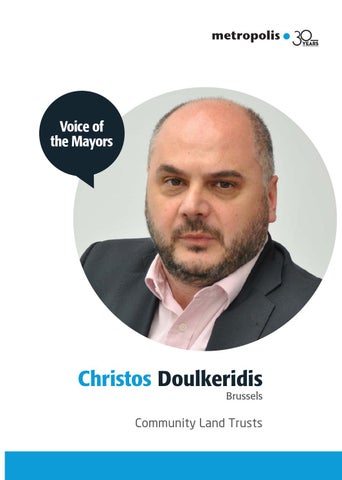
Voice of the Mayors
Christos Doulkeridis Brussels
Community Land Trusts
C h ris t o s D o u lk erid is
Voice of the Mayors
About Voice of the Mayors Celebrating its thirtieth anniversary, METROPOLIS wishes to leverage the unique experience of its members, represented by the mayors of the major metropolises, presidents and governors of metropolitan regions. Too often, the expertise of these high-ranking officials is lost once their term has come to an end. However, at a time when global urban development is quickening its pace, their experience is more beneficial than ever for the new generations of local decision-makers, the entire spectrum of public and private local development stakeholders and partners in the international community. In its capacity as a network of the world’s major metropolises, METROPOLIS also seeks to make an active contribution to the current international debate concerning the revision of the Millennium Development Goals, negotiations on climate change and the preparations for the United Nations Conference on Housing and Sustainable Urban Development (Habitat III). This is how the idea for Voice of the Mayors came into being, as a wealth of first-hand testimonies from local and regional leaders whose experience deserves to be recounted and disseminated. Bequeathing this legacy also conveys the willingess of METROPOLIS members to share their experiences and to enhance the exchange of knowledge, a concerted effort to contribute towards shaping sustainable urban development worldwide. Upon the creation of METROPOLIS in 1984, the 14 founding members expressed their desire to work together to strengthen their mutual capacities to manage their cities. Voice of the Mayors helps to achieve this goal with the 136 members that comprise METROPOLIS today and the young generations of local decision-makers. The testimony you are about to read serves to enhance the association’s training activities and the work carried out within the framework of the METROPOLIS Initiatives, the METROPOLIS Women International Network and of METROPOLIS Youth. The experience of the leading decision-makers in major metropolises across the world is essential. They manage the day-to-day needs of millions of citizens as regards housing, mobility, education, health, safety and energy, to name but a few. They run cities, urban areas and metropolitan regions that are sometimes larger than certain United Nations member states in terms of population, budget size and global reach. They are the main political leaders on the front line, tackling the challenges facing the planet. Nevertheless, this role has yet to be sufficiently recognised in present-day international relations. It is Metropolis’ aspiration that Voice of the Mayors will help these leaders’ words to be better heard, listened to and taken into consideration by the international community.
Alain LE SAUX METROPOLIS Secretary-General October, 2014
1
Curriculum vitae
CHRISTOS DOULKERIDIS
Born in 1968 in Brussels, Christos Doulkeridis is of Belgian and Greek nationality. Self-taught, he has been a member of the Green party since 1988 and held a series of posts within that party before becoming a MP in 1999. From 2004 to 2009, he was the Speaker for the French-speaking Brussels Parliament. In July 2009, after being the negotiator for his party in the formation of the Brussels-Capital Region Government, Christos Doulkeridis became the new Secretary of State for Housing and the Emergency Fire and Medical Assistance Service (Service d’Incendie et d’Aide Médicale Urgente - SIAMU / De Dienst voor Brandbestrijding en Dringende Medische Hulp - DBDMH). He was also appointed Minister-President of the French-speaking Brussels Government (the French Community Commission/Commission communautaire française - Cocof), responsible for Tourism, Education and the Budget. At the age of 45, Christos Doulkeridis already has long track record in Brussels politics, through his experience within parliament, as a minister and as an institutional negotiator. In his past five years in the Brussels Government as Secretary of State for Housing, Christos Doulkeridis has been concerned both to launch regional housing policy initiatives while implementing various innovative options for diversifying public-sector tools to achieve the maximum benefit.
C h ris t o s D o u lk erid is
Voice of the Mayors
3
Christos Doulkeridis CLTs, an innovative and participative home ownership model
A
few years ago, the letters CLT and the words Community Land Trust meant little to most Belgians. What is more, I must confess that when I took up oďŹƒce as Secretary of State for Housing, some of the subtleties of this instrument new to continental Europe occasionally escaped me. At that time, only a handful of experts could have explained all the details and niceties of this housing production model. Today, the progress we have achieved is truly remarkable. For some months now, the
Community Land Trust has become a reality of which the Brussels Region can be proud. Indeed, what was just a concept, a field of study, a subject for consideration by the Brussels housing sector in 2012 has gradually taken shape and has been concretized in two major projects but also in a series of other schemes. It is an achievement that has awakened interest and aroused curiosity within the Walloon Region, as well as in Flanders and in France. Since December 2012, the Brussels Government has given its agreement to the development of this new model for housing production and home ownership for low-income households. In March last year, CLT launched its first project
4
Visit of the international delegation of experts to the largest Community Land Trust, the “Champlain Housing Trust” (Burlington, Vermont, USA), after the latter had been granted the “Best Habitat Award” by the United Nations (September 2009).
by purchasing its first building in a Brussels municipality. Finally, when the Regional Parliament on Friday, 28 June 2013 adopted the amended Housing Code governing public-sector bodies in this sector, the existence of the Community Land Trust was given legal effect, alongside other forms of alternative housing such as intergenerational housing and solidarity-based housing.
children, rent can sometimes account for more than half of their income. As a result, there is little left over for food, clothing and the children’s education. It was to address the needs of such families that we have laid the foundations and prepared the ground for an in-depth review of the housing sector focusing on good governance and energy transition.
But why has the Brussels Region embarked on this adventure?
Action was needed to turn the right to decent housing into a reality for all Brussels residents, while at no time forgetting the more vulnerable in society (single-parent families, the disabled, etc.), and bearing in mind the aim to diversify the public-sector responses and work towards the ecological transition of social housing to bring tenants significant energy savings.
We have been concerned to bolster all regional schemes that could give reality to the right of Brussels residents to a home. Given the numerous challenges (demographic, social and environmental) faced by the Brussels Region, it was essential to place housing at the top of the Brussels Government’s priorities. For an increasing number of Brussels residents it is hard to find housing that is within their means. For single parent families with
This involves speeding up the Regional Housing Plans, which should result in the construction of more than 10,000 social and midrange housing units over the next few years, and by capitalizing on the momentum generated by
C h ris t o s D o u lk erid is
Voice of the Mayors
5
1/3 CLT DWELLERS
1/3 PUBLIC INTEREST
1/3 NEIGHBORHOOD
Innovative Governance the Housing Fund, which, in 2012, granted 1,304 loans and opened up home ownership to the same number of low-income families. In addition to this, the Brussels-Capital Region has made strenuous efforts to combat unoccupied housing. However, above and beyond the conventional tools available, I also wanted to encourage the development of creative solutions to tackle the challenges posed by housing. More specifically, we see these challenges as opportunities for putting in place new lifestyle patterns: more friendly, more democratic, more accessible and more balanced. How can we bring this about through policy and with the help of sociologists, town planners, architects and other scientific experts who analyse, conceptualise, model and conduct experiments? The Sustainable Town is primarily a physical and political space in which it must be possible to create and deploy new economic and social relationships to achieve the solidarity required if we are to safeguard our common environment. In the Brussels Region, it is increasingly difficult to become a home owner: firstly, there is a lack of affordable and decent housing; secondly, poverty is increasing among the population. The situation is particularly worrying: House prices
have exploded and becoming a home owner is now the sole preserve of households with both very comfortable incomes and an initial capital (or support from parents). Consequently, numerous households, including middle class families, are opting to move to regions where prices are more affordable. Compared with average house prices, Brussels is at the very top of the scale. The average price for an ordinary house fluctuates around EUR 355,000, which is almost three times as much as in the Hainaut. This is the context that motivated our wish, since 2009, to generate the dynamism that has grown around the creation of the Brussels Community Land Trust. A project that is far from new The impetus initially came from various associations, which began by setting up socially responsible savings groups. These groups brought together some fifteen vulnerable families to take part in an original collective savings scheme to enable them to build up the deposit needed to purchase a home.
6
Speech by the former secretary of state for Housing of the Brussels Capital Region, during the international conference organised by CLTB: “Knowledge Building Across Community Land Trusts in Europe and the United States” (Brussels, 1st and 2nd of July 2013).
This process proved to be remarkably successful, with the L’Espoir project set up in Molenbeek in 2010, making it possible to house 14 low-income families. After 5 years, the social blueprint to erect this model building finally took form in the Rue Fin straat in Molenbeek-Saint-Jean. This innovative home ownership project undertaken by the Housing Fund combines ecology – it is an ecologically passive building – and socially cohesive housing. Supported by the Bonnevie community centre, with the cooperation of CIRÉ (Coordination et initiatives pour et avec les réfugiés et les étrangers), an NGO involved in projects for and involving refugees and foreign nationals, the ingenious idea behind this project was for the potential buyers to be involved in the new construction project. These buyers did, indeed, set themselves up as a de facto association under the name “L’Espoir”. Our hopes for this project were not in vain and it was inspirational given the difficulty large low-income families have in finding homes.
However, the limitations of this remarkable initiative, which would not have been possible without excellent cooperation between residents, the voluntary sector and the public authorities, quickly became apparent. This led the players involved to look into the benefits of a Community Land Trust even before the works for the “L’Espoir” project had been completed. The fact is that if the property is sold on to the person offering the best price, it will clearly go to someone with income much higher than that of the family at the origin of the project. As a result what began as a collective venture to produce very affordable housing ends up actively contributing to the rise in prices on the private housing market and gradually squeezing out low-income families. Some fifteen associations explored the CLT model and came together in 2009 to create the Brussels Community Land Trust Platform, with the aim of working towards transferring this U.S. model to Brussels.
C h ris t o s D o u lk erid is
Exchanges between the Brussels voluntary sector and my Cabinet were rapidly put in place. Won over by this model, I commissioned a study to check that it could be adapted to the situation in Brussels. While convincing on paper, it turned out that the American-style CLT could not be transposed as it stood. There are significant differences in property rights legislation. Furthermore, there was a need to transpose an operational model adapted to local Brussels stakeholders and to the reality on the Belgian property market. Launched in partnership with the Brussels CLT Platform, which brings together several associations, this study finally came up with a suitable model and the Government of the Brussels-Capital Region gave its approval to the key aspects. The study brought out conditions in the Brussels-Capital Region that would favour the emergence of such a housing production model. For example, one key factor that could foster the establishment of a CLT in Brussels was the presence of an affordable social mortgage-loan system. The Brussels-Capital Region Housing Fund [Fonds du Logement de la Région de Bruxelles Capitale/Woningfonds van het Brussels Hoofdstedelijk Gewest] had endeavoured, over the past few years, to keep its loans affordable for low income households, despite the rise in house prices. This was reflected, for example, in a number of measures it had taken, such as raising the maximum eligible house price and the maximum allowable loan amount, increasing the relative share of
Voice of the Mayors
7
the loan amount and lowering the annual reference rate. In the USA, gaining access to suitable mortgage loans is often one of the greatest hurdles for potential owners. Provided they are used to purchase CLT housing, the socially responsible loans granted by the Brussels-Capital Region Housing Fund are a major plus point for the development of Community Land Trust in the Brussels Region. The other advantage pinpointed by the study and working in favour of a Community Land Trust being set up in the Brussels-Capital Region is the presence of a dynamic voluntary sector to support the establishment of this new model. Indeed, I have watched a number of grassroots associations develop innovative housing projects over the past few years. For example, I would cite the projects developed for squats, such as 123 Rue Royale, the socially responsible savings groups launched by CIRE and the Maison Biloba Huis community housing project for the elderly in Schaerbeek. While very diverse, what these initiatives have in common is a desire to look for new forms of urban homes and to enable people with limited incomes to gain access to decent housing at an affordable price while ensuring greater participation on the part of residents. Alongside these associations, there is rich network of organizations in the Brussels Region that are actively involved in helping those with low incomes to look for housing.
Exploratory architectural workshop in the framework of the 30 unit housing project “Arc-en-ciel”, organised by CLTB with the future owners.
8
What was it about this project that appealed to the Brussels-Capital Region?
•
if it is sold on, the owner of the home receives the value of his initial purchase and part of the capital gain that has accrued on his property. The capital thus built up should enable him to consider purchasing another property. For its part, the CLT continues to own the land; the grants obtained by the first household are returned to the CLT’s assets and may then be used to assist other families to become owners. The regional resources invested are therefore reinvested to support other families in their steps to become owners. In other words, the huge boost for the Region is the “return”;
•
its original governance model: to ensure that, as a project, it is collective, participative and open to the neighbourhood, the CLT is also based on an entirely innovative form of governance and is managed democratically: twothirds of the decision-making bodies are composed of residents and representatives of the voluntary sector or local players; one-third is composed of the public authorities financing the CLT.
Its impact on the cost of housing: The CLT is a non-profit structure which acquires and manages land. Its object is to renovate or construct buildings on that land to enable low-income families to become home owners and to foster the location on that land of collective activities open to those living in the neighbourhood. The fundamental principle underlying a CLT is simple: The idea is to separate the cost of the land from that of the bricks and mortar. The CLT continues to own the land and sells the building to the families who will live in it. Since the value of the land is no longer a factor in the value of the building, the building is less expensive than on the conventional housing market. The land remains the property of the CLT, but the building becomes the property of the families. It is an arrangement that tackles the key problem with the cost of urban housing - the cost of the land - and which, like the divided rights under other measures – such as surface rights and leasehold rights – provides an operational response. The “CLT model” does not stop with this basic fundamental principle. There are also other factors that make it special:
In view of the study’s conclusions, the Brussels Regional Government decided to jump onto the CLT bandwagon. It agreed a certain num-
Presentation of the proposals from five architecture firms for the transformation of the first community land trust into seven low-energy households of the “Le Nid” project.
C h ris t o s D o u lk erid is
Voice of the Mayors
9
Splitting land and built environment
Building ownership to the individual
Land ownership to the CLT Signature of the sales agreement between CLTB and the 7 acquiring families of the first project “Le Nid” (Brussels, 17th of April 2014).
ber of principles, which included determining the target public for the CLT system: Five categories of household will have access to the housing created under the CLT umbrella: •
•
•
4 of these 5 categories are households with income below the ceiling for social housing: the maximum income for Category A corresponds to the income giving entitlement to social housing; the minimum income for Category D corresponds to the social integration income; 1 of the 5 categories relates to households whose income falls between the ceiling amounts for social housing and the brackets applied by the Housing Fund under its mortgage loan policy (that is to say, a household with an income of less than EUR 41,356.00, or EUR 51,695.00 for those under the age of 35); the breakdown between these five categories varies for each project depending on the specific financial package that will determine the cost of the project, and the Government’s decision on the amount of financing it agrees to allocate to the project. Each operation undertaken by the CLT must be founded on a dual principle: reaching those with the lowest incomes whole achieving the maximum social mix.
The Government has also agreed to the definition of a price at which the housing is sold to the first purchaser and, linked to this, the grant necessary to achieve this. The grant for households, in fact, falls into two parts: •
a land grant that is identical for all purchasing households irrespective of their incomes;
•
a grant on the building, based on the income level of the purchasing household.
Each transaction must be the subject of an application for a specific grant to the Brussels Government. The CLT must indicate in the application the sum required to acquire the land and the amount of the complementary grant required for home ownership, based on the categories of income to which each home is allocated. The grant, with its two component parts, is only necessary the first time the property is sold; thereafter, it “transfers” to the successive purchasers under the on-selling arrangement. The Government has agreed to another key principle of the CLT system, namely if a household sells its home, the sales price will be determined on the basis of a preset formula. This on-selling scheme arrangement is aimed at ensuring that the social nature of the housing is preserved at all times, that is to say that it continues
10 A subsidy that is never lost 1st FAMILY Regional Subsidy
Price of purchase by the 1st family
RE-SALE Regional Subsidy
Price of purchase by the 1st family
Capital gain obtained in 10 years
Essentially the capital gain remains as a heritage of the CLT Regional Subsidy
Price of purchase by the 2nd family
75% of the capital gain returns to the CLT
The 9 unit housing project “Mariemont” in Molenbeek (Brussel), the first to be inaugurated (early 2015)
C h ris t o s D o u lk erid is
to be affordable without a further grant at a later stage and that the sum received by the selling household helps it to acquire a new home on the open market. The Government has given its agreement in principle to these different elements and they will be applied when the initial pilot projects are launched. The way in which the scheme operates will be the subject of ongoing evaluation and may well be adjusted during the course of the scheme where appropriate. Two projects in the pipeline In actual fact, two projects are now in the pipeline. The first is in the Brussels municipality of Anderlecht and the second in the municipality of Molenbeek. The Government has given its agreement to a grant of EUR 670,000 for the completion, through the CLT system, of an initial 9 homes under the “Verheyden” pilot project. The entire building will be refurbished to meet low-energy standards. It is an intergenerational project open to the neighbourhood and consists of 5 family homes for sale plus four small homes primarily for sale to the elderly or those with reduced mobility, a services area or cultural space open to the neighbourhood, and a community garden. The second project launched is in the municipality of Molenbeek. In contrast to the first project which involves refurbishment, the Vandepeereboom Project is a large-scale operation being undertaken with the assistance of the Brussels Region Housing Fund. CLT is planning to construct two buildings on a 1,161 m² parcel of land acquired from the municipality of Molenbeek. The first building will run along Rue Vandepeereboom straat and the second will flank Rue des Étangs Noirs/Zwarte Vijversstraat. The two buildings will be linked to each other by a community garden on the same land parcel. Thirty five 1-5 bedroom homes and two local facility areas will be established on this site. Through the financial packages for these two projects, efforts will be made to achieve the
Voice of the Mayors
11
maximum synergies between the various component parts of the project and with life in the neighbourhood. Community Land Trusts are already tried and tested, notably in the USA. There are over 250 initiatives of this kind, some of them even managing housing estates with several thousand homes. By putting in place the first CLT in Belgium, the Brussels Region has once again shown that it is at the cutting edge when it comes to putting in place innovative solutions to enable low-income families to achieve their dream of home ownership. What is more, Flanders and Wallonia are watching this innovation closely and are already looking at the possibility of adapting this model to their own scenarios. This innovative model for housing production corresponds to the objective of encouraging new forms of housing, responding to needs and allowing for the financial capabilities of Brussels residents. It is also a way of supporting a form of participative housing, open to the neighbourhood and its inhabitants, which constitutes a factor for social cohesion. I am impatient to see this project come to fruition, together with the other CLT projects currently at embryonic stage in the Brussels Region. Today, we are laying the cornerstones for a sustainable model that will take root across the Brussels landscape. Other operations are also already being examined. I hope the example provided by the Brussels CLT will be a source of inspiration well beyond regional boundaries. Through the social housing agencies (agences immobilières sociales – AIS/sociale verhuurkantoren - SVK) in the rental market and the CLT on the sales market, civil society can provide new solutions to be developed in partnership with the public authorities and thereby confirm its positive role as a catalyst for a mix of solutions in the housing sector. Bruxelles March, 2014
12 METROPOLIS’ VOICE OF THE MAYORS IS SUPPORTED BY
The Cities Alliance is a global partnership for urban poverty reduction and the promotion of the role of cities in sustainable development. Cities Alliance Members include local authorities, national governments, non-governmental organisations, multilateral organisations, and associate members. METROPOLIS is a founding member of Cities Alliance. www.citiesalliance.org
The Global fund for cities development (FMDV) was created in October 2010 at the initiative of METROPOLIS, United Cities and Local Governments (UCLG) and 34 founding members (cities and city networks). It is an international political organisation which aims to strengthen solidarity and financial capacity by and among local authorities and is complementary to existing mobilisation, coordination and advocacy networks. Supporting local authorities to access funding
www.fmdv.net
Created in 2004, United Cities and Local Governments (UCLG) is the united voice and world advocate of local and regional self-government. Members of UCLG are present in 140 countries, and are organized into seven regional sections, a Forum of Regions, and a metropolitan section coordinated by METROPOLIS. UCLG’s membership includes over 1,000 cities and regions, as well as 155 local government associations. www.uclg.org
The World Urban Campaign is a global partnership coordinated by UN-Habitat, designed to promote a positive vision of sustainable urbanization and to place the urban agenda at the highest level in development policies. It is meant to build alliances with all the sectors of society in a movement to provide a knowledge and action-oriented platform to address urban challenges. it is a platform for Habitat III, the United Nations Conference on Housing and Sustainable Urban Development to be held in 2016. www.worldurbancampaign.org
This work is licensed under the Creative Commons AttributionNonCommercial-NoDerivatives 4.0 International License. To view a copy of this license, visit http://creativecommons.org/licenses/by-nc-nd/4.0/
Voice of the Mayors
Secretariat General Aviny贸, 15 08002 Barcelona Phone: (+34) 93 342 94 60 Fax: (+34) 93 342 94 66 metropolis@metropolis.org www.metropolis.org
Design Concept by samourai.fr Layout by lina gast
# 09