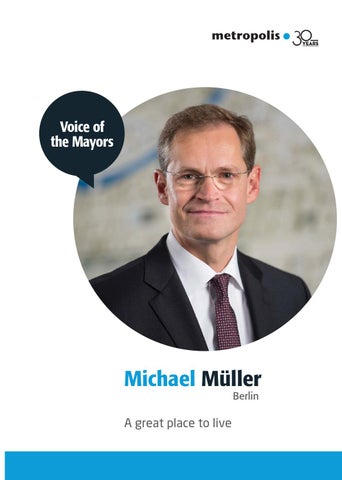
Voice of the Mayors
Michael M端ller Berlin
A great place to live
Mich a el Mü ller
Voice of the Mayors
About Voice of the Mayors Celebrating its thirtieth anniversary, METROPOLIS wishes to leverage the unique experience of its members, represented by the mayors of the major metropolises, presidents and governors of metropolitan regions. Too often, the expertise of these high-ranking officials is lost once their term has come to an end. However, at a time when global urban development is quickening its pace, their experience is more beneficial than ever for the new generations of local decision-makers, the entire spectrum of public and private local development stakeholders and partners in the international community. In its capacity as a network of the world’s major metropolises, METROPOLIS also seeks to make an active contribution to the current international debate concerning the revision of the Millennium Development Goals, negotiations on climate change and the preparations for the United Nations Conference on Housing and Sustainable Urban Development (Habitat III). This is how the idea for Voice of the Mayors came into being, as a wealth of first-hand testimonies from local and regional leaders whose experience deserves to be recounted and disseminated. Bequeathing this legacy also conveys the willingess of METROPOLIS members to share their experiences and to enhance the exchange of knowledge, a concerted effort to contribute towards shaping sustainable urban development worldwide. Upon the creation of METROPOLIS in 1984, the 14 founding members expressed their desire to work together to strengthen their mutual capacities to manage their cities. Voice of the Mayors helps to achieve this goal with the 136 members that comprise METROPOLIS today and the young generations of local decision-makers. The testimony you are about to read serves to enhance the association’s training activities and the work carried out within the framework of the METROPOLIS Initiatives, the METROPOLIS Women International Network and of METROPOLIS Youth. The experience of the leading decision-makers in major metropolises across the world is essential. They manage the day-to-day needs of millions of citizens as regards housing, mobility, education, health, safety and energy, to name but a few. They run cities, urban areas and metropolitan regions that are sometimes larger than certain United Nations member states in terms of population, budget size and global reach. They are the main political leaders on the front line, tackling the challenges facing the planet. Nevertheless, this role has yet to be sufficiently recognised in present-day international relations. It is Metropolis’ aspiration that Voice of the Mayors will help these leaders’ words to be better heard, listened to and taken into consideration by the international community.
Alain LE SAUX METROPOLIS Secretary-General October, 2014
1
Curriculum vitae
1964 Born in Berlin; married, two children
MICHAEL MÜLLER
Since 2011 Berlin Mayor and Senator for Urban Development and the Environment
1982 Graduated from secondary school Until 1986 Technical College for Business and Administration and business apprenticeship 1986 to 2011 Managing partner of a printing company Since 1981 Member of the Social Democratic Party 1991 to 2000 Chairman of local SPD chapter 1989 to 1996 Member of the Berlin-Tempelhof borough assembly, also as chairman of the SPD group; delegate to the district and state party conventions Since 1996 Member of the Berlin House of Representatives 2000 to May 2004 Chairman of the SPD in Tempelhof-Schöneberg 2001 to 2011 Chairman of the SPD parliamentary group in the Berlin House of Representatives 2004 to 2012 Chairman of the SPD in the federal state of Berlin 2011 Re-elected with a direct mandate by his district in Tempelhof-Schöneberg
Membership in organizations and associations Arbeiterwohlfahrt Bundesverband e.V. / AWO (Workers’ welfare association) Berliner Wirtschaftsgespräche (Organization for economic policy debates) Sozialdemokratische Gemeinschaft für Kommunalpolitik / SGK (Social Democratic association for municipal policy)
Mich a el Mü ller
Voice of the Mayors
3
Michael Müller Berlin, a great place to live
hand, since my family and I also live in a rented apartment. However, that’s not the only reason why I know that problems with rent and housing are vitally important issues.
M
ayor and Senator Müller, after many years as the head of the SPD parliamentary group in the Berlin House of Representatives, you became the Senator (minister) for Urban Development and the Environment. How did you approach this policy area, and what was and is your connection to it? I have been politically active in Berlin for more than three decades, which means that I’ve been a long-time observer of a lot of the city’s development and have been able to contribute to some of it, too. As a native of Berlin, not only I am proud of my city, but I am pleased to have the chance to shape policy in an exciting time. My responsibilities as Senator are both diverse and future-oriented. From the beginning of my term in office, I have made housing and rental policy a focus of my work. I’ve experienced the changes in this sector first-
Good, safe housing is a basic need. In every region of the world, securing and adding to available housing for the population is a key public service task. Local policymakers are well advised to give this issue the attention it deserves. What are your housing policy goals? My most important policy goal is to create new, affordable housing, especially for those with lower and middle incomes, and to curb rising costs for rentals. Housing must be sustainable, and shaping the general conditions for housing plays a key role in this effort. The changes in the housing and rental sector in Berlin in recent years mean that stakeholders on all levels need to rethink the situation. The future, too, will hold a lot of challenges in this area. Berlin and its neighborhoods are changing, the population is growing, rents are rising, housing is harder to find, and, at the same time, people want larger, more comfortable apartments. Policymakers need to respond to the changes, and I have made it my responsibility to find solutions to these very pressing problems.
4
In your opinion, what are Berlin’s biggest housing policy challenges? Living in and around Berlin has become more attractive. Many people from all over the world have discovered that our city is a great place to live. They want to enroll in our universities, work here, and find a new home for their families. The growth of Berlin’s economy, especially in production-oriented sectors of the creative industries, the transportation sector, the environmental industry, and the health-care sector, is creating more and more jobs for skilled workers. That brings more people to Berlin, and the new arrivals create even more demand for housing, which has shaken up the housing market still further. In the last three years, an additional 100,000 people have moved to our city, and we expect another 250,000 to come by 2030.(Fig. 1) That’s the size of a large European city. Adding that many new people has consequences of its own, in addition to the demands it places on our infrastructure.
The growth in the population is reflected in the steep rise in rents for available apartments. In no other large German city (defined in Germany as cities with a population of at least 100,000) has the asking price for new vacancies risen as sharply since 2007 as in Berlin (Fig. 2). Affordable housing is a necessity for many Berliners with low and middle incomes. The average rent for apartments under existing leases is still significantly lower than in Hamburg and Munich, the other German cities with more than a million inhabitants, but the average net household income in Berlin is also about 12% lower than the German average. This makes it clear that Berlin, with its growing population, will be facing two different housing policy challenges at the same time in the coming years: (1) On the one hand, housing for the large percentage of lower income households in the city has to remain affordable. (2) On the other hand, more new apartments must be built in order to meet the needs of the growing city.
Fig. 1 Population development in Berlin for 1990 – 2011 and population projections for 2012 – 2030
Mich a el Mü ller
Voice of the Mayors
5
Fig. 2: Development from 2007 to 2011 of asking rents published on the Internet for new vacancies in Germany’s 25 largest cities
The social mix will play a key role in the new housing projects. Owner-occupied apartments currently make up the vast majority of new housing being built in Berlin. Because so few people own their own apartments in Berlin, this new phenomenon is not a problem when considering the city as a whole. However, urban development policy also has to help maintain the city’s social mix. Preventing the emergence of single-use neighborhoods – with residential suburbs in one area and nothing but office buildings in another – is important if a city is to stay vibrant. As part of our efforts to prevent this, and also in order to preserve additional housing, we have passed a law that prohibits the misuse of housing for other purposes. This law will have an especially strong impact on neighborhoods in the city center.
Berlin is a city of many different neighborhoods with a strong individual identity. People who have lived in a particular neighborhood for decades, have grown up there, and are raising children there are reluctant to move, even when the rent goes up and the apartment is no longer affordable. We do not want gentrification to endanger the social mix that exists especially in the city center by allowing households with higher income to displace tenants with less money to housing on the outskirts of the city. How did you handle the decision-making and implementation processes of your rent and housing policies? In real-world policymaking, the path from an idea to its realization is a long one. When it came to housing policy, it was clear to me when
6
I took office that we had no time to lose, since translating an idea into concrete projects is a lengthy process. The Berlin Senate has responded to the increasing pressure on the housing market with an entire package of various housing policy measures. In his government policy statement at the beginning of this legislative term, Governing Mayor Klaus Wowereit emphasized that housing policy would be one of eleven priority areas for the Senate. The goal guiding our actions in this area is clear: making sure that our growing city is a livable place for all of its residents – despite a tight budget. Housing policy has to be geared to long-term objectives and must be shaped cooperatively and with the participation of various departments. Joint work by all of the stakeholders in the political and social sectors is necessary if we are to find solutions to major challenges. This involves trust, reliability, and awareness of many interrelationships. The support of the community is essential if we are to succeed. That’s why I work to get the public’s acceptance, trust, and understanding for every project we propose, since every single project involves complex organizational processes and often conflicting interests, too. For instance, socially minded rental policies reduce profits, and construction work causes inconvenience and annoyance – which is often true of transportation projects, too, which also fall under my jurisdiction. In making housing policy, I rely on the knowledge, experience, and commitment of many partners in the political sector, the administration, the municipal housing associations, and the private housing sector. Last but not least, I also rely on the people of the city, especially when it comes to their participation in housing-policy decision-making processes and citizens’ involvement in preserving and improving neighborhood housing and lifestyles in existing and new residential areas. One important information and coordinating tool for our housing policy is the
urban development plan on housing that was drafted over the last two years with the aid of the major housing policy stakeholders. The focus here is on determining the need for new construction in the coming years and on cataloguing the land available for new construction. The urban development plan on housing tells local residents, investors, and administrative agencies where the city would like to concentrate its development efforts (Fig. 3). In order to ease the pressure on the housing market in Berlin, we have entered into an “alliance for socially minded housing policy and affordable rents” with the municipal housing associations. As part of this alliance, the associations committed to increasing their housing stock by at least 30,000 apartments by the end of the legislative period through additional purchases and new construction. The federal state of Berlin is helping the housing associations to build new apartment buildings also by giving them state-owned land. Along with new construction, the alliance includes a number of other commitments by the housing associations, such as making apartments available for lower-income tenants and capping rent for these tenants at no more than 30% of their net income. However, the private sector is also being brought on board in view of the growing demand for new construction. Here in Berlin, we’ve introduced an “urban planning contract” with which individual developers commit to integrating affordable housing into their construction project and/or investing in necessary infrastructure in the area. This commitment often conflicts with the exclusive pursuit of profit; the idea here is to take a responsible and targeted approach to balancing interests. How did you finance your policy and who were your partners in this effort? The most important partners for the financing of housing policy in Berlin are:
Mich a el Mü ller
Voice of the Mayors
7
Fig. 3: Urban development plan on housing – Major areas of new construction
The urban development plan on housing covers the potential construction of around 115,000 apartments. About 43,000 of these are located in the 24 largest areas of new construction (circled in red).
•
Our legislature, which, by adopting the budget, decides on the funds that will be available for housing policy measures
•
Private property owners, investors, and financial institutions
•
Municipal housing associations
The city itself has very few properties of its own. The vast majority of the land that could be developed (more than 70%) is privately owned. As a result, when it comes to new construction, we are dependent both on cooperation with the private housing sector and on an effective and efficient set of instruments for promoting this construction. Berlin is the sole owner of six municipal housing associations. With total assets of around
€7 billion, average equity of 22%, and a debt burden of around €400 per square meter of living space, all six municipal housing associations are in good economic shape. Despite average rental income that is somewhat under the average for Berlin as a whole, they generate profits of around €100 million a year. In the interest of easing the city’s housing market situation, Berlin does not require the housing associations to pay out these profits. Starting this year, Berlin has been supporting new construction of up to 1,000 apartments a year by providing €64 million in loans to both the municipal housing associations and the private housing sector. The goal here is to subsidize 20 to 33% of the apartments in larger new construction projects; these will be rented to lower-income tenants, thereby helping to promote a social mix.
8
Along with municipal housing associations and private housing companies, Berlin also has housing cooperatives. In this model, the land and the apartments do not belong to a single owner, but to the tenants as a group. The housing cooperatives are not profit-motivated and are responsible only to their members, not to shareholders. Any profits generated are invested in modernizing existing housing stock, new construction, and expanding the services offered. These cooperatives are key partners when it comes to shaping socially balanced rental and housing policies. How do you communicate with the public? With all our construction projects, we make it a priority to involve residents as early and as comprehensively as possible. Many Berliners are vigorous in defending their interests, so it’s not surprising that almost every new construction project in Berlin leads to a conflict between those in favor of and those against using the land for building. In our city, people are very concerned about environmental issues, so projects on green and open spaces, for example, are especially the
subject of much debate. It is therefore important to involve citizens as soon as possible to decide whether land can be developed and to choose one plan out of the various alternatives that responds to most of the stakeholders’ interests. Participation is thus an indispensable part of all larger projects. A referendum that was held on the future of the former Tempelhof Airport grounds shows that we take the will of the people very seriously. The airport grounds are in the city center, and we wanted to build about 4,700 apartments in three sections on the edge of the former airfield; the rest of the property would have become a huge new park in the heart of the city. However, the voters who took part in this referendum decided that none of the property should be developed. We accept this decision and will now have to concentrate our housing construction efforts on other locations. I also use brochures, exhibitions, pro-active PR work, and events to do everything I can to inform people affected by projects about our plans and policies.
“Alliance for Affordable Housing” with the municipal housing associations
Mich a el Mü ller
Tempelhofer Feld
Voice of the Mayors
9
Mariengrün housing estate
I see an active civil society as a precondition to being able to shape the future of our city. All the concepts we are currently working on for Berlin’s future development are therefore geared towards broad participation by civil society. I want to win our citizens’ support for my approach to urban development.
housing and rent that Berlin has been calling for: limiting rent increases and providing more money for subsidized housing. I am delighted that our initiatives and appeals have been successful in this regard. We have used all our political contacts to exercise influence and started many initiatives in relevant political institutions.
Berlin is both a metropolis and one of Germany’s federal states. How do you represent your interests on the national and international level?
How do you assess the developments so far?
Processes of change like those we are experiencing here in Berlin also play a role abroad; all over the world, cities are growing. This is why networks, both on the national and on the international level, such as Metropolis, are so important. They help us learn from each other and give us the opportunity to exchange ideas. I’ve made a conscious decision to participate actively in these conferences, because Berlin not only has many valuable ideas to contribute, but can also learn a lot from other big cities. I am always delighted about the great international interest in Berlin and about how often we’re mentioned as a model for innovative ideas. In recent years, Berlin has pressed the national government to live up to its responsibility towards tenants in Germany. With the new federal government, the topic of rent has reached the national level. After the last national elections of September 2013, the parties that now form the government reached the same consensus on
Housing policy is a highly complex and politically often quite controversial area of responsibility. It requires a lot of staff, money, and, not least, political persuasiveness, perseverance, and consistency. We’ve already been successful in many ways and have set the course for expanding the housing market also for low and middle income groups: •
With institutional and financial support, we are promoting housing construction in the entire city, especially for low and middle incomes.
•
We are building alliances with the key housing policy stakeholders in order to make socially equitable housing possible.
•
We have improved protection against eviction, passed a law to prevent the misuse of housing, and limited rent increases for tenants already living in an apartment.
10
“Future Living” in Berlin-Adlershof
•
We are providing both financial and human resources to help the administration speed up administrative processes in the case of new construction projects.
The political level is also responsible for moving things forward and providing active assistance. We need to create framework conditions that enable the administration to act efficiently and effectively. And that brings us to the question of resources and the lack thereof in times of tight budgets. Here, too, I feel my responsibility to come up with policies that can actually be realized. We need to plan for the long term, which is why we are currently working on a concept for Berlin’s development up to 2030 under the leadership of my Senate Department. The idea is to create a vision for the social, economic, scientific, and cultural future of the city. Our goal is to make Berlin Europe’s leading “smart city,” one that is able to both compete and cooperate with other big cities worldwide. On our way to becoming a city-wide society of solidarity with more and better jobs and more financial leeway, the urban development plan for 2030 will provide us with important strategies and help us meet the challenges of a growing city.
In the last two years we have created good conditions for the socially equitable development of our city. When it comes to housing policy, it’s in the nature of things that many changes only become visible over the course of ten to twenty years. But we will continue to actively support this development. It’s too early for me personally to sum things up, but I am delighted to have the opportunity to help shape the future of a fascinating metropolis.
Berlin January, 2014
Mich a el Mü ller
Voice of the Mayors
11
Berlin’s facts & figures Berlin has a population of 3.5 million people, which represents 4.3% of the total population of Germany. These people live on an urban area of 891.7 km², making the Berlin’s density (3,925 people/km2) one of the highest in the country (which has a total population of 80.8 million distributed over 357,167.9 km², i.e, 226 people/km²). In 2013, Berlin welcomed around 47,800 new citizens, most of them between 18 and 32 years old. More than five hundred thousand people living in Berlin come from 186 different foreign countries, representing 14.5% of the city’s population – of those, 73.7% come from Europe, 14.2% from Asia , 5.6% from the Americas, 3.7% from Africa, 2.3% from undeclared states/ stateless, and 0.5% from Australia and Oceania. Rental flats are the most common type of housing for the citizens of Berlin. Out of the 1,903,231 housing units in the city, 1,638,831 (86.1%) are rented. On average, each flat has an area of 70.7 m² and is home to 1.75 inhabitants. Buildings and open space occupy 41.4%
Brandenburg Gate
of the Berlin city area, followed by recreational areas, woodlands and water bodies (36.9%), and transportation, agricultural and other areas (21.7%). Berlin’s gross domestic product (GDP) is of €103.6 billion and grew 17.4% between 2005 and 2012. Berlin benefits from tourism, with about
27 million overnight stays and more than 11 million visitors just in 2013. Berlin has 160,220 students enrolled in 39 institutions of higher education and spends €1,506 on education per capita. Since 1990, Berlin has been able to
reduce its CO2 emissions by 28.2%. More facts and figures about Berlin at
www.stadtentwicklung.berlin.de www. berlin.de
12 METROPOLIS’ VOICE OF THE MAYORS IS SUPPORTED BY
The Cities Alliance is a global partnership for urban poverty reduction and the promotion of the role of cities in sustainable development. Cities Alliance Members include local authorities, national governments, non-governmental organisations, multilateral organisations, and associate members. METROPOLIS is a founding member of Cities Alliance. www.citiesalliance.org
The Global fund for cities development (FMDV) was created in October 2010 at the initiative of METROPOLIS, United Cities and Local Governments (UCLG) and 34 founding members (cities and city networks). It is an international political organisation which aims to strengthen solidarity and financial capacity by and among local authorities and is complementary to existing mobilisation, coordination and advocacy networks. Supporting local authorities to access funding
www.fmdv.net
Created in 2004, United Cities and Local Governments (UCLG) is the united voice and world advocate of local and regional self-government. Members of UCLG are present in 140 countries, and are organized into seven regional sections, a Forum of Regions, and a metropolitan section coordinated by METROPOLIS. UCLG’s membership includes over 1,000 cities and regions, as well as 155 local government associations. www.uclg.org
The World Urban Campaign is a global partnership coordinated by UN-Habitat, designed to promote a positive vision of sustainable urbanization and to place the urban agenda at the highest level in development policies. It is meant to build alliances with all the sectors of society in a movement to provide a knowledge and action-oriented platform to address urban challenges. it is a platform for Habitat III, the United Nations Conference on Housing and Sustainable Urban Development to be held in 2016. www.worldurbancampaign.org
This work is licensed under the Creative Commons AttributionNonCommercial-NoDerivatives 4.0 International License. To view a copy of this license, visit http://creativecommons.org/licenses/by-nc-nd/4.0/
Voice of the Mayors
Secretariat General Aviny贸, 15 08002 Barcelona Phone: (+34) 93 342 94 60 Fax: (+34) 93 342 94 66 metropolis@metropolis.org www.metropolis.org
Design Concept by samourai.fr Layout by lina gast
# 04