Integrative Medicine
HCMC Offers Integrative Family Medicine at Whittier Clinic
T
he Integrative Health Program at Hennepin County Medical Center (HCMC) Family Practice Department, is located at Whittier Clinic at 2810 Nicollet Avenue South in inner city Minneapolis, and is thriving. Our approach is unique in that we are developing an integrative family medicine/ primary care model for our clinical practice as well as for residency education. Integrative medicine has been defined by the Arizona Center for Integrative Medicine as “healingoriented medicine that takes account of the whole person (mind, body and spirit), including all aspects of lifestyle. It emphasizes the therapeutic relationship between practitioner and patient and makes use of all appropriate therapies, both conventional and alternative.” We feel this sums it up well. Our approach at Whittier Integrative Health Clinic is unique in that we have set our intention to practice integrative family medicine and primary care, instead of being a consultative practice. We do occasional consultations for patients referred by our colleagues, but this plays a minor part. Patients must come with a desire or intention to work on their issues in a holistic and integrative way. Basic screening questions are asked on initial contact to determine whether a patient will be a good fit for our clinic. Family doctors have the option to shape their practices into many niches, e.g. women’s health and geriatrics; we are choosing to take care of the families and individuals who want an integrative approach. Most patients find their way to our clinic by word of mouth and the internet. Most are looking for a new primary care doctor, as they have been disappointed and frustrated with
By Selma L. Sroka, M.D.
12
May/June 2012
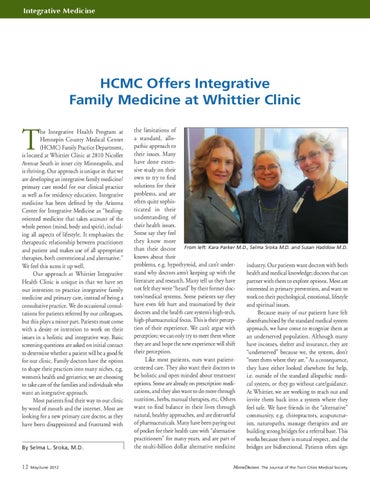
the limitations of a standard, allopathic approach to their issues. Many have done extensive study on their own to try to find solutions for their problems, and are often quite sophisticated in their understanding of their health issues. Some say they feel they know more than their doctor From left: Kara Parker M.D., Selma Sroka M.D. and Susan Haddow M.D. knows about their problems, e.g. hypothyroid, and can’t underindustry. Our patients want doctors with both stand why doctors aren’t keeping up with the health and medical knowledge; doctors that can literature and research. Many tell us they have partner with them to explore options. Most are not felt they were “heard” by their former docinterested in primary prevention, and want to tors/medical systems. Some patients say they work on their psychological, emotional, lifestyle have even felt hurt and traumatized by their and spiritual issues. doctors and the health care system’s high-tech, Because many of our patients have felt high-pharmaceutical focus. This is their percepdisenfranchised by the standard medical system tion of their experience. We can’t argue with approach, we have come to recognize them as perception; we can only try to meet them where an underserved population. Although many they are and hope the new experience will shift have incomes, shelter and insurance, they are their perception. “underserved” because we, the system, don’t Like most patients, ours want patient“meet them where they are.” As a consequence, centered care. They also want their doctors to they have either looked elsewhere for help, be holistic and open minded about treatment i.e. outside of the standard allopathic medioptions. Some are already on prescription medical system, or they go without care/guidance. cations, and they also want to do more through At Whittier, we are working to reach out and nutrition, herbs, manual therapies, etc. Others invite them back into a system where they want to find balance in their lives through feel safe. We have friends in the “alternative” natural, healthy approaches, and are distrustful community, e.g. chiropractors, acupuncturof pharmaceuticals. Many have been paying out ists, naturopaths, massage therapists and are of pocket for their health care with “alternative building strong bridges for a referral base. This practitioners” for many years, and are part of works because there is mutual respect, and the the multi-billion dollar alternative medicine bridges are bidirectional. Patients often sign MetroDoctors
The Journal of the Twin Cities Medical Society