Brian Macaskill
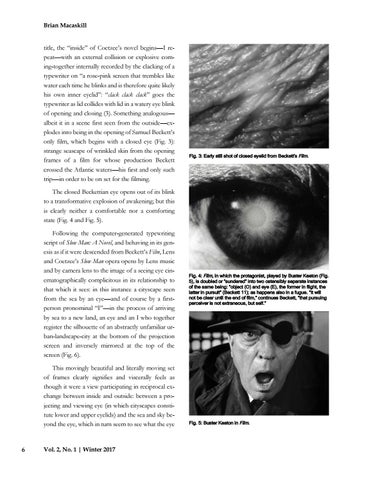
title, the “inside” of Coetzee’s novel begins—I repeat—with an external collision or explosive coming-together internally recorded by the clacking of a typewriter on “a rose-pink screen that trembles like water each time he blinks and is therefore quite likely his own inner eyelid”: “clack clack clack” goes the typewriter as lid collides with lid in a watery eye blink of opening and closing (3). Something analogous— albeit it in a scene first seen from the outside—explodes into being in the opening of Samuel Beckett’s only film, which begins with a closed eye (Fig. 3): strange seascape of wrinkled skin from the opening frames of a film for whose production Beckett crossed the Atlantic waters—his first and only such trip—in order to be on set for the filming.
Fig. 3: Early still shot of closed eyelid from Beckett’s Film.
The closed Beckettian eye opens out of its blink to a transformative explosion of awakening; but this is clearly neither a comfortable nor a comforting state (Fig. 4 and Fig. 5). Following the computer-generated typewriting script of Slow Man: A Novel, and behaving in its genesis as if it were descended from Beckett’s Film, Lens and Coetzee’s Slow Man opera opens by Lens music and by camera lens to the image of a seeing eye cinematographically complicitous in its relationship to that which it sees: in this instance a cityscape seen from the sea by an eye—and of course by a firstperson pronominal “I”—in the process of arriving by sea to a new land, an eye and an I who together register the silhouette of an abstractly unfamiliar urban-landscape-city at the bottom of the projection screen and inversely mirrored at the top of the screen (Fig. 6). This movingly beautiful and literally moving set of frames clearly signifies and viscerally feels as though it were a view participating in reciprocal exchange between inside and outside: between a projecting and viewing eye (in which cityscapes constitute lower and upper eyelids) and the sea and sky beyond the eye, which in turn seem to see what the eye
6
Vol. 2, No. 1 | Winter 2017
Fig. 4: Film, in which the protagonist, played by Buster Keaton (Fig. 5), is doubled or “sundered” into two ostensibly separate instances of the same being: “object (O) and eye (E), the former in flight, the latter in pursuit” (Beckett 11); as happens also in a fugue. “It will not be clear until the end of film,” continues Beckett, “that pursuing perceiver is not extraneous, but self.”
Fig. 5: Buster Keaton in Film.