2 The Forester’s Lesson by Ethan Crumley
Wood Chips: Winter Tree Identification Part of the enjoyment of a hike in the woods is being knowledgeable about the forest elements around you: the animals, the wildflowers, and -- of course -- the trees. In the summer, there are many distinctive leaves which aid in the identification of each species you encounter, and with a trained eye or a good field guide tree identification is easy and enjoyable. Once winter comes, however, the deciduous trees have shed their leaves and leaf characteristics are no longer helpful. But don’t retire your field guides to the bookshelf until springtime. Unlike lawn mowing, gardening, and soccer, tree ID does not require warm weather or a plane ticket to Florida: tree ID is an activity that can happen all winter long!
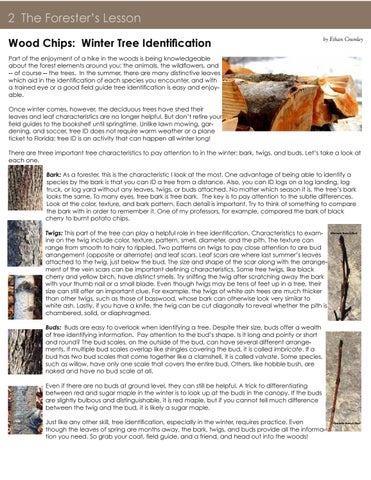
There are three important tree characteristics to pay attention to in the winter: bark, twigs, and buds. Let’s take a look at each one. Bark: As a forester, this is the characteristic I look at the most. One advantage of being able to identify a species by the bark is that you can ID a tree from a distance. Also, you can ID logs on a log landing, log truck, or log yard without any leaves, twigs, or buds attached. No matter which season it is, the tree’s bark looks the same. To many eyes, tree bark is tree bark. The key is to pay attention to the subtle differences. Look at the color, texture, and bark pattern. Each detail is important. Try to think of something to compare the bark with in order to remember it. One of my professors, for example, compared the bark of black cherry to burnt potato chips. Twigs: This part of the tree can play a helpful role in tree identification. Characteristics to examine on the twig include color, texture, pattern, smell, diameter, and the pith. The texture can range from smooth to hairy to rippled. Two patterns on twigs to pay close attention to are bud arrangement (opposite or alternate) and leaf scars. Leaf scars are where last summer’s leaves attached to the twig, just below the bud. The size and shape of the scar along with the arrangement of the vein scars can be important defining characteristics. Some tree twigs, like black cherry and yellow birch, have distinct smells. Try sniffing the twig after scratching away the bark with your thumb nail or a small blade. Even though twigs may be tens of feet up in a tree, their size can still offer an important clue. For example, the twigs of white ash trees are much thicker than other twigs, such as those of basswood, whose bark can otherwise look very similar to white ash. Lastly, if you have a knife, the twig can be cut diagonally to reveal whether the pith is chambered, solid, or diaphragmed.
Alternate Branch/Bud
Opp
Buds: Buds are easy to overlook when identifying a tree. Despite their size, buds offer a wealth of tree identifying information. Pay attention to the bud’s shape. Is it long and pointy or short Alternate Branch/Bud and round? The bud scales, on the outside of the bud, can have several different arrangements. If multiple bud scales overlap like shingles covering the bud, it is called imbricate. If a bud has two bud scales that come together like a clamshell, it is called valvate. Some species, such as willow, have only one scale that covers the entire bud. Others, like hobble bush, are naked and have no bud scale at all. Even if there are no buds at ground level, they can still be helpful. A trick to differentiating between red and sugar maple in the winter is to look up at the buds in the canopy. If the buds are slightly bulbous and distinguishable, it is red maple, but if you cannot tell much difference between the twig and the bud, it is likely a sugar maple. Just like any other skill, tree identification, especially in the winter, requires practice. Even though the leaves of spring are months away, the bark, twigs, and buds provide all the information you need. So grab your coat, field guide, and a friend, and head out into the woods!
Opposite Branch/Bud