X-DFA on track: WinGD’s Schneiter De-rating boxship: Wärtsilä Fit4Power

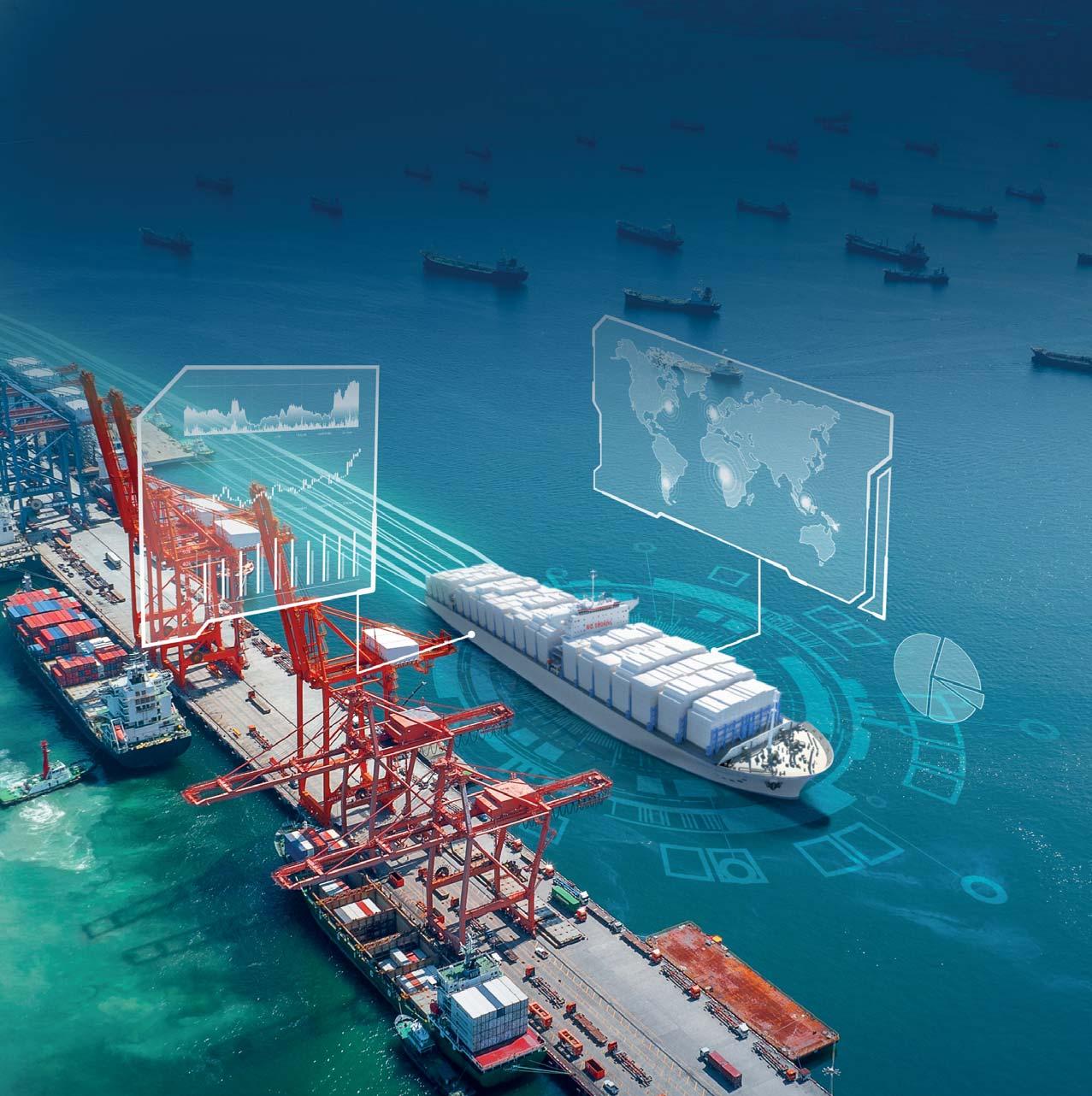
Modular LH2: Viking PEM FC project
4-stroke special: DF retrofit solutions
ALSO IN THIS ISSUE: MAN dual-fuel analysis | EU SRR consultation | Hydrogen FC special | Corvus PEM FC
MAY 2023 Vol. 104 Issue 1213 AN APPROACH TO GREEN SHIPPING CORRIDOR MODELING AND OPTIMIZATION www.eagle.org/GSCOutlook
Download your copy today
FEATURES 6
14 NH3 study for Angelicoussis
An Angelicoussis Group affiliate is conducting a joint study agreement (JSA) with Chevron into the transportation of ammonia in tankers.
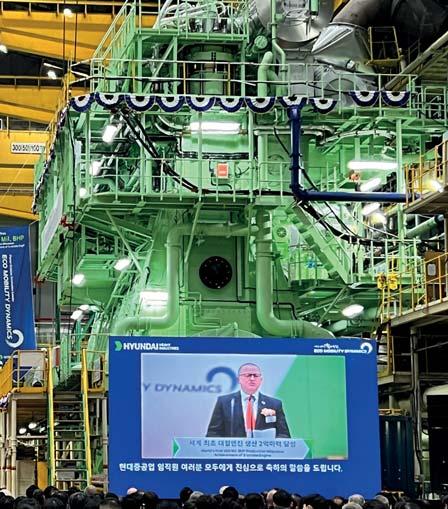
16 MAN B&W ME-LGIM FAT
MAN Energy Solutions completed FAT tests for its first 95-bore ME-LGIM engine in March at HHI-EMD’s facility in Ulsan, South Korea.
60 Turkish Takeaway
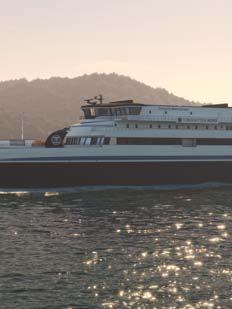
The shipbuilding contracts for Torghattan Nord’s hydrogen-fuelled vessels are close to being awarded to a Turkish yard.
60 REGULARS
11 Leader Briefing Brett Hillis of Smith Reed explains how the extension of the EU’s Emissions Trading System (ETS) to shipping could create additional compliance risks for shipping companies.
13
Regulation
Will a consultation on revisions to the EU’s Ship Recycling Regulation accept more Asian yards or will the Commission cave in to circularity pressures to increase domestic EU scrapping?
60

Ship Description
Torghatten Nord’s 6.4MW PEM fuel cell powered double enders will herald the dawn of shipping’s zeroemissions era when they enter service in late 2025.
12 Its An Ill Wind
An April deal between Norway, the UK and seven EU states to lift offshore wind capacity in the North Sea to ‘at least’ 120GW by 2030 leaves questions about shipbuilding and recycling unanswered.

22 Four Stroke Advances
The latest developments in engine efficiency are being applied to the new generation of multi-fuel 4-stroke engines.
26 Engine de-rating solutions
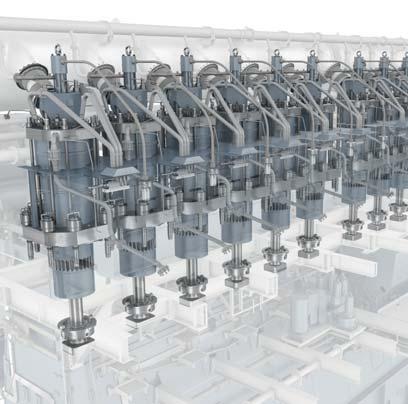
Wärtsilä has developed a radical de-rating solution for customers operating larger container vessels that offers substantial reductions in fuel consumption and greenhouse gas emissions.
28 Laughing gas no more
WinGD’s programme to develop dual-fuel two-stroke engines capable of operating on ammonia and methanol is advancing apace, Dominik Schneiter, WinGD’s Vice President R&D, tells The Motorship
34 Ammonia bloom
MAN Energy Solutions expects ammonia (NH3) to surpass LNG and methanol as the dominant dual-fuel engine type before the end of the decade, according to forecasts seen by The Motorship
The Motorship’s Propulsion and Future Fuels Conference will take place this year in Hamburg, Germany. Stay in touch at propulsionconference.com
Social Media Linkedin Facebook Twitter YouTube Online motorship.com 5 Latest news 5 Comment & analysis 5 Industry database 5 Events Weekly E-News Sign up for FREE at: www.motorship.com/enews For the latest news and analysis go to www.motorship.com MAY 2023 | 3 CONTENTS MAY 2023 NEWS
12
26 44TH
VIEWPOINT
NICK EDSTROM | Editor nedstrom@motorship.com
Declaring An Interest
Since the April issue of The Motorship went to press, there has been no let up in the relentless pace of regulatory developments in the shipping sector.
The June meeting of the IMO’s MEPC committee looks set to be highly significant, with a number of market participants confidently expecting the IMO to raise its 2050 decarbonisation objective from 50% to full decarbonisation.
This is likely to be a somewhat easier decision for the IMO to make than more politically challenging decisions around the introduction of a potential global carbon levy, or a cap and trade scheme.
However, the extension of the EU’s Emissions Trading System (ETS) to shipping, which was finally approved by the European Parliament in mid April, will force many of the world’s largest operators to introduce systems to report and verify environmental emissions, as we hear in this month’s issue.
We would urge small and medium sized owners and operators who have not yet ensured that their existing DRS emissions reporting processes will be compliant when the new ETS reporting requirements come into force to do so as a matter of urgency.
Returning to the impact of higher environmental targets, it is uncontroversial to expect every higher environmental standards to impact newbuilding designs over the course of the current decade. Such expectations underpin the development strategies of developers like Corvus Energy, who openly admit that tighter environmental regulation is likely to be a key driver of the introduction of innovative technologies, such as fuel cells.
Even if higher decarbonisation targets are not agreed at MEPC80, or if those changes are ‘backloaded’ with the steepest reductions in emissions expected after 2033, many ship owners will need to improve the environmental profile of their existing tonnage.
It is no coincidence that the number of retrofit solutions to convert existing engines to operate on alternative fuels, or perhaps simply to improve their emissions profile until the early to mid 2030, are entering the market in increasing numbers.
As Nanda Sangram of Wartsila 2-stroke explains in an exclusive interview with The Motorship in this month’s issue, technological choices when commissioning retrofits are likely to be influenced by the remaining operational life of an asset.
More changes loom
However, such calculations are likely to be complicated by the emergence of tighter end-of-life regulations. The Motorship understands that the European Commission is considering introducing tighter rules to require EU-flagged vessels to be demolished and recycled in EU certified yards as part of the current EU Ship Recycling Regulation consultation. This will inevitably result in lower purchase prices for ship owners, and may well lead to pressure to extend the operational life of vessels.
The paradoxical effects of well meaning reforms to promote the development of domestic recycling based supply chains can be well imagined by looking at the impact of the United States’ own Jones Act on fleet age profiles.
We examine the prospects for a revival of ship recycling based supply chains in the EU in a number of features in this month’s issue. As a former (journalistic) steelhand, it is an intriguing idea.
CHEVRON IN NH3 JOINT STUDY PROJECT WITH ANGELICOUSSIS GROUP
Chevron has announced the agreement of a joint study agreement (JSA) with the Angelicoussis Group into the transportation of ammonia in tankers. The deal was announced between the Energy Transition focused division of the Angelicoussis Group, Green Ships, Chevron’s subsidiary Chevron Shipping Company LLC.
The initial study will evaluate the ammonia transportation market, existing infrastructure, the safety aspects of ammonia, potential next generation vessel requirements and a preliminary system to transport ammonia between the U.S. Gulf Coast and Europe. Future opportunities will focus on additional global markets.
Ammonia is a carrier of hydrogen and is believed to have potential to lower the carbon intensity of the marine industry. Through the JSA, the Angelicoussis Group and Chevron aim to advance ammonia’s technical and commercial feasibility at scale, particularly as an export for petrochemicals, power, and mobility markets.
Through the JSA, the Angelicoussis Group and Chevron aim to advance ammonia’s technical and commercial feasibility at scale, particularly as an export for petrochemicals, power, and mobility markets.
“We are pleased to collaborate with the Angelicoussis Group on this study, help advance lower carbon energy at scale and progress marine transportation of ammonia,” said Mark Ross, President of Chevron Shipping Company.
“Global value chain solutions are critical for growing the hydrogen market, and we believe shipping will play a crucial role. Chevron is leveraging its international functional marine expertise and collaborating with the Angelicoussis Group to pursue the delivery of lower carbon proof points to the market,” said Austin Knight, Vice President, Hydrogen, Chevron New Energies.
“Through collaborating with
Chevron Shipping Company on this study, we aim to make a meaningful contribution to prepare our industries for the transition towards lower carbon operations,” said Maria Angelicoussis, CEO of the Angelicoussis Group. “Combining our many years of experience in seaborne transport of liquid and gaseous energy sources with Chevron’s vast experience in the energy business provides a solid basis for this endeavor.”
“Ammonia has potential as a hydrogen vector and is considered one of the alternative fuel options to decarbonise shipping. We believe this study will contribute towards identifying the technical, operational and commercial challenges of carrying ammonia at scale and using it as a fuel in a safe and sustainable way,” said Stelios Troulis, Green Ships and Energy Transition Director for the Angelicoussis Group.
Chevron and the Angelicoussis Group have a long-standing relationship dating back to 2000. Since then, the partnership has grown from conventional vessels to include multiple LNG carriers, as well as joint work on energy transition initiatives.
The teaming of Chevron Shipping, Chevron New Energies and the Angelicoussis Group on this study supports and accelerates both organisations’ ambitions to become leading, global clean energy providers by focusing on all aspects of the hydrogen supply chain.
NEWS REVIEW 4 | MAY 2023 For the latest news and analysis go to www.motorship.com
■ Chevron New Energies and Chevron Shipping Company LLC have agreed a joint study agreement with Angelicoussis Group’s Green Ships to study the ammonia transportation market.

FAT TEST FOR FIRST 95-BORE ME-LGIM ENGINE
MAN Energy Solutions has announced the successful conclusion of Factory Acceptance Tests (FAT) tests for its first 95-bore ME-LGIM engine in the first half at HHI-EMD’s facility in Ulsan, South Korea.
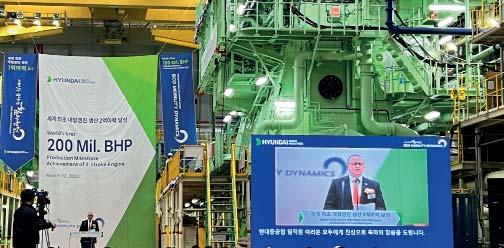
The MAN B&W G95ME-LGIM type engine is the world’s largest methanol-powered two-stroke engine. The engine’s manufacture was also a milestone for HHI-EMD, as it became the first engine manufacturer to exceed 200 million brake-horsepower for low-speed, two-stroke engines when the engine was completed in March.
At a ceremony to commemorate the engine
Maran Dry Management Inc. (MDM), the dry bulk shipping arm of the Angelicoussis Group, recently took delivery of its first LNG-fuelled bulk carriers. The two DNV-classed Newcastlemax bulk carriers are the first dual-fuel bulkers in the Greek market.
The two Newcastlemax bulk carriers, Ubuntu Unity and Ubuntu Community, were delivered from Shanghai Waigaoqiao Ship Building Co., Ltd. (SWS) on 28 February and 18 April, respectively. The two DNV-classed vessels are the first LNG-fuelled bulk carriers to join the MDM fleet.
The 190,000-dwt vessels, registered with the Greek flag, will sail using LNG. The use of LNG will lead to significant
Anglo DF bulkers
Maran Dry Management Inc. (MDM), the dry bulk shipping arm of the Angelicoussis Group, recently took delivery of its first LNG-fuelled bulk carriers. The two DNV-classed Newcastlemax bulk carriers are the first dual-fuel bulkers in the Greek market. The two DNVclassed vessels are on charter to global mining company Anglo American. The vessels’ fuel tanks will allow the vessels to complete two round-trip routes from China to Australia or one round-trip route from China to Brazil on gas.
production milestone on 22 March, Bjarne Foldager, Head of Two-Stroke Business, congratulated Hyundai, on behalf of MAN Energy Solutions. In a speech at the event, he referred to the cooperation between the two companies that started in 1974, and noted that Hyundai was the first engine manufacturer to reach the 200 million bhp mark: “It took about 35 years for the first 100 million brake-horsepower, and only 13 years for the next 100 million – an unbelievable achievement!”
Regarding the engine itself, Foldager continued: “With its 95 cm cylinder bore-size, this is the world’s largest methanol engine. And maybe most importantly,
■ Bjarne
Head of
event
South Korea and flanked by an MAN B&W G95ME-
when this engine is in operation it will save 130,000 tons of CO2 annually when operating on carbon-neutral methanol. We have a great responsibility for the future to develop and produce
engine, the world’s largest. environmentally-friendly engines and ships. We are really proud of helping Hyundai on this important journey and hope to celebrate many new milestones together in the future.”
MARAN DRY TAKES DELIVERY OF FIRST LNG-FUELLED NEWCASTLEMAXES
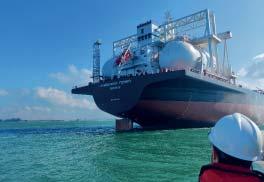
reductions in CO2 and NOx, while almost eliminating SOx and particulate matter emissions. With a combination of dual-fuel, hull optimisations and energy efficiency measures, the vessels have a very advantageous and low EEDI rating, much lower than the baseline.
“Maran Dry Management, as part of the Angelicoussis Group, is committed to decarbonization and embraces sustainability initiatives to optimise its fleet environmental performance”, said Captain Babis Kouvakas, Managing Director at Maran Dry Management Inc. (MDM). “We are delighted to have collaborated
Korean CCS trial
South Korean container operator HMM has announced that it will conduct field tests on an onboard carbon capture and storage system on a multipurpose vessel in its fleet in the second half of 2023. HMM has selected onboard carbon capture technology developed by Korean cleantech developer Panasia, following the successful conclusion of a feasibility study. Unlike other onboard CCS developers, Panasia has developed a proprietary absorbent rather than relying on MEA.
with DNV and SWS on the design and development of these modern and environmentally friendly ships. Both vessels incorporate the latest technology, aiming to reduce carbon emissions.”
The vessels are 299.80 meters long, 47.5 meters wide and 24.70 meters deep, with a design draft of 18.25 meters and a design draft speed of 14 knots. They can use both LNG and conventional fuel and are equipped with two type-C LNG fuel tanks. The capacity of the LNG tanks means that the vessels could operate for 20,000 nautical miles powered by gas,
Ammonia reforming project
Wärtsilä is participating in a Norwegian state-funded project to develop ammonia reforming technology for installation on board ammonia (NH3) carriers. The project aims to develop a system to convert ammonia back to hydrogen at the receiving destination, which will then be installed onboard a Höegh LNG vessel. The project is intended to allow ammonia carriers to act as a floating receiving terminal.
allowing the vessels to complete two round-trip routes from China to Australia or one round-trip route from China to Brazil.
The Ubuntu vessels are on charter to global mining company Anglo American.
BRIEFS
MSC Cruise bunkering
TotalEnergies Marine Fuels and the Cruise Division of MSC Group have successfully completed the first LNG bunkering operation at the Port of Marseille Fos, on France’s Mediterranean coast, for MSC Cruises’ MSC World Europa. The MSC Cruises vessel was refuelled via a ship-to-ship transfer on April 22nd, while guest operations continued as normal. The bunkering was conducted by the Gas Vitality, an LNG bunker barge.
‘‘
Ports must be able to check the background of all vessels and show bodies such as OFAC that they have the technology to screen ships for suspected sanctions evasion
6 | MAY 2023 For the latest news and analysis go to www.motorship.com NEWS REVIEW
Foldager,
Two-Stroke Business, MAN Energy Solutions speaking at the
in
LGIM methanol-burning
Source: MAN Energy Solutions


The new MAN 49/60DF Best fuel costs and long-term compliance Today’s marine propulsion choices are 2 www.man-es.com/MAN-49-60 Future-proof in multiple ways
VIKING LH2 FUEL CELL PROJECT ADVANCES
Dr. Pierluigi Busetto of Trieste-based naval architects Navalprogetti s.r.l. discusses the progress of a retrofittable liquid hydrogen (LH2) container-based system in an interview with The Motorship
A pioneering project that is seeking to develop and commercialise a retrofittable liquid hydrogen (LH2) based solution within the next three years is continuing to progress.
The project is intended to result in a test installation of a hydrogen-fuelled PEM fuel cell system on board a cruise vessel owned by Viking as a replacement for a genset on board the cruise vessel before the end of the four-year project, Pierluigi Busetto, the CEO of Navalprogetti, tells The Motorship.
The consortium includes Navalprogetti S.r.l., Viking Hydrogen AS, Chart, Cenergy, Università Degli Studi di Trieste, Plug Power, Jeumont Electric, The Port of Bergen, PNO Consultants, Ricardo plc and Lloyd’s Register EMEA IPS
among its members.
Dr. Pierluigi Busetto of Navalprogetti S.r.l is currently acting as the Coordinator of an EU-funded project to develop a liquid hydrogen containment system.
While the project involves the development of a number of different objectives, it is expected to advance the development of LH2 based solutions for the merchant and passenger sectors. “We are obliged to find new solutions to meet the challenge of decarbonising the fleet, and this project offers interesting possibilities for reducing environmental emissions from existing tonnage. We know that there will be strong demand for retrofittable solutions that can lower emissions from existing vessels towards the end of the decade,” Busetto said. The development of
Approval in Principle awarded in April 2023 to Navalprogetti
Busetto noted that a project developed by Navalprogetti for Viking had received an Approval in Principle from Lloyd’s Register for the development and basic design of the LH2/FC power generation system for propulsion and hotel loads.
The project had led to a consortium of ship owners, SMEs and original equipment manufacturers collaborating in a project into the use of liquid hydrogen (LH2) as a marine fuel. Lloyd’s Register led a hazard identification workshop (HAZID) to understand the risks involved with using liquid hydrogen as a marine fuel in Southampton in October 2022.
Lloyd’s Register adopted a risk-based approach to review the novel design and facilitated a high-level hazard identification (HAZID) workshop for the liquid hydrogen fuel supply system (and associated ancillaries) in accordance with the LR ShipRight Procedure for Risk Based Designs.
The workshop participants included Lloyd’s Register and Norway’s NMA (as observers), both of whom have extensive experience of issues around hydrogen safety gained from their involvement in other passenger vessel projects featuring PEM fuel cells in Norway.
The Motorship notes that there are
specific safety considerations relating to the use of liquid hydrogen, as opposed to gaseous hydrogen, that require careful handling. Busetto noted that as a byproduct of work conducted during the Basic Design phase, Navalprogetti and Viking are developing some specialized technology necessary for the running of the system and are working to patent these inventions.
The Motorship notes that the use of hydrogen as a fuel is not fully covered by the existing regulatory framework, such as the IMO’s IGF Code (International Code of Safety for Ship Using Gases or Other Lowflashpoint Fuels).
DESIGN FOR PERFORMANCE 8 | MAY 2023 For the latest news and analysis go to www.motorship.com
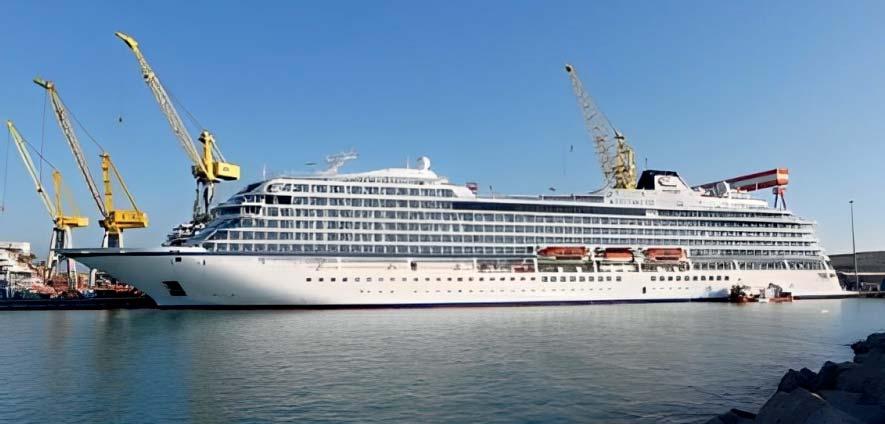
■ The Viking Neptune was delivered to Viking at Fincantieri’s shipyard in Ancona on 10 September 2022
Source: Fincantieri
simplified hydrogen bunkering solutions would also be highly relevant for ports outside North America and Europe during the early stages of the green transition.
Navalprogetti is already studying and working on bunkering of LH2 as it is believed that, once the technical and regulatory challenges are solved, the bunkering of LH2 will become as straightforward as LNG bunkering is today.
sHYpS project
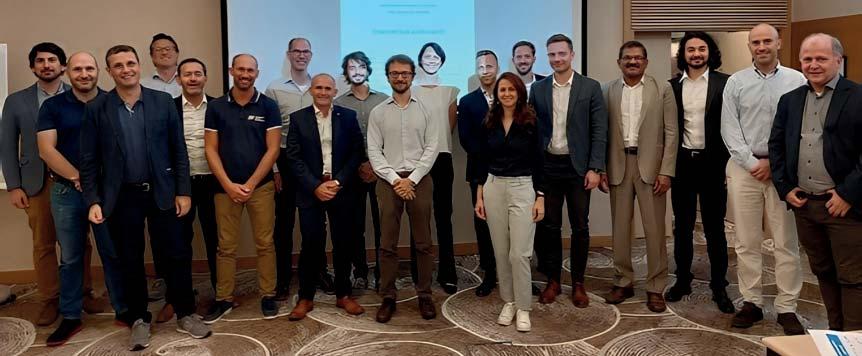
The EU funded Sustainable Hydrogen Powered Shipping Project (sHYpS) project was initiated in June 2022, and includes a consortium of partners from six different countries.
The Motorship reported on an initial development of a 100 kW PEM fuel cell trial installation on board the Viking Neptune, a vessel delivered for Viking in November 2022.
The consortium recently received a boost when Navalprogetti’s S.r.l basic design for a LH2 powered fuel cell system received an Approval in Principle from Lloyd’s Register.
Project objectives
The project intends to deliver an engine room configuration, defining spaces and arrangements for the PEM fuel cell systems as well as the relevant fuel supply and safety systems, in addition to the containerised LH2 storage system.
This system would then be subject to complete physical tests by CENERGY, a spinoff from the University of Trieste, before the system is installed and tested on board a Viking vessel before the conclusion of the project in June 2026.
Viking exercised an option with Fincantieri for four further cruise vessels in September 2022, and has an option for
a further two cruise vessels. The latest orders are due to be delivered between 2026 and 2028 and include provisions for the installation of 6 MW hydrogen-fuelled PEM fuel cell systems.
The 6 MW installation would allow Viking cruise vessels to eliminate during normal conditions the conventional genset use during port operations and sailing in Norway’s World Heritage Fjords. The Motorship understands that both the shipowner and the yard are closely following the project.
The largescale 6MW PEM fuel cell solution could be potentially applied to a number of commercial vessels operating in Europe.
Retrofittable solution for merchant fleet
Busetto noted that the fourth year of the project was likely to be focused on developing a study into the applicability of the installation of 6MW PEM fuel cell system on board merchant vessels.
While the system might not be applicable for the largest vessels operating in the EU, he had calculated that the installation would be sufficient for 75% of the fleet.
Busetto became animated when he began to discuss the wider commercial opportunities represented by the concept.
“If we can solve the technical challenges of retrofitting a 6MW PEM fuel cell system inside a cruise vessel, there is no question that the solution will not be applicable to other types of commercial shipping.”
For some of the commercial vessel classes, it may be possible to install the ISO containers on the deck of the vessel.
■ A four year EU-funded project to develop and commercialise liquid hydrogen fuelled PEM fuel cell units for the maritime sector was initiated in June 2022
Swappable container system as interim LH2 bunkering solution
One of the objectives of the project is to demonstrate the feasibility of introducing liquid hydrogen as a potential fuel for PEM fuel cells.
The project is seeking to develop a liquid hydrogen swappable storage solution, in which special 45’ foot ISO containers will be equipped with double wall stainless steel storage tanks capable of storing liquid hydrogen. The tanks are being designed to be interchangeable once the vessel is at berth and will also integrate technology to manage boil off gas from the LH2 containment units generated during transit.
Chart, the US gaseous fuels specialist, is contributing to the production of the LH2 containment tanks.
The Motorship notes that this will allow the LH2 containers to be replaced in the port of Bergen, which is envisaged to be the main refuelling spot for the Norwegian heritage fjords. The concept is expected to avoid many of the techno-economic challenges about installing expensive cryogenic LH2 bunkering equipment at the port before demand is assured. This interim approach will contribute to the development of local LH2 supply chain before shoreside
bunkering infrastructure matures, Busetto claims.
Plug Power is involved in the logistical and regulatory aspects of establishing a liquid hydrogen supply chain taking into account storage capacity and safety regulations at the port of Bergen.
“The containerised LH2 fuel supply aspect is one of the reasons that the concept is also attracting interest from other vessel segments,” Busetto commented, adding that the refilling and recycling of the cryogenic container tanks is expected to be the first application of its kind in the maritime sector.
DESIGN FOR PERFORMANCE For the latest news and analysis go to www.motorship.com MAY 2023 | 9
Source: sHYpS
POSITIONING NOR-SHIPPING AT THE HEART OF THE MARITIME ECONOMY
One of the enduring paradoxes of Nor-Shipping is that it offers visitors access to the latest developments in a wide range of maritime sectors, while maintaining its welcoming collegiate atmosphere.
Sidsel Norvik, Director of Nor-Shipping, explained that recreating Nor-Shipping’s warm and welcoming environment was easier in June “when Oslo is at her best” after last year’s exceptional spring event.
Socialising at Aker Brygge on Oslo’s waterfront in the evening or at one of the many evening receptions was an important part of what makes Nor-Shipping special. “Everyone appreciates the opportunity to meet up with old friends, but making new friends and contacts is very part of the Nor-Shipping experience.”
But creating the appearance of effortlessness requires significant preparation, and Nor-Shipping is preparing to do that for over 50,000 visitors at this year’s event.
The event is expected to break the previous record for delegates and exhibitors set in 2013, with over 1,000 exhibitors expected to attend the event. Part of the increase reflects the return of exhibitors and delegates from Asia.
Part of the increase reflects the increasing importance of the maritime economy as part of the broader environmental transition, as well as Norway’s own role in pioneering developments in a number of areas, ranging from marine aquaculture, offshore wind generation, autonomous shipping developments through to the hydrogen sector.
Nor-Shipping is continuing to expand its series of dedicated thematic conferences looking at specific marine economy sub-sectors, adding an offshore aquaculture event and an offshore wind seminar to its existing Marine Hydrogen Conference and Ship Autonomy and Sustainability events.
The offshore wind sector was likely to be boosted by Norway’s recent participation in the Ostend Declaration with EU partners and the UK, which targets over 300GW of offshore wind generation from the North Sea and Atlantic by 2050 in April.
The prominent role of Norway-based projects, such as the commissioning of the Yara Birkeland and the upcoming orders for a number of hydrogenfuelled or hydrogen-ready vessels, such as Torghattan Nord’s passenger vessels, made Nor-Shipping a natural venue for companies to share experiences.
One of the strengths of Nor-Shipping is its ability to bring together highlevel representatives from the maritime sector and from outside it, Sidsel
noted. “We are seeing more and more interest in the maritime economy from sectors who might not have been traditional attendees in years gone by,” Norvik added.
These topics will be explored in the Blue Talks series, which will look at a number of topical issues, including future fuels, carbon capture and ship recycling.
Ocean Campus
But Nor-Shipping is not just about networking, fun and upcoming opportunities in the maritime economy. It is also meant to offer practical solutions to some of the recruitment and training challenges that are confronting the maritime sector.
“We want to meet this issue head-on; building bridges between companies, education establishments and a new breed of potential industry talent.” Norvik said.
This is the inspiration behind Ocean Campus, debuting at this year’s Nor-Shipping, taking place in Oslo and Lillestrøm between 6 and 9 June.
Ocean Campus is a dedicated island of exhibition booths showcasing some of the world's leading maritime universities and colleges, including the World Maritime University (WMU), as well as the Norwegian University of Science and Technology (NTNU), BI Norwegian Business School, UiT Arctic University of Norway, MLA College, Oslo MET, and SINTEF Ocean.
The space will embody Nor-Shipping 2023’s main theme of #PartnerShip by encouraging these establishments to collaborate to support the development of a more sustainable shipping industry.
The participating schools' representatives will form an Ocean Campus Committee, working together with industry experts to tailor a program for the main Ocean Campus day, which sees thousands of students and young people visiting Nor-Shipping to discover how they can chart a future in the ocean space.
“We need a robust talent pipeline if we’re to not only meet the demands of an industry in transition, but also capitalise on the huge commercial potential offered in sustainable ocean development,” Norvik concluded.
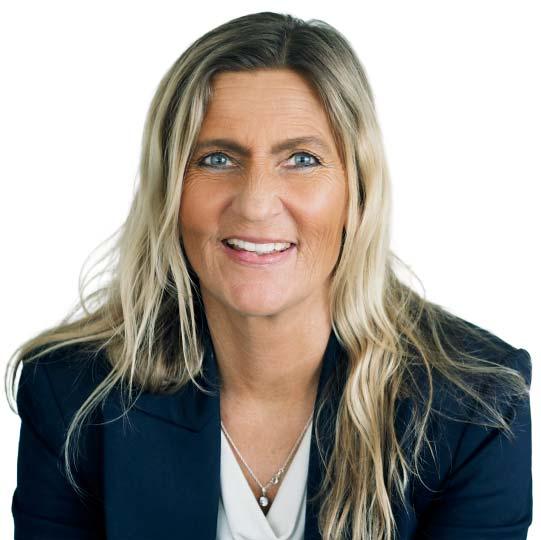
■ Sidsel Norvik, Director of Nor-Shipping
LEADER 10 | MAY 2023 For the latest news and analysis go to www.motorship.com
Source: Nor-Shipping
TRADING EU EMISSIONS ALLOWANCES COULD CREATE COMPLIANCE RISKS FOR SHIPPERS
The extension of the EU’s Emissions Trading System (ETS) to cover EU shipping from April 2023 will create additional compliance for shipping companies, as Smith Reed’s Brett Hillis explains.

While shippers have focused on the practical implications of the recently approved extension of the EU’s Emissions Trading System to cover some vessels operating in the waters of the bloc’s member states from April 2024, ETS experts at legal practice Reed Smith explain that shipping companies considering bidding for, trading in or providing services relating to EU emissions allowances runs the risk of falling within the scope of regulations governing financial instruments under EU/EEA and UK laws.
Brett Hillis, a partner at Reed Smith who has specialised in financial regulatory advice, energy, carbon and commodities trading and derivatives, outlines some of the issues that shipping companies should be aware of.
Hillis cautions that ship owners and managers who seek to pass on some of or all of the costs of surrendering EUAs to charterers, or who trade in EUAs to turn a profit, may fall within the scope of the EU’s financial regulations.
Specialist advice may be needed to ascertain a company’s regulatory position under EU MiFID 2.
MiFID 2 and the ETS
ETS
A list of the key investment activities and services covered by EU MiFID 2 is provided in Section A of Annex 1 of the EU MiFID 2 regulation but includes the receipt and transmission of orders, as well as dealing on your own account, and portfolio management.
There are a number of exemptions for market participants, including an exemption for operators with compliance obligations under the EU ETS who when dealing in EUAs do not execute client orders, provide investment services or perform investment activities other than dealing on own account.
Hillis notes that this does not provide a solution to entities looking to provide services relating to EUAs or to those active in derivatives relating to EUAs. (This would include those using derivatives contracts to pass on the costs of compliance to charterers).
Hillis notes that there are additional exemptions for the provision of services exclusively for companies within a larger group, and an ancillary activities exemption. Shipping companies that wish to trade in emissions may need to consider other exemptions and in particular the ancillary activities and groups exemptions.
EU MiFID 2 is a cornerstone of EU/EEA financial regulation, and stipulates that the provision of investment services and/or the performance of investment activities as a regular occupation or business be subject to prior authorisation. Unless they can rely on an exemption under EU MiFID 2, a person acting from the EEA will need authorisation if they carry on an investment service or activity in relation to a “financial instrument” as a regular occupation or business.
Under EU MiFID 2, EUAs in and of themselves are “financial instruments.” Therefore, the spot sale or purchase of an EUA is a trade in a financial instrument.
In addition, options, futures, swaps and other derivatives relating to EUAs, whether they may be settled physically or in cash, are also “financial instruments.”
While both EUAs themselves and related derivatives are “financial instruments”, whether a particular transaction constitutes a “derivative” may have important regulatory consequences.
For example, if a transaction relating to EUAs is a derivative then it will fall within the scope of the European Market Infrastructure Regulation (EMIR) and its UK equivalent. EMIR sets obligations relating to the reporting of derivatives contracts as well as obligations relating to the risk mitigation and (where certain conditions are met) clearing or margining of OTC derivatives.
LEADER For the latest news and analysis go to www.motorship.com MAY 2023 | 11
■ Brett Hillis, a partner at Reed Smith
NORTH SEA PARTNERS COMMIT TO RAPID EXPANSION OF OFFSHORE WIND CAPACITY
Seven members of the European Union along with Norway and the UK announced ambitious plans at the Belgian port of Ostend to increase offshore wind capacity in the North Sea to ‘at least’ 120GW by 2030 on 24 April 2023
The announcement almost doubled the ambition of a 2022 announcement in Esbjerg, Denmark between four EU member states (Denmark, Belgium, the Netherlands and Germany) that established a target of 65GW.
UK has also increased its own ambitions for offshore wind generation since 2022, most recently targeting 50GW by 2030, including 5GW of floating offshore wind capacity. To put the targets into context, the UK currently accounts for almost half (14GW) of the 30GW of offshore wind capacity installed in the North Sea.
The announcement follows after the European Union raised its own target for renewable energy generation from 32% in 2030 to 42.5% in 2030 at the end of March 2023, following an agreement between the European Parliament and the governments of EU member states.
The Motorship notes that a number of Baltic and central European EU member states increased their ambitions for offshore wind production in the Baltic Sea to 20GW by 2030 in August 2022.
The announcement lifted the long-term target for offshore wind generation from the North Sea from 150GW to 300GW in 2050.
The announcement’s immediate impact upon wind turbine installation vessel capacity and the offshore service vessel sector is likely to attract the most attention. A UK technology accelerator, ORE Catapult, estimated in March that around 150 Surface Operation Vessels (SOVs) will be needed to serve rapidly expanding offshore wind developments in Europe by 2030, and 310 by 2050.
Hydrogen and CCUS
The announcement is expected to contribute to an expansion of renewable hydrogen production “at massive scale” as well as a significant expansion in electricity and hydrogen interconnectors.
Given existing renewable hydrogen production targets of 30GW by 2030 by Germany, Denmark, the Netherlands and the UK, the announcement expects the expansion of offshore wind energy to support higher renewable hydrogen production by 2050.
Interestingly, the agreement also notes that there is a need for greater coordination of storage and offshore infrastructure planning between signatories around the North Sea’s carbon capture, utilisation and storage (CCUS) potential.
Circularity and recycling
By comparison with detailed references to bilateral and multilateral agreements to govern the development of cross-border electricity interconnectors, and energy islands, there was no explicit reference to end of life recycling commitments for the wind turbines and components themselves.
Given the scope and scale of the ramp up of offshore wind capacity, as well as the need for regular replacements of turbines every 20-25 years, it is likely that the expansion will create a permanent sector installing, servicing and decommissioning offshore wind turbines.
Circular economy considerations (as well as concerns to reduce overdependence upon suppliers outside Europe) is likely to lead to the expansion of domestic European supply chains supplying offshore wind turbines and their associated supply equipment.
The announcement’s coded references to “safeguarding the supply of relevant critical raw materials” and “the enhanced circularity of offshore renewable energy and grid infrastructure” can be understood as indicating that the initiative will seek to stimulate local manufacturing and recycling chains.
Unlike Europe’s emerging cleantech sector, there was no explicit reference in the Ostend Declaration to the potential for an expansion of European specialist shipbuilding to meet the growth in demand for vessels installing, servicing and ultimately dismantling the expansion in offshore wind generation capacity.
Country20232050
Belgium6GW8GW
Denmark5.3GW8GW
Source: O ffi ce of the Prime Minister of Belgium
■ An ill wind: the premiers of seven EU states, the UK and Norway agreed to collaborate on the expansion of offshore wind and renewable hydrogen production on 24 April at the Belgian port of Ostend.

France 2.1GW (North Sea and Eastern Channel) 4.6-17GW (North Sea and Eastern Channel)
Germany26.4GW (North Sea)66GW (North Sea)
Ireland4.5GW20GW
Luxembourg--
Norway3GW (inc. 1.5GW floating)30GW (by 2040)
Netherlands21GW50GW (by 2040), 72GW (2050)
UK50GW (inc. 5GW floating) 100GW (ambition in March 2023 Offshore Wind Plan)
REGULATION 12 | MAY 2023 For the latest news and analysis go to www.motorship.com
EU SRR: JUST ONE SMALL PROBLEM…
In the run-up to new IMO carbon efficiency regulations in January, many experts had predicted an upturn in recycling volumes through the early months of 2023, including a significant number of older container feeders. In January, Alphaliner predicted that some 350,000teu of container tonnage would be scrapped this year. However, according to that analyst’s own data, what began as a fairly buoyant recycling market has dipped to almost nothing, and barely 50,000teu has been sold for breaking as May approaches.
■ The EU is currently consulting on a revision to the Ship Recycling Regulation: critics argue that non-EU scrapyards are being excluded from the list
There are a number of reasons for this. Owners of ships affected by the IMO’s carbon intensity indicator (CII) must now collect emissions data and file it with their chosen verifiers, but even so, no action will be needed until the middle of 2024, prompting the possibility of squeezing a few months’ extra revenue out of those vessels, giving owners the opportunity to make the most of freight rates which, for whatever reason, are not cratering as they were expected to
Meanwhile in India, Bangladesh and Pakistan, the main scrapping nations and biggest in the world by volume, weak currencies and financial issues have prevented many purchases– Pakistan, in particular, is battling inflation of 35% -- with central banks holding back on issuing credit to scrap buyers. Ships with heavy lightweights have been out of the question. This has led to cash intermediaries, such as GMS, being forced to hold onto vessels at the end of their lives for much longer than they normally would.
These bottlenecks in India, Bangladesh and Pakistan do not augur well for the medium-term profitability of the container fleet, which will soon take delivery of a deluge of vast new ships. It may, however, be an early taste of a longerterm problem that is to come.
From Brussels with love
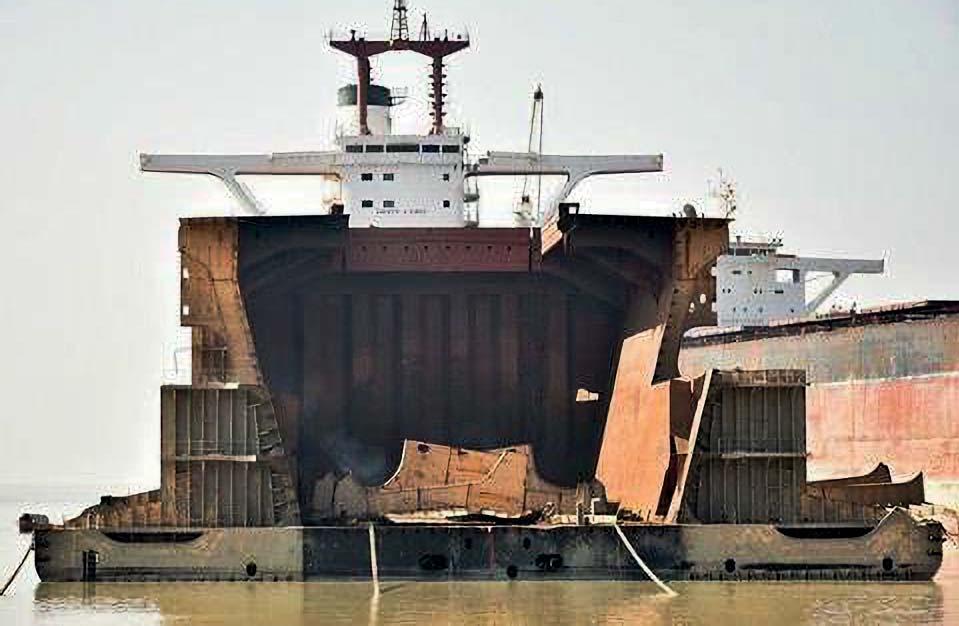
Many of the world’s largest and most profitable ships are operated by European owners, and at the end of their lives, scrapped on beaches in the Indian subcontinent. The history of practices at these facilities has not been a proud one. Run up the beaches, vessels have been effectively dismantled from underneath, by workers who earned in a day what Europeans are paid in half an hour. Recycling of steel and other materials is extraordinarily efficient, based not on high-
minded ‘green’ ideals, but on the inexorable logic of necessity and desperation. Deaths and maimings have been a matter of routine.
In recent times, positive moves have been made to address these problems. Advocates of the IMO Hong Kong Convention, global maritime regulation’s answer to lax and dangerous conditions in the vessel scrapping industry, insist that it is driving progress, despite the fact that it is yet to be ratified. But as it often has, the European Commission has prefigured IMO with its own ruling, the EU Ship Recycling Regulation (SRR). Citing such treacherous working conditions as these, the EC has sought to prevent European shipowners from selling their tonnage for scrapping in the East, which operates “under conditions that are often harmful to workers' health and the environment.”
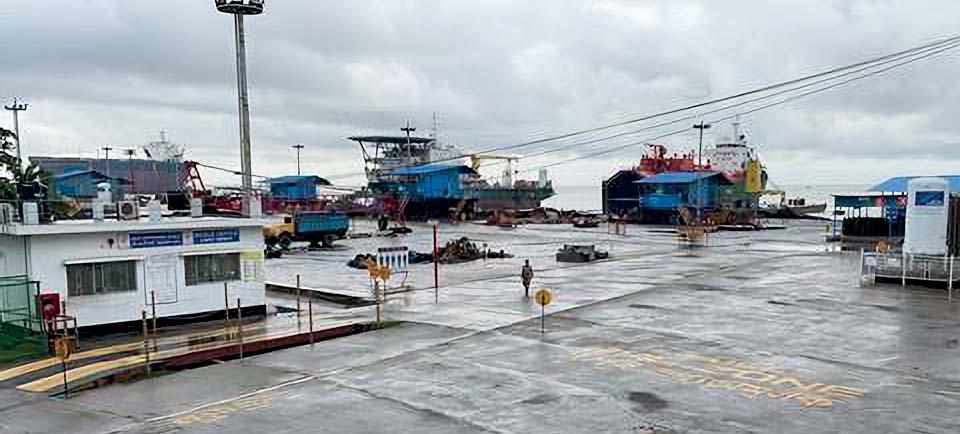
In fact, the EU SRR does not recognise any shipyard in India, Pakistan, or Bangladesh -- limiting itself to 38 yards across Europe, six in Turkey, and one in the US. Europe’s guidelines vary somewhat in their implementation but there are several constants. Hulls should be dismantled from alongside on quays or in drydocks, not clambered onto from underneath and hacked up with welding torches and explosives as they are on the beaches in Bangladesh; each ship should have an inventory of hazardous wastes including asbestos and heavy metals, which should be disposed of with due care; cranes and other equipment should be on hand to haul scrap metal around.
Rakesh Bhargava, chief executive of Singapore-based Sea Sentinels, said in March last year that offering South Asian recycling yards the opportunity to join the EU SRR scheme would be important “…to incentivise continued improvements in health, safety and environmental standards at these yards… in the absence of a globally enforced recycling regulation.”
REGULATION For the latest news and analysis go to www.motorship.com MAY 2023 | 13
Credit: ClassNK
But EU SRR’s critics argue that a deliberate attempt is being made to exclude non-EU scrapyards which the IMO’s own regulation would otherwise approve. Scrapyards in India, in particular, have invested some resources in cleaning up their act, improving on-site emergency medical provision, as well as making positive changes to hazardous waste disposal methods, and many feel they have earned EU SRR approval. A significant number of these yards have been inspected by international classification societies and certified as IMO Hong Kong Convention compliant.
John Stawpert, ICS Senior Manager of Environment and Trade, told The Motorship: “In order to meet demand going forward, it is essential that the EU recognises the huge improvements made in the recycling industry in the Indian subcontinent, and admits compliant facilities outside the OECD onto the EU list.”
European countries are not messing around, either. In 2020, shipowner Georg Eide was given a prison term, and NOK2m confiscated from his company Eide Marine Eidendom AS, after selling LASH carrier Eide Carrier to Wirana, a cash buyer. His intention was to scrap the ship at Pakistan’s Gadani beach, in contravention of the Basel Convention, which bans exports of hazardous waste from OECD to non-OECD nations.
"Eide has been charged with complicity in violation of international waste law,” said Ingvild Jenssen, Executive Director and Founder of the NGO Shipbreaking Platform, at the time. “The judgement acts as a stark warning that dodgy deals with cash buyers aimed at scrapping vessels on South Asian beaches, where there is no capacity and infrastructure to recycle and dispose of hazardous waste in a safe and environmentally sound manner, are a serious crime. It also cautions that due diligence is a must for not only shipowners, but also insurers and Marine Warranty Surveyors, to avoid any business relationship with companies that have terrible track records."
Hostile to shipowners’ attempts to circumvent EU rules on scrapping, NGO Shipbreaking Platform wants to end the practice of re-flagging ships that are about to be scrapped,
noting that the flags of St Kitts and Nevis, Comoros, Palau and Tuvalu, in particular, are “…hardly used during the operational life of ships, but are particularly popular for the last voyages to the scrap yards.” The decision of where to scrap ships should be based on the location of shipping company head offices alone, Shipbreaking Platform argues, sidestepping the flags of convenience debate entirely.
Too big to sail
But another minor snag with the EU SRR is that none of the yards on its list, including those in Turkey, have sufficient capacity to dismantle even the current fleet of very large ships. VLCCs are out, as well as capesize and panamax bulk carriers, and ultra-large container vessels, of which there are now a great many – and rather a lot more on the way, too.
“The EU list of Ship Recycling Facilities remains insufficient to meet the needs of the European fleet,” ICS’ Stawpert said. “This inadequacy will only get worse in the coming years as shipping moves towards a greener fleet to meet decarbonisation targets, with older tonnage getting taken out of service.”
In mid-March, the European Commission launched a consultation period of the SRR, due to come to an end in June.
Stawpert also added that there will be no ignoring the preferential scrap prices that south Asian yards can offer compared with yards in the west. Indeed, southeast Asian yards have typically held a strong hand in this regard, combining cheap labour and overheads, an abundance of space, and close proximity to busy scrap steel markets eager to receive recycled materials and resilient enough to receive periodic influxes of scrap metal – in stark contrast to steel markets in the EU.
“A Financial Incentive Mechanism will not improve compliance with the EU Ship Recycling Regulation,” Stawpert warned, “…as it will not be able to account for differentials in the price of steel between the European and Asian recycling markets, and will penalise certain types of shipping unfairly.”
■ The IMO’s Hong Kong Convention has not yet been ratified by enough members for the convention to come into force
REGULATION 14 | MAY 2023 For the latest news and analysis go to www.motorship.com
Source:
IMO



NorShipping 2023 Your Arena for Ocean Solutions Buy tickets Nor-Shipping2023 Oslo,6-9June Andmakea new#PartnerShip Discover new ocean opportunities. MainPartnersLeadingPartnersLeadingMediaPartners
EFFECTIVE SAFETY MANAGEMENT AND IMPROVED EFFICIENCY THROUGH REMOTE MONITORING OF INERT GAS SYSTEMS
As energy-consuming nations increasingly rely on LNG by sea rather than pipeline, LNG order books are breaking new records, and almost all newbuilding berths are booked until the end of 2026. Experts predict that with large volumes of new liquefaction capacity coming on stream in the months ahead, existing LNG fleet will run at full stretch in the coming years. Finding ways to reduce vessel downtime and support LNG tanker crews – especially when it comes to safety - are now more critical than ever, explains Bernt
at Survitec.
In the year since Russia invaded Ukraine, European LNG supplies have taken a significant hit, and gas-consuming nations have turned to suppliers around the world, including the US and Norway, for replacement gas. Liquefied gas from across the Atlantic or Middle East comes from LNG tankers, and this unexpected demand for ships drove day rates to new highs during the second half of 2022.
Rates have eased over the early weeks of this year, but sector experts predict this is only temporary. LNG carrier demand is set to climb further as new liquefaction capacity comes on stream in the US, Qatar and Australia. It is anticipated that with today’s fleet of approximately 640 ocean-going LNG carriers soon operating at total capacity, the 300+ new ships joining the fleet are likely to be snapped up as soon as they hit the water.
Optimising operations whilst protecting safety
In the face of unprecedented demand, it is no surprise that ship owners and operators are embracing new solutions and technologies to help manage resources and optimise operations. This is especially important when it comes to safety: effective and efficient management of safety critical systems such as inert gas (IG) systems is crucial.
When dealing with flammable cargo, an IG system is essential. It prevents explosion in the cargo tank by maintaining a non-explosive atmosphere. Most operators use inert gas with an oxygen content of less than 5%. Ensuring the inert gas used in cargo tanks complies with oxygen content requirements has traditionally been a complex technical process for LNG tanker crews.
IG systems are live systems that are operated every time a vessel comes into port to verify that the oxygen content is within the prescribed limits. The penalties for non-compliance are significant. Ships may be prevented from entering terminals and forced to
Öhrn, General Manager of Maritime Protection
wait on the anchorage. They may also be delayed for essential maintenance if the inert gas produced on board fails to meet specific criteria.
A problem or a technical hitch that stops the system from working is effectively treated as an emergency, requiring urgent support from specialised technicians. The Covid pandemic exacerbated this problem, with travel restrictions preventing service engineers from boarding ships to conduct inspections and diagnose faults locally. A solution had to be found.
Leveraging digital technology
At Maritime Protection, leading Inert Gas specialists and a Survitec brand, we worked in close collaboration with a customer, a globally-trading LNG company with a fleet in excess of 100 tankers, to develop a solution.
From the outset, it was clear that ship owners and operators would not want yet another IT software system on board that would require regular updates, maintenance or repairs. Also, any solution would need to be easy to install and capable of being retrofitted.
A solution was developed with this in mind, based on providing a simple programmable logic controller supplied in the mail, with clear instructions, ready for installation by a crew member. An annual feebased leasing model would supply parts and service, including maintenance and repair.
A pilot project commenced early in 2022 and operated like an IT help desk. At the critical end of operations, in the event of a tool-down situation, system experts could dial in virtually, connect to the system and take control if necessary. In the event of a
LNG 16 | MAY 2023 For the latest news and analysis go to www.motorship.com
■ Bernt Öhrn, General Manager of Maritime Protection at Survitec.
Somas valves for Cargo handling and Exhaust gas applications



Somas exhaust valves have been used for long time to control exhaust fuel engines.
Valves from Somas
Optimized for high temperature
Slim body design and low weight
In the shipping and shipbuilding industry a reliable valve is required to ensure that media







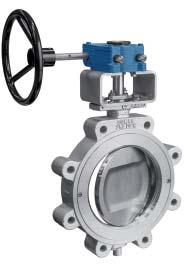

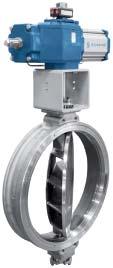

Somas triple excentric butterfly valve is an excellent choice for pipelines used for both ondue to minimal wear on the shaft and seat.
Triple excentric design


Excellent choice for
Flow optimized disc
Easy maintenance
Bi-directional


Reliable valve
Minimal wear
DIRECT DRIVE PERMANENT MAGNET SHAFT GENERATOR SOLUTION
www.somas.se
WE TECH SOLUTIONS WEB.: WWW.WETECH.FI TEL.: +358 20 786 1680 MEET WE TECH AT NOR-SHIPPING HALL D D01-40
technical glitch, the IG system could be monitored remotely, allowing shore-based experts to oversee IG operations and ensure that the gas met safety requirements regarding gas volume and composition.
There are many typical use cases. For example, there are instances where
LNG carriers have been preparing to dock and unload cargo, but the terminal authority has forbidden entry because the ship needs to prove that its systems comply with the safety requirements of the terminal. Also, incidents where ships have been delayed while safety systems are independently verified. With a remote support solution, shore-based experts can help shipboard personnel easily and quickly verify the system, whether it is a port authority, a repair yard, or a floating storage and regasification unit.
In a shipboard context, in a tool-down situation, experts can identify whether it is due to a faulty component and, if so, whether the component can be adjusted or bypassed. If a replacement part is needed, it can then be supplied at the next convenient port.
Another example is an LNG carrier on its way to drydock. In this case, cargo tanks must be dry and empty with zero risk of flammable gas, as only then will repair yard managers approve the ship to dock. Occasionally, IG systems have failed on the voyage to the repair yard. Ships have then been delayed, and penalties have built up because ships have not docked on time. A remote support solution can help ship operators avoid such a situation through timely, expert intervention.
Looking to the future
Before the advent of remote monitoring technology, Maritime Protection would typically receive a call from an asset owner asking technicians to attend ship as soon as possible. With more than 1,800 systems in operation, this could be a challenge: engineers might already be tied up travelling to and from other jobs. However, with a remote monitoring solution, engineers can access the system, diagnose the problem – and potentially resolve it – on the same day.
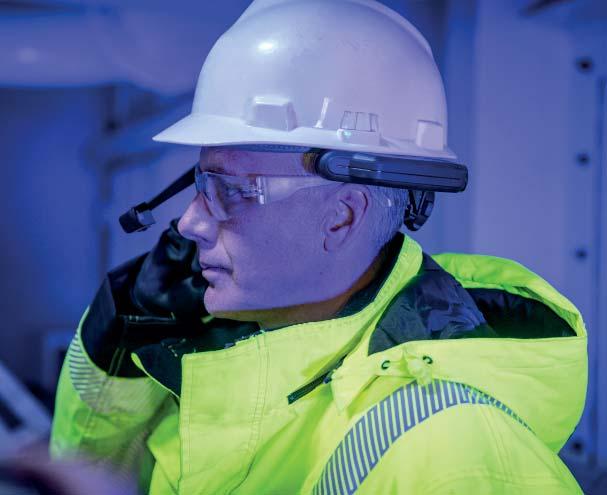
Remote monitoring can support routine operations too, such as tuning the system to improve fuel consumption and
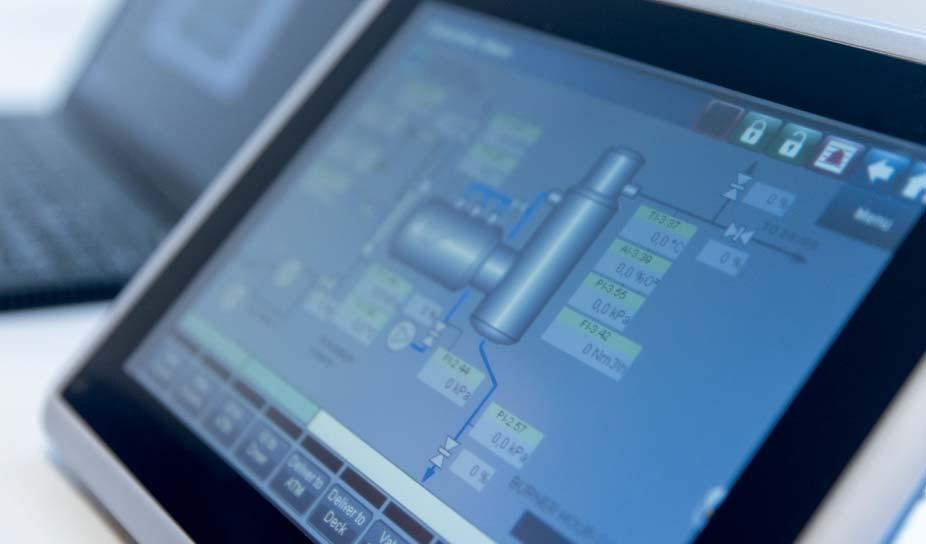
reduce emissions. On one tanker, we found that fuel optimisation alone helped to make savings of several thousands of dollars per day.
There is also potential to alleviate and improve working conditions for crew and support ship managers – for example, if seagoing personnel are suffering from fatigue and need to rest or have reached the limit of their maximum working hours, shoreside experts can provide timely support.
After a successful pilot project, the Maritime Protection remote support solution was installed and operates on a fleet of 32 vessels. Other owners recognise the value of this service and ordering systems for ships on order and for existing tonnage.
Physical rapid response is still available if and when required, but remote monitoring solutions offer customers an alternative digital solution that is immediate, convenient, and cost-effective.
LNG 18 | MAY 2023 For the latest news and analysis go to www.motorship.com
SIGN UP TODAY
The 24th edition of Europe’s largest commercial marine and workboat exhibition, is a proven platform to build business networks.
Seawork delivers an international audience of visitors supported by our trusted partners.
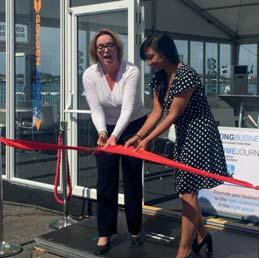
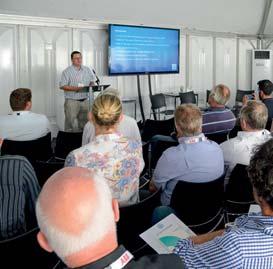
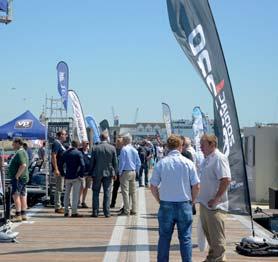
Seawork is the meeting place for the commercial marine and workboat sector.
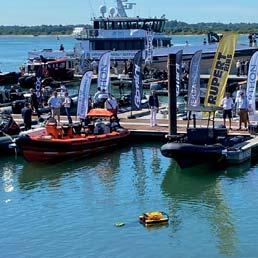
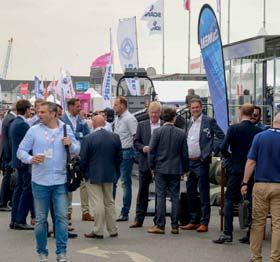
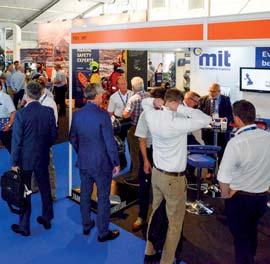
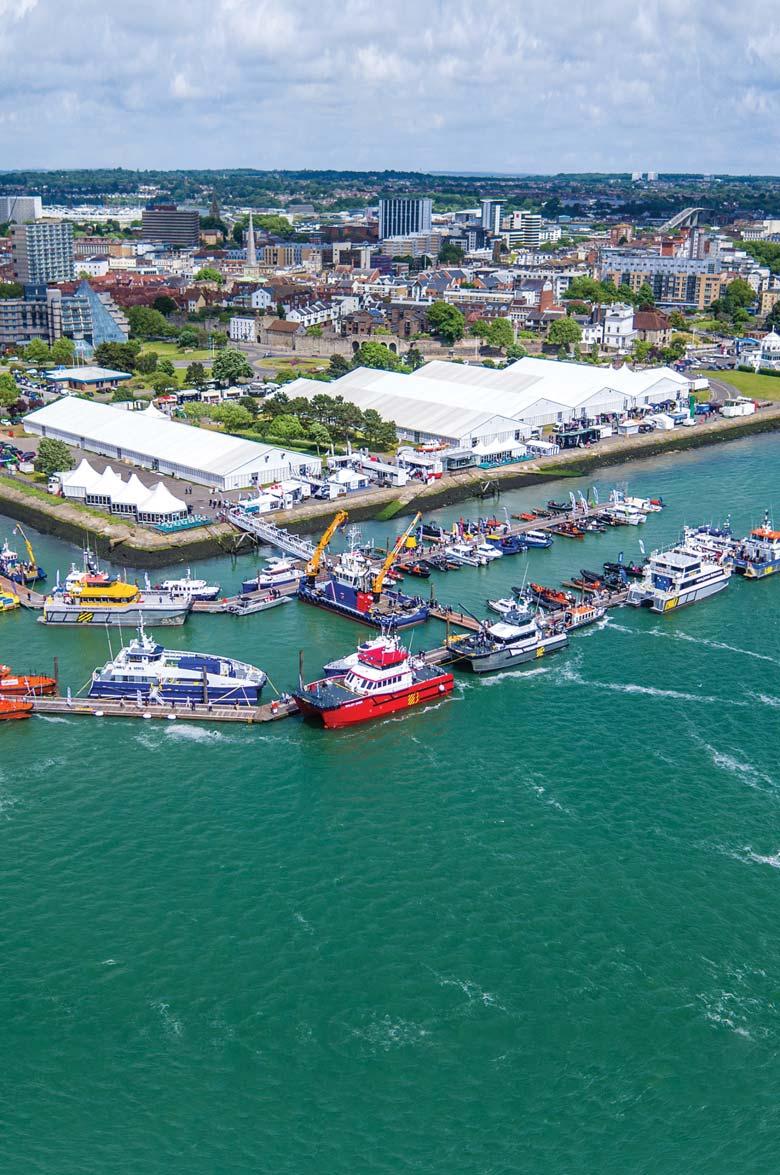
12,000m2 of undercover halls feature 500 and equipment on the quayside and pontoons.
Speed@Seawork on Monday 12 June at the Royal event for fast vessels operating at high speed for security interventions and Search & Rescue.
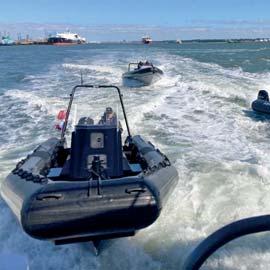
Speed@Seawork Sea Trials & Conference
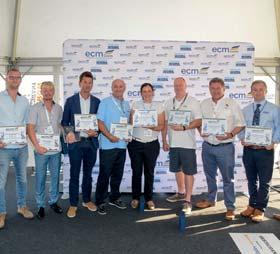
The European Commercial Marine Awards (ECMAs) and Innovations Showcase.
For more information visit: seawork.com contact: +44 1329 825 335 or email: info@seawork.com
experts, helps visitors to keep up to date with the latest challenges and emerging opportunities.
The Careers & Training Day on Thursday 15 June 2023 delivers a programme focused on careers in the commercial marine industry.
JUNE 2023 Southampton United Kingdom 13 15 TO
Media partners MARITIMEJOURNAL COMMERCIAL MARINE BUSINESS BOATINGBUSINESS THE UK LEISURE MARINE BUSINESS
#Seawork
CUMMINS BUILDS NEW MARINE PARTNER NETWORK
In its latest marine partnership, Cummins has teamed up with Danfoss Power Solutions’ Editron division to bring hybrid marine solutions to the global maritime market.
The partners will develop a set of standard solutions for marine propulsion including both engines and fuel cells along with variable-speed diesel gensets and energy storage packages.
In Dec Cummins signed a framework agreement with Energys, an Australia-based hydrogen and fuel cell company, to work together on fuel cell powerhouse packages for marine and power generation, and it has now also signed an MoU with energy storage solutions provider Leclanché. This MOU enables Cummins and Leclanché to offer customers a wide range of hybrid, battery-only and fuel cell package solutions in marine and rail applications using a variety of power sources such as engines, hydrogen fuel cells, battery packs and racks, as well as other components.
The three relationships are helping Cummins achieve its Destination Zero strategy – the company’s plan to reach net zero emissions across its products by 2050. To support that goal in the marine industry, the company recently renamed its New Power segment Accelera.
Scott Malindzak, Cummins Director Global Marine Product Management, says that Danfoss’s power electronics, inverters and traction motors work well with Energys’s DNVapproved fuel cells and Leclanché’s energy storage systems. The standardisation the companies are aiming for will overcome the industry’s current challenge of bringing together componentry from different suppliers. Instead, the companies will work together and build systems ahead of time to ensure all the right pieces are in place and work well together. Although each vessel is unique, the commonality of the building blocks will ensure that their teams will have the knowledge they need ahead of time.

Malindzak says the partnerships will also satisfy the industry’s need for a global sales and service footprint. “We are able to pull these things together, not just for the upfront integration but also for back-end market support.”
Most demand, at present, is coming from Europe and the US, but Malindzak says they are ready to support other regions as well. “The industry is moving fast and potentially at scale towards decarbonisation, and these technologies are ways to get there. It’s either short-term, for bridging technologies, or longer-term decarbonisation. We see fuel cells taking more time to hit scale due to the cost of hydrogen and the cost of the fuel cells themselves. This could slow down adoption, at least initially, but we recognise we have to be on that journey now. There’s a lot of leaning to come with these systems once they get into the real world and operating.”
Both Cummins and Danfoss have
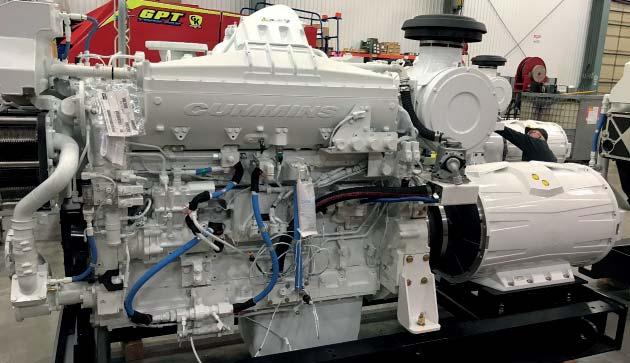
already active in the hybrid marine power sector. Cummins has provided the power system for DCV Driftmaster for the US Army Corps of Engineers. A 3,000hp (2,388 kWe) main propulsion system has been combined with a 3.4 MWh energy storage system and a Danfoss generator (EMPMI540-T4000).
In 2024, the short-sea ferry operator Molslinjen will introduce two 100% electric ferries, and Danfoss power converters feature on both vessels, powering battery power conversion on board as well as the vessel charging systems onshore. In addition, Danfoss drives will deliver precision control to the electric propulsion motors.
“This partnership is another step forward in Cummins’ Destination Zero strategy – our plan to reach net zero emissions across our products by 2050,” said Rachel Bridges, Global Marine Director, Cummins. “The respective products of Cummins and Danfoss’ are an ideal match, because both companies are focused on energy optimization, efficiency, and clean solutions. By providing a joint solution, we will be able to multiply our impact by bringing products and solutions to the market that are fully optimised for the marine industry. Our customers are looking for streamlined ways to meet complex regulations and decarbonisation goals, and together with Danfoss’ Editron division, we can help the marine industry.”
Looking further into the future, Malindzak sees Cummins targeting methanol for combustion. “Getting methanol as a fuel in our engines, it’s no big secret, is that when you start changing fuels, the performance of the engine changes. One way to mitigate this is hybridisation, add in battery power to make up for what you have potentially lost when you switch to fuels like methanol. That's not in our portfolio right now, but it’s part of our forward thinking.”
FOUR-STROKE ENGINES 20 | MAY 2023 For the latest news and analysis go to www.motorship.com
■ Cummins Danfoss Power Driftmaster
■ Scott Malindzak, Cummins Director Global Marine Product Management

NEW FUEL TECHNOLOGIES PAIRED WITH EFFICIENCY DEVELOPMENTS FOR 4-STROKES
The latest developments in engine efficiency are being applied to the new generation of multi-fuel 4-stroke engines.
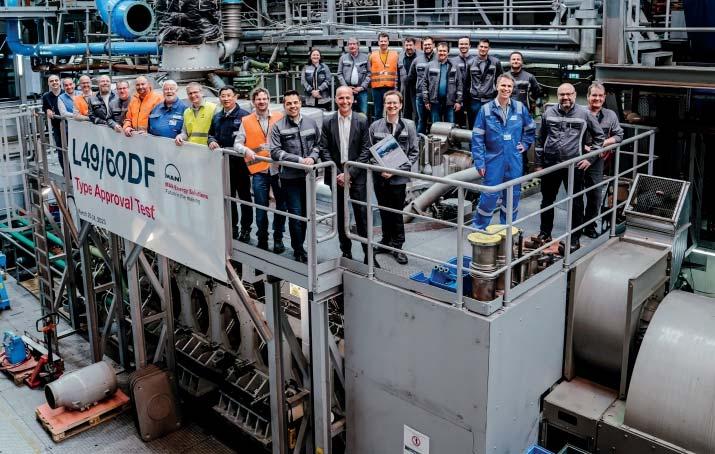
MAN Energy Solutions’ MAN 49/60DF engine has received its Type Approval after a five-day test program witnessed by inspectors representing the class societies ABS, BV, CCS, DNV, LR and RINA. This most recent addition to its 4-stroke engine portfolio is capable of running on LNG, diesel and HFO as well as a number of more sustainable fuels including biofuel blends and synthetic natural gas.
The new 49/60DF engine platform features MAN’s latest engine technologies, including two-stage turbocharging, second-generation common-rail fuel injection, the SaCoS5000 automation system, and MAN’s next-generation Adaptive Combustion Control (ACC 2.0) that automatically optimises combustion with the support of an additional on-engine sensor.
“The second-generation ACC makes use of the new safety and control system, so it has much more computational power behind it. You can see the results in the fuel consumption and also in the dynamic capabilities of the engine in gas mode,” says Thomas Huchatz, Sales Manager Four-Stroke Marine.
He cites the example of a ropax ferry manoeuvring away from a quay on a windy day. “An engine can experience very high load fluctuations, particularly coming from the bow thrusters which are often powered by the main engines via gearbox PTOs. They can ramp up and down very quickly, and engines running in gas mode are typically slower reacting to these changes than in
diesel mode, such that DF engines may switch from gas to diesel mode. If you’re an operator and you’ve purchased a dual-fuel ship, you want to operate on gas all the time. You really want to avoid this switching.”
The two-stage turbocharger reduces fuel consumption, but it can also slow response time. MAN has overcome that with the upgraded ACC as well. “The software can really make up for the more complex, two-stage technology such that we are achieving the same dynamic capabilities as the 51/60DF,” says Huchatz.
MAN states that the new engine sets a benchmark in fuel efficiency within 4-stroke engines – both in gas and diesel mode – and therefore minimises fuel costs and potential costs for CO2-emission certificates. SFC in gas mode is 6,990 kJ/kWh @ 85% load, and SFOC in diesel mode is 171.0 g/kWh at 85% load, without attached pumps.
The engine’s efficient and fuel-flexible design offers
FOUR-STROKE ENGINES 22 | MAY 2023 For the latest news and analysis go to www.motorship.com
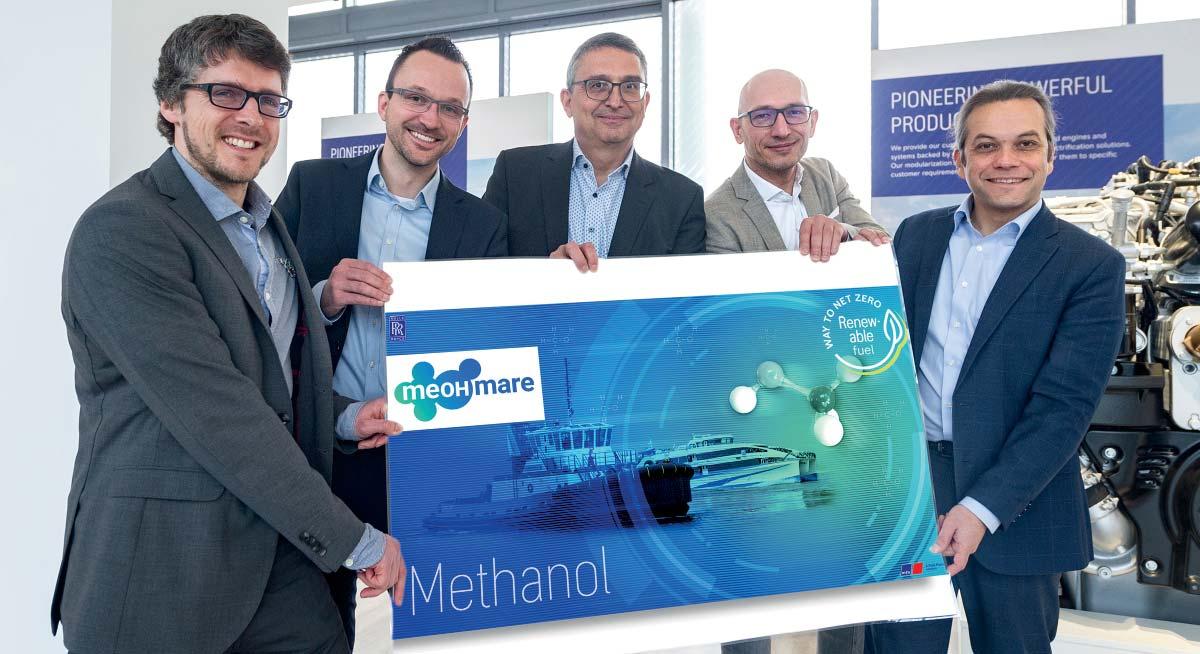
■ Rolls-Royce, Woodward L’Orange and WTZ Roßlau plan to develop a high-speed marine engine concept that can run on green methanol by the end of 2025.
‘‘
The second-generation ACC makes use of the new safety and control system, so it has much more computational power behind it.
Thomas Huchatz, Sales Manager Four-Stroke Marine
Source: Rolls-Royce
multiple paths to emission compliancy leading up to 2050, as per the current Fuel EU draft, says Huchatz. It complies with IMO Tier III without exhaust gas aftertreatment, and in diesel mode, it complies with Tier III when combined with MAN’s SCR system. Huchatz said the aim from the outset was to offer a future platform that can easily go from one fuel to the next and to make that platform as efficient and low on emissions as possible.
The engine retains well-proven MAN technologies such as the gas-injection system, the pilot-fuel-oil system and the MAN SCR system. Soot emissions in diesel mode are halved due to the second-generation common-rail system 2.2.
The 49/60DF’s methane emissions are significantly reduced in gas mode. Huchatz says a 50% reduction in methane slip has been achieved by further reducing cylinder crevices and by introducing closed crankcase ventilation where the escaping gas is redirected to the turbocharger rather than venting to the atmosphere.
The MAN 49/60DF can start in gas mode using an engine purging system that was introduced earlier in the 51/62DF. Additionally, the pump in the pilot fuel system is electrically powered, so it can deliver the full pressure required at zero rpm. This means no visible smoke during engine start-up in gas mode.
The new engine is also methanol-ready. Conversions are straight-forward as all engine variants originate from an initial, modular engine design. Huchatz
anticipates the full operation capability on methanol being taken up later this decade.
MAN is also introducing a pure diesel engine based on the 49/60 platform that will be methanol and LNG-ready and features the same technology upgrades as its dualfuel sibling; the engine can also operate on bio-fuels. This pure-diesel version allows MAN’s new common-rail system to fully play to its strengths of low-emission and low-vibration operation, paired with the maximum flexibility to design the combustion process to minimise fuel costs. Furthermore, its high powerdensity extends the power range of inline engines into applications traditionally equipped with V-type engines.
Methanol-ready 32/44CR engine
RINA has granted Approval in Principle (AiP) to MAN for its methanol-ready MAN L/V 32/44CR engine. The AiP includes an upgrade concept for the 4-stroke engine’s conversion to dualfuel running on methanol.
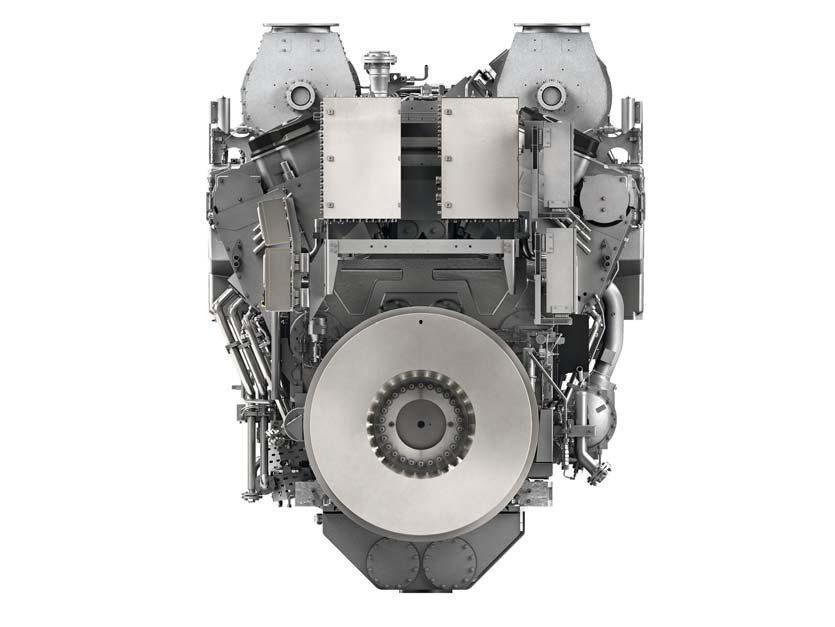
Methanol has several, physical advantages as a fuel, including a liquid state at ambient temperatures and its accordingly easy handling aboard vessels compared to gaseous fuels. Under combustion, methanol also emits fewer NOx emissions and no SOx or soot emissions.
Methanol is also much less hazardous to marine life compared with conventional marine fuels. However, Elvis Ettenhofer, Head of New Marine
■ The MAN 49/60DF engine passed its Type Approval Test after a five-day test program
■ MAN ES also plans to introduce a pure diesel variant based on the 49/60 platform that will be methanol and LNG-ready
Source: MAN ES
FOUR-STROKE ENGINES For the latest news and analysis go to www.motorship.com MAY 2023 | 23
Source: MAN ES
Solutions, MAN Energy Solutions, says methanol presents challenges for engine makers because much bigger injectors are required than for diesel to make up for the lower energy density of the fuel. Different combustion control is required, and additionally, says Ettenhofer, methanol acts as a solvent rather than a lubricant.
“This approval by RINA is significant as we move towards net zero. A major advantage of our 4-stroke portfolio is its inherent retrofit potential, which enables us to provide shipowners with cost-effective solutions and flexibility regarding future fuels. In this latter respect, there is no doubt but that interest in methanol is growing and that it will have a prominent role to play within shipping.”
Ettenhofer cites Clarksons research last year that showed many shipowners moved from favouring hydrogen to favouring methanol as a desirable 2030 fuel. “At present, it’s a bit like having a look in a crystal ball,” he says, so MAN is going to considerable lengths to ensure all options are covered. MAN’s motivation for providing shipowners with support for all potential new fuels is underpinned by its aim to “move big things to zero.”
possible power density of the propulsion system are the particular focus of the development.
Mathias Müller, project manager at Rolls-Royce Power Systems and MeOHmare’s project coordinator, says: “The focus of development activities is on redesigning the combustion process with fuel system, turbocharging and engine control as well as all fuel-interacting engine subsystems.”
Woodward L’Orange will completely redevelop the high-performance injection systems in the project. Dr. Michael Willmann, Director Technology at Woodward L’Orange, said: “So far, there are no production-ready injection systems for high-speed methanol marine engines. Methanol is a challenging fuel due to its properties. That’s why new materials and injector concepts have to be introduced.”
Wärtsilä upgrades 31 diesel engine
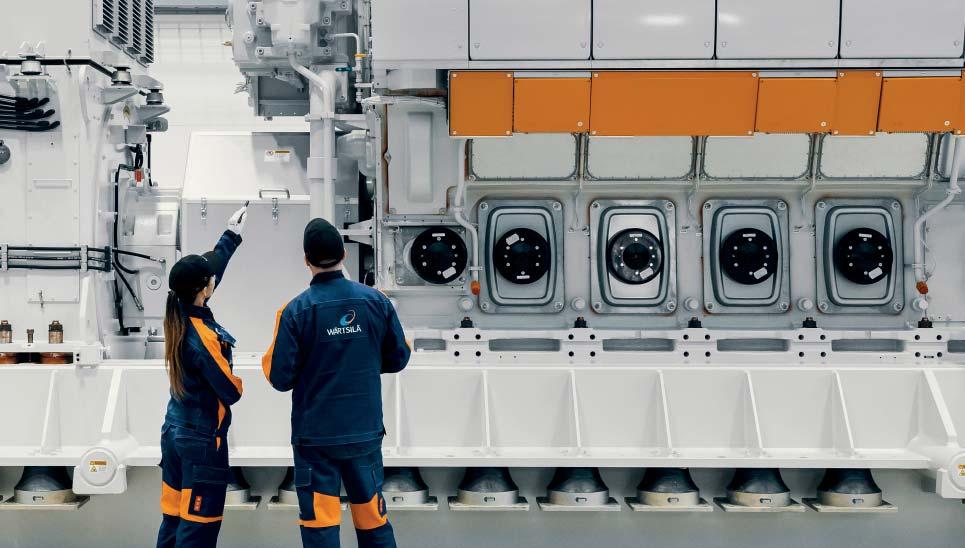
Wärtsilä has upgraded its 31 diesel engine for higher power output within the same physical footprint. The Wärtsilä 31 was originally introduced in 2015, and the OEM says it has the highest power per cylinder for engines of this bore size. The power upgrade will result in the current output range of 4.9 to 9.8 MW, being increased to a range of 5.2 to 10.4MW with 650kW per cylinder. The power increase gives customers the option to select fewer cylinders, thereby reducing the required engine room space, as well as lessening maintenance requirements.
Rolls-Royce progresses new fuel engine development Rolls-Royce, Woodward L’Orange and WTZ Roßlau have been working since the beginning of 2023 on the new joint project MeOHmare. By the end of 2025, the three partners will develop a concept for a high-speed internal combustion engine for ships that can run on green methanol in a CO2-neutral manner.
Rolls-Royce’s business unit Power Systems will develop an engine concept based on the mtu Series 4000 that will be designed for low-emission, CO2-neutral and economical operation of ships with methanol. Climate and environmental friendliness as well as the highest
The Wärtsilä 31 has proven to be extremely popular for installation on a broad range of vessel types, including among others, fishing vessels, ice breakers, ferries, cruise vessels, cable layers, and catamarans. Lars Anderson, Director of Product Management at Wärtsilä says: “The Wärtsilä 31 is already the best engine in its class, and this development widens its market advantage even further. By extending its performance, we are making a real contribution to greater sustainability and supporting our commitment to a decarbonised future.”
The first deliveries of the upgraded engine are taking place during the first half of 2023. Already, seven higher power output Wärtsilä 31 engines have been contracted.
■ Wärtsilä has upgraded its 31 diesel engine for higher power output within the same physical footprint
FOUR-STROKE ENGINES 24 | MAY 2023 For the latest news and analysis go to www.motorship.com
‘‘
This approval by RINA is significant as we move towards net zero
Elvis Ettenhofer, Head of New Marine Solutions, MAN Energy Solutions
Source: Wärtsilä





ALWAYS INNOVATING FOR A BETTER FUTUREWWW.WOODWARD.COM/WLO
DECARBONIZED WORLD The future is now! We are working on tomorrow’s solutions today –and delivering large engine components for the fuels of the future. HYDROGEN AMMONIA E-METHANE METHANOL ETHANOL … WOODWARD L’ORANGE GMBH PORSCHESTRASSE 8 70435 STUTTGART, GERMANY Visit us at the CIMAC Congress June 12-16, 2023 Busan, South Korea
LARGE ENGINE SYSTEM SOLUTIONS FOR A CLEANER,
WÄRTSILÄ DEVELOPS ENGINE DE-RATING SOLUTION
FOR 96-BORE POWERED BOXSHIPS
Wärtsilä has developed a radical de-rating solution for customers operating larger container vessels that offers substantial reductions in fuel consumption and greenhouse gas emissions.
The solution has initially been developed for RT-flex96C-B engines, and will see the engine converted to a 72-bore engine.
Sangram Nanda, General Manager of Technology Development at Wärtsilä 2-Stroke Services in Switzerland, explained that the Fit4Power solution had been developed in record time in response to specific customer requests to improve the CII profile of larger container vessels.
The solution had been pioneered for vessels powered by RT-flex96C-B main movers, which were installed on large container vessels between 2004 and 2012 or so. “The majority of the vessels were ordered before container vessel operating speeds slowed around 2010 or so, and have oversized engines for their current operating speeds,” Nanda explained.
While improving the efficiency of the engines is an important objective, most of the vessels are approaching mid-life and maintaining CII ratings for the vessels is an equally important objective for ship owners and operators.
The Motorship notes that rebuilding the engine with a 45% smaller engine capacity was likely to boost a vessel’s annual CII rating.
By improving efficiency in line with CII requirements, radical derating extends the CII compliant lifetime of the vessel by three to five years.
“It would be realistic to target fuel efficiency savings of between 10-15%,” Nanda told The Motorship, adding that there were opportunities to gain a few additional percentage points of fuel savings If you took the opportunity to upgrade and economise on the number of turbochargers.
Interestingly, Nanda noted that there were particular opex costs connected with maintaining engines approaching midlife that would partially offset some of the costs of rebuilding the RT-flex72R engines.
“Typically an engine requires significant scheduled maintenance once it approaches midlife, on the pistons, on the rings, on the liners and so on. A proportion of the cost of the Fit4Power upgrade simply replaces scheduled maintenance costs that you are saving. When you look at it from an upgrade perspective, you
are partially offsetting maintenance costs that you would spend anyway.”
From an ongoing opex perspective, Nanda noted that the radical derating solution reduces ongoing maintenance costs, particular if the components are downsized and might even lead to reduced feed-in rates for lube oil, for example.
By comparison, wider discussions around hydrodynamic optimisation, including the potential replacement of propellers optimised for slower operational speeds, or the reduced weight of the propulsion system following the engine retrofit, would increase GHG emissions reductions and fuel efficiencies, but would require cost-benefit analysis over the remaining operational life of the vessel. Such decisions needed to be taken in line with broader customer decisions about extending a vessel’s operational life.
Higher compression ratio
During the engine conversion process, the engine design team increased the firing pressure from 145 to 200 bar, while the layout of the engine was also optimised.
The combustion chamber was also replaced with an optimised chamber design, which was expected to result in more efficient combustion than in the original RT-flex96C-B design. As a result of the enhancements, Nanda reiterated that he expected the derated engine to achieve a 10-15% improvement in SFOC rates.
“Finally, towards the end of the process, we agree with the customer about the optimal tuning for the engine. The interesting thing is that this decision is the result of an active discussion with the customer, which allows us to offer the spec based on their operational requirements, and how they plan to operate the vessel.”
Alt fuel conversion compatibility
For shipowners concerned about ensuring CII compliance beyond the end of the decade, the upgrade solution is intended to be compatible with future conversions to operate on alternative fuels. It is designed to be compatible with Wärtsilä Fit4Fuels future fuels conversion platform, which will enable vessels to use LNG, methanol and ammonia fuels.
Groundbreaking floating FAT
Nanda also explained that the project was noteworthy as it resulted in the world’s first factory acceptance test (FAT) at sea.
“We had to discuss how to carry out the FAT with class and the flag state because
the rulebook is based on engines being tested on a test bed, rather than out at sea.”
In this case, the engine also required a product design assessment at sea. Wärtsilä Fit4Power received a certificate of product
design assessment from ABS in 2022.
Nanda noted that the Wärtsilä Fit4Power project was also the world’s first 22 Bar MEP two stroke engine.
RETROFIT/CONVERSION 26 | MAY 2023 For the latest news and analysis go to www.motorship.com
■ Sangram Nanda, General Manager of Technology Development at Wärtsilä 2-Stroke Services in Switzerland,
■ The solution has initially been developed for RTflex96C-B engines, and will see the engine converted to a 72-bore engine
“When we are modifying the engine for the Wärtsilä Fit4Power solution, we prepare the engine for a potential future Wärtsilä Fit4Fuels conversion... rather than requiring unnecessary replacement of engine parts. For example, when we replace the cylinder cover we include two additional unused sealed holes, which can be simply used for the installation of two alternative fuel injectors by changing the plugs in a future methanol retrofit.”
Commercial opportunities
The Wärtsilä Fit4Power radical de-rating solution has been focused on delivering solutions for larger container vessels, and a number of ship owners have placed orders for the engine conversion solution.
“We have a full order book for our engineers for the remainder of 2023,” Nanda told The Motorship. Because of the number of container vessels that are approaching midlife, Nanda noted that Wärtsilä 2-Stroke Services engineers could be busy for the next 4 years carrying out engine conversions simply on these vessels at a rate of 1-2 vessels per month.
At present Wärtsilä 2-Stroke Services are collaborating with customers before carrying out the engine conversion work themselves. Nanda noted that Wärtsilä planned to carry out the first few engine conversion projects before considering collaborating with other partners. At present, the initial conversion projects were being carried out in a handful of yards, selected by the customer, to ensure that the conversions are carried out efficiently.
Looking further ahead, Nanda noted that similar retrofit projects might be commercially viable for vessels in other vessel classes, running on smaller RT-flex engines. This would depend upon the establishment of a viable business case, but “we have already shown that we can work at pace to deliver a first pilot with the RT-flex96C-B project”.
As many of the engine component level changes are common to all the RT-flex72R conversion projects, project specific design work is not excessive, Nanda noted. Some projects might require a little design work relating to enginespecific changes if they want to upgrade or replace the turbocharger or carry out additional engineering work.
Maiden project concluded in October 2022
Sangram Nanda explained that the Wärtsilä Fit4Power solution had been developed rapidly in response to specific customer requests to improve the CII profile of larger container vessels.
The project had been developed and delivered by Wärtsilä 2-Stroke’s service engineers within a highly compressed timeframe. The project was launched in January 2022, and the first engine conversion
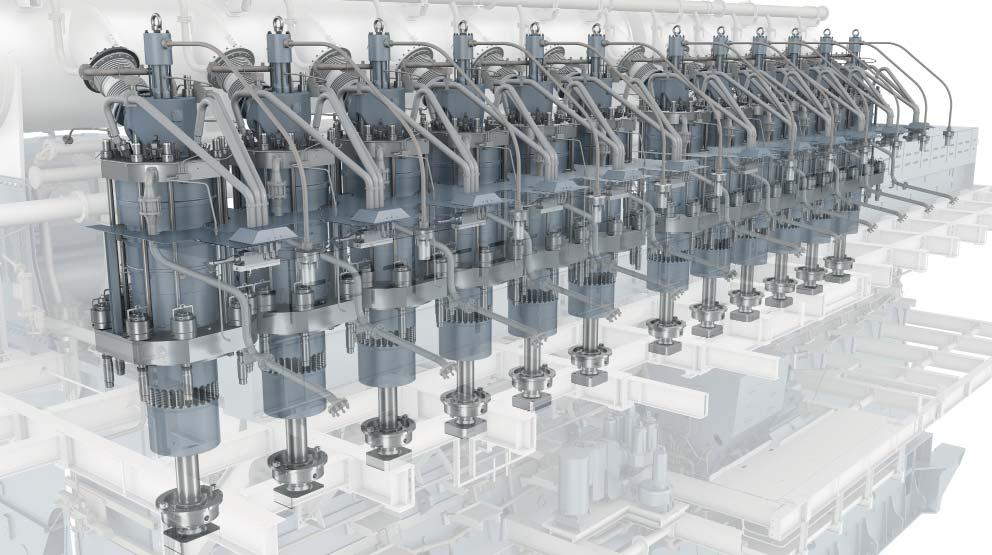
project on board a container ship was concluded in October 2022.
The Wärtsilä Fit4Power engine conversion solution was launched commercially at the end of March 2023, following the analysis of the operational results of the of a first engine conversion project on board a container ship in October 2022.
Careful study of the operational results of the first vessel after a few thousand running
■ Fit4Power solution reduces bore size of twostroke engines while improving combustion efficiency for lower emissions.
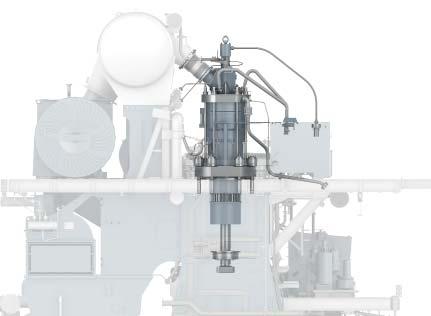
hours have revealed that the conversion was a success, and the vessel was operating on the converted engine.
The results proved that a conversion project can save 2,000 tonnes of fuel and reduce at least 6,400 tonnes of CO2 emissions annually thanks to this retrofit solution.
A second conversion project is currently being carried out on another vessel.
RETROFIT/CONVERSION For the latest news and analysis go to www.motorship.com MAY 2023 | 27
Source: Wärtsilä
Source: © Wärtsilä Corporation
NO LAUGHING (GAS) MATTER: SCHNEITER TARGETS ZERO N2O IN NEW X-DFA
WinGD’s programme to develop dual-fuel two-stroke engines capable of operating on ammonia and methanol is advancing apace, Dominik Schneiter, WinGD’s Vice President R&D, tells The Motorship.
In an exclusive interview with The Motorship in April, Dominik Schneiter provided a broad overview of the progress of WinGD’s methanol and ammonia engine development programmes, both of which expect to deliver their first engines for shop tests around June 2025.
Schneiter also explained that WinGD was expected to almost eliminate fugitive nitrous oxide (N2O) emissions from its new X-DF-A ammonia dual-fuel engine without the need for an after treatment system.
Combustion tests for WinGD’s Ammonia Engine
Before the modelled emissions profile can be validated, the first single cylinder combustion tests would need to begin on WinGD’s X-DF-A ammonia dual-fuel engine. The dedicated single cylinder engine (SCE) tests are expected to begin at WinGD’s Winterthur facility “towards the end of 2023 or at the beginning of 2024”.
The SCE test bench is currently being commissioned, operating on diesel, and will subsequently be converted to operate on ammonia.
NH3 combustion modelling
In parallel, Schneiter’s colleagues have been conducting specific combustion tests on WinGD’s spray combustion chamber since early 2023 to obtain detailed data about how ammonia combusts in 2-stroke relevant conditions.
The data from the specific combustion tests has been used to refine simulations of the combustion of ammonia in the test engine, which has helped WinGD to calibrate its own simulation models.
Schneiter concluded by explaining how the essentialfuel injection modelling work that was being conducted at Winterthur was contributing to the refinement of engine management models for operating on different alternative fuels.
“The simulation models are actually being put into the engine controls and monitors.”
“All of the simulations that we have built for these new fuels, which have been developed from our combustion modelling, will also be represented in the engine control system and in the Digital Expert system, to monitor these engines continuously.”
Pilot fuel expectations
As Schneiter previously discussed with The Motorship in 2022, the modelling work was expected to contribute to decisions around
pilot fuel and the engine’s expected greenhouse gas emissions profile.
Schneiter was delighted to confirm that the WinGD X-DF-A engine is expected to “clearly stay below 5% pilot fuel rate, which has been the target from the beginning.”
Schneiter also reiterated that WinGD’s X-DF-A engine was being developed with the intention of eventually operating on pure ammonia fuel in a liquid state when it was operating in dual-fuel mode.
Schneiter noted that WinGD had discounted operating on ammonia/LNG blends owing to “the difficulty of installing multiple fuel tanks, and fuel supply systems, with different pressure levels, and different volume flows. In our eyes, it would only make sense if you operated on gaseous ammonia onboard, which is a space challenge.”
One of the specific challenges of developing a two-stroke combustion model was the absence of pre-existing datasets covering the ignition and combustion behaviour of the fuel.
“So the [tests in the spray combustion chamber] have been the base of all our development. And we have already seen very good results.”
The most exciting development related to the engine’s expected greenhouse gas emissions profile. Schneiter noted that the potential for ammonia DF engines to produce fugitive nitrous oxide (N2O) emissions had been identified as a potential threat to the environmental emissions advantage of operating on ammonia as fuel, owing to its significantly higher greenhouse gas warming potential (GWP) than CO2.
“The target is clearly [to eliminate fugitive N2O emissions] and… the spray combustion chamber tests have demonstrated that we can manage [within the combustion chamber] without the need for an aftertreatment system.”
A separate area of focus related to the interaction between the ammonia fuel and the two-stroke engine’s lubrication systems.
Schneiter recognised that the potential ingress of ammonia into the lube oil, with resulting toxicity and related issues, had been identified as a potential risk. However, he stressed that design differences between two-stroke and four-stroke engines mitigated the risk somewhat.
“The stuffing box [in twostroke engines]
■ Dominik Schneiter expects to almost eliminate fugitive nitrous oxide (N2O) emissions from its new X-DF-A ammonia dual-fuel engine without the need for an aftertreatment system.
RETROFIT/CONVERSION 28 | MAY 2023 For the latest news and analysis go to www.motorship.com
actually separates the conversion area with the piston line from the lube oil, so we have a natural barrier where we can detect some leakages. So that is of course something we need to monitor and will be detected by gas detectors in the piston underside.”
Monitoring would also be applied in the neutral space from the stuffing box to make sure there are no ammonia leakages down to the system oil in the crankcase.
Turning to the cylinder oil, WinGD has established a target to make sure that the ammonia is burned before it hits the liner wall where the cylinder oil is sitting. Advanced monitoring techniques are being considered to identify a
Initial Engine Bore Targets
WinGD has plans to extend the range of its methanol and ammonia engines to different bore sizes once the initial development of the alternative fuel engines is completed in 2025.
The engine designer is opting to launch 92 and 82-bore versions of the methanol engine first as this is where the company is seeing the largest demand, and the largest orders in terms of kilowatt capacity.
For the dual-fuel methanol engine, WinGD was planning to deliver the first 92-bore engine to market as part of a project for the Chinese liner operator and ship owner COSCO by June 2025.
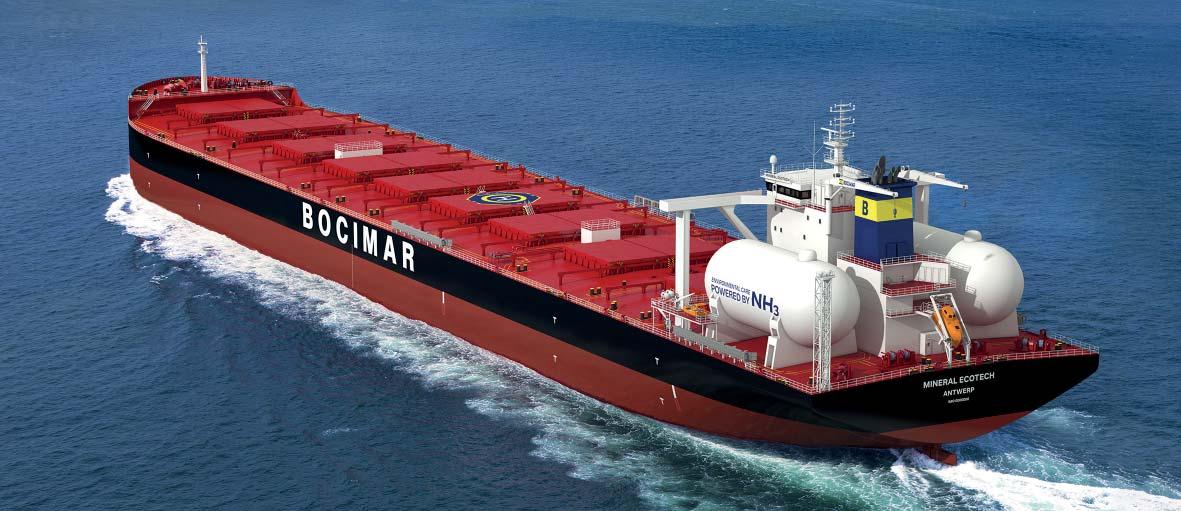
Schneiter noted that the market demand for methanol engines is “huge”, reflecting the importance of green solutions for shipowners at the moment. “We can provide the technology, the question is always when they need it.”
In parallel with the first newbuilding, WinGD was planning to introduce a conversion solution for existing X92B engines to market “more or less concurrently” with the addition of the first
circumstance where ammonia contaminates the cylinder lube oil.
“The additive majors supplying the lubricant suppliers are actually considering the cylinder lube oil as another measure to control ammonia. So in case [ammonia contamination occurs], we would have a monitoring system in place that would release additives that can protect the engine to a certain extent or act as a catalyst to convert ammonia to reduce its effects.”
Schneiter noted that this approach is currently being analysed in detail in joint development studies with classification societies as well.
methanol engine in 2025. “We have seen a lot of interest in methanol solutions from the container segment, where there are a number of large container vessels on order with delivery dates in 2024, 2025 and even 2026. Many of the owners are enquiring about potentially converting these vessels to methanol dual-fuel engines.”
The company plans to extend the methanol portfolio subsequently to smaller engine bore sizes based on WinGD’s assessment of the segments that are likely to see the greatest commercial activity. The final decisions to expand the engine portfolio will ultimately depend on customer interest.
“Ordering activity for larger container vessels has slowed since 2021 and 2022, although there are still some orders coming in. All the feeders will need to be changed next, with the 7000-8000 teu vessels likely to be followed by 3000-4000 teu feeders.
“However, projects for smaller size feeders ranging in size from 1000 teu up to 1500 and 2000 teu are also arriving, which means we have to complete the portfolio.”
Ammonia engine
The expansion of the ammonia engine portfolio will likely be slower, focused on developing smaller bore engine following the development of the 52-bore engine, which would be the same as WinGD’s second test engine at Winterthur. “Once the first research engine is running, you will also have the first commercial solution available.”
WinGD is also developing a second bore size for the ammonia engine, as part of a collaboration with CMB, the Belgian ship owner, on a series of ten ammonia-fuelled 210,000 dwt bulk carriers. The shop test of the first of the series 72-bore engines for the bulk carriers is expected to occur in mid 2025.
“Looking ahead, we will scale up from the 52-bore to the 72-bore following the same incremental approach that we used with LNG previously. It took us longer to scale up from 72 bore to 80 and 92 bore.” Schneiter emphasised that the engine designer was not planning to commit to the development of a 92 bore X-DF-A engine until it had gained operational experience from the 72bore engine.
RETROFIT/CONVERSION For the latest news and analysis go to www.motorship.com MAY 2023 | 29
■ A rendering of a CMB bulk carrier operating on ammonia as a fuel
Source: WinGD
CORVUS ENERGY ADVANCES PRACTICAL SOLUTIONS TO FUEL CELL ADOPTION
Corvus Energy is preparing to introduce practical fuel cell solutions into the maritime propulsion market, Thor Humervelt, SVP and Product Architect at Corvus Energy tells The Motorship
The company is planning to announce the launch of its inherently safe gas-safe Hydrogen Fuel Cell System at this year’s Nor-Shipping event.
Humervelt likened the advance of the system to the introduction of inherently gas-safe solutions for natural gasfuelled engines in shipping, which allowed natural gas fuelled engines to be located in conventional machinery rooms.
The solution has been developed by Corvus Energy in collaboration with a number of partners, and will be made commercially available in 2024 (see box). The launch of the solution follows the successful trial on board a vessel in 2023.
The launch of the system is expected to make it easier for PEM fuel cell units to be specified by simplifying the placement of Corvus’ Hydrogen Fuel Cell system inside a ship’s hull. A number of projects are looking at installing fuel cells onboard vessels as one route to meeting increasingly stringent environmental emissions rules. “This process will only accelerate if tighter decarbonisation targets are set by IMO,” Humervelt added.
Power management integration
Corvus Energy is also developing a fuel cell management system that will sit alongside the existing battery management system.
The advantage of developing an integrated management systems is that it will allow the battery management system and the fuel cell management to be operated simply by the ship’s crew, and will help the captain to operate the vessel simply and efficiently.
One of the advantages of integrating battery systems with fuel cells is that PEM fuel cells typically have the highest efficiency at above 20% and below 75% of maximum output, and the fuel cells typically prefer to be operated at stable loads.
Humervelt noted that Corvus Energy was developing a predictive function within its integrated energy management system to predict the energy consumption within the next second of operation (based on expectations about speed and water conditions).
“The big IP of this is that we can optimise the performance of the fuel cell and the batteries, while improving the impact on both the fuel cell and batteries’ operational life, combining both into a predicts the best way to actually satisfy the power request of the ship.”
Depending on the operating condition, you can amend the minimum state of charge for the battery depending on the season and the weather. “If you want to make sure you have spare energy on your battery, you can increase the load on the fuel cells – or you can choose to run your battery hotter and lower in charge, because there is no risk. You can combine weather forecasts and big data for the control system on a single ship.”
Corvus Set to Launch Gas-safe Hydrogen Fuel Cell System

Corvus Energy has announced plans to launch its inherently safe gas-safe Hydrogen Fuel Cell System at this year’s Nor-Shipping event.
The solution utilises well known engineering solutions such as double wall piping, and was the product of a development project, H2NOR, which involved DNV, LMG Marin and shipowners Norled and Wilhelmsen.
Humervelt explained that the safety solution relied on storing PEM fuel cells stacks inside a safe zone, which would be
designed to withstand a worst case internal failure. To minimise the rise of a fire, the safe zone will submerged with inert gas produced by a nitrogen generator. The inert gas within the safety compartment will be periodically replaced to prevent the accumulation of hydrogen.
To ensure the safety of the system, it will also be equipped with emergency shutdown valves for both hydrogen and for air.
The solution also includes rigorous monitoring of the area by monitoring and safety devices inside and outside of
the compartment.
Following the launch of Corvus Energy’s first type approved PEM fuel cell in 2023, and the first commercial deliveries of its new solution, Corvus plans to expand its production of hydrogen fuel cell systems.
The company is currently expanding the production capacity at its Bergen production plant. At present the company is developing an assembly area for prototypes. The company will eventually have a production capacity for 60MW of PEM fuel cell systems.
FUEL CELLS AND HYDROGEN 30 | MAY 2023 For the latest news and analysis go to www.motorship.com
■ Corvus Energy’s Hydrogen Fuel Cell System received Approval in Principle (AiP) from DNV in 2022
MEYER WERFT SUBSIDIARY INKS DAMEN SHIPREPAIR DEAL
Damen Shiprepair & Conversion (DSC) has signed a joint cooperation agreement with MEYER Group. DSC will work with MEYER’s subsidiary, MEYER RE.
MEYER RE offers shipping companies solutions to maximise their vessel’s sustainability, ideally throughout their lifecycle from development and build to supporting them through their operating lives and finally end-of-life recycling.
DSC and MEYER RE will initially focus on the design and implement sustainable systems up to the complete conversion of existing engines or installation of new power plants on board. These solutions include the conversion of existing engines to dual-fuel solutions capable of operating on LNG and methanol. The list of potential solutions include the installation of hybrid-electric solutions such as batteries and fuel cells solutions and their respective energy management systems.
The joint cooperation envisages the partners cooperating on the implementation of entire modernisation projects, although MEYER RE’s focus includes lifecycle optimisation strategies as well as end-of-life recycling.
“Thanks to the cooperation with the family-owned, Dutch company Damen Ship Repair & Conversion Holding BV, we are moving even closer to our customers by securing dock capacity and manpower for our customers worldwide,” says Alexander Höfling, Managing Director of MEYER RE.
“In the short time since it was founded, MEYER RE has brought us additional work as customers want to make their ships more attractive and sustainable,” added Jan Meyer, Managing Director of MEYER WERFT. “It has generated orders across our group including our shipyards. However, as we do not have our own repair and docking capacities, this cooperation agreement with DSC is of particular importance to us as we now have access to the resources we need.”
MEYER RE offers various sustainability-related services for
shipping companies in close cooperation with other specialists within the MEYER Group and now with DSC.
DSC is an ideal partner for MEYER Group, not least due to the geographical proximity of a number of its yards and a shared philosophy and dedication to quality.
Damen Shiprepair and Conversion (DSC) is a group of ten repair yards, with resources including dry docks up to 405x90 and 420x80 meters in size and a harbour & voyage team to service its customers at sea or in harbour. The shipyards are mostly very close to the main shipping routes and can therefore be reached quickly. DSC completes more than 1,500 orders annually.
“We have serviced many of cruise ships at our yards over the years, during which we have developed a detailed understanding of the technical and logistical needs of a cruise refit project” says Jeroen Heesters, Managing Director of Damen Shiprepair & Conversion Holding BV. “We look forward to working with MEYER RE.”
“I am thrilled and excited to execute together with the team of MEYER the future refurbishment projects” says Rogier van der Laan, Sales Manager Cruise of Damen Shiprepair & Conversion Holding BV.
Through their close and worldwide cooperation, MEYER RE and DSC are confident that they will make a significant contribution to the decarbonisation of shipping and the cruise industry.
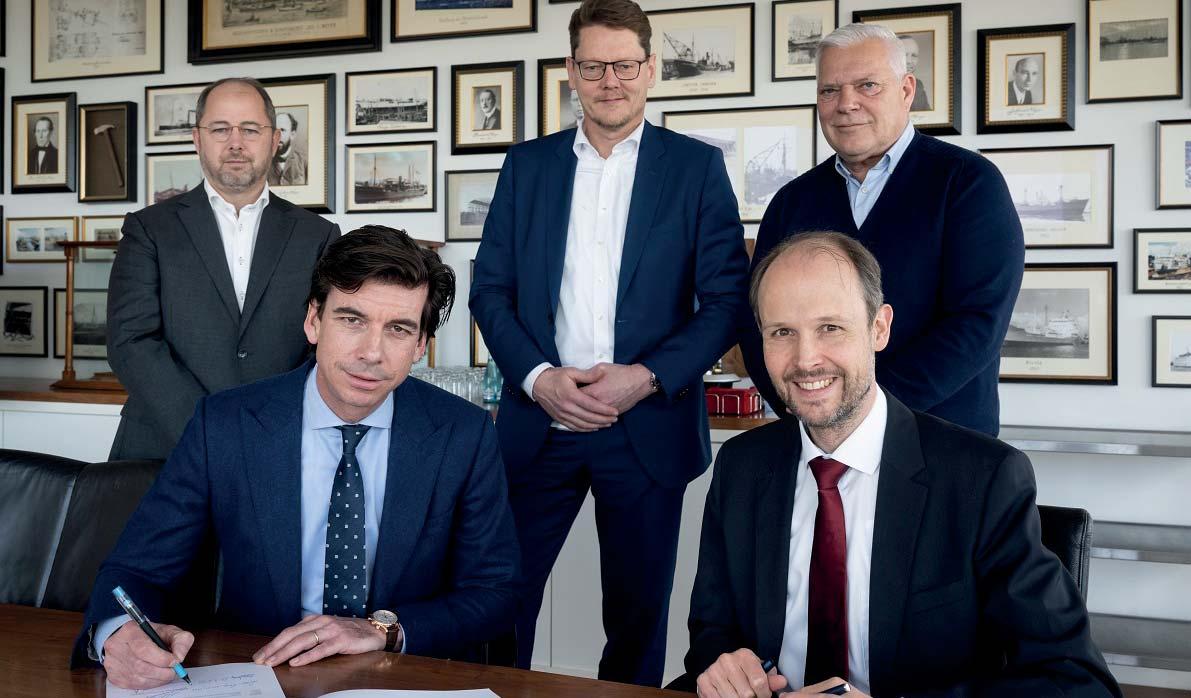
RETROFIT/CONVERSION For the latest news and analysis go to www.motorship.com MAY 2023 | 31
■ Bas Loohuis (Commercial Director of Damen Shiprepair & Conversion Holding BV), Jeroen Heesters (Managing Director of Damen Shiprepair & Conversion Holding BV), Alexander Höfling (Managing Director of MEYER RE.), Jan Meyer (Managing Director of MEYER WERFT), Rogier van der Laan (Sales Manager Cruise of Damen Shiprepair & Conversion Holding BV).
Source: Damen Shiprepair
LIMITING HARMONIC DISRUPTION TO ELECTRICAL NETWORKS ON MARINE VESSELS WITH ULTRA-LOW HARMONIC DRIVES
As the trend towards electrification of marine vessels intensifies, so do the problems posed by harmonics. Marine vessels rely on extensive electrical networks to power a series of must-not-fail functions.
Variable speed drives, also known as variable frequency drives (to be referred to as ‘drives’ in this article), are essential solutions which ensure these networks are stable, as well as energy efficient, to maximise performance and meet important sustainability objectives.
A somewhat lesser-known fact is that drives and many other types of non-linear load, such as EC (electronically commutated) motors, LED or fluorescent lightning, computers, uninterruptible power supplies (UPS), and Wi-Fi routers, can cause an undesirable event knows as harmonic distortion in the vessel’s electrical network.Juha Savanto, Sales Manager at ABB, explores the challenge and explains how ultra-low harmonic (ULH) drives provide a solution.
As global demand for marine vessel services grows alongside pressures to operate in an environmentally conscious manner, more and more ships for cargo transport and leisure cruises are being built and retrofitted with electric propulsion systems.
Sustainability aside, there are numerous other benefits offered by electric propulsion, including greater redundancy, improved maneuverability and reclaimed deck space that can be utilized for cargo and other applications.
The trend towards electrification is clear. In 2021, the market for electric ships was valued at just shy of $5 billion, according to Straits Research. By 2030, it is estimated to reach almost $12.8 billion thanks to a compound annual growth rate of well over 11%.
This will only increase the amount of electricity needed for ships to operate. In addition to propulsion systems, vessels rely on their own extensive electricity networks to power a huge array of critical functions – applications that are often reliant upon the use of drives.
In practice, drives convert supply voltage to a variable voltage and frequency to control the speed of a 3-phase induction motor and match the needs of the application, ensuring energy savings and superior motor control can be achieved across a range of vital equipment, be it main propulsion drives, compressors, pumps or thrusters. The ability to control motor speed is critical, not least because many motors run at well below their peak load most of the time.
Indeed, stability and reliability are essential traits of marine electrical systems, which must be operational at all times, especially when sailing in challenging conditions at sea. At the same time, marine operators are under pressure to ensure energy efficiency on board as the sector seeks to reduce its environmental footprint and cut costs associated with power consumption.
More electricity equates to more harmonics
However, while drives help to tick these important boxes they, like other types of non-linear loads, are prone to causing harmonics – a power quality issue leading to efficiency, reliability,
cost and safety problems for vessel operators and users.
Harmonics pollute electrical networks and prompt erratic behavior of equipment connected to them. The extent to which networks are disrupted is presented as a percentage, in what is known as total harmonic distortion (THD) value.
Rather than drawing currents in a typical sinusoidal fashion, the front-end rectifiers draw discontinuous, pulsed currents to drive different motor speeds based on application demand at any given time. Today, this non-linear loading on marine vessels can reach up to 80% of the onboard electrical generating capacity, therefore resulting in THD of up to 20%.
While drives have been singled out because of their common existence on vessels, it should be noted that they are not the only equipment that can create harmonics. Indeed, almost every type of modern electronic device are harmonics producers – electronically commutated motors, LED or fluorescent lighting, mobile phone chargers, computers, uninterruptible power supplies and Wi-Fi routers are all examples of non-linear loads. Unfortunately, it is a cost of modernity – old-fashioned lightbulbs, for instance, do not cause harmonics because they are linear loads.
Why are harmonics a problem for marine vessel operators? While most electrical networks can cope with a degree of harmonic current, issues will arise when non-linear loading becomes too high a proportion of the overall load.
Left unaddressed, harmonics can cause damage to electronic equipment, interfere with communications systems and prompt false readings on measurement devices. In serious instances, harmonics can lead to the overheating of transformers, cables, motors, generators and capacitors – this leads to energy losses, shortened equipment life, unreliable operation and even total shutdowns. In marine environments, the shutdown of electrical networks can be catastrophic, especially when maneuverability is limited in adverse conditions at sea.
Moreover, heating in the windings of transformers,
ADVERTORIAL 32 | MAY 2023 For the latest news and analysis go to www.motorship.com
generators and induction motors could potentially result in fire. A high-profile incident occurred in 2010 aboard the RMS Queen Mary 2 as it was approaching the Barcelona coast. Here, harmonics caused a deterioration of the capacitators in the aft harmonic filter room, causing an explosion which knocked out all four propulsion motors and creating a total vessel blackout. Fortunately, the ship was clear of navigational hazards and was able to drift safely in the open sea.
Indeed, such is the seriousness of the threat posed by harmonics that marine classification bodies around the world, including the American Bureau of Shipping, often treat it as a SOLAS (safety of life at sea) issue. Resultantly, many such organizations have introduced limitations on the magnitude of harmonic disruption permitted on their classed vessels.
How can the harmonics problem be solved?
Proactively dealing with harmonics is therefore a high priority issue for the marine sector, especially as it continues to tread a path of electrification on the way towards net zero.
A common approach to tackling the issue is to invest in cooling systems or ‘oversized’ critical equipment such as transformers and cables, this helping to overcome any overheating caused by the harmonic current. Additionally, the oversizing of backup generators is another method that is broadly adopted to mitigate some of the challenges.
There are significant drawbacks to these solutions, however. Oversizing in particular is a costly and often inefficient cure – it is the opposite of proactive in the sense that it does nothing to prevent harmonics in the first instance. Furthermore, in marine environments where space is often at a premium, the option to oversize equipment is not always practical.
Why ULH drives have a key role to play
In the case of harmonics, prevention is certainly better than cure, and this is where solutions such as ultra-low harmonics (ULH) drives show their worth.
What sets ULH drives apart is that they have harmonic mitigation such as active front end converters and line filters already built in. This removes the need to install external filters, special transformers, and multi-pulse arrangements, providing vessel owners with sizeable savings in terms of cost, time and space. The latter is especially relevant in the marine context, not least because traditional harmonics solutions are fitted outside of the drive box and take up space, which aboard vessels is typically at a premium.
In addition, where there are disturbances in the network, ULH drives such as those in ABB’s ACS880 industrial drives range contain an active supply unit which can boost the output voltage to enable secure, reliable motor operation, helping to reduce the amount of downtime and associated costs. Specifically, the wall-mounted AC880-31 and cabinetbuilt ACS880-37 are particularly suited to marine vessel applications. What’s more, the compact design of these “3 wire in, 3 wire out” ULH drives significantly reduces engineering and installation time.
When compared to external filters, including passive and active harmonic filters, ULH drives emerge favorably for several reasons beyond installation practicalities. In normal conditions, ULH drives operate with a THD of 3%, this being significantly lower than the typical 5 to 10% associated with passive and active harmonic filters. This difference is largely down to the fact that ULH drives prevent harmonics from entering the system as opposed to filtering harmonics that have already been allowed to build up.
Indeed, by providing a proactive and preventative solution that reduces harmonic currents, ULH drives mitigate the risk of marine equipment overheating, thereby removing the
need to oversize equipment such as transformers and cables.
In doing so, electrical assets can be optimized to match the actual load more closely, thus making their capital cost lower. If this is applied to an entire facility or vessel, a ‘rightsizing’ ripple effect will start to take place. Indeed, deploying ULH drives can help cut cable costs by around 10% compared to using standard 6-pulse drives; switchgear and circuit breaker costs can be cut by anywhere between 10% and 30%; distribution transformer costs can be reduced by 20%; and generator costs can be halved.
Taking a proactive approach to harmonics
ABB’s ACS880 industrial drives range of ULH drives are already making waves across the marine sector.
For example, we recently supplied one of the world’s leading marine electrical system integrators with several dozen wall-mounted ACS880-31 drives to meet the narrow hull structure and harmonic requirements of its customer. Representing the perfect technical solution, it has enabled the client’s customer to save space on its drilling vessel and benefit from simple installation and maintenance processes, as well as stable performance.
ABB has also successfully supplied navy vessels with wallmounted and cabinet-built ACS880 low-harmonic drives to offer lower harmonics and total motor control of waste compactor machines on board.
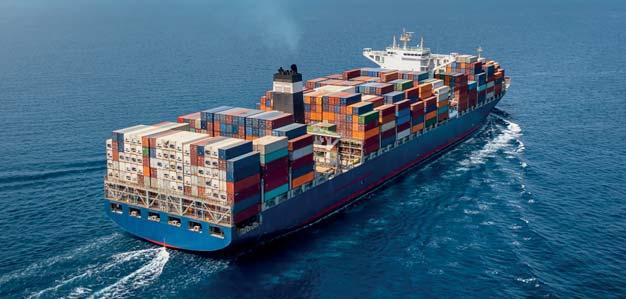
From frigates to cruise liners and many other types of ship in between, marine vessels rely heavily on what can be extremely complex electrical networks to function effectively, economically and safely. As the sector continues its course towards electric propulsion, these networks will become even larger and more difficult to maintain – not least due to the increased potential for harmonics to cause disruption.
Vessel operators, therefore, need to consider how to proactively manage harmonics to minimize downtime, improve energy efficiency, enhance safety and deliver allimportant cost benefits in the future. As an alternative to deploying traditional methods such as oversizing key electrical assets, the use of ULH drives should be considered.
To find out more about how ABB’s ULH drives can counter the harmonics problem, visit https://new.abb.com/drives/segments/marine
“Juha Suvanto is global sales manager for ABB Drive products in the Marine segment. He has more than 20 years of experience with ABB's energy-efficient products especially in the shipping industry, where equipment reliability is one of the most important criteria when choosing a supplier. In addition, he understands the importance of the sustainable development in the marine industry and the impact of the industry in question on the marine environment. He acts as strong support for global sales, product development and other stakeholders.”

ADVERTORIAL For the latest news and analysis go to www.motorship.com MAY 2023 | 33
MAN ES FORECASTS EMERGENCE OF 2-STROKE DF MULTI FUEL MARKET
MAN Energy Solutions expects ammonia (NH3) to surpass LNG and methanol as the dominant dual-fuel engine type in newbuilding engine contracting before the end of the decade, as measured by kW of engine installed, according to forecasts seen by The Motorship
The forecast predicts that the proportion of dual-fuel engines contracted with ammonia will rise from 1% in 2025 to 2% in 2026 before rising to 6% in 2027.
The proportion of NH3 DF engines will rise by over 10 percentage points per year between 2028 and 2030, reaching 40% of contracted dual-fuel engines at the end of the decade. Although the forecast predicts that ammonia will become the largest fuel type within the two-stroke dual-fuel contracting market by 2030, MAN ES’ internal analysts caution that predictions about the future development of the market are complicated by regulatory and legislative factors.
The Motorship understands that this includes the potential introduction of higher decarbonisation targets by 2050 as well as the possible introduction of a carbon levy, both of which are expected to be discussed at the next meeting of the IMO’s MEPC committee in June 2023.
Methanol share to peak in 2027
The truncated forecast did not include proprietary data about contract volumes and the aggregated data does not split out dual-fuel retrofits from newbuilding orders, so the extent to which ordering cycles in product carrier markets, such as the emerging ammonia carrier market, are expected to contribute to the transformation of the 2-stroke market remains unclear.
Similarly, it is unclear how far the expansion of methanol conversion projects, both from MAN Energy Solutions and from other two-stroke engine suppliers, will contribute to the expansion of the methanol DF market over the coming period.
The forecasts predict that the proportion of DF engines contracted with methanol engines will soar from 10% in 2022 to 35% in 2023, before rising steadily after 2024 to a peak of 45% in 2027. MAN ES notes that the forecast for methanol engine contracting is especially challenging, due to the significant peak in methanol-engine contracting in 2022 and 2023. Therefore methanol-engine contracting may very well end up exceeding this current forecast.
The proportion of engines contracted with specialist alternative fuels, such as LPG and ethane, are both expected to decline over the course of the coming five-year period. The Motorship notes that the retrofit market for the conversion of existing LPG carriers to DF LPG operation is expected to diminish over time, owing to the transition of the entire class of carriers to LPG-fuelled propulsion.
Two-stroke dual fuel mix forcast
Expecting a rapid uptake in Ammonia DF contracting
Decline of LNG share
One particularly noteworthy aspect of the forecast is the expected decline of LNG’s share among two-stroke DF engine contracts.
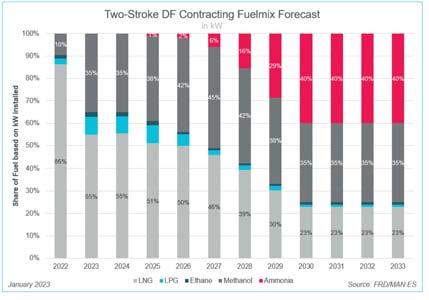
MAN ES’ internal analysts note that LNG will remain the market-leading DF engine type until 2027, but add that the increase in methanol DF contracts and the emergence of ammonia DF contracts will erode LNG’s market share. DF engines contracted with LNG engines will decline from 55% in 2023 to 51% in 2025, before slipping to 46% in 2027.
2030 and beyond
The forecast expects ammonia to achieve a market share of 40% of two-stroke DF engine contracting by 2030, when it will surpass methanol for the first time. The proportion of engines powered by methanol is expected to decline to 35% in 2030, while LNG DF engines will decline to just 23% of engines. DF engines capable of operating on the three fuel types will account for 98% of the engines contracted.
Uncertainties accumulate after 2030
The two-stroke dual fuel mix forecast has been produced by internal analysts within MAN Energy Solutions’ Two-Stroke business in Copenhagen.
Market forecasts produced by 2-stroke engine designers have tended to be
highly accurate over the near to short term, reflecting the longer lead time of commercial ship construction, which can extend to over four years or more from initial customer enquiries.
However, MAN ES has previously
identified the development of onshore alternative fuel infrastructure, as well as the emergence of international supply chains as potential brakes on the pace at which alternative fuels can enter the supply chain.
ALTERNATIVE FUELS 34 | MAY 2023 For the latest news and analysis go to www.motorship.com
■ Two-stroke dual fuel mix forcast
LNG and methonal DF will dominate the DF contracting the next couple of years
Rapid uptake in Ammonia is expected when launched
By 2030 it is impossible to predict a winning fuel (if such exists). This is highly dependent on future legislation and regulation
HYDROGEN: CELLULAR GROWTH
It is often said that the engine room of a ship today bears ever greater resemblance to a powerplant, and to some degree development of these two applications has grown to complement one another. But in the context of hydrogen fuel cells, the comparison will be truer than ever.
Despite the fact that the slow-speed two-stroke engine is likely the most fuel-efficient application of an internal combustion drivetrain, its fuel efficiency is still limited to around 50%. Engine types have certainly been designed that will use hydrogen as fuel; in fact, this is quite straightforward to achieve, as hydrogen’s tendency to explode on contact with air foregoes many of the challenges involved in engine design. However, powering a ship this way would be rather poor design, as hydrogen is already much less energydense than other fuels, without compounding the situation by adding the ICE’s inefficiencies on top.
But unlike ICEs, fuel cells are not subject to the Carnot laws which govern heat engines, meaning their maximum fuel efficiency could exceed 90%. This means that hydrogenpowered systems will almost certainly be achieved using the expedient of fuel cells.
Unfortunately, today’s fuel cells are nowhere near this potential. First mentioned in an 1838 issue of The London and Edinburgh Philosophical Magazine and Journal of Science, the technology is not new; but compared with ICEs, of which there is one for every eight humans on Earth, fuel cells necessarily lack the equivalent research and development pedigree.
Even in their immature state, however, today’s protonexchange module (PEM) and solid-oxide fuel cells (SOFC) are about 20% more efficient better than piston engines at converting their fuel into power. In fact, they closely match the advanced gas turbine generators seen at power stations.
Although the fundamental process of a fuel cell is today a matter for materials science, various secondary processes make it possible to achieve greater gains. For example, following the process of using natural gas or hydrogen to generate electricity, SOFCs emit heat of between 700 and 1000°C.
Though new vessels benefit from waste heat recovery technology to add to the efficiency of their engines, the higher heat range afforded by SOFCs means they can be coupled with a steam turbine, clawing back additional efficiencies of 10% or more.
The larger a fuel cell system becomes, the lower the costper-kilowatt of fuel cell capacity seems to be. According to recent estimates, in smaller scale systems costs of 1,000 per kilowatt were not unusual. However, fortunately for shipping, which deals in megawatts, per-kilowatt costs come down proportionately.
A problem of volume
In Norway, two Torghatten Nord ferries will each be fitted with 6MW PEM fuel cells, for EUR19.2m. At time of writing these will be the largest maritime fuel cells in the world -but likely not for long.
As with batteries, volume is something that users dealing with large fuel cell installations will have to worry about. According to an estimate by the UK’s ITM Power, a land-based fuel cell facility with a footprint of 70m long x 20m wide x 6m high would be needed to accommodate a 40MW power
output. This is comparable to the power needed for a VLCC.
To rearrange this template for a ship engine room would give dimensions of 35m long x 12m wide x 20m high, making for a bigger footprint than the Wärtsilä RT-flex96C engine, which generates 80MW. This compounds a problem already posed by storage of the fuel, particularly if hydrogen is used.
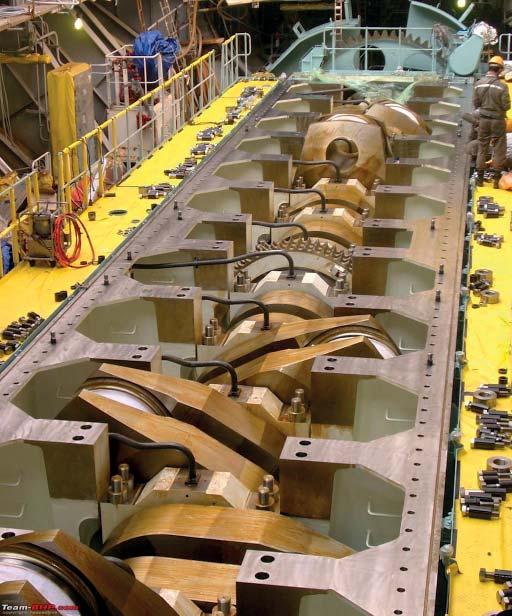
Despite becoming the subject of a great deal of research and development recently, the underlying physical properties of hydrogen do not change; it requires considerably more storage volume than any other fuel; to turn it into a less voluminous liquid requires temperatures close to those of deep space, and an enormous amount of electricity to power the refrigeration.
In the course of adapting fuel cell technology for shipping, then, compromises must be made. In a recent seminar, Christian Skajem, spokesman for TECO 2030, a Norwegian fuel cell manufacturer, told participants that graphite electrodes could not be used in maritime applications, thanks to salt water corrosion. “We have non-metal plates,” he said.
TECO 2030 has moved into a 15,000m2 manufacturing facility in northern Norway, formerly the site of a solar panel producer. Designing its fuel cells specifically for the maritime industry, TECO 2030’s first project involves installation of some 2.4MW of PEM fuel cell capacity aboard Bitflower, a 6,55dwt Swedish bitumen tanker built in 2003 and deployed on a Shell charter. Part of the arrangement involves putting containerised hydrogen tanks on deck, pressurised to 350 bar, which would be hot-swappable within port.
Scaling up quickly, TECO 2030 plans to have 1.6GW of PEM
■ A fuel cell arrangement of 40MW would be larger than the world's biggest ship engine
ALTERNATIVE FUELS For the latest news and analysis go to www.motorship.com MAY 2023 | 35
fuel cell production online by 2030, and Skajem explained that ports and port operations, “and shore power,” will be one of the key markets for its PEM systems. This extends to port manoeuvring as well: “We also want to be a contributor to the larger container vessels and tankers as well by switching out the auxiliary engines on board, so the ship can propel itself in the last hour into port, and the first hour out.”
Notably, part of redesigning fuel cells for retrofit aboard ships also involves reducing the footprint. “We have 400kW systems… twice the power density of our market peers… and we can scale up to multi-MW sizes,” Skajem explained. “Real estate is limited, so we want a compact and dense system, which doesn’t take up too much space.”
But although hydrogen is most readily associated with fuel cells, not all their manufacturers are regarding the situation with the same degree of exclusivity. SOFCs, unlike PEM units, can use methane as a feedstock. Although LNG is the least energy-dense of any fossil fuel, it is more than double that of liquid hydrogen, and beats alternative fuels and hydrogen carriers, ammonia and methanol, too.
Bosch, for example, touting the benefits of SOFCs over PEM cells in a recent webinar, pointed out that they can be used with methane as well. “Our systems are built for hydrogen, but they can also operate on natural gas and biomethane, if hydrogen is not available,” explained Marcus Spickermann, head of Sales & Market Development at Bosch SOFC. “Our systems contain an electrical efficiency of more than 60%, which is way higher if you compare it to gas-based power plants.”
Bosch also noted that the CO2 emissions of using fossil LNG with an SOFC would be around 68% lower compared with a coal-fired plant.
Biomethane, chemically identical to fossil LNG and distinguished only by its provenance, is therefore also a candidate for use with SOFCs. Although it will most likely be used with engines in most cases, coupling biomethane with a fuel cell system could offer better fuel economy, and reduced tank-to-wake emissions.
Another school of thought leans toward generating hydrogen in-situ. Rotoboost, using its Rotolyzer rotating electrolysis device, can break methane down into hydrogen
and solid carbon, which takes up six times less storage volume than carbon dioxide gas. The advantages are various; a ship could store much of this captured carbon on board, offloading it at port. Meanwhile, such a ship would be able to use LNG or bio-LNG as its fuel instead of trying to accommodate full tanks of hydrogen
Pay close attention
There is however, a problem which must be considered. Hydrogen’s hype as a ‘clean’ fuel belies two uncomfortable realities about the fuel. One of these is that according to recent study Atmospheric Implications of Increased Hydrogen Use, hydrogen is between six and 16 times as potent a greenhouse gas as CO2, meaning that escaped hydrogen, incurred for example during bunkering, would have grave implications for Earth’s atmosphere.
The other is that hydrogen’s production will have to decarbonise at an astonishing speed if it is to show any improvement on fossil fuels. According to the International Energy Agency (IEA), as little as 0.1% of hydrogen production today is achieved using water electrolysis.
The rest is made using steam-reforming from fossil fuels, a process which produces six tonnes of atmospheric CO2 for every 1.1 tonnes of hydrogen it generates. Compare this with coal-fired power production, which generates 2.6 tonnes of CO2 for every one tonne of coal burned.
Close oversight of hydrogen’s production processes and supply chains will be required from governments and interested parties via Scope 3 emission frameworks. Fortunately, some experts believe that the increasing familiarity of the concept of ‘well-to-wake’ emission measurements bodes well for hydrogen’s prospect of becoming a true stepping-stone to net zero, rather than a mere fossil-laundering scam.45% in 2027.
The proportion of engines contracted with specialist alternative fuels, such as LPG and ethane, are both expected to decline over the course of the coming five-year period. The Motorship notes that the retrofit market for the conversion of existing LPG carriers to DF LPG operation is expected to diminish over time, owing to the transition of the entire class of carriers to LPG-fuelled propulsion.
■ Bosch high temperature sofc fuel cells

ALTERNATIVE FUELS 36 | MAY 2023 For the latest news and analysis go to www.motorship.com
CAT AND SVITZER TAKE NEXT STEPS ON METHANOL ADOPTION
Caterpillar Marine and Svitzer have signed a Memorandum of Understanding (MoU) to adopt solutions that enable Svitzer to use methanol in its fleet, furthering both companies’ ambition for using methanol as part of the marine industry’s decarbonisation.
The MoU formalises a collaboration underway to deploy engine technologies that enable Svitzer to use green methanol. The adoption of Caterpillar’s dual-fuel methanol engines focuses on new tugs as well as conversions of existing Cat® powered tugs, which comprise the majority of Svitzer's fleet.
“The focus of our collaboration is two-fold,” says Andres Perez, global tug segment manager, Caterpillar Marine. “We are supporting Svitzer to enable tugs to operate on methanol with diesel-like performance while providing fuel flexibility which is key to enabling operators to lower their carbon intensity via green methanol as availability increases. Additionally, we're taking full advantage of the learnings to provide conversion solutions for the existing fleet. This is a critical aspect to reach the level of methanol adoption that Svitzer seeks to fulfill their goals."
"Given the size and complexity of our fleet and the ambitious target we have set of becoming carbon neutral in 2040, it is critical to take a holistic approach to reducing our CO2 emissions. While we seek to mature and utilize new technologies, fuel types and operational approaches for new vessels, we also have to find solutions that help reduce the emissions from our existing fleet. The support Caterpillar provides in finding ways of converting our equipment to methanol usage plays a key role in this,” says Gareth Prowse, head of decarbonisation for Svitzer.
Svitzer’s newbuild plans
The MoU follows Svitzer’s November 2021 announcement of an agreement with Robert Allan Ltd. for a new generation of methanol fuel cell tug. The goal is to design the world’s first fuel cell tug for harbour operations, running on green methanol. Using a combination of fuel cells, batteries, and electric propulsion in a new and unique towing configuration, the new tug will serve as a pilot project for future Svitzer newbuilds.
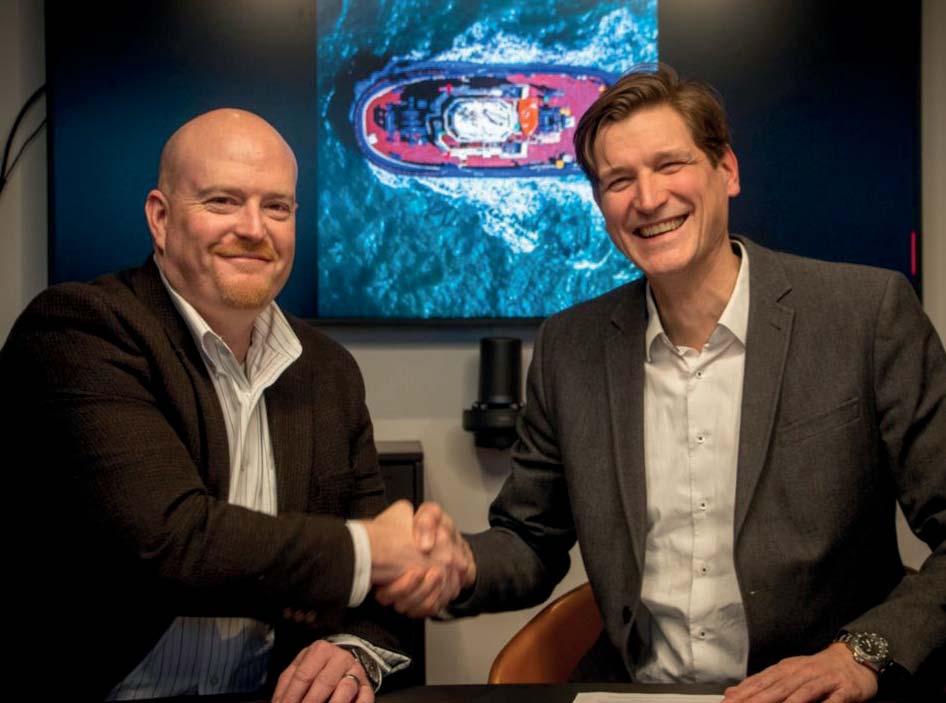
The 80 tons bollard pull newbuild tug with escort notation will come with a hybrid electrical propulsion system solution where fuel cells can be dimensioned to deliver a specific amount of sustained bollard pull using fuel cells alone, adding additional power from the batteries during the short but often frequent peaks that characterises towage.
The first vessel is planned to be put into operation within the Svitzer Europe region by Q1 2024.
Svitzer and Maersk are jointly exploring the combination of methanol fuel cells and batteries to apply knowledge and operational experience of methanol feasibility from the near shore small scale tug sector onto larger ocean-going container vessels.
Caterpillar builds its methanol portfolio
Meanwhile, Caterpillar has announced that its Cat® 3500E-series marine engines can be modified to run as dual fuel methanol in the future. Upgrade solutions to support fleets operating other 3500 series engines will also be
available in the future. Caterpillar experts are working with key customers and the industry to ensure the proper power ratings and applications are covered to meet their expectations.
Beyond Svitzer, it is also entering other partnerships. In November 2022, Caterpillar signed an MoU with Damen Shipyards Group aimed at developing methanol powered vessels. Under the MoU, Damen Shipyards will collaborate with a team of experts from Caterpillar and the Cat® Dealer, Pon Power, to learn how to adopt methanol as a fuel in marine applications, including aspects related to bunkering, storage, management, and conversion. Caterpillar will develop and provide the methanol power train to be integrated into a Damen designed and built methanol capable vessel. For tugs, Damen’s strategy is to offer fullyelectric models offering bollard pulls of 40, 60 and 80 tonnes respectively and methanol-fueled models with 60, 80 and 100 tonnes bollard pull.
Also last year, Caterpillar signed an Mou with Brazilian shipping company Wilson Sons on the adoption of reduced emissions tugboat and offshore vessel powertrain technologies. Together with Cat® dealer, Sotreq, Caterpillar will oversee the implementation of retrofits and upgrades to reduce the environmental impact of Wilson Sons’ existing fleet, technology-enabled services for emissions monitoring, and the usage of low or no carbon fuels, including methanol, in their fleet.
"Improving sustainability in maritime operations requires us to not only address building new, more efficient ships that use low carbon fuels, but also understand how we can reduce the impact from existing fleets," said Brad Johnson, vice president and general manager, Caterpillar Marine.
ALTERNATIVE FUELS For the latest news and analysis go to www.motorship.com MAY 2023 | 37
■ Cat and Svitzer handshake
NEW SWEDISH PASSENGER CATAMARAN WILL RUN ON HYDROGEN
Sweden’s
The 130-metre high-speed catamaran will be able to travel at 35 knots, carry 1,650 passengers and have space for 450 passenger cars. Serving the Gotland route during the summer months and will be able to make the trip between the Baltic island of Gotland and the Swedish mainland in under three hours.
The ship is designed to be powered by compressed hydrogen, with water vapour as the primary component of emissions. It will have a multi-fuel, twin gas turbine, combined cycle solution that can also be powered by other fossil-free fuels including methanol, e-methanol or biogas. With a relatively simple adaptation of the turbines, it is possible to change the fuel from hydrogen to both gas and liquid fuels, says Gotlandsbolaget. It is also possible to mix hydrogen gas with, for example, biogas. Power output of the combined cycle solution will be about 31MW - the system supplier not yet been chosen.
The technical development work is being led by Gotland Tech Development, and Christer Bruzelius, Senior Partner & Project Owner Gotland Tech Development, says that gas turbines are normally very responsive to load changes. “We have chosen a gas turbine concept because we believe this will be the quickest path for reaching 100% hydrogen operation together with a multifuel solution with the gas turbines possible to operate on several different fossil free fuel types.”
He says: "The ship's design is based on Gotland's and our passengers' needs to be able to travel with a short crossing time and at competitive prices, without negatively impacting the climate or the environment. In order to minimise the energy requirement and obtain a high degree of efficiency, we develop energy-efficient hulls, minimise weight, optimise energy consumers on board and streamlines operations and flows throughout the vessel. Austal is a leader in the development of large catamarans, and they are an excellent partner to take Horizon X forward."
The work to develop all the necessary technology is ongoing and the ambition is that the Gotland Horizon X will be ordered no later than 2025 to be put into service no later than 2030.
The key component for achieving good system efficiency is to run the gas turbines in combined cycle and to recycle the exhaust heat from the gas turbine, he says. With the combined cycle, the warm exhaust from the gas turbine goes through an exhaust gas boiler creating steam that goes through a steam turbine generating electricity led back to the gearbox through an electrical motor (PTI).
The conceptual design handles the compressed hydrogen tanks in a dedicated place on the foredeck. The fuel system will be built up around the tanks and leading down to the gas turbines in each hull of the catamaran. “The rules from class are not in place, so we will work to gain approval in principle from class. Several Hazard evaluations will be necessary to carry out during detailed design of the fuel system,” Bruzelius says.
“Hydrogen refuelling poses some challenges when designing the system. We foresee filling in both ports for Gotland Horizon X, where we will build a compressor station, buffer tanks, cooling unit and a filling post connected with the vessel.”
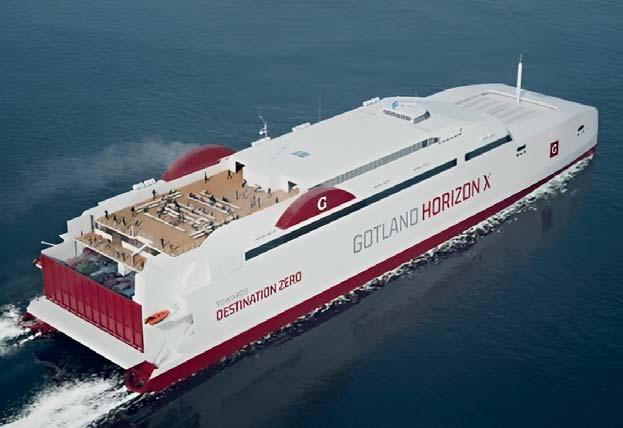
Gotlandsbolaget launched the Gotland Horizon X concept in October 2022. The vessel is the world’s first large-scale hydrogen-powered catamaran, and the second in Gotlandsbolaget's Horizon Series. Gotlandsbolaget has previously presented a large ropax, Gotland Horizon, with room for 1,900 passengers and 600 cars in 2021. The aim is to have this ship in service by 2030 as well. The main engine concept with gas turbines in combined cycle is the same for both vessels.
Gotlandsbolaget's goal is for Gotland traffic to be climateneutral by 2045. The first concept ship was formulated back in 2009 with a clear ambition to achieve fossil-free crossings between Gotland and the Swedish mainland. Since then, the company have worked tirelessly to reduce its climate footprint. “The Horizon series is our most ambitious step so far – a step that we consider vital not only for us, but for society as a whole.”
Ongoing work includes investing in next-generation technology and fuel, infrastructure for green energy, and the long-term development of vessel destinations.
FUEL CELLS AND HYDROGEN 38 | MAY 2023 For the latest news and analysis go to www.motorship.com
‘‘
The Horizon series is our most ambitious step so far – a step that we consider vital not only for us, but for society as a whole.
Gotlandsbolaget and the Australian shipyard Austal have signed a Memorandum of Understanding for a design agreement of Gotlandsbolaget’s new passenger catamaran, Gotland Horizon X, which will be able to run on hydrogen.
HYDROGEN SUPPLY AND STORAGE IMPEDING FUEL CELL UPTAKE
Progress is being made to ensure that marine fuel cells are one of the spread of technologies that will ensure that the maritime industry meets its decarbonisation target.
Challenges lie ahead for the marine fuel cell, but not all are what they seem, says Sami Kanerva, Global Product Line Manager, Fuel Cells, ABB Marine Ports. Fuel cell systems may take up more technical space on board ship than combustion engines for example, but they also do away with some of the auxiliary systems that eat up revenue-earning space in conventional power plant.
Fuel cell stacks and handling systems call for specialized knowledge, but most of a fuel cell’s auxiliaries are simple pumps and fans, while fewer moving parts than conventional engines should actually mean less maintenance, he says.
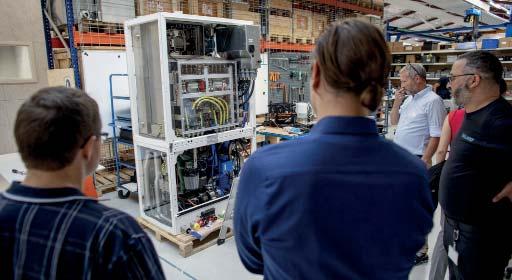
Harder to counter is the matter of storage space. Hydrogen has the highest energy content per mass of all chemical fuels - exceeding MGO by 2.8 times – but its lower density means it takes up four times the space (by carried energy). In liquefying at -253° C, hydrogen also needs extra layers or vacuum insulation for cryogenic storage, as well as other structural arrangements.
This will mean new developments in ship design, but it could also require a change in approach to bunkering, if hydrogen is to be both feedstock and fuel. “It’s possible hydrogen-powered ships will have to bunker more frequently than they do today,” says Kanerva.
Much will therefore rely on the hydrogen supply chain, the lack of which Kanerva describes as the “largest single obstacle” impeding progress. However, developments in land-based industries suggest that the picture is changing fast.
As a group, ABB is already investing in hydrogen power landside, believing this will establish a foundation for maritime use. ABB’s portfolio encompasses the full hydrogen value chain from production, transportation, storage to consumption. The company is working closely with partners and customers to create the new hydrogen ecosystem. Commitments to green hydrogen include developments projects in Italy (partnering with Swiss utility company Axpo), France (working with Lhyfe) and Canada (Hydrogen Optimized).
“The World Economic Forum projects that, if all of the land-based projects announced by industry involving hydrogen as a fuel become reality, they could amount to 60 gigawatts of power by 2030,” says Jostein Bogen, Global Product Line Manager, Electric Solutions, ABB Marine & Ports. The resulting scale-up in manufacturing capacities could reduce the cost of electrolysers by 70% over the same period. DNV, meanwhile, has suggested that enabling policies in Europe make it likely that hydrogen will contribute 11% to its energy mix by 2050.
“With the landside supply chain in place, the technical progress and approvals we have secured will mean the marine fuel cell is ready to make its full contribution to shipping’s decarbonisation goals for 2050,” he says.
According to the World Economic Forum, more than 100 pilot and demonstration projects are under way which use
■ FLAGSHIPS project fuel cells receive design review attestation from BV
hydrogen or its derivatives to fuel shipping. Using the reaction between hydrogen and oxygen to convert chemical energy into electricity which emits only clean water and heat, fuel cells offer far higher efficiency than combustion engines.
ABB has supported numerous customers in passenger and cargo segments with the planning of onboard fuel cell systems. It is also one of the key technology partners in FLAGSHIPS – the EU-funded, Seine River project which aims to deliver the world’s first commercial cargo ship with hydrogen propulsion, with a prototype vessel due delivery to Blue Line Logistics (BLL), a subsidiary of Sogestran Group, later this year. Ballard Power Systems Europe has been granted Design Review Attestation from classification society Bureau Veritas for the two 200kW FCwaveTM fuel cell modules that will be installed on board the Flagships project vessel Zulu 06
From the technical standpoint, marine fuel cell technology is mature enough to deploy as a zero-emission alternative auxiliary power source for ships in power ranges of 1-3 MW, while practical applications could be made to 10-20 MW, says Kanerva.
Together with Ballard Power Systems, ABB has already secured Approval in Principle (AiP) from DNV covering a PEMFC cell capable of generating 3MW of electrical power. It also recently signed an MoU with RINA on decarbonization which includes a commitment to developing fuel cell systems.
ABB is looking into both proton exchange mechanism (PEM) and solid oxide fuel cell (SOFC) variations. Both use hydrogen as their fuel, although the SOFC can be installed with its own reformer so that other fuels (e.g. LNG, methanol or ammonia) can be used as feedstock.
■ Jostein Bogen, Global Product Line Manager, Electric Solutions, ABB Marine & Ports.


FUEL CELLS AND HYDROGEN
■ Sami Kanerva
For the latest news and analysis go to www.motorship.com MAY 2023 | 39
METHANOL A VERSATILE OPTION FOR FUEL CELL
The need to cut emissions quickly is enticing shipowners to consider methanol as a primary energy carrier for hydrogen, says Chris Chatterton, COO of the Methanol Institute
Hydrogen’s application as a direct fuel could be many decades away. But faced with the problem of needing to cut emissions quickly ahead of 2023 and 2030, shipowners are examining and investing in hydrogen fuel cell technology, with methanol as the primary energy carrier, where it is either reformed alongside the fuel cell in a separate unit or integrated within the fuel cell itself.
Fuel cells can already meet the electrical demands of vessels in port and supply power for applications including refrigerated containers and port equipment. And a new generation of fuel cells can provide both vessel auxiliary and ultimately main propulsion power.
Methanol is an extremely efficient carrier of hydrogen atoms, with the highest hydrogen-to-carbon ratio of any liquid fuel. Liquid methanol at ambient temperature and pressure packs 40% more H2 by volume than hydrogen in a liquid state (-253C) and 140% more H2 than compressed hydrogen at 700bar. This makes methanol the ideal fuel to be re-formed onboard ship and consumed as hydrogen in fuel cells.
Compact and affordable processes are increasingly available for onboard reforming of methanol to hydrogen at qualities necessary to be used in fuel cells. In addition, using methanol as the hydrogen source reduces cost towards a competitive price with diesel for some generator applications.
Fuel cells are already in use in a number of maritime applications, notably onboard the ropax ferry Mariella. The vessel is equipped with a fuel cell stack powered by a methanol fuel supply system designed and installed by the Meyer Werft shipyard. Mariella’s methanol fuel tank is bunkered by truck using a standard hose arrangement and is reformed into hydrogen and transformed into 90kW of electrical power.
With the technology proven and accepted, the next stage of development is to further scale fuel cells to provide power for new applications and at higher loads.
Manufacturer Advent Technologies has announced its fourth generation of fuel cell units, SereneU, with claimed advantages including longer lifetime, decreased service and maintenance and lower total cost of ownership. These Methanol fuel cells have the option to interconnect with multiple units resulting in power systems and solutions for larger power demands.
Bergen-based system integrator Norwegian Electrical Systems intends to install a 3.2MW hydrogen fuel cell onto a large vessel currently being designed for the shipowner Havila. This will be the largest fuel cell ever installed on an ocean going vessel, replacing the more frequently used compressed gas. Batteries are planned to store additional energy to make the system fully emissions-free.
RIX Industries has licensed e1 Marine’s methanol-to-hydrogen reforming technology to create a mobile
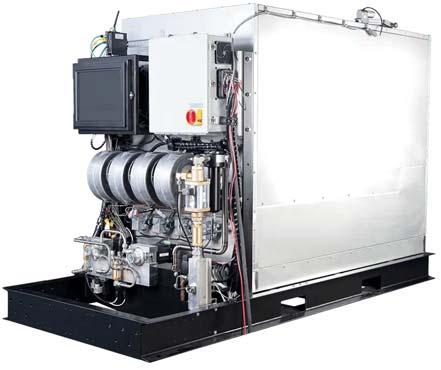
■ RIX Industries’ Methanolto-Hydrogen generation system uses e1 Marine’s proprietary methanol-tohydrogen reforming technology
Methanol-to-Hydrogen generation system and provide green power in shipboard and marine environments. With the ability to generate hydrogen onboard and on demand, the RIX system offers users a safer and smaller shipboard volume requirement than high-pressure compressed hydrogen solutions.
An innovative fuel cell system based on high-temperature proton exchange membrane (HTPEM) technology designed by fuel cell manufacturer Blue World Technologies is being constructed for testing by Alfa Laval. The test installation, which will use Methanol as fuel will explore the technology's potential as a source of marine auxiliary power. Funded by Danish Energy Technology Development and Demonstration Program, the project is a joint effort between Blue World Technologies, Alfa Laval and shipowners including DFDS, Maersk Drilling and Hafnia.
The aim of the project is to establish a highly efficient and cost-effective HTPEM fuel cell, giving marine vessels a realistic alternative to combustion-based auxiliary power within the near future. The fuel cell test setup will have a power of 200kW, but the fully developed and modular design should be possible to scale up incrementally to a level of 5MW.
Powered by conventional Methanol, fuel cells can already provide significant emissions reductions at prices which are increasingly attractive to owners facing up to the prospect of higher fuel bills in future, by sidestepping the cost prohibitive, cryogenic or compressed gas infrastructure required for pure hydrogen. As fuel cell projects scale up and larger volumes of renewable methanol become available, the ability to drive emissions even lower and meet regulatory targets ahead of time becomes a reality.
■ Chris Chatterton, COO of the Methanol Institute
FUEL CELLS AND HYDROGEN
40 | MAY 2023 For the latest news and analysis go to www.motorship.com
Source: e1 Marine
NEW CARBON CAPTURE TECHNOLOGY USES FUEL CELL AND GENERATES ENERGY
Italy-based Ecospray has developed an onboard carbon capture system based on molten carbonate fuel cell (MCFC) technology and is aiming for mass production by 2025.
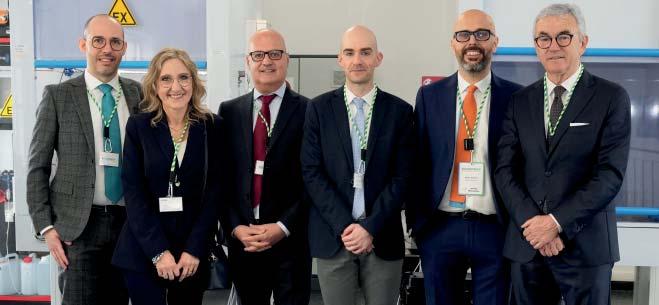
MCFCs are strategic in the context of the energy transition precisely due to their capacity to capture the CO2 in exhaust gases and generate additional clean energy, says Filippo Lossani, Marine Business Unit Director of Ecospray.
MCFCs can be powered by methane (LNG, bio-LNG), hydrogen, ammonia, syngas and other fuels providing they are reformed externally or directly inside the cell to produce hydrogen which is then fed to the fuel cell’s anode. In Ecospray’s marinised system, the CO2-rich exhaust gas coming from a power generation system is fed to the cathode, and up to 90% of the CO2 is then captured. At this point, the CO2 transferred at the anode outlet can be easily separated and liquefied for storage or further usage. The system’s only other outputs are water and air.
RINA recently confirmed that a 500kW MCFC, using carbon negative bio-LNG as feedstock for the anode, can cut the CO₂ equivalent emissions of a 10MW engine by 20%. The class society also conducted a feasibility assessment and confirmed the suitability of MCFC technologies on ships.
Engineers from the University of Genoa have collaborated with Ecospray on the MCFC technology since 2020. After completing this key stage in the validation process with RINA, Ecospray plans to start testing MCFC technologies at its new laboratory established in the Port of Genoa in partnership with the university. The lab is equipped to run testing activities, and research will include the factory processes needed for mass production of MCFCs. Ecospray expects to have a commercial product on the market in 2025.
This carbon capture technology was one of the three officially launched by Ecospray in June 2022, together with one based on the use of amines and one using calcium hydroxide. Both have been pilot tested are expected to be commercially available in 2024.
The absorption of CO2 with amines is based on an approach that is already well-established in other industrial sectors, but Ecospray has developed a new, more efficient and marinized system. In particular, Ecospray has managed to reduce the energy required for the regeneration of the amine to remove the captured CO2 from 140-160oC to 60-80oC. “We don’t need an additional burner or electrical power, we can use waste thermal power already available onboard to heat up the solution,” says Lossani. “This means saving a lot of energy for that part of the system that is one of the highest energy consumers overall.”
The third method in the company’s portfolio involves scrubbing exhaust gas with a
calcium hydroxide suspension that has a solid content ranging from 10-30%. In this lime milk, the CO2 reacts with the calcium hydroxide and forms calcium carbonate in stable, mineral form. The suspension of calcium carbonate is harmless to the marine environment, says Lossani, and the possibility of discharging it overboard is currently under evaluation.
The lime milk solution has a smaller footprint that then amine solution, as it only requires an absorption tower and a tank – there’s no need for liquified CO2 production or storage. The amine solution involves installing an absorption tower, stripping tower and condensing tower along with two storage tanks: one for the amine and one for the liquified CO2. While the MCFC solution has the smallest footprint, it still does involve CO2 storage onboard.
Bulk carriers are the main target for the lime milk solution, because the storage of the powdered calcium hydroxide is easy to incorporate onboard. Additionally, as there’s no need to regenerate the reagent, the total energy consumption is lower than the amine plant. “Liquified CO2 storage is not likely to be well suited to ships like bulk carriers that are at sea for 40-50 days, because it implies a huge amount of CO2 to be stored onboard,” says Lossani. “Some ferries and cruise ships sailing fixed itineraries, touching port ever day or two, will require less storage space. It is also easier for their operators to organise the logistics and shoreside infrastructure to handle the offloading of the liquified CO2.”
It would not make sense to develop all three solutions if shipowners’ needs were all the same, he says. The three technologies can be also integrated with other Ecospray exhaust gas solutions such as DeSOx, particle filters, and oxidation catalysts.
FUEL CELLS AND HYDROGEN For the latest news and analysis go to www.motorship.com MAY 2023 | 41
■ left to right, Filippo Lossani, director business unit Marine of Ecospray, Barbara Bosio, professor of Applied Physical Chemistry at the University of Genova, Maurizio Archetti, president of Ecospray, Ivan Capestro, Ecospray R&D manager, Alberto Di Cecio, Ecospray general manager and Franco Porcellacchia, Ecospray CEO
■ Filippo Lossani, Marine Business Unit Director of Ecospray
CHINA LAUNCHES FIRST HYDROGEN POWERED VESSEL
China’s first hydrogen fuel cell powered vessel “Three Gorges Hydrogen Boat No. 1” was launched in Guangdong on March 17.
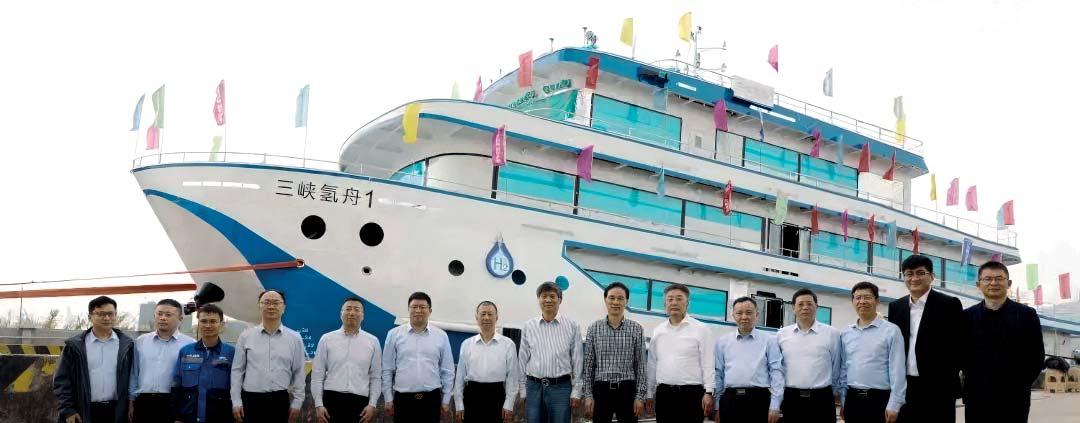
The steel-hulled, passenger catamaran was designed by Wuhan Changjiang Ship Design Institute, built by Jianglong Shipbuilding for China Yangtze Power Company, with class review by China Classification Society (CCS).
Three Gorges Hydrogen Boat No. 1 is 49.9 metres long, 10.4 metres wide, and capable of reaching a maximum speed of 28 km/h, with a maximum cruising range of 200 kilometres. The vessel will be used for traffic, inspection and emergency response in the Three Gorges Reservoir area and between the Three Gorges Dam and the Gezhou Dam.
To promote the widespread application of hydrogen energy within these Three Gorges’ waters, the Three Gorges Group has invested heavily in supporting the construction of shore-based hydrogen bunkering stations.
The vessel is powered by eight 70kW fuel cell modules located in two compartments. The storage capacity for hydrogen is up to 4,000 kWh, and a further 1,806kWh can be supplied from a lithium battery system. The motor uses direct current and has a rated power of 500kW. The power components were designed by the No. 712 Research Institute of China Shipping Group.
The performance of the fuel cell system has a big impact on the ship’s power system, says CCS, as it has good efficiency but poor response to load changes. To counter this, the Three Gorges Hydrogen Boat No. 1 has a new DC power system that, by combining the fuel cell and lithium battery, can meet the demand for manoeuvrability and power and improve dynamic response.
The vessel has obtained the characters of classification and class notations of FC-POWER 1, Green Ship-3, I-ship (M), EEDI-3 and Electrical Propulsion System, and has a higher green and intelligent ship rating. The maximum power generating efficiency of the fuel cell modules reaches 58% which greatly improves the ship energy utilization efficiency. Its DC power system results in a large increase in automation and intelligence level, says CCS.
The fuel cell system that meets the design criteria set out in the IMO’s Interim Guidelines for the Safety of Ships Using Fuel Cell Power Installations (MSC.1/Circ.1647). For example, the ship layout considers the potential for hydrogen leakage
in the hydrogen cylinder storage room and the consequences of diffusion disasters.
“CCS is highly concerned about the safety and environmental protection,” said a spokesperson from CCS. “It is crucial to protect the crew and ship against the hazard of low temperature, fire and explosion and guarantee the hydrogen or hydrogen-rich fuel cell equipment has the same safety and reliability as existing equipment.
“Designing the engine room where the fuel cells are located was a top priority, so CCS led the design of the fuel cell space together with the designer. With reference to the IMO guidelines, we studied the hazardous area assessment methods of IEC60079-10, quantitatively calculated the design plan, and confirmed that the design can make the explosive atmosphere in engine room less than 1% of the engine room by volume. This will effectively reduce the risk of fuel cell engine room.”
CCS states that the implementation of fuel cells on the vessel will provide an important theoretical and experimental basis for the subsequent promotion of hydrogen fuel cell ships in China. “The Three Gorges Hydrogen Boat No. 1 is an important breakthrough in China’s marine hydrogen fuel. It will push the pace of applying hydrogen energy technology in inland waterways ships still further and help China develop hydrogen energy in the ship industry,” says the spokesperson.
“Besides, more than 20 countries have developed strategies for the development of the hydrogen industry, and people are very receptive to hydrogen ships. CCS believes that current policies, technology research, development and promotion operate in favour of hydrogen ships.”
Currently, CCS is involved with several hydrogen ships. Additionally, in June 2022, the class society issued a certificate of type approval for the first 120kW marine hydrogen fuel cell power system in China to SPIC Hydrogen Energy Company. The FCPS-S120 marine hydrogen fuel cell power system has an output voltage 450V - 750V. All its core components are designed and made in China. Also last year, CCS issued its first Test Agency Approval Certificate for marine hydrogen fuel cell testing agency to China Automotive Technology Research Institute Centre (Tianjin).
FUEL CELLS AND HYDROGEN 42 | MAY 2023 For the latest news and analysis go to www.motorship.com
■ Three Gorges Hydrogen Boat No. 1
OCT Lisbon Portugal
Secure your place now & Save 20%
environmental challenges with economic demands in


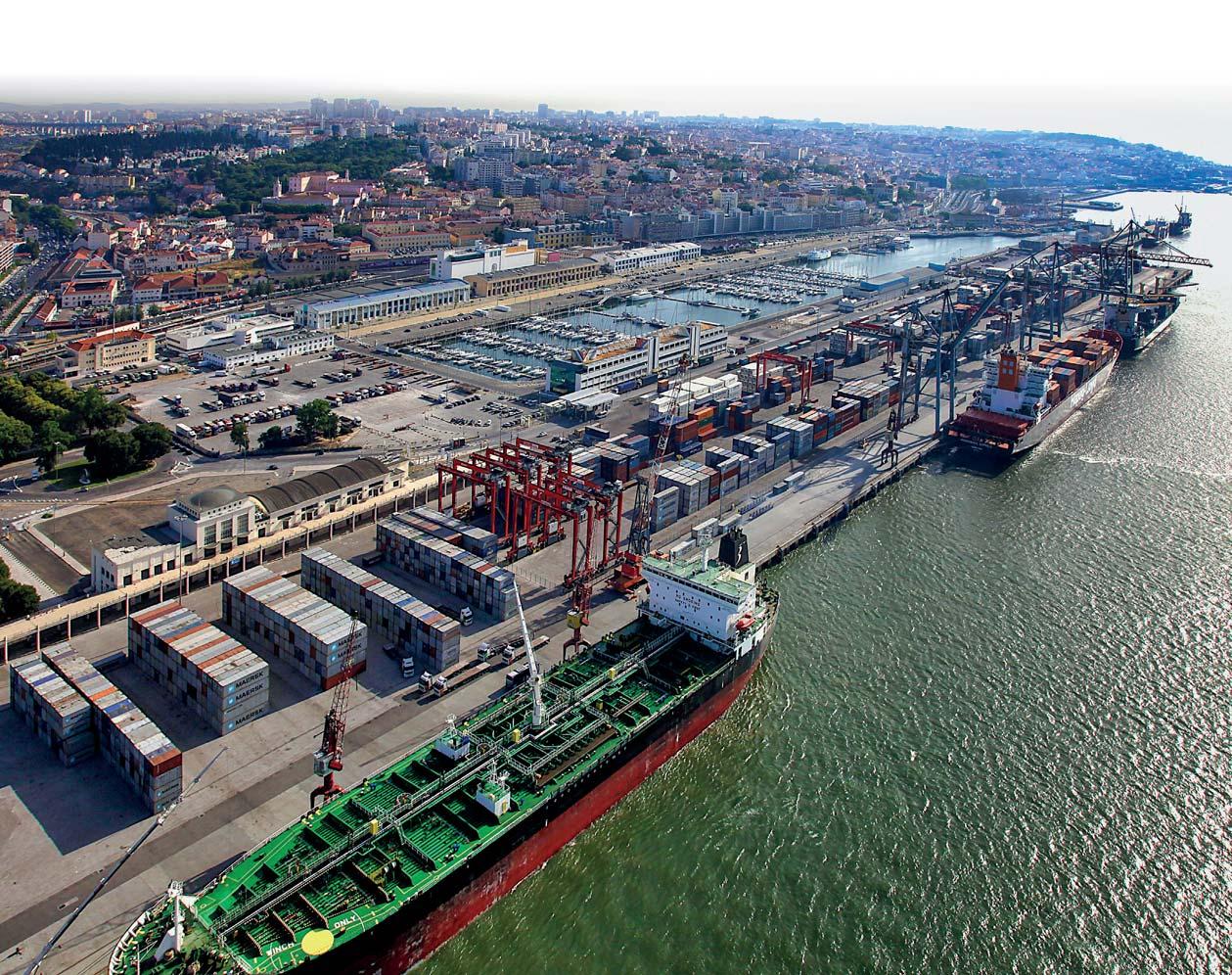
Host Port:
Sponsored by:
2023 Conference Sessions includes:
reduction & adaptation
Waste Management and Circular Economy



Infrastructure Development
Digitalization and Technology
Supported by:
Meet and network with over 200 attendees representing port authorities, terminal operators and shipping lines. For more information on attending, sponsoring or speaking, contact the events team: visit: greenport.com/congress

tel: +44 1329 825 335

email: congress@greenport.com
Media Partners:
#GPCongress
PORT
INSIGHT FOR PORT EXECUTIVES GREENPORT INSIGHT FOR PORT EXECUTIVES
STRATEGY
FUEL CELL PROJECTS MATURING FAST
Fuel cells promise zero emission power, and the progress made by the many projects underway is bringing larger-scale adoption closer.
HAV Hydrogen says it has been inundated with requests from shipowners since the launch of its containerized, deck-based hydrogen system. It’s an indication of the progress that has been made with fuel cell technology as the many projects underway begin to gain traction in the market.
The systems integrator announced DNV Approval in Principle (AiP) for its containerised system in March. The Zero Emission Pod is based on a 20-foot container that contains hydrogen fuel cells and supporting equipment such as ventilation, cooling, safety and control systems, DC/DC drives and fuel distribution system. By using 200kW hydrogen fuel cells, the system is flexible and can easily provide 1MW within the footprint of a standard 20 container.
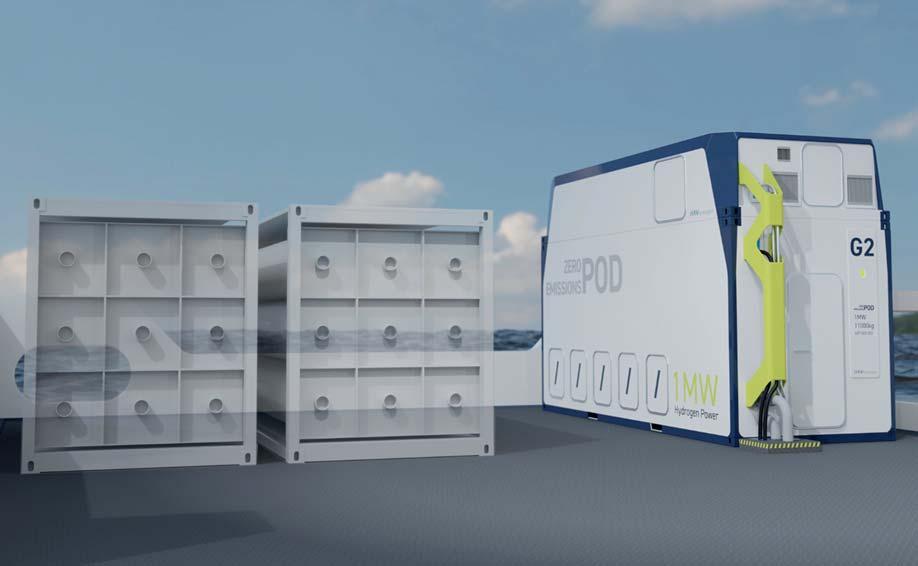
More containerisation to come
The HyEkoTank project partners, including TECO 2030 and Shell, are also developing a solution in a 40ft container, including a 2.4 MW fuel cell system, hydrogen fuel gas conditioning, air filtration systems, power converters, battery storage and automation system. It will also include a containerised, 350 bar, compressed hydrogen storage system with a 4,000kg capacity so that vessels can be refuelled by swapping containers.
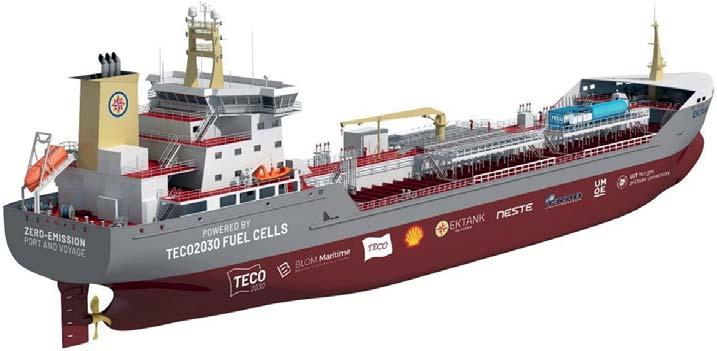
In April, Navalprogetti obtained AiP from Lloyd’s Register for a containerised hydrogen storage system for use with a fuel cell system that will be used to power propulsion and hotel loads on new Viking Cruises’ ships. The development is part of the four-year sHYpS project, and the swappable hydrogen storage container system will be based on 45-foot ISO c-type containers. The containers will be swappable, and the project is examining scale-up of storage capacity and supply in the Port of Bergen. It will also develop the concept of fuel tank by adding a connection space for an evaporator.
A first for liquid hydrogen
The DNV-classed MF Hydra, a ferry delivered in March to the Norwegian Public Roads Administration, became the world’s first vessel sailing on liquid hydrogen this year. The fuel cell system was developed as part of the FreeCO2ast project; Ballard developed the fuel cells, and SEAM acted as system integrator.
The current lack of prescriptive regulations means that companies wishing to launch hydrogen systems need to follow the IMO guidelines on alternative design (MSC.1/Circ.1455). “It was a lighthouse project where we had the first application of liquid hydrogen,” says Benjamin Scholz, gas expert at DNV. “Fulfilling alternative design requirements is an intensive process. It was important that we cooperated within and beyond DNV, and of course we worked to address
the questions the flag authorities needed answered to sign the final certificates for the vessel.”
More Norwegian ferries
SEAM is system integrator for Torghatten Nord’s project for two hydrogen ferries, designed by The Norwegian Ship Design Company to operate on Norway’s longest state ferry connection, highway 80 across Vestfjorden, from 2025. While electric ferries are becoming increasingly common, batteryelectric propulsion is not viable for longer routes like the one between Bodø and Lofoten.
Torghatten's hydrogen ferries received approval in principle from Lloyd’s Register in August 2022, and the owner has specified that they must run on a minimum of 85% hydrogen and a maximum of 15% biofuel over long and demanding distances of up to four hours.
SEAM will deliver an in-house developed control and safety system, as well as the entire powertrain including fuel cell, batteries, switchboards, and electric motors. The fuel cells will be supplied by PowerCell, with the company’s Marine System 200 providing the two ferries with 6.5MW power each, the largest for a Norwegian ferry to date. Multiple 200kW Marine System 200s will be
FUEL CELLS AND HYDROGEN 44 | MAY 2023 For the latest news and analysis go to www.motorship.com
■ HyEkoTank project source Teco 2030
■ HAV Hydrogen containerised system
vastly supersedes any previously built application in maritime history,” says Johan Burgren, Business Manager at PowerCell. The 32 fuel cell units for each ferry are going to be clustered into groups, to provide redundancy, and will work together on a direct current DC switchboard.
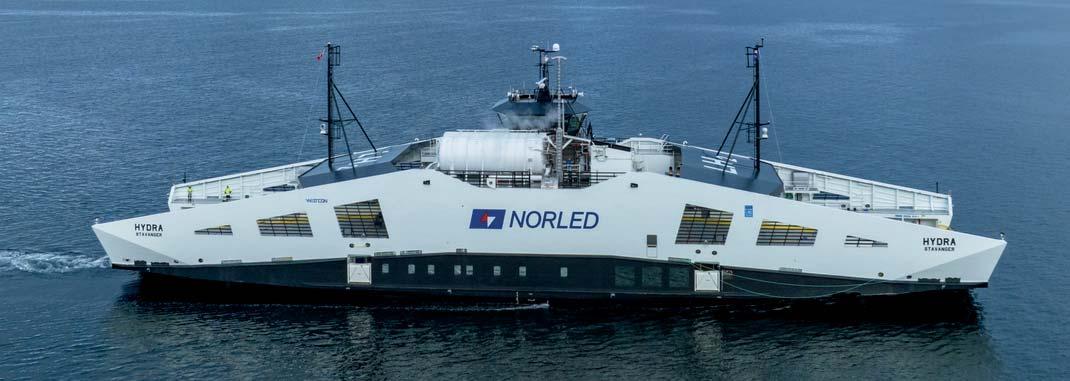
The main fuel line coming from the storage system will be split within the clusters until the inlet is only a few millimetres thick on entering each unit. There’s a safety benefit to the clustering as well as a financial one, says Burgren. Spaces requiring ventilation will be smaller, including purge lines, and it avoids bunching issues that arise if there are too many cables going into a compartment.
PowerCell claims the highest power density in the marine market thanks to it having developed the core technology for on-road and aviation applications. Additionally, reforming is part of the company’s heritage, says Burgren, and it is involved in projects where the hydrogen is reformed from other feedstocks. Projects include providing fuel cells to the Hydrogen One, the world’s first methanol-fuelled towboat being developed by Maritime Partners using e1 Marine's methanol-to-hydrogen reformer technology. Other project participants include naval architecture firm Elliott Bay Design Group as well as ABB, who will supply electrical power distribution and automation systems. The first-of-its-kind towboat is set to hit the water in 2023. PowerCell has also received an order from Amogy for a workboat that will have an ammonia-to-power generator.
Burgren is positive about the operational benefits of fuel cells. “From a service perspective, you can stop the fuel cell system and service it; you can replace parts, and then you can get it going again without stopping the other units. And you don't have to go to dry dock to handle very heavy units. This contrasts with rotary machinery, such as large 2-stroke engines that have to be built into the vessel. We can bring things in and out of our fuel cell systems and maintain the system continuously.”
PowerCell is scaling up to support larger power systems. “We are close to having more powerful single units ready, but right as we speak, we think that we will reach pretty far with 200kW increments, covering the short sea market very well, up to let's say, 9-10MW,” says Burgren. The company plans to support power systems for main propulsion and deep-sea shipping in the future.
“Owners need zero-emissions
technology as the next-build solution for their fleets, and cannot wait until the next generation of ships to adopt the zero-carbon technologies of the future. Hydrogen electric fuel cell solutions are playing a key role in the maritime industry to deliver immediate, true sustainability for owners in the green transition.”
More to come
More fuel cells are coming to market. HELION Hydrogen Power received Approval in Principle from Bureau Veritas for its FC-RACKTM Marine version, a zero-emission hydrogen powered electric generator dedicated to maritime applications. Marinization involved a double envelope enclosure to seal the system and a thermal management system, dedicated on-board control system and a hydrogen safety system that enables the FC-RACK Marine to be installed inside or on the deck of the vessel. The HELION system will be operational by the end of 2023 supplying a 200kW hydrogen generator integrated in a 15-foot container to a dredger built by Piriou shipyard.
Guillaume Daniel, Engineer, Regulatory Development at Bureau Veritas (BV) Marine & shore, says the partnership with Helion has supported the development of the BV’s rules.
“At BV, all our Rules are developed and updated regularly in constant dialogue with the industry to ensure that they reflect technology evolution and the realities on
He notes that BV’s rules for fuel cells (NR 547) cover safety equipment such as fireghting systems and the use of specific electric equipment in hazardous areas. For example, the space around the fuel cell must either be ventilated or made inert. Additionally, NR 547 is to be used jointly with others that address the specific safety requirements for alternative fuels.
■ Guillaume Daniel, Engineer, Regulatory Development at Bureau Veritas (BV) Marine & Offshore
FUEL CELLS AND HYDROGEN
■ The DNVclassed MF Hydra
‘‘
Owners need zeroemissions technology as the next-build solution for their fleets
For the latest news and analysis go to www.motorship.com MAY 2023 | 45
Johan Burgren, Business Manager at PowerCell
For the next few years, risk assessment must remain at the core of the process leading to the installation of fuel cells on board ships, he says. “We recognise that fuel cell technology is evolving quickly, and as such classification rules need to be kept up to date. In addition to monitoring regulatory discussions at the IMO, close collaboration with industry stakeholders will be essential to achieve this. By working together and sharing knowledge and experience from early projects, we can help advance solutions that will help different companies progress in their decarbonisation journeys, while also supporting shipping’s energy transition as a whole.”
Starting small
Madadh MacLaine, Secretary General at Zero Emissions Ship Technology Association (ZESTAs), says experience on smaller vessels is a good way to develop technologies suitable for deepsea sailing. Energy storage systems (ESS), hydrogen fuel cells, and wind technology can all be combined to deliver on zero emissions goals. Working together, they reduce costs and increase efficiencies throughout the system, creating a virtuous circle of complementary energy efficiencies.
The Zero Emissions Ship Technology Association (ZESTAs) exists to accelerate the large-scale uptake of zero emissions ship technology. For the 30+ members of ZESTAs, zero emissions mean zero greenhouse gas emissions at point of use on the vessel, with minimal upstream impact. It means true zero, not net-zero.
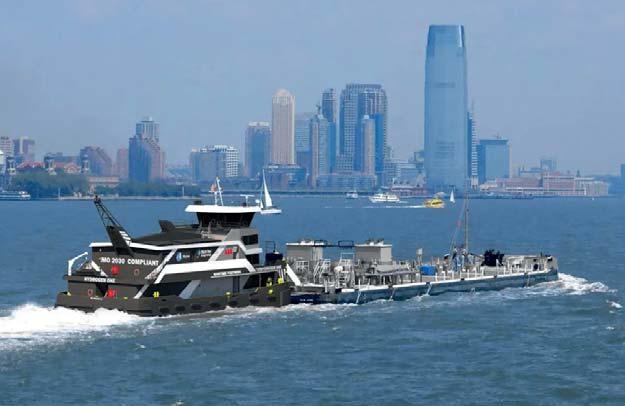
Green hydrogen, used in energy-efficient hydrogen fuel cells, can act as a range extender when there is not enough wind, or if the ESS has been depleted. Marine batteries complement hydrogen fuel cells and wind propulsion to deliver maximum efficiency in zero emissions propulsion. They deliver instant power up to multiple MWh and have the greatest energy efficiency of any fuel or energy storage system.
Combined with electric drives, these technologies enable zero emissions and optimised manoeuvring in port. As there are minimal moving parts, vibration and sound, both onboard and projecting out into the marine ecosystems, are drastically reduced.
“By combining these zero emission technologies, we can achieve true zero faster, particularly on smaller, return to base vessels,” says MacLaine. These vessels under 5,000 GT represent 15% of international shipping emissions, according to the IMO’s 4th GHG Study. ZESTAs believes the IMO and EU must include 4005,000 GT vessels in environmental legislation (i.e. IMO DCS and CII, EU MRV and ETS etc) to create immediate impact.
“Excluding them is a wasted opportunity, and lack of policy is a key barrier to action. By tackling this 15% of GHG emissions, we can make significant progress on the harder-to-abate 85% within this decade,” she says. “Smaller vessels serve as the ideal test bed to circumvent the chicken and egg situation that is hindering development for hydrogen and

efficiency technology providers: currently, hydrogen production is held up by a lack of demand, despite significant potential up-taker markets, and efficiency technology providers need cash flow to invest in R&D and explore upscaling for larger vessels.
“We only have seven years to 2030, and to keep shipping in line with 1.5ºC of warming. This 15% is a window of opportunity where we can we reduce emissions right now. The technology is ready today for smaller vessels. It makes most sense to start here and scale up for larger, deep-sea vessels. By excluding the smaller vessels from policy, we are effectively stopping ourselves from starting.”
In Hydrogen Forecast to 2050, DNV predicts that the uptake of hydrogen will differ significantly by region, heavily influenced by policy. Europe is the forerunner with hydrogen set to take 11% of the energy mix by 2050, as enabling policies both kickstart the scaling of hydrogen production and stimulate end-use.
Olaf Drews, Head of Machinery Systems and Marine Products, is often asked whether or not fuel cells will be used to power deepsea vessels. “It will come,” he says. Projects are being discussed, and DNV is already working on multiple fuel cell projects involving different vessel and fuel cell types, including design concepts up to 10MW and one for a container feeder vessel.
For now, PEM fuel cell technology is benefiting from the development work undertaken in the automotive industry, but the ultimate choice between PEM and SOFC for shipowners will often be driven by fuel choice considerations. “For LNG and methanol, we already have an interim guideline and the IGF code available. So it's sometimes quite an obvious choice if one of those fuels is already onboard or is easier to implement than hydrogen. However, some shipowners are more focused on hydrogen as a future fuel. There’s no single best solution.”
FUEL CELLS
46 | MAY 2023 For the latest news and analysis go to www.motorship.com
■ Madadh MacLaine, Secretary General at Zero Emissions Ship Technology Association (ZESTAs)
AND HYDROGEN
■ HydrogenOne source Maritime Partners
Powering shipping’s emissions-cutting ambitions
Learn from C-suite keynote panel
Keynote panel topic: The cost of decarbonisation & who is going to pay?

Some of the topics you can expect to discuss with the keynote panel will include carbon levy funding, funding for investment, national incentives, funding for new technology & hypothecation.
Book your place now and save 20%
Secure your place at the 44th Propulsion & Future Fuels Conference, the leading technical conference that provides:

A meeting space for the latest innovation in transoceanic zero-carbon shipping Technical solutions for decarbonising the shipping sector of 5,100 ships Multiple networking opportunities.



Sponsored by:




Supported by:

Propulsion stream | Alternative fuels stream | Technical visit





Meet and network with 200 CEOs and technical directors from ship owning, operating and management policy makers, shipbuilding, fuel, equipment and technology suppliers. Visit: motorship.com/PFFBOOK

Contact: +44 1329 825335

Email: conferences@propulsionconference.com


THE Media partner:
MOTORSHIP
Media supporters:
TH 23 TO NOV
21
44
3
Hamburg Germany
#MotorshipPFF
Silver sponsors
MARINE TECHNOLOGY
MODERATOR
Lars Robert Pedersen, Deputy Secretary General, BIMCO
Ricardo Batista, European Commission
Simon Bennett, Deputy Secretary General, International Chamber of Shipping
Martin Kröger, CEO, German Shipowners’ Association (VDR)
Wolfram Guntermann, Director Regulatory Lloyd AG
Markus Münz, Managing Director, VDMA Large Engines
Provisional Conference Programme
Empire Riverside Hotel, Hamburg
Powering shipping’s emissions-cutting ambitions
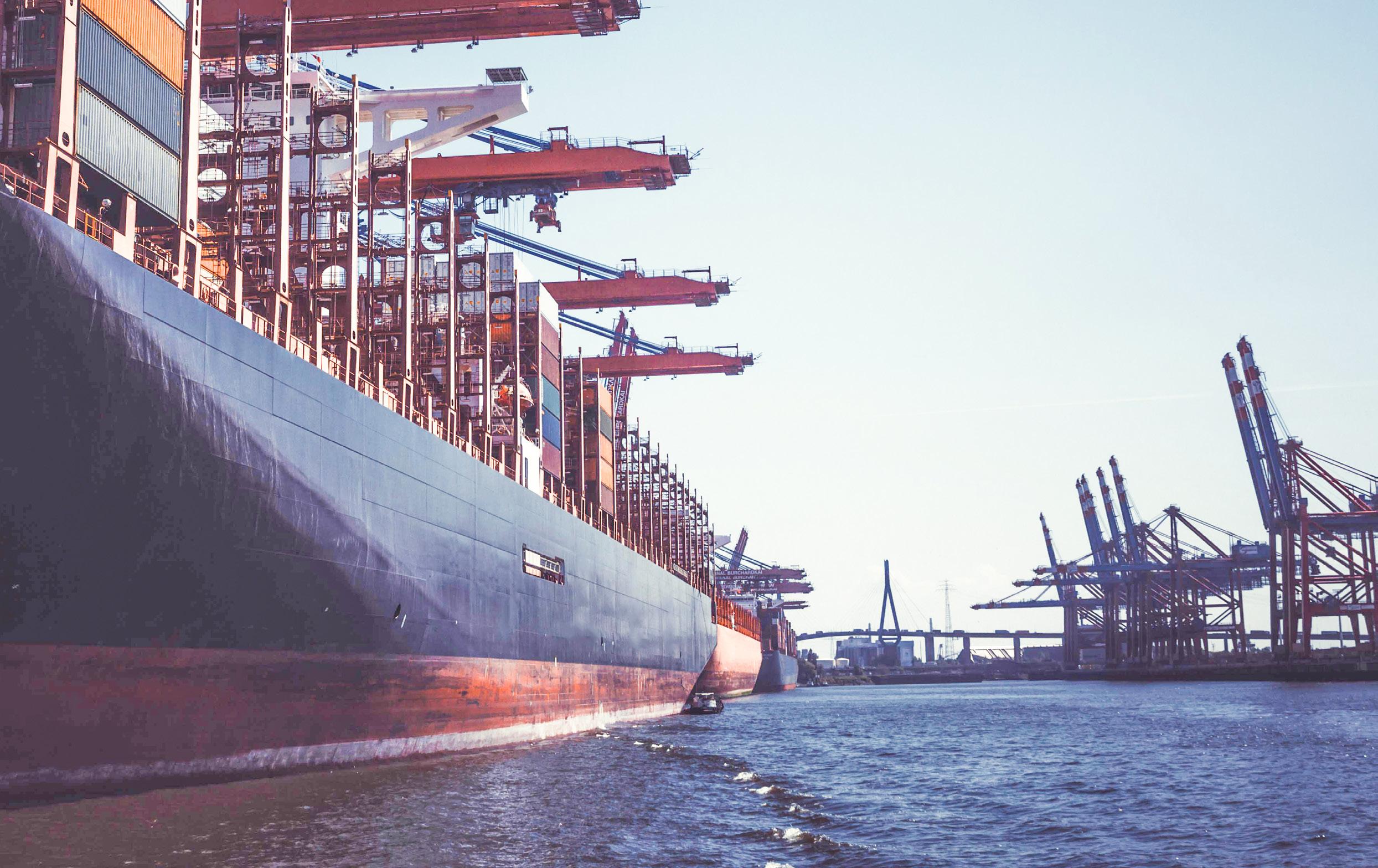
Propulsion stream | Alternative fuels stream | Technical visit




Two days of conference streams commencing with a keynote panel focused on the cost of financing decarbonisation and who is going to pay, followed by sessions that will explore the Fuels for 2030, Safety challenges with new technology and the shortlisted nominations for the Motorship Awards. Within the streamed sessions on day 2 you can expect to learn about the specific challenges with LNG / bio methane, ammonia, methanol, liquefied hydrogen, retrofit solutions, advances in lubrications, and carbon capture.
Chairmen: Lars Robert Pedersen, Deputy Secretary General, BIMCO
Silver sponsors

Sponsored by:



Supported by:

visit: propulsionconference.com

contact: +44 1329 825335

email: conferences@propulsionconference.com
THE Media partner: Media supporters:
#MotorshipPFF 23 TO NOV 202
21 Hamburg
2023 44TH
SHIP
TECHNOLOGY
3
Germany
MOTOR
MARINE
DAY ONE - TUESDAY 21 NOVEMBER 2023
08:00 Coffee & Registration
09:00 Chairmen’s welcome
Lars Robert Pedersen, Deputy Secretary General, BIMCO
KEYNOTE PANEL: THE COST OF DECARBONISATION & WHO IS GOING TO PAY?
Moderator: Lars Robert Pedersen, Deputy Secretary General, BIMCO
Ricardo Batista, Policy Officer, European Commission
Martin Kröger, CEO, VDR (German Shipowners’ Association)
Markus Münz, Managing Director, VDMA Large Engines
Simon Bennett, Deputy Secretary General, International Chamber of Shipping
Wolfram Guntermann, Director Regulatory Affairs, Hapag-Lloyd AG
10:30-10:50 Tea and Coffee break
SESSION 1 THE SOLUTIONS FOR 2030
Moderator: Sebastian Ebbing, Technical Advisor, German Shipowners’ Association
Reaching 2030: the continuous marathon of change – regulatory, technological and financial challenges.
Antony Vourdachas, Principal Engineer, Global Sustainability, ABS
Whether it is the IMO CII, EU ETS or FuelEU, Ship Operators are facing major challenges adapting to the new regulatory landscape. Multiple ship types and operational profiles require different approaches to reaching the mid-term 2030 goals and one solution does not fit all.
Taking efficiency to the next level for large cargo vessels
Oskar Levander, SVP Business Development, Business Development, Kongsberg Maritime Finland
ABB – A radically efficient propulsion system optimized for future
11:50-12:10 Q&A
12:10-13:40 Lunch & Networking
SESSION 2: SAFETY CHALLENGES FOR NEW TECHNOLOGY
Moderator: Lars Robert Pedersen, Deputy Secretary General, BIMCO
Optimizing the lubricant supply towards 2030
Serge Dal Farra, Global Marketing Manager, Total Lubmarine
The operation challenges that ship operators face grow daily with increasing scrutiny on decarbonization efforts. How engines are lubricated is a critical piece of this puzzle. We are actively developing new ways to make our customers’ lives easier. We are doing this by using the benefits of better ship connectivity, using quality operational and performance data, improving engine monitoring and lubrication planning, and using digital ordering to maximize uptime and delivery efficiencies.
New Technology & Safety
Brent Perry, CEO, Shift Clean Energy
Using a pay-as-you-go subscription model for electrification, swappable batteries create a viable solution for maritime decarbonization. With a commercial subscription model, customers pay for energy used per trip, eliminating typical barriers of electrification such as capex, charging infrastructure, and battery maintenance.
Exploring the integration challenges in the maritime
Gisle Anderssen, VP Sales and Marketing, Vard Electro
Integrating power systems with alternative fuels to achieve optimal energy efficiency for sustainable operations.
14:40-15:00 Q&A
15:00-15:30 Coffee break
Book online at motorship.com/PFFBOOK or fax form to +44 1329 550192 For further information please call +44 1329 825335 or email conferences@propulsionconference.com Book online at motorship.com/PFFBOOK or fax form to +44 1329 550192
OY
SESSION 3: THE MOTORSHIP AWARDS
Projects to be released closer to the conference - watch this space.
17:00 Conference close
17:00 Pre Dinner Drinks Reception
18:30 Conference Dinner
DAY TWO - Wednesday 22 November 2023
08:30 Coffee & Registration
09:00-09:15 Recap of day 1 by Chairmen
Lars Robert Pedersen, Deputy Secretary General, BIMCO
SESSION 4: PANEL DISCUSSION: LNG BEYOND TRANSITION
Moderator: Lars Robert Pedersen, Deputy Secretary General, BIMCO
New generation of LNG fuelled container vessels: what has been improved and what will come next?
Alexandre Tocatlian, Head of Business Development EMEAI, GTT Other panellist tbc
10:30-10:55 Coffee Break
SESSION 5
10:55
SESSION 5.1 AMMONIA
Moderator:Lars Robert Pedersen, Deputy Secretary General, BIMCO
Ammonia as a Shipping Fuel: Project
AmmoniaMot and research into Four-Stroke Engines in Medium and High-Speed Applications
Alexander Feindt, Global Business Development Manager, Marine (Four-Stroke), MAN Energy Solutions SE
Pathway to Zero Carbon Emissions –Ammonia as Fuel
Dieter Hilmes, Sales Manager, TGE Marine
Ammonia will be one of the most important fuels for driving forward the decarbonisation of shipping. Dieter will highlight the opportunities and challenges that this new maritime fuel will bring.
Bringing ammonia two-stroke engines
to the marine market
Dominik Schneiter, Vice President R&D, WinGD
Enabling sustainable scalable fuel pathways – with a focus on Ammonia
Claus Winter Graugaard, Head of Onboard Vessel Solutions, Mærsk Mc-Kinney
Møller Center for Zero Carbon Shipping
11.55-12.15 Q&A
12:15-13:45 Lunch & Networking
SESSION 5.2 METHANOL
Moderator: Sebastian Ebbing, Technical Advisor, German Shipowners’ Association
Greg Dolan, Chief Executive Officer, Methanol Institute
This session will be looking at the specific challenges with methanol. You can expect to learn about methanol and its emmision reduction effects.
11.55-12.15 Q&A
Book online at motorship.com/PFFBOOK or fax form to +44 1329 550192 For further information please call +44 1329 825335 or email conferences@propulsionconference.com Book online at motorship.com/PFFBOOK or fax form to +44 1329 550192
SESSION
6
13:45-15.05
SESSION 6.1 LIQUIFIED HYDROGEN
Moderator:Lars Robert Pedersen, Deputy Secretary General, BIMCO
New Rules – Handling Liquid
Hydrogen Safely
Rolf Stiefel, Country Chief Executive, Bureau Veritas Marine & Offshore for Central Europe
Hydrogen is both explosive and highly flammable, and it is vital that the right safeguards are in place to ensure its safe storage and use on board. New BV Rules on hydrogen will provide the industry with guidelines that keep seafarers and vessels safe.
15:05-15:35 Coffee Break
SESSION 7
15:35-16.55
SESSION 7.1 RETROFIT
Moderator:Lars Robert Pedersen, Deputy Secretary General, BIMCO
Achieving EEXI and CII compliance with energy efficiency technologies:
Alessandro Castagna, Sales Manager / Naval Architect, Sales Department, Becker Marine Systems GmbH
The installation of propulsion improving energy efficiency devices (ESD) is proven to be one of the most suitable solutions
in terms of cost and efficiency gain. ESDs like the Becker Mewis Duct® and Becker
Twisted Fin® have a direct impact on the calculation of the EEXI (increase of Vref) and CII (reduction of fuel consumption and consequently CO2 emissions), improving the rating and helping shipping companies to reach compliance and to stay operationally competitive
SESSION 6.2 CARBON CAPTURE
Moderator: Sebastian Ebbing, Technical Advisor, German Shipowners’ Association
Will Pre-Combustion Carbon Capture
Systems Applied to LNG Carriers and Containerships be an Option
to Reduce CO2 emissions?
René Sejer Laursen, Director, Fuels & Technology, ABS
14.45-15.05
SESSION 7.2 ADVANCES IN LUBRICATION
Moderator: Sebastian Ebbing, Technical Advisor, German Shipowners’ Association
Lubricating the decarbonisation transition
Cassandra Higham, Marketing Director, Castrol Global Marine & Energy
The emerging expanded fuel mix poses new opportunities and risks, meaning the role of lubricants and lubricant providers within this sustainability-driven market is evolving. Castrol supports customers in smoothly navigating the ever-changing market with digital and human technical expertise.
Advancements in cylinder lubrication
for two stroke engines
Nikolaj Kristensen, Head of R&D, Hans Jensen Lubricators
Advancements in cylinder liner lubrication technology have led to the development of spray lubrication systems, which offer increased flexibility as a means for reducing consumption, improving engine durability, and preparing for green fuels.
Book online at motorship.com/PFFBOOK or fax form to +44 1329 550192 For further information please call +44 1329 825335 or email conferences@propulsionconference.com Book online at motorship.com/PFFBOOK or fax form to +44 1329 550192
Q&A
SESSION 7 (cont)
SESSION 7.1 RETROFIT
Moderator:Lars Robert Pedersen, Deputy Secretary General, BIMCO
Containerized marine fuel cell system
Sami Kanerva, Global Product Manager, Fuel Cells Marine Systems
Containerized marine fuel cell system comprises type approved fuel cell modules, internal piping, required auxiliaries and safety systems. Designed for above-deck installation, it provides a feasible solution to decrease the carbon intensity of existing vessels under stringent emission control requirements.
SESSION 7.2 ADVANCES IN LUBRICATION
Moderator: Sebastian Ebbing, Technical Advisor, German Shipowners’ Association
Sterntubeless vessels with water lubricated bearings – a novel promising design concept
Chris Leontopoulos, Director, Global Ship Systems Center, ABS
ABS granted “Approval In Principle” to the Shanghai Merchant Ship Design and Research Institute, SDARI, for a revolutionary vessel design that negates the risk of pollution from oil-lubricated bearing seals and promotes efficient vessel operations. The design, also developed in cooperation with Thordon Bearings, Canada, and the National Technical University of Athens, involves elimination of the sterntube, utilizing seawater for bearing lubrication, and creating an aft chamber to permit in-water maintenance, thus eliminating the need for drydocking or shaft line removal to replace the bearing and/or the seal. This promises significant efficiencies and substantial cost savings for most vessel types.
Assessing Lubrication environmental footprint
Lubmarine Market Liaison & Product Manager, Stuart Fuller
With shipping’s decarbonization journey well under way, Lubmarine Market Liaison & Product Manager, Stuart Fuller, shares key insights on the multiple approaches to reduce fuel consumption on 4S engines. As levels of activity increasingly focus on sustainable operations, the environmental impact of onboard lubrication is also a critical part of how operators transition to a cleaner future today and tomorrow.
16:55-17:10 Conference Wrap up with Moderators and Chairmen
Lars Robert Pedersen, Deputy Secretary General, BIMCO
Sebastian Ebbing, Technical Advisor, German Shipowners’ Association
17:10 Conference Close
DAY THREE - THURSDAY 23
Book online at motorship.com/PFFBOOK or fax form to +44 1329 550192 For further information please call +44 1329 825335 or email conferences@propulsionconference.com Book online at motorship.com/PFFBOOK or fax form to +44 1329 550192
NOVEMBER 2023
- TECHNICAL VISIT
16.35-16.55 Q&A
16.35-16.55 Q&A
For further information please call +44 1329 825335 or email conferences@propulsionconference.com
Conference Fee
Cost per delegate Premium rate: €2475/ £2,100
Premium fee includes:
• Conference Attendance with lunch and refreshments on both days
Full documentation in electronic format
Place at drinks reception (21 November)
• Place at conference dinner (21 November)
• Place at technical visit (23 November)
Cost per delegate Standard rate: €2,380/ £2,000
• Group booking discounts available
Special rate available for recognised educational establishments & ship operators
Please contact us for details
Booking Online propulsionconference.com or complete and fax the booking form below to +44 1329 550192. On receipt of your registration, you will be sent
BOOKING FORM
Contact Us
For further information on exhibiting, sponsoring, or attending the conference, contact the Events team on: +44 1329 825335 or conferences@propulsionconference.com
Venue
Empire Riverside Hotel Hamburg, Bernhard-Nocht-Straße 97, 20359 Hamburg, Germany Visit propulsionconference.com
2023 44TH 23 TO NOV 202 3 21 Hamburg Germany
BOOK ONLINE OR COMPLETE THIS FORM AND FAX TO +44 1329 550192
(Please copy this form for additional delegates)
Please tick all that apply :
Please register me for the Propulsion and Future Fuels Conference 2023 . I will attend the following:
Conference Dinner (21st November 2023 ) - No additional cost
Technical Visit (23 November 2023) - No additional cost Members of supporting associations will receive up to 50% off your delegate booking.
I am a member of
Family Name First Name Title Mr/Mrs/Ms/Dr/Other
HOW TO PAY *UK registered companies will be charged the standard rate UK VAT
Bank Transfer: Mercator Media Ltd, HSBC Bank plc, EURaccount, Sort Code: 40-12-76, Account number: 70235247
SWIFT/BIC8: HBUKGB4B BRANCH BIC11: HBUKGB41CM1 IBAN: GB35HBUK40127670235247
Prepayment is required in full for entry to the conference. Full terms & conditions are available at mercatormedia.com/our-business/terms-and-conditions
Credit/Debit Card: Complete the form with your card details
I have paid by bank transfer
Please fax form. Do not send by email as we cannot guarantee the security of card information.
Please charge my card (delete as appropriate) Mastercard/Visa/Amex
Card Number
Name on Card Expiry Date
Security Code
Credit Card Billing Address
Signature
https://www.mercatormedia.com/terms-conditions-1
Book online at motorship.com/PFFBOOK or
fax form to +44 1329 550192
Company
Country Telephone Fax Email Signature
Company VAT No.
Job Title
Company Address
in England. Company Number 2427909. Mercator Media Ltd reserve the right to alter the timing, content or speeches of this conference at any time. Full terms & conditions are available at
SPACE AT THE CONFERENCE IS LIMITED – RESERVE YOUR PLACE TODAY! Book online at propulsionconference.com or fax booking form to +44 1329 550192 Registered
(3 Numbers on the reverse/ AMEX 4 numbers on front)
Further information call +44 1329 825335 or email conferences@propulsionconference.com. Book online at propulsionconference.com
IS THE SHIPPPING INDUSTRY READY FOR EUROPE’S CAP AND TRADE RULE?
Is the roll out of the carbon cap-and-trade scheme to the sector an important component in the fight to curtail carbon emissions or just another financial hit, Patrik Wheater wonders
Following the formal approval of the EU’s ETS by the European Parliament in April, shipowners are now mandated to submit verified emissions data for all voyages that start or end at an EU port from 2024.
As the European Parliament this week ushered in sweeping reforms to the EU’s emissions trading scheme (EU ETS), shipowners are now mandated to submit verified emissions data for all voyages that start or end at an EU port from 2024. But is the roll out of the carbon cap-and-trade scheme to the sector an important component in the fight to curtail carbon emissions or just another financial hit?
To ensure the accuracy and integrity of a ship’s emissions data, the EU ETS now requires shipowners to submit emissions data at least five days before the deadline for submitting CO2 permits/allowances, with the data verified by an accredited body, such as a Classification Society.
The five-day rule is likely to have a significant impact on shipowners' operations, as it requires operators to gather and verify emissions data in a shorter timeframe than was previously required.
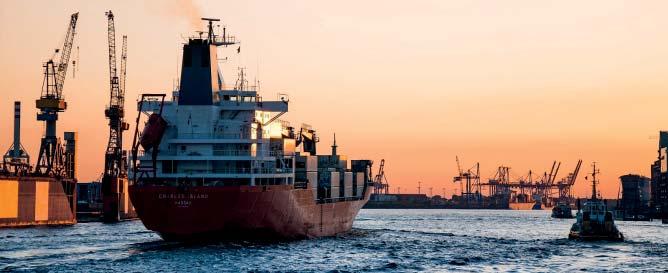
They will also need to budget for the cost of compliance, which may include the purchasing of emissions monitoring equipment and sensors, hiring accredited verifiers, the cost of submitting emissions data, and the cost of buying carbon credits, if required.
Yet, while the exact cost of compliance is going to be dependent on a range of factors, including the size and type of the vessel, the complexity of the emissions monitoring system, and the number of voyages that the vessel undertakes each year, shipowners are concerned.
Speaking under the cloak of anonymity, one major cruise line with operations in Europe, told The Motorship: “Looking at it from a financial perspective we would have thought it would negatively impact the smaller operators and favour larger operators due to the increased administrative burden and financial planning. However, in the shipping sector there appears to be general support for the development of MBMs [market-based measures] as part of the basket of initiatives that allow us to meet our 2050 aspirations. But these would be best done at a global level via the IMO.”
The cruise operator, which currently uses a combination of bunker delivery notes, tank soundings and fuel flow meters to monitor, calculate and reconcile emissions data, says it is investigating direct measurement options.
“The emissions reporting to EU MRV is already in place and verified by Class, but we will be looking into increasing the accuracy of reporting now that there is a financial impact,” said the cruise line.
The owner, which runs a number of LNG fuelled cruiseships and is currently trialling various biofuels, uses a variety of tools, including NAPA software, and solutions developed by Class and in-house, to collect and analyse emissions data. However, despite efforts to reduce CO2 emissions by up to 80%, the company still anticipates having to “purchase EU ETS credits (EUAs) to be compliant, but it’s not clear how many. The cost of compliance is not clear yet, but it could be substantial,” said the shipowner in an email exchange.
Nevertheless, despite the additional OPEX, the cruise line does not believe cost factors will slow the drive towards emissions targets. “In fact, the regulatory drive towards netzero by 2050 is incentivising the development rather than slowing things down,” the company said.
Indeed, the industry-wide adoption of technologies and alternative fuels is indicative in the investments shipowners are already making to lower emissions comply with the ETS regulations. For despite the potential costs and challenges, failure to comply is expected to be much more costly, in terms of fines, vessel downtime and reputational damage.
Classification Society DNV, which announced the introduction of its emissions data verification platform, Emissions Connect, on the same day the European Parliament rubber stamped the reforms, said the EU ETS will expose Document of Compliance holders (typically shipmanagers) “to significant financial risk”, as emission costs will be factored into contracts between stakeholders to ensure fair distribution.
The Society furthered that the Carbon Intensity Indicator (CII) is becoming a factor in charter terms, creating balance sheet risk and impacting shareholder value, access to capital, and commercial attractiveness. “In this context, the collecting, managing, and sharing of accurate and reliable data will be crucial.”
“Reducing emissions and reporting on progress is becoming increasingly important for the maritime industry and is set to have an impact on business that goes beyond regulatory compliance,” said Knut Ørbeck-Nilssen, CEO, DNV Maritime.
“Through providing real-time verified emissions data that the entire maritime value chain can share, trust and act on, Emissions Connect can serve as an important enabler to help the industry achieve its decarbonisation goal,” he said.
The EU ETS is due to be phased in from 2024 and will require shipmanagers to surrender EU Allowances (EUAs) based on the annual level of emissions.
The reforms, extending the EU ETS to the maritime industry for the first time, increases significantly the original ambition of the scheme, as GHG emissions in the ETS sectors must be cut by 62% by 2030 compared to 2005-levels. It also phases out free allowances to companies from 2026 until 2034 and creates a separate new ETS II for fuel for road transport and buildings that will put a price on GHG emissions from these sectors in 2027.
DIGITALISATION 48 | MAY 2023 For the latest news and analysis go to www.motorship.com
■ The European Parliament has approved the extension of the ETS to cover shipping from 2024
A DIGITAL FOUNDATION FOR CII
With simulation and data analysis tools, the technological groundwork has been built to enable shipowners and charterers to succeed in the CII era. And the sooner they start, the better off they will be, writes
Ossi Mettälä, Sales Manager at NAPA Shipping Solutions.
For many in shipping, this year is reminiscent of old school times. The world’s commercial ships have started their first round of examinations under the IMO’s Carbon Intensity Indicator (CII) regulation. While their official ratings won’t be formally calculated until the end of the year, the assessment is already well under way. Since the 1st January, every sea passage, and every unit of carbon emitted, is building towards a vessel’s final score for the year.
Just like for students, this score is intended to shape a ship’s future prospects. While it is still early days, it is expected that CII ratings will influence a ship’s competitiveness moving forward, with pressure from both ends of the logistics chain. On the one hand, cargo owners, consumers and ESG-conscious companies will increase demand for sustainable shipping. On the other, top-rated vessels may receive better freight rates, loan conditions and interest rates, or lower insurance costs.
As a result, poorly rated ships may struggle to secure business and financing, while top-rated vessels are likely to have a competitive advantage. This will become apparent, especially starting in 2024, when the first CII ratings will be assigned for the vessels based on 2023 data.
A collaborative approach to CII
The CII era is shifting some of shipping’s most enduring paradigms. Perhaps most significantly, it demands that we rethink the relationship between owners and charterers.
If we are to make CII a success, owners and charterers need to work together more closely on operational decisions to improve a vessel’s fuel performance and ensure its compliance. This is because responsibilities and incentives are shared: on the one hand, owners oversee any technical improvements made to a ship and will be on the receiving end of a good or bad CII rating. On the other, charterers, for the most part, determine how the vessel is operated.
While much has been said about the contractual elements that will define this new relationship, it’s worth taking a look at the technology and software platforms needed to make this collaboration work in practice.
Simulating the future to improve it
In essence, both parties need a common platform where they can develop a shared understanding of how a vessel’s CII evolves throughout the year, and what can be done to improve or maintain it.
This is where data analysis and simulation tools come in.
Our NAPA CII Simulator module, for instance, uses a ship’s digital twin, together with data on a vessel’s past and current operations and performance and information about planned future voyages, to predict its CII rating for every sea passage and for any desired date, such as the end of the year or after a given chartering period.
Crucially, the software can model the impact of technical and operational measures (including weather routing, slow steaming, or installing energy-efficiency devices) on the vessel’s rating for each voyage, and the overall result at the end of the year. It provides granular insights, even modeling
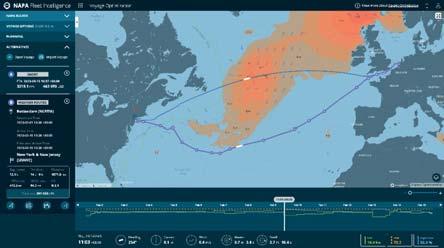
the impact of hull cleaning at different moments in the year, so that these cleaning operations can take place when they will have the desired impact on CII.
This gives owners and charterers a common understanding of whether they are on track to achieve the agreed CII, and helps them make the best possible choices knowing what will achieve optimal outcomes for that specific ship. Data analysis tools can also play a key role to help prevent or resolve disputes under charter party agreements, which will be particularly important when maintaining a certain CII is part of the contract.
The case for a head start
Armed with that knowledge and the confidence that they are on the same page, owners and charterers can take a proactive approach to CII.
In tangible terms, this enables them to act early to correct the course of a vessel that is heading towards a poor CII rating. Early action is preferable, as this means being able to make minor adjustments for a longer period of time, rather than having to take drastic action in the last months of the year, by reducing speed significantly, for example, which would have a bigger impact on the ship’s competitiveness.
Together, owners and charterers can compensate for any unexpected events, including bad weather or a less efficient journey, to bring the vessel’s CII back in line with expectations. They can also identify when they have enough margin to take a hit on CII optimization and seize a business opportunity that will involve a less efficient or faster journey.
With simulation, performance monitoring and voyage optimization, the technological groundwork needed to make CII a success already exists. The next step is to use these tools collaboratively to advance shipping’s decarbonization in harmony with business strategies. More than an exam board, the world is watching.
DIGITALISATION For the latest news and analysis go to www.motorship.com MAY 2023 | 49
■ An illustration of NAPA Voyage Optimization comparing the shortest navigable route with the weather routed voyage.
■ Screenshot of NAPA CII Simulator showing the CII prediction of a bulk carrier
Sustainable. Profitable. Achievable.
At ABS Wavesight™, we’re committed to helping maritime companies achieve profitable and efficient operations while maintaining compliance. As a software company and ABS affiliate, we are acutely aware that striking this balance is among the most pressing challenges the shipping industry faces today.







That is why we are the only maritime software provider with a complete suite of products purpose-built to gain a competitive advantage despite industry challenges and market changes. Nautical Systems covers all aspects of fleet management, including compliance, asset and workforce management. My Digital Fleet provides fleet optimization solutions that range from vessel performance to fuel efficiency. And eLogs simplifies and expedites recordkeeping.
To learn more about ABS Wavesight, visit www.abswavesight.com


Attending Nor-Shipping 2023? Be sure to visit Booth D02-24 to see our software in action.




























THE BRAINS BEHIND YASKAWA ENVIRONMENTAL ENERGY / THE SWITCH’S ULTRA-FAST DC PROTECTION DEVICES
Some 15 years ago, as the marine industry faced increasing challenges with space and costs, people started to recognise that DC power distribution on ships would be more efficient than traditional AC systems. But safety was a big concern, requiring new safeguarding technology to be developed. R&D Manager for Converters
Gullvik and his colleagues at Yaskawa Environmental Energy / The Switch in Trondheim took up the challenge.
The results of their ingenuity are a suite of unique, ultrafast disconnect devices that protect against short-circuit faults. They are specifically designed for the company’s proprietary DC-Hub power distribution drives. The Electronic DC Breaker (EDCB) is designed to handle faults inside a DC-Hub, while the Electronic Bus Link (EBL) handles faults between DC-Hubs. On the battery side, the Electronic Current Limiter (ECL) handles faults toward the battery on the DC-Hub end of the cable, while the Battery Short-Circuit Limiter (BSCL) handles faults emanating from the battery.
Out with fuses, in with EDCB
The team’s early challenge was to create DC systems that were safe for marine use while at the same time reducing their Capex cost. Their solution was the market-leading DCHub, or ‘multidrive’ grid as it was first called, which uses a common DC bus link for effective power distribution. “DC distribution enhances energy efficiency as you avoid the losses associated with AC. But in case of a failure, the conventional circuit breakers and fuses used in AC grids are far too slow to provide the kind of protection and selectivity required in DC. We needed to come up with something else,” says Gullvik.
They came up with the semiconductorbased EDCB, which disconnects the failing drive module from the common DC link within 10 microseconds before a fault can bring the whole system down. “To my knowledge, it’s the fastest protection device on the market and a standard component inside every DC-Hub,” he adds.
Onwards and upwards with the DP3-rated EBL
The next big challenge was figuring out how to deliver protection across linked DC-Hubs in bigger ships. “In 2017, Wärtsilä approached us to solve a safety issue on its propulsion retrofit of a huge subsea construction vessel.
They wanted to connect the vessel’s three DC-Hubs together to achieve greater redundancy and power but were
William
missing vital protection capability,” says Gullvik.
The project was the first time that a series of DC-Hubs had been linked together, plus there was significant time pressure. “Wärtsilä asked us to design something in six months. Our solution was the EBL, which connects the vessel’s DC-Hubs and diesel engines and protects against faults between the DC-Hubs. The EBL splits on-board grids in microseconds, isolating faults and protecting the complete operational system. It was DP3 tested and approved by DNV – and I’m happy to report that we met the deadline.”
ECL and BSCL for battery protection
Large battery banks were the focus of the third challenge. “We were in dialogue with Corvus about the need for faster protection on projects where customers wanted the batteries to be connected directly to the DC-Hub but without a DC/DC voltage converter. The short-circuit current increases in tandem with the number of battery packs, limiting the number of packs you can link together before exceeding design limits. We knew the EBL could handle this, but it wasn’t optimal as it’s a high-intensity DP3 solution,” says Gullvik. Their solution this time was the ECL, which connects the batteries and functions in the same way as the EBL protects The Switch DC-Hubs. And to protect the battery side, they designed the BSCL, which is optimized for the much higher inductance of battery banks that the EBL can’t handle.
“Today, the EBL has competitors, but there’s nothing like the EDCB. We’re the first in the market with such a device. There are similar products to the ECL and BSCL, but they are much more expensive,” Gullvik says.
While he and his team are proud to have helped meet the safety challenges of DC distribution, the protective devices are just a small part of Yaskawa
■ William Gullvik, R&D Manager for Converters
DIGITALISATION 52 | MAY 2023 For the latest news and analysis go to www.motorship.com
Environmental Energy / The Switch’s portfolio. “As well as working on new game-changing concepts for DC systems, we’re also working on expanding the feature sets of our nextgeneration marine drive trains. We have plenty to do,” says Gullvik.
Not tempted by farming
Gullvik grew up on a farm near Mo i Rana in Northern Norway but soon realized agriculture was not for him. “At 18, I had to make a choice between the three fields I did find fascinating – maths and physics, computer science and electrical engineering. I opted for the latter because there seemed to be more career research possibilities.”
He completed his MSc at the Norwegian University of Science and Technology (NTNU) in 2000, then went to work for electrical machine manufacturer SmartMotor until 2003. During that time, he was seconded to what was then Aker Elektro, before its acquisition by Wärtsilä, to help develop new marine drives.
‘An inspiring industry’
"That was my first step into marine. Part of my PhD, which I did between 2003 and 2007 at NTNU, also involved working on an electric ship project. In January 2007, I returned to Wärtsilä with full focus on marine. It was a deliberate choice, and I don’t regret it – it’s been an inspiring industry.” He singles out Roy Nilsen, professor in Electric Drives at NTNU, as a key mentor who encouraged him.
Wärtsilä Drives’ products, R&D and manufacturing were acquired by Yaskawa Environmental Energy / The Switch in 2016, “I’m in my element as our group focuses on drives and the electrical aspect of systems versus Wärtsilä, where the focus was on engines,” Gullvik says. His group numbers seven in Trondheim and three in Lappeenranta. “The guys in Lappeenranta work with me on software. The rest of the guys work with power electronics. We split responsibility with Finland, with cabinets developed in Vaasa and production in Stord. Altogether, we’re six PhDs, so I have to be on the ball!”
Staying ahead of the game
What he loves most about his job is there is still so much to
learn even after 22 years in the business. “Collaborating with skilled colleagues thrashing out new solutions is very motivating,” he says. “Sharing the same Nordic mindset makes communication easy, but there is no resting on our laurels. We haven’t had a huge market so far for our offerings – it’s much more than just products, there’s also the support and service side – but as the rest of the world go greener, we have to be one step ahead on innovation to stay competitive. We’re selling quite a bit, so we must be on the right track.”
As developers, they don’t get out to visit ships regularly, but when they do, Gullvik never fails to be impressed by their sheer size. “That also goes for the deliveries we’ve made to offshore rigs. Knowing that our products are in there somewhere is personally rewarding as it confirms we are contributing to maritime sustainability in a concrete way. Including the Wärtsilä period, I have worked on deliveries to something like 200 vessels. It’s great to see the tangible results of your work – and sometimes a bit scary too!”
‘Typical Norwegians!’
Outside the office, Gullvik has always been into science in general and keeps himself informed. At home, he indulges his inner teenager playing video games with his 11-year-old twin boys. But the family also spends a lot of time in nature. “We live on the edge of Trondheim with easy access to hiking. We’re typical Norwegians!”
Does he hope the twins will follow in his footsteps? “I am an unashamed advocate for engineering, but of course, what they end up doing is their own choice, so there’s no pressure.”
Renewables open new ‘electric avenues’
As for future developments in marine electronics, Gullvik flags up opportunities to develop new types of drives using silicon-carbide semiconductor technology. “Marine battery technology is also moving at a fast pace, and we’ll likely see batteries for higher voltages than 1,000 to 1,200 volts in the near future. There’s also a growing focus on fuel cells and basically everything around using renewable energy sources in new ways. That will require power electronics and drives, which is a huge new market. Connecting all these in a common DC system is the future. The green transition is an exciting time!”
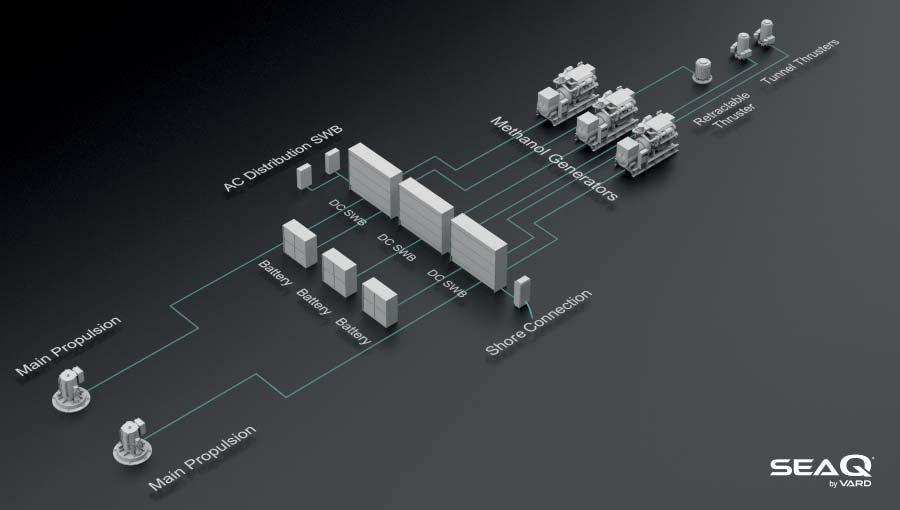
DIGITALISATION For the latest news and analysis go to www.motorship.com MAY 2023 | 53
■ The Switch’s EDCB provides protection on the inside against shortcircuit faults
Source: Yaskawa / The Switch
CHAOS BREWING IN BALLAST WATER
The 15-year interval between the conception and entry into force of the IMO’s Ballast Water Management Convention left abundant opportunity for invasive organisms to do their nasty work, and despite the sector’s reputation for inertia, some shipowners grew tired of waiting. At the time, they were warned that early adopters of ballast water management (BWM) systems would suffer, having to spend more money to replace their ‘stranded assets’ in a few years’ time.
Unfortunately for various shipowners, that appears to be exactly what has happened. From around 120 systems which initially gained IMO G8 Type-Approval, more than half have turned out to be insufficient in US Coastguard (USCG) tests.
“In a couple of cases we have physically taken off a competitor’s system,” said EVP of sales at Norway’s Optimarin, Tore Andersen recently. “This is very costly for the [shipowner] that has to do it.”
A few years ago, the USCG Type-Approval process was thought to guarantee that a ballast water system would work as intended, but experience has shown that to be far from the case. Optimarin’s compatriot, OceanSaver, appeared to have a winning formula with its electrochemical system, until it went bankrupt after a protracted disagreement with a filter supplier.
In fact, those old systems requiring replacement have become a major contributor to Optimarin’s revenues, Andersen explained. “The front runners had bought systems back in 2012 and didn’t have US Coastguard Type Approval because that came later on. They never spent the money on testing, and so it cannot be operated. The options are to buy a new system from the same maker or choose to do something else.”
For Optimarin, which has sold 1500 systems, this is not so much of a setback. Having proven its mettle in various settings and to the most exacting of testing standards, it is now not uncommon for Optimarin to “Retrofit to the retrofit,” something which “gives us a second chance” at market share, said Andersen.
This is vitally important for ballast water OEMs, Andersen explained, because ballast water manufacturers rely on spare parts for their earnings. The system itself remains a lossleader. “The margin is not in selling the system itself, but the revenue is on the spare parts side. For us to be able to compete on newbuildings, it is purely down to price,” he said.
An added challenge is that shipyards with standard specs do not trouble themselves with installing the most advanced ballast water treatment systems if they can help it, but rather the cheapest. This means that a significant number of new vessels are being launched with systems that do not work properly.
“The yard is running
the show, and their purchaser is deciding who is the lowest bidder,” Andersen said. “You need to be on the maker’s list from the owner’s side, and from there it is a matter of who wins the race of price.”
Heading East
In response to this, Optimarin has moved to establish new production capacity in China, in the hope of bringing costs down as well as garnering closer involvement with the shipyards. “The political situation in the world is not super stable for the moment, but we still believe that the Chinese market will continue to be the biggest shipbuilder,” Andersen said.
Optimarin’s system is one of the more successful ultraviolet irradiation (UV) systems, based on using ultraviolet light to sterilise microorganisms in sea water. Manufacturers of UV systems have run into problems of light penetration in water of high turbidity; when a system runs into difficulty with this, it tends to increase power requirements, thereby increasing the energy cost on the ship.
While flow rates of up to around 1000m3/hour are where UV predominates, electro-chlorination (EC) systems are favoured for higher-uptake applications.
“LNG [carriers] need bigger systems where the electrolysers -- Sunrui -dominate,” Andersen explains, referring to the Chinese ballast maker. “We see that electrolysers make up 50% of all systems installed. If we look at how to run this system, for the operator UV is simpler to run. But for the electrolysers you have the advantage that you have always treated the water on the way in, which means if you need to get rid of that water in a hurry, full flow from the pumps, you can do that.”
Flag states, unsatisfied with the efficacy of current ballast water systems, are granting numerous extensions
■ Optimarin’s EVP Sales, Tore Andersen, anticipates a surge of retrofits occurring before October 2024
BWMS 54 | MAY 2023 For the latest news and analysis go to www.motorship.com
■ Bawat’s quayside ballast water system uses Damen Green Solutions’ InvaSave technology
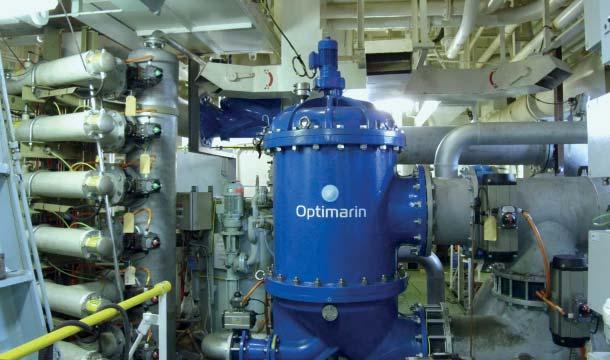
to allow more time for shipowners to install. Although the ballast water bottleneck was supposed to have happened already, this makes it likely that another one will happen at the end of 2024. According to some estimates, around 30,000 vessels have yet to be fitted with a system at all – let alone those which will need a “retrofit of retrofits”.
“What we have seen in the last year, a lot of ships have an extension to the end of 2024,” Andersen said. “We believe there will be some circus at the end, to meet the October deadline.”
The deadline to which Andersen is referring is the IMO D-2 standard implementation, in September 2024. This incorporates stringent guidelines over the permissible number of large and small ‘viable’ organisms in treated ballast water.
The prospects are not good. Compiling information from 828 system tests conducted between 2017 and 2021, not-forprofit members association Global TestNet found that around 20% of BWM systems did not meet the IMO D-2 discharge standard for which they were designed. In over 80% of such cases, more than 10 viable organisms of ≥50μm were found per m3; and in several cases, E-Coli were found.
IMO G8 guidelines specify that a system must operate properly at a Total Suspended Solids (TSS) concentration of over 50ppm, and the more stringent USCG controls specify an-over 24ppm limit. However, in reality, TSS levels can reach over 50 times this limit.
So exasperated are manufacturers over the perceived inadequacy of these tests that they have invented new ones to distinguish themselves. One is the Shanghai Test, for filters. Administered by Control Union at its facility in the Port of Texel, Netherlands, this test uses water with the same TSS concentrations at the Port of Shanghai, where 1000mg/l is not unusual.
The IMO seems to be examining ways to get ahead of this issue too. At the recent Meeting of the Environmental Protection Committee (MEPC) 79, IMO discussed guidance for ships encountering “challenging water quality” in ports.
This included open communication with the port receiving the water to be treated and discharged. Bypassing the ballast water system should only be used as a last resort, MEPC 79 determined, but the industry would have to wait for MEPC 80 in July for further discussion.
Ballast-as-a-service
Quayside ballast water systems provide one possible solution to the problem. In 2023, Bawat Water Technologies and Damen Green Solutions joined forces, subsuming the latter’s InvaSave technology into “InvaSave powered by Bawat”.
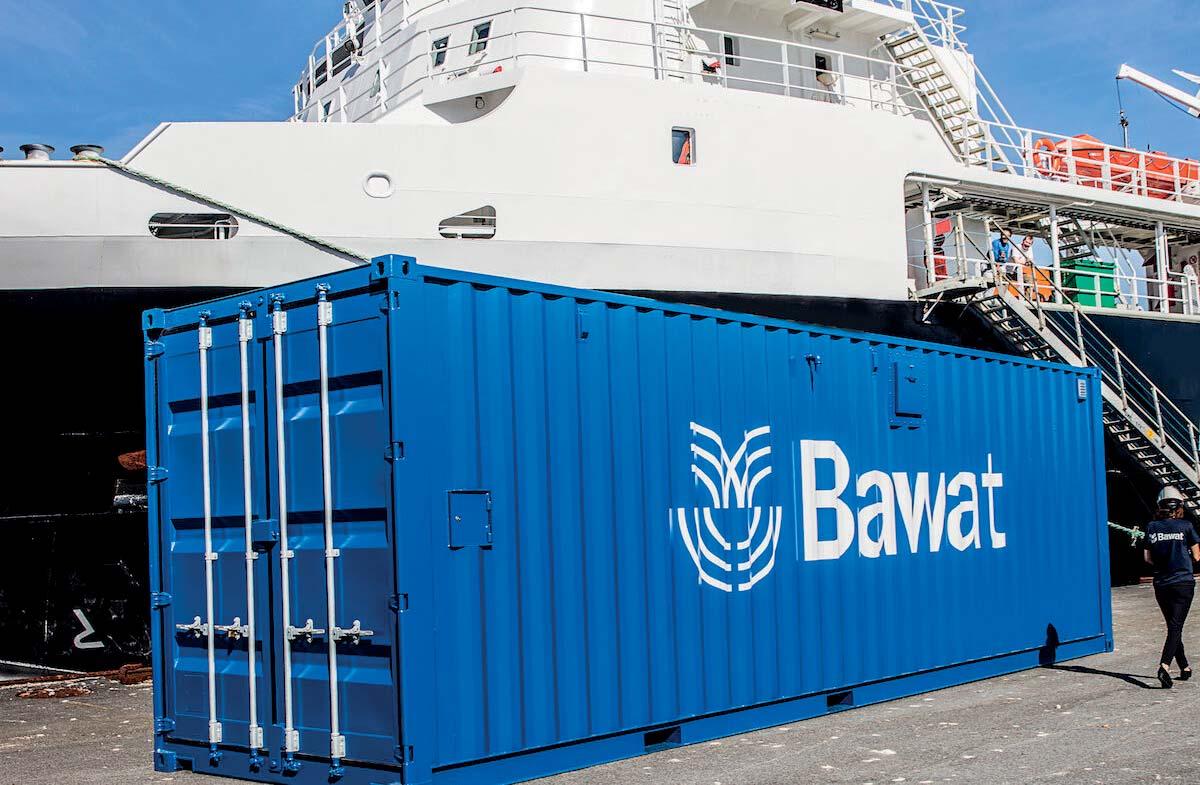
Bawat was a latecomer to the ballast water management field, departing from the usual dichotomy of UV or EC with a system operated using heat exchangers and pasteurisation principles. The setup provided a helpful answer to the question of energy usage, which has become a concern for BWM systems. Instead of demanding yet ever greater amounts of electricity, the system would use heat energy, which can be extracted from exhaust gases and engine jacket water much more efficiently.
■ Andersen notes that the market for BWMS systems shares similarities with the consumer market for disposable razors, with suppliers making a “margin… on the spare parts side.”
BWMS For the latest news and analysis go to www.motorship.com MAY 2023 | 55
Now though, Bawat’s pasteurisation technology has been containerised by Damen and is being used by ballast vessels at berth. Far from expecting business to drop off once every ship is compelled to install a system after 2024, manufacturers of containerised BWM systems seem to be expecting shipowners to prefer their systems and treat their own onboard models as components only to be used if necessary. According to Bawat CEO Marcus Hummer, the system is necessary to address shortcomings in ballast water systems installed on board ships.
“There is a growing interest in Bawat’s mobile ballast water treatment system from ports and harbours ... this is in particular arising from a contingency need for ballast water treatment due to existing faulty on-board BWMS,” he said. “But we are also seeing a business demand from planned ballast water treatment in ports typically for those with multiple vessels that don't need to treat ballast water frequently.”
Bawat’s system arguably lends itself to mobile treatment better than UV or EC, since generation of heat in-situ using a boiler is much more straightforward, and more efficient by orders of magnitude, than generating large amounts of electricity. It does not use a filter, sidestepping the need for the Shanghai Test entirely, and also circumvents the need for other costly-to-replace components such as lamps and electrodes, with only pipes, pumps and heating elements to maintain.
“We see that the mobile solutions for ballast water treatment have generated a lot of interest from ports and operators, primarily for two reasons,” said Rutger van Dam, sales manager Damen Green Solutions, in April. “First, we are approaching the deadline set by the International Maritime
Organization (IMO) to implement a ballast water treatment system by September 2024.
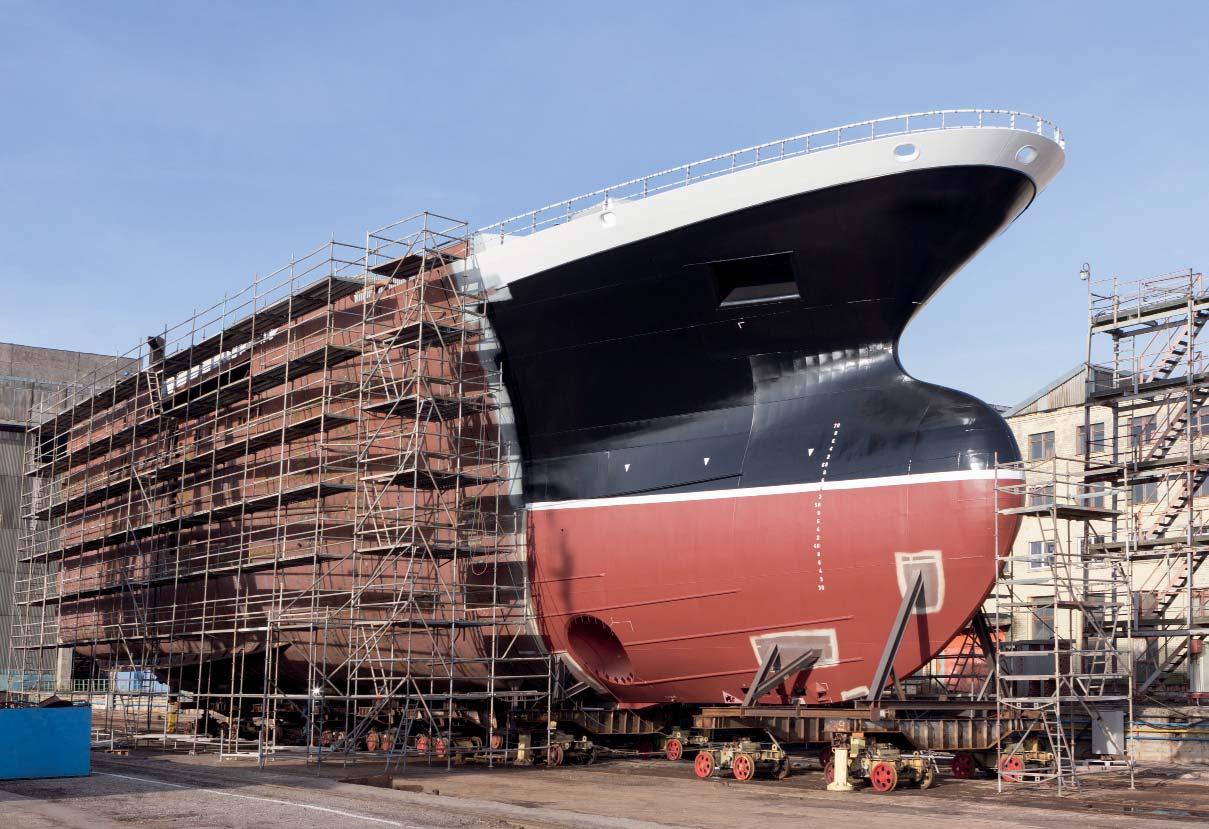
“Secondly many vessels currently have faulty systems on board that need to be replaced before the deadline. Bawat and Damen are ready to provide and offer the greenest highend mobile solution in the market to treat ballast water. With joining forces Damen and Bawat can offer a mobile solution which is suited for all markets worldwide.”
In another recent partnership for Bawat, US ‘ballast-as-aservice’ provider Freedom Ballast has developed a new system based on combining UV with Bawat’s pasteurisation system. In a case report in which Freedom Ballast brought in a containerised Bawat system for third-party work in Louisiana, the former company was similarly scathing about installations on board vessels. “It is evident, based on published reports, that 30-50% of [on-board] systems fall into disrepair and non-compliance that can cause delays and interruptions in the vessel schedule that are costly for the involved parties and will cascade costly effects throughout the related supply chains,” noted Freedom Ballast.
Optimarin’s Tore Andersen believes that once the crush at the end of 2024 becomes evident, even more extensions will be granted, well into 2025. “There is always an extension for these owners who have forgotten to install a system,” he said.
If this is true, it will add to an already interminable period during which little of consequence has been done to stem invasive species. It does not bode well as shipping now squares up to the era-defining question of how to deal with climate change.
■ The IMO D-2 standard implementation will come into effect in September 2024
BWMS 56 | MAY 2023 For the latest news and analysis go to www.motorship.com
JUNE 202 Southampton United Kingdom 14
The all-new 2023 Seawork Conferences will deliver bitesize in-person sessions to help commercial marine and workboat operators face the challenge of reducing operational expenditure at the same time as meeting
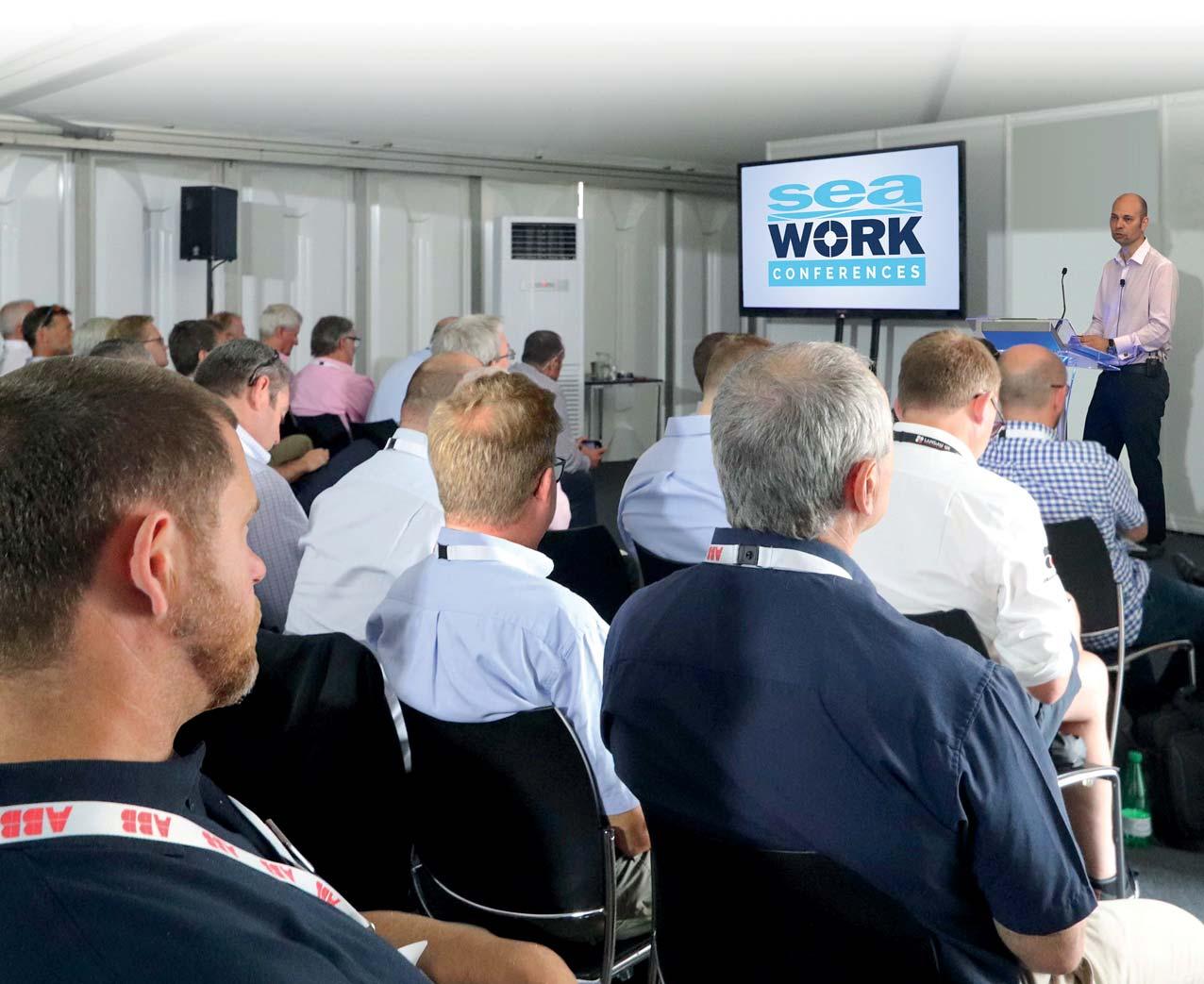
Learn how your business can create cost savings in alternative fuels, hybrid propulsion, technology, and design.
Conference Sessions
Alternative fuels – how operators can make

operator costs
Vessel Design – Optimising
If you are interested in speaking, attending, or sponsoring these sessions please contact the events team on conferences@seawork.com or +44 1329 825335
Book to attend: seawork.com/our-conferences
Media partners:
MARITIMEJOURNAL COMMERCIAL MARINE BUSINESS BOATINGBUSINESS THE UK LEISURE MARINE BUSINESS
#Seawork
TORGHATTEN NORD’S H2 FERRIES MARK SHIPPING’S NEW DAWN
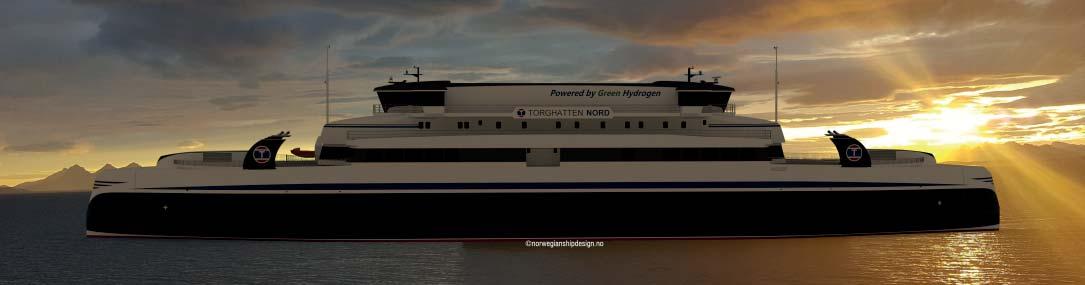
Even though the new H2 ferries The Norwegian Ship Design Company has designed for Torghatten Nord have yet to find a builder and a fuel supplier, their ground-breaking design undoubtedly heralds the dawn of shipping’s zero-emissions era, Patrik Wheater writes.
As a decision on a shipbuilder for the new H2 ferries for Torghatten Nord nears, The Norwegian Ship Design Company claims their ground-breaking design heralds the dawn of shipping’s zero-emissions era.
Scheduled for operation from late 2025 along the Arctic waters of Norway’s Vestfjord, Torghatten Nord’s new 599 passenger, 120 car-carrying double enders will be powered by pair of ultra efficient Marine System 200 hydrogen fuel cell stacks designed to provide 6.4MW of gross power. They will be the largest hydrogen fuel cells put to sea to date.
And while there has been conjecture that a protonexchange membrane (PEM)-type fuel cell may not be equipped to deal with the fluctuating electrical loads demanded of a modern ferry’s power consumers, manufacturer PoweCell says they are the most “dynamic fuel cells on the market”.
Traditionally, a PEM fuel cell is built around a stack of carbon compensates, which can shut down if system pressures drop. “But our stacks behave differently,” Johan Burgren, PowerCell,’s marine business manager, told The Motorship. “We have stainless steel stacks that can achieve high voltage across the pressure spectrum, at very low pressure, but also at high pressure.”
The H2 fuel cells will stabilise at about 1000 volts to provide constant, intermittent, or dynamic power to switchboards, responding to the power demand within seconds, just as a rotary engine would.
“We can go from 20% load to 100% load in seconds, without starving the stack or any degradation effects,” said Burgren. “When we were developing the core technology it was very important that the fuel cells could be installed without the need for a large battery bank or other type of load variation mitigation system.”
For redundancy four stacks will be sited in compartments designed high up in the ship, adjacent to compartments housing auxiliary equipment, such as filtration systems, colling pumps and so on.
“Gaseous hydrogen is very buoyant and quickly disperses
upwards,” explained Gjermund Johannessen, the CEO and Managing Director of The Norwegian Ship Design Company. “All hydrogen installations are therefore arranged in a concentrated area on the uppermost deck, and no hydrogen is fed below deck. This is so any leaked gas will quickly disperse upwards and away from the vessel.”
The hydrogen is stored in ten shipping containers, each with capacity for eleven bottles of gas pressurised at 350 bar. Each container has its own tank connection space with several advanced safety features, including pressure reduction to 10bar, an advanced monitoring and fault detection system, and an emergency shut down system.
As each vessel is expected to operate two daily roundtrips on the 100km crossing, mostly in open ocean north of the polar circle, hydrogen storage capacity is about 5t, with daily bunkering from a dedicated but as yet unknown shoreside facility.
Designed for a service life of about 30,000 running hours, the fuel cell system itself consists of very few moving parts, mainly valves, transmitters, cooling water pumps and an electrically driven cathode compressor that provides pressurised air to the fuel cell stacks.
However, it is the stainless-steel stack – where the actual hydrogen to power conversion takes place – that could prove the costliest component to replace. Burgren estimates it to be around 40% to 50% of the cost of the complete fuel cell system. As such, PowerCell plans to keep a team of engineers onboard to “babysit the system for the first year or two after commissioning”, and to train ships’ crews on how best to operate and maintain the technology.
Aside from the zero-emission capability of a hydrogen fuelled ship, The Norway Ship Design Company has designed the vessel’s hull form for optimal fuel efficiency, with each vessel propelled by two electrically driven azimuth thrusters, one at each end. Norway’s SEAM, as system integrator, will deliver propulsion control and safety systems.
While electric power to propulsion motors and other consumers is intended to be generated by the hydrogen
■ Torghatten Nord’s new 599 passenger, 120 car-carrying double enders will be powered by pair of ultra efficient Marine System 200 hydrogen fuel cell stacks designed to provide 6.4MW of gross power
DESIGN AND PERFORMANCE 58 | MAY 2023 For the latest news and analysis go to www.motorship.com
fuelled fuel cells alone, there is a battery system designed into the powertrain for peak shaving or to deliver power in the event of fuel cell system failure. And should there be any hydrogen availability or battery charging issues, diesel gensets allow for normal vessel operation on 100% biodiesel. This level of redundancy was a pre-requisite specified by the charterer, the Norwegian Public Roads Administration (NPRA).
“These vessels are specially designed for the efficient and comfortable carriage of vehicles and passengers in exposed waters,” said Johannessen. “The ambitious tender for two hydrogen vessels for year-round trade in Vestfjord to the Lofoten Islands led us to design a completely new solution compared to what we know today as ‘ordinary’ ships.
“We evaluated a number of different solutions for the onboard hydrogen system and believe we have come up with a unique and safe concept that takes hydrogen’s properties into account. What we are developing now will set the standard for an entire class of passenger ships powered by hydrogen. Our philosophy is that new technology shall never compromise vessel safety, function and efficiency.”
Safety has been the core focus area of the design, with the general arrangements, system solutions, and equipment selection having been analysed, simulated and verified by fuel safety consultant HyeX Safety.
Unusually for what is ostensibly a Norwegian project, it was UK-based Classification Society Lloyd’s Register that granted the ferry operator approval in principle last August. This was based on a set of comprehensive and constructive HAZID risk assessments.
Michael North, Lloyd’s Register’s Commercial Manager, Norway and Iceland, said it was LR’s experience with vessels already in service that run partly on hydrogen, as well as Egil Ulvan Rederi’s zero-emission bulker With Orca, also designed by The Norwegian Ship Design Company and which won a Motorship award last year, that led to the organisation’s involvement in the project.
“These projects gave us an understanding of the risks and what to do with bringing hydrogen on as a fuel. In order to do that, in the absence of our hydrogen rules, which are in place and will be formally released in July, we used our risk-based certification process. Even when rules are in place, there will still be risk assessments made in relation to hydrogen installation due to the nature of these fuels and as the market is still evolving. We can’t be completely prescriptive.
“Hydrogen is an explosive substance, with a potential risk for fire and explosion. So, we reviewed the safety aspects of how hydrogen as a gas performs and behaves, as well as the ways to handle it. One of its benefits is that it is a very light
molecule and as long as you have an unobstructed path, any hydrogen that leaks from the hydrogen spaces, will be able to go straight up into the atmosphere.”
LR’s HAZID evaluated the H2 system’s impact on ship safety to define what action need to be put in place. Through the appraisal and AiP certification process, the vessel is essentially approved for the building stage.
When delivered in October 2025, the new vessels will operate under a 15-year agreement with the Norwegian Public Roads Administration (NPRA), in a contract worth NOK 4.9 billion.
In a statement published on the NRPA website announcing the agreement, Torghatten Nord’s CEO Torkild Torkildsen, said: “We will be the first major buyer of hydrogen in Norway, thanks to the decisions of the NPRA and the Government’s climate policy. This also provides significant opportunities for the shipbuilding and ship equipment industry to take part in the development of competence in the field of using of hydrogen as an energy source.”
The new ferries will reduce CO2 emissions on the Vestfjord connection by 26,500 tonnes annually compared to the existing LNG-fuelled vessels on the route. This corresponds to the annual emissions from 13,000 diesel cars.
Shipbuilding contracts are thought imminent and likely to be with a Turkish yard, possibly CEMRE.

THE FUTURE OF H2 AS A MARINE FUELSYSTEM
While hydrogen is not going to work as an alternative fuel option for all vessels it has an important role in the short sea segment. For ferries on a longer crossing where batteries and shore power is not an option, compressed hydrogen is the optimal choice for and much less cost extensive than any other alternatives for zero emission.
“We applaud every zero-emission project and all the good work done by everybody involved. But unlike the liquid hydrogen (LH2)-operating Norled ferry Hydra, delivered in 2021, which can be regarded as

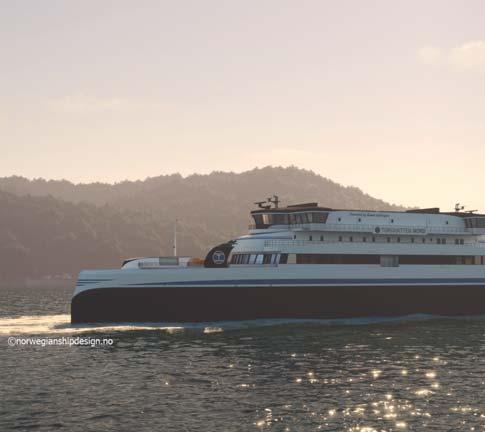
a demonstration project, the compressed gaseous hydrogen approach Torghatten Nord has taken is the more energy efficient and commercially competitive option,” says Gjermund Johannessen, CEO and Managing Director, The Norwegian Ship Design Company.
“We have been involved in a large number of important zero emissions projects, but the choice of fuel for zero emission short sea shipping can be summarised thus: ‘Commercially you will, where technically possible, always choose full electric
with power originating from shore. If full electric is not possible the next option is compressed hydrogen. Then if you have a very long travelling distance LH2 may be the next option. In some cases, the higher energy cost of LH2 can be reduced if the production of hydrogen is far away, adding a higher delivery cost of the less volume efficient compressed hydrogen’.” an assembly area for prototypes. The company will eventually have a production capacity for 60MW of PEM fuel cell systems.
DESIGN AND PERFORMANCE For the latest news and analysis go to www.motorship.com MAY 2023 | 59
■ The Torghatten Nord newbuildings will be the first significant consumer of hydrogen in the transportation sector in Norway
BESPOKE FERRY FOR ISLE OF MAN RUN
The 133m, twin-screw Manxman is distinguished by a battery/diesel hybrid system, coupled with greater payload capacity than the 25-year old, 125m Ben-my-Chree, the present mainstay of the route linking Douglas with the northwest English port of Heysham. The £78m($97m) newbuild’s more sophisticated power installation affords a high degree of operating flexibility and economy, and reflects a new environmental standard in relation to her 19knot predecessor.
The fleet investment project by the Isle of Man Steam Packet Company(IOMSPC) posed several design challenges arising from a significant capacity increase within given operating parameters, notably restrictions at the ports, and the need to ensure year-round service dependability and schedules, along with onboard comfort and habitability, despite often harsh Irish Sea conditions.
Manxman combines a 949-passenger certification, up from the 636 maximum of the Ben-My-Chree, plus nearly 500m2 of additional ro-ro space, amounting to provision for some 1,500 lane-metres of freight and other vehicles, relative to the 1,235 lane-metres of the earlier ship. The newcomer will play a vital economic role in maintaining service continuity and ensuring the safety and competitiveness of the lifeline run between Douglas and mainland UK through the most inclement seasons. The hull lines have been crafted to help achieve smoother motions, while the stabilisers adopted have twice the fin area of those on Ben-My-Chree.
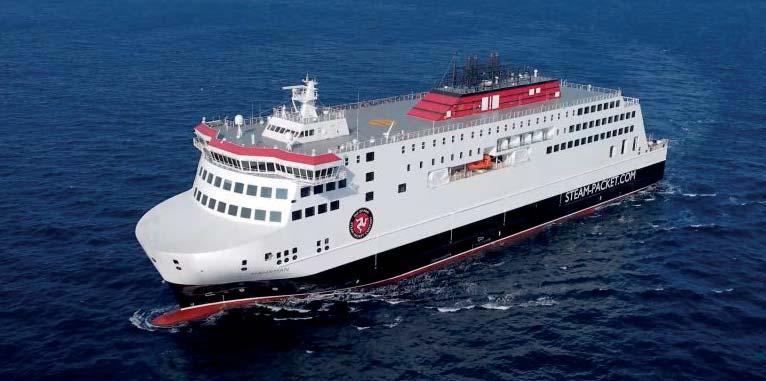
It had been anticipated that Manxman would be ready to
make her service debut by the start if the 2023 tourist season, and most especially as regards the annual, two-week Isle of Man TT motorcycle racing programme, beginning this year at the end of May.
However, the planned introduction of the new ship, ordered from South Korean contractor Hyundai Mipo Dockyard(HMD), has been delayed. In January, IOMSPC announced that “Testing carried out by Manxman’s builders during routine sea trials revealed a significant problem in the vessel’s systems.” Reports suggest that the issue related to a mechanical (transmissions) fault, and that the ship’s performance was otherwise positive. Corrective works were put in hand, to be followed by further sea trials.
The bespoke newbuild project has entailed extensive collaboration with specialist organisations. IOMSPC retained UK consultancy Houlder as technical advisor, which offered insights into regulations and compliance, providing pragmatic solutions to the various technical and logistical considerations, and contributing to the dialogue with the shipbuilder throughout the plan approval and build stages.
The shipowner’s fleet operations manager Jim Royston said that Houlder had effectively integrated with the IOMSPC team. “We last worked with Houlder on a newbuild back in the early 1990s and a lot has changed since then in terms of regulations and design standards. Through an in-depth understanding of our operations, Houlder has provided frictionless mediation between ourselves and HMD offering constructive perspectives on challenges faced, and working
SHIP DESCRIPTIONS 60 | MAY 2023 For the latest news and analysis go to www.motorship.com
■ Manxman on initial sea trials off the Korean coast
credit: IOMSPC
A new stage in the evolution of the Irish Sea ferry sector is signified by the construction and imminent delivery of a ro-pax optimised for long-term viability in the Isle of Man trade, writes David Tinsley.
proactively to minimise delays relating to class society approval. Essentially, it’s a service we didn’t know we needed, but one we’re incredibly grateful to now have access to,” observed Mr Royston.
Hong Kong-based SeaQuest Marine has also been engaged for on-site supervision at the Ulsan yard, and for advising the shipowner’s team on specialist areas of the build including weld inspection, pipe production and test, paint preparation and application, electrical and machinery installation, and further down the line during the testing and trials process.
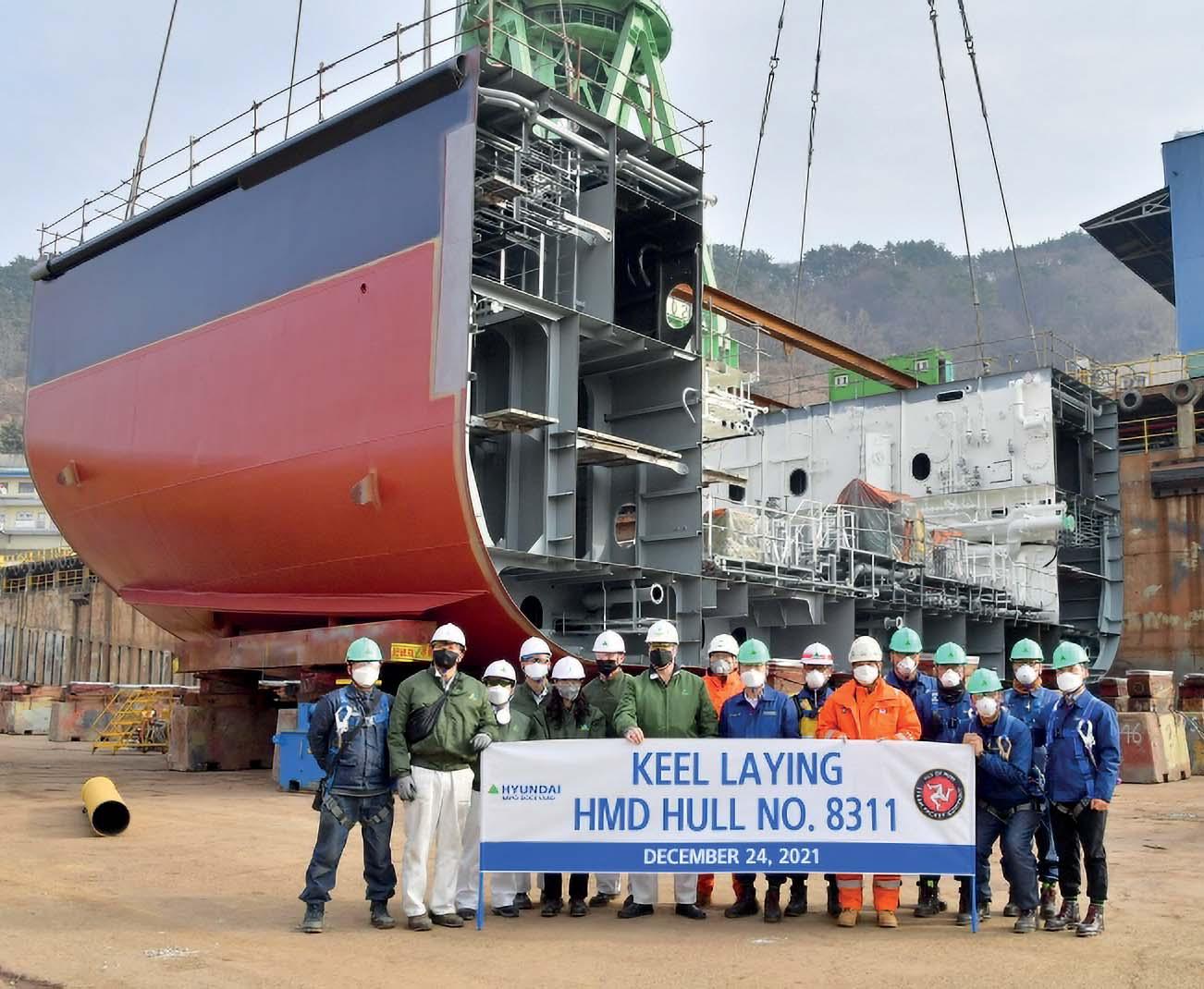
Wartsila worked closely with IOMSPC to devise a functionally integrated package based on the vessel’s operating profile and customer-specific requirements. Reliability, efficiency and low operating costs were key tenets. Central to the overall solution is the Finnish group’s W31-series medium-speed engine technology, reckoned at the time of ordering as 8% more efficient than other options, exerting a correspondingly beneficial impact on unit exhaust emissions, coupled with the flexibility conferred by a fourengine installation.
Excess electricity generated will be stored by the vessel’s batteries, which will be brought on line during periods of higher load or while the ferry is in port, so as to curb emissions and noise. The solution overall allows various operating permutations and ensures that machinery can be run as close as possible to its sweet spot, or most efficient point, in accordance with the changes in the load profile and demand on the route involved.
The power plant comprises two 10-cylinder and two eightcylinder models of the W31 four-stroke diesel, yielding
around 22,000kW overall. The machinery choice will help the shipowner meet a corporate target of delivering a far more ‘sustainable’, environmentally-friendly operation. Moreover, the type of engine chosen offers the flexibility to take advantage of alternative future fuels as they become available and viable, and can utilise artificial intelligence(AI) and machine learning under a condition-based maintenance regime.
The scope of Wartsila’s supply also embraced the two 1,582kWh banks of batteries, Low Loss Concept(LLC) power distribution, electrical and automation systems, and transverse thrusters. The array of three bow tunnel thrusters, giving twice the output available from the units in Ben-myChree, confer the requisite manoeuvrability of the larger ship in the tight confines of the ports at each end of the route.
Wartsila’s stamp on the Manx fleet development includes the Aquarius UV ballast water management plant and NACOS Platinum integrated navigation system incorporating a newly-developed bridge console design.
The Dutch company Heatmaster, which has its own factory in China, supplied the main heating and hot water storage systems, tapping the heat energy in the engine exhaust gases by way of four economisers. Standby capacity plus inport heating is provided by an electrical heater.
The shipowner’s investment in available technology to attain a safety standard beyond that of regulation is expressed in its nomination of two NAPA onboard systems. NAPA Emergency Computer assesses the vulnerability of an intact ship as well as its survivability in the event of a flooding emergency, while NAPA Loading Computer optimises vessel load while minimising stress and safety risk.
For the latest news and analysis go to www.motorship.com MAY 2023 | 61
SHIP DESCRIPTIONS
credit: IOMSPC
■ The keel-laying ceremony for the Manxman was held in December 2021
prevent leakage
•Marine engineering consultancy


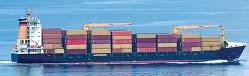

•Project management
•Service contracts
Maintaining the highest possible standards for our customers. Service, upgrades and retrofits. ● Governors / Actuators


● Support for all Viking based products and our new simple to install Viking352G upgrade pack (below)
● Spare parts & Service
● OEM quality overhauls and service exchange units

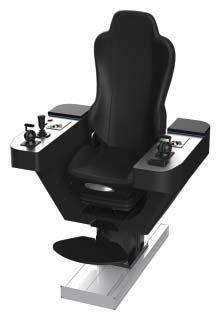
● Propulsion Controls ● Generator Controls ● Power Management


● Turbocharger Condition Monitoring systems Regulateurs Europa Limited Port Lane, Colchester. CO1 2NX UK
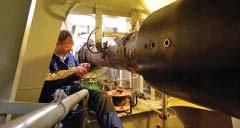
+44 (0)1206 799556 Fax +44 (0)1206 792685Email sales@regulateurseuropa.comWeb www.regulateurseuropa.com

Is your damper providing engine protection?

Torsional Vibration Dampers


Maintenance and Repair of Crankshaft Torsional Viscous Vibration Dampers

Tel: +44 (0)1422 395106
Fax: +44 (0)1422 354432 davidwhitaker@metaldyne.com www.metaldyne.co.uk


Formerly Simpson Ind - Holset Dampers
LUBRICANTS

Explore our range of innovative, high performance and Environmentally Acceptable Lubricants, delivered

62 | MAY 2023 For the latest news and analysis go to www.motorship.com PRODUCTS & SERVICES DIRECTORY BRIDGE EQUIPMENT Tel: +49-2938-98769-0 info@chair-systems.com http://www.pilotchairs.com
THE COMFORTABLE 9 High quality upholstery with individual logo stitch (optional) 9 Adjustable armrests 9 Variable seat depth 9 Infinitive height adjustment of the seat top 9 Seat angle adjustment 9 Length adjustment of the seat top
& OILS DAMPERS CONTROL & MONITORING BEARINGS CONTROL & MONITORING EMISSION CONTROL
NAUTIC PRO
FUELS
atzmartec.com Experts in marine
•Seals
Phone
engineering equipment •Bilge water monitors & filtration
and bearings •Dry dock services •Underwater repairs •Additives to
with an unparalleled level of personal service. For more information
contact us at Vickers Oils 6 Clarence Rd, Leeds, LS10 1ND, UK Tel: +44 (0)113 386 7654 Fax: +44 (0)113 386 7676 Email: inbox@vickers-oil.com Web: www.vickers-oil.com
FOR GENERATIONS MAINTENANCE 30 60 PROPULSION AEGIR-MARINE, BUILT ON SERVICE Call us at +31 343 432 509 or send us an email: info@aegirmarine.com
more information
1329
or email: info@seawork.com 13 15 TO JUNE 2023 Southampton United Kingdom
please
TRUSTED
Reliable measurement, optimization and monitoring solutions for fuel oils. info@aquametro-oil-marine.com www.aquametro-oil-marine.com For
visit: seawork.com contact: +44
825335












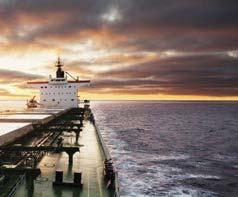


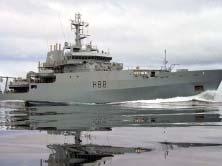




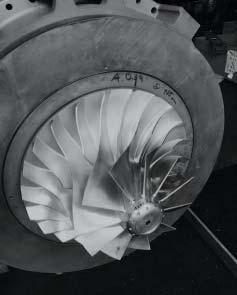




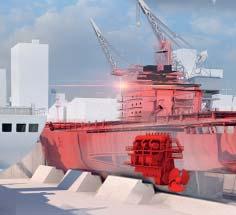



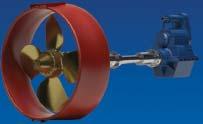

For the latest news and analysis go to www.motorship.com MAY 2023 | 63 PRODUCTS & SERVICES DIRECTORY SPARE PARTS High quality underwater repairs Hydrex offers underwater repair solutions to shipowners around the globe. Our experienced teams are qualified to perform all class-approved repair procedures in even the harshest conditions. Hydrex headquarters Phone: +32 3 213 53 00 (24/7) E-mail:hydrex@hydrex.be www.hydrex.be Hermann-Blohm-Str. 1 · D-20457 Hamburg Phone +49 40 317710-0 · Fax +49 40 311598 E-mail info@nds-marine.com www.nds-marine.com Our reliability.Your move. Big enough to handle it Small enough to care Your Ship Repair Yard in Lisbon Estaleiro da Rocha Conde de Óbidos 1399 –036 Lisboa –PORTUGAL Tel. Yard (+ 351) 213 915 900 www.navalrocha.com navalrocha@navalrocha.pt TESTING & ANALYSIS SHIPREPAIR TEMP CONTROL TURBOCHARGERS WASTE WATER ENGINEERING CO. LTD. TEMPERATURE CONTROL VALVES Comprehensive range of 3-way Valves suitable for Fresh Water, Lubricating Oil and Sea Water Systems Wide choice of materials. Robust construction, low maintenance, simple to use and cost effective method of temperature control Tel: +44 (0) 1727 855616 Fax: +44 (0) 1727 841145 E-mail: Sales@waltonengineering.co.uk Website: www.waltonengineering.co.uk DIRECT • PNEUMATIC • ELECTRIC • GAS PRESSURE OPERATED VALVES Start Systems for Two and Four-Stroke Engines Please visit: www.seitz.ch LABORATORY ANALYSIS FOR THE MARINE INDUSTRY Tel: +44 (0) 1256 704000 Email:enquiries@spectro-oil.com Web: spectro-oil.com For more information contact us Phone: +44 141 880 6939 Email: mrhmarineoff@btconnect.com Or visit: www.mrhmarine.com Jets AS Vacuum Toilet Systems and STP’s, Jowa Water Handling Systems, Libraplast A60 Doors, Metizoft Green Passport Solutions, Modular Wet Units, Vacuum Pipe De-Scale Solutions and all kinds of bathroom and plumbing accessories you may require for any vessel 10 30 60 70 70 2950 SW 2nd Avenue Ft. Lauderdale, FL 33315 Toll free: 877-887-2687 Telephone: 954-767-8631 Fax: 954-767-8632 Email: info@turbo-usa.com www.turbo-usa.com Installing Turbocharger Confidence TURBOCHARGERS ABB Turbo MarineCare Predictability in a changing world Full range of CP Propulsion Systems • Reduction Gearboxes 150 • 12000 kW • PTO - PTI and 2 - Speed solutions • 3 - 4 and 5 bladed CP Propellers Ø1-6m dia • Fifth Generation Electronic Remote Controls • Nozzles NACA 19A Finnøy High Speed Finnøyveien 195 6487 Harøy NORWAY (+47) 712 76 000 post@finnoygear.no PUMPS PROPULSION
MEDIUM SPEED ADVANCES
The international magazine for senior marine engineers
EDITORIAL & CONTENT
Editor: Nick Edstrom editor@mercatormedia.com
Correspondents
Please contact our correspondents at editor@motorship.com
Bill Thomson, David Tinsley, Wendy Laursen
SALES & MARKETING
Brand manager: Sue Stevens sstevens@mercatormedia.com
Tel: +44 1329 825335
In May 1973 the medium speed engine debate continued, with the main editorial viewpoint page mentioning the continued upward trend in power output
The new Pielstick PC4 had been demonstrated in France, with a power of 1500 bhp/cylinder, while in Japan IHI was testing a 12-cylinder version with a total of 18,600 bhp at 400 rpm. Fiat, B&W, Mitsui and the Sulzer/MAN joint venture were all said to be making good progress with their designs. These were eclipsed by the Doxford Seahorse opposedpiston design which had confirmed, on test, its rated output of 2500 bhp/cylinder.
Despite these advances, and the perceived advantages of the medium-speed unit, shipowners were still sceptical about the demands on their engineers of maintaining multi-cylinder engines. This meant that demand for the traditional cross-head low speed engine remained high. There was even speculation about a probable 72,000 bhp 12-cylinder two-stroke.
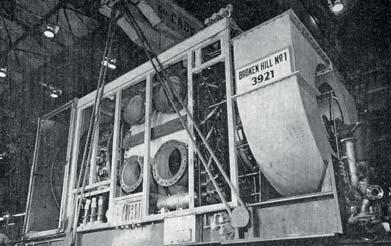
The CIMAC congress, which had just been held in the US, seemed to confirm the industry’s interest in developing the medium speed format, yet it was noted that attendance from users, including technical superintendents of shipping companies, as well as naval architects, was low. Our editorial predecessors asked whether this suggested a certain conservatism among the users of diesel engines, who were more interested in reliability and simple maintenance than in advanced design.
Nevertheless, the Pielstick PC4 merited a detailed feature in the journal, noting in particular its relatively
low fuel consumption and cost per horsepower. This, however, was considered by the feature writers less important than time between overhauls, and, particularly, the time and manpower required for maintenance. However, the possibility of achieving a total output in excess of 100,000 bhp from four engines on two shafts was believed to be of great interest for the ever-growing market in large tankers.
The medium speed emphasis continued through the ship descriptions, focusing on two ferries for different routes. Wärtsilä’s Turku shipyard had delivered Bore 1 to Silja line for the Turku-Stockholm route. This vessel had to be capable of operating in ice, which meant that as well as a strengthened hull, of 17.5 and 23.5mm plating, a propulsion plant of 18,000 bhp was needed for the 8000gt ship. This was provided by four Wärtsilä/Sulzer 9ZH40/48 engines coupled in pairs to two Kamewa CP propellers. When full power was not needed for icebreaking, the ferry was capable of over 20 knots on three engines, or 18 knots on just two, allowing maintenance to be carried out at sea. A high level of automation, not only for the main and auxiliary engines, but also in the navigation equipment.
The other ferry was the Senlac, built for Sealink’s Newhaven-Dieppe route, which was said to be popular for freight trailers bound for Spain. But with the prospect of competition from a Channel tunnel being considered, the ship had been designed so that some of the hold could be adapted for more passenger and car accommodation should it be necessary to re-deploy the vessel elsewhere.

Although the choice of Pielstick machinery reflected that on the near-sister ships working between Dover and Calais, Senlac’s two 7,500bhp 16PC2V engines were intended to burn HFO from the outset rather than the operator’s previous choice of MDO.
Gas turbines had begun to make inroads into the ship propulsion market, with the first all-gas turbine merchant vessels – three 35,000 dwt tankers for Chevron, having begun construction in the US. In Australia, meanwhile, the Whyalla shipyard had launched a 15,000 dwt ro-ro vessel with a GE industrial turbine burning HFO, though backed by diesel auxiliaries. This was to be followed by a smaller gas turbo-electrically-driven version.
Production
David Blake, Paul Dunnington production@mercatormedia.com
EXECUTIVE
Chief Executive: Andrew Webster awebster@mercatormedia.com
TMS magazine is published monthly by Mercator Media Limited Spinnaker House, Waterside Gardens, Fareham, Hampshire PO16 8SD, UK
t +44 1329 825335
f +44 1329 550192 info@mercatormedia.com www.mercatormedia.com
Subscriptions
Subscriptions@mercatormedia.com
Register and subscribe at www.motorship.com
1 year’s digital subscription with online access £222.00
For Memberships and Corporate/multi-user subscriptions: corporatesubs@mercatormedia.com

64 | MAY 2023 For the latest news and analysis go to www.motorship.com 50 YEARS AGO
© Mercator Media Limited 2023. ISSN 0027-2000 (print) ISSN 2633-4488 (online). Established 1920. The Motorship is a trade mark of Mercator Media Ltd. All rights reserved. No part of this magazine can be reproduced without the written consent of Mercator Media Ltd. Registered in England Company Number 2427909. Registered office: Spinnaker House, Waterside Gardens, Fareham, Hampshire PO16 8SD, UK
■ Silja Lines’ icebreaking ferry ‘Bore 1’
■ A GE industrial gas turbine destined for an Australian ro-ro
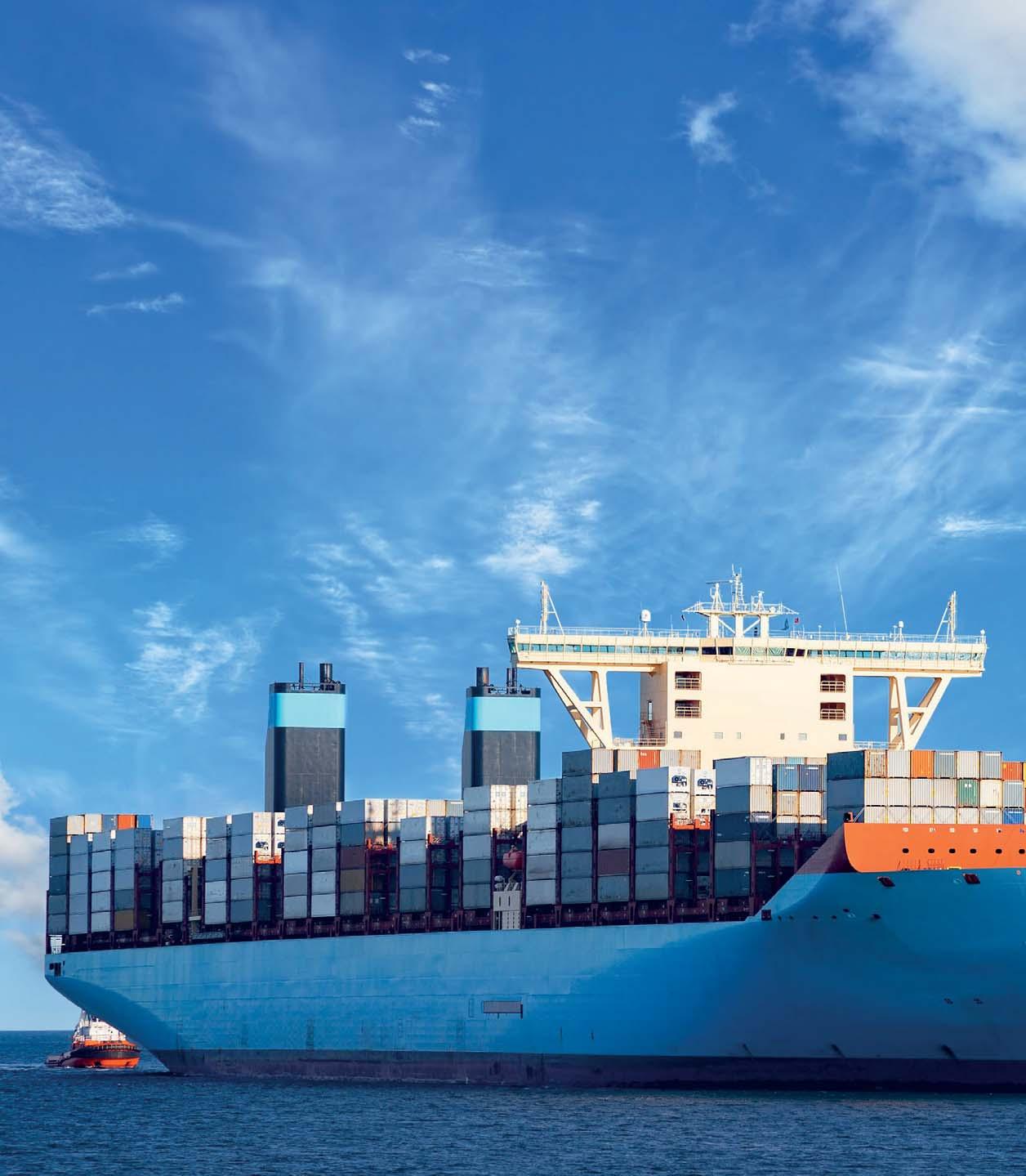

MOTORSHIP MARINE TECHNOLOGY THE Contact us today Reach industry professionals with The Motorship Promote your business to the right audience in the right place at the right time. Engage with our audience of senior marine engineers, from ship owners and commercial partners a wide range of opportunities for campaign delivery. We Motor Ship’s valued content is relied upon by shipping professionals and is delivered through multiple channels. Sue Stevens, Brand Manager t: (+44) 1329 825 335 e: sales@motorship.com www.motorship.com MAGAZINE RECIPIENTS DECISION MAKERS PAGEVIEWS PER MONTH 12,92572%40,330