Finding Beauty in Unlikely Places: The Art of a
20 Neuropathologist
For Desiree Marshall, MD, her imagination sparks when she looks at brain tissue under a microscope. Her art contemplates the bittersweet beauty she sees in her work as a neuropathologist. By Desiree Marshall, MD I’m a very visual person, often to a fault–meaning I am easily distracted by the aesthetics of my surroundings. In large part, it was the striking beauty of tissues under the microscope, dressed in their various histologic stains that drew me to the subspecialty of pathology in medical school. To me, being a pathologist who specializes in autopsy neuropathology, has put me even more in touch with my humanity. When it comes down to it, my clinical work is all about the decedent and their families. Despite the nourishing altruistic feelings inherent to this type of work, it can be a labor of significant emotional toll. I once felt guilty in finding beauty in diseased tissue, but no longer. Like a moth to a flame, I am drawn to the beauty of histopathology and gross anatomy—in both health and disease—a gravitational pull allowing me to do the work that others might find themselves incapable of. I have learned that something can be both beautiful and terrible at the same time; that beauty exists in many forms and can be found in the unlikeliest of places. I found an amazing creative outlet and artistic community of like-minded brain nerds through the UW Graduate Program in Neuroscience and Eberhard Fetz Art Fund annual neuroscience themed art show, Art Neureau. I have been lucky enough to show my work at three of the exhibits and hope to participate in many more.
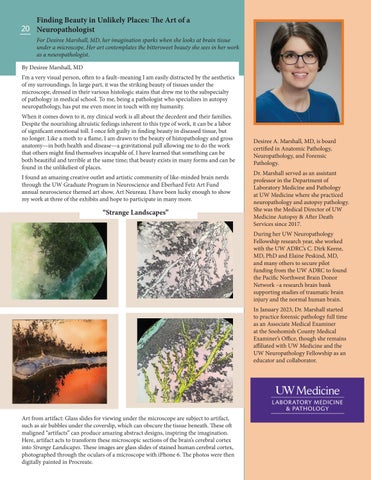
“Strange Landscapes”
Desiree A. Marshall, MD, is board certified in Anatomic Pathology, Neuropathology, and Forensic Pathology. Dr. Marshall served as an assistant professor in the Department of Laboratory Medicine and Pathology at UW Medicine where she practiced neuropathology and autopsy pathology. She was the Medical Director of UW Medicine Autopsy & After Death Services since 2017. During her UW Neuropathology Fellowship research year, she worked with the UW ADRC’s C. Dirk Keene, MD, PhD and Elaine Peskind, MD, and many others to secure pilot funding from the UW ADRC to found the Pacific Northwest Brain Donor Network –a research brain bank supporting studies of traumatic brain injury and the normal human brain. In January 2023, Dr. Marshall started to practice forensic pathology full time as an Associate Medical Examiner at the Snohomish County Medical Examiner’s Office, though she remains affiliated with UW Medicine and the UW Neuropathology Fellowship as an educator and collaborator.
Art from artifact: Glass slides for viewing under the microscope are subject to artifact, such as air bubbles under the coverslip, which can obscure the tissue beneath. These oft maligned “artifacts” can produce amazing abstract designs, inspiring the imagination. Here, artifact acts to transform these microscopic sections of the brain’s cerebral cortex into Strange Landscapes. These images are glass slides of stained human cerebral cortex, photographed through the oculars of a microscope with iPhone 6. The photos were then digitally painted in Procreate.