I was until I put on the glasses!” he said.
“Of course, I had my own personal experience of getting glasses in third grade … I had no idea how nearsighted I was until I put on the glasses!” “Professionally, I love watching the transformation of people — especially teenagers — when you put them into contact lenses and their whole personality blossoms,” shared Dr. Whetstone, noting that although they weren’t prescribing contact lenses in Honduras, they were changing lives nonetheless.
Of spectacles and sunglasses In addition to eye glasses to correct refractive errors, Dr. Whetstone said that sunglasses are greatly needed as well. “If I could waive a magic wand, the ability to provide sunglasses to everyone we see would be ideal,” he shared. “Most of the places I’ve been, the sun damage to the eyes is mind boggling —
there is scar tissue on the front of the eye, as well as ‘early’ cataracts.”
easier for optometrists to match the prescription to the patient’s needs.
In addition to the disease itself, this can cause a host of other challenges: For example, it’s unlikely that patients in these communities can afford or access medical or surgical care — and thus, quality of life decreases further.
In addition, he said that OneSight is also adept at partnering with the local health ministries in the countries where they operate. This ensures they have the resources they need to serve patients.
“The last [OneSight] trip was to the interior of Peru, deep in the jungle … and the incidence of cataracts in young people was very high,” he said. “I came home bent on finding a way to make surgery happen — but then COVID hit and things are at a standstill.”
Around the world, OneSight holds charitable clinics, which are designed to meet urgent unmet needs, and creates sustainable clinics, which are a permanent solution. Charitable clinics last one week to serve those with acute needs; while sustainable clinics offer a long-term solution in the community. In addition to providing vital access to vision services, the permanent sustainable centers also create jobs.
Saving sight through outreach There are numerous outreach organizations within the optical industry, said Dr. Whetstone, whose office also supports local and U.S.based organizations like St. Matt’s House, the Red Cross and the Women’s Shelter. “Anyone who is interested just needs to search and opportunities can be abundant,” he continued. “What I liked about OneSight is that they saw the need to change the process,” continued Dr. Whetstone. For example, they began making spectacles in the clinics rather than using recycled pairs. This, of course, makes it much
The nonprofit plans to continue its commitment to serving all of the world’s 1.1 billion people who are in need of eye exams and spectacles. In Asia, outreach includes 85 charitable clinics and 76 sustainable centers. These provide millions of people with eye care in countries including: Thailand, Vietnam, Bangladesh, East Timor, Indonesia, Malaysia, India and China.
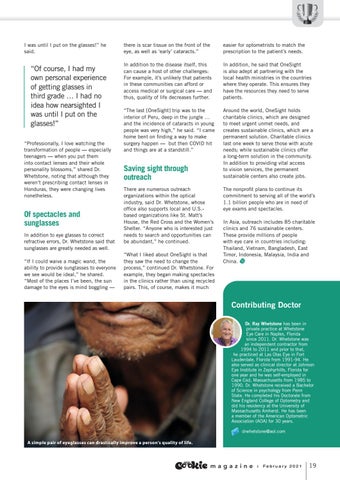
Contributing Doctor Dr. Ray Whetstone has been in private practice at Whetstone Eye Care in Naples, Florida since 2011. Dr. Whetstone was an independent contractor from 1994 to 2011 and prior to that, he practiced at Las Olas Eye in Fort Lauderdale, Florida from 1991-94. He also served as clinical director at Johnson Eye Institute in Zephyrhills, Florida for one year and he was self-employed in Cape Cod, Massachusetts from 1985 to 1990. Dr. Whetstone received a Bachelor of Science in psychology from Penn State. He completed his Doctorate from New England College of Optometry and did his residency at the University of Massachusetts Amherst. He has been a member of the American Optometric Association (AOA) for 30 years. drwhetstone@aol.com A simple pair of eyeglasses can drastically improve a person’s quality of life.
| February 2021
19