PROFESSIONAL SERVICES
WILLS What happens if a person dies without making a will? “If you die without a will an archaic piece of legislation called the Administration of Estates Act 1925 will dictate who receives your assets and when. It does not make provision for unmarried partners, step-children, friends or charities.
“WILL TRUSTS DO NOT HAVE TO BE COMPLICATED OR TIME-CONSUMING”
What are the legal requirements for a will? In order to make a will you must be over the age of 18, have testamentary capacity and the will must be signed in accordance with S9 of the Wills Act 1837. If you are on active military service some of these rules may not apply. It’s not just about money is it? What assets can be included in a will? Your will can dispose of any assets you own including money, pets, investments, properties and possessions such as vehicles, watches, paintings, furniture etc. Do all assets pass to heirs through last wills and testaments? Some assets may not pass under the terms of your will. Examples include joint bank accounts or property held as ‘beneficial joint tenants’. These often pass automatically to the surviving owner(s). Pensions and assets held in trust may not pass under the terms of your will. What if I change my mind, is it easy to change? You are able to amend or cancel your will at any time, provided that you have testamentary
TOP TIPS WHEN MAKING A WILL “Use a solicitor that specialises in
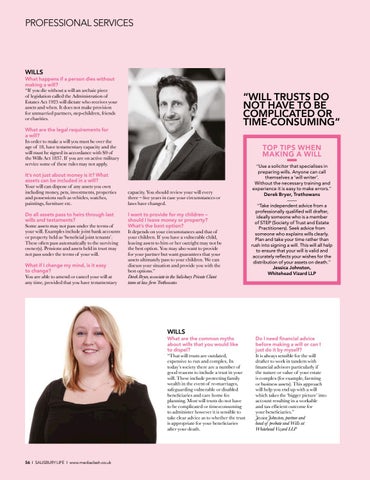
capacity. You should review your will every three – five years in case your circumstances or laws have changed. I want to provide for my children – should I leave money or property? What’s the best option? It depends on your circumstances and that of your children. If you have a vulnerable child, leaving assets to him or her outright may not be the best option. You may also want to provide for your partner but want guarantees that your assets ultimately pass to your children. We can discuss your situation and provide you with the best options.” Derek Bryer, associate in the Salisbury Private Client team at law firm Trethowans
preparing wills. Anyone can call themselves a ‘will writer’. Without the necessary training and experience it is easy to make errors.” Derek Bryer, Trethowans
“Take independent advice from a professionally qualified will drafter, ideally someone who is a member of STEP (Society of Trust and Estate Practitioners). Seek advice from someone who explains wills clearly. Plan and take your time rather than rush into signing a will. This will all help to ensure that your will is valid and accurately reflects your wishes for the distribution of your assets on death.” Jessica Johnston, Whitehead Vizard LLP
WILLS What are the common myths about wills that you would like to dispel? “That will trusts are outdated, expensive to run and complex. In today’s society there are a number of good reasons to include a trust in your will. These include protecting family wealth in the event of re-marriages, safeguarding vulnerable or disabled beneficiaries and care home fee planning. Most will trusts do not have to be complicated or time-consuming to administer however it is sensible to take clear advice as to whether the trust is appropriate for your beneficiaries after your death.
56 I SALISBURY LIFE I www.mediaclash.co.uk
Do I need financial advice before making a will or can I just do it by myself? It is always sensible for the will drafter to work in tandem with financial advisors particularly if the nature or value of your estate is complex (for example, farming or business assets). This approach will help you end up with a will which takes the ‘bigger picture’ into account resulting in a workable and tax efficient outcome for your beneficiaries.” Jessica Johnston, partner and head of probate and Wills at Whitehead Vizard LLP