And what were you in therapy for?
Oh, I was just trying to get over the usual shit. What would that ’80s guy, the one who made all these pots and plates, think of the success you’re enjoying now?
He’d be very surprised but very pleased, I’m sure. But I do think that he’d be pretty shocked that I’d done so well in quite so many ways. When I started making these works I was on the dole and squatting in central London, often feeling very sorry for myself, but always energetic and working hard. Those, at least, were two qualities that I always had. And how did you start to become famous?
I had help, of course. The art dealer, James Birch, ga e me my first e hi ition and continued to show me for most of this period; he was an enormously good supporter, and all the clients and the collectors he had around him were great too. I sometimes meet people who bought my work very early on, and they ask if I’d mind them selling them on for a huge profit. m always saying to them,‘Great! Cash in!’ Did you find people reluctant to take ceramics seriously as an art form back then?
Still do. There’s a degree of intellectual snobbery about traditional crafts which I sensed even back then, but I used it to my advantage. I was always looking for an angle that would make the art world discomforted in a way, as that’s what artists do – we’re always looking for where the tender spots are on the body cultural. Ceramics remain the lower middle class neighbour of art, which I enjoy – people would look at what I was doing, and say, “I can’t believe he’s got a degree from a good university.” And I e ploited that to a certain e tent.
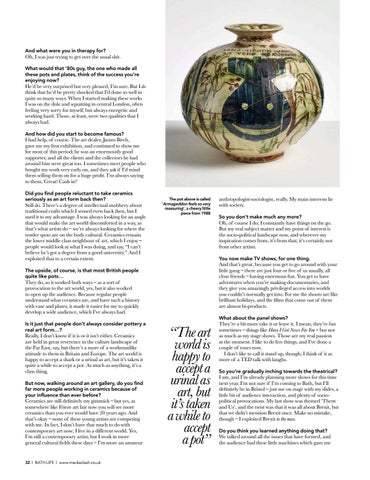
The pot above is called ‘Armageddon feels so very reassuring’, a cheery little piece from 1988
You now make TV shows, for one thing.
And that’s great, because you get to go around with your little gang there are ust four or fi e of us usually all close friends ha ing enormous fun. ou get to ha e adventures when you’re making documentaries, and they give you amazingly privileged access into worlds you couldn’t normally get into. For me the shoots are like rilliant holidays and the films that come out of them are almost bi-products.
They do, so it worked both ways – as a sort of provocation to the art world, yes, but it also worked to open up the audience. Because regular people understand what ceramics are, and have such a history with vase and plates, it made it easier for me to quickly develop a wide audience, which I’ve always had.
Really, I don’t know if it is or it isn’t either. Ceramics are held in great reverence in the culture landscape of the Far East, say, but there’s a more of a workmanlike attitude to them in Britain and Europe. The art world is happy to accept a shark or a urinal as art, but it’s taken it quite a while to accept a pot. As much as anything, it’s a class thing.
But now, walking around an art gallery, do you find far more people working in ceramics because of your influence than ever before?
eramics are still definitely my gimmick ut yes at somewhere like Frieze art fair now you will see more ceramics than you ever would have 20 years ago. And that’s okay – none of these young artists are competing with me. In fact, I don’t have that much to do with contemporary art now li e in a different world. es I’m still a contemporary artist, but I work in more general cultural fields these days m more an amateur
32 I BATH LIFE I www.mediaclash.co.uk
So you don’t make much any more?
Oh, of course I do; I constantly have things on the go. But my real subject matter and my point of interest is the socio-political landscape now, and wherever my inspiration comes from, it’s from that; it’s certainly not from other artists.
The upside, of course, is that most British people quite like pots…
Is it just that people don’t always consider pottery a real art form…?
anthropologist-sociologist, really. My main interests lie with society.
What about the panel shows?
“The art world is happy to accept a urinal as art, but it’s taken a while to accept a pot”
They’re a bit more take it or leave it. I mean, they’re fun sometimes – things like Have I Got News For You – but not as much as my stage shows. Those are my real passion at the moment. I like to do live things, and I’ve done a couple of tours now. I don’t like to call it stand up, though; I think of it as more of a TED talk with laughs. So you’re gradually inching towards the theatrical?
I am, and I’m already planning more shows for this time ne t year. m not sure if m coming to ath ut ll definitely e in ristol ust me on stage with my slides a little bit of audience interaction, and plenty of sociopolitical provocations. My last show was themed ‘Them and s and the twist was that it was all a out re it ut that we didn t mention re it once. ake no mistake though e ploited re it to the max. Do you think you learned anything doing that?
We talked around all the issues that have formed, and the audience had these little machines which gave me