Bath Cover Feb idea3.qxp_Layout 1 25/01/2024 17:17 Page 1
thebathmag.co.uk | £4.95 where sold
THEBATHMAGAZINE
ISSUE 252 | FEBRUARY 2024
DIAMONDS ARE FOREVER
But is there a hierarchy? Bath jeweller Nicholas Wylde explores natural versus lab-grown diamonds
PLUS • Lorraine Kelly shares her thoughts on her debut novel set in The Orkneys • Pam Downe on creating costumes for David Tennant, Andy Garcia and Gemma Arterton • The changing shape of kitchens and expert views of what’s on trend • Ringing the ancient bells at Bath Abbey
AND...
S O M U C H M O R E I N T H E C I T Y ’ S B I G G E S T G U I D E T O L I V I N G I N B AT H
Cotswold Company fp.qxp_Layout 1 26/01/2024 15:13 Page 1
Ben Argent FP New dimensions.qxp_Layout 1 22/01/2024 09:53 Page 1
Coopers idea.qxp_Layout 1 24/01/2024 12:06 Page 1
The new, fully-electric Rayburn Ranger 100-3i.
Friends and fam ily gathering round, the arom a of a beautifully cooked Sunday lunch. For 70 years, Rayburn by AGA has been the w arm , beating heart of m any B ritish hom es. V isit our show room to see this latest innovation in range cooking.
C oopers H om e A ppliances, 13/15 Walcot Street, B ath, B A1 5B N 01225 311811 sales@ coopershom eappliances.com coopershom eappliances.com
The home of appliances.
Coopers idea.qxp_Layout 1 24/01/2024 12:06 Page 2
Contents Bath.qxp_Layout 1 26/01/2024 16:53 Page 1
IN THIS ISSUE
Contents
42 20 10
5 THINGS . . . . . . . . . . . . . . . . . . . . . . . . . . . . . . . . . . . . . . . . . . . . . . . . . . . . . . . .
42
Great things to look forward to this month
14
CITYIST - RINGING THE ABBEY BELLS . . . . . . . . . Meet Matthew Butler the Tower Master of Bath Abbey
16
NOTES ON A SMALL CITY . . . . . . . . . . . . . . . . . . . . . . . . . . . . . Columnist Richard Wyatt entertains the idea of taking a small electric vehicle to the streets of Bath
20 NOVEL APPROACH . . . . . . . . . . . . . . . . . . . . . . . . . . . . . . . . . . . . . . . Emma Clegg chats to TV presenter Lorraine Kelly about her debut fiction novel
22 HOT TOPIC – DIAMONDS . . . . . . . . . . . . . . . . . . . . . . . . . . . . . . Nicholas Wylde discusses the virtues of naturally formed versus lab-grown diamonds
30 WHAT’S ON THIS MONTH . . . . . . . . . . . . . . . . . . . . . . . . . . . . . Feel good in February with a our rundown of great things to do and see in Bath this month
32 THE HIDDEN TREASURES OF BRLSI . . . . . . . . . . . .
COSTUME COUTURE Bath’s Pam Downe on dressing the stars of the screen
46
FOOD & DRINK . . . . . . . . . . . . . . . . . . . . . . . . . . . . . . . . . . . . . . . . . . . . . . . Wines to celebrate the end of dry January and we review the fabulous Green Park Brasserie
56 BETTER LAKE THAN NEVER . . . . . . . . . . . . . . . . . . . . . . . . . . Make a dash to one of the South West Lakes for some much needed great outdoor diversion
58 BATH’S FEEL GOOD FESTIVAL If you’re a little off kilter, then it’s time to ‘Rebalance’
64 WALK LIKE A GEORGIAN . . . . . . . . . . . . . . . . . . . . . . . . . . . . . . . Andrew Swift follows in the footsteps of the city’s forefathers
66 INTERIOR DESIGNS We ask local kitchen experts for all the tips and trends for the year ahead
74 GARDENING – REIGN OF TERRARIUM Create the perfect mini eco-system, in a bottle
Bath Royal Literary & Scientific Institution starts a year of bicentenial celebrations and we access its hidden treasures
34 ORCHESTRAL MANOEUVRES . . . . . . . . . . . . . . . . . . . . . . . Five minutes with Anthony Brown of the Fulltone Orchestra
38 ARTS & EXHIBITIONS . . . . . . . . . . . . . . . . . . . . . . . . . . . . . . . . . . . . . A round-up of the great art on display in our local galleries
Follow us on social media @ thebathmagazine
6 TheBATHMagazine | FeBRuaRy 2024 | issue 252
On our cover this month Diamonds are Forever. Natural Diamonds v Lab Grown is a hot topic. Jeweller Nicholas Wylde helps us to understand all facets of the debate.
Kutchenhaus Feb Century Reds.qxp_Layout 1 24/01/2024 18:24 Page 2
Try out the amazing BORA HOBS
TheGermanKitchen
Visit our showroom to see and experience our beautiful displays of BORA downdraft hobs
The kitchen you’ve been searching for. German engineering | Quality | Craftsmanship
Visit our showroom or request a brochure by clicking the QR code or see www.kutchenhaus.co.uk BATH - Saracen Street, BA1 5BR - 01225 634025
BRISTOL - Clifton Down Shopping Centre, BS8 2NN - 0117 213 0680
Bath 275 x 210 Ed's let Feb.qxp_Layout 1 26/01/2024 18:53 Page 1
CREATIVE IN THE CITY / FILM & TV
FROM THE EDITOR
A
merican novelist Pearl M Buck once said that you face your future with your past. Which seems like a very wise way of looking at things. So we’re seriously taking a tip out of her book. To be fair we might have been about to do that anyway, but it’s great to do it with the backing of a sage quote. Let’s get to it. So you can’t get more into the depths of the past than with an Ice Age mammoth’s milk tooth, which I came across in BRLSI’s collection when I was given a tour recently. I so love their store of 150,000 objects, which is a treasure trove of learning and wonder – and as a result I’m insisting that Matt, the Collection Manager, shares more of their objects with us over the coming months (see page 32). Secondly we have our interiors feature on the very latest trends in the design and layout of kitchens on page 66, with advice from our local kitchen experts. Here I looked back to my grandmother’s kitchen in the 1970s to give some forward perspective on just how much more convenient things now are – boiling water tap or decorative splashback anyone? Costume designer Pam Downe makes regular forays into the past as she moves from drama to drama, and in fact she is able to flit quickly from one historical period to another – for example with Charlotte Hope in The Spanish Princess (16th century), Sophie Cookson in The Trial of Christine Keeler (1960s) and David Tennant in Doctor Who, who clearly is also a bit of a flitter himself (see page 42). You can always rely on Andrew Swift for a backwards look at something special, and this month he’s walking in the footsteps of the Georgians (see page 64). That’s also partly because country walks are still quite muddy, which is another advantage of history – you don’t get mud on your feet when you’re immersed in it. Of course the city of Bath will never escape its hallowed history as a spa town, and I’m sure we all think that is a very good thing. Also in this issue you’ll find a fascinating discussion of diamonds. I talked to jeweller Nicholas Wylde about a new kind of diamond, one that’s grown in a factory, and he explained the difference between these and natural diamonds, which is a subject that’s being hotly debated in the industry right now (see page 22). I hope we’ve now given you enough history ballast to face the immediate future with confidence... Emma Clegg, Editor Finally compare and contrast my mother’s drawing of my grandmother’s kitchen in the late 1940s (thanks mum!) to Miele’s vision for this year, courtesy of Coopers Home Appliances.
The Bath Magazine 2 Princes Buildings, George Street, Bath BA1 2ED; 01225 424499 www.thebathmag.co.uk Editor Emma Clegg 01225 424592; emma@thebathmagazine.co.uk Financial Director Jane Miklos jane@thebathmagazine.co.uk Assistant Editor/Web Editor Jasmine Tyagi jasmine@thebathmagazine.co.uk Production Manager Jeff Osborne production@thebathmagazine.co.uk Advertising Sales Liz Grey liz@thebathmagazine.co.uk To advertise tel: 01225 424499 Publisher Steve Miklos steve@thebathmagazine.co.uk
Contact us at thebathmag.co.uk Follow us on Twitter @thebathmagazine and Instagram @thebathmagazine The Bath Magazine and The Bristol Magazine are published by MC Publishing Ltd. We are independent of all other local publications. The Bath Magazine is delivered free, every month, to more than 15,000 residential addresses as well as businesses throughout Bath and the surrounding area. We also have special distribution units in many of Bath’s supermarkets. © MC Publishing Ltd 2024 Disclaimer: Whilst every reasonable care is taken with all material submitted to The Bath Magazine, the publisher cannot accept responsibility for loss or damage to such material. Opinions expressed in articles are strictly those of the authors. This publication is copyright and may not be reproduced in any form either in part or whole without written permission from the publishers. All paper used to make this magazine is taken from good sustainable sources and we encourage our suppliers to join an accredited green scheme. Magazines are now fully recyclable. By recycling magazines, you can help to reduce waste and contribute to the six million tonnes of paper already recycled by the UK paper industry each year. Please recycle this magazine, but if you are not able to participate in a recycling scheme, then why not pass your magazine on to a friend or colleague.
8 TheBATHMagazine | february 2024 | iSSue 252
En
gi
10 %
ne
er
ed
W oo
d
of f an
d
LV T
Timeless natural beauty Engineered wood flooring • Plank, herringbone & distressed designs • Suits classic & modern décor • A host of plank widths, lengths & colours • Sustainable. Ethically sourced • Supports underfloor heating • Long life warranty. Easy to maintain • Domestic & commercial
Laminate • Luxury vinyl tile • Natural • Stain resistant • Tailor made • Vinyl • Wood • Wool T&C’s: 10% off flooring, discount not applicable to accessories or fitting. Extended offer valid until 29th February.
Avonvale fp February 1.indd 1
24/01/2024 12:33
5 things feb V2.qxp_Layout 1 26/01/2024 19:28 Page 1
ZEITGEIST
5 things to do
Revel in retail therapy
Feel mesmerised Senbla presents Opera International’s award-winning Ellen Kent production featuring the Ukrainian Opera and Ballet Theatre Kyiv with international soloists, highly-praised chorus and full orchestra. One of the world’s most popular operas, Puccini’s Madama Butterfly tells the heart-breaking story of the beautiful young Japanese girl who falls in love with an American naval lieutenant – with dramatic results. Showing on 21 February at the Bath Forum. bathboxoffice.org.uk
Two new retailers are opening venues in the city this month. British bedding and lifestyle brand Piglet in Bed will open its doors on Old Bond Street, selling a collection of linen and cotton bedding, sleepwear, and other natural homewares. They will also be stocking cosy alpaca wool socks, a new scented candles and diffuser collection, a range of merino wool blankets and plenty more. International jeweller Monica Vinader is also opening its first boutique in Bath (24 February), on New Bond Street. As well as jewellery, the shop will offer welding (where 14k solid gold bespoke chains are measured and welded around the wrist) and ear piercing services, as well as complimentary same-day monogramming and engraving. Customers will also be able to recycle gold and silver jewellery in store in exchange for a voucher towards their next purchase. monicavinader.com; pigletinbed.com
See some stand up Comedian Joe Wilkinson is taking his adults-only Work In Progress stand-up show to the Rondo Theatre on 20 February. Wilkinson is a TV regular, having appeared on 8 Out of 10 Cats Does Countdown, Him & Her and After Life. The theatre is raising money for a restoration by adding a £1.50 levy onto its tickets. rondotheatre.co.uk
Inhale aromas As part of ReBalance Bath’s programme of inspiring talks and engaging sessions focusing on physical and mental wellbeing, Penhaligon’s is hosting a series of fragrance profiling sessions at its store on New Bond Street. Running until 18 February, the free 30-minute one-to-one sessions with the team can be booked in store. Simply answer a few questions and the team member will formulate a selection of fragrances that they believe will tickle your fancy. Customers will also receive a gift with every 75ml and 100ml purchase. welcometobath.co.uk
10 TheBATHMagazine | FeBRUaRY 2024 | issUe 252
Learn about the ‘Queen of Crime’ Historian, author, curator and presenter Lucy Worsley is heading back out on the road to share stories from the fascinating life of the ‘Queen of Crime, Agatha Christie. Exploring her research based on the writer’s personal letters and papers, Lucy will uncover the story of a person who, despite the obstacles of class and gender, became an astonishingly successful working woman. Lucy comes to Bath Forum on 4 February and her appearance is the start of a series of Fane events in Bath. These include An Audience with Aggers and Tuffers in May, Politics On the Edge with Rory Stewart in June, and Dick and Angel’s Forever Home in November. fane.co.uk
Visage Gallery fp.qxp_Layout 1 24/01/2024 12:39 Page 1
275 x 210 City Updates.qxp_Layout 1 26/01/2024 14:30 Page 1
ZEITGEIST
City updates Save 24 or 25 February in your diary, because bringing together over 90 of the most innovative and exciting professional independent artists from Scotland to Cornwall, including many from the south west, the Bath Art Fair at Bath Pavilion is the place to discover new, original art. Visitors enjoy meeting the artists and find an emotional connection with their work that galleries just can’t offer. Created by Somerset artist Alce Harfield, the fair is now in its seventh year. Returning artist Fee Dickson Reid (North Berwick) creates expressive, atmospheric large-scale seascapes filled with a sense of calm and peace. The work is about the solace of the sea, the light-filled skies above the local beaches, and reflections on sand and water. “I aim to find the ‘still point in a turning world’, to anchor the viewer to a place and a state of mind that is about tranquility and connection to the natural world.” Returning artist Zaza Lewis (Derbyshire) skilfully combines hand-cut card with colourful textured or fine fabrics to illustrate her ideas, without the need to use paint. Originally from France, Zaza
Mobius Deacon by Adrian Bates
DNA FAMILY SECRETS STAR COMING TO UNIVERSITY OF BATH Professor Turi King has been announced as the next Director of the Milner Centre for Evolution at the University of Bath. Professor King is a distinguished geneticist who uses genetic methods to advance research in fields including forensics, history and archaeology. She is perhaps best known for her role as part of the team that used genetic and statistical methods to identify the remains of King Richard III after their discovery in a Leicester car park in 2012. Her research expertise is in ancient and forensic biomolecules. Prof King is also a passionate communicator of science and is a presenter, lecturer and author. She is the co-presenter with Stacey Dooley of the BBC2 series DNA Family Secrets, where she uses her skills in genetics to answer questions about participants’ families and ancestry. She will join Bath in April from the University of Leicester, where she is currently Professor of Genetics and Public Engagement.
Harvesthome by David Alderslade
BATH ART FAIR IN THE CITY
has won three awards for her paper-cut and fabric pictures, at exhibitions held in both the Midlands and Monmouthshire. New exhibitor Adrian Bates from Gloucestershire first became interested in working with clay after doing an evening class iin 2000. Having suffered from CFS (Chronic Fatigue Syndrome) for five years Adrian eventually returned to work teaching woodwork, copperwork, silversmithing, and pottery. In 2012 he started to make full-time, and he describes the intervening 10 years as “thrilling, challenging and hugely rewarding”. New artist David Alderslade (Ceredigion) describes his work as “an honest attempt at recording the indescribable atmosphere present in wild places, historic landscapes affected by dramatic weather and light, and the excitement in sudden encounters with Britains wildlife.” Opening: Saturday 10am–6pm, Sunday 10am–5pm. Tickets £6 online, £7 on the door, £3.50 concessions, under 18s free. bathartfair.co.uk
VISAGE IN BATH Visage Gallery has opened a new location at No. 3 Northumberland Buildings, a beautiful Grade II* terrace of Georgian townhouses. On offer are an eclectic selection of fine and decorative artworks, furniture, lighting, and jewellery, all of exceptional quality spanning all genres and time periods. Chinese porcelains, jades, and textiles sit alongside British modernist drawings; antique and mid-century furniture mingles with French and English pottery; contemporary paintings in dialogue with Old Master drawings; unusual mirrors and colourful stained glass round out the collection. Also available are unique, inhouse designed marbled papers, handmade leather bags, and antique garden decorations. Stop by to browse the large selection of high quality works available. Dogs welcome! Visage gallery is open Tuesdays to Saturdays from 10am to 6pm. visagegallery.co.uk; Tel: 01225 430922
Midford Manor fp.qxp_Layout 1 24/01/2024 12:40 Page 1
Bath 275 x 210 My Bath V2.qxp_Layout 1 26/01/2024 14:49 Page 1
CITYIST
MY BATH
Matthew Butler Here is the Tower Master of Bath Abbey who once rang the Abbey’s heaviest bell for three hours and 21 minutes. He has also rung bells in Wells, Washington and New York. Being Tower Master of Bath Abbey sounds like you are a character in Game of Thrones, and may soon get your head chopped off. Thankfully not! I think my head is generally quite safe. However, the type of ringing that we practise, known as change ringing, originated in the 17th century and the Abbey bells, of which there are ten, mostly date back to 1700. So I do participate in something that is fairly ancient. Where are you from originally and where do you live in Bath? I was brought up in Wimborne Minster, Dorset, and learned to ring at the church there. I moved to Bath in 2004 for university, stayed, and now live in Odd Down. I love Bath because of its beautiful architecture and history, its vibrancy and liveliness, but also because it’s the right size: big enough to be interesting and small enough to feel like a community.
Image courtesy of Tony McAteer (tonymcateer.co.uk)
What number of hours do you spend ringing? Many! We practise on Monday evenings and ring between 10.40am and 11.30am on Sunday mornings, sometimes in the evenings too. Then there are weddings, the occasional funeral, and events such as the MayorMaking. And that’s only at the Abbey; most bellringers, including myself, ring at more than one tower. Do you have a background in music? I learned to play the piano when I was growing up, but change ringing is more about mathematical patterns than music. Once I started ringing I preferred it to playing the piano, because it is about being part of a team.
Change ringing Change ringing is a form of bell-ringing which originated in England in the 17th century. Each bell is attached to a wheel, and the wheel is attached to a rope. When the bellringer pulls the rope from below, the bell swings through a 360° arc. The bellringer can pause the bell in the upside-down position for as long as necessary, enabling him to control the precise moment that the bell strikes, so it rings in time with the other bells. The most basic form of change ringing is ringing the bells from the lightest to the heaviest, creating a descending scale known as ‘rounds’. From there, the order that the bells sound can be changed by ‘methods’: mathematical patterns which are memorised by the bellringers and can produce many permutations known as ‘changes’ – hence ’change ringing’, and the idiom ‘to ring the changes’. The cascade of sound does not produce a recognisable tune, but can sound very impressive.
How large is the bell-ringing team? There is a pool of about 30 ringers, but we don’t get that many at the Sunday or Monday evening practice. We do normally get all ten bells going, which requires at least ten people. How long did it take you to learn bell-ringing? It took me a month or so to handle a bell myself, then it took me another few months to ring simple things competently with the other ringers. After that I moved on to more complex things. But you never stop learning. I’ve been ringing for nearly 20 years now, and have only recently started to conduct, which is another skill in itself. What do you do as a profession, and how does it complement your bell-ringing? I am a solicitor at the international law firm DAC Beachcroft, and work from their Bristol office. As Tower Master I organise events and make sure everything is communicated clearly; these skills clearly overlap with those of a solicitor.
14 TheBATHMagazine | february 2024 | iSSue 252
Do you ever travel for bell-ringing? In 2007 I visited the USA and I rang at Washington National Cathedral to celebrate Independence Day on 4 July, and also at Trinity Church in Wall Street, New York City. I’ve also rung at cathedrals including Wells, Lincoln, Lichfield, Exeter, Winchester and Gloucester. St Paul’s or Westminster Abbey are still on my bucket list! Is bell-ringing both mental and physical? It can be both. On special occasions we ring what are known as peals, extended lengths of ringing in which the goal is to ring 5,000 or more unique changes without stopping. At the Abbey this takes around three and a half hours. In 2012, I rang the largest bell, which weighs about 1.5 tonnes for 3 hours 21 minutes non-stop. That was probably the biggest physical challenge I have ever put myself through. Do you have a special bell-ringing memory? On the morning of Easter Sunday 2020 at the height of the first lockdown, we were unable to ring normally; instead, I and one other ringer were allowed to chime the bells. Chiming is where the bells remain stationary and are struck by hammers, operated by one person using a different set of ropes. Unlike change ringing...Unlike change ringing, this allows tunes to be played, so I chimed a selection of Easter hymns, including Jesus Christ is Risen Today. That morning the weather was beautiful and Bath was quiet, with almost everyone isolating in their homes, so the sound of our chiming could be heard all over Bath. This generated much favourable comment. A YouTube video of our chiming received over 25,000 views (it’s still there!). bathabbey.org
P15.qxp_Layout 1 24/01/2024 13:22 Page 1
Handmade in the Heart of Bath
Give a heart to the one you love
Heart’s available in 9ct Gold and in Silver. Prices start from £145
JODYCORY.CO.UK | 01225 460072 JODY@JODYCORY.CO.UK 9 ABBEY CHURCHYARD, BATH BA11LY
THEBATHMAG.CO.UK | february 2024 | TheBATHMagazine 15
Richard Wyatt.qxp_Layout 1 26/01/2024 15:18 Page 1
CITY / NOTEBOOK
NOTES ON A SMALL CIT Y
Richard Wyatt
Columnist Richard Wyatt chooses four wheels over two, for a while at least, while he assesses the viability of an electric quadricycle with a top speed of 28mph. We think that Richard and the Ami look the best of friends!
I
am not really into cars, so l had better explain what l was doing ringing around dealerships enquiring whether they had in their showroom a particular four-wheeler l was curious to inspect. The vehicle in question is certainly a little out of the ordinary, and technically it’s not a car at all, but a large electric quadricycle. Some might say a bike with windows. Others – rather unkindly – an invalid carriage with French chic! Say hello to the Citroen Ami, which means ‘friend’ in English. It’s a very basic and tiny plastic-bodied two-seater with a top speed of 28 mph, and fully charged has a range of 46 miles. The vehicle is primarily aimed at households and businesses who need a second form of transport for short urban trips. Though perfect for narrow urban streets, with its low top speed, it’s not permitted on motorways – neither, realistically, would it cope with any road with a speed limit above 30 mph. I saw one of these vehicles while on holiday in The Canaries and I spotted my first in Bath, parked just off Walcot Street. You can buy them online, but l had to pop over to Bristol – where the regional dealer had just taken delivery of a demonstrator – to actually sit in one. I already have an electric bike and if you read this column last month you will know I went over the handlebars recently as the wheel slid into a rut in the road covered in ice. Maybe I would be safer on four ecofriendly wheels, rather than two? It’s certainly a head turner and I can see how local businesses could use one as a mobile advertisement. It’s not the first little electric oddity on our roads, although they do seem more popular on the European mainland at present where 14-year olds are allowed to drive them. There are other car manufacturers who are producing similar vehicles. We’ll be seeing the Topolino (meaning ‘little mouse’ in Italian) arriving from Fiat later in the year. Are these little buggies the urban transport of the future I wonder? Whatever the moans and groans, enjoy your bigger ‘Chelsea Tractors’ The University of Bath
City Motors at Brislington, Bristol
while you may. The future IS electric, even though the government has pushed back the ban on the sale of new petrol and diesel cars to 2035. The Prime Minister recently said that one new electric car is being sold every 60 seconds in the UK and car manufacturers are gearing up production lines to cope with similar targets across Europe. However, there are still hurdles to choosing one, big or small. I have been talking to Professor Sam Akehurst who is the Research Director of the Institute for Advanced Automotive Propulsion Systems (IAAPS) based at the University of Bath. He shares his time between the Claverton Down Campus and their new £70-million state-of-the-art building on the Bristol and Bath Science Park (www.iaaps.co.uk). Researchers at IAAPS are working on a broad range of topics around future transport solutions including electrification and hydrogen-fuelled vehicles. There are more than 80 PhD students and researchers located on campus and a workforce of 50 engineers at the Science Park site. There is a strong community engagement element to their work and many of the PhD students work with local councils and transport providers, to research the solutions needed to decarbonise our transport. Professor Akehurst told me that “to encourage the adoption of electric vehicles there are still challenges to overcome; reducing battery weight, increasing charging infrastructure availability, improving battery supply logistics and reducing the cost of electric vehicles, although significant investment IS being made in these areas. In the wider context there currently remains significant economic barriers to lower income families adopting electric vehicles.” We must also understand, he explained, that electric vehicles do not mitigate congestion and ultimately require similar amounts of energy as conventional vehicles. “They use energy that is drawn from an electricity grid heavily fuelled by natural gas. While the grid is becoming greener, we should consider other solutions to decarbonising our local transport, such as cycling or using public transport. “These choices have immediate benefits but are part of a complex system reliant heavily on existing infrastructure, social norms and personal habits. Our future success in providing affordable, clean and sustainable transport is underpinned by our ability to develop technologies with full awareness of this wider context.” I am undecided as to whether l will succumb to ordering “a little electric friend” online – expect to pay from £8,500 on the road. Indeed as something that will easily fit into narrow city parking spaces, leaving room to spare, shouldn’t prospective owners be rewarded with a discount? n Richard Wyatt runs the Bath Newseum: bathnewseum.com
16 TheBATHMagazine | febrUarY 2024 | issUe 252
P17.qxp_Layout 1 26/01/2024 17:11 Page 1
RECEIVE THE BATH MAGAZINE BY POST AND NEVER MISS OUT We deliver to over 15,000 addresses every month, and there’s plenty of pick up points around town. But if you live outside our distribution area or would like us to send a copy to friends or family, we offer a magazine mailing service. Make sure you never miss an issue... all 12 issues from just £33*
ANNUAL SUBSCRIPTIONS FROM JUST £33* SUBSCRIBE ONLINE AT www.thebathmag.co.uk/subscribe
ANTIQUE JEWELLERY REPAIRS AND REMODELLING
or call: 01225 424 499
THEBATHMAG.CO.UK | february 2024 | TheBATHMagazine 17
Lorraine Kelly.qxp_Layout 1 26/01/2024 19:38 Page 1
BOOKS / IN THE CITY
Photograph by Nicky Johnston
The Island Swimmer: Lorraine Kelly’s big-hearted first novel about families, friendship and finding yourself, is published on 15 February by Orion, £11.99
Getting a Lorraine check
The Queen of morning TV (for 33 years and counting), the tables are turned on Lorraine Kelly CBE as she answers Emma Clegg’s questions on the subject of her new book The Island Swimmer
Your novel is set in the Isle of Orkney. Why did you set it here, and what past associations do you have with the island? (We’ve just been looking at images and it looks amazing.) Isn’t it glorious! I first went to Orkney in the eighties when I was Scottish correspondent for TVam and we filmed a travel piece for David Frost’s Sunday morning show, Breakfast with Frost. I just loved everything about it. There’s such fascinating history, going back before the pyramids were built, right up to WW1 and WW2 and to the present day, then there’s rich cultural heritage and the wonderful food and drink, and above all the warm and friendly people. It is just the perfect place to set a book, and there are so many stories to be told. The weather can be hit and miss, but I don’t mind the rain, because it is usually followed by sunshine. As Freya says in the book there’s no such thing as bad weather, just bad clothes and in Orkney you can get all four seasons in an afternoon. Did you spend any time living in Orkney before you wrote the book to absorb the atmosphere and rhythms? Well I go every year so I feel as though I know Orkney well, but believe me I would have loved to have decamped there for a year to write the book, but I had several trips last year and of course the memories of all the times we have visited over the years. What gave you the idea for the plot around two estranged sisters and a group of cold water swimmers? I think the idea of sisters who don’t connect, and one of them actively loathes the other is extremely interesting. I really resented my brother Graham. I was six years old and a pampered princess and then along came this cherub from central casting and I was most put out. We 18 TheBATHMagazine | february 2024 | iSSue 252
fought like cat and dog until our teens and now he is one of my best friends, but I drew on those feelings for Liv’s resentment of Evie. There are a lot of misunderstandings in the book, and people trying to do the right thing, or getting trapped in toxic relationships and thinking it’s all they deserve. How is the cold water swimming significant to the storyline? The swimming is more about Evie taking back control of her life and overcoming her fears. We gradually learn of the traumatic event that forced her to leave Orkney and throughout the book more and more of her story is revealed as we peel away the layers. How did you write the book – do you take a block of time out and do it in a concentrated way, or was it a gradual process? I had to be extremely disciplined and carve out chunks of time. When I wasn't doing my homework for the show, I was writing. My husband and daughter were very understanding when I disappeared into the kitchen to sit working on my iPad for hours on end. I found it challenging, but I loved the whole process of writing. My characters were clamoring to be heard and I could hardly keep up with them! Did you plan your plot in detail before you start writing, or does it evolve as you go? I had a rough idea of a beginning, middle and end, but I did go down a few rabbit holes and there were some unexpected twists and turns along the way as I discovered more and more about my characters. I made the rookie mistake of overwriting and then I had to be ruthless in the edit process, but it was a most enjoyable learning curve.
Lorraine Kelly.qxp_Layout 1 26/01/2024 19:38 Page 2
BOOKS / IN THE CITY
What was it like moving the story back and forth in time? Does this require extra planning and thought? I had yellow ‘post-it’ notes all over the kitchen wall to keep track of events, and my daughter Rosie was really helpful reading chapters and picking up on any mistakes in the time lines. I like to bounce back in time because you gradually find out more about what makes the characters tick, and hopefully the reader will want to finish “just one more chapter”.
When reading your book I could hear you narrating it. This links to words like ‘wee dram’ and ‘lassie’, but it also sounds like the way you talk – it’s conversational, has a lilting rhythm and the pace is easy. Did you choose this as your voice? That is such a lovely thing to say. I think it is important to ‘hear’ the writer and, yes, it is very much my way of speaking and the dialogue of people I know. I have put little touches of the Orkney dialect (using ‘peedie’ for small for example), and I may do more of that in the next book.
What sort of books do you like to read yourself and are there authors who have inspired you as a fiction writer? I have to read a lot of books for work, but for me that’s a perk as I have always loved reading. My mum and dad taught me to read when I was four, before I went to primary school. There were always books and newspapers in the house and I thought every home was like that. I love reading anything about Antartica (I am obsessed) and I enjoy a rattling good story. The late Maeve Binchy was a wonderful storyteller and I go back and reread her wonderful works often. Kate Atkinson is brilliant and I love Ian Rankin’s Rebus books. I also enjoy Ruth Rendell, as well as re reading the classics. I did Russian at school and I found it a joy to read Tolstoy and Turgenev and Crime and Punishment by Dostoevsky is one of my favourite books of all time. I did my sixth year study dissertation on George Orwell and when I first read 1984 at the age of 12 I cried for hours when I had finished. These books stick with you.
What are your plans for a new novel, and might Orkney or Scotland provide the location again? Oh I have definitely unfinished business with this lot! There are many stories still to be told and I will most definitely be revisiting them and disappearing into Orkney once again. I am already working on it and looking forward to spending time with them all, especially my lovely wise woman Freya. Finally, what associations do you have with Bath ? My daughter adores Bath and has lots of friends here. She will be coming with me for the evening and catching up with them. It’s going to be lovely and I can’t wait. I am looking forward to a lovely conversation, and many questions about Orkney and The Island Swimmer. An Evening with Lorraine Kelly, 17 February, 7.30pm, St Swithin’s Church, 37 The Paragon, Bath; toppingbooks.co.uk
THEBATHMAG.CO.UK | february 2024 | TheBATHMagazine 19
Red products.qxp_Layout 1 26/01/2024 13:17 Page 1
Retailnotebook A ROSE FOR A ROSE This dainty rose necklace by jewellers Honey Willow is handmade in Bath using recycled 9ct gold and set with a tiny ruby. Price: £377.50. Honey Willow, 8 Pulteney Bridge, Bath, BA2 4AX
SIMPLY SUBLIME A purchase made at Mallory Jewellers is a very special moment and one that will always be cherished. This 18ct yellow gold and platinum oval-cut ruby and diamond halo cluster ring is an exceptionally special gift of love. Price: £4,150.00 Mallory Jewellers, 1-5 Bridge Street, Bath BA2 4AP
SAY I HEART YOU The Silver Shop of Bath has a new collection of gold-plated jewellery, this gold-plated, sterling silver heart makes a lovely gift for someone special. Price: £32.95 The Silver Shop of Bath, 25 Union Passage, Bath BA1 1RD
WHOLE HEARTED We love these solid heart pendants by Jody Cory. There are various sizes available in gold and silver and they come in a variety of finishes - polished, hammered, satin and skate. Prices from £130. See the Whole Hearted collection at Jody Cory, 9 Abbey Churchyard, Bath, BA1 1LY
The colour red, hearts, flowers and gifts of love... It must be Valentine’s
STATEMENT SUNNIES Step out in a bold and stylish look with the Mulberry Edie women’s sunglasses. The fashionable frame comes with Mulberry’s iconic Postman’s Lock plaqueand logo on the sides.They provide excellent sun protection to filter out harmful UVA and UVB rays. Comes with Mulberry case and lens cloth. Price: £250. Ellis & Killpartrick, 18 New Bond Street, Bath BA1 1BA
SAY IT WITH FLOWERS In a secluded flower field between Bath and Bristol, along the banks of the River Boyd, traditional flowers are grown to create wild meadow inspired bouquets. Order yours at: goldenvalleymeadow.uk
CONTEMPORARY DESIGNS Visit Gallery Nine for something different. Showcasing the work of local, tatlented artists across a range of disciplines, there’s always eye catching and interesting gifts to be found. The Grey and Shard acrylic necklace (£115) and matching Earrings (£72) is a special creation by contemporary jewellery designer, Sarah Packington. Gallery Nine, 9B Margaret Buildings, Bath BA1 2LP
20 TheBATHMagazine | february 2024 | iSSue 252
PAST PRESENT AND FUTURE LOVE An 18ct white gold ruby and diamond ‘trilogy’ ring; a truly romantic style of ring consisting of three stones, each carrying its own symbolic meaning. Typically, the largest stone in the centre represents a couple’s relationship in the present, while the two smaller stones on either side symbolise their past and the future. Price: £1,525. Nicholas Wylde, 12 Northumberland Place, Bath BA1 5AR
FLASK MASTER This beautiful 20th century Nailsea glass flask (priced at £75) is a delightful objet d’art keepsake that will bring joy and memories for years to come. Visit the Visage Gallery for more inspired ideas, 3 Northumberland Buildings, Wood Street, Bath BA1 2JB
PUCKER UP Rouge Coco, the iconic Chanel lipstick, reinvented. With a new formula for more sensoriality and hydration all day long and a new range of shades inspired by the close friends of Mademoiselle Chanel. The perfect pout - made for kissing. Shade shown is ‘444 Gabrielle’. chanel.com
P21.qxp_Layout 1 24/01/2024 16:16 Page 1
LE SA ON W NO R O O M
7 Quiet Street Bath BA1 2JU T: 01225 330563 E: info@dressingroombath.com www.dressingroombath.com
T H E
F I N E S T
I N
L I N G E R I E ,
B E A C H
&
N I G H T W E A R
THEBATHMAG.CO.UK | february 2024 | TheBATHMagazine 21
Diamonds Final.qxp_Layout 1 26/01/2024 17:54 Page 1
Diamonds are forever
...but the world of diamonds is changing, and you now have more choice than ever! Emma Clegg takes a deep dive into the world of diamonds, with the help of local jeweller Nicholas Wylde. She discovers that natural diamonds have exactly the same chemical qualities as laboratorygrown stones and the difference can only be identified with a specialist, high value machine. So what do those considering a dazzling purchase need to know before they buy?
A
round 90 miles below the surface in areas of the Earth’s mantle, temperatures reach 2,000°F. It is here, at these depths and temperatures, where natural diamonds form under extremely high pressure. It is the fast-moving magma from deep-source volcanic eruptions that brings them closer to the surface and allows us to access them via a mining process that involves excavating the earth using heavy machinery and explosives. Once the rough crystal has been mined, usually two diamonds are cut from it into faceted gems. Cutting diamonds requires specialised knowledge, tools and techniques, and often a diamond will be used to cut a diamond. Due to their rarity, beauty and durability – they have a hardness rating of 10 on the Mohs scale – natural diamonds are highly valued. They have also benefitted from the marketing strategies of diamond companies including De Beers, which in its 1948 campaign adopted the slogan ‘A diamond is forever’, sky-rocketing the attraction of the diamond engagement ring. Ever since that time, diamonds have been endowed with a mystical power and are the most coveted gemstone in the world. Everyone loves to wear these sparkling crystals made up of pure carbon atoms, and the giving of a diamond – especially as an engagement ring – has become a symbol of a love or enduring bond that will live as long as the stone itself. The formation of natural diamonds is a complex process, but it results in a rare gift from the Earth from which goldsmiths and jewellers like Nicholas can create beautiful jewellery, that will last for generations to come.
The swift growth of laboratory-grown diamonds
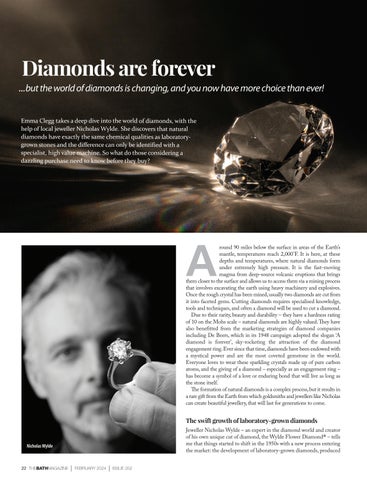
Nicholas Wylde
22 TheBATHMagazine | february 2024 | iSSue 252
Jeweller Nicholas Wylde – an expert in the diamond world and creator of his own unique cut of diamond, the Wylde Flower Diamond® – tells me that things started to shift in the 1950s with a new process entering the market: the development of laboratory-grown diamonds, produced
Diamonds Final.qxp_Layout 1 26/01/2024 17:55 Page 2
JEWELLERY / DAZZLED BY STONES
Laboratory-grown diamond 5ct tennis bracelet: £7,395
Seven-stone natural diamond 18ct yellow gold tiara ring: £2,120
“Everyone loves to wear these sparkling crystals made up of pure carbon atoms, and the giving of a diamond – especially as an engagement ring – has become a symbol of a love or enduring bond that will live as long as the stone itself” from graphite at temperatures of around 1,400°C and pressures around 1.5 million psi. By the 1980s, the technology had advanced enough for gem-quality stones to be produced, but at that time they formed a small fraction of the market; by 2019, the laboratory-grown diamond market share was around 3%. Since the pandemic, this has risen to around 35%, and experts forecast it to be closer to 40% by the end of 2024. The astonishing thing about laboratory-grown diamonds, says Nicholas, is that it is impossible with the naked eye to identify the difference between them and natural diamonds. They have the same physical properties, the same durability, and even an expert would find it extremely difficult to tell them apart without specialist equipment that detects the differing fluorescence between the two.
To make a laboratory-grown diamond requires an artificial setting that mimics how diamonds are naturally made. There are two methods: chemical vapour deposition (CVD) and high-pressure, hightemperature (HPHT). During the CVD process, a minuscule slice of diamond is placed into an iron chamber, where it is exposed to carbonrich gas, extremely high temperatures and microwave beams. Over a matter of weeks, the carbon gas ionises and the particles stick to the original diamond slice, before crystallising into a fully formed laboratory-grown diamond crystal, usually in a cube shape. During the HPHT process, pure carbon is pressed within a metal cube in a machine that is roughly the size of a Mini. The carbon is exposed to immense heat and pressure through electric pulses. Eventually, the carbon breaks down and crystallises into a cuboctahedron-shaped laboratory-grown diamond. Both processes result in different-shaped crystals to the octahedron shape of a natural diamond crystal, so at this stage laboratory-grown stones are easily distinguishable.
Relative values So where does that leave those looking for that special diamond, to last a lifetime and beyond? Nicholas tells me that there is a valid place for both laboratory-grown and natural diamonds. His stores in Bath and Bristol have – through demand – introduced a collection of laboratorygrown diamond jewellery that sells alongside the natural diamond collections. Part of their appeal is that the price of a laboratory-grown diamond will always be significantly lower than a natural diamond of the equivalent size, colour and clarity. The complexities come when laboratory-diamonds are knowingly or unknowingly mis-sold as natural diamonds, and a client can end up with a stone that is worth a fraction of what they paid for it and they were led to believe it was worth. This alone highlights the importance of always buying from a jeweller or a retailer that you know can be trusted, and who makes the necessary checks on all their stones. At Wylde’s, every single diamond that comes into the store is checked for its authenticity using a specialist machine – an expensive investment, but worth it because it provides peace of mind to all clients, Nicholas says.
Lab-grown facts * It takes one month to grow a HPHT crystal large enough to cut a 1–2 carat white diamond. * The CVD process can grow 60 square crystals at one time in two weeks, but CVD stones are often a lower colour grade and then they are reheated by the HPHT treatment to make them whiter. * It costs more to cut, certificate and transport a laboratory-grown diamond than to grow them. * From 2016 to 2023, the average price of a 1.5 carat laboratory-grown diamond decreased by over 74%.
THEBATHMAG.CO.UK | february 2024 | TheBATHMagazine 23
Diamonds Final.qxp_Layout 1 26/01/2024 17:55 Page 3
JEWELLERY / DAZZLED BY STONES
Sustainability and environmental impact Natural diamonds are mined from great depths and this can be disruptive to the eco-system, which historically has been a matter of controversy. But Nicholas tells me that the rough diamond trade globally supports 10 million people, and the industry also invests in sustainability and plants three acres of trees for every acre mined. In countries like Botswana, 80% of rough diamond revenue goes back into local communities. While laboratory-grown diamonds are frequently touted as ‘green’ or ‘sustainable’, their creation requires a great amount of energy, which is likely sourced from non-renewable fuels. Their environmental impact varies, depending on local regulations or the producers’ own policies, but this developing market has grown at speed and lacks the governance that is in place for the natural diamond industry. There is much current debate in the diamond industry about these issues.
Advice from Nicholas Wylde Nicholas explains his thoughts on laboratory grown and natural diamonds: “At Wylde Jewellers, we believe there is a place in the market for both natural and laboratory-grown diamonds. With the annual worldwide excavation of gemstone-quality natural diamonds only being one cubic metre, they are considered rare and have a long-standing sentimental and emotional value, so will still be largely considered the stone of choice for engagement rings and other luxury jewellery items – what gift could be more symbolic than something that was formed in the Earth itself and has been around for longer than any of us can comprehend! The monetary value of natural diamonds has historically been proven to increase over time, therefore they are considered to be a good choice for long-term investment, particularly for something like a piece of jewellery that will become a family heirloom. “Laboratory-grown diamonds, which have flooded the market since lockdown, do not have this rarity – an infinite number of them can be grown and thus they are not generally considered to be as sentimental
or precious. The price of laboratory-grown diamonds fell by 74% between 2016 and 2023; for as long as more laboratory-grown diamonds can be mass-produced, the value will not increase. But they serve a different and very valid purpose: perhaps to the young couple wanting to buy an engagement ring, but are also saving for a house deposit, who could get a beautiful laboratory-grown diamond for a fraction of the price of a natural diamond, with the intention of one day upgrading when finances allow; maybe a client will want a much-less-valuable replica of a very expensive piece of jewellery to be made, so that they can wear it in public with more confidence; a 3ct diamond – something previously unaffordable to most people – can now be yours for a fraction of the cost of a natural diamond, and with laboratory-grown diamonds available in all the colours that you find in natural diamonds, you can even have the opportunity to own a version of the most expensive natural diamond in the world – the pink diamond. “Responsible jewellers and retailers like us are not shying away from having laboratory-grown stones on the market, but we do all have a responsibility as retailers to test every stone to check if it is natural or laboratory-grown, and to tell the truth about its origins and the processes involved in the creation of the diamonds. “Regardless of whether they are purchasing natural or laboratory-grown diamonds, all of our customers will benefit from the ‘Wylde experience' as we call it here when they buy jewellery from us – the emotions, the journey, the story, the Champagne, the trust. The item that they are purchasing is a personal choice; we just want people to understand exactly what they are buying. We sell to our customers with confidence, knowing we are selling the correct diamond, at the best quality, at a competitive price and following the budget that a client wants to spend. “Natural diamonds are forever – but laboratory-grown diamonds can also be yours right now.” Nicholas Wylde, 12 Northumberland Place, Bath BA1 5AR nicholaswylde.com
1ct natural diamond engagement ring £15,000
1ct Lab Grown diamond engagement ring £2,000 1ct Natural Diamond Platinum Solitaire Ring, £8,995, clarity Si1, colour D – £8,995
2 x 0.50ct natural diamond studs £7,000
2 x 0.50ct lab-grown diamond studs £1,000
A pair of 3ct pear shape natural diamond earrings £60,000
A pair of 3ct pear lab-grown diamond earrings £3,000
20ct natural diamond tennis bracelet £90,000
20ct lab-grown diamond tennis bracelet £10,000
24 TheBATHMagazine | february 2024 | iSSue 252
1ct Laboratory-Grown Diamond Platinum Solitaire Ring, clarity VS2, colour E – £2,625
* Approximate market prices; these are subject to change
The prices of naturally formed diamonds vs lab-grown diamonds*
P25.qxp_Layout 1 24/01/2024 13:25 Page 1
Please Fill Our Empty Shelves
Contact Us For Silver Valuation info@beaunashbath.com | 01225 334234 | www.beaunashbath.com beaunashbath
THEBATHMAG.CO.UK | february 2024 | TheBATHMagazine 25
What's On Feb V2.qxp_Layout 1 26/01/2024 18:27 Page 1
FEBRUARY EVENTS
WHAT’S ON MUSIC AT GREEN PARK BRASSERIE n Green Park Brasserie, Green Park Road Enjoy live jazz/funk/soul/swing at Green Park Brasserie on Weds and Thurs from 6.30–8.45pm and Fri and Sat from 6.30–9.45pm. Music includes dynamic duos, modern trios and a Hot Club style quintet. greenparkbrasserie.com
This Yoga in the Chapel workshop (available for all abilities) is a light-hearted experience that offers time for every individual to move in different forms, finding balance as we move toward the end of winter, and step into the warmer seasons. This event is part of the ReBalance Bath Festival. Tickets £25. welcometobath.co.uk
loCAl lIfE dRAwING ClASSES Every Wednesday throughout the month, 7pm–9pm n The Common Room, 2 Saville Row, Lansdown, Bath Join a growing artistic community in the heart of Bath. Drawing boards and a wide array of art equipment are provided but feel free to bring your own tools and get as experimental as you like! The sessions are relaxed and untutored. The model will sit a variety of different nude poses, including some short and some long poses. There will be a 15-minute break in the middle of the session. Instagram: citylifedrawing; eventbrite.co.uk
ThE vEGAN PlATfoRM 4 February n Green Park Station, Bath The Vegan Platform is Bath’s monthly vegan market located at Green Park Station in central Bath. Here you will find a wide variety of vegan or sustainable products, including food, clothing, beauty products, and household items. The market takes place every first Sunday of the month. There is also a Retro Fit Fair so you can find vintage pieces for your wardrobe. theveganplatform.co.uk
yoGA AT ThE GAINSBoRoUGh: ‘BAlANCE yoUR ENERGIES’ 4 February, 10am–12pm n The Gainsborough Bath Spa, Beau Street, Bath Local life drawing Classes
‘BREAKfAST AT TIffANy’S’ fIlM EvENING 6 February, 5.30pm n Bath & County Club, Queen’s Parade, Bath The film will begin at 6pm. Bar and coffee will be provided, as well as a buffet during the interval. Visitors are welcome. £20 for both. bathandcountyclub.com fINd lovE wITh PAUl C. BRUNSoN 7 February, 7.30pm–9pm n Komedia, 22-23 Westgate Buildings, Bath Brought to you by the brand new team behind Bath Arts Collective, you are invited to join world-renowned relationships expert and head of global insight at Tinder Paul C. Brunson (Married at First Sight UK and Celebs Go Dating) for a very special event as he introduces us to his brand new book, Find Love, a brilliant guide to navigating modern love. Price £12. bathboxoffice.org.uk MARTIN hARlEy 9 February, 8pm–10.30pm n Chapel Arts, St James’s Memorial Hall, Lower Borough Walls Martin Harley has been making music and touring the world for over two decades. His sound has never been more down to earth.
26 TheBATHMagazine | february 2024 | iSSue 252
Image of the Year of the Dragon
Exploring roots, blues and slide guitar in a style The Guardian referred to as ‘Spellbinding’, Harley has released nine albums to date, four recorded on home soil and four across the Atlantic in Texas and Nashville. His solo shows are known for mixing excellent musicianship and songwriting with a down to earth sense of humour and tales of three decades of world travel. Tickets £20. chapelarts.org lUNAR NEw yEAR – yEAR of ThE dRAGoN 10 February, 11am–4pm n Bath Assembly Rooms, Bennett Street, Bath The Museum of East Asian Art will be running a fun-filled day for all the family at the Bath Assembly Rooms. Learn about the history and customs of this festival and take part in activities, workshops, and trails exploring different aspects of Lunar New Year and Chinese culture. meaa.org.uk UNIvERSITy of BATh GARdENING ClUB 12 February, 7.30pm–9pm n Room 1 Level 1, East Building, East Car Park, University of Bath, Claverton Down ‘Ben Pope – Creating Movement Whilst Frozen Still’. Ben is a garden designer and head gardener. This is a seasonal talk looking at the potential beauty of the garden in winter, how to achieve structure, movement and interest in the cold months. Open to all, annual membership £25, visitors £8. ubgc.org AldRIdGE’S of BATh AUCTIoN 13 February, 10am (viewing on Saturday 10 February) n Online Decorative and household sale, including Victorian, Edwardian, 20th-century and modern household furniture and furnishings, decorative china and glass,
Continued page 28
➲
Bath Philharmonica fp.qxp_Layout 1 24/01/2024 12:38 Page 1
What's On Feb V2.qxp_Layout 1 26/01/2024 18:28 Page 2
FEBRUARY EVENTS
pictures and prints, mirrors and rugs; also garden furniture, tools and general household goods. aldridgesofbath.com
performing Chopin’s elegant but unrequited second piano concerto. Tickets from £25, under 18s and students £5. bathforum.co.uk
SuliS hoSpital: prediabeteS; preventing and managing diabeteS; the riSk factorS you can beat 14 February, 6.15pm–8pm n Combe Grove, Brassknocker Hill, Bath “Prevent Diabetes and Take Control of Your Life!” This event is your chance to learn about the latest research on diabetes risk factors, prevention and management. Expert speakers Dr Bhattacharya, a consultant in diabetes and endocrinology, and Dr Rebecca Hiscutt PhD will provide practical tips on how to maintain good metabolic health and prevent disorders associated with the endocrine system, such as diabetes. sulishospital.com
bath comedy club 15 February, 8pm (doors open 7.30pm) n Nowhere, Lower Bristol Road, Bath Starring: Matt Bragg’s unique, low-energy, deadpan comedy; Ted Hill and his highconcept multimedia PowerPoint silliness; and Mark Flynn with his “divorced” personality, who will show the audience it’s never too late to find your comedic voice. Limited presale tickets available – buy now and save £5. bathcomedy.com
Sterling elliot 14 February, 1pm n Wiltshire Music Centre, Ashley Road, Bradford on Avon Acclaimed for his stellar stage presence and joyous musicianship, emerging American cellist Sterling Elliott has already appeared with many major orchestras. His programme explores the music of 19th and 20th century France. Claude Debussy’s Rêverie remains one of the composer’s most iconic melodies. wiltshiremusic.org.uk lara melda & bath philharmonia 14 February, 7.30pm n Bath Forum, 1a Forum Buildings, St James Parade, Bath Fill your hearts with music at a concert exploring the many facets of love and joy, featuring award-winning pianist Lara Melda Pianist Lara Melda plays with Bath Philharmonia at The Forum
bath bachfeSt 15–17 February n Various locations Celebrating the music of Johann Sebastian Bach and his Baroque contemporaries this delightful 3-day, 5-concert, midwinter festival offers classical music lovers respite from the darkest, coldest days and is guaranteed to raise spirits. The concerts will take place at St Mary’s Bathwick, Guildhall, and Bath Abbey. bathboxoffice.org.uk
Ted Hill from Bath Comedy Club
Bath Abbey and Bath Astronomers for live stargazing at the top of Bath Abbey’s tower. Bring your burning astronomy questions for a chance to have them answered by Bath’s space-ial experts. eventbrite.co.uk
bath opera: Semele 15–17 February n The Roper Theatre, Hayesfield School, Upper Oldfield Park If you like Handel's Messiah, you'll love his Semele! Nine glorious choruses enhance the story of Jupiter taking the mortal Princess Semele to be his mistress. Bath Opera's fully staged production will be set five minutes from now in a world adjacent to our own in which the drab reality of the populace is enlivened by the new Gods of the internet, 'influencers', social media stars and instagrammers - Jupiter, his wife Juno et al. bathboxoffice.org.uk
managing your menopauSe: a balanced approach with dr kate kerr 17 February, 3.30pm–5pm n Double Tree Hilton Hotel, Walcot Street, Bath Join Dr Kate Kerr, a Bath-based British Menopause Society-accredited menopause specialist, for a session that will cover holistic and evidence based approaches to managing menopause related issues. Topics covered will include low mood, anxiety, weight gain, brain fog, poor sleep and low libido. Ticket prices for this Bath Arts Collective event are £20. bathboxoffice.org.uk
mardi graS Supper and live muSic 16 February, 6pm n Bath & County Club, Queen’s Parade, Bath Listen to Chris Nesbitt as he plays New Orleans Jazz over a two-course meal served with coffee. Price £30. bathandcountyclub.com
wine dinner: umani ronchi le marche at la terra 21 February, 7.30pm n John Street, Bath The dinner consists of a four-course meal, with matching wine flight to accompany each course. £80 per person. You will recieve a drink upon arrival. laterra.co.uk
Stargazing tour 16 February, 6.30pm n Bath Abbey, Bath Are you fascinated by the night sky? Would you like to spot planets and stars from the top of one of Bath’s historic buildings? Join
puccini’S madama butterfly 21 February, 7.30pm n Bath Forum, 1a Forum Buildings, St James Parade, Bath Senbla presents Opera International’s awardwinning Ellen Kent production featuring the Ukrainian Opera and Ballet Theatre Kyiv
28 TheBATHMagazine | february 2024 | iSSue 252
Continued page 30
➲
Fulltone FP.qxp_Layout 1 24/01/2024 12:40 Page 1
What's On Feb V2.qxp_Layout 1 26/01/2024 18:28 Page 3
FEBRUARY EVENTS
with international soloists, highly-praised chorus and full orchestra. One of the world’s most popular operas, Puccini’s Madama Butterfly tells the heart-breaking story of the beautiful young Japanese girl who falls in love with an American naval lieutenant – with dramatic results. bathboxoffice.org.uk trio paradis: daughters of the muse 23 February, 3.30pm n St Michael’s Church, Bath This concert will explore pieces written by female composers. The performance will then be ongoing, taking place every last Friday of each month until June (with the exception of Good Friday), with each performance exploring a different piece. This means the audience will see something new each month. It forms part of a wider project covering the Somerset and Wiltshire area. Concerts last 45 minutes, entrance is by donation. trioparadis.com bath art fair 23–25 February n Bath Pavilion, North Parade Road, Bathwick, Bath Original contemporary art work, ceramics, jewellery and sculpture from over 80 of the nation’s leading independent artists, all under one beautiful roof ! Find the perfect painting for that awkward spot in the living room, the hand-crafted print to finish off your new extension, or a stunning centrepiece for the garden. Tickets £6 online, £7 on the door, £3.50 concessions and under 18s go free. bathartfair.co.uk an audience with lucy worsley on agatha christie 28 February, 7.30pm n Bath Forum, 1a Forum Buildings, St James Parade, Bath The ‘Queen of History’ Lucy Worsley is heading back out on the road to share stories from the fascinating life of the ‘Queen of Crime’, Agatha Christie. Sharing her research based on the writer’s personal letters and papers, Lucy will uncover the story of a person who, despite the obstacles of class and gender, became an astonishingly successful working woman. fane.co.uk italian wine dinner 29 February, 7pm n The Royal Crescent Hotel & Spa, Bath Indulge in an exquisite five-star wine dinner, where fine wines, delicious food and great company await. A special Leap Year Day
gastronomic delight, featuring a meticulously crafted four-course menu perfectly matched with a fascinating selection of Brunello di Montalcino wines of Capanna. £165 per person. royalcrescent.co.uk bath probus club Throughout February n Bath and County Club, Queen’s Parade The Probus Club is offering a talk on ‘Policing in the Sixties’. Membership of the club is open to professional and business people who are aged 55+ and are wholly or partially retired. The club has recently voted to welcome female members to the group. Talks take place on the second Thursday of each month. You can also enjoy a two-course lunch with coffee, priced at £22. tel: 01225 469722; email: brianwebber3@outlook.com
LOOKING AHEAD hellebore garden open days 3 and 10 March n Kapunda, Southstoke Lane, Bath A stunning display as seen on BBC Gardeners’ World with plants for sale. Tea and homemade cakes are available for visitors. Entry £5. Supporting Dorothy House and Wessex MS Therapy Centre. kapundaplants.co.uk u3a: the history and restoration of the kennet and avon canal 7 March n The Pavilion, North Parade The history and restoration of the Kennet and Avon canal by Graham Horn. Doors open at 9.45am for coffee. Admission is free for members, and a donation of £2 for nonmembers. u3ainbath.uk dorothy house: men’s walk to support 9 March, 11am n Dorothy House Hospice, Winsley, Bradford-on-Avon Team up with your brother, your son, your dad, your best mates, or take on the walk solo – it’s up to you! The Men’s Walk to Support is a great chance to chat and share experiences with fellow participants while supporting the charity’s vital work at Dorothy House Hospice Care. Entry is £25. dorothyhouse.org.uk
30 TheBATHMagazine | february 2024 | iSSue 252
Trio Paradis: Daughters of the Muse
bath symphony orchestra: reach for the stars 9 March, 7.30pm–9.45pm n Bath Forum, 1a Forum Buildings, St James Parade, Bath Listen to Bath Abbey Girls’ Choir and Hayesfield Girls’ School Choir sing with Bath Symphony Orchestra as they present a spacethemed programme of music featuring Gustav Holst’s The Planets; John Williams’ Star Wars Suite for Orchestra and Star Trek music by James Horner and Michael Giacchino. bathforum.co.uk bath minerva choir 16 March, 7.30pm n Bath Abbey, Bath Join Bath Minerva Choir for Bach’s monumental masterpiece, featuring a cast of international soloists led by James Gilchrist as the Evangelist, with Bristol Baroque Ensemble on period instruments under the inspiring baton of the director Gavin Carr. Tickets £30. bathboxoffice.org.uk J.s bach st matthew passion 27 March, 7pm n Bath Abbey, Bath In Holy Week hear the beautiful sounds of baroque players Rejouissance as they lead the nationally acclaimed singers of Abbey Girls, Boys and Lay Clerks in this most uplifting and inspiring piece of music. bathboxoffice.org.uk For updates and new events subscribe to our weekend edition newsletters. See thebathmag.co.uk to sign up.
P31.qxp_Layout 1 25/01/2024 15:13 Page 1
THEBATHMAG.CO.UK | february 2024 | TheBATHMagazine 31
BRLSI.qxp_Layout 1 26/01/2024 18:50 Page 1
CULTURE & COLLECTIONS
Hidden treasures at BRLSI
It’s 200 years since the Bath Royal Literary & Scientific Institution first opened, and that’s something worth celebrating. Here we track some of the highlights this month, and Emma Clegg has a collection tour...
C
elebrating its 200-year anniversary in 2024, Bath Royal Literary & Scientific Institution has some exciting things in store – and yes, there are plans to celebrate all year long. This month brings the Brilliantly Engineered exhibition from 24–26 February, where local engineering companies return to BRLSI to showcase the amazing technology and engineering strength emanating from the south west. Comprising of a community-focused weekend event and student learning workshops during the week, this promises to be a fun learning experience for families and children of all ages; in fact, anyone with an interest in science, technology or engineering. Other unmissable opportunities to find out fascinating things include Nelson and the Slave Trade, a talk by Chris Brett, who investigates allegations that Lord Nelson was pro-slavery, and reveals how the West Indian planters took a private letter from Nelson, written on board HMS Victory in June 1805 and forged it in an attempt to influence debates on the abolition of the slave trade in Parliament in 1807 (Monday 5 February, 7.30pm–9pm, £3–£6). There is also a talk by by Paul d’Anieri and Rajan Menon on The War in Ukraine, asking Is Peace Possible? (28 February, 7.30pm–9pm, £4–£8). Another one to note is a consideration of A Vindication of the Rights of Woman by Marie-Louise Luxemburg, talking about how Mary Wollstonecraft’s feminist treatise, initially received with a mixture of outrage and enthusiasm, was rediscovered by feminists in the 20th century (21 February, 11am–12pm, £4). brlsi.org
32 TheBATHMagazine | february 2024 | iSSue 252
COLLECTION CORNER I was recently given a tour of the BRLSI collection, when Collections Manager Matt Williams spent an hour and a half showing me round. It wasn’t a massive amount of time for a collection of 150,000 objects. Despite this, in that time I saw a tusk of the male narwhal – who lived in Arctic waters – that was over two metres long; an Ice Age mammoth milk tooth; and John Calvin’s 1954 In Librum Psalmorum, where the endpaper was made out of vellum manuscipt mostly likely sourced from a book confiscated in the Dissolution of the Monasteries in the 1530s. I also saw a 4.3 billion year old meteorite specimen; ridge tiles likely to have come from the looting of the ‘Old Summer Palace’ in Beijing in October 1860 (see left); a gibbet cap used when the last person was hung in Bath; and a Bath Humane Society resuscitation kit from 1805, including ivory tubes to fit the nose and a metal laryngeal tube. Then there was a Romano British brooch that was excavated in Lansdown in 1905, a fossil of the Twerton Dolphin who lived 125,000 years ago when Bath was a savannah with a huge river and sea level was nine metres higher than now. Oh yes, and a Canadian one-horse sleigh collected by Adela Breton, which sits commandingly on a cabinet behind Matt’s desk. In this, the year celebrating BRLSI’s bi-centenary, we will be choosing some select items from the Society’s collection each month, starting below with a bottle that has an uncomfortably close association with Lord Nelson. THE LORD NELSON BOTTLE The label on this little bottle has faded but it reads ‘Part of the liquor in which the body of Lord Nelson was preserved – after the Battle of Trafalgar.’ If genuine, it takes us back to the most murderous and bloody sea battle in British history. On 21 October 1805 the battle-scarred Vice Admiral master-minded an attack upon Napoleon’s French and Spanish fleet. He routed the enemy at the cost of his own life and that of thousands of other seamen. The British Navy normally committed its dead to the deep, but Nelson had wanted his body brought back to England. With no refrigeration, his remains were placed in a large water barrel – called a ‘leaguer’ – which was filled with brandy to preserve it. The journey home took 44 days. Nelson was buried in St Paul’s. The bottle belonged to a retired naval commander called Thomas Pickering Clarke who came to Bath around 1806 and was a founder member of the BRLSI in 1826. In 1862, the year of his death, the little bottle features amongst donations to the museum.
P33.qxp_Layout 1 26/01/2024 17:04 Page 1
...and Enjoy these Benefits:
* Staying active, keep learning and having fun * Meeting people and making new friends * Access to online learning and training * Free attendance to talks and learning events * Meeting other members with similar interests * Learning new things and sharing your skills
About u3a in Bath
There are 450,000 of us in the UK and 1,300 in Bath. We are in “u3a in Bath” and our members are all retired or semi-retired. We take part in a range of educational or recreational activities. See the complete list of over 100 interest groups on our website u3ainbath.uk
Come and join us
You can join us by going to our website www.u3ainbath.uk and completing the online application form or you can download the application form from the website and send it to Membership Secretary, u3a in Bath, PO Box 4040, Bath BA1 0EJ. You can also join in person at one of our monthly talks at The Pavilion. Membership fee is still only £15 per person per year.
Our Monthly Talks
Monthly Talks are usually held on the first Thursday in themonth (except August) and start at 10.30 a.m. Doors open at 9.45 a.m. for coffee. Admission is free for members but a donation of £2 for non-members. Talks take place at: The Pavilion, North Parade Road, Bath BA2 4EU
Upcoming Monthly Talks are :
1 February 2024 THE HISTORY OF THE THEATRE ROYAL BATH by Jane Tapley 7 March 2024 THE HISTORY AND RESTORATION OF THE KENNET AND AVON CANAL by Graham Horn 4 April 2024 THE TITANIC DISASTER by Paul Barnett
THEBATHMAG.CO.UK | february 2024 | TheBATHMagazine 33
Fulltone Orch.qxp_Layout 1 26/01/2024 19:20 Page 1
MUSIC / ORCHESTRAL
FIVE MINUTES WITH...
Anthony Brown / Fulltone Orchestra
Anthony Brown of the Fulltone Orchestra tells us about his musical life – from singing as a tenor, the transformative power of an orchestra, and what music he would most want to save from the waves. What are your earliest musical memories and did you have an upbringing in classical music? My earliest memory is sitting on the floor singing nursery rhymes and songs with my grandmother from a vinyl record (which I still have). My classical journey started as a young boy chorister and I was just a few years behind Aled Jones, so I grew up listening to him singing all the songs that I wanted to sing. I don’t have a musical upbringing as such, but my great grandfather was a lay clerk at Canterbury Cathedral, a professional singer and was described as a superb musician. When did you first start The Fulltone Orchestra? The orchestra started in 2017 with our first Iconic Movie Themes concert. It came after many years of being Musical Director of The
Invitation Theatre Company and I had a desire to work on large-scale orchestral music. What is it you liked about singing? And what were some of your favourite tenor roles? I have always loved singing, especially choral singing where you must work as a team. Singing as a soloist, I think, is even more nerve-wracking than playing an instrument – it’s just you and your voice, and you really do need confidence to sing in front of a large audience. I have a secret passion for the music of Gilbert and Sullivan, and I’ve always enjoyed playing the tenor roles from their operas. However, my top highlight on stage was singing Jesus from Jesus Christ Superstar. A totally different type if singing and a role that really challenged me . Was it a natural process moving from being a musician to conducting and directing? Yes, I would say so. But, I have always seen my approach to conducting as a collaborative one with the musicians I am conducting. I’ve also never been afraid to seek out advice and have had a great mentor over these last few years. What are the most important qualities of a conductor would you say? Being a great listener. You have to tune in and pick out different musicians and instruments throughout an orchestra of 60 players. You also need to have conviction and an inner strength to bring out the best possible sound from the musicians. How wide are your musical tastes? Very wide. There is very little music that I don’t like and what I listen to does depend on my mood. One minute it could be Holst, the next Meatloaf followed up with a little Irish Folk Music. Do you enjoy silence and other sounds apart from musical constructions? I am always listening to music, I am always looking for new music to perform, but I also do love a podcast. How did you come up with the name The Fulltone Orchestra? We were looking for a play on words; we didn’t want to name it after me, in the same way as The John Wilson Orchestra, and I also didn’t want a geographical tie. My nickname is Tone, and as it’s also a musical term it came from there.
Fulltone Orch.qxp_Layout 1 24/01/2024 13:34 Page 2
MUSIC / ORCHESTRAL How do you recruit new members of the orchestra? Can this sometimes be difficult, or is it competitive? We have never really struggled. In the early days we had to adapt a little, but as time has gone on and as our reputation has grown we regularly get musicians approaching us wanting to play. We now have a great selection of musicians playing from us with a group of over 150 that we select from. Do the individuals in the orchestra vary considerably from concert to concert? We definitely have a core, but I’ve always said that not everyone can or will want to play every concert of ours. I don’t think any two concerts have had the same list of musicians. What makes the Fulltone Orchestra the Fulltone Orchestra? We are unashamedly a mix of great amateur, semi-pro or former pro and professional musicians. Everyone brings something different to the music and we’ve managed to create a really safe, all-inclusive and focused work environment for everyone involved. How do you decide on the pieces to perform? I tend to pick the big piece, the headline piece of music, and then I think from an audience point of view – what would I like to listen to alongside that. I like to throw in a few surprises too! Most of our programmes tend to be full-on rollercoaster rides. What is one of your most favourite pieces of music? One you would save from the waves if you were on Desert Island Discs?
I would struggle to name one, Holst: The Planets, Bernstein: West Side Story, Rimsky-Korsakov: Scheherazade would all be up there. Along with Queen’s Greatest Hits Album! When conducting, do you feel the emotion in the music and can this be transformative? Absolutely! If you’re not feeling the emotion in what you’re performing, how can you expect the audience to be moved? The challenge comes when you’re performing a piece that you’re not particularly fond of, but you still need to convey the right emotions and get the best out of the piece for your musicians. Tells us about your upcoming concerts this year. I am really looking forward to conducting the Queen Symphony in Wells Cathedral (24 February), Tewkesbury Abbey (2 March) and Bath Abbey (9 March). We are now becoming regular visitors to these venues and I love the atmosphere that we can create. A classical concert, presented by my hero Aled Jones and wonderfully sung by Carly Paoli and Gareth Dafydd Morris comes to Bath Forum on 30 May, and this is going to be a magical moment. Our summer music festival in Devizes on 26–27 July where we do six orchestral concerts in two days is always a highlight and I’m ending the year with a Latin adventure (Latin Escapades!, 11 October, Bath Forum). The year 2024 is shaping up nicely! n The Fulltone Orchestra are playing The Queen Symphony by Tolga Kashif at Wells Cathedral (24 February) at Tewkesbury Abbey (2 March) and at Bath Abbey (9 March). fto.org.uk/queen-symphony/
THEBATHMAG.CO.UK | february 2024 | TheBATHMagazine 35
P36.qxp_Layout 1 25/01/2024 15:35 Page 1
From Past To Practical RON PRINGLE by Ron Pringle, Beau Nash Bath
T
hroughout history, families accumulated silverware not just for its aesthetic value, but as a form of financial security. Ancestral silver was a tangible representation of wealth and a safety net for uncertain futures. However, as societal values shift and priorities change, the significance of silver as a financial safety net has diminished. Instead, people are increasingly recognising the value of functional silver, not only as an aesthetic addition to their homes but also as a practical and usable asset. This change is closely tied to shifting lifestyle trends. Modern living often prioritises practicality and versatility over ornate displays of wealth. Ancestral silver, while undoubtedly holding sentimental value, may not align with the functional preferences of today's generation. Rather than relegating these pieces to storage, individuals are exploring the option of selling ancestral silver to fund more relevant and functional acquisitions. Functional silver items, such as cutlery, wine decanters and candlesticks have become sought-after pieces. Likewise, there are many old pieces of silver which have been repurposed for today’s needs. Sugar sifters once used for sprinkling caster sugar on strawberries are now being used to sprinkle cocoa on cappuccinos. Old meat skewers are now used as letter openers. Napkin rings, once a favourite for christenings, are now being used on a daily basis around the dinner table. With contemporary designs and a focus on usability, functional silver seamlessly integrates into everyday life. Selling ancestral silver allows individuals to invest in pieces that not only honour tradition but also enhance their daily experiences. Selling silver heirlooms doesn't diminish its historical significance; rather, it allows for a reinterpretation of that history in light of modern priorities. As we navigate an ever-changing world, it's essential to appreciate the evolving perspectives on possessions and find a balance between honouring the past and embracing the present. n beaunashbath.com; info@beaunashbath.com; 01225 334234 @beaunashbath
36 TheBATHMagazine | february 2024 | iSSue 252
Bath Airt Fair Feb.qxp_Layout 1 24/01/2024 12:41 Page 1
Bath 275 x 210 Arts_2.qxp_Layout 1 26/01/2024 14:14 Page 1
WHAT’S ON / ARTS
ARTS & EXHIBITIONS The Wonderful World of the Ladybird Book Artists, Victoria Art Gallery, Bridge Street, Bath, Until 14 April This colourful, family-friendly exhibition includes rare books, original artwork and artefacts, and reveals how illustrators contributed to Ladybird’s extraordinary success. The company’s story is recounted over Ladybird’s ‘golden years’ – 1940 to 1975. Visually rich and varied, the exhibition will evoke many memories of childhood. Hundreds of Ladybird books are available for visitors to browse through and share in themed retro reading areas. There’s lots for children to enjoy, with a free exhibition ‘I Spy’ trail and a quirky ‘Coco the Caravan’ reading den. victoriagal.org.uk
Catherine Ducker: Emotion in Colour, Victoria Art Gallery, Bridge Street, Bath, Until 21 April Catherine aims to create soft, calm places in her paintings, to produce works that sing with colour and light and give people solace in a turbulent world. Catherine Ducker studied at Central St Martin’s, but now lives in Oxfordshire. Surrounded by plants at all times, nature is ever present in her paintings, together with its therapeutic effects. All works in this exhibition are for sale. victoriagal.org.uk
Firewater, oil on canvas, by Louisa Burnett-Hall
Louisa Burnett-Hall at sandrahiggins.art Sandra Higgins Art is delighted to exhibit works by Paris-based British artist Louisa Burnett-Hall, from the series shown recently in China at the Water, Aria and Variations exhibition. Louisa explores the theme of water as a source of life and meditation in its real and imagined forms. To view works by Louisa, visit the online gallery or email Sandra to arrange a private viewing by appointment. sandrahiggins.art; sandra@sandrahiggins.com The Holburne Museum, Great Pulteney Street, Bath Gwen John: Art and Life in London and Paris, until 14 April This exhibition brings together paintings, watercolours, drawings and sketches to trace Gwen John’s career. The exhibition will place her art in relation to the two cities where she chose to live and work: from her early years at the Slade School of Fine Art in London to her move to Paris in 1904 and the life she built as an artist there.
38 TheBATHMagazine | february 2024 | iSSue 252
Gillian Lowndes: Radical Clay, Until 21 April Gillian Lowndes (1936-2010) was one of the most daring and original artists of the post-war period. Focusing on work from the 1980s to the 2000s, the exhibition showcases a small number of tabletop and wall pieces which reflect the breadth of her practice in the last few years of her career. holburne.org
P39.qxp_Layout 1 25/01/2024 15:16 Page 1
Beaux Arts Bath Sculpture Painting Ceramics •
•
12-13 York St. BA1 1NG 01225 464 850 www.beauxartsbath.co.uk info@beauxartsbath.co.uk Helen Simmonds Blue-rimmed Cup and Saucers Oil on Board 41 x 71cm.
THEBATHMAG.CO.UK | february 2024 | TheBATHMagazine 39
Bath 275 x 210 Arts_2.qxp_Layout 1 26/01/2024 17:42 Page 3
WHAT’S ON / ARTS Lubaina Himid: Lost Threads, The Holburne Museum, Great Pulteney Street, Bath, Until 21 April
Dragons, Dragons, Dragons, Museum of East Asian Art, 12 Bennett Street, Bath Until 22 June
Born in Zanzibar in 1954, Lubaina Himid is a British artist who has dedicated her four-decades-long career to uncovering marginalised and silenced histories, figures, and cultural expressions. Weaving and flowing across the front façade and around the permanent collections, Lubaina Himid’s Lost Threads will see 400 metres of vibrant Dutch wax fabric transform the spaces of the Holburne Museum, reflecting the movement of the oceans and rivers that have been used to transport cotton, yarn and enslaved people throughout history. holburne.org
A Celebration of Lighter Days, Beaux Arts Bath, 12-13 York Street
Dragons are coming! This family-focused exhibition showcases over 50 dragonthemed objects from the Museum’s collection to celebrate the Year of the Dragon. It explores the stories and symbolism of dragons across China, Japan, and Korea through family-friendly activities. Design your own dragon to hang in the ‘Dragon Gallery’; write your own dragon myth; and learn more about their history through a Fun Facts Trail and Family Activity Guide. meaa.org.uk
Woodland Study at the Dyson Cancer Centre at the RUH Woodland Study by artist Chrystel Lebas, created in 2024, stems from her previous works Abyss, Between Dog and Wolf, Blue Hour and Regarding Forests, an immersive installation recently shown at the Wellcome Collection (2021). Chrystel’s Regarding Forests explored positive
Woodland Study (still) by Chrystel Lebas
Late Summer Cosmos, by Helen Simmonds
Beaux Arts gallery throws off the January blues and strides determinedly into lighter days with a selection from the gallery stable – Bobbie Russon, Jo Barrett, Helen Simmonds, Nathan Ford, Atsuko Fujii, Anthony Scullion. Sculptures by Beth Carter, Anna Gillespie, Patrick Haines, Nichola Theakston - ceramics on show include Akiko Hirai, Jack Doherty, Chris Keenan. Open 10-5 Monday to Saturday. beauxartsbath.co.uk
emotions and their effects on physical and mental health. Immersive analogue photographs taken in forests and wildernesses during the twilight hour using slow large-format camera processes, combined with scent and ambisonic soundscape, consider notions of the sublime and our relationship to the natural world. The works highlight the complexity of these locations, showing a landscape controlled by human beings and observing natural phenomena occurring at a specific time and place. Studies on ‘forest bathing’ by researchers at the Nippon Medical School in Tokyo suggest that the multi-sensory experience of being in nature calms the stress response of the nervous system, which assists the body's immune response. For centuries, people have made pilgrimages to places of natural wonder to restore the spirit. Chrystel travelled to the southern Japanese island of Yakushima, known for its dense forest of ancient Japanese cedar trees known as ‘Yakusugi’. This primeval temperate rainforest contains some of the oldest living trees in the world.
40 TheBATHMagazine | february 2024 | iSSue 252
The film installation created for the dedicated space ‘Ambient Room’ in the Atrium at the RHU Bath Dyson Cancer Centre aims to bring calm and an introspective feeling of serenity for the visitor, drawn from forest bathing philosophies and from research from psychologists and scientists working on the parasympathetic (rest and recovery) nervous system. Woodland Study offers a contemplative space that includes a looped one-hour film recorded in an ancient bluebells forest in Wiltshire, tracking the forest from dawn to dusk in the spring and paired with surround sound. The sound of rain, wind, birds chirping and singing from dawn chorus to dusk is produced in collaboration with sound designer Paul Richardson. Forest Study makes us conscious of the time and space we occupy and give us an insight into the nature of time itself. The Dyson Cancer Centre is due to open in spring 2024. ruh.nhs.uk
P41.qxp_Layout 1 26/01/2024 14:16 Page 1
THEBATHMAG.CO.UK | february 2024 | TheBATHMagazine 41
Bath 275 x 210 Pam Downe costumes V3.qxp_Layout 1 26/01/2024 09:22 Page 1
CREATIVE IN THE CITY / FILM & TV
Costumed identities
Creating an authentic and believable world for a film or TV drama involves many creative contributors. One of those is Bath-based Pam Downe who has created costumes for actors such as David Tennant, Gemma Arterton, Dervla Kirwan and Andy Garcia. Pam shares some of her visionary world with us...
I
have been designing costumes for many years, moving
between TV and film and from period to contemporary projects, I have also worked on fantasy and more recently futuristic projects. I have been lucky enough to work in many countries including Romania, the Czech Republic, Morocco and the USA. Some of the more recent projects were Mr Malcom’s List, a film set in the Recency period which we shot in Dublin during the pandemic, Funny Woman a 1960s’ TV drama which filmed in Liverpool and starred Gemma Arterton. I am currently working on the new Doctor Who series and, having finished the three specials which starred David Tennant, we have now moved on to our new Doctor, Ncuti Gatwa.
My training was an Expressive Arts degree at Brighton Polytechnic
(it doesn’t exist now), which combined fine art with a performance option where I chose dance. I always had an interest in the construction of clothes and taught myself how to sew. I also was attracted to the differences of cut in period costume, so I ended up working for a short while in a costume house called Clothes Peg in London. However my
Charlotte Hope in The Spanish Princess 2 (2019), by Starz. Photo courtesy of Starz
big break was when I randomly contacted Sandy Powell (now a multi Oscar winner) who asked if I could sew and invited me to join her team and from there I learnt a lot about the film industry. I was lucky! For every project I work on I am given a certain amount of prep time.
This differs from job to job, from six weeks up to 12 weeks. Often a period piece will need a longer prep than a contemporary one. Prep time is for researching, for meetings with other creatives such as the director, production designer and the make-up designer so everyone is collaborating on the look as a whole, and for fittings. Where I source my costumes is entirely dependent on the project.
If I am on a period piece then most of my principles wear bespoke outfits. This means you can control the cut and choose more accurately the colours you want to use, thereby making sure they suit the actor and will work well in the sets. However for most smaller parts I often hire costumes, which will sometimes be altered to fit and be retrimmed to work with the aesthetic. With contemporary pieces I will buy from current collections, but also might make some pieces too. The best briefs I get are those that give a clear idea of the characters,
but allow you to interpret that visually. When I am ready to share my ideas I create mood boards for each character, which I send to key people such as the director, the producer and the show runner (the highest exec.). After feedback I adjust the images or not, depending on the response. After this all creatives go into a ‘tone meeting’ and share their images. Any sketches are done after this process. For researching a period piece I will often go to the V&A and the
National Portrait Gallery in London and the Fashion Museum in Bath. I also look at paintings and for more recent periods find photographic images in books and on the internet. Sometimes I read texts about costume from the period as this can give some insights. For contemporary I look for images on the internet and also look at new fashion collections. Period tends to be my preference over contemporary, as I like the
detail you have to go into with cut, fabrics, printing and trimming and the fact that you have licence to emerge yourself in that world. However it does depend also on the script – for some contemporary pieces you can stylise the look which can be fun. I always meet my actors at some point in order to fit them in their
outfits, however the timing of this can vary. For instance when I had to fit Andy Garcia for Modigliani (2003) I had so little time before he was to shoot that we had to make everything for him from measurements we managed to get from his previous show and I had to fly to LA with fully made-up costumes and fit him with my fingers crossed, hoping it would work and he would like it. This was my only
Bath 275 x 210 Pam Downe costumes V3.qxp_Layout 1 26/01/2024 09:23 Page 2
CREATIVE IN THE CITY / FILM & TV
“I had to fly to LA with fully made-up costumes and fit [Andy Garcia for Modigliani] with my fingers crossed, hoping it would work” Top: A still of Andy Garcia from the film Modigliani (2004) directed by Mick Davis, for which Pam Downe was nominated for an International Press Academy Golden Satellite Award for Costume Design Right: Gemma Arterton as Barbara Parker and Rupert Everett as Brian Debenham in Funny Woman (2023)
THEBATHMAG.CO.UK | february 2024 | TheBATHMagazine 43
Bath 275 x 210 Pam Downe costumes V3.qxp_Layout 1 26/01/2024 15:08 Page 3
fitting as he was flying to the UK four days later to shoot. (It did work!) In fact he was the actor who I was the most scared of meeting, but I was fairly new in my career then. I think my most challenging job is the new Doctor Who series,
which is very ambitious in its writing and visuals. There is the pressure of dressing the Doctor himself as the show has many fans with opinions so I am mindful of the legacy. In addition this Doctor has several costume changes, many of which are distinct, which is different from previous Doctor incarnations. It is also a show where each episode has its own tone so it is like making a new film each time. Added to that it involves complicated stunts and lots of visual effects which impact the costumes. In the new series of Doctor Who there are so many more characters
and fantastical creatures apart from the Doctor packed into each episode. One of the more interesting episodes for me was Special 3 (which aired in December 2023), for which I had to design a new costume for David Tennant but also the costumes for a character called the Toy Maker, played by Neil Patrick Harris, We made four bespoke costumes for him, a 1930s’ evening tails with a top hat, a 1920s’ toy shopkeeper, a full marching band outfit and a 1930s’ pilot outfit. Some of these looks were referred to in the script (such as the tails) but for the others I just interpreted what was written on the page. One of my most memorable projects is The Trial of Christine Keeler.
This is because the story about the Profumo affair is so fascinating and
Sophie Cookson in The Trial of Christine Keeler (2019) Photo: Ben Blackall/Ecosse Films/BBC
44 TheBATHMagazine | february 2024 | iSSue 252
Doctor Who Special 3, December 2023 (BBC Studios)
CREATIVE IN THE CITY / FILM & TV
I loved doing the research on the different worlds Keeler inhabited, from the fancy world of Profumo to the edgy world of Notting Hill where she also hung out. It was shot in Bristol and Bath, so it was local for me which was a huge bonus. By the same token I enjoyed working on The Spanish Princess 2, a Tudor TV drama, also shot locally. One of the shows I am most proud of is Interlude in Prague, an 18th-
century film about Mozart’s time in Prague where he created Don Giovanni. We shot in Prague and I had costumes made in London. There was a notable scene where Mozart attends a masked ball filled with monied dignitaries – this allowed me to create fantasy costumes where I had to try and imagine what these 18th-century people might wear as fancy dress! n
P45.qxp_Layout 1 25/01/2024 15:17 Page 1
THEBATHMAG.CO.UK | february 2024 | TheBATHMagazine 45
Food and drink.qxp_Layout 1 22/01/2024 10:06 Page 1
FOOD & DRINK
Wines of the
Lebanese mountains
FOOD & DRINK LUXURIOUS TREATS TO ENJOY WITH YOUR VALENTINE
Recommendations by Tom Bleathman from the Great Wine Company Beautiful yet troubled Lebanon enjoys warm summers, cool winters and dramatic landscapes. One of its outstanding wines is IXSIR, established in 2008, which uses fruit from Lebanon's finest sites, including the dramatic Ainata vineyard, which at an awe-inspiring 1,800m elevation is higher than any vineyard in Europe. Vines grown this high make wines with spectacular, soaring fruit, and exhilarating balance and complexity. Discover more at greatwine.co.uk A rich garnet in colour, the IXSIR Altitudes Red 2019 has irresistibly succulent aromas of juicy, ripe black cherries, fresh raspberries, and a sprinkling of peppery spice. Drink now and over the next 3-4 years. This would complement roast or barbecued lamb beautifully. £24 This unique IXSIR Altitudes White 2022 has beautifully distinctive aromas of oranges, jasmine, honeysuckle, and mango. It is superbly well-balanced: fresh and refreshing, with satisfying completeness of texture and a long, elegant finish. Exceptionally delicious. £24 The IXSIR Grande Reserve Red 2016 is drinking beautifully at the moment. It’s young enough to still show fresh, plump and juicy black cherry and purple plum fruit, and old enough to have developed a wonderful, velvety texture. Great to enjoy now and over the next three years. This IXSIR benefits from the consultancy of Hubert de Boüard, the winemaker of the famous Saint Emillion and proprietor of Château Angélus and exhibits the same fabulous sophistication in winemaking. £35 46 TheBATHMagazine | FebrUarY 2024 | issUe 252
Recipes by Melissa Blease
Baked Camembert Preheat the oven to 200°C/gas mark 6. Remove the packaging from 1 x 250g whole, round Camembert, wrap it loosely in greaseproof paper and place it back in its box. Slash the top of the cheese in a criss-cross pattern and add a generous splash of dry white wine, a couple of sprigs of thyme or rosemary, a pinch of dried chilli flakes and a drizzle of honey. Bake on a baking tray for around 20 minutes or until meltingly gooey and serve with shards of toasted French bread, for dipping.
Chocolate & Raspberry Mousse Break 50g high-quality dark chocolate into a bowl. Heat 200ml double cream until it just about reaches boiling point (but do NOT allow it to boil!). Pour the hot cream over the chocolate and whisk until the chocolate has completely melted. Put 6 fresh raspberries into the base of each of two glasses or ramekins and pour the chocolate mixture over the fruit. Chill for 2 hours (or cover with cling film and leave in the fridge for up to 24 hours) before serving topped with a dollop of thick cream, more raspberries and a dusting of cocoa powder.
The Circus fp.qxp_Layout 1 26/01/2024 10:40 Page 1
Bath 275 x 210 Green Park Brass review.qxp_Layout 1 26/01/2024 17:30 Page 1
FOOD & DRINK
FOOD REVIEW
Green Park Brasserie Green Park Brasserie, 6 Green Park Station, Bath; Tel: 01225 338565; greenparkbrasserie.com
Bring the routines back, says Emma Clegg, as she samples Sunday lunch at this much-loved Bath food and drinks venue and remembers the good old days.
T
here was a time, before Amazon and iPhones, when routines rigorously punctuated our daily lives. Things happened at the same time each day, each week. The postman walking up the garden path; a set time to collect the paper from the newsagent and freshly baked bread from the baker; fish and chips on a Friday evening; shopping at Woolworths or Ratners on a Saturday; and watching That’s Life with the family on a Sunday night. Nowadays we have lost many of our weekly landmarks. It’s often for the best – we can take advantage of hybrid or flexi working to avoid the traffic-rammed commute; streaming on demand trumps set viewing times; online meetings take away the travel grind; Spotify brings music immediately to hand; and an air fryer allows the creation of fast meals with a fraction of the energy (from you and from the grid). This is instead of slaving over a family-sized roast chicken requiring exact timings calculated on the back of an envelope and the laying of the table by younger family members as the tempting aromas and rumbling stomachs make them think they might collapse with hunger. The Sunday lunch was a given. It was family time, a day of rest, whether or not you were a church-goer – it was sharing news, it was a comfort, a togetherness, before the afternoon allowed adults to read the papers at their ease and in the warmer months do a spot of gardening. So here’s an idea. If your Sundays have had the routine stuffing knocked out of them – or maybe a reassuring pattern for the seventh day of the week has never emerged, because it’s just another chance to do your tax returns or catch up on that work assignment – then take a stand, collect your family together (banning the use of mobiles if you’re feeling brave) and take them to Green Park Brasserie.
It’s a no-brainer. Lunch is served from 12 to 4, families are welcome, it’s a buzzy atmosphere of conversation and warmth, heightened by the golden colours of the glitzy bottles behind the bar and the draught beer pumps. The location – the former ticket office of Green Park railway station – is of a grand height and area, with delineated seating groupings, and the restaurant feels traditional, animated, welcoming. It was a nippy day when we visited and we first charged ourselves up with a San Miguel and a Glenmorangie whisky on the rocks, always a welcome aperitif to warm the cockles. We knew as we perused the menu that there would be no need to take gastronomic risks, or to challenge the palate. The food is honest, consoling, nourishing. Our roasts – one free-range chicken and one nut roast, the latter with apricot and almond flavours – were all that was needed, served with Yorkshire pudding, roast potatoes, maple-glazed carrots and parsnips, cauliflower cheese and garlic hispi cabbage. Children’s portions are available and staff are friendly and ever-present. The nut roast (with a vegan option) was really tasty, crisp, moist and crumbly and the chicken breast was tender and infused with flavour. If you don’t fancy the traditional home-styled dishes, then opt for a Braz Classic, perhaps the Newlyn Market Fish catch of the day, a 30day aged sirloin steak from nearby Newton Farm with fries, garlic butter, Portobello mushrooms and grilled tomato, or a choice of burgers including those with Chuck Steak or ‘Vegan Moving Mountains’ with cheddar and tomato chilli jam and fries. For the pure-diet advocates, a Superfood Salad with avocado, quinoa, kale, pumpkin seeds and pomegranate ensures that all tastes are catered for. If we had been feeling boozy we could have drunk our dessert – and the Sloe Gin Negroni and Salted Caramel Espresso Martini were both on our radar. After deliberation it was the Madagascan Vanilla with Salted Almond and Ginger Crumb Cheesecake with Burgundy poached pears, and the Crème Brulée that won the Sunday. Plainly these were not strictly necessary after our wholesome main meal, but they rounded things off nicely. But none of it was strictly necessary, was it? This wasn’t a grim routine, it was a weekend treat that reminded us of family Sundays of old, evoking those familiar, grounding and companiable times in just the same way. For the children sitting within their family networks across the way, colouring and chatting, it was surely creating memories that they might one day remember and treasure. IPhones and air-fryers may come and go, but Sunday lunch remains an unchallengeable institution, with the help of Green Park Brasserie. n Sunday Roasts at Green Park Brasserie: Roast Beef Newton Farm Topside (£21), Roast Chicken Free Range Chicken Breast (£19), Nut Roast with Apricot and Almond (£19)
48 TheBATHMagazine | february 2024 | iSSue 252
P49.qxp_Layout 1 25/01/2024 14:14 Page 1
THEBATHMAG.CO.UK | february 2024 | TheBATHMagazine 49
Bath business.qxp_Layout 1 26/01/2024 17:20 Page 1
THIS IS BATH
Bath business
LOCAL BUSINESS AND COMMUNITY ORGANISATION UPDATES
JITTY LAUNCHES ITS APP
BATH TECH START-UP Bath tech start-up Xplore has plans to create a thriving local economy through a new discovery app dedicated to independent businesses and 0% transaction fee technology that helps business owners reduce their costs. Based at Newark Works, Bath, Xplore aims to connect communities and empower businesses. Its mission is rooted in the belief that this is key to creating inclusive, vibrant and sustainable communities. The mobile-first technology serves as a bridge between communities and businesses, a dedicated place to discover local eateries, cafés, shops and services. The team at Xplore aims to help businesses grow by providing the technology to positively influence the towns and cities we call home. xplorelocal.com Jitty co-founders Graham Paterson, Daniel Cooper and James Storer
Jitty, the UK’s AI-powered home-discovery app has launched across Bath and is now officially available for download in app stores iOS and Android. Backed by Gradient Ventures, Google’s AI-focused venture fund, Jitty provides a superior and more transparent view of every home on the market, alongside beautiful social and shareability features, and curated content-discovery. The home discovery app plans to index the whole UK property market this year and will initially cover the south west of England, starting with Bath. Unlike existing property portals, which haven’t changed since the MySpace generation, Jitty has been built with property addicts and home-buyers at heart. The new app, which currently has more coverage of the housing market in Bath than Zoopla, enables deep-dive search and discovery of homes through a delightful, fun, and simple user experience. jitty.com
ROTARY CLUB DONATES £10,000 TO LOCAL CHARITY SSAFA, the Armed Forces charity, was recently given a cheque for £10,000 by the Rotary Club of Bath at a presentation hosted by the Lansdown Golf Club. SSAFA South West Regional Chair, Tony Singer received the cheque from Allan Gait, Rotary Club Bath Chair. Allan said: “We wanted to show our support for those who serve our country, and we have been really impressed by the individualised assistance which SSAFA gives to those in need from a services background.”
The south west region has seen a recent increase in requests for assistance, with the average need becoming more complex, time consuming and costly. SSAFA relies on donations to run its world-wide support, which depends on a network of fully trained and experienced volunteers. Volunteers come from all walks of life and a military background is not necessary. To find out about opportunities with the UK’s oldest triservice charity, visit: ssafa.org.uk/volunteer
AIRPORT TERMINAL IN A GARDEN IN INDIA A first-of-its-kind ‘airport terminal in a garden’, based on a vision of landscape architects Grant Associates, has opened in India, putting nature and biodiversity at the heart of the passenger experience. Terminal 2 at Kempegowda International Airport Bengaluru has successfully reinvented the idea of a traditionally stressful and bustling airport landscape. The innovative design offers passengers an immersive and authentic nature-focused experience; the unique flora that occupies the new terminal has been sourced from multiple ecological habitats in India, showcasing the beauty of nature and 50 TheBATHMagazine | february 2024 | iSSue 252
the state of Karnataka’s culture. Trees of 600–800 years meet with over 180 rare, endangered and threatened species, all combining to cultivate a thriving ecosystem that embraces both India's heritage and forward-thinking sustainability. Grant Associates was appointed by Bangalore International Airport Limited in May 2016 to deliver on this unique brief. The international landscape architecture practice, which employs over 70 landscape architecture professionals in its studios in Bath, UK and Singapore, has proven experience of delivering numerous remarkable projects at
scale, including the world-renowned Gardens by the Bay in Singapore. grant-associates.uk.com
P51.qxp_Layout 1 25/01/2024 15:19 Page 1
THEBATHMAG.CO.UK | february 2024 | TheBATHMagazine 51
P52.qxp_Layout 1 26/01/2024 11:57 Page 1
ocl A C C O U N TA N C Y
141 Englishcombe Lane, Bath BA2 2EL Tel: 01225 445507
www.oclaccountancy.com
HMRC reminds cryptoasset holders of tax obligations HMRC is urging cryptoasset holders to check if they need to report transactions. Does this affect you? HMRC is concerned that individuals who sell or exchange cryptoassets may not be aware that they need to file a tax return, particularly as a charge can arise even if no money (in the traditional sense) is received. A return will be needed if capital gains, including any arising from transactions in cryptoassets, exceeded £12,300, or if aggregate disposal proceeds for the tax year exceed £49,200. HMRC says that you should check your position if you have made transactions involving cryptoassets, including: • selling cryptoassets for money • exchanging one type of cryptoasset for another • using cryptoassets to make purchases • gifting cryptoassets to another person • donating cryptoassets to charity. In some circumstances, the receipt of cryptoassets may be liable to income tax, e.g. where received from an employer or from mining activity. HMRC does provide further guidance on its website in the form of it’s Cytoassets Manual. Online side hustlers to feel HMRC's wrath? HMRC will soon start to receive information about the money people make on online selling platforms such as TikTok and Etsy. This has led to panic about a new “side hustle” tax. Who will be affected? Despite the sensational headlines, no new taxes have been introduced. In fact, it’s always been the case that if you are trading, i.e. attempting to make a profit, you may be subject to income tax and NI on those profits. Where profits exceed £1,000, you are required to report the income and expenses to HMRC, via a selfassessment tax return, even if there is no tax to pay. For example, this could be the case if profits are below the personal allowance of £12,570 per annum. For those where the online selling is a secondary income source, the £1,000 de minimis still applies, i.e. if you have earnings from your main job that exceed the personal allowance, you can earn up to £1,000 as a self-employed individual tax free. If you are using online selling sites, it’s important to recognise whether you are trading or not. A quick rule of thumb would be that if you are making a profit, you are likely to be trading. For example, if you are importing goods from China and listing them on Amazon at a higher price, this is clearly a trade and profits exceeding £1,000 are taxable. Likewise, if you are making goods, such as candles, and selling them on Etsy, you are trading. Whereas, if you are selling unwanted gifts, and your second-hand clothes/toys/furniture etc., you are unlikely to be trading and unlikely to be making a profit.
For more information contact us – call Tristan Wilcox-Jones, Samantha Gillham or Lucas Knight on 01225 445507
Call Tristan Wilcox-Jones, Samantha Gillham or Lucas Knight on 01225 445507 to arrange a no-obligation meeting 52 TheBATHMagazine | february 2024 | iSSue 252
Do you want to start a new chapter? Some people use the start of a new year as a time to reflect on their lives and make resolutions for the future. With the new year underway there is no better time to make a Will. If you already have a Will consider if there have been any changes since it was made. Life events such as marriage, divorce, the birth of a child or grandchild or the acquisition of a home or other significant assets often have an impact on the wishes in your Will. When a person dies without leaving a valid Will, their property (the estate) must be shared out according to certain rules. These are called the rules of intestacy. As a result of intestacy, your estate may not pass to your intended beneficiaries. By making a Will and keeping it up to date you can ensure that your estate passes to your chosen beneficiaries in the most taxefficient way. We are a team of experienced lawyers based in Bath who are here to provide you with expert advice and guidance when making decisions for yourself, your family and your future. No matter how complex your situation, we can guide you through the process and help you make the right decisions for you.
Bath College fp.qxp_Layout 1 24/01/2024 13:09 Page 1
Bath education.qxp_Layout 1 26/01/2024 18:12 Page 1
THIS IS BATH
Education matters NEWS FROM THE CITY’S LEARNERS AND LEADERS
LEARN TO TOUCH TYPE King Edward’s School in Bath is running a four-day Learn to Touch Type Easter Course which will run every day from 2–5 April. The course is suitable for pupils in Year 7 to Year 13 with two course options available. All courses will be based at the school’s Senior School campus on North Road. The Learn to Touch Type Easter Course is open to all pupils; you do not have to attend King Edward’s in order to book a place. Fee: £450 per course. kesbath.com
54 TheBATHMagazine | february 2024 | iSSue 252
MILLFIELD NO. 1 FOR SPORTS Millfield has been named as the number one sports school in the country. The rankings, published annually by School Sports Magazine, sees Millfield claim top spot for the tenth time in 11 years. This is in recognition of both Millfield and Millfield Prep School’s continued success across a variety of sports. Last year proved to be another year of exceptional sporting performance at Millfield. It became the first northern hemisphere school to be featured in the renowned rugby documentary The Season, which followed Millfield’s First XV’s
journey to St. Joseph’s Festival and School’s Championship victory, with footage of the series generating more than 1 million views on social media. Their pioneering Girls in Sport programme continued to educate, raise awareness and remove taboos around girls’ needs in sports that can hamper progress and champions equality. The programme addresses many of the societal and physical issues professional sportswomen are currently facing, that has been widely covered in the national press. millfieldschool.com
P55.qxp_Layout 1 25/01/2024 15:20 Page 1
THEBATHMAG.CO.UK | february 2024 | TheBATHMagazine 55
Bath 275 x 210 SW Lakes.qxp_Layout 1 26/01/2024 17:11 Page 1
TRAVEL / SPRING BREAK
Lake expectations
Walking next to Wimbleball Lake; inset: Camping at Tamar Lakes
One of South West Lakes Trust’s five lakeside campsites in Cornwall, Devon and on Exmoor could be your next spring getaway. With footpaths and cycle trails to investigate, woodlands to discover and play areas to enjoy, everyone can get involved and benefit from being outdoors. It’s your outdoors – come and explore! Wimbleball Lake, Exmoor Discover the beauty of Wimbleball Lake, a designated Dark Sky Discovery Site, nestled in the rolling hills of Exmoor National Park, and just a twohour drive from Bath. The family-friendly campsite has five bell tents, two wooden camping pods and a cabin as well as a choice of hard standings, electric and nonelectric pitches for tents, motorhomes and caravans. You can hire a fire pit, purchase wood and charcoal made onsite, rent a telescope and pay an afterdark visit to the new Dark Sky Discovery Hub to gaze at the stars. Enjoy an aerial adventure on the high ropes course, hit the bullseye on the archery range or fly fish for rainbow trout. Hire watersports equipment, launch your own or learn something new with the friendly and knowledgeable instructors. You’ll also find a packed programme of activities on during the school Easter, May half term and summer holidays. Explore Exmoor and walk to Haddon Hill from Wimbleball. See if you can spot the great range of wildlife at the lake, such as the iconic Exmoor ponies and deer. The closest town to Wimbleball is Dulverton but it’s also worth venturing slightly further to CAMPSITE OPENS explore the popular towns and villages of Tiverton, Porlock, 1 MARCH Minehead, Watchet, Wiveliscombe, Taunton and Wellington.
Roadford Lake, Devon The magnificent Roadford Lake is situated amongst the beautiful countryside of the Wolf Valley with the dramatic tors of Dartmoor as its backdrop, making it the perfect location for your next family escape. The scenic campsite offers a choice of spacious electric and non-electric pitches for tents, caravans and motorhomes as well as a fantastic bell tent 56 TheBATHMagazine | february 2024 | iSSue 252
called Bertie. Enjoy a tasty treat from the Roadford Lake Café while the little ones let off steam in the new play area. Hire watersports equipment, launch your own or learn to kayak, canoe, paddleboard or sail with the activities team. You’ll also find a packed programme of activities during the school Easter, May half term and summer holidays as well as at weekends in June and July. Roadford is also one of the best brown trout fisheries in the UK, with 700 acres of fishing to explore by boat or bank. Roadford is the perfect base to explore the spectacular Dartmoor National Park. Within easy reach of Roadford are the historic towns of Launceston and Okehampton and some CAMPSITE OPENS of the best beaches in Devon and Cornwall are less than an 1 MARCH hour away.
Siblyback Lake, Cornwall With the striking backdrop of Bodmin Moor, a designated International Dark Sky Landscape, Siblyback Lake near Liskeard lies within the Cornwall Area of Outstanding Natural Beauty. Right next to the lake, the small campsite has a choice of electric and non-electric pitches for tents and motorhomes. Watersports equipment hire and self-launch is available when the Activity Centre opens in May. Siblyback is also renowned for its fly fishing. It is regularly stocked with rainbow trout and home to a large population of resident brown trout. CAMPSITE A must-do on your visit to Bodmin Moor is Dozmary OPENS Pool, where according to legend, King Arthur rowed out to 26 APRIL the Lady of the Lake and received the sword Excalibur.
Bath 275 x 210 SW Lakes.qxp_Layout 1 26/01/2024 17:13 Page 2
TRAVEL / SPRING BREAK
Stithians Lake, Cornwall
Tamar Lakes, Cornwall
Stithians is the largest inland water in West Cornwall, with activities from fly fishing to footpaths, wildlife to watersports and café to camping. Surrounded by farmland and moorland, Stithians Lake’s family-friendly campsite has a choice of electric and non-electric pitches. If glamping is more your style, you can stay in one of the luxury bell tents, furnished with comfy double beds and the option of camp beds for up to two children. Everything you need will be in your tent, including storage for clothes, bean bags, fairy lights, lighting and a charging point for your gadgets. Each bell tent has an undercover outdoor cooking area with table and seating. Hire watersports equipment, launch your own or learn to kayak, canoe, paddleboard or sail. You’ll also find a packed programme of activities on during the school Easter, May half term and summer holidays. The lake is open for fly fishing from March to November. Cornish landmarks the Minack Theatre, Glendurgan CAMPSITE OPENS Gardens and Pendennis Castle are all within easy reach. 29 MARCH
This idyllic location on the Devon and Cornwall border is perfect for exploring on bike or foot. The campsite has a CAMPSITE OPENS choice of electric and non-electric pitches for tents, caravans 26 APRIL and motorhomes. Alternatively, the onsite four-berth glamping pod is perfect for families not wanting to travel with lots of camping gear. It’s furnished with two bunk beds, a table and chairs, cutlery and a cool-box. Hire watersports equipment or launch your own. Upper Tamar Lake is also renowned for its carp and match fishing. The Cornish coastal town of Bude with its sea pool and popular beaches is nearby and Dartmoor National Park and the beach resort of Newquay are under an hour’s drive from the lake. South West Lakes Trust is an independent charity dedicated to caring for and enhancing the region’s reservoirs and lakes. Your support helps us keep these places special for people and wildlife. n swlakestrust.org.uk/activities
Windsurfing on Stithians Lake
THEBATHMAG.CO.UK | february 2024 | TheBATHMagazine 57
Bath 275 x 210 ReBalance V4.qxp_Layout 1 26/01/2024 17:34 Page 1
HEALTH / REJUVENATE IN BATH
Festival of feeling-good
Chase away the cold dark days and treat yourself in the city hosting a celebration of feel-good activities, mindfulness and motivation, spa packages and taster sessions. Here are some of the Rebalance events taking place until 18 February... RELAX AND REFUEL PACKAGE AT NO 15 BY GUESTHOUSE HOTELS, BATH Every day until 18 February, 8am–5pm n Laura Place, Bath
Relax and refuel with a 60-minute Ritual or Facial followed by Lunch, Choose from Bespoke No.15 Facial, Lessen Your Stress, Ease Your Tension, Regimen for Him, Time Out for Mum-to-be. Monday – Friday: £110 per person ;Saturday – Sunday: £140 per person. LUNCHTIME SOUND IN BATH Every day until 18 February, 12pm, 2pm 4pm and 5pm n The Soul Spa, 2 Hetling Court, Bath
Enjoy deep relaxation in the sound waves of crystal bowls. The sound bath timetable runs every day of the week Monday – Sunday at 12pm, 2pm, 4pm and 5pm. The Soul Spa is providing a 50% discount for the ReBalance Festival, so quote the code ‘REBALANCE’ to receive your discounted price of £7.50. PERSONAL STYLING WITH MINT VELVET Every day until 18 February, 8am–5pm n Mint Velvet, 6 New Bond Street, Bath
Join Mint Velvet for a personal styling experience – try out wardrobe staples, must-buys and some of the season’s biggest new looks. Build and create new outfitting options that will work hard alongside your current collection. Elevate your everyday wares and secure timeless new classics to lean on. Book your Personal Styling session in store. Free. AQUASANA AT THERMAE BATH SPA 7 February, 8am–11am n Thermae Bath Spa, Hot Bath Street, Bath
Explore mind, body and soul with expert teacher Bex Bridgford for a morning of Aquasana in Thermae Bath Spa’s Rooftop Pool, followed by a Thermae Welcome 2-hour spa session. Aquasana includes classic yoga postures combined with gently tai chi and invigorating karate moves in the spa’s mineral-enriched waters. £50 58 TheBATHMagazine | february 2024 | iSSue 252
WALKING CRICKET AT BATH CRICKET CLUB 8 February, 2pm–4pm n Bath Cricket Club, North Parade
Walking Cricket is cricket played at a slower pace – perfect for people who are older, or less physically able, but who still want to enjoy the thrill of the game. The game can be played as teams or in pairs. Everything is walking, including the ‘runs’ and fielding. Whether you’re batting, bowling, or fielding, it’s a great form of cardio exercise. £5 THE SUNDAY SOCIAL BATH CYCLING CLUB 11 February, 9am–11pm n The Sunday Social normally leaves from Brunel Square ReBalance guests are welcome and need to have a safe, roadworthy bike, be confident riding on the road and choose a ride length and speed that is appropriate for their fitness, and experience. Please sign up beforehand. Details of all rides are posted on the Bath Cycling Club site a few days before a ride takes place. Free. SUNDAY ARTFUL YOGA AT THE HOLBURNE MUSEUM 11 February, 10am–11pm n The Holburne Museum, Bath Marta Poszwa invites you to join her for yoga in the Holburne Museum. Yoga is one of the most beautiful ways to reconnect with your mind, body, and spirit. The beautiful shapes of yoga asanas, the euphoric bliss that comes over you at the end of a class, this is art in its simplest and most divine form. £12 SILENT DISCO AT THE GUILDHALL 10–11 February, 10.15pm–12.30am n The Guildhall, High Street, Bath Grab your friends and a headset and curate your own soundtrack against a unique and historic backdrop at the Guildhall. With your dancefloor the splendid Banqueting Room, pick your channel, take to the dance-floor and choose your side as the DJs battle it out playing the best in 80s and 90s pop, rock and party classics. An 18+ only event. £16 For the full list of Rebalance activities and events and to book your place visit: welcometobath.co.uk/rebalance-bath-festival-of-wellbeing
The Orangery October.qxp_Layout 1 24/01/2024 12:45 Page 1
the orangery clinic l a s e r
•
a e s t h e t i c s
•
b e a u t y
Wind back the clock BODY TREATMENTS • Slimming • Cellulite reduction • Skin tightening and toning • Massage therapy
AESTHETICS • Peptide injections for skin and hair rejuvenation • Dermal fillers • Lip enhancement • Wrinkle treatments • Profhilo • Non surgical skin tightening & lifting treatments for face, eyes & neck
IPL PERMANENT HAIR REDUCTION TREATMENT • Suitable for face & body • Offers permanent hair reduction for men and women
IPL SKIN REJUVENATION
FACIALS • Radio frequency facials • Environ skin care & facials • Bespoke facials to treat all skin concerns • Scientific skincare that really makes a difference, outstanding results for all skin types and ages • Skin peels • Microdermabrasion • Wow facial • Guinot Hydradermie facials
COSMETIC TEETH WHITENING
Gift Vouchers Available
• Reverse skin damage, tighten pores & skin • Boost collagen & elastin production • Reduce the appearance of fine lines & wrinkles • Treat vascular lesions (broken capillaries, blood vessels & rosacea)
Let’s get you booked in No.1 Argyle Street, Bath BA2 4BA | Tel: 01225 466851 www.theorangerylaserandbeautybath.co.uk
Nuffield fp.qxp_Layout 1 26/01/2024 09:09 Page 1
Edgar Buildings fp.qxp_Layout 1 24/01/2024 12:58 Page 1
Rush Hill Care FP.qxp_Layout 1 25/01/2024 15:26 Page 1
R
Quality care in Bath you can trust
When a family is thinking about care for a loved one, they want the best - they want to know that the care home they choose will put their loved one’s safety, happiness and wellbeing first. ush Hill Mews is managed by award-winning provider Care UK - one of the UK's most highly successful care home operators* with over 40 years' experience of delivering high quality care to older people.
Living at Rush Hill Mews is all about quality of life. Every colleague in the home is passionate about enabling residents to enjoy a fulfilling lifestyle, tailored around their unique needs and preferences. The lifestyle team organises a huge variety of group and one-to-one activities, with plenty going on each day. With the extra support that our care home offers, new residents are often surprised at what they can do, whether that’s being able to continue with an activity they’ve enjoyed in the past, or even discovering new hobbies with our daily activities.
62 TheBATHMagazine | february 2024 | iSSue 252
The purpose-built home is designed for enjoying a luxury lifestyle, with en-suite rooms and facilities including a cinema, café, hair and beauty salon, and comfortable lounges and dining rooms. The home also boasts stunning gardens with wheelchair friendly pathways – the perfect place to spend some time when the weather allows.
Whether your loved one enjoys a quiet cup of tea in bed before starting the day, loves going for strolls in the landscaped grounds, or enjoys a chat over a glass of wine, the team at Rush Hill Mews will spend time to enable them to continue living life the way they want to. Rush Hill Mews care home Clarks Way, Bath, Somerset, BA2 2TR 01225 591 334. careuk.com/rush-hill-mews
*As rated by the Care Quality Commission in England and the Care Inspectorate in Scotland.
P63.qxp_Layout 1 26/01/2024 17:14 Page 1
DENTAL & DENTURE CLINIC
Thinking of promoting your business? Our 2024 media pack can be viewed online
NEW PRIVATE DENTIST APPOINTMENTS NOW AVAILABLE Routine check ups No waiting list Invisalign Teeth whitening Implants
SCAN THE CODE TO READ THROUGH OUR 2024 MEDIA PACK OR CONTACT US ON 01225 424499 or EMAIL: SALES @ THEBATHMAGAZINE.CO.UK
Free denture consulation
Call to book an appointment!
01225 311 681 @ jbdental@live.co.uk
www.jbdentureclinic.co.uk
THEBATHMAG.CO.UK | february 2024 | TheBATHMagazine 63
Bath 275 x 210 Andrew Swift.qxp_Layout 1 26/01/2024 16:16 Page 1
WALKING / A HISTORY
Royal Crescent in 1800
Walking in the footsteps of the Georgians
Walking in Bath is not a recent trend; it goes right back to 1668 when Samual Pepys strolled around the city walls towards the riverside meadows. Andrew Swift (who’s quite keen on walking himself) explains why it has always been such a pleasure
M
uch of Bath’s appeal resides in stories of a fabled past, peopled by tutelary deities such as Beau Nash, Ralph Allen and Jane Austen – a time beyond recall when its denizens enjoyed an endless round of bathing, betting, balls and taking the waters. But there was something else those well-heeled pleasure seekers indulged in no less keenly, something that indeed was a little pedestrian – walking. Walking was an essential part of the health cure that many came seeking in Bath in the 18th century. But it was also an important part of the social scene. In 1742, John Wood described how, “when noon approaches, some of the company appear on the Grand Parade, and other public walks, where a rotation of walking is continued for about two hours ...” Walking was popular before Bath’s Georgian heyday, however. When Samuel Pepys visited in 1668 he strolled around the city walls before heading for the riverside meadows known as the King’s Meads, southwest of the city, a favourite resort for those taking the air. When Celia Fiennes visited Bath 20 years later, paths had been laid out through the meadows and ‘ little cake-houses’ had opened to entertain the company. Within the city walls, the area east of the abbey was planted in 1675 with 80 sycamore trees and gravel were walks laid out. It was known as the Grove – later renamed the Orange Grove after an obelisk to commemorate a visit by the Prince of Orange was erected. According to John Wood, this was “the only Place of general Resort in the City for Pleasure and Exercise. Here the Company repaired in the Afternoon, when they had drank the Hot Waters, to compleat the Day with walking, while the Musick was playing to them”. In 1714, a visitor called John Macky described the Grove as “spacious and well shaded, planted round with shops filled with everything that contributes to pleasure, and at the end a noble room for gaming, from whence there are hanging-stairs to a pretty garden ... to walk in.” This ‘noble room’ was Bath’s first assembly room; the garden below it was Bath’s first pleasure garden, a more exclusive riverside retreat than the King’s Meads. To the south of the garden, high above the flood plain, 64 TheBATHMagazine | february 2024 | iSSue 252
“The green hills that enfold the city... are still, as they were in the 18th century, an abiding backdrop to the bustle of its streets” John Wood built grand terraces opening onto wide traffic-free streets which he called North and South Parades. This is where the beau monde could promenade – or parade – in all weathers. St James’s Parade was built to serve a similar function. By now, the King’s Meads had disappeared under Kingsmead Square and the streets to the west of it. Bath’s visitors were also growing more adventurous. They took ferries to newly opened pleasure gardens across the river or explored the woods and fields overlooking the city. They were encouraged by John Wood, whose guide to Bath reassured them that “the difficulty of ascending our hills is not so great as is generally reported; but when surmounted, what beautiful prospects do they give? ... I will venture to say, that so many beautiful points of view, and matters of curiosity may be found about Bath, as conducive to the health and pleasure of mankind in general, as can be met with in ten times the space of ground in any other country.” One of the walks he recommended was to Prospect Stile, near the racecourse – then as now a fair old hike from the city centre – to which, he confided, “the curious resort not only to look down upon the cities of Bath and Bristol ... but to behold a region that sets paradise itself before ones eyes”. As far as Wood was concerned, taking a country walk was less about getting fit than about communing with the ideal of rural bliss lauded by the writers and artists who moulded 18th-century taste and inspired landscape gardens such as those at Prior Park. Artist Thomas Gainsborough came to Bath to work as a portrait painter, but one of his chief delights was to head for the hills and valleys around the city, where he could indulge his passion for sketching rural scenes. Another painter who loved Bath was Benjamin West. In 1807,
Bath 275 x 210 Andrew Swift.qxp_Layout 1 26/01/2024 17:30 Page 2
WALKING / A HISTORY he “spoke of Bath and its vicinity with rapture as abounding with picturesque scenery. Take Bath & 20 miles round it he said, and there is not in the world anything superior to it.” Walking also figures largely in Jane Austen’s two Bath novels – not only as a means of getting to the shops or visiting acquaintances, but also as an end in itself. In Northanger Abbey, Catherine Morland climbs Beechen Cliff with Eleanor and Henry Tilney to admire the view, while at the end of Persuasion Captain Wentworth and Anne Elliot head off not into the sunset but along the Gravel Walk. Jane Austen herself walked what may seem to us an extraordinary amount. She didn’t consider it extraordinary – simply because everyone who could walk, did walk. As she writes in Northanger Abbey, “a fine Sunday in Bath empties every house of its inhabitants, and all the world appears on such an occasion to walk about and tell their acquaintance what a charming day it is.” To cater for this captive audience, a never-ending series of guides and descriptions of walks appeared. One of the most popular, published in 1819, was Walks through Bath by Pierce Egan, a journalist known for penning descriptions of bare knuckle boxing and the seedier side of London life. Written in an irreverent style which still makes it entertaining reading today, it provides a fascinating insight into Regency life and serves as a measure of how much the city has changed. So multifarious have those changes been and so insistent are the demands of the 21st century that it is difficult to feel any sense of what walking along the Parades or through the Orange Grove would have been like two centuries or more ago. The green hills that enfold the city, though, are still, as they were in the 18th century, an abiding backdrop to the bustle of its streets, and still offer a ready means of escape from their fumes and frivolity. It is here, if anywhere, that we can come closest to
experiencing what Georgian visitors would have experienced. And, in case you’re tempted to assume that the Georgians – clad as they were in their voluminous finery – only ventured forth when the weather was warm and the ways unsullied, bear in mind that the popular time to visit Bath back then was winter rather than summer, and take heart from what Edmund Rack wrote in 1780: “Even in the nakedness of winter our prospects are pleasing. The wild irregularity of surface, the extent of varied country, the numbers of objects, and the changes of scene at every step furnishes the spectator with unabated pleasure.” Exploring the landscape around Bath isn’t just a way of evoking the past. It also introduces us to the best of what the city has to offer today. For ideas to set you off on the right track, visit bathscape.co.uk. Andrew Swift has written many books including On Foot in Bath: Fifteen Walks around a World Heritage City – available from bookshops or akemanpress.com.
View from Beechen Cliff, 1757
THEBATHMAG.CO.UK | FEBRUARY 2024 | ThEBATHMAgAzinE 65
Bath 275 x 210 Kitchens V3.qxp_Layout 1 26/01/2024 18:24 Page 1
INTERIORS
Cooking up a style storm
Emma Clegg remembers her grandmother’s simple kitchen in the 1970s and wonders what she would think of boiling hot water taps, decorative splashbacks and induction hobs with integrated extraction. It’s hard to tell, but what she is sure she would have liked is a kitchen that belongs to the whole family.
I
remember my grandmother’s kitchen in the 1970s. I say my grandmother’s, because I only remember my grandfather walking through the kitchen to the garden. It was a closed-off room, a fairly small room at the back of the house, a bit chilly, very practical. An area to prepare food and wash up. There was worn grey linoleum, an enamelled electric stove with a fold-down top, a stainless steel whistle kettle, a small fridge, linoleum counters, wooden drawers and cabinets with simple wooden knobs, and a single door to the back garden. I suspect she had lived with that kitchen for many years because it had none of the ‘modern’ flourishes typical of a kitchen of that time – particle board cupboards, laminate benchtops, or shades of pastel. Things have changed in the kitchen world, thank goodness (including the idea of who the kitchen ‘belongs’ to!). Kitchens are now the focal point of our homes, a place for the whole family to relax, work and socialise as well as cook and eat. And, location permitting, they are likely to spill out into the garden, creating a ‘green room’ extension. Sir Terence Conran described the kitchen in his 1994 The Essential House Book as ‘the hub of the home’ – and this was undoubtedly an expert projection. That established, prevailing fashions come and go, and kitchen design constantly shifts in its make-up and flow. New trends, often driven by technology, sweep in and change the kitchen conversation. Equally, reinvention is necessary from time to time, ranging from a simple style refresh to commissioning a new extension where you start from scratch.
Modern-style twooven Aga in Raspberry by Blake and Bull
Here are some thoughts from our local kitchen experts on what’s hot in the room that is the warm, beating heart of so much family activity.
BLAKE & BULL — Aga cookers remanufactured as ecoelectric — MATTHEW BATES — blakeandbull.co.uk
The longevity of our Aga cookers and the fact they now run on electricity that gets cleaner and more sustainable every year, has meant a huge increase in their popularity. Everyone wants what Aga cookers provide – amazing food from a cosy, warm kitchen. The controllable electric models mean kitchens don’t need to be stifling in the summer and that the cookers can cope with even the biggest Christmas dinner! Through the careful choice of style, colour and trim you can create a sleek modern appliance or a traditional feel. We make cookers to order in nearly 6,000 combinations, so no two are alike. Aga cookers cook with radiant heat from cast iron ovens unlike almost every other cooker, and nothing else makes food taste the same. No ‘forced convection’ (fan) oven comes close! Colour trends change all the time, so rich colours are in now when a couple of years ago every second cooker was grey. We make and sell our own range of accessories too, from drying racks (to make use of the warmth!) to textiles and roasting trays, all made in Britain.
BEN ARGENT KITCHENS — contemporary bespoke kitchens — EMI ARGENT — benargentkitchens.co.uk We create timeless contemporary kitchens, and there has been a shift from uber-minimal to more of a hybrid, contemporary style mixed with rustic or industrial, or with classic elements to add visual interest. Natural wood always gives a timeless finish and adds warmth. Pale or whitened oak is ever-popular, but there is a trend towards darker, richer tones, such as smoked or fumed oak. We’re introducing antique metals including brass and bronze, and incorporating liquid metal finishes for kitchen fronts or splashbacks to create distinctive, sophisticated features. Our bespoke freestanding 20/20 collection, inspired by elegant, modern furniture design was a result of wanting to move away from kitchen units being fitted between walls, instead designing individual, free-standing furniture with more personality. Our freestanding kitchens float on beautifully crafted legs, creating an elegant, lightweight appearance that makes a room feel spacious and dynamic. We recommend the Bora induction hob with integrated extraction, removing the need for an extractor above or ducting below, and giving more design freedom and storage. It also removes all steam and odours, which is mesmerising to watch and complements open-plan living. All our worktops are sintered stone, or ceramic. These are the most durable surfaces available, and can’t be scratched, stained or burnt. Highly polished worktops are long gone, replaced by those with matt
66 TheBATHMagazine | february 2024 | iSSue 252
Bath 275 x 210 Kitchens V3.qxp_Layout 1 26/01/2024 18:25 Page 2
INTERIORS
Above: Liquid Antiqued Brass cabinet fronts by Ben Argent Kitchens; Top right: Easy Touch Mineral Green kitchen by Kütchenhaus: Right: Easy Touch Rust Red kitchen by Kütchenhaus; Bottom right: A take on a modern, Shaker kitchen by Ben Argent Kitchens infuses elements of opulence and grandeur
and subtly textured finishes. Accessory channels – giving versatile functional storage within the worktop – can be used for anything from utensils, chopping boards to power bottles and herb sinks. Open pantry units are in vogue, and backdrops include those with beautiful veined stones, antique mirrors, or a striking hand-laid decorative geometric mirror backing.
KÜTCHENHAUS — German inspired kitchens — BEN GREGORY — uk.kutchenhaus.com
Kitchen trends this year include the use of earthy colours such as reds, greens and blues, which help create a tranquil environment. Continuing its rise is a timber accent finish, which works well for Scandi-style oak décors. Acoustic panelling provides an interesting contrast to block colour doors and panels. Exciting door colours to look out for in 2024 include coral and jade, with splashes of colour coming from colourful flower motifs and detailed boho-style décor. Kitchen styles of note include minimalist true handleless cabinetry, paired with taller base cabinets and lower plinth panels, which look streamlined and add more storage. Hiding a utility entrance or walk-in larder using dummy tall units or sliding door solutions can provide great ways of not breaking up the design flow. Kitchen appliances continuing to garner attention include the vented hob collection by Bora – where there are no more unsightly overhanging extractor hoods. To those looking for an integrated refrigeration solution with the capacity of freestanding options, a new range of 30in/760mm wide integrated fridges and freezers are available from Bosch, Neff, Siemens and AEG. As the sustainability message continues, worktop manufacturers are highlighting their porcelain, low-silica products, and interest is being shown to the Dekton and Neolith brands, which offer heatproof, extremely hard-wearing worktops, wall panels and tabletops.
Bath 275 x 210 Kitchens V3.qxp_Layout 1 26/01/2024 18:28 Page 3
BATH KITCHEN COMPANY — high-quality bespoke kitchens — JAMES HORSFORD — bathkitchencompany.co.uk
We are seeing dark moody colours coming in, paired with warm woods, and almost American farmhouse-style features. Bronze and brass patinated handles are very popular, with unique shapes, such as wavy pull handles, making a comeback. Splashback ledges are in vogue, and open shelving made of the same material as the worktop. Lighting is a big factor that can change the mood of a kitchen. We are seeing statement pendants predominate, and even table lamps on worktops. Mixed metals are a big focus for kitchens and it’s no longer the rule that everything needs to be in one colour. Fluted and ribbed marble and islands are also very trendy, and unique. Shaker is always a popular choice as a kitchen style, especially in Somerset, as it lends so well to the style of period homes here. As we are a bespoke kitchen company, we can cater for any design dream or
idea, and we work with lots of variations of that. For simpler spaces you could be more refined, and for grand homes with high ceilings, we add profiles and beading to match particular detailing. In Bath, classic will never go out of fashion, but we also make some beautiful contemporary kitchens. Marble with strong veining has been a consistent desired worksurface over the last few years. The statement that it can make, especially if pared with a more neutral cabinet, is beautiful. This fulfills the desire for a kitchen that has character, as the marble will age and gently wear in, while still retaining beauty for years to come. For cooking applicances, steam ovens are becoming more and more popular as people are wanting to eat more cleanly, and most of the brands we work with such as Wolf and Bertazzoni, cater to that.
DREAM DOORS — new kitchens and replacement doors — MALCOLM MCKAY — dreamdoors.co.uk
Neutral colours, such as sage green and sky blue, have been taking over our homes. This means that we connect with nature and green kitchen elements are a great way to bring a sense of zen. Our kitchen designers have also seen a rise in the desire for energyefficient swaps in their homes, including switching to a microwave oven and induction hob, and installing a boiling water tap to eliminate the energy used to heat a kettle, or boil water on the stove. We have a commitment to sustainability, and that’s why we actively encourage our customers to reuse any existing cabinets that are in good condition and only to replace doors and drawers! Accent lighting, including within pelmets and plinths, is increasingly popular. Slim shaker style doors are also on trend, with narrower and plainer details for a cleaner look. Granite sinks are another big area and have taken over from ceramic sinks. These are hard-wearing, scratch and stain resistant, and available in multiple colours to match your kitchen design. Left: Bella Matt Denim in the Aldridge style, by Dream Doors; Above: Accessory channels and a herb sink, from The Bath Kitchen Company 68 TheBATHMagazine | february 2024 | iSSue 252
Bath 275 x 210 Kitchens V3.qxp_Layout 1 26/01/2024 18:32 Page 4
“One of the more surprising kitchen trends that has gained traction is the boiling water tap” COOPERS HOME APPLIANCES — kitchen appliance retailer — DARRIN CHRISTAN — coopershomeappliances.com
One of the more surprising kitchen trends that has gained traction is the boiling water tap. Once seen as a luxury item in the kitchen, people have started to be far more diligent around the running costs of their white/small goods, and this even applies to the humble kettle! When you crunch the numbers and realise it’s a long-term investment, it’s hard to imagine your home without one. We love the Quooker cube which offers the all-in-one solution of chilled filtered drinking water, sparkling water and boiling water. We have an entire suite of recently launched kitchen products. We have undertaken a drastic refurbishment in the shop over the years and the last piece of the jigsaw is the upstairs addition. The first phase was to introduce our brand-new Miele area which showcases top-ofthe range laundry, cooking and dishwashing appliances. One of the biggest trends currently is to navigate away from inefficient appliances to greener alternatives. Clear examples of this are heat pump technology dryers that have all but completely replaced the older condenser and vented options, and the sudden boom in replacing gas with safer and more efficient induction where possible. Induction cooking has been around for a long time, but with demand for the technology now higher than it has ever been and with prices becoming more and more reasonable, the question is, why would you choose gas?
Karndean Art Select Prairie Oak by Bath Carpets and Flooring (Bath Carpets and Flooring, 4 Kingsmead Stret, Bath; carpetsandflooringbath.co.uk)
A kitchen with a pantry cupboard from Sky Interiors (Sky Interiors, Bluesky House, Western Way, Melksham, Wiltshire SN12 8BZ; skyinteriors.co.uk) The Quooker Fusion Carbon Tap from Coopers Home Appliances
Bath 275 x 210 Kitchens V3.qxp_Layout 1 26/01/2024 18:29 Page 5
Above: Chester Pure White Kitchen Island with a granite top and oak storage crates, from Cotswold Company (The Cotswold Company Bath, 12 Northgate Street, Bath; cotswoldco.com)
MANDARIN STONE — tile specialists — LOUISA MORGAN — mandarinstone.com
Texture is big in kitchen tile trends right now. As technology advances, tactile finishes are capturing the imagination of homeowners and designers alike. This trend offers a sensory experience, adding interest, warmth, and personality. Often coupled with tonal variation, textural elements invite interaction and soften the ambience of your home. The ever-popular subway tile has been elevated and given extra character as seen in our new Alba and Loki ranges. Such tiles work well in rustic and retro kitchens, but also offer textural contrast to sleek, modern designs. Wood effect is still firmly on trend, and our range reflects this with new additions for 2024. Their warmth and earthy tones provide a sense of calm and complement natural materials and varying colour palettes. The Jakob range is both beautiful and practical in its plank and parquet format. We’ve also recently introduced an interesting parquet design, which combines a light-coloured porcelain inset within the wood effect tile. There is a definite shift away from grey hues that have dominated design for so long. Warm tones are increasingly prevalent, as seen in our Zellige Sand and Kobi Clay. Clients are certainly replacing coolness with cosiness choosing nuances of red, pink, orange and peach.
HOBSON’S CHOICE — luxury kitchens and bathrooms — GRAHAM CRAIG — hobsonschoice.uk.com
The modern kitchen continues to be a place where we socialise, work, cook and dine. With personal wellbeing and sustainability being strong drivers, we can see the integration of decorative planters that go beyond the ‘plant pot on the windowsill’, and storage options tailored for homemade items, such as kimchi. Our clients often choose to combine textured natural materials or decorative finishes with more hardwearing surfaces. This creates a space that balances eye-catching texture and detail with durability and will have a lasting appeal to the homeowner. The minimal, understated appearance of a Bulthaup kitchen allows the furniture to sit comfortably in any age or style of home, designed and finished to suit the taste of the homeowner. This style of kitchen is easy to manage and can be continually refreshed with the addition of decorative accessories such as lighting, plants, art and cookbooks. Induction cooktops with an integrated downdraft recirculate extraction and have a commanding presence – available from brands such as Bora, Miele, Siemens and Gaggenau. Their design freedom and cooking and air cleaning efficiency have quickly made them a firm favourite. Modern integrated downdraft extraction has seen bulky overhead cooker hoods fade away, freeing up space for more decorative lighting alongside bright working area spotlights. With the press of a button, the lights dim, and the sleek kitchen workspace transforms into a more intimate casual dining environment. Quartz worktops with a decorative ‘marble-esque’ pattern have a real presence. These luxurious, opulent surfaces offer consistent colours and veining, making them a more hardwearing and low-maintenance alternative to natural stone. n
Left: Rustic Barn Conversion with exposed beams and brickwork uses the B3 Bulthaup kitchen from Hobson’s Choice; Above: Alba Mist matt tiles from Mandarin Stone
P71.qxp_Layout 1 26/01/2024 14:36 Page 1
V I N T A G E
F U R N I T U R E
given a new lease of life j e f fo s b o @ h ot m a i l .c o m | 0 7 8 7 5 1 2 9 9 6 4
We specialise in design, manufacture and installation of bespoke kitchens, bathrooms, bedrooms, home studies and media cabinetry.
Sky Interiors
Melksham SN12 8BZ www.skyinteriors.co.uk E: enquiries@skyinteriors.co.uk T: 01225 707372 Showroom viewing Mon-Fri 8am-5pm Saturday via appointment only
THEBATHMAG.CO.UK | february 2024 | TheBATHMagazine 71
P72.qxp_Layout 1 26/01/2024 10:08 Page 1
Church Farm, Hilperton, Wiltshire
12 beautiful homes in an eclectic mix of designs ranging from three to five bedrooms.
Show home open
01225 791155 | ashford-homes.co.uk | 72 TheBATHMagazine | february 2024 | iSSue 252
Bespoke Roofing fp.qxp_Layout 1 25/01/2024 15:29 Page 1
Gardening.qxp_Layout 1 22/01/2024 12:13 Page 1
GARDENING
Bottle it up
Elly West lets her imagination run riot as she explores the fascinating world of terrariums – terrain where horticultural lovers of all levels can create their own miniature ecosystems, from tropical jungles to Japanese-style gardens
H
ouseplants have had a resurgence in popularity in recent years, possibly helped by Instagram, but also well-deserved as we become more conscious of the health benefits of being in touch with the natural world. My memories of houseplants from childhood are largely dusty spider plants and shrivelled cacti, but a contemporary houseplant display can be so much more with a bit of careful planning. Terrariums are also enjoying a revived popularity, and as I currently have a pet fish that appears to be on its last legs (so to speak), I’ve been wondering how to repurpose the tank when he floats off to the giant fish bowl in the sky. A bit of research and I’m hooked. There are so many ideas and inspirational images online, from small jars with simple mosses and miniature ferns, to larger landscapes simulating tropical forests, Japanese-style gardens, hills and mountains. Imagination is allowed to run riot. Rocks, gnarly driftwood, and a multitude of ornaments join the plants for more (and less) realistic displays that include fairy gardens, alien habitats, and Hobbit-style landscapes complete with pathways, steps, houses and fake streams.
Where science meets art The combination of horticulture, science, creativity and artistry is appealing, and the result can be a beautiful focal point for a room, or a fun project for younger family members. These miniature ecosystems are low-maintenance and largely self-sustaining, so ideal for the less green-fingered among us. Although terrariums are back in the spotlight, the concept dates back to the mid-19th century, when south London botanist Dr Nathaniel Bagshaw Ward accidentally dropped a fern seed inside a jar where he was keeping a sphinx moth. This was an era of botany, natural history and plant collecting. Ferns were a popular fascination in Victorian times, coining the term ‘Pteridomania’ (or ‘fern fever’), and Bagshaw Ward had a collection in his garden. However, the polluted London air of a postindustrial world meant many would fail to thrive. Over time the little fern seed grew into a healthy plant in this toxin-free, humid environment, which sparked the idea to grow other humidity-loving plants in a contained space. His illustrated book On the Growth of Plants in Closely Glazed Cases followed, as did his invention of the ‘Wardian Case’, which meant plants could be transported on ships around the world, protected from the harshness of life at sea and the salty air. This brought exotic plants to the UK from far-flung locations, thanks to his ideas. Terrariums are not just ornamental displays; they add a natural element to our indoor space and can be beneficial to our wellbeing. They integrate easily into contemporary lifestyles and fit into most design schemes, with a multitude of different shapes and sizes available. They’re ideal for people living in cities without much outdoor space, and are a convenient and low-maintenance alternative to traditional gardening. As a self-contained ecosystem, condensation ensures that moisture is recycled, so minimal watering and attention is necessary.
Make your own terrarium You can make your own terrarium in just about any clear glass container with an opening large enough to get your hand in, such as a pasta jar, fish bowl or tank, or even a large jam jar. Tropical foliage plants will need a lid, which should be removed once a month or so to allow some condensation to escape. Desert-style succulents and cacti should be grown in a container with an open top. Make sure your plants have similar light and moisture requirements. Ferns and mosses go well together, for example, or succulents and air plants. In the bottom of your container, place a layer of gravel or small pebbles for drainage, followed by a layer of activated charcoal. This is available from garden centres or online, and helps to prevent bacterial growth and odours. This should be topped with a layer of compost, deep enough to cover your plants’ roots. Arrange your plants and firm the compost gently around the roots, leaving space for them to grow. Top tropical plants with a moss from the garden if you can find some, or gravel, and add any ornaments or extra features that you want to include. Water carefully until the soil is damp but not wet. Succulents and cacti will require very little watering. Wait until the compost is dry, then water sparingly.
Gardening.qxp_Layout 1 26/01/2024 19:23 Page 2
GARDENING
A tropical closed terrarium with a cork or rubber lid will barely need watering at all, as it recycles the water in its humid environment, so the compost will remain damp. If in doubt, always water less, and look out for signs of any plants rotting. Remove any dead or decaying matter promptly and increase ventilation for a while if you are worried that there is too much condensation and moisture in your terrarium. Place the display in indirect sunlight, or use a fluorescent light, as excessive warmth can build up inside the container and cause plants to overheat if it’s in too sunny a spot. Succulents in an open container are happy with higher light levels. n
Babylon Terrariums offer a range of off the shelf pre-made terrariums. They also have a bespoke range so you can customise your terrarium. They run workshops around Bath, Bristol and the south west; babylonterrariums.co.uk Ellies Wellies Gardening: ellieswellies.com
Plant of the month: Moss (Bryophyta) This fascinating prehistoric plant is a great addition to a tropical-style terrarium, where it will add a natural aesthetic and texture to the scheme. It’s small and low-growing, so won’t take over or detract from your other plants, providing a backdrop and helping to create a balanced ecosystem. There are 12,000 different types of moss, many of which are suitable for terrariums. These vary from clumpy mosses that are compact and form little mounds, great for miniature hillocks, or rolling hills; or there are carpeting mosses that provide flatter cover; ‘mood moss’ grows in dense clumps and has lush, wavy leaves that look like grasslands, while epiphytic mosses will grow on hard surfaces like rocks and logs. Although moss will generally thrive in the warm and humid conditions of a terrarium, it can turn yellow and die in direct sunlight, so keep somewhere away from the window for a verdant green display.
THEBATHMAG.CO.UK | february 2024 | TheBATHMagazine 75
THE BATH DIRECTORY - FEBRUARY 2024.qxp_Layout 1 26/01/2024 15:46 Page 1
the directory
to advertise in this section call 01225 424 499 House & Home
Electricians
GCS WINDOW CLEANING
IN BATH AND THE SURROUNDING AREA
Graham’s Cleaning Services Ltd
Specialist in commercial & retail and large domestic properties Traditional and Reach & Wash window cleaning services
Trusted, professional and fully insured. Tel: Office: 01761 433123 or Mobile: 07989 302299 grahams.wcsltd@gmail.com grahamscleaningser vices.co.uk
Chauffeur/Private Hire
A IRP ORT TRA NSFE RS A ND TOU R S
Holiday Rental Health, Beauty & Wellbeing
60+ luxury properties for lets 2 nights to 5 months Holidays – For business – Friends & family Temporary accommodation during renovation/relocation Contact: 01225 482 225 alexa@bathholidayrentals.com www.bathholidayrentals.com Providing 4 & 5 star self-catering properties since 2006
Jewellery
Nigel Dando WE BUY Gold, Silver & Platinum in any form or condition.
Nigel Dando 11 Pulteney Bridge, Bath BA2 4AY Tel/Fax: 01225 464013 www.nigeldando.co.uk
76 TheBATHMagazine | FEBRUARY 2024 | issue 252
Cobb Farr PIF February.qxp_PIF Full Page 26/01/2024 19:11 Page 1
PROPERTY | HOMEPAGE
edge Wood is an immaculately presented four bedroom family home located in an attractive elevated position on the north side of this much sought after cul de sac, with a stunning semirural aspect to the rear overlooking the Kingswood Meadows and a delightful southerly aspect to the front The property is approached via beautiful gardens and a level driveway with parking for several cars. To the front of the property at ground floor level there is a large welcoming entrance hall with steps that lead up to the formal sitting room, which has an attractive dual aspect overlooking both the front and rear gardens. The sitting room links with a pretty dining room which has a feature bay window to the rear and in turn conveniently leads into the well equipped kitchen and breakfast room. Accessed to the rear there is a charming glazed sun room overlooking the sun terraces, along with a large double garage and workshop. On the first floor there are three good size double bedroom and a further single, three with a pleasing aspect to the rear and one with lovely views to the front, along with a large family bathroom and separate WC. The property is positioned beautifully in a large secluded plot with perfectly.
W
Wedge Wood, Bath • 4 bedrooms • 2 reception rooms • Beautifully manicured gardens • Double garage • Off street parking for several cars • Stunning semi-rural aspect to the rear
OIEO £1,500,000
Cobb Farr, 35 Brock Street, The Circus, Bath; Tel: 01225 333332
THEBATHMAG.CO.UK | FEBRUARY 2024 | ThEBATHMAgAzinE 77
Cobb Farr February.qxp_Layout 1 24/01/2024 13:00 Page 1
The Common, Broughton Gifford £650,000
A charming, Grade II listed, 3 bedroom detached, Georgian property, positioned on The Common with delightful countryside views, private parking and beautiful, well stocked gardens.
•
•
•
•
•
•
Grade II listed property
3 bedrooms, 2 reception rooms En suite facilities
Wealth of period features
Garage and private parking
Separate home office/studio
01225 333332 | 01225 866111
Cobb Farr February.qxp_Layout 1 26/01/2024 19:09 Page 2
Residential Lettings
Available Now
London Road West, Batheaston £5,000 pcm
A five-bedroom detached, individually designed, modern property with the benefit of large gardens and garaging all set on the eastern outskirts of Bath in an idyllic location.
•
Substantial individually designed, detached property
•
Car port and parking for ample vehicles
•
•
• •
Wonderfully spacious and well-proportioned rooms 5 good size bedrooms, 5 shower/bathrooms Stone built potting shed
Lovely far-reaching views towards Bathampton
Available Now
Lansdown, Bath £4,650 pcm
A substantial three storey detached property with the benefit of a larger than average garden, double garage, four/five bedrooms, one/two reception rooms and attractive views both to the front and rear.
•
Substantial three storey detached property
•
2 reception rooms, 3 bathrooms, 4/5 bedrooms
•
Double width driveway and parking for 4 cars
•
•
Attractive good size garden
Double garage
Steeple Ashton, Wiltshire 01225 333332 | 01225 866111
Leigh Road, Bradford on Avon
Holburne Park fp February.qxp_Layout 1 22/01/2024 09:56 Page 1
Lifestyle Pegasus fp.qxp_Layout 1 24/01/2024 16:37 Page 1
Camella February 2.qxp_Layout 1 25/01/2024 16:05 Page 1
camella.co.uk
Bath’s boutique estate agents
Widcombe OIEO £875,000 Walking distance to Bath city centre • Immaculate contemporary decoration • Two luxurious bathrooms South facing tiered garden • Original period features • Beautifully renovated Grade II period Georgian town house
www.camella.co.uk
We offer viewings 7 days a week 8am – 8pm
3
2
2
01225 255321 hello@camella.co.uk
Camella February 2.qxp_Layout 1 25/01/2024 16:05 Page 2
Bath’s boutique estate agents R FOALE S
R FOALE S
Bathwick OIEO £425,000 R FO LE A S
Combe Down OIEO £685,000 LD SO
Cork Street OIEO £500,000 LD SO
Colerne OIEO £450,000 LD SO
Batheaston OIEO £300,000 SO
camella.co.uk
LD
Montpelier, Lansdown OIEO £1,000,000 LD SO
Colerne OIEO £375,000
www.camella.co.uk
We offer viewings 7 days a week 8am – 8pm
Batheaston OIEO £560,000
01225 255321 hello@camella.co.uk
Mallory fp Bath.qxp_Layout 1 25/01/2024 16:46 Page 1