marblingman_vZ.qxp_Layout 1 16/02/2015 09:59 Page 2
RESTORATION | MAN
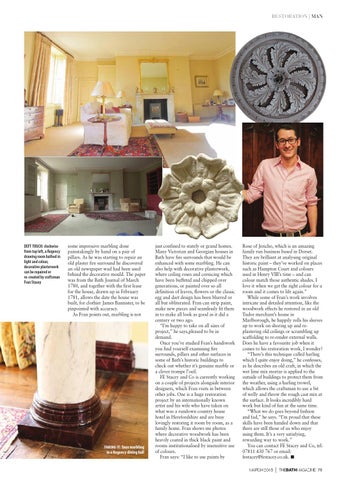
DEFT TOUCH: clockwise from top left, a Regency drawing room bathed in light and colour, decorative plasterwork can be repaired or re-created by craftsman Fran Stacey
some impressive marbling done painstakingly by hand on a pair of pillars. As he was starting to repair an old plaster fire surround he discovered an old newspaper wad had been used behind the decorative mould. The paper was from the Bath Journal of March 1780, and together with the first lease for the house, drawn up in February 1781, allows the date the house was built, for clothier James Bannister, to be pinpointed with accuracy. As Fran points out, marbling is not
FAKING IT: faux marbling in a Regency dining hall
just confined to stately or grand homes. Many Victorian and Georgian houses in Bath have fire surrounds that would be enhanced with some marbling. He can also help with decorative plasterwork, where ceiling roses and cornicing which have been buffeted and chipped over generations, or painted over so all definition of leaves, flowers or the classic egg and dart design has been blurred or all but obliterated. Fran can strip paint, make new pieces and seamlessly fit them in to make all look as good as it did a century or two ago. “I’m happy to take on all sizes of project,” he says,pleased to be in demand. Once you’ve studied Fran’s handiwork you find yourself examining fire surrounds, pillars and other surfaces in some of Bath’s historic buildings to check out whether it’s genuine marble or a clever trompe l’oeil. FE Stacey and Co is currently working on a couple of projects alongside interior designers, which Fran visits in between other jobs. One is a huge restoration project by an internationally known artist and his wife who have taken on what was a rundown country house hotel in Herefordshire and are busy lovingly restoring it room by room, as a family home. Fran shows me photos where decorative woodwork has been heavily coated in thick black paint and rooms institutionalised by insensitive use of colours. Fran says: “I like to use paints by
Rose of Jericho, which is an amazing family run business based in Dorset. They are brilliant at analysing original historic paint – they’ve worked on places such as Hampton Court and colours used in Henry VIII’s time – and can colour match those authentic shades. I love it when we get the right colour for a room and it comes to life again.” While some of Fran’s work involves intricate and detailed attention, like the woodwork effects he restored in an old Tudor merchant’s house in Marlborough, he happily rolls his sleeves up to work on shoring up and replastering old ceilings or scrambling up scaffolding to re-render external walls. Does he have a favourite job when it comes to his restoration work, I wonder? “There’s this technique called harling which I quite enjoy doing,” he confesses, as he describes an old craft, in which the wet lime mix mortar is applied to the outside of buildings to protect them from the weather, using a harling trowel, which allows the craftsman to use a bit of welly and throw the rough cast mix at the surface. It looks incredibly hard work but kind of fun at the same time. “What we do goes beyond fashion and fad,” he says. “I’m proud that these skills have been handed down and that there are still those of us who enjoy using them. It’s a very satisfying, rewarding way to work.” You can contact FE Stacey and Co, tel: 07811 430 767 or email: festacey@festacey.co.uk. n MARCH 2015
|
THeBATHMAgAzine 79