food heroes_vZ.qxp_Layout 1 16/02/2015 13:11 Page 1
FOOD | HEROES
MAGIC MUSHROOMS Silvana Tann goes deep underground in the heart of Bath to meet the mushroom entrepreneur intent on making the city self-sufficient in fungi
T
RECYCLING: the mushrooms are grown using a mixture containing coffee grounds
56 THEBATHMAGAZINE
|
MARCH 2015
mushrooms lingering in the air. It is quite mesmerising. Hugh tells me that he initially got the idea to set up this operation in 2013 when the mushroom trader at Bath Market announced his retirement. Up until this point the majority of Hugh’s career had been in the charity sector working in accounts and IT. He now had an interest in food production, with an ambition greater than just trading produce on a stall. Hugh’s aim was, and still is, to make Bath self sufficient in mushrooms. This aspiration has undoubtedly sprung out of Hugh’s involvement as treasurer of a project called Transition Bath. The focus of this voluntary environmental organisation is primarily on sustainability and low carbon footprint through local production and recycling where possible. “I discovered that used coffee grounds and cardboard produces the perfect food for oyster mushrooms to grow. I then started to think about the sheer volume of used coffee grounds from retailers in Bath. This is the basis of my business,” says Hugh. This initial discovery has led Hugh from knowing nothing about mushroom production, to becoming an entrepreneurial mycologist with a successful business model. A considerable amount of planning and work has gone in to funding this
business and in to making the vault space flow efficiently for the production of mushrooms. In 2014 Hugh successfully gained capital outlay for Fungi Fruits through online crowd funding. He says: “I pay investors 3% return on profit in cash or 4% of profit in mushrooms.” He has also pledged a percentage of profits from the business to local charities.
❝
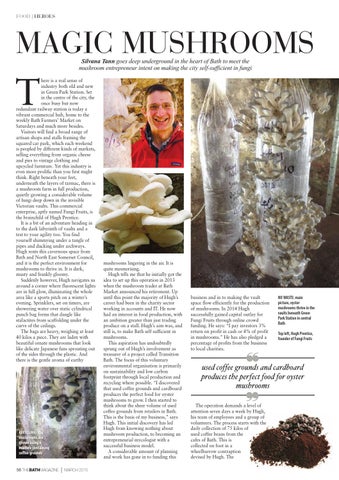
NO WASTE: main picture, oyster mushrooms thrive in the vaults beneath Green Park Station in central Bath Top left, Hugh Prentice, founder of Fungi Fruits
used coffee grounds and cardboard produces the perfect food for oyster mushrooms
❝
here is a real sense of industry both old and new in Green Park Station. Set in the centre of the city, the once busy but now redundant railway station is today a vibrant commercial hub, home to the weekly Bath Farmers’ Market on Saturdays and much more besides. Visitors will find a broad range of artisan shops and stalls framing the squared car park, which each weekend is peopled by different kinds of markets, selling everything from organic cheese and pies to vintage clothing and upcycled furniture. Yet this industry is even more prolific than you first might think. Right beneath your feet, underneath the layers of tarmac, there is a mushroom farm in full production, quietly growing a considerable volume of fungi deep down in the invisible Victorian vaults. This commercial enterprise, aptly named Fungi Fruits, is the brainchild of Hugh Prentice. It is a bit of an adventure heading in to the dark labyrinth of vaults and a test to your agility too. You find yourself shimmying under a tangle of pipes and ducking under archways. Hugh rents this cavernous space from Bath and North East Somerset Council, and it is the perfect environment for mushrooms to thrive in. It is dark, musty and frankly gloomy. Suddenly however, Hugh navigates us around a corner where fluorescent lights are in full glow, illuminating the whole area like a sports pitch on a winter’s evening. Sprinklers, set on timers, are showering water over static cylindrical punch bag forms that dangle like stalactites from scaffolding under the curve of the ceilings. The bags are heavy, weighing at least 40 kilos a piece. They are laden with beautiful ornate mushrooms that look like delicate Japanese fans sprouting out of the sides through the plastic. And there is the gentle aroma of earthy
The operation demands a level of attention seven days a week by Hugh, his team of employees and a group of volunteers. The process starts with the daily collection of 75 kilos of used coffee beans from the cafes of Bath. This is collected on foot in a wheelbarrow contraption devised by Hugh. The