5 minute read
Relying on Education

Dr. Minns believes education is key to helping the public understand the new virus and the behaviors that spread it in a community.
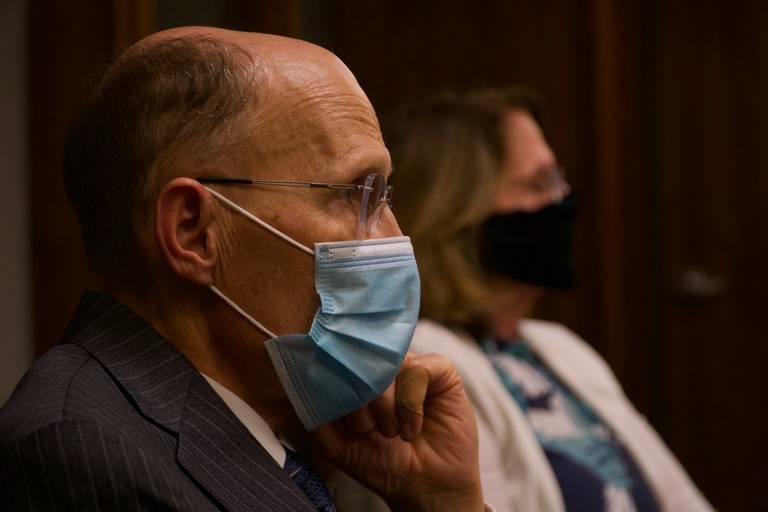
His role as chief county health o fficcer is normally a very part-time position, mostly consulting; however when cases of COVID-19 started to surface in Wichita in early to mid-March, Dr. Garold Minns ‘73 became a leading health o cial for Sedgwick County, and his decision to implement a stay-at-home order for the county on March 24 thrust him into the public spotlight.
Dr. Minns grew up in McPherson. He graduated from McPherson College with a degree in biology and continued his education at the University of Kansas School of Medicine-Wichita where he also completed his residency training in internal medicine followed by an infectious disease fellowship. He joined the faculty of KUMC-Wichita in 1980, and today he serves as its dean as well as associate dean for Academic and Student A airs, professor, and program director for the Department of Internal Medicine.
His background in infectious disease, basic epidemiology, and public health, as well as a commitment to education provide the right tools for the work he finds himself doing this year. In December he began studying medical publications coming from China on the spread of a new virus and recognized that the severity of it would eventually lead to outbreaks in the United States.
“I guess in some ways we were fortunate here in the middle of the United States, in that we were able to learn from what coastal cities were experiencing before it even arrived here,” Dr. Minns said. “When it finally did arrive here, we had some virtual experience of it and learned quite a bit from other parts of our country that got it first. I think we were more prepared for its arrival than many of our coastal cities.”
Dr. Minns believes education is key to helping the public understand the new virus and the behaviors that spread it in a community. It has been challenging to gain widespread acceptance of the personal behavioral interventions required to decrease the transmission of the disease, but that is to be expected with something that has never been seen before, he said. Additionally, the virus is unique in the di erent ways it a ects people.
“It’s quite variable in the illness it produces in people,” he said. “I think that has led some people to be skeptical of it. It’s been easy for people to discount the virus because it’s hard to understand how a virus can be so variable from mild and bit.ly/33Jt5by almost no symptoms to life-threatening. I think we have to assume that we are all susceptible to it. There are di erences of opinion on whether we really need to wear masks and practice social distancing. It’s been a challenge convincing people that yes, for the greater good we all need to do that because we just can’t predict who is going to get sick and who is going to transmit it.”
Asking businesses to close amid a skeptical public only added to the challenges that Dr. Minns has faced during this outbreak. He understood the economic impact that the stay-at-home order had on communities and tried to educate the public why this di cult trade-o was necessary to help to control the spread of the virus.
“I don’t think you can ever diminish the importance of education in these kind of conditions in helping people understand the science behind it, the uncertainties we have about it,” he said. “I think it confirms what McPherson College’s mission is – to educate and make people broadly educated so they can deal with these kind of challenges in their life. Regardless of whether they have a science major or a sociology major, they had enough of a liberal arts education that they could understand the basics of something like this and be part of the solution.”
There are many things that Dr. Minns thinks communities can learn from this outbreak. He hopes this experience will help change attitudes some have regarding vaccinations and make all vaccines widely accepted. He also thinks the virus proves that, now more than ever, people are part of a larger global community. No nation is isolated, and there are global implications not only for viruses but other areas like climate change. He also hopes the virus will help people resolve the tension between what is good for society versus individual liberties.
“I think the discussions we are having now everyday about the balance between mandates to do what is for society’s good versus our individual liberties are important,” he said. “That has been an issue for humankind since the beginning of society. We will see. Maybe when all this is over there will be more acceptance of doing what is good for society, even if it means giving up some individual activities.”
He said it would be naïve of him to think that this outbreak would not become such a political issue; however he does admit to being a little surprised by the degree of politicization that has occurred.
“I never thought that an infectious agent would be used by politicians to promote their agenda as much as this has,” Dr. Minns said. “At times I think the politics has tried to cover up the science and slowed us down in getting control of this virus because people have adopted a political view at the expense of the science. A virus does not recognize red or blue. It doesn’t really care what political stripe you wear.”
The virus also does not recognize geography, and when Dr. Minns considers the work he does in Sedgwick County, he hopes that it may have an even larger impact.
“This virus doesn’t recognize county or state lines,” he said. “In some sense because so many people travel to Wichita, I consider what I am doing here not just for Sedgwick County but in the very least for south central Kansas, our state, or even a small piece of our country. My small jurisdiction here is helping a lot of square miles.”
