SPRING 2020
McPHERSON COLLEGE MAGAZINE
Keeping Community During a Pandemic MC's response to COVID-19
CONGRATULATIONS! McPherson College conferred degrees on 139 students in the ďŹ rst-ever virtual Commencement Ceremony on Sunday, May 24, 2020. The celebration included a pre-show with recognitions from family, faculty and staff. Commencement celebrations kicked off earlier in the day with a President’s Zoom Brunch for seniors and their families. www.mcpherson.edu/graduation
McPHERSON COLLEGE MAGAZINE
RESEARCHING COVID-19
Keeping Community During a Pandemic 2 NEWS
On the cover:
Screens of faculty and staff during one of the ‘campus huddles’ on Zoom.
4 FACE OF GIVING
Spring 2020 | Vol. 109, No. 1 McPherson College 1600 E. Euclid PO Box 1402 McPherson, KS 67460 (620) 242-0400 (800) 365-7402 www. mcpherson.edu The Review welcomes and reports the news of our diverse alumni and friends. Their activities may represent a variety of viewpoints which may or may not be endorsed by the college. McPherson College does not discriminate on the basis of race, religion, color, national origin, gender, sexual orientation or physical or emotional disability. © 2020 McPherson College
Micaila Curtis ‘19 put her future plans on hold because of the COVID-19 pandemic, but she has no regrets. She is among the many researchers in our country studying the COVID-19 virus.
6
RELYING ON EDUCATION
8
When cases of COVID-19 started to surface in Wichita , Dr. Garold Minns ‘73 became a leading health official for Sedgwick County, Kansas.
18 ALUMNI NEWS
10
22 ALUMNI NOTES
The Review McPherson College Magazine is published twice a year by the Office of Marketing and Public Relations for the alumni, faculty, staff and friends of the college. Editor - Tina Goodwin director of public relations Design - Brian Lundberg director of marketing, Corey Long ‘17 graphic designer Contributing Staff Monica Rice director of alumni and constituent relations Dave Barrett ’90 advancement officer Jeremy Nelson athletic communications director Kendra Flory ‘00 advancement assistant
A COVID JOURNAL President Michael Schneider has chronicled the rapid changes caused by COVID-19 in a journal.
28 THEN & NOW
McPherson College Administration Michael P. Schneider ‘96 president Abbey Archer-Rierson ‘16 chief of staff Bruce Clary ’77 vp for academic affairs Amanda Gutierrez vp for automotive restoration Christi Hopkins vp for enrollment management Chandler Short ‘15 director of athletics Marty Sigwing ’16 director of facilities Brenda Stocklin-Smith ‘16 director of human resources Rick Tuxhorn ’16 vp for finance Erik Vogel ‘98 vp for advancement
President’s message 2
review
Dear McPherson College Alumni, Friends, & Family, Friday, March 13, 2020 was one of the most challenging days of my career. It was the day I met with members of the McPherson College Class of 2020 and informed them that in all likelihood they would not return after spring break to finish their last semester on campus. It was a difficult conversation, and I was prepared for an angry response. However, the response I received from those students is what inspires me as our campus continues making hard decisions caused by the COVID-19 pandemic. The students I spoke with on March 13 had every right to be angry, sad, and disappointed, and I am sure they were, but their response to me was one of concern for their instructors and staff, concern for their classmates, and concern for me. They understood the challenges ahead of us and gave me encouragement. I can’t imagine better evidence that these students are well prepared to take on whatever the future holds for them. Reflecting on how McPherson College has faced the challenges caused by this virus, I see evidence daily of a community that is concerned for one another. Our faculty was asked to adapt very quickly to transition curriculum to remote learning in the spring. Faculty continues to adapt and is preparing for an ever-changing learning environment. Many staff members were asked (and some volunteered) to work outside of their areas as we transitioned to a remote campus. Students and families have faced their own challenges and through it all continued to support our efforts. We committed to safely returning students to campus for the fall semester and worked tirelessly over the summer to develop the Health & Safety Guidelines that serve as our road map. I encourage you to go to our website, www.mcpherson.edu/covid, and see the work done to reopen campus. When classes started on August 17, we recorded the largest enrollment in MC history.
MCPHERSON COLLEGE MAGAZINE
In addition to our concerns about the pandemic, our attention was also focused on the racial injustice being protested across the nation in the wake of the brutal killing of George Floyd and so many other instances of racist violence in our country. Our campus is committed to the work we started five years ago to become a more inclusive campus through training employees and student leaders to ensure everyone has the same opportunities in and out of the classroom. Our work will continue when we are together this fall to engage our campus in antiracism education and initiatives. It’s not often that you are aware of history being made around you. McPherson College will grow and learn from the challenges our campus has faced in 2020, and I am confident that when people read about this time in McPherson College’s history, they will see a community that cared for each other and weathered a difficult time with resilience and determination. When you turn toward the back of this magazine, you will see that this is not the first time in MC history that we were tested. A letter from President Dr. Daniel W. Kurtz rings as true today as it did in 1918. While this year has been challenging and required many changes to our daily lives, I am impressed by and grateful for the ways we continue to be a community at McPherson College. Thank you for being part of our community. I hope you are safe and healthy.
Michael P. Schneider President, McPherson College
Photo: Tina Schwartz, Selah Vida Photography
Pursuing diversity and inclusion While reacting to the COVID-19 outbreak, McPherson College also addressed the difficult issue of systemic racism as it recognized the trauma caused by the deaths of Black Americans in early June and the protests that followed. The events were a stark reminder of the importance of MC’s work to combat racism on its campus. “Certainly, our students turn to us for leadership, but I also think the greater McPherson community looks to us as well,” President Michael Schneider said. The community’s perception of McPherson College’s leadership in antiracism and diversity was evident this summer when two peaceful marches, one recognizing Black Lives Matter and the first-ever Pride March in McPherson, both started in the circle drive at the college. Over the past five years, McPherson College has made a concentrated effort to become a more inclusive campus. The college works with the Kansas Leadership Center to engage the campus in solutions to develop a more inclusive culture through meaningful dialogue, training, and new initiatives. It also participates in the University of Southern California Race and Equity Center’s National Assessment of Collegiate Campus Climates to better understand and act on student perspectives on campus climate and diversity. In fact, McPherson College was the first college to sign up for next year’s assessment. A campus task force meets regularly to evaluate progress on its goals, which include engaging and inclusive programming, retention of underrepresented students, more diverse applicant pools, ongoing education and conversations with employees, and serving as leaders in our community. A student work group began meeting over the summer to discuss actions that the college can implement to support student efforts in creating and promoting antiracism activities. The college has also supported diversity and inclusion training for all student leaders, as well as any interested student, through the Student Government Association. Gabrielle Williams, M.Ed., director of student life, facilitates diversity and leadership training for students on campus. The leadership training is part of the MC Student Experience framework used to drive programming across campus to ensure inclusion in activities and organizations in student life. The training has expanded this year to include all Residence Advisors, Orientation Leaders, and ACE mentors. Williams said the training begins with a focus on listening and communication skills.
In early June the McPherson community held a BLM March from campus to Lakeside Park.
“Many times facilitators want to begin these trainings by introducing terminology to the participants,” Williams said. “While I do believe that terminology is essential, my approach focuses more on how to invite participants to meet on common ground. My trainings teach them how to listen to validate others’ experiences and how to practice better emotional intelligence. The key is to walk away from the trainings with knowledge on how to practice ally-ship and solidarity.” She says talking to people about diversity and antiracism is “a process.” Often conversations about antiracism can become very uncomfortable because they ask people to strip away their learned behaviors and hold themselves accountable to do deep inner work. That is why it is important to start from a common place, Williams said.
International Student Association event.
“The training is developmental. It asks, ‘how can I be better after this training?’ It all starts with listening,” she said. After completing the training, students receive a certificate indicating they are racial and ethnic allies trained in combating stereotypes and micro-aggressions. Beyond the training, students have also created several activities on campus to promote diversity and inclusion. Last fall, the International Student Association hosted MACNATION, an outdoor festival that featured cultural dishes from 15 countries. During the event, students had the opportunity to taste international snacks and delicacies and improve geographical awareness through trivia for a chance to win airline gift cards. The event attracted approximately 420 attendees in addition to visitors and food donations from students at Bethel College. This academic year the college plans to host Shaun R. Harper to speak and interact with students. Harper is a racial equity expert, a professor, and executive director of the Race and Equity Center at the University of Southern California.
SPRING 2020
3
support
THE FACE OF GIVING I was recruited to McPherson College to play baseball, but as soon as I got here I was given the opportunity to explore interests I had put on the back burner in high school. MC puts students first and gives us a chance to develop into whole people, through mentors, programs, and a solid support system. The college lays the foundation that we can build on. Baseball may have brought me here, but the family atmosphere made me stay. More importantly, it made me grow. I have been involved in a number of things on campus like The Spectator, the ACE Program, Campus Ambassadors, and Student Government Association. These programs have shown me different dynamics that mirror the world we live in while shedding light on the type of person I want to become. The experiences have led me as far as Washington D.C. for a leadership conference where students from across the nation collaborated and discussed the issues we have in common. Experiences like these, outside of the classroom, teach us skills in our fields and encourage us to think about ways to improve and grow our passions. The move to an online format because of COVID-19 this spring helped me through the haze I was in at the time. The support I received from the college through its COVID-19 relief grant greatly impacted my ability to stay in McPherson and keep up with life until I was able to find another job. As Student Body President, I hear from many students and the college’s plan to reopen the campus safely has been one of their biggest concerns. By constantly adapting and keeping up with the latest guidelines and policies, I can tell my peers that we are doing all that we can, and more, to ensure a safe and exciting return in the fall. I can say with confidence that McPherson College strives to make every day a great day to be a Bulldog!
4
review
MCPHERSON COLLEGE MAGAZINE
“
MC puts students first and gives us a chance to develop into whole people, through mentors, programs, and a solid support system.
Tyler Dunn
”
Lawton, Oklahoma Major: Business Marketing and Communications SGA President
You can support our students by giving to the McPherson College Fund online at: www.mcpherson.edu/giving
Or contact the development office at (800) 365-7402.
Keeping Community During a Pandemic How McPherson College alumni, students, faculty, and staff are working through these difďŹ cult times.
Micaila Curtis ‘19 is part of the research team at the UCI Messaoudi Lab studying the SARS-CoV-2 virus as well as the disease it causes, COVID-19.
SPRING 2019
11
Keeping Community During a Pandemic
Researching COVID-19 Like so many people, Micaila Curtis ‘19 put her future plans on hold because of the COVID-19 pandemic, but she has no regrets. She is among the many researchers in our country studying the COVID-19 virus and knows that her work will ultimately help people understand more about this new virus. Curtis is a research specialist at the University of California, Irvine. She is part of the research team at the UCI Messaoudi Lab studying the SARS-CoV-2 virus as well as the disease it causes, COVID-19. Dr. Ilhem Messaoudi is the principal investigator and received fast-track funding to begin studying the virus early on to expedite a response to the pandemic. After graduating from McPherson College with a Bachelor of Science in biology, Curtis planned to study for the Medical College Admissions Test (MCAT) and begin applying to medical school programs. “I had decided to wait to get more experience and build my resumé before applying to medical school and started working at the lab in early March,” Curtis said. “Then the pandemic hit and everything changed. I’m going to take an extra year before applying because this experience is so impactful. I can’t get what I am learning here from out of a book.” The lab is the ultimate classroom for Curtis. To keep pace with the pandemic-time research, she is working 11 hours a day during the week and three to seven hours most weekends. On an average day, the lab receives 40+ COVID-related samples. Curtis helps process these samples and then runs tests for analysis. The lab is involved with multiple surveillance studies, using model cell lines to understand the immune response in the lungs when infected with the virus, as well as analyzing clinical specimens of COVID-19 positive individuals to study how the immune response develops over time and its association with disease outcomes. “It is an intense workload for research, and everybody has taken on an enormous amount of work, including teaching me new things,” she said. “I love learning, and I think that is why I love research because you are constantly learning. For me, it is
6
review
MCPHERSON COLLEGE MAGAZINE
Micaila Curtis ’19, second from the right, stands with other researchers after completing Biosafety Level 3 Laboratory training. According to Curtis, the photo illustrates the level of personal protective equipment (PPE) necessary to work in a level 3 laboratory.
exciting. I am learning outside of my realm and that is also rewarding. Sure I’m working more than 40 hours a week, but you won’t hear me complain about it.” As a student at McPherson College, Curtis said her instructors influenced and supported her future goals. “I had amazing mentors,” she said. “Dr. Manjula Koralegedara saw potential in me that I did not see and encouraged me to apply for the UCLA prep program. Dr. Frye and Dr. Wilgers helped get me into the labs and research, where I discovered how much I enjoyed it.” Curtis was one of only 25 undergraduates selected for the University of California, Los Angeles, Pre-Medical & Pre-Dental Enrichment Program. It is a six-week summer program that provided Curtis with study resources to help her prepare for
the MCAT and introduced her to a network of people in the University of California system, which led her to her current research position. “I was so fortunate to get into the program,” she said. “Last summer I got the opportunity to study with a diverse group of students and met so many people who helped me continue aspiring to follow my dreams – leading me to where I am now.” Curtis had the opportunity to train for a biosafety level 3 laboratory, which is the highest safety level on the west coast, she said. The training will enable her to work with more virulent strains of viruses such as SARS and MERS and other microbes that can be transmitted by aerosols and cause severe disease. She also expects the COVID-19 research to continue well after a vaccine is found. “You can’t rush science. The longer this virus is around, the more data we will have to analyze,” Curtis said. “We have a lot more to learn. More than we can fathom right now. Everybody has a different immune system and will respond differently to the virus, but that’s where the most fascinating research happens.” She is hopeful that the research she is involved in will help educate people about the virus and, in broader terms, about health awareness issues. “The virus is very much a threat to many people,” she said. “You may be healthy, but you don’t know about other people and how they might respond to the virus. I think this will show people that we all need to be more aware of our own actions and be respectful of others.” This research experience is teaching her a great deal - not only about the virus, but also about where she sees herself in the future. “I definitely think research will always be part of my life,” she said. “I love the challenge it brings, but I’m not closing the door on becoming a doctor. I want to help people by eventually becoming an M.D. or a Ph.D., or maybe both.”
MC Health Care Heroes
During the pandemic several Bulldogs balanced school work and other student responsibilities while working on the frontlines in healthcare positions. We salute their work ethic, drive, and passion for helping others.
Meklit Tilahun, CNA, McPherson Hospital
Jake Curtis, CMA, The Cedars
Richard Mbuyamba, CNA, The Cedars
Neville Kabangu, CNA, Moundridge Manor
Lenae Albina, CNA, Moundridge Manor
Kayembe Chourcranie, CNA, Moundridge Manor
Samantha Mayaka n’Sombre, CNA, Moundridge Manor
Ashley Hiebert, CNA, Bethesda Home
Thara Kalambayi Kapinga, CNA, Moundridge Manor
Amy Braimbridge, direct support care professional, Disability Supports of the Great Plains
Sebia Kalambayi Kabedi, CNA, Moundridge Manor
Heidi Beckham, CNA-HHA, Attica Long Term Care
NEW
PROGRAM
McPherson College introduces a new program this fall that offers two majors, Health Science and Healthcare Management, that prepare students for careers in the healthcare industry. The college has partnered with the McPherson hospital to offer extensive field experience opportunities to provide hands-on learning for students. The college awarded healthcare scholarships to eight students who will also participate in community outreach programs. www.mcpherson.edu/health-science SPRING 2020
7
Keeping Community During a Pandemic
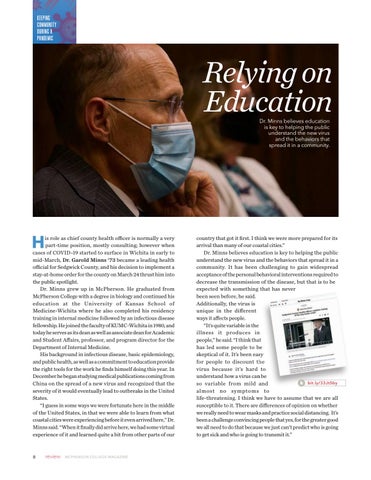
Relying on Education Dr. Minns believes education is key to helping the public understand the new virus and the behaviors that spread it in a community.
H
is role as chief county health officer is normally a very part-time position, mostly consulting; however when cases of COVID-19 started to surface in Wichita in early to mid-March, Dr. Garold Minns ‘73 became a leading health official for Sedgwick County, and his decision to implement a stay-at-home order for the county on March 24 thrust him into the public spotlight. Dr. Minns grew up in McPherson. He graduated from McPherson College with a degree in biology and continued his education at the University of Kansas School of Medicine-Wichita where he also completed his residency training in internal medicine followed by an infectious disease fellowship. He joined the faculty of KUMC-Wichita in 1980, and today he serves as its dean as well as associate dean for Academic and Student Affairs, professor, and program director for the Department of Internal Medicine. His background in infectious disease, basic epidemiology, and public health, as well as a commitment to education provide the right tools for the work he finds himself doing this year. In December he began studying medical publications coming from China on the spread of a new virus and recognized that the severity of it would eventually lead to outbreaks in the United States. “I guess in some ways we were fortunate here in the middle of the United States, in that we were able to learn from what coastal cities were experiencing before it even arrived here,” Dr. Minns said. “When it finally did arrive here, we had some virtual experience of it and learned quite a bit from other parts of our
8
review
MCPHERSON COLLEGE MAGAZINE
country that got it first. I think we were more prepared for its arrival than many of our coastal cities.” Dr. Minns believes education is key to helping the public understand the new virus and the behaviors that spread it in a community. It has been challenging to gain widespread acceptance of the personal behavioral interventions required to decrease the transmission of the disease, but that is to be expected with something that has never been seen before, he said. Additionally, the virus is unique in the different ways it affects people. “It’s quite variable in the illness it produces in people,” he said. “I think that has led some people to be skeptical of it. It’s been easy for people to discount the virus because it’s hard to understand how a virus can be bit.ly/33Jt5by so variable from mild and almost no symptoms to life-threatening. I think we have to assume that we are all susceptible to it. There are differences of opinion on whether we really need to wear masks and practice social distancing. It’s been a challenge convincing people that yes, for the greater good we all need to do that because we just can’t predict who is going to get sick and who is going to transmit it.”
Asking businesses to close amid a skeptical public only added to the challenges that Dr. Minns has faced during this outbreak. He understood the economic impact that the stay-at-home order had on communities and tried to educate the public why this difficult trade-off was necessary to help to control the spread of the virus. “I don’t think you can ever diminish the importance of education in these kind of conditions in helping people understand the science behind it, the uncertainties we have about it,” he said. “I think it confirms what McPherson College’s mission is – to educate and make people broadly educated so they can deal with these kind of challenges in their life. Regardless of whether they have a science major or a sociology major, they had enough of a liberal arts education that they could understand the basics of something like this and be part of the solution.” There are many things that Dr. Minns thinks communities can learn from this outbreak. He hopes this experience will help change attitudes some have regarding vaccinations and make all vaccines widely accepted. He also thinks the virus proves that, now more than ever, people are part of a larger global community. No nation is isolated, and there are global implications not only for viruses but other areas like climate change. He also hopes the virus will help people resolve the tension between what is good for society versus individual liberties. “I think the discussions we are having now everyday about the balance between mandates to do what is for society’s good versus our individual liberties are important,” he said. “That has been an issue for humankind since the beginning of society. We will see. Maybe when all this is over there will be more acceptance of doing what is good for society, even if it means giving up some individual activities.” He said it would be naïve of him to think that this outbreak would not become such a political issue; however he does admit to being a little surprised by the degree of politicization that has occurred. “I never thought that an infectious agent would be used by politicians to promote their agenda as much as this has,” Dr. Minns said. “At times I think the politics has tried to cover up the science and slowed us down in getting control of this virus because people have adopted a political view at the expense of the science. A virus does not recognize red or blue. It doesn’t really care what political stripe you wear.” The virus also does not recognize geography, and when Dr. Minns considers the work he does in Sedgwick County, he hopes that it may have an even larger impact. “This virus doesn’t recognize county or state lines,” he said. “In some sense because so many people travel to Wichita, I consider what I am doing here not just for Sedgwick County but in the very least for south central Kansas, our state, or even a small piece of our country. My small jurisdiction here is helping a lot of square miles.”
The face of a pandemic Ryan Erb sent out a plea on social media in late June to raise awareness of what life is like for front-line health care workers during the COVID-19 outbreak. As the emergency room night shift charge nurse at The Children’s Hospital at Oklahoma University Medicine, Erb is faced with managing PPE supply, staff shortages, and being prepared to implement a disaster response plan in 15 minutes if there is an even greater up-tick of patients needing isolation. She is also facing questions she asks herself, like “How do I keep myself safe?” and “How do I prevent it from spreading to my own house?” “Here in Oklahoma City, we prepare for natural disasters like tornados or for mass casualties because of the bombing in 1995,” she said. “We don’t really train for a pandemic on this level. This is a completely different response. You have to think on your toes and be ready to adjust for changes.” Some of the changes are a matter of “retraining the emergency brain,” she said. Because PPE supply can be difficult to keep up with, especially in a teaching hospital where typically many health care professionals and students work with patients, nurses have to make adjustments. “We are so used to running in and out while taking care of patients in the ER, and now we need to focus on preserving our PPEs,” she said. “We have to remember to take our time and make sure everything is put on properly and make sure we consolidate our care and get everything accomplished in one trip.” Erb has been working in the emergency department at Children’s Hospital since 2014. She attended McPherson College in 2007-08 and is married to Dan Erb ’08. They have two children.
SPRING 2020
9
Keeping Community During a Pandemic
A COVID Journal President Michael Schneider has chronicled the rapid changes caused by COVID-19 in a journal. The entries describe actions
taken to manage the college through the pandemic as well as insights from President Schneider.
Here are some highlights from the past several months.
Wednesday, March 11, 2020
Thursday, March 12, 2020
Sent first email to the Board of Trustees just four days after their on-campus spring meetings. We are monitoring the coronavirus situation to ensure campus safety, and regular communication is in place and outbreak protocol is coordinated with McPherson Hospital and the county health department. The Department of Education provided flexible guidelines for institutions affected by the virus so the college can complete the year online without accreditation issues. Kansas Association of Independent Colleges (KICA) and National Association of Independent Colleges and Universities (NAICU) held their first conference calls about the situation. And my cabinet met to process next steps to keep the campus safe.
First email sent to MC campus community regarding COVID-19 and met with faculty to make preparations for finishing the fall semester remotely using online resources. We announced early dismissal for Spring Break with likelihood classes would resume remotely after break on March 30.
MY TAKEAWAY: We need to stay ahead of this and start preparing for the worst case—shutting down the campus.
10
review
MCPHERSON COLLEGE MAGAZINE
MY TAKEAWAY: Day ended with the most donations ever received on MC’s 2020 Power Day; yet, looming crisis and major decisions impacting our campus community forthcoming. It has a name, COVID-19, and it is like a train coming down the tracks. And it isn’t going to stop.
President Schneider, Dr. Becki Bowman and students announce early dismissal for Spring Break.
Community Response: Faculty Faculty took on the task of planning for what the campus needed academically knowing that they could not predict what those needs would look like in a month or even in two weeks. Planning for the unknown requires an incredible amount of flexibility, a willingness to learn, and a strong sense of community. According to Faculty Chair Becki Bowman, these are the attributes that help the MC faculty prepare for teaching through the pandemic. Shortly after the faculty began teaching remotely to complete the spring semester, Bowman and her colleagues on the Faculty Executive Committee, along with other faculty members representing specialized areas of campus, joined the campus task force to begin making plans and recommendations for all facets of campus. Bowman said the faculty members on the task force realized quickly that they needed to move toward a hybrid model of instruction for the fall semester that combined online and in-person instruction to provide a safe option to return to campus for both students and faculty. They developed online training modules for the faculty to help them make the switch. The modules include research and examples of hybrid classes, ways to design courses, and technical training for instructional tools. An active discussion board also allows instructors to learn from each other. “None of us are experts at this. We are all learning together,” Bowman said. “Thankfully we have a great group of colleagues and are willing to share ideas and help one another. Many of us
feel like fish without fins but we are all willing to try even if it means making mistakes and learning from them. We also have patient and supportive students.” Student adoption of the changes is an important part of the academic plan. Faculty became very aware of students’ commitment to learning during the spring semester and helped them get assistance when needed through Academic Support Services. “We worked with students who had to drive 30 miles to get a good WiFi connection or who were balancing jobs with their class work while at home,” Bowman said. “The students' commitment to learning this spring, despite some of their challenges, was incredibly inspiring.” Faculty relied on the strong community at McPherson College to meet the challenges they faced finishing the spring semester and preparing for the fall semester. “We are part of a good community,” Bowman said. “This challenge has moved us closer together, not further apart. Faculty worked all summer because they want our students to have a good and meaningful semester despite all the changes we have to make.”
Tuesday, March 17, 2020
Friday, April 3, 2020
I met with all employees today in groups of 10-15. Mingenback was filled with one person sitting at eight-person round tables. I spoke honestly and directly about our plans. People looked worried but appreciated the time together. I hope we are “right” by moving the campus remote and requiring people to work at home.
I met with student leaders on Microsoft Teams this week and they are adapting better than expected as they continue work leading Student Government and various clubs online. Communication is our most important operational tool, and everyone is on social media — I look for the new virtual campus community to evolve on Facebook @McPhersonCollege; Twitter @McPherson_College and Instagram @mcphersoncollege to get a feel for the energy on campus. We continue to reach out to perspective students, over 3,000 contacts made during the week to current and prospective students, alumni and supporters.
Monday, March 30, 2020 This is the first day of completely online courses in 133-year history of MC. Campus-wide digital communication plan takes effect this week. Communication with all constituents is critical in this new virtual world. Evaluation of student needs and hardships is complete. Every student who requested a digital device (laptop or tablet) has received one and all students have access to free WIFI through their cellular devices.
MY TAKEAWAY: Students miss campus, and it appears recruits can’t wait to get here next year—we can’t miss this opportunity. How do we end up on the right side of this outbreak?
MY TAKEAWAY: Message to campus community—“It isn’t what we planned, but you are ready. Have a great first day of class!”
SPRING 2020
11
A COVID Journal
Christi Hopkins, vp for enrollment, hosts a livestreamed parent session during the virtual Presidential Scholarship Competition. The virtual event included interviews, roundtable discussions, and presentations submitted by students.
Friday, April 10, 2020 The first-ever Virtual Presidential Scholarship Day was the largest in our history with over 100 participants. Campus visits (although virtual) are also up—a good sign. MY TAKEAWAY: A parent of a prospective student said it best in a note to me after a virtual visit day—“Your team did a great job adapting to the current situation. I work with Fortune 500 companies and government organizations and they’ve been struggling to get up to speed. It is almost as if you were prepared to deal with this based on how seamlessly you moved to this new online format.”
Tuesday, April 14, 2020 We held our first campus huddle since the pandemic with over 150 participants in a Zoom room. Adapting to a remote environment is going well. But we need to improve as it is likely we will be operating this way for longer than expected. The campus is learning a lot—systems are good but we can’t forget about individuals who might be isolated given the remote operation; students want to be on campus; uncertainty is our enemy so creating certainty and taking advantage of opportunities to be decisive is important; communication (particularly in the virtual world on social media) is our most important tool; reallocation of work is critical. I am in regular conversations with the KICA, NAICU, KCAC as well as contact with colleagues at places like Whittier, Grinnell, Drexel and University of Pennsylvania have been beneficial in decision making.
12
review
MCPHERSON COLLEGE MAGAZINE
MY TAKEAWAY: The virus is the boss and our job is to be ready for different scenarios. The last time we went through a recession starting in 2008 we were able to grow enrollment by 10% over 3 years—we can do it again. We will be ready for August 17—the first day of class.
Friday, May 1, 2020 Kansas Governor Laura Kelly eases restrictions but encourages those that can work from home until May 18 to do so. We saw our largest deposit week of the year enrollment is looking good. Students are reminded of our commitment to career services as we reallocated our human resources department to support them finding internships, jobs and graduate school placement. MY TAKEAWAY: Uncertainty about the fall semester is weighing heavy. However, spending time in the “balcony” is critical. We have the luxury to sit tight and see what happens with the opening of the state. We will continue to operate remotely and proceed with caution—we don’t need to take any unnecessary risks. A risk that leads to a positive COVID-19 test sets us too far back and prevents a clean recovery from this situation. Kerri Kobbeman has been a rock as our board chair. She has been a great listener and wise advisor sorting through the complexities of the situation.
Community Response: ATHLETICS When the NAIA announced the cancellation of spring athletic seasons on March 16, the McPherson College athletic department quickly transitioned from coaching on the field to helping student-athletes navigate their new reality. The athletic department leaned heavily on one of its strongest core values – building relationships with student-athletes. A few days before the NAIA announcement, the athletic department met with all spring sport athletes to announce the college’s decision to extend spring break and that it was likely students would not return to campus after the break. From that point, the focus for the department shifted to seeing student-athletes finish the semester well, retaining non-seniors, and recruiting incoming freshmen and new transfer student-athletes. Throughout the spring semester, Bulldog head coaches continued weekly team meetings on Zoom and facilitated team meetings with Carole Barr, director of academic development. Coaches and staff initiated a letter-writing campaign that reached out to every student-athlete offering them encouragement. Student-athletes were also regularly featured on McPherson College’s social media channels. “Our coaching staff did a tremendous job engaging and communicating with our student-athletes during this extraordinary time,” Chandler Short, athletic director, said. “Things were changing quickly and communication became key with the weekly Zoom meetings, team updates, individual phone calls, and hand-written notes.” Short was named the new athletic director in early March replacing Andrew Ehling, who resigned in December. Although she served as interim for several months, some of her first decisions as the new athletic director were due to the COVID-19 outbreak. According to Short, the work put into communications and building relationships with student-athletes paid off. McPherson College finished the spring semester with all but one of its programs being named KCAC Scholar teams. “Finishing any semester with a cumulative team GPA of 3.9 is impressive,” Cory Cahill, head volleyball coach, said. “But finishing a semester where so many things were thrown at them
with a 3.9 cumulative team GPA is completely surreal! I am so proud to be a Bulldog and so impressed by how the athletic department and my student-athletes responded to this crisis.” In addition to its focus on student success, the athletic department is also focused on establishing operational protocols for a return to campus this fall. Short serves on a newly formed KCAC COVID-19 Task Force consisting of two KCAC presidents, three KCAC athletic directors, the KCAC commissioner, and two athletic trainers. The committee works on schedules and guidelines for a safe return to play. Working with other departments across campus over the summer, the athletic department designed the Athletic Safety and Contingency Plan that includes guidelines for sanitation, pre-screening student-athletes before arrival in the fall, testing, and screening requirements from the NAIA, as well as other outbreak plans. The athletic facilities were reopened during the final phase of the Kansas reopening plan giving staff an opportunity to implement, on a small scale, the protocols they established for moving forward. “There are outside factors that we can’t control, but the things in our control, such as the daily check-in log for our student-athletes, sanitizing equipment, and making masks mandatory on campus in situations where social distancing Chandler Short ‘15, is not possible, are well thought director of athletics out and executed on a daily basis,” Josh Nichols, head women’s basketball coach, said. “We take this as a challenge like most competitors do. This is a test of our mental toughness, and we want to be ready in any situation that we may have to face. It also puts the game in perspective. I don’t think we take it for granted anymore knowing it can be taken away so quickly.”
FROM THE Students “MC helped during the spring semester by being very supportive and not letting me just give up. My coaches and teammates pushed me very hard to maintain my grade point average, and we all held each other accountable. Some of my successes included finishing the spring semester with a 4.0 GPA and winning my student government election. I am looking forward to being the 2020-21 chief of staff!” Shyanne Henkis Hometown: Laveen, Arizona Class Year: Junior Major: Sociology with emphasis in criminal justice; minor in psychology Activities: Track and field, SGA, Resident Assistant SPRING 2020
13
A COVID Journal
Community Response: Facilities “This is something we are going to be living with for some time,” Marty Sigwing, director of facilities and chair of the campus COVID-19 task force, said. Sigwing was among the first to begin mapping a plan for what dealing with the virus would entail for the college. The plan has evolved into the health and safety guidelines that are the foundation of how the campus plans to move forward and prepare for the return of employees and students. “The plan started out as a pet project of mine,” he said. “Shortly after students left campus in the spring, I sat down and started working on protocols for when students would return.” Since then, others from athletics to student life have contributed to the guidelines. The guidelines address every facet of campus life. Implementing the guidelines has included addressing social distancing in all areas, class sizes, blended learning options, quarantine rooms, isolation houses, installing Plexiglas at some work stations, blue tape indicating social distancing, work with the local health department, and freedom for employees to set up their own work places according to their comfort level. Some sections of the guidelines are very in-depth such as athletics, which include guidance from its sanctioning body. Sigwing started with what classrooms would look like with students in the fall and considered the technology necessary, class sizes, and personal protective equipment, among other things then moved on to other areas of campus. Developing the guidelines was much like writing a research paper, Sigwing said. “You write what you know best first and then research outside of that,” he said.
Sigwing turned to experts like the Center for Disease Control, the World Health Organization, and John Hopkins for his research. He stays current with the Kansas Department of Health and Environment’s recommendations and meets (virtually) with the McPherson County Health Department on a regular basis. He also draws on his experience at MC working through the H1N1 outbreak in 2009 and on similar experiences with distancing and sanitizing while he was director of facilities for Sedgwick County. Although he spends the major part of each day working on COVID-19 related issues, the focus of the task force has shifted away from the day-to-day operations to more of a sounding board that keeps the work moving. For example, the task force is evaluating a new mobile app that can help students and employees with self-screening. The work of the task force and the health and safety guidelines will continue to evolve and adapt as situations related to COVID-19 continue to change. According to Sigwing, the biggest challenge the college faces is preparing during uncertainty, but he is confident in the planning that has been done. “We have a good plan and are as prepared as we can be with so much unknown,” he said. “Our plan has been reviewed by people with experience in public health and they think it is a good tool. I think we have nailed down key things and have a good guide.” Even though the health and safety guidelines are extensive, they are based on three simple practices — wearing face masks, social distancing, and washing hands, according to Sigwing.
Friday, May 15, 2020
Sunday, May 24, 2020
Campus reopening is underway with Phase 1.5 and our stay -at-home orders lifted—limited staff to campus with social distancing and no groups bigger than 10 people. Students can retrieve items from dorms and we will be allowing limited campus visitors. The Faculty Executive Committee’s Pandemic Working Group completed guidelines with focus on scenarios and being prepared to deliver hybrid courses in the fall. Other Task Force work included health and safety plans coming together as well as plans for housing and athletics. Deposits are still ahead of our record-setting pace from last year.
Another first in MC history - virtual Zoom President’s Brunch and 132nd Commencement. There was a great turnout to the brunch, and students had fun with their families. Dr. Clary and I (with great support from communications) presided over the graduation ceremony with all but three students participating. Typically it is the president’s role to give the graduation speech in their first and last years of office. This year was an exception. My message to graduates was a reiteration of my regular advice on student success: Show up and ask for help. I shared the story of my 4’11’’ grandmother, Gertie who delivered meals-on-wheels to old people when she was in her 70s and took her friends to the Kansas City Royals game in her 80s. She taught me these things and how to build a fire, cook, read, apologize, talk to girls as well as how to “will” something done by doing your best.
MY TAKEAWAY: We continue to learn to be patient and focus our work. The entire campus is pitching in to help.
MY TAKEAWAY: To the Class of 2020: “Know that today and especially those days in your future when life’s struggles have you down, your best is good enough for me.”
14
review
MCPHERSON COLLEGE MAGAZINE
Community Response: Campus Health Clinic An important partner assisting the college throughout the COVID-19 outbreak has been the on-campus health clinic operated by Partners in Family Care, a private practice owned by physicians including McPherson College alumni Dr. Paul Ullom-Minnich ‘89 and Dr. Marla Ullom-Minnich ‘87. Dr. Paul Ullom-Minnich, who also serves on the McPherson College Board of Trustees, has been working with college officials on a plan to explore how the clinic can be the most useful this fall when students and employees return to campus. “The crazy thing about planning for a pandemic is that you never know what it will do next and you have to be ready for really unlikely scenarios,” Dr. Paul Ullom-Minnch said. “I feel confident with the planning we have done. It is careful and forward thinking. You want to put in 95 percent more planning than you will ever need. We are trying to be ready for whatever might happen.” One way the clinic will prepare is to have same-day testing available shortly after the beginning of the fall semester. The college and the clinic have invested in COVID-19 testing machines, expected to arrive in September, which will allow the clinic to run tests on-site. Currently, getting test results back can take up to 10 days depending on how quickly testing labs are able to process them. “It will be so much easier to stop an outbreak early on if we can tell somebody the same day they get tested if they are at a high risk of spreading the virus,” he said. “Testing is evolving right now but soon after school starts we will have the ability to have test results the same day.” Another way the clinic is evolving is in the delivery of care. During the outbreak, the use of tele-health has increased and will
likely continue to increase. In a campus setting, tele-health can be a strong tool to provide care, he said. “I expect it will play a role in what we will do with patients at the college,” he said. “When you have a disease that is really infectious and you have a way to touch base with somebody with no chance of passing germs, that is a really great opportunity. For monitoring and a quick check-in it is a really good way to do what we need to do, but if you need a visit in-person, you can still get that done.” The campus health clinic is available to all full-time MC students for acute care and management of chronic conditions. It provides services on a walk-in basis for students but is asking anybody with suspected symptoms of COVID-19 to call for an appointment first. Office visits are free to all full-time students. In addition to both Drs. Ullom-Minnich, Ashlee Pauls ‘10, P.A.-C, also provides care at the clinic. It is open Monday through Friday from 8 a.m. to 3 p.m. and is located south of Hess Fine Arts Center.
Although the McPherson College 132nd Commencement Ceremony took place on campus in an empty Brown Auditorium, it will likely be one of the most memorable commencements in the history of the college. The ceremony was streamed live on the college’s website and included a pre-recorded messages from family, faculty and staff. Alumni Director Monica Rice provided a welcome and seniors Lillian Oeding and Kento Aizawa performed an instrumental duet of “Somewhere Over the Rainbow.” Here, Dr. Bruce Clary presents the individual graduates from the class of 2020. The complete ceremony can be viewed at: www.mcpherson.edu/graduation
SPRING 2020
15
A COVID Journal
FROM THE Students “MC is doing a super job staying in contact with the campus community. I’ve been a part of the live campus forums and they have been very beneficial. It is very important that we hear what is happening in McPherson and across the globe and make sure we all get it from one source so there aren’t any discrepancies for fall arrival. It is imperative to maintain communication during this time in our lives when things can change drastically and suddenly. I commend the college on doing so.” Nicole Abunaja Hometown: Phoenix, Arizona Class Year: Senior Major: Business administration with emphasis in finance Activities: SALT, varsity women’s basketball
Friday, May 29, 2020
Monday, June 1, 2020
McPherson County lifts all restrictions with health and safety guidelines. MC classes are scheduled to begin on August 17 and we plan to meet in-person. The fall semester has been condensed and finals will be finished by Thanksgiving break. Faculty will be ready to deliver courses in hybrid formats for students who need to complete coursework off-campus. In addition, because of our small size we are prepared to social distance in our classrooms, labs, studios and shops. We continue to work with the county health department and our campus health clinic to ensure the campus remains safe. We are starting the year with fewer students in dorms and limitations on common spaces as well as practicing important social distancing and personal hygiene behavior. The NAIA in coordination with the National Athletic Trainers Association is providing guidance for keeping athletes safe. The KCAC is developing contingency plans in case there is a disruption in seasons. We will be prepared to limit facility capacity as well as sanitize equipment and spaces as needed.
We stand with our Black faculty, staff and students in the wake of the crisis across our country. Our work with the Kansas Leadership Center is helping us to ensure a more inclusive culture through meaningful dialogue, training and new initiatives. We continue to support diversity and inclusion training for all student leaders as well as any interested student through the Student Government Association. Our participation in the University of Southern California Race and Equity Center’s National Assessment of Collegiate Campus Climates helps us to better understand and act on student perspectives on campus climate and diversity. I learned a few weeks ago that McPherson College was the first college to sign up for next year’s assessment.
MY TAKEAWAY: I am more optimistic than I am worried today.
16
review
MCPHERSON COLLEGE MAGAZINE
MY TAKEAWAY: Our work to fight racism and ensure an inclusive campus does not stop for a pandemic. I was challenged by two students who said we needed to do more. They are right. I’ve been too passive with our efforts. I invited those two students to help and they created a working group. Once the moment has passed we need to make sure we are more committed than ever.
Community Response: CaREER Services McPherson College graduated 139 students on May 24, 2020. It was the first class to ever participate in an online, virtual graduation and the first class in a long time to enter a job market that was changing daily because of the impact of the COVID-19 outbreak. The Office of Career Services is an example of how the college was able to adapt and react to support students through a time of crisis. Like many departments on campus that were asked to work outside of their normal job duties and fill in where needed, Career Services and the Office of Human Resources joined together to work with MC students at all levels of career search. Amy Beckman, executive director of career services and experiential learning, and Brenda Stocklin-Smith, director of human resources, developed a plan to assist recent graduates entering the job market, current students searching for internships and other work opportunities, and even alumni experiencing career changes. “Teaming up with HR was a natural collaboration to connect students with professional networks, job opportunities, and career guidance,” Beckman said. Their strategies included sharing student “pitch” videos on LinkedIn for those graduates still seeking employment, sharing weekly career tips on social media, and helping alumni access the college’s online career search platform, Handshake. “We communicated lavishly during the spring semester and after,” Stocklin-Smith said. “Not just to our students looking for outcomes, but also about our students who achieved so much success during such a difficult time. My HR interns and I were delighted to showcase our recent graduates to future employers and graduate schools in Kansas and to the world.” The collaboration was a success that paid off for MC students. Currently, MC students are on trend with non-COVID-19 years at
nearly 70 percent of graduates with outcomes at this point in time. Additionally, nearly 75 percent secured their post-grad plans before graduation, according to Beckman. As part of the student experience and career preparation, McPherson College strongly encourages and supports students in securing at least one internship or field placement during their time at MC to gain relevant experience in a career field. Of the students in the Class of 2020 who secured post-grad outcomes, nearly 75 percent learned job skills and knowledge directly in their field of study through an internship or field placement. The Career Service Office works with nearly 70 local businesses, some with regional and even global footprints, to offer MC students real-world experience exploring a variety of careers. Beckman also encourages other businesses and alumni to contact her if they are able to provide mentorship, job shadowing, company tours, micro-internships, full-semester internships, field experience/observation, or part-time employment. Companies and individuals can offer to assist MC students by filling out a short questionnaire at www.mcpherson.edu/employer-inquiry. Beckman and Stocklin-Smith are working with students to solidify outcomes, whether it is job placement, graduate school, volunteer service, or military, to keep on pace with MC’s continued placement of 96 percent or higher six-months post-graduation, which is nearly 40 percent higher than the national average. As students return to campus in the fall, the Career Service Office will continue to support students in the work place. Beckman is developing online resources for the students participating in the Student Debt Project that will allow them to benefit from mentorship while they continue to make payments and earn matching funds in their efforts to reduce and eliminate their student debt at graduation.
Thursday, June 18, 2020
Friday, June 19, 2020
Held our first Zoom Campus Forum with new and returning students/families. I hosted the forum with student Nicole Abunaja. She encouraged me to be more open to sharing than initially planned. She was right that students will not be shaken when we talk about masks, tests and quarantine. The forum assured students and families that we have a plan to move forward. It also made clear that we recognize there is a lot going on in the world and we stand firmly against racism—our students of color will return to a campus that values their contributions and is committed to keeping them safe.
Updated information on a safe and successful return to campus was shared with campus, students, and families today. We will continue to communicate through the website, www.mcpherson.edu/covid, with updates on our most comprehensive plans yet for the 2020-21 academic year.
MY TAKEAWAY: I was nervous about sharing so much with students and families. However, when done well, transparent, authentic conversations will make a bond stronger.
MY TAKEAWAY: Everyone is accepting the reality of the situation in different ways and at different paces. We need to be patient and kind to each other. Leadership will be ready for the fall semester. And I hope everyone else is ready to take care of each other.
Read more journal entries at: www.mcpherson.edu/covid/journal
SPRING 2020
17
alumni news Who’s your face of MC? As part of Power Day 2020 we asked alumni to share with us who is their ‘Face of MC.’
Who is it they think of when they think about the college? Who was the faculty or staff person that impacted their life? Who best represents our mission? See more Faces of MC at: www.mcpherson.edu/power
Doris Coppock ‘48 manifested the qualities of integrity as well as the pursuit of excellence and goodwill in the context of the educational setting. Francis ‘66 & Jean Hendricks ’69
Dave Barrett ‘90 is who I think of when I think of a great representation of who we want our current students to grow up to be like. Colby Patton ‘15
Herb Smith is the Face of MC for me! He was a great teacher and truly cared about the students at McPherson College. A true favorite of many!! Stacey Bruton ‘92
Thank you Bulldog family for supporting our students during Power Day on March 12, 2020. Over 248 donors donated $193,855 in gifts!
18
review
MCPHERSON COLLEGE MAGAZINE
My face of MC is Janelle Miller. She does an amazing job with the upkeep of Hess all while being an extremely positive person, always willing to stop and chat for a few minutes and really make you feel valued! Corey Long ‘17
Dan Hoffman was always there as a professor and advisor. Even when I wasn't sure the direction I was going, he was always there with a kind word, quirky story or just general encouragement. Rhea Lay ‘01
Shay was always someone I could go to for help with school or personal matters. She made my stay at McPherson College feel like a true family experience. Shay will always be my College Mom! Josh White ‘11
Dr. Rick Tyler ‘74 dedicated his entire professional life serving the students of MC. He was a cornerstone of influence in the growth and experience of thousands of students who walked on campus. I am proud to have had the opportunity to learn under Rick's incredible leadership. Logan Schrag ‘18
SPRING 2020
19
why I give
A few members of the next generation of McPherson College alumni were asked why it is important for them to be donors supporting the next generation of Bulldogs. Here is what they had to say. “I am thankful for all the opportunities I had at McPherson College, both as a student and as an alum, for out-of-the-classroom experiences. Whether it was choir trips, business club trips, or riding camels around the pyramids of Egypt, these were amazing opportunities I couldn’t have found elsewhere.”
“McPherson College will always have a special place in my heart. Traveling sixteen hours through three states to get to an unfamiliar place was a little scary for me as a student but McPherson College made me feel at home. The people I met and teachers I had made me feel I could reach for the stars.” - Omar Mireles ‘04
- Lane Allison ’12
“I am proud to be a Bulldog because of the leadership opportunities I gained as a student. I value my liberal arts education that taught me to think critically and uniquely about problems. And, I am thankful for the life-long friends I made at McPherson College.”
“When I think about McPherson College, I think about family, which with everything going on today is more important than ever. My time there not only prepped me for my career but also provided lasting memories and life-long friends and family. My experience at McPherson College made me who I am today.”
- Sarah Neher ‘13
“My time at McPherson College meant the world to me. It shaped me into the person I am today. If it wasn’t for the generous support of donors when I was a student, I wouldn’t have been able to attend and that’s why it’s important to me to give back and afford other students the kind of opportunities I had.”
- Melisa Leiter-Grandison ‘12
“McPherson College will always be a second home to me, and I am thankful to the behavioral science department that helped me decide on my focus and helped me into my current career.” - Stachea Mora ‘12
- Matt Tobias ‘04
support our students ONLINE:
www.mcpherson.edu/giving
BY MAIL: McPherson College Advancement Office Amount: Designation:
$1,000 MC Fund
$500
1600 E. Euclid St. PO Box 1402 $200
Student Debt Project
$100 Scholarships
McPherson, KS 67460
Other $ Other
Special Instructions Name
Phone
Address City 20
review
MCPHERSON COLLEGE MAGAZINE
State
Zip
alumni news
Huddle Up, Bulldogs!
Watch your email and MC social media for invites to our MC Huddles on Zoom with President Schneider and staff as they share information about the fall semester. Wednesday, August 26, 2020 at noon CDT with Michael Schneider and Chandler Short Wednesday, September 16, 2020 (Time TBD) with Michael Schneider and Christi Hopkins Friday, October 2, 2020 at noon CDT with Michael Schneider
The Alumni Directory is wrapping up!
If you placed an order for the printed directory our vendor is scheduled to ship them out by the end year.
McPherson College Branded Masks
from the director
Dear MC alumni
and M C friends, HOMECOMING
ege
McPherson Coll
Get an MC mask through the Campus Store at
campusstore@mcpherson.edu
McPherson College is working with Katie Sue Nicklos ‘02, CEO of Wing & Weft Gloves, to create our special masks with a grommet hole for straws. Her business has depended on pivoting to branded masks during the pandemic. To purchase an MC mask through the Campus Store please email: campusstore@mcpherson.edu
Connect to MC!
It feels unique to write this message knowing that each person reading it has a shared experience of at least change, and probably disruption, because of the current global COVID-19 pandemic. At McPherson College, evidence of change is all around - from classrooms to ballfields to the missing bustle of the cafeteria. And while we anticipate being together once again, there is also the realization that life as we know it has changed fundamentally. When the college made the decision to complete the spring 2020 semester online, and faculty and staff were instructed to work from home, I took the opportunity to reach out to alumni. I was intentional about connecting with each person currently serving on the Alumni Board. I simply wanted to hear stories of their lives and families. In each of these conversations, after talking about their own circumstances, they asked a question that is fundamental to the McPherson College spirit, “How can I help?” One significant way that alumni helped this spring was through sharing messages of encouragement with current MC students through videos, photos, and written notes. In a message shared with the alumni office by Don Ziegler ’79, he wrote about the challenges of social connection in the midst of pandemic. He then wrote, “What could we learn? I am hopeful: That we become more aware [that] what each of us does every day affects everyone else and our environment locally & globally.” While change is complicated, and usually difficult, the opportunity to learn and grow is always available to us. May we continue grow, to find hope, and to ask, “How can I help?”
Access our social media channels and website to keep in touch. www.mcpherson.edu/alumni-update www.facebook.com/MCalumni www.linkedin.com/school/mcpherson-college
Monica Rice director of alumni & constituent relations www.mcpherson.edu/alumni
SPRING 2020
21
A N N O U N C E M E N T S Dwight Oltman ’58, Waynesville, North Carolina, received the Albert Nelson Marquis Lifetime Achievement Award by Marquis Who’s Who this spring. During his more than 55-year career as a conductor, he was founding music director of the Ohio Chamber Orchestra in Cleveland, Ohio, which he conducted for two decades. He also served as the music director and principal conductor of the Cleveland Ballet for 24 years. Currently, Oltman serves annually as the master teacher of the Smoky Mountain International Conducting Institute and Competition, which he co-founded in 2017. Edward Shapley ’67, Sparta, New Jersey, recently completed ten years of teaching at the Morris County Juvenile Detention Center, where he worked with incarcerated youth. Dennis Engbrecht ’72, Bremen, Indiana, has retired after nearly four decades in higher education at Bethel University, which has named him senior vice-president emeritus. Judy LeClerc Gump ’74, Greeley, Colorado, recently retired and was named professor emeritus by Aims Community College, her employer for 21 years. She was honored for her teaching and for her leadership of the Early Childhood Education Program. Charles Baker ’75, San Antonio, Texas, retired after 25 years with NewTek, Inc., a pioneer in computer-based video and graphics production. He held roles in most areas of the company over that time. Sharon Enos Jones ’76, Ogallala, Nebraska, released a children’s book, “Little Dreamer,” in May under the pen name Nell Jones. Thomas Slaughter ’76, Des Moines, Iowa, has joined Fredrikson & Byron as an attorney in the Securities, Corporate Governance and Mergers & Acquisitions Groups. Pam Tucker ’82, Hutto, Texas, was featured in a groundbreaking story published by “USA Today” titled “1619: Searching for Answers: Pam’s family enslaved black people. Wanda believes her ancestor was one of them. They met, and are confronting a painful history.” Written by Rick Hampson, the story was published in mid-December.
22
review
MCPHERSON COLLEGE MAGAZINE
Glen Snell ’84, McPherson, a Private Wealth Advisor with Ameriprise Financial, was named to the list of “Best-in-State Wealth Advisors” published by Forbes magazine. Glen also qualified for Ameriprise’s Circle of Success annual recognition program and will be honored for this achievement in 2020. Anne Kletchka Kirchner ’90, McPherson, is working at The Cook’s Nook managing their demo kitchen and sharing her passion for the culinary arts. Adam Smith ’94, St. Louis, Missouri, was recently promoted to associate scientist in global change conservation at the Missouri Botanical Garden. He conducts research on how climate change, urbanization, and other factors affect biological diversity and how we can address these threats. Patrick Crowdis ’97, Hoisington, Kansas, recently began service as superintendent at Hoisington USD 431. Previously, he was principal at Spearville Middle School and High School. Brian Ward ’97, Reno, Nevada, was named the defensive coordinator of the University of Nevada football team in January. Formerly, he was the defensive coordinator at Syracuse. Sarah Wagoner Hendricks ’98, McPherson, was named one of McPherson Middle School’s Teachers of the Year for 2019-2020. She teaches sixth and seventh grade English and language arts. Ben Proctor ’00, Hesston, Kansas, superintendent of Hesston schools USD 460, graduated from Wichita State University with a doctorate in education leadership this spring. John Viviani ’00, Hoover, Alabama, is activities and development director at Classic Car Motoring in Birmingham. Brandon Babcock ’07, Lincoln, California, recently earned his Ph.D. in theological studies from Regent University. Ryan Lander ’07, Seattle, Washington, began work in January as the collections manager at The Shop Clubs. Tabetha Hammer ’09, Stamford, Connecticut, is director of Greenwich Concours d’Elegance at Hagerty Classic Insurance. Robert Kiersztyn ’09, Traverse City, Michigan, works for Hammer & Dolly Automotive Restorations.
alumni notes Eric Sader ’09, Bloomington, Indiana, has accepted a full-time faculty position to begin this fall with the Department of Business Law and Ethics at Indiana University’s Kelley School of Business. Todd Flory ’10, Wichita, Kansas, a fourth grade teacher at Wheatland Elementary School in Andover, was a recent writer for the award-winning education news organization EdSurge. His article, “When Schools Reopen, It Shouldn’t Be Business as Usual,” was published online on May 11. Carley Sharp Hittle ’10, Andover, Kansas, is controller at Washer Specialties Company in downtown Wichita. Mark Watson ’10, Vermillion, South Dakota, was hired in June as wide receivers coach for the Southern Illinois University football team. For the last four years he has been defensive back coach and director of player development at University of South Dakota. Leah Fitzjarrald ’11, Larned, Kansas, teaches K-12 vocal music at Moundridge USD 423. Amanda Baxter ’13, Los Angeles, California, graduated from the University of Southern California with a Ph.D. in chemistry this spring. She began her postdoctoral position at Columbia University as the recipient of the Earth Institute Fellowship.
Alex Wuest ’16, McPherson, has joined the McPherson College staff as assistant director of admissions. Logan Gates ’17, Denton, Texas, is a PDI technician at Royal Enfield North America. Joshua Hall ’17, McPherson, will teach theater at Andale High School, Andale, Kansas, starting this fall. Joshua ’17 and Jordyn Lipe Kelly ’17, Dunn, North Carolina, have started a permaculture farm, Working Aussies Homestead, where they raise pastured poultry and organic foods as well as Australian Shepherds. Jared Thurston ’17, Aurora, Colorado, works for Vintage Car Works in Englewood. Channing Wall ’17, McPherson, works as administrative assistant and in marketing at Swindoll, Janzen, Hawk & Loyd. Grant Tuttle ’18, Waterloo, Iowa, will teach fourth grade at Red Cloud Elementary, Red Cloud, Nebraska, starting this fall. Graham Eidemiller ’19, Georgetown, Texas, works as a restoration technician at Jeff’s Resurrections.
Dustin Hague ’13, Cheney, Kansas, is doctor and owner at Hague Chiropractic.
Amanda Lolling ’19, McPherson, is working as an account representative at QueenBee Marketing in Hutchinson, Kansas.
Emilee Reinert ’13, Wichita, Kansas, was Subaru of Wichita Sales Person of the Year for 2019.
Erik Wallace ’19, Raleigh, North Carolina, started work in November as an upholsterer at JNG Creations in Pittsboro.
Allison Snyder ’13, Adel, Iowa, began work in June as the 2020-2021 intern in the Brethren Historical Library and Archives in Elgin, Illinois.
Francis Abate ’20, Steamboat Springs, Colorado, has launched his own business, First Ride Restorations, to serve the vintage car collector market with fabrication and electronics restoration.
Deon Shorter ’14, Pasadena, California, is a professional realtor with Keller Williams Realty. Colby Patton ’15, Oxford, Kansas, was named a 2020 Teacher of the Year for USD 358. She teaches Spanish and Career and Technical Education at Oxford Junior Senior High School. Alaina Johnson ’16, McPherson, graduated from Friends University with a global masters of business administration with a concentration in health care leadership.
Kento Aizawa ’20, McPherson, started working this summer as an actuarial analyst for Farmers Alliance, where he was a student intern for two years. Nick Navarro ’20, Stratford, Connecticut, is working at Automotive Restorations, Inc. He previously worked at McPherson College as admissions and automotive restoration assistant. www.mcpherson.edu/alumni-update
SPRING 2020
23
M A R R I AGE S
Randall Livingston ‘11 to Shaleigh Smith
Ann Marie Burk ‘12 to Jordan Carver
John Davidson ’12 to Katie Naccarato ’13
Callie McCaffrey ‘13 to Ethan Burgess
James Temaat ‘13 to Kitrina Schuette
Joshua Hall ‘17 to Aubrey Hollinger ’18
Abilene, Kansas, February 29, 2020.
Limon, Colorado, September 28, 2019.
Overland Park, Kansas, June 6, 2020.
Minneola, Kansas, January 4, 2020.
Tyler Bruton ’14 to Samantha Patton
Justyn Shaw ’05 to Holly Trumble
Trachell Wilburn ’14 to Alvaro Williams
Austin Klumpe ’07 to Elise Umbarger
Kaley Kinnamon ’15 to Kyle Crooker
Bartlesville, Oklahoma, April 25, 2020.
Overland Park, Kansas, December 28, 2019.
Miles Birch ’11 to Gabrielle Guðbjörg Waterman Shelton, Connecticut, August 2, 2019.
Kati Beam ’12 to Tyler Peachey McPherson, December 7, 2019.
Antowine Lamb ’12 to Phoebe Barton ’15 Lindsborg, Kansas, December, 28, 2019.
24
review
MCPHERSON COLLEGE MAGAZINE
McPherson, May 30, 2020.
Rod Boatner ’05 to Jennifer Hume Hill Gig Harbor, Washington, February 8, 2020.
Bailey Reinoehl ‘18 to Greggory Elvin ’19
Valley Center, Kansas, July 12, 2020.
Goddard, Kansas, August 10, 2019.
Estrella Medina ‘13 to Matthew Watkins Wichita, Kansas, July 6, 2020.
Valley Center, Kansas, February 21, 2020. Bonaire, Georgia, January 24, 2020.
Burlington, Vermont, February 29, 2020.
Chantelle Theron ’18 to Zach Smith Ellsworth, Kansas, October 5, 2019.
alumni notes B I RT H S
Dreya Boatner to Jennifer Hume Hill and Rod Boatner ‘05
Gwendolyn Mae to Tyler and Rachel Arnold Detring ’10
Braden Ray to BranDee and Chris German ’11
Paxton Edgar to Mike and Lauren Larsen Rosales ’11
Cassian Davis to Anjoylus ’14 and Rissa McNichols Brinkley ’16
Selah Lynn to Misha and Deon Shorter ’14
Gig Harbor, Washington, July 3, 2019.
Arkansas City, Kansas, March 2, 2020.
Kansas City, Missouri, March 18, 2020.
Lawrence, Kansas, July 7, 2020.
Park City, Kansas, October 17, 2019.
Pasadena, California, June 26, 2020.
Ramsey James to Matt and Christa Blose Palmateer ’06 North Port, Florida, December 6, 2019.
Wren Elsie to Matt and Jessica Miller Robinson ’08 San Antonio, Texas, May 8, 2020.
Evan Wren to Tiffany and Ripp Harrison ’09 Lawrence, Kansas, March 24, 2020.
Katelyn to Matthew and Natasha Florian Mondero ’10 Lincoln, Nebraska, September 18, 2019.
Gia Marie to Antowine ’12 and Phoebe Barton Lamb ’15 Goddard, Kansas, May 7, 2020.
Jude Parker to Kenzie and Cody Turnbull ’14 Weston, Missouri, January 17, 2020.
Colt Perry to Joshua and Aspen Ulrich Tharp ’14
Sylvan Grove, Kansas, April 12, 2020.
Jordyn Lucy to Julissa and Zuriel Reyes ’18 Lyons, Kansas, May 12, 2020.
Piper Sky to Alvaro and Trachell Wilburn Williams ’14 Bonaire, Georgia, March 15, 2020.
Nya to Kevin ’15 and Makenzie Frank Aka ’16 Louisville, Kentucky, March 30, 2020.
Manning Von to Trenton and Sawyer Pittenger Ptacek ’17 Lincoln, Kansas, May 8, 2020. James Harland to Rhiannon Kuhn ‘18 and Dalton Whitfield ’18 McPherson, May 14, 2020.
SPRING 2020
25
ANNIVERSARIES
John ‘70 and Sandy Kussart Zinn ’71,
Fountain Hills, Arizona, October 26, 2019.
50 YEARS
Charles ‘66 and Sigrid Wagner Horner ’70, Lincoln, Nebraska, December 27, 2019.
61 YEARS
Shirley and Rex Morris ‘60,
McPherson, June 21, 2020.
review
M E M O R I A M
Harold “Ernie” Dale ’44, Federal Way, Washington, May 7, 2020. Charles W. Lunkley ’44, Marion, Indiana, March 18, 2019. Ila Verne Lobban Stull ’47, Glen Rose, Texas, May 25, 2020. Leona Holderread Ward ’47, Ponca City, Oklahoma, May 10, 2020. Leona Dell Ikenberry ’48, Walnut Creek, California, January 24, 2020. Wayne E. Lucore ’48, Westfield, Indiana, September 21, 2019. Eulalia Crist Sanger ’48, Quinter, Kansas, June 29, 2020. Royce E. Loshbaugh ’49, Silverdale, Washington, March 29, 2020. Ronald C. Sullivan ’50, Olney, Illinois, August 22, 2019. Richard “Dick” S. Klingaman ’51, Waterloo, Iowa, May 3, 2020. Kathy Willems Blickenstaff ’53, Boise, Idaho, March 19, 2020. Herbert N. Edmonds ’53, Winchester, Kansas, October 28, 2019. C. Arthur Myers ’53, San Diego, California, June 9, 2020. Ruth Crumpacker Wagoner ’53, Perry, Iowa, December 16, 2019. W. Ellis Powell ’53, Rockford, Illinois, March 18, 2020.
50 YEARS
26
I N
MCPHERSON COLLEGE MAGAZINE
Ivan R. Nicholson ’54, Saint Joseph, Missouri, January 25, 2020. Leonard “Len” H. Goering ’55, Newton, Kansas, September 13, 2019. Betty Brammell Tointon ’55, Greeley, Colorado, July 20, 2020. Lawrence “Larry” Brooks ‘56, Topeka, Kansas, May 21, 2020. George A. Eisele ’57, Overland Park, Kansas, April 7, 2020. Verlin R. Kolman ’58, Beloit, Kansas, April 1, 2020. Ellen Kurtz ’59, Topeka, Kansas, November 13, 2019. Doris Walinov Peltzman ’59, South Windsor, Connecticut, July 18, 2019. Robert W. Dell ’61, McPherson, January 16, 2020. Dorothy Kurtz Longmire ’61, Halstead, Kansas, January 18, 2020. Harvey L. Pauls ’61, Georgetown, Texas, December 7, 2019. Robert W. Detwiler ’62, New Enterprise, Pennsylvania, June 27, 2020. George H. Snyder ’63, Crawfordsville, Indiana, July 4, 2020. Betty Bybee Gordon ’64, Port St. Lucie, Florida, May 10, 2020. Kenneth Smucker ’64, Athens, Ohio, April 14, 2020. Laurel L. Patrick ’66, Marquette, Kansas, January 29, 2020. Robert C. Ennis, III ’67, Denver, Colorado, February 12, 2019. Michael D. Hultberg ’67, Newton, Kansas, July 4, 2020. Lorene Pauls Hunt ’68, Eugene, Oregon, November 30, 2019. Douglas H. Trostle ’68, Rogers, Arkansas, February 9, 2019. Donald Woodcock ’68, Washington, Kansas, May 15, 2020. Valeria “Val” Machgan Graber ’69, Moundridge, Kansas, January 4, 2020. John C. Hadden ’70, Henderson, Nevada, April 2, 2020. Spencer Mahurt ’16, Carrollton, Texas, June 17, 2020.
alumni notes
JACK HARTER
JACK MELHORN
McPherson College is grateful for the significant contributions of Jack Harter, who passed away last year on May 30, 2019. Jack graduated in 1954 with a Bachelor of Science Degree in mathematics. He spent his life building homes in California. Starting at M.J. Brock & Son, he eventually worked his way to president and CEO of the company and later sold it to one of the largest homebuilders in the nation. In the early 1990s, he founded Pacific Graystone Corporation and grew it into one of the largest homebuilders before retiring in 1998. He was a leader in the industry and served as president of many national homebuilder organizations including the National Association of Homebuilders and received the Builder of the Year Award from the Los Angeles chapter twice.
Past President of McPherson College, Dr. J. Jack Melhorn, passed away on May 19, 2020 in Wichita. Dr. Melhorn was president of McPherson College from 1965 to 1972. While president, Dr. Melhorn was instrumental in strengthening the academic program as well as designing and planning the construction of Miller Library and Bittinger Hall. In 2001, Melhorn Science Hall was dedicated honoring his life-long commitment to education.
He was a generous and steadfast supporter of McPherson College. He and his wife Eleanor Hamm Harter ’56 provided national leadership for two major McPherson College campaigns, and contributed many annual giving challenges to boost alumni support. Jack also served on the college’s Board of Trustees for three decades. When he retired from the board, the college established the Harter Lecture Series in Business to honor his service to the school. Harter Hall, a home to many students at McPherson College that he helped to build, was dedicated in 2011. He and his wife have two daughters, Janice Meeker ’80, and Karen Moulton. “Jack’s leadership and generosity over the years has supported the dreams of thousands of McPherson College students,” President Michael Schneider said. “His long commitment to McPherson College was and will continue to be an inspiration to me.”
He received a bachelor’s degree in sociology from Elizabethtown College, a master’s degree in divinity from Yale University as well as a master’s degree and Ph.D. in sociology from the University of LaVerne in California and at age 70 completed his “official” career in education at Emporia State University where he was chair of the sociology and anthropology department. He never lost his commitment to education or community service after retiring. While in Emporia, he served on the Metropolitan Planning Commission, the Board of Zoning Appeals, and the Citizens Review Board for the Juvenile Justice Authority. He was ordained in the Church of the Brethren and served in several pastor roles. He is survived by his wife, Mary, and children, J. Mark ‘75 (Katherine ‘77) Melhorn, Linda (Randall) Gilbert, and Kent (Ginna) Melhorn. “Jack Melhorn was a mentor,” President Michael Schneider said. “I will always remember the support and advice he shared in the first couple years as I was navigating the president’s office. His leadership as a McPherson College president serves as an example to me and how I hope to serve the college.”
SPRING 2020
27
then
Digitized issues of the Spectator and other McPherson College publications can be found at:
28
review
MCPHERSON COLLEGE MAGAZINE
archive.mcpherson.edu
& now
GIVING THE PRESENT STATUS IN 2020 Communicating with campus during the pandemic looks very different today. One of the ways President Michael Schneider kept in touch with students,
families, alumni, friends, and employees was through regular campus forums on Zoom. In the live online conservations, President Schneider shared important
information about the college. Several times, he was joined by students like in this screen shot from the July 28 forum about returning to campus.
www.mcpherson.edu/covid
SPRING 2020
29
Non-ProďŹ t Organization U.S. Postage PAID Permit #1148 Wichita, KS
McPherson College 1600 East Euclid PO Box 1402 McPherson, KS 67460
HOMECOMING
OCT 2-4 2020
www.mcpherson.edu/homecoming
Alumni, friends and families look forward to gathering each year for Homecoming. This year, like many things, homecoming will be different than past gatherings. As a precaution, we plan to host a limited schedule of activities. Athletic contests are still planning to be held, along with some virtual reunions and other events. Visit www.mcpherson.edu/homecoming for an update of virtual and in-person events available.
A portion of the publication cost for the Review comes from Docuplex in Wichita, Kan. - www.docuplex.com