4 | V E R M O N T D E PA R T M E N T O F L I Q U O R C O N T R O L
The Board The DLC is governed by the Liquor Control Board (the Board) and a Commissioner. The composition of the DLC is described at 7 V.S.A. 5, § 101. The Board was created by state law in 1933. The Board consists of five members who are appointed by the governor and confirmed by two-thirds of the state Senate.
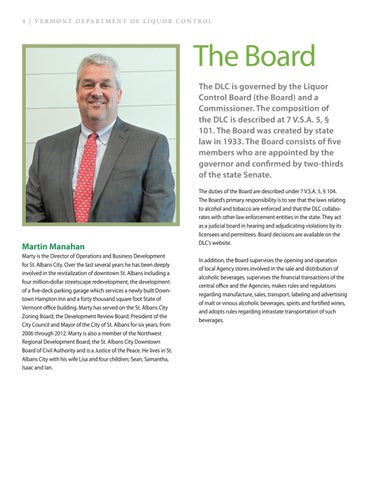
Martin Manahan Marty is the Director of Operations and Business Development for St. Albans City. Over the last several years he has been deeply involved in the revitalization of downtown St. Albans including a four million-dollar streetscape redevelopment, the development of a five-deck parking garage which services a newly built Downtown Hampton Inn and a forty thousand square foot State of Vermont office building. Marty has served on the St. Albans City Zoning Board; the Development Review Board; President of the City Council and Mayor of the City of St. Albans for six years, from 2006 through 2012. Marty is also a member of the Northwest Regional Development Board, the St. Albans City Downtown Board of Civil Authority and is a Justice of the Peace. He lives in St. Albans City with his wife Lisa and four children; Sean, Samantha, Isaac and Ian.
The duties of the Board are described under 7 V.S.A. 5, § 104. The Board’s primary responsibility is to see that the laws relating to alcohol and tobacco are enforced and that the DLC collaborates with other law enforcement entities in the state. They act as a judicial board in hearing and adjudicating violations by its licensees and permittees. Board decisions are available on the DLC’s website. In addition, the Board supervises the opening and operation of local Agency stores involved in the sale and distribution of alcoholic beverages, supervises the financial transactions of the central office and the Agencies, makes rules and regulations regarding manufacture, sales, transport, labeling and advertising of malt or vinous alcoholic beverages, spirits and fortified wines, and adopts rules regarding intrastate transportation of such beverages.