19
SPORTS
OUA EAst Quarterfinal (GAme three) — Nipissing Lakers 2, McGill Redmen 1 (lakers win Best-of-three 2-1)
Playoff life nasty, brutish, and short for Redmen Injuries catch up to defending National Champions who fall 2-1 in first round against Nipissing Adam Sadinsky Managing Editor One year after bringing home the school’s first national championship in its 135 year history, the McGill Redmen learned that the only thing harder than winning a title is holding onto it. On Sunday night, the Redmen’s season came to a decisive end, as they lost 2-1 to the Nipissing Lakers in deciding game of the OUA East quarterfinal. To say they failed to deliver, however, would ignore the unprecedented rash of injuries that plagued the team towards the end of the season. All things considered, the Redmen played through adversity, leaving everything on the ice, but ran out of gas by Sunday night. “I couldn’t be prouder of a group of guys,” Redmen Head Coach Kelly Nobes said after the Game Three loss. “We’re playing with, essentially, our hands tied behind our back with so many guys out of our lineup. We just ran out of juice. I go back to what we’ve done over the season, but the last six weeks or so where we’ve been anywhere from seven to 11 guys out of the lineup, and that’s just unheard of.” After losing a penalty-filled Game One that saw a combined 86 penalty minutes handed out to both teams, the Redmen stormed back on home ice to tie the series in a
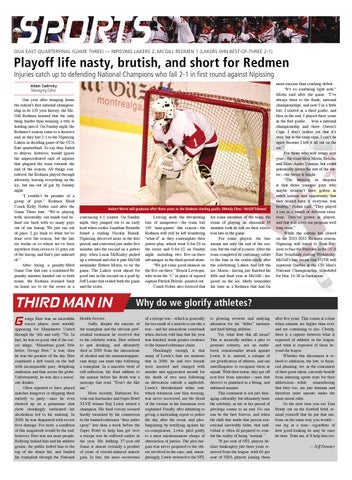
Hubert Morin will graduate after three years as the Redmen starting goalie. (Wendy Chen / McGill Tribune)
convincing 4-1 contest. On Sunday night, they jumped out to an early lead when rookie Jonathan Brunelle found a trailing Nicolas Biniek. Nipissing deserved more in the first period, and converted just under five minutes into the second on a power play, when Lucas McKinley picked up a rebound and slid it past McGill netminder Hubert Morin, to tie the game. The Lakers went ahead for good late in the second on a goal by Jeff Leaist that sealed both the game and the series.
THIRD MAN IN G
eorge Best was an incredible soccer player, most notably appearing for Manchester United through the ‘60s and early ‘70s. In fact, he was so good, that if the soccer adage, “Maradona good; Péle better; George Best,” is true, then he was the greatest of the day. Best combined a deft touch on the ball with incomparable pace, delighting audiences and fans across the globe. Unfortunately, he was also a notorious drinker. Often reported to have played matches hungover or skipping them entirely to party—once he even showed up on a primetime chat show shockingly inebriated—his alcoholism led to his undoing. In 2000, he was diagnosed with severe liver damage. For most, a condition of this magnitude would be the end; however, Best was not most people. Rallying behind him and his athletic genius, the public bolted him to the top of the donor list, and funded his transplant through the National
Leaving aside the devastating loss of manpower—the team lost 130 ‘man-games’ this season—the Redmen will still be left wondering ‘what-if’ as they contemplate their power-play, which went 0-for-24 in the series and 0-for-12 on Sunday night, including two five-on-three advantages in the third period alone. “We got some good chances on the five-on-three,” Benoit Levesque, who wore the ‘C’ in place of injured captain Patrick Belzile, pointed out. Coach Nobes also stressed that
for some members of the team, the strain of playing an abnormal 35 minutes took its toll on their execution late in the game. For some players, the loss means not only the end of the season, but the end of a career. After the team completed its customary salute to the fans in the centre-circle after the celebrating Lakers had left the ice, Morin—having just finished his fifth and final year at McGill—lingered on the ice, likely remember his time as a Redmen that had far
more success than crushing defeat. “It’s so confusing right now,” Morin said after the game. “I’ve always been to the finals, national championships, and now I’m a little lost. I started as a third goalie, and then in the end, I played three years as the first goalie … won a national championship and three Queen’s Cups. I don’t realize yet that it’s over, but at the same time, I can’t be upset because I left it all out on the ice.” For those who will return next year—the team loses Morin, Belzile, and Marc-Andre Daneau, but could potentially return the rest of the roster—the future is bright. “The blessing in disguise is that those younger guys who maybe wouldn’t have gotten as much icetime and opportunity that they would have if everyone was healthy,” Nobes said. “They played a ton in a bunch of different situations. They’ve grown as players, and that will serve our program well long-term.” While the curtain has closed on the 2013-2013 Redmen season, Nipissing will travel to Trois-Rivieres to face the Patriotes in the OUA East Semifinals starting Wednesday. McGill’s loss means that UQTR will represent Quebec at the CIS Men’s National Championship, scheduled for Mar. 14-18 in Saskatoon.
Why do we glorify athletes?
Health Service. Sadly, despite the success of the transplant and the obvious preferential treatment he received due to his celebrity status, Best refused to quit drinking, and ultimately died in 2005 from the interactions of alcohol and the immunosuppressant drugs one must take following a transplant. In a macabre twist of self-reflection, his final address to the masses before his death was a message that read, “Don’t die like me.” More recently, Baltimore Ravens star linebacker and Super Bowl XLVII winner Ray Lewis retired a champion. His final victory seemed hardly tarnished by his connection to the banned substance “deer antler spray” less than a week before the Super Bowl to help him get over a triceps tear he suffered earlier in the year. His hulking 37-year-old frame is almost certainly a product of years of steroid-induced muscle gain. In fact, the mere occurrence
of a triceps tear—which is generally far too small of a muscle to invoke a tear—and his miraculous comeback when doctors told him that his year was finished, lends greater credence to the banned substance claim. Shockingly enough, is that many of Lewis’s fans are unaware that in 2000, he and two friends were arrested and charged with murder and aggravated assault for the death of two men following an altercation outside a nightclub. Lewis’s bloodstained white suit, which witnesses saw him wearing, was never recovered, nor the blood of the victims in his limousine ever explained. Finally, after admitting to giving a misleading report to police the day after the event, and pleabargaining by testifying against his co-conspirators, Lewis pled guilty to a mere misdemeanour charge of obstruction of justice. The plea bargain was never proposed to the others involved in the case; and, unsurprisingly, Lewis returned to the NFL
to glowing reviews and undying adoration for his “killer” instincts and hard-hitting abilities. Yet, what does this all mean? This is assuredly neither a plea to promote sobriety, nor an embittered, sensationalist attack against Lewis. It is, instead, a critique of our glorification of athletes, and our unwillingness to recognize them as equals. With their status, they get off scot-free from mistakes—ones that deserve to punished in a fitting, and unbiased manner. This sentiment is not just damaging culturally, but ultimately hurts the celebrity, as his or her period of privilege comes to an end. No one can be the best forever, and when the skill that made that person sensational inevitably fades, that individual is often ill-prepared to combat the reality of being “normal.” 78 per cent of NFL players declare bankruptcy just three years removed from the league, with 60 per cent of NBA players joining them
after five years. This comes at a time when salaries are higher than ever, and are continuing to rise. Clearly, there is a rupture between what is expected of athletes in the league, and what is expected of them beyond the league. Whether this disconnect is related to addiction, the law, or financial planning; we, as the consumers of their great talent, can truly benefit from admiring sports stars for their athleticism—while remembering that they too, are just humans and therefore must operate under the same moral rules. So the next time you see Tom Brady out on the football field, remind yourself that he put that uniform on the same way you would— one leg at a time—regardless of how good-looking he may be once he does. Trust me, it’ll help him too. — Jeff Downey