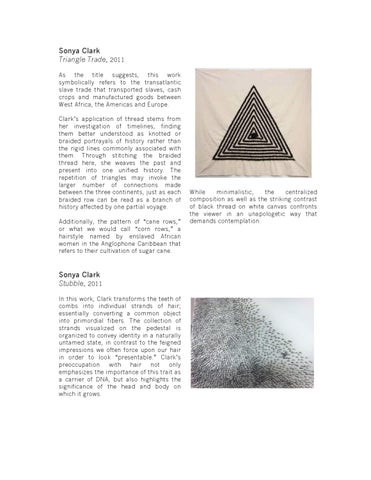
Sonya Clark Triangle Trade, 2011 As the title suggests, this work symbolically refers to the transatlantic slave trade that transported slaves, cash crops and manufactured goods between West Africa, the Americas and Europe. Clark’s application of thread stems from her investigation of timelines, finding them better understood as knotted or braided portrayals of history rather than the rigid lines commonly associated with them. Through stitching the braided thread here, she weaves the past and present into one unified history. The repetition of triangles may invoke the larger number of connections made between the three continents, just as each braided row can be read as a branch of history affected by one partial voyage. Additionally, the pattern of “cane rows,” or what we would call “corn rows,” a hairstyle named by enslaved African women in the Anglophone Caribbean that refers to their cultivation of sugar cane.
While minimalistic, the centralized composition as well as the striking contrast of black thread on white canvas confronts the viewer in an unapologetic way that demands contemplation.
Sonya Clark Stubble, 2011 In this work, Clark transforms the teeth of combs into individual strands of hair; essentially converting a common object into primordial fibers. The collection of strands visualized on the pedestal is organized to convey identity in a naturally untamed state, in contrast to the feigned impressions we often force upon our hair in order to look “presentable.” Clark’s preoccupation with hair not only emphasizes the importance of this trait as a carrier of DNA, but also highlights the significance of the head and body on which it grows.