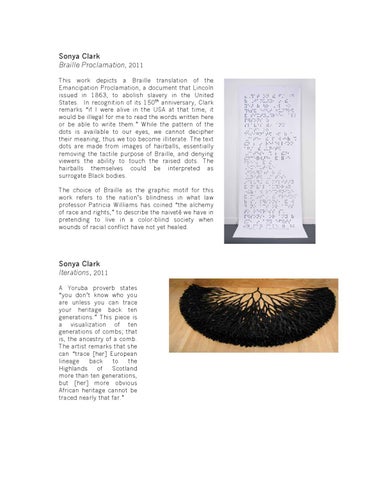
Sonya Clark Braille Proclamation, 2011 This work depicts a Braille translation of the Emancipation Proclamation, a document that Lincoln issued in 1863, to abolish slavery in the United States. In recognition of its 150th anniversary, Clark remarks “if I were alive in the USA at that time, it would be illegal for me to read the words written here or be able to write them.” While the pattern of the dots is available to our eyes, we cannot decipher their meaning, thus we too become illiterate. The text dots are made from images of hairballs, essentially removing the tactile purpose of Braille, and denying viewers the ability to touch the raised dots. The hairballs themselves could be interpreted as form of hairballs. The surrogate untouchable content of thebodies. work also refers to the artist’s personal expeBlack
unpaid labor in the United none of this tension or conten parent on the surface of Bra cipation. Artwork with such s
or white supremacist unde in the Emancipation Proclam commonly marginalized in th many scholars, collectors and subjective, angry or ‘politic produced at the expense of pecially when produced by a African descent.
Work of this nature, howev political, but social. Con ‘politics’ of the artist who u
rience with random white people who without permission touch or attempt to touch her own hair, a behavior that has become all too common for African-American women with untreated The choice aschoice theof graphic motif for hair—styles at-once regarded as ravishingof and Braille repulsive. The Braille as the graphic motif for this work could be read as a reference the nation’s blindnessblindness in the matter of what work refers to tothe nation’s in what law professor Patricia Williams has termed “the alchemy of race and rights.”3
this law professor Patricia Williams has coined “the alchemy of race and rights,” to describe the naiveté we have in the overwhelmingly disadvantaged dark-skinned descendants of nineteenth and twentieth pretending to live in a color-blind society when century chattel slavery, and the overwhelmingly advantaged white-skinned benefactors of that wounds of racial conflict have not yet healed.
Braille Emancipation Sonya Clark 2011, digital print, 60” x 120”
14
Sonya Clark Iterations, 2011 A Yoruba proverb states “you don’t know who you are unless you can trace your heritage back ten generations.” This piece is a visualization of ten generations of combs; that is, the ancestry of a comb. The artist remarks that she can “trace [her] European lineage back to the Highlands of Scotland more than ten generations, but [her] more obvious African heritage cannot be traced nearly that far.”
Afro Abe II Sonya Clark 2011, $5 bill and embroidery, 4” x 6”
24
through an exclusive networ tized power and appraisal m market and investor-driven Conversely, to be social as a to pursue a courageous, cre loquial and public engageme the artist, the work and the but at the expense of neith cal, conceptual or formal professional achievement or prosperity. In works such as Afro Abe
Iterations Sonya Clark 2011, combs, 120” x 60” x 96”