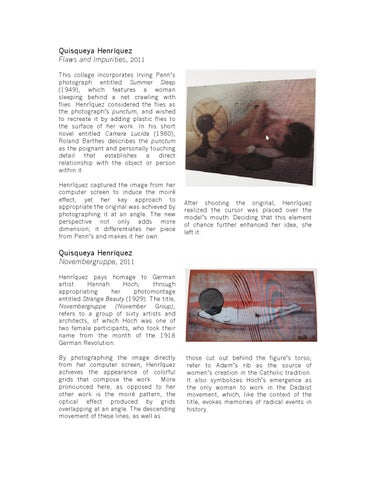
Quisqueya Henríquez Flaws and Impurities, 2011
This collage incorporates Irving Penn’s photograph entitled Summer Sleep (1949), which features a woman sleeping behind a net crawling with flies. Henríquez considered the flies as the photograph’s punctum, and wished to recreate it by adding plastic flies to the surface of her work. In his short novel entitled Camera Lucida (1980), Roland Barthes describes the punctum as the poignant and personally touching detail that establishes a direct relationship with the object or person within it. Henríquez captured the image from her computer screen to induce the moiré effect, yet her key approach to appropriate the original was achieved by photographing it at an angle. The new perspective not only adds more dimension; it differentiates her piece from Penn’s and makes it her own.
Quisqueya Henríquez Novembergruppe, 2011
Henríquez pays homage to German artist Hannah Höch, through appropriating her photomontage entitled Strange Beauty (1929). The title, Novembergruppe (November Group), refers to a group of sixty artists and architects, of which Höch was one of two female participants, who took their name from the month of the 1918 German Revolution. By photographing the image directly from her computer screen, Henríquez achieves the appearance of colorful grids that compose the work. More pronounced here, as opposed to her other work is the moiré pattern, the optical effect produced by grids overlapping at an angle. The descending movement of these lines, as well as
After shooting the original, Henríquez realized the cursor was placed over the model’s mouth. Deciding that this element of chance further enhanced her idea, she left it.
those cut out behind the figure’s torso, refer to Adam’s rib as the source of women’s creation in the Catholic tradition. It also symbolizes Höch’s emergence as the only woman to work in the Dadaist movement, which, like the context of the title, evokes memories of radical events in history.