® March/April 2014
G N I S I R RS A T S
S ’ A C MC
CES A F E R F U T U f the o L EGA L N SSIO E F O R P
®
®
THE LAWYERS WHO BROUGHT DOWN DOMA PAGE 36
WHO MADE PARTNER IN 2013? PAGE 42
®
®
®
SEDGWICK RULE #84
COOKIE-CUTTER
LAWYERS MAKE FOR A
HALF-BAKED LAW FIRM. At Sedgwick, our commitment to diversity has created a law firm where differing opinions aren’t just encouraged, but anticipated. Where passion is as respected as experience. And change is more than welcome, it’s embraced. Because you can’t make good law with the same old ingredients. To see what makes us different please visit www.sedgwicklaw.com
14-207-004_Sedgwick_CookieCutter-DATB-7x9.75_v0.indd 1
2/18/14 1:13 PM
Chicago Leaders Beverly N. Masuda
Brady Connolly & Masuda PC
Chicago
312.425.3134
Danielle Anne Phillip
Brinks Gilson & Lione
Chicago
312.840.3232
Luisa F. Trujillo
Cassiday Schade LLP
Chicago
312.444.1663
Aurora N. Abella-Austriaco
Clark Hill PLC
Chicago
312.985.5900
René A. Torrado, Jr.
Corboy & Demetrio PC
Chicago
312.346.3191
Jesse H. Ruiz
Drinker Biddle & Reath LLP
Chicago
312.569.1135
Sang-yul Lee
Edwards Wildman Palmer LLP
Chicago
312.201.2735
LaVon M. Johns
Gonzalez Saggio & Harlan LLP
Chicago
312.236.0475
Emily J. Kuo
Harrison & Held LLP
Chicago
312.332.5547
Richard B. Polony
Hinshaw & Culbertson LLP
Chicago
312.704.3632
Leslie Richards-Yellen
Hinshaw & Culbertson LLP
Chicago
312.704.3562
José Jorge Behar
Hughes Socol Piers Resnick & Dym Ltd
Chicago
312.604.2614
Rick Hammond
Johnson & Bell Ltd
Chicago
312.984.3425
Nerissa Coyle McGinn
Loeb & Loeb LLP
Chicago
312.464.3130
Li-Hsien Rin-Laures MD
Marshall Gerstein & Borun LLP
Chicago
312.474.6300
Michael C. Kim
Michael C Kim & Associates
Chicago
312.419.4000
Langdon D. Neal
Neal & Leroy LLC
Chicago
312.641.7144
Larry R. Rogers, Jr.
Power Rogers & Smith PC
Chicago
312.236.9381
Larry R. Rogers
Power Rogers & Smith PC
Chicago
312.236.9381
Jorge V. Cazares
Pugh Jones & Johnson PC
Chicago
312.768.7800
Walter Jones, Jr.
Pugh Jones & Johnson PC
Chicago
312.768.7800
Kathleen R. Pasulka-Brown
Pugh Jones & Johnson PC
Chicago
312.768.7800
Preston L. Pugh
Pugh Jones & Johnson PC
Chicago
312.768.7800
Stephen H. Pugh
Pugh Jones & Johnson PC
Chicago
312.768.7800
Emilio E. Machado
Rubin Machado & Rosenblum Ltd
Chicago
312.327.1840
Patricia Brown Holmes
Schiff Hardin LLP
Chicago
312.258.5722
Erika N. Chen-Walsh
Schiller DuCanto & Fleck LLP
Wheaton
630.784.7412
Graham C. Grady
Taft Stettinius & Hollister LLP
Chicago
312.836.4036
Michael A. Chabraja
Vedder Price PC
Chicago
312.609.779
Leading Lawyers Recognizes Our Diversity
Workers' Compensation Defense Intellectual Property
Health; Medical Malpractice Defense
Commercial Litigation; Foreclosure Defense; Real Estate: Associations & Condominiums; Real Estate: Commercial; Real Estate: Residential Antitrust; Commercial Litigation; ADR: Commercial Litigation; Personal Injury: General Corporate Finance; Governmental, Municipal, Lobbying & Administrative; Publicly Held Corporations Employment: Management; International Business & Trade; Labor: Management
Land Use, Zoning & Condemnation; Public Finance; Real Estate: Commercial; Real Estate: Finance Trust, Will & Estate Planning Commercial Litigation Public Finance
Civil Rights/Constitutional; Employment: Employee; Employment: Management; School Insurance, Insurance Coverage & Reinsurance
Advertising & Media; Arts, Entertainment & Sports; Copyright & Trademark; Intellectual Property Intellectual Property
Real Estate: Associations & Condominiums; Real Estate: Commercial; Real Estate: Residential
Commercial Litigation; Governmental, Municipal, Lobbying & Administrative; Land Use, Zoning & Condemnation; Public Finance; Real Estate: Commercial Personal Injury: General
Aviation; Personal Injury: General; Personal Injury: Professional Malpractice; PI: Transportation Incl FELA & Maritime Civil Rights/Constitutional; Commercial Litigation; Employment: Management; Land Use, Zoning & Condemnation Civil Appellate; Commercial Litigation; Criminal Defense: White Collar
Commercial Litigation; Federal Regulatory; Governmental, Municipal, Lobbying & Administrative; Telecommunications
Civil Rights/Constitutional; Commercial Litigation; False Claims Act/Whistle Blower; Governmental, Municipal, Lobbying & Administrative Commercial Litigation; Governmental, Municipal, Lobbying & Administrative; Public Finance Personal Injury: General
Commercial Litigation; Criminal Defense: White Collar Family
Governmental, Municipal, Lobbying & Administrative; Land Use, Zoning & Condemnation; Real Estate: Commercial Commercial Litigation
A lawyer CANNOT buy the distinction of being a Leading Lawyer. This distinction was earned by being among those lawyers who were most often recommended by their peers in statewide surveys. Respondents COULD NOT recommend themselves or lawyers at their law firm. For a complete list of all Leading Lawyers and to view profiles of the lawyers listed on this page, go to www.LeadingLawyers.com.
312.644.7000 | LeadingLawyers.com
A Division of Law Bulletin Publishing Company–est. 1854
March/April 2014
SI
ST
S • RI
ARS
A’
• MCC
NG •
TABLE OF CONTENTS
p.20 p.36
These lawyers are moving to new heights.
Unjust laws are met with destruction.
FEATURES 20 MCCA’S RISING STARS Read about the amazing young attorneys in MCCA’s network who will be the face of the legal profession in years to come. The list includes in-house and outside counsel from all over the country. In a few years, it won’t be a surprise to see these attorneys in even more prominent roles. BY PATRICK FOLLIARD
36 THE LAWYERS WHO BROUGHT DOWN DOMA Over the past few years, acceptance of same-sex marriage has become mainstream, culminating in the invalidation of the Defense of Marriage Act by the U.S. Supreme Court. Who are the lawyers who made it happen and what challenges are they facing now? BY LEKAN OGUNTOYINBO
42 WHO MADE PARTNER IN 2013? MCCA congratulates the attorneys of color joining the partnership ranks in 2013. COMPILED BY JOSHUA H. SHIELDS
VISIT WWW.MCCA.COM FOR THE LATEST INFORMATION ON OUR EVENTS, AWARDS, AND RESEARCH.
MCCA® Board Of Directors
COLUMNS 8 Notes from the President & CEO 10 Perseverance in Profile Highlighting the contributions and talents of attorneys with disabilities.
Aaron Bates BY TOM CALARCO
14 Lawyer’s Lantern
Offering illuminating professional guidance for your career.
An Interview with Nicole Jones of Cigna
16 Spotlighting Horacio Gutiérrez of Microsoft
DEPARTMENTS 44 Association Focus
Karamah—Muslim Women Lawyers for Human Rights BY LEKAN OGUNTOYINBO
46 Diversity News
Navigating the IP Rights of Cultural Traditions BY ADRIENNE DOMINGUEZ
48 In Closing…
An Interview with Thomas A. Saenz BY JOSHUA H . SHIELDS
50 Movers & Shakers BY JOSHUA H . SHIELDS
BY PATRICK FOLLIARD
2014 STRATEGIC DIVERSITY SPONSOR
4
Vernon G. Baker II Senior Vice President & General Counsel, Meritor, Inc. Michelle Banks Executive Vice President, General Counsel, Corporate Secretary & Chief Compliance Officer, Gap, Inc. Clarissa Cerda Senior Vice President, General Counsel & Secretary, LifeLock, Inc. A. B. Cruz III Former Chief Legal Officer & Corporate Secretary, Scripps Networks Interactive, Inc. Anthony K. Greene Director, Jamison Insurance Group Gary F. Kennedy Senior Vice President, General Counsel & Chief Compliance Officer, American Airlines, Inc. Jean Lee Vice President & Assistant General Counsel, JPMorgan Chase Don H. Liu Senior Vice President, General Counsel, & Secretary, Xerox Corporation Hinton J. Lucas Vice President & Assistant General Counsel, DuPont Company Robbie E. B. Narcisse Vice President-Global Ethics & Business Practices, Pitney Bowes Inc. Advertising For advertising inquiries, contact Don Cooksey, Montrose Media Sales, at donald.cooksey@verizon.net. MCCA® Membership Please visit our web site at www.mcca.com for membership and other information. General Information and Address Changes Send your questions, complaints, and compliments to MCCA®, Editor, Diversity & the Bar®, 1111 Pennsylvania Avenue, NW, Washington, DC 20004. Address changes should be sent to MCCA’s Director of Membership and Development at 1111 Pennsylvania Avenue, NW, Washington, DC 20004. Permissions and Reprints Reproduction of Diversity & the Bar in whole or in part without permission is prohibited. The Copyright Act of 1976 prohibits the reproduction by photocopy machine or any other means of any portion of this issue, except with the permission of MCCA. To obtain permission, contact: Joshua H. Shields, Editor-in-Chief, 1111 Pennsylvania Avenue, NW, Washington, DC 20004. Copyright Copyright® 2014 by the Minority Corporate Counsel Association. Diversity & the Bar is published six times a year and is distributed to supporters and subscribers, 1111 Pennsylvania Avenue, NW, Washington, DC 20004. The information contained in this publication has been provided to the Minority Corporate Counsel Association (MCCA®) by a variety of independent sources. While MCCA makes every effort to present accurate and reliable information, MCCA does not endorse, approve, or certify such information, nor does MCCA
Samuel M. Reeves Senior Vice President, General Counsel, Walmart U.S. Legal Carlos Rincon Partner, Rincon Law Group, P.C. Thomas L. Sager Senior Vice President & General Counsel, DuPont Company Robin H. Sangston Vice President, Chief Compliance Officer, Cox Communications, Inc. Kenneth S. Siegel Chief Administrative Officer & General Counsel, Starwood Hotels & Resorts Worldwide, Inc. Mary E. Snapp Corporate Vice President & Deputy General Counsel Legal & Corporate Affairs, Microsoft Corporation Lawrence P. Tu Senior Vice President, General Counsel & Secretary, Dell, Inc. Neil Wilcox General Counsel Chase Card Services, JP Morgan Chase Simone Wu Senior Vice President, General Counsel, Corporate Secretary & Chief Compliance Officer, Choice Hotels International, Inc.
guarantee the accuracy, completeness, efficacy, or chronological sequence of any such information. Use of such information on the readers’ part is entirely voluntary and reliance upon it should be undertaken only upon independent review and due diligence. References herein to any commercial product, process, or service by trade name, trademark, service mark, manufacturer, or otherwise shall not constitute or imply endorsement, preference, recommendation, or the favor of MCCA. MCCA (including its employees and agents) assumes no responsibility for consequences resulting from the use of the information herein, or in any respect for the content of such information, including (but not limited to) errors or omissions, the accuracy or reasonableness of factual or other data, including statistical or scientific assumptions, studies or conclusions, the defamatory nature of statements, ownership of copyright or other intellectual property rights, and the violation of property, privacy, or personal rights of others. MCCA is not responsible for, and expressly disclaims and denies liability for, damages of any kind arising out of use, reference to, or reliance upon such information. No guarantees or warranties, including (but not limited to) any express or implied warranties of merchantability or fitness for a particular use or purpose, are made by MCCA with respect to such information. Copyright in this publication, including all articles and editorial information contained herein, is exclusively owned by MCCA and MCCA reserves all rights to such information. MCCA is a tax-exempt corporation organized in accordance with section 501(c)(3) of the Internal Revenue Code. Its tax ID number is 13-3920905.
MCCA® Law Department Members The Minority Corporate Counsel Association (MCCA) acknowledges the support of the following law departments whose financial contributions have helped to advance the goal of furthering diversity in the legal profession.
6
3M Company AARP AT&T Accenture LLP AECOM AGCO Corporation Allstate Insurance Altria Group, Inc. American Airlines, Inc. American Express Company American Lawyer Media Aon Corporation Areas USA, Inc. Bank of America Bechtel Becton, Dickinson and Company Behr America Inc. Boehringer Ingelheim Corporation Booz Allen Hamilton BP America Inc. Bristol-Myers Squibb Company BNY Mellon CALIBR, global leadership network Capital Legal Solutions, LLC Capital One Financial Corporation Cargill Inc. Carter’s, Inc. Catalent Pharma Solutions CBIC Construction & Development, LLC Chevron Corporation Choice Hotels International, Inc. CIGNA Corporation CITGO Corporation Colgate-Palmolive Company Compass Group, The Americas Compassion Care Hospice Computer Science Corporation ConAgra Foods, Inc. ConocoPhillips Constellation Energy
Cox Communications Crawford & Company Darden Restaurants, Inc. D.C. Water and Sewer Authority Deere & Company Dell Inc. DHL America Diageo North America Inc. Dignity Health DiversityInc Media, L.L.C. Dow Corning Corporation Duke Energy DuPont Eaton Corporation Eli Lilly and Company Entergy Corporation Estée Lauder Companies Inc. Exelon Business Services Company Fannie Mae Federal Home Loan Bank of San Francisco Fickel Enterprises Inc. Flagstar Bank Freddie Mac Fujitec America, Inc. Gap Inc. General Electric Company General Mills Inc. GlaxoSmithKline Graduate Management Admission Council Genentech, Inc. Goldman Sachs & Co. Google Inc. Hewlett-Packard Company HJ Heinz Company H.J. Russell & Company Halliburton Honda of America MFG., Inc. Honeywell International Huntington Ingalls Industries
IBM Corporation Ingersoll-Rand PLC Intel Corporation International Paper Company Jamison Insurance Group JC Penney Company, Inc. JetBlue Airways Corporation Johnson & Johnson JPMorgan Chase Bank NA JM Family Enterprises, Inc. Kaiser Foundation Health Plan, Inc. KeyCorp Kraft Foods Law School Admission Council (LSAC) Leading Educators Leidos Leo Burnett Company LexisNexis Liberty Mutual Insurance Company Lifelock, Inc. LifeVantage Corporation Liquidity Services, Inc. Macy’s, Inc. ManpowerGroup Marriott International, Inc. MassMutual Financial Group Medifast, Inc. MetLife Inc. Merck & Co., Inc. McDonald’s Corporation Microsoft Corporation MillerCoors Monsanto Company Morgan Stanley Nabholz Construction Services National Grid Nationwide Mutual Insurance Company Navistar, Inc. Neighborhood
Defender Service Newegg Inc. New York Life Insurance Company NORCAL Mutual Insurance Company Northrop Grumman Corporation Nuclear Electric Insurance Limited Office Depot Pacific Gas and Electric Company Pepco Holdings, Inc. PepsiCo, Inc. Pfizer Inc. Pitney Bowes, Inc. PPG Industries, Inc. Porzio Life Sciences, LLC PRAXAIR, INC. PreCash Premier Media, Inc. Prudential Financial Quest Diagnostics Incorporated RBS Americas Reckitt Benckiser, Inc. Reed Elsevier, Inc. Rockwell Collins Rolls Royce North America Inc. Rosetta Stone Inc. Sara Lee Corporation Scripps Networks Interactive, Inc. Sears Holding Company Sempra Energy ServiceMesh, Inc. Shell Oil Company Sodexo Sony Electronics, Inc. Southeastern Freight Lines, Inc. Southern California Edison Company
Science Applications International Corporation (SAIC) Staples, Inc. Starbucks Coffee Company Starwood Hotels & Resorts Worldwide, Inc. Spanish Broadcasting System Inc. Synopsys, Inc. Tanenbaum Harber of Florida, Inc. Target Corporation Tessera North America, Inc. The Brookings Institution The Church Pension Fund The Clorox Company The Coca-Cola Company The Conference Board, Inc. The Dow Chemical Company The Juilliard School The Vanguard Group, Inc. The Walt Disney Company The Williams Companies, Inc. Tyson Foods Inc. UBS UnitedHealth Group United Parcel Service United Technologies Corporation U.S. Food Service, Inc. Verizon Communications Walmart Stores, Inc. WellPoint, Inc. Waste Management Wells Fargo & Company Wireless Generation Inc. Xerox Corporation XO Holdings, Inc. Xylem Inc. Yazaki North America Inc. Zenith Insurance Company
All Firm Affiliates Receive These Exceptional Benefits: • Use of MCCA Law Firm Affiliate Network’s logo for the firm’s business cards, ads, website, etc. (under license agreement).
marketed to MCCA member companies for outside counsel selection.
• Listed as a Firm Affiliate Network (FAN) member on the MCCA website—this will be regularly circulated to MCCA member companies who care about diversity for their information and reference.
• Access to the FAN Virtual Library of diversity resources (FAN directory, law firm best practices, sample documents, message board) and ability to contribute and share resources for inclusion in the FAN Virtual Library or Career Center.
• Ability to post bios and practice information on the firm’s diverse attorneys in an online directory that is
• Access to MCCA’s Career Center. Firms will be able to post jobs at low cost and review resumes at no cost.
DIVERSIT Y & THE BAR®
MARCH/APRIL 2014
• Professional development information via Career Center and Group Mentoring opportunities via KAN-Do! Mentoring. • Special firm affiliate e-newsletter containing trends, statistics, article links, and information on in-house counsel promotions. • Two (2) MCCA Diversity Planning Toolkits (compendium of diversity research and best practice information compiled by MCCA).
MCCA.COM
MCCA® Law Firm Affiliates MCCA® acknowledges the decision of the following law firms who have joined with MCCA to advance the goal of furthering diversity in the legal profession. Alchemy-Partners, PC Alexander & Associates Anderson Kill P.C. Archer & Greiner, P.C. Arent Fox LLP Arrastia & Capote LLP** Axiom Baldassare & Marra LLC** Benesch Friedlander Coplan & Aronoff LLP Beveridge & Diamond, P.C. Bond, Schoeneck & King, PLLC Bressler, Amery & Ross PC Bricker & Eckler LLP Brinks Hofer Gilson & Lione Brown Law Group** Buchanan Ingersoll & Rooney PC Butler, Snow, O’Mara, Stevens & Cannada, PLLC Calfee, Halter & Griswold LLP Cavich, Familo & Durkin Co., LPA Christian & Small LLP Clifford Chance US LLP Cooley LLP Cottrell Solensky & Semple, P.A. Courington Kiefer & Sommers LLC Cozen O’Connor Crumbie Law Group, LLC** Davis & Gilbert LLP DeMahy Labrador & Drake, PA** Dickstein Shapiro LLP Drinker Biddle & Reath LLP Duane Morris LLP Elliott Greenleaf Epstein, Becker & Green, PC Finnegan, Henderson, Farabow, Garrett & Dunner, LLP Fish & Richardson P.C. Fitzpatrick, Cella, Harper & Scinto Goldberg Segalla, LLP Gonzalez Saggio & Harlan LLP** Griffith Sadler & Sharp, P.A.** Hamilton Miller & Birthisel LLP**
Helms & Greene LLC Hinkley Allen & Snyder LLP Hughes Roch LLP** Ice Miller LLP Infante Zumpano** Innis Law Group LLC** Igbanugo Partners International Law Firm Jeffrey Samel & Partners** Kasowitz, Benson, Torres & Friedman LLP Kaufman Dolowich & Voluck, LLP Kenyon & Kenyon LLP Kilpatrick Townsend & Stockton LLP King Branson LLC Kirkland & Ellis LLP Kumagai Law Group PC Kumar, Prabhu, Patel & Banerjee** Lathrop & Gage LLP Law Office of LaVonne Lawson** Leader & Berkon LLP Littler Mendelson P.C. Lim Ruger & Kim LLP** Loeb & Loeb LLP Lowe & Associates LLC Martin & Martin, LLP** Maynard Cooper & Gale PC McGuireWoods LLP Meckler Bulger Tilson & Pearson LLP Messner & Reeves, LLC Miles & Stockbridge P.C. Miller Law Group** Montgomery, Barnett, Brown, Read, Hammond & Mintz LLP Morgan, Lewis & Bockius LLP Nemeth Burwell, P.C.** Nicholson Law Group LLC** Ogletree Deakins Nash Smoak & Stewart P.C. Patton Boggs LLP Pepper Hamilton, LLP Peter Law Group** Phelps Dunbar LLP Pinckney, Harris & Weidinger LLC** Polsinelli PC
Porzio, Bromberg & Newman, PC Quarles & Brady LLP Quintarios Prieto Wood & Boyer, P.A.** Rivero Mestre, LLP** Rooney Rippie & Ratnaswamy, LLP Sanchez & Amador, LLP** Sanchez-Medina, Gonzalez, Quesada, Lage, Crespo, Gomez & Machado LLP** Saul Ewing LLP Schiff Hardin, LLP Schwartz Hannum PC** Shella, Harris and Aus, P.C.** Sher Garner Cahill Richter Klein & Hilbert LLC Shook, Hardy & Bacon L.L.P. Smith, Anderson, Blount, Dorsett, Mitchell & Jernigan, LLP Snell & Wilmer LLP Steptoe & Johnson LLP Stevens & Lee Stradling Yocca Carlson & Rauth, P.C. Sughrue Mion PLLC Sutherland Asbill & Brennan LLP The Goldstein Environmental Law Firm P.A. Thompson Hine LLP Troutman Sanders LLP U.K. Vyas Law** Vinson & Elkins LLP Waas Campbell Rivera Johnson & Velasquez LLP Weil, Gotshal & Manges LLP Willis Law Group** Winston & Strawn LLP Wheeler Trigg O’Donnell LLP Wong Fleming P.C.** Vinson & Elkins LLP Xupkus & Angell, P.C.** Young Conaway Stargatt & Taylor, LLP Zuber Lawler & Del Duca LLP
• Unlimited licenses to reprint articles/ information from Diversity & the Bar® and MCCA Research Reports for internal educational use and distribution within the firm.
• Subscriptions to MCCA’s invitation-only Connected online community (Connected is a social networking service offered by Lexis/Nexis via MCCA).
• Ability to sign up high potential diverse associates as KAN-Do! mentees.
** Minority or Women Owned Law Firm
• Bulk rate subscriptions* to Diversity & the Bar for unlimited number of firm’s attorneys.
* This item will require an additional payment at MCCA’s cost for printing and centralized shipping of a specified number of copies of the magazine to an office of the firm for the firm’s further internal distribution.
For more information, contact David Chu, MCCA’s Director of Membership & Development, at 202-739-5906 or davidchu@mcca.com.
MCCA.COM
MARCH/APRIL 2014
DIVERSIT Y & THE BAR®
7
Notes
From the President & CEO
RISING TO NEW HEIGHTS TWO YEARS AGO A YOUNG ASSOCIATE NAMED TARSHA PHILLIBERT was named a “Rising Star” in this magazine. Today she is a
8
partner at Jenner & Block where she is a member of the white collar defense and investigations practice. As we continue to feature attorneys in our network who are climbing the career ladder, it is fun to watch and revel in their professional achievements. In this issue we feature twelve attorneys from our network who are in different stages in their careers. Some are associates just starting out in their first Big Law position, while others are moving into new leadership roles. Some have navigated routes through large law firms and others have moved in-house. One of them is a Korean-American who has been only practicing two years, yet has handled negotiation and drafting of all documents for films starring Nicole Kidman and Jason Bateman. There is also an attorney who moved to a new position during the selection of this year’s Rising Stars. That position? General counsel. Regardless of where they are now, they are all moving on and up in the legal world. This group shows that for diverse lawyers, the sky is the limit. It seems it was more than a year ago that the U.S. Supreme Court invalidated the Defense of Marriage Act. It is now history. Looking back on that momentous achievement, we profile four attorneys who contributed to the landmark case: Roberta Kaplan, Mary Bonauto, James Esseks, and Pamela Karlan. While these four lawyers don’t represent a comprehensive roll call of lawyers who aided the decision, the outcome may have been very different if it were not for the talents of the four passionate attorneys. This issue’s departments are especially strong: Nicole Jones, Cigna’s general counsel, shares her thoughts on diversity best practices and her career
advice for aspiring in-house leaders. The Mexican American Legal Defense and Education Fund’s President and General Counsel Thomas A. Saenz also spoke to the magazine and outlined his vision for the coming year. Horacio Gutiérrez, another strong Latino voice (not to mention deputy general counsel of Microsoft), tells his story in our Spotlighting column. Finally, make sure to read our Association Focus column on Karamah. The group, comprised of Muslim women lawyers, seeks to educate the public about the difference between religion and culture in the Muslim world. The diversity of the legal industry doesn’t surprise me. These stories are only a few that we hear about all the time. We want to share as many of them as we can with you. JOSEPH K. WEST
President & CEO MCCA_law
www.facebook.com/mcca.law
Publications Staff President & CEO Joseph K. West Founder and Publisher Emeritus Lloyd M. Johnson Jr. Editor-in-Chief Joshua H. Shields
DIVERSIT Y & THE BAR®
Publishing Consultants Toni Coleman Joanne Richcreek Advertising Don Cooksey Design/Art Direction Quad/Graphics Creative Solutions
MARCH/APRIL 2014
MCCA® Staff Jennifer Chen Mahzarine Chinoy David Chu Donna Crook Charles Hollins Jessica Martinez Aracely Muñoz Petrich Andrea Pimm
Contributing Writers Tom Calarco Adrienne Dominguez Patrick Folliard Lekan Oguntoyinbo Joshua H. Shields
MCCA.COM
Perseverance in Profile
AARON BATES Fighter for Disability Rights BY TOM CALARCO “Everything’s been a fight in my world,” says attorney Aaron Bates. The Jacksonville, Fla., native was born with spinal muscular atrophy (SMA), a severe form of muscular dystrophy, and has no use of his legs and only limited use of his arms. 10
F
rom the time he was placed in special education in grade school to the time he challenged the state of Florida to expand its provision of personal care attendants for the disabled, his life has been a struggle to live normally. “Thank God for my parents,” Bates says, “who wanted me treated like every other kid.” His father, a maritime engineer, and his mother, a homemaker, have devoted their lives to the care of their children— Bates has a younger sister who also has SMA, which is passed genetically. Because of their strong advocacy, Bates was taken out of special ed and placed in classes for gifted children. “My dad instilled in me a drive to hold myself to a high standard,” Bates says. “He taught me how to fight and not take no for an answer, and that lesson has played out in my life.” His family was deeply involved in the Muscular Dystrophy Association, and Bates became the MDA’s Florida poster child. Although he enjoyed the work and made many friends, he found the considerable travel demanding. “I got burned out by the time I was 14,” he says. This period of his life ended with Bates’s acceptance to rigorous Stanton College Prep in Jacksonville. “I had
DIVERSIT Y & THE BAR®
MARCH/APRIL 2014
MCCA.COM
five to six hours of homework every night,” he says. “College was a breeze after Stanton. It was on par with law school. But it really prepared me for what was ahead.” Bates earned two bachelor’s degrees from Florida State University in three years and was awarded a scholarship to the university’s law school. After completing law school in two and a half years in December 2003, he set his sights on a position as a prosecutor. An internship at the state attorney’s office at Tallahassee led to a promised job offer after graduation. But his dream job was stymied when the Florida Division of Vocational Rehabilitation (VR) rejected his application to continue the funding of his personal care attendant. Florida law at the time only provided personal attendants to those who sustained spinal cord injuries. Throughout his time in school, the Florida VR had provided him
with a personal care attendant to help him out of bed, dress, bathe, and get into his electric wheelchair. Although he confirmed with VR three months prior to completing his studies that he would get assistance for 18 months after graduation, the VR would later claim that there had been a misunderstanding. Without an attendant, Bates was forced to live with his parents, who had relocated to Tennessee. “I was trying to figure out what to do,” says Bates, whose independence is vitally important to him. In the meantime, he found a job with a law firm near his parents’ home. However, when his dad’s job moved to Alabama, he realized he couldn’t continue to move around with his parents and needed to return to Florida to pursue his career. The irony was that he could receive ample assistance from the state for his condition if he didn’t work. But he
was an able and well-educated man who wanted to make his contribution. Reflecting on his father’s advice to pursue law as a career so that he could be independent, Bates took matters into his own hands. Bates had by then passed the Florida Bar Exam and began his job search. He also began to lobby the state of Florida to expand its Florida Personal Care Attendant Program, which still provided attendants only to those who suffered spinal cord injuries. These efforts led to an agreement to provide him with an attendant for 18 months through the Able Trust, a foundation established by the Florida Legislature to provide employment opportunities for Floridians with disabilities. With this agreement in place, he was hired as a state attorney for the Fifth Circuit Judicial District, which covers five counties in central Florida. A month prior to beginning his employment in
BATES HOPES TO MAKE IT EASIER FOR OTHERS WITH SPINAL MUSCULAR ATROPHY.
12
November, he met with a VR counselor in order to set up the attendant services and was assured they would be in place when he started work. But then fate took a cruel twist as he headed for Tavares in Lake County, where he was to be working. “My parents were driving my Dodge Caravan with a U-Haul trailer containing my furniture and belongings, and my attendant was already in central Florida, ready to take over and go to work,” he says. “And then I got a call that there would be no payment for an attendant. We were actually passing Tallahassee when I got the call, so we exited off, drove to the governor’s office and demanded a meeting with the assistant chief of staff. In retrospect, that was a little comical and radical.” It was a devastating blow as once again confusion about his eligibility under the law for a personal care attendant had been approved then was denied. But Bates is not one to give up easily. “I did something my dad taught me when I was younger,” he says. “When things aren’t being done corDIVERSIT Y & THE BAR®
MARCH/APRIL 2014
rectly, the quickest way to get things moving is to put a spotlight on it.” Bates called government representatives and circulated a letter to legislators and the media about the need to supply personal care services for others with disabilities so that they could accept gainful employment. The Orlando Sentinel picked up his story in December 2005, and a month later the Florida Bar News in Tallahassee began running a series of articles about his situation. Support developed quickly from influential people such as disability rights attorney Matthew Dietz of Miami; state legislator Andy Gardiner of Orlando; and lobbyist Steve Uhlfelder, who arranged meetings with Governor Jeb Bush and his chief of staff. Florida Supreme Court Clerk Thomas Hall, who has since retired, was among others who spoke up for Bates. He became a cause celebre in the legal community of Florida. Three months after his story broke, Bates was hired by an Orlando firm, Mirabilis Ventures, whose interests included an employment leasing business. The firm provided him with an attendant. The job offer was a joyful
resolution for Bates, but his battle had only just begun. “It’s great for me,” Bates said at the time. “But the problem hasn’t gone away for other people in my situation.” Bates continued to lobby to change the law that had denied him services, testifying at state hearings and working with legislators. Less than three years after Bates was denied his assistance, state representatives Gardiner and Steve Wise of Jacksonville co-sponsored an amendment to the original disabilities law to expand access to attendants to all individuals with disabilities who needed attendants to be gainfully employed. The legislation created a program to coordinate these services, called the James Patrick Memorial Work Incentive Personal Attendant Services Program in honor of the late Jacksonville attorney Jimmy Patrick, a quadriplegic, whose groundbreaking efforts led to the creation of the original program assisting those with spinal cord injuries. It was a great victory for Bates, whose case and continued efforts had helped to provide support for the eventual passage of the legislation. “It finally passed and it’s a done deal,” said Bates, who was then dealing with new challenges. The IRS charged his employer, Mirabilis Ventures, with tax evasion, claiming the firm owed the government upwards of $200 million including penalties. Not only had it filed for bankruptcy, but its CEO, Frank Amodeo, was under indictment for fraudulent activities. Bates’s response was indicative of his resilience. He formed, with coworker Matt Mokwa, their own law firm, Bates Mokwa, to help handle the bankruptcy proceedings for Mirabilis. They also handled civil rights litigation related to the Americans with Disabilities Act and represented plaintiffs harmed by prescription drugs. Bates successfully represented a man with dystonia, a neurological condition associated with twisting, MCCA.COM
ADVERTORIAL
I did something my dad taught me when I was younger. When things aren’t being done correctly, the quickest way to get things done is to put a spotlight on it. repetitive, or abnormal movements, who was refused a ticket on American Airlines because of his condition. “He was told he couldn’t fly unless he bought a ticket for an attendant, just because he looks very strange,” Bates says. “The ADA does not apply to airplanes. So we threatened to take the case to Arizona, where courts have allowed lawsuits in such cases, and they settled and put in new policies and procedures to deal with such a situation.” Bates and Mokwa both have become associates at the Orlando-based Maher Law Firm. Although Bates, 33, still accepts clients at Bates Mokwa, he has cut back his work for Maher after being diagnosed with leukemia two years ago. “It’s treatable and it’s in remission,” Bates says. In addition to actively litigating, he is a member of several boards, including the Central Florida Disability Chamber of Commerce and the Muscular Dystrophy Association, and he serves on several committees for the American Bar Association. He also lobbies for disability rights in Florida and with the federal government, a passion he will continue to pursue for as long as he can. “My passion is to become a full-time advocate in a nonprofit context,” he says, “to help the disabled become contributing members of society, and be an advocate and resource for the next generation. A cure for SMA is not that interesting to me. I’ve lived with this disease all my life, but there are a lot of things that could be done to make my life easier, so many other issues that need to be addressed.” D&B
ADEEL MANGI We congratulate Adeel Abdullah Mangi for being named a “2014 Rising Star” by Diversity & the Bar magazine. Adeel is a Partner of Patterson Belknap Webb & Tyler LLP, a New York City law firm of over 200 lawyers. Adeel is a trial lawyer concentrating in complex commercial disputes. He has particular experience in pharmaceutical pricing, false advertising, and class action defense. Adeel joined the firm in 2000 upon his graduation with an LL.M. from Harvard Law School, where he was a Kennedy Memorial Scholar. He also holds a First Class Degree in Law from the University of Oxford and is a British Barrister. Adeel grew up in Karachi, Pakistan. For more than a decade, Adeel has represented Fortune 500 companies and major corporations in bet-thecompany high stakes litigation in courts around the country. In 2010, Adeel became the youngest person elected partner in Patterson Belknap’s modern history. Adeel is also a graduate of the Microsoft Litigation Group’s Trial Advocacy Academy 2013. From 2010 to 2013, Adeel was elected to multiple successive terms on the Board of Directors of the Muslim Bar Association of New York. He has been a mentor to young lawyers and law students and maintains an active pro bono practice. He also works towards rural uplift in Pakistan through a family charity building schools and providing access to clean water, health care and microfinance.
Tom Calarco is a freelance writer based in Wildwood, Fla. MCCA.COM
MARCH/APRIL 2014
DIVERSIT Y & THE BAR®
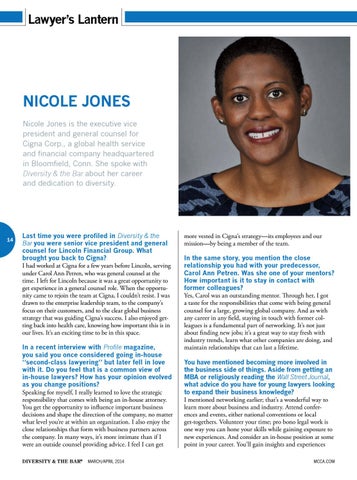
Lawyer’s Lantern
NICOLE JONES Nicole Jones is the executive vice president and general counsel for Cigna Corp., a global health service and financial company headquartered in Bloomfield, Conn. She spoke with Diversity & the Bar about her career and dedication to diversity.
14
Last time you were profiled in Diversity & the Bar you were senior vice president and general counsel for Lincoln Financial Group. What brought you back to Cigna? I had worked at Cigna for a few years before Lincoln, serving under Carol Ann Petren, who was general counsel at the time. I left for Lincoln because it was a great opportunity to get experience in a general counsel role. When the opportunity came to rejoin the team at Cigna, I couldn’t resist. I was drawn to the enterprise leadership team, to the company’s focus on their customers, and to the clear global business strategy that was guiding Cigna’s success. I also enjoyed getting back into health care, knowing how important this is in our lives. It’s an exciting time to be in this space. In a recent interview with Profile magazine, you said you once considered going in-house “second-class lawyering” but later fell in love with it. Do you feel that is a common view of in-house lawyers? How has your opinion evolved as you change positions? Speaking for myself, I really learned to love the strategic responsibility that comes with being an in-house attorney. You get the opportunity to influence important business decisions and shape the direction of the company, no matter what level you’re at within an organization. I also enjoy the close relationships that form with business partners across the company. In many ways, it’s more intimate than if I were an outside counsel providing advice. I feel I can get DIVERSIT Y & THE BAR®
MARCH/APRIL 2014
more vested in Cigna’s strategy—its employees and our mission—by being a member of the team. In the same story, you mention the close relationship you had with your predecessor, Carol Ann Petren. Was she one of your mentors? How important is it to stay in contact with former colleagues? Yes, Carol was an outstanding mentor. Through her, I got a taste for the responsibilities that come with being general counsel for a large, growing global company. And as with any career in any field, staying in touch with former colleagues is a fundamental part of networking. It’s not just about finding new jobs; it’s a great way to stay fresh with industry trends, learn what other companies are doing, and maintain relationships that can last a lifetime. You have mentioned becoming more involved in the business side of things. Aside from getting an MBA or religiously reading the Wall Street Journal, what advice do you have for young lawyers looking to expand their business knowledge? I mentioned networking earlier; that’s a wonderful way to learn more about business and industry. Attend conferences and events, either national conventions or local get-togethers. Volunteer your time; pro bono legal work is one way you can hone your skills while gaining exposure to new experiences. And consider an in-house position at some point in your career. You’ll gain insights and experiences MCCA.COM
When I felt I had sufficiently grown in one position, I decided to explore another—whether internal or external. Each position I’ve been in has helped me learn new things, grow my experience, and broaden my view of leadership and strategy.
beyond those that you can gain from working at a firm. Your career arc is a gradual series of steps—first in private practice, then at International Paper Company, MCI, Inc., and Johnson & Johnson. When did you know it was the right time to move to a new company? How did each new experience prepare you for the next one? Each person has different signals for when it’s time to move on. For me, I deliberately pursued career opportunities that gave me greater and broader responsibilities over time. When I felt I had sufficiently grown in one position, I decided to explore another— whether internal or external. Each position I’ve been in has helped me learn new things, grow my experience, and broaden my view of leadership and strategy. And the company’s mission and vision for the future is important for me. I’ve been incredibly fortunate on the path I’ve chosen. But it’s important to recognize that each person’s path can be different. Not MCCA.COM
everyone needs to pursue a broad career based on diverse roles in different companies. Going deep in your chosen legal field is also a great way to contribute to your firm’s or company’s success while providing a rewarding career. Obviously you have been involved in diversity efforts— you are speaking to this magazine right now. In your opinion, what’s the best driver for diversity in the legal profession? It’s hard to pick a “best” driver, but I believe that the changing demographics in the U.S. will be a major force. Not only do I think a more diverse population will naturally fuel more diversity in the legal profession—I also think that a more diverse population will demand to be serviced by professionals that reflect that growing diversity. Whether you are a lawyer in a company, or a law firm, chances are that you are or will be working with a diverse customer or client base. Demonstrating an ability to truly understand the wants or needs of
that client or customer will require a diverse pool of talent whose experiences, knowledge, and general way of thinking can be drawn from to create the best service experience. As such, diversity is becoming a business imperative, not a “nice-to-have.” What would you like to see more or less of from diverse law students? Today, law students of all backgrounds are pursuing their education in an environment completely different than that of twenty, ten, or even five years ago. There are many factors for this, but two come to the top of my mind. First, the technology is much more advanced. And I’m not just talking about smaller and faster computers; I’m also talking about social media, the digital space, and the personalization of technology. They consume, and share, information in unprecedented ways. Second, the sheer volume of information continues to grow exponentially. There is so much more available to them to frame their views of the world and their positions on the law. In this environment, diversity in terms of life experience and thought is increasingly important and desirable. I hope to see more students who can embrace a variety of different viewpoints while staying true to their core beliefs— and to the underlying laws we all serve. This will go a long way in any career path they pursue. D&B Nicole Jones is executive vice president and general counsel for Cigna. Jones rejoined Cigna after serving as senior vice president and general counsel for Lincoln Financial. From 2006 to 2010, Jones was Cigna’s deputy general counsel, corporate secretary and chief counsel of domestic health service, securities, and investment law. Jones has held increasingly responsible leadership roles in corporate law departments at Johnson & Johnson, MCI, Inc. and International Paper Company. She holds a bachelor’s degree from Fordham University and earned a J.D. from New York University. MARCH/APRIL 2014
DIVERSIT Y & THE BAR®
15
Spotlighting
HORACIO GUTIÉRREZ Corporate Vice President and General Counsel of the Microsoft Corporation BY PATRICK FOLLIARD As head of Microsoft Corporation’s Innovation and Intellectual Property group, Horacio Gutiérrez has established a farreaching reputation as an effective leader. Colleagues and tech-industry insiders credit him with making strides in patent ownership transparency while also helping Microsoft generate lucrative licensing revenues.
H
16
is handling of the company’s enviable patent portfolio has made him a star in the profession. But intellectual property was not always so sexy. The information technology boom pushed IP, copyrights and patents (and those who manage them) to the forefront, making them an increasingly important and vibrant part of the business world. “The IP function used to be a back office support function; nowadays it’s become a C Suite issue where top-level executives are paying attention in terms of licensing and the opportunities IP provides,” Gutiérrez says. “These days, licensing transactions make headlines. [A prime example is Microsoft’s patent cross-licensing agreement with Samsung that provides coverage under Microsoft’s patent portfolio for Samsung’s mobile phones and tablets.] Negotiations that don’t go well and end up in court are followed especially closely. For better or worse, litigation in the patent space has elevated the profile of these issues for the public and executive decision-makers in the business world.”
DIVERSIT Y & THE BAR®
MARCH/APRIL 2014
MCCA.COM
Still, the reality of the job is a lot of hard work on a vast breadth of matters. The members of Microsoft’s IP division serve as counsel to research; provide counseling on copyright, trademark, and patent law issues and transactions; and handle regulatory and public policy matters. Prior to Gutiérrez’s tenure Microsoft never sued unauthorized use of its inventions. Gutiérrez changed that. And while many applaud him for protecting the company’s high-quality intellectual property portfolio with cases such as Motorola [Microsoft sued Motorola for violating its patents with smartphones] in the U.S. and Europe, detractors complain too much litigation stifles innovation and competition. “While advancing the position of Microsoft, I’m not out to destroy our competition,” said Gutiérrez. “Being inflexible isn’t conducive to good results. You need to think broadly and not be afraid to look at deal-making as an opportunity to reshape a relationship. By removing that IP concern you can further two companies’ ability to collaborate and accelerate innovation.” Gutiérrez joined Microsoft in 1998 as a commercial attorney for the Latin America region based in Miami and later moved to Microsoft’s corporate headquarters in Redmond, Wash. He spent four years in Paris as Microsoft’s general counsel in Europe, the Middle East, and Africa, where he handled legal, regulatory, and government affairs affecting the tech giant. In 2006, he returned to Redmond to head the IP division as corporate vice president and deputy general counsel. Was his career trajectory carefully planned? “Not at all,” Gutiérrez recalls with a chuckle. “When Microsoft called me I was happily employed at a firm in Miami with big clients like Levi Strauss. I thought Microsoft was going to be my new client. I was ecstatic. When I learned they wanted me to work for them, I was thrown. It took me four months to decide to take the job. It was the best professional MCCA.COM
decision I’ve ever made.” He recalls a happy, but unheralded entry. “My title was corporate attorney, a low-level position in the legal department,” he says. “And my responsibility was to negotiate license deals throughout Latin America. I spoke Spanish, had an advanced proficiency in Portuguese, and was familiar with technical issues, especially international ones.” He describes his four years as Microsoft’s general counsel in Europe as phenomenal: “My focus was working in connection with a huge antitrust case. Though extremely difficult at the time, I learned and grew a lot as a lawyer. On a personal and cultural level, being based in Paris for those years was invaluable for me and my family.” What Gutiérrez most likes about his current role at Microsoft is that it allows him to sit at the crossroads of the law, legal and regulatory policy,
and business strategy. “This has been my focus since I took the job and why the IP division is such a successful group within the legal department. It’s important that business and IP strategy are on the same page. Case in point: the successful acquisition of AOL’s patent portfolio and the subsequent resale of a portion of it to Facebook. Deals like this raise the profile of my division at Microsoft, and, for me, make the job so much more interesting.” Born and raised in Venezuela’s second largest city, Maracaibo, Gutiérrez entered college at 16 and earned a bachelor of laws degree from Universidad Católica Andrés Bello in Caracas. After graduating he worked in Baker & McKenzie’s Caracas office and later moved to a boutique firm where he represented mostly American and European clients. A Fulbright scholarship took him to Harvard Law School where he earned a Master of 17
It’s important that business and IP strategy are on the same page. Case in point: the successful acquisition of AOL’s patent portfolio and the subsequent resale of a portion of it to Facebook. Deals like this... make the job so much more interesting. MARCH/APRIL 2014
DIVERSIT Y & THE BAR®
At the time I felt I’d be better off if I took what I’d learned in the financial world and go back to law. My thoughts were I’d rather be a strong lawyer than a mediocre banker.
18
Laws degree in 1991. He returned to the firm in Caracas, where for several years his work centered on financial transactions. An investment bank offered him a position in Miami, not as a lawyer but as a vice president of structured finance for primarily Latin American companies. He accepted and has been in the U.S. ever since. Banking, says Gutiérrez, was not his true calling. “It was during a typical cyclical Latin American financial downturn, and my job wasn’t so much at risk as it was changing. At the time I felt I’d be better off if I took what I’d learned in the financial world and go back to law. My thoughts were I’d rather be a strong lawyer than a mediocre banker.” He left the bank on a Friday and the following Monday started his new job in Morgan Lewis & Bockius’ Miami office as an international consultant. It felt right, he says, but without a juris doctorate from an American law school he could not be admitted to the bar. Gutiérrez worked by day and, for two years, attended evening classes at the University of DIVERSIT Y & THE BAR®
MARCH/APRIL 2014
Miami School of Law. “It was very important for me to have that degree. It meant I was no longer just another foreign lawyer working in the U.S., but rather a U.S. lawyer who also had valuable experience in the practice of law abroad. Everything seemed set: My foundation for a career in private practice was in place. Then that fall, Microsoft came a calling.” During Fred Humphries’ 13 years with Microsoft, he has often worked with Gutiérrez, mostly doing advocacy on Capitol Hill. “He’s an excellent communicator,” Humphries, vice president of U.S. government affairs for Microsoft in Washington, says of Gutiérrez. “IP law can be nuanced. He does a great job of communicating about patents in particular and that’s very effective on the Hill. “Horacio is a doer,” says Humphries. “If there’s something that needs to get done or someone who needs his help, he launches into action.” He adds that Gutiérrez is well-liked and admired within Microsoft, by members of Congress, and beyond. Gutiérrez was named in
PODER Magazine’s list of “The 100 Most Influential Hispanics in America for 2013.” “Because I’m a minority, I especially appreciate Horacio’s tireless efforts in diversity,” continues Humphries, who is African American. Gutiérrez is a board member of the Hispanic National Bar Association (HNBA) and a regional president. He conceived and helped launch the HNBA/Microsoft IP Law Institute, a new partnership designed to increase the number of Latino lawyers in the U.S. practicing intellectual property. Each year the institute sends a group of 25 Hispanic law students to Washington, D.C., for a week, immersing them in the world of IP with visits to the U.S. Patent and Trademark Office, the U.S. Copyright Office, the White House, and the U.S. Court of Appeals for the Federal Circuit, which hears patent cases from across the country. “Attorneys can be intimidated by the IP field. There’s a common misconception that you need an engineering degree to practice IP law,” says Gutiérrez. “We dispel that notion over the week. We get it into the participants’ heads that the IP field is broad and holds many opportunities with and without an engineering background.” Gutiérrez knows there are challenges in the tech industry. He acknowledges the mobile market is competitive and Microsoft is currently fighting to reestablish its relevance in some fields. “Yet, in spite of or because of that,” he says, “it’s the most exciting place I can be now. When I started at Microsoft 15 years ago, I came to work at a company where the founders had done amazing things and created something incredibly successful. And now I have the chance to be part of the transformation of Microsoft, to make it a success and relevant for the next 20 years. I’m excited and motivated by that. It’s my turn to leave my fingerprints on the company.” D&B Patrick Folliard is a freelance writer based in Silver Spring, Md. MCCA.COM
Gala
The MCCA DIVERSITY GALA
Washington, DC
July 25, 2014
Red Carpet, VIPs, Business Executives, General Counsel, Premium Networking, Elegant Ambience Join MCCA in the nation’s capitol to honor the foremost corporate and industry leaders at one unforgettable awards presentation. Employer of Choice Honorees
South Region BP America Inc.
Midwest Region Cummins Inc.
Western Region Xcel Energy Inc.
Mid-Atlantic Region GlaxoSmithKline
Northeast Region Prudential Financial
Sponsored by
For more information you can visit our website: www.mcca.com/gala
SI
ST
S • RI
ARS
A’
• MCC
NG •
HOLLI FEICHKO, ENVIRONMENTAL LAWYER FOR W.R. GRACE, SAYS TAKING CALCULATED RISKS HAS ADVANCED HER CAREER.
MCCA’S
G N I S I R RS A T S 12
FUTURE FACES of the LEGAL PROFESSION by PATRICK FOLLIARD
NG •
L
SI
22
S • RI
ARS T S
A’
• MCC
awyers like Holli Feichko, who is environmental counsel for W.R. Grace & Co., are constantly asking themselves what they can do to be better lawyers. Like all the attorneys in the following pages, the answer is not only related to day job performance but to overall altruism. For example, Feichko has worked on pro bono issues, providing counsel for women who have been subjected to violence. Although the lawyers profiled here are in different stages of their career, all of them possess immense talent and an ability to rise to the occasion when opportunity presents itself.
DIVERSIT Y & THE BAR®
MARCH/APRIL 2014
MCCA.COM
S • RI
A ST RS
A’
• MCC
SI
NG •
TAMMY ALBARRÁN
COVINGTON & BURLING LLP | SAN FRANCISCO, CALIF.
W
hen Tammy Albarrán joined Covington & Burling LLP’s San Francisco office as a corporate transactional attorney, she was certain she had found her niche. “Coming from a District Court clerkship I thought litigators were too confrontational, and I wanted a more collaborative setting,” she says. “I mistakenly thought corporate law was the place for me.” Today, Albarrán is a Covington partner in the white collar defense and security litigation groups—two distinct practice areas, both very different from corporate law. Her primary responsibilities include representing companies and individuals in security lawsuits, FCC investigations, and internal investigations. Recently, she has been doing a lot of work involving the FCPA, working in the anticorruption space. Albarrán’s current goal is to make a name for herself in the firm’s anticorruption group. “We’re trying to do this on a more global level. I’m leading our initiative with companies that are either based in Latin America or working with Latin American counterparts. I want to be better known. When there’s a connection in Latin America, I want people to think about me in particular. My legal experience, language skills, and bicultural background make me the perfect fit.” Growing up as the daughter of Mexican immigrants in Southern California, Albarrán never personally knew a lawyer or professional of any type. But she’s always been ambitious and channeled that drive
MCCA.COM
into a thriving law career. “I have always approached everything with a lot of passion and energy. That contributes to me standing out from some peers. Whether serving on committees or working on matters, pitches, whatever the task at hand—I dive in wholeheartedly and motivate others to do the same.”
I’m leading our initiative with companies that are either based in Latin America or working with Latin American counterparts.
23
MARCH/APRIL 2014
DIVERSIT Y & THE BAR®
S • RI
A ST RS
A’
• MCC
SI
NG •
24
Whatever the business, I really get a handle on the industry.
DIVERSIT Y & THE BA R®
TAMMY BRANDT
COMPUTER SCIENCES CORPORATION Falls Church, Va.
“T MARCH/APRIL 2014
he secret sauce of my success is that I’m able to understand what a business needs,” says Tammy Brandt, chief
M&A and alliance counsel at Computer Sciences Corporation (CSC), the global IT giant headquartered in Falls Church, Va. “I’m different from a lot of other attorneys in that way, and it’s what adds to my value. Whatever the business, I really get a handle on the industry. I identify what businesses need and clients are happy.” Recently CSC acquired ServiceMesh, the Santa Monicabased cloud management startup company where Brandt had worked as general counsel for over five years. A driving force on the ServiceMesh acquisition, Brandt had ample exposure to the CSC corporate development team and the high level executives who tapped her for her current role. And though she still works out of a small Los Angeles office, her role has changed considerably: As GC at ServiceMess, Brandt was the company’s only lawyer and did a little everything, including human resources. At CSC, her responsibilities are much broader. She is working on transactions and alliances throughout a large corporation. The legal team numbers over two hundred. As a practicing attorney for fourteen years, Brandt’s vitae is varied (six years of M&A at two big law firms; in-house lead marketing lawyer for Toyota Auto Sales, handling its entire racing division; general counsel at a startup; and now she has a leadership position at CSC). She has also demonstrated a unique skill set. “In the tech start-up community I’ve been able to identify ServiceMesh and rise very quickly as their GC and grow that company to acquisition by CSC, a leader in tech service and sourcing business in the world. That means something.”
MCCA.COM
S • RI
A ST RS
A’
• MCC
SI
NG •
GARY CARTER ENTERGY New Orleans, La.
T
hroughout his legal career, Gary Carter has tried not to look too far ahead. “I’ve learned that when I concentrate on doing my best work, opportunities open up to me. Of course, I have aspirations and a general sense of how I want my career to develop, but I focus on the matters at hand,” says Carter, senior counsel at Entergy Corporation, the New Orleansbased utility company with annual revenues of more than $11 billion and approximately 14,000 employees. Carter describes working in-house at Entergy as the best of both worlds. He not only receives the mentoring and support that a Fortune 500 company can provide, but he’s also able to handle and try casualty and commercial cases, often as first chair. He uses this experience and the resulting skill set to provide exceptional service not only to Entergy, but also to help others in his community. As the co-leader of Entergy’s Pro Bono Initiative, Carter helped Entergy earn the Law Department of the Year honor from the New Orleans Pro Bono Project. Carter says he truly embraces the moral responsibilities of being a lawyer. “Regardless of work load, every lawyer has a responsibility to provide legal services to persons of limited means,” Carter explains. The
MCCA.COM
25
Regardless of work load, every lawyer has a responsibility to provide legal services to persons of limited means. native New Orleanian counts social responsibility as his chief reason for going to law school, and since graduating from Tulane
Law School in 2002, he has actively participated in nonprofit organizations dedicated to improving the New Orleans area.
MARCH/APRIL 2014
DIVERSIT Y & THE BAR®
S • RI
A ST RS
A’
• MCC
SI
NG •
HOLLI FEICHKO
W.R. GRACE & CO. | Columbia, Md.
H
26
olli Feichko credits her success in part to a solid work ethic she learned while growing up in a small Utah coal mining town. “But it takes more to succeed,” she says. “You must always do excellent work, continually build on strengths, and tackle weaknesses.” As environmental counsel for W. R. Grace & Co., a leading specialty chemicals and materials company with operations in over 40 countries, Feichko’s responsibilities include providing environmental, health and safety (EHS) compliance counseling and training, managing complex projects and litigation, and advising on Grace’s global EHS strategy. Because the Maryland-based company has well-established product lines and a strong research and development division, Feichko’s position requires expertise in the regulation of chemical manufacturing processes and the ability to quickly grasp new issues. The work, she says, is never dull. The University of Virginia School of Law’s reputation and strong environmental law faculty attracted her to the school. After graduation, she joined Beveridge & Diamond, P.C., a firm known for the breadth and depth of its environmental law practice. While developing her environmental expertise, Feichko coordinated and engaged in the firm’s pro bono work, ranging from complex real estate disputes to U Visas and Violence Against Women Act petitions. Feichko has followed an early interest in environmental issues,
DIVERSIT Y & THE BAR®
MARCH/APRIL 2014
but says her career path was never set in stone: “My path is a combination of planning and seizing great opportunities. It’s helpful to set goals, but it’s important to be flexible and take calculated risks.” Outside the office, Feichko devotes her time to organizations that provide professional develop-
It’s helpful to set goals, but it’s important to be flexible and take calculated risks. ment opportunities for in-house counsel, women, and Hispanic attorneys and that promote diversity and inclusion in the legal profession.
MCCA.COM
S • RI
A ST RS
A’
• MCC
SI
NG •
JAMILA B. GRANGER
PRIMO WATER CORPORATION | Winston-Salem, N.C.
J
amila Granger was recently named vice president and general counsel for Primo Water Corporation, a water and dispenser brand based in WinstonSalem, North Carolina. As the company’s first and only attorney, her responsibilities cover all legal matters for the company including corporate, employment, contracts, litigation, intellectual property, and securities. She fulfills a longtime goal by joining the company. “From the beginning of my law career, I wanted to go in-house and eventually be a GC, preferably at a company that sells a familiar product. I’ve kept my eye on that and have tried to move forward and not laterally. It has been tempting at times to say it’s not happening fast enough and do something else but I’ve stayed focused, persistent, and kept my vision.” Prior to her current position, Granger was senior counsel and assistant secretary for Krispy Kreme Doughnuts, Inc., concentrating primarily on domestic and international franchise transactions. Before that she was senior attorney for Sealy, Inc., where she served as the lead attorney for all commercial real estate matters. Granger started her career with law firms in the D.C. metro area. A 1998 graduate of the University of Virginia School of Law, Granger attributes a lot of her success to relationships. She values them highly and goes out of her way to keep them intact. “That’s how I’ve been able to
MCCA.COM
draw on my experience with old colleagues from firms to identify good outside counsel. For me, relationships add connectedness and cohesion to a career.” Granger’s advice to young attorneys is to pay attention. “Everything you do in your career is something to learn from and build upon. You never know what it’s going to translate into later in your career.”
It has been tempting at times to say it’s not happening fast enough and do something else but I’ve stayed focused, persistent, and kept my vision.
27
MARCH/APRIL 2014
DIVERSIT Y & THE BAR®
S • RI
A ST RS
A’
• MCC
SI
NG •
At Polsinelli, Jennings represents small- and mid-size businesses, Fortune 500 companies, and nonprofits on a range of legal issues. He provides support to clients in a variety of business transactions, including mergers and acquisitions, while negotiating million-dollar business deals. “I love working with startups and helping them to succeed,” Jennings says. “It’s exciting to introduce them to the private equity folks and see their ideas become a reality.” Jennings was raised by a single mother in Kansas City, Mo. “She was the first in the family to go to college. I was the second. Seeing her work two jobs and struggle motivated my drive for success. I wanted to be able to care for her one day. That was the impetus for me to work hard and do my best.” He attended the University of Massachusetts, Amherst, and then earned his J.D. at the University of Missouri. Following law school he worked as an in-house attorney in the financial services industry focusing on estate planning and securities work. And though he enjoyed the client interaction, he was eagerly joined a firm.
28
QUENTIN JENNINGS POLSINELLI | Kansas City, Mo.
O
nce a year Quentin Jennings, a corporate and transactional lawyer in Polsinelli’s Kansas City office since 2006, meets with his mentor to review his strategic plan
DIVERSIT Y & THE BAR®
MARCH/APRIL 2014
and set new goals. His current goal is to become an equity partner at the firm. Over the next five years, Jennings plans to increase his productivity and revenue for the firm.
It is exciting to introduce [startups] to the private equity folks and see their ideas become reality.
MCCA.COM
S • RI
A ST RS
A’
• MCC
NG •
AKIN GUMP STRAUSS HAUER & FELD LLP | Abu Dhabi, UAE
A
s partner-in-charge of Akin Gump’s Abu Dhabi office, Natasha Kohne is member of a select group–there are very few women representing global law firms in the Mideast. “The firm took a chance in giving me the position. Not just because of my gender but my age as well. I wasn’t the logical choice in a region that is more traditional. But to the credit of the mostly male United Arab Emirates business community, I’ve been very well received. They’ve demonstrated open-mindedness and appreciation for diversity.” Kohne’s job has many facets. In addition to representing the firm in
Abu Dabi, she is responsible for her own international litigation practice; maintaining client relations; business development; and human resources issues. Prior to joining the Abu Dhabi office, Kohne was an associate with Akin Gump in New York. “In coming here, I realized I had nothing to lose. I recognized an opportunity and went for it. Of course it was made possible by the support of my mentors and the firm’s intrinsic entrepreneurial spirit.” Kohne, who graduated from Harvard Law School in 2000, encourages younger attorneys to
take a chance. She tells them that a legal career is no longer a linear journey. Sometimes they must be willing to get off the beaten track to get ahead. She credits her ongoing success to a willingness to adapt. “Adaptability is important,” she says. “And it’s important to anticipate and get in front of changes whenever you can.”
4th National Conference on Employment and Education Law Impacting Persons with Disabilities
Commission on Disability Rights
WEDNESDAY, APRIL 9, 2014 Omni Los Angeles Hotel | Los Angeles, CA http://ambar.org/EmploymentEdCon
California Committee on Employment of People with Disabilities (CCEPD)
Council on Access and Fairness
SI
NATASHA G. KOHNE
S • RI
A ST RS
A’
• MCC
SI
NG •
NADIA EL MALLAKH XCEL ENERGY | Denver, Colo.
E
30
very morning when Nadia El Mallakh passes through the doors of Xcel Energy’s Denver offices, she experiences a rush of satisfaction. “I played a big part in an intensive eight-month negotiation to get this office built and to make Xcel its lead tenant,” says El Mallakh. “And as an environmentally friendly building with LEED Platinum certification, it reflects both Xcel’s and my own values.” As assistant general counsel at the multibillion-dollar utility holding company, El Mallakh focuses on real estate, negotiating utility franchise agreements with municipalities and supervising condemnation cases for land Xcel has acquired. She works with a variety of business units from governmental affairs to regulatory. Her Egyptian father arrived in the U.S. on a Fulbright scholarship in the 1950s; her mother has a PhD. El Mallakh attributes much of her professional success to a basic tenet she learned at home: treat everyone with respect and dignity. “Respecting and listening to people creates a personal dynamic that helps to make me a happier person, and it definitely helps in my work,” she says. “It’s important to step back and hear what the client is trying to achieve. I enjoy working with them to reach their end goal while protecting the legal interest of the corporation.” Prior to Xcel, El Mallakh (whose law degree is from the University of California, Berkeley)
DIVERSIT Y & THE BAR®
MARCH/APRIL 2014
was in private practice at the law firm of Gibson, Dunn & Crutcher in San Francisco and Denver. “At the firm I was working mostly on national deals and not rooted in the community. Going in-house allows me to be more of a local player. As a native Coloradoan, that’s important to me.”
Going in-house allows me to be more of a local player. As a native Coloradoan, that’s important to me.
MCCA.COM
S • RI
A ST RS
A’
• MCC
NG •
PETER LAW GROUP | Beverly Hills, Calif.
M
arcus Lee, a transactional and litigation attorney at Peter Law Group in Beverly Hills, recently took depositions from members of the Kardashian clan. “When your practice includes entertainment law, there are some surreal moments,” says Lee. “But mostly you’re dealing with the nuts and bolts of contracts or IP and you rarely even see the clients.” At Peter Law Group for about two years, Lee says the learning curve is much steeper there than at other firms because of its small size. “Once I’ve demonstrated I can handle something, I’m handed something else. It’s challenging and
sometimes scary. The payoff is I’m doing things here that I’d have to wait years to do some place else.” In his first year at the firm, Lee second chaired a wrongful death case. “It was a full blown jury trial. Peter Arnold [the firm’s founding partner] did the opening and closing, but I did the direct and crosses of expert witnesses. I was very nervous, but fortunately Peter was there to guide me through it and we did very well. It was really an unparalleled learning experience.” A Los Angeles native, Lee graduated from the University of California, Berkeley, and then spent several years as an LSAT instructor
before going to law school himself (Southwestern Law School’s accelerated J.D. program, SCALEd). “I’d decided to be a lawyer in college,” he says. “Friends said I was eloquent and capable of seeing all sides of an issue rather than bullheadedly arguing one opinion. I like to think I’ve retained those qualities now that I’m in the profession.”
Hot JOBS
Hot Jobs Email Blast -- MCCA is pleased to send out an email blast of Hot Job announcements to our network on the last Friday of every month. As an exclusive membership benefit, MCCA member companies, and MCCA FAN law firms, wishing to advertise their open positions to our diverse network may participate in MCCA’s Hot Jobs email blast. This service is provided in addition to the MCCA Job Bank, which allows users to post job announcements online to the MCCA website. Members, who would like to submit a job announcement to be included in the MCCA Hot Jobs email blast, should email Connie Swindell-Harding, Regional Coordinator, Southeast Region, at connieharding@mcca.com to receive the requisite form. All forms must be submitted by 5:00 pm EST on the 20th of the month before the listings are to be sent. Interested in becoming a Member of MCCA or a Firm Affiliate Network law firm? Contact David Chu, Director of Membership, at davidchu@mcca.com or (202) 739-5906.
HotJobs_halfpg_D&B_MAR.indd 2
2/5/2013 9:06:44 AM
SI
MARCUS LEE
S • RI
A ST RS
A’
• MCC
SI
NG •
ADEEL A. MANGI
PATTERSON BELKNAP WEBB & TYLER LLP | New York, N.Y.
A
32
deel Mangi’s path to partner at a New York firm was unconventional. He left his native Pakistan for England to study law at Oxford University. He graduated and became a barrister. Soon after, he was awarded a Kennedy scholarship (a sort of Rhodes scholarship in reverse), which allowed him to earn a master’s of law from Harvard Law School. He liked America, so he decided to stay. “Patterson is the ideal place for me,” says Mangi, who joined the firm in 2000. “I’m in the profession because I love being in court. I’d wither on the vine if I were in an environment where I never got into court. At Patterson, I’m allowed the time and focus to refine my trial skills. Here I learn from mentors who are some of the best trial lawyers in the country.” Mangi’s practice area focuses on complex commercial litigation. In recent years, he spends the majority of time litigating cases related to pharmaceutical pricing and false advertising. “Cases involve major ad campaigns for
major corporations as seen on TV and in newspapers,” he says. “It’s a very accessible topic.” His ingredients to success are parents who provided him with a top-notch education, a supportive spouse, and strong mentors at the firm. Early in his career, a partner gave him the chance to take a very
significant deposition, allowing him to show off his abilities in that area. “I could have easily been someplace else and not have gotten the opportunity to perform. Rather than being an on-my-feet advocate so early on, and I might have spent all my time secondseating someone else.”
I’d wither on the vine if I were in an environment where I never got into court.
DIVERSIT Y & THE BAR®
MARCH/APRIL 2014
MCCA.COM
S • RI
A ST RS
A’
• MCC
SI
NG •
Whether compliance or ethics, I strive to bring everyone to where we’re all on-board with a solution.
NINA C. MARTIN
BECHTEL OIL, GAS, & CHEMICALS | Houston, Texas
F
or Nina Martin, ethics is a mission. “I believe in being fair and honest. I like to work in an environment where that’s an expectation, and where you’re rewarded for it. My job is in perfect alignment with that.” As ethics and compliance officer at Houston-based Bechtel Oil, Gas, & Chemicals (the
MCCA.COM
largest business unit of the global Bechtel Corporation), Martin focuses on ensuring employees understand work expectations, codes of conduct, and laws and regulations that apply to their job wherever they might work in the world. With employees in over 40 countries worldwide, training and education about legal compliance
risk areas can be tricky. “It is important to communicate in the employees’ native language, so we engage interpreters and external law firms to ensure the right message gets across. “Other challenges include everchanging standards and keeping employees up-to-date on those and being available to the workforce; when you’re going to sleep at night someone else is coming into the office,” says Martin, who has been with Bechtel for five years. Prior to Bechtel, Martin was an ethics and compliance officer in Boeing’s Chicago office, and before that a compliance team member at the Atlantabased Southern Company. But Martin started her career as public defender in Athens-Clarke County, Ga. “When you’re a public defender you go down to the mat to win for your client every time. That’s not always effective. Whether compliance or ethics, I strive to bring everyone to where we’re all on-board with a solution. Collaboration has been the key to my success.”
MARCH/APRIL 2014
DIVERSIT Y & THE BAR®
33
S • RI
A ST RS
A’
• MCC
SI
NG •
DAVID MESA
SEDGWICK | San Francisco, Calif.
“I
34
do good work, and I’m a dependable go-to guy,” says David Mesa, a litigation attorney in Sedgwick LLP’s San Francisco office. “When partners need something fast and done right, they go to me. Whatever it is, I’ll get it done. I’m like a Swiss Army knife that way.” Recently he worked with his mentor, Sedgwick partner Michael Healy, on a case going to trial. “He essentially gave me the case,” says Mesa. “I took all the depositions, did all legwork, and prepped the experts for trial. I positioned the case so that a few days before trial we got a favorable settlement. Our client was very happy.” Mesa, a lawyer for seven years, practices in the products liability group, defending automobile, medical device, and consumer product manufacturers. He is also part of the retail and fashion industry group representing retailers in litigation and counseling clients in compliance with state and local laws, regulations, and agency mandates. A San Francisco native of mixed Asian descent, Mesa was one of six children his parents pushed to do well. “An A- or B+ was the equivalent to an F for my parents,” Mesa says. “They wanted straight A’s, varsity sports, student government, etc., and they usually got it.” His advice to new attorneys: “Be involved. Be a good firm citizen. But be yourself, too. If you’re a homeboy from the East Bay area like me, be that. And
DIVERSIT Y & THE BAR®
MARCH/APRIL 2014
be your biggest cheerleader. This can be a challenge for Asians in particular. Our culture frowns on bragging. But at firms if you don’t [talk about your accomplishments], it’s like they never happened. I’ve learned to toot my horn tactfully.” D&B
Be a good firm citizen. But be yourself, too. If you’re a homeboy from the East Bay like me, be that.
MCCA.COM
General Counsel Invitational Diversity Leadership Summit April 24 - 26, 2014 Join MCCA at PGA National Resort & Spa for the 11th Annual General Counsel Invitational Diversity Leadership Summit. with the support of Enhance your CLE experience with unparalleled networking, superb business development opportunities, and unique events that help cultivate long-term professional relationships. The GCI supports the Lloyd M. Johnson Jr. Scholarship Program and MCCA’s eorts to assist diverse students in their pursuit of a legal career. Make your CLE Experience Count! For more information regarding Sponsorships, Schedule of Events, & Registering Visit our website at
www.mcca.com/gci
Sponsored by:
THE
LAWYERS WHO BROUGHT DOWN DOMA BY LEKAN OGUNTOYINBO
THE DEFENSE OF MARRIAGE ACT (DOMA) DENIED SAME-SEX COUPLES OVER 1,100 FEDERAL BENEFITS AND PROTECTIONS. THE COURAGEOUS WORK OF MANY PEOPLE, ESPECIALLY THE LAWYERS PROFILED HERE, CONTRIBUTED TO THE DESTRUCTION OF A HISTORIC INJUSTICE.
ALTHOUGH THE VICTORY WAS HARD FOUGHT, THE LAWYERS SAY THE STRUGGLE CONTINUES.
38
S
ince the U.S. Supreme Court handed down a historic ruling invalidating the Defense of Marriage Act last June, lead plaintiff Edie Windsor has become a kind of folk hero. Windsor is the 84-year-old woman who took the federal government to court over a $363,000 inheritance tax it levied on her following the 2009 death of her partner of more than 40 years, Thea Spyer. The government did not recognize same-sex marriages, and Windsor was stuck with a tax she could not afford. By now, Windsor’s story is familiar to most people and is the stuff of legend: an elderly woman takes on the government over a law that recognizes marriage as only between a man and woman and wins. “She can’t walk down the street without
people coming to her,” says Windsor’s attorney Roberta Kaplan. But less known are the stories of the principal lawyers in United States v. Windsor. For most of these attorneys, the lawsuit and the pursuit of marriage equality were personal. The attorneys include a woman who’s been described as the Thurgood Marshall of the marriage equality movement; an attorney at a blue chip law firm who as a youngster fell in love with the idea of using laws to champion the rights of the vulnerable and who took on the Windsor case at no cost; an ACLU attorney who’s been advocating for the LGBT community since his days as a Harvard University law student; and a Stanford University public interest law professor who’s been called as a potential U.S. Supreme Court justice.
S E I R O T S R I E H T E R A E S E H T DIVERSIT Y & THE BAR®
MARCH/APRIL 2014
MCCA.COM
ROBERTA KAPLAN THE PRO BONO HERO
S
ometime in 2009, Kaplan, a partner at the New York law firm of Paul, Weiss, Rifkind, Wharton & Garrison LLP, got a call from, as she puts it, “a friend who was a friend of a friend” of a distressed elderly woman who had just been stuck with a large tax bill from the Internal Revenue Service. She’d received an inheritance from her late partner of 44 years. But since the federal government defined marriage as between a man and a woman, the IRS could not recognize Edie Windsor’s relationship with her partner. If the government had recognized the marriage she wouldn’t have had to pay anything. She needed a lawyer and Kaplan agreed to meet with her. “It took me seconds to decide and I said I would be absolutely happy to do it,” Kaplan recalled. "How much would she charge?" Windsor asked. Kaplan responded by putting her thumb and her index finger together to form a zero. “Not a penny,” she said. She began the path to a legal decision that some have described as the biggest since Brown v. Board of Education. “It was clear to me that she was the perfect plaintiff because of her age, her experience, and her marriage to Thea for 44 years,” says Kaplan, 47, a lesbian and mother of one who wed her partner in 2005. They were married in Canada in 2007 but the union was not recognized under American law. For Kaplan, it was just the continuation in her fight for marriage equality. A few years earlier, in the wake of the 2003 ruling by the Massachusetts Supreme Court legalizing same-sex marriage, she’d been approached by
MCCA.COM
the ACLU to work on a marriage equality case in New York. Kaplan worked on the New York case. “She’s an excellent lawyer and she had clerked for the chief judge of the New York Court of Appeals,” says James Esseks, director of the ACLU’s Lesbian Gay Bisexual Transgender Project. “She knew a bunch of judges on the court. She’s a lesbian, and we knew she would make it personal.” Kaplan and the ACLU worked on the New York case from 2004 to 2006. They did not prevail in that case. But after agreeing to take on Windsor’s case Kaplan decided to build a legal team that included Esseks and the ACLU. Even months after they succeeded in persuading the court to overturn DOMA, Kaplan still marvels at what the team accomplished. “Sometimes I still wake up in the morning and have to pinch myself,” says Kaplan. “Sometimes it’s hard for me to wrap my hand around what we accomplished. I filed for my first tax refund a few weeks ago. I’m honestly not sure I still fully grasp it. I’ve received hundreds of emails from people around the world saying how this has helped them.” She continues: “I don’t think I or a lot of gay people I know fully appreciated the extent to which the imprimatur of the federal government on discrimination had on us. It feels like one hundred pounds has been taken off my shoulders.” Since the court’s decision, she says, she’s been spending a lot of time traveling the country and giving talks about her work in the marriage equality fight. “I’m hoping to spend less time on airplanes,” she says.
MARCH/APRIL 2014
DIVERSIT Y & THE BAR®
39
MARY BONAUTO DOMA’S ACHILLES HEEL
40
M
ary Bonauto, the 52-year-old civil rights project director of the Gay and Lesbian Advocates and Defenders (GLAAD), has been hailed as the Thurgood Marshall of the marriage equality movement. Bonauto came out as a lesbian in college. The difficulties she encountered when she came out, such as harassment and being ostracized, influenced her decision to become a lawyer. She says her parents imbued in her a sense of justice and a desire to treat everyone with dignity. That, she says, has shaped her outlook on life and her work. After graduating from Northeastern Law School in the late 1980s, Bonauto went into private practice in Maine and soon found herself doing civil rights work for gays, lesbians, and those affected by HIV. She also did a lot of public education work and some legal consulting and litigation on civil unions. She rose to national prominence as lead counsel on a marriage equality suit in Vermont in the late 1990s and later worked on the Massachusetts case. In 2009, Bonauto and GLAAD filed a lawsuit challenging the constitutionality of the Defense of Marriage Act. Bonauto and her co-counsels argued that excluding same-sex married couples from all marital protections violated the constitution’s equal protection guarantees. The judge sided with Bonauto. “There were many people who thought the case was too bold and dangerous,” she says. “But after we won we thought we had come up with the right way to approach the marriage equality fight. It was clear to people that
DIVERSIT Y & THE BAR®
MARCH/APRIL 2014
we had figured out the Achilles heel for DOMA.” After the federal district court’s ruling, she notes, “we had marriage in Connecticut and Vermont and New Hampshire and this was before New York had marriage.” Throughout this time, Bonauto collaborated with other attorneys in the marriage equality fight like Kaplan and those at the ACLU. “We’d been exchanging drafts and briefs for years at that point,” she says. So when the Supreme Court agreed to hear the Windsor case, Bonauto teamed up with them again, except this time she hovered in the background playing a critical strategic role, such as coordinating the amicus briefs, which was helpful in shaping the attorney’s presentation before justices. Although she’s delighted they were able to invalidate DOMA, she says there’s still a lot of work ahead. “There are still 34 states that don’t allow gays and lesbians marry,” she says, adding that same-sex married people should be recognized as married in all states. She says members of the LGBT community are still vulnerable in many areas of public life, such as employment. In more than half the states it is still legal to fire someone for being gay. “I can’t tell you how important that is. In 1994 there was a sense during the Clinton presidency that (an employment law protecting the rights of gays) might be easy to pass,” she says, adding that gays are still vulnerable in many other areas. “We need a federal law and a law in housing, credit, and public accommodation. There’s progress but we still need a law to secure that law.”
MCCA.COM
JAMES ESSEKS THE LAWYER WHO HAD A MISSION
E
ven as a Harvard law student, James Esseks knew what he wanted to do with his legal training: advance LGBT rights. He secured a position at a mid-sized law firm, where he represented employees and did pro bono work on LGBT issues. But his heart was still set on doing that kind of work full time. So when the opportunity came to serve as director of the ACLU’s Lesbian Gay Bisexual Transgender Project, he jumped at it. That was more than 12 years ago. “I feel passionately about doing the work because I understand the chal-
lenges LGBT people face. I am a gay man and so these issues are not just of professional interest but of personal interest as well,” says Esseks, who married his partner of more than 20 years last fall, months after the Supreme Court’s ruling. So the high court’s groundbreaking decision, he says, only heightens the feeling of both personal and professional satisfaction. Esseks sees himself as part of a nearly 80-year legacy of the ACLU’s fight for the rights of gay people. The ACLU took on its first gay rights case in 1936 when a censor in Boston prohibited “The Children’s Hour,” a play considered controversial for its time because it explored a lesbian matter, from being staged there. The ACLU took the case to federal court, but the ban was upheld. In 1970, the ACLU brought the nation’s first freedom to marry case to court on behalf of two young men in Minnesota but was unsuccessful. “The marriage movement starts in 1970 and gets going again in the 1990s in Hawaii,” says Esseks, referring to a marriage equality case that crept through the Hawaii court system in the late 1990s. “The breakthrough is in fall of 2003.”
That breakthrough came about when the Supreme Court of Massachusetts ruled that gays could marry. It was the first ruling of its kind in the country. The ruling inspired a raft of marriage equality lawsuits in several other states, including Oregon, Washington, Connecticut, New York, and Maryland. The ACLU filed some of these lawsuits. Esseks says striking down DOMA was just one of two goals in the fight for marriage equality. “The other goal we have is to ensure that couples can get married in all 50 states,” he says. In November 2012, the areas that permitted same-sex marriage represented 11 percent of the population. Today, he says, 37 percent of the nation’s population lives in the 16 states and the District of Columbia that permit gay marriage. Now it's time for the rest of the United States. “We are working in state legislatures to pass more marriage bills. We are working on ballot campaigns. We are hoping to put on the ballot initiative questions in those states that have a constitutional amendment against marriage.”
P PAMELA KARLAN THE PROFESSOR MCCA.COM
amela Karlan, 55, has been described as a favorite of the left for her work in public interest law, voting rights, and equality issues. Karlan, who has publicly identified as a lesbian, has been mentioned in some circles in Washington as a possible Supreme Court nominee. Recently appointed to a high-profile Justice Department post overseeing voting rights issues, Karlan declined to be interviewed for this story, citing her new responsibilities. Until her appointment last December, Karlan, who joined the Windsor team at the behest of Kaplan, was a popular and award-winning law professor at Stanford. Students in her Supreme Court Litigation Clinic were part of the large cast of lawyers and law students who worked on the Windsor case. Hundreds of pages of the documents written by her students were examined by the justices before they reached their 5-4 decision. Under her supervision, the students spent months drafting the documents and flew to Washington to hear oral arguments. D&B MARCH/APRIL 2014
DIVERSIT Y & THE BAR®
41
WHO MADE
PARTNER IN 2013? THE MINORITY CORPORATE COUNSEL ASSOCIATION CELEBRATES ATTORNEYS OF COLOR WHO MADE THE CAREER MILESTONE OF PARTNERSHIP IN 2013.
42
ANDREWS KURTH LLP Alison L. Chen, Jubilee Easo, Giji M. John, Jie Li, Angela Richards, Michael X. Ye Ph.D. ARCHER & GREINER P.C. Charles J. Dennen, Jordan L. Fischer,
COURINGTON, KIEFER & SOMMERS, LLC Dawn Danna Marullo
ARNOLD & PORTER Amy Rifkind, Bridget M. Weiss BAKERHOSTETLER Jeremy A. Atencio BALLARD SPAHR LLP Cristina Coronado, Abran Vigil
BEVERIDGE & DIAMOND, P.C. Ryan Tacorda BINGHAM MCCUTCHEN Akshay Belani, Laura Flores, Sujal Shah
DIVERSIT Y & THE BAR®
FARELLA BRAUN + MARTEL LLP Ryan Lowther FINNEGAN, HENDERSON, FARABOW, GARRETT & DUNNER, LLP Margaret Esquenet, Kenie Ho, Gary C. Ma, Jill K. MacAlpine Ph.D., Denise Main Ph.D.
GREENBERG TRAURIG Christopher D. Castro, Mark G. Chretien, Enrique A. Conde, Paul A. Del Aguilla, Hugo Lopez Coll, Antonio Peña, Arturo Pérez-Estrada, Neeraj (Neil) Verma GREENSFELDER, HEMKER & GALE, P.C. Christopher A. Pickett
COVINGTON & BURLING LLP Phyllis A. Jones
FORD HARRISON LLP Anessa Abrams, Geetha Adinata, Lavern Wilson
JACKSON WALKER L.L.P. Marisela M. Peña Gonzalez, Elena Villaseñor Sullivan
CRAVATH, SWAINE & MOORE LLP Ting Chen
FROST BROWN TODD LLC Kimera J. Hall, LaQuita S. Wornor, Jared M. Tully
DAVIS GRAHAM & STUBBS LLP Kristi Walton
GARDERE WYNNE SEWELL Ashley Anderson, Katharine D. David, Elsa Manzanares, Michelle Schulz, Rhonda Reed Weiner
JONES DAY Rafael A. Aguilar, Fred W. Alvarez, Maria Luisa Canovas, Kelly A. Carrero, Javade Chaudhri*, Jose A. Isasi II, Enrique J. Martin, Yvetee McGee Brown, Emmanuel E. Ubinas
DAVIS WRIGHT TREMAINE LLP Sheila Gibson
BANNER & WITCOFF, LTD. Chunhsi Andy Mu
* Lateral hire.
BUCHANAN INGERSOLL & ROONEY Fang Liu CALFEE HALTER Teresa Metcalf Beasley
AVILA RODRIGUEZ HERNANDEZ MENA & FERRI LLP Javier A. Alvarez, Manuel M. Rodriguez
BLANK ROME LLP Eric G. Fikry, Stanley B. Tarr
BRICKER & ECKLER LLP Anthony M. Sharett
DENTONS US LLP Karen Jordan, Ramji Kaul DORSEY & WHITNEY LLP Charlene Krogh DUANE MORRIS LLP Jessica Singh ECKERT SEAMNS CHERIN & MELLOTT, LLC Ellen D. Bailey
MARCH/APRIL 2014
GIBSON, DUNN & CRUTCHER LLP Jay Srinivasan GORDON & REES LLP Byeongsook Seo, Laura E. De Santos, Leslie A. Benitez, Jacqueline M. De Leon, Jose I. Leon
KASOWITZ, BENSON, TORRES & FRIEDMAN LLP Jenny S. Kim, Jason S. Takenouchi K&L GATES Carlos Chavez, Hector Espinosa, Franklin Na, Nicholas Ranjan, Adam Tejeda, Amigo Xie, Yujing Shu, Pallavi Wahi
MCCA.COM
KELLEY DRYE & WARREN Deepak Nambiar KIRKLAND & ELLIS LLP Dario D. Avram, Richard M. Brand, Lien K. Dang, Luke Guerra, Erin Johnston, Tarnetta V. Jones, Nisha Kanchanapoomi, Ragan Naresh, Jason Pien, Sylvia N. Winston, Amy F. Wollensack LITTLER MENDELSON, P.C. Jennifer Mora, Judy Iriye, Raven Winters, Michael Wilder HAYNES AND BOONE, LLP Emma Cano, Liza Mark, Rima Moawad, Ariel Ramos, Frank Vivero HONIGMAN MILLER SCHWARTZ AND COHN LLP Jamal M. Edwards HUNTON & WILLIAMS Jamillia Padua Ferris*, Paul M. Tiao*, Daniel E. Uyesato MCCURLEY ORSINGER MCCURLEY NELSON & DOWNING Amber Liddell Alwais MESSNER REEVES LLP Scott L. Evans MILLER BARONDESS, LLP Mira Hashmall MCCA.COM
MORGAN, LEWIS & BOCKIUS Yalei Sun, Nagwa Hultquist
PROSKAUER Keisha-Ann G. Gray, Glen K. Lim
TUCKER ELLIS LLP Su-Lyn Combs, Frank O. Garritano
MORRISON & FOERSTER Takamitsu Fujiu, Rita Lin, Ruti Smithline
QUARLES & BRADY LLP Brenda Maloney Shafer
WEINER LESNIAK LLP Roy G. Locke
REED SMITH LLP Cristina Shea
WEISS SEROTA HELFMAN PASTORIZA COLE & BONISKE Alison Smith
MUNCK WILSON MANDALA Michael G. Rodriguez MUNGER, TOLLES & OLSON LLP Miriam Kim, Katherine H. Hu, Misty M. Sanford O’MELVENY & MYERS LLP Houman Ehsan, Carlos Lazatin, Wendy Pan ORRICK, HERRINGTON & SUTCLIFFE LLP: Rafael Galvan*, Scott Iyama, Grace Pan*, Nagendra Setty, Siddhartha Venkatesan PERKINS COIE LLP Brian Hennessy, Teresa Poulsen PETTIT KOHN INGRASSIA & LUTZ PC Christina Bernstein, Kelly Douglas, Valerie Hong, Jeff Miyamoto, Cassandra Mougin PHELPS DUNBAR Brandon E. Davis, Pablo Gonzalez
REILLY JANICZEK & MCDEVITT Damian S. Jackson RIVERO MESTRE LLP Maria Paula Aguila SEIPP, FLICK & HOSLEY LLP Dustin A. Lane SIDLEY AUSTIN LLP Ike Adams, Yolanda C. Garcia*, Thomas J. Kim*, Anna E. Ha, Kerriann S. Mills, Yvette Ostolaza*, Gazeena K. Soni SMITH, CURRIE & HANCOCK, LLP Y. Lisa Colon Heron SHACKELFORD, MELTON & MCKINLEY Rakhee Patel THOMPSON & KNIGHT Katharine Battaia Clark, Adrienne E. Dominguez, Jennifer Rudenick Ecklund, Jennifer Taylor Fargo, Neely P. Munnerlyn
WILKIE FARR & GALLAGHER LLP Sameer Advani WILMERHALE Danielle Y. Conley WINSTON & STRAWN LLP Timothy D. Kincaid, Richard A. Naski, Monique NgoBonnici, Bijal N. Vira WOMBLE CARLYLE SANDRIDGE & RICE LLP Megan Baer, Jana Baker, Alida Dagostino, Theresa Sprain YOUNG CONAWAY STARGATT & TAYLOR, LLP Kara Hammond Coyle, Erin D. Edwards, Anne Shea Gaza ZUPKUS & ANGELL, P.C. Dina M. Bernardelli, Muliha Khan, Kristi Lush D&B
MARCH/APRIL 2014
DIVERSIT Y & THE BAR®
43
ASSOCIATION FOCUS
BY LEKAN OGUNTOYINBO
KARAMAH—MUSLIM WOMEN LAWYERS FOR HUMAN RIGHTS INTELLECTUAL CONVERSATIONS ABOUT FAITH WERE TYPICAL AT THE DINNER TABLE when Dr. Azizah al-Hibri was growing up in
44
world. Islam remains a mystery to many in the West and correcting misconceptions about the faith is a priority for Karamah. The organization also seeks to empower Lebanon. Her father and grandfather were Islamic Muslims—and Muslim women in particular—by helping scholars. A teacher hired by her family came to their home them understand the difference between culture and faith. to instruct her in the Islamic scriptural texts. She was The grant-funded organization is not member based, but encouraged to read, think, and ask thoughtful questions. thrives through affiliations or “circles of friendships” with Those experiences and her subsequent involvement as a like-minded groups and individuals around the world. graduate student in the U.S. feminist movement led her to Karamah officials say that over time certain cultural reflect on the role and place of women in predominantly practices regarding women in predominantly Islam societIslamic societies. As her interests in women’s issues ies have been blended with the Islamic faith. For example, deepened, she discovered how the intertwining of faith and women’s roles in their homes and how much say they can culture in Islam impacted women’s standing. have over their finances. “I went back and “Islam gives looked at faith with a lot of rights to new eyes. That’s how women but certain I was able to separate cultural beliefs are faith from culture. being touted as I was not scared to religious beliefs. approach the reliOur challenge is to gious texts,” says aldissect what is the Hibri, a University of faith and what is Richmond emeritus culture,” says Aisha —AISHA RAHMAN law professor who’s Rahman, execuwritten extensively about Muslim women’s rights and tive director of Karamah and a graduate of the University human rights in Islam and who was appointed in 2011 of Tennessee College of Law. She notes that the Prophet by President Barack Obama to the U.S. Commission on Muhammad’s first wife Khadija was a businesswoman who International Religious Freedom. not only employed him but proposed their marriage. His Her analysis of women’s rights under Islam informs the second wife Aisha helped lead warriors into battle. programs proffered by Karamah Muslim Women Lawyers “We’re challenging these cultural norms. Karamah is for Human Rights, which she co-founded in 1993. showing what Islam is,” she says. Based in Washington, D.C., Karamah, which is derived Adds al-Hibri: “In many Muslim countries part of the from the word “dignity” in Arabic, is an organization of duties of the wife, which is viewed as religion-based, is that several firsts: It is the U.S.’s oldest Muslim women lawyers’ she takes care of the household.” organization (and may be the only one), the oldest Muslim She says that according to an analysis of the principles of women’s group, and one of the oldest Muslim organizations. the Koran by Islamic jurists, it is actually the responsibilIts signature program is a three-week law and leadership sumity of the husband to ensure that food is provided for the mer session that attracts women from all over the world. household and it is also his responsibility to hire someone to Karamah combines education, outreach, and advotake care of household matters. cacy in efforts to explain Islam to audiences around the But Karamah focuses mainly on the law.
“ISLAM GIVES A LOT OF RIGHTS TO WOMEN BUT CERTAIN CULTURAL BELIEFS ARE BEING TOUTED AS RELIGIOUS BELIEFS.”
DIVERSIT Y & THE BAR®
MARCH/APRIL 2014
MCCA.COM
Aisha Rahman and Dr. Azizah al-Hibri are members of Karamah.
“The vision of Islam we put forward is gender equity, moderation, and justice. Karamah is oriented toward law,” says al-Hibri, 71. “Our legal training gives us a certain take on things.” Karamah also contributes to and serves as a resource for scholarly publications on Islamic law and culture. With approximately 1.5 billion adherents, Islam is the world’s second largest religion. It is also the fastest growing faith in the United States—and perhaps the most feared and least understood. Islam has commanded the attention of increasing numbers of people in the United States in recent decades, particularly in the wake of the September 11 tragedies and the steadily expanding Muslim population. As a result, Karamah’s visibility has soared. Karamah officials work with a variety of organizations to help educate people about Islam and to correct many of the misconceptions about Islam and stereotypes about Muslims. “Some people have the idea that Muslim women are oppressed by men in their lives or are not allowed to go out or work or have clothing scrutinized by their men, that they have no rights,” says Rahman. “There’s a lot of talk about whether Muslim women are forced to marry at an early age.” MCCA.COM
“One of the largest misconceptions is that Muslim women are quiet, subservient, and not well-informed,” adds Raheemah Abdulameen, Karamah’s vice president and secretary and a lawyer in the civil rights division of the U.S. Justice Department. “Some studies show that Muslim women tend to be highly educated within their faith and secularly. Even with something as small as the hijab there is the misconception that women who wear it are oppressed. But many women who wear the hijab feel it is very empowering. They believe it speaks to their relationship with God.” Perhaps even more important to Karamah is educating Muslim women about their legal rights and helping them distinguish between faith and culture. Karamah serves as a resource for the scholarship of Muslim scholars, leaders, and jurists, particularly on the subject of gender equity in Islam. It regularly conducts workshops and programs on Islamic law and the rights of women under Islamic law throughout the United States, Europe, and the Middle East. The group also hosts programs that educate people of all faiths about Islam, particularly in the D.C. area. “We are lawyers interested in legal systems but we look to our legacy to bring down some of these barriers that are people-made,” says Rahman, referring to gender barriers and other restrictions applied to women. Al-Hibri acknowledges that as is the case with many ancient scriptures, there are varying interpretations. “Today in the Muslim world there are five to ten schools of thought,” she says. “Muslims are free to choose one.” She laments the methods used in some heavily Muslim countries where a group or committee or religious clerics make decisions about what’s best for the country. “That’s a modern development.” D&B Lekan Oguntoyinbo is a freelance writer based in St. Louis, Missouri. MARCH/APRIL 2014
DIVERSIT Y & THE BAR®
45
DIVERSITY NEWS
BY ADRIENNE DOMINGUEZ
NAVIGATING THE IP RIGHTS OF CULTURAL TRADITIONS “GLOBALIZATION” IS ALL THE RAGE THESE DAYS. BUT WHAT ROLE SHOULD CULTURAL TRADITIONS PLAY IN AN INCREASINGLY INTERCONNECTED WORLD? And who owns the
46
rights to these ancient practices? While many legal professionals are familiar with the general concepts of copyright, trademark rights, and unfair competition, the interplay between intellectual property and cultural traditions is less obvious. Any study of the effect of intellectual property (IP) law on cultural traditions must begin with two basic questions: “To whom, if anyone, does a nation’s cultural heritage ‘belong’? What is the relationship between IP protection and the promotion of cultural diversity?”1 First, we must define the subject matter of our inquiry. The World Intellectual Property Association (WIPO) has explained that “[i]n general, it may be said that TCEs [“traditional cultural expressions”]/folklore [are] (i) handed down from one generation to another orally or by imitation, (ii) reflect a community’s cultural and social identity, (iii) consist of characteristic elements of a community’s heritage, (iv) are made by ‘authors unknown’ and/or by individuals communally recognized as having the right, responsibility, or permission to do so, (v) are often not created for commercial purposes, but as vehicles for religious and cultural expression, and (vi) are constantly evolving, developing, and being recreated within the community.”2 TCEs could be songs, dances, folktales, art, designs, and any other expression of culture or tradition. WIPO3 and UNESCO4 are among several international organizations that have drafted model regulations to establish IP or trade protection specifically for TCEs. This article, however, will provide a brief overview of protection for TCEs under established United States IP law and existing international treaties.
PROTECTION IN THE UNITED STATES
Generally, United States copyright law provides protection for original works of authorship fixed in any tangible medium of expression including: 1. literary works; 2. musical works, including any accompanying words; DIVERSIT Y & THE BAR®
MARCH/APRIL 2014
3. dramatic works, including any accompanying music; 4. pantomimes and choreographic works; 5. pictorial, graphic, and sculptural works; 6. motion pictures and other audiovisual works; 7. sound recordings; and 8. architectural works.5 Unless the work at issue was created as a work-made-forhire, ownership of the copyright vests in the initial author or authors of the work.6 When seeking to protect TCEs, however, problems arise in the frequent circumstance where there is no known or single author. For translations, revisions, and adaptations of TCEs, however, the author may be readily identifiable and can be credited with ownership of the copyrights in those derivative works. Further, under Article 15.4 of the Berne Convention, to which the U.S. is a signatory, anonymous and unpublished works can be protected: “In the case of unpublished works where the identity of the author is unknown, but where there is every ground to presume that he is a national of a country of the Union, it shall be a matter for legislation in that country to designate the competent authority which shall represent the author and shall be entitled to protect and enforce his rights in the countries of the Union.”7 Under both the Berne Convention and U.S. copyright law, groups of persons, such as a tribe or indigenous community, could form a trust, for example, to hold the copyright in a TCE.8 Of course, there may also be hurdles with respect to attempting to copyright a TCE, such as a folktale, for example, when the TCE has been in the public domain for generations. In addition to copyright protection, if indigenous marks or designs are used in commerce as an identifier of source, they may be entitled to protection as trademarks under the Lanham Act.9 Trademark protection would prevent persons or entities from representing their goods as being those of a particular culture when they are not. In fact, The Indian Arts and Crafts Act of 1990 specifically prohibits misrepresentation in marketing of American Indian or Alaska Native arts and crafts products within the United States.10 MCCA.COM
figures woven throughout from a “big box” retailer such as Target, is the inherent, indigenous nature and value of the rug lost? Or are we all just becoming more culturally diverse in our choice of home furnishings? Does it really matter as long as the Guatemalan community’s TCE is protected and it is being compensated for its use? As one researcher has noted regarding the economic effect of intercultural trade, “[i]nternational economic efficiency is achieved through the choice offered by intercultural exposure—the opening of trade between Portugal and England. As a result, however, cloth manufacture in Portugal ceases, with its techniques, traditions, and lifestyles, and in the cultural sense, there is a loss of choice and diversity that could be maintained only through inefficient means.”13 In other words, the availability of cheaper, and perhaps better quality, goods from other cultures may ultimately destroy indigenous traditions. Such may be the cost of cultural diversity in a global economy. CONCLUSION
Lastly, the agreement on Trade-Related Aspects of Intellectual Property Rights (TRIPS), administered by the World Trade Organization (WTO), provides international copyright and trademark protection that may apply to TCEs.11 Significantly, TRIPS provides protection for geographical indications, or indications that identify a good as originating in a territory or region when a quality, reputation, or other characteristic of the good is essentially attributable to its geographic origin.12 EFFECT OF TRADE
The dissemination of TCEs is enriching, and cultural diversity is enhanced when TCEs are mixed and meshed with a variety of other cultures. However, does globalization actually diminish the very TCEs sought to be protected and shared? For example, if we can purchase a rug with native Guatemalan Intellectual Property and Traditional Cultural Expressions/Folklore, Booklet No. 1, World Intellectual Property Organization, WIPO Publication No. 913(E), at 2. 2 Id. at 5. 3 Model Provisions for National Laws on the Protection of Expressions of Folklore Against Illicit Exploitation and other Forms of Prejudicial Action, 1982, World Intellectual Property Association. 1
MCCA.COM
Convention on the Protection and Promotion of the Diversity of Cultural Expressions, UNESCO, adopted 20 October 2005. 5 17 U.S.C. §102. 6 17 U.S.C. §201. 7 Berne Convention for the Protection of Literary and Artistic Works, §15.4(a), Sept. 9, 1886, as revised at Paris on July 24, 1971 and amended in 1979, S. Treaty Doc. No. 99-27 (1986). 8 See Intellectual Property and Tradi4
In the United States, intellectual property laws combine to provide means to protect TCEs from unfair use and ensure compensation for their use. Ultimately, however, while the broader availability of divergent cultures’ TCEs may add to the coffers of indigenous peoples and enrich the cultural diversity of the world at large, the widespread dissemination of such TCEs comes at a cost. And, any meaningful assessment of the ability to establish and protect ownership of TCEs must take these costs into account. D&B Adrienne E. Dominguez is a partner in the Dallas office of Thompson & Knight LLP. She focuses her practice on matters involving intellectual property litigation and complex commercial litigation representing national clients in numerous commercial matters, including patent and copyright infringement, antitrust, class actions, and breach of contract lawsuits. tional Cultural Expressions/Folklore, Booklet No. 1, World Intellectual Property Organization, WIPO Publication No. 913(E), at 17. 9 15 U.S.C. §1951, et seq. 10 The Indian Arts and Crafts Act of 1990, Public Law 101-644. 11 Agreement on Trade-Related Aspects of Intellectual Property Rights, Apr. 15, 1994, Marrakesh Agreement Establishing the World Trade Organization, Annex 1C, 1869 U.N.T.S. 299;
12 13
33 I.L.M. 1197 (1994). Id. at §3, art. 22.1. Conflict and Complementarity in Trade, Cultural Diversity and Intellectual Property Rights, Tomer Broude, July 2007, at 14 (citations in original omitted).
MARCH/APRIL 2014
DIVERSIT Y & THE BAR®
47
IN CLOSING... Thomas A. Saenz is president and general counsel of the Mexican American Legal Defense and Educational Fund (MALDEF). Founded in 1968, MALDEF is the nation’s leading Latino legal civil rights organization.
Q 48
Often described as the “law firm of the Latino community,” MALDEF promotes social change through advocacy, communications, community education, and litigation in the areas of education, employment, immigrant rights, and political access.
What are the biggest priorities for MALDEF in 2014? MALDEF faces a number of urgent challenges in pursuing its mission of promoting the civil rights of all Latinos living in the United States. A major imperative for our nation’s continued success is to reform our immigration system to integrate and provide legal rights and protections to the millions of peaceful immigrants who have contributed immensely to our society, yet live in a precarious legal position. A bipartisan legislative solution that secures an immigration framework that reflects our nation’s constitutional principles and serves our national interests is essential and timely in 2014. At the same time, last year’s Supreme Court decision temporarily nullifying the powerful and effective Section 5 of the Voting Rights Act of 1965 demands a legislative solution that will serve the ongoing need to protect well-established and emerging minority communities from efforts to limit their constitutional right to vote and to stem their ability to influence electoral outcomes through vigorous and even-handed political competition. In the interim, MALDEF and others must redouble their efforts in our nation’s courts to defend the right to vote from unlawful deprivation.
DIVERSIT Y & THE BAR®
MARCH/APRIL 2014
Finally, we must re-focus our national debate on public education reform to emphasize the essential imperative of closing the education gap for minority students. With the size and ongoing growth of the Latino community, our national future depends upon our success in this endeavor. This success will not be achieved without shifting to a national consensus and commitment to adjusting our public education system to focus on redressing the ongoing inequities that exacerbate the education gap. How do you see the issue of affirmative action in higher education evolving? Do you have a prediction for when we will have a definitive model of affirmative action for schools? The Supreme Court’s decision in the University of Texas case last year reaffirmed the constitutionality of affirmative action and reiterated the applicable
MCCA.COM
“MALDEF AND OTHERS MUST REDOUBLE THEIR EFFORTS IN OUR NATION’S COURTS TO DEFEND THE RIGHT TO VOTE FROM UNLAWFUL DEPRIVATION.”—THOMAS A. SAENZ legal test established a decade ago in the University of Michigan cases. Considering race in admissions remains essential to ensuring that universities can in fact, cognizant of social context, identify and select the applicants with the greatest demonstrated potential for success and future contribution. Ultimately, if we focus on affirmative action as one mechanism to choose the applicants with the greatest such potential, we will have to invest the necessary research and resources to ensure greater equity in the K-12 education pipeline and to derive fairer and less biased selection criteria. Failure to do so will imperil our future national success in an increasingly competitive world. How did your time working in the Los Angeles mayor’s office impact your work at MALDEF? I learned a great deal through serving on Mayor Antonio Villaraigosa’s executive team, from confirmation of the resistance of bureaucracies to modernizing change, to the necessity of debating the continued utility of longstanding government structures that developed in different social and political contexts. These and other insights from working inside government provide invaluable wisdom in working once again from the outside to reform government and other policymaking institutions. What is the best method to fight unjust state and local laws targeting immigrants? Do you feel that Latino voters are galvanized to the point where serious reform is going to happen? At present, federal courts remain the best protectors for well-established federal supremacy in the area of immigration regulation and for the rights of all per-
MCCA.COM
sons to live with the freedoms inherent in our nation’s constitutional principles. That is why the work of MALDEF and others to challenge laws like Arizona’s infamous SB 1070 and local ordinances, in a number of jurisdictions, that require tenants to obtain a license to rent a home, at the cost of ongoing city investigation of immigration status, is so critically important. Latino voters have demonstrated through a number of recent elections, including the 2012 presidential election, their strong desire to participate in reshaping American policy on many critical issues, including particularly immigration policy. Policymakers must recognize that Latino voters’ impact on electoral outcomes reflects a desire for policies reflecting the abiding values emblematic of our national success and reflected in our constitution. When policy leaders fully appreciate that Latino voters will not be misled by labels and sound bites, but demand real policy change, our nation will see the adoption of more positive immigration policies. After working on civil rights litigation for nearly two decades, where would you like to see more progress? Sixty years after Brown v. Board of Education, we know that courts can play a critical role in moving our nation closer to the constitutional values and policy principles that form the ideal vision of our nation, a vision shared in basic form by nearly everyone who lives here, from the most recent immigrants to the descendants of the Mayflower. Though critical case decisions now come from claims under the Supremacy Clause as much as under the Equal Protection Clause, the courts’ role remains significant, even as civil rights litigation is also only one of several complementary tools for social change. Progress is needed in acknowledging and embracing the critical role of constitutional litigation. Less than 20 years after Brown, the Supreme Court pushed most education equity claims out of federal courts by holding that education is not a fundamental right. We must find a way to revisit or overturn that determination, or we will face a substantial headwind in our future national progress. D&B
MARCH/APRIL 2014
DIVERSIT Y & THE BAR®
49
MOVERS & SHAKERS
50
COMPILED BY JOSHUA H. SHIELDS
ROBERT E. BOSTROM
KAREN MEYER BUESING
DON SMITH
TARSHA PHILLIBERT
Senior Vice President, General Counsel and Corporate Secretary Abercrombie & Fitch
Recipient 2014 Tobias Simon Pro Bono Service Award
Director of Attorney Development and Diversity Fried, Frank, Harris, Shriver & Jacobson LLP
Partner Jenner & Block
Robert Bostrom started his new role as Abercrombie & Fitch’s senior vice president, general counsel, and corporate secretary in January 2014. Bostrom joins Abercrombie from international law firm Greenberg Traurig, where he served as co-chair of the Financial Regulatory and Compliance Practice. Prior to that, Bostrom was executive vice president, general counsel, and corporate secretary of the Federal Home Loan Mortgage Corporation, where he played a pivotal role directing the company’s legal strategy. During his tenure, he was named one of the most influential in-house counsels in Washington, D.C., by The National Law Journal. Bostrom holds a J.D. from Boston College Law School and received his B.A. from Franklin & Marshall College.
Akerman LLP Partner Karen Meyer Buesing received the 2014 Tobias Simon Pro Bono Service Award for her outstanding pro bono service in the legal field. It is Florida’s highest pro bono service award, named for Miami civil rights lawyer Tobias Simon. Buesing was selected for the award by a Florida Supreme Court committee after its review of nominations from across Florida’s 20 Judicial Circuits. The award was presented by Chief Justice Ricky Polston of the Florida Supreme Court. Buesing has donated countless hours to various Tampa Bay area organizations. She chaired a selection committee for the board of directors of Bay Area Legal Services. Buesing earned both her J.D., with honors, and her B.S., with high honors, from the University of Florida.
Don Smith is expanding his role at Friend, Frank, Harris, Shriver & Jacobson LLP by serving as the director of the diversity and inclusion department. For nearly seven years, Smith has led training programs for the firm’s approximately 500 attorneys—including Fried Frank University, the third-year associate graduate program, and initiatives for affinity groups. In his new role, Smith will lead Fried Frank’s diversity and inclusion department and promote best practices related to the diversity of attorneys and staff. Among other initiatives, the department champions affinity groups that foster community and support for attorneys of color and LGBT attorneys. Smith received his J.D. from Howard University School of Law and his B.A. from the University of California, Berkeley.
Two years after being named a ‘Rising Star” in this magazine, Tarsha Phillibert is a partner in the litigation department and a member of the white collar defense and investigations practice. Her practice includes counseling individuals and companies in criminal, regulatory, and complex civil matters. She has conducted internal investigations into financial, accounting, and other fraud. She recently represented the court-appointed examiner in the Lehman Brothers bankruptcy case. Phillibert is active in pro bono matters, including successfully representing a victim of domestic violence in a New York appellate court. She holds a J.D. from Case Western Reserve University and earned a B.A. from Boston University.
Please send your submissions to our Movers & Shakers feature to joshshields@mcca.com Please include a high-resolution photo (300 dpi or greater), along with an electronic version of the applicable announcement.
DIVERSIT Y & THE BAR®
MARCH/APRIL 2014
MCCA.COM
job bank The place for Diverse Employment Connections in the Legal Profession!
Introducing the new and improved
job bank sary 1 Year Anniver
MCCA Job Bank ®
Many diverse job seekers and employers committed to diversity are discovering the advantages of searching online for industry jobs and for qualified candidates to fill them. But when it comes to finding diverse legal professionals, the mass market approach of the mega job boards may not be the best way to find what you’re looking for.
http://jobbank.mcca.com
The Minority Corporation Counsel Association ( MCCA ) has created the MCCA®
Job Bank to give employers committed to diversity, and diverse job seeking legal professionals, a better way to find one another and make that perfect career fit.
Employers: Target your recruiting to reach
diverse qualified professionals quickly and easily. Search the resume database to contact candidates, and get automatic email notification whenever a candidate matches your criteria.
Job seekers: Get your resume noticed by the
most sought after companies who are committed to diversity. Whether you’re looking for a new job, or ready to take the next step in your career, we’ll help you find the opportunity you’ve been looking for.
Visit: http://jobbank.mcca.com today to post your your job or search job listings.