We Built This City - The Legacy of Master Builders ACT - DIGITAL EDITION
WE BUILT THIS CITY
The Master Builders ACT Legacy
Curation of We Built this City
This commemorative publication is not intended as an exhaustive history of building in Canberra, but a snapshot in time and a reflection on the last 100 years of our members building Canberra. The stories have been curated through detailed historical research, as well as Expressions of Interest and direct outreach from February to August 2025, with editorial direction from the Master Builders ACT Alumni. Effort has been made to include a variety of stories and experiences that span our five building and construction sectors, but we could not feature every member or significant building. If you would like to share your Canberra building story, we invite you to submit content and images on the Master Builders ACT Centenary Website: mbaact100.org.au which will also be placed in the Master Builders ACT archive.
Acknowledgement of Country
We acknowledge the Ngunnawal and Ngambri people as the traditional custodians of the land we live, meet and build on, and recognise any other people, including Master Builders ACT members, with connection to the lands of the ACT and region on which we built this city.
Thank you to our Centenary Partners
LEGACY PARTNERS
Acknowledgements
We would like to thank members of the Master Builders ACT Alumni, in particular Ross Barrett OAM and John Hayes, for their contributions to this publication in the form of advice, background information and feedback.
I have planned a city that is not like any other in the world... I have planned an ideal city –a city that meets my ideal of the city of the future.
–Walter Burley Griffin
Foreword
100 years is at once a long and a short time.
In 1925, Australia was still a young Federation, navigating the uneasy years between wars and standing on the precipice of the Great Depression. Economic, national security, and industrial tensions were all on the rise.
That same year, Australians went to the polls in the nation’s first compulsory federal election, with 91 per cent of the small population of six million participating. The White Australia Policy remained firmly in place, and constitutional recognition of Indigenous Australians was still another 42 years away.
Canberra did not yet exist as a functioning capital. The region was still pastoral, a blank slate for a nation finding its feet both within itself, and in the world, and without a capital from which its fledgling government could seat its power.
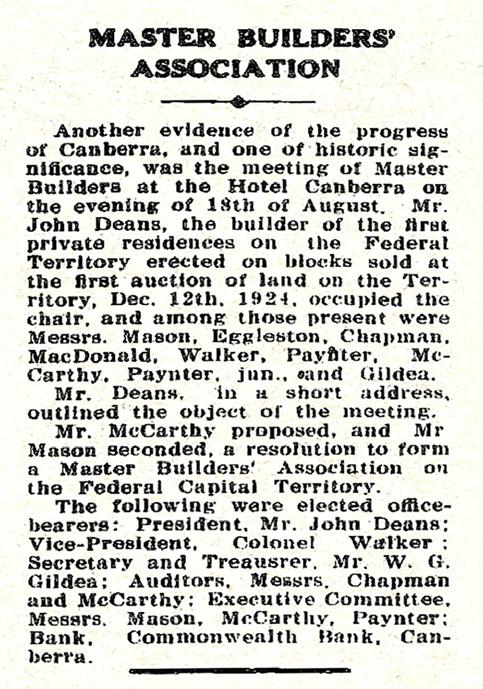
On 18 August 1925, ten builders came together “to keep in touch with each other and to assist one another in their task of building the city of Canberra.” And so, the Master Builders movement of the Australian Capital Territory was born.
From bare paddocks rose Canberra’s first roads, homes, offices, hotels, and important buildings like the provisional Parliament House. As the city’s population grew, so too did our movement — one defined by quality, craftsmanship and community.
What became strikingly clear in the curation and writing of this book is that the road to building the capital was paved with endless challenges and setbacks.
Over the past century, the ACT has weathered at least six major building cycles. The Depression and economic decline of the 1930s. The post-war rebuild and public infrastructure boom of the 1950s. The expansion and experimentation of the 1960s and 70s.
The contraction of the 1980s and 90s. The uncertainty of the early 2000s, marked by the Global Financial Crisis, the collapse of an insurance giant, and severe bushfires. And most recently, the COVID-19 pandemic, and the complex new realities of climate policy and modern housing construction decline into 2025.
Despite these many challenges, one truth stands clear: our members across the five sectors have always met adversity with pride, integrity and purpose, and a motto of ‘do what you say you will do.’
Families and individuals came from all over Australia and the world to build this city from the ground up. It is an extraordinary feat.
Through it all, Master Builders ACT has been a constant, a community that has stood together to weather the challenges that building cycles have presented.
We have evolved into a modern, multicultural building and construction body that represents the five sectors that literally shaped Canberra: residential builders, commercial builders, civil contractors, subcontractors and suppliers and professionals. This has particularly been the case in recent times, with the Master Builders ACT rebuilding the region from the ashes of the 2003 bushfires, seeding the Master Builders Fidelity Fund, building multiple Charity Houses, being a strong voice for employers in the Heydon Royal Commission and training more than 150 carpentry apprentices each year.
In 2025, we again face familiar economic headwinds. Regulation and red tape have deepened, and the ACT’s building and construction sector continues to operate under some of the most challenging business conditions in the country.
There are many reasons to feel frustration. But as we know from looking back through our history, the road to progress is rarely smooth or straight.
Land affordability, skills, cost of business and construction and regulation all remain central advocacy priorities in 2025.
Across a century of change, Master Builders ACT has remained a cornerstone of the Territory’s growth. Ever-present advocate and voice for our industry, backbone of the Canberra community, and builder of our city’s future.
As we celebrate 100 years of Master Builders ACT, we do so with immense respect for those who came before us, and with optimism for those members who will carry the torch for the next century.
We look forward to seeing what is yet to come.
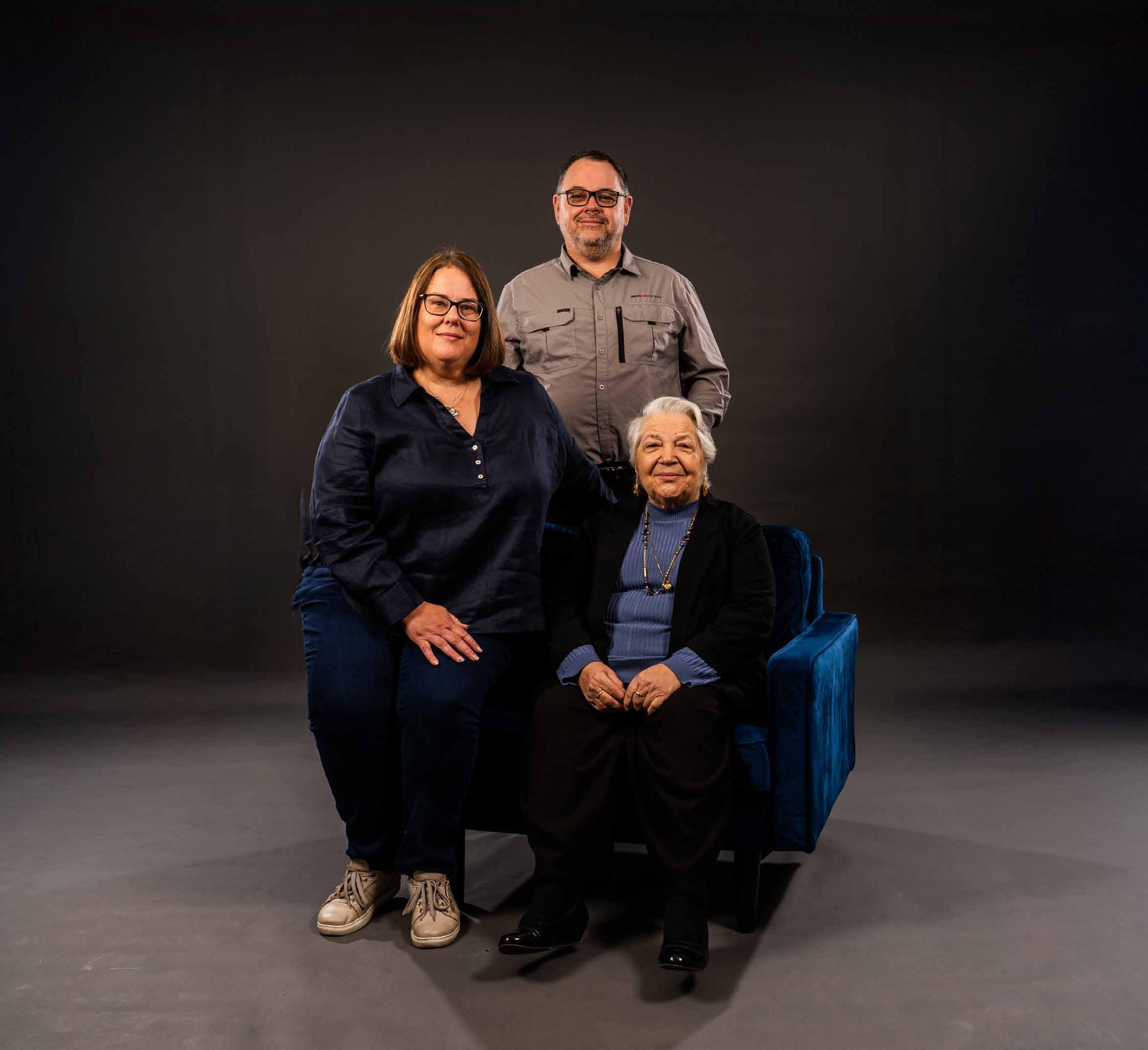
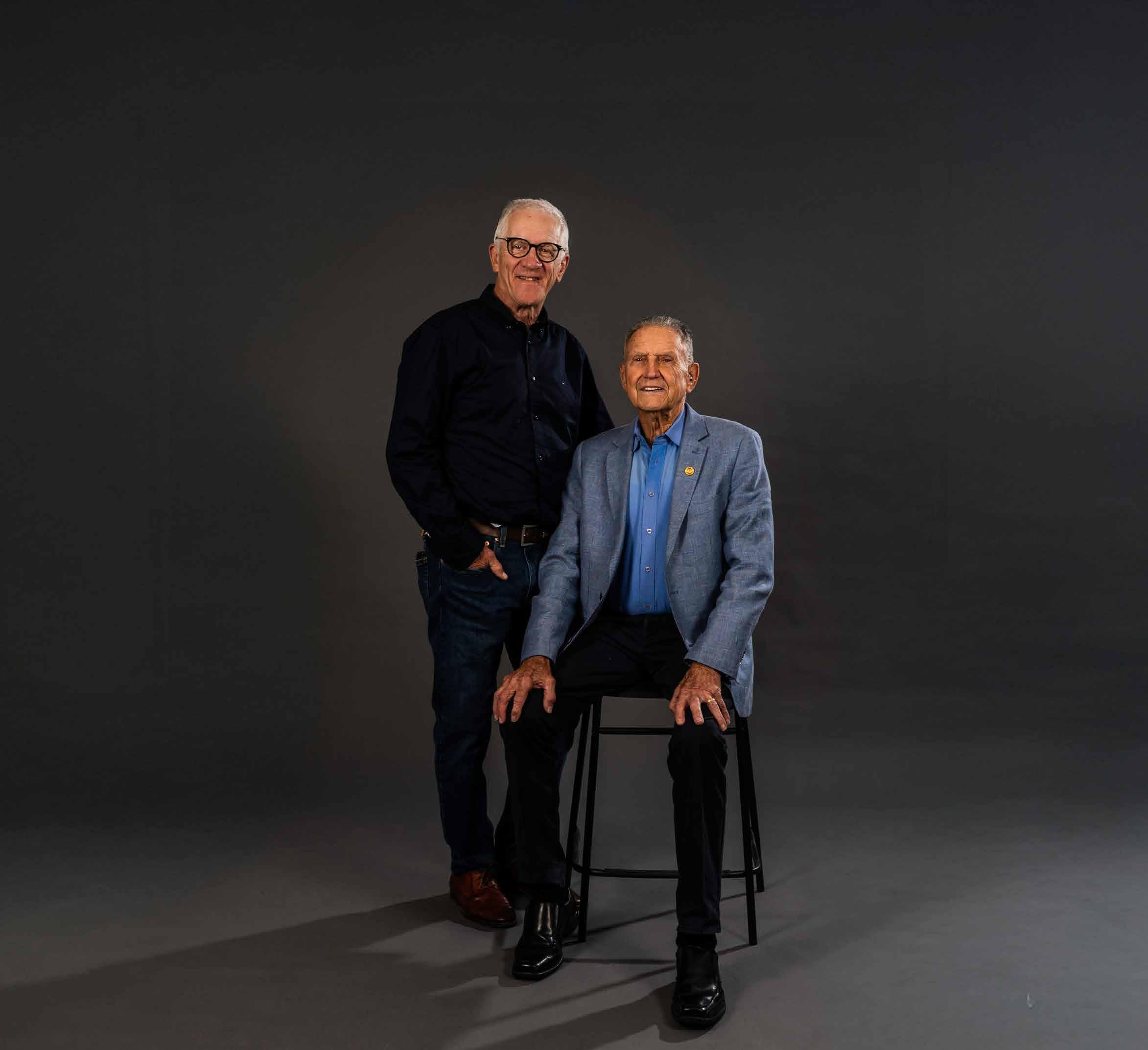
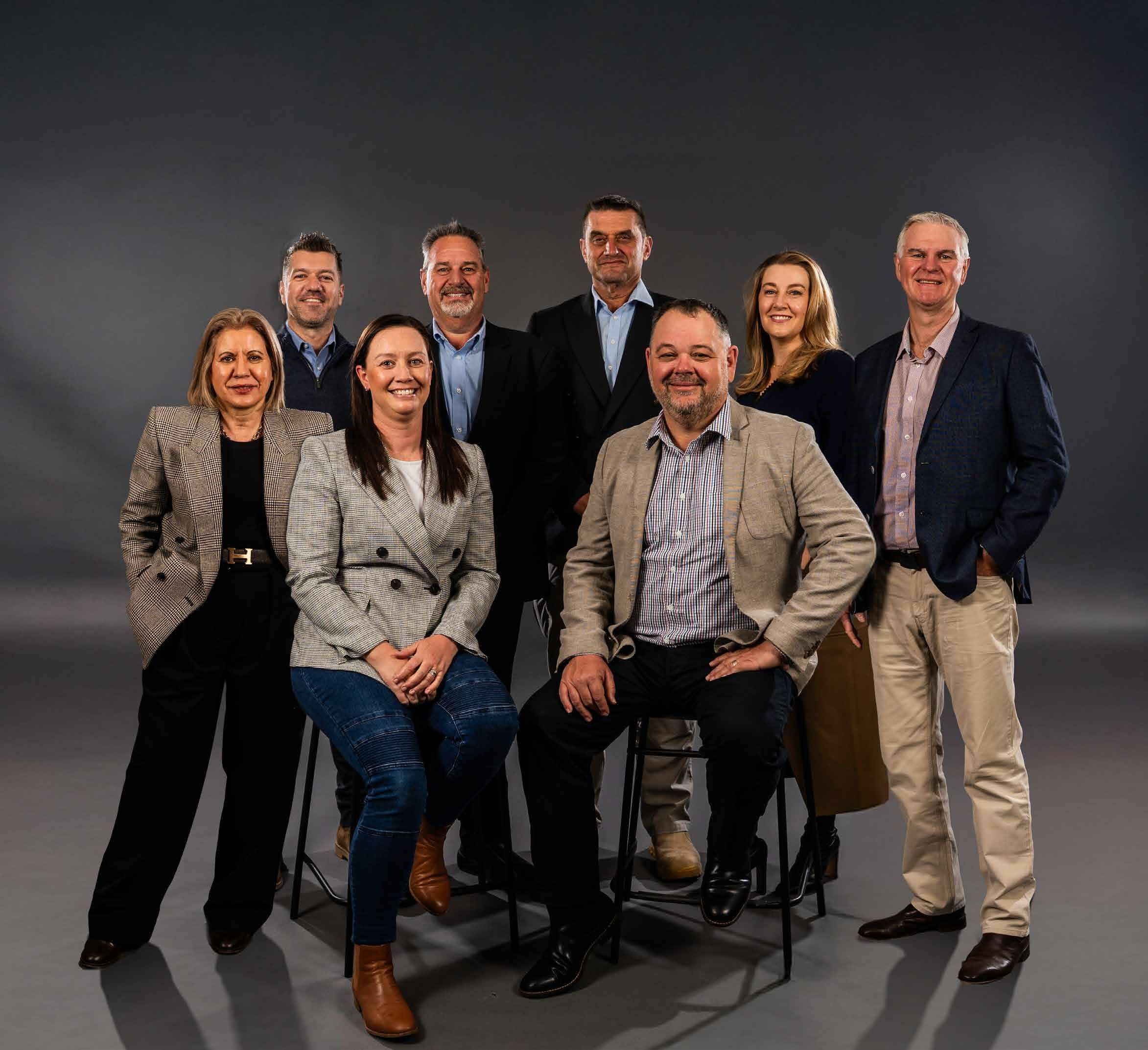
Anna Neelagama Frank Porreca CEO President Master Builders ACT Master Builders ACT
OPPOSITE:
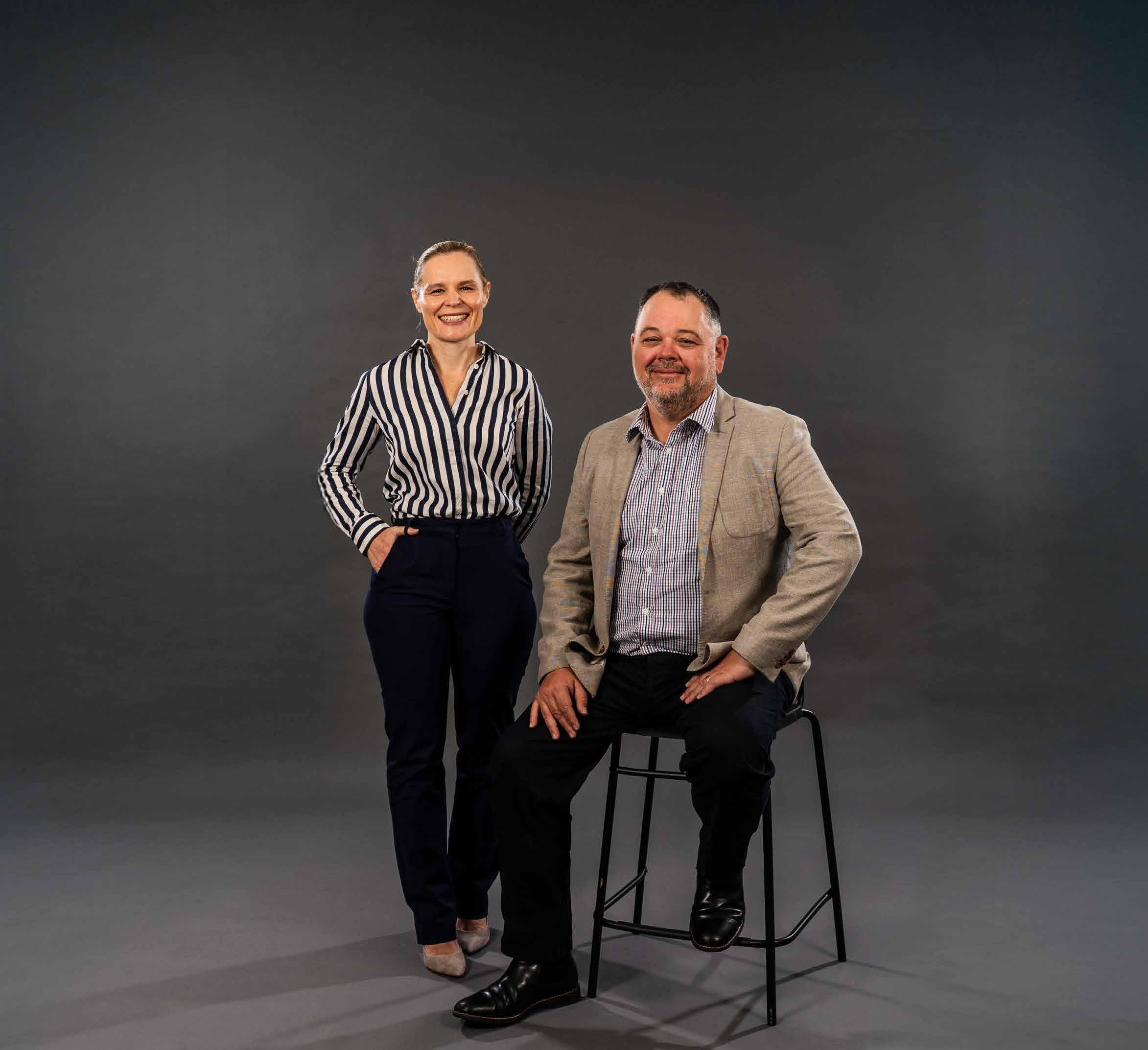
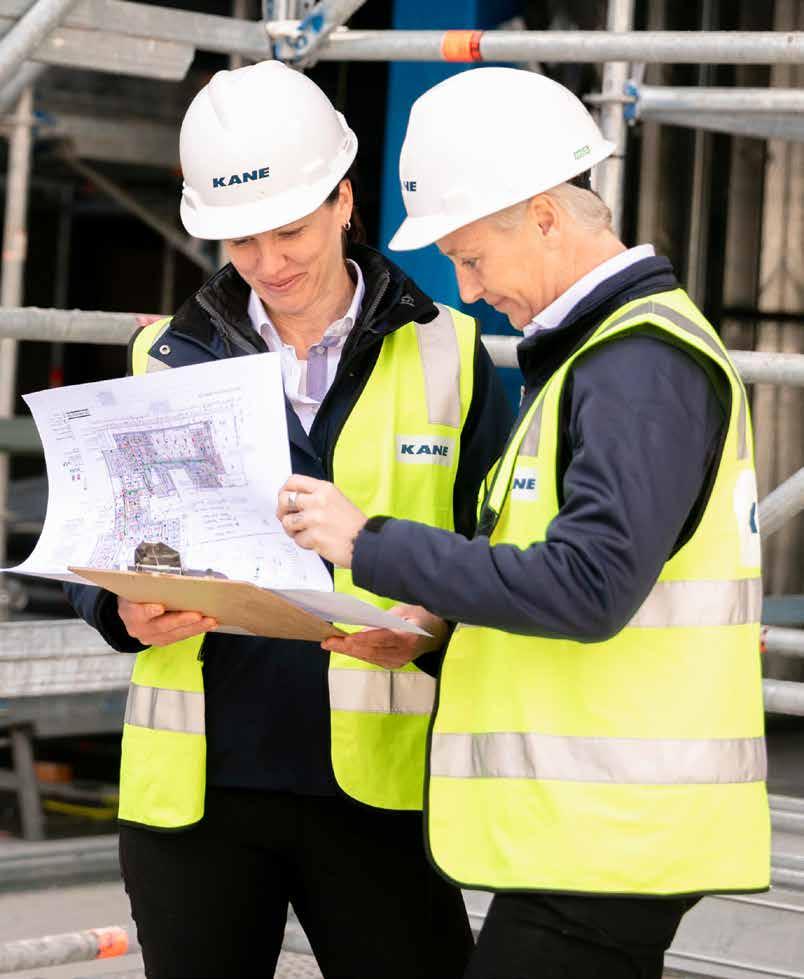
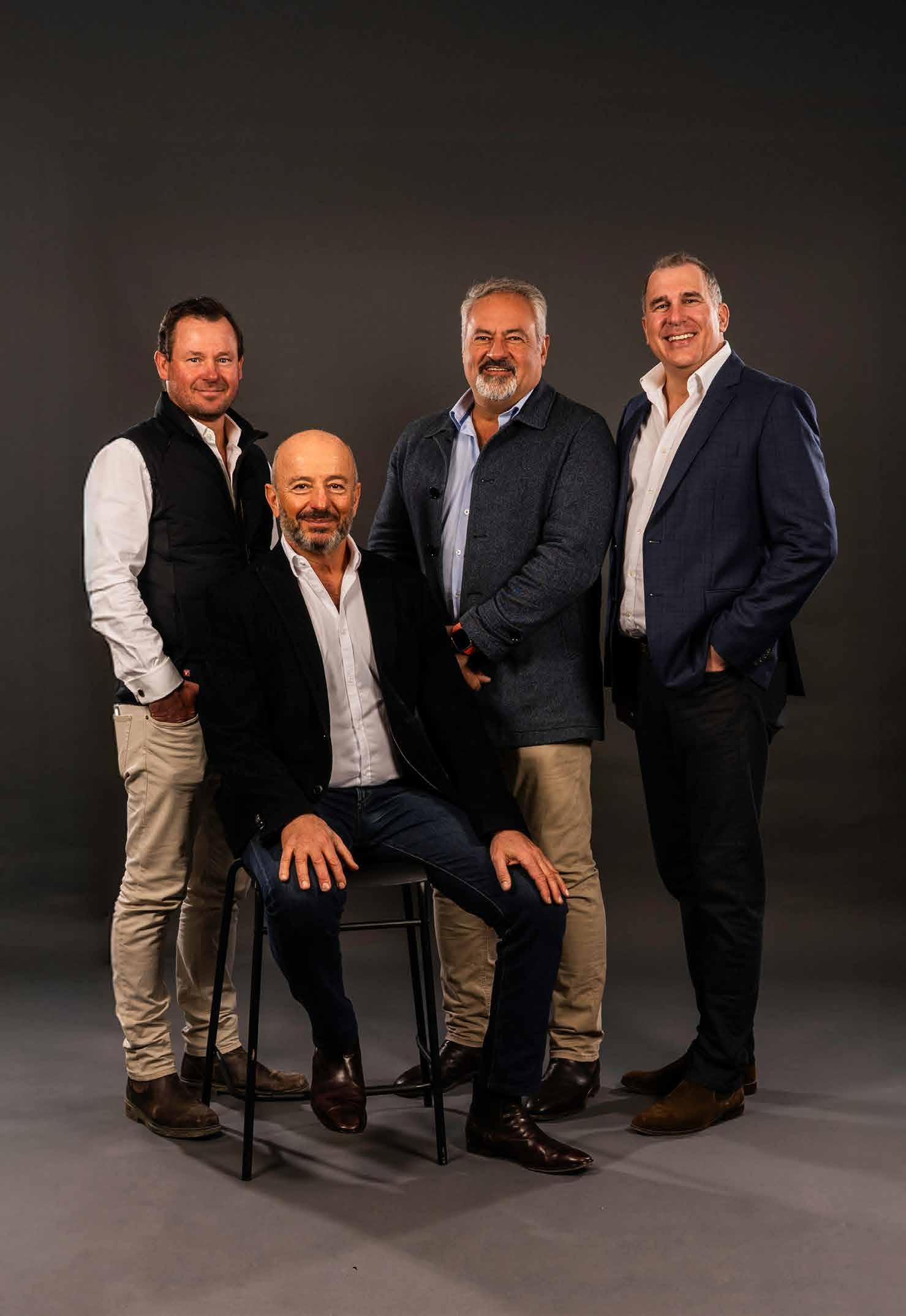
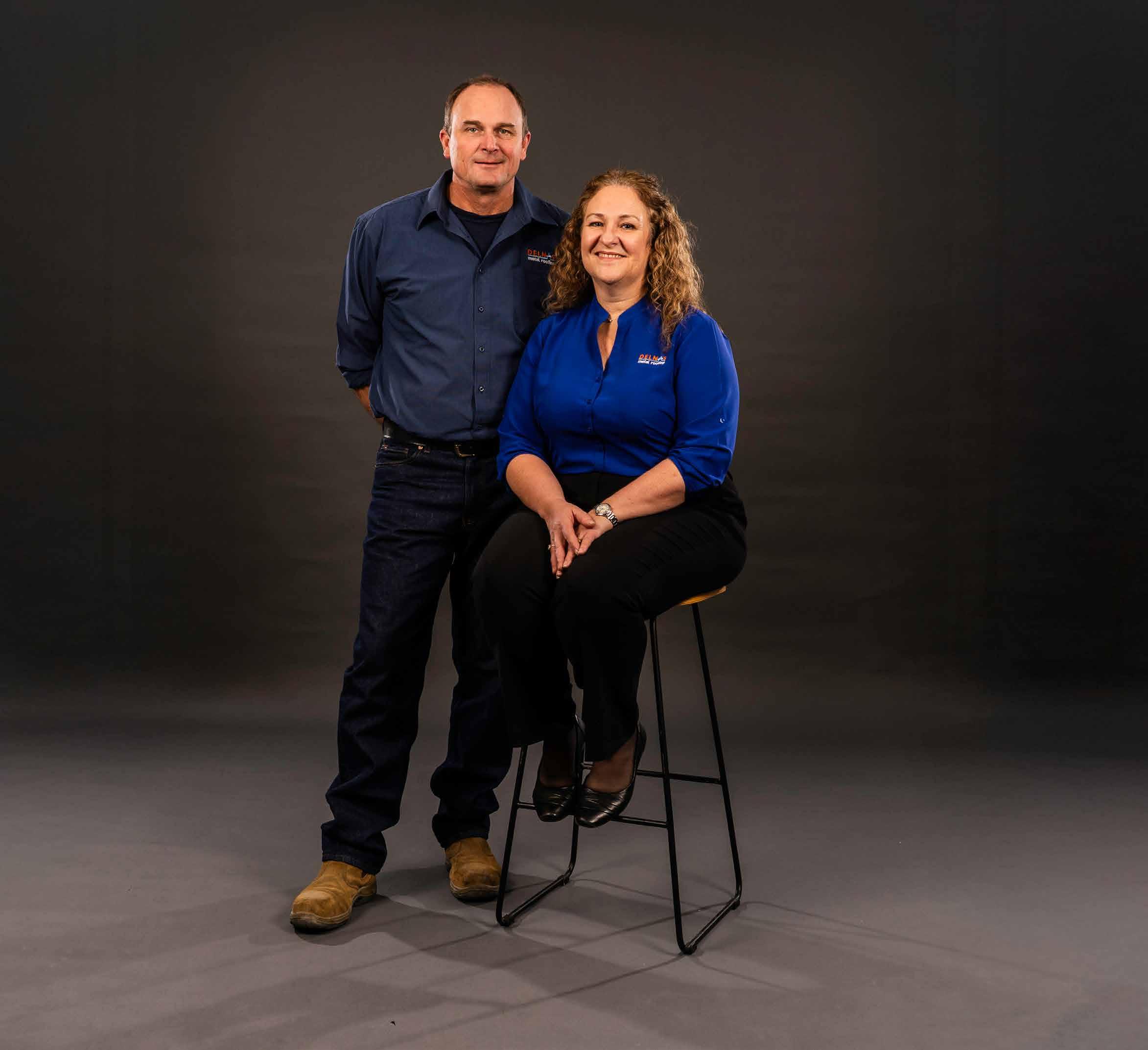
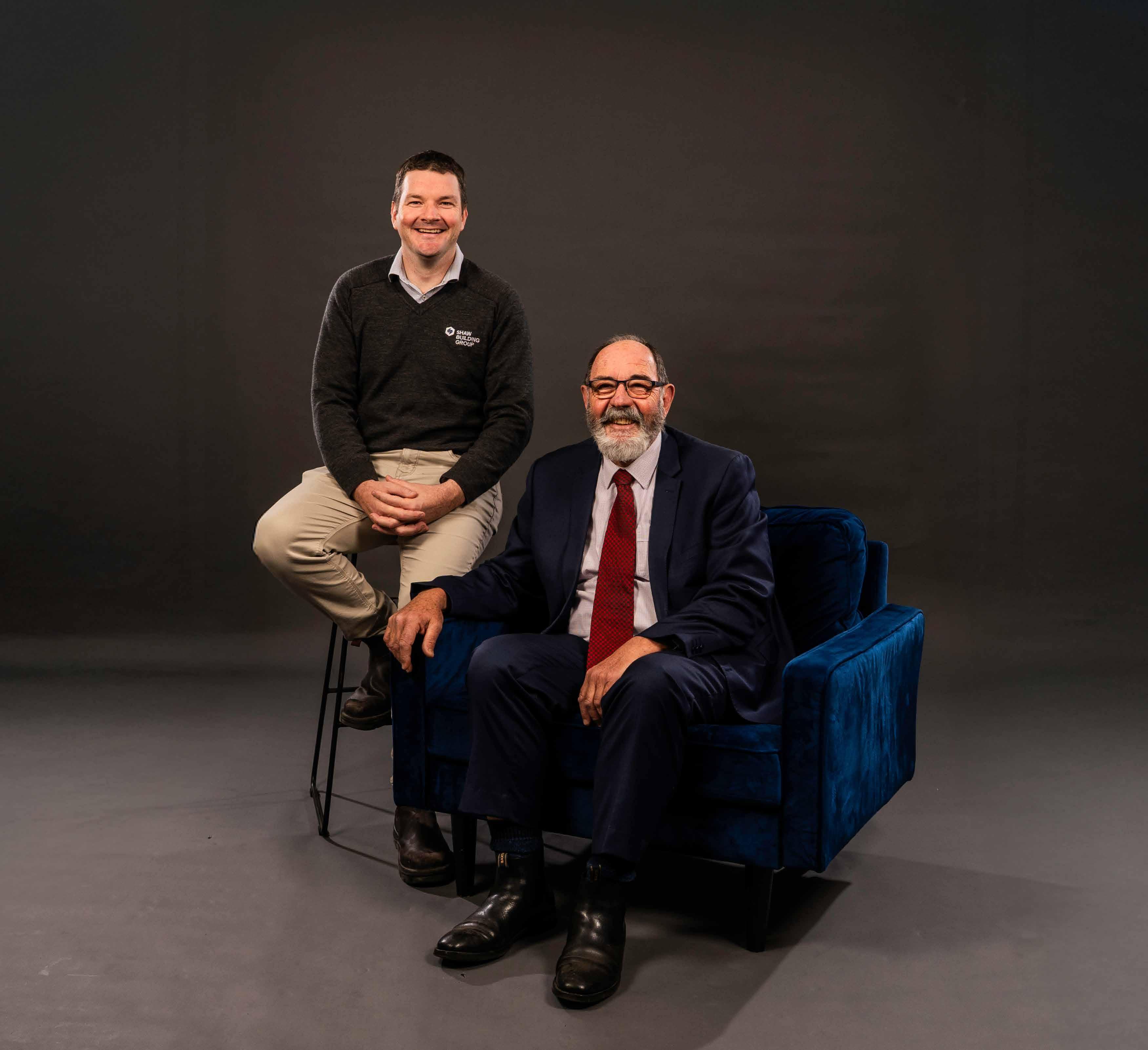
Anna Neelagama (left), current CEO of Master Builders ACT and Frank Porreca, current President of Master Builders ACT
Centenary Year Milestone Members
A special congratulations to our members who are celebrating Member Milestones in our centenary year.
65 Years
G A Anderson & Son
35 Years
CRT Building Products Madison
BAL Building
Porreca Constructions
Shape Australia
Woden Contractors
50 Years
Anderson Holdings
R & A Andriolo
45 Years
Hindmarsh Construction Australia
30 Years
Ewer Constructions
CEHH
Dale & Hitchcock
MMM Interiors
Narona Homes
P & K Joinery
Universal Truss Management
WR Engineering
Country Style Windows
40 Years
Elvin Group
Valley Landscape
CSR Masonry & Insulation
25 Years
AMC Architecture
Bordeaux Construction
& Management
Downer Edi Works
Drewaire Constructions
AMC Homes
Antos Constructions
Archertec Interiors
Bell-Air Air Conditioning
Lend Lease Building
Builders Trading Co-operative
Caliber Kitchens
Complete Constructions
Melinda Boag Design
Maximus Projects
Peet Limited
Per-Se Developments
Pink Building Services
Prestige Scaffolding Services
RHG Constructions
Simply Ceramics
Smart Bathrooms
Territory Constructions
Vale Residential
Bink Cement Products
Dellow Excavations
Hinds Construction
Matthew Homes
CLMK Contracting
20 Years Geocon
Pichelmann Custom Building Services
35 Degrees
Artistic Concrete Management
Benemma Constructions
Keith Woodward
Bricklaying and Scaffolder
Mastro 5 Design & Construction
Nova Builders
Paragalli Haulage
Patches Asphalt
Perin Group Management
Professional Tiling Services
Tharwa Sands
Tailor Made Builders
Hawker Roofing
OPPOSITE:
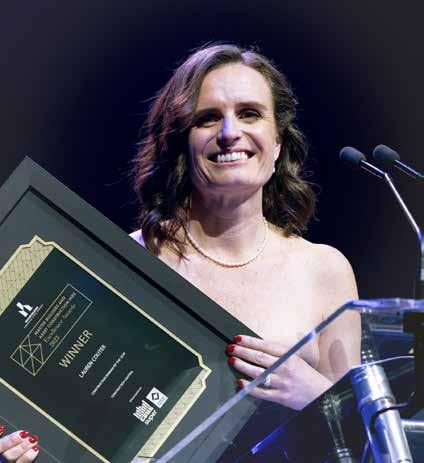
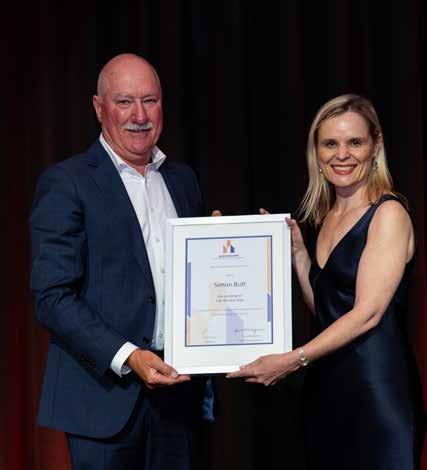
Alan Ewer of Ewer Constructions (30 year Milestone Members) at the 2025 Master Builders and Asset Construction Hire Excellence Awards.
Passion, pride and family: a century of Master Builders in Canberra
This memoir is not a catalogue of projects or a list of dates. It is, at its heart, a collection of stories about people. Over the past one hundred years, the Master Builders Association of the ACT has been home to builders, engineers, architects, subcontractors and advocates who together have shaped our city. Their stories reveal not just what they built, but why they built, and how their values have carried them through good times and hard ones.
Three themes run through every story: passion, pride and family. For some, building was literally in their blood – grandfathers, fathers, spouses, sons and daughters following one another into the trade. For others, it was a calling discovered later, but one that quickly became part of their identity. All speak of the pride that comes from standing in front of a building, a bridge, a subdivision, knowing they helped bring it to life. All, without exception, carry a passion for their work and for the community they serve.
The industry has changed enormously over the decades. Earlier generations recall handshake deals and the mateship on site, long before compliance forms and safety systems became second nature. Today’s builders speak of GPS-guided machinery, digital modelling, modular design and sustainability standards. Some changes have brought challenges: red tape, rising costs and staffing pressures. Others have brought great improvements – safer work practices, better quality, a more diverse workforce, and the industry is better for it. Their stories represent an industry that has not stood still, but has adapted and grown with Canberra itself.
Throughout, the Master Builders Association has been the thread that ties their stories together. From training apprentices to providing contracts, from lobbying governments to celebrating excellence at awards nights, the MBA has been there in the background, and often the foreground, of their construction industry journey. Time and again, members describe it as their voice, their support and their community.
Above all, these stories are about resilience. Families who rebuilt after setbacks, subcontractors who fought for fairness, companies that adapted through change. There is deep pride in what has been achieved, but also optimism for what is to come. Many speak with excitement about succession, about the next generation of leaders, about ensuring the industry is strong for another hundred years.
As you read the stories that follow, you will see the diversity of experiences, but also the shared values that bind this community. Respect, honesty, hard work. Pride in a job well done. Passion for building. And family, in all its forms, as the foundation upon which so much has been built.
These stories capture a snapshot in time, 100 years on from the foundation of the Master Builders Association of the (then) Federal Capital Territory. Like the people in them, they honour the past, celebrate the present and give us some hints about the stories that will be written in the future.
OPPOSITE:
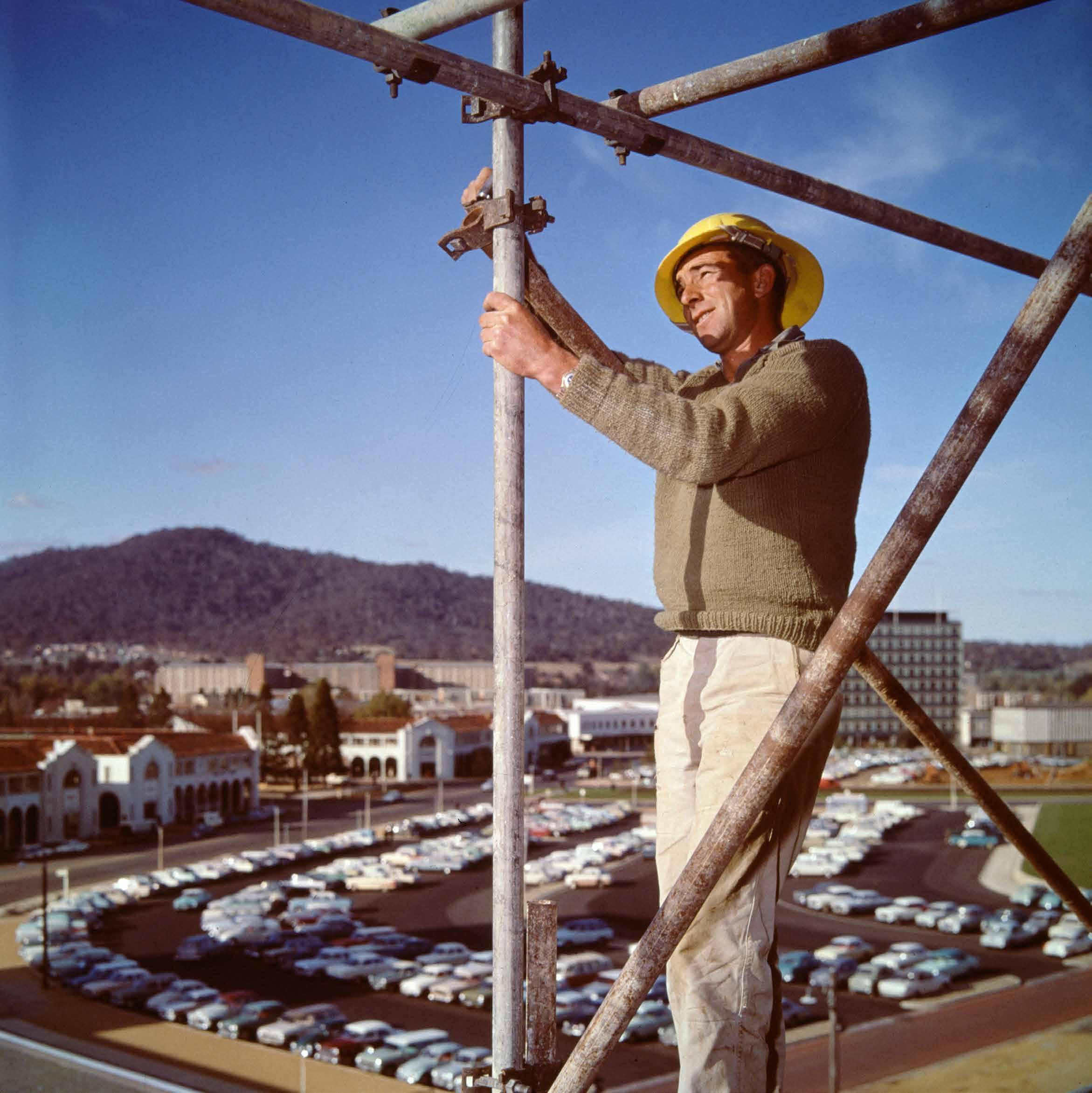
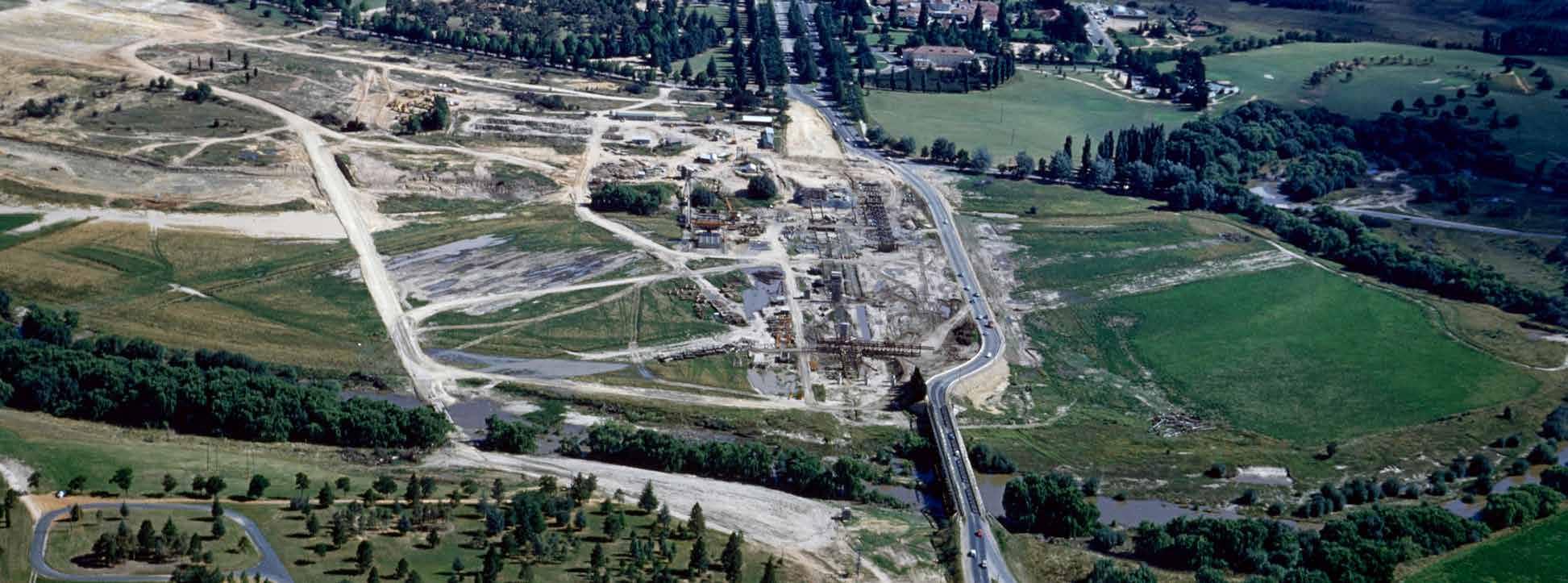
New construction in progress in Canberra, with Civic in background, 1963. National Archives of Australia, NAA: A1500, K10221
Building the capital: a timeline
1900 to early 1920s Planning the capital
1908
Canberra chosen as the site for the capital
1911
Federal Capital Territory created on 1 January 1911
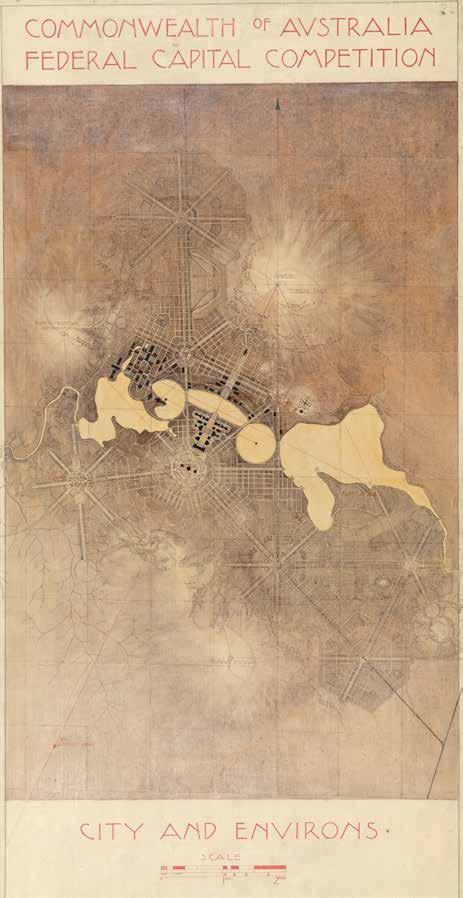
Walter Burley Griffin and Marion Mahony Griffin’s design chosen as winning design for the capital
1913
Yarralumla brickworks completed
20 February 1913
King O’Malley drives first survey peg into the ground marking commencement of building the city
12 March 1913
Capital named as ‘Canberra’ by Lady Denman at Capital Hill
1914
World War I breaks out
Rail line linking Canberra and Queanbeyan established for freight and industrial services
1918
Design for Canberra finalised by Walter Burley-Griffin
1921
First homes in Braddon built
Federal Capital Advisory Committee established
1922
Suburbs of Barton and Parkes established
Westlake workers cottages at Yarralumla completed
1923
Telopea Park School opened in Barton
1924
Hotel Canberra opens in Yarralumla
12 December 1924
First blocks of land in Canberra sold by auction
First building boom in Canberra
With Canberra’s population growing rapidly, the first building boom saw the construction of key buildings including the provisional Parliament House, The Lodge and the GovernorGeneral’s residence, the Manuka and Kingston shopping precincts, the Sydney and Melbourne buildings in Civic, Albert Hall and many more. There were engineering works to support the growing population, including completion of the main sewerage scheme and treatment works; roads, water supply, lighting and storm water services; parks, footpaths and recreational facilities. Contracts were awarded for the construction of homes. The Federal Capital Commission dedicated all its resources to building houses for public servants, leaving the responsibility of building homes for business professionals to private developers.
1925
1 January 1925
Federal Capital Commission (FCC) established
18 August 1925
Master Builders Federal Capital Territory (FCT) founded
On the evening of 18 August 1925, a meeting of ten of Canberra’s master builders at the Hotel Canberra saw a resolution to establish the Master Builders Association of the Federal Capital Territory, with Mr. John Deans elected as the first President.
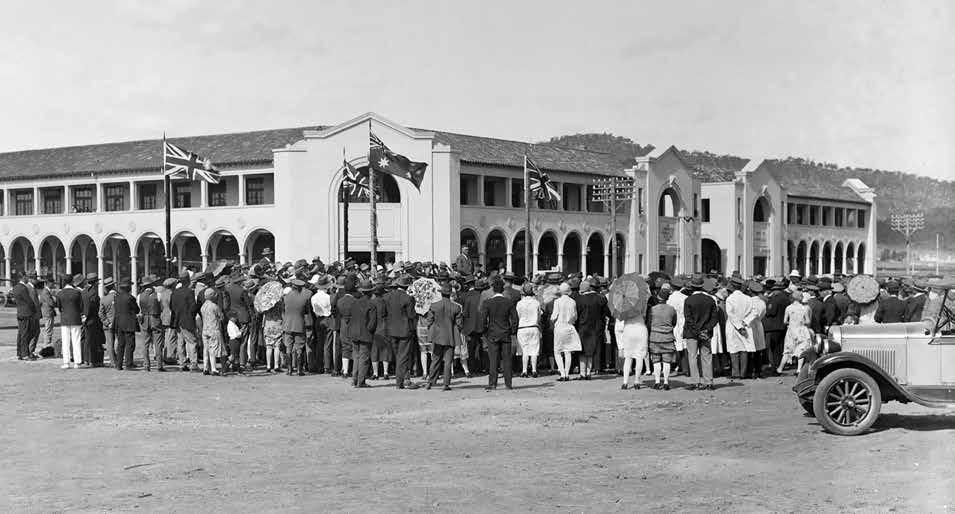
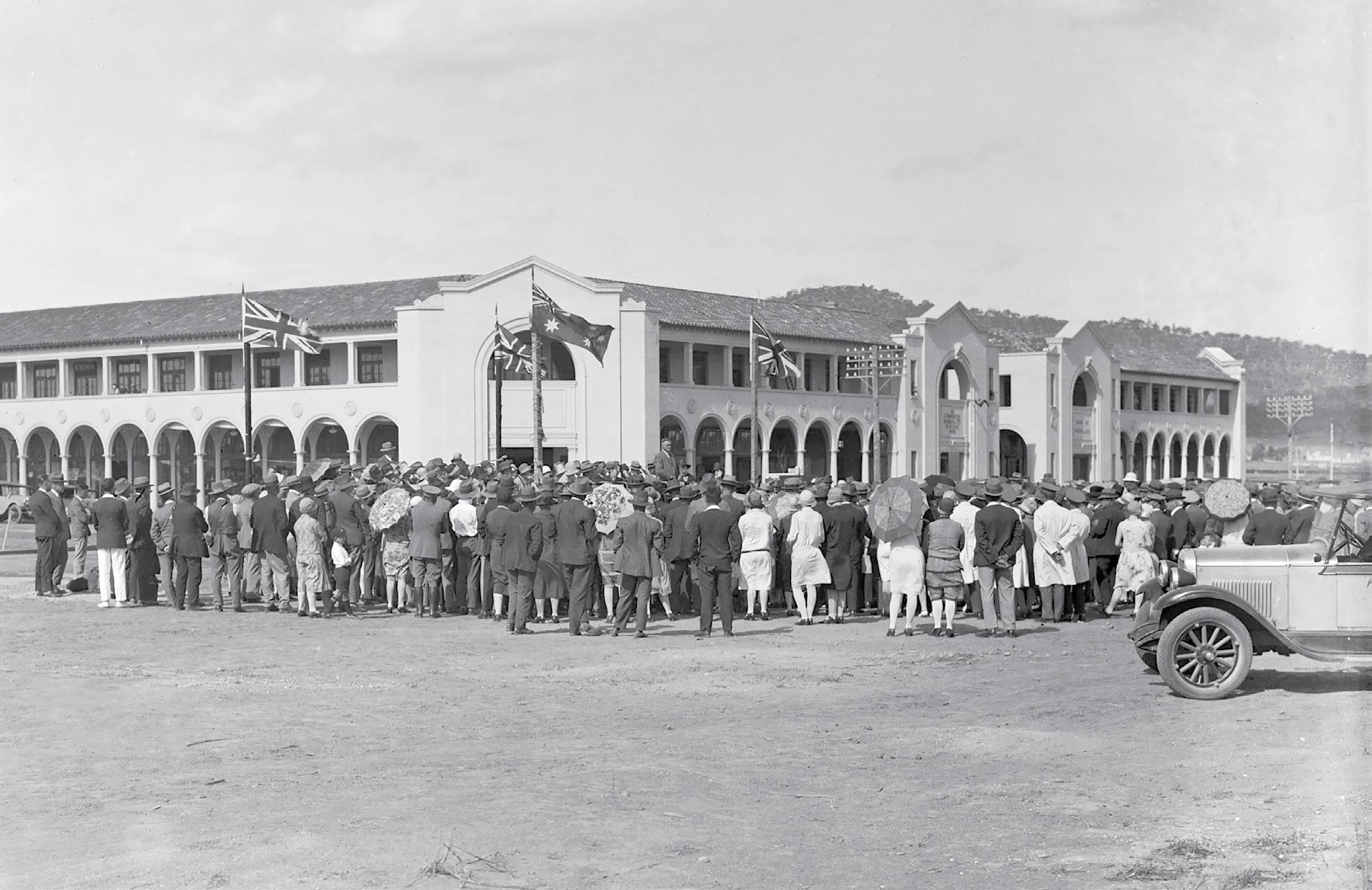
Formal opening of Civic Centre by Prime Minister
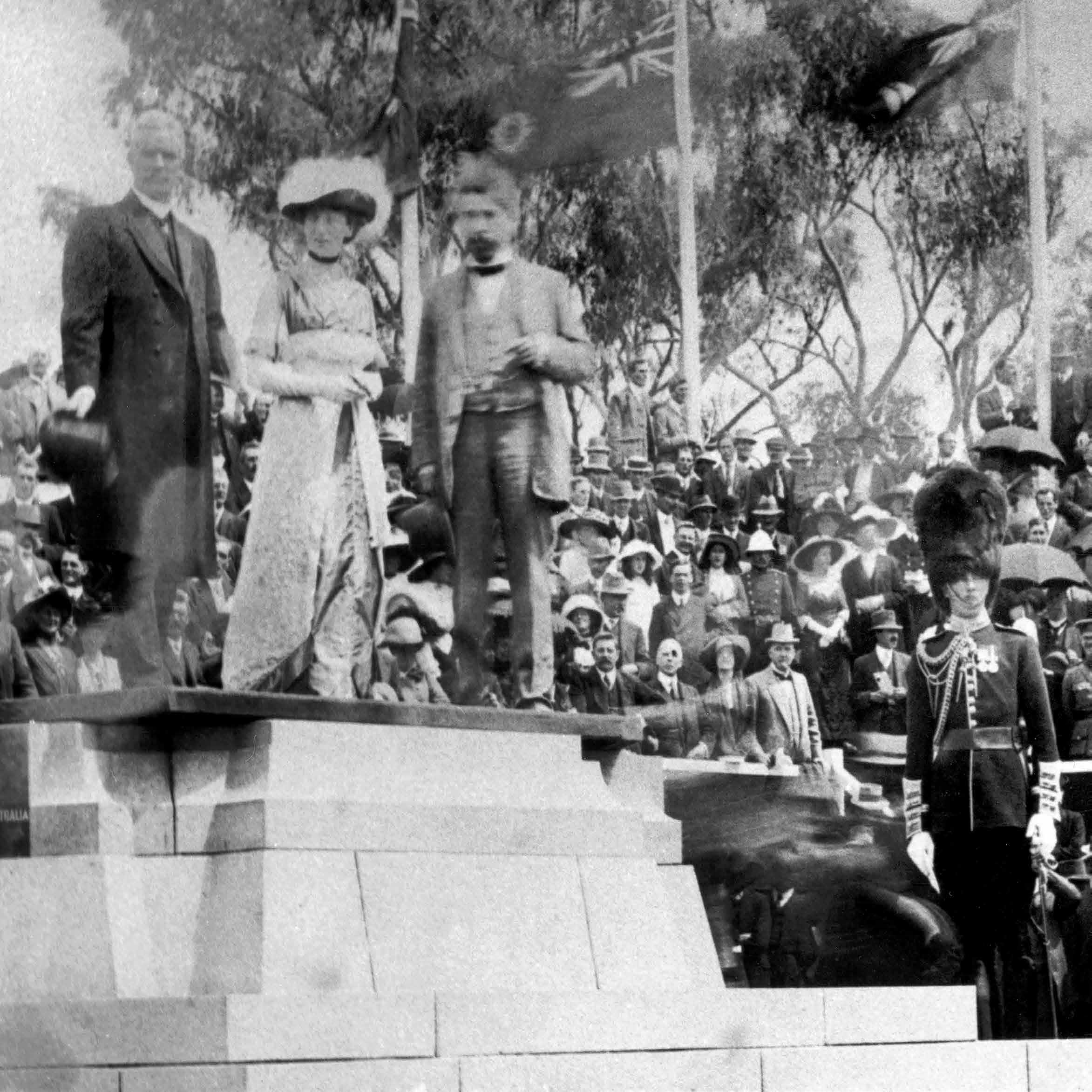
Stanley Melbourne Bruce, 6 December 1927 National Archives of Australia, NAA: A3560, 3756
LEFT TO RIGHT:
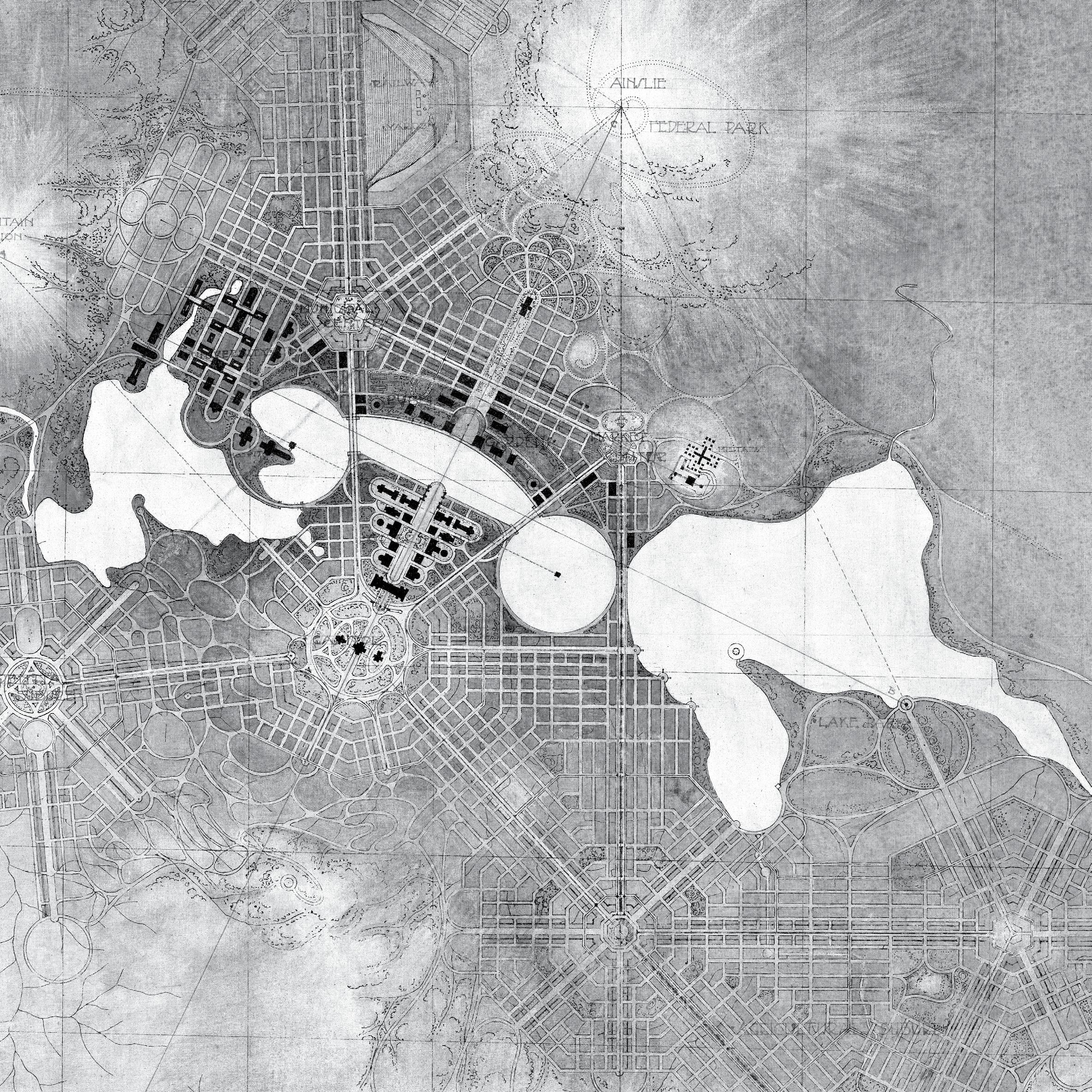
Walter Burley Griffin’s City and Environs, 1912.
National Archives of Australia, NAA: A710, 38
1926
Parliament relocated to Canberra
18 August 1926
First Annual Meeting of the Master Builders Association of the Federal Capital Territory
Canberra’s master builders met at Hotel Canberra on the first anniversary of the Association’s founding. At the event, there was a shared sentiment that the Association was making great strides as a key contributor to the growth of the national capital through private enterprise.
1927
Canberra’s population grows to over 8,000
Suburbs of Griffith and Manuka established
9 May 1927
Provisional Parliament House opened by the Duke of York
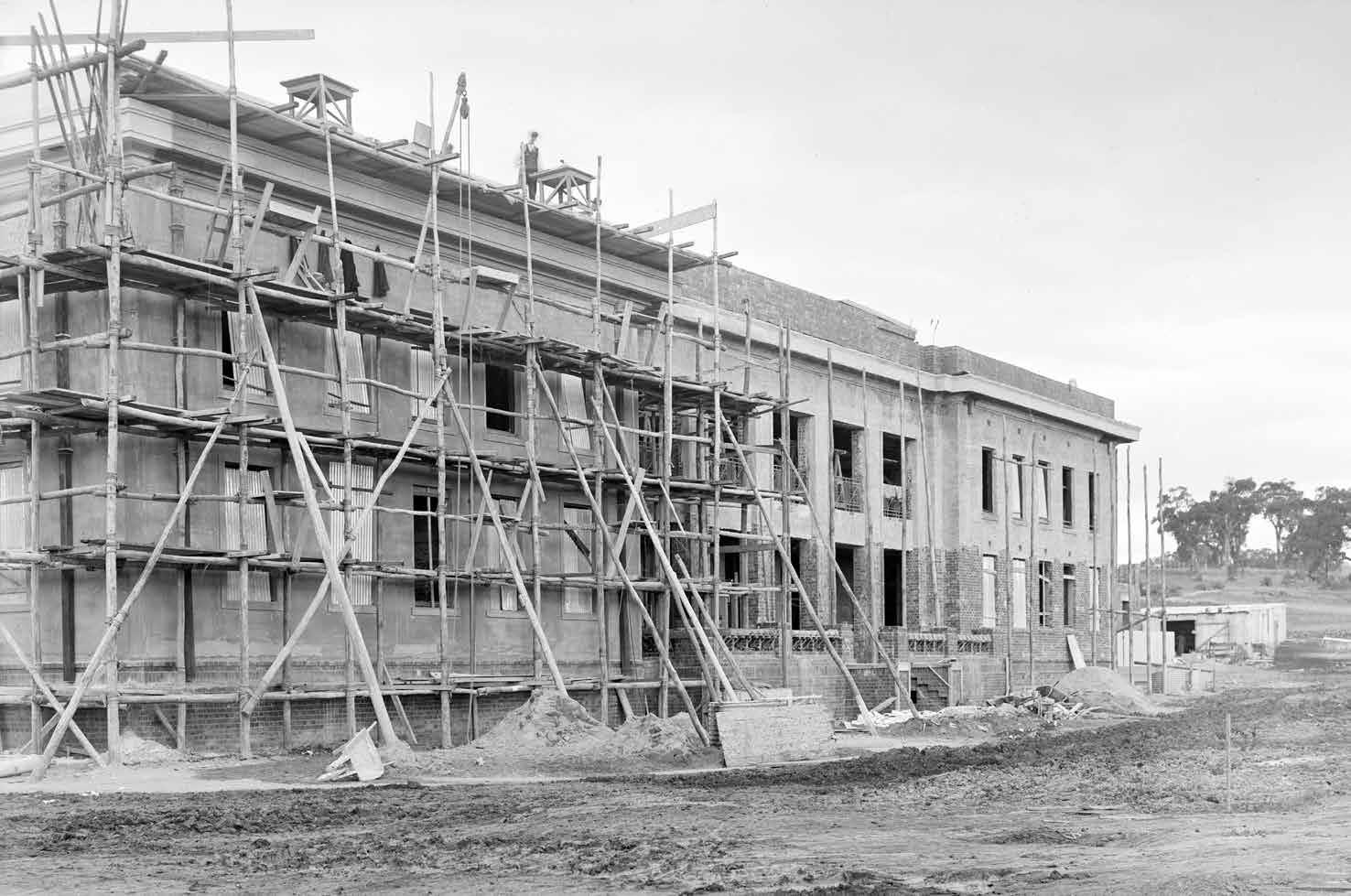
The Provisional Parliament House stands as a remarkable milestone in the early growth of Canberra. Numerous early builders from Canberra played a key role in its construction. This building served as the home of Australia’s Parliament from 1927 until 1988.
Early building continues
More essential buildings were completed in 1927, including The Lodge, Ainslie Public and Primary Schools, Hotel Ainslie and Kurrajong, West Block Government Offices, and the Capitol Theatre in Manuka. The new Civic Centre’s Sydney Building was opened by Prime Minister Stanley Melbourne Bruce on 6 December 1927.
1928
Early suburbs established, including Civic, Acton, Ainslie, Braddon, Campbell and Duntroon, Deakin, Dickson, Forrest (originally Blandfordia), Lyneham, O’Connor, Red Hill, Reid, Turner, Yarralumla
1929
The Great Depression Building activity in the capital largely came to a halt during the Great Depression. This caused the retrenchment of 1,800 labourers and the abolishment of the Federal Capital Commission, and led to the population falling to 7,000 people by 1931. It delayed work on Lake Burley-Griffin and the Australian War Memorial, and only a handful of buildings were completed from 1929 to 1933, including Canberra Grammar School, Manuka Swimming Pool, the Institute of Anatomy and the Patents Office, along with the Manuka Housing Precinct.
1930s Depression, then recovery 1937
Building activity picks up following the wide ranging effects of the Depression. There were reports of building expenditure returning to pre-Depression levels. Completed new buildings included 144 cottages, the Royal Military College at Duntroon, the first stage of the Australian War Memorial and first National Library, a public hospital and an expanded Hotel Kurrajong.
1938
National Capital Planning and Development Committee (NCDC) established Canberra’s population recovers to 12,000 people
1940s War strikes again 1939-1945
World War II
World War II sees 3,000 public service families brought to Canberra along with military personnel. Due to the war, from 1929 to 1942, only 500 new homes were built in the capital due to extreme worker and materials shortages. This led to major accommodation shortages, with only 450 private houses in the capital by 1946 despite a population of 14,500. Several embassies were built during this time, and the Australian War Memorial opened officially on Remembrance Day, 11 November 1941.
1946
Australian National University completed
1949
ACT gains a federal seat in House of Representative
Master Builders Association of the ACT reorganised
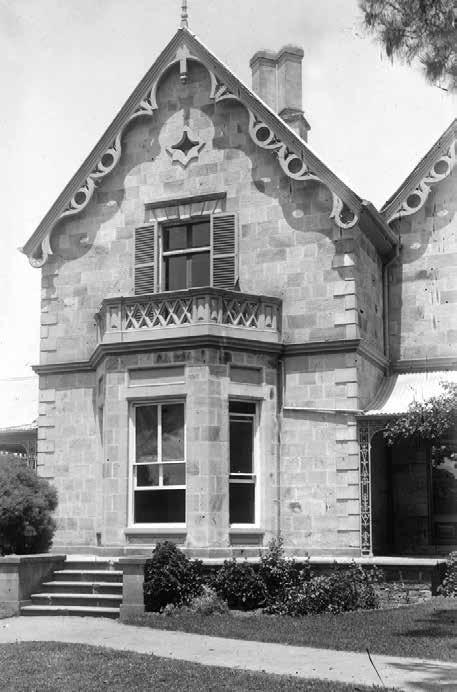
LEFT:
Duntroon House Royal Military College, 1926. National Archives of Australia, NAA: A3560, 8
1950s
A building industry in recovery
1954-1956
The mid-1950s saw a large number of buildings completed. These included University House (the first permanent building at the Australian National University), the Allawah and Bega Flats in Braddon, the Canberra Olympic Pool and the John Gorton Building.
The 1960s Building booms
1962
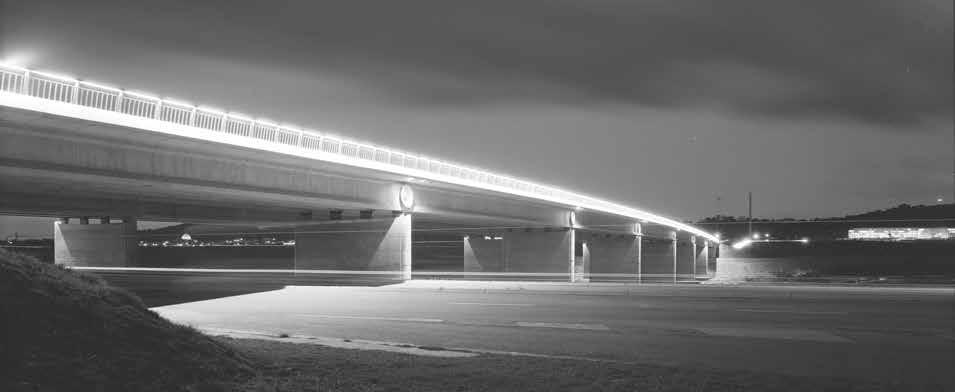
Kings Avenue Bridge is established as the permanent crossing over the future Lake Burley Griffin. In this year, Northbourne Housing Precinct and Northbourne Flats were also completed, and the MBA lobbied the Federal Government to expand availability of credit to stimulate more residential building growth.
1964
1954
Queen Elizabeth II visits Canberra and is the first reigning monarch to visit Australia
1957
National Capital Development Commission (NCDC) established
BELOW:
Kings Avenue Bridge spanning Lake Burley Griffin, 1963.
National Archives of Australia, NAA: A1200, L45246
TOP RIGHT:
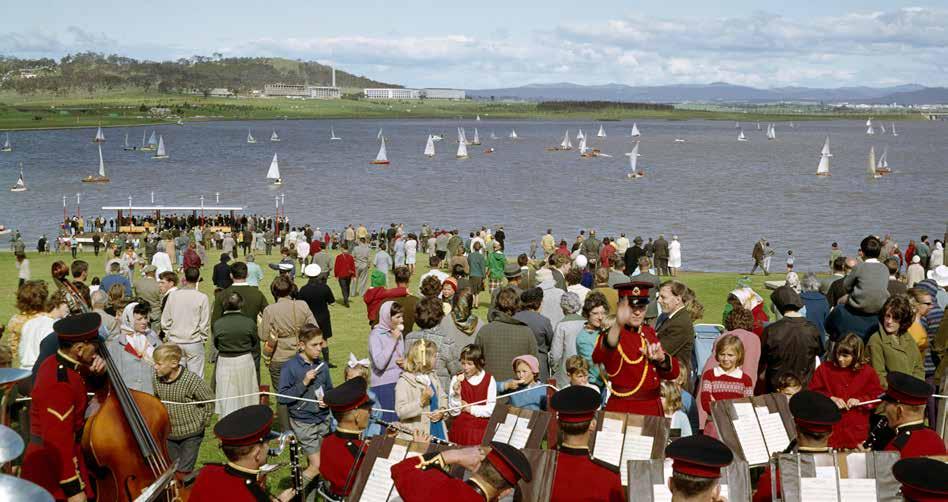
Inauguration of Lake Burley-Griffin, 17 October 1964.
National Archives of Australia. NAA: A1500, K12346
1963
1963 saw major new buildings and infrastructure completed for the capital.
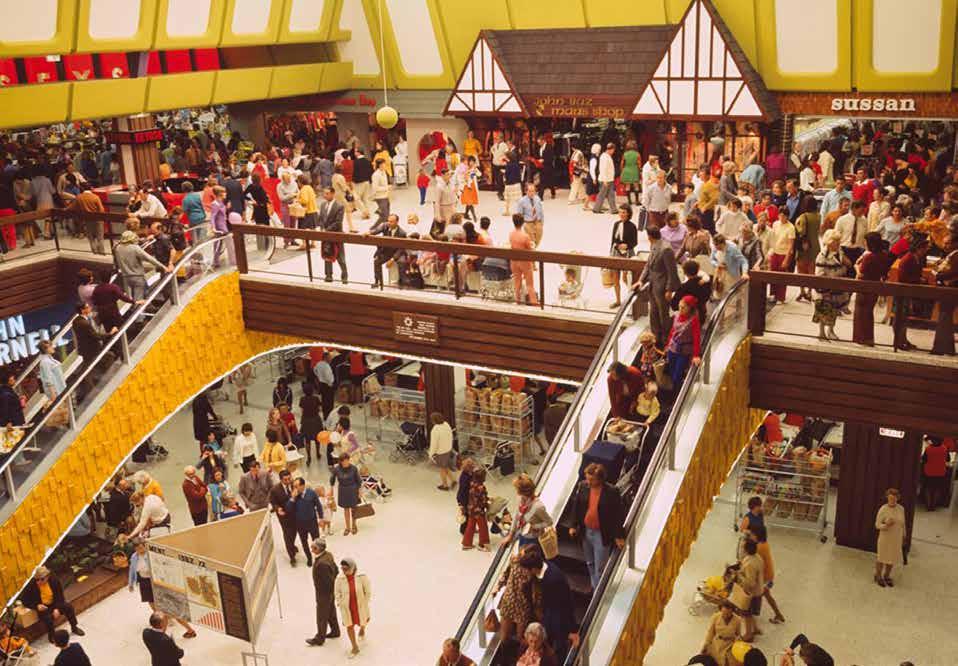
The ANZ Bank Building and Law Courts of the ACT in Civic were completed, as well as Monaro Mall (now the Canberra Centre), Australia’s first fully enclosed, air conditioned mall. The new Commonwealth Avenue Bridge was opened, while Scrivener Dam was also completed, marking one of the biggest civil projects to date in the capital’s development.
A lake at last Lake Burley Griffin was formally inaugurated on 17 October 1964, bringing to fruition a key element of Walter Burley Griffin’s vision and design for the national capital. It followed a delay caused by a long drought, which delayed water from the Scrivener Dam, completed in 1963, from reaching the lake.
1967
Canberra’s population reaches 100,000
1968
In 1968, the MBA advocated for a registration system to protect the public from unqualified builders.
1969
The MBA becomes the first employer body to be registered under the Conciliation and Arbitration Act
1965
Canberra Theatre, Royal Australian Mint and Anzac Parade completed
1966
First section of Hindmarsh Drive completed, providing a major new arterial connection to the newly developing suburbs of Garran, Pearce, Torrens, Mawson, Farrer and Phillip.
Master Builders Group Training established, and Master Builders ACT becomes the first organisation in Australia to establish a Group Apprenticeship Scheme
Master Builders Group Training was established in 1969 by the then-President Len O’Hara, and set out to train and employ apprentices and cadets, placing them with host employers.
New National Library opens in Parkes
1970s
Suburbs, stadiums and shopping centres
1970-1975
The early 1970s saw many new suburbs in the south of Canberra gazetted.
These included Chapman, Duffy, Fisher, Holder and Stirling in 1970, O’Malley in 1973, Kambah and Wanniassa in 1974 and Calwell, Chisholm, Fadden, Gilmore, Isabella Plains, Monash, Richardson and Theodore, all in 1975. However, industrial challenges and stagnating projects stifled growth, and the MBA confronted this head on by advocating to government and running a series of public advertisements with the slogan “Let us finish the job” of building Canberra.
1970
Captain Cook Memorial Jet opened
1971
Canberra flood disaster on 26 January affects 500 people and kills seven, with 95mm rain in one hour
1972
18 September 1972
Woden Plaza opened by Prime Minister William McMahon
1974
Capital Hill was chosen as the site for the new Parliament House following nineteen years of debate and discussion.
1978
Bruce Stadium and Belconnen Mall completed
Prime Minister Malcolm Fraser announces an international competition for the design of the new Parliament House
1979
Googong Dam completed after five years of construction
1980s
A bonza decade for Canberra construction, and for the MBA 1980
26 May 1980
High Court of Australia opened
Telstra Tower (then Black Mountain Tower) opened in Acton
18 September 1980
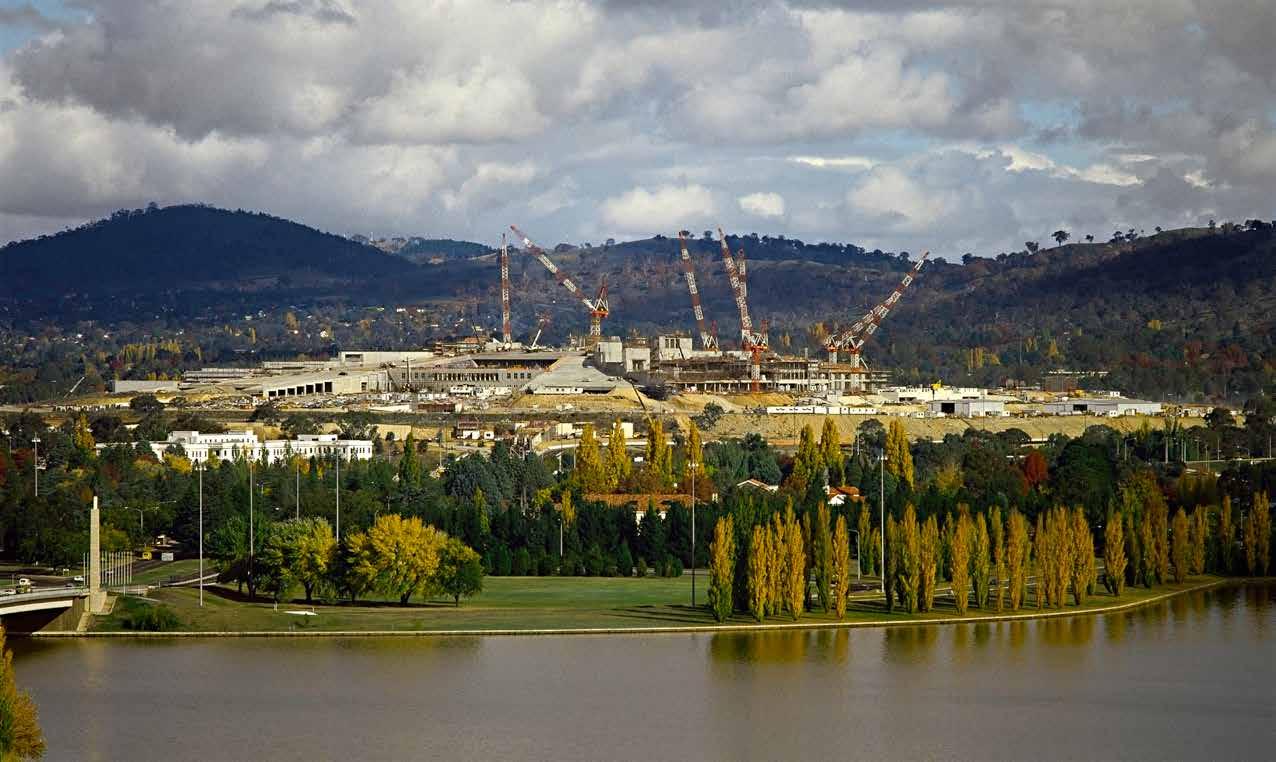
First sod turned for new Parliament House
1981
The MBA attains Government support for the Group Apprenticeship Scheme
Royal Commission into corruption by the Builders Labourers Federation begins
1982
The MBA introduces the ACT Award Service and produces safety booklets to improve safety and awareness in Canberra’s construction and housing industry
National Gallery of Australia opened
LEFT TO RIGHT:
Woden Plaza: Photographer J. Crowther, National Archives of Australia, NAA: A6135, K21/9/72/6:
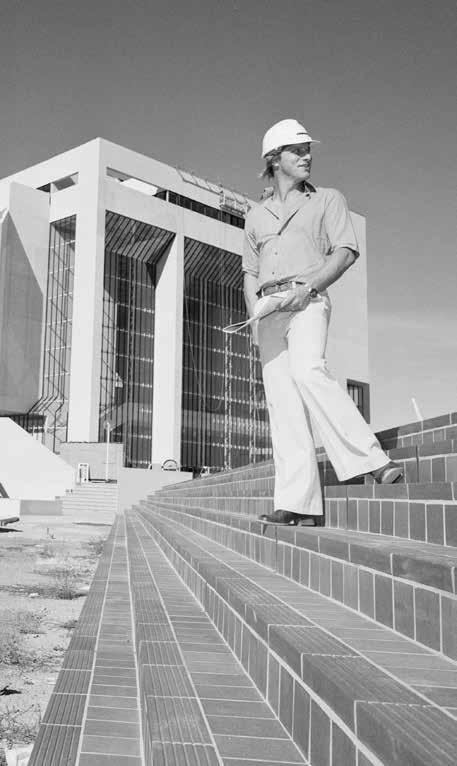
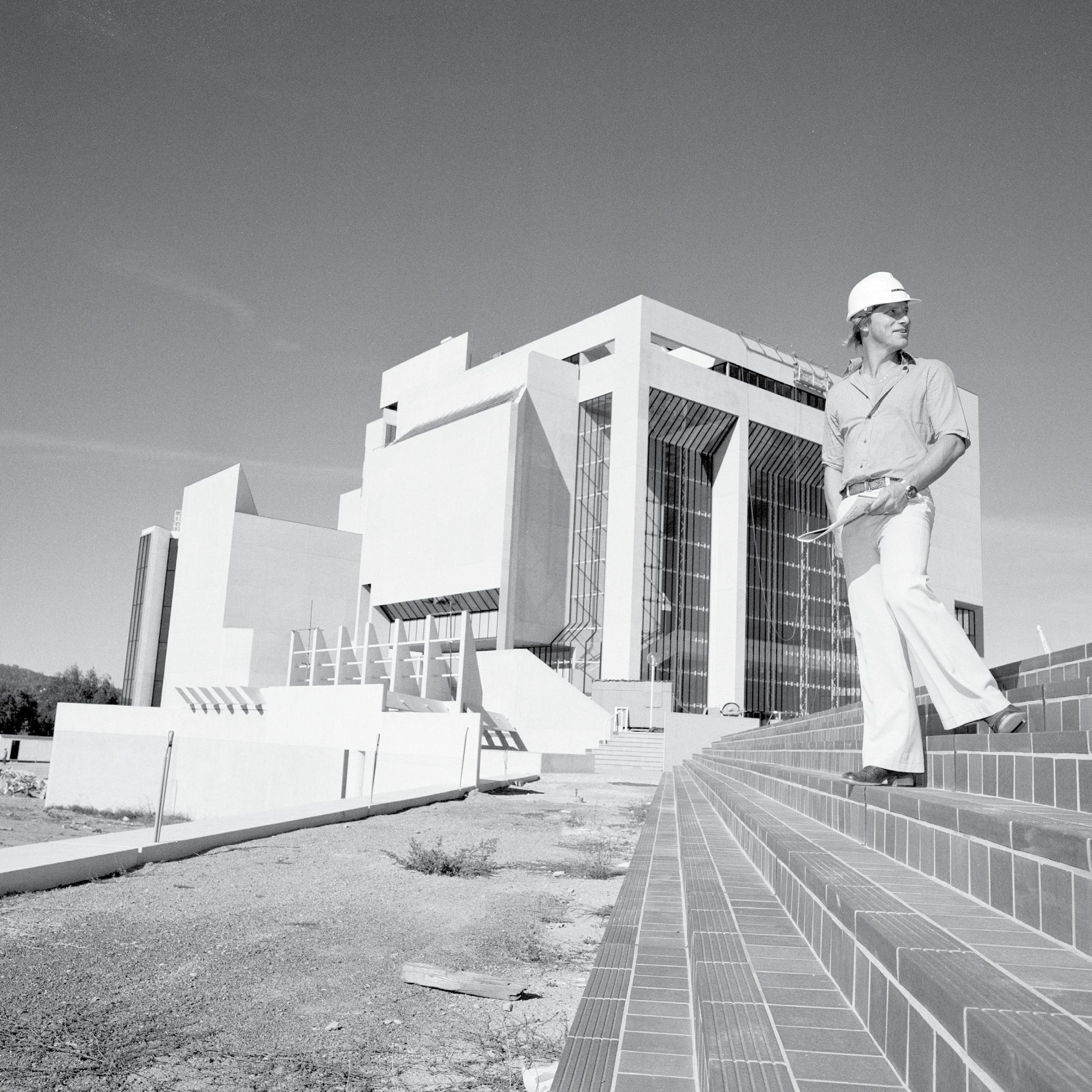
Supervising architect David Tregoning observes the High Court nearing the end of construction, 7 March 1980. National Archives of Australia, NAA: A6180, 7/3/80/9
1986
Tuggeranong Town Centre completed
Canberra’s population reaches 250,000
The Labor government takes the extraordinary step of deregistering the Builders Labourers Federation (BLF) in the wake of a Royal Commission into corruption by the union.
1987
1987 was a busy year for Master Builders ACT.
During this year the Association made a submission to a Joint Parliamentary Committee on the ACT in support of Section 38 retail development. It also set up an Industry Training Council with government, unions and other employer groups, produced a submission on new Unit Titles Ordinance, produced research on Synthetic Mineral Fibre materials as input to the national code, and joined with the ACT Industry Liaison Committee to lobby for development oportunities and a more viable planning system.
1988
MBA Land Development Company formed by Bob Winnell
MBA leads lobby for removal of payroll tax on small business, lobbies for GPO ahead of former Canberra Times redevelopment, and lobbies for Civic Square Entertainment/Casino complex
MBA produces submission to National Building Industry Inquiry to protect subcontractors.
9 May 1988
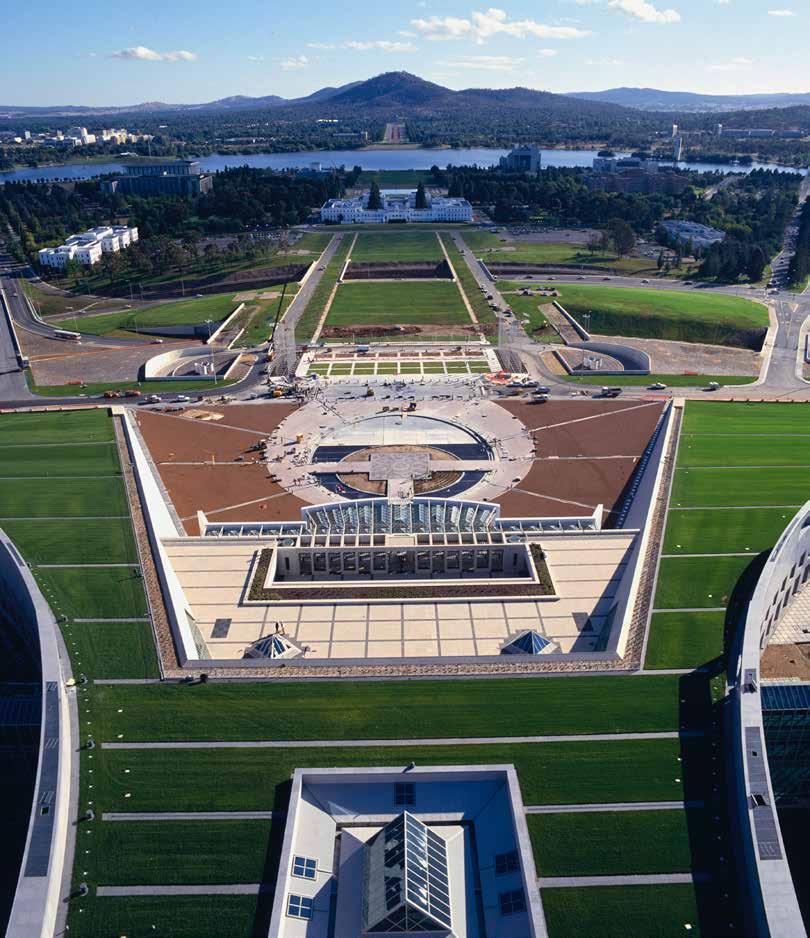
New Parliament House opens
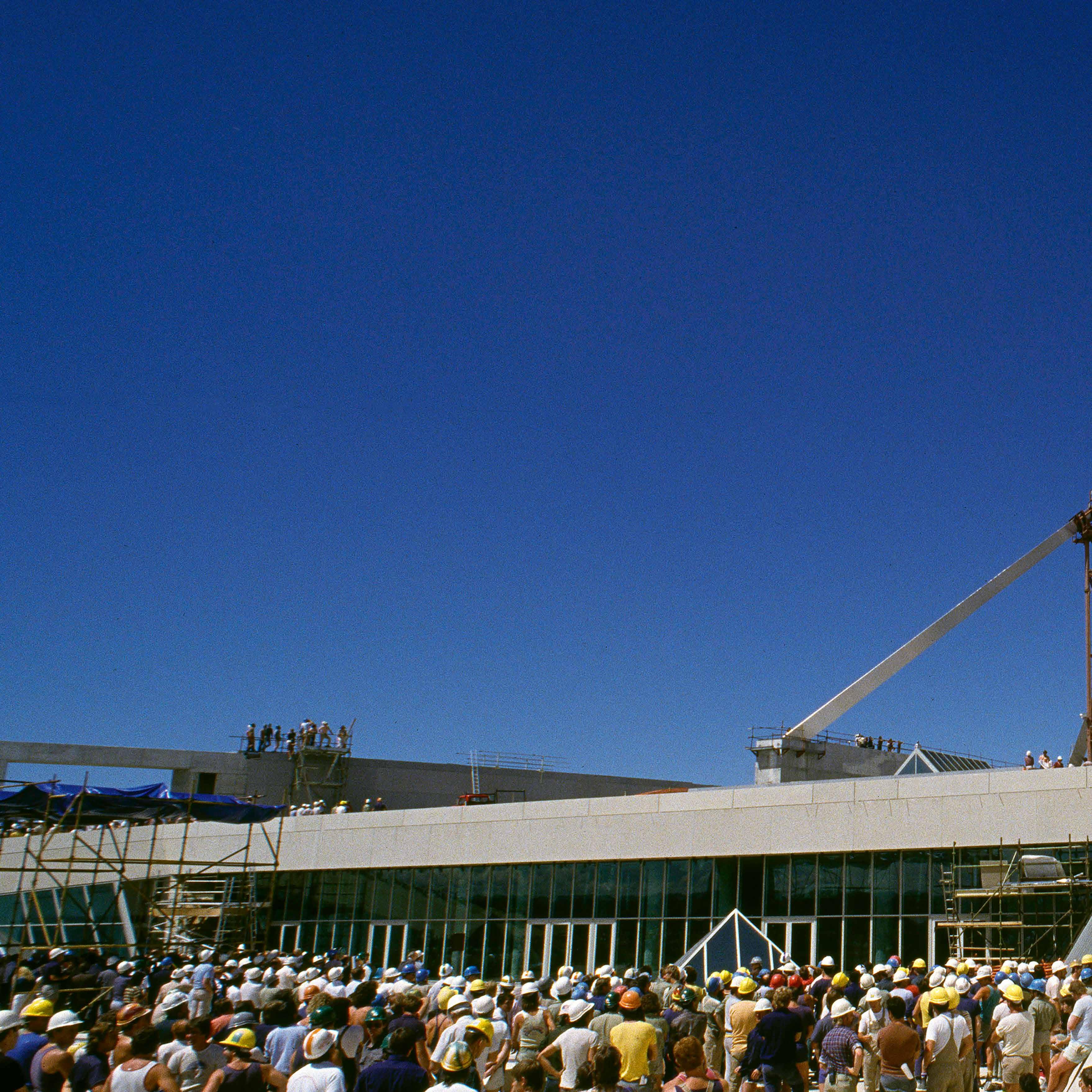
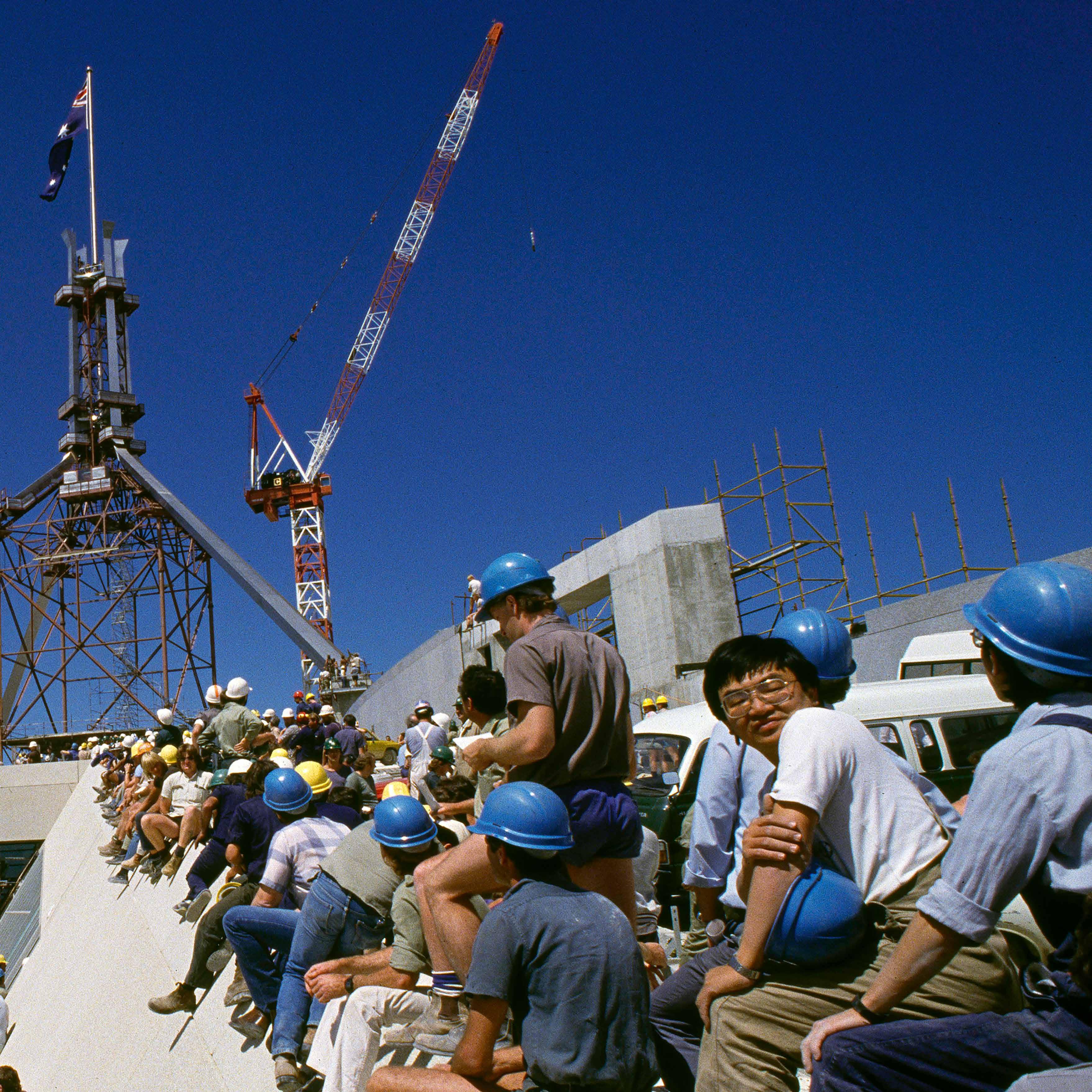
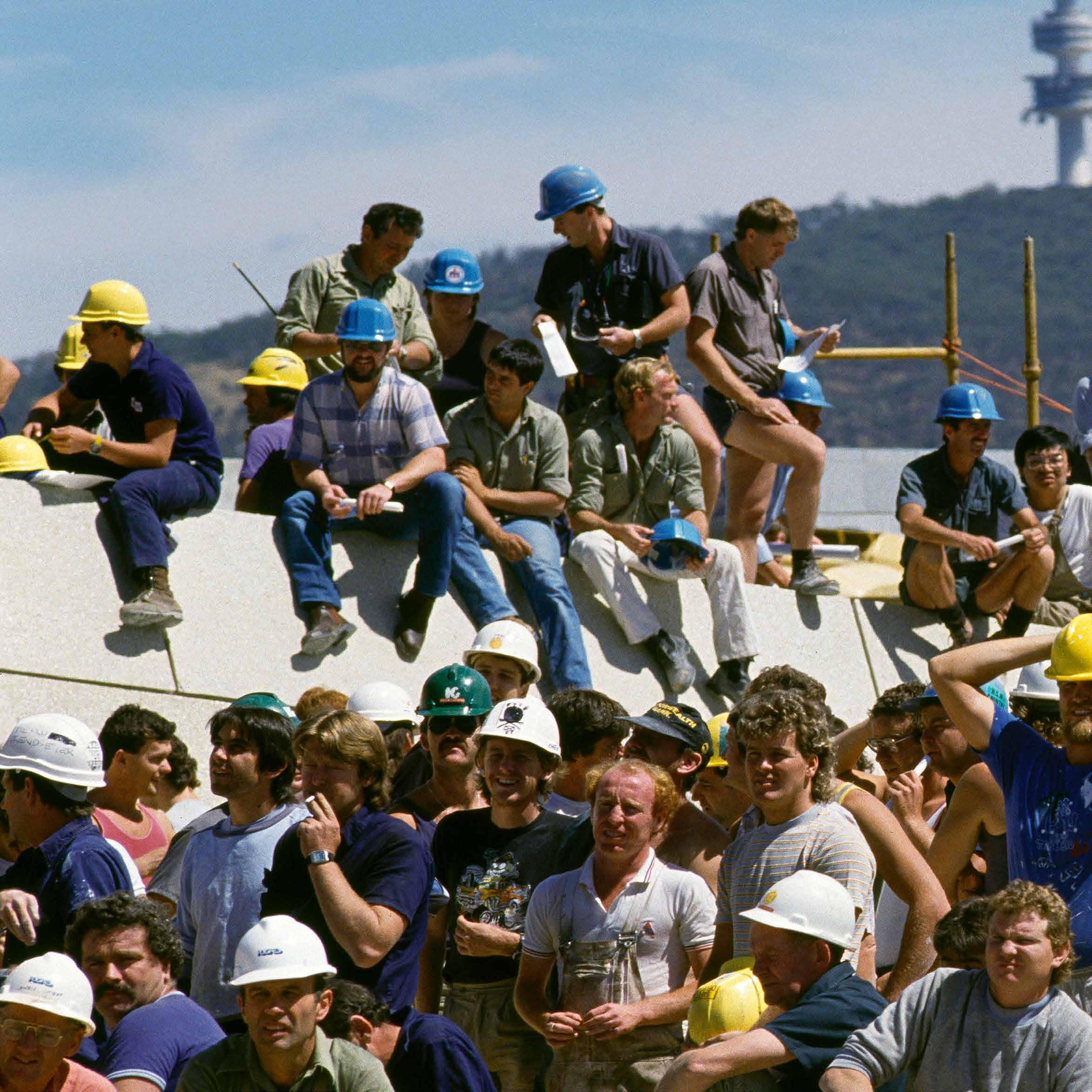
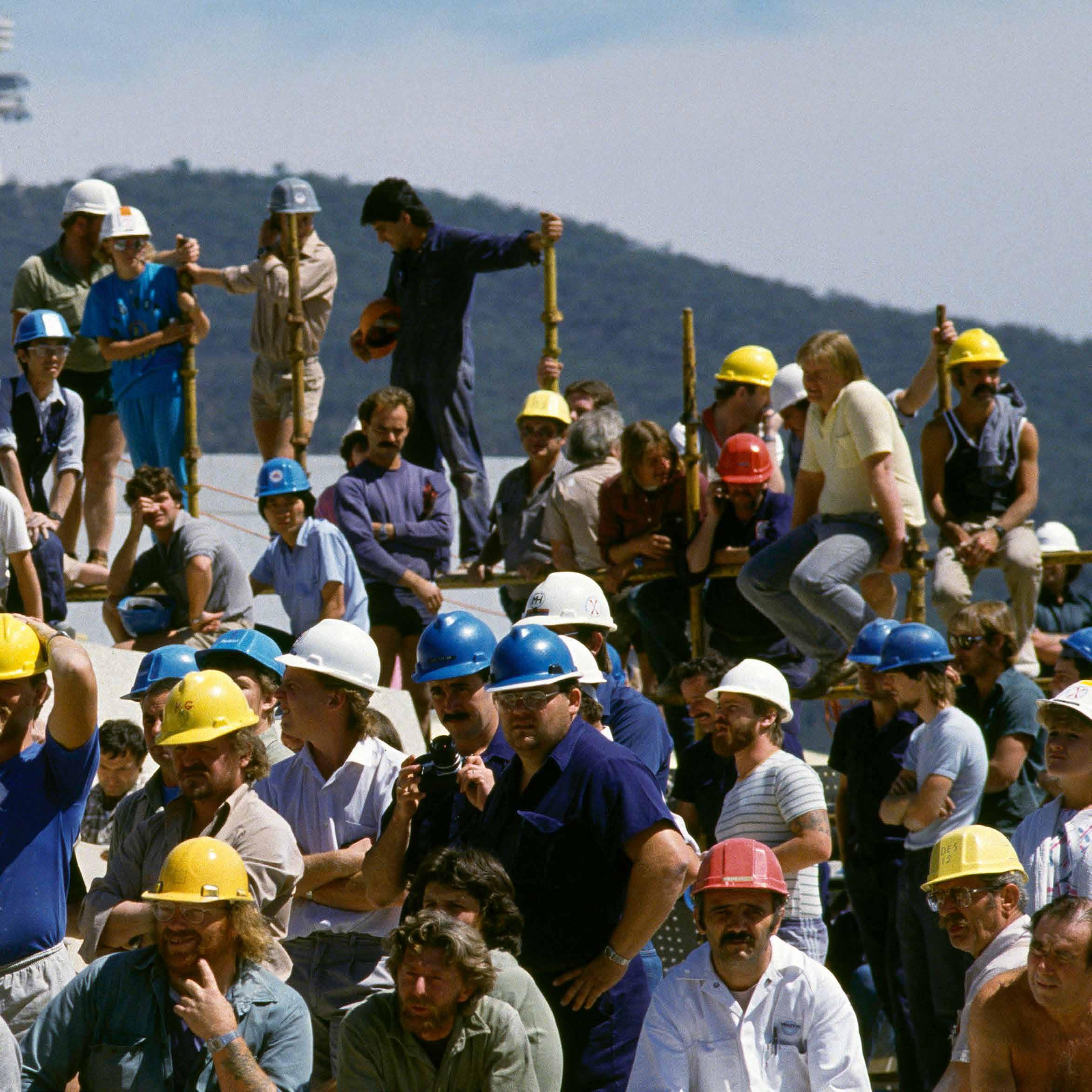
Over 1,000 organisations were involved in the project, including builders, suppliers and subcontractors. Over 10,000 onsite workers, and a total of 40,000 workers, contributed to the billion dollar project, which remains one of the largest buildings in the southern hemisphere with a floor area of 250,000 square metres.
ACT granted full self-government
1989
MBA ACT divisions establishedConstruction & Housing Service of the ACT, Construction & Housing Training, Construction & Housing Research
1990s Recession strikes
1990
Australia experienced a severe economic recession from mid-1990 to late 1991
This was marked by high interest rates (up to 17%), falling real GDP, and a sharp rise in the unemployment rate, which peaked at over 10.8%.
The MBA Group Apprenticeship Scheme celebrates 21 years as the oldest building industry training scheme in Australia
1991
First Master Builders ACT Awards for Excellence
1995
Master Builders ACT moves to its new premises at Construction House on Northbourne Avenue
ABOVE:
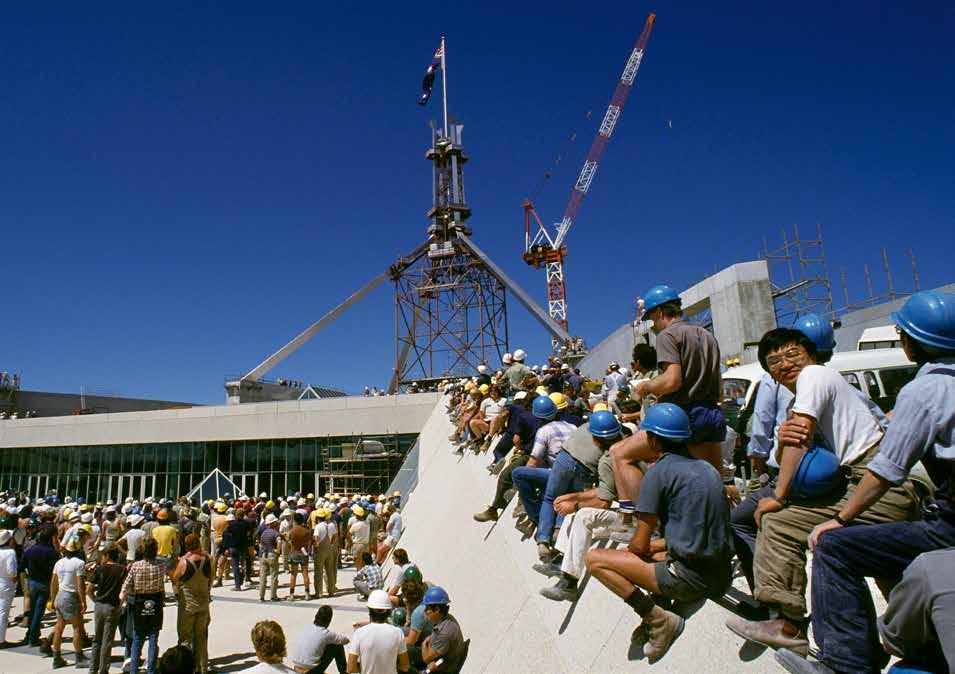
Workers observe the flag raising at New Parliament House, 26 February 1987. National Archives of Australia, NAA: A6135, K26/2/87/44
First edition of Canberra Building News (now Canberra Builder), the magazine of the Master Builders Association ACT, published Tuggeranong Hyperdome completed
HIH Insurance collapses
Regarded as one of Australia’s largest corporate failures, the collapse of HIH Insurance saw financial losses worth an estimate $5.3 billion. Construction was hit hard, with HIH providing builders’ warranty insurance to at least 20,000 builders across Australia, including in the ACT, who suddenly found themselves uninsured and therefore, unable to work.
National Museum of Australia opens
2002
Formation of the Master Builders Fidelity Fund
In 2002, the Master Builders Fidelity Fund was established in response to the insurance crisis brought about by HIH’s collapse, and the withdrawal of insurance broker Dexta from the market. The Master Builders Fidelity Fund was set up to protect homeowners from financial loss in the event of a builder being unable to complete a project.
2003
Canberra bushfires
On 18 January 2003, the ACT experienced the most destructive bushfires in its history. Four people died, hundreds were injured and 510 properties were destroyed. The work to rebuild following the fires was extensive and involved many Master Builders members.
2008
Global Financial Crisis (GFC)
In 2008, the building industry was again hit by economic hard times with the Global Financial Crisis, which led to the world’s major advanced economies experiencing their deepest recessions since the Great Depression.
Master Builders ACT relocates to new Fyshwick headquarters
National Portrait Gallery completed
2013
Canberra marks its centenary
To celebrate, Master Builders ACT published the book “The Master Builders that built Canberra”.
2015
Heydon Royal Commission
The Heydon Royal Commission sought to investigate alleged financial irregularities associated with the affairs of trade unions. In 2015, it was found that union corruption was widespread and deep-seated, and recommended a new national regulator with the same powers as the Australian Securities and Investments Commission be established to combat corruption in the trade union movement.
2018
MBA Women in Construction program founded, with the goal of creating avenues for female members to connect with other women working in similar roles in the construction industry. The first program meeting took place on 22 October 2018 in the MBA Boardroom.
2020s Towards the future 2020-2023
COVID-19 pandemic
The COVID-19 pandemic had farreaching impacts on the Canberra building industry that are still being felt today. The Territory experienced a significant backlog of houses under construction and a challenging construction environment amidst long periods of lockdown. Since 2020-21, dwelling approvals and commencements have fallen each year, and cost to build in the ACT is over 40% higher than pre-pandemic.
2024
3 August 2024
Construction, Forestry and Maritime Employee’s Union (CFMEU)
Construction and General Division placed under administration
This was in response to alleged widespread corruption and criminal activity within the union.
2025
Master Builders ACT celebrates 100 years of building Canberra
As we look back on the last century with immense pride, we ask: what will the future hold?
BELOW:
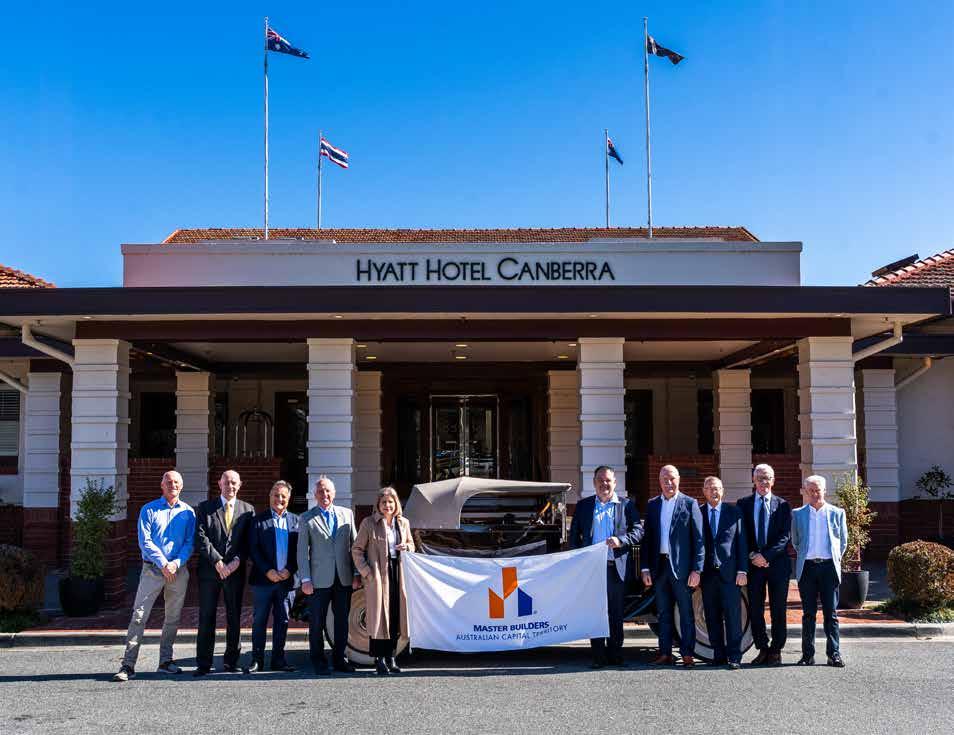
The Master Builders ACT Alumni gathered at the Hyatt Hotel on 18 August 2025 to mark the 100th anniversary of the Association’s formation at the then-Hotel Canberra in 1925. (Left to right) Peter Leemhuis, Paul Murphy, Sam DeLorenzo, Ross Barrett OAM, Graciete Ferreira, Frank Porreca, Simon Butt, Wilhelm Harnisch, John Miller, John Hayes
We built this city: an essay
In 1925, Canberra had already been chosen as the capital of Australia for over a decade. But looking at what appeared to be a blank, rural canvas, it would be hard to tell. Parliament was still meeting in Melbourne. American architect, Walter Burley Griffin, had won the competition to design Australia’s capital, but very little of that design had come to fruition.
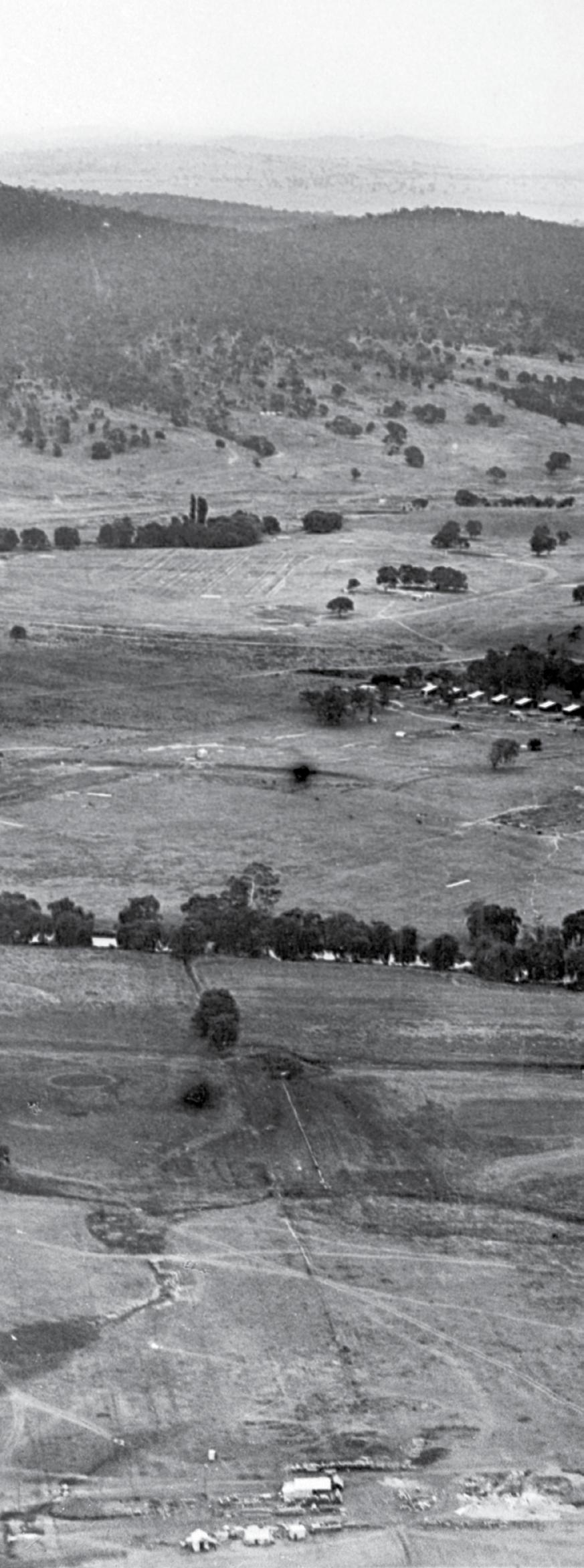
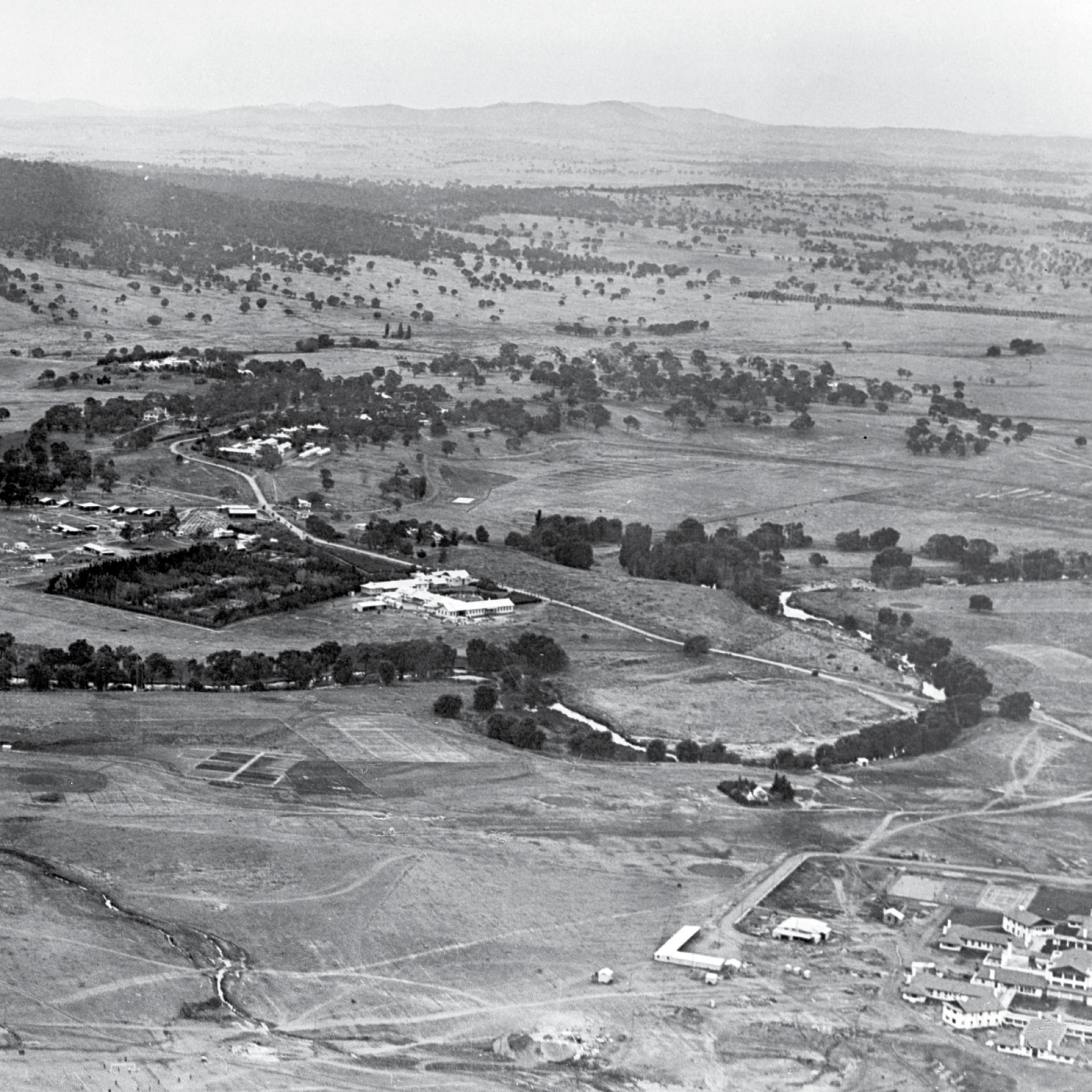
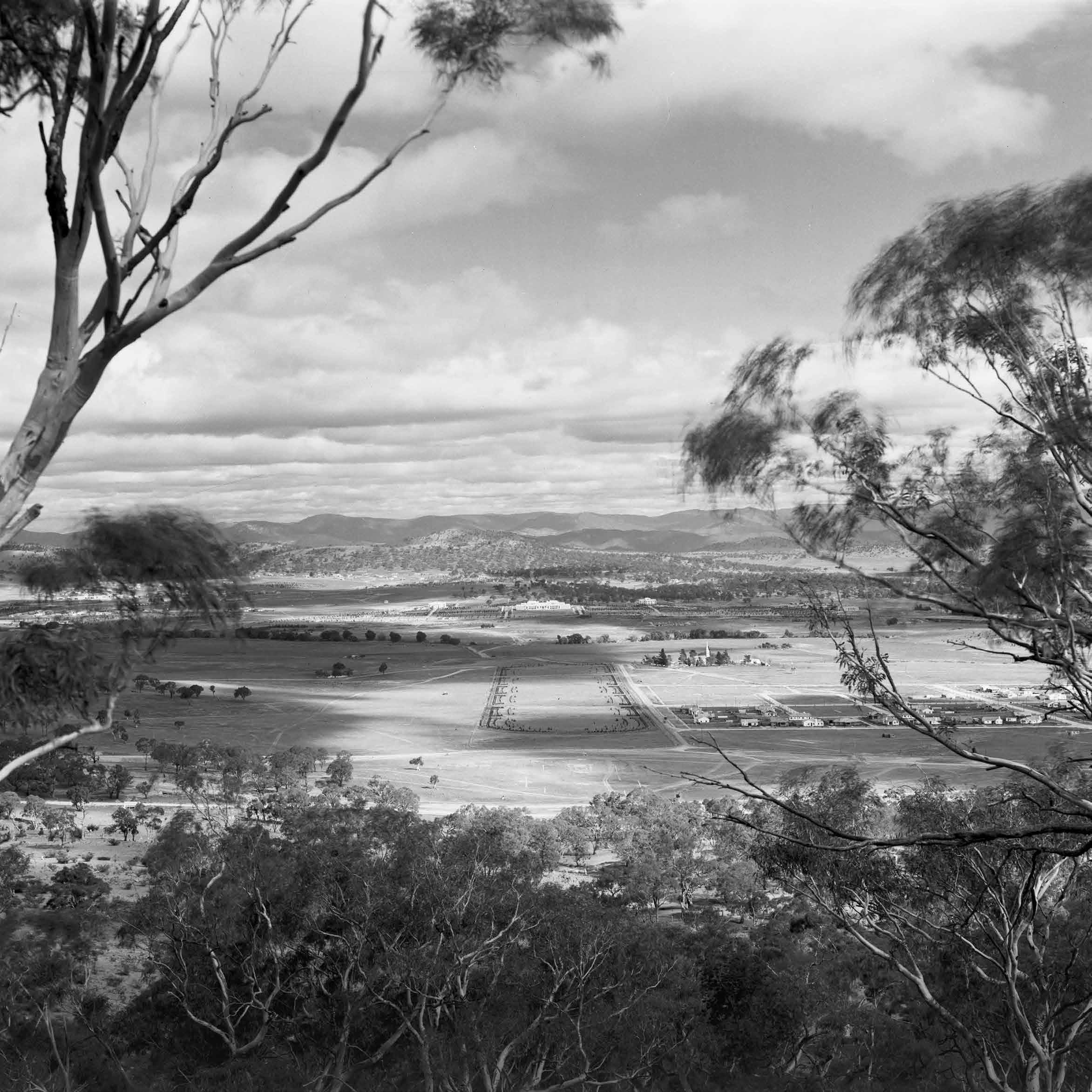
A photograph taken on 25 April 1925 shows part of Black Mountain and scant buildings. There’s no lake, very few roads, but some workers’ cottages are visible. At this point, aside from farming properties, most of Canberra’s built environment was anticipating the amenities and utilities required for further infrastructure development. There was the Commencement Column Foundation Stone. There was Old Canberra House, an early residence of the Administrator of the
Federal Territory and the headquarters of the Federal Capital Advisory Committee who were tasked with implementing the city plan. There was a hospital, a school, and a hotel. There was the Yarralumla Brickworks and the Kingston Powerhouse. Just enough ingredients to really get things started.
RIGHT:
View of Canberra from Hostel, showing portion of Black Mountain, 25 April 1925. National Library of Australia, nla.obj-137349044
A photograph taken on 25 April 1925 shows part of Black Mountain and scant buildings. There’s no lake, very few roads, but some workers’ cottages are visible.
Progress had stalled because of World War I, but there was still a sense of anticipation. You had to use your imagination, but a city could grow out of these acres of paddocks.
This is the context in which ten of Canberra’s builders met at the Hotel Canberra on 18 August 1925. They resolved to form the Master Builders Association of the Federal Capital Territory, now known as Master Builders ACT. John Deans, the builder of the first private residences in the Territory, was elected as the inaugural President.
A year after the MBA’s formation, The Canberra Times reported “a considerable increase in building activities” in the capital and that the “association promises to become an important factor in the development of the capital through private enterprise.”
ABOVE RIGHT:
MASTER BUILDERS ASSOCIATION, news clipping from The Federal Capital Pioneer, Tuesday 25 August 1925.
Early MBA members realised the opportunity they had to grow Canberra. Parliament would be relocated to Canberra in 1926, which required built infrastructure and amenities.
One thousand public servants would be relocated from Melbourne. By the end of the 1920s, Canberra’s population climbed to over 8,000. Supporting that population, members of the MBA worked to create the sewage and treatment works, water supply systems, lighting, stormwater services, parks, footpaths, shops and homes that would form the foundations of the new capital.
Over the Association’s first hundred years, it continued to shape Canberra’s landscape. Though never immune to geopolitics–such as the outbreak of the Great Depression and other episodes of economic turmoil, World War II, and, more recently, the COVID-19 pandemic–Canberra has been and continues to be shaped by the skills of master builders.
From social infrastructure, to family homes, to iconic buildings such as the Sydney and Melbourne buildings (1927), the Capitol Theatre (1927), Albert Hall (1928), the Canberra School of Music (1976), the Parliamentary Triangle (1988), Duntroon (1996), and more, master builders have made Canberra what it is today.
“Canberra is here, and despite the fact that there are still some people who ask what it is wanted for, nothing that can be said can stop it. In the course of a very few years, Canberra will be the finest city in Australia.”
–
Mr. J. H. Butters, Chief Commissioner, at the Master Builders first Annual Dinner on 21 September, 1926
Navigating Canberra’s building booms and busts
Making a city: the 1920s
The first building boom began at MBA’s inception. They would lay the groundwork for Parliament to meet and public servants to live and work. For starters, the builders working on these projects would need somewhere to live.
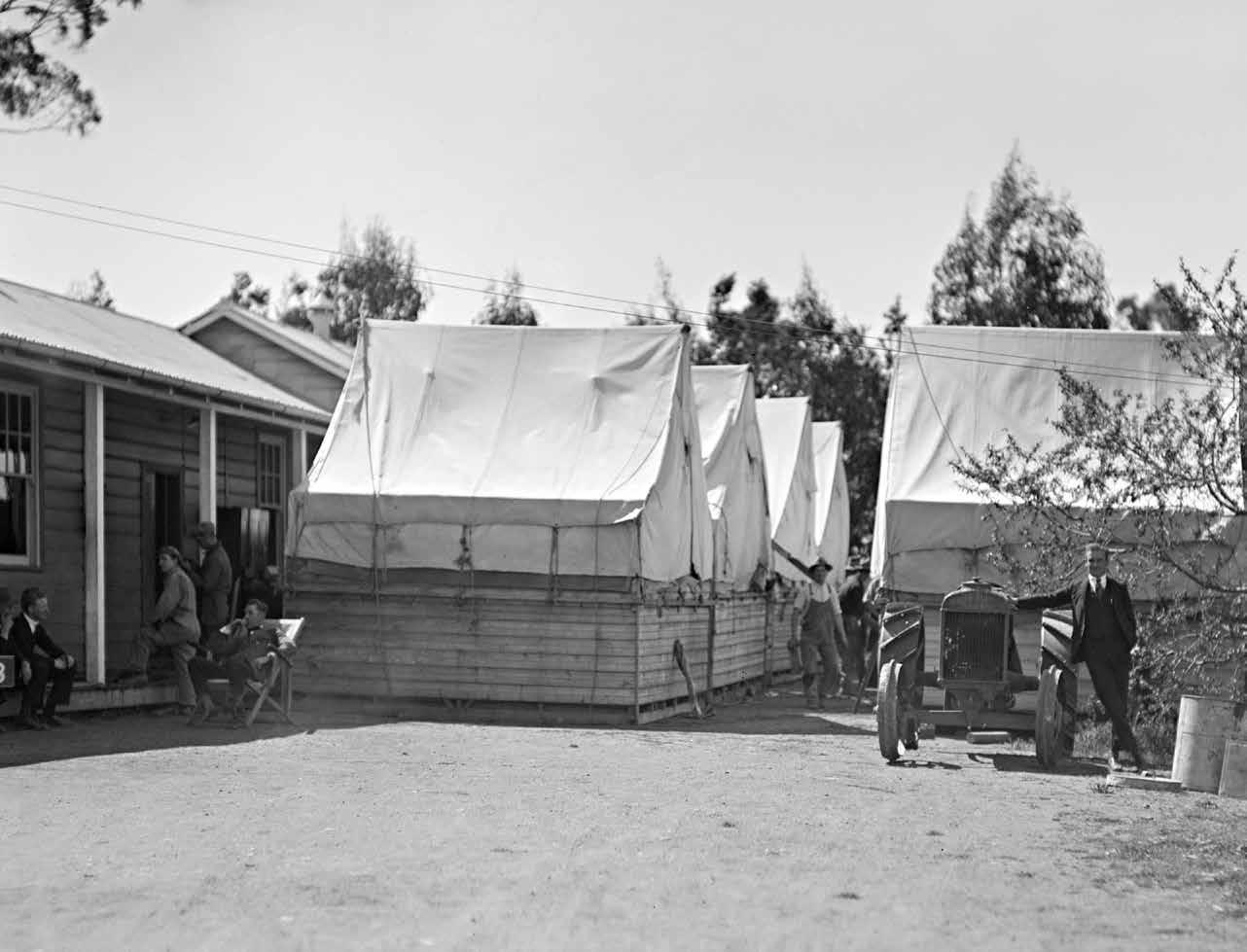
Although some builders already lived or could find a home in the already-established town of Queanbeyan, large camps were established for single men. The Molonglo Camp was used to house families, while standalone workers’ cottages were also built in The Causeway (now part of the Kingston precinct) and Westlake (recognised now in relation to the outskirts of Yarralumla).
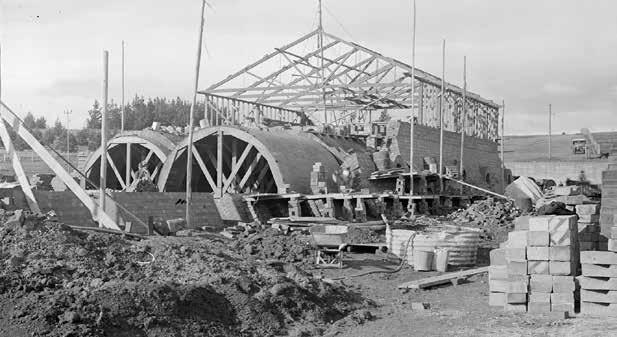
Brickworks, quarries, and a joiner’s shop provided the materials necessary for construction. Increasingly, electricity, sewerage, roads, and other utilities were connecting Canberra’s early suburbs. To house the relocating public servants, there were cottages at Eastlake (also now part of the Kingston precinct), Blandfordia (now part of Forrest and Griffith), Braddon, and Acton.
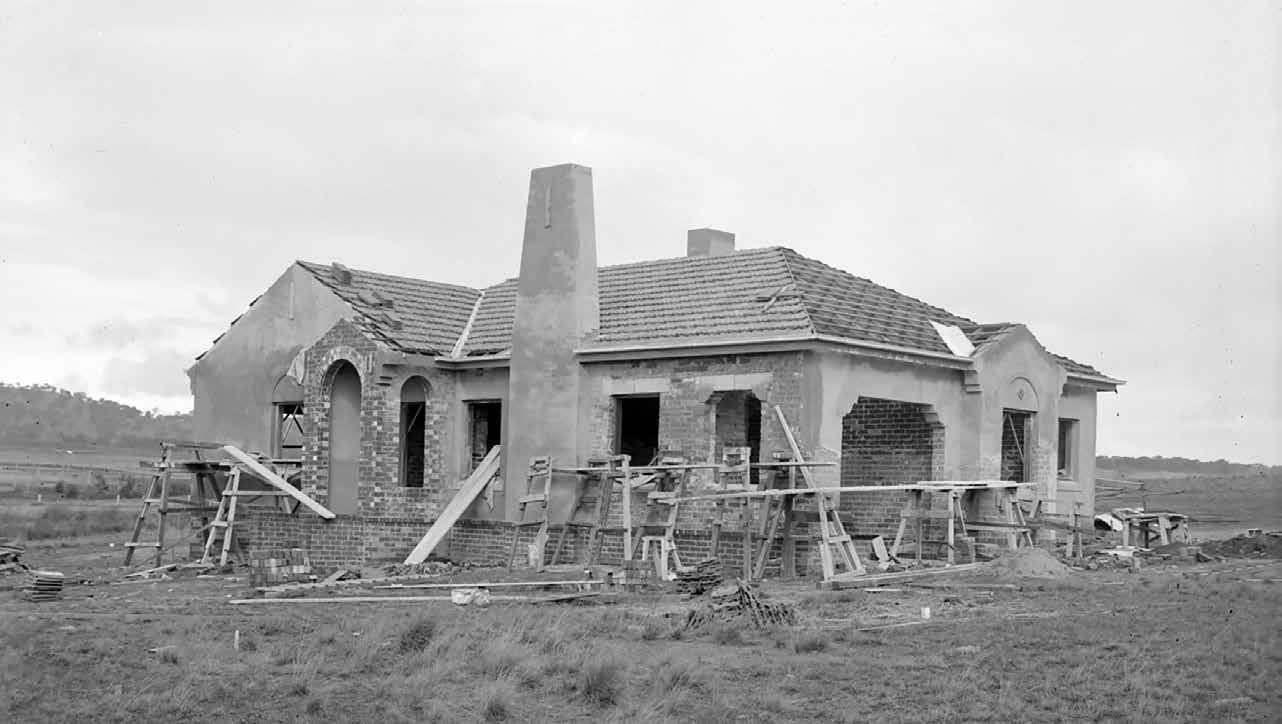
Aside from completing the provisional Parliament House, there was also fast-paced construction of buildings including the Secretariat Building (West Block Offices), the Automatic Telephone Exchange and Post and Telegraph Office (East Block Offices), and the Government Printing Office. Hotel Canberra was expanded and another hotel, the Hotel Kurrajong, was built. Gorman House, which originally served as a hostel for public servants, was completed, as well as residences for the Prime Minister and the Governor General.
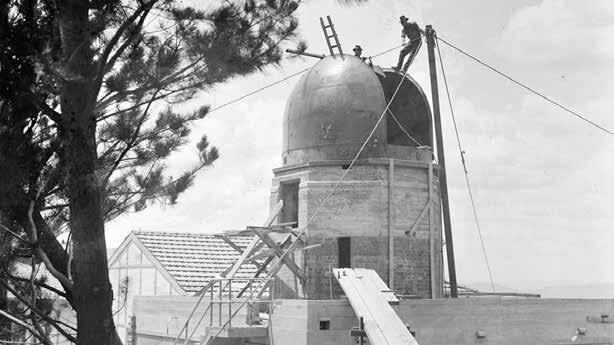
Another major public work was the Observatory at Mount Stromlo. Of the public works commissioned by the Federal Capital Commission, the new body responsible for planning and developing Canberra between 1925 and 1930, most work was undertaken by the 26 members and 10 builders of the newly-formed Master Builders Association ACT.
CLOCKWISE FROM LEFT:
Tents and buildings, bachelors quarters, Acton, 1926. Photographer: William Jack Mildenhall. National Archives of Australia, NAA: A3560, 2076
Brick kilns at Canberra Brickworks Yarralumla, under construction, August 1926. National Archives of Australia, NAA: A3560, 2076 Workmen on the dome over the Farnham telescope, Commonwealth Solar Observatory, Mt Stromlo, 1928. National Archives of Australia, NAA: A3560, 7543
Conditions faced by workmen were rough. Historian Alan Foskett writes in On Solid Foundations that time spent working in the capital was measured in terms of the number of winters, such was the brutally cold climate.
Some accommodation was comfortable enough, such as a settlement of timber cottages built near Hotel Canberra by John Howie. But other builders’ camps comprised only tents and cubicles. Those who lived in family accommodation banned their children from curious visits to the camps. It was not uncommon to find black market liquor (Canberra was a dry city until 1928), gambling, and sex workers in the camps. Many workers were World War I veterans who suffered a mix of “shell shock”, injuries, and disease acquired during their service. There were reports of alcohol-fuelled fights and deaths due to heavy drinking.
The quality of accommodation improved over time, with tent camps mostly abolished by 1927, but in these years, the Federal Capital Commission (FCC) would not permit construction workers to live outside the camps, even if they could afford to do so.
As leaseholds were sold starting in 1924, the role of private construction was also solidifying in the Territory. At the time, the FCC identified that it was important for early Canberrans to access the amenities they would expect in any Australian state.
Yet, there were also regulations in place to ensure design and construction was in “conformity with the Garden City treatment that is being universally adopted”. These standards were rigid. Buildings were to be integrated with their natural surroundings, which restricted building heights, materials, and landscaping.
The FCC determined fixed block prices and lease covenants that specified the minimum amount that had to be spent on building, which varied by suburb. Houses in the more expensive suburbs tended to be built in a prescribed “FCC style”. After homes were bought and built, rigidity remained. Public servants from the FCC, and later from the Department of the Interior, would tell homeowners to tidy their front yards and trim their hedges or would even tidy them on the homeowner’s behalf. This inflexibility, along with the costs of freighting some materials and setting wages higher to attract a new workforce, made building in the capital often more expensive than in cities like Sydney and Melbourne.
Nonetheless, private works amassed in the late 1920s. Plans for 371 private residences, shops and offices were approved. Eastlake and Manuka saw considerable commercial development. Civic had also been established with shops and businesses. Major banks and insurance companies had a presence in Canberra. There were churches, and two private schools.
From its early days, the MBA had close links with the Government. At its first annual meeting in 1926, the guest list included the Federal Capital Commission’s Chief Commissioner, John Butters, and its Secretary, Charles Daley. The MBA had met with the FCC on many occasions over this first year. The Canberra Times reported that all the members had been “working at full capacity” in the complicated task of building Canberra. At the event, Butters commented that “it was a wonderful privilege that a man should build something which lasted beyond his life”, and likewise, an immense privilege for builders and policymakers alike to be making “the capital of a nation”. He continued, “We should put forward our very best endeavour in the work we are engaged, so that when the great task is completed, we can say that we did our share of Canberra.”
But the task of building Canberra is never done. Cities are always under construction, and boom times don’t last.
Hard times:
the Depression and World War II
This first building boom ended with the Great Depression, followed closely by World War II. Economic conditions caused the postponement of Lake Burley Griffin, the Australian War Memorial and some permanent administrative offices in Parkes. It also stopped extensions to the railway line that was originally intended to go to Civic, and sewer line extensions.
At this point, major construction in the capital had almost halted, the main exception being some road construction work, and the construction of the Patents Office in 1933. The labourers’ camps became unemployment camps, and Canberra’s population shrank from 8,000 in 1927 to 7,000 in 1931.
The Federal Capital Commission was wound down in 1929 as a cost-cutting measure, following a change of government and criticism over its undemocratic approach to building. Around this time, the MBA was on the record in The Canberra Times denouncing the FCC for issues with delays in payments to builders, and non-return of tender deposits.
The MBA further argued in a subsequent letter to The Canberra Times that “It is very questionable… whether the Commission can build as economically as a private firm.” The Association pointed out that up to four salaried FCC public servants would visit a building site at one time, and that each would be eligible for a travel allowance to get to the site. On that site, they would micromanage decisions when, “The builders maintain that under the Executive Architect and one competent man having power to give decisions on all minor matters relative to the job would mean better supervision, less irritation to the builder, and less final cost.”
Despite the dissolution of the FCC, the Federal Government continued to regulate building. In 1930, this regulation meant that “wherever practicable,” it would contract work “by day labour under its own departments”. The government became the boss, instead of awarding building contracts to private builders. Most of this work was residential construction. James Scullin’s Labor Government believed that day labour could create employment opportunities, where the Government had greater control over worker wages. It ensured that public money would be distributed among lower paid workers. Earnest Spendelove, the MBA President at the time, publicly spoke against this policy, noting that many private builders had come to Canberra before the Depression, at their own expense, and met frustrating circumstances. The use of departmental day-labour felt like a betrayal. “They had seen the programme of the building in the Territory through and established themselves, and they… were entitled to a continuance of work.”
The use of day labour would also have undesirable economic consequences: without a contract, the Government had no visibility of how much works would cost until it was done. Spendelove also argued that the expert supervision, connections with materials suppliers, and a vested business interest that contractors maintain often meant work could be conducted at a lower cost.
In June 1929, a Parliamentary Standing Committee on Public Works recommended a tender process for building contracts to encourage competition in a bid to maximise value for money. Master builder Jock Simmie, who had moved his family to Canberra in 1926 to establish a presence for building company Simmie & Co, also pointed out that contracts were an important means of keeping the work in Canberra. Where day labour was used, most of the joinery work was conducted in Sydney, while contracted builders ensured that this type of work was done locally.
As Australia recovered from the Depression in 1932, the MBA advocated successfully to return to more contract-based work. According to The Canberra Times, a group of MBA members met with the Minister for Works, Major W. Marr, “with a request that the Minister should eliminate day work, and re-impose the contract system for all public works in the Federal Capital.” Marr, under the new Prime Minister Joseph Lyons, agreed to this, except for maintenance jobs.
LEFT:
The Australian War Memorial under construction, 1933. National Archives of Australia, NAA: 3560, 7079
On March 12, 1913, a sparse gathering of frock‑coated, stiff collared politicians and their wives watched on as Lady Denman took a card from a small gold case and announced, I name the city of Australia’s Capital, Canberra. – archives.act.gov.au
OPPOSITE:
Lady Denman naming the Federal City “Canberra” on 12 March 1913.
Photograph from the personal archives of Claude Stafford Vautin. National Archives of Australia, NAA: M11, 24
In the brief interlude between the Depression and World War II, building picked up. Plans for the Australian War Memorial resumed. Simmie & Co, an early MBA member, won the museum wing tender in 1934 and later won the contract to complete the Memorial in 1937. Their contract was still concerned with local employment, and stipulated that only local workers could be employed. As a big player in Canberra building, Simmie & Co was also awarded the contract to construct the first National Library in 1935, and for some Royal Military College Buildings in 1936. Residential building was particularly important during this period. By 1938, Canberra’s population had recovered to 12,000 people, but there were only 2,100 dwellings.
The outbreak of World War II, however, meant that only 500 new homes were built between 1939 and 1942, which further postponed the movement of various institutions to Canberra. There were extreme worker and materials shortages, to the point that even maintenance of existing buildings was difficult. That said, the Community Hospital on the Acton Peninsula, now the home of the National Museum of Australia, was constructed with the help of the US Army, which also made use of the hospital. Workshops on Mount Stromlo were built for the manufacture of scientific instruments for defence use, and the Canberra Technical College in Kingston was expanded to become a training centre for aircraftmen and munitions workers.
Fixing the ”appalling” lag: post-war growth
By the end of the 1930s, the MBA was looking towards a more optimistic future, and formally registered with the Territory’s Industrial Board Ordinance in 1938 as an organisation of employers. This established the MBA as the only representative body of private employers in the building and construction industry, giving it an important status for industrial relations matters. Some of the optimism was tempered by materials and labour shortages but the post-war period was a time of substantial growth.
Canberra still suffered from extreme accommodation shortages. In 1946, as a city of 14,500, there were only 450 private houses. The Federal Government resolved to address these issues urgently. In 1947, it unveiled an ambitious project to construct 3,500 homes, alongside the construction of more amenities, administrative buildings, and foreign embassies.
ABOVE:
The project would welcome another 15,000 people into Canberra over a five-year period, doubling the population. This growing population comprised relocated public servants, builders, tradespeople, and migrants. To cope with the sudden influx, the Acton Guest House and Hotel Acton were repurposed as temporary hostels and new hostels were constructed.
Despite this wave of construction, in 1955 the thenPrime Minister Robert Menzies expressed concern about the “appalling” lag in Canberra’s establishment as a true capital city. A Senate Committee to “Inquire into and Report on the Development of Canberra” found that Canberra was still not the administrative centre of government. To pick up the pace of development, The National Capital Development Commission (NCDC) was established in 1957. Aside from relocating government departments to Canberra, the NCDC was tasked with giving Canberra the gravitas befitting a capital city. This administrative work sparked another boom in construction in the 1960s where, by the end of the decade, the population grew to 125,000 people.
Over this period, the MBA advocated for policies to help builders, and the whole Territory, capitalise on the boom. For instance, in 1962, they urged the Federal Government to expand the availability of credit to stimulate more residential building growth. They also called for assurances that contracts for construction be issued on a stable basis so that Canberra could likewise attract a secure workforce.
In 1966, the Association identified that access to red sand, a vital ingredient for concrete and brickwork, was being restricted to government contractors in the ACT. They wanted to keep private construction costs lower by ensuring that local builders would have access to it, rather than having to source it from interstate at greater expense. The cost of bringing materials into the ACT, red sand or otherwise, was among the reasons that construction in Canberra was more expensive than in other major Australian cities. In 1968, the MBA advocated for a registration system to protect the public from unqualified builders. Through this decade, there were also still problems associated with skills shortages and labour disputes to navigate.
The 1960s were a busy decade, and the results for the Canberra landscape speak for themselves. At this time, the Woden Valley and Belconnen residential districts took shape. Civic was solidified as a community hub, particularly with the building of Monaro Mall (now the Canberra Centre) in 1963. It was the first Australian shopping centre to have three stories and to be fully enclosed and air conditioned.
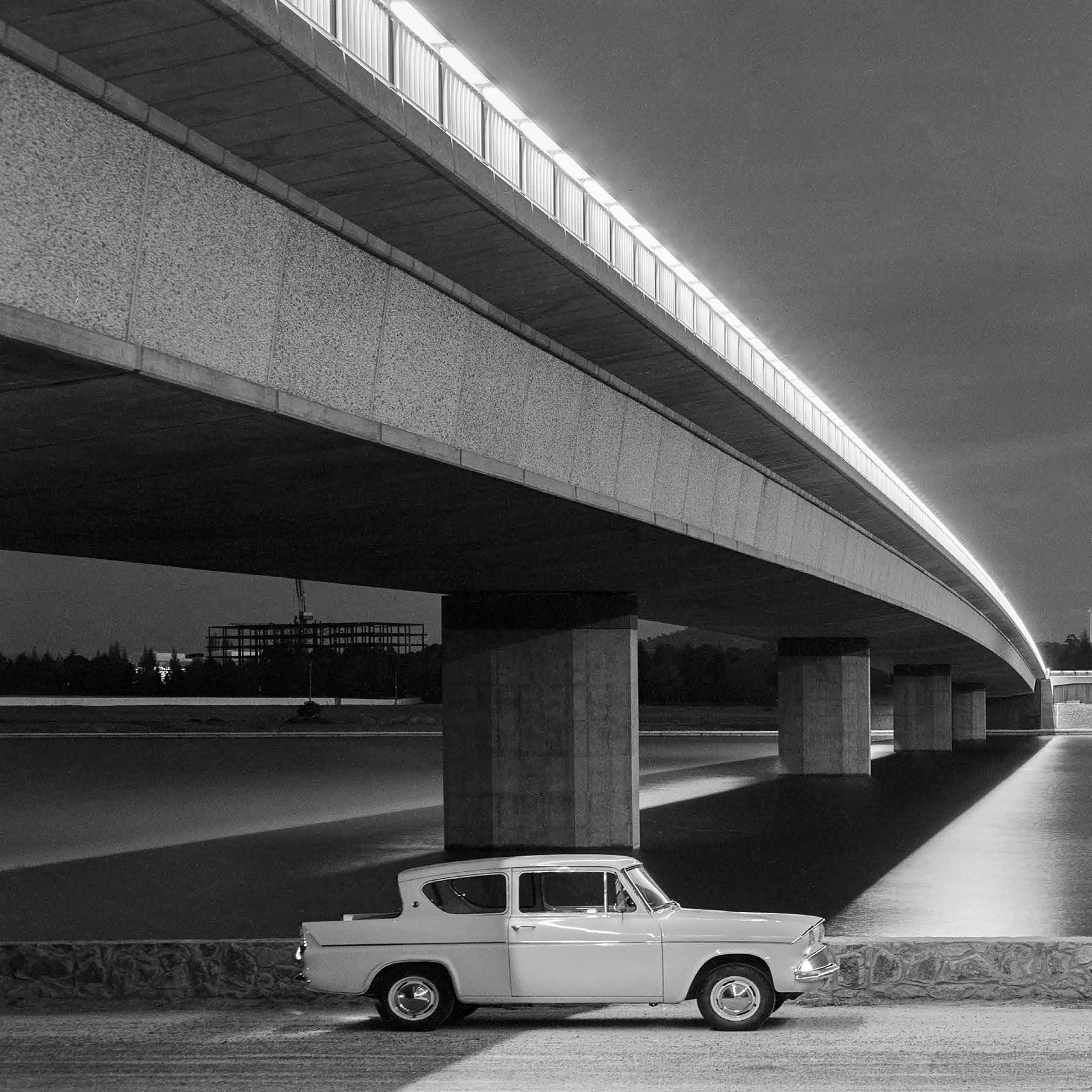
Iconic Canberra buildings such as the Australian Academy of Science’s “Shine Dome” (1959), the Royal Australian Mint (1965), and the permanent National Library (1968) also took shape. Civil works progressed too. The Commonwealth Avenue Bridge (1963) replaced a series of earlier bridges that couldn’t withstand Canberra’s summer heat. It remains today thanks to innovative local techniques to improve its endurance, with Prime Minister Menzies calling it “the finest building in the capital” when he opened it. Anzac Parade (1965) was also built to highlight Australia’s military history, and to realise part of Walter Burley Griffin’s original “land axis” design, visually connecting the Australian War Memorial with Capital Hill.
The largest project was the $5 million dollar construction of Lake Burley Griffin in 1963. Before the lake was constructed, the north and south of Canberra were divided by Springbank Homestead (now Springbank Island), grazing cows, and a horse racing track. To create the lake, members of the MBA had to impound the Molonglo River with Scrivener Dam. Construction involved pouring 55,000 cubic metres of concrete, creating a 33 metre-high and 319 metre-long wall. A long drought eased the difficulties of construction, but also delayed water reaching the lake until 1964. An opening ceremony with a fireworks display took place on 17 October 1964, after the water rose to its intended level.
Into the 1970s, another dam was needed to secure a reliable water supply for the growing populations of Canberra and Queanbeyan. The three existing dams along the Cotter River wouldn’t be enough to hold the growing needs of a growing population. So, the Googong Dam project began in 1974. Completed in 1979, the dam is 66 metres high, 417 metres long, and holds 119,400 million litres of water. The project mobilised a significant workforce of engineers, labourers, and planners, whose efforts over five years transformed the Queanbeyan River into a vital water source. They laid the foundations for further regional growth.
Let’s finish the job: advocating for a true capital city
Shaping the ACT isn’t limited to physically building. It also involves getting politicians to let you get on with the job of building. An early lesson from the FCC, and from the use of day-labour in the Depression, is that government overreach can stifle the construction industry. But a lack of government investment in construction also has a chilling effect, especially in Canberra.
The story of how the new Parliament House was built paints a perfect picture of how the advocacy of the MBA has helped realise the promises of Canberra. Old Parliament House, originally known as the Provisional Parliament House, was always meant to be temporary. But 61 years after it was first opened, over 3,000 staff were crammed into a building designed for a few hundred.
RIGHT:
Googong Dam under construction, 23 June 1976. National Archives of Australia, NAA: B6295, 4549N
Discussions over where a permanent parliament house would be located began officially in 1955 in a Senate Select Committee, which recommended Capital Hill. Other recommendations to construct it on the lakeside were raised through the years. In 1965, another Joint Select Committee formed to tackle the same question. The Committee travelled the world, touring other parliament buildings. After four years, it recommended Camp Hill (the site of Old Parliament House). Camp Hill and Capital Hill were both debated in Parliament as possible sites, but a consensus could not be reached. The House of Representatives voted for Camp Hill, while the Senate voted for Capital Hill. It wasn’t until 1974, following further debate, and nineteen years after discussions began, that the matter was resolved by a Parliamentary Bill that Capital Hill would be the location. In 1975, the Joint Standing Committee on the New Parliament House recommended that the design for Parliament House be selected through an architectural competition, and that the House be completed in time for Australia’s 1988 bicentenary.
Further progress stalled because of a change of government. The new Prime Minister Malcolm Fraser had pledged to streamline the public service and keep public expenditure down.
The MBA understood that it would need to apply some political pressure to get any momentum towards finally building Parliament House. In 1975, they had identified serious industrial challenges and stagnating projects. At the time, unemployment in the ACT had increased by 35 per cent and 22 per cent of this increase was born by concrete producers. Concrete suppliers had started accepting only cash payments because they were having issues with cheques clearing. More retrenchments were on the horizon, with up to 50 per cent of ACT construction workers at risk of losing their jobs. Residential blocks had roads, but no houses. With a shrinking public service, there was no demand to make them. It was noted by the MBA’s Executive Director at the time, David Andrew, that talented ACT-based construction firm managers were being moved interstate, and some firms had ceased operations in the ACT entirely.
The MBA ran a series of advertisements in The Canberra Times with the rallying cry to “Let us finish the job” of building Canberra. The MBA held that unless there was commitment to the construction industry of some major projects very quickly, including Parliament House, “the specialised resources, which were set up by the private sector at the request of previous governments, will leave the ACT”.
The opportunity to build a permanent Parliament House was not a simple logistical matter of giving some politicians and staffers a bit of extra space. Nor was it a purely symbolic effort to finally give Australian nationhood a grand building. Parliament House’s construction would have real, widespread consequences for the sustainability of the Territory to continue growing. In a meeting in June 1977, the MBA resolved to advocate to the Federal Government to finally build a new, permanent Parliament House. Such building works would stimulate Canberra’s construction industry, promote local skills retention and development, and boost business enterprise. The MBA launched a postcard campaign encouraging members to remind Prime Minister Fraser of these benefits.
In 1978, Fraser announced an international competition to design the new Parliament House, to be completed by 1988.
The new Parliament House was finally opened in May of 1988. At the time, the then-executive director of the MBA, John Murray, wrote for The Canberra Times that “54 ACT contractor members will stand proud”. The lead contractors, John Holland and the Concrete Constructions Group, were both affiliated with the Master Builders movement. Over 1,000 other organisations were also involved in the project. Other members of the MBA handled contracts and sub-contracts for the huge range of elements necessary for the Parliament House that was designed to last for 200 years.
LEFT:
New Parliament House under construction, 17 May 1985. NAA: A6135, K17/8/85/8
Members of the MBA were involved in providing supplies, woodwork, marble and granite, excavation, concreting, glassworks, electrical work, air-conditioning, fire protection, plumbing and sanitation for the new national icon. There were 10,000 on-site workers and 40,000 workers throughout Australia who contributed to this billion-dollar project. Parliament House became, and remains, one of the largest buildings in the Southern Hemisphere, covering 32 hectares and a floor area of 250,000 square metres.
The construction of Parliament House was part of a wider boom in iconic works. In the same era, Canberra also saw the construction of the High Court of Australia (1980), the National Gallery of Australia (1982), Questacon (1989), and the National Convention Centre (1989). The Parliamentary Triangle was established, as was the gravitas that early Canberra visionaries were seeking.
Self-determination:
Canberra from the 90s to today
Construction is heavily influenced by boom-and-bust economic cycles. Construction in Canberra is also shaped by government decision-making. Cycles of growing the Federal Public Service, and then shrinking it, have influenced demand for housing and associated amenities. Likewise, periodic investment in establishing Canberra’s big infrastructure and institutions has determined some of the biggest construction projects on offer.
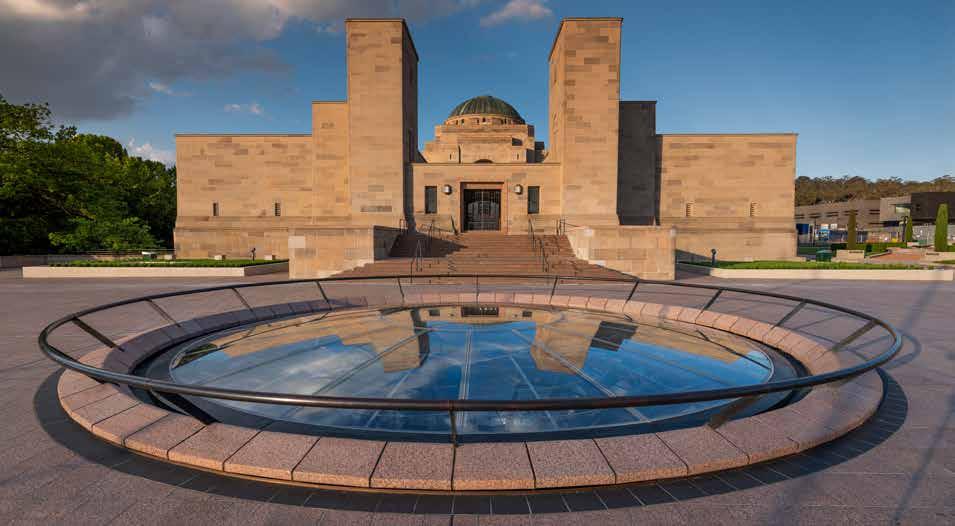
A recent large, award-winning project is the completion of the southern entrance of the Australian War Memorial. The works are opulent, including “the Oculus”, a visual inversion of the Hall of Memory Dome made of a steel frame and 350kg petals of glass.
While these big public projects continue to influence the industry, over time, builders have achieved increasingly more agency. As Canberra has grown to be a city in its own right, with industries outside the public sector, private endeavours have also grown. The ACT’s self-governance, beginning in 1989, also prioritised local decision-making, allowing Canberrans to cultivate a cultural identity separate from federal interests. Many recent large projects emphasise that Canberra isn’t just a place federal politicians come to visit when Parliament is in session. Rather, it’s a place where people work, learn, get around, and live.
Living cities require living buildings. A clear example of how building supports population and culture shifts is the decades of expansion of the Canberra Centre. In the early 2000s, the centre’s atrium was extended over Bunda Street, and much more space has been added for stores and street-facing restaurants. The continual upgrades of this central shopping precinct reflect the changing preferences and needs of Canberrans.
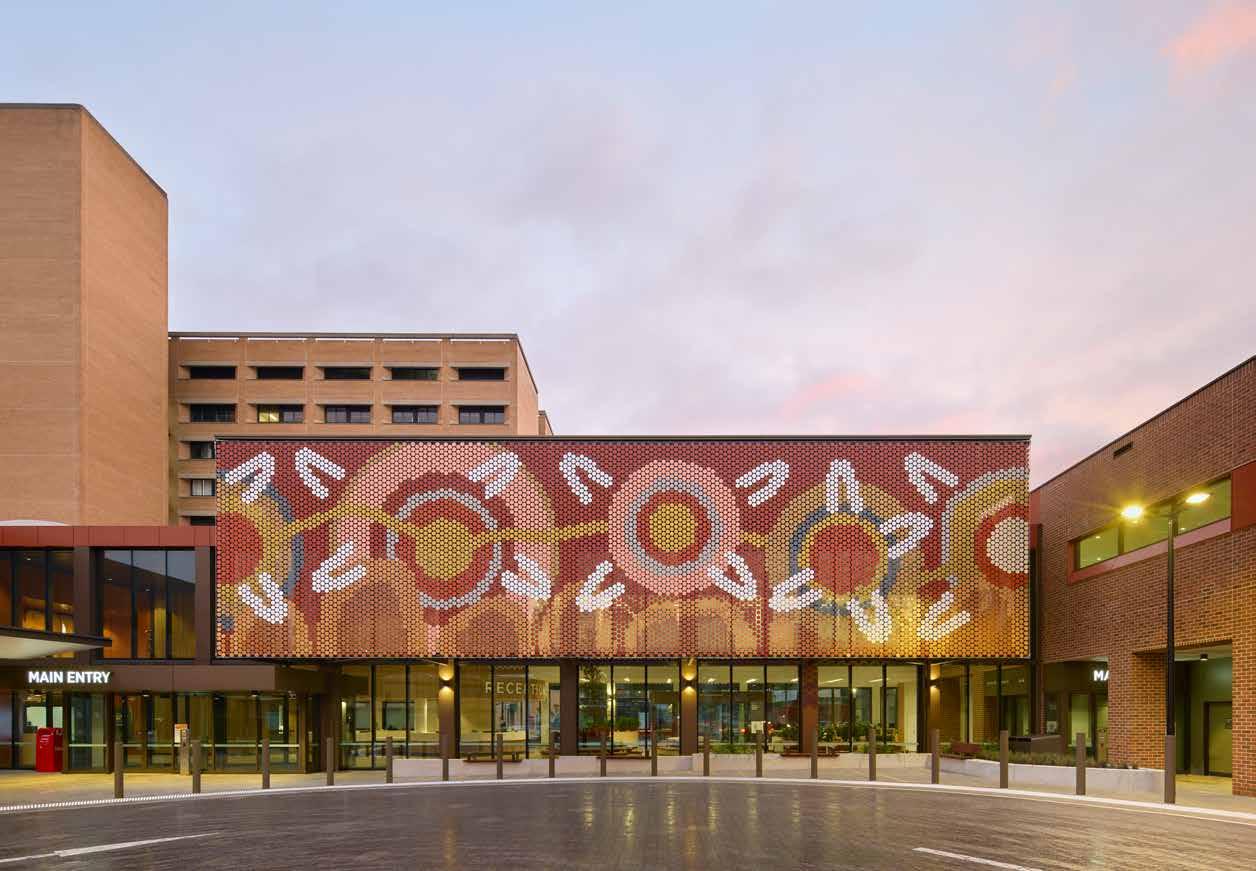
As Canberra continues to grow, we have also seen the need for expansion of the infrastructure to care for it. The Canberra Hospital expansion project, completed in 2024, involved an additional 45,000 square metres of hospital land. It has also increased capacity across Canberra Hospital’s adult intensive care, paediatric intensive care, surgical, coronary care and emergency services. There are more operating rooms, treatment spaces and intensive care beds. The upcoming expansion of the North Canberra Hospital will achieve similar results for the northside suburbs of Canberra.
The Gungahlin region, along with the Molonglo Valley, and Strathnairn (part of the Belconnen district) have high year-on-year population growth. Looking across these suburbs, it is commonplace to see private dwellings under construction, as well as new and emerging community assets. One of the most recent examples is the construction of the new Shirley Smith High School, built to meet the demands of the rapidly growing population in the Gungahlin region, which opened to new students in 2024. The first stage of the light rail project launched in 2019, and serves the North Canberra-Gungahlin corridor.
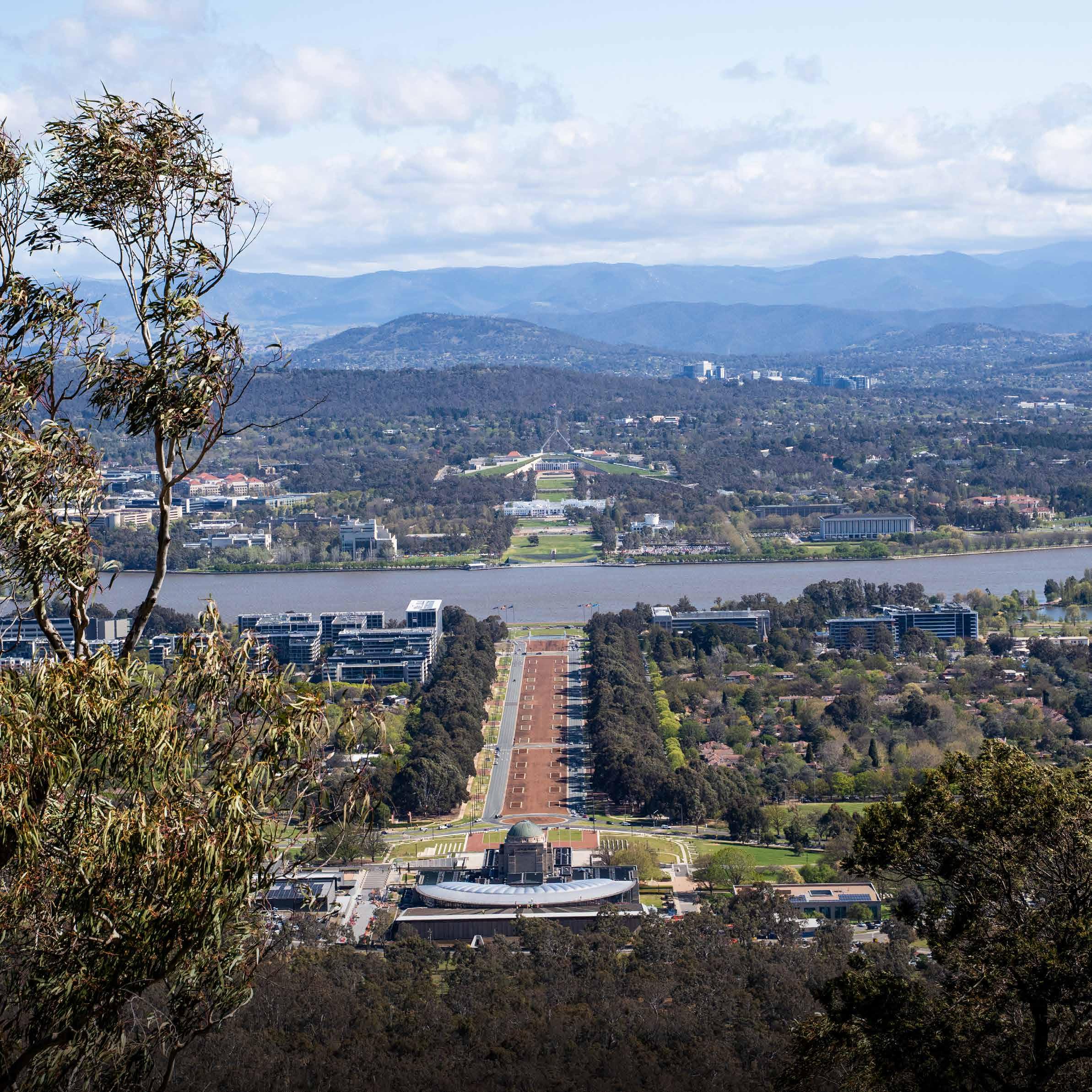
Canberra is now facing the question of whether to keep or adapt its characteristic suburban sprawl. This year, the ACT Government has proposed increasing the stock of medium-density housing, such as lowand mid-rise apartment buildings, townhouses, and dual occupancies. This vision may increase housing supply and affordability, but it would also mark a very different, denser way of living, where a big backyard might be replaced by access to a local public park or community garden. It would also mark a significant departure point for the plan laid out for us by Walter Burley Griffin. It’s now up to Canberrans to decide what the city map will look like in the future.
View of Canberra from New Parliament House flagpole, 1988.
A6135, K12/2/88/25
Commonwealth Avenue Bridge crossing Lake Burley Griffin, 1964. National Archives of Australia, NAA: A1200, L47601
Since the early 2000s, MBA membership in the ACT has taken on a uniquely democratic structure, enabling the organisation to hear and take up important issues, like lack of projects in the ACT, identified by different arms of the diverse construction industry. Master Builders ACT has members from the commercial sector, the residential sector, and the civil contracts sector. The MBA also has a dual role in civil contracts with the Civil Contractors Federation, which represents over 1,800 businesses nationwide in the civil sector.
The Association members who are suppliers and subcontractors, and members from a range of different professions within the industry, including architects, engineers, building officials, educators and more. Members will have different interests from time to time and won’t always agree with each other. But in this structure, big firms don’t crowd out smaller firms and individuals.
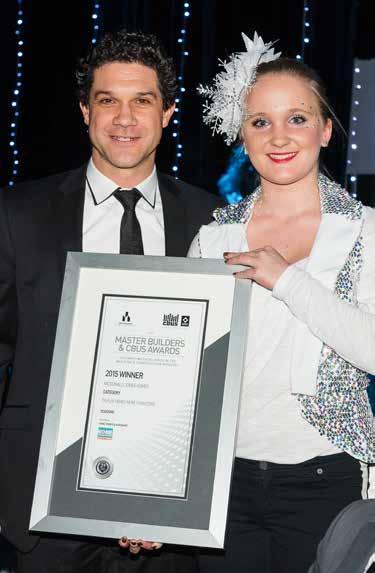
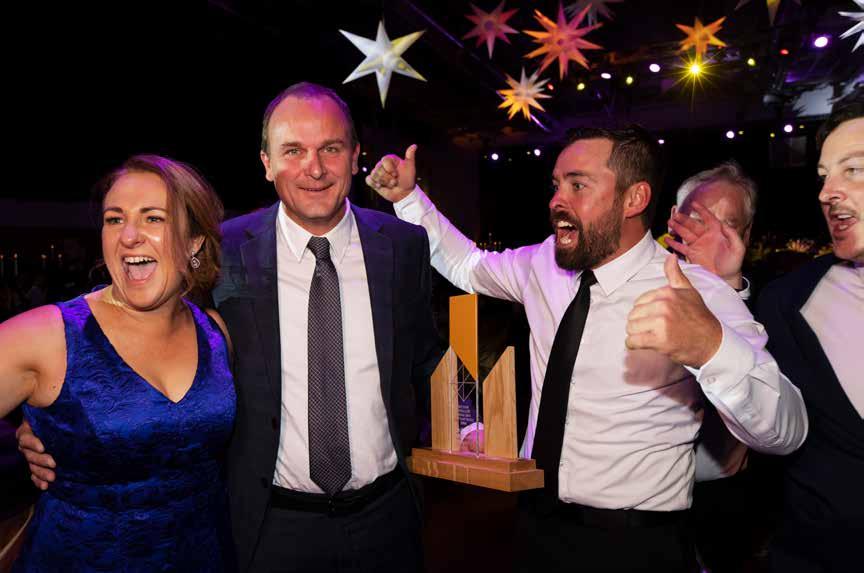
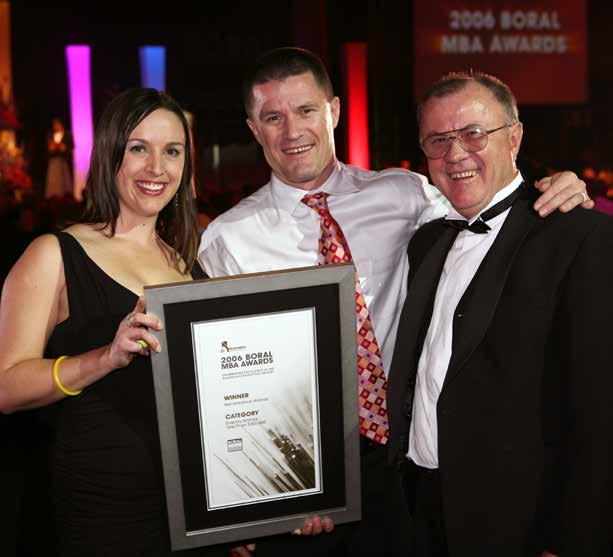
In 1991, the MBA also launched their own Master Builders Excellence Awards to celebrate outstanding achievements in residential, commercial, and civil construction across the ACT. Winners across a range of categories gain recognition among peers and clients, and true achievements in the industry are celebrated at a black-tie event that has grown to be Canberra’s biggest.
In 2010, the then-ACT Chief Minister, John Stanhope, lauded the MBA at the Excellence in Building Awards, saying that the Association is “an outstanding example of how an industry body can support its members, advocate for the sector, and nurture a future workforce.” He further reflected that the counsel he had received from the MBA on matters relating to regulation, standards, and planning “is always thoughtful and practical”.
Teaching generations of young master builders
The MBA has always been a strong voice for quality training. As early as 1929, the then-President of the MBA, Ernest Spendelove, expressed enthusiasm about the introduction of technical training in the ACT. The Association celebrated the establishment of the Canberra Trades School, run through Telopea Park School, with a gift, where members donated 5 pounds to its Prize Fund.
ABOVE:
Over time, this commitment to training deepened. Alongside advocating for quality construction to take place, the structures that support members have been a vital means to sustainably build the ACT. The industry must be able to access quality training and maintain safe conditions, in ways that support members rather than imposing financial and regulatory burdens.
For example, the availability of apprenticeships has always been determined by the capacity of businesses to provide them with work that will last the duration of an apprenticeship. It was observed in 1981 that for smaller businesses particularly, it was hard to guarantee such long-term placements. Not everyone was able to offer apprenticeships, leading to skills shortages. But, heading into the 1980s, Australia had high levels of unemployment which reached 10 per cent by 1983.
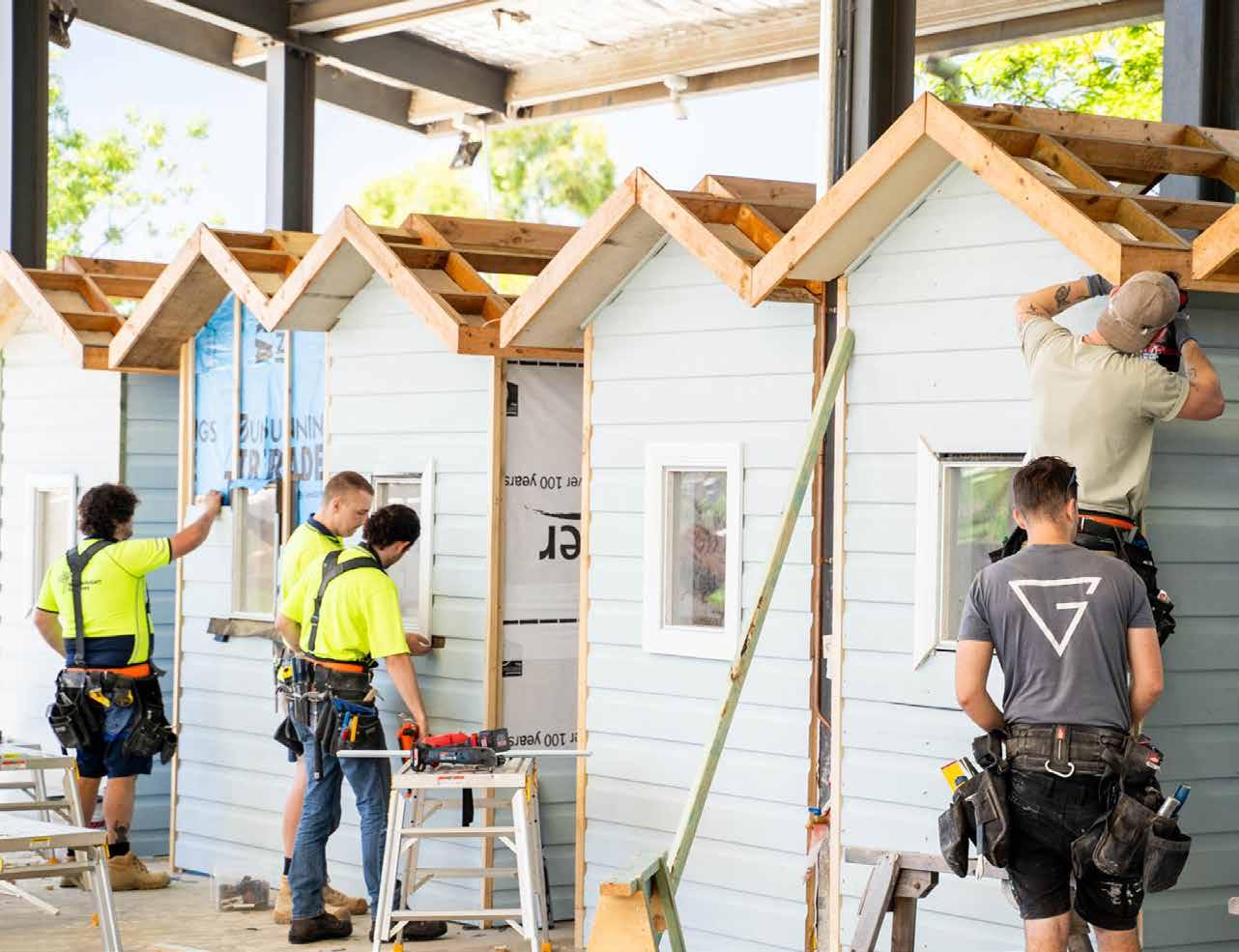
Carpentry apprentices learn wall cladding at the MBA Training facility in Fyshwick, ACT, 2024.
There were many people willing to work, but difficulties in getting them qualified. It was estimated that between 1974 and 1981, 10,000 young people, who otherwise would have gone through an apprenticeship, were not able to do so.
Since 1970, the MBA has been working towards solving this vicious cycle through its Group Apprenticeship Scheme, the first of its kind in Australia. Under this scheme, apprentices come under MBA’s auspices, and the MBA ensures they have placements among their membership. This means that an apprentice may not be working with the same firm for the entirety of their apprenticeship, but that they are getting the training they need over a range of projects.
In 1981, the MBA attained government support for its Group Apprenticeship Scheme from the Minister of the Capital Territory and the Department of Employment and Youth Affairs. By this time, the MBA had already trained over 200 apprentices through the Scheme, but this additional funding allowed for further expansion and the employment of a Master of Apprentices.
Even with the Group Scheme, economic conditions could impact the training that apprentices could access. In the 1990s, economic downturn meant that there wasn’t enough work for, at that point, the 300 Master Builders ACT apprentices. This prompted the MBA to offer its own training courses as a Registered Training Organisation. It offered school-based apprenticeships and TAFE qualifications, later expanding into offering a Builders Licence Training program and continuing education. In 2008, the MBA moved from its location at Construction House on Northbourne Avenue to its current Fyshwick headquarters, in a move motivated by the need to facilitate more training.
Caring for the construction industry
While training offers vital skills and knowledge to create quality building, the MBA has remained committed to providing other types of support to foster long, safe and inclusive careers.
Work health and safety is always key to good construction. The MBA helps builders navigate safety accreditation and documentation and provides safety training. It also looks into the safety aspects of regulations to ensure that government decisions uphold worksite safety. For example, in 2022, the MBA had concerns about legislation involving the use of water to control silica dust on construction sites. They argued that in certain situations, such as around electricity or where drainage is inadequate, water application could create unsafe conditions for workers. The ACT Government responded by granting a temporary exemption to the industry from the new regulations.
In recent years, there has been a shift, with much more awareness of the importance of psychosocial safety. In 2001, a young building apprentice died by suicide. In that same year, three other suicide deaths in the ACT construction industry occurred over a three-month period.
Collaboration between the MBA, the CFMEU, and the ACT Government led to the formation of Oz Help, an organisation that provided tailored support to members of the construction industry until 2024. People in construction sadly have a high risk of suicide and mental health issues, with some of these issues starting early in careers.
Incorporating education about mental health, suicide prevention, life skills, and resilience helps people withstand challenges and encourages important conversations. More recently, the MBA commenced a partnership with charity Menslink to provide ongoing mental health education and awareness for carpentry apprentices and other young people in the construction industry.
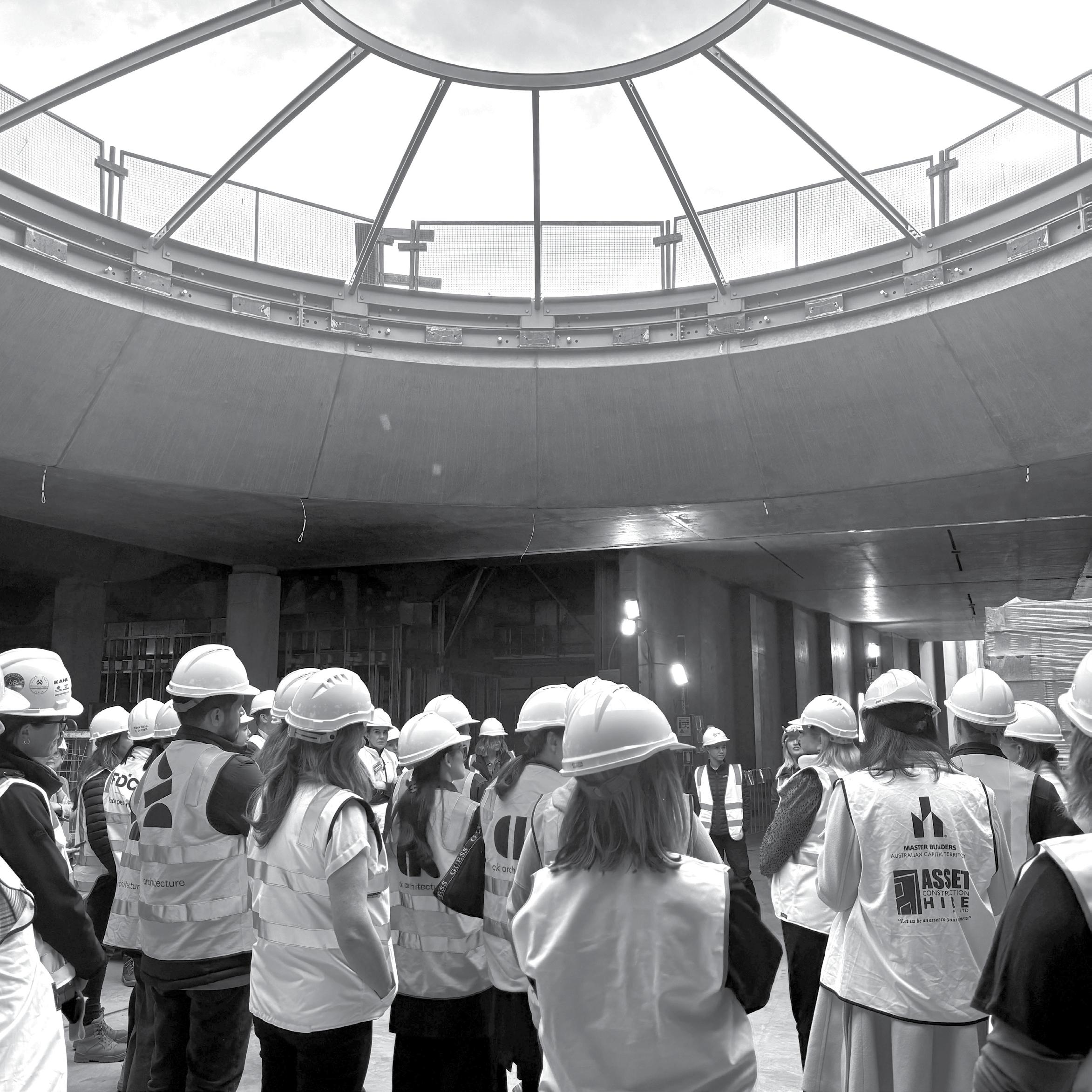
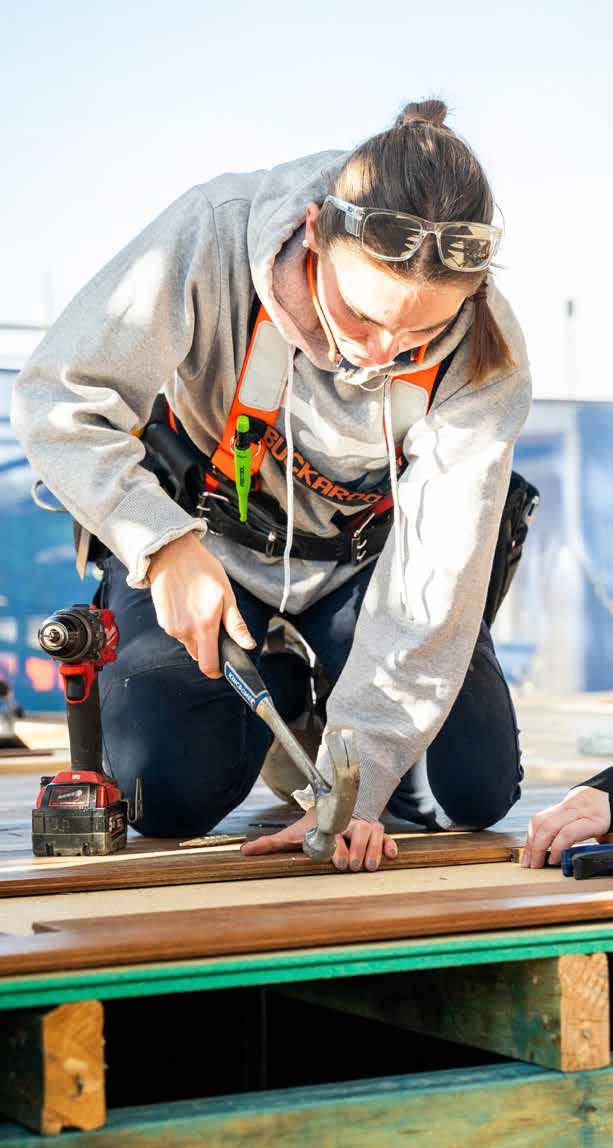
Aside from enhancing the psychological safety of construction, the MBA has also worked to diversify the industry. Women are still deeply underrepresented in the industry. On 22 October 2018, the MBA founded the Master Builders Women in Construction group as a space for women in the industry to connect with each other. The group started with only 10 women, but has since grown to include over 600. The group provides networking and training opportunities as well as guest speakers, days out, site tours, and education sessions, for women to feel a sense of belonging in the industry.
BELOW:
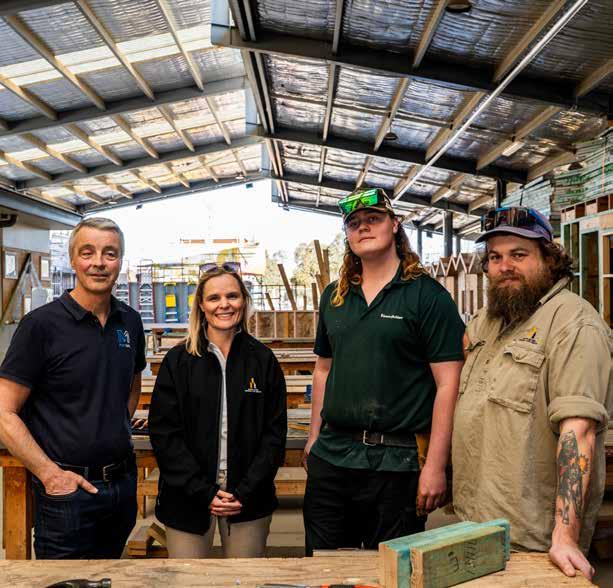
Menslink CEO Ben Gathercole with Anna Neelagama, CEO of Master Builders ACT, an MBA apprentice, and MBA carpentry trainer Braeden Crosswell-Snow.
Keeping the capital insured and consumers protected
The 2001 collapse of HIH Insurance is regarded as one of Australia’s largest corporate failures. It culminated in financial losses worth an estimated $5.3 billion and had devastating consequences throughout Australia.
A royal commission into the HIH identified a “litany of failures” that caused this crisis. HIH did not keep sufficient cash reserves to finance insurance claims while also criminally overestimating its assets and underestimating its liabilities. In the interests of unfettered corporate expansion, HIH dangerously undercharged for premiums. What put their precarious position completely over the edge though was its ill-advised acquisition of FAI Insurance in 1998. FAI was itself under financial stress, and overvalued. There was evidence to suggest that HIH had been insolvent for some time before its collapse. After the collapse, 200 permanently disabled people no longer received their regular payments. Further, those who had invested their superannuation or life savings with HIH were left with nothing.
Construction was hit hard. HIH provided compulsory builders’ warranty insurance to at least 20,000 builders across Australia. When HIH went into administration, builders suddenly found themselves uninsured, and therefore unable to work. As builders scrambled to get new coverage, only two insurance providers remained on the market, and backlogs of applications grew. Builders were laying off apprentices and sub-contractors to avoid bankruptcy as construction was indefinitely delayed.
Builders were also at risk of litigation if previous buildings had a warranty that was backed by HIH. It was not unusual for builders to have to wait at least five months to become insured. New documentation requirements became unusually pedantic. The insurance companies would then often lose those documents, or take a long time to assess them. When builders were finally insured, strict turnover limits imposed by insurers further interrupted workflows.
The Age newspaper reported in 2003 that the effects of the HIH collapse continued to reverberate years later. Many builders scaled back or ceased business operations. Some builders who structured their business in the form of a trust were required to get their money out of the trust so that insurers could access it in the case of bankruptcy, which caused large tax burdens. At least six suicides of builders were linked to the collapse.
In 2002, the construction industry faced yet another crisis. Insurance broker, Dexta, withdrew from providing residential building cover because it was unable to find reinsurance, which is where the risk of insurance is mitigated by another insurer. Dexta had a 50 per cent market share for this type of insurance and left only one other provider. That remaining provider, Royal & Sun Alliance, was also at that time pulling out of insuring developments over three storeys high.
States and territories around Australia dealt with the insurance crisis in different ways through a mix of public and private insurance underwriting arrangements. Master Builders ACT developed a unique solution: the Master Builders Fidelity Fund. The Fidelity Fund is a not-for-profit scheme that issues a Fidelity Fund Certificate to builders. Under the scheme, homeowners are protected for all residential work (over the value of $12,000) done under this Certificate in the case of under warranty defects, or if the builder dies, disappears, or becomes insolvent. Because of its structure, the Fidelity Fund isn’t subject to the difficulties of international private insurance markets. It was further designed to have financial safeguards to ensure sufficient reserves.
David Dawes, Master Builders ACT Executive Director at the time, described the process of taking the Fidelity Fund from an idea on a whiteboard to reality. He and Jerry Howard, as the Deputy Executive Director, had to convince the Executive Board of the idea, and then acquired an interest free loan of $500,000 cash from MBA Board members, Ross Barrett and Josip Zivko. This community-oriented approach to risk management has meant that the ACT hasn’t faced as many issues with warranty insurance as other parts of Australia. As Howard wrote to the ACT Minister for Environment and Sustainable Development in 2012: “The establishment of this Fund has secured a stable environment for the building and construction industry… it is comforting for the ACT that we have a system that is not subject to the vagrancies of the larger insurance companies.”
RIGHT:
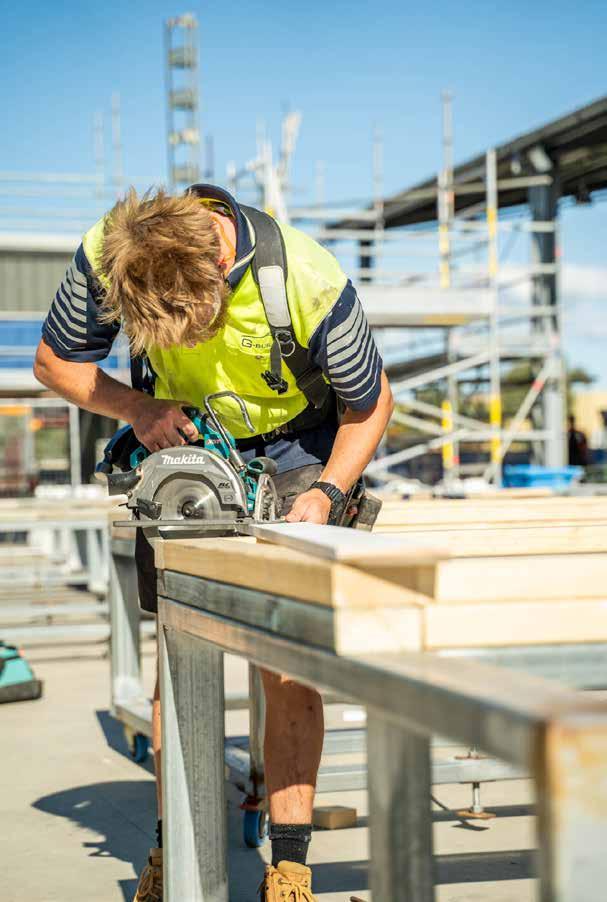
Carpentry apprentices at the Master Builders Association ACT Headquarters
Looking toward the future
Throughout the last century, the MBA has delivered on the promises of Canberra, while weathering and mitigating economic storms.
Large-scale forces continue to play a role in what can be built. The COVID-19 pandemic is a clear, recent case study of how global conditions and resulting supplychain disruptions can impact day-to-day decisions and work. Throughout the MBA’s entire history, skills shortages have also remained an issue, which is still true today. But new innovations may make the industry more resilient and efficient.
It’s hard to imagine what building was like in the first years of the Association’s history. An excerpt from The Canberra Times describes the 1934 construction of the Australian War Memorial as such: “Earth will be removed by a huge scoop, tractor drawn. In addition to this scoop, six horse-drawn scoops will also be put to use.” The 1930s were a time of early mechanisation. Alongside horse-powered equipment, there was also a reliance on hand tools and cranes. Common materials of the era included timber, brick, asbestos-cement sheeting, pressed metal, and Vitrolite glass.
The 1950s brought more advanced construction machinery, including equipment like bulldozers, excavators and dump trucks, thanks to innovations in assembly lines related to the rise of the automobile. Materials like reinforced concrete, steel, glass and plywood dominated. Innovations over the following decade involved the use of prefabricated and modular elements, making the erection of buildings faster.
Since the 1980s and 1990s, there’s also been greater reliance on Computer-Aided Design (CAD) software, which allows plans to be quickly developed and modified, and for exact measurements and angles to be produced. CAD models feed into ComputerAided Manufacturing for a seamless progression towards constructing prefabricated or modular building elements.
Materials have generally become more sustainable, including high performance glazing, solar panels, and the use of recycled materials. Materials are also safer, with the banning of asbestos and regulation of other workplace hazards.
The change from horse-drawn scoops to the technologies of today would have been impossible to predict. Likewise it is difficult to predict what the future of building might look like. So far, the future of building technology is being reshaped by a convergence of digital innovation, material science and streamlined regulation. Tools like artificial intelligence (AI), building information modelling (BIM), data analytics, and mobile platforms are transforming how projects are designed, managed and executed. Modular construction and prefabrication are also gaining more traction for their efficiency, cost-effectiveness and reduced environmental impact.
New materials are also promising. Self-healing concrete, carbon-fibre reinforced composites, bioplastics made from recycled waste, and even 3D-printed mycelium structures that combine sustainability with structural integrity are being developed.
But building a city is not only about materials and machines: it’s about people. The future of construction in the ACT will depend on how well we support and grow the workforce that shapes it. Without investment in training, mental health, and inclusive pathways, we risk having no one left to build. Strategic investment will maintain a quality industry that makes construction an attractive career for the next generation.
The industry faces real pressures such as rising costs, regulatory complexity, and a stubbornly slow pipeline of skilled workers. Yet these challenges also present an opportunity: to reimagine what it means to build well, and who gets to be part of that story. As regulatory pressures mount, the MBA will continue to advocate for smarter systems that reduce red tape without compromising safety or standards. Promising initiatives like Auckland’s design manual offer clear but flexible building standards such that, where projects comply with their guidance, builders don’t require going through long approval processes. The MBA has also embedded training into its central purpose for decades. It will continue to do its part in nurturing quality skills in the industry to ensure members–and our region–are future-ready.
In Canberra, we’re currently seeing the construction of latter stages of light rail projects, contentious conversations about suburban density and whether the landscape will continue to be sprawling, or change entirely, and an increased emphasis on sustainability. The MBA’s Excellence Awards will continue to celebrate achievements in buildings that solve the problems of our time, and provide wonderful spaces for the people who use them.
In every blueprint, every apprentice, every innovation, we see the future taking shape. And in Canberra, that future is ours to make.
ABOVE:
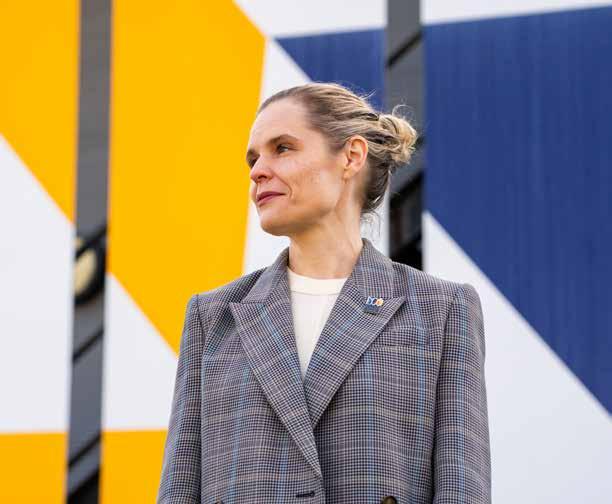
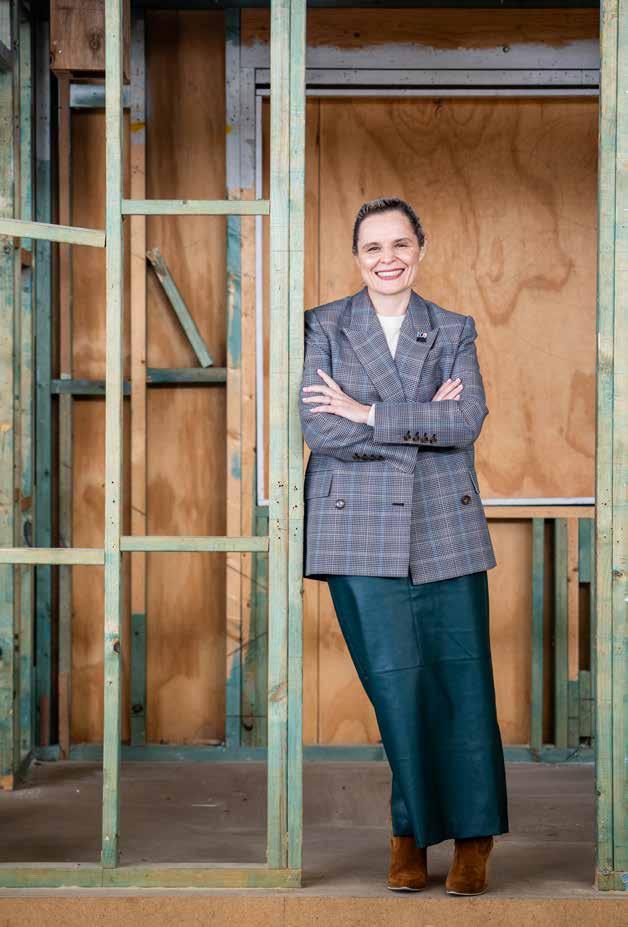
Master Builders ACT CEO Anna Neelagama in 2025.
“Leadership is building a bridge that connects the vision with the purpose, in order to empower those who are around us.”
– David Walker
OPPOSITE:
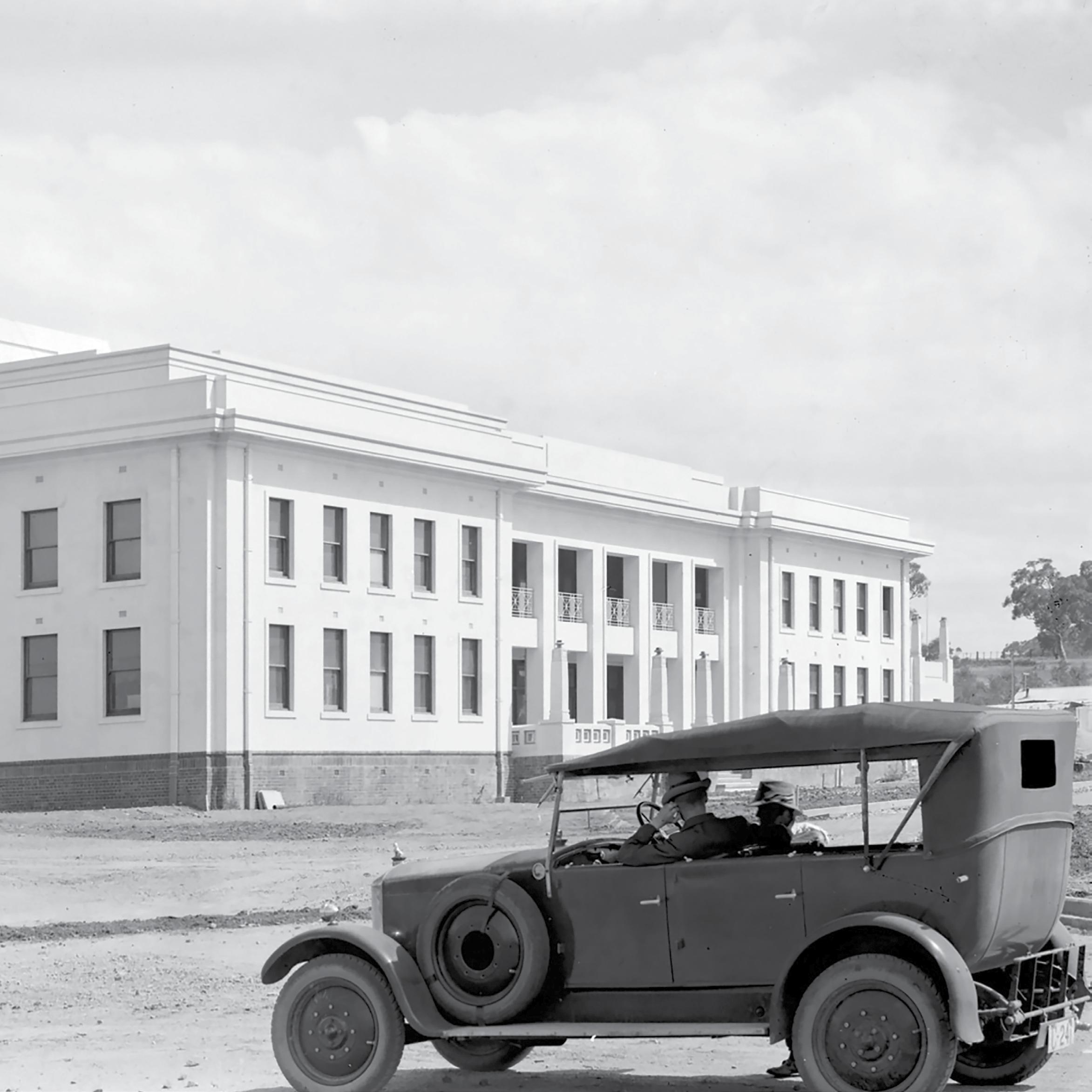
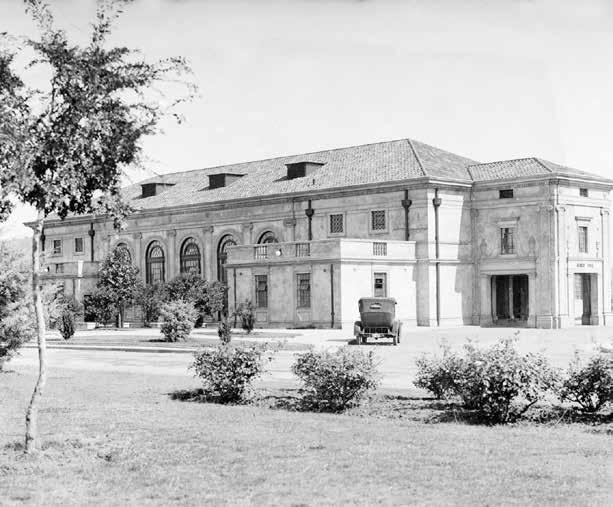
West side of Parliament House with Mildenhall’s Armstrong Siddeley motor car, December 1926. National Archives of Australia, NAA: A3560, 2635
The leaders who shaped Master Builders ACT
The leaders who shaped Master Builders ACT
Over the past century, Master Builders ACT has been shaped by a group of leaders whose vision and determination have steered the Association through both prosperous and challenging times. With 39 Presidents and 12 Executive Directors and CEOs at the helm, each leader has left their unique mark.
The journey has not been without obstacles. Due to the Great Depression, from 1932 to 1938 the Master Builders Association of the ACT drastically wound down its activities. This helps explain why during this period, records about the Association’s leadership are scant. As noted in the book On Solid Foundations, this period was a time of great struggle in the building industry as it grappled with the economic fallout of the Depression in 1938, and the MBA began to work towards recovery.
World War II brought further challenges, with the Master Builders Federation of Australia reporting only a “skeleton” level of activity in 1941.
This may explain why there was no representative from the ACT at the annual Master Builders Federation meeting that year, and why there are few, if any, references to who was leading the organisation in the following years. We do know that in 1949, the Master Builders Association of the ACT was reorganised, paving the way for renewed growth and influence.
As we reflect on the leaders who have guided Master Builders ACT, it is evident that their hard work and commitment have not only shaped the Association’s history but also laid the groundwork for its future.
BELOW:
Formal opening of Civic Centre by Prime Minister S.M.Bruce. Sydney Building.
List of Presidents 1925-2025
John Deans 1925-1926
F.J. McCarthy 1926 – 1927 (d. 1927)
D. B. Elphinstone 1927-1928
E. Elphinstone 1928-1929
Ernest Spendelove 1929-1930
W.J. Perry 1930-1931
J. L. Chapman 1932
From 1932 to 1938, the Master Builders Association of the ACT largely ceased activity, which explains the limited records of its leadership during that time.
W. J. Perry 1938-39
G.T. Evans 1941 1941 to 1949: no records available.
F. J. Watters 1949-1954
D. C. Smith 1954-1956
J. B. Kennedy 1956-1958
C. Burrows 1958-1959
F. Somes 1960
P. R. Armstrong 1960-1962
T. Blow 1962-1963
G. A. Anderson 1963-1965
C. F. Moore 1965-1967
L. V. O’Hara 1967-1969
A. M. Marr 1969-1971
A. C. Williams 1971-1973
W. I. Plant 1973-1975
G. A. Jones 1977-1978
F. J. Quinn 1978-1980
F. J. Marr 1980-1982
C. Gustavsen 1982-1983
J. K. Hindmarsh AM 1983-1986
C. T. Spring 1986-1987
M. E. Milne 1987-1988
J. J. Hanrahan 1988-1989
R. Winnel AM 1989-1991
K. J. Bromfield 1991-1993
J. A. Haskins AM 1993-1998
T. J. Rodgers 1998-1999
J. A. Haskins AM 1999-1999
S. J. Pinter 1999-2001
R. Barrett OAM 2001-2012
S. Butt 2012-2013
J. A. Haskins AM 2013-2014
V. Luks 2016-2016
G. Ferreira 2016-2021
F. Porreca 2021-present
Executive Directors and CEOs 1964-2025
D. Andrew 1964-1980
P.M. Berents 1980-1983
E. M. Lonie 1983-1986
F. G. Gillingham 1986-1987
R. Winnel AM 1987-1989
G. Williams 1989-1990
B. D. Bryant 1990-1998
D. P. Dawes 1998-2007
J. R. Miller 2007-2015
K. Coningham 2015-2017
M. Hopkins 2017-2024
A. Neelagama 2024-present
The legacy of John Deans: a visionary’s footprint in Canberra
John Deans, inaugural president of the Master Builders Association (MBA), lived in Canberra for just eleven years, yet left a lasting imprint on the city’s early development.
ABOVE:
John Deans, first president of the Master Builders Association of the Federal Capital Territory. Pictured at farewell to Prime Minister Scullin on the eve of his visit to London for the Imperial and Economic Conference (detail), 13 August 1930. Photographer: Alex Collingridge. nla.obj-136659083
Arriving in Canberra in 1925, Deans brought with him a strong belief in civil responsibility shaped by his earlier life in Sydney. He had worked as a schoolmaster at Concord Public School, qualified as an accountant in the public service in the Postmaster General’s office, and served three years in World War I with the 9th Australian Field Ambulance. During his time abroad, he studied systems of local government, water supply, and sanitation across Europe and Central America, but he returned home suffering from shell shock and the effects of gassing.
In 1921, after studying building theory and practice, Deans launched his first construction business. His work in New South Wales included projects for the Australian Gaslight Company, the Metropolitan Board of Water Supply and Sewerage, and Sydney City Council. He built engine and transformer houses along the high-pressure water line from Pott’s Hill to Waterloo.
Beyond construction, he was deeply involved in his community. He served as secretary to the Concord Parents and Citizens Association, honorary secretary for Empire Day and Armistice Day events, and as an Alderman of Concord Council. He also acted as trustee of the Australian War Trophies within the Municipality of Concord, and was appointed honorary magistrate and member of several government inquiries. He was described in Sydney’s Evening News as “always a student of municipal law, he is a man of ideas, and has the courage of his opinions.”
His business activities and community service would continue in Canberra. He recognised early the immense potential that the new city held. As the MBA’s President, and later Vice President, he championed private enterprise in shaping the city. He said to the Canberra Times in 1928: “Personally, I have invested a great deal of money in Canberra, and, notwithstanding the setbacks which private enterprise has had, I would not be afraid to invest double the amount.”
Deans built Canberra’s first private residences, shop, and bank. He also established the city’s first scholarship for school leavers, aiming to provide students with opportunities equal to those in the States. His advocacy extended through various civic groups, including the Representation League, City League, Citizens’ League, Canberra Rotary Club, and the Economic Society of Australia and New Zealand. He was also the inaugural president of the City Area Lessees’ Association, founded in 1929, which tackled practical issues such as rates, land costs, tenant rights, and unemployment through land development. Like the MBA, the City Area Lessee’s Association maintained strong ties with government and achieved many of its aims.
Deans was an early proponent of self-governance of the Territory, and in speeches and Letters to the Editor, he called for stronger opportunities for Canberrans. He expressed dismay that it had been taking so long for the public service to completely move to Canberra, urging politicians to endorse “the policy of finishing the job, and thus make Canberra, a most profitable investment to the nation”. He encouraged them to bring their families as they worked in the capital, rather than retreating to Melbourne or Sydney each weekend or once a Parliamentary session was over.
He envisioned a future where young people could build careers without leaving home, writing: “There is no parallel for this distressing outlook in any other Australian town or city. People here are faced with the fact that if their children are to be placed in business or professional callings, they will have to leave home at the very time when they will need most the help and guidance of their parents… The only remedy for the present outlook is the encouragement of industry in Canberra.”
Deans did his bit. Aside from building operations, he had a number of other enterprises. He was chairman of directors of Seafresh Products, which provided fish to Canberra and other inland places. He was also a mortgage lender, offering loans which were more accessible than the ones under the government Commonwealth Housing Scheme. He had a business supplying hardware products to Canberra.
Despite his prominence and activity, Deans is identified by historian Jim Gibbney in Canberra 1913-1953, as “the one serious business casualty the business community suffered from the Depression”. While his business, Canberra Building and Investment Co, was rescued by government guarantee given its heavy involvement in city development, his other enterprises were less well-protected.
Due to what Deans saw as a lack of government investment in building contracts during the Depression, sources for revenue dried up. In addition, early investment in Canberra included the “speculative” purchase of land, which meant that when developments were halted because of economic downturn, Deans stood to lose.
He continued investing through the 1930s, but faced setbacks. His attempt to convert the Mort Street cordial factory into a brewery was blocked by clergy protests, and his tender for Hotel Wellington was rejected. In 1936, Deans followed a new opportunity to serve as an industrial officer for the Australian Broadcasting Commission. He retired in 1944 and passed away in 1963 at age 70.
Though his time in Canberra was brief, John Deans helped shape its foundations. His legacy is one of civic engagement, advocacy, and a deep belief in the city’s potential. He shows how a city’s growth involves building structures alongside building community.
ABOVE:
House of John Deans, 18 Mugga Way, with Mrs. Deans in the garden, 1928. NAA: A3560, 7698
Remembering a founding father
When people speak of the men who laid the foundations of Canberra, the name Jock Simmie is never far from their lips. A carpenter turned builder descended from Scottish immigrants, Jock arrived in Canberra from Victoria in 1926 with a determination to put his skills to work. He was one of the earliest members of the Master Builders Association, which had been founded the year before. Within a few short years he had become one of the city’s most important early builders, establishing Simmie & Co and leaving a legacy that endures in some of Canberra’s most iconic landmarks.
RIGHT: :
Jock Simmie. Photo courtesy of Richard Simmie.
“Jock always said he wanted to be a builder,” recalls his grandson Richard. “He trained as a carpenter while a young adult living in Echuca, but then the war intervened. He was wounded in the Battle of Pozières, and after he came back and was recuperating, he still had that desire to build.”
After returning from the war, Jock worked at the Commonwealth Audit Office from about 1918, studying accountancy while employed there. “His superior told him, ‘Whilst you’re working here, study accountancy, because no matter what you do in life, it’ll stand you in good stead,’” Richard says. “He took that advice, and it set him up for what came later.”
In 1926, Jock resigned and moved his family to Canberra to join his brothers in the fledgling company. “He proved himself very quickly and developed a reputation for good quality work: reliable and dependable,” Richard explains.
Among their early projects were the Albert Hall (1928), the Institute of Anatomy, St Andrew’s Presbyterian Church (1934), the Civic Theatre (1936), and several embassies, including the German and American embassies. They also built the original aerodrome at Canberra Airport and later, the R.G. Menzies Library at the ANU. “One of the first buildings they were awarded was the Melbourne Building in Civic. In 1928 he even built himself a house at 5 Baudin Street, Forrest – it’s still standing today,” says Richard.
Building relationships was part of Jock’s success, according to Richard. “He was very good at networking. He joined the golf club, the horticultural society, the tennis club, the RSL, and he was heavily involved with Freemasonry,” Richard notes.
ABOVE:
Albert Hall, from the south, 1930. National Archives of Australia, NAA: A3560, 7242
His word was his bond.
A lot of things were done on a handshake and he honoured that. Even after his death, people honoured handshake deals with him, because they trusted him
Jock’s reputation extended beyond Canberra. “In 1963, when the Queen opened the Menzies Library, it was the first time a builder had ever been invited to an official opening. Jock was sitting on the dais with the Queen. He came home and the family story is that he didn’t wash the hand she shook for weeks,” Richard says. “It was the pinnacle of his career.”
Though proud of his achievements, Jock was modest. “He didn’t boast, he kept clippings of his work, but he believed the buildings spoke for themselves,” Richard recalls. His integrity also defined him. “His word was his bond. A lot of things were done on a handshake and he honoured that. Even after his death, people honoured handshake deals with him, because they trusted him.”
Jock balanced his building career with farming. In 1940 he purchased “Harpsdale”, a farm in Victoria and built a Dorset Horn stud. “His first passion was building, his second was the sheep stud, and then came family,” Richard says.
Looking back, Richard sums up his grandfather’s impact: “He was extraordinarily proud of what he had achieved in Canberra, but he never sought fame. He was described as a typical Australian: many fine parts, a delightful sense of humour, able to mix in any company. He was a keen businessman, but in his success he was always mindful of others.”
Jock Simmie was an early member of the Master Builders Association of the Federal Capital Territory, serving as Treasurer in 1928.
Construction workers observe flag raising at Parliament House, 1987. National Archives of Australia, NAA: A6135, K26/2/87/44
Standing up for each other
Benchmark Projects, Residential Builder
Frank Porreca grew up with building in his blood. The son of Italian migrants, his father Silvio trained on the job in Italy before arriving in Australia in the late 1960s. “He did block work, brickwork, window installation, tiling, roofing…what we would probably call, if one existed here, a builder’s apprenticeship more than a trade apprenticeship,” Frank explains.
In Australia, his father and uncle worked first on major government projects such as the Lower Molonglo Treatment Plant and the High Court, before moving into residential construction. By the late 1980s, Frank’s father had bought his own block and become a builder-developer, with young Frank the future builder never far away. “I was this little podgy kid in Dad’s old boots hanging around a job site, and from the age of six, that’s all I wanted to be.”
Through his school years Frank spent weekends and holidays working with his father. “If I could have wagged school, I would have,” he laughs. After finishing Year 12, he was accepted into both TAFE and the University of Canberra’s construction management degree. “My Mum Maria said ‘Frank, you’re accepted into both, wouldn’t you be better off going to uni and getting the degree so you can get the higher-class licence?’ I said, that’s a great idea, Mum.”
Three years later he had joined the family business full-time and applied for his first builder’s licence. “I didn’t have an apprenticeship, I didn’t have a trade, I hadn’t completed my degree, but I had this yearning to get my licence early,” he recalls. After interviews with the registrar, he became – at just 20 – the youngest person ever to receive a builder’s licence in the ACT. “By the time I was 21 I had an A-class builder’s licence. From there it was seven days a week for the next decade, and I’ve loved every second of it.”
Residential construction has always been Frank’s passion. “All single and multi-unit, townhouse style – that’s what I love. I’ve never really been a contract builder, it’s always been as a developerbuilder.” He also worked as part of a consortium delivering more than 2,500 blocks across Gungahlin and other suburbs.
His journey with the MBA began thanks to Jerry Howard. “When the market turned down and builders needed support, Jerry was always there. One day I was having a whinge to him about land and building, and he leaned across the desk and said, ‘Well Frank, why don’t you do something about it and get involved instead of just whinging?’ So I did.”
Frank went on to serve as chair of the Residential Builders Council, nine years as treasurer, and now as President of Master Builders ACT as it celebrates its centenary. “They tell me I was the youngest treasurer ever and I suspect I’m the youngest President too, though I’ve got the grey hair now.”
What Frank values most is the MBA’s role for small family firms. “It’s all about the mum and dad businesses. You need something there for them to share their stories, get their support, feel that bit of comfort to know that everyone else is going through it too.”
Looking back on the Association’s history, he points to its resilience. “When HIH collapsed it was the difference between surviving and bankruptcy for many. Members invested their own money, others switched business to support the Fidelity Fund. That’s what welded me onto the values of MBA: people stood up for each other.”
Frank is equally clear about the future: stronger engagement, more education, and a focus on quality. “Education has been at the forefront of everything the MBA has done. 100 years ago they were talking about apprentices, and we’re still doing it now. But quality is the number one value; we’ve always stood up for that, and we have to keep doing it.”
An annual trip past all his projects – subdivisions, townhouses, houses – reminds Frank of what drives him. “My favourite part is when someone’s moved in. When you see there’s a scuff on the wall and the carpet’s a little bit dirty because the three-year-old’s been throwing stuff around. I like it, because it means it’s being lived in.”
Frank Porreca has served as President of Master Builders ACT since 2021.
OPPOSITE:
(Left to right) Laura Porreca, Frank Porreca and Maria Porreca.
“Better to make the hard decisions today than the harder ones tomorrow.”
– Frank Porreca
“Respect everyone and never be afraid to speak up for what’s right.”
– Grace Ferreira
Cementing the pathway for women in construction
Graciete (Grace) Ferreira has spent more than two decades proving that women not only belong in construction, but thrive. Alongside her family, she has been a driving force in Pacific Formwork and Precast Projects and a long-standing advocate for the industry through the Master Builders Association. She has become a role model for women in and outside construction and a powerful voice for subcontractors.
“I came to Australia from Portugal when I was 21. I didn’t have any formal work skills and my dad had a business with some partners. I became the girl Friday in the office, doing everything,” Grace recalls. “It had nothing to do with what I actually wanted to do which was to be an air hostess or work in hospitality and tourism.”
Life took a different course. Grace married Fernando, also from Portugal, and together with her father and sister, they started Pacific Formwork. “We realised there was an opportunity there. Fernando had knowledge of the business and I knew how to do the paperwork. Initially my dad was with us for nine months, but from then on it was us running the show.”
The business was built on hard work, honesty and innovation. “We’ve never overpromised and underdelivered. We actually lost jobs because we’d say it can’t be done in that timeframe, and we were generally proven right. Honesty and working with clients to get a good outcome for both sides has been our approach.”
Investing in safety and technology became a hallmark. “We always looked for better, more efficient ways of doing things. Having had Fernando carrying frames, he knew how hard it was on the body. So, we invested in lighter materials and new systems. Our main concern has always been safety, and making sure the work was as easy as possible for our employees.”
As the business grew, so did family involvement. “Our kids learned to drive bobcats and forklifts very early on; probably too early,” Grace laughs. Today, her sons are senior managers, one running Precast Projects and the other the formwork business. “It’s given them a sense of ownership. They were concerned when we said we wanted to step back, but they’ve done a really good job.”
Grace’s advocacy on behalf of subcontractors was initially borne out of frustration with the MBA. “I went to a Subcontractors and Suppliers meeting with the intention of resigning from the MBA, but telling them why. I came out of that meeting having been elected as deputy chair. That was 2008, and I’ve been heavily involved ever since.”
She has never been afraid to speak out. “I’ve never been backwards in coming forward about the issues subcontractors face. Between residential builders and subcontractors and suppliers, we make up the majority of MBA members. It was important to make sure the board focused on our issues.”
Her leadership broke new ground when she became the MBA’s first female president. “It was by accident. I never intended to be president. I didn’t realise there had never been another woman president of the MBA in Australia. For me, it was never a barrier. I never thought I couldn’t do anything because I was a woman. And the men around me always believed more in me than I believed in myself.”
That experience led her to start Women Working in Construction. “I thought, there are a lot of women who don’t feel supported. We brought women together and asked, what would make you want to be part of this? From there, it grew. For me, it was important that every event had real value – education, training, networking – not just a social gathering.”
She encourages young women to take the leap. “It’s a great industry. You can be creative, you can be hands-on, you can work in the office. It pays well, the skills are portable and it’s a much more welcoming place than when I started 37 years ago. People have accepted that women can do the job as well as any man.”
Grace’s advice to the next generation is simple: “If it’s worth doing, it’s worth doing right. Always be honest with your clients and suppliers. Don’t think joining and being part of the MBA is a waste of time; you end up getting a lot more back than what you give. You find people going through the same challenges and you learn from each other.”
Grace Ferreira was the first female President of Master Builders ACT, serving from 2016 to 2021.
Engineering a career in building and construction
Ross Barrett OAM had no interest in construction as a student at Newcastle Boys High School. But a vocational guidance counsellor set him on a civil engineering path. At the time, he and his parents did not even know what civil engineering was.
Ross studied at the University of New South Wales. “I can’t believe it worked out so well. To be honest, I wasn’t interested in uni at all. I’d go to the lectures and I’d do the assignments, but I was never really involved in uni life.” Ross says in those days, you went to university full time for part of the year then they found you a paid practical placement in a job for the remainder of the year. “At the start of my last year, they sent me to the Snowy. Until then I really wondered what I was doing at uni. I just wasn’t into it. But I got to the Snowy and the world opened up.”
Ross met his wife, a conscientious Arts student who spent many hours in the library, in his final year at uni. “I studied more in the library in the last year at university than in the total of my life before that! So, I ended up with a pretty good outcome at uni.”
His university reference reads: “After a slow start, Mr. Barrett excelled.”
After university, Ross began his career in local government as an assistant engineer for the Ulmarra Shire (now part of Clarence Valley Council in northern NSW). “I did the designs. I did the surveys. I did the supervision. I worked my butt off.” After several years learning all he could, Ross took a job as deputy engineer in Merriwa (now Upper Hunter Shire) and two years later stepped up to the role of Shire Engineer in Boorowa. But private enterprise called him in 1969, and he responded to an advertisement by Woden Contractors who were looking for an engineer. “They had tendered a job for the National Capital Development Commission who controlled all the civil work in Canberra. Wodens had a price and a reputation that the NCDC were willing to take a punt on because they were local. They were told by the NCDC, if you employ an engineer, we’ll give you the job. At that stage, none of the local companies had engineers.” He stayed with Wodens for 35 years, rising to become Managing Director then, after retiring, continued as Chair of the Board until 2022 when the company was sold to employees.
Ross also became one of the national capital’s most respected construction industry figures, serving as President of Master Builders ACT from 2001 until 2012, after which he was made a Life Member. Amongst other achievements, he chaired the Capital Region Development board, the Regional Development Australia (ACT) board, Community Housing Canberra Ltd (CHC) board, the Land Development Agency board and the Boundless Canberra Inc. board. “They were mostly government appointments that came from my association with the MBA and the people I met and built relationships with,” Ross says. He was awarded a Medal of the Order of Australia in 2012 for service to the building and construction industry, and has been recognised by Engineers Australia as one of Australia’s 100 most influential engineers.
Ross is candid about the lessons he has learnt along the way. “You think you know it all when you leave uni, but you don’t,” he says. “What you learn in the field is so much more important. The practical side, working with people, dealing with the authorities; that’s where you really learn.”
As a project manager, and later director, Ross has overseen developments across the ACT and beyond. He also reflects on the challenges of the job. “Engineering is about problem solving,” he says. “There are always issues: ground conditions, weather, budgets. The key is to stay calm, work it through and get the job done.”
The industry has changed significantly since Ross began. “When I started it was drawings on a board and slide rules,” Ross says. “Now it’s all computer models and GPS. The technology is incredible. But at the end of the day, it still comes back to people: relationships, communication, teamwork. That hasn’t changed.”
Ross has had a long and close association with the MBA and values its role in supporting the industry.
“The MBA provides contracts, training, advocacy,” he says. “It brings people together. I’ve always found it a great support.”
Looking forward, he sees both challenges and opportunities. “We’ve got a skills shortage, housing affordability issues, sustainability pressures,” Ross says. “But there are also opportunities in new materials, new methods, renewable energy projects. It’s an exciting time if we can get the people to do the work.”
He is clear about what gives him the most satisfaction. “Seeing young people come through, helping them, mentoring them. And driving around Canberra and seeing the projects you’ve been part of, that’s very satisfying.”
Ross Barrett OAM is a Life Member of Master Builders ACT and its longest-serving President, serving the Association from 2001 to 2012.
“Relationships, communication, teamwork.”
– Ross Barrett OAM
A vision for affordability
Long before “affordable housing” became the buzzword it is today, Bob Winnel AM was championing the right and opportunity for lower income earners to purchase their own home.
“I had just built my own house and became aware of the kind of issues facing the construction industry,” the former public servant recalls. “My wife and I started a business called R and B Extensions in 1974. We did a whole range of extensions throughout Canberra, and that led to doing work in the broader industry, growing organically from there. Our first major project was 26 townhouses in Giralang, then six townhouses in Chapman.”
At the time, land could be purchased directly from the government and sometimes even over the counter. However, this was also a time of industrial turmoil. “In the 1980s there was industrial lawlessness on a big scale,” Bob recalls. “The Builders Labourers Federation was in the process of being deregistered, and MBA members were really feeling the pressure of union misconduct. I’d been a member virtually from the start of our business and I offered to take on the CEO’s role at the MBA because our members needed support.”
Bob went on to serve as President and is now a Life Member. He helped to found MBA Land, with the original shareholders largely drawn from MBA members. That enterprise later became The Village Building Company. The name “Village Building Company” was deliberately chosen to reflect the company’s mission to not only service land and build houses, but to create communities or villages.
Affordable housing means smaller blocks, modest freestanding homes and townhouses. “There was a lot of opposition from the Planning Authority to townhouses, and we worked to change the acceptability of denser development,” Bob recalls. “When we were doing Palmerston in the ACT, we introduced a far higher proportion of small lots,” says Bob.
“While this approach was considered unconventional at the time, it went on to set a benchmark for affordability and we provided the majority of Canberra’s accessible housing for nearly a decade. We did a development at West Macgregor where we built 1,400-1,500 true affordable homes, small freestanding houses on individual blocks.”
“Stick together. Don’t get greedy. Do it fairly and move on to the next job.”
– Bob Winnel AM
Bob Winnel AM is a Life Member of Master Builders ACT, and served as Executive Director from 1987 to 1989, and then as President from 1989 to 1991.
After 28 years of building the company’s legacy, Bob stood down as Managing Director in 2016. Current CEO Vince Whiteside describes the company’s philosophy as visionary. “Now that all of the major cities are running out of greenfield sites, there will have to be significant densification to house people. This doesn’t just mean apartments, but also means allowing two or three dwellings on blocks that previously only permitted one. This densification is something that Village has been pursuing and championing since its inception,” says Vince.
Joining the Company as Chief Financial Officer in 1993, Vince has been with Village for 32 of its 37 years. “For us, affordability means delivering quality homes at a price that is accessible to more people. While we do seek to offer a range of housing types to appeal to a broad range of lifestyles and budgets, our focus has always been on the more affordable end of the market,” Vince explains. “We were a pioneer in advocating for smaller block sizes, which lowered the price point of our house-and-land packages and helped make home ownership more attainable. We are passionate about the importance of home ownership and the security and stability that it brings to both families and individuals.”
The Village Building Company also partnered with the ACT Government on multiple projects. “We did six or seven joint ventures with the ACT Government before they took the decision to bring land development fully back in-house,” Vince recalls. “That was when we decided to pursue sites across the border in Queanbeyan-Palerang. We were already in Brisbane and Wollongong and have since completed projects in Sydney and Melbourne.”
From the beginning, connections between the MBA and The Village Building Company have been integral to Village’s success. MBA advocacy has not only supported Village, but also helped shape a stronger, more sustainable construction industry. “The MBA gives a voice to an industry under pressure – by sticking together, you survive,” Bob says.
“Operate honestly and ethically. Build communities, not just houses.”
– Vince Whiteside
Vince agrees: “Their advocacy has been invaluable. They partnered with us on the South Jerrabomberra Display Village, and the MBA awards bring recognition from both the public and industry.” By championing better industry standards and providing platforms for collaboration and recognition, the MBA has played a pivotal role in enabling Village to grow into the successful company it is today.
Looking ahead, the mission for affordability remains the same. “There’s strong demand from young people and families if you can reduce the price point without compromising quality. We’ve always sought to behave in an honest, fair and ethical manner with all of our stakeholders including our staff, shareholders, customers, contractors, consultants and financiers. I have no doubt that this ethical behaviour has been a significant factor in our Company’s longevity,” Vince says.
John Hindmarsh: a lasting imprint
Hindmarsh Construction Australia, Commercial Builders
John Hindmarsh was born in Manly, and has always considered himself a Manly boy, playing rugby for the suburb and surf lifesaving at Freshwater. As a boy he visited Canberra in the spring of 1951 on a family trip. He remembered Canberra as being cold and empty with no lake, but newly planted blossom trees along the avenue to the Governor-General’s residence. John never gave a thought to the possibility that he might one day make Canberra his family home, spending over half a century in the national capital, building a network of friends, colleagues and headquartering Hindmarsh, the national construction company he founded in 1979.
John and his wife Rosanna came to Canberra in 1971 after years working in construction in far flung locations such as Papua New Guinea, northern Wales in the UK, and Gove in the Northern Territory. John was offered an opportunity to work for AV Jennings in Canberra as Construction Manager for its Southern NSW commercial group. Arriving in Canberra, the couple saw a city taking shape with less than 140,000 people, but rapidly growing. John recalled in his memoirs that everyone knew everyone, and everyone knew everyone’s business, but that the community and the goodwill was strong. He threw himself into becoming an active part of the business and construction community.
After seven years working for AV Jennings on projects such as the Urambi Primary School, accommodation in the Snowy Mountains in Cabramurra and factories in Albury, John decided to start his own business. Having established a solid reputation working with government and the private sector throughout the region he was keen to be a proactive contributor to shaping the evolution of Canberra.
Hindmarsh marked its 45th year of operation in the capital in 2024. John was proud to have seen the company grow to support a diverse client base, ranging from federal and state government, universities, education and data centres, to private and public housing. The company has offices in Sydney and Adelaide and employs over 320 staff.
In the 1980s and 90s, John steadily expanded Hindmarsh from its construction origins to take advantage of development opportunities including apartment buildings, retirement living communities and parking facilities. Hindmarsh now owns and operates three retirement living communities in Canberra. This was an area of the business that
John and Rosanna were immensely proud of, as developing and supporting community in Canberra has been one of the family’s values from when the business commenced.
Over the years, Hindmarsh successfully explored development and partnerships in the USA, Vietnam, China and Malaysia. John went on numerous trade missions to promote Canberra and build international relationships to benefit Canberra and Australia. Alongside these activities, John embraced an entrepreneurial spirit and invested in local businesses such The Village Building Company, TransAct Capital Communications (acquired by IPG), and start-ups that embraced technology advantages from Canberra’s preeminent research and university sector. These activities evolved into the funds management and venture capital business that is now a significant part of the family’s business operations.
A drive around Canberra today reveals the extensive mark that John Hindmarsh has left on this city. Outstanding projects include the award-winning Questacon building, major extensions to the Australian War Memorial, multiple corporate offices in the CBD, several diplomatic embassies, and the recent development of the eastern section of Constitution Avenue and Woden town centre comprising over 1,000 apartments. The long partnership with the Australian National University has resulted in Hindmarsh building some of university’s most complex and recognised facilities, including the John Curtin School of Medical Research, the Research School of Physics and Engineering and the College of Sciences campus.
The company has always supported the Master Builders Association and the Canberra business community. John previously served as President of Master Builders ACT, and in the mid 1980s Hindmarsh was one of 21 local businesses that brought the “Canberra Business Council” into existence –demanding a much greater voice for the private sector in the affairs of the city.
In 2015, Rowan Hindmarsh was appointed CEO of Hindmarsh and has continued to grow the construction business across Australia. With over 1,000 residential units in the development pipeline, Hindmarsh remains committed to contributing towards housing availability and affordability. And as the population continues to age, Hindmarsh are seeking to expand their retirement communities and the services offered to their residents.
Hindmarsh is a family company. Its foundations are built on integrity and a commitment to excellence. None of what the company has achieved to date would have been possible without so many loyal and hardworking employees, subcontractors, suppliers, consultants and clients, both past and present. As they look to the future, the Hindmarsh family, supported by the company’s leadership, look forward to continuing to honour and build on John’s legacy.
John Hindmarsh AM served as President of Master Builders ACT from 1983 to 1986. John passed away in May 2025, leaving behind an incredible legacy in Canberra, and he is greatly missed.
“Dialogue is important, relationships are key.”
– Jerry Howard
People: the real legacy
Jerry Howard arrived in Australia more than 50 years ago. He is still very passionate about the construction profession. “We arrived in Australia in 1972; I was 21, my wife was 18, and we knew nobody,” he recalls. It was the start of a journey that would see him become one of Canberra’s most respected and quietly influential figures in the construction industry.
Jerry hails from a family of Irish builders. “My grandfather and great grandfather were masons, and my uncles were bricklayers. I qualified in Ireland through the City and Guilds system before arriving in Brisbane with my building qualifications.” His first years in Australia were spent working on major projects in Queensland. “I worked on the Queensland Performing Arts Centre, the Queensland Cultural Centre, the Police Headquarters and Police Academy, and the Treasury Building.”
In the early 1980s, Jerry moved to Canberra. “I was offered a position in the ACT as a building surveyor with the Department of Territories. I then transitioned into building regulation and the licencing of builders.” With the adoption of self-government, Jerry became the Senior Builders Licencing Officer and Deputy Building Controller, a role that shaped standards across the ACT. “We were responsible for who could be licensed, what qualifications were required, and ensuring standards were upheld.”
Jerry’s involvement with Master Builders ACT was another defining chapter. “We were the first in Australia to undertake school-based apprenticeships. We started with 14 students, many of whom are now successful builders.” He also oversaw the actual building and establishment of the MBA’s Training Centre, which has provided skills pathways for thousands of young people. “Training has always been the core objective. We wanted to make sure young people had opportunities in construction.”
Jerry regards the creation of the Master Builders Fidelity Fund, established in 2002 in the aftermath of the HIH home warranty insurance collapse, as a highlight of his time with the organisation. With the cooperation of the Building Controller, speculative builders were allowed to commence construction without home warranty insurance until the MBA system was fully established. The proviso was that those builders had an insurance certificate prior to the issue of the certificate of occupancy. About 300 homes were in the balance. The MBA decided to start its own insurance company. “The Fidelity Fund was created to give consumers confidence. If something went wrong with their builder, there was protection,” Jerry says. “During this process the MBA received incredible support from the ACT Government and the industry in general. It was an incredible achievement from drafting legislation to final approval in the space of just a few months.”
Jerry has always spoken frankly about the industry’s challenges. “Housing affordability is the biggest issue now. We need more land, more houses and more apprentices and builders to build them.” He also points to the changing relationship with unions. “The unions were very strong in the 70s and 80s. They still have a role, but the balance has shifted. Builders today face more challenges from compliance and regulation than from industrial action.”
Technology and regulation have transformed the sector in his lifetime. “When I commenced, the system was all paper based. Now it’s all digital. There’s more compliance, more scrutiny. Some of these changes are positive. Site safety is much improved which is one of the positive outcomes; however some of the negatives are added costs and additional red tape which do not achieve any additional benefits.”
Despite these challenges, Jerry remains optimistic. “There will always be construction. The key is professional training, succession and encouraging young people to seek a career in construction. We need to promote construction as a profession and career of choice.”
Looking back, Jerry is proud of what has been achieved. “If you look around Canberra now, you’ll see the apprentices and other professionals the MBA trained everywhere, managing projects and building companies, making their mark. That’s the legacy.”
Jerry Howard is an Honorary Member of Master Builders ACT, and also served as Deputy Executive Director.
The power of partnership
David Dawes has spent his career making things happen. Known for his straight talking and his ability to get projects moving, he has played a central role in shaping housing, infrastructure and development policy in the ACT and beyond. From his work with the Master Builders Association to public service leadership, David has been a driving force for the industry.
David moved to real estate and senior roles in development, before his tenure with the MBA and finally, finishing up in the bureaucracy. “I started as a real estate salesman in Reg Daly Real Estate back in the early 80s. I became their sales director, a shareholder and a director of Reg Daly and RA Wellsmore. I then worked for Ivan Domazet in the late 80s early 90s. That was my introduction to development,” he recalls. The appeal was obvious: “What I liked was seeing something come out of the ground. You could drive past it years later and know you were part of it.”
David went to the MBA in 1994, initially working in membership. He was quite involved with the start of the excellence in building awards. Soon after, he applied for and won the role of Deputy Executive Director, and was ultimately promoted to Executive Director where he served the Association for just shy of a decade. “I started at the MBA on my 40th birthday. At the time the organisation was really on its knees. We had 50 first-year apprentices on our books and the building industry had collapsed. But I felt we had a moral obligation to keep paying those kids; they don’t get much money anyway.”
Under David’s stewardship the MBA developed pioneering programs. “We did the first school-based apprenticeship in Australia, with Marist College and Phillip College. We had 21 kids in that program,” he says. That success led to the establishment of the MBA Skills Centre at Page in the old Parks and Gardens depot, and eventually the purpose-built centre at Fyshwick. “I was very passionate about training –that’s the future of the industry.” He also helped establish the youth-at-risk program with a grant from the ACT Government. “We took on 10 boys from really troubled backgrounds. Some of them didn’t even have breakfast, so the host employers would feed them. That was very successful; some of those kids are still tradies today.” He is keen to highlight Jerry Howard’s role in the MBA’s training success. “We won a government grant to employ Jerry initially, and I kept him on. We worked on a lot of initiatives together.”
Financial security for builders came through another innovation. When insurer HIH collapsed, many MBA members faced disaster. At that time, the MBA represented 95 percent of the market. After lobbying hard for the industry, the Master Builders Fidelity Fund was established. It gave confidence back to homeowners and lifted standards right across the industry. “I am proud to have been an integral part of the success of the MBA, representing the interests of all facets of the building industry in the ACT,” says David.
In 2007, David was wooed into government as Deputy Secretary of the Chief Minister’s Department, later heading Land and Property Services and then Economic Development. “The first job I did was increase the land supply. The Chief Minister at the time, Jon Stanhope was all about increasing supply, because he was the first one to say housing affordability is an issue. We tested a lot of policies here with our MBA members before they became government policy,” he says. Among his proudest achievements was the public housing renewal program. “That was about dignity. Everyone deserves a decent home.”
Looking back, David has seen big changes. “When I started it was about getting things built. Now, it’s about how sustainable they are, how inclusive they are, and how quickly they can adapt. The pressures are greater, but so are the opportunities.”
Right now, he sees affordability and skills as the big issues. “We’ve got to find ways to get costs down and to get more people into the trades. Otherwise, we’re not going to meet the demand for housing and infrastructure. We need to show young people that building is a career of first choice.”
As for the future, David suggests there is more available land the government should be releasing, and the MBA should be lobbying for that. “When you’ve got 90 per cent unit developments and 10 percent land, the land’s not going to get any cheaper. I believe the MBA should be lobbying to open up more standard residential and that ‘missing middle’, which is townhouses as well. There’s plenty of land,” he says.
David Dawes is an Honorary Member of Master Builders ACT, and served as Executive Director from 1998 to 2007.
“Have perseverance, be innovative and be prepared to put in the hard yards.”
– David Dawes
Three generations, one legacy: Bernie Rees and a life in building
Written by John Miller
When Bernie Rees arrived in Canberra in 1939, the city was barely more than a country town of 12,000. Yarralumla was called Westridge, the “Woden Valley” was farmland, and Lake Burley Griffin was still a paddock with a river running through it.
As a boy, Bernie thought he might be a mechanic like his eldest brother, but the cold concrete floors of the Kingston Bus Depot convinced him otherwise. By twelve, he’d set his heart on carpentry. This was a decision that would shape not just his life, but three generations of Rees builders.
At fifteen, Bernie landed an apprenticeship with George Grant and Sons, working on a project at the Australian National University nicknamed the “Bomb Job” because it housed an atom-splitting device. He soaked up lessons from skilled tradesmen, including two German carpenters who taught him craftsmanship, work ethic — and a little German, most of which he’s now forgotten.
One of Bernie’s favourite stories from those early days involves a jewellery music box he made for his girlfriend’s 18th birthday. A joiner named Joe Horestead helped him perfect it — only to discover years later the gift was for his own granddaughter. That young woman, Joan, became Bernie’s wife in 1959.
After completing further building courses, welding, and business training — and a stint in National Service — Bernie launched his own business in 1960. His first job was a grand Yarralumla home for Colonel Grenfell Windsor. Over the next 56 years, he built houses across Canberra and far beyond, from the Snowy Mountains to the South Coast.
Bernie worked with some of Canberra’s most respected architects, including Dirk Bolt. One Boltdesigned home in Curtin, 128 feet long with a pool and a gargoyle waterspout, remains Bernie’s favourite. It was later destroyed in the 2003 bushfires, a bittersweet reminder of the city’s changes.
In 1963, Bernie joined the Master Builders Association of the ACT, encouraged by then-director David Andrew and President George Anderson. Over the years, he served on committees, mentored apprentices, and became a long-time judge of the Excellence in Building Awards. In 2017, Master Builders ACT recognised his extraordinary by awarding him life membership, an honour reserved for only a handful in the organisation’s 100-year history.
Bernie’s greatest pride, however, is seeing the family tradition continue. His son Geoff started as his apprentice, became a successful builder, and won multiple MBA awards. Geoff’s son, John, followed suit, naming his company R3 Constructions — short for “Rees 3,” celebrating three generations in the trade.
Even now, approaching his 90th birthday in March 2026, Bernie still helps out on projects with Geoff and John. “Seeing them work together in harmony pleases me so much,” he says.
From the days when building plans could sometimes be approved in half an hour, to today’s complex processes and factory-made components, Bernie has seen Canberra, and its building industry, transform completely. Yet his values remain constant: skill, integrity, and passing knowledge to the next generation.
As Master Builders ACT marks its centenary, Bernie stands as a living link between the city’s pioneering builders and its future: a craftsman whose work is written into the very fabric of Canberra.
Bernie Rees is a Life Member of Master Builders ACT. John Miller is an Honorary Member, and served as Executive Director from 2007 to 2015.
OPPOSITE:
John Miller (left) and Bernie Rees
In 1912, Walter Burley Griffin and Marion Mahony Griffin won a high profile competition for the Australian Federal Capital at Canberra, for which Mahony Griffin’s renderings “had a great deal to do with the judges’ decision.” –
National Capital Authority
OPPOSITE:
Members of the MBA Women in Construction group
tour the new southern entrance of the Australian War Memorial under construction, May 2024.
Women in construction
The women who built Canberra, and the ones still building
From the very beginning, women have contributed to Canberra’s construction industry. Despite this, their achievements have often gone unrecognised, and their participation remains disproportionately low. Today, only 15% of the construction workforce are women, and just 3% occupy “on-the-tools” roles.
Yet despite barriers, women have shaped the industry’s past and continue to forge its future. Master Builders ACT is looking back to recognise the female pioneers in the industry, and looking forward to reshaping the industry’s future, one where women are not only welcomed, but empowered to lead.
Among Canberra’s earliest visionaries was Marion Mahony Griffin, a gifted architect and artist. Although Walter Burley Griffin is widely credited as
Canberra’s designer, his wife, Marion created the drawings that would come to shape Canberra. Walter himself credited her as “the genius” behind their architectural output, although her name was never included in their entry to the international contest to design Australia’s capital.
BELOW:
Licensed builder, Mrs Alice Schreiner of Canberra, and Jonothan Weiss, at a building site in Canberra, 1962. National Archives of Australia, NAA: A1200, L40774
Marion was the first licensed female architect in her home state: Illinois, United States. She was also one of the first working female architects in the world. While her contributions stand as a testament to the creative and technical brilliance women have long brought to the built environment, her story also highlights issues of recognising these contributions. Both her and Walter felt that if her name was on the design, it would trivialise their entry. Even today, her name is still barely known as an early creator of Canberra.
Continuing Marion’s early visionary work, the first woman civil engineer in Canberra was Alice Schreiner. Trained in Vienna, Alice and her husband, Karl, came to Canberra in 1945 and were in business together. Later, after her divorce to Karl, Alice forged her own path as a firm director. She was registered as a master builder in the 1960s, and was responsible for building many homes across Canberra.
Since its introduction in 2022, the Construction Woman of the Year award at the Master Builders ACT Excellence Awards has honoured women who exemplify leadership, innovation, and impact in the building and construction industry. The inaugural recipient, Jo Farrell of Kane Constructions, was recognised for founding the not-for-profit organisation, “Build Like a Girl”, which supports women in construction careers. In 2021, Jo and her female team completed construction on the Strathnairn Charity House, a project that was designed, built and sold by women.
In 2023, Lauren Couter from Construction Control was celebrated for her excellence in project delivery, and her advocacy for inclusive workplace culture. In 2024, Nicole Leishman of Delnas Metal Roofing was recognised for her outstanding contributions to roofing and sectoral leadership.
Graciete (Grace) Ferreira has also broken ground in leadership. Working as the Managing Director of Pacific Formwork Pty Ltd for 28 years, Grace served for five years as the President of Master Builders ACT until 2021. And, when she joined the national board of Master Builders Australia in 2019, she was its first female non-executive board member.
Today, Anna Neelagama, as the first female CEO of MBA, draws on her expertise in law, real estate, advocacy, and policy, to further make room for women in the sector. Under her leadership, the MBA continues to advocate for diversity as an important part of addressing structural skills shortages. But, to attract more women to the industry, there needs to be less bias and greater opportunities. Welcoming women into the industry is socially important as well as strategic.
These women, and many others, have demonstrated that women can succeed and lead in construction. But there remain multiple barriers to women’s participation in the industry. One is the prevailing stereotype that construction is “men’s work”. Young women may never be encouraged into these careers, or may never imagine themselves doing them, because there are so few role models they can see. Women may also face barriers as they embark upon careers including sexism, harassment, and lack of appropriate facilities, like bathrooms. Isolation can compound these challenges, especially when women are the only ones in their training cohort or on site.
In 2018, Master Builders ACT contributed to changing the culture of construction to be more inclusive of women through the Master Builders Women in Construction group. Since its founding, the group has grown from ten women gathered around a boardroom table to a vibrant network of over 600 participants. The initiative offers women across all roles in construction a space to connect, upskill, and share knowledge. Through workshops on legal and business skills, social media, and self-confidence, alongside social events like networking dinners and project site visits, the program fosters a strong community while offering professional development.
ABOVE:
Women in the industry see and share its benefits. Being able to realise interesting, complex projects as part of a team, build strong social networks, and see the tangible results of your work are highly valued aspects of construction. The industry also has opportunities for running your own business – women are more likely to be business owners in building and construction than in other industries. Realising these opportunities through learning with peers, sharing, and mentorship is an important part of the Women in Construction group.
The Women in Construction group reflects the state of the industry: there is much progress to celebrate, but it also plays a role in overcoming the gender gap, and proactively making women in construction more visible, included, and empowered.
A female carpentry apprentice on the tools at the MBA Training facility in Fyshwick.
CLOCKWISE FROM TOP LEFT:
Miriam De Kevith of Guideline ACT oversees a concrete pour on a civil project.
Nicole Leishman accepts her award for Construction Woman of the Year at the 2024 Master Builders and Asset Construction Hire Excellence Awards.
Jo Farrell from Kane Constructions looks over plans on a construction site.
Miriam de Kevith of Guideline ACT accepts her award for Outstanding Woman in Civil at the 2025 CCF Earth Awards.
CLOCKWISE FROM TOP LEFT:
Anna Neelagama, the first female CEO of Master Builders ACT, at the Association’s headquarters in Fyshwick in 2025.
Hannah Pearce of Complex Co was awarded Oustanding Woman in Civil at the 2024 CCF Earth Awards.
Lauren Couter accepts her awards for Construction Woman of the Year at the 2023 Master Builders Excellence Awards.
2023 Construction Woman of the Year Lauren Couter on site.
“Every sector has played a crucial role in transforming what was once just a vision into the national capital we know and love. The success of Canberra hinges on the effective partnership among our five key construction sectors: residential, commercial, civil, professional, and subcontractors and suppliers.”
– Anna Neelagama, CEO, Master Builders ACT
OPPOSITE:
Supervising architect David Tregoning observes the High Court nearing the end of construction, 7 March 1980.
National Archives of Australia, NAA: A6180, 7/3/80/9
Five sectors, one capital
The five sectors that shaped Canberra
The building of Canberra is a story of cross-sector collaboration, involving the five critical sectors that have worked together to bring the vision for the capital to life.
There are the residential builders who have built homes and neighbourhoods, and the commercial builders responsible for business and government offices, shopping centres, apartment complexes, national icons, community facilities and much more.
But before any architect’s or builder’s vision could become reality, civil contractors laid the very groundwork for the city with essential urban infrastructure, including roads, bridges and subdivisions. And of course, no building can take place without a plan, hence the involvement of professionals like engineers, architects, planners and designers.
Finally, every subdivision, every home, every road, and every building has been supported by a vast network of subcontractors and suppliers who support all elements of construction – electricians, plumbers, carpenters, roofers, metal fabricators, material suppliers… the list goes on.
Master Builders ACT has members that traverse each of these sectors, and each member has a unique story to tell about how they have contributed to the landscape of Canberra. This is a selection of those stories.
OPPOSITE:
Current Master Builders ACT Executive Committee (Left to right) Graciete Ferriera, Extraordinary Committee Member; Jason Tanchevski, Residential Sector Chair; Amie Lloyd, Supplier and Subcontractor Sector Chair; Nick Zardo, Civil Sector Chair; Peter Henden, Commercial Sector Chair; Frank Porreca, President; Alisa Taylor, Professional Sector Chair; Bryan Leeming, Extraordinary Committee Member
Residential builder, Canberra, 1984.
National Archives of Australia, NAA: A6135, K23/11/84/6
RIGHT:
Building on classic family foundations
Classic Constructions, Residential Builder
For Jason Tanchevski, building has always been about family. As the managing director of Classic Constructions, he continues a tradition that began with his father and uncle, growing into one of Canberra’s most respected residential building companies. His story is one of continuity, innovation and pride in creating homes that last.
“My father Michael and my uncle George started Classic Constructions nearly 40 years ago, back in 1987,” Jason says. “Dad’s a carpenter by trade. He had a real knack and a love for joinery and that expanded into building. My uncle’s background was business and finance, so together they created a good synergy.”
Jason grew up around a solid work ethic. “I never really knew what Dad did when I was little, because he was always at work,” he recalls. “But it grounded me from an early age in the morals around hard work. As I got older, I started helping out on sites during school holidays and it was just a natural progression to get into the construction industry once I finished school. I never really planned it, I kind of just fell into it.”
After finishing Year 12, Jason studied Construction Management at the University of Canberra. “It was the highest type of qualification you can get from a construction perspective. I wanted to learn more about the industry outside of what Dad’s business knew. But I also started working in ‘Classics’ at the same time; everything from photocopying and answering phones through to client selections and approvals. That grounding over the past 25 years has helped me be in the position I am now to run the business.”
Now, Classic Constructions is in its second generation of leadership. Jason and his cousin, George’s son Jon, have continued the legacy that their fathers began all those years ago. “Jon and I have been running the business now for well over 10 years and our shared values and vision have enabled us to continually evolve our business to keep up with the demands of our industry.”
Classic Constructions designs and builds custom homes. “We understand the importance of being able to facilitate the full process for our clients, right from initial design through to construction and handover. This provides the best outcomes for the homeowner,” Jason explains. “We’ve worked with panels of architects since the early days, and it’s something that sets us apart. We created a niche service, and now a lot of the industry has caught on to it. I feel like we were pioneers with that offering.”
Display homes have always been central. “We’ve been building display homes since the 90s and we always aim to have a display home on show. Each display home we build remains on display for at least two to four years, until we look to develop the next one,” he says. “It’s our main way of communicating to people what we can offer. It’s where we break the shackles and be innovative. Potential clients walk into a display to get ideas for their next build, and will mostly take elements from the display into the project or try and replicate a similar design into their project, which we will design and construct for them. That’s what we love.”
Classic Constructions homes now stand across the entire Canberra and surrounding NSW regions. “We’ve built well in excess of a thousand homes, so we’ve been everywhere. I still drive around Canberra and recognise homes that we may have built 20 or 30 years ago and point it out to my kids that ‘we built that house’,” Jason says with pride.
MBA membership has been part of that journey.
“We’ve been members for over 30 years,” Jason says. “It gives you a collaborative forum to talk about opportunities or issues. One of our first key involvements was building the Franklin Charity House in 2012, which raised funds for five Canberra charities. More recently, I’ve been chair of the Residential Sector and on the board. My first major involvement was during COVID, when I worked with the MBA to advocate for reopening the industry. We got a win there, and that validated why I wanted to be part of it.” Winning awards has also been a feature of the Classic Constructions journey with the MBA over the years, seeing them receive multiple MBA Excellence in Building Awards, including the 2019 House of the Year.
Jason is positive about the wider industry’s shift back to an emphasis on quality. “The prestige of being a Master Builder probably dipped in the 2000s, when it felt like anyone could join. But I think we’re bringing that back now, through awards, scrutiny and duty of care. There’s more focus on quality and integrity.” He also sees technology shaping the future. “We’ve seen the biggest changes to the construction code in years, and there’s a revolution coming with prefabrication, automation and robotics. Artificial intelligence will also play a role. Builders today need to manage businesses, embrace technology and adapt, not just swing a hammer.”
Asked what matters most to him, Jason points back to values. “My father and uncle built their reputation from scratch by relying on personal principles and values: integrity and respect. That’s what we continue today.”
Jason Tanchevski is the current Residential Sector Chair on the Master Builders ACT Executive Committee.
“Treat every job like it’s your own.”
– Jason Tanchevski
Image coming
“The standard you walk past is the standard you accept. (Lt Gen D. Morrison)”
- Eugene Haigh
“Build your reputation for quality and do the job properly.”
- Parry Pichelmann
Prioritising relationships over profits
Pichelmann Custom Building, Residential Builder
From bathroom renovations to custom homes and now a thriving multistream company, the Pichelmann journey reflects family values, pride in workmanship and a determination to deliver quality.
“I’m actually a plumber and gas fitter by trade originally,” says Parry Pichelmann. “I went into bathroom renovations and ended up working as a project manager for a couple of building companies. That enabled me to become a licenced builder rather than going through the traditional way of doing a carpentry apprenticeship.”
In 2005, he established Pichelmann Custom Building with his wife Meike. “We started so we could work for ourselves,” Parry says. “Having worked for two other companies, primarily building custom homes for about seven years, we had a decent client base and it encouraged us to do our own thing and do it the way we wanted.”
Meike was born in Hamburg, Germany, where her parents ran their own plumbing business, and gained her qualification as a Master Plumber there. In a male dominated industry, Meike excelled in her trade, and was selected to represent Germany in plumbing at the 1985 International Vocational Skill Olympics in Osaka, Japan. It was there that she met Parry.
Fellow Pichelmann director Eugene Haigh joined the industry in 2006 as an apprentice, fresh out of school. “I always saw myself joining the construction industry. It felt comfortable and natural,” he recalls. “After my apprenticeship I subcontracted back to my apprenticeship boss, until about 2014-15 when things got quieter. That’s when I went for my builder’s licence to stand on my own two feet.”
By 2017, Parry and Eugene were “arm wrestling for the same trades and time.” Eugene says: “That was when we sat down and had a conversation about my coming on board with Pichelmann. Tom Argaet was part of that conversation as well. There was lots to figure out, but we never really looked back. From the first time it was suggested, I feel we were all swinging for the same fence.”
Tom, who had been an apprentice a few years behind Eugene, soon joined too. “Those two became great mates; very different personalities, but they covered each other really well,” Parry says. “When we all got together, we decided none of us wanted a boss. So, we can’t be each other’s boss, we just have to be professional colleagues and mates.” Eugene adds: “That’s why we’re perfectly capable of having hard conversations when we need to. Everyone can respect that and leave it at the door, then walk out and still go fishing together.”
Building relationships has been the foundation of their approach. “We’ve put a lot of effort into relationships with clients over the years,” Eugene says. “Not always the best short-term financial decisions, but in the long term they’ve been very good business decisions. That’s probably our key to success; prioritising relationships over financial outcomes.” Parry agrees: “We’ve been very lucky to have a lot of repeat clients, and they trust us implicitly.”
In the residential building sector, they see the great industry challenge as the ‘race to the bottom’. “Clients 20 years ago were far more trusting of the building industry,” Parry says. “Builders are under pressure from cost, legislation and client demands”. Eugene adds: “Houses are getting more expensive and, in many cases, built worse. That’s what you see in the media: not-so-great building and builders going under. They’re doing it as cheaply as they can, so their profit margins are nothing on a building that’s been built poorly. It’s a set of circumstances that we as society have created, because we value getting the most we can for the least amount of money.”
The MBA has been a big part of their story. “Like many, we started with the awards cycle. You want to get into the magazines, it drives you to be a member,” Parry says. “Then you see how the MBA helps with contracts, legal support, apprentice training, and you get more involved.” Eugene adds: “They’ve always been a massive support for our apprentices and they’re a sounding board. We’ve always felt supported by them, like nothing’s ever been unachievable.”
Recognition through the MBA awards has been significant. Parry won the first Emerging Builder of the Year award the MBA bestowed. “We hung our hat on that award,” he laughs. Eugene followed years later with his own Emerging Builder of the Year award. “At that point in my career, I was still pretty young, early 30s, and had just built the biggest home I’d ever been a part of. To get that award from the MBA was hugely reassuring. It gave me confidence that I deserved to be where I was,” Eugene says.
Looking ahead they are cautious about the industry’s hurdles. “Something’s got to give between cost, quality and legislation – the trajectory is unsustainable,” Eugene says. Parry adds: “At some point we’ll hit a wall, and we’ll have to go backwards to go forwards in a better direction.”
OPPOSITE:
(Left to right) Meike Pichelmann, Steve Swift, Eugene Pichelmann, Tom Argaet, Parry Pichelmann
Building on honesty and integrity
Nikias Diamond, Residential and Commercial Builders
When Constantinos “Dino” Nikias arrived in Canberra from Greece in the 1950s, his first job was as a truck driver for the Government. “Out of 65 Greek migrants on the ship I travelled on to Australia, I was the only one with a driver’s licence,” he recalls.
“Work honestly. Don’t cut corners. Whatever you promise, do it.”
– Dino Nikias
“I had to take people to work, and that’s how I met many migrant Germans, Austrians and others in the construction industry. That’s how I started learning about building.”
Now 97 and still going to the office every day, Dino is the patriarch of Nikias Diamond, the firm established over 25 years ago with the “younger generation” - his son Dimitri and business partner George Diamond.
By the late 1950s and early 60s, Dino was working alongside European tradesmen on government projects. “I was at Old Parliament House rectifying leaks in the roof, with other migrants.” Soon after, he moved into industrial construction, building factories, workshops and warehouses in Fyshwick, before moving into housing with his brother-in-law Angelo Stramarcos in their own company, ‘Ideal Homes’. “We built houses in Deakin in the 60s. Later, in one year, we built 36 homes—standard plans, good quality,” Dino says.
Business was built on trust. “Back then it was handshake deal. You were honest, no cutting corners, and whatever you promised people, you did. That’s how you earned respect.” His reputation for paying subcontractors on time meant people wanted to work with him.
In the 1980s, Dino returned to commercial projects, delivering developments such as Tuggeranong Square and Bonner House in Woden. Attaining his A-class builder’s licence was a career highlight. “I was very proud to get my A-class licence, which then allowed me to build higher storeys. Today you’d need a degree to get that!”
Meanwhile, Dimitri Nikias studied business in valuations and commercial property and gained experience in commercial real estate. He pivoted into construction in the late 1990s to work with his father. Their growing pipeline soon needed more capacity.
That’s when George Diamond, also of Greek heritage, joined the team in the 2000s. “Dino taught me that the way you treat people is just as important as the buildings you put up,” George says. With a background working with tier one builders, George had honed his skills with Lendlease, Multiplex and Iqon, working on projects such as the Finger Wharf at Woolloomooloo and the ANU School of Music.
“My mentor Mike Rafferty taught me never to assume or accept anything, and the real strength comes from knowledge. That discipline stayed with me,” George explains. Dino adds: “He systemised us, and we needed it!”
For George, NewActon stands out as a career-defining project. “The heritage buildings, the Palace Cinemas, Hotel Hotel. It tested every bit of Nikias Diamond, but it created something spectacular for the city.”
In 2003, the team officially formed Nikias Diamond, beginning with the John James Hospital clinical services building. “We started with limited resources, but with a strong culture of honesty, quality and paying people on time,” George recalls. The firm has since expanded while staying family focused. Dimitri Stramarcos joined as a director in 2016, followed in 2023 by Solai Hosken who had been with the company for 11 years. Dino’s grandson, Constantine Nikias, also joined in 2023 as a contract administrator after completing his construction management degree at the University of Canberra and a cadetship with Construction Control.
“Our vision is to continue building with honesty, integrity and quality, values that have guided us since the beginning,” George says. “We are committed to creating places that strengthen communities, support families and stand the test of time. As we grow into the next generation, we remain dedicated to fairness, craftsmanship and respect for everyone who builds with us.”
Dino Nikias OAM
Reflecting on the past, Dino notes: “We once worked with handshakes. Today it’s contracts and lawyers. But if you asked me what one thing has changed our lives the most, I’d say power tools. We used to hand drill everything and use hammers and saws by hand. Power tools have made more difference than the mobile phone.”
George sees technology and regulations as both challenges and opportunities. “The industry is building safer and smarter, but affordability and quality are key. Less is more. A simple, well-built home is better than chasing bells and whistles that remain untested.”
For Dino, the Master Builders Association has always mattered. “I’ve been with them since the 1960s. They gave us support, contracts, training and recognition.” Dino received a one-off special award from the MBA for long-term service to the industry, while the company has been recognised with multiple MBA Excellence in Building Awards. George adds: “The MBA provides security and a community for builders. Their lobbying is essential with government.”
As the company enters its third generation, its values remain unchanged. “I think in every business the key is honesty and integrity, and I stand by that,” George says. “Our business is based on those morals and that’s been the basis from day one with Dino. A big focus for us is that people are paid on time. The construction industry deals with large sums of money, and many individuals rely on timely payment. Nikias Diamond has always made sure the people who work for us are paid on time so that their businesses can succeed with us.”
“Honesty and integrity, don’t take things for granted.”
– George Diamond
RIGHT:
(Left to right) Solai Hosken, Dimitri Nikias, Dimitri Stramacos, George Diamond
By 1966 Canberra’s population had passed the 100,000 mark (Burley Griffin had designed the city for 75,000 people).
The transfer of public servants and the population growth of more than 10% per year made Canberra Australia’s fastest growing city.
– archives.act.gov.au
OPPOSITE:
“Lead by example”
– Peter Henden
Preserving the past, leading for the future
Cercol Construction Services, Commercial Builder
Peter Henden joined Cercol in 2011. He was fresh off the plane from the UK, seeking a new and exciting career challenge as well as new opportunities for his family. “I’m a blow-in” he says with a smile. “My wife and I decided we wanted to experience life in Australia and its opportunities for our daughters. I got a job as Project Manager, and here I am 14 years later, co-owner of that same company, loving life in Canberra and thankful we made the move.”
Within weeks of arriving in Canberra, Peter was on site at Duntroon, leading a complex refurbishment that set the tone for his Australian career. “My first job here was at the Chief of Defence Force’s house. When the client, Defence Housing Australia, asked if I was used to heritage work, and what was the oldest building I had worked in, I was happy to tell them it was a twelfth century church where George Washington’s grandfather had been a parishioner. It was a great job – not least because it was next to a good old fashioned English pub.” Whilst Defence Housing Association was the client, Peter remembers that the then-Chief of the Defence Force, General David Hurley, could not have been nicer, and both he and his wife were heavily involved in the project.
Since its inception, Cercol has built a reputation as one of Canberra chosen builders for sensitive, high-profile projects. This continues under Peter’s guidance. “We have worked at Old Parliament House undertaking various works on accessibility, waterproofing and the front steps. We have worked with Eric Martin and Philip Leeson, both recoginised heritage architects, and we are regularly found at Duntroon, having worked on houses for the Chief of Navy, Vice Chief of the Defence Force and the Chief of Army. I have met three Prime Ministers when handing over various projects.”
Another momentous project in Peter’s repertoire was the Jewish Memorial Centre in Forrest. “The project doubled the size of the Centre and I’m proud to say it won the 2021 MBA Excellence award. The joinery detailing was exceptional. We mainly used our own carpenters and they did an amazing job. Curved blockwork was a bugger to do but worth the work. Everything had to be anti-ballistic which added another layer to the complexity. The community was so welcoming and held a ceremony in our honour. Knowing they were pleased with the outcome meant a lot to me and the team.”
Peter recalls another notable project in the nearby NSW town of Booroowa where the team extended an aged care facility by adding a 13-bed dementia wing. “We really worked with the client to get the best outcome for those who would go onto use the facility. Keeping the building’s purpose in mind is paramount; it means much more than just a project to the client, so it has to mean more to us as well.”
Peter believes heritage projects demand empathy as much as they demand skills. “When you work on heritage projects, you are not just building, you are conserving stories, culture and identity.”
As much as Peter enjoys heritage work he is just as excited to embrace modern innovation. “We are currently building a high-efficiency Passiv Haus in Chisholm. It will only use 1.5 KW to heat and cool. This is where the industry is heading and it’s energising to witness and use these new advances in building.”
Alongside managing projects and the company, mentoring and education are extremely important to Peter, and he was pleased to become an Adjunct Associate Professor in Construction Management at the University of Canberra. “Giving lectures and guidance is a way to encourage students in their journey into the industry and help to ensure that it continues to grow and develop in Canberra and across Australia,” Peter says. He is a champion of women in construction, having trained many female cadets over the years, and would love to see more flourishing within the industry.
Outside of the industry Peter is a keen volunteer for the Rural Fire Service, and before that was an active member of the ACT Emergency Service. This, and his longstanding career in the industry, won him the inaugural John Haskin Memorial Award for Services to the Construction Industry in the ACT in November 2023.
Peter has been involved with the Master Builders ACT for some years, serving on the Board and chairing the Commercial Sector meetings. “When I became a director at Cercol, I started going along to the Commercial Sector meetings and found that they provide a good space for the industry to come together to address issues. Yes, often we are competing for work, but when we are at the meetings, as members of the MBA, we are collaborating and finding solutions together.”
On industry challenges, he is outspoken. “Ethics is the word, and it shouldn’t be a swear word. Cutting corners is not an option, it is wrong and will, in every way, cost more in the long run. You live and die by your reputation!” Looking forward, he sees many opportunities. “Technology like prefabrication and digital tools are transforming how we build, but we can’t lose sight of quality.”
Peter Henden is the current Commercial Sector Chair on the Master Builders ACT Executive Committee.
OPPOSITE:
(Left to right) Peter Henden and Antonio Pochi
Country roots to Canberra landmarks
Residential and Commercial Builders
Sometimes a career can turn on a single moment. For Rod Mitton, Manteena’s Design Manager and director, that moment came in 1987 when
he was spotted working hard on site while others were slacking off.
He was a chippie subcontracting on a Manteena job at the Lyneham shops. “John Hailey (the company’s founder) turned up one day and I was the only one working. He sacked the others on the spot and said to me ‘come and see me in the office tomorrow.’ So, I did, and he offered me a job. I’d never worked directly for a builder before but I talked to my wife and we decided, what did I have to lose? That was my sliding doors moment,” Rod recalls. It was the start of a career with the company where he would eventually become a director, and go on to play a leading role in Canberra’s building industry.
Rod grew up on a farm in rural Victoria. “From a very early age I’d set my goal to be a carpenter,” he says. “It was about working with wood and making things that really inspired me. I got an apprenticeship and I worked for a number of different small builders in country Victoria and in Melbourne. Then I moved to the Riverina and pursued a semi agricultural farming/building career there, working on a farm. I built the farmer’s blue stone house and worked on other projects around at the time. There was a mix of shearing and planting crops and building. Then I moved to Canberra in 1984.” Initially, Rod intended to get a job working on the new Parliament House, but he ended up buying a milk run. “They were big in the day,” he says. “I thought that’d be good because it was a nighttime thing, and I could still work during the day.”
Fate intervened, and under John Hailey’s mentorship and with guidance from long-time manager (and now Manteena director) Lou Agnello, he learnt what it meant to be a builder. “Lou really showed me the ropes. If I hadn’t had Lou, I reckon John would have sacked me in the first month. John was terrific, very forgiving, but he called a spade a spade. That culture shaped me, and shaped Manteena.”
By the mid 1990s, another young talent had joined the company. Mark Bauer was a construction cadet from the University of Canberra, placed on site at the Barton Police College in 1994. “I was so green, but on my first day I met Rod. At the end of my cadetship, the PM had left, so as a 21-year-old I had to finish a $15 million project. It was daunting, but it taught me to take responsibility early. That’s the Manteena way,” says Mark.
Also having grown up in a farming family in country Victoria, Mark had wanted to be an architect. “I was encouraged to do something other than farming as the youngest of seven, but my dad wasn’t so sure about architecture. I didn’t love farming the way my brothers did, so university felt right for me. And Canberra felt right because, being a country person, it was not too big. So, I did the construction economics degree.” For the compulsory six month practical in third year, Mark went to see Manteena, and John took him on as a cadet. He was given a permanent job at the end of his degree. Thirty years later, he is a director and CEO of Manteena.
BELOW:
(Left to right) Simon Agnello, Lou Agnello, Danny Agnello
Manteena,
From modest beginnings in a small Geelong Street office with just 16 staff, Manteena has grown into one of Canberra’s most respected homegrown commercial builders. “John always had an ethos, and we still maintain it to this day: building for people who have a long-term interest in their buildings,” Mark explains. Their portfolio includes refurbishments and upgrades at the Australian War Memorial, Parliament House, and greenfield projects at the National Gallery, ANZAC Parade and aged care facilities like Goodwin Village in Downer. “We’ve always been about quality. We take on jobs where the detail matters.”
There have been challenges along the way. Rod recalls one project vividly: “Two days before handover, they repressurised the sprinkler system and a head let go. It flooded the whole thing, and we had to rip it all out and start again. It was a disaster, but you learn resilience in this game.” Mark adds: “We’ve had a few obstacles over the years. It’s not unusual that it happens the week before handover. The key is you can’t hide. You face it, fix it, and move on.” Out of those experiences, Manteena has continued to build improved processes and policies. “And insurers now are a lot more helpful around the data in terms of saying, these things have happened across the industry, how can you prevent them?” Mark says.
The Master Builders Association has been central to Manteena’s journey. Manteena has had someone on staff actively involved in service for the MBA for virtually the life of the company. John Hailey served as Treasurer and was elected as a Life Member, while Rod has chaired the MBA’s Group Training Committee, and Mark has chaired the Commercial Sector Council and served on the board. Lou Agnello has been a trainer for the MBA, and former CEO Simon Butt served as both Treasurer and President. Simon, like John, has been recognised as a Life Member. “The MBA has been our backbone. They support training, deal with industrial relations and provide a voice for builders. You can’t underestimate the value of that,” Rod says.
“Be fair, be firm and build to last.”
- Mark Bauer
Both Mark and Rod are encouraged by the growing number of women in construction and believe the industry must do more to present itself as a professional and inclusive career path. “We have a massive opportunity if we can turn the narrative,” Mark says. “Construction is an engine room of the economy, but it’s also about building communities. We need to show young people that this is a profession, not just a job. That’s part of our legacy –giving young people the same chances we were given.”
Mark believes it is important to put in the effort to make the industry attractive to the next generation.
“At the moment, apprentice commencements are down, the drop-out rate is high, and we’re losing around eight percent of our workforce every year.
ABOVE:
Add to that the fact that more than a quarter of people working in construction are over 55, and it’s clear we need renewal. For me, it starts with culture: creating safe, positive sites where people trust each other, where conversations are honest but respectful, and where expectations are fair. If we can do that, we’ll attract more women, more young people will see apprenticeships and cadetships as a great pathway, and older workers will be encouraged to stay on. I’m a cuphalf-full person. The positives outweigh the challenges, and I believe it’s worth the investment by all of us.”
(Left to right) Scott Press, Peita de Boer, Lou Agnello, Mark Bauer, Danny Agnello, Andrew Kemp, Simon Agnello
The Leemhuis legacy
A & P Leemhuis, Commercial Builders
Brody Leemhuis is the fifth generation of his family to pick up the tools, and the fourth in Australia. His great, great grandfathers were both employed in construction in Holland. At 19, Brody has just completed his carpentry apprenticeship through the MBA. His father Darrell, grandfather Peter and great-grandfather Alex couldn’t be prouder.
“Family is everything to us,” says Peter, who at 16 joined his father in A & P Leemhuis Builders, the firm Alex started in 1956.
Peter is frank about his start in building. “I had thought I might be an architect, but I was not the best behaved kid in school. One day we had to have a meeting with the principal who told my parents ‘if he does anything else wrong, he’s out’. Dad just said to him ‘well, he’s not coming back’. I was on site the next day.”
Alex, now 96 and “Opa” to the whole Leemhuis clan, migrated to Australia after World War II from Holland, where he’d completed compulsory national service and studied building full-time at tech before finishing practical training in Indonesia. At the end of the training, he chose coming to Australia over a return to war-ravaged Europe, arriving in Canberra to a city growing rapidly with the burgeoning public service. He first worked in a nursery which allowed him to save up to buy his own tools so he could then go and work for AV Jennings, erecting imported weatherboard buildings at Harman. Over time he did small jobs on the side, and eventually there was enough work coming in to set up on his own. One of the first houses he built in Ainslie still stands today.
“There was a lot of building and plenty of jobs,” Alex says. Alex and Peter worked together for more than thirty years. “We never had a fight. We just got on with it,” says Peter.
Darrell, Peter’s son, followed a similar path. “From a young age, I just wanted to go to work with Dad. I never wanted to do anything else,” he says. Like his father before him, Darrell left school at 16 and stepped straight onto a building site.
And, he’s learnt a thing or two in the intervening decades. His guiding philosophy as the company’s leader now is painted on the boardroom wall: “If the plan doesn’t work, change the plan but never the goal.”
Each Leemhuis generation has added their own layer to the business. Peter and Alex built their reputation initially through additions and alterations, then full builds, often on a handshake and with repeat clients. The company moved into the commercial sector in the 1980s, then with Darrell at the helm expanded its reach while keeping the business grounded in relationships and trust. Now Brody is at the start of his own journey. He’s already talking about doing a ‘Cert 4’ and building his own home (and maybe a few more after that), to learn the whole process from the ground up.
The family has seen the industry change. “There are more rules, more paperwork and safety is front and centre in a way it wasn’t in our time,” Peter says. But the values of hard work, honesty and pride in a job well done have not shifted.
Through it all, the Master Builders Association has been a constant. From apprenticeships to advice, networking and training, the Leemhuis family have relied on the MBA as a partner in their journey. “The MBA’s been part of the story. It’s given us support, a voice and a community. It’s always been there for builders like us.”
More than seven decades after Alex first put down roots in Canberra, A & P Leemhuis is poised to celebrate its 70th anniversary, and its work is quietly woven into the city’s streets and suburbs.
“It’s been a great journey,” Peter says. “And we’re still going.”
“If the plan doesn’t work, change the plan but never the goal.”
–
Darrell Leemhuis
“Like what you do, and you’ll be good at it.”
– Alex Leemhuis
“Family is everything.”
–
Peter Leemhuis:
“Don’t do a half job: do it properly the first time.”
– Brody Leemhuis
“Communicate, be accountable and earn trust.”
– Ross Greenup
Behind the scenes, building Canberra
Shaw Building Group, Commercial Builders
For nearly three decades, Ross Greenup has been part of Canberra’s construction story, building the projects that keep the city running. As Managing Director of Shaw Building Group, he has overseen some of the ACT’s most complex and technically demanding jobs, from hospitals to universities and research facilities.
Ross studied building at the University of Canberra, graduating in the early 1990s, and stepped straight into a role with Shaw Building Group. 27 years later, he is still there. “I’ve grown with the company,” he says. “From cadet to Managing Director, I’ve had the chance to learn every part of the business.”
Shaw Building Group has built its reputation on projects that test skill and precision. Ross points to the ANU supercomputer facility as a standout. “That was cutting-edge,” he says. “The cooling systems, the power demands, the technical requirements, it was like nothing we’d done before.” He also recalls the restoration work at Mount Stromlo after the 2003 bushfires. “It was about more than buildings,” he says. “It was about helping the community recover.”
Hospitals have been another constant. From upgrades at Canberra Hospital to specialist medical facilities, Shaw Building Group has delivered projects where precision and reliability are non-negotiable. “In health, you can’t cut corners,” Ross says. “It has to be right, because lives depend on it.”
Over the years Ross has seen the industry change dramatically. “When I started it was still a lot of paper plans and manual processes,” he says. “Now everything is digital – 3D modelling, BIM, real-time project management. That’s made things more efficient, but it also means you need different skills.” Regulation and accountability have also increased. “There’s a lot more scrutiny now, and that’s a good thing. People deserve safe, high-quality buildings. But it does add layers of complexity.”
As the industry has evolved, so too has the role of leadership. Ross believes success now depends on creating strong teams that combine experience with innovation. “You can’t do this work in isolation,” he explains. “Our younger staff bring energy and new ideas, and our senior people bring depth of knowledge. The key is balance — giving people the freedom to grow while maintaining the high standards that define our company.” He adds that mentoring the next generation has become one of the most rewarding parts of his job, ensuring the skills and values built over decades continue well into the future.
Another change is the focus on inclusivity in the construction industry. Shaw Building Group is a supporting partner of the Master Builders ACT Women in Construction Program. The program provides a practical contribution to initiatives that support women pursuing career pathways in construction, such as career development and opportunities, networking, mentorship, visibility and recognition.
MBA membership has been part of Shaw Building Group’s journey, and Ross’s own career. “The MBA has always been there: for contracts, for training, for advocacy,” he says. “They’ve given us a platform to raise issues, to push for fairer terms, to recognise our people at the awards. It makes you feel part of a bigger community.”
Looking ahead, Ross sees housing affordability, sustainability and skills shortages as the defining issues. “We’ve got to bring more young people into the industry,” he says. “There are great careers here, but we need to show that. And we’ve got to keep focusing on sustainable design and building; it’s not optional anymore, it’s essential.”
Despite the challenges, Ross remains passionate. “What keeps me going is the variety,” he says. “No two projects are the same. You’re always learning, always problem-solving. And at the end of the day, you can drive around Canberra and see the results of your work. That’s a good feeling.”
Construction workers observe flag raising at Parliament House, 26 February 1987. National Archives of Australia, NAA: A6135, K26/2/87/47
“Work hard – it gets recognised and pays.”
- Jake Pulo
“Don’t come back empty-handed. If you’re asked to bring three things, bring four.”
- Michael Zardo
“Maintain your reputation through your actions and what you leave behind.”
- Nick Zardo
Paving the way for the future
Guideline ACT, Civil Contractor
When Nick Zardo first knocked on the door of Guideline ACT in the late 1980s, he was a teenager determined to break into construction. “I just went around knocking on doors, looking for a start. The owner of Guideline didn’t say no straight up, so I kept going back. On about the third time he took pity on me and gave me a job,” Nick recalls. “I kicked off as a trainee engineer and I went to TAFE. I probably wasn’t a great student and not 100 percent sure of the industry at the time, but I just took it on from day one and haven’t looked back.”
Guideline ACT has been shaping Canberra’s civil landscape for decades. From sewerage and water treatment plants, upgrades to all the water supply dams and bridges, to all types of underground services, the company has delivered the infrastructure that underpins the city’s growth. “Most of our good stuff is underground, unnoticed, and people just drive over it, oblivious to the blood, sweat and tears that have gone into what’s underneath,” Nick says. “But that’s what we do.”
For Nick, the company has always been about more than machines and projects. It’s about people, including two of Guideline’s emerging leaders: General Manager and shareholder Jake Pulo, and Project Engineer Michael Zardo. Both are on track to become directors of the business. “I see both of them as the future of Guideline ACT,” Nick says. “I’ve never been more excited about succession and ensuring it’s here for the next 40 years.”
As Nick’s son, Michael grew up around Guideline, particularly drawn to the machinery. “I’ve only been at Guideline for about seven years now, but I’ve always been around it,” he says. “I just love it – it’s always been a part of my life. I believe in hard work, and I know you don’t always know what the future holds, but if you plan for the best and prepare for the worst, the future’s positive. You just work hard and it gets recognised.” Since joining Guideline, Michael has become a supervisor and is now stepping into a Project Engineer role. “I know where I want to go, and I know where I should go – I can see my future here.”
Jake’s path was different. Raised in Wollongong in a boilermaker’s household, he studied civil engineering. “I got into Wollongong Uni on a scholarship, studied civil engineering and worked in Sydney with Azzurri Concrete and then Boral. But I realised I loved the hands-on stuff. It’s not in my veins to sit in an office all day. I love the camaraderie with the teams and getting the best out of people,” he explains.
Nick sees their progress as proof that the culture of Guideline is working. “We’ve always believed in training our own, giving people the chance to grow with us. Jake and Michael are the next generation; they’ll take Guideline into the future.”
The industry they are inheriting has changed dramatically since Nick first picked up a stringline and bubble. “The paperwork’s multiplied. Safety has become paramount. Technology like GPS and digital design has transformed the way we work. We’re building safer and smarter. But we can’t lose the old values: hard work, honesty, respect.”
Guideline’s projects tell the story of Canberra’s growth. “The Arboretum is a great monument to the city,” Nick says. “We built the terraces and the roads there. When you drive around and see it, you feel proud. That’s what it’s about.”
The Master Builders Association has been part of that pride. “Guideline ACT has recognised the benefit of being a member of the MBA throughout its history,”
Nick says. “The MBA is our representative. They give us a united voice. Individually we can’t do much about unfair contracts, but together we can. Their advocacy is critical; sometimes it’s about what they stop from happening, as much as what they achieve.”
Looking to the future, the team sees growth and opportunity. “Canberra’s population has reached a tipping point. The next ten years will be really busy, more complex jobs, and even some once-in-a-lifetime projects,” Jake says. Michael agrees. “With growth comes the opportunity to build local skills, so people here can deliver complex projects rather than having to bring in teams from Sydney or Melbourne.” Nick is equally confident: “Canberra will become the best place to live in Australia, probably the most expensive too, but Guideline will remain flexible and ready for the future.”
Nick Zardo is the current Civil Sector Chair on the Master Builders ACT Executive Committee.
Building on strong foundations at Wodens
Woden Contractors, Civil Contractor
For Ben Helmers, construction was a career path inspired by family. His father was a surveyor and foreman, and Ben spent time on sites as a teenager. “By the time I was in high school, I was often going to projects with him,” he recalls. “It was at that time I decided that I wanted to be a project manager. I’d had a lot of exposure to the PMs, and the time and encouragement they gave me just helped me on my way.”
That decision took him to study engineering, and then onto working on major civil projects across Queensland and New South Wales before returning to Canberra. It was here that he joined Woden Contractors, where he has been for over a decade and is now Managing Director. “The opportunity came up to work with Wodens, and it’s been a fantastic experience. I wanted to be part of projects that mattered to the community, and Wodens gave me that chance.”
Since then, Ben has contributed to some of Canberra’s most significant infrastructure. He highlighted the Butters Bridge in the Molonglo Valley as a particularly memorable job. Butters Bridge, named after eminent engineer Sir John Butters, is one of the longest pedestrian bridges in the Southern Hemisphere and bears a discreet 600 millimetre sewerage pipe. “That was one of the most interesting projects I’ve been involved with. It was a very technical bridge for its time and was recognised with an MBA award.” Ben also points to standout projects including the Bowen Place Crossing near the National Gallery, stages of the Gundaroo Drive duplication, works at Denman Prospect and, currently, the upgrade of the Monaro Highway. “The Monaro Highway upgrade is the largest contract the company has ever had, so it’s a real milestone.”
Working with Wodens, a company founded in 1958 and one of the oldest privately-owned civil construction companies in Australia, comes with responsibility. “Wodens has been around for over 60 years and built a reputation on strong foundations. You feel that responsibility when you’re working on behalf of the company. There’s a lot of history, and it’s about more than just the jobs; it’s about quality, about a reputation built over decades.”
The industry has transformed over Ben’s career. “Digitisation and GPS technology have been game changers,” he explains. “The levels of accuracy and efficiency are incredible compared to what was possible before. But you’ve still got to have people who understand the basics. Technology is a tool, not a substitute for experience.”
Ben is passionate about bringing more diversity into civil construction. “We’ve been involved in the Women in Civil program, and I’ve seen firsthand the benefits of having more women on site. It changes the culture in a positive way and makes teams stronger and more balanced.”
But there are challenges too. “There’s more red tape, more compliance, more pressure on margins. Housing affordability is a big one. It affects civil works because demand for land drives demand for roads and infrastructure. Immigration is strong, people want to live here, but we’ve got to keep up with the infrastructure.”
Through these challenges, the Master Builders Association has been an anchor. “The MBA has always been our advocate,” Ben says. “During COVID, when costs were spiralling, they were the ones arguing for escalation clauses and relief. They’re the ones who deal with unions, WorkSafe, training. They give us the backing we need.”
Recognition through MBA awards has also meant a lot to Ben and his colleagues. “Those awards are judged by our peers. That recognition means a lot because it shows that what we’re doing stands up to the best in the industry.”
For Ben, the highlights of his career are not just about projects, but people. “I’ve always tried to make sure that the people working with me have the opportunity to succeed. I had people who gave me guidance when I was young, and I want to do the same. It’s about paying it forward and building strong teams.”
“Quality has to come first. Treat people honestly, deliver what you promise, and help the next generation succeed.”
– Ben Helmers
“Set goals and don’t give up.”
– Lach Haskins
“Be passionate. Stick to what you’re good at and do it well.”
– Matt Haskins
No resting on the Haskins legacy
Complex Co., Civil Contractors
The Haskins name has been part of Canberra’s construction story for three generations. For brothers Matt and Lach, running Complex Co. is as much about honouring that legacy as it is about shaping the city’s future. Their journey has been marked by resilience, hard work and a refusal to give up, qualities that trace back to their grandfather John, who arrived in Australia from England aged just 15.
“Grandad came to Australia and ended up in Canberra, originally working on the first Snowy Hydro project as a chainman for a surveying company,” Lach explains. “He came out by himself at 15, lied a little bit about his qualifications to get his first job, and worked his way through. He eventually started his own construction business and developed many of the suburbs around Canberra.”
Their father, Mark, followed in John’s footsteps. “Dad started in the industry through working for some of the other businesses that are still around, Guideline being one of them,” Matt recalls. “He started on the tools; Grandad thought it was very important that he knew what it was like to be treated like a labourer back in those days. He eventually started his own business, Hasko, but went broke in 2001 –the same day as September 11. We lost the family home and we went from private school to being home-schooled. it was a big. It was a big eye opener, and it taught us a lot about business.”
Lach was the first to help restart the family company. “Originally it was just me and Dad. I worked with other firms like Dale and Hitchcock, driving rollers, labouring, and really built my way up from the bottom. Then we started again and grew the business from there,” he says. Matt joined later, and together they built Complex Co. into a company employing more than 120 staff and prequalified to deliver ACT Government infrastructure projects.
Motocross also helped shaped them. “We both raced motocross professionally in our younger years,” Lach says. “Too many injuries took their toll: Matt’s broken both legs, I’ve broken both arms. But motocross teaches you discipline – one mistake can cost everything – and it’s the same in construction.”
They also learned everything hands-on. “We were fortunate enough that there was often an excavator or something at home that we could operate,” Matt says. “What I’m proud of is that Lach and I actually learnt the basic skills: rollers, excavators, concreting, in the trenches laying pipe. We have a really good understanding of the process of construction.”
Complex Co.’s projects reflect that philosophy. “We’re still looking after Scrivener Dam, which is pretty special to us,” Matt says. “We’ve worked on the Acton waterfront, Civic laneways and the National Portrait Gallery. We’ve helped remediate almost every major building in the Parliamentary Triangle. The Bunda Street shareway stands out because it changed the city. We also did the Namarag project in the Molonglo Valley which was really special, remediating old sewage ponds and live firing ranges into a nature play space with amazing vegetation.”
Lach says remediation work does not get spoken about much, but plays a critical role in preserving and extending the useful life of structures. “It’s not just fixing things that are broken. It is really preserving infrastructure and giving it new life. We did hydraulic jacking at the Australian War Memorial to help extend the new parts there.
We’ve worked on over 100 bridges in Canberra. We’ve repaired, fixed and given new life to a lot of the buildings around Canberra in some way, shape or form. We’ve worked to really make the most of some of the cultural heritage that we have in the ACT.”
”These are legacy projects and we’re proud when we drive around and see what we’ve built,” Matt says.
But they are frank about the challenges for the industry. “At the moment there’s $2.2 billion being invested in local infrastructure, and none of it will be delivered by a local contractor,” Lach says. “It’s not sustainable. We need procurement reform so ACT Government projects are delivered by Australian-owned businesses. Otherwise, there’ll be no opportunity for our kids to have their own businesses here.” Matt adds: “We don’t want to be subcontractors to tier ones; you just get bullied. We need a fair playing field.”
The MBA has always been part of their story. “Master Builders has always given us a sense of grounding,” Lach says. “Grandad was MBA President, and we’ve always been able to come to the Association for support, whether it’s IR, WHS or industry issues. It feels like a team, pushing for better industry conditions.”
Matt agrees: “In the early days, if we had payroll or IR questions, it gave us security. That’s still the case today.”
Looking ahead, the brothers see both challenge and opportunity. “Delivering work is harder than ever –more red tape, tighter money – but there are still great projects,” Lach says.
The legacy of the Haskins that have come before them and their own hard-earned experience guides the advice the brothers share. “Do what you’re good at. And, if you’re letting yourself down on any of the simple tasks, generally the building work isn’t going to be right either. So, make sure your signs are in straight. Make sure your star pickets are in properly. Make sure your bollards are straight. All the simple tasks have to be done well. If the simple tasks are done well, everything else flows from that.”
Not just shifting dirt, but building communities
Canberra Contractors, Civil Contractor
For more than 40 years Canberra Contractors has been part of the city’s growth, shaping suburbs, roads and infrastructure. Formed in 1983 by three friends, Ettore Grande, Pasquale Cerullo, and Geremia Pino, over time Frank Macor joined the team. When Ettore left, Michael De Simone came on board, managing the company for many years. Today, the company is led by Paul Macor, who grew up in the business, alongside Angelo Cerullo, and together they have carried it into new era of civil construction.
Both Paul and Angelo were introduced to the industry through their fathers, who worked together at CITRA before their time with Canberra Contractors. From a young age, they each spent time on job sites, soaking in the atmosphere, observing the work, and understanding the people and challenges involved.
“Watching Dad manage projects and lead teams gave me a strong appreciation for the dedication and skill required in construction,” says Paul. Angelo echoes this. “Being exposed early to construction on job sites with my father really ignited my passion for the industry,” he says.
Canberra Contractors began as a family business with a strong work ethic, a hands-on approach, and a commitment to reliable, quality work. Over the years, other family members have also contributed to the business, helping maintain the values and standards that set them apart. “The biggest influences on my career have been my father Frank, Michael De Simone, Pasquale Cerullo, Mike Dunn and Nick Huseo,” Paul says. “They not only taught me the technical side of the industry but also the values that truly matter: hard work, honesty and taking pride in everything you do.”
Angelo reflects with pride on the company’s impact, showcased through many standout projects over the years. “Some highlights include the duplication of Horse Park Drive, the Denman Prospect subdivision, Gungahlin Town Centre infrastructure works and South Jerra,” he observes. “Seeing families move in, schools open, businesses start – that’s when you know what we do really matters. We’re not just shifting dirt. We’re building communities.”
The industry has changed significantly since Canberra Contractors started. In the beginning, deals were made with handshakes and a lot of trust. Now, contracts, compliance, and risk management are the norm. “While some of these changes are for the better, you do miss the simplicity of the past” reflects Paul.
Technology has also transformed the way they work. “We’ve moved from largely manual processes to a much more digitised and data-driven approach, from GPS-guided machinery and 3D site modelling to project management software,” says Angelo, who oversees the company’s technical capabilities.
Safety and sustainability are also priorities for the company today. “Safety is front and centre now and that’s how it should be,” Paul says. “Everyone deserves to go home safely at the end of the day.”
“We’ve got to be thinking about the environmental impact of the work we do, because that’s the future,” says Angelo.
“Build it right the first time.”
– Paul Macor
Master Builders ACT has been part of Canberra Contractors’ journey since 1991. Paul and Angelo remain grateful for the resources, advocacy, and networking opportunities their membership has afforded them.
“The MBA has been so important for keeping us informed about industry best practices, regulations, and emerging trends,” says Paul. “But more than that, it’s given us a community. On a personal level, it has provided me with a strong sense of connection to the broader construction community in Canberra, allowing me to learn from industry leaders and contribute to shaping the future of the sector.”
Angelo agrees with this sentiment. “You know you’re not on your own. You can pick up the phone and get advice, or meet up with other builders and share ideas.”
Looking ahead, Paul sees both challenges and opportunities. “We need more young people to see civil construction as a career,” he says. “It’s rewarding work. You build things that last. But we’ve got to make it attractive to them.” He also points to housing affordability and infrastructure demand. “Canberra’s going to keep growing. Our job is to make sure the infrastructure keeps up.”
Despite the pressures, Paul and Angelo remain passionate. “It’s not always easy, but it’s real,” says Angelo. “You can see the results of your work in the roads, the suburbs, the communities. That’s something to be proud of.”
OPPOSITE:
(Left to right) Scott Regan, Angelo Cerullo, Daniel Hill
“You need the relationships and respect, with pride in your work.”
– Angelo Cerullo
Houses under construction, Canberra, 1984.
National Archives of Australia, NAA: A6135, K23/11/84/9
“Hard work does pay off. No one is going to save you; you have to save yourself.”
- Anthony Lloyd
“Treat others the way you want to be treated.”
- Amie Lloyd
Standing up for subcontractors
Lloyd’s Constructions, Subcontractor
Amie Lloyd is an accidental activist. She did not set out to campaign for subcontractors’ rights, but when her family business was left hundreds of thousands of dollars out of pocket thanks to collapsing head contractors, she found herself speaking up for the people who build Canberra’s projects but often stand last in line to be paid.
Amie and husband Anthony run Lloyd’s Constructions, a commercial carpentry business. Anthony began his career young. “I was 16 when I started a school-based apprenticeship in carpentry,” he says. Encouraged by his grandfather, he left behind dreams of being a fighter pilot and took up the trade. After finishing his apprenticeship, he struck out on his own. “I just wanted to work for myself,” he recalls. His first major job was at the Australian National University in 2012, which opened the door to commercial projects across Canberra.
Amie joined the business later, after working in the public service for years. “Anthony said he wanted to do his own thing, and I said I’d help out,” she remembers. With a degree in management and experience in government, she began doing the books at night while still working as a public servant. By the time their third child was born, running the business side of the company had become full time. “I could never go back to a nine-to-five job,” she says. “The flexibility of working for ourselves has been amazing for our family.”
The couple’s business grew steadily, but like many subcontractors they were hit hard when builders they were working for collapsed. “In six months we lost in excess of $400,000 across three different insolvencies,” Amie says. “That’s life-changing money. You feel powerless.” Instead of staying silent, she wrote to the MBA. To her surprise, they listened. “They put on briefings to explain creditor reports, helped subcontractors get support, and gave us a way forward,” she says.
From that point, Amie began speaking out more publicly. She and Anthony joined media interviews, fronted cameras with ACT Senator David Pocock, met with government ministers, and even appeared on SBS Insight to argue for stronger protections for subcontractors. “We never set out to do that,” Amie says. “But someone had to.”
Their work with the MBA deepened. They attended subcontractor and supplier meetings, joined events, and Amie put her hand up to serve as the subcontractor representative on the MBA executive committee. “It’s good to have a subbie voice on the committee,” she says. “We need to make sure the people actually doing the work are heard.”
Despite the setbacks, Anthony and Amie remain proud of their projects. They reel off a list that stretches across the city: The Marion at Regatta Point, refurbishments at the National Museum of Australia, schools, clubs and fit-outs for government departments. “You create the dreams that people have,” Anthony says. “Architects put it on paper, but we bring it to life.”
Having faced the limelight to expose the problems in parts of the industry, they don’t mince words about the challenges. “The standards have slipped,” Anthony says. “Timeframes are tighter, documentation is incomplete and there’s pressure everywhere. Something has to give, and too often it’s quality.” Amie says that licencing of trades would help. “At the moment anyone can call themselves a carpenter. If we had proper licensing for trades, it would lift the whole industry.” “Labour shortages are another big one,” Anthony says. “Not enough people want to get into the trades. Young people look at the public service or social media careers instead of putting on boots.” The cost of land, materials and energy standards also weigh heavily. “It’s getting harder for people to afford to build a home,” Amie says. “That worries me.”
Still, both say the industry has given them purpose. “We put food on the table for the people we employ,” Anthony says. “That matters to us.” Amie nods. “We’ve had some tough years, but we enjoy what we do. If we didn’t, we wouldn’t still be here,” she says.
Amie Lloyd is the current Subcontractor and Supplier Sector Chair on the Master Builders ACT Executive Committee.
The simple secret to success
Delnas Metal Roofing, Subcontractor
“Well, quite frankly, I married a tradesman,” laughs Nicole Leishman as she explains how she wound up working in the construction industry. She and Daryl form the husbandand-wife team who have combined practical skill with business savvy and determination, and turned a small operation into one of Canberra’s most respected roofing companies: Delnas.
Daryl grew up on the land and in the trade. “We lived on a property, about 5,000 acres. In our spare time we used to go and dig a hole out the back and build a cubby or something. Dad was a plumber and I thought, I want to do that too,” he recalls. Straight out of school, he became apprenticed to his father. “Dad was tough, but it was good. There was no bludging, put it that way.” Roofing soon became his specialty.
Nicole’s career journey was quite different. “I was from a family of public servants. I had a wonderful job in the public service while doing basic admin for the business at night.” She remembers the day she went on maternity leave for their first child, not just because it marked the beginning of motherhood, but because deep down, she knew it also marked the end of her career in the public service. “I cried all the way home, knowing I wouldn’t be going back,” she recalls. After officially resigning, she began increasing the business branding, typing up quotes and handling the accounts. Naturally, she found herself drawing on her public service background, particularly her experience writing policies and procedures, which soon became a key part of her new role.
The early days were modest. “We set a tendering value upper limit of $200k. That was huge for us. And then we smashed it within about six months. It turned into one and a half million about a year later,” Nicole says. From small residential jobs, they quickly grew into commercial projects, finding a niche in complex, technically demanding work.
Their success came not just from technical skill, but from the way they ran the business, focusing on a simple commitment. “I must admit, I remember standing back and thinking, we don’t even do anything special. It’s just that we turn up when we say we will,” Nicole says. “Clients really appreciated that, and a phone call if we were delayed for an appointment. Daryl had the technical skills and I had the admin background, and we put it all together.” Daryl adds: “It was, in a way, really easy. We just turned up, communicated, and did a really good job. And then it just grew legs.”
Some of their proudest work is on Canberra landmarks. “The Arboretum. You see that building on the hill, and I look at it and go, wow, we did that. It’s very iconic,” Daryl says. “We did the Portrait Gallery, that was pretty complex, and right now we’re reroofing Old Parliament House. That’s a three-year project for us.”
But the path was not always smooth. When a major builder collapsed, the Leishmans were left with over a million dollars unpaid. “We nearly lost everything,” Nicole says. “We even put the business up for sale. At a staff meeting, Daryl was trying to spit it out and he just broke down. I had to take over. We thought we were finished.” Instead of leaving, their staff stood by them. “All but one person stuck with us. That was uplifting, but it also put a lot of pressure on, because we were holding on to all these people’s mortgages and bills.”
They fought through years of legal battles, eventually securing some of what was owed. “It could have broken us completely,” Nicole reflects. “But I’m really proud that we survived, and that we still actually like each other and still laugh and smile. It says a lot about who we are and what we believe in.”
Their involvement with the Master Builders Association has been expansive. “At first it was about legal and IR support,” Nicole says. Awards then became a turning point. “We put in for an award and we won. That opened doors. People saw what we could do.” The company has since won Subcontractor of the Year four times, and Nicole was awarded Construction Woman of the Year in 2024. Delnas has been a longtime sponsor of the MBA Awards.
Family remains central, and Daryl refers proudly to his sons. “Jakob’s finished his plumbing apprenticeship and Blake’s in his last year at TAFE,” he says. “So, we’ve got grandfather, dad and the two boys; three generations of plumbers in the one family.”
Looking ahead, they are investing in a new workshop and continuing to train apprentices. “We’ve long said we’ve got to grow our own,” Nicole explains. “Being that employer of choice, educating the public and keeping standards high – that’s what matters to us.”
Through resilience and respect, Daryl and Nicole have built more than a business. They have built a reputation, a family legacy and a team that stands by them.
“Failure is not an option –be solution focused.”
- Daryl Leishman
“Do what you say you’re going to do.”
- Nicole Leishman
“It’s all about the people. Relationships are what matter, starting with your own team.”
– Damian Ross
Concrete, chemistry and commitment
CE Construction Solutions, Supplier
For Damian Ross, building has always been about more than bricks and mortar. As Managing Director of CE Construction Solutions, he has spent decades helping Canberra’s builders get the best out of one of the industry’s most fundamental materials: concrete.
“Concrete is a cake with all sorts of different ingredients, and part of that is the chemical admixtures we supply,” Damian explains. “That’s really what CE’s core niche has been from day one. The rest of our business grew from there.”
Damian started his career as a young man with a keen interest in both construction and business. CE Construction Solutions was established as a family business in 1973, and Damian joined the company in its early years. Over time he took the reins, expanding its reach and product range. Today CE is recognised as one of Canberra’s most important specialist suppliers. “We’ve been around for 52 years now,” he said. “We’ve never deviated from construction solutions.”
One of the company’s strengths has been its ability to help builders solve complex problems. “We’ve never gone down the path of mass retail or the Big Box-type model,” he says. “We’ve always been technical specialists.” From waterproofing and grouts to sealants and concrete repair systems, CE has carved out a reputation for expertise and reliability. “When there’s a problem on site, the industry knows we’re here to help solve it.”
Damian has seen plenty of change in the industry. “The expectations on builders now are a lot greater,” he says. “In the old days, you could take longer, and people would accept it. Now there’s no tolerance for mistakes, there’s a lot more regulation, and a lot more accountability.”
Technology has reshaped his business as well. “When we started, it was all paper,” he recalls. “Now everything’s on your phone in the palm of your hand. The need to access critical information in an instant is paramount to unlocking productivity. We’re proud to be at the forefront of this, changing the way builders work with concrete and supporting them with smarter construction solutions.”
Despite the pressures, Damian is optimistic about the future. “There’s always going to be construction,” he says. “The products change, the methods change, but people will always need buildings, infrastructure and homes. The challenge is improving productivity, making it sustainable and making sure the next generation wants to be part of it.”
For Damian, it’s all about the people. “I’ve had great staff over the years,” he says. “We’ve had people here for 20 or 30 odd years. That loyalty means everything. It’s not just a job – it’s a career and a family.”
Looking back on his career, he takes pride in the contribution CE has made to the industry. “If you drive around Canberra, you’ll see projects we’ve been part of everywhere. You might not see our name on the sign, but we’ve been there in the background, making sure things work. That’s what I’m proud of.”
The company now operates across Australia and New Zealand but its roots are still firmly in Canberra. The Master Builders Association has always been, and remains, central to the company’s activities.
“We started as CE Industries in 1973 and have been proud members of the MBA from day one. The MBA is a great sounding board for us, and they give a voice to businesses like ours,” Damian says. “They’re always there with advice, with training, with contracts. It’s just been this cool sounding board and safety net for us.”
OPPOSITE:
(Left to right) Jack Lenaghan, Damian Ross, Dan Rowley
Happy customers an enduring legacy
WR Engineering, Supplier/Subcontractor
In 1967, a small sheet metal workshop opened its roller doors on Isa Street in Fyshwick. Canberra was a very different place back then: blocks were big, houses were small, and nearly everyone needed a shed or a secure garage to protect their valuables, tools and cars.
“WR Engineering has stood on the same street, in the same suburb, through bushfires, building booms, GFCs, COVID lockdowns, government shifts, you name it. We’ve worked for generations of the same families, supported thousands of Canberra homes and builders and built a company culture that means something to the people in it,” says Managing Director and secondgeneration owner Wayne Read.
Founders Peter White and Wayne’s father Brian Read had a simple philosophy: build well, do the job properly and look after the customer. “That mindset hasn’t changed,” says Wayne. “What has changed is the scale and complexity of what we deliver. From the beginning, WR was about solutions. If someone needed a shed, we built it. Then they needed a gate? We sorted it. Fence to match? Done. Before long, we were doing garage doors, gates, fencing and whatever else homeowners needed to make their properties more secure, functional and private. As Canberra grew and changed, so did we.”
Starting his career journey as an apprentice electrician with the CSIRO, Wayne bought the business from his father in 1999. Since then, he’s led WR through an era of innovation, expansion and cultural evolution, positioning it as a professional, well-run, supplier of choice for Canberra homeowners and tradespeople.
Wayne says in the early days of the business most homes just needed a tin shed out the back. “We now provide Colorbond fencing, custom gates, automated access, privacy screens and garage doors that are integrated seamlessly into modern home designs. Where once we were hammering together tin sheds, we’re now precision-fitting automated sectional doors, creating pedestrian access gates with keypad entry and delivering modern screening solutions for privacy-conscious homeowners.
“We’ve adapted the raw materials and skills of our past, wall sheeting, metal fabrication, galvanised framework, and reimagined them for today’s homes.”
Wayne says the essence of the WR brand is working really hard on having happy customers. “It used to be just word of mouth that was the best form of advertising. Now it’s Google reviews and Facebook likes. I think our longevity in the marketplace is because people enjoy having us in their home or having us as part of their project, and we enjoy doing it.”
In 2025, a third generation joined WR with Wayne’s son Matthew Read now hands-on in the business, learning the ropes on the tools. “He’s doing it the right way, installing, servicing, repairing, learning all the hard skills, but also the soft skills we value: professionalism, communication, turning up on time, problem-solving, being respectful and tidy in someone’s home,” Wayne says.
Wayne is particularly proud of the team culture and values the company stands for. Over the years, WR has moved away from the subcontractor model and transitioned to a fully employed team model, investing heavily in training, support and professional development. “All of our staff are employed full-time,” Wayne explains. “We supply the vehicle, the phone, the tools, the uniforms. We invest in our people and their careers. We want our team to be proud to say they work at WR and we want them to feel supported in return.”
That approach breeds loyalty, which is no better demonstrated than in respected Senior Fabricator / Installer Tony Sideris this year celebrating 35 years of continuous service to the company.
One of the main benefits the WR team enjoys is variety. “We’re not stuck on the same site every day. We’re out and about, meeting people, solving new problems, seeing some of the most interesting homes and backyards in the region.” That suits WR’s team culture well. “We’re mostly outdoors types, into camping, fishing, hiking, sport, people who like being active and hands-on. We support local sport, we sponsor local teams, we coach, we play, we’re part of the community.”
Wayne has been part of the MBA community all along too. “I first became involved in the Master Builders around the time I bought Dad out. We talked to them about transitioning ownership, what it meant for our staff, builders, licensing, trade licensing, stuff we didn’t know. We were using their function rooms to have meetings and utilising their services,” he says. “When things are going well, you feel like you don’t really need the MBA, but when you have problems, when there’s a staffing issue or a safety issue or a union issue or industrial relations issue, or any of the various issues that they deal with, they are there.”
As WR Engineering approaches its 60th year in business, Wayne reflects on what the team has built and where it’s going.
“We’re proud to be part of this city’s fabric. From the big blocks of the 1960s to the architecturallydesigned homes of today, WR Engineering has been there, evolving with the times, protecting what matters. The Canberra market knows we stand for quality and great value. Our customers know they can rely on us. Our staff know they’re supported. And our community knows we’re in it for the long haul. In a world where so much is uncertain, I think people value that kind of consistency. We do things properly. That’s why we’ve lasted.”
(Left to right) Kate Scholte, Glen Buckley, Wayne Read, Dean Barker
OPPOSITE:
“The reward for work well done is the opportunity to do more.”
– Wayne Read
“It’s not just about recycling — it’s about building better, smarter, and more responsibly.”
– Ian Oliver
Building smarter: the Canberra Construction Recyclers story
Canberra Construction Recyclers, Supplier
When the Master Builders Association was founded in 1925, Canberra was still emerging — a city of foundations, scaffolds, and ambition. As new suburbs and civic centres took shape, waste from construction was mostly an afterthought. Brick, concrete, and timber offcuts were often buried or dumped. Recycling simply wasn’t part of the industry’s vocabulary.
Fast forward nearly a century, and both the city and the industry have transformed. At the heart of that evolution is Canberra Construction Recyclers (CCR), who have reshaped how the local building sector thinks about waste and sustainability.
In the early days of CCR, industry veterans Tom and Ken Jackson recognised that construction waste didn’t have to be the end of the line — it could be the beginning of something new. Their vision was ahead of its time: transform discarded materials into resources that could be reused, repurposed, and reintegrated.
“We were seeing perfectly reusable materials going straight to landfill,” Tom recalls. “It just didn’t make sense, not environmentally and certainly not economically. We knew there had to be a better way.”
Today, that vision continues under directors Tom Jackson and Ian Oliver, who lead a team deeply committed to environmental progress. Their work has helped normalise recycling in a sector that once saw landfill as the easiest, most convenient option.
“Back then, landfill was seen as the cheapest solution,” Ian says. “But it meant losing valuable materials and leaving a huge environmental footprint. Today we know better, and we have the systems to do better.”
Those systems — both technical and cultural — have been strengthened over decades, in no small part through CCR’s long-standing partnership with Master Builders ACT. As members and active contributors to the MBA community, CCR has not only witnessed the industry’s shift toward sustainability, but helped shape it.
“Being part of Master Builders ACT has helped us stay aligned with broader industry goals and share knowledge across the sector,” Tom reflects. “It’s not just about recycling — it’s about building better, smarter, and more responsibly.”
Ian agrees: “Sustainability isn’t a bolt-on anymore. It’s embedded in how leading builders operate. And having a network like the MBA to support that shift, has been a big part of the change.”
Across Australia, the construction and demolition industries are uniquely positioned to drive meaningful environmental change. They generate a significant portion of the nation’s total waste, yet have the power to dramatically reduce it through innovative reuse, smarter material management, and circular practices.
“Every time we find a new use for something that would’ve been wasted, that’s a win,” Tom says. “Whether it’s turning crushed concrete into road base or reusing timber for landscaping, we’re proving that recycling works — and works well.”
Through advocacy, collaboration, and shared standards, CCR has helped create a more sustainable construction ecosystem across the capital.
“We’re not just ticking boxes here,” Ian says. “We’re working closely with builders, developers, and local government to keep raising the bar. Because if we don’t lead this change, who will?”
The results speak for themselves: thousands of tonnes of construction and demolition waste now avoid landfill each year, re-emerging as aggregates, road base, and landscaping material.
“We used to talk about recycling as the future,” Tom says. “Now, it’s the present. And the next step is making it second nature for every builder in the Territory.”
Blandfordia Houses under construction by Oakley and Parks, National Circuit and Melbourne Avenue, 1927. National Archives of Australia, NAA: A3560, 1441
Giving the professional sector a voice
Alisa Taylor, Professional Sector
Alisa Taylor did not set out to become a leader in the construction industry, but as a partner at MV Law and chair of the MBA’s Professional Sector group, she has become a strong voice for the people who plan, design and advise on Canberra’s building projects.
When Alisa began her career as a solicitor in Canberra, many of the files sent her way were Canberra property matters. “Someone accidentally built the wrong house because there were different plans attached to the contract.” There were planning disputes and shareholder disputes over developments, and all sorts of construction and commercial matters. “I was drawn to the problem-solving side of law,” she says. “Construction is full of complex contracts, multiple stakeholders and high stakes. You need to be able to find solutions that work for everyone.”
Over time she became increasingly involved with the Master Builders Association, first through legal work with members and later through direct participation. She began attending the Professional Sector meetings and ultimately became Professional Sector chair. “Consultants are an essential part of every project, but often their voices aren’t heard as clearly as builders or contractors. Being involved with the Professional Sector group is about making sure their perspectives are represented.”
Alisa champions the critical work of those in the professional sector. “We’re right at the door opening on a project. People in our sector are the architects and town planners and engineers who have to do the negotiation with government right up front about what can be built, and setting the boundaries and constraints on that building.
The feasibility of that development feeds into the quality or the specs for what the builders will actually build.” She says the feedback flowing to the MBA through that sector is very important. “If things are not working at the outset, it’s very difficult to have the industry working really smoothly.”
Under Alisa’s leadership, the Professional Sector group has tackled issues ranging from insurance, to defects, to delays in government approvals. “One of the biggest frustrations for consultants is the time it takes to get decisions through the system,” Alisa says. “Those delays add cost and uncertainty. We’ve pushed hard for more efficient processes.” The committee has also been active on licensing and accountability. “If you want quality outcomes, you need proper regulation and responsibility at every level, not just the builder.”
Alisa is proud of the MBA’s role in advocating for businesses in the construction industry. “In my 20 years of having some involvement, I think the MBA’s part in the trade union royal commission is probably one of the high achievements; having a strong voice but not an aggressive voice, and supporting the members that gave evidence in that commission.” Alisa also points to earlier achievements like the establishment of the Master Builders Fidelity Fund, which protects homeowners and builds confidence in the industry. “That sort of initiative shows what the MBA does best,” she says. “It’s about finding practical solutions that benefit everyone, builders, consultants and the community.”
On the hot topic of building quality, Alisa says a few ‘fly-by-night’ operators are not reflective of the ACT construction industry as a whole. “I think the majority are definitely solid builders, developers, consultants, suppliers, subcontractors. I think there are a lot of people who are very dedicated to the industry and to Canberra, and want not just to make a buck, but to contribute to the lasting landscape of our city.”
Alisa acknowledges the challenges for an industry that has become far more complex. “The layers of compliance, the scrutiny, the paperwork; it’s all grown enormously. That can be challenging, but it has also lifted standards. The quality of what we build today is better than it was twenty years ago.”
Looking to the future, Alisa hopes the industry has transitioned away from the increasing risk exposure it faces.
“I think there’s a lot of ambulance chasing that happens, and scaremongering. We’re seeing people being told that they’ve got time periods in which to do things, and fear is being used as a tool to start litigation. I think in some cases, the cure that people are being sold is worse than the disease that they’re told they’ve got. Litigation being run six years and, in some cases, 10 years after the building is completed, is not an efficient way to deal with problems.
“I’d like to think that we’ve gotten over this pinch point that we’re currently at where a lot of risk and responsibility is being placed on particular parts of the industry, but the profitability of the work is being so squeezed that it’s not worth the risk. People are looking at it and saying, ‘is it worth it?’ And that’s potentially a big problem, particularly for our housing supply.”
Diversity is an area where she has already seen welcome change. “I walked into my first sector meeting in my suit with pink high heels and it was just a wall of men. I remember being very intimidated by that. Now there are a lot more females involved across the organisation. I am seeing the results of the change that everyone was trying to make happen, not just in the Professional Sector, but across all of the sectors,” she says.
“The more diversity, the more opinions and different ways of doing things and people from different backgrounds you have around the table, the better you are as an organisation. You’re not just always singing from the same song sheet.”
For Alisa, the MBA is essential to identifying and making the changes the industry needs. “The MBA brings everyone together: builders, subbies, consultants, suppliers. No one else does that. It’s the forum where we can have the conversations that matter and push for improvements.”
Her advice to the next generation is simple: “Don’t sit back and wait for things to change. Join the MBA, put your hand up, get involved. That’s how you make the industry better.”
Alisa Taylor is the current Professional Sector Chair on the Master Builders ACT Executive Committee.
“Get involved, be part of the solution.”
– Alisa Taylor
“Do what you say you’re going to do.”
- Jack Harris
“Be honest and transparent – tell people what you can do and what you can’t.”
– John Harris
A family united by construction
John Harris, Professional Sector
Jack Harris, Commercial Builder
The Harris family has been part of Canberra’s building story for three generations. John Harris took a different path from his grandfather, a carpenter, choosing law over the tools. Yet his career as a construction lawyer kept him firmly within the industry, representing builders and contractors for decades. His son Jack has now brought the family full circle, stepping onto sites as a builder in his own right.
“My grandpa was a builder, a carpenter and a joiner,” John recalls. “When I was a little boy in the 1950s, he’d effectively retired, but I got to play in his shed. I managed to ruin quite a few of his tools, but it gave me an interest in the industry, and I’ve still got all those tools today.”
Instead of becoming a builder himself, John pursued the law. “I became a lawyer rather than a builder, but because I had a fair bit of background in the building industry, I very quickly drifted into construction law,” he explains. His early work in the 1970s with the large Croatian building community in Canberra cemented his practice. “As well as acting for builders in matters, I acted for the MBA in two or three major disputes and volunteered for various jobs and duties. I’ve sort of been around ever since.”
John describes the industry as one of strong friendships and sharp divisions. “There are two kinds of people in the industry: nice blokes and cheats. Nice blokes tend to get on terribly well, and you end up having a big fight with the cheats and never speaking to them again. Every builder in Canberra would say they’ve met both.”
Jack Harris followed a more traditional route into building. “My first delve into the construction industry was when I was about 14 or 15, working summer holidays on a building site,” he says. “I think my pay was a boiling hot VB out of the container at the end of the day.” Later he completed a cadetship, finishing with Shaw Building Group. “I’ve been with them for over 20 years now. I started at the end of my cadetship, and now I’m a director and shareholder.”
He remembers some of his early jobs vividly. “They needed a small, nimble boy down a narrow trench to paint the retaining walls with tar. I used to come home every day covered in it. It was horrible stuff. I’ll never forget wheeling a big barrow of tar up a ramp one day; it got too heavy and rolled back down. The boss went ballistic.”
Today, Jack sees the industry’s biggest challenges in compliance and regulation. “Building Code and energy and acoustic standards have ramped up enormously. That’s a good thing, but it adds cost and complexity and can be interpreted in different ways. Sometimes you get two consultants with two different opinions and it’s hard to fathom which is right.”
John points to broader structural problems. “It’s no accident that about a third of the construction companies in Canberra have gone bankrupt. The cost of construction, contractual conditions, unrealistic consumer demands – it’s putting builders under enormous pressure.” John says one of the big issues is fixed price contracts. “Builders are committing two years out with no fixed price on services or materials. That’s what’s killed most of the major construction companies who’ve gone out of business.”
For both father and son, the MBA has been vital. “Having a forum that is supportive and collaborative for people to sort out their issues and receive support is very important,” John says. “The MBA keeps the industry in touch with government, regulations and training. Without it, everyone would be operating in a vacuum.” Jack adds: “There’s nothing worse when new policy comes in without industry consultation. That’s where the MBA has to keep pushing.”
John Harris was a founder of the Master Builders Fidelity Fund, and it also its Chair and Trustee.
Collaboration key to better outcomes
Oztal Architecture, Professional Secto
When Dean Kensit and Nick Pelle reflect on their careers at Oztal, one theme comes through strongly: collaboration. Both architects by training, they have built a practice that balances creativity, technical expertise and client relationships, and they have become trusted names in Canberra’s construction industry.
“I started back in 2008 as a work experience student,” Dean recalls. “I just got caught up in the Oztal culture and never really left. Throughout university they were there to support me, and in 2020 I became a director.” His pathway began at CIT before completing bachelors and masters degrees at the University of Canberra. “I did a lot of tech drawing and woodworking at school, and I’ve got multiple uncles who are builders. It was second nature really, but I wanted to be more on the artistic and creative side than wearing the tool belt.”
Nick’s story goes back even farther. “I started with Oztal in 1987. The way the course was run at the University of Canberra, you did a degree in Applied Science and then worked for a year before coming back to complete your architecture degree. I worked at Oztal for that year, then came back after I graduated.” His passion for architecture began at school. “I was always interested in art, design, science and people, and architecture combines all those things. Without those ingredients, architecture doesn’t exist.”
Oztal itself began with founder Dominic Maiuto, initially focusing on residential projects. “The majority of the clients were builders,” Nick explains. “As the practice grew, we got more into multi-residential apartments, fit-outs, master planning and medical work. These days it’s a whole range, from boutique regional projects to large mixed-use and educational facilities. It keeps us sharp and it keeps us engaged.”
Some projects stand out. “The Shaw Wines cellar door is definitely a highlight,” Dean says. “It won the MBA award locally and nationally, and because it’s a public building, people can go and see it, experience it, be part of it. That’s special.” Nick adds that satisfaction also comes from impact. “We did a place in Queanbeyan for people with chronic mental illness, in a heritage precinct. To see that actually benefit people’s lives, that’s just as rewarding.”
Working with builders has always been central. “We try to make sure the relationship is open and trustworthy from the start,” Dean says. “If something comes up, you don’t feel like you’re walking on eggshells; you can talk about it. That makes for a better product.” Nick agrees: “Building is a team sport. We’ve got technical knowledge, but builders deal with it every day. We learn from their experience, and if we collaborate early, the outcome is always better.”
Regulation has been a big shift the architects have noticed. “There are positives and negatives,” Nick says. “It’s good that government is trying to legislate for quality, but often it’s a knee-jerk reaction to the five percent doing the wrong thing. That means some controls are half-baked and don’t achieve what they set out to achieve. The intent is right, but the process needs work.”
MBA membership has opened doors for Oztal. “The MBA represents the whole industry,” Dean says. “It’s training, education, advocacy and a chance to give back, like through the 2026 charity house we’re working on with the MBA. It also gives us visibility, networking and the awards process, which means a lot to our team.” Nick adds: “The MBA is respected not just by builders but by the community. Their awards are judged by peers, which gives recognition real weight.”
Looking to the future, both agree that modular systems, sustainability and affordability will dominate. “We need to streamline the planning system,” Dean says. “It’s dragging projects out and adding cost. Modular and prefabricated systems can help speed things up while improving sustainability.” Nick highlights density. “We can’t just sprawl forever, we have to go up. The challenge is making higher density housing high quality and community focused. Affordability means thinking about whole-of-life costs, not just upfront construction.”
OPPOSITE:
(Left to right) Nick Pelle, Dean Kensit and Frank Parisi
“Service your client, consider the big picture and don’t forget about the detail.”
- Nick Pelle
“Good design solves problems; it has to work for the people who use
it.”
- Dean Kensit
With an average of seven hours of sunshine a day, freedom from smog and industrial pollution, and a spaciousness that gives the city an almost rural air, makes Canberra a great place to live.
– archives.act.gov.au
OPPOSITE:
Bridge under construction, Canberra, 1971.
National Archives of Australia, NAA: A1500, K7845
The places Master Builders shaped
The places Master Builders shaped
As former Master Builders ACT president, Ross Barrett OAM says, “stand up on Red Hill with a cup of coffee and look down. There’s not a single thing you see, other
than the geography, that wasn’t built by our industry.”
Homes and suburbs
Early suburbs that took shape in the 1920s like Griffith, Kingston, and Yarralumla stuck to Walter Burley Griffin’s Garden City principles, which were enforced rigidly by the Federal Capital Commission. Modest “FCC cottages” were dotted across curved streets, generous setbacks, and native plantings.
A much more recent subdivision, South Jerrabomberra, adapts these early Garden City principles to the needs of today. Iconically “Canberra” green corridors, open space, and mixed-use spaces are combined with medium-density housing, architectural plurality, and modern sustainable design elements.
Education
Telopea Park School, established in 1923, is Canberra’s oldest school. Located near the emerging precincts of Manuka and Kingston, it served the children of public servants, construction workers, and early residents during Canberra’s formative years. Beyond its heritage-listed façade, the school has been adapted over the century. A new, $47.2 million modernisation, to be completed in 2027, will accommodate an additional 500 students.
Telopea Park is bookended by Canberra’s newest school, Shirley Smith High School (2024). The design features ample natural light, environmentally conscious elements such as passive solar, and native landscaping that will grow alongside the school’s burgeoning population.
In tertiary education, the Australian National University has a constantly changing, architecturally diverse campus. Founded post World War II as a national research university, ANU has grown into a sprawling campus of modernist and contemporary buildings.
Award-winning projects include the updated John Curtain School of Medical Research (commenced in 2005) that serves as an interface between cuttingedge research and community outreach; and the Kambri precinct (2019) which acts as a vibrant meeting place for students. Student accommodation options are also expanding, with the most recent addition, Yukeembruk Village (2023), revitalising communal living and learning through connected, sunlit spaces.
Government buildings
Originally known as the Provisional Parliament House, Old Parliament House’s (1927) simplified classical structure served as the seat of government until 1988. Its simplicity reflects the intention for its impermanence, though it still has a home on Camp Hill today as the Museum of Australian Democracy.
The current Parliament House (1988) constituted a huge project, and many ACT master builders contributed to its fruition. Built into Capital Hill, Parliament House was and remains one of the largest buildings in the southern hemisphere.
BELOW:
Provisional Parliament House under construction, 1925. National Archives of Australia, NAA: A3560, 338
Alongside Parliament House, the 1980s saw the fruition of the High Court of Australia. An awardwinning example of “new Brutalism” architecture, the High Court’s design lets in an unusual amount of natural sunlight, serving as a metaphor for the light of truth and justice.
On the other side of the lake, Canberra’s iconic geometric lines find a key point at the Australian War Memorial. Construction on this building was deferred because of the Depression, but began in the 1930s. The Memorial opened in 1941. Since then, it has significant change, including the most recent, award-winning expansion of its southern entrance.
Hospitals
Canberra Hospital (originally Royal Canberra Hospital) was demolished in 1997, at the current site of the National Museum of Australia. Its legacy of care for Canberrans lives on in the Canberra Hospital precinct in Garran. The site has seen continual redevelopment, with master builders contributing to new wings, research facilities, and patient care environments. Hospital projects can be some of the most technically challenging buildings, requiring interdisciplinary expertise. They need to incorporate new technologies, safely hold radioactive equipment, and meet strict regulations.
ABOVE:
National Gallery Of Australia Indigenous Galleries, built by Manteena in 2011.
Commercial precincts
Canberra’s first commercial hubs were situated in Manuka and Kingston, beginning in the 1920s. Manuka’s Mediterranean-style buildings and Kingston’s utilitarian shopfronts offered groceries, cinemas, and cafés to early residents. Their local characters remain intact as they have been adapted and reused over the century.
Another early commercial precinct was the Sydney and Melbourne Buildings. Designed to evoke European civic squares, their colonnades and terracotta detailing remain iconic, housing shops, offices, and eateries.
Down the road, civic was rendered a true hub with the construction of the Monaro Mall in 1963. Now considerably expanded by different master builders over time, and renamed to the Canberra Centre, new iterations of what modern shopping looks like are built and re-shaped in this central hub.
Bridges and roads
Northbourne Avenue, Constitution Avenue, and Kings Avenue form the city’s arteries – all started out as lines on Walter Burley Griffin’s map, and have been progressively modernised by master builders over the years.
Connecting north and south, the Commonwealth Avenue Bridge (1963) links Civic to the Parliamentary Triangle. Its clean lines and solidity were lauded by then-Prime Minister Robert Menzies as forming “the finest building in the National Capital”.
Transport
Canberra Airport began as a modest airstrip in the 1920s and was commandeered by the Royal Australian Air Force in 1939, operating as both a military base and civil aviation site. Following its privatisation in 1998, the airport underwent major upgrades and opened to international flights in 2016, transforming into a national hub. Today, it anchors three commercial precincts, including Brindabella Business Park, which spans 190,000 square metres of office space.
From travelling around the world, to more local travel, Stage One of Canberra’s light rail (2019) connects Gungahlin to Civic, with future stages planned.
Cultural institutions
The National Gallery of Australia (1982) has a striking, Brutalist design. Its recent renovations (2007-2010), including the Aboriginal and Torres Strait Islander art wing, expands the Gallery’s capacity to house and display significant national art collections.
On the Acton Peninsula, the National Museum of Australia (2001), is a newer Canberra cultural icon. The large Gandel Atrium is shaped like a knotted rope as it would look inside the knot, serving as a metaphor for the threads that connect Australians across time and place.
The landscape
Lake Burley Griffin (1963), created by damming the Molonglo River, is central to Canberra’s identity. Scrivener Dam, a feat of engineering, regulates water flow into the Lake.
As Ross Barrett points out, even the trees in Canberra were placed there. Horticulturalist, Charles Weston, in collaboration with Walter Burley Griffin, undertook testing to breed trees that would thrive in the region. Between 1913 and 1926, Weston was responsible for planting two million trees and shrubs in Canberra.
This early work of greening the city continues with the National Arboretum (2013). Across 250 hectares of land, the Arboretum is one of the world’s largest living collections of rare, endangered, and significant trees.
CLOCKWISE FROM TOP LEFT:
Civic Quarter, built in 2020 by Construction Control.
Master Builders ACT Excellence Awards House of the Year 1992.
Master Builders Excellence Awards House of the Year 2007
Master Builders Excellence Awards House of the Year 2004
John Curtin School of Medical Research at Australian National University, built by Hindmarsh Construction Australia in 2013.
OPPOSITE:
Willinga Park Administration Building, built by Construction Control in 2017.
“The Master Builders Association is proud of our industry in Canberra. However, one concern we had was that due recognition and acclaim have not, in the past, been provided to the high achievers in our industry. It was against this background that the concept for the Excellence in Building Awards evolved.”
The 2025 Master Builders and Asset Construction Hire Excellence Awards, National Convention Centre, Friday 5 September 2025.
Celebrating 35 years of the Master Builders Excellence Awards
Celebrating excellence
Since their inception in 1991, the Master Builders ACT Excellence Awards have celebrated outstanding quality, innovation, and professionalism in construction. As MBA Executive Director Bernie Bryant stated at the time, the awards aimed to “heighten the profile and raise the standard of quality achieved in the ACT building and construction industry.” From the outset, they focused on rewarding high standards across residential, commercial, and civil categories.
Over time, the awards have evolved into Canberra’s premier black-tie gala and the largest awards event in the ACT, held annually at the National Convention Centre. Each year, nearly 1500 guests, including industry leaders, clients, and suppliers, gather to honour exceptional projects. As the event has grown, so too have the types of projects recognised and the criteria used to judge them.
In the early years, winners were celebrated for technical precision and flawless execution, with judges acknowledging the real-world pressures builders faced – tight budgets, environmental constraints, and strict timelines. For example, the 1991 winner in the “Civil engineering works under $1 million” category was Bruce Stadium, built by Integrated Construction Management Services, R A Young & Associates, and Magules Groome & Poyry. Judges praised its quality and public acclaim, noting the challenge of completing it within a tight timeframe to meet a fixed opening date. BELOW:
Residential awards also considered market performance and resident needs alongside architectural merit, reflecting a pragmatic view of building excellence.
This practical lens continued through the 1990s. In 1995, the refurbishment of Calvary Hospital’s Maternity Ward (John Haskins & Staff) impressed judges for its non-invasive approach – 320 babies were born on-site during construction – and its transformation of the space into a “less clinical and sterile environment.”
While practicality remains central, the awards increasingly recognise architectural innovation and design excellence. Project of the Year winners such as the Vibe Hotel near Canberra Airport, Willinga Park Equestrian Centre, Constitution Place, Canberra Grammar School Music Centre and Auditorium (all by Construction Control Australia), and the ANU Physics Building (Hindmarsh Construction Australia) are aweinspiring sites.
Master Builders and Asset Construction Hire Excellence Awards 2025, held at the National Convention Centre, 5 September 2025.
The Auditorium, for instance, was built alongside heritage-listed buildings, and showcases cutting-edge acoustic design. The awards also note the less visible impacts of excellent projects – Vibe Hotel, for example, created over 600 jobs and provided economic stimulus during a slow time for construction.
Residential winners have grown more ambitious in scale and innovation. The 2022 House of the Year, “the Nest” in Ainslie (Preferred Builders and DNA Architects), includes a basement car museum with an internal lift. The 2024 winner, “Pavilion House” in Deakin (Brother Projects), features hidden solar systems, underground water storage, and a lift shaft. It demonstrates how opulence and sustainability can coexist.
Environmental efficiency was first recognised as part of MBA’s awards categories from 1993 where judges noted clever solar efficiency, insulation, and summer shading, particularly in residential builds.
The 2010s, however, marked a major turning point for the way sustainability was recognised in awards, becoming increasingly important for all awardwinning construction, not just sustainability-specific awards. A 2016 award for exterior finishes went to Bulk Goods Warehouse (Red8 Roofing and Hindmarsh Construction) where judges noted that their finish was not just structurally impressive, it also “far exceed[ed] the building code with regards the thermal insulation requirements”. Innovative sustainability projects also continue to be recognised in specific sustainability categories, with highly impressive results. For example, in 2016, a low carbon asphalt road project (Downer) received an award for its use of reclaimed asphalt pavement and recycled printer toner that reduced carbon emissions of the road by 23%.
Over time, the awards have also expanded to acknowledge landscaping, materials use, and fitout excellence, work health and safety excellence, and excellence of individual project managers and women in construction. Categories have been expanded to recognise a greater number of civil projects, with sub-categories for bridgeworks, roadworks, hydraulics, and subdivisions. Sub-categories of residential awards have also massively expanded to include awards for custom-built, display, and project homes, apartments, town homes and villas, affordable housing, remodelling, heritage restoration and refurbishment, special purpose/ adaptable dwellings, use of materials (both internal and external), work health and safety, landscape design, and the design and construction of bathrooms and kitchens. This expanded list of categories emphasises that all kinds of projects are capable of achieving excellence.
The Excellence Awards stands as a barometer of the industry’s progress. The award-winners have mirrored the industry’s transformation – showcasing the very best examples – from a focus on getting a great build done on time and within budget, to a more holistic understanding of the ways construction contributes to sustainability, innovation, and social responsibility.
CLOCKWISE FROM TOP LEFT:
McDonald Jones Homes accepts an award at the 2015 Master Builders Excellence Awards.
Nicole and Daryl Leishman of Delnas Metal Roofing accept their award at the 2019 Master Builders Excellence Awards.
Renaissance Homes accept an award for residential building at the 2006 Excellence Awards.
Entertainment
percussion trio at the 2018 event.
Excellence Awards House of the Year 2006
Builders Excellence Awards House of the Year 2005
CLOCKWISE FROM TOP LEFT:
Spiral staircase at the newly developed Australian War Memorial, built by Details by Ned in 2024.
Canberra Hospital Critical Services Building, built by Multiplex in 2024.
The newly developed southern entrance of the Australian War Memorial, completed by Kane Construction in 2025.
Canberra Airport Vibe Hotel, built in 2016 by Construction Control.
Master Builders
Master
House of the Year 1995
House of the Year 1994
House of the Year 1999
House of the Year 1998
CLOCKWISE FROM TOP:
James Turrell Installation at the National Gallery of Australia, built in 2010 by Manteena.
The New Fenner Hall on ANU Campus, built in 2019 by Lendlease.
“A culture of giving back is a hallmark of Master Builders ACT membership.
For the 100 years of its existence, Master Builders ACT has been at the forefront of charitable initiatives and ongoing community support.”
– Master Builders Association ACT
OPPOSITE: Strathnairn Charity House (2023)
Building for good: MBA Charity Houses
Building for good: MBA Charity Houses
Master Builders ACT has pioneered many charitable causes and functions over the last 100 years, and a ‘give back’ culture is a trademark of Master Builders ACT membership. In recent times, this has centred around the delivery of Charity Houses where a builder contributes their time and expertise, and members contribute materials. MBA’s Charity Houses reflect the idea that building well can also mean building generouslydelivering family homes that benefit Canberrans in need.
The inaugural Jenolan Charity House, completed in 2007, marked the beginning of the MBA’s Charity House initiative. Construction of Jenolan, at Wells Station in Gungahlin, was led by PBS Building.
The house, designed by Alistair McCallum of AMC Projects, boasts a five-star energy rating.
The project raised $270,000, with profits supporting PatCH (Paediatrics at The Canberra Hospital), CanTeen, and Koomarri. BELOW:
Jenolan Charity House (2007)
Jenolan Charity House (2007)
Franklin Charity House (2013)
A 386 square metre, two-storey, two-garage, fourbedroom, 7-star thermal rated house was designed by Guy Mahoney from Designs by Mahoney and built by Classic Constructions. The home stays comfortable year-round thanks to its clever positioning on the block, a modern slab foundation, double-glazed windows, and generous insulation throughout.
The property sold for $850,000. Profits from the project were shared between YWCA of Canberra, YouthCARE Canberra, Canberra Men’s Centre, Inanna, and Toora Women.
Deakin Charity House (2016)
The Land Development Agency contributed two adjoining separate title infill blocks in Deakin to create two houses. Renaissance Homes led the project. Other MBA members offered Deakin Charity House over $750,000 in time, hard work, expertise and materials.
The result was two properties, designed by AMC Architecture. As the two houses were conceptualised at the same time, their designs could work harmoniously to maximise solar gain and street appeal.
The project raised over $2.06 million. Profits were shared between Boundless, Hands Across Canberra, and Hartley Lifecare.
Strathnairn
Charity House (2023)
The Strathnairn Charity House, was auctioned in March 2023 for an impressive $1.596 million. Designed and led by women, the project was a flagship for gender equity in construction. Every trade involved included at least one female apprentice, and participants from the SPARK Women in Trades program used the site as a live training ground.
Led by Kane Constructions and designed by CK Architecture, the four-bedroom home featured dual living arrangements, sustainable design, and bespoke detailing.
Proceeds were distributed to Hands Across Canberra, Pegasus Riding for the Disabled, Karinya House, and Canberra City Care.
Whitlam Charity House (Launching 2026)
Whitlam Charity House is slated for auction in 2026, with the turning of the sod in October 2025. The Whitlam Charity House is under construction by A&P Leemhuis Builders, with Oztal contributing its architectural design. The guiding theme for the 2026 house is ‘Building Hope for Canberra, Brick by Brick,’ with proceeds from the auction destined for Canberra charities that provide support for survivors of domestic and family violence.
The house will have views of the Brindabellas and a playground right across the road.
As the next chapter in MBA’s philanthropic building legacy, it is expected to continue the tradition of collaborative construction and raising significant funds for local charities.
LEFT TO RIGHT:
Deakin Charity House (2016), Franklin Charity House (2013), Strathnairn Charity House (2023)
View from Mount Ainslie along Anzac Parade to Parliament House, April 1929. National Archives, NAA: A3560, 5280
View of Canberra from Mount Ainslie, October 2025.
Photo by Sam Coulter. 100
Life and Honorary Members of Master Builders ACT
T. H. O’Connor (1981)
Len O’Hara (1984)
F.J. Quinn (1984)
Fred Marr (1993)
Robert Winnel AM (1994)
Paul Murphy (1995)
John Haskins AM (1998)
Life Members
John Hailey (2002)
Ross Barrett OAM (2007)
Hans Sommer (2014)
Bernie Rees (2017)
Simon Butt (2023)
Peter Middleton (2024)
Honorary Members
David Andrew (1989)
David Dawes (2007)
Frank Gillingham (2009)
John Miller (2015)
Jerry Howard (2015)
Don Rail (2019)
OPPOSITE:
(Clockwise from top left)
Bob Winnel receiving Life Membership in 1993.
Paul Murphy, Life Member since 1995.
John Haskins AM, Life Member since 1998.
John Hailey, Life Member since 2002.
Simon Butt receiving Life Membership in 2023.
David Dawes, Honorary Member since 2007.
Bernie Rees, Life Member since 2017.
Don Rail, Honorary Member since 2019.
John Miller, Honorary Member since 2015.
Frank Gillingham, Honorary Member since 2009.
Jerry Howard, Honorary Member since 2015.
Ross Barrett OAM receiving Life Membership in 2007.
Suburb of O’Connor under construction – Canberra, mid 1950s. National Archives of Australia, NAA: A6180, 8/5/74/31
John Holland Construction Group on site during construction at Melba College, 1986.
National Archives of Australia, NAA: B4498, 24D10
Bibliography
ACT Government
New northside hospital project (23 March 2025). Built for CBR Accessed 19 September 2025 from act.gov.au/builtforcbr
Manuka Shopping Precinct – Nomination to the ACT Heritage Register [PDF] (n.d.). Accessed 7 October 2025 from act.gov.au
Early Kingston shops – End of consultation report [PDF] (n.d.). Accessed 7 October 2025 from act.gov.au
Melbourne and Sydney Buildings Conservation Management Plan [PDF] (2022). Accessed 7 October 2025 from environment.act.gov.au
Auckland Council (2019). Auckland Design Manual. Accessed 19 September 2025 from www.aucklandcouncil.govt.nz
Australia for Everyone (2023). Canberra – Australia’s capital city. Accessed 7 October 2025 from www.australiaforeveryone.com.au
Australian Bureau of Statistics (31 October 2022). Dwelling stock growth areas. ABS. Accessed 19 September 2025, abs.gov.au
Australian National University Archives (n.d.). Building highlight – John Curtin School of Medical Research. Accessed 7 October 2025 from archives.anu.edu.au
Australian War Memorial (8 July 2024). Australian War Memorial begins Oculus glass installation. Accessed September 19, 2025 from awm.gov.au
Boral (2006) Boral for Builders. Accessed 7 October 2025 from www.scribd.com
Building magazine (24 November 1941). MASTER BUILDERS FEDERATION OF AUSTRALIA 35TH ANNUAL CONVENTION, MELBOURNE, 1941. Building : the magazine for the architect, builder, property owner and merchant, Vol. 69, No. 11, p. 63. Accessed 29 September 2025 from nla.gov.au/nla.obj-297433788
BVN Architecture (2019). ANU: Kambri. Accessed 7 October 2025 from www.bvn.com.au
Calver, R (2008). Master Builders ACT Submission to Senate Economics Committee Inquiry into Australia’s Mandatory Last Resort Home Warranty Insurance Scheme. Accessed 19 September 19, 2025, from aph.gov.au
Canberra Airport (n.d.). History of Canberra Airport. Accessed 7 October 2025 from www.canberraairport.com.au
Daley, Paul (2012). Canberra. Sydney: NewSouth Publishing.
Evening News (26 April 1922). WATER. Evening News, p. 10. Accessed 23 September 2025 from nla.gov.au
Federal Capital Pioneer (20 October 1925). MASTER BUILDERS’ ASSOCIATION. Federal Capital Pioneer (Canberra, ACT : 19241926), p. 3. Accessed 23 September 2025 from trove.nla.gov.au
Federal Capital Pioneer (24 May 1926). CANBERRA’S FIRST PRIVATE BANK. Federal Capital Pioneer, p. 4. Accessed 23 September 2025 from trove.nla.gov.au
Find A Grave Memorial (2023) John Deans (1893-1963) Accessed 23 September 2025 from https://www.findagrave.com
Foskett, Alan, Andrew, David and Johnstone, Phil (2001). On solid foundations : the building and construction of the Nation’s Capital 1920 to 1950 : a history of the pioneering efforts of those who built Canberra. Dickson: Canberra Tradesmen’s Union Club.
Francis, A and Midena, K (16 July 2020). “There are so many stories”: Before Lake Burley Griffin, there was Springbank. ABC News. Accessed September 19, 2025, from abc.net.au
Franklin Charity House (2013). Franklin Charity House project [Archived]. Accessed 7 October 2025 from web.archive.org
Gee, S (23 July 2017). Why does the Sydney-Canberra train stop in Kingston and not the CBD? ABC News. Accessed September 19, 2025, from abc.net.au
Gibbney H.J (1988). Canberra 1913-1953. Canberra: Australian Government Publishing Service.
Ginninderry (2023). Strathnairn Charity House. Accessed 7 October 2025 from ginninderry.com
Halter, A (11 October 2022). “Unsafe” legislation could close ACT construction sites. Canberra Daily. Accessed 19 September 2025 from canberradaily.com.au
Hindmarsh (n.d.). ANU John Curtin School of Medical Research Accessed 7 October 2025 from hindmarsh.com.au
Howard, J (2012). Ministerial Correspondence: Master Builders Fidelity Fund Scheme. Accessed September 19, 2025, from www.environment.act.gov.au
Icon Water (2023). Googong Dam. Accessed 19 September 2025 from www.iconwater.com.au
Jacques, O. (3 August 2024). Suicide prevention charity placed in hands of voluntary administrators RSM Australia, owes $1 million. Region Canberra. Accessed 19 September 2025 from region.com.au
Kark, H (2013). A pictorial history of Telopea Park School 1923–1983 [PDF]. Accessed 7 October 2025 from www.telopea68.org
2023 Master Builders and Asset Construction Hire Excellence Awards (2023). Accessed 7 October 2025 from mba.org.au
Commercial Construction – Shirley Smith School (2024). Accessed 7 October 2025 from mba.org.au
Awards results (2025). Accessed 7 October 2025 from mba.org.au
Industry-leading projects at the Master Builders and Asset Construction Hire Excellence Awards 2023 (September 2023) [Media release, PDF]. Accessed 7 October 2025 from mba.org.au
Winning Projects (2016) [PDF]. Accessed 7 October 2025 from mba.org.au
Winning Homes (2022) [PDF]. Accessed 7 October 2025 from issuu.com
2024 House of the Year – Pavilion House by Brother Projects (2024). Accessed 7 October 2025 from mba.org.au
Funding for women in construction a welcome boost (September 2023) [Media release, PDF]. Accessed October 2025 from mba.org.au
Deakin Charity House project (2016) [Archived]. Accessed 7 October 2025 from web.archive.org
Winning Homes (2016) [PDF]. Accessed 7 October 2025 from mba.org.au
Canberra Builder – Edition 1 2025 (2025) [Digital magazine]. Accessed 7 October 2025 from issuu.com
Master Builders Australia
Breaking Ground: Women in Building and Construction (2024). Accessed 23 September 2025 from masterbuilders.com.au
Build Your Future, Shape the Industry (2019). Accessed September 23, 2025, from masterbuilders.com.au
Mather Architecture (2017). Monaro Mall, Canberra Centre Accessed 19 September 2025 from matherarchitecture.com
Multiplex (2025). Canberra Hospital Expansion. Accessed 19 September 2025 from www.multiplex.global
National Arboretum Canberra (n.d.). Welcome to the National Arboretum Canberra. Accessed 7 October 2025 from www.nationalarboretum.act.gov.au
National Capital Authority (n.d.). Charles Weston and the greening of Canberra. Accessed 7 October 2025 from www.nca.gov.au
National Capital Authority (n.d.). Marion Mahony Griffin Accessed 4 October 2025 from nca.gov.au
National Museum of Australia (n.d.). The Museum building Accessed 7 October 2025 from nma.gov.au
Nowroozi, Isaac (19 February 2021). Unrecognised at the time, Marion Mahony Griffin helped shape Canberra — literally. ABC News. Accessed 4 October 2025 from abc.net.au
Parliamentary Education Office (n.d.). Parliament House Accessed 19 September 2025 peo.gov.au
Region Media (2025). Gears 4 Giving Gala hits top speed for Hands Across Canberra. Region Media. Accessed 7 October 2025 from region.com.au
Simmie and Co. (2024). Family Business. Accessed 19 September 2025 from simmiefamilybusiness.com
Spiire (2025). South Jerrabomberra. Accessed 7 October 2025 from www.spiire.com.au
Stirrat, Catriona (2024). Jo’s Heard Countless “Horror Stories” from Other Women Tradies. She Wants a “Reckoning.” SBS News. Accessed 23 September 2025 from sbs.com.au
Supawood (2024). Biophilic design transforms Yukeembruk Student Accommodation at ANU. Accessed 7 October 2025 from supawood.com.au
Taylor, Graeme (1974). The Federal Capital Commission 1925-1930. Canberra: The Australian National University. The Canberra Times
MASTER BUILDERS (September 3 1926). The Canberra Times, p. 10. Accessed 19 September 2025 from trove.nla.gov.au
MASTER BUILDERS DEVELOPING CANBERRA (September 24 1926). The Canberra Times, p. 1. Accessed 19 September 2025 from trove.nla.gov.au
IDEALS OF THE A.N.A. (16 August 1927). The Canberra Times, p. 1. Accessed 23 September 2025, from trove.nla.gov.au
“WOULD INVEST DOUBLE” (20 January 1928). The Canberra Times, p. 1. Accessed 23 September 2025 from trove.nla.gov.au
IMPROVED HOUSING SCHEME (1 May 1929). The Canberra Times, p. 5. Accessed 23 September 23 2025 from trove.nla.gov.au
Difficulties Confronting Master Builders (7 March 1929). The Canberra Times, p. 1. Accessed 19 September 2025 from trove.nla.gov.au
MASTER BUILDERS (1929, March 12). The Canberra Times, p. 3. Accessed 19 September 2025 from trove.nla.gov.au
PERSONAL NOTES ON THE CANDIDATES (16 May 1930). The Canberra Times, p. 7. Accessed 23 September 2025 from trove.nla.gov.au
BLACK FUTURE (4 October 1930). The Canberra Times, p. 5. Accessed 23 September 2025 from trove.nla.gov.au
FISH SUPPLIES (1 November 1930). The Canberra Times, p. 2. Accessed 23 September 2025 from trove.nla.gov.au
DAY LABOUR (12 June 1930), The Canberra Times, p.4. Accessed 19 September 2025 from trove.nla.gov.au
BUILDING (23 January 1930), The Canberra Times, p. 4. Accessed 19 September 2025 from trove.nla.gov.au
JOHN DEANS PRIZE (16 May 1931). The Canberra Times, p. 2. Accessed 23 September 2025 from trove.nla.gov.au
SURE PROFIT (26 January 1931). The Canberra Times, p. 1. Accessed 23 September 2025 from trove.nla.gov.au
CONTRACT WORK (18 March 1932). The Canberra Times, p. 4. Accessed 19 September 2025 from trove.nla.gov.au
WAR MUSEUM (22 February 1934). The Canberra Times, p. CITY AREA LESSEES (12 March 1938). The Canberra Times, p. 6. Accessed 23 September 2025 from trove.nla.gov.au.
MASTER BUILDERS IN CANBERRA ORGANISED (11 March 1949). The Canberra Times, p. 2. Accessed 29 September 2025 from trove.nla.gov.au.
Woman Hustles Homes Contract At Kingston (26 June 1957). The Canberra Times, p. 3. Accessed 23 September 2025 from trove.nla.gov.au
FIRM PLANS NEW FLATS (2 June 1961). The Canberra Times, p. 24. Accessed 23 September 2025 from trove.nla.gov.au
Plea For Home-builders (31 January 1962). The Canberra Times, p. 1. Accessed 19 September 2025 from trove.nla.gov.au
Builders Ask For Stable Works Plan (12 May 1962). The Canberra Times, p. 12. Accessed 19 September 2025 from trove.nla.gov.au
High ACT housing cost explained (1 October 1965). The Canberra Times, p. 9. Accessed 19 September 2025 from trove.nla.gov.au
Demand by builders over sand deposits (8 November 1966). The Canberra Times, p. 3. Accessed 19 September 2025 from trove.nla.gov.au
‘PROTECT PUBLIC’ Builders seek registration (4 January 1968). The Canberra Times, p. 8. Accessed 19 September 2025 from trove.nla.gov.au
Building jobs threatened (20 December 1975). The Canberra Times, p. 3. Accessed 19 September 2025 from trove.nla.gov.au
ACT builders facing close down (1 March 1977). The Canberra Times, p. 3. Accessed 19 September 2025 from trove.nla.gov.au
Work on new Parliament House sought (29 June 1977). The Canberra Times, p. 1. Accessed 19 September 2025 from trove.nla.gov.au
ACT builders ‘losing skills’ (1 March 1978). The Canberra Times, p. 3. Accessed 19 September 2025 from trove.nla.gov.au
Apprenticeship system must face the changes(15 February 1981). The Canberra Times, p. 7. Accessed 19 September 2025 from trove.nla.gov.au
A new association for builders (9 May 1988). The Canberra Times, p. 5 [SUPPLEMENT TO THE CANBERRA TIMES]. Accessed 19 September 2025 from trove.nla.gov.au
AMA House diagnosed as fit for top award (22 June 1991). The Canberra Times, p. 4. Accessed 7 October 7 2025 from trove.nla.gov.au
MBA EXCELLENCE IN BUILDING AWARDS to raise building standards (24 May 1992). The Canberra Times, p. 25. Accessed 7 October 7 2025 from trove.nla.gov.au
MBA EXCELLENCE IN BUILDING AWARDS Emphasis on development (25 April 1993). The Canberra Times, p. 12. Accessed 7 October 7 2025 from trove.nla.gov.au
COMMERCIAL DIVISION (4 June 1995). The Canberra Times, p. 6 [Advertising Supplement]. Accessed 7 October 7 2025 from trove.nla.gov.au
The Age (17 April 2003). Painful process takes toll on industry. The Age. Accessed 19 September 2025 from theage.com.au
Thompson, Louise (2024). Construction Mental Health Statistics Accessed 8 September 2025 from foremind.com.au.
Thank you for 100 years of building Canberra.
We look forward to what the next 100 will bring.
BACK ROW (Left to right): Alex Mueller, Abigail Wakefiled, Ahmed Alsharif, Braeden Crosswell-Snow, Geoff Wood, Adrian Korelin, Julie Hall, Ashley Palmer, Sam Coulter, Tara Nichols FRONT ROW (Left to right): Simon Elgie, Ziad Zakout, Karen Shaw, Lisa Dart, Anna Neelagama, Mili Dukic, Lin Jia, Melissa Fourie, Claudia Copeland, Vicky Dodsworth, Mila Bartholomew, Saima Khalid