24
Maynooth University
The Bridge
25
Maynooth psychologists work on HSE-funded research to help families struggling with mental health
C
hristine Mulligan’s personal story of a child trying to cope with a parent’s depression is not unique, and it highlights the urgent need to tackle parental mental illness and its impact on families.
For the first time in Ireland, a team of psychologists at Maynooth University’s Centre for Mental Health and Community Research (CMHCR), is researching how services can better support families facing the traumatic challenges experienced by Christine Mulligan as child. Professor Sinéad McGilloway and Dr Mairead Furlong are leading the ‘PRIMERA’ research programme, funded by the HSE Mental Health Division. This programme is playing an important role in increasing awareness among mental health professionals of the impact of family mental health on children. Professor McGilloway, the Principal Investigator of the programme at Maynooth’s Centre for Mental Health and Community Research, said children of parents with mental health difficulties are at risk of poor mental and physical health, impaired social relationships and low levels of educational attainment. As a result, they are among the most vulnerable hidden groups in society.
Inspired by Experience Studying to support families burdened by parental mental illness
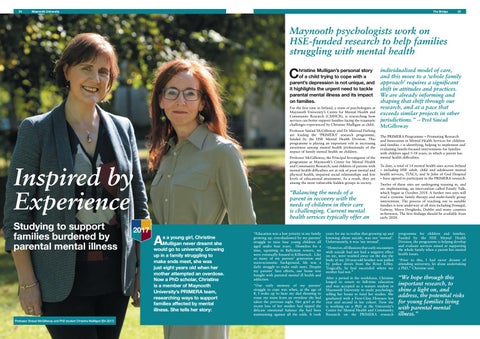
Professor Sinéad McGilloway and PhD student Christine Mullligan (BA 2017)
2017
“Balancing the needs of a parent in recovery with the needs of children in their care is challenging. Current mental health services typically offer an
A
s a young girl, Christine Mulligan never dreamt she would go to university. Growing up in a family struggling to make ends meet, she was just eight years old when her mother attempted an overdose. Now a PhD scholar, Christine is a member of Maynooth University’s PRIMERA team, researching ways to support families affected by mental illness. She tells her story:
“Education was a low priority in my family growing up, overshadowed by my parents’ struggle to raise four young children all aged under four years. Homeless for a time, squatting in Ballymun towers, we were eventually housed in Kilbarrack. Like so many of my parents’ generation and socio-economic background, life was a daily struggle to make ends meet. Despite my parents’ best efforts, our home was fraught with parental mental ill health and addiction. “One early memory of my parents’ struggle to cope was when, at the age of 8, I woke up to hear my dad shouting to rouse my mum from an overdose she had taken the previous night. Her grief at the recent loss of her mother had tipped the delicate emotional balance she had been maintaining against all the odds. It took
individualised model of care, and this move to a ‘whole family approach’ requires a significant shift in attitudes and practices. We are already informing and shaping that shift through our research, and at a pace that exceeds similar projects in other jurisdictions.” -- Prof Sinéad McGilloway
The PRIMERA Programme – Promoting Research and Innovation in Mental Health Services for children and families – is identifying, helping to implement and evaluating family-focused interventions for families with children aged 5-18 years, in which a parent has mental health difficulties. To date, a total of 14 mental health sites across Ireland – including HSE adult, child and adolescent mental health services, TUSLA, and St John of God Hospital – have agreed to participate in the PRIMERA research. Twelve of these sites are undergoing training in, and are implementing, an intervention called Family Talk, which began in October 2018. A further two sites will trial a systemic family therapy and multi-family group intervention. The process of reaching out to suitable families is now underway at all sites including Donegal, Galway, Mayo Drogheda, Dublin and many counties in-between. The first findings should be available from early 2020.
years for me to realise that growing up and knowing about suicide, was not ‘normal’. Unfortunately, it was ‘my normal’. “However, all illusions that early encounters with suicide had not had a negative effect on me, were washed away on the day the body of my 20-year-old brother was pulled by police divers from the River Liffey. Tragically, he had succeeded where my mother had not.” After a period in the workforce, Christine longed to return to full-time education and was accepted as a mature student in Maynooth University to study psychology, selling her house to fund her studies. She graduated with a First-Class Honours last year and second in her cohort. Now she is working on a PhD at the University’s Centre for Mental Health and Community Research on the PRIMERA research
programme for children and families. Funded by the HSE Mental Health Division, the programme is helping develop and evaluate services aimed at supporting the whole family when a parent has mental health issues. “Prior to this, I had never dreamt of attending university, let alone undertaking a PhD,” Christine said.
“We hope through this important research, to shine a light on, and address, the potential risks for young families living with parental mental illness.”