THE FREIGHT DEBATE FEEDBACK
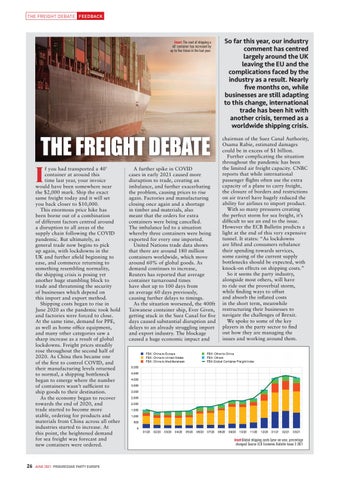
Inset: The cost of shipping a 40’ container has increased by up to five times in the last year.
THE FREIGHT DEBATE I f you had transported a 40’ container at around this time last year, your invoice would have been somewhere near the $2,000 mark. Ship the exact same freight today and it will set you back closer to $10,000. This enormous price hike has been borne out of a combination of different factors centred around a disruption to all areas of the supply chain following the COVID pandemic. But ultimately, as general trade now begins to pick up again, with lockdowns in the UK and further afield beginning to ease, and commerce returning to something resembling normality, the shipping crisis is posing yet another huge stumbling block to trade and threatening the security of businesses which depend on this import and export method. Shipping costs began to rise in June 2020 as the pandemic took hold and factories were forced to close. At the same time, demand for PPE, as well as home office equipment, and many other categories saw a sharp increase as a result of global lockdowns. Freight prices steadily rose throughout the second half of 2020. As China then became one of the first to control COVID, and their manufacturing levels returned to normal, a shipping bottleneck began to emerge where the number of containers wasn’t sufficient to ship goods to their destination. As the economy began to recover towards the end of 2020, and trade started to become more stable, ordering for products and materials from China across all other industries started to increase. At this point, the heightened demand for sea freight was forecast and new containers were ordered.
26
A further spike in COVID cases in early 2021 caused more disruption to trade, creating an imbalance, and further exacerbating the problem, causing prices to rise again. Factories and manufacturing closing once again and a shortage in timber and materials, also meant that the orders for extra containers were being cancelled. The imbalance led to a situation whereby three containers were being exported for every one imported. United Nations trade data shows that there are around 180 million containers worldwide, which move around 60% of global goods. As demand continues to increase, Reuters has reported that average container turnaround times have shot up to 100 days from an average 60 days previously, causing further delays to timings. As the situation worsened, the 400ft Taiwanese container ship, Ever Given, getting stuck in the Suez Canal for five days caused substantial disruption and delays to an already struggling import and export industry. The blockage caused a huge economic impact and
So far this year, our industry comment has centred largely around the UK leaving the EU and the complications faced by the industry as a result. Nearly five months on, while businesses are still adapting to this change, international trade has been hit with another crisis, termed as a worldwide shipping crisis. chairman of the Suez Canal Authority, Osama Rabie, estimated damages could be in excess of $1 billion. Further complicating the situation throughout the pandemic has been the limited air freight capacity. CNBC reports that while international passenger flights often use the extra capacity of a plane to carry freight, the closure of borders and restrictions on air travel have hugely reduced the ability for airlines to import product. With so many pressures creating the perfect storm for sea freight, it’s difficult to see an end to the issue. However the ECB Bulletin predicts a light at the end of this very expensive tunnel. It states: “As lockdowns are lifted and consumers rebalance their spending towards services, some easing of the current supply bottlenecks should be expected, with knock-on effects on shipping costs.” So it seems the party industry, alongside most others, will have to ride out the proverbial storm, while finding ways to offset and absorb the inflated costs in the short term, meanwhile restructuring their businesses to navigate the challenges of Brexit. We spoke to some of the key players in the party sector to find out how they are managing the issues and working around them.
Inset:Global shipping costs (year-on-year, percentage changes) Source ECB Economic Bulletin Issue 3 2021
JUNE 2021 PROGRESSIVE PARTY EUROPE
26-27_29_Freight Debate.indd 26
24/06/2021 14:05