32-33.qxp_Grid 28/05/2020 15:37 Page 2
JEREMY’S JOURNAL
BUSINESS BLOGGING BY PUBLISHER JEREMY CORNER OF BLUE EYED SUN
Costing The
Earth
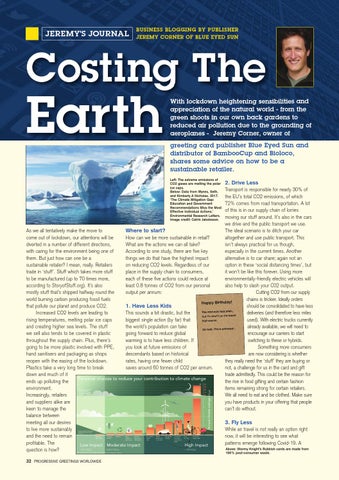
With lockdown heightening sensibilities and appreciation of the natural world - from the green shoots in our own back gardens to reduced air pollution due to the grounding of aeroplanes - Jeremy Corner, owner of greeting card publisher Blue Eyed Sun and distributor of BambooCup and Bioloco, shares some advice on how to be a sustainable retailer. Left: The extreme emissions of CO2 gases are melting the polar ice caps. Below: Data from Wynes, Seth, and Kimberly A Nicholas. 2017. ‘The Climate Mitigation Gap: Education and Government Recommendations Miss the Most Effective Individual Actions.’ Environmental Research Letters. Image credit: Catrin Jakobsson.
As we all tentatively make the move to come out of lockdown, our attentions will be diverted in a number of different directions, with caring for the environment being one of them. But just how can one be a sustainable retailer? I mean, really. Retailers trade in ‘stuff’. Stuff which takes more stuff to be manufactured (up to 70 times more, according to StoryofStuff.org). It’s also mostly stuff that’s shipped halfway round the world burning carbon producing fossil fuels that pollute our planet and produce CO2. Increased CO2 levels are leading to rising temperatures, melting polar ice caps and creating higher sea levels. The stuff we sell also tends to be covered in plastic throughout the supply chain. Plus, there’s going to be more plastic involved with PPE, hand sanitisers and packaging as shops reopen with the easing of the lockdown. Plastics take a very long time to break down and much of it ends up polluting the environment. Increasingly, retailers and suppliers alike are keen to manage the balance between meeting all our desires to live more sustainably and the need to remain profitable. The question is how? 32
PROGRESSIVE GREETINGS WORLDWIDE
Where to start? How can we be more sustainable in retail? What are the actions we can all take? According to one study, there are five key things we do that have the highest impact on reducing CO2 levels. Regardless of our place in the supply chain to consumers, each of these five actions could reduce at least 0.8 tonnes of CO2 from our personal output per annum:
1. Have Less Kids This sounds a bit drastic, but the biggest single action (by far) that the world’s population can take going forward to reduce global warming is to have less children. If you look at future emissions of descendants based on historical rates, having one fewer child saves around 60 tonnes of CO2 per annum.
2. Drive Less Transport is responsible for nearly 30% of the EU’s total CO2 emissions, of which 72% comes from road transportation. A lot of this is in our supply chain of lorries moving our stuff around. It’s also in the cars we drive and the public transport we use. The ideal scenario is to ditch your car altogether and use public transport. This isn’t always practical for us though, especially in the current times. Another alternative is to car share; again not an option in these ‘social distancing times’, but it won’t be like this forever. Using more environmentally-friendly electric vehicles will also help to slash your C02 output. Cutting CO2 from our supply chains is trickier. Ideally orders should be consolidated to have less deliveries (and therefore less miles used). With electric trucks currently already available, we will need to encourage our carriers to start switching to these or hybrids. Something more consumers are now considering is whether they really need the ‘stuff’ they are buying or not, a challenge for us in the card and gift trade admittedly. This could be the reason for the rise in food gifting and certain fashion items remaining strong for certain retailers. We all need to eat and be clothed. Make sure you have products in your offering that people can’t do without.
3. Fly Less While air travel is not really an option right now, it will be interesting to see what patterns emerge following Covid-19. A Above: Stormy Knight’s Rubbish cards are made from 100% post-consumer waste.