38-39_GF.qxp_Grid 02/05/2023 17:37 Page 3
In Conversation with... Abacus
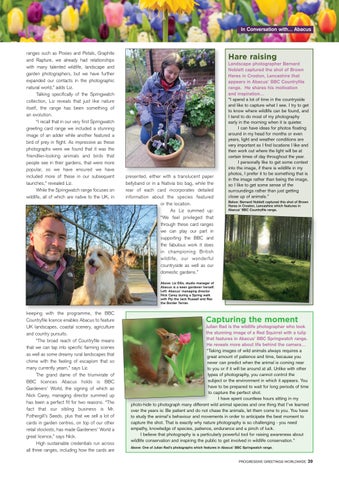
ranges such as Posies and Petals, Graphite and Rapture, we already had relationships with many talented wildlife, landscape and garden photographers, but we have further expanded our contacts in the photographic natural world,” adds Liz. Talking specifically of the Springwatch collection, Liz reveals that just like nature itself, the range has been something of an evolution. “I recall that in our very first Springwatch greeting card range we included a stunning image of an adder while another featured a bird of prey in flight. As impressive as these photographs were we found that it was the friendlier-looking animals and birds that people see in their gardens, that were more popular, so we have ensured we have included more of these in our subsequent launches,” revealed Liz. While the Springwatch range focuses on wildlife, all of which are native to the UK, in
Hare raising
presented, either with a translucent paper bellyband or in a Nativia bio bag, while the rear of each card incorporates detailed information about the species featured or the location. As Liz summed up: “We feel privileged that through these card ranges we can play our part in supporting the BBC and the fabulous work it does in championing British wildlife, our wonderful countryside as well as our domestic gardens.”
Landscape photographer Bernard Noblett captured the shot of Brown Hares in Croston, Lancashire that appears in Abacus’ BBC Countryfile range. He shares his motivation and inspiration… “I spend a lot of time in the countryside and like to capture what I see. I try to get to know where wildlife can be found, and I tend to do most of my photography early in the morning when it is quieter. I can have ideas for photos floating around in my head for months or even years, light and weather conditions are very important so I find locations I like and then work out where the light will be at certain times of day throughout the year. I personally like to get some context into the image, if there is wildlife in my photos, I prefer it to be something that is in the image rather than being the image, so I like to get some sense of the surroundings rather than just getting close up of animals.” Below: Bernard Noblett captured this shot of Brown Hares in Croston, Lancashire which features in Abacus’ BBC Countryfile range.
Above: Liz Ellis, studio manager of Abacus is a keen gardener herself. Left: Abacus’ managing director Nick Carey during a Spring walk with Pip the Jack Russell and Rex the Border Terrier.
keeping with the programme, the BBC Countryfile licence enables Abacus to feature UK landscapes, coastal scenery, agriculture and country pursuits. “The broad reach of Countryfile means that we can tap into specific farming scenes as well as some dreamy rural landscapes that chime with the feeling of escapism that so many currently yearn,” says Liz. The grand dame of the triumvirate of BBC licences Abacus holds is BBC Gardeners’ World, the signing of which as Nick Carey, managing director summed up has been a perfect fit for two reasons. “The fact that our sibling business is Mr. Fothergill’s Seeds, plus that we sell a lot of cards in garden centres, on top of our other retail stockists, has made Gardeners’ World a great licence,” says Nick. High sustainable credentials run across all three ranges, including how the cards are
Capturing the moment Julian Rad is the wildlife photographer who took the stunning image of a Red Squirrel with a tulip that features in Abacus’ BBC Springwatch range. He reveals more about life behind the camera… “Taking images of wild animals always requires a great amount of patience and time, because you never can predict when the animal is coming near to you or if it will be around at all. Unlike with other types of photography, you cannot control the subject or the environment in which it appears. You have to be prepared to wait for long periods of time to capture the perfect shot. I have spent countless hours sitting in my photo-hide to photograph many different wild animal species and one thing that I’ve learned over the years is: Be patient and do not chase the animals, let them come to you. You have to study the animal's behaviour and movements in order to anticipate the best moment to capture the shot. That is exactly why nature photography is so challenging - you need empathy, knowledge of species, patience, endurance and a pinch of luck. I believe that photography is a particularly powerful tool for raising awareness about wildlife conservation and inspiring the public to get involved in wildlife conservation.” Above: One of Julian Rad’s photographs which features in Abacus’ BBC Springwatch range.
PROGRESSIVE GREETINGS WORLDWIDE 39