58-59_muk.qxp_Grid 28/02/2019 09:14 Page 58
JEREMY’S JOURNAL Business blogging by publisher Jeremy Corner of Blue Eyed Sun.
Feedback Loops Jeremy Corner, owner of greeting card publisher Blue Eyed Sun and distributor of BambooCup, discusses the importance of feedback.
The American architect and leader in sustainable development, William McDonough, once taught me that, “Any system without a feedback loop is, by definition, stupid.” What he meant is that any system that isn’t testing the assumptions it’s founded on and then adjusting to feedback isn’t actually learning. Frankly, even when we have the best of intentions, if we don’t create and pay attention to feedback loops in our businesses and in our lives, we are being stupid.
The map is not the territory The terrain we encounter on the ground is rarely identical to the map we use to navigate it with. Geography is not naturally grid shaped and it changes over time. Grids (like words) are our representations of reality. They are not the reality itself. Just as money is not wealth and a menu is not the food that sustains us. The plans we make for our businesses are seldom the everyday reality we face when we implement them. Billionaire businessman Scott D. Cook put it in more relatable terms when he said: “For every one of our failures, we had spreadsheets that looked awesome.” One of the main reasons for this is that our knowledge is limited. We know what we know (Jane knows she can drive a car). We know what we don’t know (Jane knows she doesn’t speak French). We don’t know what we don’t know (Jane doesn’t know that there are rich oil reserves beneath her 58
PROGRESSIVE GREETINGS WORLDWIDE
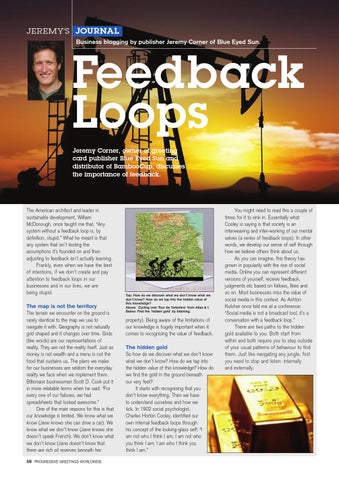
Top: How do we discover what we don’t know what we don’t know? How do we tap into the hidden value of this knowledge? Above: 'Cycling over Tour de Yorkshire' from Atlas & I. Below: Find the ‘hidden gold’ by listening.
property). Being aware of the limitations of our knowledge is hugely important when it comes to recognising the value of feedback.
The hidden gold So how do we discover what we don’t know what we don’t know? How do we tap into the hidden value of this knowledge? How do we find the gold in the ground beneath our very feet? It starts with recognising that you don’t know everything. Then we have to understand ourselves and how we tick. In 1902 social psychologist, Charles Horton Cooley, identified our own internal feedback loops through his concept of the looking-glass self: “I am not who I think I am; I am not who you think I am; I am who I think you think I am.”
You might need to read this a couple of times for it to sink in. Essentially what Cooley is saying is that society is an interweaving and inter-working of our mental selves (a series of feedback loops). In other words, we develop our sense of self through how we believe others think about us. As you can imagine, this theory has grown in popularity with the rise of social media. Online you can represent different versions of yourself, receive feedback, judgments etc based on follows, likes and so on. Most businesses miss the value of social media in this context. As Ashton Kutcher once told me at a conference: “Social media is not a broadcast tool, it’s a conversation with a feedback loop.” There are two paths to the hidden gold available to you. Both start from within and both require you to step outside of your usual patterns of behaviour to find them. Just like navigating any jungle, first you need to stop and listen: internally and externally.