87_89_Pigment.qxp_Grid 21/05/2025 15:57 Page 87
PUBLISHER FACE TO FACE
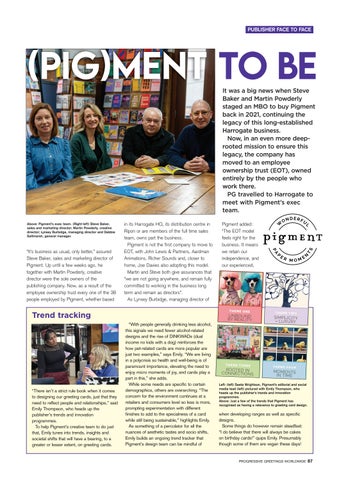
(PiG)MENT TO BE It was a big news when Steve Baker and Martin Powderly staged an MBO to buy Pigment back in 2021, continuing the legacy of this long-established Harrogate business. Now, in an even more deeprooted mission to ensure this legacy, the company has moved to an employee ownership trust (EOT), owned entirely by the people who work there. PG travelled to Harrogate to meet with Pigment’s exec team.
Above: Pigment’s exec team. (Right-left) Steve Baker, sales and marketing director; Martin Powderly, creative director; Lynsey Burbidge, managing director and Debbie Saltmarsh, general manager.
“It’s business as usual, only better,” assured Steve Baker, sales and marketing director of Pigment. Up until a few weeks ago, he together with Martin Powderly, creative director were the sole owners of the publishing company. Now, as a result of the employee ownership trust every one of the 38 people employed by Pigment, whether based
in its Harrogate HQ, its distribution centre in Ripon or are members of the full time sales team, owns part the business. Pigment is not the first company to move to EOT, with John Lewis & Partners, Aardman Animations, Richer Sounds and, closer to home, Joe Davies also adopting this model. Martin and Steve both give assurances that “we are not going anywhere, and remain fully committed to working in the business long term and remain as directors”. As Lynsey Burbidge, managing director of
Pigment added: “The EOT model feels right for the business. It means we retain our independence, and our experienced,
Trend tracking
“There isn’t a strict rule book when it comes to designing our greeting cards, just that they need to reflect people and relationships,” said Emily Thompson, who heads up the publisher’s trends and innovation programmes. To help Pigment’s creative team to do just that, Emily tunes into trends, insights and societal shifts that will have a bearing, to a greater or lesser extent, on greeting cards.
“With people generally drinking less alcohol, this signals we need fewer alcohol-related designs and the rise of DINKWADs (dual income no kids with a dog) reinforces the how pet-related cards are more popular are just two examples,” says Emily. “We are living in a polycrisis so health and well-being is of paramount importance, elevating the need to enjoy micro moments of joy, and cards play a part in this,” she adds. While some needs are specific to certain demographics, others are overarching. “The concern for the environment continues at a retailers and consumers level so less is more, prompting experimentation with different finishes to add to the specialness of a card while still being sustainable,” highlights Emily. As something of a percolator for all the nuances of aesthetic tastes and socio shifts, Emily builds an ongoing trend tracker that Pigment’s design team can be mindful of
Left: (left) Seeta Wrightson, Pigment’s editorial and social media lead (left) pictured with Emily Thompson, who heads up the publisher’s trends and innovation programmes. Above: Just a few of the trends that Pigment has recognised as having a relevance to greeting card design.
when developing ranges as well as specific designs. Some things do however remain steadfast: “I do believe that there will always be cakes on birthday cards!” quips Emily. Presumably though some of them are vegan these days!
PROGRESSIVE GREETINGS WORLDWIDE 87