43-44-45_47.qxp_Grid 02/03/2021 11:44 Page 44
Historical Perspective
the constant stream of talented new publishers/designers who have come into the market (latterly facilitated by the low cost of entry that digital printing and licensing to print on demand operators allows), the greater focus on environmental issues as well as the ramifications of Card Factory’s expansion. Brokerage (from Hallmark, UKG, Woodmansterne and Waterwells), which has paved the way for card selections to broaden, most notably in supermarkets and garden centres looks set to increase in the indie sector too.
1991 and all that The year 1991 was a pretty momentous year in many ways probably one of the most significant of the post war years. That was the year the Soviet Union was dissolved, signifying, we all hoped at the time, the end of Russian interference in Europe and the beginning of genuine democracy in Russia. It was the year that apartheid ended in South Africa, again a move that instilled hope for millions. Less encouragingly, 1991 was the year of the first Gulf War, after Saddam Hussein invaded Kuwait. And Yugoslavia was about to break up, leading to years of internecine bloodshed and war. On the domestic front, John Major, had only just taken over as Prime Minister from Margaret Thatcher. After the booming late 1980s, the UK was experiencing a nasty recession with a 2% contraction in the economy and unemployment hit 2.5 million. It was the year that the pandemic of the time really hit home with the death of Freddie Mercury from AIDS. Back then Sunday trading was still illegal, with Tesco and Asda trying to force the government’s hands by opening illegally. And so it was early in this historic year into a recessionravaged economy, that our Progressive Greetings saw the light of day. It emanated from a tiny cupboard in an office that consisted of two tatty desks, a second-hand filing cupboard and one static phone! No fancy mobiles then - or even a computer, with the articles still written by hand. The UK greeting card industry had grown steadily in the 1980s from a low base to be worth around £500 million back then - less than a third of what it is worth today. But given the uncertain economic situation some publishers and retailers were starting to wonder if that growth was sustainable. And as owners and publishers, of one of the then three greeting card trade magazines, we had to hold our nerve that there was enough advertising support to pay our respective mortgages. The greeting card retail scene was totally different then to what is today too. WH Smith led the field as market leader in everyday 44
PROGRESSIVE GREETINGS WORLDWIDE
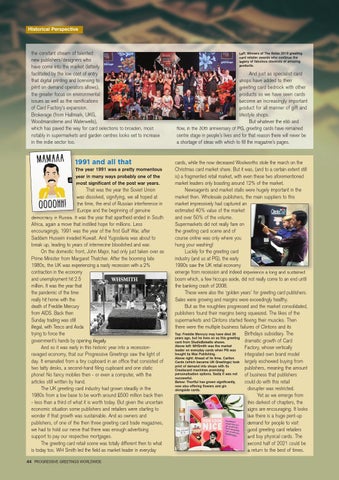
Left: Winners of The Retas 2019 greeting card retailer awards who continue the legacy of fabulous stockists of amazing products.
And just as specialist card shops have added to their greeting card bedrock with other products so we have seen cards become an increasingly important product for all manner of gift and lifestyle shops. But whatever the ebb and flow, in the 30th anniversary of PG, greeting cards have remained centre stage in people’s lives and for that reason there will never be a shortage of ideas with which to fill the magazine’s pages.
cards, while the now deceased Woolworths stole the march on the Christmas card market share. But it was, (and to a certain extent still is) a fragmented retail market, with even these two aforementioned market leaders only boasting around 12% of the market. Newsagents and market stalls were hugely important in the market then. Wholesale publishers, the main suppliers to this market impressively had captured an estimated 40% value of the market and over 50% of the volume. Supermarkets did not really fare on the greeting card scene and of course online was only where you hung your washing! Luckily for the greeting card industry (and us at PG), the early 1990s saw the UK retail economy emerge from recession and indeed experience a long and sustained boom which, a few hiccups aside, did not really come to an end until the banking crash of 2008. These were also the ‘golden years’ for greeting card publishers. Sales were growing and margins were exceedingly healthy. But as the noughties progressed and the market consolidated, publishers found their margins being squeezed. The likes of the supermarkets and Clintons started flexing their muscles. Then there were the multiple business failures of Clintons and its Top: Freddie Mercury may have died 30 Birthdays subsidiary. The years ago, but he lives on as this greeting dramatic growth of Card card from StudioBoketto shows. Above left: WHSmith was the market Factory, whose vertically leader on everyday cards when PG was bought by Max Publishing. integrated own brand model Above right: Ahead of its time. Carlton Cards (which became UK Greetings) took largely eschewed buying from print of demand into shops with its publishers, meaning the amount Creatacard machines promising personalisation options. Sadly it was not of business that publishers successful. Below: Thortful has grown significantly, could do with this retail now also offering flowers and gin disrupter was restricted. alongside cards. Yet as we emerge from this darkest of chapters, the signs are encouraging. It looks like there is a huge pent-up demand for people to visit good greeting card retailers and buy physical cards. The second half of 2021 could be a return to the best of times.