28-29_Cardsharp.qxp_Layout 1 07/12/2023 22:14 Page 2
cardsharp Cardsharp was recently sitting in the audience at an amazing one-day seminar held at the historic Royal Geographical Society in Kensington, London. This was Products of Change’s Sustainability Conference (SiLC). It was an inspiring and informative event that highlighted the real challenges that retailers, wholesalers, licensees and manufacturers are embracing, to attempt to keep pace with the eco-agenda. As in-depth discussions went into the intricacies of Scope 3 emissions and the need for greater circularity that Cardsharp’s mind wandered to thoughts of how to find the right balance between saving the planet for future generations while also considering those living in poverty today.
who pays the piper? Being greeted by a couple of real live Wombles certainly put a smile on the faces of those who thronged to the recent Sustainability Conference (SiLC) with those from the greeting card industry as well as many other consumer product sectors attending. Uncle Bulgaria, Orinoco and co first debuted in a series of children’s books by Elizabeth Beresford in 1968, before their tales of going ‘underground, over ground, wombling free…making good use of the things we find, things that the everyday folks leave behind’ were brought to life on TV in 1973 and now, 50 years later are being given a reboot by Altitude Films, the makers of Horrible Histories. Certainly, the downward slide on the environmental front over the last few decades has been something of a ‘horrible history’ story that will sadly take more than a few adorable characters to sort. While the strong speaker line-up at SiLC collectively highlighted, huge strides have and are being made in making the retail process more sustainable and circular, Cardsharp did wonder about certain other elements in all of this. 28 PROGRESSIVE GREETINGS WORLDWIDE
From what Cardsharp gathered, it is key for companies not just to examine their own environmental practices, but to look all the way down the supply chain, to their suppliers’ practices taking it from source right through to the end consumer, the Scope 3 emissions. In most cases this will involve a huge amount of data collection and inherently an increase in resources and costs for everyone involved. The saying that came to Cardsharp’s mind was “Who pays the piper?” The green agenda is of course very necessary, but with the pace needing to rev up considerably to hit even some of the United
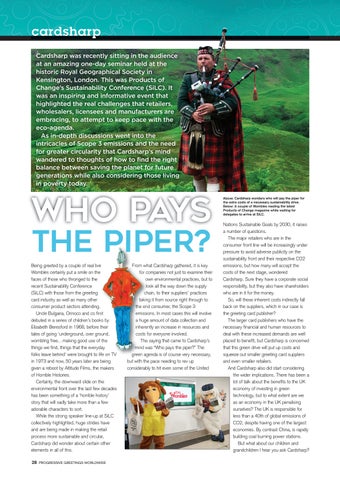
Above: Cardsharp wonders who will pay the piper for the extra costs of a necessary sustainability drive. Below: A couple of Wombles reading the latest Products of Change magazine while waiting for delegates to arrive at SiLC.
Nations Sustainable Goals by 2030, it raises a number of questions. The major retailers who are in the consumer front line will be increasingly under pressure to avoid adverse publicity on the sustainability front and their respective CO2 emissions, but how many will accept the costs of the next stage, wondered Cardsharp. Sure they have a corporate social responsibility, but they also have shareholders who are in it for the money. So, will these inherent costs indirectly fall back on the suppliers, which in our case is the greeting card publisher? The larger card publishers who have the necessary financial and human resources to deal with these increased demands are well placed to benefit, but Cardsharp is concerned that this green drive will put up costs and squeeze out smaller greeting card suppliers and even smaller retailers. And Cardsharp also did start considering the wider implications. There has been a lot of talk about the benefits to the UK economy of investing in green technology, but to what extent are we as an economy in the UK penalising ourselves? The UK is responsible for less than a 40th of global emissions of CO2, despite having one of the largest economies. By contrast China, is rapidly building coal burning power stations. But what about our children and grandchildren I hear you ask Cardsharp?