28-29.qxp_Layout 1 21/12/2020 13:41 Page 2
cardsharp
Cardies Really
Are Weird Why do we British love cards so much? To Cardsharp one of the great mysteries is why greeting card sending is so popular, not just in the UK where we lead the world in per capita sending, but in certain other selected nations? Despite serious efforts in so many other countries, greeting card sending remains a fringe activity. Was it just that Sir Henry Cole really made the UK the real heartland, publishing the first commercial Christmas cards in 1843? Perhaps, but finally, after many years of contemplation, Cardsharp thinks he has found the real answer.
Recently in lockdown, Cardsharp has been doing a spot of bedtime reading. In particular a new book by the Harvard anthropologist Joseph Henrich called ‘The Weirdest People in the World’ bi-lined ‘How the West became Psychologically Peculiar and Particularly Prosperous’. If you think that Cardsharp is looking for a cure for insomnia, think again! If not exactly a page turner, parts of it are fascinating, and it helped Cardsharp ascertain why certain nations embrace greeting card buying and sending and why others simply don’t. ‘W.E.I.R.D’ in this context, stands for ‘Western, Educated, Industrialised, Rich and Democratic.’ Author Joseph Henrich identifies one big theme in western civilization, namely individualism. He argues that this individualism makes westerners radically different to most other societies. Over centuries, individualism freed westerners from the restrictions of a social network, just based on families and tribes. We became more mobile, better at exchanging ideas and better at cooperating in organisations such as guilds - scientific and art societies - and nation states. These changes fuelled innovation and growth, propelling the
28
PROGRESSIVE GREETINGS WORLDWIDE
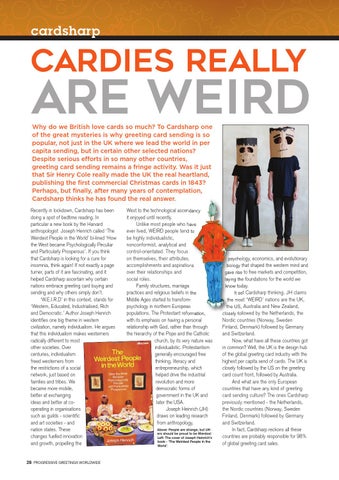
West to the technological ascendancy it enjoyed until recently. Unlike most people who have ever lived, WEIRD people tend to be highly individualistic, nonconformist, analytical and control-orientated. They focus on themselves, their attributes, accomplishments and aspirations over their relationships and social roles. Family structures, marriage practices and religious beliefs in the Middle Ages started to transform psychology in northern European populations. The Protestant reformation, with its emphasis on having a personal relationship with God, rather than through the hierarchy of the Pope and the Catholic church, by its very nature was individualistic. Protestantism generally encouraged free thinking, literacy and entrepreneurship, which helped drive the industrial revolution and more democratic forms of government in the UK and later the USA. Joseph Heinrich (JH) draws on leading research from anthropology, Above: People are strange, but UKers should be proud to be Wierdos! Left: The cover of Joseph Heinrich’s book - ‘The Weirdest People in the World’.
psychology, economics, and evolutionary biology that shaped the western mind and gave rise to free markets and competition, laying the foundations for the world we know today. It set Cardsharp thinking. JH claims the most ‘WEIRD’ nations are the UK, the US, Australia and New Zealand, closely followed by the Netherlands, the Nordic countries (Norway, Sweden Finland, Denmark) followed by Germany and Switzerland. Now, what have all these countries got in common? Well, the UK is the design hub of the global greeting card industry with the highest per capita send of cards. The UK is closely followed by the US on the greeting card count front, followed by Australia. And what are the only European countries that have any kind of greeting card sending culture? The ones Cardsharp previously mentioned - the Netherlands, the Nordic countries (Norway, Sweden Finland, Denmark) followed by Germany and Switzerland. In fact, Cardsharp reckons all these countries are probably responsible for 98% of global greeting card sales.