32-33.qxp_Grid 21/11/2018 12:11 Page 2
Point Of View
Brexit’s Impact On The Cards? As the Brexit situation continues to evolve, Sherwood Group’s ceo Jeremy Bacon draws on his wealth of industry and economic experience to predict some possible ramifications for the UK greeting card sector.
As ceo of leading greeting card printer and packaging business, The Sherwood Group (which was recently crowned Best Social Stationery Printer in the PrintWeek Awards), Jeremy Bacon knows a thing or two about the greeting card ‘economy’, with his natural analytical bent coming to the fore when it comes to predicting likely outcomes of complicated situations. It was no surprise that the high-powered workshop that he led at the recent GCA AGM & Conference during which he shared his considered opinion as to the likely implications of Brexit on the greeting card industry was well attended. Here he shares some of his notes…
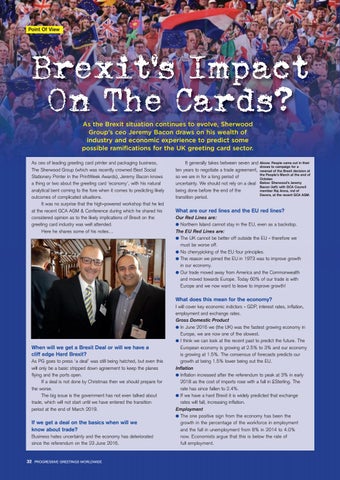
It generally takes between seven and Above: People came out in their droves to campaign for a ten years to negotiate a trade agreement, reversal of the Brexit decision at the People’s March at the end of so we are in for a long period of October. uncertainty. We should not rely on a deal Below: Sherwood’s Jeremy Bacon (left) with GCA Council being done before the end of the member Raj Arora, md of Davora, at the recent GCA AGM. transition period.
What are our red lines and the EU red lines? Our Red Lines are: l Northern Island cannot stay in the EU, even as a backstop. The EU Red Lines are: l The UK cannot be better off outside the EU - therefore we must be worse off. l No cherrypicking of the EU four principles. l The reason we joined the EU in 1973 was to improve growth in our economy. l Our trade moved away from America and the Commonwealth and moved towards Europe. Today 60% of our trade is with Europe and we now want to leave to improve growth!
What does this mean for the economy?
When will we get a Brexit Deal or will we have a cliff edge Hard Brexit? As PG goes to press ‘a deal’ was still being hatched, but even this will only be a basic stripped down agreement to keep the planes flying and the ports open. If a deal is not done by Christmas then we should prepare for the worse. The big issue is the government has not even talked about trade, which will not start until we have entered the transition period at the end of March 2019.
If we get a deal on the basics when will we know about trade? Business hates uncertainty and the economy has deteriorated since the referendum on the 23 June 2016.
32
PROGRESSIVE GREETINGS WORLDWIDE
I will cover key economic indictors - GDP, interest rates, inflation, employment and exchange rates. Gross Domestic Product l In June 2016 we (the UK) was the fastest growing economy in Europe, we are now one of the slowest. l I think we can look at the recent past to predict the future. The European economy is growing at 2.5% to 3% and our economy is growing at 1.5%. The consensus of forecasts predicts our growth at being 1.5% lower being out the EU. Inflation l Inflation increased after the referendum to peak at 3% in early 2018 as the cost of imports rose with a fall in £Sterling. The rate has since fallen to 2.4%. l If we have a hard Brexit it is widely predicted that exchange rates will fall, increasing inflation. Employment l The one positive sign from the economy has been the growth in the percentage of the workforce in employment and the fall in unemployment from 8% in 2014 to 4.0% now. Economists argue that this is below the rate of full employment.