49 LSB Wynne Jones.qxp_NEW LSB 2008 GRID 09/09/2020 18:05 Page 49
IP SURGERY
At times, the Brexit Battle Bus seems to have been careering along, out of control and driverless. With so many back stops, back ups and back downs, it’s been a bumpy ride. But, while the brakes may have been on for most of this year, come January 1, 2021, the UK will not be in the EU. Victor Caddy, director at IP specialist Wynne-Jones, outlines what our industry needs to know.
Driving blind? W
hile the world has been fighting a pandemic, the clock has been relentlessly ticking down on Brexit. The UK has already left the European Union, and we are currently in a Transition Period that will end on December 31, 2020. After that, we are free-wheeling and, if you are involved in licensing, now is the time to dust off your Brexit driving licence and hone your off-road skills. A licence agreement is an intellectual property agreement – a partnership between a brand owner and a manufacturer. We know how Brexit is going to affect IP generally, but how it’s going to affect IP agreements is much more of a blind bend in the road. On the grid, things seem clear enough. The UK Intellectual Property Office has adopted an underlying principle throughout its approach to Brexit, which is that no one should lose any rights after Brexit that they had before Brexit. A licence is a right. It is a right to do something that otherwise would be an infringement. So, the UK IPO has said that existing licences of EU trademarks and designs will continue to have effect in the UK after Brexit. But, the problem with black ice is that you don’t see it until you are on it. Say you have a licence agreement that refers to an EU registered trademark. After December 31, 2020, that EU trademark will cover the 27 remaining member states of the EU, but not the UK. Instead, there will be a new, proudly independent UK trademark. But the UK trademark will not be mentioned anywhere in the licence. What’s more, the UK trademark can be cancelled, assigned, licensed or renewed separately from the original EU one. This is a slippery slope for licensors. Every merchandise licensing deal is based on the understanding that
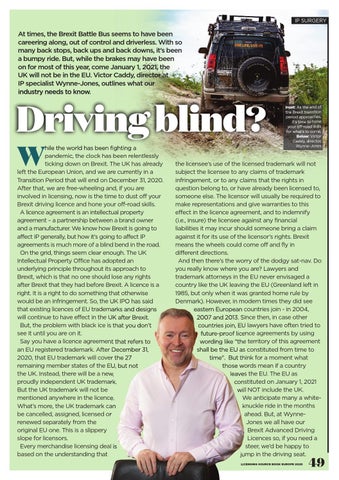
Inset: As the end of the Brexit transition period approaches, it’s time to hone your off-road skills for what’s to come. Below: Victor Caddy, director, Wynne-Jones
the licensee’s use of the licensed trademark will not subject the licensee to any claims of trademark infringement, or to any claims that the rights in question belong to, or have already been licensed to, someone else. The licensor will usually be required to make representations and give warranties to this effect in the licence agreement, and to indemnify (i.e., insure) the licensee against any financial liabilities it may incur should someone bring a claim against it for its use of the licensor’s rights. Brexit means the wheels could come off and fly in different directions. And then there’s the worry of the dodgy sat-nav. Do you really know where you are? Lawyers and trademark attorneys in the EU never envisaged a country like the UK leaving the EU (Greenland left in 1985, but only when it was granted home rule by Denmark). However, in modern times they did see eastern European countries join - in 2004, 2007 and 2013. Since then, in case other countries join, EU lawyers have often tried to future-proof licence agreements by using wording like “the territory of this agreement shall be the EU as constituted from time to time". But think for a moment what those words mean if a country leaves the EU. The EU as constituted on January 1, 2021 will NOT include the UK. We anticipate many a whiteknuckle ride in the months ahead. But, at WynneJones we all have our Brexit Advanced Driving Licences so, if you need a steer, we’d be happy to jump in the driving seat. LICENSING SOURCE BOOK EUROPE 2020
49