CC Pia.QXP
24/11/10
13:13
Página 168
Ciencia y práctica
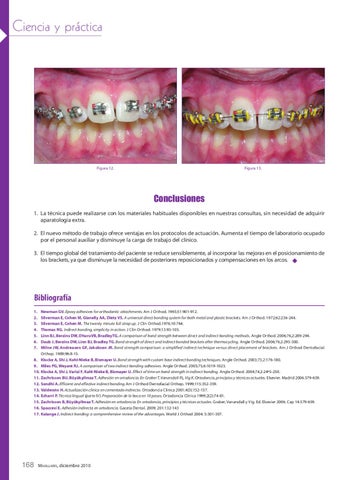
Figura 12.
Figura 13.
Conclusiones 1. La técnica puede realizarse con los materiales habituales disponibles en nuestras consultas, sin necesidad de adquirir aparatología extra. 2. El nuevo método de trabajo ofrece ventajas en los protocolos de actuación. Aumenta el tiempo de laboratorio ocupado por el personal auxiliar y disminuye la carga de trabajo del clínico. 3. El tiempo global del tratamiento del paciente se reduce sensiblemente, al incorporar las mejoras en el posicionamiento de los brackets, ya que disminuye la necesidad de posteriores reposicionados y compensaciones en los arcos.
Bibliografía Newman GV. Epoxy adhesives for orthodontic attachments. Am J Orthod. 1965;51:901-912. Silverman E, Cohen M, Gianelly AA, Dietz VS. A universal direct bonding system for both metal and plastic brackets. Am J Orthod. 1972;62:236-244. Silverman E, Cohen M. The twenty minute full strap up. J Clin Orthod.1976;10:764. Thomas RG. Indirect bonding, simplicity in action. J Clin Orthod. 1979;13:93-105. Linn BJ, Berzins DW, DhuruVB, BradleyTG. A comparison of bond strength between direct and indirect bonding methods. Angle Orthod. 2006;76,2:289-294. Daub J, Berzins DW, Linn BJ, Bradley TG. Bond strength of direct and indirect bonded brackets after thermocycling. Angle Orthod. 2006;76,2:295-300. Milne JW, Andreasen GF, Jakobsen JR. Bond strength comparison: a simplified indirect technique versus direct placement of brackets. Am J Orthod Dentofacial Orthop. 1989;96:8-15. 8. Klocke A, Shi J, Kahl-Nieke B, Bismayer U. Bond strength with custom base indirect bonding techniques. Angle Orthod. 2003;73,2:176-180. 9. Miles PG, Weyant RJ. A comparison of two indirect bonding adhesives. Angle Orthod. 2005;75,6:1019-1023. 10. Klocke A, Shi J, Varizi F, Kahl-Nieke B, Bismayer U. Effect of time on bond strength in indirect bonding. Angle Orthod. 2004;74,2:24º5-250. 11. Zachrisson BU, Büyükyilmaz T. Adhesión en ortodoncia. En Graber T, Vanarsdall RL, Vig K.:Ortodoncia, principios y técnicas actuales. Elsevier. Madrid 2006.579-659. 12. Sondhi A. Efficient and effective indirect bonding. Am J Orthod Dentofacial Orthop. 1999;115:352-359. 13. Valderato H. Actualización clínica en cementado indirecto. Ortodoncia Clinica 2001;4(3):152-157. 14. Echarri P. Técnica lingual (parte IV). Preparación de la boca en 10 pasos. Ortodoncia Clínica 1999;2(2):74-81. 15. Zachrisson B, Büyükyilmaz T. Adhesión en ortodoncia. En ortodoncia, principios y técnicas actuales. Graber, Vanarsdall y Vig. Ed. Elsevier 2006. Cap 14:579-659. 16. Spaccesi E. Adhesión indirecta en ortodoncia. Gaceta Dental. 2009; 201:132-143 17. Kalange J. Indirect bonding: a comprenhensive review of the advantages. World J Orthod 2004; 5:301-307. 1. 2. 3. 4. 5. 6. 7.
168
MAXILLARIS, diciembre 2010