226
MODERN MAPPING
Equal Area World Map 1973
1 FT 8¾ IN × 2 FT 8½ in (53 CM × 82.5 CM)
ODT MAPS, MASSACHUSETTS, USA
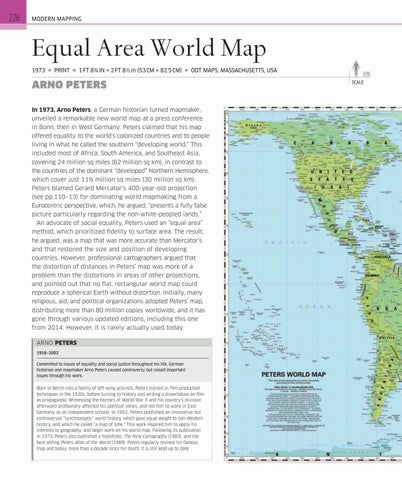
ARNO PETERS In 1973, Arno Peters, a German historian turned mapmaker, unveiled a remarkable new world map at a press conference in Bonn, then in West Germany. Peters claimed that his map offered equality to the world’s colonized countries and to people living in what he called the southern “developing world.” This included most of Africa, South America, and Southeast Asia, covering 24 million sq miles (62 million sq km), in contrast to the countries of the dominant “developed” Northern Hemisphere, which cover just 11½ million sq miles (30 million sq km). Peters blamed Gerard Mercator’s 400-year-old projection (see pp.110–13) for dominating world mapmaking from a Eurocentric perspective, which, he argued, “presents a fully false picture particularly regarding the non-white-peopled lands.” An advocate of social equality, Peters used an “equal-area” method, which prioritized fidelity to surface area. The result, he argued, was a map that was more accurate than Mercator’s and that restored the size and position of developing countries. However, professional cartographers argued that the distortion of distances in Peters’ map was more of a problem than the distortions in areas of other projections, and pointed out that no flat, rectangular world map could reproduce a spherical Earth without distortion. Initially, many religious, aid, and political organizations adopted Peters’ map, distributing more than 80 million copies worldwide, and it has gone through various updated editions, including this one from 2014. However, it is rarely actually used today. ARNO PETERS 1916–2002
Committed to issues of equality and social justice throughout his life, German historian and mapmaker Arno Peters caused controversy but raised important issues through his work.
Born in Berlin into a family of left-wing activists, Peters trained in film production techniques in the 1930s, before turning to history and writing a dissertation on film as propaganda. Witnessing the horrors of World War II and his country’s division afterward profoundly affected his political views, and led him to work in East Germany as an independent scholar. In 1952, Peters published an innovative but controversial “synchronoptic” world history, which gave equal weight to non-Western history, and which he called “a map of time.” This work inspired him to apply his interests to geography, and begin work on his world map. Following its publication in 1973, Peters also published a manifesto, The New Cartography (1983), and the best-selling Peters Atlas of the World (1989). Peters regularly revised his famous map and today, more than a decade since his death, it is still kept up to date.
SCALE