220
MODERN MAPPING
Dymaxion Map 1943
PAPER
9½ IN × 1 FT 3¼ IN (24 CM × 39 CM)
BUCKMINSTER FULLER INSTITUTE, NEW YORK, USA
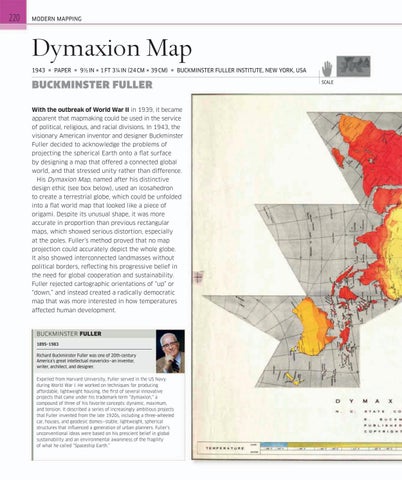
BUCKMINSTER FULLER With the outbreak of World War II in 1939, it became apparent that mapmaking could be used in the service of political, religious, and racial divisions. In 1943, the visionary American inventor and designer Buckminster Fuller decided to acknowledge the problems of projecting the spherical Earth onto a flat surface by designing a map that offered a connected global world, and that stressed unity rather than difference. His Dymaxion Map, named after his distinctive design ethic (see box below), used an icosahedron to create a terrestrial globe, which could be unfolded into a flat world map that looked like a piece of origami. Despite its unusual shape, it was more accurate in proportion than previous rectangular maps, which showed serious distortion, especially at the poles. Fuller’s method proved that no map projection could accurately depict the whole globe. It also showed interconnected landmasses without political borders, reflecting his progressive belief in the need for global cooperation and sustainability. Fuller rejected cartographic orientations of “up” or “down,” and instead created a radically democratic map that was more interested in how temperatures affected human development.
BUCKMINSTER FULLER 1895–1983
Richard Buckminster Fuller was one of 20th-century America’s great intellectual mavericks—an inventor, writer, architect, and designer.
Expelled from Harvard University, Fuller served in the US Navy during World War I. He worked on techniques for producing affordable, lightweight housing, the first of several innovative projects that came under his trademark term “dymaxion,” a compound of three of his favorite concepts: dynamic, maximum, and tension. It described a series of increasingly ambitious projects that Fuller invented from the late 1920s, including a three-wheeled car, houses, and geodesic domes—stable, lightweight, spherical structures that influenced a generation of urban planners. Fuller’s unconventional ideas were based on his prescient belief in global sustainability and an environmental awareness of the fragility of what he called “Spaceship Earth.”
SCALE