Renewable Energy Systems
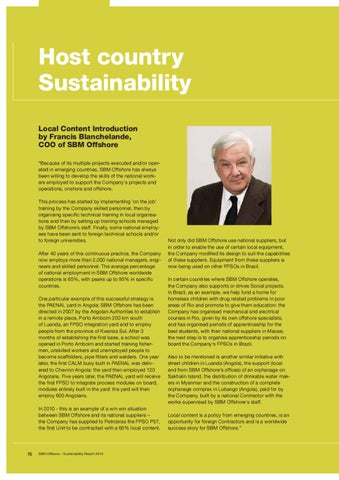
Host country Sustainability Local Content Introduction by Francis Blanchelande, COO of SBM Offshore “Because of its multiple projects executed and/or operated in emerging countries, SBM Offshore has always been willing to develop the skills of the national workers employed to support the Company's projects and operations, onshore and offshore. This process has started by implementing 'on the job' training by the Company skilled personnel, then by organising specific technical training in local organisations and then by setting up training schools managed by SBM Offshore’s staff. Finally, some national employees have been sent to foreign technical schools and/or to foreign universities. After 40 years of this continuous practice, the Company now employs more than 2,000 national managers, engineers and skilled personnel. The average percentage of national employment in SBM Offshore worldwide operations is 65%, with peaks up to 95% in specific countries. One particular example of this successful strategy is the PAENAL yard in Angola: SBM Offshore has been directed in 2007 by the Angolan Authorities to establish in a remote place, Porto Amboim 200 km south of Luanda, an FPSO integration yard and to employ people from the province of Kwanza Sul. After 3 months of establishing the first base, a school was opened in Porto Amboim and started training fishermen, unskilled workers and unemployed people to become scaffolders, pipe fitters and welders. One year later, the first CALM buoy built in PAENAL was delivered to Chevron Angola: the yard then employed 120 Angolans. Five years later, the PAENAL yard will receive the first FPSO to integrate process modules on board, modules entirely built in the yard: the yard will then employ 600 Angolans. In 2010 - this is an example of a win win situation between SBM Offshore and its national suppliers – the Company has supplied to Petrobras the FPSO P57, the first Unit to be contracted with a 65% local content.
76
SBM Offshore – Sustainability Report 2010
Not only did SBM Offshore use national suppliers, but in order to enable the use of certain local equipment, the Company modified its design to suit the capabilities of these suppliers. Equipment from these suppliers is now being used on other FPSOs in Brazil. In certain countries where SBM Offshore operates, the Company also supports or drives Social projects. In Brazil, as an example, we help fund a home for homeless children with drug related problems in poor areas of Rio and promote to give them education: the Company has organised mechanical and electrical courses in Rio, given by its own offshore specialists, and has organised periods of apprenticeship for the best students, with their national suppliers in Macae; the next step is to organise apprenticeship periods on board the Company's FPSOs in Brazil. Also to be mentioned is another similar initiative with street children in Luanda (Angola), the support (local and from SBM Offshore’s offices) of an orphanage on Sakhalin Island, the distribution of drinkable water makers in Myanmar and the construction of a complete orphanage complex in Lubango (Angola), paid for by the Company, built by a national Contractor with the works supervised by SBM Offshore's staff. Local content is a policy from emerging countries, is an opportunity for foreign Contractors and is a worldwide success story for SBM Offshore.”