RESEARCH
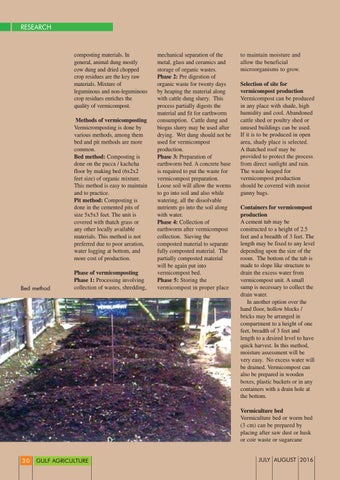
composting materials. In general, animal dung mostly cow dung and dried chopped crop residues are the key raw materials. Mixture of leguminous and non-leguminous crop residues enriches the quality of vermicompost. Methods of vermicomposting Vermicromposting is done by various methods, among them bed and pit methods are more common. Bed method: Composting is done on the pucca / kachcha floor by making bed (6x2x2 feet size) of organic mixture. This method is easy to maintain and to practice. Pit method: Composting is done in the cemented pits of size 5x5x3 feet. The unit is covered with thatch grass or any other locally available materials. This method is not preferred due to poor aeration, water logging at bottom, and more cost of production.
Bed method
Phase of vermicomposting Phase 1: Processing involving collection of wastes, shredding,
mechanical separation of the metal, glass and ceramics and storage of organic wastes. Phase 2: Pre digestion of organic waste for twenty days by heaping the material along with cattle dung slurry. This process partially digests the material and fit for earthworm consumption. Cattle dung and biogas slurry may be used after drying. Wet dung should not be used for vermicompost production. Phase 3: Preparation of earthworm bed. A concrete base is required to put the waste for vermicompost preparation. Loose soil will allow the worms to go into soil and also while watering, all the dissolvable nutrients go into the soil along with water. Phase 4: Collection of earthworm after vermicompost collection. Sieving the composted material to separate fully composted material. The partially composted material will be again put into vermicompost bed. Phase 5: Storing the vermicompost in proper place
to maintain moisture and allow the beneficial microorganisms to grow. Selection of site for vermicompost production Vermicompost can be produced in any place with shade, high humidity and cool. Abandoned cattle shed or poultry shed or unused buildings can be used. If it is to be produced in open area, shady place is selected. A thatched roof may be provided to protect the process from direct sunlight and rain. The waste heaped for vermicompost production should be covered with moist gunny bags. Containers for vermicompost production A cement tub may be constructed to a height of 2.5 feet and a breadth of 3 feet. The length may be fixed to any level depending upon the size of the room. The bottom of the tub is made to slope like structure to drain the excess water from vermicompost unit. A small sump is necessary to collect the drain water. In another option over the hand floor, hollow blocks / bricks may be arranged in compartment to a height of one feet, breadth of 3 feet and length to a desired level to have quick harvest. In this method, moisture assessment will be very easy. No excess water will be drained. Vermicompost can also be prepared in wooden boxes, plastic buckets or in any containers with a drain hole at the bottom. Vermiculture bed Vermiculture bed or worm bed (3 cm) can be prepared by placing after saw dust or husk or coir waste or sugarcane
30
GULF AGRICULTURE
JULY AUGUST 2016